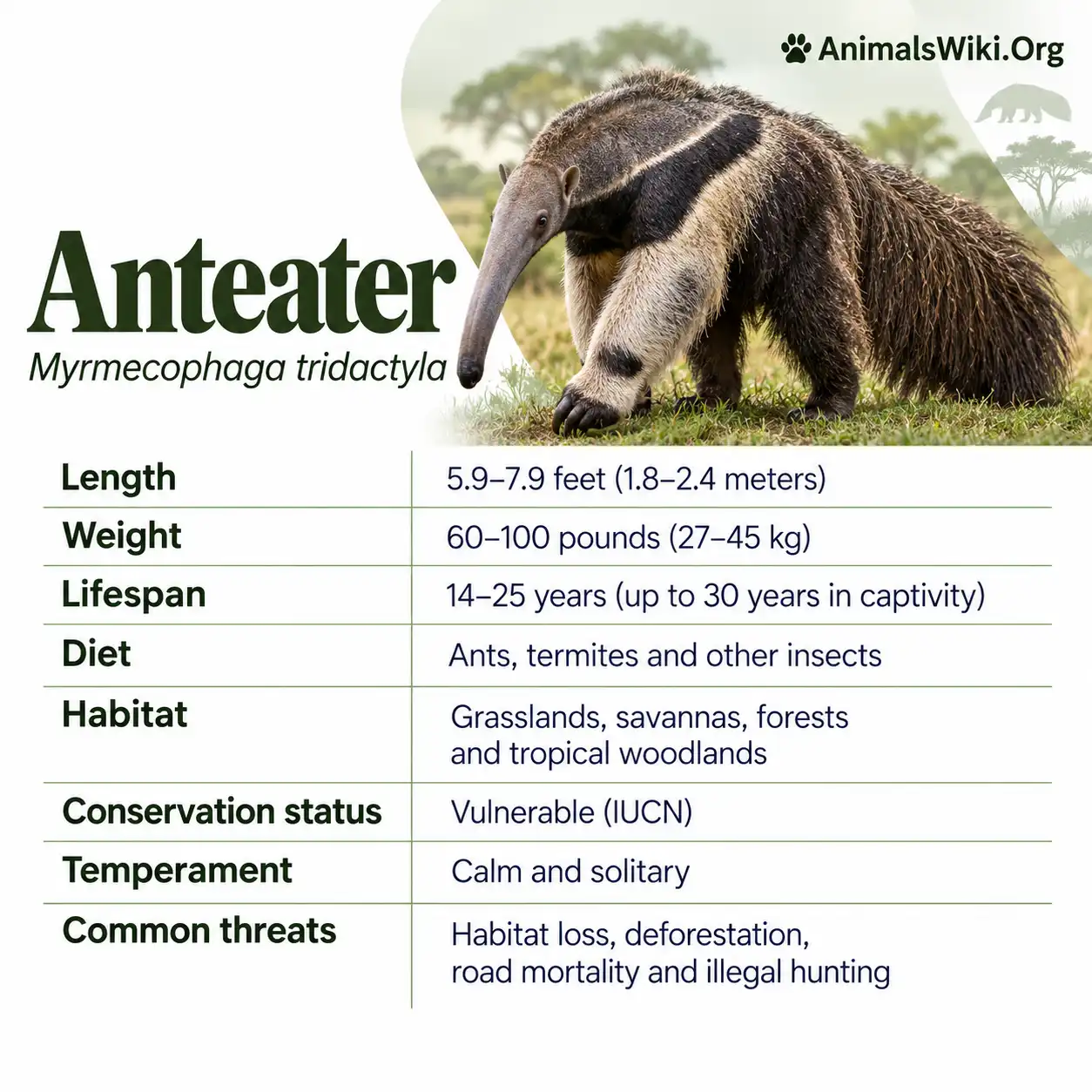
Anteater Facts
| Feature | Details |
|---|---|
| Common Name | Giant Anteater (focus species); also: Silky Anteater, Northern & Southern Tamandua |
| Scientific Name | Myrmecophaga tridactyla (Giant Anteater) |
| Family | Myrmecophagidae |
| Order | Pilosa |
| First Described | 1758 (by Carl Linnaeus) |
| Native Habitat | Grasslands, tropical forests, wetlands of Central and South America |
| Geographic Range | Honduras south to northern Argentina; greatest density in Brazil |
| Average Size | 100–120 cm body length; tail 60–90 cm (Giant Anteater) |
| Average Weight | 22–39 kg (Giant Anteater) |
| Lifespan | 14–16 years (wild); up to 26 years (captivity) |
| Diet | Carnivore — ants, termites, soft-bodied insects |
| Tongue Length | Up to 60 cm (24 inches); flicks up to 150 times per minute |
| Conservation Status | Vulnerable (IUCN) — Giant Anteater |
| Defining Feature | Extraordinarily elongated snout and tongue; no teeth whatsoever |
| Number of Species | 4 species across 3 genera |
1. Anteater Species Overview & Classification
There are animals that evolution has shaped into specialists — creatures so precisely adapted to a single ecological niche that every aspect of their anatomy, physiology, and behavior reflects one overriding purpose. Few animals on Earth demonstrate this evolutionary specialization more completely, more dramatically, or more fascinatingly than the Anteater.
Consider the specifications: a snout so elongated and tube-like that it looks less like a nose and more like a biological vacuum hose. A tongue that can extend 60 centimeters (24 inches) beyond that snout and flick in and out of ant mounds up to 150 times per minute. No teeth whatsoever — not a single one — because teeth are entirely unnecessary when your food is swallowed whole and your muscular gizzard-like stomach grinds everything to paste. Claws so powerful that a cornered anteater can kill a puma. And a brain running at a body temperature so low — just 32.7°C (90.9°F) — that it represents the lowest body temperature of any placental mammal, a metabolic slowdown that makes the meager caloric content of ants and termites sufficient for survival.
The Giant Anteater (Myrmecophaga tridactyla) is the most dramatic representative of a group of four anteater species that together constitute one of nature’s most remarkable examples of evolutionary engineering. Across the family, the same basic adaptations appear in different scales and contexts — from the largest, the Giant Anteater (up to 39 kg), down to the tiny Silky Anteater (Cyclopes didactylus), which weighs less than 500 grams and spends its entire life in the forest canopy.
Anteaters are not merely interesting because of their extraordinary physical adaptations. They are ecologically critical — consuming up to 35,000 ants and termites daily, regulating insect populations across vast areas of South and Central American ecosystems. They are culturally significant — woven into the mythology and symbolism of indigenous peoples across their range. And they are increasingly vulnerable — the Giant Anteater is classified as Vulnerable on the IUCN Red List, with populations declining across much of its range due to habitat loss and road kill.
Species Classification Table
| Classification Level | Details |
|---|---|
| Kingdom | Animalia |
| Phylum | Chordata |
| Class | Mammalia |
| Order | Pilosa |
| Suborder | Vermilingua (“worm tongue”) |
| Family | Myrmecophagidae (Giant + Tamanduas) |
| Family | Cyclopedidae (Silky Anteater) |
| Genera | Myrmecophaga, Tamandua, Cyclopes |
The Four Anteater Species
| Species | Common Name | Weight | Habitat | IUCN Status |
|---|---|---|---|---|
| Myrmecophaga tridactyla | Giant Anteater | 22–39 kg | Grasslands, forests | Vulnerable |
| Tamandua tetradactyla | Southern Tamandua | 3.5–8.4 kg | Forests, edge habitat | Least Concern |
| Tamandua mexicana | Northern Tamandua | 3.2–7 kg | Tropical forests | Least Concern |
| Cyclopes didactylus | Silky (Pygmy) Anteater | 175–400 g | Forest canopy | Least Concern |
2. Anteater Physical Description & Unique Features
The anteater’s body is a masterclass in evolutionary optimization — every feature precisely engineered for a single lifestyle. Examining that body from snout to tail reveals an animal that has traded generalization for breathtaking specialization.
The Extraordinary Snout
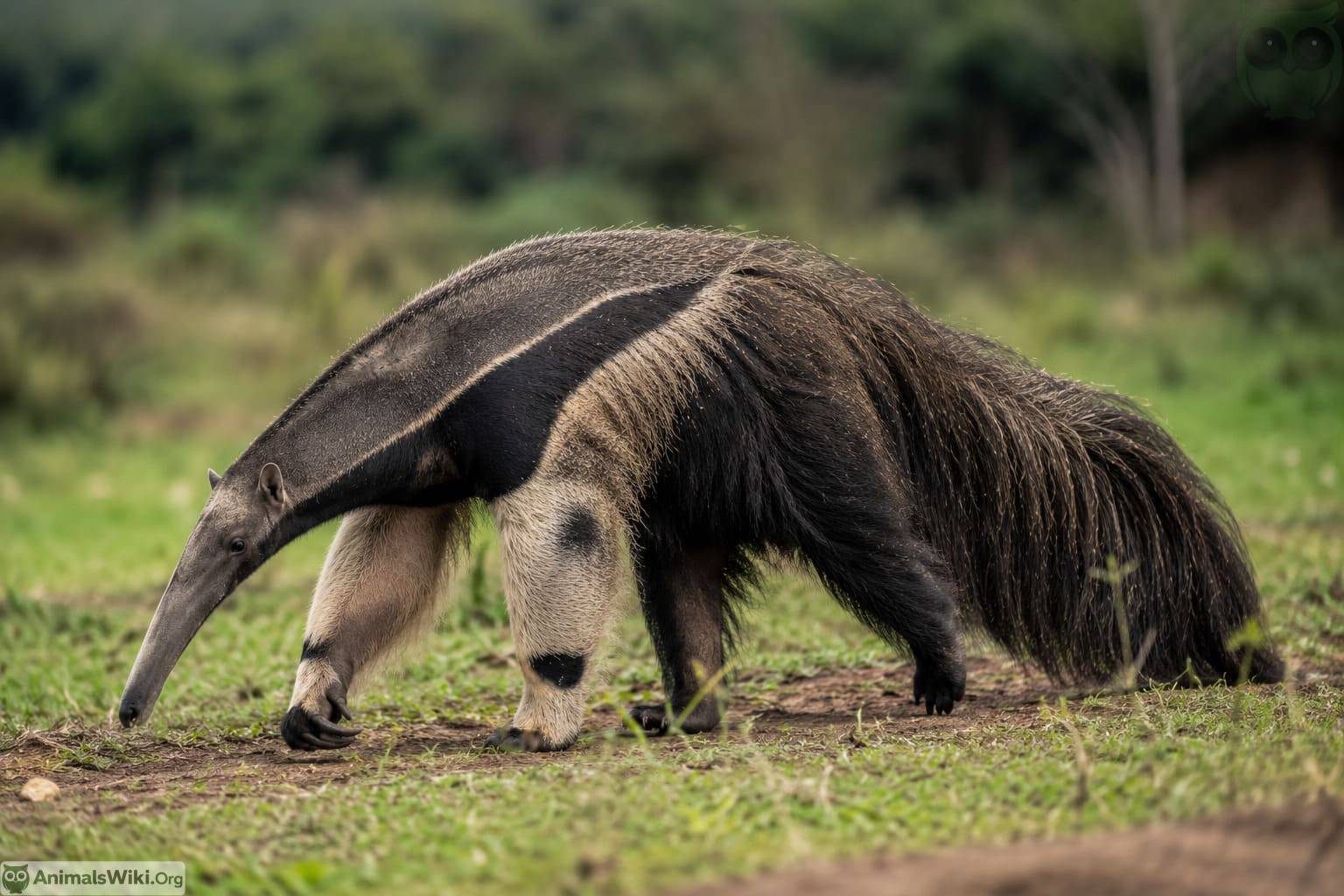
The Giant Anteater’s snout is perhaps the most immediately striking feature of any mammal on Earth — an elongated, tube-like structure that occupies approximately one-third of the animal’s total head-and-body length. This snout is not merely an extended nose; it is a finely engineered instrument containing:
- Nasal passages of extraordinary sensitivity — the anteater’s sense of smell is estimated to be 40 times more powerful than a human’s, allowing it to detect ant and termite colonies through soil and mound walls
- A tiny, toothless mouth opening at the tip — just large enough to admit the tongue but nothing else
- Specialized bone structure — the bones of the skull and snout are uniquely modified to support the forces generated by the tongue mechanism
The Magnificent Tongue
The anteater’s tongue is the central wonder of its entire biology — a structure of remarkable length, speed, stickiness, and endurance.
The Giant Anteater’s tongue reaches 60 cm (24 inches) in fully extended length — the longest tongue relative to body size of any land mammal. At its base, the tongue attaches not to the hyoid bone (as in most mammals) but to the animal’s sternum (breastbone) — a unique anatomical arrangement that allows the extraordinary extension length.
The tongue’s surface is coated in microscopic, backward-pointing spines and covered in a thick, viscous saliva produced by extraordinarily large salivary glands — estimated to produce up to 1 litre of saliva per day. This sticky coating means that ants and termites contacted by the tongue are trapped and withdrawn before they have any possibility of escape. The tongue flicks in and out at speeds of up to 150 times per minute — so fast that individual strokes are not distinguishable to the human eye.
The Claws
The Giant Anteater’s front feet carry three enormously enlarged claws — up to 10 cm (4 inches) in length — that are the animal’s primary tools for ripping open concrete-hard termite mounds and ant nests. These claws are so large and so curved that the animal cannot walk on the flat of its front feet; instead, it knuckle-walks on the backs of its folded front feet, keeping the claws elevated.
These same claws are formidable defensive weapons — capable of delivering a disemboweling swipe that can kill a puma or jaguar.
The Tail
The Giant Anteater’s bushy tail — approximately 60–90 cm long — is covered in coarse, bristly hair up to 40 cm in length. The tail serves several functions: as a blanket when the animal curls to sleep; as camouflage (the large, bushy shape disrupts the animal’s outline when it lies curled on grassland); and as a balance counterweight during feeding.
No Teeth
The anteater has absolutely no teeth — not vestigial stubs, not hidden molars, nothing. This is the most extreme dental reduction of any mammal. Instead, food is swallowed whole and processed in a muscular, gizzard-like stomach that grinds insects using ingested small stones and grit — a system functionally similar to birds’ gizzards.
Did You Know? The Giant Anteater’s tongue moves so fast — up to 150 flicks per minute — that a single foraging session at an ant or termite mound involves thousands of individual tongue strikes in just a few minutes. High-speed camera footage of anteater feeding, slowed dramatically, reveals each strike as a precise, targeted action rather than random sweeping — the animal actively directs its tongue toward concentrations of insects within the mound.
3. Anteater Habitat & Geographic Range
The anteater family spans an impressive geographic range across Central and South America — from southern Mexico in the north to the northern grasslands of Argentina in the south. Within this range, different species occupy different ecological niches, from open savannahs to dense rainforest canopy.
Habitat Preferences by Species
Giant Anteater — the most habitat-flexible of the four species, found in:
- Cerrado (Brazilian tropical savannah) — the preferred and most important habitat; the Giant Anteater reaches its highest densities in Brazil’s vast cerrado ecosystem
- Pantanal — the world’s largest tropical wetland; supports significant Giant Anteater populations
- Amazon forest edges and gallery forests — found at forest margins but not deep forest interiors
- Gran Chaco (dry forest and scrub of Paraguay and Argentina)
- Llanos (tropical grasslands of Venezuela and Colombia)
Northern and Southern Tamandua — primarily forest species, found in:
- Tropical and subtropical forests throughout their ranges
- Forest edge habitats and scrub
- Both ground level and arboreal (tree-climbing) environments
Silky Anteater — exclusively arboreal (tree-dwelling), found in:
- Dense tropical forest canopy
- Cecropia trees are particularly favored — both for shelter and for the ants that inhabit them
- Never descends voluntarily to the ground
Habitat Range by Country
| Country/Region | Species Present | Key Habitat | Population Status |
|---|---|---|---|
| Brazil | All 4 species | Cerrado, Amazon, Pantanal | Largest global Giant Anteater population |
| Venezuela | Giant Anteater, both Tamanduas, Silky | Llanos, forest | Significant populations |
| Colombia | All 4 species | Forest, llanos | Moderate populations |
| Bolivia | Giant Anteater, Southern Tamandua | Chaco, forest | Declining |
| Paraguay | Giant Anteater, Southern Tamandua | Chaco, cerrado | Severely declining |
| Argentina | Giant Anteater, Southern Tamandua | Northern grasslands | Endangered nationally |
| Central America | Northern Tamandua, Silky Anteater | Tropical forests | Stable |
| Peru/Ecuador | Giant Anteater (rare), both Tamanduas | Amazon forest | Low density |
Did You Know? The Pantanal — the world’s largest tropical wetland, located primarily in Brazil with portions in Bolivia and Paraguay — is considered the single best place on Earth to observe Giant Anteaters in the wild. The open, flat terrain and extraordinary biodiversity of the Pantanal supports very high anteater densities, and wildlife tours specifically targeting anteater sightings have a remarkably high success rate compared to virtually any other large mammal wildlife experience in South America.
4. Anteater Diet & Feeding Behavior
The anteater’s feeding behavior is simultaneously the most remarkable and the most precisely engineered aspect of its entire biology — a feeding system so specialized that the animal has literally reshaped its entire skull, tongue, digestive system, and behavioral ecology around the single act of consuming ants and termites.
What Anteaters Eat
All four anteater species feed exclusively on social insects — primarily ants and termites — plus occasional soft-bodied larvae and other small insects encountered while foraging. This dietary specialization is so extreme that anteaters are among the most nutritionally constrained of all mammals, surviving on food sources that most other animals cannot efficiently exploit.
The Giant Anteater may consume up to 35,000 individual ants and termites in a single day — visiting dozens of different mounds and nests during a feeding session to avoid exhausting any single colony and to minimize exposure to the biting, stinging insects’ defensive responses.
The Remarkable Feeding Strategy
What makes anteater feeding behavior genuinely extraordinary is not merely what they eat but how they manage the process:
Mound selection: Giant Anteaters do not feed randomly — they actively select specific mounds and nests based on the size of the insect colony, the hardness of the mound structure, and crucially, how recently the mound was last visited. Individual anteaters maintain mental maps of feeding territories covering up to 25 km², returning to specific mounds on rotation to allow colonies to rebuild between visits.
Controlled exposure: When a Giant Anteater tears open a termite mound or ant nest, it does not linger indefinitely. Despite consuming thousands of insects per minute, it typically feeds at any single opening for only 30–40 seconds before moving to a new breach or a new mound entirely. This brevity is strategic — it minimizes the number of defensive bites and stings from soldiers and workers whose chemical alarms progressively mobilize more defenders the longer the intrusion continues.
Avoiding soldier ants: Many ant species have dedicated soldier castes with powerful jaws and venom that can injure even an anteater. Anteaters have been observed selectively targeting worker-heavy areas of mounds while avoiding concentrations of soldiers — a level of feeding intelligence that suggests considerable cognitive mapping of colony structure.
Diet Breakdown Table
| Food Type | % of Diet | Acquisition Method | Notes |
|---|---|---|---|
| Termites | 45–55% | Tongue extraction from mounds | Preferred when available; high density in mounds |
| Ants (various species) | 35–45% | Tongue extraction from nests | Varies by season and habitat |
| Ant and termite larvae | 5–10% | Incidental during foraging | Higher caloric value than adults |
| Other soft insects | <5% | Opportunistic | Beetles, flies encountered while foraging |
“The anteater represents one of evolution’s most extraordinary experiments in dietary specialization. Every aspect of its anatomy — the skull, the tongue, the claws, the stomach — has been redesigned from the standard mammalian blueprint to serve a single dietary purpose. It is, in many ways, the most thoroughly specialized large mammal on Earth.” — Dr. Arnaud Desbiez, Wildlife Biologist, Royal Zoological Society of Scotland
5. Anteater Reproduction & Life Cycle
The anteater’s reproductive strategy reflects its position as a large, long-lived mammal with low natural predation risk — slow reproduction, intensive parental care, and offspring that remain dependent for an unusually extended period.
Sexual Maturity
Female Giant Anteaters reach sexual maturity at approximately 2–3 years of age. Males mature slightly later, at approximately 3 years. In the wild, animals typically do not breed until they have established adequate foraging territories — which can delay first reproduction further.
Mating Behavior
Giant Anteaters are solitary animals that come together only briefly for mating. The mating season in wild populations is concentrated in the dry season (approximately April–May in Brazilian cerrado), though captive animals can breed year-round.
Males locate females primarily through scent — following olfactory trails and investigating scent markings left at territorial boundary points. Courtship is brief; the male follows and investigates the female for a period before mating occurs.
Gestation and Birth
- Gestation period: Approximately 180–190 days (6 months)
- Litter size: Almost always a single pup — twins are extremely rare
- Birth weight: Approximately 1.2–1.5 kg
- Birth: Females give birth in a standing or sitting position; the pup is born relatively well-developed
The Pup on the Mother’s Back — One of Nature’s Most Charming Sights
Immediately after birth, the Giant Anteater pup climbs onto its mother’s back — and stays there for approximately 6–9 months. The pup positions itself so that its own markings align with the mother’s bold black-and-white shoulder stripe, providing both camouflage and security.
This dorsal transport system means that the mother is never slowed significantly by her offspring — she can run, dig, and even rear up defensively with the pup securely clinging to her back. The pup’s grip is extraordinary — it can maintain its position even during vigorous maternal activity.
Weaning and Independence
- Weaning: Approximately 6 months of age
- Independence: Full independence at approximately 1–2 years, though offspring may remain loosely associated with the mother for longer
- Breeding interval: Females typically produce one offspring per year, though in poorer habitats this may extend to once every two years
Lifespan Comparison
| Animal | Average Lifespan (Wild) | Average Lifespan (Captivity) |
|---|---|---|
| Giant Anteater | 14–16 years | Up to 26 years |
| Southern Tamandua | 9–12 years | Up to 16 years |
| Silky Anteater | 2–4 years (estimated) | Up to 7 years |
| Aardvark (convergent species) | 10–15 years | Up to 23 years |
| Pangolin (convergent species) | 10–20 years | Up to 20 years |
| Armadillo (relative) | 7–15 years | Up to 23 years |
Did You Know? When a Giant Anteater pup rides on its mother’s back, it positions itself so precisely that its own black-and-white shoulder markings align perfectly with the mother’s markings — creating the optical illusion of a single, larger animal. This camouflage effect is so precise that researchers initially debated whether it was coincidental or genuinely adaptive; subsequent studies confirmed that the alignment is consistent and non-random, representing one of the animal kingdom’s most elegant examples of offspring camouflage.
6. Social Behavior & Communication
For animals as visually dramatic as anteaters, their social lives are remarkably understated — shaped by the demands of a specialized diet that makes sharing food sources impractical and solitary foraging the optimal strategy.
Solitary Lifestyle
Giant Anteaters are fundamentally solitary animals — outside of the mother-offspring relationship and brief mating encounters, individuals live and forage alone across exclusive or partially overlapping home ranges. Male home ranges tend to be larger (up to 25 km²) than female ranges (up to 15 km²).
This solitary lifestyle is not antisocial in the negative sense — it reflects ecological reality. The distributed nature of ant and termite colonies means that multiple large anteaters sharing a territory would quickly exhaust available food sources. Solitary foraging territories represent the optimal exploitation of dispersed insect resources.
Communication Methods
Despite their solitary nature, anteaters communicate through several channels:
Scent marking — the primary form of communication; anteaters have anal glands that produce strong scent secretions, which they deposit on vegetation, logs, and territorial boundary markers. These scent marks convey information about individual identity, sex, reproductive status, and territorial occupancy to other anteaters who subsequently investigate the same areas.
Vocalizations — anteaters are generally quiet animals but produce several sounds in specific contexts:
- A hissing/snorting sound when threatened or disturbed
- Grunting sounds during mating encounters
- Soft squeaking by pups communicating with their mothers
Body language — posture communicates threat level and intent:
- Rearing on hind legs with forelimbs spread wide — the classic defensive threat display, making the animal appear much larger
- Tail position — elevated tail indicates alertness; relaxed tail indicates calm
- Snout direction — rapid snout movement indicates active scent investigation
Tamandua Social Structure
The tamandua species show slightly more flexibility than the Giant Anteater — while primarily solitary, they occasionally share overlapping territories and have been observed in loose associations at productive foraging areas. The arboreal tamanduas use their prehensile tails extensively in social interactions and marking behavior within forest canopy territories.
7. Predators & Defense Mechanisms
The Giant Anteater occupies a somewhat paradoxical position in the predator-prey relationship — it is large enough and powerful enough to be genuinely dangerous to most of its potential predators, yet vulnerable enough that apex predators do successfully take it.
Natural Predators
- Jaguar (Panthera onca) — the primary natural predator of adult Giant Anteaters; capable of overpowering even large adults, though attacks are not without risk to the jaguar
- Puma (Cougar) (Puma concolor) — a significant predator, particularly of subadults and juveniles
- Harpy Eagle (Harpia harpyja) — capable of taking tamandua species and juveniles from the canopy
- Anacondas (Eunectes murinus) — occasionally take anteaters near water
- Domestic dogs — a significant and often-underestimated threat in areas near human settlements
The Extraordinary Defense — Claws as Weapons
An adult Giant Anteater cornered by a predator deploys a defense that is genuinely dangerous to the attacker. The animal:
- Rears up on its hind legs — supported by the tail — to present maximum height and threat
- Spreads its forelimbs wide, exposing the enormous, curved claws
- Embraces the attacking predator in a bear-hug grip that brings the claws to bear on the predator’s body with the full force of the anteater’s powerful forelimb muscles
This embrace-and-slash combination has been documented to kill pumas and seriously injure jaguars. There are recorded cases of Giant Anteaters killing human attackers with their claws. The defense is so effective that experienced jaguar hunters in South America considered Giant Anteaters among the most dangerous prey they could encounter.
Camouflage
The Giant Anteater’s distinctive black-and-white shoulder stripe — running diagonally across its body — functions as disruptive camouflage, breaking up the animal’s outline when viewed from a distance in dappled grassland light. The effect is most pronounced when the animal is curled to sleep with its bushy tail wrapped over its body — the entire shape becomes remarkably difficult to distinguish from a grass clump or fallen log.
Armored Relatives for Context
Interestingly, the anteater’s closest relatives — the armadillos (also within the superorder Xenarthra) — take a completely different defensive approach, evolving bony armor. The anteater, by contrast, invested in offense rather than defense, developing weapons capable of deterring rather than simply withstanding attack.
8. Relationship with Humans
Indigenous Relationships
Across the vast range of the anteater — from Mexico to Argentina — indigenous peoples have coexisted with these animals for tens of thousands of years, developing complex cultural, utilitarian, and spiritual relationships with them.
For many Amazonian and cerrado indigenous groups, the Giant Anteater has been both a food source (particularly during lean seasons) and a significant spiritual entity. Its extraordinary anatomical peculiarities — the toothless tube-snout, the impossibly long tongue, the powerful claws — made it a natural subject for mythological elaboration across numerous cultural traditions.
The Guaraní people of Paraguay and Brazil incorporated the Giant Anteater into their cosmological framework as a being of particular power — its ability to tear open apparently invincible termite mounds made it a symbol of persistence and specialized strength. Various Amazonian groups used different parts of the animal — the claws for tools and ornaments, the hide for bags and containers, and in some traditions the glands for medicinal preparations.
Scientific Discovery and Study
The Giant Anteater was formally described by Carl Linnaeus in 1758 in his landmark Systema Naturae — based on specimens and accounts brought back to Europe by explorers of South America. Linnaeus placed it in the genus Myrmecophaga (from the Greek for “ant-eating”), and the species name tridactyla (“three-toed”) refers to the three prominent front claws.
Subsequent centuries of zoological study have gradually revealed the extraordinary physiological adaptations that make anteaters such remarkable animals — from the tongue mechanics to the low body temperature to the specialized stomach — making them among the most frequently cited examples of extreme mammalian specialization in biology education worldwide.
Modern Human Relationship
Today, the anteater’s relationship with humans is complex and multi-dimensional:
Ecotourism — in the Brazilian Pantanal and cerrado, anteater sightseeing has become a significant ecotourism attraction, generating economic value for conservation through tourism revenue.
Road mortality — one of the most significant and growing threats to Giant Anteater populations is death on roads crossing their habitat. The animals are slow-moving, have poor vision, and show no road-avoidance behavior — making road crossings genuinely lethal.
Zoo populations — Giant Anteaters are maintained in zoos worldwide, where they are consistently among the most popular exhibits; their extraordinary anatomy makes them endlessly fascinating to visitors.
Research subjects — anteaters are studied by physiologists, ecologists, and evolutionary biologists for insights into metabolic adaptation, digestive system evolution, and the ecology of myrmecophagous (ant-eating) specialization.
Did You Know? Despite their peaceful, slow-moving appearance, Giant Anteaters are responsible for multiple documented human fatalities in South America — all in cases where humans cornered or threatened the animals and the anteater responded with its defensive embrace-and-slash maneuver. Their claws generate force comparable to a large bear’s, and their forelimb strength is extraordinary. Wildlife biologists working with Giant Anteaters in the field treat them with the same respect given to large carnivores.
9. Anteater Conservation Status & Threats
IUCN Status
- Giant Anteater: Vulnerable — population declining; estimated fewer than 5,000 mature individuals remaining in the wild by some assessments, though this figure is debated
- Southern Tamandua: Least Concern — widespread and relatively stable
- Northern Tamandua: Least Concern — stable across most of range
- Silky Anteater: Least Concern — forest-dependent but range is large
Key Threats
1. Habitat Loss and Fragmentation The Brazilian cerrado — the Giant Anteater’s most important habitat — has been described as the world’s most threatened tropical savannah, with over 50% of the original ecosystem converted to agriculture (primarily soy cultivation and cattle ranching) in the past 50 years. Remaining cerrado habitat is increasingly fragmented into patches too small to support viable anteater populations.
2. Road Mortality Road kill is now considered the single greatest documented cause of Giant Anteater mortality in Brazil. The animals’ slow movement, poor vision, and complete lack of road-avoidance behavior make road crossings lethal — and as road networks expand through previously intact cerrado and Pantanal habitat, mortality increases proportionally. Some estimates suggest roads kill over 1,000 Giant Anteaters in Brazil annually.
3. Fire The cerrado ecosystem burns both naturally (lightning-ignited dry season fires) and through human agricultural burning. Giant Anteaters are slow-moving and struggle to escape fast-moving fires — both direct mortality and habitat degradation from burning affect populations significantly.
4. Hunting While protected by law across most of their range, Giant Anteaters are still hunted in some areas — for meat, for traditional use of body parts, and occasionally as perceived threats to domestic animals (a misperception; anteaters pose no threat to livestock).
5. Dog Attacks Domestic and feral dogs in areas near human settlements attack Giant Anteaters — particularly at night when anteaters are active and dogs range widely. Dog attacks kill significant numbers of anteaters in areas where human and wildlife habitats overlap.
10. Famous Anteaters Around the World
Otto — Frankfurt Zoo’s Beloved Ambassador
Otto, a Giant Anteater resident at Frankfurt Zoo in Germany, became one of the most famous zoo anteaters in Europe during his two-decade residency, during which he fathered multiple offspring. His calm temperament and photogenic appearance made him a frequent subject for natural history photographers and a beloved figure among the zoo’s visitors.
Milton — The Brazilian Conservation Symbol
Milton was a Giant Anteater rehabilitated and released by the Giant Anteater Conservation Program in Brazil’s Minas Gerais state — one of the first anteaters to be fitted with a GPS tracking collar, providing invaluable data on home range size, road-crossing behavior, and habitat use that has directly informed conservation policy.
Sabine Kiefer’s Suri — Vienna Zoo
A Giant Anteater mother at Vienna’s Tiergarten Schönbrunn (the world’s oldest zoo) became internationally famous when photographs of her carrying her pup on her back — with the pup’s markings perfectly aligned with her own — were published globally in 2019, generating millions of social media shares and renewed international interest in anteater conservation.
Project Tamanduá — Brazil’s Research Stars
The Giant Anteater Conservation Program (Programa de Conservação do Tamanduá-Bandeira) operates in the Brazilian cerrado with numerous individually tracked and named anteaters. Animals including Dorotéia, Priscila, and Bartolomeu have provided years of behavioral data that have fundamentally advanced scientific understanding of the species.
11. Role in Ecosystem & Food Chain
Keystone Insect Regulators
The Giant Anteater’s ecological role is far more significant than its modest appearance might suggest. Consuming 35,000 ants and termites daily, a single Giant Anteater regulates insect populations across its entire home range — preventing any single ant or termite species from dominating and maintaining the diversity of insect communities that other ecosystem functions depend upon.
Termite mound opening creates habitat — when an anteater tears open a termite mound, the exposed, modified mound structure becomes habitat for numerous other species including small reptiles, frogs, and birds that exploit the opened mound for shelter and secondary feeding. In this sense, anteaters function as inadvertent ecosystem engineers — creating habitat complexity through their feeding activity.
As Prey
Giant Anteaters support populations of jaguars and pumas — apex predators whose presence in an ecosystem is itself critically important for controlling prey species populations and maintaining the trophic structure that healthy ecosystems require. By serving as prey, anteaters contribute indirectly to the entire predator-mediated ecological regulation system.
Seed Dispersal (Indirect)
While not seed dispersers themselves, anteaters’ disturbance of ant and termite mounds — and the secondary habitat creation that follows — influences vegetation patterns in cerrado and forest edge habitats, indirectly affecting plant community composition over time.
Nutrient Cycling
Through their feeding on ant and termite colonies and subsequent waste production, anteaters contribute to nutrient cycling across their home ranges — returning organic matter to the soil in a distributed pattern that influences local plant productivity.
12. Anteater Discovery & Evolution Timeline
~60 million years ago — The superorder Xenarthra — containing anteaters, sloths, and armadillos — diverges from other placental mammals. South America is an island continent at this time, allowing Xenarthra to evolve in isolation.
~35–40 million years ago — The first recognizable ancestors of modern anteaters appear in the fossil record; early myrmecophagous (ant-eating) mammals are established in South America.
~20 million years ago — The anteater lineage diversifies significantly; ancestors of the modern genera become distinguishable in the fossil record.
~3 million years ago — The Great American Biotic Interchange — when North and South America connected via the Isthmus of Panama — allows anteaters to expand their range northward into Central America and southern North America.
~2 million years ago — Myrmecophaga tridactyla (Giant Anteater) evolves into its modern form; the four modern species are all recognizable in their current configurations.
Pre-colonial era — Giant Anteaters and tamanduas are well-known to indigenous peoples across their range; integrated into cultural and spiritual systems throughout Central and South America.
1558 — The first European written descriptions of anteaters appear in accounts by Spanish explorer Francisco López de Gómara, describing the extraordinary “ant bear” of the New World.
1758 — Carl Linnaeus formally describes Myrmecophaga tridactyla in his Systema Naturae — the foundational document of modern biological classification.
19th century — European naturalists study anteaters extensively; the extraordinary adaptations of the tongue, skull, and stomach are documented by anatomists including Richard Owen and Georges Cuvier.
20th century — Field ecology studies begin documenting Giant Anteater behavior, home range requirements, and population ecology in the wild.
1994 — The Giant Anteater is listed as Vulnerable on the IUCN Red List for the first time, formalizing conservation concern.
2000s–2010s — GPS tracking technology allows the first detailed studies of Giant Anteater home range use, road-crossing behavior, and habitat requirements in the Brazilian cerrado.
2016 — Road mortality is formally identified as the leading documented cause of Giant Anteater mortality in Brazil; conservation efforts increasingly focus on road mitigation measures.
2026 — Conservation programs in Brazil, Paraguay, and Argentina working to protect remaining cerrado and Pantanal habitat; road mortality mitigation measures including underpasses and crossing zones being implemented.
13. Anteater Comparison with Similar Species
| Feature | Giant Anteater (M. tridactyla) | Aardvark (Orycteropus afer) | Pangolin (Manis spp.) |
|---|---|---|---|
| Range | Central & South America | Sub-Saharan Africa | Africa & Asia |
| Weight | 22–39 kg | 40–65 kg | 1.8–33 kg (by species) |
| Tongue | 60 cm; 150 flicks/minute | 30 cm; very sticky | 40 cm; extremely sticky |
| Teeth | None | Yes (simple peg teeth) | None |
| Armor/Defense | Claws; defensive embrace | Thick skin; digging escape | Scales; curl into ball |
| Diet | Ants and termites exclusively | Ants and termites primarily | Ants and termites exclusively |
| Social structure | Solitary | Solitary | Solitary |
| IUCN Status | Vulnerable | Least Concern | Critically Endangered (some) |
| Relationship | No relation (convergent evolution) | No relation (convergent) | No relation (convergent) |
The remarkable similarity between anteaters, aardvarks, and pangolins — despite having no evolutionary relationship whatsoever — is one of the most celebrated examples of convergent evolution in zoology: three entirely separate lineages independently evolving nearly identical solutions to the problem of exploiting ant and termite colonies.
14. Best Places to See Anteaters in the Wild
Brazil — The Heartland
- 🇧🇷 Pantanal, Mato Grosso do Sul and Mato Grosso, Brazil — the undisputed best location for Giant Anteater sightings; the open, flat terrain of the world’s largest tropical wetland provides excellent visibility, and anteater densities are high. Wildlife lodges in the southern Pantanal (Bonito area and Miranda region) offer anteater-specific wildlife drives with very high success rates — 90%+ sighting rates on multi-day visits are commonly reported.
- 🇧🇷 Emas National Park, Goiás, Brazil — a spectacular cerrado national park with extraordinary biodiversity and excellent Giant Anteater populations; one of the best places in the world to see anteaters in their preferred open cerrado habitat.
- 🇧🇷 Serra da Canastra National Park, Minas Gerais, Brazil — highland cerrado with excellent Giant Anteater populations; particularly good for daytime sightings.
- 🇧🇷 RPPN Caiman Ecological Refuge, Pantanal — a private wildlife reserve with outstanding anteater sighting records and excellent accommodation and guiding.
Other Countries
- 🇧🇴 Noel Kempff Mercado National Park, Bolivia — UNESCO World Heritage Site supporting Giant Anteater populations in transitional cerrado-Amazon habitat.
- 🇻🇪 Llanos, Venezuela — the vast tropical grasslands of Venezuela support Giant Anteater populations in landscapes of extraordinary wildlife density.
- 🇨🇷 Corcovado National Park, Costa Rica — excellent location for Northern Tamandua sightings in tropical forest setting.
In Zoos and Wildlife Parks
- Smithsonian’s National Zoo, Washington DC, USA — one of the finest Giant Anteater exhibits in North America
- San Diego Zoo, California, USA — excellent Giant Anteater exhibit with educational programming
- London Zoo, UK — maintains Giant Anteaters with good visitor access
- Tiergarten Schönbrunn, Vienna, Austria — the world’s oldest zoo; excellent anteater facility
- Frankfurt Zoo, Germany — long-established Giant Anteater program with breeding success
15. Anteaters Fun Facts for Kids
- The Giant Anteater has no teeth — not one, anywhere in its mouth
- Its tongue flicks in and out up to 150 times per minute — faster than the human eye can follow
- A Giant Anteater eats up to 35,000 ants and termites in a single day
- The tongue attaches to the sternum (breastbone), not the hyoid bone — the only mammal with this arrangement
- Giant Anteaters have the lowest body temperature of any placental mammal at 32.7°C (90.9°F)
- The anteater’s smell is estimated to be 40 times more powerful than a human’s
- Anteater pups ride on their mother’s back for 6–9 months after birth
- A cornered Giant Anteater can kill a puma with its claws
- Giant Anteaters never feed at the same mound twice in a row — they maintain mental maps of dozens of feeding sites
- The University of California, Irvine’s mascot is Peter the Anteater — one of the most distinctive in American college sports
- An anteater pup’s markings align perfectly with its mother’s for camouflage when riding on her back
- The aardvark and pangolin independently evolved nearly identical adaptations to the anteater — one of evolution’s greatest examples of convergence
16. Frequently Asked Questions About Anteaters
Q1: What does an anteater eat?
Anteaters feed exclusively on ants and termites — and nothing else. The Giant Anteater may consume up to 35,000 individual insects in a single day, visiting dozens of different ant and termite mounds during a feeding session. They do not eat the solid mound structure itself, nor do they feed on other insects, fruit, or plant material. Their entire anatomy — the elongated snout, the 60 cm tongue, the toothless mouth, the grinding stomach — has been specifically evolved for this single diet.
Q2: How long is an anteater’s tongue?
The Giant Anteater’s tongue reaches 60 cm (24 inches) in fully extended length — making it one of the longest tongues of any land mammal relative to body size. This tongue attaches to the sternum (breastbone) rather than the hyoid bone, which allows the extraordinary extension. The tongue is covered in microscopic backward-pointing spines and coated in thick, sticky saliva — trapping insects on contact. It can flick in and out of ant mounds up to 150 times per minute.
Q3: Do anteaters have teeth?
Absolutely not — anteaters are completely toothless. This is not a coincidence or a deficiency; it is a precise evolutionary adaptation. Their food — individual ants and termites — is small enough to swallow whole without chewing. Grinding occurs in a muscular, gizzard-like stomach using ingested grit and small stones, similar to the digestive system of birds. The mouth opening is deliberately tiny — just large enough to admit the tongue but nothing else, preventing insects from escaping back through the mouth during feeding.
Q4: Are anteaters dangerous to humans?
Yes — cornered or threatened Giant Anteaters are genuinely dangerous. Their front claws — up to 10 cm long and driven by extremely powerful forelimb muscles — can deliver disemboweling strikes that have killed jaguars, pumas, and documented cases of humans who cornered or threatened the animals. An anteater that feels trapped rears on its hind legs and can embrace a threat with both forelimbs, bringing its claws to bear with considerable force. Well-behaved anteaters encountered in the wild or in zoos pose no threat — the danger arises only from cornering or threatening the animal.
Q5: How many species of anteater are there?
There are four recognized anteater species in three genera: the Giant Anteater (Myrmecophaga tridactyla) — the largest, reaching 39 kg; the Southern Tamandua (Tamandua tetradactyla) and Northern Tamandua (Tamandua mexicana) — medium-sized semi-arboreal species; and the Silky (Pygmy) Anteater (Cyclopes didactylus) — the tiny, fully arboreal species weighing less than 500 grams. All four species feed exclusively on ants and termites.
Q6: Is the Giant Anteater endangered?
The Giant Anteater is classified as Vulnerable on the IUCN Red List — not yet Endangered but declining significantly. The primary threats are habitat loss (particularly the conversion of cerrado savannah to soy and cattle agriculture), road mortality (the leading documented cause of death in Brazil), and fire. The species has already been locally extinct in several countries including Uruguay and El Salvador. Conservation organizations are working urgently to address road mortality and protect remaining habitat.
Q7: Are anteaters related to aardvarks or pangolins?
Despite their almost identical lifestyle and many similar anatomical features, anteaters, aardvarks, and pangolins are not related to each other at all. They belong to entirely different mammalian orders that independently evolved nearly identical adaptations for exploiting ant and termite colonies — a phenomenon called convergent evolution. Anteaters (order Pilosa) are most closely related to sloths and armadillos. Aardvarks (order Tubulidentata) have no close relatives. Pangolins (order Pholidota) are most closely related to carnivores (cats, dogs, bears). The three groups last shared a common ancestor approximately 85–90 million years ago.
Q8: Why do anteater pups ride on their mother’s back?
Giant Anteater pups ride on their mother’s back for approximately 6–9 months after birth — a transport system that keeps the offspring safe while allowing the mother to maintain her normal foraging activities without significant slowdown. The pup’s grip is so secure that it remains in place even during vigorous maternal movement. Most remarkably, the pup positions itself so that its own black-and-white shoulder markings align precisely with the mother’s markings — creating the optical illusion of a single, larger animal. This camouflage effect reduces the visual conspicuousness of mother-and-offspring pairs to potential predators.