The Intelligent and Social Hunters of the World’s Oceans
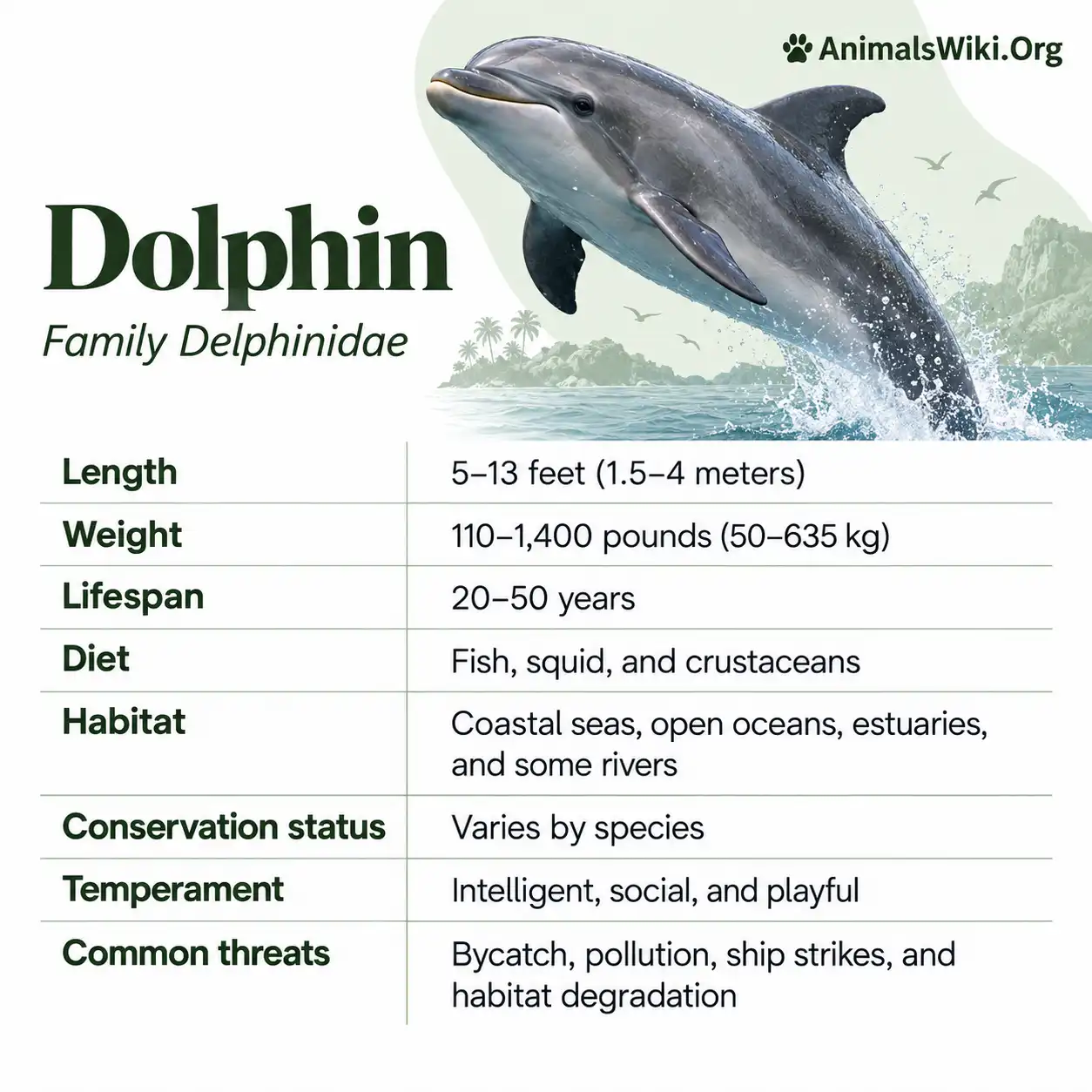
The dolphin is one of the world’s most recognizable marine mammals, famous for its streamlined body, remarkable intelligence, complex social behavior, powerful swimming ability, and sophisticated use of sound.
Although dolphins spend their entire lives in water, they are not fish.
They are mammals.
Like other mammals, dolphins:
- Breathe air with lungs
- Are warm-blooded
- Give birth to live young
- Produce milk for their calves
- Possess hair during at least part of development
Instead of extracting oxygen from water through gills, a dolphin must regularly return to the surface and breathe through a blowhole located on top of its head.
Dolphins belong to the cetacean group of mammals alongside whales and porpoises.
Most familiar dolphins belong to the family Delphinidae, commonly called the oceanic dolphins.
This family includes animals such as:
- Common bottlenose dolphin
- Common dolphins
- Spinner dolphins
- Atlantic spotted dolphins
- Pacific white-sided dolphins
- Risso’s dolphins
- Pilot whales
- Killer whales
Surprisingly, the killer whale, or orca, is technically the largest member of the oceanic dolphin family.
Not every dolphin lives exclusively in the sea.
Several specialized dolphins inhabit freshwater river systems, including dolphins associated with the Amazon and South Asian river basins.
Dolphins are superb swimmers.
Their bodies are shaped to move efficiently through water.
Important features include:
- Streamlined body
- Powerful tail stock
- Horizontal tail flukes
- Pectoral flippers
- Dorsal fin in many species
- Smooth body surface
Unlike fish, which commonly move their tails from side to side, dolphins propel themselves primarily by moving their tail flukes up and down.
Dolphins are also famous for echolocation.
A dolphin can produce high-frequency clicks and direct sound through specialized tissues in its forehead.
When those sounds strike objects, echoes return.
By analyzing the returning echoes, the dolphin can gather information about its surroundings.
Echolocation can help identify:
- Fish
- Squid
- Seafloor features
- Obstacles
- Other objects
This biological sonar is particularly useful when visibility is poor.
Dolphins also communicate socially through combinations of:
- Whistles
- Clicks
- Burst-pulsed sounds
- Body movements
- Physical contact
Bottlenose dolphins are particularly famous for signature whistles—individually distinctive vocal signals associated with particular dolphins.
Their social lives can be extraordinarily complicated.
Depending on species and population, dolphins may:
- Form long-lasting relationships
- Cooperate while hunting
- Care for calves
- Play together
- Compete for mates
- Form alliances
- Coordinate group movements
Dolphin intelligence has also attracted considerable scientific attention.
Different species have demonstrated abilities involving:
- Learning
- Memory
- Problem solving
- Imitation
- Social learning
- Object manipulation
- Behavioral innovation
Some bottlenose dolphins even use tools.
In parts of Australia, certain dolphins carry marine sponges over their rostrums while searching the seafloor for prey. The sponge appears to protect the sensitive snout during foraging.
Dolphin diets vary among species and habitats.
Common foods include:
- Fish
- Squid
- Octopuses
- Crustaceans
Large dolphin-family members such as orcas can consume much larger prey.
Dolphins themselves face threats from both natural predators and human activities.
Depending on species and region, threats may include:
- Large sharks
- Entanglement in fishing gear
- Accidental capture
- Pollution
- Underwater noise
- Habitat degradation
- Prey depletion
- Boat strikes
- Climate-related ecosystem changes
Dolphins therefore represent far more than playful animals leaping beside boats.
They are highly specialized marine mammals with advanced sensory systems, complex societies, powerful bodies, and an evolutionary history that ultimately traces back to land-dwelling mammalian ancestors.
This comprehensive guide explores dolphin facts, species, anatomy, size, habitat, distribution, diet, hunting, echolocation, intelligence, communication, social behavior, speed, swimming, breathing, sleeping, reproduction, baby dolphins, lifespan, predators, adaptations, bottlenose dolphins, river dolphins, orcas, dolphin vs. porpoise differences, dolphin vs. whale comparisons, conservation, and much more.
Dolphin Facts
| Feature | Information |
|---|---|
| Common Name | Dolphin |
| Animal Type | Mammal |
| Order | Cetacea |
| Major Group | Toothed whales (Odontoceti) |
| Familiar Family | Delphinidae |
| Habitat | Oceans, coastal waters and some rivers |
| Distribution | Waters around much of the world |
| Respiration | Lungs |
| Breathing Opening | Blowhole |
| Body Temperature | Warm-blooded |
| Diet | Primarily carnivorous |
| Common Foods | Fish, squid and other aquatic animals |
| Young | Calf |
| Swimming | Tail flukes move mainly up and down |
| Sensory Adaptation | Echolocation in toothed dolphins |
| Communication | Whistles, clicks, pulses and body signals |
| Social Structure | Varies; many species are highly social |
| Reproduction | Live birth |
| Feeding Young | Mother’s milk |
What Is a Dolphin?
A dolphin is an aquatic mammal belonging to the cetacean lineage.
Cetaceans include:
- Dolphins
- Whales
- Porpoises
Dolphins belong to the toothed-whale branch known as Odontoceti.
This means dolphins are more accurately understood as specialized toothed cetaceans rather than as a completely separate type of marine mammal unrelated to whales.
Are Dolphins Mammals?
Yes.
Dolphins possess the fundamental characteristics of mammals.
They:
- Breathe using lungs
- Maintain a relatively stable internal body temperature
- Give birth to live young
- Nurse calves with milk
Their ancestors were terrestrial mammals that gradually evolved increasingly aquatic adaptations.
Are Dolphins Fish?
No.
Dolphins and fish evolved from very different vertebrate lineages.
| Feature | Dolphin | Typical Fish |
|---|---|---|
| Animal Group | Mammal | Fish |
| Respiration | Lungs | Usually gills |
| Body Temperature | Warm-blooded | Usually ectothermic |
| Reproduction | Live birth in dolphins | Varies |
| Young Fed Milk | Yes | No |
| Tail Movement | Mainly up and down | Commonly side to side |
A dolphin will drown if prevented from reaching the surface to breathe.
Scientific Classification of Dolphins
A simplified classification is:
| Classification | Name |
|---|---|
| Kingdom | Animalia |
| Phylum | Chordata |
| Class | Mammalia |
| Order | Cetacea |
| Suborder/Clade | Odontoceti |
Many familiar dolphins belong to:
Family Delphinidae
However, animals commonly called dolphins occur in additional cetacean families as well.
How Many Species of Dolphins Are There?
There are dozens of living dolphin species, with the exact number depending partly on taxonomy and on which river-dolphin groups are included under the common term “dolphin.”
Scientific classification continues to change as researchers use:
- DNA
- Anatomy
- Geographic information
- Vocal behavior
- Population structure
to investigate relationships among cetaceans.
Types of Dolphins
Dolphins include an impressive range of species adapted to different marine and freshwater environments.
Common Bottlenose Dolphin
The common bottlenose dolphin (Tursiops truncatus) is among the best-known species.
It has:
- Robust streamlined body
- Distinctive beak
- Curved dorsal fin
- Gray coloration
Bottlenose dolphins have been extensively studied for their intelligence, communication, social relationships, and hunting behavior.
Common Dolphins
Common dolphins are recognizable for their streamlined bodies and complex flank patterns.
They are highly active swimmers and often occur in social groups.
Spinner Dolphin
Spinner dolphins are famous for spectacular aerial rotations.
They may leap from the water and spin around their longitudinal axis before reentering the sea.
Atlantic Spotted Dolphin
Atlantic spotted dolphins develop increasingly noticeable body spotting as they mature.
They occur in warm Atlantic waters.
Risso’s Dolphin
Risso’s dolphins have relatively blunt heads and often accumulate extensive pale scarring as they age.
Their diet is strongly associated with cephalopods such as squid.
Orca
The orca (Orcinus orca), also called the killer whale, is actually the largest member of the oceanic dolphin family.
Different orca populations can specialize on dramatically different prey.
River Dolphins
Several dolphin lineages have adapted to freshwater river systems.
Examples include dolphins associated with:
- Amazon River basin
- Ganges-Brahmaputra river systems
- Indus River system
Murky river environments make acoustic sensing especially valuable.
What Does a Dolphin Look Like?
A typical dolphin has a streamlined body designed for efficient swimming.
Major external features include:
- Beak or rostrum in many species
- Blowhole
- Eyes
- Pectoral flippers
- Dorsal fin in many species
- Tail stock
- Horizontal flukes
The exact shape varies significantly among species.
Dolphin Anatomy
Dolphins are highly modified mammals.
Their aquatic anatomy includes:
- Streamlined body
- Thick insulating blubber
- Modified forelimbs forming flippers
- Greatly reduced external hind limbs
- Powerful tail musculature
- Horizontal flukes
- Blowhole
- Specialized respiratory system
- Acoustic tissues used in echolocation
Despite their fish-like appearance, their internal anatomy remains fundamentally mammalian.
Dolphin Skin
Dolphin skin is generally smooth and streamlined.
A smooth external surface helps reduce resistance as the animal moves through water.
The skin is continuously maintained and renewed.
Beneath it lies a layer of fat known as blubber.
Dolphin Blubber
Blubber performs several important functions.
It helps with:
- Insulation
- Energy storage
- Streamlining
- Buoyancy-related body properties
Insulation is especially important because water removes body heat much faster than air.
Dolphin Flippers
The pectoral flippers evolved from the forelimbs of terrestrial mammalian ancestors.
Inside a dolphin flipper are bones evolutionarily corresponding to:
- Upper arm
- Forearm
- Wrist
- Hand
- Digits
Externally, however, these structures form a hydrodynamic flipper.
Dolphin Tail
A dolphin’s tail ends in two broad structures called flukes.
Unlike fish tails, dolphin flukes contain no large supporting bones.
Powerful muscles in the rear body and tail stock drive the flukes.
Why Do Dolphins Swim Up and Down?
The vertical movement of the tail reflects their mammalian evolutionary heritage and aquatic specialization.
Dolphins move their tail flukes primarily:
up and down
Many fish generate propulsion by moving their tails primarily:
side to side
Dolphin Dorsal Fin
The dorsal fin helps stabilize the body during swimming.
Its shape varies among species and individuals.
Researchers can sometimes identify individual dolphins by distinctive features such as:
- Nicks
- Scars
- Notches
on the dorsal fin.
Dolphin Teeth
Most dolphins possess numerous conical teeth.
They are useful for:
- Grabbing fish
- Holding slippery prey
- Capturing squid
Dolphins generally do not chew food the way humans do.
Many prey items are swallowed whole or in large pieces.
How Many Teeth Do Dolphins Have?
Tooth number varies considerably among species.
Some species have many dozens of teeth.
Others have far fewer.
Therefore, there is no single tooth count that applies to all dolphins.
Dolphin Blowhole
The blowhole is located on top of the head.
It connects to the respiratory system and allows the animal to breathe rapidly at the surface.
Dolphins normally possess one blowhole, a characteristic of toothed whales.
How Do Dolphins Breathe?
A dolphin surfaces and:
- Opens its blowhole.
- Exhales.
- Rapidly inhales fresh air.
- Closes the blowhole.
- Dives again.
Breathing is highly controlled.
Can Dolphins Breathe Underwater?
No.
Dolphins do not have gills.
They must breathe atmospheric oxygen.
They can remain underwater for periods of time, but eventually they must surface.
How Long Can Dolphins Hold Their Breath?
Dive duration varies considerably among species and activities.
Many familiar dolphins make relatively short dives lasting only several minutes, although some dolphin species can remain submerged considerably longer.
There is no single breath-hold duration for all dolphins.
Why Don’t Dolphins Drown When They Eat?
The respiratory and digestive passages are highly specialized for aquatic life.
The blowhole allows breathing to occur through the top of the head rather than through the mouth.
This separation helps dolphins capture prey underwater without using the mouth for breathing.
How Big Are Dolphins?
Dolphin size varies enormously.
Smaller species may measure roughly around 1–2 meters in length.
Large dolphin-family members can be several times longer.
The orca represents the extreme upper end of dolphin-family body size.
What Is the Largest Dolphin?
The orca is the largest member of the family Delphinidae.
Adult males can become exceptionally large, greatly exceeding the body size of familiar bottlenose dolphins.
What Is the Smallest Dolphin?
Several small dolphin species reach adult lengths around the lower end of the cetacean size range.
Exact “smallest dolphin” rankings can depend on whether length, mass, sex, and taxonomic definitions are being compared.
Where Do Dolphins Live?
Dolphins inhabit waters around much of the world.
Habitats include:
- Open ocean
- Coastal waters
- Bays
- Estuaries
- Continental shelves
- Tropical seas
- Temperate seas
- Polar and subpolar waters for some species
- Freshwater rivers for specialized river dolphins
Do Dolphins Live in Freshwater?
Some do.
River dolphins have evolved to live in freshwater environments.
They may inhabit:
- Main river channels
- Tributaries
- Flooded forests
- Seasonal floodplains
depending on species and water conditions.
Do Dolphins Live in Every Ocean?
Dolphin-family species collectively occur throughout the world’s major oceans.
Individual species, however, have particular geographic ranges and environmental requirements.
What Do Dolphins Eat?
Dolphins are carnivorous.
Their diets may include:
- Fish
- Squid
- Octopuses
- Crustaceans
- Other marine animals
Diet depends strongly on:
- Species
- Location
- Season
- Prey availability
- Hunting tradition
Do Dolphins Eat Fish?
Yes.
Fish are major prey for many dolphin species.
Common prey can include schooling fish that dolphins capture individually or cooperatively.
Do Dolphins Eat Squid?
Yes.
Squid are important prey for many species.
Deep-diving dolphins may rely particularly heavily on cephalopods.
Do Dolphins Eat Sharks?
Most dolphins do not routinely hunt large sharks.
However, orcas—members of the dolphin family—can prey on sharks, including substantial species.
Dietary specialization varies among orca populations.
Do Dolphins Drink Seawater?
Dolphins obtain much of the water they need from their food and internal metabolic processes.
Their kidneys are adapted to living in marine environments.
They do not depend on drinking large quantities of seawater in the way terrestrial mammals drink freshwater.
How Do Dolphins Hunt?
Dolphins use diverse hunting strategies.
They may:
- Chase individual fish
- Herd schooling prey
- Trap fish against shorelines
- Hunt cooperatively
- Search the seafloor
- Use echolocation
- Create mud barriers
- Strike prey with their bodies or tails in some contexts
Hunting techniques can vary even between populations of the same species.
Cooperative Dolphin Hunting
Groups of dolphins may work together to concentrate fish.
Individuals can take different positions around a school.
By coordinating movements, dolphins can make prey easier to capture.
Such cooperation demonstrates the importance of social behavior in feeding.
Dolphin Mud-Ring Feeding
Some bottlenose dolphins use a remarkable technique known as mud-ring feeding.
A dolphin swims in a circle near the seafloor while disturbing sediment with its tail.
The resulting ring or plume of mud surrounds fish.
Fish attempt to escape by jumping from the water.
Waiting dolphins intercept them.
This is an example of highly specialized local hunting behavior.
Dolphin Sponge Tool Use
Some bottlenose dolphins in Shark Bay, Australia, use marine sponges as tools.
A dolphin places a sponge over its rostrum while searching the seafloor.
The sponge may protect the sensitive snout from:
- Sharp objects
- Abrasive substrate
- Defensive prey
The behavior can be socially transmitted between generations.
Do Dolphins Use Tools?
Yes.
Sponge-carrying bottlenose dolphins provide one of the clearest examples.
Other specialized object-related behaviors have also been documented.
Tool use demonstrates behavioral flexibility but should not be assumed to occur in every dolphin population.
Dolphin Echolocation
Echolocation is one of the dolphin’s most remarkable adaptations.
The dolphin produces rapid clicks.
These sounds travel through water.
When they encounter an object, part of the sound returns as an echo.
The dolphin analyzes those echoes to gather information about the target.
How Does Dolphin Echolocation Work?
The simplified process is:
- Dolphin generates clicks.
- Specialized forehead tissues help focus the sound.
- Clicks travel through water.
- Sound strikes an object.
- Echoes return.
- Acoustic information reaches structures associated with the lower jaw and ear.
- The brain processes the signal.
This provides a detailed acoustic representation of the environment.
What Is the Dolphin Melon?
The melon is a specialized fatty structure in the dolphin’s forehead.
It plays an important role in focusing and directing echolocation sounds.
Its shape contributes to the characteristic rounded forehead seen in many toothed cetaceans.
Can Dolphins See With Sound?
Not literally in the visual sense.
However, echolocation allows them to obtain detailed information without relying entirely on eyesight.
They can detect characteristics related to:
- Distance
- Direction
- Size
- Shape
- Movement
of objects and prey.
Can Dolphins Echolocate in Darkness?
Yes.
Echolocation does not depend on visible light.
This makes it extremely valuable:
- At night
- In deep water
- In murky water
- When searching around complex structures
Dolphin Eyesight
Dolphins also possess functional vision.
Their eyes are adapted for aquatic environments and can provide useful information both underwater and near the surface.
They combine visual and acoustic information rather than relying exclusively on one sense.
Dolphin Hearing
Hearing is exceptionally important to dolphins.
Their auditory systems are specialized for underwater sound.
Hearing supports:
- Echolocation
- Communication
- Navigation
- Environmental awareness
This is one reason excessive underwater noise can be a conservation concern.
How Do Dolphins Communicate?
Dolphins use a rich combination of signals.
These include:
- Whistles
- Echolocation clicks
- Burst-pulsed sounds
- Body movements
- Touch
- Jaw claps
- Leaps
- Tail slaps
Different signals can serve different functions.
Dolphin Whistles
Whistles are especially important in social communication.
Bottlenose dolphins are famous for producing signature whistles.
What Is a Signature Whistle?
A signature whistle is an individually distinctive whistle pattern strongly associated with a particular dolphin.
These whistles can help dolphins maintain contact and communicate identity.
Researchers have found evidence that dolphins can recognize the signature whistles of familiar individuals.
Do Dolphins Have Names?
It is tempting to describe signature whistles as “names.”
There are meaningful similarities because an individually distinctive signal can function as an identity cue.
However, human language and dolphin communication are not identical.
The scientifically safer description is that signature whistles function as individual identity signals.
Can Dolphins Talk?
Dolphins communicate extensively, but there is no evidence that their natural communication system is equivalent to human language in its full grammatical and symbolic complexity.
Their vocal behavior is nevertheless sophisticated.
Dolphin Intelligence
Dolphins are considered cognitively sophisticated mammals.
Research has demonstrated abilities involving:
- Learning
- Memory
- Imitation
- Problem solving
- Social learning
- Object manipulation
- Behavioral innovation
- Understanding trained signals
Cognition differs among individuals, species, and contexts.
Are Dolphins Smart?
Yes.
They display complex learning and social abilities.
However, simplistic statements that dolphins are “the second-smartest animal” or possess a specific human-equivalent IQ are not scientifically meaningful.
Intelligence cannot reliably be reduced to one cross-species number.
Dolphin Brain
Dolphins possess relatively large and complex brains.
Their brains include highly developed regions associated with:
- Sensory processing
- Movement
- Learning
- Social behavior
Brain size alone does not determine intelligence, but dolphin neurobiology is consistent with their sophisticated behavior.
Can Dolphins Recognize Themselves in Mirrors?
Bottlenose dolphins have shown behavior in mirror experiments interpreted as evidence consistent with mirror self-recognition.
This ability has been documented in only a limited range of animals.
Scientists continue to debate exactly what mirror tests reveal about self-awareness across species.
Do Dolphins Have Emotions?
Dolphins possess neurological and behavioral systems supporting complex affective states.
They display behaviors associated with:
- Social bonding
- Excitement
- Stress
- Play
- Aggression
- Caregiving
Applying highly specific human emotional labels requires caution, but dolphins clearly have rich social and motivational lives.
Dolphin Social Behavior
Many dolphins are strongly social.
Groups can change in:
- Size
- Membership
- Stability
- Function
Individuals may leave one group and later join another.
This flexible pattern is often described as fission-fusion social organization in species such as bottlenose dolphins.
What Is a Group of Dolphins Called?
A group of dolphins is commonly called a:
pod
However, dolphin group size and social structure can change rapidly.
How Many Dolphins Live in a Pod?
There is no fixed number.
A pod might contain:
- A few individuals
- Dozens
- Much larger temporary aggregations
depending on species, food, habitat, and social conditions.
Do Dolphins Have Friends?
Scientific studies show that dolphins can form long-term preferred associations with particular individuals.
“Friendship” is an everyday word, but stable social bonds and preferences are well documented.
Dolphin Alliances
Male bottlenose dolphins in some populations form long-term cooperative alliances.
Males may coordinate their behavior with one another in complicated social interactions involving access to females and relationships with rival groups.
These alliance systems are among the most sophisticated known in nonhuman mammals.
Do Dolphins Play?
Yes.
Dolphins have been observed:
- Chasing one another
- Surfing waves
- Manipulating objects
- Playing with seaweed
- Leaping
- Interacting socially
Play may contribute to:
- Physical development
- Social learning
- Skill practice
Why Do Dolphins Jump Out of the Water?
Leaping may serve multiple functions.
Possible reasons include:
- Communication
- Play
- Travel
- Parasite removal
- Social display
- Environmental observation
The reason depends on context.
Why Do Spinner Dolphins Spin?
Spinner dolphins are famous for rotating while airborne.
The exact functions of spinning may vary, potentially involving:
- Social signaling
- Play
- Physical effects on attached organisms
It is one of the most spectacular dolphin behaviors.
Why Do Dolphins Ride Waves?
Dolphins can use pressure waves created by:
- Boats
- Large whales
- Ocean swells
Bow riding may reduce some locomotor effort while also appearing to have a social or playful component in certain situations.
How Fast Can Dolphins Swim?
Swimming speed varies by species and situation.
Dolphins are capable of rapid bursts, but frequently repeated internet claims assigning one precise maximum speed to all dolphins are misleading.
Their streamlined bodies and powerful flukes make them highly efficient swimmers.
Can Dolphins Swim Backward?
Dolphins can maneuver in multiple directions, including limited backward movement.
Their normal efficient locomotion, however, is forward swimming.
Can Dolphins Swim Deep?
Yes.
Dive depth varies enormously among species.
Some dolphins forage relatively close to the surface.
Others make deep dives in search of squid and fish.
How Do Dolphins Sleep?
Dolphins face a unique challenge.
They must sleep while continuing to control breathing and maintain awareness of their environment.
Their solution is called unihemispheric slow-wave sleep.
Do Dolphins Sleep With Half Their Brain?
In simplified terms, yes.
During unihemispheric sleep, one cerebral hemisphere enters a sleep-like state while the other remains more alert.
The active side helps maintain:
- Breathing
- Swimming
- Environmental awareness
The hemispheres can alternate.
Do Dolphins Sleep With One Eye Open?
They can.
The eye opposite the more active brain hemisphere may remain open during periods of unihemispheric sleep.
This can help maintain awareness of:
- Group members
- Predators
- Surroundings
Do Dolphins Breathe Automatically?
Dolphin breathing is more consciously controlled than ordinary human breathing.
Because they must reach the surface, respiratory timing is closely integrated with behavior and awareness.
Dolphin Reproduction
Dolphins reproduce sexually.
After mating and fertilization, the embryo develops inside the female.
Pregnancy length varies among species.
In many dolphins it lasts roughly around a year, though some species have substantially longer gestation periods.
Do Dolphins Lay Eggs?
No.
Dolphins are placental mammals.
They give birth to live young.
Baby Dolphin
A baby dolphin is called a:
calf
The mother is commonly called a cow, while an adult male may be called a bull.
How Are Dolphins Born?
Dolphins give birth underwater.
In many observed cetacean births, the calf emerges tail-first, although presentation can vary.
Soon after birth, the calf must reach the surface to breathe.
The mother may assist it.
Do Baby Dolphins Drink Milk?
Yes.
Dolphin calves nurse from their mothers.
The milk is rich in nutrients and fat needed for rapid growth.
How Do Dolphins Drink Milk Underwater?
The calf positions its mouth near the mother’s mammary slit.
The mother can help deliver milk into the calf’s mouth.
This allows nursing to occur underwater.
Do Dolphin Mothers Care for Their Babies?
Yes.
Maternal care is extensive.
A calf may remain closely associated with its mother for years.
During this time it learns:
- Feeding techniques
- Social behavior
- Communication
- Navigation
- Predator awareness
Do Male Dolphins Care for Calves?
Paternal care is generally limited compared with maternal care in many dolphin species.
However, social interactions between calves and other group members can be important.
How Long Do Dolphins Live?
Lifespan varies greatly by species and sex.
Some dolphins can live for several decades.
Certain long-lived species and individuals may survive for many decades.
Therefore, statements that “dolphins live exactly X years” oversimplify substantial variation.
What Eats Dolphins?
Potential natural predators include:
- Large sharks
- Orcas in populations that hunt marine mammals
Risk varies greatly with:
- Dolphin species
- Body size
- Region
- Group size
Large adult dolphins are formidable animals.
Do Sharks Eat Dolphins?
Some large sharks can prey on dolphins.
Species capable of doing so include large predatory sharks in regions where their ranges overlap.
Dolphins often bear scars consistent with shark encounters.
Are Dolphins Afraid of Sharks?
Dolphins can recognize and respond to predatory threats.
Their reactions depend on the species, number of animals, circumstances, and type of shark.
They may:
- Avoid
- Flee
- Group together
- Defend themselves
Can Dolphins Kill Sharks?
Dolphins are powerful swimmers and can defend themselves.
Groups may mob or strike potential threats.
However, the popular idea that dolphins routinely hunt and kill every shark they encounter is inaccurate.
Interactions vary enormously.
Do Orcas Eat Dolphins?
Some orca populations prey on dolphins and other cetaceans.
Other orca populations specialize primarily on fish and may show little interest in marine mammals as prey.
This dietary specialization is one of the most fascinating features of orca ecology.
Dolphin Defense Mechanisms
Dolphins can protect themselves through:
- Speed
- Agility
- Group cooperation
- Vigilance
- Powerful body strikes
- Avoidance
Social living can increase predator detection.
Are Dolphins Dangerous to Humans?
Wild dolphins are powerful animals and should not be treated as harmless toys.
They can:
- Bite
- Ram
- Strike
- Behave unpredictably
Serious incidents are uncommon relative to the enormous number of human-dolphin encounters, but respectful distance is essential.
Do Dolphins Attack Humans?
Aggressive interactions can occur.
Wild dolphins may react defensively or behave aggressively in certain social contexts.
People should avoid:
- Chasing
- Grabbing
- Feeding
- Riding
- Harassing
wild dolphins.
Are Dolphins Always Friendly?
No.
“Friendly” is a human interpretation.
Dolphins have complex behavior that includes:
- Cooperation
- Play
- Competition
- Aggression
- Sexual behavior
- Territorial or social conflict
Their smiling-looking face is produced by anatomy and does not necessarily indicate happiness.
Why Do Dolphins Look Like They Are Smiling?
The shape of a dolphin’s jawline creates a permanent appearance resembling a human smile.
It does not reliably communicate the animal’s emotional state.
Dolphin Adaptations
Dolphins possess numerous adaptations for aquatic life.
Streamlined Body
Reduces drag.
Tail Flukes
Generate powerful propulsion.
Flippers
Provide steering and stability.
Dorsal Fin
Stabilizes swimming in many species.
Blubber
Provides insulation and energy storage.
Blowhole
Allows rapid surface breathing.
Echolocation
Allows acoustic investigation of the environment.
Sensitive Hearing
Supports communication and hunting.
Dive Physiology
Allows oxygen to be managed efficiently underwater.
Unihemispheric Sleep
Allows rest while maintaining breathing and awareness.
Social Intelligence
Supports cooperation and cultural transmission of behavior.
How Do Dolphins Survive Deep Dives?
Diving dolphins possess physiological adaptations that help manage oxygen.
Important mechanisms can include:
- High oxygen storage in blood and muscles
- Changes in heart rate
- Redistribution of blood flow
- Tolerance of changing pressure
- Flexible respiratory anatomy
Specific capabilities vary among species.
Dolphin Evolution
Dolphins ultimately descended from terrestrial mammals.
The earliest cetacean ancestors lived more than 50 million years ago and gradually became increasingly adapted to aquatic life.
Over evolutionary time:
- Forelimbs became flippers
- Hind limbs became greatly reduced
- Bodies became streamlined
- Nostrils migrated toward the top of the head
- Tail-powered swimming evolved
- Hearing became highly specialized underwater
Modern dolphins therefore carry anatomical evidence of terrestrial ancestry.
Do Dolphins Have Leg Bones?
Modern dolphins lack functional external hind legs.
However, they retain reduced pelvic structures inside the body.
These are evolutionary remnants associated with their land-mammal ancestry, although the structures also have modern functional roles related to reproductive anatomy.
Are Dolphins Related to Hippos?
Yes, but not in the sense that dolphins evolved from modern hippos.
Cetaceans and hippopotamuses belong to closely related branches within the even-toed ungulate evolutionary radiation.
They share an ancient common ancestor.
Dolphin vs. Porpoise
Dolphins and porpoises are both toothed cetaceans but belong to different families.
| Feature | Dolphin | Porpoise |
|---|---|---|
| Common Family | Delphinidae | Phocoenidae |
| Teeth | Usually conical | Typically spade-shaped |
| Beak | Often distinct | Usually less pronounced |
| Body | Often more streamlined | Frequently stockier |
| Dorsal Fin | Often curved | Often more triangular |
These are general tendencies rather than universal identification rules.
Dolphin vs. Whale
The distinction is partly based on everyday naming rather than strict evolutionary divisions.
Dolphins are members of the toothed-whale lineage.
Some animals called “whales,” such as killer whales and pilot whales, actually belong to the oceanic dolphin family.
Therefore:
Dolphins are cetaceans within the broader whale evolutionary radiation.
Dolphin vs. Shark
Dolphins and sharks have superficially similar streamlined bodies because both evolved to move efficiently through water.
But they are fundamentally different animals.
| Feature | Dolphin | Shark |
|---|---|---|
| Group | Mammal | Cartilaginous fish |
| Skeleton | Bone | Cartilage |
| Respiration | Lungs | Gills |
| Body Temperature | Warm-blooded overall | Varies; many largely ectothermic |
| Tail Motion | Mainly up and down | Mainly side to side |
| Young Fed Milk | Yes | No |
Their similar shapes are a classic example of convergent evolution.
Dolphin vs. Fish
Dolphins differ from fish in fundamental anatomy, reproduction, respiration, and evolutionary history.
Their fish-like shape evolved because a streamlined form is efficient for fast movement through water.
Dolphin Culture
Some dolphin behaviors are socially transmitted.
This means individuals can learn techniques from other dolphins rather than inheriting every behavior genetically.
Examples include local:
- Hunting strategies
- Tool use
- Foraging traditions
This socially transmitted information is sometimes described as animal culture.
Do Dolphins Teach Their Young?
Young dolphins learn extensively through:
- Observation
- Practice
- Interaction with mothers
- Interaction with other dolphins
Determining when behavior qualifies as deliberate “teaching” requires stricter scientific evidence, but social learning is clearly important.
Ecological Importance of Dolphins
Dolphins are important predators in aquatic food webs.
They influence populations of:
- Fish
- Squid
- Other prey
They also interact competitively with other marine predators.
Their presence can provide information about ecosystem structure and prey availability.
Dolphin Conservation
Conservation status differs dramatically among dolphin species and populations.
Some remain widespread.
Others are seriously threatened.
Major human-related pressures include:
- Fishing bycatch
- Entanglement
- Habitat loss
- Pollution
- Chemical contaminants
- Underwater noise
- Vessel traffic
- Prey depletion
- Hunting in some regions
- Climate-related environmental change
Dolphin Bycatch
Bycatch occurs when dolphins become accidentally captured in fishing operations targeting other species.
Animals can become trapped in:
- Gillnets
- Trawls
- Other fishing gear
Because dolphins must surface to breathe, entanglement can be fatal.
Plastic Pollution and Dolphins
Marine plastic can affect dolphins indirectly by damaging ecosystems and prey populations.
Discarded fishing gear can also create dangerous entanglement hazards.
Pollutants can accumulate through marine food webs.
Underwater Noise
Dolphins depend heavily on sound.
Human-generated underwater noise can come from:
- Shipping
- Construction
- Industrial activity
- Some sonar systems
Effects depend on:
- Sound intensity
- Frequency
- Duration
- Distance
- Dolphin species
- Behavioral context
Noise can interfere with communication and acoustic awareness.
Climate Change and Dolphins
Climate change can alter marine ecosystems by affecting:
- Water temperature
- Ocean circulation
- Prey distribution
- Food-web structure
- Habitat suitability
Dolphin responses differ among species and regions.
40 Interesting Dolphin Facts
- Dolphins are mammals.
- Dolphins are cetaceans.
- They are not fish.
- Dolphins breathe with lungs.
- They must surface to breathe.
- Most dolphins have one blowhole.
- Dolphins are warm-blooded.
- Baby dolphins are called calves.
- Dolphin mothers produce milk.
- Dolphins give birth to live young.
- Most familiar dolphins belong to Delphinidae.
- Orcas belong to the dolphin family.
- The orca is the largest oceanic dolphin.
- Some dolphins live in rivers.
- Dolphins possess streamlined bodies.
- Their forelimbs have evolved into flippers.
- Their tails end in horizontal flukes.
- Dolphins move their tails mainly up and down.
- Many dolphins possess dorsal fins.
- Blubber helps insulate the body.
- Dolphins are carnivores.
- Many species eat fish.
- Squid are important prey for numerous dolphins.
- Dolphins can hunt cooperatively.
- Toothed dolphins use echolocation.
- The melon helps focus echolocation sounds.
- Dolphins have highly specialized hearing.
- Bottlenose dolphins produce signature whistles.
- Dolphins can form long-term social bonds.
- Some male bottlenose dolphins form alliances.
- Dolphins display play behavior.
- Some dolphins use tools.
- Certain Australian bottlenose dolphins forage with marine sponges.
- Dolphins can socially transmit hunting techniques.
- They can sleep with one brain hemisphere more active than the other.
- One eye may remain open during some sleep periods.
- Dolphin ancestors once lived on land.
- Dolphins retain reduced pelvic bones.
- Fishing bycatch threatens some dolphin populations.
- Dolphins depend heavily on healthy aquatic ecosystems.
Did You Know?
A dolphin can sleep without completely switching off its brain.
For humans, ordinary sleep usually involves losing much of our conscious awareness of the environment.
A dolphin cannot safely do that in the same way.
There is a simple reason:
it has to keep breathing.
A dolphin lives in water but breathes air.
If it became completely unconscious for long periods and failed to surface, it could drown.
Evolution produced an extraordinary solution called:
unihemispheric slow-wave sleep.
Instead of both cerebral hemispheres entering the same sleep state simultaneously, one hemisphere can rest more deeply while the other remains comparatively alert.
The more active hemisphere helps the dolphin:
- Control breathing
- Maintain swimming
- Monitor its surroundings
- Remain near companions
- Detect potential danger
Then the roles can switch.
The hemisphere that was more active gets an opportunity to rest while the other takes over more of the vigilance.
The eyes reflect this unusual arrangement.
During some periods of unihemispheric sleep, one eye may remain open while the other is closed.
The open eye can help the dolphin monitor:
- Other dolphins
- Predators
- Obstacles
- Environmental conditions
This adaptation demonstrates one of the central challenges of becoming a fully aquatic mammal.
Dolphins evolved bodies capable of spending their entire lives in water—but they never abandoned their mammalian need to breathe air.
Their sleeping system therefore had to evolve around that requirement.
Even while resting, part of a dolphin’s brain can remain sufficiently alert to help bring the animal back to the surface for its next breath.
Frequently Asked Questions About Dolphins
What is a dolphin?
A dolphin is an aquatic mammal belonging to the cetacean group.
Are dolphins mammals?
Yes.
Are dolphins fish?
No.
Why is a dolphin a mammal?
It breathes with lungs, is warm-blooded, gives birth to live young, and produces milk.
What family do dolphins belong to?
Most familiar oceanic dolphins belong to Delphinidae.
Are dolphins whales?
Dolphins belong within the toothed-whale evolutionary lineage.
Are killer whales dolphins?
Yes. Orcas are the largest members of the oceanic dolphin family.
Are pilot whales dolphins?
Despite their common name, pilot whales belong to Delphinidae.
Are dolphins related to porpoises?
Yes. Both are toothed cetaceans, but they belong to different families.
How many dolphin species are there?
There are dozens of living species, with exact totals varying according to taxonomy and which groups are included under the common name.
Where do dolphins live?
They live in oceans, coastal waters, estuaries, and some freshwater river systems.
Do dolphins live in rivers?
Some specialized species do.
Do dolphins live in freshwater?
River dolphins do.
What do dolphins eat?
Most eat fish, squid, and other aquatic animals.
Are dolphins carnivores?
Yes.
Do dolphins eat fish?
Yes.
Do dolphins eat squid?
Yes.
Do dolphins eat octopuses?
Some can.
Do dolphins eat sharks?
Most do not normally hunt large sharks, but some orca populations prey on sharks.
Do dolphins chew their food?
They generally capture prey with their teeth and swallow it whole or in large pieces rather than chewing like humans.
Do dolphins have teeth?
Yes. Toothed dolphins possess teeth.
How many teeth does a dolphin have?
The number varies considerably among species.
Do dolphins drink water?
They obtain much of their water from prey and metabolism rather than relying on drinking large amounts of seawater.
How do dolphins breathe?
They surface and breathe through a blowhole.
Do dolphins have lungs?
Yes.
Do dolphins have gills?
No.
Can dolphins breathe underwater?
No.
How long can dolphins hold their breath?
It depends on species and activity. Many familiar dolphins make dives lasting several minutes, while some species can remain submerged much longer.
Can dolphins drown?
Yes. If unable to reach the surface to breathe, a dolphin can drown.
Why is a dolphin’s blowhole on its head?
Its position allows rapid breathing at the surface without raising the entire head.
Do dolphins have noses?
The blowhole is evolutionarily derived from the nostrils of their terrestrial ancestors.
Can dolphins smell?
Modern toothed whales have greatly reduced olfactory abilities compared with many terrestrial mammals and rely much more heavily on hearing.
Can dolphins see?
Yes.
Can dolphins hear underwater?
Yes. Hearing is one of their most important senses.
What is echolocation?
Echolocation is a sensory system in which emitted sounds produce echoes that reveal information about objects.
Do all dolphins use echolocation?
Toothed dolphins possess echolocation abilities, although usage and acoustic characteristics vary among species.
What is the melon on a dolphin?
The melon is a specialized fatty structure in the forehead involved in directing echolocation sounds.
Can dolphins echolocate in darkness?
Yes.
Can dolphins find fish with echolocation?
Yes.
How do dolphins communicate?
They use whistles, clicks, pulsed sounds, body movements, touch, and other signals.
Do dolphins have names?
Bottlenose dolphins possess individually distinctive signature whistles that function as identity signals.
Can dolphins talk?
They communicate extensively, but their communication should not simply be equated with human language.
Are dolphins intelligent?
Yes. They demonstrate sophisticated learning, memory, problem solving, and social behavior.
What is a dolphin’s IQ?
Human IQ tests cannot meaningfully assign dolphins a comparable universal IQ score.
Are dolphins smarter than humans?
Such a simple ranking is not scientifically useful because human and dolphin cognition evolved for very different environments and challenges.
Can dolphins recognize themselves?
Bottlenose dolphins have shown behavior in mirror experiments consistent with mirror self-recognition.
Do dolphins use tools?
Some do.
How do dolphins use sponges?
Certain bottlenose dolphins carry marine sponges on their rostrums while searching the seafloor for prey.
Do dolphins have culture?
Some behaviors are socially transmitted between individuals and generations and are therefore described by researchers as cultural traditions.
Are dolphins social animals?
Many species are highly social.
What is a group of dolphins called?
A pod.
How many dolphins are in a pod?
Group size varies from a few animals to very large temporary aggregations.
Do dolphins have friends?
They can form stable preferred social relationships.
Do dolphins play?
Yes.
Why do dolphins jump?
Possible functions include communication, play, travel, social display, and other behaviors.
Why do dolphins spin?
Spinner dolphins perform spectacular aerial rotations that may have several social or physical functions.
Why do dolphins swim beside boats?
They can ride pressure waves created near moving vessels, a behavior known as bow riding.
How do dolphins swim?
Powerful muscles move the horizontal tail flukes mainly up and down.
Can dolphins swim backward?
They can maneuver backward, although forward swimming is their normal efficient movement.
How fast can dolphins swim?
Speed varies by species and circumstance. Dolphins are capable of fast bursts and efficient sustained movement.
How deep can dolphins dive?
Depth varies enormously among species, with some remaining relatively shallow and others making deep foraging dives.
How do dolphins sleep?
They use unihemispheric sleep, allowing part of the brain to rest while the other remains more alert.
Do dolphins sleep with one eye open?
They can during some periods of unihemispheric sleep.
Why can’t dolphins sleep like humans?
They must continue surfacing to breathe and maintain awareness in an aquatic environment.
Do dolphins lay eggs?
No.
Do dolphins give birth?
Yes. They give birth to live young.
What is a baby dolphin called?
A calf.
What is a female dolphin called?
A female may be called a cow.
What is a male dolphin called?
A male may be called a bull.
How long are dolphins pregnant?
Gestation varies by species and is commonly around a year or longer in many dolphins.
Are dolphins born underwater?
Yes.
How does a newborn dolphin breathe?
It must reach the surface soon after birth for its first breaths.
Do baby dolphins drink milk?
Yes.
How do dolphins nurse underwater?
The calf positions its mouth near the mammary area and receives milk from its mother.
Do dolphin mothers care for their calves?
Yes. Maternal care can continue for years.
How long do dolphins live?
Lifespan varies greatly by species, but many can live for several decades.
What eats dolphins?
Large sharks and mammal-eating orcas are among their natural predators.
Do sharks eat dolphins?
Some large sharks do.
Are dolphins stronger than sharks?
There is no universal answer. Both groups include animals of dramatically different sizes and abilities.
Can dolphins fight sharks?
Yes. Dolphins can use speed, group cooperation, and powerful body strikes defensively.
Are dolphins dangerous?
Wild dolphins are powerful animals capable of injuring humans and should be treated with respect.
Do dolphins bite?
They can.
Are dolphins always friendly?
No. They display complex behavior including cooperation, competition, play, and aggression.
Why do dolphins smile?
Their jaw anatomy creates a smile-like appearance; it does not necessarily represent emotion.
Do dolphins have hair?
As mammals, dolphins retain traces of their hairy ancestry. Small hairs can occur around the rostral region during early development in some species.
Do dolphins have bones?
Yes. Their skeleton is made primarily of bone.
Do dolphins have leg bones?
They retain reduced internal pelvic structures but no functional external hind legs.
Did dolphins once live on land?
Their distant ancestors were terrestrial mammals.
Are dolphins related to hippos?
Cetaceans and hippos share an ancient common ancestor within the even-toed ungulate evolutionary radiation.
Why do dolphins have flippers?
Their forelimbs evolved into structures specialized for steering and movement in water.
What is dolphin blubber?
Blubber is a thick layer of fatty tissue beneath the skin that provides insulation and energy storage.
Why are dolphins important?
They are significant marine predators and important components of aquatic food webs.
What threatens dolphins?
Threats include bycatch, entanglement, pollution, habitat degradation, underwater noise, vessel traffic, prey depletion, and climate-related changes.
What is dolphin bycatch?
It is accidental capture in fishing operations targeting other species.
Why is underwater noise harmful to dolphins?
Excessive noise can interfere with animals that depend heavily on sound for communication and environmental awareness.
Are dolphins endangered?
Some species and populations are seriously threatened, while others remain comparatively widespread. Conservation status must be evaluated species by species.
How can dolphins be protected?
Important measures include reducing accidental fishing deaths, protecting habitat, limiting pollution, managing vessel disturbance, maintaining prey populations, and protecting particularly vulnerable species.
Conclusion
The dolphin is one of evolution’s most remarkable examples of a land-mammal lineage becoming completely adapted to life in water.
Its streamlined body resembles that of a fish, yet beneath that shape remains a fundamentally mammalian animal.
A dolphin has lungs rather than gills.
It gives birth rather than laying fish-like eggs.
A mother produces milk for her calf.
Its forelimbs have become flippers.
Its nostrils have migrated to the top of its head to form a blowhole.
Its powerful tail ends in horizontal flukes that move primarily up and down.
And because it still depends on atmospheric oxygen, every dolphin must repeatedly return to the surface throughout its life.
The challenges of underwater living produced even more extraordinary adaptations.
Echolocation allows toothed dolphins to investigate their surroundings using sound.
Clicks travel through the water and return as echoes, revealing information about prey and objects even when vision is limited.
Their hearing systems are exquisitely adapted to an acoustic world.
Their brains support sophisticated learning, memory, problem solving, and social behavior.
Some populations have developed hunting traditions that are passed socially between generations.
Some bottlenose dolphins use marine sponges as tools.
Others cooperate to herd fish.
Certain groups form complicated alliances.
Individuals can maintain long-term social relationships and recognize distinctive vocal signals produced by familiar dolphins.
Even sleep had to be redesigned for aquatic life.
A dolphin cannot simply become completely unaware for hours while remaining underwater.
Instead, one cerebral hemisphere can rest while the other maintains greater vigilance, helping the animal continue breathing and monitoring its surroundings.
Their diversity is equally impressive.
Some dolphins hunt fish in tropical coastal waters.
Others pursue squid offshore.
Spinner dolphins perform spectacular aerial rotations.
River dolphins navigate murky freshwater systems.
Orcas—the largest members of the oceanic dolphin family—occupy the upper levels of marine food webs and can develop highly specialized hunting cultures.
Yet these extraordinary adaptations do not make dolphins invulnerable.
Many populations share increasingly busy waters with:
- Fishing gear
- Ships
- Chemical pollutants
- Plastic waste
- Underwater noise
- Changing prey populations
- Altered marine habitats
Because dolphins rely so strongly on sound, healthy prey populations, social relationships, and regular access to the surface, changes to their environment can have complex consequences.
Understanding dolphins therefore means seeing beyond the familiar image of a smiling animal jumping beside a boat.
They are predators, mothers, learners, communicators, cooperative hunters, acoustic specialists, deep evolutionary descendants of land mammals, and important members of aquatic ecosystems.
From a calf taking its first breath at the surface to a pod coordinating a hunt using sound and movement, dolphins demonstrate just how dramatically mammalian evolution can adapt to life in the sea.