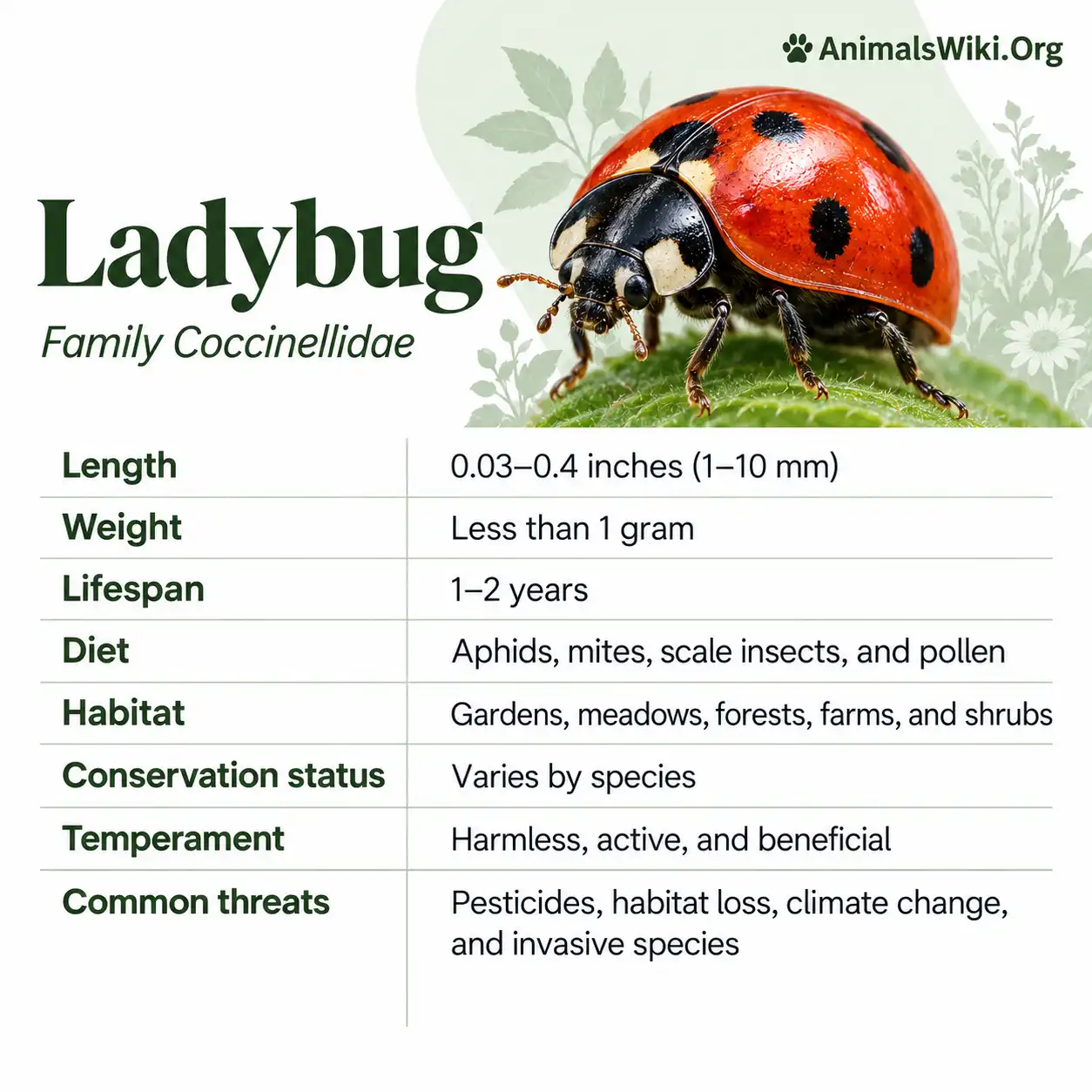
Ladybug Facts, The Colorful Beetles That Protect Plants From Pests
The ladybug is one of the world’s most recognizable insects, famous for its small rounded body, brightly colored wing covers, and distinctive black spots.
Despite its familiar name, a ladybug is not actually a true bug.
It is a beetle.
Ladybugs belong to the beetle family Coccinellidae, a diverse group containing thousands of species distributed across much of the world.
They are also commonly known as:
- Ladybirds
- Ladybird beetles
- Lady beetles
The name used depends largely on region.
In North America, ladybug is especially common.
In Britain and many other English-speaking regions, ladybird is widely used.
Ladybugs are famous for their red-and-black appearance, but not every species looks like the classic red beetle with black spots.
Depending on species, ladybugs can be:
- Red
- Orange
- Yellow
- Brown
- Black
- Grayish
Their markings may include:
- Black spots
- Red spots
- Orange spots
- Stripes
- Patches
- No obvious spots at all
Even the number of spots varies.
This means that counting spots is not a reliable way to determine a ladybug’s age.
The spots are primarily determined by species and genetics, not by how many years the beetle has lived.
Ladybugs are especially valued because many species are voracious predators of small plant-feeding insects.
Their prey can include:
- Aphids
- Scale insects
- Mealybugs
- Whiteflies
- Mites
- Insect eggs
Aphids are particularly important prey for many familiar ladybug species.
Because aphids can damage crops and garden plants, ladybugs often function as natural biological pest-control agents.
Both adult ladybugs and their larvae can be predators.
The larvae look dramatically different from adults.
Instead of being round and brightly polished, ladybug larvae are usually elongated and may appear dark, spiny, and somewhat alligator-like.
Their unusual appearance causes many people to mistake them for harmful insects.
In reality, a ladybug larva searching across a plant may be consuming large numbers of pests.
Ladybugs undergo complete metamorphosis.
Their life cycle has four main stages:
- Egg
- Larva
- Pupa
- Adult
A female commonly lays clusters of small eggs near potential prey.
After hatching, larvae begin feeding and growing.
They molt several times before entering the pupal stage.
Inside the pupa, the body undergoes a dramatic transformation.
The familiar adult beetle eventually emerges.
Freshly emerged adults may initially appear pale and soft.
As the exoskeleton hardens and pigments develop, the characteristic colors become more visible.
Ladybugs also possess surprisingly effective defenses.
Their bright coloration can warn predators that they may taste unpleasant.
When threatened, some ladybugs release yellowish fluid from joints in their legs.
This behavior is known as reflex bleeding.
The fluid contains defensive chemicals that can discourage predators.
Some species may also remain motionless when disturbed, creating the impression that they are dead.
Ladybugs can fly as well.
Their colorful outer wing covers, called elytra, protect a pair of delicate flight wings underneath.
Before taking off, the beetle raises the elytra, unfolds the hindwings, and begins flying.
Ladybugs may travel in search of:
- Food
- Mates
- Suitable habitat
- Seasonal shelter
In colder climates, some species gather in large groups and spend unfavorable periods in a dormant state.
Large aggregations may occur beneath:
- Rocks
- Bark
- Leaf litter
- Logs
- Buildings
Ladybugs are therefore much more than attractive garden insects.
They are highly specialized beetles with sophisticated defenses, complete metamorphosis, functional wings, powerful predatory behavior, and major ecological importance.
This comprehensive guide explores ladybug facts, species, colors, spots, anatomy, size, habitat, distribution, diet, aphid hunting, wings, flight, eyesight, antennae, defenses, reflex bleeding, life cycle, eggs, larvae, pupae, baby ladybugs, reproduction, lifespan, predators, overwintering, ladybugs in gardens, biological pest control, ladybug vs. ladybird terminology, Asian lady beetles, conservation, and much more.
Ladybug Facts
| Feature | Information |
|---|---|
| Common Names | Ladybug, ladybird, lady beetle |
| Animal Type | Insect |
| Order | Coleoptera |
| Family | Coccinellidae |
| Species | Thousands worldwide |
| Body Parts | Head, thorax and abdomen |
| Legs | 6 |
| Antennae | 2 |
| Wings | Protective elytra plus flight wings |
| Diet | Often aphids and other small insects; varies by species |
| Habitat | Gardens, forests, grasslands, farms and other vegetated habitats |
| Distribution | Widespread around the world |
| Life Cycle | Egg → larva → pupa → adult |
| Metamorphosis | Complete |
| Major Defense | Warning colors and defensive chemicals |
| Young Stage | Larva |
| Ecological Role | Predator of many plant pests |
| Famous Prey | Aphids |
What Is a Ladybug?
A ladybug is a small beetle belonging to the family Coccinellidae.
Ladybugs are members of the insect order Coleoptera, which contains all beetles.
Therefore, the common name can be misleading.
A ladybug is:
a beetle, not a true bug.
Is a Ladybug an Insect?
Yes.
Ladybugs possess the defining characteristics of insects, including:
- Six legs
- Three major body regions
- One pair of antennae
- Exoskeleton
- Compound eyes
Adult ladybugs also possess wings.
Is a Ladybug a Beetle?
Yes.
Ladybugs belong to the order Coleoptera.
Beetles are characterized in part by hardened front wings called elytra.
These protective structures cover the more delicate flight wings.
Why Is a Ladybug Not a True Bug?
In scientific classification, “true bugs” belong to the order Hemiptera.
Ladybugs belong to Coleoptera.
Therefore, despite the word “bug” in the American common name, they are scientifically beetles.
Ladybug vs. Ladybird
Ladybug and ladybird generally refer to the same family of beetles.
Usage is largely regional.
Ladybug is particularly common in North America.
Ladybird is common in Britain and elsewhere.
“Lady beetle” is another useful name because it clearly identifies the animal as a beetle.
Scientific Classification of Ladybugs
Broad classification:
| Classification | Name |
|---|---|
| Kingdom | Animalia |
| Phylum | Arthropoda |
| Class | Insecta |
| Order | Coleoptera |
| Family | Coccinellidae |
Coccinellidae contains thousands of species distributed among numerous genera.
How Many Species of Ladybugs Are There?
There are thousands of recognized ladybug species worldwide.
The exact number depends on taxonomic treatment and continues to change as researchers describe and reclassify species.
This diversity explains why ladybugs vary so dramatically in:
- Size
- Color
- Spot pattern
- Diet
- Habitat
- Behavior
Types of Ladybugs
Some familiar species and groups include:
Seven-Spotted Ladybug
The seven-spotted ladybug (Coccinella septempunctata) is one of the most recognizable species.
It typically has red wing covers with seven dark spots.
Two-Spotted Ladybug
The two-spotted ladybug (Adalia bipunctata) is widespread and highly variable in coloration.
Some individuals look very different from the familiar red form.
Asian Lady Beetle
The Asian lady beetle (Harmonia axyridis) is highly variable.
Individuals may be:
- Orange
- Red
- Yellowish
- Black
Spot numbers also vary considerably.
The species has been introduced widely outside its native Asian range.
Twenty-Two-Spot Ladybird
The twenty-two-spot ladybird is a small yellow species covered with numerous black spots.
Unlike many aphid-eating ladybugs, it is associated largely with fungal food.
What Does a Ladybug Look Like?
The familiar adult ladybug has:
- Small rounded body
- Dome-shaped back
- Six legs
- Short antennae
- Compound eyes
- Hardened wing covers
- Flight wings underneath
Body shape and coloration differ among species.
Ladybug Body Parts
Like other insects, a ladybug’s body consists of three main regions:
Head
Contains:
- Eyes
- Antennae
- Mouthparts
Thorax
Supports:
- Six legs
- Wings
Abdomen
Contains major internal systems associated with:
- Digestion
- Reproduction
- Respiration
The abdomen is largely covered by the wing structures when viewed from above.
How Many Legs Does a Ladybug Have?
Ladybugs have:
6 legs
This is one of the defining characteristics of insects.
Do Ladybugs Have Antennae?
Yes.
A ladybug has one pair of antennae.
They help detect information about the surrounding environment.
Antennae contribute to sensing:
- Chemicals
- Objects
- Air movement
- Food-related cues
Ladybug Eyes
Ladybugs possess compound eyes.
Compound eyes consist of many individual visual units.
Their vision is useful for:
- Navigation
- Detecting movement
- Locating suitable habitat
However, ladybugs also depend heavily on chemical and tactile information.
Ladybug Colors
Not all ladybugs are red.
Species may be:
- Red
- Orange
- Yellow
- Black
- Brown
- Grayish
Some are brightly patterned.
Others are relatively plain.
Why Are Ladybugs Red?
Bright coloration can function as warning coloration, scientifically called aposematism.
Red, orange, yellow, and black patterns may signal to predators that the beetle possesses unpleasant defensive chemicals.
Predators that have bad experiences with such insects may learn to avoid similarly colored prey.
Why Do Ladybugs Have Spots?
Spots form part of the beetle’s characteristic coloration and pattern.
Their appearance is largely determined by:
- Species
- Genetics
- Development
They are not a record of the beetle’s age.
Do Ladybug Spots Tell Their Age?
No.
This is a common myth.
A ladybug does not gain one new spot every year.
The number and arrangement of spots are primarily characteristics of its species and genetic form.
How Many Spots Does a Ladybug Have?
There is no universal number.
Depending on species or color form, a ladybug may have:
- No obvious spots
- Two spots
- Seven spots
- Many spots
Some species display markings other than simple spots.
Are All Ladybugs Red With Black Spots?
No.
The familiar red-and-black ladybug represents only part of the family’s enormous diversity.
Some ladybugs are black with red markings.
Others are yellow with black spots.
Some are nearly unmarked.
Ladybug Exoskeleton
Ladybugs, like all insects, possess an exoskeleton.
This hard external covering:
- Supports the body
- Protects internal organs
- Provides attachment points for muscles
- Helps reduce water loss
Because the exoskeleton cannot expand indefinitely, immature ladybugs must molt while growing.
How Big Are Ladybugs?
Most ladybugs are small.
Many familiar species measure only several millimeters long.
Exact size depends on species.
Their compact size allows them to move efficiently across:
- Leaves
- Stems
- Flowers
- Bark
in search of food.
Where Do Ladybugs Live?
Ladybugs occur in a wide variety of environments containing suitable vegetation and food.
Habitats include:
- Gardens
- Farms
- Meadows
- Grasslands
- Forests
- Shrublands
- Orchards
- Fields
- Wetlands
- Urban green spaces
Different species have different habitat preferences.
Where Are Ladybugs Found?
Ladybugs are widely distributed around the world.
They occur across large portions of:
- North America
- South America
- Europe
- Asia
- Africa
- Australia and surrounding regions
Species diversity and abundance vary by climate and habitat.
Where Do Ladybugs Live in Gardens?
They may occur on plants containing abundant prey.
You may find them on:
- Leaves
- Stems
- Flowers
- Shrubs
- Trees
- Vegetable plants
Plants heavily populated by aphids can attract predatory ladybugs.
What Do Ladybugs Eat?
Many ladybugs are predators.
Their diet may include:
- Aphids
- Scale insects
- Mealybugs
- Whiteflies
- Mites
- Insect eggs
- Other small arthropods
Some also consume:
- Pollen
- Nectar
- Fungi
- Plant material
Diet varies substantially among species.
Do Ladybugs Eat Aphids?
Yes.
Aphids are among the most famous prey of predatory ladybugs.
Aphids feed on plant fluids and can reproduce rapidly.
Ladybugs help suppress their populations naturally.
How Do Ladybugs Hunt Aphids?
Ladybugs move across vegetation searching for prey.
Chemical and physical cues can help them locate areas where aphids are abundant.
Once an aphid is encountered, the beetle captures it using its mouthparts.
Ladybug larvae are also active aphid predators.
How Many Aphids Can a Ladybug Eat?
A predatory ladybug can consume many aphids during its lifetime, but exact numbers vary substantially with:
- Species
- Age
- Temperature
- Prey size
- Prey availability
Claims that every ladybug consumes one exact lifetime number should therefore be treated cautiously.
Do Baby Ladybugs Eat Aphids?
Yes—if by “baby ladybug” we mean the larval stage of an aphid-eating species.
Ladybug larvae can be extremely active predators.
Their unfamiliar appearance sometimes causes gardeners to mistake them for pests.
Do Ladybugs Eat Plants?
Some species do.
Although many familiar ladybugs are predators, the family contains plant-feeding species.
Certain ladybugs can damage crops by eating plant tissue.
This is an important reminder that not every ladybug is beneficial in every agricultural situation.
Do Ladybugs Eat Pollen?
Some species supplement their diet with pollen.
Pollen can be particularly useful when animal prey is scarce.
Do Ladybugs Drink Nectar?
Some ladybugs consume nectar or other sugar-rich plant resources.
Their diet can change depending on food availability.
Do Ladybugs Drink Water?
Ladybugs require moisture and can obtain water from:
- Droplets
- Plant surfaces
- Food
- Humid environments
Like all animals, they need sufficient water for normal biological functions.
Are Ladybugs Carnivores?
Many familiar species are primarily predatory and can reasonably be described as carnivorous.
However, the entire ladybug family cannot be classified under one simple diet because some species eat:
- Fungi
- Pollen
- Plant tissue
Dietary diversity is substantial.
Ladybug Mouthparts
Ladybugs possess chewing mouthparts.
Predatory species use them to capture and consume small prey.
This differs from the piercing-sucking mouthparts of aphids.
Can Ladybugs Fly?
Yes.
Adult ladybugs are capable fliers.
Their visible colored shells are not the primary flight wings.
Instead, the hardened outer structures protect delicate wings folded beneath them.
Ladybug Wings
Adult ladybugs effectively possess two pairs of wings.
Elytra
The hardened front wings are called elytra.
They protect:
- Flight wings
- Abdomen
Hindwings
The thin membranous hindwings perform most of the actual flying.
When the ladybug prepares for flight:
- Elytra lift.
- Hindwings unfold.
- Wings begin beating.
- The beetle takes off.
After landing, the flight wings are folded beneath the elytra again.
Why Can’t We Usually See Ladybug Wings?
The delicate flight wings are normally hidden beneath the colorful elytra.
This arrangement provides the benefits of both:
- Protective armor
- Functional flight
How Do Ladybugs Fold Their Wings?
Ladybug hindwings are much larger than the space beneath the closed elytra might suggest.
They fold into compact configurations when not in use.
This allows large functional flight surfaces to fit beneath small protective covers.
How Far Can Ladybugs Fly?
Ladybugs can travel in search of:
- Food
- Mates
- Seasonal shelter
- Suitable habitat
Flight distances vary enormously with species and environmental conditions.
Wind can also influence dispersal.
Ladybug Life Cycle
Ladybugs undergo complete metamorphosis.
The four major stages are:
Egg → Larva → Pupa → Adult
Each stage looks and functions differently.
Ladybug Eggs
Female ladybugs commonly deposit eggs on vegetation.
Eggs may be placed near colonies of prey such as aphids so newly hatched larvae have immediate access to food.
Eggs are generally:
- Small
- Elongated
- Yellowish to orange depending on species and development
Ladybug Larva
After hatching, the ladybug enters the larval stage.
A ladybug larva looks nothing like the familiar adult.
It may be:
- Long
- Dark
- Segmented
- Spiny
- Marked with orange or yellow
The appearance is sometimes compared with a tiny alligator.
What Do Ladybug Larvae Eat?
Predatory larvae may eat:
- Aphids
- Scale insects
- Mites
- Insect eggs
- Other small prey
They spend much of their time feeding and growing.
Do Ladybug Larvae Molt?
Yes.
The larva’s exoskeleton cannot continuously expand.
As the larva grows, it molts several times.
Each developmental period between molts is called an instar.
Ladybug Pupa
After completing its larval growth, the ladybug enters the pupal stage.
The pupa is often attached to:
- Leaves
- Stems
- Other surfaces
The insect may appear inactive from outside.
Inside, however, dramatic transformation is occurring.
What Happens Inside a Ladybug Pupa?
During pupation, larval structures are reorganized as the adult body develops.
Features such as:
- Adult wings
- Adult legs
- Reproductive structures
- Adult body shape
become established.
Adult Ladybug
The adult eventually emerges from the pupal casing.
At first it may appear:
- Pale
- Yellowish
- Soft
- Weakly marked
Over time, the exoskeleton hardens and characteristic pigmentation develops.
Why Is a Newly Hatched Ladybug Yellow?
A newly emerged adult has not yet fully hardened or developed its final coloration.
Its colors darken as the exoskeleton matures.
Technically, an adult emerging from a pupa is eclosing, rather than hatching from an egg.
How Long Does the Ladybug Life Cycle Take?
Development time depends on:
- Species
- Temperature
- Food
- Climate
- Environmental conditions
Warm conditions and abundant prey can accelerate development within biological limits.
There is no single developmental duration that applies to every ladybug.
Ladybug Reproduction
Ladybugs reproduce sexually.
The basic process involves:
- Adults locate mates.
- Mating occurs.
- Females develop fertilized eggs.
- Eggs are deposited in suitable habitat.
- Larvae hatch.
- Larvae feed and molt.
- Pupation occurs.
- Adults emerge.
How Many Eggs Does a Ladybug Lay?
Egg production varies by species and environmental conditions.
A female may produce many eggs over her reproductive life, often depositing them in groups.
Food availability strongly influences reproductive success.
Why Do Ladybugs Lay Eggs Near Aphids?
Newly hatched larvae need food.
By placing eggs near aphid colonies, a female can increase the chance that her offspring encounter prey quickly.
Do Ladybugs Care for Their Babies?
Ladybugs generally do not provide prolonged parental care after laying their eggs.
The larvae must feed and survive independently after hatching.
What Is a Baby Ladybug Called?
The immature feeding stage is called a:
larva
Calling it a “baby ladybug” is understandable in everyday speech, but ladybug larva is scientifically more accurate.
Ladybug Metamorphosis
Complete metamorphosis allows immature and adult stages to occupy somewhat different ecological roles.
A larva is specialized primarily for:
- Feeding
- Growing
An adult must also:
- Disperse
- Find mates
- Reproduce
This separation of life stages is one reason complete metamorphosis has been so successful among insects.
How Long Do Ladybugs Live?
Ladybug lifespan varies with:
- Species
- Climate
- Food availability
- Predators
- Seasonal conditions
Many familiar species can live around a year, and some individuals may survive longer under favorable conditions.
There is no single exact lifespan for every species.
What Happens to Ladybugs in Winter?
In regions with cold winters, many ladybugs enter a dormant state known as diapause or overwinter in a state of reduced activity.
They seek protected locations where conditions are more stable.
Where Do Ladybugs Go in Winter?
Depending on species, they may shelter:
- Beneath rocks
- Under bark
- Inside leaf litter
- In crevices
- In logs
- In buildings
Some species gather in large groups.
Why Do Ladybugs Gather Together?
Aggregation can be associated with overwintering.
Large numbers may gather in protected locations that provide suitable:
- Temperature
- Humidity
- Shelter
Some aggregations can contain enormous numbers of beetles.
Why Do Ladybugs Enter Houses?
Certain species, particularly Asian lady beetles, may enter buildings while searching for protected overwintering sites.
They can gather around:
- Windows
- Roof spaces
- Wall gaps
- Attics
Their presence indoors does not necessarily mean they are feeding or reproducing inside the house.
Ladybug Defense Mechanisms
Despite their small size, ladybugs possess several effective defenses.
Warning Colors
Bright red, orange, yellow, and black patterns can advertise chemical defenses.
Reflex Bleeding
Some release defensive fluid from leg joints.
Unpleasant Taste
Defensive chemicals can make them unappealing to predators.
Playing Dead
A disturbed beetle may remain motionless.
Flight
Adults can escape through flight.
What Is Ladybug Reflex Bleeding?
When threatened, a ladybug can release a yellowish fluid from joints in its legs.
The fluid is hemolymph, the insect equivalent of circulating blood-like fluid.
It contains defensive compounds that can taste unpleasant to predators.
Is the Yellow Liquid From a Ladybug Urine?
Usually, the yellow defensive fluid people notice after handling a ladybug is associated with reflex bleeding, not ordinary urine.
It comes from the insect’s hemolymph.
Why Do Ladybugs Smell?
Defensive chemicals released during disturbance can produce a noticeable odor.
Large aggregations, especially indoors, can make the smell more obvious.
Are Ladybugs Poisonous?
Ladybugs contain defensive chemicals that can make them distasteful or potentially harmful to predators if consumed.
For humans, ordinary contact with typical ladybugs is generally not dangerous.
“Poisonous” should not be interpreted as meaning that touching a ladybug normally causes poisoning.
Are Ladybugs Venomous?
No.
Ladybugs do not inject venom through specialized stingers or fangs.
Their chemical defense is fundamentally different from venom delivery.
Can Ladybugs Bite Humans?
Ladybugs do not possess a blood-feeding bite like mosquitoes.
However, some individuals, particularly certain lady beetles, may occasionally pinch human skin with their mouthparts.
This is generally minor.
Do Ladybugs Sting?
No.
Ladybugs do not have stingers.
Are Ladybugs Dangerous to Humans?
Generally, no.
They are usually harmless.
Large indoor aggregations can occasionally cause nuisance problems, and some people may experience sensitivity to beetle-associated material.
But ladybugs do not normally represent a serious human threat.
What Eats Ladybugs?
Potential predators include:
- Birds
- Spiders
- Frogs
- Lizards
- Insects
- Other arthropods
Their warning coloration and chemical defenses can discourage many predators.
Do Birds Eat Ladybugs?
Some birds may eat ladybugs, but defensive chemicals and warning colors can reduce their attractiveness as prey.
Predator responses vary.
Do Spiders Eat Ladybugs?
Some spiders can capture ladybugs.
Chemical defenses do not guarantee complete protection from every predator.
Ladybug Camouflage vs. Warning Coloration
Ladybugs are usually better known for warning coloration than camouflage.
A bright red beetle with black spots may be conspicuous rather than hidden.
That visibility can be useful when the message is:
“I am unpleasant to eat.”
Are Ladybugs Good for Gardens?
Many species are highly beneficial because they prey on plant pests.
They can help suppress populations of:
- Aphids
- Scale insects
- Mealybugs
- Whiteflies
- Mites
However, because ladybug diets vary, not every species provides exactly the same benefits.
Ladybugs as Natural Pest Control
Ladybugs are important examples of biological control.
Instead of relying entirely on chemical pesticides, farmers and gardeners can benefit from natural predators that consume crop pests.
Ladybugs may form part of a broader community of beneficial organisms.
Should You Buy Ladybugs for a Garden?
Releasing commercially purchased ladybugs does not always produce the expected results.
Adults may simply fly away after release.
A more sustainable approach can involve creating habitat that naturally attracts and supports beneficial insects.
Helpful practices may include:
- Maintaining plant diversity
- Providing flowering plants
- Reducing unnecessary pesticide use
- Preserving shelter
- Tolerating small prey populations
Do Pesticides Kill Ladybugs?
Some pesticides can harm ladybugs directly or indirectly.
Broad-spectrum insecticides may kill beneficial predators along with target pests.
Reducing prey populations can also remove the food ladybugs need.
Asian Lady Beetle
The Asian lady beetle (Harmonia axyridis) deserves special attention because it has spread widely outside its native range.
It was introduced to various regions partly because of its ability to consume agricultural pests.
It subsequently became established across extensive areas.
How to Identify an Asian Lady Beetle
Color varies greatly.
Individuals may be:
- Yellowish
- Orange
- Red
- Black
Spot number is also variable.
Many have a pale pronotum behind the head bearing dark markings that may resemble an M or W, although appearance varies.
Identification should therefore use multiple features rather than color alone.
Are Asian Lady Beetles Ladybugs?
Yes.
They belong to the family Coccinellidae.
They are genuine ladybugs/ladybirds, even though they may behave differently from familiar native species.
Why Are Asian Lady Beetles a Problem?
In some introduced regions they can:
- Become extremely abundant
- Compete with native ladybugs
- Enter homes in large numbers
- Release staining defensive fluid
- Occasionally pinch human skin
- Affect some fruit production environments
Their ecological effects vary by region.
Ladybug vs. Asian Lady Beetle
This comparison can be confusing because an Asian lady beetle is a ladybug.
The meaningful distinction is between Harmonia axyridis and other ladybug species.
Therefore:
All Asian lady beetles are ladybugs, but not all ladybugs are Asian lady beetles.
Ladybug vs. Beetle
A ladybug is a beetle.
“Beetle” describes the enormous insect order Coleoptera.
“Ladybug” describes members of one beetle family, Coccinellidae.
Therefore:
All ladybugs are beetles, but only a small proportion of beetles are ladybugs.
Ladybug vs. True Bug
| Feature | Ladybug | True Bug |
|---|---|---|
| Order | Coleoptera | Hemiptera |
| Animal Type | Insect | Insect |
| Front Wings | Hardened elytra | Different hemipteran wing structure |
| Mouthparts | Chewing in ladybugs | Typically piercing-sucking |
| Example | Seven-spotted ladybug | Stink bug |
The everyday word “bug” is much broader than the scientific term “true bug.”
Ladybug vs. Firefly
Ladybugs and fireflies are both beetles, but they belong to different families.
Ladybugs belong to:
Coccinellidae
Fireflies belong to:
Lampyridae
Fireflies are famous for bioluminescence, while ladybugs are famous for bright warning coloration and pest predation.
Ladybug Adaptations
Ladybugs possess several adaptations contributing to their success.
Hardened Elytra
Protect the flight wings and abdomen.
Functional Flight
Allows movement between habitats.
Small Body Size
Allows movement through dense vegetation.
Warning Coloration
Advertises chemical defenses.
Reflex Bleeding
Releases unpleasant defensive compounds.
Complete Metamorphosis
Separates larval growth from adult reproductive functions.
Strong Appetite for Prey
Allows predatory species to exploit abundant insect populations.
Seasonal Dormancy
Helps survive unfavorable conditions.
Ecological Importance of Ladybugs
Ladybugs occupy important positions in food webs.
Predatory species help regulate populations of:
- Aphids
- Scale insects
- Mites
- Other small arthropods
They are also prey for other organisms.
Their ecological importance is particularly noticeable in agricultural systems where pest insects can reproduce rapidly.
Ladybugs and Aphid Control
Aphids can:
- Remove plant fluids
- Weaken plants
- Produce sticky honeydew
- Encourage sooty molds
- Transmit certain plant diseases
Ladybugs and other natural enemies can reduce aphid populations before they become extremely abundant.
Ladybug Conservation
Although some ladybug species remain common, others can decline locally or regionally.
Potential pressures include:
- Habitat loss
- Pesticide exposure
- Reduced plant diversity
- Changes in prey availability
- Climate change
- Competition with introduced species
Conservation needs vary considerably among species and locations.
How to Attract Ladybugs
A garden can become more suitable for ladybugs by providing:
- Diverse flowering plants
- Natural vegetation
- Shelter
- Water or moisture
- Prey insects
- Reduced pesticide exposure
A healthy ecosystem generally supports a wider range of beneficial insects than a heavily treated monoculture.
40 Interesting Ladybug Facts
- Ladybugs are insects.
- They are beetles, not true bugs.
- Ladybugs belong to the family Coccinellidae.
- They are also called ladybirds.
- Thousands of ladybug species exist worldwide.
- Not every ladybug is red.
- Some are yellow.
- Some are orange.
- Some are black.
- Not every ladybug has spots.
- Spot number does not reveal age.
- Ladybugs have six legs.
- They possess one pair of antennae.
- Adults have compound eyes.
- Ladybugs have hardened front wings called elytra.
- Their true flight wings are folded underneath.
- Adult ladybugs can fly.
- Many species eat aphids.
- Ladybug larvae can also eat aphids.
- Ladybug larvae look very different from adults.
- Larvae molt as they grow.
- Ladybugs undergo complete metamorphosis.
- Their life cycle includes egg, larva, pupa and adult.
- Females often lay eggs near prey.
- Ladybug pupae are commonly attached to vegetation.
- Newly emerged adults may initially look pale.
- Their colors become stronger as the exoskeleton hardens.
- Bright colors can warn predators.
- Ladybugs can release defensive chemicals.
- This behavior is called reflex bleeding.
- The defensive fluid may appear yellow.
- Ladybugs do not have stingers.
- Some can occasionally pinch human skin.
- Many species help control agricultural pests.
- Not every ladybug is predatory.
- Some species feed on fungi.
- Some species consume plants.
- Certain ladybugs aggregate during winter.
- Asian lady beetles may enter buildings in large numbers.
- Ladybugs are important natural enemies of many plant pests.
Did You Know?
A ladybug’s familiar red shell is not actually the wing it uses for flying.
The bright red, orange, yellow, or black structures visible on the beetle’s back are hardened front wings called elytra.
Their primary function is protection.
Hidden beneath them is another pair of wings.
These thin, flexible hindwings perform the actual flying.
When a ladybug is resting, the delicate wings are folded tightly beneath the elytra.
When it prepares to fly, something remarkable happens.
The ladybug:
- Raises its elytra.
- Unfolds its hidden hindwings.
- Extends them outward.
- Begins beating them.
- Takes off.
The hindwings are relatively large compared with the compact space in which they are stored.
After landing, the ladybug must fold these flexible structures back beneath its protective covers.
This arrangement solves two problems at once.
Large, delicate wings are useful for flight but vulnerable to:
- Damage
- Dirt
- Predators
- Dense vegetation
Hard armor protects the body but would be poor for powered flight.
Beetle evolution effectively produced both.
The ladybug carries protective armor on the outside and folding flight equipment underneath.
Its familiar spotted back is therefore not simply decorative.
It is part of an ingenious body design that helps make beetles one of the most successful groups of animals on Earth.
Frequently Asked Questions About Ladybugs
What is a ladybug?
A ladybug is a small beetle belonging to the family Coccinellidae.
Is a ladybug an insect?
Yes.
Is a ladybug a beetle?
Yes.
Is a ladybug a true bug?
No. True bugs belong to Hemiptera; ladybugs belong to Coleoptera.
Is a ladybird the same as a ladybug?
Yes. The names are regional alternatives.
Why are they called ladybugs?
The common name has historical European roots associated with “Our Lady,” referring to the Virgin Mary. Regional forms eventually produced names such as ladybird and ladybug.
How many ladybug species are there?
There are thousands of species worldwide.
Are all ladybugs red?
No.
What colors can ladybugs be?
They may be red, orange, yellow, black, brownish, or other shades depending on species.
Are all ladybugs spotted?
No.
Why do ladybugs have spots?
Spots are part of species-specific and genetically influenced coloration.
Do ladybug spots tell their age?
No.
How many spots does a ladybug have?
It depends on the species and color form.
Does a seven-spotted ladybug have seven spots?
Typically, yes—the characteristic adult pattern includes seven dark spots.
How many legs does a ladybug have?
Six.
Do ladybugs have antennae?
Yes.
Do ladybugs have eyes?
Yes. They possess compound eyes.
Do ladybugs have an exoskeleton?
Yes.
Do ladybugs have wings?
Yes.
Can ladybugs fly?
Yes.
What are the red wings on a ladybug called?
The hardened outer wing covers are called elytra.
Are the elytra used for flying?
They mainly provide protection. The membranous hindwings underneath provide most of the flight power.
Why do ladybugs open their shells before flying?
They must raise the elytra so the folded hindwings can extend.
Where do ladybugs live?
They inhabit gardens, forests, fields, farms, grasslands and many other vegetated environments.
Where are ladybugs found?
They are widespread around the world.
What do ladybugs eat?
Many eat aphids and other small arthropods, although diets vary among species.
Do ladybugs eat aphids?
Yes. Many predatory species do.
Why do ladybugs eat aphids?
Aphids are abundant, nutrient-rich prey suitable for many predatory ladybugs.
Do ladybug larvae eat aphids?
Yes. Larvae of many predatory species are active aphid hunters.
Do ladybugs eat plants?
Some species do, although many familiar species are predators.
Do ladybugs eat pollen?
Some do.
Do ladybugs drink nectar?
Some species consume nectar and other sugary resources.
Do ladybugs drink water?
They need moisture and can obtain it from food, droplets, and their environment.
Are ladybugs carnivores?
Many are predominantly predatory, but the family also includes species with other diets.
What is a baby ladybug called?
The immature feeding stage is called a larva.
What does a baby ladybug look like?
Larvae are elongated and often dark with spiny projections and colored markings.
Why doesn’t a ladybug larva look like a ladybug?
Ladybugs undergo complete metamorphosis, so larval and adult body forms are dramatically different.
What are the stages of a ladybug’s life cycle?
Egg, larva, pupa and adult.
Do ladybugs have complete metamorphosis?
Yes.
Where do ladybugs lay eggs?
Usually on vegetation, often near suitable prey.
What color are ladybug eggs?
They are commonly yellowish or orange, although appearance varies.
Why do ladybugs lay eggs near aphids?
The newly hatched larvae need access to prey.
Do ladybugs care for their babies?
They generally provide no prolonged parental care after laying eggs.
Do ladybug larvae molt?
Yes.
What is a ladybug pupa?
It is the transformation stage between larva and adult.
Can a ladybug pupa move?
It is largely stationary, although limited movement can occur when disturbed.
Why is a new ladybug pale?
Its exoskeleton and pigmentation have not fully hardened and developed.
How long do ladybugs live?
Many familiar species may live around a year, while lifespan varies with species and conditions.
Where do ladybugs go during winter?
Many shelter beneath bark, rocks, leaf litter, logs, or inside structures.
Do ladybugs hibernate?
Many enter diapause or a similar period of reduced seasonal activity.
Why do ladybugs gather in groups?
Aggregation can help them locate suitable overwintering conditions.
Why are ladybugs in my house?
Certain species enter buildings while searching for protected overwintering sites.
Do ladybugs bite?
Some may occasionally pinch skin with their mouthparts.
Do ladybugs sting?
No.
Are ladybugs poisonous?
They contain defensive chemicals that discourage predators, but normal human contact is generally harmless.
Are ladybugs venomous?
No. They do not inject venom.
What is the yellow liquid from a ladybug?
It is commonly defensive hemolymph released during reflex bleeding.
Is yellow ladybug liquid urine?
Usually not. The characteristic defensive yellow fluid is associated with reflex bleeding.
Why do ladybugs smell?
Defensive chemical secretions can have a noticeable odor.
Why are ladybugs red?
Bright coloration can warn predators about chemical defenses.
What is warning coloration?
Warning coloration, or aposematism, uses conspicuous colors to advertise defenses.
What eats ladybugs?
Potential predators include birds, spiders, frogs, lizards and other arthropods.
Do birds eat ladybugs?
Some do, although defensive chemicals can discourage predation.
Do spiders eat ladybugs?
Some spiders can capture them.
Are ladybugs good for gardens?
Many are beneficial predators of plant pests.
Why do gardeners like ladybugs?
Predatory species can consume aphids, scale insects, mealybugs and other pests.
Are ladybugs natural pest control?
Yes. Predatory ladybugs can contribute to biological control.
Do pesticides kill ladybugs?
Some insecticides can harm them.
How can I attract ladybugs?
Plant diversity, flowering plants, prey availability, shelter, and reduced pesticide use can help support them.
Should I release purchased ladybugs?
Released adults may disperse rather than remain in the garden. Supporting suitable habitat can provide a more sustainable approach.
What is an Asian lady beetle?
Harmonia axyridis is a highly variable ladybug native to Asia that has become established in many other regions.
Is an Asian lady beetle a ladybug?
Yes.
Are Asian lady beetles invasive?
They are introduced and invasive in various regions outside their native range.
Why do Asian lady beetles enter houses?
They search for protected places in which to overwinter.
How can you identify an Asian lady beetle?
Many have a pale area behind the head with dark markings that can resemble an M or W, but color and spots are highly variable.
Are yellow ladybugs real?
Yes. Several ladybug species are naturally yellow.
Are black ladybugs real?
Yes. Some species and color forms are predominantly black.
Can ladybugs have no spots?
Yes.
Are ladybugs helpful to farmers?
Predatory species can help suppress agricultural pests.
Are all ladybugs beneficial?
No. Some species feed on plants or fungi rather than pest insects.
Why are ladybugs important?
They contribute to food webs and many species help regulate populations of plant-feeding insects.
Conclusion
The ladybug is much more than a tiny red insect decorated with black spots.
It is a highly specialized beetle belonging to a diverse family containing thousands of species.
Some are red.
Others are orange, yellow, black, or brownish.
Some possess numerous spots.
Others have only a few.
Some have no obvious spots at all.
And those spots do not reveal the beetle’s age.
Beneath the colorful appearance lies an effective predatory insect.
Many ladybugs spend both their larval and adult lives searching vegetation for aphids and other small prey.
This makes them valuable members of natural and agricultural ecosystems.
Their life cycle is equally remarkable.
A ladybug begins as an egg.
It hatches into an elongated larva that looks almost nothing like the adult.
The larva eats and grows, shedding its exoskeleton several times.
It then becomes a pupa.
Inside that seemingly inactive structure, its body is reorganized.
Eventually, the familiar rounded adult emerges.
Even then, the transformation is not immediately complete.
The new adult can initially be pale and soft before its exoskeleton hardens and characteristic coloration develops.
Its famous colors also provide protection.
Bright red, orange, yellow, and black patterns can warn predators that the beetle contains unpleasant defensive chemicals.
When threatened, some ladybugs reinforce that warning through reflex bleeding, releasing defensive hemolymph from their leg joints.
The yellowish fluid may taste unpleasant enough to persuade a predator to search for easier prey.
And if defense is not enough, the adult possesses another option:
flight.
Its colorful spotted back consists partly of hardened wing covers called elytra.
Beneath them are delicate folding wings capable of carrying the tiny beetle to new plants, feeding grounds, mates, and seasonal shelters.
Ladybugs therefore combine:
- Armor
- Flight
- Chemical defense
- Warning coloration
- Complete metamorphosis
- Predatory behavior
- Seasonal survival strategies
in a body only a few millimeters long.
Their relationship with humans is generally beneficial.
By feeding on aphids, scales, mealybugs, and other plant pests, many species provide a form of natural pest control.
However, the story is more complicated than simply labeling every ladybug “good.”
Some feed on plants.
Others specialize on fungi.
Introduced species such as the Asian lady beetle can compete with native species and become household nuisances.
Understanding ladybugs therefore means appreciating their diversity rather than treating every spotted beetle as identical.
Whether crawling across a garden leaf, hunting through an aphid colony, unfolding hidden wings for flight, or gathering with thousands of others to survive winter, the ladybug demonstrates how much biological complexity can exist inside one of the smallest and most familiar animals in the garden.