Grasshopper Facts, The Powerful Jumping Insects of Grasslands & Wild Habitats
The grasshopper is one of the world’s most familiar insects, instantly recognizable by its powerful hind legs, elongated body, large eyes, short antennae, folded wings, and extraordinary ability to launch itself through the air.
Grasshoppers occur across much of the world and are especially common in:
- Grasslands
- Meadows
- Savannas
- Agricultural fields
- Shrublands
- Forest edges
- Semi-arid landscapes
- Mountain habitats
Although a grasshopper may appear simple, its body contains a remarkable collection of specialized adaptations.
Its enormous hind legs function like biological springs.
Muscles inside the legs gradually store energy before a jump. When released, that energy propels the insect forward with acceleration far beyond what its small body size might suggest.
Many species can also fly.
After jumping into the air, a winged grasshopper can unfold its hindwings and continue traveling by flight.
Grasshoppers are primarily plant eaters.
Their powerful mandibles cut and crush:
- Grasses
- Leaves
- Stems
- Seeds
- Flowers
- Agricultural crops
This feeding behavior makes grasshoppers ecologically important herbivores.
It can also bring them into conflict with humans.
Under normal circumstances, grasshoppers occur as individual insects or relatively dispersed populations.
But certain grasshopper species possess one of the most dramatic behavioral transformations in the insect world.
Under particular environmental and population conditions, these species can transform into locusts.
Locusts are not a completely separate kind of insect.
They are grasshoppers capable of undergoing a process called phase polyphenism.
When population density and environmental conditions trigger the change, their:
- Behavior
- Coloration
- Physiology
- Movement
- Social tendencies
can change dramatically.
Instead of avoiding one another, they begin gathering.
Large groups can eventually develop into enormous migrating swarms capable of traveling long distances and consuming vast quantities of vegetation.
Yet most grasshopper species never form such swarms.
Grasshoppers are also famous for sound.
Many males communicate using stridulation, producing characteristic chirps or buzzing noises by rubbing specialized body structures together.
These sounds can help:
- Attract females
- Identify species
- Communicate reproductive readiness
- Interact with rivals
Grasshoppers do not hear with ears on the sides of their heads like humans.
In many species, sound-sensitive structures called tympanal organs are located on the abdomen.
Their respiratory system is equally unusual.
Grasshoppers do not possess lungs.
Instead, air enters through openings called spiracles and travels through an internal network of tubes called tracheae.
Oxygen can therefore be delivered directly to tissues without relying on blood to transport it in the same way mammalian blood does.
Grasshoppers also undergo incomplete metamorphosis.
Unlike butterflies, they do not pass through a caterpillar and chrysalis stage.
Their life cycle is:
Egg → Nymph → Adult
A newly hatched nymph already resembles a tiny wingless grasshopper.
As it grows, it repeatedly sheds its exoskeleton.
With each molt, the wings and reproductive structures become progressively more developed until the insect reaches adulthood.
From their powerful jumping mechanisms and unusual hearing organs to their ecological importance and transformation into locust swarms, grasshoppers are far more sophisticated than their familiar appearance suggests.
This comprehensive guide explores grasshopper facts, species, classification, anatomy, size, habitat, distribution, diet, feeding, jumping, speed, wings, flight, sounds, hearing, vision, breathing, reproduction, eggs, nymphs, molting, life cycle, lifespan, predators, defenses, adaptations, grasshopper vs. cricket differences, grasshopper vs. katydid differences, grasshopper vs. locust differences, agricultural impact, ecological importance, and much more.
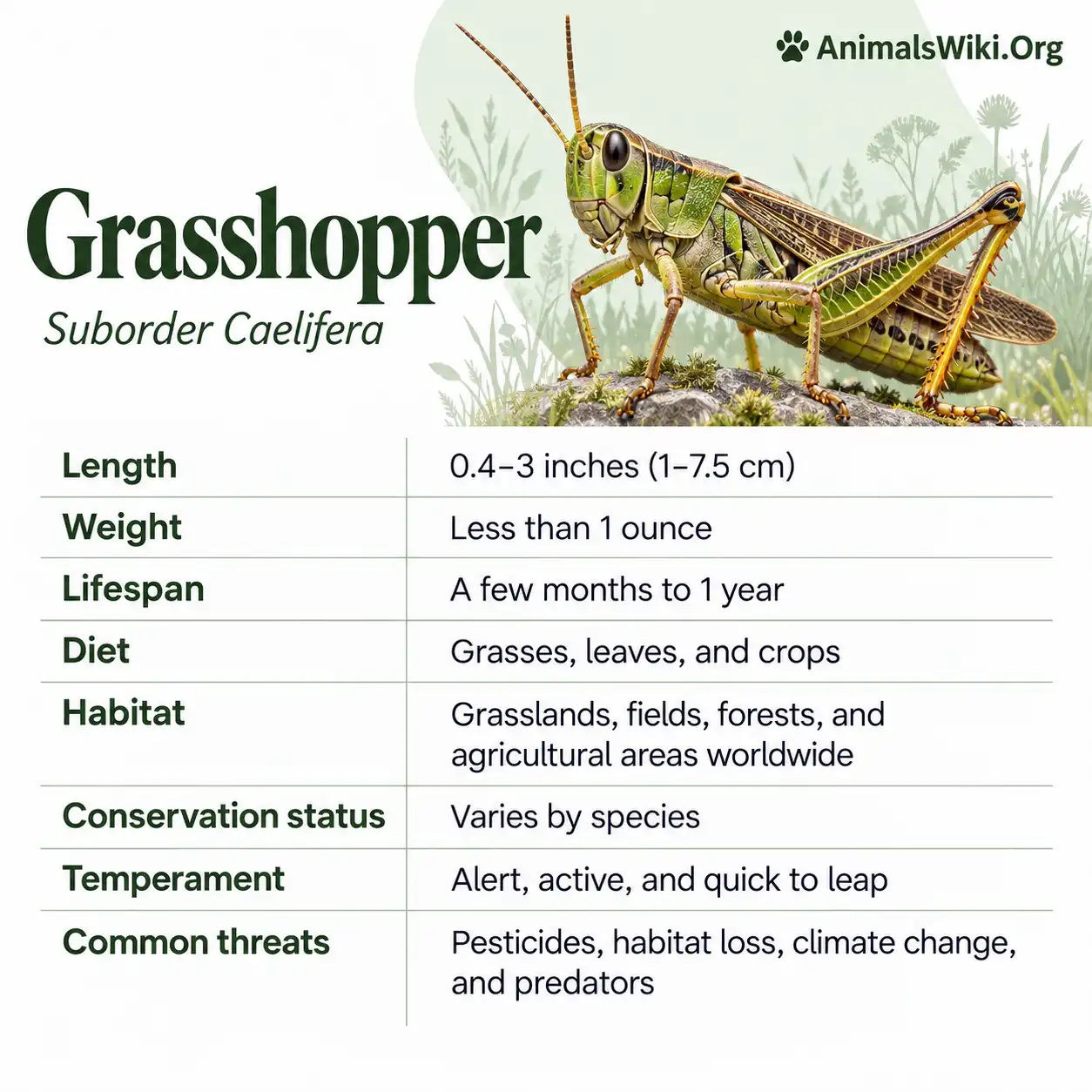
Grasshopper Facts
| Feature | Information |
|---|---|
| Common Name | Grasshopper |
| Animal Type | Insect |
| Class | Insecta |
| Order | Orthoptera |
| Suborder | Caelifera |
| Body Sections | Head, thorax and abdomen |
| Legs | 6 |
| Antennae | Usually relatively short |
| Wings | Usually two pairs in winged adults |
| Diet | Primarily herbivorous |
| Main Foods | Grasses, leaves, stems and other vegetation |
| Habitat | Grasslands, fields, savannas and many terrestrial habitats |
| Distribution | Widespread worldwide except extreme polar regions |
| Main Movement | Walking, jumping and often flying |
| Hearing | Tympanal organs in many species |
| Breathing | Spiracles and tracheal tubes |
| Development | Incomplete metamorphosis |
| Life Cycle | Egg → Nymph → Adult |
| Young | Nymph |
| Main Defenses | Jumping, flight, camouflage and chemical defenses in some species |
What Is a Grasshopper?
A grasshopper is an insect belonging to the order Orthoptera and primarily the suborder Caelifera.
Grasshoppers are particularly recognizable because of their:
- Powerful enlarged hind legs
- Relatively short antennae
- Strong chewing mouthparts
- Large compound eyes
- Winged adult forms in many species
They are close relatives of:
- Crickets
- Katydids
- Locusts
Scientific Classification of Grasshoppers
Broadly:
| Classification | Name |
|---|---|
| Kingdom | Animalia |
| Phylum | Arthropoda |
| Class | Insecta |
| Order | Orthoptera |
| Suborder | Caelifera |
Because “grasshopper” refers to thousands of species rather than one species, there is no single scientific species name for all grasshoppers.
How Many Species of Grasshopper Are There?
There are thousands of grasshopper species distributed across the world.
Caelifera contains many families and an enormous diversity of species adapted to different climates, vegetation types, elevations, and feeding strategies.
One of the largest and best-known families is:
Acrididae
This family contains many of the grasshoppers people encounter in:
- Grasslands
- Farms
- Gardens
- Roadsides
- Open landscapes
It also includes several important locust species.
Types of Grasshoppers
Grasshoppers occur in many forms.
Major or familiar groups include:
- Short-horned grasshoppers
- Spur-throated grasshoppers
- Band-winged grasshoppers
- Slant-faced grasshoppers
- Pygmy grasshoppers
- Lubber grasshoppers
- Locust-forming grasshoppers
They vary enormously in:
- Size
- Color
- Wing development
- Habitat
- Diet
- Behavior
What Does a Grasshopper Look Like?
A typical grasshopper possesses:
- Large head
- Two antennae
- Two large compound eyes
- Chewing mouthparts
- Three-part thorax
- Six legs
- Enlarged hind legs
- Segmented abdomen
- Two pairs of wings in many adults
The body is protected by an exoskeleton.
Grasshopper Body Parts
Like other insects, a grasshopper’s body has three major regions:
Head
Contains:
- Eyes
- Antennae
- Mouthparts
- Sensory structures
Thorax
Contains:
- Six legs
- Wings
Abdomen
Contains major:
- Digestive organs
- Reproductive organs
- Respiratory openings
- Hearing structures in many species
Grasshopper Exoskeleton
Grasshoppers do not possess an internal skeleton like humans.
Their body is supported by an external skeleton called an exoskeleton.
It is composed largely of chitin and associated proteins.
The exoskeleton:
- Supports the body
- Protects internal organs
- Provides attachment points for muscles
- Helps reduce water loss
However, it cannot expand indefinitely.
The grasshopper must molt in order to grow.
How Many Legs Does a Grasshopper Have?
A grasshopper has:
6 legs
Like all insects, it has three pairs.
The front and middle legs are used mainly for:
- Walking
- Climbing
- Holding surfaces
The hind legs are greatly enlarged for jumping.
Grasshopper Hind Legs
The hind legs are one of the grasshopper’s defining adaptations.
They contain:
- Large muscles
- Long leg segments
- Elastic structures
- Strong joints
Together, these allow the insect to store and release substantial mechanical energy.
How Do Grasshoppers Jump?
A grasshopper does not simply contract its leg muscles and instantly leap.
In many species, the jumping mechanism involves energy storage.
The process can be simplified as:
- Hind legs bend.
- Powerful muscles contract.
- Elastic structures store energy.
- The legs remain temporarily loaded.
- The release mechanism activates.
- Stored energy is rapidly released.
- Hind legs extend explosively.
- The grasshopper launches into the air.
This allows the insect to generate power beyond what direct muscle contraction alone could produce instantaneously.
How High Can a Grasshopper Jump?
Jumping ability varies by species and individual.
Many grasshoppers can jump distances many times their own body length.
Relative to body size, this is an extraordinary athletic performance.
A human with equivalent proportional ability would be capable of remarkable leaps.
Why Do Grasshoppers Jump?
Jumping serves several purposes.
Grasshoppers may jump to:
- Escape predators
- Move between plants
- Reach food
- Avoid threats
- Begin flight
- Search for mates
For many species, jumping is their fastest immediate escape response.
Can Grasshoppers Fly?
Many adult grasshoppers can fly.
However, flight ability varies.
Some species are:
- Strong fliers
- Short-distance fliers
- Reluctant fliers
- Nearly flightless
- Completely flightless
Young nymphs cannot fly because their wings are not fully developed.
Grasshopper Wings
A typical winged adult possesses two pairs of wings.
Forewings
The front pair is generally:
- Narrower
- Tougher
- More protective
These are often called tegmina.
Hindwings
The rear pair is generally:
- Broader
- Thinner
- Membranous
- Folded beneath the forewings when resting
The hindwings provide much of the aerodynamic surface used during flight.
Why Do Grasshoppers Jump Before Flying?
Jumping rapidly launches the insect away from the ground.
Once airborne, the wings can unfold and begin generating lift.
The jump therefore provides an effective launch system.
Do All Grasshoppers Have Wings?
No.
Wing development differs among species.
Some adults possess:
- Full-sized wings
- Reduced wings
- Tiny nonfunctional wings
- No functional flight structures
Environmental adaptation strongly influences wing evolution.
Grasshopper Antennae
Grasshopper antennae are usually relatively short compared with those of crickets and katydids.
They contain sensory receptors that help detect:
- Touch
- Air movement
- Chemicals
- Environmental cues
Antennae are therefore important sensory organs.
Grasshopper Eyes
Grasshoppers possess large compound eyes.
Each compound eye consists of numerous visual units called ommatidia.
This visual system is especially effective at detecting:
- Movement
- Changes in light
- Approaching predators
Do Grasshoppers Have Simple Eyes?
Yes.
In addition to compound eyes, grasshoppers typically possess small simple eyes called ocelli.
Ocelli primarily detect:
- Light intensity
- Changes in illumination
rather than producing highly detailed images.
Can Grasshoppers See Color?
Grasshopper visual systems can distinguish certain wavelengths of light.
The exact visual capabilities vary among species.
Their vision is particularly valuable for:
- Detecting vegetation
- Recognizing movement
- Navigating
- Avoiding predators
Grasshopper Mouth
Grasshoppers possess chewing mouthparts.
The major structures include strong mandibles.
These function somewhat like jaws.
They allow grasshoppers to:
- Cut vegetation
- Tear leaves
- Crush plant tissue
- Process food
Do Grasshoppers Have Teeth?
Grasshoppers do not possess teeth like mammals.
Instead, their strong mandibles have hardened cutting and crushing surfaces.
These can process surprisingly tough plant material.
What Do Grasshoppers Eat?
Most grasshoppers are primarily herbivorous.
Common foods include:
- Grasses
- Leaves
- Stems
- Flowers
- Seeds
- Agricultural crops
Different species may specialize on particular plant groups.
Are Grasshoppers Herbivores?
Most are predominantly herbivorous.
However, grasshopper diets are more flexible than this simple label suggests.
Some species may consume:
- Dead insects
- Animal material
- Feces
- Other nutrient-rich substances
especially when important nutrients are scarce.
Do Grasshoppers Eat Grass?
Yes.
Grass is one of the most important foods for many species.
Their name reflects their strong association with grassy habitats.
Do Grasshoppers Eat Crops?
Yes.
Grasshoppers may consume crops such as:
- Wheat
- Corn
- Barley
- Rice
- Sorghum
- Vegetables
- Forage plants
The exact crops affected depend on region and species.
At high population densities, feeding damage can become economically significant.
Do Grasshoppers Eat Other Insects?
Some grasshoppers occasionally consume animal material, including dead insects or even other grasshoppers.
However, most are primarily plant feeders rather than specialized insect predators.
Do Grasshoppers Drink Water?
Grasshoppers obtain much of their water from:
- Fresh vegetation
- Moisture on plants
- Environmental sources
Their water requirements vary with climate and species.
Grasshopper Digestion
Food is mechanically processed by the mouthparts before entering the digestive system.
The digestive tract includes specialized regions for:
- Food storage
- Mechanical processing
- Digestion
- Nutrient absorption
- Waste formation
Microorganisms in the digestive system can also contribute to processing plant material.
Where Do Grasshoppers Live?
Grasshoppers occur in an enormous range of terrestrial environments.
Common habitats include:
- Grasslands
- Savannas
- Meadows
- Agricultural fields
- Deserts
- Shrublands
- Forest clearings
- Wetlands
- Mountain slopes
- Gardens
Different species have very different habitat requirements.
Where Are Grasshoppers Found?
Grasshoppers occur on most continents and across a wide range of climates.
They are particularly diverse and abundant in warm environments containing suitable vegetation.
Extreme polar regions provide little suitable habitat.
Do Grasshoppers Live in Deserts?
Yes.
Many species are adapted to dry and semi-arid environments.
Desert grasshoppers may possess adaptations involving:
- Water conservation
- Heat tolerance
- Camouflage
- Seasonal reproduction
Do Grasshoppers Live in Forests?
Some species inhabit forests, especially:
- Clearings
- Edges
- Understory vegetation
- Open woodland
However, many familiar species are more strongly associated with open habitats.
Grasshopper Camouflage
Camouflage is an important defense.
Grasshoppers may resemble:
- Green leaves
- Dry grass
- Soil
- Bark
- Stones
Common colors include:
- Green
- Brown
- Gray
- Tan
- Yellow
This makes a motionless grasshopper difficult for predators to detect.
Why Are Grasshoppers Green?
Green coloration helps species living among fresh vegetation blend into their surroundings.
Not all grasshoppers are green.
Species living in dry habitats are often brown, gray, or sandy-colored.
Can Grasshoppers Change Color?
Some grasshoppers can undergo changes in coloration during development or in response to environmental conditions.
The most dramatic example occurs in locust-forming species, where phase changes can alter coloration along with behavior and physiology.
Grasshopper Sounds
Grasshoppers are famous for producing:
- Chirps
- Buzzes
- Clicks
- Rattling sounds
These sounds are often associated with courtship.
How Do Grasshoppers Make Sounds?
Many produce sound through stridulation.
This involves rubbing specialized body structures together.
A common mechanism involves rubbing parts of the hind leg against the forewing.
Other mechanisms occur in different species.
Why Do Grasshoppers Chirp?
Sound is commonly used for communication.
Males may produce songs to:
- Attract females
- Advertise species identity
- Communicate reproductive condition
- Interact with rival males
Different species produce different acoustic patterns.
Do Female Grasshoppers Make Sounds?
Sound production is particularly associated with males in many species, although females of some species can also produce sounds.
Behavior differs across the group.
Do Grasshoppers Have Ears?
Yes—but not ears resembling those of mammals.
Many grasshoppers possess sound-sensitive tympanal organs.
Where Are a Grasshopper’s Ears?
In many short-horned grasshoppers, the tympanal organs are located on the first abdominal segment.
This means their main hearing organs are effectively on the sides of the abdomen rather than on the head.
How Do Grasshoppers Hear?
Sound waves cause a thin tympanal membrane to vibrate.
Sensory structures detect these vibrations and convert them into nerve signals.
This allows the insect to detect:
- Mating calls
- Other grasshoppers
- Environmental sounds
- Potential predators
Do Grasshoppers Have Lungs?
No.
Grasshoppers breathe through a tracheal respiratory system.
How Do Grasshoppers Breathe?
Air enters through small external openings called:
spiracles
These connect to tubes called:
tracheae
which branch into increasingly small tubes called:
tracheoles.
Oxygen can then diffuse directly toward tissues.
Where Are Grasshopper Spiracles?
Spiracles occur along the sides of the thorax and abdomen.
They can open and close to regulate:
- Gas exchange
- Water loss
This is particularly important for terrestrial insects.
Do Grasshoppers Have Blood?
Yes, but insect blood differs significantly from vertebrate blood.
It is called hemolymph.
Hemolymph circulates:
- Nutrients
- Hormones
- Waste products
- Immune cells
Unlike human blood, it generally does not serve as the primary oxygen-transport system.
The tracheal system delivers oxygen directly to tissues.
Does a Grasshopper Have a Heart?
Yes.
Grasshoppers possess a long dorsal vessel that functions as part of an open circulatory system.
The system moves hemolymph through the body.
Grasshopper Life Cycle
Grasshoppers undergo incomplete metamorphosis, also called hemimetabolous development.
Their life cycle is:
Egg → Nymph → Adult
There is no pupal stage.
Grasshopper Eggs
After mating, a female deposits eggs in suitable locations.
Many species place eggs in:
- Soil
- Sand
- Plant tissue
- Protected ground
The eggs may be grouped into structures called egg pods.
Grasshopper Egg Pod
A female can use her abdomen to deposit multiple eggs beneath the soil.
Foamy or protective secretions may surround the eggs.
The material can harden and help protect them against:
- Drying
- Physical damage
- Environmental conditions
How Many Eggs Do Grasshoppers Lay?
The number varies enormously among species.
A female may produce multiple egg pods during her lifetime, with each pod containing several to many eggs.
Temperature, nutrition, species, and environmental conditions influence reproductive output.
Grasshopper Nymph
A newly hatched grasshopper is called a nymph.
It resembles a miniature adult but typically lacks:
- Fully developed wings
- Mature reproductive organs
Nymphs feed and move independently.
Do Grasshoppers Have Caterpillars?
No.
Grasshoppers do not have a caterpillar stage.
Caterpillars are the larvae of butterflies and moths.
A young grasshopper is a nymph.
Do Grasshoppers Form Cocoons?
No.
Because grasshoppers undergo incomplete metamorphosis, they do not form a chrysalis or cocoon between juvenile and adult stages.
Grasshopper Molting
The exoskeleton cannot continuously expand.
As a nymph grows, it periodically sheds its old exoskeleton.
This process is called:
molting or ecdysis.
After emerging, the new exoskeleton is initially softer.
It expands and then hardens.
How Many Times Does a Grasshopper Molt?
The number of molts varies by species but commonly involves several nymphal stages.
Each developmental stage between molts is called an:
instar.
With each molt, the nymph increasingly resembles the adult.
When Do Grasshopper Wings Develop?
Wing structures appear gradually during nymphal development.
After the final molt, the grasshopper reaches adulthood and the wings, when present, become fully developed.
Grasshopper Reproduction
Grasshoppers reproduce sexually.
The general process involves:
- Males locate or attract females.
- Courtship occurs.
- Mating transfers sperm.
- The female’s eggs are fertilized.
- Eggs are deposited.
- Embryos develop.
- Nymphs hatch.
- Nymphs molt repeatedly.
- Adults emerge after the final molt.
Male vs. Female Grasshopper
Sexes may differ in:
- Body size
- Abdomen shape
- Reproductive structures
- Sound production
- Behavior
Females are often larger than males in many species.
Female reproductive structures are adapted for egg deposition.
Grasshopper Ovipositor
The posterior abdomen of the female contains structures used to help place eggs into suitable substrates.
Collectively, these are associated with the ovipositor.
In many grasshoppers, the valves can help dig into soil during egg laying.
Grasshopper Lifespan
Lifespan varies among species and climates.
For many temperate species, the entire life cycle follows a seasonal pattern:
- Eggs survive unfavorable periods.
- Nymphs emerge when conditions improve.
- Adults reproduce.
- Adults die after the breeding season.
Some species and tropical populations follow different schedules.
Therefore, there is no single universal grasshopper lifespan.
Do Grasshoppers Survive Winter?
This depends on species and climate.
In many temperate species, winter is survived primarily in the egg stage.
Other species may overwinter as:
- Nymphs
- Adults
depending on their biology.
Grasshopper Predators
Grasshoppers are an important food source for many animals.
Predators include:
- Birds
- Frogs
- Lizards
- Snakes
- Spiders
- Praying mantises
- Beetles
- Wasps
- Rodents
- Small mammals
- Other insects
Their abundance makes them important links in terrestrial food webs.
How Do Grasshoppers Defend Themselves?
Grasshoppers possess several defenses.
Jumping
Their primary rapid escape mechanism.
Flight
Winged adults can extend their escape.
Camouflage
Helps prevent detection.
Startle Coloration
Some species reveal brightly colored hindwings when they suddenly fly.
Chemical Defense
Certain species contain or release unpleasant chemicals.
Regurgitation
Some grasshoppers can release partially digested material when disturbed.
Grasshopper Spitting
When handled, some grasshoppers release a brownish liquid from the mouth.
People sometimes call this “tobacco juice.”
It is not tobacco.
It is regurgitated digestive material and may help discourage predators.
Are Grasshoppers Poisonous?
Most familiar grasshoppers are not dangerously poisonous to humans.
However, some species can accumulate or produce defensive chemicals that make them unpleasant or potentially harmful to predators.
Bright warning coloration can advertise these defenses.
Can Grasshoppers Bite Humans?
Grasshoppers possess strong mandibles.
A large individual may attempt to bite when handled.
However, grasshoppers do not normally attack humans, and they are not significant biting pests.
Are Grasshoppers Dangerous?
For people, individual grasshoppers are generally harmless.
Their greatest potential impact is agricultural.
Large populations can consume substantial quantities of crops and forage.
Locust swarms can produce far more severe damage.
Grasshopper vs. Locust
This is one of the most misunderstood grasshopper facts.
Locusts are grasshoppers.
But not all grasshoppers are locusts.
A locust is a grasshopper species capable of undergoing dramatic density-dependent phase changes.
| Feature | Typical Grasshopper | Locust Phase |
|---|---|---|
| Group | Caelifera | Caelifera |
| Behavior | Often relatively solitary | Highly gregarious |
| Population Movement | Limited | Can form migrating swarms |
| Appearance | Typical species form | May change with phase |
| Physiology | Solitary phase | Altered physiology |
| Crop Impact | Usually localized | Can become enormous |
What Causes Grasshoppers to Become Locusts?
Only particular grasshopper species possess this ability.
When environmental conditions cause populations to become crowded, repeated physical and sensory stimulation can trigger biological changes.
These changes can affect:
- Brain chemistry
- Behavior
- Color
- Physiology
- Movement
- Reproduction
Individuals become increasingly attracted to one another.
Groups form.
Eventually, large migrating bands and swarms may develop.
Are All Grasshoppers Locusts?
No.
Only a relatively small number of grasshopper species are capable of forming true locust phases and massive swarms.
Are Locusts a Different Species From Grasshoppers?
Not in the general sense.
The word “locust” describes particular grasshopper species when discussing their capacity for phase transformation and swarming.
For example, the desert locust is a grasshopper species with both solitary and gregarious phases.
Why Do Locusts Swarm?
Swarming emerges from a combination of:
- High population density
- Environmental conditions
- Food distribution
- Behavioral changes
- Physiological transformation
Rainfall can sometimes create abundant vegetation that allows populations to increase rapidly.
As vegetation later becomes concentrated or conditions change, individuals may crowd together, helping trigger gregarization.
How Big Can Locust Swarms Become?
Large locust swarms can contain enormous numbers of insects and extend across many square kilometers.
Such swarms can consume huge quantities of vegetation.
This makes locust outbreaks a major threat to agriculture and food security in affected regions.
Grasshopper vs. Cricket
Grasshoppers and crickets both belong to Orthoptera but differ in several ways.
| Feature | Grasshopper | Cricket |
|---|---|---|
| Antennae | Usually short | Usually very long |
| Main Activity | Often daytime | Many are nocturnal |
| Hearing Organs | Often abdomen | Often front legs |
| Sound Production | Often hind leg against wing | Usually wing against wing |
| Suborder | Caelifera | Ensifera |
These are broad tendencies rather than absolute rules for every species.
Grasshopper vs. Katydid
Katydids are more closely aligned with crickets than with short-horned grasshoppers.
| Feature | Grasshopper | Katydid |
|---|---|---|
| Antennae | Usually short | Very long |
| Body | Often robust | Often leaf-like |
| Activity | Frequently daytime | Frequently evening/night |
| Hearing | Often abdomen | Forelegs |
| Suborder | Caelifera | Ensifera |
Katydids are famous for exceptional leaf mimicry.
Grasshopper vs. Praying Mantis
These insects are very different.
| Feature | Grasshopper | Praying Mantis |
|---|---|---|
| Main Diet | Mostly plants | Predatory |
| Front Legs | Walking | Raptorial grasping |
| Hind Legs | Enlarged for jumping | Normal walking role |
| Order | Orthoptera | Mantodea |
| Hunting | Plant feeding | Ambush predator |
Grasshopper Adaptations
Grasshoppers possess numerous specialized adaptations.
Powerful Hind Legs
Provide explosive jumping.
Elastic Energy Storage
Increases jump power.
Wings
Allow dispersal and escape in many adults.
Camouflage
Reduces predator detection.
Compound Eyes
Detect movement across a broad visual field.
Ocelli
Detect changes in light.
Antennae
Sense chemical and physical information.
Mandibles
Process tough vegetation.
Tympanal Organs
Detect sound.
Stridulation
Allows acoustic communication.
Spiracles and Tracheae
Deliver oxygen efficiently without lungs.
Egg Pods
Protect developing embryos.
Incomplete Metamorphosis
Allows nymphs and adults to exploit similar environments without a pupal stage.
Grasshopper Ecological Importance
Grasshoppers play several major ecological roles.
They are:
- Herbivores
- Prey
- Nutrient recyclers
- Influencers of plant communities
By eating vegetation, grasshoppers can alter competition among plants.
Their waste returns nutrients to soil.
When grasshoppers die or are eaten, nutrients move through food webs.
Grasshoppers as Food for Wildlife
Grasshoppers provide protein-rich food for many animals.
Birds may depend heavily on insects when feeding chicks.
Reptiles, amphibians, spiders, and mammals also consume them.
A decline in grasshopper populations can therefore influence predators higher in the food web.
Are Grasshoppers Pests?
Grasshoppers are natural components of ecosystems.
They become agricultural pests when populations reach densities that cause economically significant crop or forage loss.
Whether a species is considered a pest depends on:
- Population size
- Location
- Crop type
- Season
- Feeding behavior
Grasshopper Crop Damage
Damage occurs when grasshoppers chew:
- Leaves
- Stems
- Seed heads
- Young plants
Heavy feeding can reduce:
- Crop growth
- Yield
- Forage availability
The most severe impacts occur during major outbreaks.
Benefits of Grasshoppers
Despite their reputation as crop pests, grasshoppers provide important ecological benefits.
They:
- Feed wildlife
- Recycle nutrients
- Influence vegetation
- Support food webs
- Contribute to biodiversity
Grasshoppers should therefore not be viewed simply as destructive insects.
Do Humans Eat Grasshoppers?
Yes.
Grasshoppers and locusts have been consumed by people in various cultures for centuries.
They can provide:
- Protein
- Fat
- Minerals
- Other nutrients
Preparation methods vary greatly among regions.
Wild insects should not be consumed casually because they may have contacted pesticides or contain species-specific hazards.
Grasshoppers and Human Culture
Grasshoppers appear in:
- Traditional stories
- Religious texts
- Art
- Agriculture
- Cuisine
- Folklore
Locust swarms in particular have influenced human history because of their ability to devastate crops.
40 Interesting Grasshopper Facts
- Grasshoppers are insects.
- They belong to the order Orthoptera.
- Most true grasshoppers belong to the suborder Caelifera.
- There are thousands of species.
- Grasshoppers have six legs.
- Their hind legs are specialized for jumping.
- Elastic structures help store energy before a jump.
- Many can jump many times their body length.
- Many adult grasshoppers can fly.
- The forewings are often tough and protective.
- The hindwings provide much of the flight surface.
- Grasshoppers usually have relatively short antennae.
- Crickets generally have much longer antennae.
- Grasshoppers possess compound eyes.
- They also possess simple eyes called ocelli.
- Their mouthparts are designed for chewing.
- Strong mandibles cut plant material.
- Most grasshoppers are primarily herbivorous.
- Grass is important food for many species.
- Some species can damage crops.
- Grasshoppers have no lungs.
- Air enters through spiracles.
- Tracheal tubes deliver oxygen to tissues.
- Insect blood is called hemolymph.
- Grasshoppers have an open circulatory system.
- Many produce sounds through stridulation.
- Males often call to attract females.
- Many grasshoppers hear through tympanal organs on the abdomen.
- Grasshoppers undergo incomplete metamorphosis.
- Their life cycle is egg, nymph, and adult.
- Grasshopper young are called nymphs.
- Nymphs resemble small wingless adults.
- Nymphs molt repeatedly while growing.
- Grasshoppers do not have a caterpillar stage.
- They do not need a chrysalis stage.
- Many species rely on camouflage.
- Grasshoppers are important food for wildlife.
- Locusts are specialized grasshoppers.
- Not all grasshoppers can become locusts.
- Some locust-forming species can create enormous migrating swarms.
Did You Know?
A locust is not a completely different insect from a grasshopper.
Locusts are particular species of grasshoppers capable of undergoing one of the most dramatic transformations in the insect world.
When population densities remain low, these insects may live primarily in a solitary phase.
Individuals tend to avoid one another.
Their coloration, behavior, movement, and physiology reflect this relatively isolated lifestyle.
Then environmental conditions change.
Rain may produce abundant vegetation.
Food availability allows populations to increase.
As vegetation later becomes concentrated and grasshoppers are forced closer together, repeated contact among individuals can begin triggering biological changes.
The insects become increasingly social.
Instead of avoiding one another, they begin to gather.
Their:
- Behavior changes
- Activity increases
- Physiology changes
- Coloration may change
- Movement becomes coordinated
This is known as phase polyphenism.
Groups of young locusts may form marching bands.
Winged adults can form flying swarms.
A major swarm can contain enormous numbers of individuals moving across large areas.
Each locust is small.
Together, however, they can consume vast quantities of vegetation.
This ability has made locust outbreaks a recurring agricultural threat throughout human history.
Yet it is important to remember:
Most grasshoppers never become locusts.
Locust formation is a specialized evolutionary ability found in only certain grasshopper species.
Frequently Asked Questions About Grasshoppers
What is a grasshopper?
A grasshopper is a jumping insect belonging primarily to the suborder Caelifera within the order Orthoptera.
Is a grasshopper an insect?
Yes.
Is a grasshopper an animal?
Yes. Insects are animals.
What order do grasshoppers belong to?
Orthoptera.
What suborder do grasshoppers belong to?
Most true grasshoppers belong to Caelifera.
How many grasshopper species are there?
There are thousands of species worldwide.
Where do grasshoppers live?
They inhabit grasslands, fields, savannas, deserts, forests, mountains, gardens, and many other terrestrial environments.
Are grasshoppers found worldwide?
They are widespread across most suitable terrestrial regions outside extreme polar environments.
How many legs does a grasshopper have?
Six.
Why are a grasshopper’s back legs so large?
They contain specialized muscles and mechanical structures for powerful jumping.
How do grasshoppers jump?
They load energy into the hind-leg system and release it rapidly to propel themselves into the air.
How far can grasshoppers jump?
Many can jump several or many times their own body length, depending on species.
Why do grasshoppers jump?
Mainly for movement and escaping danger.
Can grasshoppers fly?
Many adults can.
Can baby grasshoppers fly?
Nymphs generally cannot fly because their wings are not fully developed.
Do all grasshoppers have wings?
No. Some species have reduced wings or are flightless.
How many wings does a grasshopper have?
A typical winged adult has two pairs, for a total of four wings.
What are grasshopper forewings called?
They are commonly called tegmina.
What do grasshoppers eat?
Mostly grasses, leaves, stems, flowers, seeds, and other plant material.
Are grasshoppers herbivores?
Most are primarily herbivorous.
Do grasshoppers eat grass?
Yes.
Do grasshoppers eat crops?
Yes. Some species can become significant agricultural pests.
Do grasshoppers eat other insects?
Some occasionally consume animal material, but most are primarily plant feeders.
Do grasshoppers have teeth?
They do not have vertebrate-style teeth. They possess strong chewing mandibles.
Can a grasshopper bite?
A large grasshopper may bite defensively when handled, but it does not normally attack humans.
Are grasshoppers dangerous to humans?
Individual grasshoppers are generally harmless to people.
Are grasshoppers poisonous?
Most familiar species are not dangerous to humans, although some possess chemical defenses.
Why do grasshoppers spit brown liquid?
It is defensive regurgitation of digestive material, sometimes nicknamed “tobacco juice.”
Do grasshoppers have eyes?
Yes.
How many types of eyes do grasshoppers have?
They possess large compound eyes and smaller simple eyes called ocelli.
Can grasshoppers see?
Yes. Vision is important for navigation and predator detection.
Do grasshoppers have ears?
Yes, many possess tympanal hearing organs.
Where are grasshopper ears?
In many species, the tympanal organs are located on the first abdominal segment.
How do grasshoppers make noise?
Many use stridulation, rubbing specialized structures together.
Why do grasshoppers chirp?
Males often produce sounds to attract females and communicate.
Do grasshoppers have lungs?
No.
How do grasshoppers breathe?
Air enters through spiracles and travels through tracheal tubes.
Do grasshoppers have blood?
Yes. Their circulatory fluid is called hemolymph.
Does grasshopper blood carry oxygen?
The tracheal system performs most oxygen delivery rather than hemolymph.
Do grasshoppers have hearts?
They possess a dorsal vessel that pumps hemolymph through their open circulatory system.
How are grasshoppers born?
They hatch from eggs.
Do grasshoppers lay eggs?
Yes.
Where do grasshoppers lay eggs?
Many species deposit eggs in soil, often in protected egg pods.
What is a baby grasshopper called?
A nymph.
Does a baby grasshopper look like an adult?
Yes, but it is smaller and lacks fully developed wings and reproductive organs.
Do grasshoppers have larvae?
They have nymphs rather than a dramatically different larval stage such as a caterpillar.
Do grasshoppers become caterpillars?
No.
Do grasshoppers make cocoons?
No.
Do grasshoppers undergo metamorphosis?
Yes, but they undergo incomplete metamorphosis.
What are the stages of a grasshopper life cycle?
Egg → Nymph → Adult.
What is molting?
Molting is the shedding of the old exoskeleton so the insect can grow.
Why do grasshoppers molt?
Their rigid exoskeleton cannot continuously expand.
What is an instar?
An instar is a developmental stage between two molts.
How long do grasshoppers live?
Lifespan varies by species and climate; many species complete their active life cycle within a year.
What happens to grasshoppers in winter?
Many temperate species survive winter as eggs, although strategies differ among species.
What eats grasshoppers?
Birds, frogs, reptiles, spiders, mantises, mammals, and many other predators.
How do grasshoppers protect themselves?
They use jumping, flight, camouflage, startle displays, and sometimes chemical defenses.
Why are grasshoppers green?
Green coloration provides camouflage among vegetation.
Are all grasshoppers green?
No. Many are brown, gray, tan, yellow, or brightly patterned.
Can grasshoppers change color?
Some can change coloration during development or in response to environmental or phase-related conditions.
Is a locust a grasshopper?
Yes.
Is every grasshopper a locust?
No.
What is the difference between a grasshopper and a locust?
Locusts are particular grasshopper species capable of density-dependent phase changes and large-scale swarming.
Why do locusts form swarms?
Crowding and environmental conditions can trigger physiological and behavioral changes that promote grouping and migration.
Can any grasshopper turn into a locust?
No. Only certain species possess true locust phase polyphenism.
Are crickets grasshoppers?
No, but they are close relatives within Orthoptera.
What is the difference between a cricket and grasshopper?
Grasshoppers generally have shorter antennae and abdominal hearing organs, while crickets typically have long antennae and hearing organs on their front legs.
Are katydids grasshoppers?
They are related orthopterans but belong to the long-horned group Ensifera rather than the grasshopper suborder Caelifera.
What is the difference between a grasshopper and katydid?
Katydids generally have much longer antennae and often possess strongly leaf-like bodies.
Are grasshoppers useful?
Yes. They contribute to nutrient cycling, regulate vegetation, and provide food for many predators.
Why are grasshoppers important?
They are major herbivores and important prey within terrestrial food webs.
Are grasshoppers pests?
Some species can become agricultural pests when populations grow large.
Can grasshoppers destroy crops?
Large populations can significantly damage crops and forage.
Do people eat grasshoppers?
Yes. Grasshoppers and locusts are traditional foods in several cultures.
Are grasshoppers good for the environment?
Native grasshoppers are natural and important components of many ecosystems.
Conclusion
The grasshopper is far more sophisticated than the small jumping insect commonly seen disappearing into grass.
Its entire body is an integrated system designed for life among vegetation.
Powerful hind legs transform stored mechanical energy into explosive movement.
A grasshopper resting quietly on a leaf can launch itself several body lengths away almost instantly when danger appears.
For many species, the jump is only the beginning.
Once airborne, the wings unfold and convert a terrestrial escape into flight.
Its sensory systems are equally specialized.
Large compound eyes detect movement.
Simple eyes monitor changes in light.
Antennae sample physical and chemical information from the surroundings.
And in one of the strangest arrangements in the insect world, many grasshoppers effectively hear through organs located on their abdomen.
Their respiratory system is unlike ours.
There are no lungs.
Instead, openings called spiracles connect directly to an internal network of air-filled tubes.
Oxygen travels through these tracheae and smaller tracheoles toward the tissues that require it.
Even their blood works differently.
The hemolymph circulating through the body transports nutrients, hormones, wastes, and immune components, while the respiratory system performs most oxygen transport independently.
Their development also demonstrates a fundamentally different route to adulthood from that of butterflies.
A grasshopper never becomes a caterpillar.
It never forms a chrysalis.
Instead, a tiny nymph emerges from the egg already resembling a miniature version of its parents.
It eats.
It grows.
Its exoskeleton becomes restrictive.
Then it molts.
The cycle repeats several times.
Wing structures gradually become more prominent until the final molt produces a sexually mature adult.
As herbivores, grasshoppers have enormous ecological influence.
They transform plant material into animal biomass that can be consumed by:
- Birds
- Frogs
- Lizards
- Spiders
- Mammals
- Predatory insects
Their waste and bodies return nutrients to ecosystems.
Their feeding can influence which plants dominate an environment.
In moderate populations, they are ordinary and valuable members of natural food webs.
At high densities, however, the relationship between grasshoppers and vegetation can change dramatically.
Crop losses can occur.
And in a small number of specialized species, population crowding can trigger something even more extraordinary.
The solitary grasshopper can become a gregarious locust.
Its behavior changes.
Its physiology changes.
Its appearance may change.
Individuals that once avoided one another begin gathering.
Groups grow into bands.
Bands can eventually contribute to enormous flying swarms.
This transformation demonstrates one of the most important lessons about grasshoppers:
A locust is not simply a bigger or more aggressive grasshopper.
It represents an alternative biological phase available to certain grasshopper species under particular conditions.
Yet the overwhelming majority of grasshoppers never produce such swarms.
They continue their quieter ecological role—feeding on vegetation, escaping predators with remarkable leaps, communicating through sound, reproducing, and serving as food for countless other animals.
From the mechanics of their spring-loaded legs to the tympanal organs on their abdomen and the remarkable transformation of certain species into locusts, grasshoppers demonstrate how much biological complexity can exist inside a familiar insect.
Small enough to disappear beneath a leaf yet powerful enough, collectively, to reshape landscapes, the grasshopper is one of the most successful and fascinating jumping insects on Earth.