Stingray Facts, The Flat-Bodied Hunters of the World’s Oceans
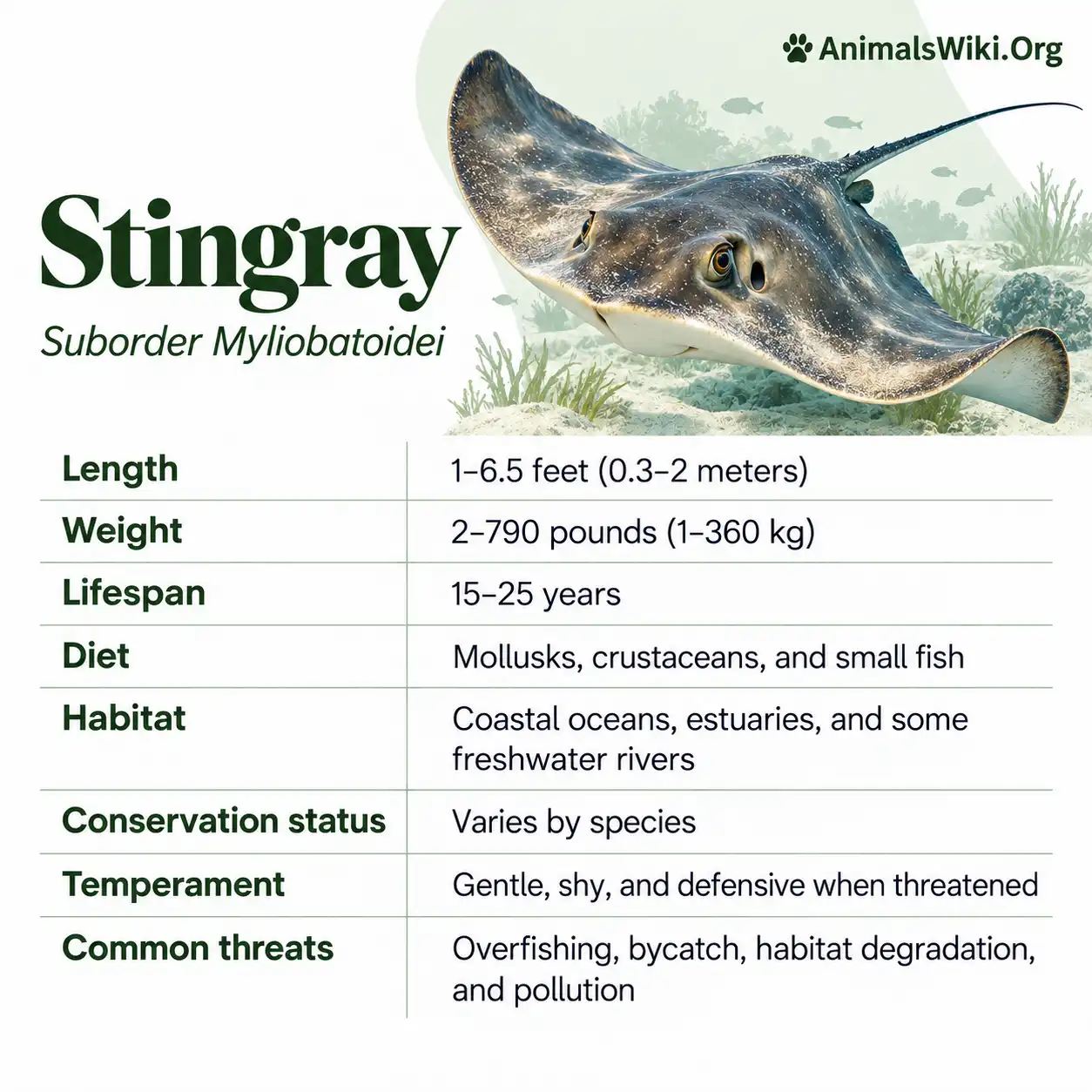
The stingray is one of the ocean’s most distinctive animals—a flattened, graceful fish famous for its broad wing-like fins, long tail, bottom-dwelling lifestyle, hidden mouth, powerful senses, and defensive venomous spine.
Stingrays may look completely different from familiar fish such as salmon, tuna, or clownfish, but they are genuine fish.
More specifically, stingrays are cartilaginous fish, meaning that their skeletons are composed primarily of cartilage rather than true bone.
They belong to the same broad evolutionary group as:
- Sharks
- Skates
- Manta rays
- Eagle rays
- Sawfishes
- Other rays
Stingrays have evolved a body perfectly suited to life close to the bottom.
Their greatly enlarged pectoral fins merge with the head and create a flattened disc. By moving these fins in smooth waves, a stingray can appear to “fly” through the water.
Many species spend substantial amounts of time resting or searching for prey across:
- Sandy seabeds
- Mudflats
- Estuaries
- Lagoons
- Coral reefs
- Seagrass beds
- Coastal waters
Some even live permanently in freshwater rivers.
Their mouths are located underneath the body.
This is ideal for feeding on bottom-dwelling prey such as:
- Crabs
- Shrimp
- Worms
- Mollusks
- Small fish
Some stingrays possess powerful flattened teeth capable of crushing hard shells.
Their eyes, however, are positioned on the upper surface of the body.
This creates an interesting problem: how does a stingray find food underneath itself when its eyes cannot directly watch its mouth?
The answer involves an extraordinary sensory system.
Like sharks, stingrays possess specialized electroreceptors called the ampullae of Lorenzini. These organs detect weak electrical fields produced by the muscles and nerves of other animals.
A stingray can therefore detect prey hidden beneath sand even when it cannot see it.
Another famous feature is the tail.
Many stingrays possess one or more serrated defensive spines—commonly called barbs or stingers—on the tail.
The spine is associated with venom-producing tissue.
However, the stingray is not normally an aggressive predator that actively hunts animals with its barb.
The spine is primarily a defensive weapon.
When threatened, trapped, grabbed, or accidentally stepped on, a stingray may rapidly whip its tail and drive the spine into an attacker.
This can cause:
- Deep puncture wounds
- Severe pain
- Tissue damage
- Infection
- Embedded spine fragments
Serious injuries can occur, although most stingrays would rather escape than confront a human.
Stingrays also possess remarkable reproductive biology.
Unlike many familiar fish that release enormous numbers of eggs into the water, many stingrays give birth to live young.
Developing embryos initially obtain nutrients from yolk and, in many species, later receive additional nutrient-rich uterine secretions often called histotroph or “uterine milk.”
At birth, young stingrays are miniature versions of adults and are generally capable of surviving independently.
Stingrays range enormously in size.
Some species are small enough to fit easily across a person’s hands, while giant freshwater stingrays can grow to extraordinary dimensions and rank among the world’s largest freshwater fishes.
From coral reefs and tropical lagoons to muddy rivers and sandy continental shelves, stingrays have evolved into a diverse and highly specialized group.
This comprehensive guide explores stingray facts, species, classification, anatomy, size, weight, habitat, distribution, diet, hunting, teeth, swimming, breathing, electroreception, camouflage, venom, stingray barbs, reproduction, baby stingrays, lifespan, predators, freshwater stingrays, stingray vs. manta ray differences, stingray vs. skate differences, conservation, human interactions, and much more.
Stingray Quick Facts
| Feature | Information |
|---|---|
| Common Name | Stingray |
| Animal Type | Fish |
| Skeleton | Cartilage |
| Class | Chondrichthyes |
| Broad Group | Rays and sharks |
| Habitat | Marine, brackish and freshwater depending on species |
| Distribution | Tropical and temperate waters worldwide |
| Diet | Carnivorous |
| Main Foods | Crustaceans, mollusks, worms and small fish |
| Body Shape | Flattened |
| Mouth | Underside |
| Eyes | Upper surface |
| Breathing | Gills |
| Special Sense | Electroreception |
| Tail Weapon | Venom-associated spine in many species |
| Main Defense | Escape, camouflage and tail spine |
| Reproduction | Commonly live-bearing |
| Young | Pups |
| Skeleton Material | Primarily cartilage |
What Is a Stingray?
A stingray is a flattened cartilaginous fish belonging to the ray lineage.
The name applies to numerous species rather than one single animal.
Stingrays are closely related to sharks.
Both belong to the class:
Chondrichthyes
The word comes from Greek roots referring to:
cartilage + fish
Their skeletons therefore differ fundamentally from the bony skeletons of most familiar fishes.
Are Stingrays Fish?
Yes.
Stingrays are genuine fish.
They:
- Live in water
- Breathe through gills
- Possess fins
- Have vertebral structures
- Are ectothermic
- Belong to an ancient fish lineage
Their highly flattened shape is simply an extreme adaptation to their lifestyle.
Are Stingrays Sharks?
No, but they are close relatives.
Sharks and rays belong to the same broad cartilaginous fish lineage.
Their ancestors share deep evolutionary relationships.
A typical shark has a streamlined body with large fins projecting outward.
A stingray’s body is flattened, with greatly enlarged pectoral fins fused to the sides of the head.
Scientific Classification of Stingrays
Broadly:
| Classification | Name |
|---|---|
| Kingdom | Animalia |
| Phylum | Chordata |
| Class | Chondrichthyes |
| Subclass | Elasmobranchii |
| Group | Batoidea |
| Common Group | Rays |
Stingrays occur across multiple families and genera, so there is no single scientific species name for “the stingray.”
How Many Species of Stingray Are There?
There are well over 200 species that may be described as stingrays under broad modern usage, depending on taxonomic treatment.
The ray lineage as a whole contains hundreds of species.
Stingrays include animals adapted to:
- Oceans
- Estuaries
- Coastal lagoons
- Coral reefs
- Freshwater rivers
Their diversity is much greater than the familiar coastal stingray alone suggests.
Types of Stingrays
Well-known stingray groups and species include:
- Southern stingray
- Atlantic stingray
- Round stingrays
- Bluespotted ribbontail ray
- Common stingray
- Pelagic stingray
- Freshwater whiprays
- Giant freshwater stingray
- River stingrays
Different species vary dramatically in:
- Size
- Color
- Habitat
- Tail length
- Diet
- Reproductive biology
Southern Stingray
The southern stingray (Hypanus americanus) is a well-known species of the western Atlantic.
It occurs around:
- Caribbean reefs
- Sandy flats
- Seagrass beds
- Coastal habitats
It often rests partially buried in sediment.
Bluespotted Ribbontail Ray
The bluespotted ribbontail ray (Taeniura lymma) is one of the most colorful rays.
It is famous for:
- Bright blue spots
- Blue markings along the tail
- Yellowish-brown body
- Reef-associated lifestyle
It occurs across parts of the Indo-Pacific.
Giant Freshwater Stingray
The giant freshwater stingray (Urogymnus polylepis) is one of the world’s largest freshwater fishes.
It inhabits major river systems of Southeast Asia.
Extremely large individuals can have enormous disc widths and body masses reaching hundreds of kilograms.
Its enormous size demonstrates that stingrays are not exclusively small coastal animals.
What Does a Stingray Look Like?
Typical stingrays possess:
- Broad flattened body
- Wing-like pectoral fins
- Eyes on top
- Spiracles behind the eyes
- Mouth underneath
- Gill openings underneath
- Long tail
- One or more defensive spines in many species
Viewed from above, many resemble rounded, diamond-shaped, or oval discs.
Why Are Stingrays Flat?
Flattening provides several advantages.
It allows stingrays to:
- Remain close to the seabed
- Hide beneath sediment
- Approach bottom prey
- Reduce their visible profile
- Move efficiently above the substrate
Their flattened form represents a major evolutionary specialization for bottom-associated life.
Stingray Wings
The structures commonly called “wings” are actually enlarged pectoral fins.
They extend along much of the sides of the body and connect closely with the head.
By moving these fins, stingrays generate lift and propulsion.
Do Stingrays Fly Underwater?
Not literally.
But their swimming can resemble flight.
Some rays move their pectoral fins in smooth waves, while others flap them more like wings.
The result can look remarkably similar to a bird flying through air.
How Do Stingrays Swim?
Most stingrays generate propulsion through movements of their enlarged pectoral fins.
Depending on species, these movements may be:
- Wave-like
- Undulating
- Flapping
The tail is generally less important for propulsion than the tail of a typical fish.
How Fast Can a Stingray Swim?
There is no single maximum stingray speed.
Speed varies enormously among species.
Bottom-dwelling stingrays generally rely more on:
- Efficient cruising
- Short bursts
- Maneuverability
- Camouflage
than sustained high-speed swimming.
Stingray Eyes
The eyes are located on the upper surface of the head.
This allows a resting stingray to watch the water above while much of its body remains close to or beneath the substrate.
However, the mouth is underneath.
Stingrays therefore rely on senses other than vision when locating prey directly beneath them.
Can Stingrays See?
Yes.
Stingrays possess functional eyes and use vision to understand their environment.
But vision is only one component of their sensory system.
They also rely heavily on:
- Smell
- Touch
- Water movement
- Electroreception
Stingray Spiracles
Behind the eyes are openings called spiracles.
These allow water to enter the respiratory system.
This is extremely useful for a bottom-dwelling animal.
If water entered primarily through a mouth pressed into sand, sediment could interfere with respiration.
Instead, water can enter through the upper spiracles and pass across the gills.
How Do Stingrays Breathe?
Stingrays breathe using gills.
Water containing dissolved oxygen passes across the gill surfaces.
Oxygen enters the bloodstream while carbon dioxide moves out.
The water then exits through gill slits located on the underside.
Can Stingrays Breathe While Buried?
Yes.
Spiracles allow many bottom-dwelling rays to draw relatively clean water from above the sediment while remaining partly buried.
This is a major adaptation for their lifestyle.
Stingray Mouth
The mouth is positioned on the underside of the body.
This location is ideal for feeding on organisms living:
- On the seabed
- Inside sediment
- Beneath rocks
- Among shells
The mouth may be difficult to see when viewing a stingray from above.
Stingray Teeth
Many stingrays possess flattened teeth arranged into crushing surfaces.
These are ideal for breaking hard prey such as:
- Clams
- Snails
- Crabs
- Other shellfish
Instead of slicing prey like many sharks, they can crush it.
Do Stingrays Have Teeth?
Yes.
The teeth often look very different from stereotypical triangular shark teeth.
They may form dense pavement-like plates capable of crushing shells.
Do Stingrays Lose and Replace Teeth?
Like other cartilaginous fishes, stingrays can continuously replace teeth throughout life.
Old or damaged teeth are replaced by newer ones.
What Do Stingrays Eat?
Stingrays are carnivores.
Common prey includes:
- Crabs
- Shrimp
- Worms
- Clams
- Snails
- Small fish
- Other crustaceans
- Bottom-dwelling invertebrates
Diet varies with species and habitat.
Are Stingrays Predators?
Yes.
Although they may look peaceful, stingrays are active predators of smaller animals.
They are not usually apex predators.
Instead, they often occupy intermediate positions within aquatic food webs.
How Do Stingrays Hunt?
A stingray may glide slowly above the bottom while searching for prey.
It can use:
- Smell
- Touch
- Vision
- Electroreception
to locate hidden animals.
Once prey is found, the stingray can position its body over it and capture it using the mouth underneath.
Can Stingrays Detect Electricity?
Yes.
Stingrays possess specialized sensory organs known as the ampullae of Lorenzini.
These detect weak electrical fields.
Living animals produce tiny electrical signals through:
- Muscle contractions
- Nerve activity
- Heart activity
A stingray can use these signals to locate prey that is difficult or impossible to see.
Ampullae of Lorenzini
The ampullae of Lorenzini consist of networks of small sensory pores and gel-filled canals.
They occur primarily around the head and snout.
These organs make stingrays extraordinarily sensitive to weak bioelectric signals.
Sharks possess similar electroreceptors.
Can Stingrays Find Prey Under Sand?
Yes.
This is one of the great advantages of electroreception.
A buried crab or fish may be invisible, but its body still produces electrical activity.
The stingray can detect that signal and investigate.
Do Stingrays Have a Good Sense of Smell?
Yes.
Chemical cues help stingrays locate food and gather information about their environment.
Smell works together with electroreception and other senses.
Stingray Camouflage
Many stingrays possess coloration that blends with the seabed.
Common colors include:
- Brown
- Gray
- Tan
- Olive
- Mottled patterns
Some species are dramatically patterned.
Camouflage helps both:
- Avoid predators
- Approach prey
Why Do Stingrays Bury Themselves?
A stingray may use its fins to throw sand over its body.
This can:
- Conceal it from predators
- Hide it from prey
- Allow resting
- Reduce visibility
Often only the eyes and spiracles remain exposed.
Stingray Tail
The tail varies greatly among species.
It may be:
- Long
- Whip-like
- Relatively short
- Thick
- Thin
Many species possess one or more defensive spines along the tail.
Stingray Barb
The famous stingray “stinger” is a modified spine.
It can be:
- Sharp
- Serrated
- Associated with venomous tissue
When used defensively, the tail can move rapidly and drive the spine into a perceived attacker.
Is a Stingray Barb Venomous?
Many stingray spines are associated with venom-producing tissue.
A sting can therefore cause intense pain beyond the mechanical puncture wound itself.
The spine may also leave fragments in the injury.
Is a Stingray Poisonous or Venomous?
Venomous is the more accurate term.
Venom is delivered through a wound.
A stingray’s defensive spine can introduce venom into tissue.
“Poisonous” usually refers to organisms that cause harm when eaten or touched in a way that transfers toxins without an injection mechanism.
Why Do Stingrays Have Stingers?
The spine is primarily defensive.
It helps protect the ray against predators.
It is not normally used to capture prey.
Do Stingrays Hunt With Their Stingers?
Generally, no.
They hunt using their:
- Mouth
- Crushing teeth
- Suction
- Sensory systems
The tail spine is primarily a defensive structure.
Are Stingrays Aggressive?
Stingrays are generally not aggressive toward humans.
Most prefer to escape.
Stings commonly occur when a ray:
- Feels trapped
- Is stepped on
- Is handled
- Is threatened
Respecting their space greatly reduces risk.
Why Do Stingrays Sting People?
In shallow water, a stingray may be buried beneath sand.
A person can accidentally step directly onto it.
The startled ray may defend itself with a rapid tail strike.
The response is defensive rather than predatory.
What Is the Stingray Shuffle?
In areas where stingrays commonly rest in shallow sandy water, people are sometimes advised to shuffle their feet rather than take large steps.
The disturbance can alert nearby rays and give them an opportunity to swim away.
Local safety advice should always be followed.
What Happens if a Stingray Stings You?
A stingray injury may cause:
- Severe pain
- Bleeding
- Swelling
- Tissue injury
- Retained spine fragments
- Infection
In rare circumstances, injuries can be life-threatening, particularly if the spine penetrates the chest, abdomen, neck, or a major blood vessel.
A serious stingray wound requires appropriate medical evaluation.
Can a Stingray Sting Kill a Human?
Fatalities are rare, but they can occur.
The greatest danger may come from:
- Penetrating trauma
- Injury to vital organs
- Major blood vessels
- Complications from the wound
Stingrays should therefore be respected despite their generally non-aggressive behavior.
Do Stingrays Die After Stinging?
No.
Unlike a honeybee, a stingray does not automatically die after using its spine.
The spine can also be replaced if lost or damaged.
Can a Stingray Regrow Its Barb?
A lost or damaged tail spine can be replaced as part of the animal’s natural growth process.
The exact process and timing vary.
Where Do Stingrays Live?
Stingrays occur across much of the world.
They inhabit:
- Tropical oceans
- Subtropical seas
- Temperate waters
- Estuaries
- Lagoons
- Rivers
Different species have evolved for very different environmental conditions.
Do Stingrays Live in the Ocean?
Yes.
Most stingray species are marine.
They occur from shallow coastal habitats to deeper offshore waters.
Do Stingrays Live in Freshwater?
Yes.
Several lineages have adapted to freshwater.
South America contains an especially distinctive radiation of freshwater stingrays.
Giant freshwater stingrays also inhabit Southeast Asian rivers.
Freshwater Stingrays
Freshwater stingrays may live their entire lives in river systems.
They have evolved physiological adaptations that allow them to maintain internal salt and water balance in freshwater.
This distinguishes them from marine rays that occasionally enter estuaries.
South American River Stingrays
The family Potamotrygonidae contains freshwater stingrays native to South America.
They occur in river systems including parts of the:
- Amazon
- Orinoco
- Paraná-Paraguay drainage
Many display striking circular or spotted patterns.
Stingrays in Coral Reefs
Coral reefs provide:
- Food
- Shelter
- Sandy feeding areas
- Complex habitats
Many tropical rays use reefs and adjacent sandy flats.
Stingrays in Seagrass Meadows
Seagrass ecosystems support abundant:
- Crustaceans
- Mollusks
- Worms
- Small fish
making them valuable feeding grounds for various rays.
Stingray Reproduction
Many stingrays reproduce through live birth rather than laying externally deposited eggs.
The reproductive process differs from that of skates.
Fertilization is internal.
Males possess specialized reproductive structures called claspers.
Male vs. Female Stingray
Male stingrays can usually be distinguished by their claspers.
These paired structures are located near the pelvic fins.
Females lack claspers.
In some species, females also grow larger than males.
Do Stingrays Lay Eggs?
Most true stingrays give birth to live young rather than depositing egg cases.
This differs from many skates, which typically lay egg cases sometimes called mermaid’s purses.
Stingray Pregnancy
After internal fertilization, embryos develop inside the female.
Initially, developing embryos receive nutrition from yolk.
In many species they later receive additional nutrient-rich secretions from the uterus.
These secretions are commonly called:
histotroph
or informally:
uterine milk.
Do Stingrays Have a Placenta?
Their reproductive biology differs from typical placental mammals.
Most stingrays do not possess a mammalian-style placenta.
Instead, embryos can receive nutrition through yolk and specialized uterine secretions.
Baby Stingray
A baby stingray is commonly called a pup.
At birth, pups resemble miniature adults.
They possess:
- Flattened bodies
- Developed fins
- Tails
- Functional sensory systems
They generally receive little parental care after birth.
How Many Babies Do Stingrays Have?
Litter size varies greatly by species.
Some produce only a few pups.
Others can produce larger litters.
Species producing fewer offspring may invest substantially in each developing pup.
Are Baby Stingrays Born With Stingers?
Young stingrays can possess developing defensive spines.
During birth, the spine is arranged in a way that reduces the risk of injuring the mother.
As the young grow, the defensive apparatus becomes fully functional.
Do Mother Stingrays Care for Their Babies?
Generally, there is little or no prolonged parental care after birth.
The pups are relatively well developed and begin independent life quickly.
Stingray Lifespan
Lifespan varies substantially among species.
Some may live for roughly a decade, while larger species can survive for several decades.
Because stingrays are diverse, a single lifespan figure should not be applied to the entire group.
Stingray Predators
Predators vary with species, size, and habitat.
Potential predators include:
- Large sharks
- Other large predatory fish
- Marine mammals in some ecosystems
- Large reptiles in certain habitats
- Humans
Young stingrays are particularly vulnerable.
Do Sharks Eat Stingrays?
Yes.
Several large shark species prey on rays.
Hammerhead sharks are particularly famous for feeding on stingrays.
Their broad heads contain extensive sensory systems useful for detecting rays.
Stingray Defense
Stingrays use several defensive strategies.
Camouflage
Helps avoid detection.
Burial
Allows the ray to disappear beneath sediment.
Escape
Swimming away is usually the preferred response.
Bony or Cartilaginous Body Structure
Provides some physical protection.
Venomous Tail Spine
Provides a powerful last-resort defense in many species.
Stingray Adaptations
Stingrays possess a remarkable collection of adaptations.
Flattened Body
Ideal for life near the bottom.
Enlarged Pectoral Fins
Provide smooth, efficient propulsion.
Eyes on Top
Allow observation while resting on the substrate.
Mouth Underneath
Ideal for capturing bottom-dwelling prey.
Spiracles
Allow breathing while partly buried.
Electroreceptors
Detect hidden prey.
Crushing Teeth
Break hard shells.
Camouflage
Makes rays difficult to see.
Tail Spine
Provides defense.
Live Birth
Produces relatively developed young.
Stingray vs. Manta Ray
Stingrays and manta rays are relatives, but their lifestyles differ substantially.
| Feature | Stingray | Manta Ray |
|---|---|---|
| Typical Habitat | Often bottom-associated | Open water / reef-associated |
| Diet | Bottom animals, small fish | Plankton and tiny organisms |
| Feeding | Benthic predation | Filter feeding |
| Tail Stinger | Present in many species | Absent in manta rays |
| Mouth | Usually underside | Large forward-facing mouth |
| Cephalic Lobes | Absent | Prominent |
| Body | Often bottom-adapted | Adapted for continuous swimming |
Manta rays are therefore not simply giant stingrays.
Stingray vs. Skate
Stingrays and skates can look similar.
| Feature | Stingray | Skate |
|---|---|---|
| Reproduction | Usually live-bearing | Usually egg-laying |
| Tail Spine | Common in stingrays | Generally absent as a venomous sting |
| Tail | Often whip-like | Often thicker |
| Egg Case | Usually no | Yes |
| Body Shape | Flattened | Flattened |
The distinctions vary somewhat across the diverse ray lineages.
Stingray vs. Shark
| Feature | Stingray | Shark |
|---|---|---|
| Skeleton | Cartilage | Cartilage |
| Body | Flattened | Usually streamlined |
| Pectoral Fins | Enlarged into disc | Separate fins |
| Gill Openings | Usually underneath | Usually on sides |
| Main Swimming Surface | Pectoral fins | Tail important |
| Electroreception | Yes | Yes |
Their shared features reflect common ancestry.
Stingray vs. Electric Ray
Electric rays possess specialized electric organs capable of producing strong electrical discharges.
Stingrays do not normally produce powerful electric shocks.
Their electrical ability is primarily sensory—they detect electrical fields.
Therefore:
Stingray = detects electricity
Electric ray = can generate substantial electrical discharge
Can Stingrays Electrocute You?
No.
Stingrays do not possess the powerful electric organs found in electric rays.
Their ampullae of Lorenzini detect electricity; they do not function as electrical weapons.
Stingray Intelligence
Research on rays and other elasmobranchs suggests they possess more sophisticated behavior than older stereotypes of fish imply.
Depending on species, rays can demonstrate:
- Learning
- Memory
- Environmental exploration
- Behavioral flexibility
However, broad claims about “stingray intelligence” should be made carefully because hundreds of ray species have different lifestyles.
Are Stingrays Social?
Some species are largely solitary.
Others may gather:
- At feeding areas
- During reproduction
- In suitable resting habitats
- During seasonal movements
Social behavior varies substantially among species.
Do Stingrays Sleep?
Stingrays have periods of reduced activity and rest.
They may settle onto or partly beneath the substrate.
Fish sleep differs from human sleep, but behavioral rest states clearly occur.
Can Stingrays Jump Out of Water?
Some rays can leap from the water.
This behavior is more famous in certain eagle rays and mobulid rays than in typical bottom-dwelling stingrays.
Possible explanations include:
- Communication
- Parasite removal
- Escape
- Social behavior
depending on species.
Stingray Evolution
Rays evolved from shark-like cartilaginous fish ancestors.
Over millions of years, their lineage became increasingly adapted to a flattened lifestyle.
Major evolutionary changes included:
- Flattening of the body
- Expansion of pectoral fins
- Movement of gill openings underneath
- Development of specialized bottom-feeding strategies
This produced one of the most distinctive vertebrate body plans in the ocean.
Why Are Stingrays Related to Sharks?
They share numerous fundamental traits, including:
- Cartilaginous skeleton
- Similar tooth replacement systems
- Electroreception
- Internal fertilization
- Similar skin structures
- Common evolutionary ancestry
A stingray can therefore be thought of as a highly specialized member of the broader shark-and-ray evolutionary radiation.
Stingray Ecological Importance
Stingrays influence aquatic ecosystems through their feeding.
By digging into sediment, they can disturb and turn over the seabed.
This process can affect:
- Nutrient cycling
- Sediment structure
- Small animal communities
- Food availability for other species
Their feeding pits may even create small microhabitats used by other organisms.
Stingrays as Ecosystem Engineers
When rays excavate sediment while hunting buried prey, they physically modify the seabed.
This bioturbation can:
- Redistribute nutrients
- Oxygenate sediment
- Expose hidden organisms
- Create feeding opportunities for other animals
Stingrays therefore influence ecosystems in ways extending beyond simply eating prey.
Are Stingrays Endangered?
There is no single conservation status for all stingrays.
Some remain relatively widespread.
Others are threatened with extinction.
Conservation status must be assessed species by species.
Major threats include:
- Targeted fishing
- Bycatch
- Habitat degradation
- River modification
- Pollution
- Coastal development
- Slow reproduction
Large freshwater species can be particularly vulnerable.
Why Are Some Stingrays Vulnerable to Overfishing?
Many rays share life-history traits that make population recovery relatively slow.
These can include:
- Slow growth
- Late maturity
- Long pregnancies
- Small litters
When adults are removed faster than offspring can replace them, populations may decline.
Freshwater Stingray Conservation
Freshwater stingrays face additional threats such as:
- Dams
- River modification
- Water pollution
- Habitat loss
- Fishing
- Accidental capture
Because rivers are geographically restricted compared with oceans, freshwater species may have limited opportunities to escape environmental disturbance.
Stingrays and Humans
Human interactions range from accidental encounters to ecotourism.
Stingray tourism occurs in some regions where rays regularly approach people.
Responsible interactions should prioritize:
- Animal welfare
- Natural behavior
- Safe distances
- Local regulations
- Avoiding unnecessary handling
Wild animals should not be treated as props.
Can You Touch a Stingray?
Some managed aquarium programs permit supervised touching of certain rays.
Wild stingrays should generally be given space.
Touching or grabbing a wild animal can cause stress and increase the risk of defensive behavior.
Are Stingrays Friendly?
“Friendly” is not an ideal scientific description.
Some rays become accustomed to people, particularly where feeding occurs.
Tolerance of humans should not be confused with domestication.
They remain wild animals.
40 Interesting Stingray Facts
- Stingrays are fish.
- Their skeletons consist primarily of cartilage.
- They are close relatives of sharks.
- Stingrays belong to the ray lineage Batoidea.
- There are many different stingray species.
- Their bodies are strongly flattened.
- Their “wings” are enlarged pectoral fins.
- Many swim by producing waves through these fins.
- Their eyes are located on top of the body.
- Their mouths are underneath.
- Their gill openings are underneath.
- Spiracles are positioned behind the eyes.
- Spiracles help bottom-dwelling rays breathe.
- Stingrays are carnivores.
- Many eat crabs.
- They also eat shrimp, worms, mollusks and small fish.
- Many possess crushing teeth.
- Stingrays can replace worn teeth.
- They can detect electrical fields.
- Their electroreceptors are called ampullae of Lorenzini.
- Electrical sensing helps locate buried prey.
- Many stingrays camouflage themselves against the seabed.
- Some bury themselves in sand.
- Many species possess a defensive tail spine.
- The spine is often associated with venomous tissue.
- Stingrays do not normally use the spine to hunt.
- They generally sting defensively.
- Most prefer escaping from humans.
- Stingrays do not die automatically after stinging.
- A damaged or lost spine can be replaced.
- Some stingrays live in freshwater.
- South America contains numerous freshwater stingray species.
- Southeast Asia has giant freshwater stingrays.
- Some freshwater stingrays rank among the world’s largest freshwater fish.
- Most true stingrays give birth to live young.
- Baby stingrays are called pups.
- Many embryos receive nutrient-rich uterine secretions.
- Sharks can prey upon stingrays.
- Stingray feeding can physically reshape seabed sediment.
- Some stingray species face serious conservation threats.
Did You Know?
A stingray can detect an animal hiding under sand without seeing it.
Imagine a small crab buried completely beneath the seabed.
To a human observer, the crab may be invisible.
But it is not electrically invisible.
Every heartbeat, nerve impulse, and muscular contraction produces extremely weak electrical activity.
Around the stingray’s head are tiny sensory structures connected to the ampullae of Lorenzini.
These organs contain specialized receptors capable of detecting weak electrical fields.
As the stingray moves across the bottom, it can combine information from:
- Electroreception
- Smell
- Touch
- Vision
- Water movement
to locate prey.
When it detects a hidden animal, the ray can position its flattened body over the target.
Its mouth lies underneath.
The prey may then be sucked from the sediment or crushed using powerful pavement-like teeth.
This remarkable system solves one of the strangest problems created by stingray anatomy.
The animal’s eyes are on top.
Its food is usually underneath.
It therefore does not need to see everything it eats.
It can sense living prey through the electrical signals produced by life itself.
Frequently Asked Questions About Stingrays
What is a stingray?
A stingray is a flattened cartilaginous fish belonging to the ray lineage.
Are stingrays fish?
Yes.
Are stingrays mammals?
No.
Are stingrays sharks?
No, but sharks and rays are close evolutionary relatives.
What are stingray skeletons made of?
Primarily cartilage rather than true bone.
Why are stingrays flat?
Their flattened bodies are adaptations for swimming and feeding near the bottom.
What are stingray wings?
They are greatly enlarged pectoral fins.
Can stingrays fly?
They do not fly through air, but their swimming movements can resemble underwater flight.
How do stingrays swim?
They move their enlarged pectoral fins in waves or flapping motions.
Where do stingrays live?
They occur in oceans, estuaries and, in some groups, freshwater rivers.
Do stingrays live in freshwater?
Yes. Several species spend their entire lives in freshwater.
Do stingrays live in rivers?
Some do.
Do stingrays live in coral reefs?
Many tropical species use coral reefs and nearby sandy habitats.
What do stingrays eat?
Crabs, shrimp, worms, mollusks, small fish and other animals.
Are stingrays carnivores?
Yes.
Do stingrays eat crabs?
Yes.
Do stingrays eat fish?
Many species consume small fish when available.
Do stingrays have teeth?
Yes.
What do stingray teeth look like?
Many species possess flattened, pavement-like teeth used for crushing hard prey.
Can stingrays replace their teeth?
Yes.
Where is a stingray’s mouth?
On the underside of its body.
Where are its eyes?
On the upper surface.
How does a stingray find food it cannot see?
It uses smell, touch and especially electroreception.
Can stingrays sense electricity?
Yes.
What are the ampullae of Lorenzini?
They are specialized sensory organs that detect weak electrical fields.
Can stingrays detect prey beneath sand?
Yes.
Why do stingrays bury themselves?
For camouflage, rest and sometimes hunting.
How do stingrays breathe under sand?
Spiracles behind the eyes allow water to enter from above and pass across the gills.
Do stingrays have gills?
Yes.
Do stingrays have lungs?
No.
What is a stingray barb?
It is a sharp defensive tail spine.
Is a stingray barb venomous?
In many species, the spine is associated with venom-producing tissue.
Are stingrays poisonous?
Venomous is the more accurate term.
Do stingrays use their barb to hunt?
Generally, no. It is primarily defensive.
Why do stingrays sting humans?
Most incidents occur when a ray feels threatened, trapped or is accidentally stepped on.
Are stingrays aggressive?
Generally not toward humans.
Can stingrays kill people?
Fatal injuries are rare but possible, especially when the spine penetrates vital areas.
Does a stingray die after stinging?
No.
Can a stingray regrow its barb?
A lost or damaged spine can be replaced.
What should you do around wild stingrays?
Give them space, avoid grabbing them, and follow local wildlife and water-safety guidance.
What is the stingray shuffle?
It is a technique sometimes recommended in stingray habitat in which people shuffle their feet through shallow sand to alert nearby rays rather than stepping directly onto them.
Do stingrays lay eggs?
Most true stingrays give birth to live young.
How do stingrays reproduce?
Fertilization is internal, and embryos develop inside the female.
What is histotroph?
Histotroph is a nutrient-rich uterine secretion that supports developing embryos in many rays.
What is a baby stingray called?
A pup.
Do stingrays care for their babies?
Usually there is little prolonged parental care after birth.
How many babies do stingrays have?
Litter size varies greatly by species.
How long do stingrays live?
Depending on species, they may live from around a decade to several decades.
What animals eat stingrays?
Large sharks are important predators, along with other large aquatic predators depending on habitat.
Do hammerhead sharks eat stingrays?
Yes. Stingrays can be important prey for some hammerhead species.
Can stingrays camouflage themselves?
Yes. Many closely match sandy or muddy bottoms.
Can stingrays electrocute humans?
No. Stingrays detect electrical fields but do not produce powerful defensive electrical shocks like electric rays.
What is the difference between a stingray and an electric ray?
Stingrays often possess defensive tail spines, while electric rays possess organs capable of generating electrical discharges.
Is a manta ray a stingray?
Manta rays are related rays but are distinct from the typical animals referred to as stingrays.
Do manta rays have stingers?
Manta rays do not possess the venomous tail spine characteristic of many stingrays.
What is the difference between a stingray and a skate?
Stingrays usually give birth to live young and often possess tail spines, while skates generally lay egg cases and lack a typical venomous sting.
What is the largest stingray?
The giant freshwater stingray is among the largest stingrays and among the world’s largest freshwater fishes.
Are stingrays endangered?
Conservation status varies by species. Some remain widespread, while others are threatened.
Why are stingrays threatened?
Fishing, bycatch, habitat destruction, pollution and slow reproduction can reduce populations.
Are stingrays important to ecosystems?
Yes. They are predators and can modify seabed habitats while searching for food.
Can people keep stingrays in aquariums?
Some species are maintained in large specialized aquariums, but their space, water-quality, dietary and safety requirements make them unsuitable for typical home setups.
Are stingrays dangerous to divers?
They generally avoid divers unless threatened or disturbed.
Are stingrays friendly?
Some tolerate humans, but they remain wild animals and should not be interpreted as domesticated or inherently friendly.
Conclusion
The stingray is one of the most highly specialized forms produced during the long evolutionary history of cartilaginous fish.
Its flattened appearance may seem simple at first, but nearly every part of its body reflects a sophisticated adaptation.
Its enormous pectoral fins allow it to glide smoothly over the bottom.
Its eyes remain above the body where they can watch for predators and environmental changes.
Its mouth lies underneath, perfectly positioned to capture animals living in and on the sediment.
Its spiracles solve the problem of breathing while resting against the seabed.
Instead of drawing sand-filled water through a downward-facing mouth, many stingrays can take in cleaner water through openings positioned behind the eyes.
Then there is electroreception.
A stingray does not need to see every animal it hunts.
Tiny electrical fields produced by the living tissues of buried prey can reveal animals hidden beneath the sand.
Combined with smell, touch, and other senses, this makes the stingray an extraordinarily effective bottom predator.
Its tail spine provides another form of specialization.
Despite its fearsome reputation, the sting is primarily defensive.
A stingray does not normally cruise across the seabed stabbing prey.
Instead, it feeds using its mouth and teeth while saving the tail spine for dangerous encounters.
This distinction is important because stingrays are often portrayed as naturally aggressive animals.
Most are not.
Given an opportunity, a stingray generally escapes rather than fights.
Many human injuries happen simply because the animal was hidden beneath shallow sand and was accidentally stepped on.
Their reproductive biology is equally fascinating.
Most true stingrays do not scatter thousands of eggs into the ocean.
Instead, females carry developing embryos internally.
In many species, embryos begin with yolk and later receive additional nourishment from nutrient-rich uterine secretions.
The resulting pups are born as functional miniature stingrays capable of beginning independent life.
Yet this reproductive investment can also create vulnerability.
Animals that grow slowly, mature late, and produce relatively few young cannot always replace individuals removed rapidly by fisheries.
Consequently, while some stingrays remain widespread, others face substantial conservation pressures.
Freshwater species can be especially vulnerable because rivers are easily altered by dams, pollution, fishing, and habitat destruction.
Stingrays also play important ecological roles.
When they excavate sand or mud in search of prey, they physically reshape the bottom.
Their feeding pits can move sediment, expose nutrients, and create opportunities for other animals.
A stingray is therefore more than a predator moving across the seabed—it can also function as a small-scale ecosystem engineer.
From tiny rays hidden beneath tropical sand to enormous freshwater stingrays inhabiting Southeast Asian rivers, these animals demonstrate the extraordinary versatility of the shark-and-ray lineage.
They can detect the electrical signature of hidden prey, crush armored shellfish, breathe while buried, glide with wing-like fins, produce live young, and defend themselves with a venom-associated spine.
The stingray’s unusual body is not an evolutionary oddity.
It is an exceptionally effective design for life at the boundary between water and the world beneath it.