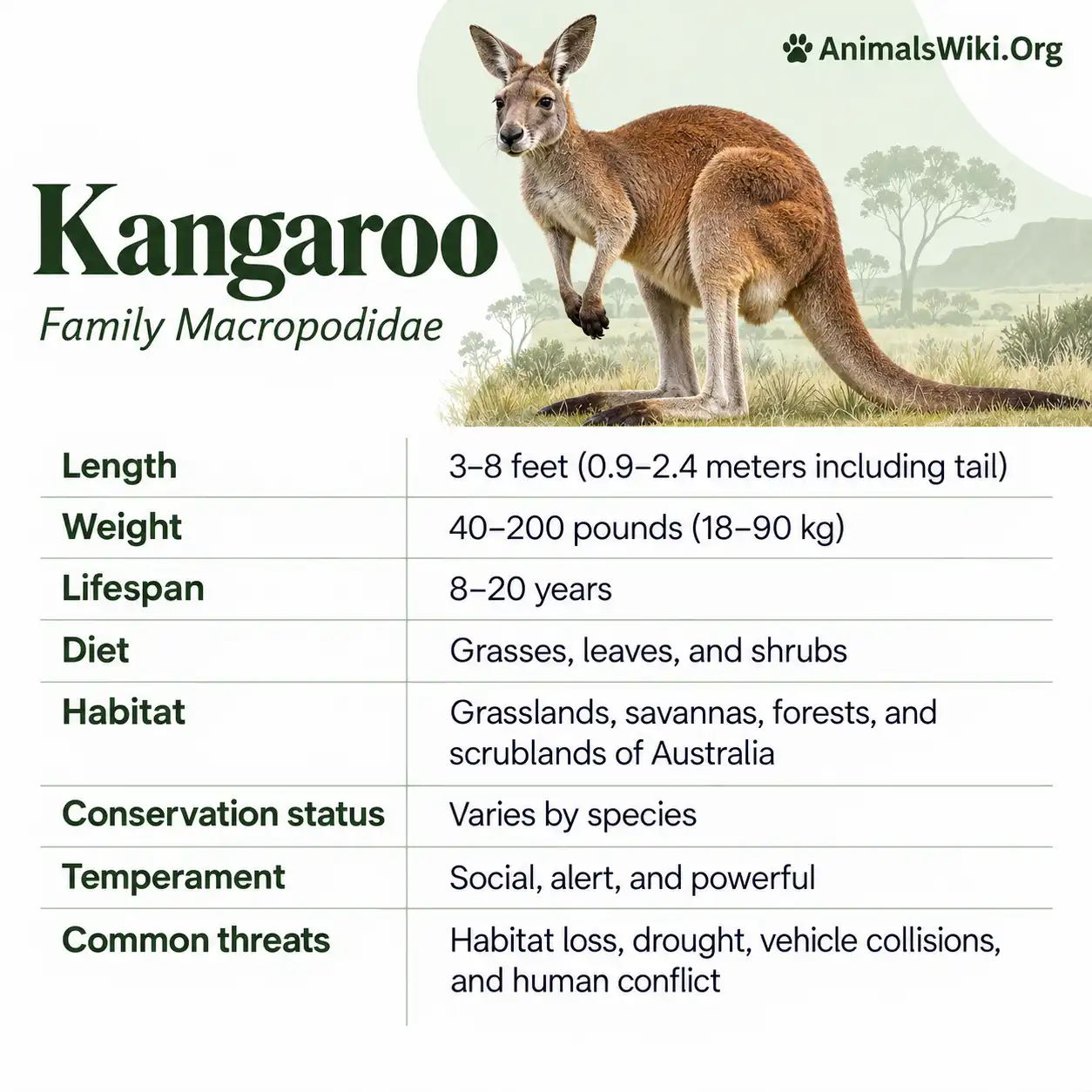
Kangaroo Facts, The Powerful Hopping Marsupials of Australia
The kangaroo is one of the world’s most recognizable animals and one of the strongest symbols of Australian wildlife. Famous for its enormous hind legs, muscular tail, upright posture, long feet, powerful hopping ability, and remarkable pouch-based reproduction, the kangaroo possesses a body plan unlike that of almost any large mammal outside Australia.
Kangaroos are marsupials.
Unlike placental mammals such as dogs, horses, elephants, and humans, kangaroos give birth to extremely small and developmentally immature young. The newborn—called a joey—then crawls into its mother’s pouch, attaches to a teat, and continues developing for months.
This extraordinary reproductive system is one of the defining features of kangaroo biology.
The word kangaroo does not technically refer to every hopping Australian marsupial.
In its narrower zoological sense, it is most commonly applied to the largest members of the family Macropodidae, especially species in the genus Osphranter and the genus Macropus.
The best-known living kangaroos include:
- Red kangaroo (Osphranter rufus)
- Eastern grey kangaroo (Macropus giganteus)
- Western grey kangaroo (Macropus fuliginosus)
- Antilopine kangaroo (Osphranter antilopinus)
The red kangaroo is the largest living marsupial.
A large adult male can stand well over 1.5 meters tall in an upright posture and weigh around 90 kg or more in exceptional cases.
But sheer size is only one remarkable aspect of kangaroo anatomy.
Their enormous hind limbs act like powerful biological springs.
During hopping, elastic tendons stretch and store energy when the feet contact the ground. That energy is released during the next leap.
As speed increases, this spring-like system allows kangaroos to travel surprisingly efficiently.
Their tail is equally impressive.
During rapid hopping, the tail contributes to balance and control.
During slow movement, however, kangaroos can use the tail in a completely different way. Together with the forelimbs, it can support and propel the body while the hind feet swing forward.
Researchers sometimes describe this form of slow locomotion as pentapedal movement because the tail effectively acts like an additional limb.
Kangaroos are also excellent examples of animals adapted to environments where water and food availability can fluctuate dramatically.
Most are herbivores, consuming grasses and other vegetation. Their digestive systems use microbial fermentation to extract nutrients from fibrous plant material.
They can survive dry conditions through combinations of:
- Efficient digestion
- Behavioral thermoregulation
- Reduced daytime activity
- Shade seeking
- Specialized reproduction
- Flexible movement across large areas
Their reproductive biology is especially sophisticated.
A female kangaroo can potentially support offspring at three developmental stages simultaneously:
- An older joey outside the pouch
- A younger joey inside the pouch
- A temporarily paused embryo in the uterus
The ability to delay embryonic development is known as embryonic diapause.
Even more remarkably, a mother can produce milk with different nutritional compositions for offspring at different developmental stages.
Kangaroos are therefore not simply unusual animals that hop.
They are highly specialized marsupials whose anatomy, reproduction, digestion, social behavior, and locomotion reflect millions of years of evolution in Australian environments.
This comprehensive guide explores kangaroo facts, species, scientific classification, size, weight, habitat, distribution, diet, hopping, speed, jumping, tail function, strength, pouch biology, reproduction, joeys, embryonic diapause, behavior, predators, lifespan, adaptations, kangaroo vs. wallaby differences, conservation, Australian ecology, and much more.
Kangaroo Facts
| Feature | Information |
|---|---|
| Common Name | Kangaroo |
| Animal Type | Mammal |
| Mammal Group | Marsupial |
| Family | Macropodidae |
| Main Genera | Macropus and Osphranter |
| Native Region | Australia |
| Largest Species | Red kangaroo |
| Largest Living Marsupial | Red kangaroo |
| Diet | Herbivorous |
| Main Food | Grasses and other vegetation |
| Movement | Bipedal hopping; pentapedal slow movement |
| Young | Joey |
| Female | Doe / Flyer |
| Male | Buck / Boomer |
| Group | Mob |
| Special Feature | Pouch |
| Tail | Large, muscular and functionally important |
| Activity | Often crepuscular or nocturnal |
| Main Threats | Vary by species and region |
What Is a Kangaroo?
A kangaroo is a large macropod marsupial native to Australia.
The family name Macropodidae means approximately:
“large foot.”
This is an extremely appropriate description.
Kangaroos possess enormously elongated hind feet that form part of their specialized hopping system.
Macropodidae also includes animals such as:
- Wallabies
- Wallaroos
- Tree-kangaroos
- Pademelons
- Quokkas
Therefore, not every macropod is properly called a kangaroo.
Scientific Classification of Kangaroos
Because “kangaroo” refers to several species, there is no single species-level scientific name for all kangaroos.
Their broad classification is:
| Classification | Name |
|---|---|
| Kingdom | Animalia |
| Phylum | Chordata |
| Class | Mammalia |
| Infraclass | Marsupialia |
| Order | Diprotodontia |
| Family | Macropodidae |
The familiar large kangaroos belong mainly to Macropus and Osphranter.
How Many Kangaroo Species Are There?
The term “kangaroo” is usually reserved for a handful of the largest macropods.
Four particularly important species are commonly recognized as kangaroos:
Red Kangaroo
Osphranter rufus
The largest living kangaroo and the largest living marsupial.
Eastern Grey Kangaroo
Macropus giganteus
A large grey species common across suitable habitats of eastern Australia.
Western Grey Kangaroo
Macropus fuliginosus
Found primarily across southern and western portions of Australia.
Antilopine Kangaroo
Osphranter antilopinus
A large northern Australian macropod adapted to tropical grasslands and woodlands.
Red Kangaroo
The red kangaroo is the largest and perhaps most iconic kangaroo species.
It inhabits much of Australia’s dry and semi-arid interior.
Large males may possess rich reddish-brown fur, while females and younger animals are often more blue-grey or brownish.
Red kangaroos are superbly adapted to:
- Open plains
- Grasslands
- Shrublands
- Arid environments
Their ability to cover long distances efficiently is especially valuable in landscapes where rainfall and food availability vary.
Eastern Grey Kangaroo
The eastern grey kangaroo occurs across much of eastern Australia.
It generally favors areas with:
- Grass
- Woodland
- Forest edges
- Suitable shelter
It is one of the kangaroos most frequently encountered near populated areas where appropriate habitat remains.
Eastern grey kangaroos are generally darker and more uniformly grey than red kangaroos.
Western Grey Kangaroo
Western grey kangaroos inhabit parts of:
- Western Australia
- Southern Australia
- South Australia
- Victoria
- New South Wales
They resemble eastern greys but are genetically and behaviorally distinct.
Males may produce a distinctive strong odor, contributing to regional nicknames such as “stinker.”
Antilopine Kangaroo
The antilopine kangaroo lives in northern Australia.
Its habitat includes:
- Tropical savannas
- Open woodland
- Grasslands
Its long limbs and body proportions give it an antelope-like appearance, which inspired its common name.
Kangaroo vs. Wallaby
Kangaroos and wallabies are closely related macropods.
The distinction is based largely on size and traditional naming rather than a single strict anatomical boundary.
| Feature | Kangaroo | Wallaby |
|---|---|---|
| Typical Size | Larger | Smaller |
| Legs | Very long | Usually shorter proportionally |
| Habitat | Often open landscapes | Many favor denser habitat |
| Family | Macropodidae | Macropodidae |
| Movement | Hopping | Hopping |
| Young | Joey | Joey |
A wallaby is therefore not simply a baby kangaroo.
It is a different macropod.
Kangaroo vs. Wallaroo
Wallaroos are generally intermediate in size between large kangaroos and smaller wallabies.
Several belong to the same broader evolutionary group as red and antilopine kangaroos.
They often inhabit:
- Rocky hills
- Escarpments
- Rugged country
The name “wallaroo” itself reflects its perceived intermediate position between “wallaby” and “kangaroo.”
What Does a Kangaroo Look Like?
Kangaroos possess an unmistakable body shape.
Typical features include:
- Small head
- Large mobile ears
- Short forelimbs
- Large hands
- Narrow upper body
- Powerful hips
- Huge hind legs
- Elongated feet
- Massive muscular tail
- Thick fur
Their body is strongly specialized toward the hindquarters.
Kangaroo Size
Size varies considerably among species and sexes.
Large red kangaroo males can reach an upright standing height approaching or exceeding:
1.8 meters (about 6 feet)
when measured to the head, although posture makes exact height comparisons difficult.
Including the tail, a large individual may exceed 2 meters in total length.
Females are substantially smaller.
Kangaroo Weight
A large male red kangaroo commonly weighs approximately:
55–90 kg (121–198 lb)
with exceptional individuals potentially exceeding this range.
Females are much lighter.
Eastern grey males can also become very large, sometimes exceeding 60 kg (132 lb).
Size varies according to:
- Species
- Sex
- Age
- Nutrition
- Geographic population
What Is the Largest Kangaroo?
The red kangaroo (Osphranter rufus) is the largest living kangaroo.
It is also the largest living marsupial.
Adult males are substantially larger than females.
Male vs. Female Kangaroo
Kangaroos display pronounced sexual dimorphism.
| Feature | Male | Female |
|---|---|---|
| Common Terms | Buck / Boomer | Doe / Flyer |
| Size | Much larger | Smaller |
| Muscularity | Very high in adults | Lower |
| Pouch | No | Yes |
| Competition | Strong between males | Less direct fighting |
| Reproductive Role | Competes for mating opportunities | Pregnancy, pouch care, lactation |
Large adult males can develop extremely muscular:
- Shoulders
- Arms
- Chest
- Neck
These muscles are important during competition with other males.
Why Are Male Kangaroos So Muscular?
Male kangaroos compete for access to females.
Physical size and strength can influence reproductive success.
Males may:
- Display
- Grapple
- Push
- Wrestle
- Kick
each other.
Over evolutionary time, sexual competition has favored powerful upper bodies in large males.
Kangaroo Ears
Kangaroos possess large, mobile ears.
The ears can rotate to detect sounds from different directions.
Excellent hearing helps identify:
- Predators
- Other kangaroos
- Environmental disturbances
Their hearing complements strong vision and smell.
Kangaroo Eyesight
Kangaroos have good vision suited to detecting movement across open environments.
Their eyes are positioned toward the sides of the head, providing a broad field of view.
This helps them detect potential danger while feeding.
Kangaroo Sense of Smell
Smell is also important.
Kangaroos can use scent to gather information about:
- Food
- Other kangaroos
- Reproductive condition
- Environmental conditions
Multiple senses work together to maintain awareness in open habitats.
Where Do Kangaroos Live?
Wild kangaroos are native to Australia.
Different species occupy different regions.
Collectively, kangaroos can be found across enormous portions of the continent.
Habitats include:
- Grasslands
- Savannas
- Open woodlands
- Shrublands
- Semi-arid regions
- Forest edges
- Agricultural landscapes
Do Kangaroos Live Only in Australia?
The large animals traditionally called kangaroos are native to Australia.
The wider macropod family also includes species occurring naturally in:
- New Guinea
- Nearby islands
Tree-kangaroos, for example, occur in Australia and New Guinea.
However, the iconic large red and grey kangaroos are Australian animals.
Do Kangaroos Live in the Desert?
Some species, especially red kangaroos, are strongly associated with Australia’s arid and semi-arid interior.
However, they are not limited to true desert.
Red kangaroo habitat includes:
- Open grassland
- Shrubland
- Semi-desert
- Dry plains
They depend heavily on vegetation produced by rainfall.
Do Kangaroos Live in Forests?
Some kangaroo species use:
- Open forest
- Woodland
- Forest edges
Eastern grey kangaroos frequently occur in landscapes combining grassy feeding areas with nearby woodland cover.
Dense rainforest is generally not typical habitat for the large open-country kangaroos.
What Do Kangaroos Eat?
Kangaroos are herbivores.
Their diet consists primarily of vegetation.
Foods include:
- Grasses
- Leaves
- Shoots
- Herbs
- Shrubs
- Other plant material
Diet varies among species and habitats.
Red and grey kangaroos are particularly important grazers.
Do Kangaroos Eat Meat?
Kangaroos are not adapted as predators.
Their normal diet is plant-based.
Rare unusual feeding observations do not change their fundamental classification as herbivorous mammals.
Do Kangaroos Eat Grass?
Yes.
Grass is a major component of the diet of many large kangaroo species.
Their teeth and digestive systems are well adapted to processing fibrous vegetation.
Do Kangaroos Drink Water?
Yes.
Kangaroos drink when water is available.
However, some species are extremely well adapted to dry environments and can obtain substantial moisture from vegetation.
Their water requirements depend on:
- Temperature
- Food moisture
- Species
- Activity
- Reproductive condition
Kangaroo Digestive System
Kangaroos use foregut fermentation.
Microorganisms living in specialized parts of the digestive tract break down fibrous plant material.
This allows nutrients to be extracted from grasses and leaves that would otherwise be difficult to digest.
Their system differs anatomically from the four-chambered stomach of cattle.
Do Kangaroos Chew Cud?
Kangaroos can regurgitate and rechew food under some circumstances, a behavior sometimes compared with rumination.
However, their digestive anatomy is different from true ruminants such as:
- Cattle
- Sheep
- Deer
It is therefore better to describe kangaroos as foregut fermenters rather than true ruminants.
Kangaroo Teeth
Kangaroos possess teeth specialized for plant material.
Their front teeth help cut vegetation.
Their cheek teeth grind fibrous food.
An especially interesting adaptation occurs in some macropods: as heavily worn molars are lost, teeth farther back can move forward.
This helps maintain effective grinding surfaces despite years of consuming abrasive vegetation.
Why Do Kangaroos Hop?
Hopping is extremely effective for large macropods traveling across open environments.
Their hind limbs contain:
- Large muscles
- Long bones
- Elastic tendons
During each landing, tendons stretch and store energy.
That energy is released during the next leap.
At moderate to high speeds, this system can make hopping remarkably energy efficient.
How Do Kangaroos Hop?
Both hind legs move together during fast hopping.
The sequence is approximately:
- Kangaroo lands on its hind feet.
- Tendons stretch under load.
- Elastic energy is stored.
- Powerful muscles and tendons propel the body forward.
- The tail helps stabilize the body.
- The feet land again.
- The cycle repeats.
This spring-like system reduces the muscular energy required for each jump.
Kangaroo Speed
Large kangaroos can reach approximately:
50–60 km/h (31–37 mph)
during short bursts.
Exact maximum speeds vary among species, individuals, terrain, and measurement methods.
They normally travel much more slowly.
How High Can a Kangaroo Jump?
Large kangaroos can clear obstacles around:
1.5–2 meters (5–6.5 feet)
under suitable conditions.
Exceptional jumps may be higher.
How Far Can a Kangaroo Jump?
A large kangaroo moving rapidly can cover roughly:
8–9 meters (26–30 feet)
in a single bound under exceptional conditions.
Normal hops are considerably shorter.
Can Kangaroos Walk?
Kangaroos cannot walk using the alternating hind-leg gait typical of humans.
Their anatomy makes independent forward movement of each large hind limb difficult on land.
Instead, slow movement uses a remarkable pattern called pentapedal locomotion.
Pentapedal Locomotion
During slow movement, a kangaroo:
- Places its forelimbs on the ground.
- Places its muscular tail on the ground.
- Uses the forelimbs and tail to support the body.
- Swings both hind legs forward together.
- Places the hind feet down.
- Repeats the process.
The tail therefore functions almost like a fifth leg.
Biomechanical studies show that it can contribute substantial propulsive force.
Kangaroo Tail
The kangaroo’s tail is not merely a balancing device.
It is:
- Large
- Muscular
- Strong
- Structurally important
It serves different functions depending on movement.
During Hopping
It helps with:
- Balance
- Posture
- Midair control
During Slow Movement
It helps:
- Support body weight
- Propel the body forward
During Fighting
It can help stabilize the body while the hind legs deliver kicks.
Can a Kangaroo Stand on Its Tail?
A kangaroo does not normally balance exclusively on its tail like a tripod pole.
During fighting, however, the tail and body posture provide strong support while the hind feet leave the ground.
During slow locomotion, the tail also bears significant load.
Kangaroo Legs
The hind legs are enormously powerful.
Important features include:
- Long thigh and lower-leg bones
- Large muscles
- Long feet
- Strong tendons
- Specialized ankle structure
They provide propulsion for both hopping and defensive kicking.
Kangaroo Feet
Kangaroo feet are elongated and specialized.
The fourth toe is especially large and strong.
The hind foot includes a long claw capable of contributing to defense.
These feet function as powerful levers during hopping.
Kangaroo Arms
The forelimbs are much smaller than the hind limbs but remain highly useful.
They are used for:
- Feeding
- Grooming
- Manipulating vegetation
- Slow locomotion
- Grappling during fights
Large males develop particularly muscular arms.
Can Kangaroos Swim?
Yes.
Kangaroos can swim.
Interestingly, while the hind legs usually move together on land, they can move independently in water.
This demonstrates that the inability to alternate the legs during terrestrial walking is related to locomotor mechanics rather than complete neurological inability.
Are Kangaroos Good Swimmers?
They can swim effectively when necessary.
Kangaroos may enter water to:
- Cross waterways
- Escape danger
- Cool themselves
Swimming is not their primary form of locomotion, but they are capable aquatic movers.
Kangaroo Strength
Large male kangaroos are extremely strong for their body size.
Their strength is concentrated especially in:
- Hind legs
- Hips
- Tail
- Shoulders
- Forearms
However, claims that kangaroos are a specific number of times stronger than humans are generally unsupported.
Their anatomy is specialized for very different tasks.
Kangaroo Kick
A kangaroo’s kick can be extremely powerful.
During a serious fight or defensive encounter, a kangaroo may:
- Grapple with its forelimbs.
- Shift weight backward.
- Use the tail for support.
- Lift both hind legs.
- Kick forward.
The large claws can cause serious injuries.
Do Kangaroos Box?
Yes, although “boxing” is a simplified description.
Male kangaroos fight using:
- Forelimb grappling
- Pushing
- Wrestling
- Striking
- Powerful hind-leg kicks
Their fights often determine access to females and social dominance.
Why Do Kangaroos Fight?
Common reasons include:
- Competition for females
- Dominance
- Establishing rank
- Defense
Young males may also spar playfully, developing skills needed later in adulthood.
Are Kangaroos Aggressive?
Wild kangaroos generally prefer avoiding humans.
However, large individuals can become dangerous when:
- Cornered
- Threatened
- Habituated to people
- Competing
- Protecting themselves
People should maintain respectful distance from wild kangaroos.
Are Kangaroos Dangerous to Humans?
Potentially.
Serious attacks are uncommon compared with everyday peaceful encounters, but a large male possesses:
- Strong arms
- Powerful legs
- Large claws
- Considerable body weight
Feeding or approaching wild kangaroos can increase risk by encouraging habituation.
What Is a Group of Kangaroos Called?
A group of kangaroos is commonly called a mob.
Other terms such as herd or troop may occasionally be used, but mob is especially associated with kangaroos.
Kangaroo Social Behavior
Many large kangaroos are social.
A mob may contain:
- Females
- Joeys
- Juveniles
- Adult males
Group composition changes over time.
Individuals can join and leave.
Larger groups may provide improved predator detection.
Kangaroo Dominance
Adult males can form dominance relationships.
Larger, stronger males often gain greater access to receptive females.
Dominance may be established through:
- Displays
- Sparring
- Wrestling
- Kicking
Not every interaction escalates into a serious fight.
Kangaroo Communication
Kangaroos communicate using:
- Body posture
- Touch
- Scent
- Vocalizations
- Foot thumping
Mothers and joeys maintain especially important communication.
Why Do Kangaroos Thump the Ground?
A kangaroo may strike or thump the ground with its feet as an alarm signal.
The sound and vibration can alert nearby kangaroos to potential danger.
Do Kangaroos Make Sounds?
Yes.
Depending on species and context, kangaroos can produce:
- Cough-like sounds
- Grunts
- Hisses
- Clicking or clucking sounds
- Growls
Joeys and mothers also use vocal communication.
Are Kangaroos Nocturnal?
Many kangaroos are most active:
- At dawn
- At dusk
- At night
This helps them avoid extreme daytime heat.
Activity patterns vary according to:
- Weather
- Season
- Food
- Human disturbance
How Do Kangaroos Stay Cool?
Australian heat creates major physiological challenges.
Kangaroos use several cooling strategies.
They may:
- Rest in shade
- Reduce daytime activity
- Increase breathing rate
- Lick their forearms
- Allow saliva to evaporate from the skin
The forearms contain blood vessels close to the surface.
Evaporative cooling can help reduce blood temperature.
Why Do Kangaroos Lick Their Arms?
They spread saliva across relatively hairless areas of the forearms.
As the saliva evaporates, it removes heat.
This is especially useful during hot weather.
Kangaroo Reproduction
Kangaroo reproduction is among the most extraordinary reproductive systems of any mammal.
Females possess:
- A reproductive tract specialized for marsupial reproduction
- A pouch
- Multiple teats
- Ability in some species to delay embryo development
- Ability to produce milk tailored to different joey stages
Pregnancy is short compared with placental mammals of similar adult size.
Kangaroo Pregnancy
Gestation varies among species but is commonly only around one month.
For example, red kangaroo pregnancy lasts roughly 33 days.
The newborn is therefore extremely undeveloped.
Baby Kangaroo
A baby kangaroo is called a joey.
At birth, a joey is:
- Tiny
- Hairless
- Blind
- Extremely immature
Despite this, it must make an extraordinary journey.
How Big Is a Newborn Kangaroo?
A newborn kangaroo can be only around:
2–3 cm long
and may weigh less than a gram in some species.
This is extraordinary considering that the mother may weigh tens of kilograms.
How Does a Baby Kangaroo Get Into the Pouch?
After birth, the newborn joey emerges from the reproductive tract.
Using relatively well-developed forelimbs, it climbs through its mother’s fur toward the pouch.
The mother does not simply pick it up and place it inside.
Once inside, the joey locates a teat and attaches.
Kangaroo Pouch
The pouch is called a marsupium.
It provides:
- Protection
- Warmth
- Access to milk
- A controlled developmental environment
The pouch is not simply an empty pocket.
It is living tissue containing:
- Mammary glands
- Muscles
- Skin
- Microbial communities
Do Male Kangaroos Have Pouches?
No.
Only females possess functional pouches for raising young.
Is a Kangaroo Pouch Open at the Top?
In large kangaroos, the pouch opens toward the front/top region of the abdomen.
Muscles around the opening help the mother control it.
Is the Inside of a Kangaroo Pouch Hairy?
The inner pouch is largely less furry than the outer body.
It contains mammary teats and specialized skin.
The environment changes as the joey develops.
How Long Does a Joey Stay in the Pouch?
The exact period depends on species.
In large kangaroos, joeys may remain heavily dependent on the pouch for many months.
Eventually they begin:
- Looking outside
- Leaving briefly
- Returning for protection and milk
Later they permanently leave the pouch while often continuing to nurse.
Can a Joey Return to the Pouch?
Yes.
During the transitional stage, a joey may leave to explore and then return.
As it becomes larger, pouch entry eventually stops.
How Does a Joey Breathe in the Pouch?
The pouch is not airtight.
Air can circulate through the opening.
The joey therefore breathes normally with lungs.
What Does a Joey Eat?
Initially, a joey drinks only milk.
As it grows, it begins experimenting with vegetation.
Eventually it transitions toward the adult herbivorous diet.
Kangaroo Milk
Kangaroo milk changes composition as the joey develops.
Early milk differs from later milk in proportions of:
- Fat
- Protein
- Carbohydrates
- Bioactive compounds
This allows the mother’s milk to match the offspring’s changing nutritional needs.
Can a Kangaroo Produce Two Types of Milk at Once?
Remarkably, yes.
A female can sometimes nurse:
- A younger joey attached to one teat
- An older joey using another teat
Different mammary glands can produce milk of different composition suited to each offspring.
This phenomenon is known as asynchronous concurrent lactation.
Embryonic Diapause
One of the most remarkable kangaroo adaptations is embryonic diapause.
After mating, a fertilized embryo may begin development and then temporarily pause.
The embryo remains in a suspended state until conditions are appropriate for development to continue.
Triggers can include:
- Presence of a young joey
- Lactation
- Environmental conditions
Why Do Kangaroos Pause Pregnancy?
Embryonic diapause helps females coordinate reproduction with:
- Pouch availability
- Existing offspring
- Food conditions
- Environmental conditions
If an older joey dies or leaves the pouch, a paused embryo may resume development.
This can allow rapid reproductive replacement.
Can a Kangaroo Have Three Babies at Once?
A female can potentially support offspring at three stages:
- An older joey outside the pouch but still nursing.
- A younger joey developing inside the pouch.
- A dormant embryo waiting in the uterus.
This does not mean she has three fully developed babies inside her body.
It reflects three different stages of reproductive investment.
Kangaroo Birth
Kangaroo birth is dramatically different from birth in most large placental mammals.
The newborn is extremely tiny.
After emerging, it crawls independently toward the pouch.
Its forelimbs are unusually well developed relative to the rest of its body because they are essential for this climb.
Kangaroo Mother and Joey
The bond between mother and joey is central to kangaroo reproduction.
The mother provides:
- Milk
- Protection
- Warmth
- Pouch access
- Social learning
A frightened young joey may rapidly return to its mother’s pouch.
Do Kangaroo Fathers Care for Joeys?
Direct paternal care is generally limited.
Males primarily compete for mating opportunities.
The mother carries the overwhelming burden of:
- Pregnancy
- Lactation
- Pouch care
- Protection
Kangaroo Lifespan
Lifespan varies by species and environment.
Large kangaroos may commonly survive roughly:
8–15 years in the wild
with some individuals living longer.
Under managed conditions, some can survive beyond 20 years.
Kangaroo Predators
Natural predators can include:
- Dingoes
- Large eagles, particularly for small young
- Large reptiles in some contexts
Historically, extinct Australian predators also interacted with macropods.
Humans are now a major influence on kangaroo populations through:
- Hunting
- Land management
- Vehicles
- Habitat change
Do Dingoes Eat Kangaroos?
Yes.
Dingoes are important predators of kangaroos.
They may target:
- Young animals
- Smaller individuals
- Injured kangaroos
- Adults under suitable circumstances
Dingo predation can influence kangaroo behavior and population dynamics.
Do Eagles Eat Kangaroos?
Large eagles such as the wedge-tailed eagle can prey on small joeys or young macropods.
Healthy adult large kangaroos are generally too large to be normal eagle prey.
Kangaroo Defense
Kangaroos defend themselves using:
- Speed
- Powerful hopping
- Forelimb grappling
- Hind-leg kicks
- Large claws
- Strong tail support
Avoidance is usually the first strategy.
Physical fighting occurs when escape is difficult or during competition.
Do Kangaroos Drown Predators?
Stories often claim kangaroos deliberately lure predators into water specifically to drown them.
The reality is more nuanced.
Kangaroos may flee into water when pursued.
If a predator follows, a kangaroo can defend itself using its forelimbs and body position, potentially holding an attacker underwater.
This can be dangerous for pursuing dogs.
However, describing every entry into water as a calculated “drowning trap” overstates the evidence.
Kangaroo Adaptations
Kangaroos possess numerous remarkable adaptations.
Powerful Hind Legs
Provide rapid, energy-efficient hopping.
Elastic Tendons
Store and release energy between hops.
Long Feet
Act as powerful levers.
Muscular Tail
Provides balance and propulsion.
Large Ears
Improve predator detection.
Foregut Fermentation
Allows digestion of fibrous plants.
Pouch
Protects highly undeveloped young.
Embryonic Diapause
Allows reproductive timing to adjust to offspring and environmental conditions.
Specialized Lactation
Provides age-specific milk.
Arm Licking
Promotes evaporative cooling.
Activity Timing
Reduces exposure to extreme heat.
Kangaroo vs. Rabbit
Kangaroos and rabbits both possess large hind legs, but they are not closely related.
| Feature | Kangaroo | Rabbit |
|---|---|---|
| Mammal Type | Marsupial | Placental mammal |
| Native Region | Australia | Multiple regions |
| Young | Joey | Kit |
| Pouch | Yes in female | No |
| Tail | Large and muscular | Short |
| Locomotion | Large bipedal hopping | Quadrupedal hopping |
| Family | Macropodidae | Leporidae |
Their similarities are examples of different mammalian lineages evolving jumping adaptations independently.
Kangaroo vs. Deer
Both are large herbivores but belong to completely different mammalian groups.
Deer are placental mammals and true ruminants.
Kangaroos are marsupials and foregut fermenters.
Kangaroos hop.
Deer run on four legs.
Kangaroo vs. Wallaby
The main distinction is generally body size and ecological adaptation.
Kangaroos are typically the largest members of their broader macropod group.
Wallabies tend to be:
- Smaller
- More compact
- Often associated with denser habitats
Both raise joeys in pouches.
Kangaroo vs. Koala
Both are Australian marsupials, but their lifestyles are dramatically different.
| Feature | Kangaroo | Koala |
|---|---|---|
| Family | Macropodidae | Phascolarctidae |
| Locomotion | Hopping | Climbing |
| Habitat | Grassland/woodland | Eucalyptus woodland/forest |
| Diet | Grasses and vegetation | Primarily eucalyptus leaves |
| Tail | Large | Externally almost absent |
| Pouch | Yes | Yes |
| Lifestyle | Mostly terrestrial | Arboreal |
Kangaroo vs. Quokka
The quokka is also a macropod.
However, it is much smaller.
Quokkas belong to Setonix brachyurus and are famous for their rounded faces and restricted distribution in southwestern Australia.
Both quokkas and kangaroos are members of Macropodidae.
Kangaroo vs. Tree-Kangaroo
Tree-kangaroos are macropods adapted for climbing.
Unlike large ground kangaroos, they possess:
- Shorter, broader hind feet
- Strong forelimbs
- Climbing adaptations
- Greater ability to move limbs independently
They inhabit forests of New Guinea and northeastern Australia.
Kangaroo Evolution
Kangaroos belong to an ancient Australian marsupial radiation.
Their ancestors evolved as Australia’s climate and vegetation changed over millions of years.
As open grasslands expanded, large grazing macropods developed increasingly specialized adaptations for:
- Efficient hopping
- Long-distance travel
- Grass consumption
- Dry environments
The modern kangaroo body plan reflects this evolutionary history.
Why Are Kangaroos Found in Australia?
Australia’s long geographic isolation allowed marsupials to diversify with less competition from many placental mammal groups found on other continents.
Marsupials evolved into ecological roles filled elsewhere by various placental mammals.
This produced Australia’s extraordinary diversity of:
- Kangaroos
- Wallabies
- Koalas
- Wombats
- Possums
- Other marsupials
Giant Prehistoric Kangaroos
Australia once supported much larger and more diverse macropods.
The extinct genus Procoptodon included giant short-faced kangaroos.
Some species stood considerably taller than modern kangaroos and had unusual:
- Short faces
- Different feet
- Browsing adaptations
They disappeared during the late Pleistocene.
Were Giant Kangaroos Bigger Than Modern Kangaroos?
Yes.
Some extinct macropods were substantially heavier than modern red kangaroos.
Procoptodon goliah is often estimated to have weighed well over 100 kg, although precise estimates vary.
Australia’s prehistoric ecosystems contained a remarkable diversity of giant marsupials.
Kangaroos and Australian Ecosystems
Kangaroos influence ecosystems through:
- Grazing
- Seed movement
- Nutrient cycling
- Vegetation modification
- Predator-prey relationships
Their grazing can affect:
- Grass height
- Plant composition
- Habitat structure
Their ecological impact varies with rainfall, population density, livestock abundance, and land management.
Kangaroo Population
There is no single fixed number of kangaroos in Australia.
Populations fluctuate dramatically.
Rainfall can cause vegetation to increase, allowing populations to expand.
Drought can then reduce:
- Food
- Water
- Reproductive success
- Survival
Population estimates therefore need to specify:
- Species
- Region
- Survey year
Are Kangaroos Endangered?
There is no single conservation status for everything called a kangaroo or macropod.
Several of the familiar large kangaroo species remain widespread and abundant.
Other macropods have much smaller populations and face serious conservation problems.
Threats across the wider group can include:
- Habitat loss
- Habitat fragmentation
- Altered fire regimes
- Predation by introduced species
- Climate change
- Vehicle collisions
- Hunting
- Competition with livestock
Conservation status must therefore be considered species by species.
Kangaroos and Roads
Vehicle collisions are a major issue in many parts of Australia.
Kangaroos may move onto roads:
- At dusk
- At night
- Around dawn
These are also times when visibility for drivers is reduced.
Road collisions can injure or kill both kangaroos and people.
Kangaroos and Humans
Humans and kangaroos frequently share landscapes.
Interactions occur in:
- Farmland
- Parks
- Golf courses
- Suburbs
- Roadsides
- Nature reserves
Wild kangaroos should not be treated as domestic animals.
Feeding can cause:
- Habituation
- Aggression
- Poor nutrition
- Increased conflict
Can Kangaroos Be Pets?
Kangaroos are wild animals with complex requirements.
They need:
- Large spaces
- Appropriate social environments
- Specialized diets
- Veterinary care
- Legal authorization in many jurisdictions
They are generally unsuitable as conventional household pets.
Kangaroo Cultural Importance
The kangaroo is one of Australia’s most powerful national symbols.
It appears in:
- Art
- Tourism
- Sports
- Company branding
- Government symbolism
- The Australian coat of arms
The kangaroo has also held profound cultural importance for Aboriginal Australian peoples for thousands of years.
Different Indigenous communities have their own:
- Languages
- Stories
- Ecological knowledge
- Hunting traditions
- Cultural relationships
connected to kangaroos and other macropods.
40 Interesting Kangaroo Facts
- Kangaroos are mammals.
- They are marsupials.
- They belong to the family Macropodidae.
- Macropodidae means approximately “large foot.”
- Kangaroos are native to Australia.
- The red kangaroo is the largest living marsupial.
- Male red kangaroos can weigh around 90 kg or more in exceptional cases.
- Males are substantially larger than females.
- A baby kangaroo is called a joey.
- Female kangaroos possess pouches.
- Male kangaroos do not have functional pouches.
- A newborn joey can weigh less than one gram.
- Newborn joeys are blind and hairless.
- A newborn crawls to the pouch after birth.
- The mother does not simply place it inside.
- Joeys attach to a teat inside the pouch.
- Kangaroo milk changes as a joey grows.
- A mother can produce different milk for different-aged offspring.
- Some kangaroos use embryonic diapause.
- Embryonic diapause temporarily pauses embryo development.
- A female can support offspring at three developmental stages.
- Kangaroos are herbivores.
- Grass is important food for many species.
- Kangaroos use foregut fermentation.
- Their huge hind legs are specialized for hopping.
- Both hind legs move together during fast terrestrial hopping.
- Elastic tendons store energy between hops.
- Hopping becomes highly efficient at faster speeds.
- Kangaroos can reach around 50–60 km/h in short bursts.
- Large kangaroos can make exceptionally long leaps.
- Their tail helps balance during hopping.
- Their tail also provides propulsion during slow movement.
- Slow kangaroo movement is sometimes called pentapedal locomotion.
- Kangaroos can swim.
- Their hind legs can move independently while swimming.
- Male kangaroos wrestle and kick during fights.
- A group of kangaroos is called a mob.
- Kangaroos may lick their forearms to cool themselves.
- Dingoes are important kangaroo predators.
- Kangaroos are among the world’s most specialized large hopping mammals.
Did You Know?
A female kangaroo can effectively care for three generations of offspring at the same time.
This is possible because kangaroo reproduction works very differently from reproduction in most familiar large mammals.
Imagine an adult female red kangaroo.
Outside her pouch may be an older joey that has already begun feeding on vegetation but still returns to its mother for milk.
Inside her pouch may be a much younger joey that is still developing while attached to a teat.
At the same time, another embryo may already exist inside her reproductive tract—but its development has temporarily stopped.
This phenomenon is called embryonic diapause.
When conditions become appropriate, the embryo can resume development.
The mother’s reproductive system can therefore coordinate offspring across three stages:
older dependent joey → pouch joey → dormant embryo
The system becomes even more extraordinary because the mother’s mammary glands can produce different kinds of milk simultaneously.
An older joey needs milk rich enough to support a large, active youngster.
A tiny pouch joey requires a completely different nutritional formula.
Different teats can provide milk suited to these different developmental stages.
Rather than being a simple pocket for carrying a baby, the kangaroo pouch is therefore part of one of the most sophisticated reproductive systems among mammals.
Frequently Asked Questions About Kangaroos
What is a kangaroo?
A kangaroo is a large hopping marsupial belonging to the family Macropodidae.
Are kangaroos mammals?
Yes.
Are kangaroos marsupials?
Yes.
What does marsupial mean?
A marsupial is a mammal belonging to a group whose young are typically born at an extremely early developmental stage and continue development while closely associated with the mother’s teats, often inside a pouch.
What is the scientific name of a kangaroo?
There is no single scientific name for all kangaroos because several species are called kangaroos.
What family do kangaroos belong to?
Macropodidae.
What does Macropodidae mean?
Approximately “large-footed.”
How many types of kangaroo are there?
The name kangaroo is most commonly applied to several large macropod species, especially the red, eastern grey, western grey, and antilopine kangaroos.
What is the largest kangaroo?
The red kangaroo.
What is the largest marsupial?
The red kangaroo is the largest living marsupial.
Where do kangaroos live?
They live naturally in Australia.
Do kangaroos live only in Australia?
The iconic large kangaroos are native to Australia, while other macropods occur in New Guinea and nearby islands.
Do kangaroos live in deserts?
Some, particularly red kangaroos, inhabit arid and semi-arid environments.
Do kangaroos live in forests?
Some species use woodland, open forest, and forest edges.
What do kangaroos eat?
Mostly grasses, leaves, herbs, shoots, and other vegetation.
Are kangaroos herbivores?
Yes.
Do kangaroos eat meat?
Meat is not a normal component of their diet.
Do kangaroos eat grass?
Yes. Grass is especially important for many large kangaroos.
Do kangaroos drink water?
Yes, although some can survive for extended periods using moisture obtained from food when conditions permit.
Do kangaroos chew cud?
They are foregut fermenters and may regurgitate and rechew food, but they are not true ruminants like cattle.
How tall is a kangaroo?
Large males can stand around 1.5–1.8 meters or more depending on species, individual, and posture.
How much does a kangaroo weigh?
Large males may weigh from around 50 kg to 90 kg or more, depending on species.
Are male kangaroos bigger than females?
Yes, often dramatically.
Why are male kangaroos muscular?
Male competition favors large body size and powerful muscles used during wrestling and fighting.
What is a male kangaroo called?
Common terms include buck and boomer.
What is a female kangaroo called?
Doe and flyer are commonly used terms.
What is a baby kangaroo called?
A joey.
What is a group of kangaroos called?
A mob.
Do kangaroos have pouches?
Females do.
Do male kangaroos have pouches?
No.
What is a kangaroo pouch called?
A marsupium.
Is a kangaroo pouch just a hole?
No. It is a specialized living structure containing mammary teats, muscles, skin, and other tissues.
How small is a newborn kangaroo?
A newborn can be only a few centimeters long and weigh less than one gram.
Are newborn kangaroos blind?
Yes. They are extremely undeveloped.
How does a joey get into the pouch?
It crawls from the birth opening through the mother’s fur and into the pouch using its forelimbs.
Does the mother put the joey in the pouch?
No. The newborn normally makes the journey itself.
How long is a kangaroo pregnant?
Gestation is short, often around one month depending on species.
How long does a joey stay in the pouch?
Several months, with exact timing depending on species.
Can a joey leave and return to the pouch?
Yes, during a transitional stage.
Can kangaroos pause pregnancy?
Some species can delay embryonic development through embryonic diapause.
What is embryonic diapause?
It is a temporary pause in embryo development.
Why do kangaroos use embryonic diapause?
It allows reproduction to be coordinated with existing offspring and environmental conditions.
Can a kangaroo have three babies at once?
A female may simultaneously support an older joey, a pouch joey, and a dormant embryo.
Can kangaroos produce different milk at the same time?
Yes. Different mammary glands can produce milk suited to different-aged offspring.
Why do kangaroos hop?
Their specialized hind limbs and elastic tendons make hopping an efficient way to travel across open landscapes.
How fast can a kangaroo run?
Kangaroos hop rather than run conventionally and can reach roughly 50–60 km/h during short bursts.
How high can kangaroos jump?
Large individuals can clear obstacles around 1.5–2 meters under suitable conditions.
How far can kangaroos jump?
Exceptional bounds can approach roughly 8–9 meters.
Can kangaroos walk?
They cannot walk with an alternating hind-leg gait like humans. At slow speeds they use the forelimbs, tail, and hind legs in pentapedal locomotion.
What is pentapedal locomotion?
It is slow movement in which the forelimbs and tail support and propel the body while both hind legs swing forward.
Is a kangaroo’s tail a fifth leg?
Functionally, it acts somewhat like one during slow movement.
Why do kangaroos have such big tails?
The tail provides balance, support, stabilization, and propulsion.
Can kangaroos stand on their tails?
The tail provides major support during fighting and slow locomotion, although they do not normally balance solely on it.
Can kangaroos swim?
Yes.
Are kangaroos good swimmers?
They are capable swimmers and can cross waterways when necessary.
Do kangaroos move both legs together while swimming?
No. Unlike terrestrial hopping, the hind legs can move independently during swimming.
Why do kangaroos box?
Male kangaroos grapple and strike during competition, especially over mating opportunities.
Do kangaroos kick?
Yes. Powerful hind-leg kicks are important weapons.
Can a kangaroo kick hurt a human?
Yes. Large kangaroos can cause serious injuries.
Are kangaroos dangerous?
They generally avoid people, but large animals can be dangerous if threatened or habituated.
Do kangaroos drown dogs?
Kangaroos may flee into water and can defend themselves against pursuing dogs, potentially holding an attacker underwater. The popular claim that they always deliberately lure dogs into drowning traps is an exaggeration.
Are kangaroos nocturnal?
Many are most active around dusk, night, and dawn.
Why do kangaroos lick their arms?
Evaporating saliva helps cool blood flowing through vessels near the skin.
Do kangaroos sweat?
Their thermoregulation relies on several mechanisms, including evaporative cooling through licking and panting.
How long do kangaroos live?
Large species commonly live around 8–15 years in the wild, although some survive longer.
What animals eat kangaroos?
Dingoes are important predators. Eagles can take small young.
Do dingoes eat kangaroos?
Yes.
Do eagles eat kangaroos?
Large eagles can prey on joeys and smaller young animals.
Are kangaroos endangered?
Several familiar large species remain widespread, but conservation status varies among species and the wider macropod family.
What is the difference between a kangaroo and a wallaby?
Kangaroos are generally larger, while wallabies are usually smaller and more compact.
Is a wallaby a baby kangaroo?
No. A baby kangaroo is a joey.
What is the difference between a kangaroo and wallaroo?
Wallaroos are generally intermediate in size and often associated with rocky environments.
Are kangaroos related to koalas?
Both are marsupials, but they belong to different families and are not especially close relatives within the marsupial radiation.
Are kangaroos related to rabbits?
No. Rabbits are placental mammals.
Why are kangaroos only naturally found in Australia?
Australia’s long geographic isolation allowed marsupials to diversify into many ecological roles.
Were prehistoric kangaroos bigger?
Some extinct macropods were substantially larger than modern species.
What was the giant short-faced kangaroo?
Species of Procoptodon were large extinct Australian macropods with unusual short faces and body proportions.
Why are kangaroos important?
They influence Australian ecosystems through grazing, nutrient cycling, vegetation modification, and predator-prey relationships.
Conclusion
The kangaroo is far more than an animal that moves by jumping.
Its entire body represents one of the most specialized approaches to terrestrial locomotion among large mammals.
Enormous hind legs provide propulsion. Long feet act as powerful levers. Elastic tendons capture energy from each landing and return it during the next leap. A huge muscular tail stabilizes the body at high speed and becomes an active propulsive structure when the animal slows down.
The result is an animal capable of moving rapidly across enormous Australian landscapes while using energy with remarkable efficiency.
But locomotion is only part of the kangaroo’s extraordinary biology.
Its reproductive system is even more unusual.
A newborn joey enters the world at an extraordinarily early developmental stage. Blind, hairless, and sometimes weighing less than a gram, it nevertheless climbs through its mother’s fur and enters the pouch without being placed there.
Inside, it attaches to a teat and continues developing.
Months later, the same joey that began life smaller than many insects can emerge as a recognizable young kangaroo.
Meanwhile, its mother may already be supporting another reproductive stage.
Through embryonic diapause, development of another embryo can temporarily stop until conditions are appropriate.
An older joey may still be drinking milk outside the pouch while a younger joey nurses inside it—and the mother can produce milk with different nutritional compositions for each.
Few mammalian reproductive systems demonstrate such remarkable flexibility.
Kangaroos are also products of Australia’s extraordinary evolutionary history.
Long geographic isolation allowed marsupials to diversify into ecological roles occupied by very different mammals elsewhere. As Australia’s climate became increasingly dry and open grasslands expanded, large macropods developed efficient hopping and grazing adaptations.
Modern kangaroos now occupy environments ranging from tropical savannas and open forests to semi-arid plains.
They are prey for dingoes, grazers that influence vegetation, and important components of Australian food webs.
They also share landscapes increasingly modified by people.
Roads, agriculture, livestock, fencing, suburbs, hunting, drought, and changing fire patterns all influence kangaroo populations in different ways.
Some large species remain extremely widespread, while other members of the broader macropod family face much greater conservation challenges.
For humans, the kangaroo has become inseparable from the image of Australia.
Yet behind that familiar silhouette is a mammal possessing one of nature’s most extraordinary combinations of spring-powered locomotion, tail-assisted walking, heat adaptation, marsupial reproduction, embryonic diapause, specialized lactation, and environmental resilience.
From a newborn joey weighing less than a gram to a muscular adult male capable of covering several meters in a single bound, the kangaroo demonstrates just how dramatically evolution can reshape the mammalian body.