Seahorse Facts, The Remarkable Ocean Fish With Male Pregnancy
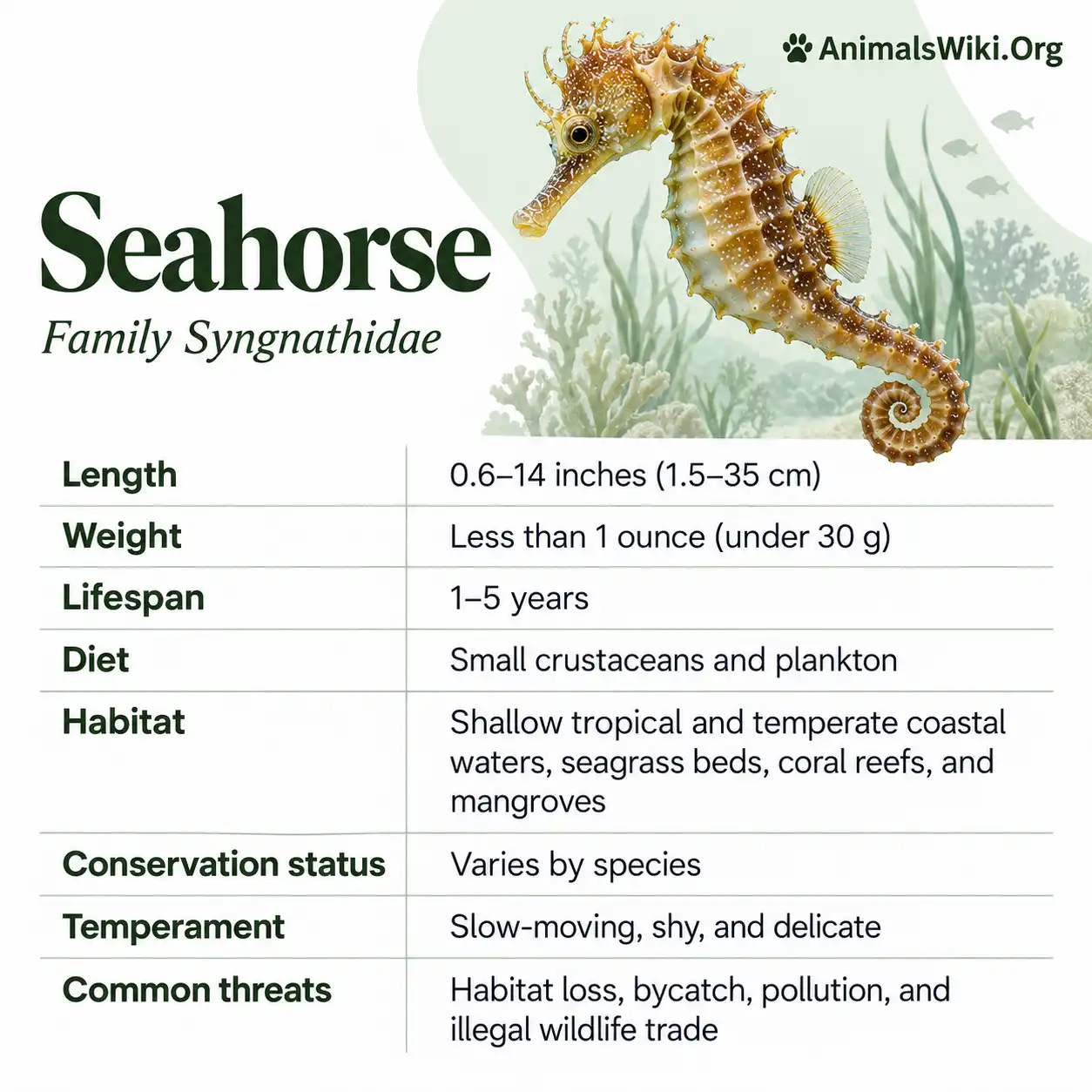
The seahorse is one of the most unusual and instantly recognizable fish in the ocean. With its horse-shaped head, upright swimming posture, curled grasping tail, independently moving eyes, tube-shaped snout, armored body, and extraordinary reproductive system in which the male becomes pregnant and gives birth, the seahorse seems almost unlike a fish at all.
But seahorses are genuine fish.
They possess:
- Gills
- Fins
- A backbone
- A swim bladder
- An aquatic vertebrate body plan
Seahorses belong to the genus Hippocampus and the family Syngnathidae, which also contains their close relatives:
- Pipefishes
- Pipehorses
- Seadragons
The scientific name Hippocampus comes from ancient Greek words associated with horse and sea monster, reflecting the animal’s distinctive horse-like head.
There are dozens of recognized seahorse species, ranging from tiny pygmy seahorses barely longer than a fingernail to much larger species exceeding 20 centimeters in length.
They inhabit shallow coastal waters across many tropical and temperate regions of the world.
Typical seahorse habitats include:
- Seagrass meadows
- Mangrove roots
- Coral reefs
- Estuaries
- Seaweed beds
- Sponge communities
- Rocky coastal habitats
Unlike powerful open-water fish such as tuna, sharks, or mackerel, seahorses are generally weak swimmers.
Their bodies are held vertically rather than horizontally, and propulsion is generated primarily by a rapidly beating dorsal fin.
Tiny pectoral fins near the head help with:
- Steering
- Balance
- Fine positioning
Instead of relying on speed, seahorses survive through camouflage, patience, precision, and attachment.
Their long, muscular tails are prehensile, meaning they can wrap around objects.
A seahorse may anchor itself to:
- Seagrass
- Coral
- Mangrove roots
- Seaweed
- Sponges
- Other underwater structures
This prevents currents from sweeping the animal away and provides a stable position from which to hunt.
Seahorses are predators.
They feed primarily on tiny animals such as:
- Copepods
- Amphipods
- Mysid shrimp
- Small crustaceans
- Larval organisms
- Other zooplankton
Rather than chasing prey, a seahorse often waits almost motionless.
Its eyes can move independently, helping it scan its surroundings.
When prey comes within range, the seahorse rapidly lifts and positions its head before sucking the animal through its narrow tubular snout.
The entire strike can happen in a fraction of a second.
But the most famous seahorse adaptation is reproductive.
In seahorses, the male carries the developing embryos.
During mating, the female transfers eggs into a specialized brood pouch on the male’s body. The male fertilizes the eggs, regulates the internal pouch environment, supplies important physiological support during development, and eventually goes through muscular contractions that expel fully formed baby seahorses into the water.
Depending on species and individual size, a male may release anywhere from relatively few to hundreds—and in some species potentially far more—young during a reproductive event.
The babies receive little or no parental care after birth.
From their first moments outside the pouch, they must:
- Swim
- Feed
- Avoid predators
- Find suitable habitat
on their own.
This extraordinary combination of male pregnancy, camouflage, suction feeding, independent eye movement, vertical swimming, bony armor, and a grasping tail makes seahorses among the most specialized fish on Earth.
This comprehensive guide explores seahorse facts, species, scientific classification, anatomy, size, habitat, distribution, diet, hunting, swimming, camouflage, eyes, prehensile tail, male pregnancy, courtship, mating, birth, baby seahorses, lifespan, predators, adaptations, conservation, seahorse vs. pipefish differences, and much more.
Seahorse Facts
| Feature | Information |
|---|---|
| Common Name | Seahorse |
| Scientific Genus | Hippocampus |
| Animal Type | Fish |
| Family | Syngnathidae |
| Class | Actinopterygii |
| Habitat | Coastal marine habitats |
| Distribution | Tropical and temperate seas |
| Diet | Carnivorous |
| Main Foods | Small crustaceans and zooplankton |
| Swimming Position | Upright |
| Main Propulsion | Dorsal fin |
| Tail | Prehensile |
| Teeth | Absent |
| Typical Feeding | Suction feeding |
| Reproduction | Sexual |
| Pregnancy | Male |
| Egg Producer | Female |
| Young | Baby seahorses / fry |
| Parental Care After Birth | Usually little or none |
| Major Adaptations | Camouflage, suction feeding, grasping tail, male pregnancy |
What Is a Seahorse?
A seahorse is a small marine fish belonging to the genus Hippocampus.
Although its appearance is highly unusual, it is a true fish.
Seahorses possess:
- Vertebral columns
- Gills
- Fins
- Internal organs typical of fishes
- Swim bladders
Their strange appearance reflects extreme specialization rather than membership in a completely different animal group.
Scientific Classification of Seahorses
| Classification | Name |
|---|---|
| Kingdom | Animalia |
| Phylum | Chordata |
| Class | Actinopterygii |
| Order | Syngnathiformes |
| Family | Syngnathidae |
| Genus | Hippocampus |
Individual seahorse species then possess their own species names.
Are Seahorses Really Fish?
Yes.
Seahorses are genuine ray-finned fish.
They breathe using gills and move using fins.
Their unusual features—including an upright posture and prehensile tail—make them look radically different from familiar fish, but their evolutionary ancestry and anatomy clearly identify them as fish.
Why Are They Called Seahorses?
Their head resembles the profile of a small horse.
They possess:
- Long snout
- Curved neck
- Prominent head
- Upright posture
This resemblance inspired the common name seahorse.
What Does Hippocampus Mean?
The genus name Hippocampus comes from ancient Greek roots:
- hippos = horse
- kampos = sea creature or sea monster
The name therefore reflects the animal’s horse-like appearance.
How Many Species of Seahorse Are There?
There are more than 40 recognized species, with taxonomic revisions and new scientific descriptions occasionally changing the exact total.
Seahorse identification can be difficult because:
- Species may resemble each other.
- Color can change.
- Body projections vary.
- Geographic populations differ.
- Individuals may resemble their habitat.
Genetic research has helped clarify many species relationships.
Types of Seahorses
Well-known species include:
Common Seahorse
Hippocampus kuda
A widespread Indo-Pacific species associated with shallow coastal habitats.
Lined Seahorse
Hippocampus erectus
Found in the western Atlantic.
Long-Snouted Seahorse
Hippocampus guttulatus
Occurs in parts of the northeastern Atlantic and Mediterranean region.
Short-Snouted Seahorse
Hippocampus hippocampus
Another European and Mediterranean species.
Big-Belly Seahorse
Hippocampus abdominalis
One of the largest seahorse species, associated particularly with waters around Australia and New Zealand.
Bargibant’s Pygmy Seahorse
Hippocampus bargibanti
A tiny species famous for extraordinary camouflage among gorgonian corals.
Denise’s Pygmy Seahorse
Hippocampus denise
Another extremely small coral-associated species.
Pygmy Seahorses
Pygmy seahorses are among the smallest and most visually remarkable seahorses.
Some measure only around 1.5–2.5 centimeters long.
They can be exceptionally difficult to see because their:
- Color
- Body texture
- Knob-like projections
closely resemble the coral or other habitat in which they live.
Bargibant’s pygmy seahorse is particularly famous for blending almost perfectly into gorgonian sea fans.
Largest Seahorse
The big-belly seahorse (Hippocampus abdominalis) is among the largest living seahorses.
Large individuals can exceed approximately:
30 centimeters (12 inches)
in length.
This is enormous compared with tiny pygmy species.
Smallest Seahorses
Some pygmy seahorses measure less than 2 centimeters.
At this size, an adult animal can be shorter than a human thumb.
The difference between the largest and smallest seahorses demonstrates the extraordinary diversity within Hippocampus.
What Does a Seahorse Look Like?
A typical seahorse possesses:
- Horse-shaped head
- Long tubular snout
- Curved neck
- Upright body
- Large eyes
- Small mouth
- Dorsal fin
- Small pectoral fins
- Bony body rings
- Curled prehensile tail
Unlike most fish, the body is covered not with typical scales but with bony plates arranged beneath the skin.
Seahorse Body Armor
Seahorses possess an external framework of bony plates.
These form rings around the body and tail.
The armor helps:
- Support the body
- Protect internal tissues
- Resist crushing
It also contributes to the animal’s stiff appearance.
A seahorse cannot flex its body in the same fluid manner as many other fish.
Do Seahorses Have Scales?
No typical fish scales cover their bodies.
Instead, seahorses possess skin stretched over a series of bony plates.
This gives them a hard, armored exterior.
Seahorse Snout
The long snout acts like a biological suction tube.
A seahorse does not chew prey.
Instead, it rapidly expands parts of the head and mouth cavity, creating suction.
The prey is pulled through the snout and swallowed.
Do Seahorses Have Teeth?
No.
Seahorses lack conventional teeth.
Their feeding strategy does not require chewing.
Small prey is swallowed whole.
Do Seahorses Have Stomachs?
Seahorses lack a conventional true stomach comparable with that of many vertebrates.
Food moves relatively rapidly through their digestive tract.
This contributes to the need for frequent feeding.
Seahorse Eyes
Seahorses possess well-developed eyes that can move largely independently.
One eye may inspect prey while the other scans another part of the environment.
This ability provides a broad visual field without requiring the seahorse to move its entire head or body.
Can Seahorses Move Their Eyes Independently?
Yes.
Independent eye movement is one of their best-known sensory adaptations.
It helps with both:
- Hunting
- Predator detection
Once prey is targeted, the eyes can coordinate more closely during the final strike.
Can Seahorses See Well?
Vision is important to seahorses.
They rely heavily on sight to detect tiny moving prey.
Their hunting style requires accurate estimation of:
- Distance
- Position
- Movement
This is particularly important because they feed through rapid suction strikes.
Seahorse Tail
The seahorse tail is one of its most extraordinary structures.
It is prehensile, meaning it can grasp and wrap around objects.
A seahorse may anchor its tail around:
- Seagrass
- Coral
- Seaweed
- Mangrove roots
- Sponge branches
This is especially valuable in currents and waves.
Why Do Seahorses Curl Their Tails?
Curling allows the tail to grip underwater structures.
This helps:
- Prevent drifting
- Save swimming energy
- Maintain position while feeding
- Hide within vegetation
- Remain near a mate or territory
Why Is a Seahorse Tail Square?
Research into seahorse biomechanics has shown that the tail’s cross-sectional structure is unusual compared with the cylindrical tails of many animals.
Its bony plates create a somewhat square-shaped cross section.
This design combines:
- Flexibility
- Strength
- Resistance to crushing
- Controlled bending
The structure has even inspired research into biomimetic engineering and robotics.
Can Seahorses Swim?
Yes.
Despite their unusual posture, seahorses are capable swimmers.
However, they are generally poor long-distance swimmers compared with streamlined fish.
How Do Seahorses Swim?
The main propulsive fin is the dorsal fin on the back.
It beats rapidly to push the animal forward.
Small pectoral fins near the head help with:
- Steering
- Turning
- Stability
The seahorse adjusts gas inside its swim bladder to help control buoyancy.
Why Do Seahorses Swim Upright?
The vertical posture is a highly specialized feature of the seahorse body plan.
It may help them maneuver through vertically structured habitats such as:
- Seagrass
- Coral
- Mangrove roots
Their ancestors evolved from more horizontally oriented pipefish-like fishes.
Are Seahorses Slow Swimmers?
Yes.
Seahorses are generally among the slower-moving fishes.
Their stiff armored bodies and tiny fins are not designed for sustained high-speed swimming.
Instead, they rely on:
- Camouflage
- Attachment
- Ambush feeding
- Habitat structure
Can Seahorses Swim Backward?
Seahorses can maneuver in multiple directions by adjusting their fins and body position.
Their swimming is highly controlled at short range, although they lack the speed and agility of many open-water fishes.
Seahorse Swim Bladder
A gas-filled swim bladder helps the seahorse regulate buoyancy.
By adjusting its buoyancy, a seahorse can maintain depth without constantly swimming upward.
Damage or disease affecting buoyancy can severely impair its ability to survive.
Where Do Seahorses Live?
Seahorses occur in coastal waters of many tropical and temperate regions.
Habitats include:
- Seagrass meadows
- Coral reefs
- Mangrove forests
- Estuaries
- Lagoons
- Seaweed beds
- Sponge habitats
- Rocky coastal zones
Many species depend strongly on structured habitats that provide places to grip and hide.
Do Seahorses Live in Coral Reefs?
Some do.
Coral reefs provide:
- Attachment sites
- Camouflage
- Food
- Shelter
Pygmy seahorses can be particularly specialized for life on particular corals.
Do Seahorses Live in Seagrass?
Yes.
Seagrass meadows are extremely important habitats for many species.
The long blades provide:
- Tail attachment points
- Camouflage
- Abundant small crustaceans
- Protection
Do Seahorses Live in Mangroves?
Many species use mangrove habitats.
Underwater root systems create complex three-dimensional environments rich in:
- Shelter
- Feeding opportunities
- Grasping surfaces
Do Seahorses Live in Freshwater?
True seahorses are primarily marine or brackish-water fish.
They are not generally freshwater animals.
Some species tolerate substantial salinity variation in estuaries.
How Deep Do Seahorses Live?
Many familiar species inhabit relatively shallow coastal water.
However, depth ranges differ among species.
Some seahorses have been recorded in considerably deeper habitats.
What Do Seahorses Eat?
Seahorses are carnivorous predators.
Their diet includes:
- Copepods
- Amphipods
- Mysid shrimp
- Small crustaceans
- Fish larvae
- Other zooplankton
The exact diet depends on species, body size, habitat, and prey availability.
Are Seahorses Carnivores?
Yes.
Despite their delicate appearance, seahorses are predators.
They specialize in capturing tiny animals.
How Do Seahorses Hunt?
A typical hunting sequence involves:
- Seahorse anchors or moves slowly.
- Eyes scan independently.
- Prey is detected.
- Seahorse approaches carefully.
- Head is positioned near the prey.
- Rapid head movement brings the mouth into range.
- Mouth cavity expands.
- Suction pulls the prey into the snout.
- Prey is swallowed whole.
The final strike can occur extremely quickly.
Seahorse Suction Feeding
Suction feeding allows a relatively slow animal to capture fast-moving prey.
The seahorse’s head and snout function together as a specialized feeding system.
Rapid expansion of the mouth cavity produces a pressure difference.
Water—and the prey—is sucked inward.
Do Seahorses Eat Shrimp?
Yes.
Tiny shrimp and shrimp-like crustaceans are important foods for many species.
Do Seahorses Eat Fish?
Large seahorses may consume tiny fish larvae or similarly small prey.
They cannot eat large fish.
How Often Do Seahorses Eat?
Seahorses feed frequently when prey is available.
Because they lack a conventional stomach and process small prey rapidly, they may consume many individual prey items throughout the day.
Exact numbers vary enormously by:
- Species
- Age
- Prey size
- Water temperature
- Food availability
Claims that every seahorse eats a fixed number such as “3,000 shrimp per day” should not be treated as a universal fact.
Seahorse Camouflage
Camouflage is one of the seahorse’s most important defenses.
Their:
- Shape
- Color
- Body projections
- Slow movement
help them resemble surrounding vegetation or coral.
Some can change coloration to varying degrees.
Can Seahorses Change Color?
Yes.
Many species can alter aspects of their coloration.
Color change may be associated with:
- Camouflage
- Courtship
- Stress
- Social interaction
- Environmental conditions
They cannot necessarily match every background instantly like a fictional invisibility system.
Pygmy Seahorse Camouflage
Pygmy seahorses provide some of the most spectacular camouflage among vertebrates.
Their bodies may develop:
- Matching coloration
- Knob-like projections
- Patterns
that closely resemble the coral on which they live.
An observer can look directly at one and still fail to notice it.
Seahorse Predators
Potential predators include:
- Larger fish
- Crabs
- Rays
- Sea turtles
- Seabirds
- Other marine predators
Their hard body armor makes them less attractive to some predators, but it does not make them invulnerable.
How Do Seahorses Defend Themselves?
Their main defenses include:
Camouflage
Helps prevent detection.
Stillness
Movement attracts attention, so remaining motionless can be valuable.
Bony Armor
Makes the body harder and less easily crushed.
Habitat Attachment
The tail helps the animal remain hidden among vegetation.
Color Change
Can improve camouflage in some situations.
Seahorses do not rely on speed as their primary defense.
Seahorse Reproduction
Seahorse reproduction is famous because males become pregnant.
This is not simply a case of males carrying eggs externally.
The male possesses a specialized brood pouch in which embryos develop under regulated physiological conditions.
Male Seahorse Pregnancy
During reproduction:
- Male and female court.
- The pair may perform synchronized movements.
- The female transfers mature eggs into the male’s brood pouch.
- The eggs are fertilized.
- Embryos develop inside the pouch.
- The male regulates the pouch environment.
- Pregnancy continues for days or weeks depending on species and conditions.
- The male undergoes contractions.
- Fully formed young are expelled into the water.
Why Do Male Seahorses Get Pregnant?
Male pregnancy may allow females to begin producing another batch of eggs while males carry developing embryos.
This can potentially increase reproductive efficiency.
However, the evolutionary biology is complex and differs among syngnathid species.
Male pregnancy also allows males to provide a specialized developmental environment for embryos.
Seahorse Brood Pouch
The male’s brood pouch is a specialized reproductive structure.
During pregnancy it contributes to:
- Embryo protection
- Gas exchange
- Osmotic regulation
- Waste management
- Physiological support
The pouch environment changes as the embryos develop.
This makes seahorse pregnancy biologically much more sophisticated than simply “holding eggs.”
Do Female Seahorses Get Pregnant?
No, not in the conventional seahorse reproductive system.
Females produce the eggs.
The eggs are transferred into the male’s brood pouch.
The male carries the pregnancy.
Do Male Seahorses Give Birth?
Yes.
At the end of pregnancy, the male uses muscular contractions to expel the young from the pouch.
This process can appear remarkably similar to labor.
How Long Is a Seahorse Pregnant?
Pregnancy length varies by species and environmental conditions.
It commonly lasts approximately:
10 days to several weeks.
Water temperature can influence developmental speed.
How Many Babies Do Seahorses Have?
The number varies enormously.
A pregnancy may produce:
- A few young
- Dozens
- Hundreds
and some larger species may release substantially greater numbers.
There is no universal brood size for all seahorses.
Baby Seahorse
Baby seahorses are often called fry.
At birth they are miniature versions of adults.
They possess:
- Small snouts
- Tails
- Fins
- Seahorse-shaped bodies
They are immediately exposed to the challenges of the marine environment.
How Big Is a Baby Seahorse?
Size varies by species.
Many newborns are only a few millimeters long.
Even at this tiny size, they must begin feeding and avoiding predators.
Do Seahorses Care for Their Babies?
Generally, parental care ends after birth.
The newborns disperse and survive independently.
This helps explain why many species produce relatively large broods.
Mortality among young seahorses can be very high.
Do Seahorses Eat Their Babies?
Seahorses do not provide prolonged parental care, and under artificial conditions adults may potentially consume extremely small animals, including young.
However, describing routine deliberate cannibalism as a defining parenting strategy would be misleading.
Seahorse Courtship
Courtship can involve elaborate synchronized behavior.
Pairs may:
- Change color
- Swim together
- Hold tails
- Rise through the water
- Mirror each other’s movements
Courtship helps synchronize reproductive readiness.
Do Seahorses Dance?
Their courtship is often described as a dance.
Pairs may move together repeatedly in coordinated patterns.
This can strengthen pair coordination and help ensure that eggs are transferred when the male pouch is ready.
Do Seahorses Mate for Life?
The statement that all seahorses mate for life is an oversimplification.
Some species can form pair bonds lasting through a breeding season or longer.
Others may change partners.
Pairing behavior depends on:
- Species
- Population
- Mate availability
- Environmental conditions
Therefore, seahorses should not universally be described as lifelong monogamous animals.
Do Seahorses Hold Tails?
Yes.
Seahorses may wrap their tails around:
- Habitat structures
- Each other
Tail holding can occur during social and courtship interactions.
Male vs. Female Seahorse
The easiest distinction in many adult species is the male’s brood pouch.
| Feature | Male | Female |
|---|---|---|
| Produces Sperm | Yes | No |
| Produces Eggs | No | Yes |
| Brood Pouch | Yes | No |
| Carries Embryos | Yes | No |
| Gives Birth | Yes | No |
The male’s lower abdomen may appear smoother and more rounded because of the pouch.
Seahorse Lifespan
Lifespan varies by species.
Smaller species may live around one year or somewhat longer, while larger species can survive for several years.
In managed conditions, some may live longer if their specialized needs are met.
There is no single lifespan applicable to every seahorse species.
Do Seahorses Sleep?
Seahorses show periods of reduced activity and rest.
They may anchor their tails to vegetation and remain relatively motionless.
Using the word “sleep” is convenient, although fish sleep differs neurologically and behaviorally from human sleep.
Seahorse Behavior
Much seahorse behavior revolves around:
- Feeding
- Attachment
- Camouflage
- Courtship
- Reproduction
- Maintaining position
Many individuals occupy relatively small areas when suitable food and habitat are available.
Are Seahorses Territorial?
Some species and individuals show site fidelity and territorial behavior.
Males may defend areas, especially where suitable habitat or mates are concentrated.
Behavior varies among species.
Seahorse Communication
Seahorses communicate using:
- Body posture
- Color changes
- Courtship movements
- Physical contact
Some can also produce small clicking sounds.
Do Seahorses Make Sounds?
Yes.
Some seahorses produce clicking noises associated with feeding or social behavior.
These sounds are generally subtle and would not resemble the vocalizations of terrestrial animals.
Seahorse Adaptations
Seahorses possess an exceptional collection of adaptations.
Horse-Shaped Head
Provides the distinctive feeding geometry used during prey capture.
Tubular Snout
Creates efficient suction for catching tiny prey.
Independent Eyes
Allow simultaneous prey searching and predator detection.
Upright Posture
Works well within complex vegetation.
Rapid Dorsal Fin
Provides propulsion.
Prehensile Tail
Anchors the animal to underwater structures.
Bony Armor
Provides structural support and defense.
Camouflage
Reduces detection by predators and prey.
Color Change
Supports camouflage and communication.
Male Pregnancy
Transfers embryo-carrying responsibility to the male.
Seahorse vs. Horse
The resemblance is purely superficial.
| Feature | Seahorse | Horse |
|---|---|---|
| Animal Group | Fish | Mammal |
| Habitat | Water | Land |
| Breathing | Gills | Lungs |
| Limbs | Fins | Legs |
| Tail | Prehensile | Hair-covered |
| Pregnancy | Male | Female |
| Relationship | Not closely related | Not closely related |
The name comes entirely from the shape of the seahorse’s head.
Seahorse vs. Pipefish
Seahorses and pipefish are close relatives in Syngnathidae.
| Feature | Seahorse | Pipefish |
|---|---|---|
| Body | Upright and curved | Long and straight |
| Tail | Often strongly prehensile | Variable |
| Head | Horse-shaped | Tube-shaped |
| Male Pregnancy | Yes | Yes in various forms |
| Swimming | Generally upright | Usually horizontal |
| Family | Syngnathidae | Syngnathidae |
Pipefish help scientists understand how the unusual seahorse body plan evolved.
Seahorse vs. Seadragon
Seadragons are also syngnathids.
They possess elaborate leaf-like appendages that provide extraordinary camouflage.
Unlike seahorses, many seadragons:
- Have less strongly prehensile tails
- Swim more horizontally
- Possess elaborate body projections
Male seadragons also carry developing eggs, though reproductive structures differ from the enclosed brood pouch of many seahorses.
Seahorse Evolution
Seahorses evolved from elongated, pipefish-like ancestors.
Over evolutionary time, their lineage developed:
- Upright posture
- Curved neck
- Prehensile tail
- Specialized suction-feeding geometry
- Distinctive armored body
Changes in coastal habitats such as expanding seagrass environments may have influenced seahorse diversification.
Why Did Seahorses Evolve Their Strange Shape?
The seahorse body is highly effective for ambush feeding in complex habitats.
Its shape allows it to:
- Hide among vegetation
- Anchor in place
- Approach prey slowly
- Strike quickly
- Maneuver vertically
What looks inefficient for fast swimming is highly effective for the ecological niche seahorses occupy.
Seahorse Ecological Importance
Seahorses are small predators within coastal food webs.
They consume populations of tiny crustaceans and other planktonic animals.
They are also prey for larger marine animals.
Because many species depend on seagrass, mangrove, coral, and estuarine habitats, their populations can reflect broader changes in coastal ecosystem health.
Are Seahorses Endangered?
There is no single conservation status for all seahorses.
Conservation status varies by species and population.
Many face pressures from:
- Habitat destruction
- Coastal development
- Pollution
- Destructive fishing
- Bycatch
- Collection
- International trade
- Climate-related habitat change
Some species remain relatively widespread, while others are more vulnerable.
Seahorse Habitat Loss
Habitat loss is a major concern because many seahorses depend on coastal environments that are also heavily affected by humans.
Important habitats include:
- Seagrass meadows
- Mangroves
- Coral reefs
- Estuaries
Damage to these ecosystems can remove:
- Feeding grounds
- Attachment sites
- Breeding habitat
- Shelter
Seahorses and Fishing
Seahorses can be captured unintentionally as bycatch in fishing operations.
Bottom trawling and other fishing methods can also damage the structured seabed habitats they depend on.
Some seahorses are additionally collected intentionally for:
- Aquarium trade
- Traditional medicine
- Dried curios
International trade is regulated under wildlife trade agreements.
Seahorses and CITES
Seahorses in the genus Hippocampus are listed under CITES Appendix II.
This does not mean all international trade is prohibited.
Instead, international commercial trade is regulated so that it should not threaten wild populations.
Can Seahorses Be Pets?
Seahorses can be maintained in specialized marine aquariums, but they are challenging animals.
They require carefully controlled:
- Temperature
- Salinity
- Water quality
- Flow
- Tank mates
- Feeding
- Attachment structures
Captive-bred seahorses are generally preferable to wild-caught animals for aquarium keeping.
Why Are Seahorses Difficult to Keep?
Their specialized feeding behavior creates challenges.
They may require frequent access to appropriate small prey.
They can also be vulnerable to:
- Poor water quality
- Strong currents
- Aggressive tank mates
- Disease
- Nutritional deficiencies
They should not be considered simple beginner aquarium fish.
Can Seahorses Live With Other Fish?
Sometimes, but tank mates must be chosen carefully.
Fast or aggressive fish may:
- Outcompete them for food
- Stress them
- Injure them
A specialized seahorse aquarium is often easier to manage safely.
Can You Touch a Seahorse?
Wild seahorses should generally be observed without handling.
Handling can:
- Cause stress
- Damage skin
- Disturb normal behavior
- Force the animal to release its attachment
Responsible wildlife observation minimizes disturbance.
40 Interesting Seahorse Facts
- Seahorses are fish.
- They belong to the genus Hippocampus.
- They are members of the family Syngnathidae.
- Pipefish are close seahorse relatives.
- Seadragons are also relatives.
- Seahorses swim upright.
- They propel themselves mainly with a dorsal fin.
- Small pectoral fins help them steer.
- Seahorses are relatively weak swimmers.
- Their tails are prehensile.
- They can wrap their tails around seagrass.
- Seahorses do not have typical fish scales.
- Bony plates support and protect their bodies.
- Their snouts function as suction-feeding tubes.
- Seahorses lack conventional teeth.
- They swallow prey whole.
- They are carnivores.
- Small crustaceans make up much of their diet.
- Seahorses are ambush predators.
- Their eyes can move largely independently.
- Vision is important for hunting.
- Many species can change color.
- Camouflage is a major defense.
- Pygmy seahorses can be extraordinarily well camouflaged.
- Some adult pygmy seahorses are less than 2 cm long.
- Large seahorses can exceed 20 cm.
- The big-belly seahorse is among the largest species.
- Male seahorses become pregnant.
- Females produce the eggs.
- Eggs are transferred to the male.
- Embryos develop in the male’s brood pouch.
- The male regulates conditions inside the pouch.
- Male seahorses give birth.
- Brood size varies enormously among species.
- Newborn seahorses receive little parental care.
- Seahorse courtship may resemble a dance.
- Not all seahorses mate for life.
- Seahorses occur in tropical and temperate seas.
- Many depend on seagrass, mangroves, reefs, and other coastal habitats.
- Habitat loss and unsustainable exploitation threaten some populations.
Did You Know?
In seahorses, the father is the one that becomes pregnant and gives birth.
But this remarkable process is more complicated than simply carrying a group of eggs.
Courtship may begin with a male and female swimming together, changing color, wrapping tails around vegetation, and performing synchronized movements.
When both partners are ready, the female transfers mature eggs into a specialized pouch on the male’s body.
The male fertilizes them.
The pouch then becomes a highly specialized developmental environment.
As the embryos grow, the male helps regulate conditions involving:
- Oxygen
- Salinity
- Chemical balance
- Waste removal
- Embryo protection
After a pregnancy lasting days or weeks, depending on the species and environment, the male begins powerful contractions.
Tiny seahorses are expelled from the pouch into the surrounding water.
A large brood may contain hundreds of babies.
Yet the father’s job essentially ends at birth.
The newborns must immediately survive on their own.
They receive no nest.
No food is brought to them.
No parent protects them from predators.
Many will not reach adulthood.
The unusual system may allow the female to invest energy in producing another batch of eggs while the male handles the current pregnancy.
Male pregnancy therefore represents one of the most extraordinary divisions of reproductive labor known among vertebrate animals.
Frequently Asked Questions About Seahorses
What is a seahorse?
A seahorse is a small marine fish belonging to the genus Hippocampus.
Is a seahorse really a fish?
Yes.
Why is it called a seahorse?
Its head resembles that of a small horse.
What does Hippocampus mean?
The name derives from ancient Greek terms referring to a horse and a sea creature.
What family do seahorses belong to?
Syngnathidae.
What animals are related to seahorses?
Pipefish, pipehorses, and seadragons.
How many species of seahorse are there?
More than 40 species are currently recognized, although taxonomy can change.
What is the largest seahorse?
The big-belly seahorse is among the largest and can exceed 30 cm.
What is the smallest seahorse?
Several pygmy species are extremely small, with adults around or below 2 cm in some cases.
Where do seahorses live?
They occur in coastal tropical and temperate marine environments.
Do seahorses live in coral reefs?
Some species do.
Do seahorses live in seagrass?
Yes. Seagrass meadows are important habitat for many species.
Do seahorses live in mangroves?
Yes, some species use mangrove root systems.
Can seahorses live in freshwater?
True seahorses are primarily marine or brackish-water animals.
What do seahorses eat?
Mostly tiny crustaceans and other small aquatic animals.
Are seahorses carnivores?
Yes.
Do seahorses eat shrimp?
Yes. Small shrimp and shrimp-like crustaceans are common prey.
Do seahorses eat fish?
They may consume tiny fish larvae.
How do seahorses eat?
They suck prey through their tubular snouts.
Do seahorses have teeth?
No conventional teeth.
Do seahorses chew food?
No. Their prey is swallowed whole.
Do seahorses have a stomach?
They lack a conventional true stomach and process food relatively rapidly.
Why do seahorses eat so frequently?
They consume small prey and have a relatively simple, rapidly processing digestive system.
Do seahorses really eat 3,000 shrimp a day?
A fixed number should not be applied to all seahorses. Food intake varies by species, age, prey size, temperature, and availability.
Can seahorses swim?
Yes.
Are seahorses good swimmers?
They are generally weak swimmers compared with streamlined open-water fish.
How do seahorses swim?
Their dorsal fin provides most propulsion while pectoral fins help with steering.
Why do seahorses swim upright?
Their body plan evolved for life in complex coastal habitats and differs dramatically from the horizontal posture of most fish.
What happens if a seahorse’s swim bladder is damaged?
Buoyancy control may be impaired, potentially making normal swimming and feeding difficult.
Why do seahorses have curled tails?
Their prehensile tails allow them to grip vegetation and other structures.
Can seahorses grab things with their tails?
Yes.
Why is a seahorse tail unusual?
Its armored structure combines flexibility, grasping ability, and resistance to damage.
Can seahorses change color?
Many species can alter coloration to some degree.
Why do seahorses change color?
Reasons can include camouflage, courtship, social signaling, and stress.
How do seahorses hide?
Their coloration, body shape, projections, slow movement, and habitat choice provide camouflage.
Do seahorses have eyes?
Yes.
Can seahorses move their eyes separately?
Yes. Their eyes can move largely independently.
Why do their eyes move independently?
This allows them to search for prey while simultaneously watching other parts of their surroundings.
Do seahorses have scales?
No typical fish scales. Their skin covers bony plates.
Do seahorses have bones?
Yes. They are vertebrate fish and also possess distinctive bony external plates.
Why are seahorses hard?
Their body is reinforced by rings of bony plates.
Who gets pregnant in seahorses?
The male.
Do female seahorses get pregnant?
No. Females produce eggs and transfer them to males.
How does a male seahorse get pregnant?
The female deposits eggs into his brood pouch, where they are fertilized and develop.
Does a male seahorse really give birth?
Yes.
How long is a seahorse pregnant?
Typically around 10 days to several weeks, depending on species and conditions.
How many babies can a seahorse have?
Brood sizes range from relatively few offspring to hundreds or more depending on species.
What is a baby seahorse called?
Young fish are commonly called fry.
Are baby seahorses tiny?
Yes. Many are only a few millimeters long.
Do seahorse parents care for their babies?
Generally, little or no parental care occurs after birth.
Why do seahorses have so many babies?
High mortality among tiny young means producing numerous offspring can increase the chance that some survive.
Do seahorses mate for life?
Not universally. Pair-bonding patterns vary among species and populations.
Do seahorses dance?
Their synchronized courtship behavior is often described as dancing.
Do seahorses hold tails?
Yes. They may interact using their tails and frequently use them to grasp habitat structures.
Can a male seahorse become pregnant again quickly?
In suitable conditions, males of some species can begin another reproductive cycle relatively soon after giving birth.
How long do seahorses live?
Lifespan varies from roughly a year or more in small species to several years in larger species.
Do seahorses sleep?
They experience periods of rest and reduced activity, often while attached to a structure.
What eats seahorses?
Predators can include larger fish, crabs, rays, turtles, and other marine animals.
How do seahorses protect themselves?
They rely heavily on camouflage, stillness, habitat structure, and bony armor.
Are seahorses poisonous?
Seahorses are not generally considered venomous or dangerous to humans.
Can seahorses hurt humans?
They pose essentially no direct physical threat to people.
Are seahorses endangered?
Conservation status varies among species, but many populations face habitat loss, fishing pressure, bycatch, and trade.
Why are seahorses threatened?
Major pressures include coastal habitat destruction, pollution, bycatch, collection, and environmental change.
Are seahorses protected?
International trade in Hippocampus species is regulated through CITES Appendix II.
Can you keep a seahorse as a pet?
Yes in some places, but they require specialized marine aquarium care and should ideally be captive-bred.
Are seahorses difficult to keep?
Yes. Feeding, water quality, disease prevention, and tank conditions require considerable expertise.
Can you touch a wild seahorse?
It is better not to handle wild seahorses because doing so can stress or injure them.
What is the difference between a seahorse and pipefish?
Pipefish generally possess elongated horizontal bodies, whereas seahorses have curved necks, upright bodies, and strongly prehensile tails.
Are seadragons seahorses?
No, but they are close relatives in the same family.
Why are seahorses important?
They are predators within coastal food webs and are closely associated with ecologically valuable habitats such as seagrass beds, mangroves, estuaries, and reefs.
Conclusion
The seahorse is one of the clearest examples of how evolution can transform the familiar fish body into something almost unrecognizable.
It is unmistakably a fish.
It breathes through gills.
It possesses fins.
It has a vertebral column.
Yet almost everything about the way it lives differs from the streamlined fish most people imagine.
Instead of swimming horizontally, the seahorse moves upright.
Instead of relying on speed, it depends on camouflage.
Instead of pursuing prey over long distances, it waits patiently and uses an extraordinarily rapid suction strike.
Instead of possessing a flexible scaled body, it is protected by an armored framework of bony plates.
And instead of using its tail simply for propulsion, it can curl that tail around seagrass, coral, mangrove roots, and other underwater structures.
The tail allows a weak swimmer to remain anchored in an environment constantly moved by currents and waves.
Its eyes provide another remarkable advantage.
By moving largely independently, they can search different areas simultaneously. One can help track potential prey while the other monitors the surrounding environment.
When a tiny crustacean comes within range, the seahorse shifts from almost complete stillness to an extremely rapid feeding strike.
Its tubular snout becomes a suction device.
The prey disappears into the mouth almost instantly.
Yet even these extraordinary adaptations are overshadowed by seahorse reproduction.
In seahorses, the female produces eggs—but the male becomes pregnant.
The female transfers her eggs into his specialized brood pouch.
Inside, the embryos develop in a carefully regulated environment.
The male helps manage physiological conditions as the embryos grow.
Then, after days or weeks of pregnancy, muscular contractions expel tiny fully formed seahorses into the water.
From that moment, the babies are largely on their own.
This unusual division of reproductive labor is one of the most remarkable reproductive systems known among vertebrates.
Seahorses also demonstrate the importance of habitat specialization.
Their survival is closely connected to complex coastal environments such as:
- Seagrass meadows
- Mangrove forests
- Coral reefs
- Estuaries
- Seaweed beds
These habitats provide food, camouflage, attachment points, and breeding areas.
When coastal ecosystems disappear, the seahorses adapted to them can disappear as well.
Pollution, habitat destruction, destructive fishing, accidental capture, collection, and international trade place pressure on various populations.
Protecting seahorses therefore requires more than protecting individual animals.
It requires protecting the underwater landscapes on which their entire lifestyle depends.
From a pygmy seahorse barely larger than a fingernail to a large big-belly seahorse, members of Hippocampus demonstrate an extraordinary range of adaptations.
They are slow yet effective predators.
Delicate-looking yet armored.
Poor swimmers yet highly successful inhabitants of moving coastal waters.
And in one of nature’s most remarkable reversals of familiar reproductive roles, they are fish in which fathers carry the pregnancy and give birth.
Few animals demonstrate more clearly that evolutionary success does not depend on being the biggest, strongest, or fastest.
Sometimes survival comes from being exceptionally specialized.