Dodo Facts, The Extinct Flightless Bird of Mauritius
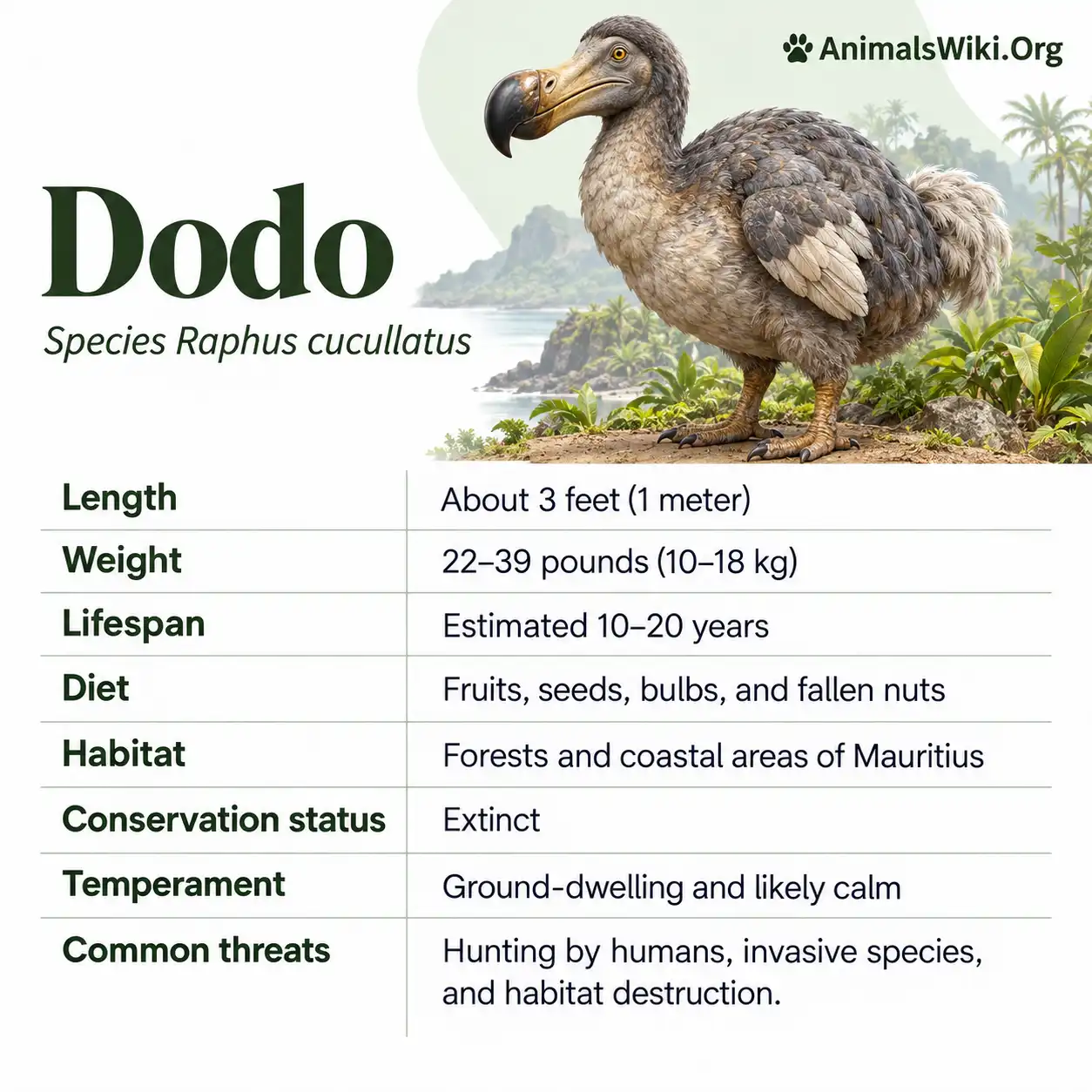
The dodo (Raphus cucullatus) was a large, flightless bird that lived only on the island of Mauritius in the Indian Ocean. Famous for its heavy body, large hooked beak, small wings, stout legs, and inability to fly, the dodo has become one of the world’s most recognizable extinct animals.
Today, the word dodo is almost synonymous with extinction.
Yet the real animal was far more interesting than the clumsy, unintelligent creature portrayed in popular culture.
The dodo was a highly specialized island bird whose ancestors were flying pigeons. Over many generations, those ancestors colonized Mauritius and evolved in an environment where large terrestrial predators were largely absent.
Without the same need to escape land predators, natural selection favored a very different lifestyle.
The dodo eventually became:
- Large
- Ground-dwelling
- Flightless
- Strong-legged
- Adapted to island forests
Its closest living relatives are pigeons and doves.
This evolutionary relationship can seem surprising because modern pigeons are usually lightweight and excellent flyers. However, anatomical evidence and modern genetic research place the dodo firmly within the pigeon and dove family, Columbidae.
One particularly close living relative is the Nicobar pigeon (Caloenas nicobarica), although it should not be described simply as the dodo’s direct ancestor.
The dodo’s isolation ended dramatically when humans began reaching Mauritius.
Dutch sailors arrived in 1598, and within less than a century the dodo disappeared.
The exact date on which the last dodo died is unknown.
One of the last widely accepted historical sightings dates to 1662, although records surrounding the species’ final decades are incomplete.
The extinction was probably not caused by a single factor.
Instead, the dodo faced a combination of pressures associated with human colonization, including:
- Hunting
- Habitat disturbance
- Introduced mammals
- Predation on eggs and chicks
- Competition for food
- Destruction of nesting areas
Animals introduced to Mauritius included pigs, rats, monkeys, cats, and other species that could disturb nests, consume eggs, compete for resources, or alter the island ecosystem.
Because dodos evolved without major mammalian predators, they probably had few defenses against these new threats.
Their reproductive biology may have made the situation even worse.
If dodos produced relatively few offspring and nested on the ground—as evidence strongly suggests—introduced predators could have reduced recruitment rapidly.
Within decades, a bird that had evolved on Mauritius over an immense period disappeared forever.
The dodo’s extinction later became an important symbol of the consequences of human-driven ecological change.
But the dodo should not be remembered merely as a cautionary tale.
It was a remarkable example of island evolution, demonstrating how flying ancestors can become giant terrestrial birds when ecological conditions change.
This comprehensive guide explores dodo facts, scientific classification, appearance, size, weight, habitat, Mauritius, diet, behavior, flightlessness, evolution, reproduction, eggs, lifespan, predators, extinction, relationship to pigeons, fossils, scientific reconstruction, myths, de-extinction discussions, and much more.
Dodo Facts
| Feature | Information |
|---|---|
| Common Name | Dodo |
| Scientific Name | Raphus cucullatus |
| Animal Type | Bird |
| Family | Columbidae |
| Order | Columbiformes |
| Native Range | Mauritius |
| Distribution | Endemic to Mauritius |
| Habitat | Primarily forested island habitats |
| Diet | Probably mainly plant material, possibly opportunistic foods |
| Flight | Flightless |
| Wings | Small and incapable of powered flight |
| Closest Living Relatives | Pigeons and doves |
| Reproduction | Egg-laying |
| Nesting | Probably ground nesting |
| Extinction | 17th century |
| Last Widely Accepted Sighting | 1662 |
| Major Extinction Pressures | Human activity and introduced animals |
| Conservation Status | Extinct |
What Was the Dodo?
The dodo was a large flightless pigeon relative found naturally only on Mauritius.
Its scientific name is:
Raphus cucullatus
It belonged to the family Columbidae, which contains modern:
- Pigeons
- Doves
This makes the dodo an extraordinary example of how dramatically an animal lineage can change when isolated on an island.
Its ancestors could fly.
The dodo could not.
Scientific Classification of the Dodo
| Classification | Name |
|---|---|
| Kingdom | Animalia |
| Phylum | Chordata |
| Class | Aves |
| Order | Columbiformes |
| Family | Columbidae |
| Genus | Raphus |
| Species | Raphus cucullatus |
The dodo was the only species in the genus Raphus.
Where Did the Dodo Live?
The dodo lived exclusively on Mauritius, an island in the southwestern Indian Ocean.
Mauritius lies east of Madagascar and forms part of the Mascarene Islands.
The main Mascarene islands are:
- Mauritius
- Réunion
- Rodrigues
The dodo itself was endemic to Mauritius.
It did not naturally occur anywhere else on Earth.
Was the Dodo Found in Madagascar?
No.
Although Mauritius lies east of Madagascar, the dodo was not a Madagascan bird.
Its natural range was restricted to Mauritius.
This geographic isolation played an important role in both its evolution and eventual extinction.
Dodo Habitat
Reconstructing the exact habitat preferences of an extinct species is difficult.
However, dodos probably occupied forested environments on Mauritius.
Their habitat may have included:
- Lowland forest
- Dry forest
- Coastal woodland
- Areas containing fruiting trees
- Seasonal wet areas
The island before extensive human modification would have contained ecosystems very different from much of modern Mauritius.
What Did the Dodo Look Like?
Historical descriptions and illustrations portray the dodo as a large, unusual bird with:
- Heavy body
- Large head
- Massive hooked beak
- Small wings
- Powerful legs
- Short tail
- Tuft of curled feathers near the rear
- Grayish or brownish plumage
However, historical artwork must be interpreted cautiously.
Some paintings may depict captive birds that were overweight, while others were copied from earlier illustrations rather than drawn from living animals.
Modern reconstructions therefore combine:
- Skeletal evidence
- Historical descriptions
- Early illustrations
- Anatomical studies
- Evolutionary comparisons
How Big Was the Dodo?
Adult dodos were approximately 1 meter (3.3 feet) tall, although exact estimates vary.
They were substantially larger than most living pigeons.
Their size was one of the most dramatic results of island evolution.
How Much Did a Dodo Weigh?
Weight estimates have changed considerably over time.
Older reconstructions sometimes portrayed dodos as extremely obese birds weighing more than 20 kg.
Modern research generally suggests more moderate body masses, often roughly around:
10–18 kg (22–40 lb)
depending on the reconstruction, sex, season, and individual.
Exact weight remains uncertain because no living dodo was scientifically weighed using modern methods.
Was the Dodo Fat?
Probably not in the exaggerated way depicted in some historical paintings.
The classic extremely plump dodo image may partly reflect:
- Artistic conventions
- Captive individuals
- Seasonal body condition
- Copying among artists
Skeletal reconstructions suggest a relatively robust but more athletic bird than the stereotypical cartoon dodo.
Dodo Beak
The dodo possessed an enormous and distinctive beak.
It was:
- Long
- Deep
- Strong
- Hooked near the tip
The beak was proportionally much larger than the bills of many modern pigeons.
It may have helped the bird manipulate:
- Fruits
- Seeds
- Tough plant material
- Other food items
It could potentially also have been used during defense or social interactions.
Dodo Wings
Dodos possessed wings, but the wings were too small for powered flight.
Their wing bones were reduced compared with those of flying pigeons.
They were essentially vestigial flight structures.
The wings may still have been useful for:
- Balance
- Display
- Communication
Flightlessness does not mean wings become completely functionless.
Could the Dodo Fly?
No.
The dodo was completely flightless.
Its:
- Large body
- Reduced wings
- Altered chest anatomy
- Terrestrial lifestyle
made powered flight impossible.
Why Couldn’t the Dodo Fly?
The dodo descended from flying ancestors.
After those ancestors reached Mauritius, they entered an island environment without the same terrestrial predator pressures found on continents.
Flight is energetically expensive.
Maintaining large flight muscles requires substantial energy.
If escaping terrestrial predators by flight is no longer essential, natural selection can favor:
- Larger body size
- Reduced wings
- Reduced flight muscles
- Greater investment in terrestrial movement
Over many generations, the ancestral population became increasingly ground-adapted.
Eventually, the dodo lost the ability to fly.
Was the Dodo Born Flightless?
Individual dodos did not “lose” flight during their lifetimes.
Flightlessness evolved gradually across many generations.
Every dodo living during recorded human history was already part of a naturally flightless species.
Dodo Legs
The dodo possessed relatively strong legs.
Unlike its small wings, its legs were important for everyday movement.
The bird was adapted for:
- Walking
- Standing
- Foraging on the ground
- Moving through forest environments
Modern skeletal reconstructions suggest dodos were probably more mobile and capable terrestrial birds than popular culture often implies.
Could Dodos Run?
Probably.
Their powerful legs suggest that they were competent terrestrial walkers and likely capable of running when necessary.
The stereotype of the dodo as an almost immobile, waddling animal is probably exaggerated.
However, exact running speeds are unknown.
Dodo Feathers
Historical accounts suggest the dodo had generally:
- Gray
- Gray-brown
- Brownish
body plumage.
Its tail region was famous for a small cluster of curled or fluffy feathers.
The wings also possessed feathers despite being incapable of flight.
Male vs. Female Dodo
Scientists know relatively little about visible sexual differences in dodos.
Males and females may have differed in:
- Size
- Body proportions
- Beak dimensions
but the extent of sexual dimorphism remains uncertain.
Because historical observers rarely documented sex carefully, many details cannot be reconstructed confidently.
What Did Dodos Eat?
The exact diet remains partly uncertain.
Dodos were probably primarily plant eaters or omnivorous opportunists, consuming foods available on the forest floor.
Potential foods may have included:
- Fallen fruits
- Seeds
- Nuts
- Plant material
- Roots
- Bulbs
They may also have eaten small invertebrates or other opportunistic foods.
Claims about highly specific diets should be treated cautiously because direct evidence is limited.
Did Dodos Eat Fruit?
Almost certainly.
Mauritian forests contained numerous fruit-producing plants.
As large ground-foraging pigeons, dodos were probably important consumers of fallen fruits and seeds.
Their digestive system may also have helped disperse seeds across the island.
Did Dodos Eat Meat?
The dodo was probably not a specialized carnivore.
However, many primarily plant-eating birds consume:
- Insects
- Small invertebrates
- Other opportunistic animal matter
It is possible dodos behaved similarly.
Evidence is insufficient to describe meat as a major dietary component.
Did Dodos Swallow Stones?
Historical reports suggest dodos may have swallowed stones.
Many birds intentionally consume small stones known as gastroliths.
These stones remain in the gizzard and help grind food.
This would have been useful for processing:
- Seeds
- Tough plant material
- Fibrous foods
Did Dodos Drink Water?
Yes.
Like other terrestrial birds, dodos required water.
Mauritius contained:
- Streams
- Pools
- Wetlands
- Seasonal water sources
Dodos would have used these resources as part of their normal habitat.
Dodo Behavior
Very little direct behavioral information survives.
Dodos probably spent much of their time:
- Walking
- Foraging
- Searching for fallen fruit
- Resting
- Interacting with other dodos
- Breeding
- Moving through forest habitats
They may have been relatively fearless around unfamiliar animals, including humans.
Were Dodos Friendly?
Describing them as “friendly” is probably misleading.
Island animals that evolve without large terrestrial predators often show reduced fear responses toward unfamiliar threats.
Early sailors could therefore approach dodos relatively easily.
This does not necessarily mean the birds were affectionate or naturally tame.
They simply may not have recognized humans as dangerous predators.
Were Dodos Stupid?
There is no good scientific evidence that dodos were unusually unintelligent.
The stereotype of the “stupid dodo” arose largely after the species became extinct.
Its lack of fear toward humans was an evolutionary consequence of living on an isolated predator-poor island—not evidence of stupidity.
Modern pigeons, the dodo’s relatives, demonstrate substantial abilities in:
- Learning
- Memory
- Navigation
- Visual discrimination
- Problem solving
The dodo was probably appropriately adapted to the environment in which it evolved.
Why Is “Dodo” Used to Mean Stupid?
After extinction, cultural portrayals increasingly presented the dodo as:
- Clumsy
- Foolish
- Obsolete
- Incapable of survival
This image became embedded in language.
But the interpretation is unfair biologically.
The dodo survived successfully on Mauritius for a very long period before rapid ecological disruption followed human colonization.
Dodo Social Behavior
Whether dodos lived alone, in pairs, or in loose groups is not firmly established.
Food abundance and breeding could have brought multiple individuals together.
Like many pigeons, they may have displayed social behavior, but direct evidence is limited.
Dodo Communication
No one today knows exactly what a dodo sounded like.
It likely communicated using:
- Vocalizations
- Body posture
- Wing movements
- Beak movements
- Visual displays
Comparisons with pigeons may provide clues, but reconstructed dodo calls remain speculative.
What Did a Dodo Sound Like?
The true dodo call is unknown.
Movies, documentaries, games, and reconstructions use imagined sounds.
No sound recording could exist because the species became extinct centuries before audio recording technology.
Dodo Reproduction
Dodos reproduced by laying eggs.
Historical information is limited, but available evidence suggests they probably nested on or near the ground.
Ground nesting would later become a serious disadvantage after humans introduced mammals to Mauritius.
Dodo Eggs
Dodo eggs have not survived in sufficient intact material to answer every question about their size and appearance.
Historical accounts suggest the birds may have laid relatively small clutches.
The frequently repeated claim that a dodo always laid exactly one egg should be treated cautiously.
It is plausible but not as firmly established as many popular sources imply.
Where Did Dodos Build Their Nests?
They probably nested on the ground.
This made sense before Mauritius contained introduced mammalian nest predators.
Once animals such as pigs, rats, and monkeys became established, ground nests became much more vulnerable.
Baby Dodo
A young dodo would have been a chick.
Like other birds, chicks would have required:
- Food
- Protection
- Growth
- Feather development
The exact duration of parental care is unknown.
Comparison with related pigeons suggests parental investment was probably important.
Did Dodos Produce Crop Milk?
Modern pigeons and doves feed their chicks a nutrient-rich secretion known as crop milk.
Because dodos belonged to the pigeon family, researchers have considered the possibility that they may have possessed similar parental feeding physiology.
However, direct confirmation is impossible.
It is best treated as a plausible inference rather than a proven behavioral fact.
Dodo Lifespan
The precise lifespan of a dodo is unknown.
No individual was followed throughout life using modern scientific methods.
Based on:
- Body size
- Growth patterns
- Related birds
- Bone studies
dodos probably lived for many years under favorable conditions.
Specific lifespan numbers should be regarded as estimates rather than established facts.
Dodo Seasonal Growth
Studies of dodo bones have provided fascinating clues about their annual life cycle.
Bone structure suggests the birds experienced seasonal changes connected to Mauritius’s climate.
They may have undergone:
- Seasonal feather replacement
- Changes in body condition
- Reproductive cycles
This evidence has helped scientists reconstruct aspects of dodo biology that historical observers never documented.
Dodo Molting
Like modern birds, dodos replaced their feathers.
Historical descriptions show birds with somewhat different plumage appearances.
Modern research suggests some differences may reflect stages of molting rather than entirely different types of dodos.
This helps explain why historical illustrations sometimes disagree.
Dodo Evolution
The ancestors of dodos were flying pigeons.
At some point, ancestral pigeons reached islands in the Indian Ocean.
Isolation then allowed different populations to evolve independently.
On Mauritius, one lineage eventually produced the dodo.
On nearby Rodrigues, a related lineage produced another giant flightless pigeon:
Rodrigues solitaire (Pezophaps solitaria)
Both species later became extinct.
Dodo and Rodrigues Solitaire
The dodo’s closest known extinct relative was the Rodrigues solitaire.
| Feature | Dodo | Rodrigues Solitaire |
|---|---|---|
| Scientific Name | Raphus cucullatus | Pezophaps solitaria |
| Island | Mauritius | Rodrigues |
| Family | Columbidae | Columbidae |
| Flight | Flightless | Flightless |
| Status | Extinct | Extinct |
Together they illustrate parallel island evolution among pigeon relatives in the Mascarene region.
Is the Dodo Related to Pigeons?
Yes.
The dodo was a member of the pigeon and dove family Columbidae.
This relationship is supported by:
- Anatomy
- Skeletal comparisons
- Molecular evidence
The ordinary pigeons seen in cities therefore belong to the same broad bird family as one of history’s most famous extinct animals.
What Is the Closest Living Relative of the Dodo?
The Nicobar pigeon (Caloenas nicobarica) is commonly identified as one of the dodo’s closest living relatives based on evolutionary studies.
It lives on islands in parts of South and Southeast Asia and the western Pacific.
It is a striking bird with:
- Iridescent plumage
- Long neck feathers
- Strong terrestrial habits
However, the Nicobar pigeon is not the dodo’s direct ancestor.
The two share older common ancestors.
Dodo vs. Pigeon
| Feature | Dodo | Typical Pigeon |
|---|---|---|
| Family | Columbidae | Columbidae |
| Flight | Flightless | Usually capable of flight |
| Body Size | Large | Usually much smaller |
| Wings | Reduced | Well developed |
| Lifestyle | Terrestrial island bird | Highly variable |
| Status | Extinct | Many living species |
| Range | Mauritius only | Worldwide |
The difference demonstrates how dramatically island evolution can transform a lineage.
Dodo vs. Ostrich
Both birds are flightless, but they are not close relatives.
Dodo
- Pigeon relative
- Mauritius
- Extinct
- Relatively small wings
- Forest-associated island bird
Ostrich
- Ratite
- Africa
- Living
- Extremely long legs
- Open-country runner
Flightlessness evolved independently in these lineages.
Dodo vs. Penguin
Both are flightless birds, but for completely different reasons.
Penguins transformed their wings into flippers for underwater propulsion.
Dodos became terrestrial island birds and reduced their flight structures.
Penguins are therefore highly specialized swimmers.
Dodos were primarily walkers.
Dodo vs. Turkey
The two are unrelated beyond both being birds.
The turkey belongs to the order Galliformes.
The dodo belonged to Columbiformes.
Superficial similarities in body shape do not indicate close evolutionary relationships.
Did Dodos Have Predators Before Humans Arrived?
Mauritius lacked large native terrestrial mammals capable of regularly preying upon adult dodos.
This low-predator environment probably contributed to:
- Flightlessness
- Reduced fear
- Ground nesting
Native predators may still have threatened eggs or chicks, but the ecological pressure was very different from that on continental birds.
When Did Humans Discover the Dodo?
Arab and possibly other sailors may have known Mauritius before Europeans documented the dodo.
The first well-known European encounters occurred around the end of the 16th century.
Dutch sailors reached Mauritius in 1598 and produced some of the earliest widely cited written accounts of the bird.
When Did the Dodo Go Extinct?
The dodo disappeared during the 17th century.
The exact extinction date is unknown.
A widely accepted late sighting dates to 1662.
Some later reports have been proposed, but their reliability is debated.
It is therefore more accurate to say the dodo became extinct in the late 1600s, rather than assigning a precise final year with complete certainty.
How Quickly Did the Dodo Become Extinct?
If we compare the documented Dutch arrival in 1598 with the widely accepted 1662 sighting, the dodo’s documented decline occurred within roughly six decades.
That is extraordinarily rapid for the disappearance of an entire species.
However, humans may have visited Mauritius before 1598, and the exact last surviving dodo is unknown.
Why Did the Dodo Become Extinct?
The extinction was probably caused by several interacting factors.
1. Human Hunting
Sailors and settlers killed dodos for food.
However, hunting alone probably does not explain the entire extinction.
2. Introduced Animals
Humans brought animals such as:
- Pigs
- Rats
- Monkeys
- Cats
- Dogs
Some could consume eggs or chicks.
Others disturbed nests or competed for food.
3. Habitat Destruction
Settlement changed Mauritian forests.
Clearing land reduced suitable habitat.
4. Ground Nesting
Ground nests were highly vulnerable to newly introduced mammals.
5. Slow Reproduction
If dodos produced few offspring, populations would recover slowly from losses.
6. Small Geographic Range
The entire species existed on a single island.
There were no distant populations capable of replacing those lost on Mauritius.
Did Humans Eat Dodos to Extinction?
This is an oversimplification.
Humans certainly hunted dodos.
But evidence suggests extinction probably resulted from the combined effects of:
hunting + introduced animals + habitat change + reproductive vulnerability
Introduced mammals may have been particularly damaging to eggs and chicks.
Were Dodos Good to Eat?
Historical accounts are inconsistent.
Some sailors apparently ate them.
Others described their meat as tough or unpleasant.
The Dutch sometimes used names that have been interpreted as reflecting dissatisfaction with the meat.
Historical food descriptions should nevertheless be treated carefully because translations and interpretations vary.
Did Rats Kill the Dodo?
Rats probably contributed to the species’ decline by potentially eating eggs or chicks.
However, it is inaccurate to claim that rats alone killed off the dodo.
The extinction was likely caused by multiple interacting pressures.
Did Pigs Kill the Dodo?
Introduced pigs were potentially extremely destructive.
They could:
- Eat eggs
- Attack chicks
- Disturb nests
- Compete for food
- Alter vegetation
Like rats, however, pigs were one part of a broader ecological disruption.
Why Didn’t Dodos Escape?
Their ancestors had evolved for generations in an environment where flight was unnecessary.
Evolution cannot instantly restore lost flight structures when a new predator arrives.
By the time humans and introduced mammals appeared, the dodo already had:
- Small wings
- Reduced flight musculature
- Heavy terrestrial body
The environmental change occurred far faster than the species could adapt.
Was the Dodo Doomed Because It Was Flightless?
No.
Flightlessness itself was not a failed adaptation.
Before human colonization, the dodo survived successfully for an enormous period.
Flightlessness only became a major disadvantage after the island’s ecological conditions changed abruptly.
An adaptation can be highly successful in one environment and dangerous in another.
Why Is the Dodo Important to Evolution?
The dodo provides an excellent example of island evolution.
On isolated islands, animals may experience:
- Few predators
- Different food resources
- Reduced competition
- Geographic isolation
These conditions can favor unusual traits.
For the dodo, they contributed to:
- Increased body size
- Terrestrial life
- Flightlessness
- Reduced predator avoidance
Island Gigantism and the Dodo
Island animals sometimes evolve much larger body sizes than their ancestors.
This phenomenon is known as island gigantism.
The dodo’s flying pigeon ancestors were much smaller.
On Mauritius, ecological conditions allowed their descendants to evolve into much larger terrestrial birds.
Why Do Island Birds Become Flightless?
Flight is expensive.
It requires:
- Large flight muscles
- Lightweight anatomy
- High energy expenditure
On predator-poor islands, the survival advantage of flight may decrease.
Natural selection may instead favor energy investment in:
- Growth
- Reproduction
- Terrestrial feeding
Flightlessness has independently evolved in numerous island bird lineages.
Dodo Fossils
Dodo remains include:
- Bones
- Subfossil skeletons
- Fragmentary remains
One of the most important fossil localities is Mare aux Songes in Mauritius.
Large numbers of dodo bones and remains of other extinct Mauritian animals have been recovered there.
These remains allow scientists to reconstruct:
- Anatomy
- Growth
- Population variation
- Disease
- Ecology
- Evolution
Are There Complete Dodo Skeletons?
Nearly complete composite skeletons exist in museums, but fully complete naturally associated dodo skeletons are exceptionally rare.
Many museum mounts combine bones from multiple individuals.
This is important when interpreting the famous “dodo skeleton.”
Are There Any Stuffed Dodos?
No complete taxidermied dodo survives.
Some early specimens reached Europe, but almost all soft tissue material was eventually lost.
One famous historical specimen at Oxford deteriorated so badly that only parts, including preserved head and foot material, remained.
As a result, modern understanding depends heavily on bones and historical records.
Dodo DNA
Scientists have recovered genetic material from preserved dodo remains.
DNA evidence has helped establish the dodo’s evolutionary relationship with pigeons and other extinct Mascarene birds.
Ancient DNA is usually:
- Fragmented
- Chemically damaged
- Incomplete
Recovering a genome from an extinct animal does not mean scientists possess intact living cells from that species.
Can Scientists Clone a Dodo?
Traditional cloning would require a suitable intact living cell containing an undamaged nucleus.
No living dodo cells exist.
Therefore, cloning a dodo in the same manner used for living mammals is not currently possible.
Proposed “dodo de-extinction” approaches instead focus on genetic engineering of living relatives.
Can the Dodo Be Brought Back?
Researchers and biotechnology companies have discussed attempts to create birds containing selected dodo-like genetic characteristics.
This is sometimes described publicly as dodo de-extinction.
However, even a heavily genetically modified pigeon relative would raise difficult scientific questions:
- Would it truly be a dodo?
- How many genes would need modification?
- Could its developmental biology be recreated?
- Would appropriate parental behavior exist?
- Could the original ecosystem be restored?
- How would animal welfare be managed?
A reconstructed dodo-like bird would not erase the historical extinction of Raphus cucullatus.
Are Dodos Still Alive?
No.
The dodo is extinct.
There are no verified surviving wild or captive populations.
Claims that hidden dodos survive on remote islands are unsupported.
Could Dodos Still Be Hiding Somewhere?
No credible evidence supports this idea.
Mauritius has been extensively inhabited, explored, and studied.
A large terrestrial bird population could not realistically remain undetected for centuries.
The Dodo in Alice’s Adventures in Wonderland
The dodo became especially famous in popular culture through Lewis Carroll’s Alice’s Adventures in Wonderland.
The book features a Dodo character involved in the famous Caucus-Race.
This literary appearance helped transform the extinct bird into an internationally recognizable cultural symbol.
Why Is the Dodo a Symbol of Extinction?
The dodo disappeared shortly after sustained human contact with Mauritius.
Its:
- Restricted island range
- Flightlessness
- Distinctive appearance
- Rapid disappearance
- Historical documentation
made it a powerful symbol of human-caused extinction.
The phrase “dead as a dodo” became shorthand for something completely extinct or obsolete.
Was the Dodo the First Animal Humans Made Extinct?
No.
Humans contributed to the extinction of many animals long before the dodo disappeared.
Examples include numerous:
- Island birds
- Large mammals
- Reptiles
What makes the dodo unusual is that its extinction occurred relatively recently and was documented during the early modern historical period.
Dodo Ecological Role
The dodo probably influenced Mauritius’s forests through:
- Fruit consumption
- Seed dispersal
- Ground disturbance
- Nutrient cycling
Large fruit-eating birds can transport seeds away from parent trees.
Their extinction may therefore have changed ecological relationships involving Mauritian plants.
However, specific claims about individual plants depending entirely on the dodo should be treated cautiously.
The Dodo and Tambalacoque Tree Myth
A famous hypothesis once proposed that the tambalacoque tree depended on dodos to grind or digest its seeds before germination.
The idea became popular as an example of coevolution.
Later research showed that the relationship was probably more complicated.
The tree does not appear to have depended exclusively on dodos for reproduction.
This is a useful reminder that attractive ecological stories require careful testing.
What Animals Lived With the Dodo?
Pre-human Mauritius supported a remarkable island ecosystem.
Animals included:
- Giant tortoises
- Parrots
- Pigeons
- Rails
- Bats
- Reptiles
- Numerous seabirds
- Other endemic species
Many Mauritian animals later declined or disappeared following human settlement and introduced species.
Dodo Adaptations
The dodo possessed several important island adaptations.
Large Body
Allowed efficient terrestrial living and storage of energy.
Powerful Legs
Supported walking and ground foraging.
Large Beak
Helped process available foods.
Flightlessness
Reduced the energetic cost of maintaining flight.
Ground-Based Foraging
Allowed exploitation of fallen fruit and other resources.
Reduced Predator Fear
Was suitable in an environment without major terrestrial predators.
These adaptations were successful before the ecosystem changed.
Dodo Myths vs. Facts
| Myth | Fact |
|---|---|
| Dodos were stupid | No evidence shows unusual stupidity |
| Dodos died because they were too dumb to survive | Human-driven ecological changes were central |
| Humans simply ate every dodo | Extinction involved multiple factors |
| Dodos had no wings | They had reduced wings |
| Dodos were giant turkeys | They were pigeon relatives |
| Dodos lived worldwide | They lived only on Mauritius |
| Every dodo was extremely fat | Historical art likely exaggerated body shape |
| Dodos disappeared instantly | Decline occurred across several decades |
| The exact last dodo is known | The final extinction date remains uncertain |
| Dodos can simply be cloned | No intact living dodo cells exist |
Dodo Conservation Lessons
The dodo’s extinction teaches several principles still relevant to wildlife conservation.
Island Species Are Vulnerable
Small geographic ranges make species vulnerable to rapid environmental change.
Introduced Species Can Transform Ecosystems
Animals harmless in one ecosystem can become devastating invasive species elsewhere.
Ground-Nesting Birds Need Protection
Introduced mammals can severely reduce reproductive success.
Extinction Can Happen Quickly
A species does not need centuries to disappear.
Protecting Habitat Matters
Animals cannot survive indefinitely without functioning ecosystems.
Prevention Is Easier Than De-Extinction
Protecting living species is far more realistic than attempting to recreate extinct ones.
40 Interesting Dodo Facts
- The dodo was a bird.
- Its scientific name was Raphus cucullatus.
- It lived only on Mauritius.
- Mauritius is in the Indian Ocean.
- Dodos were flightless.
- They still possessed small wings.
- The dodo belonged to the pigeon family.
- Pigeons and doves are its living relatives.
- The Nicobar pigeon is among its closest living relatives.
- The dodo was not a turkey.
- It was roughly around one meter tall.
- Modern weight estimates are lower than some historical depictions suggest.
- Dodos possessed large hooked beaks.
- They had powerful legs.
- Their ancestors could fly.
- Flightlessness evolved over many generations.
- Mauritius historically lacked major terrestrial mammalian predators.
- Reduced predator pressure contributed to the evolution of flightlessness.
- Dodos probably ate fruits and seeds.
- They may have swallowed stones to help grind food.
- They probably nested on the ground.
- Their young were chicks.
- Their exact lifespan is unknown.
- Their exact call is unknown.
- There are no sound recordings of dodos.
- Dutch sailors documented dodos after arriving in Mauritius in 1598.
- The species disappeared during the 17th century.
- A widely accepted late sighting dates to 1662.
- The exact year of extinction remains uncertain.
- Humans hunted dodos.
- Introduced mammals also contributed to their decline.
- Pigs could disturb nests and consume eggs.
- Rats may have eaten eggs or chicks.
- Habitat alteration also affected the species.
- The dodo was not biologically “stupid.”
- Its fearlessness was an island adaptation.
- Dodo bones have been recovered from Mauritius.
- Ancient DNA has helped reveal its relationship to pigeons.
- The dodo became a global symbol of extinction.
- Its story remains highly relevant to modern conservation.
Did You Know?
The dodo was essentially a giant flightless pigeon relative.
This fact can be difficult to believe when comparing a city pigeon with the classic image of a dodo.
But the two belong to the same bird family: Columbidae.
Millions of years ago, flying pigeon ancestors reached islands in the Indian Ocean.
On Mauritius, isolation and an unusual predator-poor environment changed the evolutionary pressures acting on them.
Flying is extremely expensive.
A bird must maintain:
- Large flight muscles
- Lightweight skeletal adaptations
- Specialized feathers
- High metabolic output
On an island where escaping terrestrial predators through flight was far less important, maintaining all of those adaptations offered fewer advantages.
Generation after generation, the birds became larger and increasingly terrestrial.
Their wings became smaller.
Their bodies became heavier.
Eventually, they could no longer fly.
This did not make the dodo an evolutionary failure.
Quite the opposite—the species successfully occupied Mauritius for a very long time.
The problem came when humans suddenly transformed its environment by introducing new predators, competitors, habitat disturbance, and hunting pressure.
Evolution had produced a bird perfectly suited to old Mauritius.
It could not adapt quickly enough when Mauritius changed.
Frequently Asked Questions About Dodos
What was a dodo?
The dodo was a large flightless pigeon relative endemic to Mauritius.
What was the scientific name of the dodo?
Raphus cucullatus.
Was the dodo a bird?
Yes.
Was the dodo a pigeon?
It belonged to the pigeon and dove family Columbidae.
Was the dodo a turkey?
No.
Where did dodos live?
Only on Mauritius.
Where is Mauritius?
Mauritius is an island nation in the Indian Ocean east of Madagascar.
Did dodos live in Madagascar?
No.
Did dodos live in Africa?
Their island home lies geographically near Africa, but dodos were endemic specifically to Mauritius.
Did dodos live anywhere else?
No known natural population existed outside Mauritius.
Could dodos fly?
No.
Did dodos have wings?
Yes, but the wings were too small for powered flight.
Why couldn’t dodos fly?
Their ancestors evolved toward a large terrestrial body and reduced flight structures in the predator-poor island environment.
Were dodos always flightless?
Their distant ancestors could fly.
How tall was a dodo?
Roughly around one meter tall, although estimates vary.
How much did a dodo weigh?
Modern estimates commonly fall roughly around 10–18 kg, but exact body mass remains uncertain.
Were dodos fat?
They were robust birds, but some historical artwork probably exaggerated their obesity.
What color was the dodo?
Historical descriptions generally suggest grayish or brownish plumage with lighter areas and a tuft of feathers near the rear.
What did dodos eat?
Probably fruits, seeds, plant material, and perhaps opportunistic foods.
Did dodos eat fruit?
Yes, fruit was probably important.
Did dodos eat meat?
They were not specialized carnivores, although occasional consumption of invertebrates is plausible.
Did dodos eat rocks?
They may have swallowed stones that functioned as gastroliths to help grind food.
Were dodos herbivores?
They were probably predominantly plant-eating, although their complete diet remains uncertain.
Could dodos run?
Their powerful legs suggest they could move effectively on land and probably run when necessary.
Were dodos slow?
Their exact speed is unknown, and the stereotype of an extremely slow dodo is unsupported.
Were dodos stupid?
There is no scientific evidence that dodos were unusually unintelligent.
Why are dodos called stupid?
Later cultural portrayals interpreted their lack of fear and extinction as evidence of stupidity, which is biologically misleading.
Were dodos afraid of humans?
They may initially have shown little fear because they evolved without comparable terrestrial predators.
Were dodos friendly?
Reduced fear should not be confused with friendliness or domestication.
What did a dodo sound like?
Its true vocalizations are unknown.
Did dodos lay eggs?
Yes.
How many eggs did a dodo lay?
The exact clutch size is uncertain. The commonly repeated claim of exactly one egg should not be treated as completely established.
Where did dodos nest?
They probably nested on the ground.
What was a baby dodo called?
A chick.
How long did dodos live?
Their exact lifespan is unknown.
Did dodos have natural predators?
Adult dodos probably faced relatively little predation from large terrestrial animals before human arrival.
When were dodos discovered by Europeans?
Dutch sailors documented them after reaching Mauritius in 1598.
When did the dodo become extinct?
During the 17th century.
What was the last confirmed dodo sighting?
A widely accepted late record dates to 1662.
Did the dodo become extinct in 1681?
1681 is sometimes cited, but the exact extinction date remains uncertain and later reports are debated.
How long did it take dodos to become extinct?
Their documented disappearance occurred within several decades of sustained European contact.
Why did the dodo become extinct?
Likely because of a combination of hunting, introduced animals, habitat disturbance, nest predation, and ecological change.
Did humans kill the dodo?
Human activities were central to its extinction.
Did humans eat dodos?
Yes, sailors and settlers consumed dodos, although hunting was only one extinction pressure.
Did rats cause dodo extinction?
Introduced rats probably contributed by threatening eggs or chicks, but they were not the sole cause.
Did pigs cause dodo extinction?
Introduced pigs likely damaged nests and competed for resources, contributing to decline.
Did monkeys contribute to dodo extinction?
Introduced macaques may have affected nests, food resources, or habitat, adding to ecological pressures.
Why didn’t dodos just fly away?
They had already lost the anatomical ability to fly long before humans arrived.
Was the dodo an evolutionary failure?
No. It was successfully adapted to Mauritius before rapid human-driven environmental changes occurred.
What bird is closest to the dodo?
The Nicobar pigeon is commonly identified among its closest living relatives.
Is the Nicobar pigeon a dodo?
No. It is a distinct living species.
Did dodos evolve from Nicobar pigeons?
Not directly. They share ancestral relationships.
What was the Rodrigues solitaire?
It was another large extinct flightless pigeon relative from Rodrigues Island and a close extinct relative of the dodo.
Are there dodo fossils?
Yes. Numerous subfossil bones have been recovered on Mauritius.
Is there a complete preserved dodo?
No complete taxidermied dodo survives.
Are there dodo skeletons in museums?
Yes, although many are composite skeletons assembled from bones of multiple individuals.
Does dodo DNA still exist?
Fragments of ancient DNA have been recovered from preserved remains.
Can scientists clone a dodo?
Traditional cloning is not possible because no intact living dodo cells remain.
Can scientists bring back the dodo?
Scientists are investigating genetic technologies that might create dodo-like birds using living relatives, but this would involve complex genetic engineering rather than simply resurrecting an original dodo.
Are dodos alive today?
No.
Could dodos still exist somewhere?
There is no credible evidence that living dodos survive.
Why is the dodo famous?
Its unusual appearance, rapid extinction, literary appearances, and association with human-driven extinction made it internationally famous.
What does “dead as a dodo” mean?
It means completely extinct, gone, or obsolete.
Why is the dodo important?
The dodo is an important example of island evolution and a powerful reminder of how rapidly human activity can contribute to extinction.
Conclusion
The dodo (Raphus cucullatus) was not simply a strange, overweight bird that failed to survive.
It was the product of a remarkable evolutionary experiment.
Its distant ancestors were flying pigeons that somehow crossed the ocean and reached Mauritius. Once established on an isolated island with abundant food and few major terrestrial predators, they encountered a very different set of evolutionary pressures.
Flight gradually became less important.
Body size increased.
Wings became reduced.
Strong legs supported a terrestrial lifestyle.
The result was a large, flightless pigeon unlike anything alive today.
For generations, these characteristics were successful adaptations.
Then the environment changed with extraordinary speed.
Human visitors and settlers brought hunting, forest disturbance, and an entirely new community of mammals. Rats, pigs, monkeys, cats, and other introduced animals entered an ecosystem whose native species had evolved without them.
Ground nests that had once been relatively safe became vulnerable.
Animals that had little reason to fear terrestrial predators suddenly encountered humans and introduced mammals.
Habitat began changing.
And a species confined to a single island had nowhere else to go.
By the late 17th century, the dodo had disappeared.
Its extinction happened so long before modern ecology, conservation biology, photography, and scientific wildlife monitoring that enormous gaps remain in our knowledge.
We do not know exactly what its call sounded like.
We do not know precisely how long it lived.
We cannot say with certainty exactly how many eggs it laid.
We do not know the identity of the final dodo or the exact date on which it died.
Yet bones, historical accounts, artwork, geological evidence, and ancient DNA have allowed scientists to reconstruct an increasingly detailed picture.
That picture has also corrected one of history’s most persistent misconceptions.
The dodo was not necessarily stupid.
Its lack of fear was appropriate in the ecosystem in which it evolved. Its inability to fly had not prevented it from surviving before humans transformed Mauritius. The bird disappeared because its environment changed much faster than evolution could respond.
Today, the dodo remains one of the world’s strongest symbols of extinction.
Its story demonstrates why island species with small geographic ranges can be especially vulnerable, why introduced animals can transform ecosystems, why habitat protection matters, and why waiting until a species is almost gone makes conservation extraordinarily difficult.
Modern genetic technology has even produced discussions about creating a dodo-like bird through genetic engineering.
Whether such a project ultimately succeeds or not, it cannot undo the original extinction.
The more immediate lesson of the dodo is therefore about the species that are still alive.
Protecting an endangered animal while viable populations and functioning ecosystems remain is far more achievable than attempting to reconstruct it centuries after the last individual has vanished.
The dodo’s legacy is consequently much larger than one extinct bird from Mauritius.
It is a reminder that extinction is permanent, ecological change can happen rapidly, and even a species that has survived successfully for thousands of generations can disappear within a human lifetime.