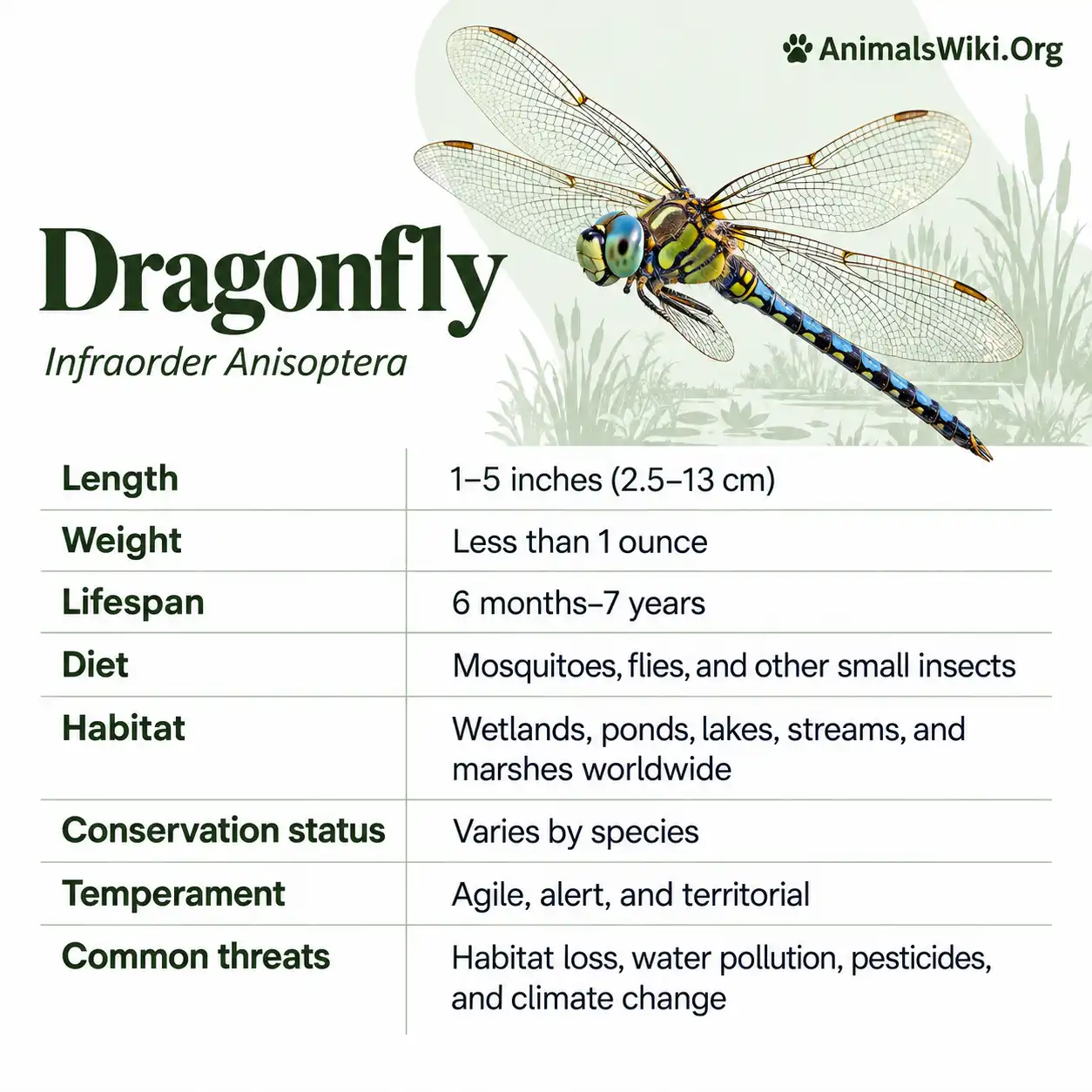
The Fast-Flying Aerial Hunters of Wetlands & Freshwater Habitats
The dragonfly is one of the most skilled aerial predators in the insect world, instantly recognizable by its long body, enormous compound eyes, and two pairs of transparent wings.
Dragonflies belong to the insect order Odonata, alongside their close relatives, the damselflies.
True dragonflies are generally placed in the infraorder Anisoptera.
They have existed in various evolutionary forms for hundreds of millions of years, making the dragonfly lineage far older than:
- Humans
- Birds
- Flowering plants
- Dinosaurs
However, the enormous prehistoric insects sometimes popularly called “giant dragonflies” were ancient relatives rather than simply oversized versions of modern dragonfly species.
Modern dragonflies are formidable predators.
Adult dragonflies hunt primarily in the air, capturing prey such as:
- Mosquitoes
- Midges
- Flies
- Small moths
- Other flying insects
Their hunting abilities are supported by extraordinary vision.
A dragonfly’s head is dominated by two huge compound eyes containing thousands of visual units called ommatidia.
This provides an extremely broad field of view and exceptional sensitivity to movement.
Once prey is detected, the dragonfly can intercept it in flight.
Its six legs form a basket-like structure that helps seize the target.
The insect may then consume its prey while flying or after landing.
Dragonfly flight is equally remarkable.
Unlike many insects, dragonflies can control their two pairs of wings with considerable independence.
This allows impressive aerial maneuvers.
They can:
- Fly forward
- Turn sharply
- Accelerate rapidly
- Hover
- Change direction
- Fly backward for short periods
- Intercept moving prey
Some dragonflies are also long-distance migrants.
The globe skimmer, Pantala flavescens, is particularly famous for extraordinary migratory movements across regions and even oceans.
Yet the flying adult represents only part of a dragonfly’s life.
Dragonflies begin life in or around freshwater.
Their immature aquatic stage is called a nymph or naiad.
Dragonfly nymphs inhabit environments such as:
- Ponds
- Lakes
- Marshes
- Wetlands
- Streams
- Rivers
They are predators just like adults.
Instead of chasing mosquitoes through the air, however, a dragonfly nymph hunts aquatic prey.
Depending on its size and species, prey can include:
- Aquatic insect larvae
- Small crustaceans
- Tadpoles
- Other invertebrates
- Occasionally very small fish
The nymph possesses one of the strangest feeding structures in the insect world.
Its lower lip, or labium, is highly modified.
When prey approaches, the nymph rapidly extends this structure forward and grabs the target.
After spending months or, in some species, years underwater, the nymph eventually climbs onto vegetation, rocks, or another surface.
Its outer skin splits.
An adult dragonfly slowly emerges.
The wings expand and harden.
Soon afterward, the insect begins the aerial stage of its life.
This means a dragonfly lives in two dramatically different worlds:
an aquatic predator as a juvenile and an aerial predator as an adult.
Dragonflies are also valuable components of freshwater ecosystems.
Because their immature stages depend on aquatic habitats, dragonfly communities can provide useful ecological information about wetlands and freshwater environments.
They are both predators and prey.
Nymphs influence aquatic food webs.
Adults consume flying insects.
Dragonflies themselves are eaten by:
- Birds
- Frogs
- Fish
- Spiders
- Larger insects
Despite myths and intimidating names such as “devil’s darning needle,” dragonflies are generally harmless to humans.
They do not possess stingers.
A dragonfly may use its mouthparts defensively if handled roughly, but it does not normally attack people.
This comprehensive guide explores dragonfly facts, species, anatomy, eyes, wings, flight, speed, habitat, distribution, diet, mosquito hunting, life cycle, eggs, nymphs, aquatic hunting, metamorphosis, mating, migration, lifespan, predators, adaptations, dragonfly vs. damselfly differences, ecological importance, conservation, and much more.
Dragonfly Facts
| Feature | Information |
|---|---|
| Common Name | Dragonfly |
| Animal Type | Insect |
| Order | Odonata |
| Major Group | Anisoptera |
| Legs | 6 |
| Wings | 4 |
| Eyes | Large compound eyes |
| Diet | Carnivorous |
| Adult Food | Flying insects |
| Juvenile Stage | Aquatic nymph/naiad |
| Juvenile Habitat | Freshwater |
| Metamorphosis | Incomplete |
| Major Hunting Sense | Vision |
| Flight | Fast and highly maneuverable |
| Common Habitats | Ponds, lakes, marshes, streams and rivers |
| Distribution | Most regions except Antarctica |
| Human Danger | Generally harmless |
| Stinger | None |
| Ecological Role | Predator and freshwater food-web component |
What Is a Dragonfly?
A dragonfly is a predatory flying insect belonging to the order Odonata.
Dragonflies are closely related to damselflies.
Adult dragonflies are recognized by:
- Long abdomen
- Large compound eyes
- Short antennae
- Six legs
- Two pairs of wings
- Strong flight
- Predatory behavior
Their immature stages are aquatic.
Is a Dragonfly an Insect?
Yes.
Dragonflies possess the basic characteristics of insects.
They have:
- Six legs
- Three major body regions
- One pair of antennae
- An exoskeleton
Their body is divided into:
- Head
- Thorax
- Abdomen
Scientific Classification of Dragonflies
A simplified classification is:
| Classification | Name |
|---|---|
| Kingdom | Animalia |
| Phylum | Arthropoda |
| Class | Insecta |
| Order | Odonata |
| Major Dragonfly Group | Anisoptera |
Damselflies belong to another major branch of Odonata.
How Many Species of Dragonflies Are There?
There are thousands of dragonfly species worldwide.
When dragonflies and damselflies are considered together, the order Odonata contains several thousand recognized species.
Taxonomic totals change as:
- New species are discovered
- DNA studies reveal relationships
- Existing species are reclassified
Tropical regions support especially high diversity.
Types of Dragonflies
Dragonflies occur in numerous families and ecological forms.
Some familiar groups include:
- Darners
- Skimmers
- Clubtails
- Emeralds
- Cruisers
- Petaltails
Darners
Darners are generally large, powerful dragonflies.
Many are strong fliers that patrol territories while searching for prey.
Skimmers
Skimmers form a diverse and familiar group.
They commonly occur around:
- Ponds
- Lakes
- Marshes
- Slow-moving water
Clubtails
Clubtails are named for the enlarged appearance near the end of the abdomen in many species.
They are frequently associated with rivers and streams.
Emerald Dragonflies
Many emeralds possess brilliant metallic coloration and striking green eyes.
Globe Skimmer
The globe skimmer (Pantala flavescens) is famous for its exceptional dispersal and migration capabilities.
What Does a Dragonfly Look Like?
A typical adult dragonfly has:
- Large rounded head
- Enormous compound eyes
- Small antennae
- Powerful thorax
- Six legs
- Four wings
- Long segmented abdomen
Body colors can include:
- Blue
- Green
- Red
- Yellow
- Orange
- Brown
- Black
- Metallic shades
Color may vary with:
- Species
- Sex
- Age
- Temperature
Dragonfly Anatomy
The dragonfly body has three primary regions.
Head
Contains:
- Compound eyes
- Simple eyes
- Antennae
- Mouthparts
Thorax
Supports:
- Six legs
- Four wings
- Powerful flight muscles
Abdomen
The long abdomen contains structures involved in:
- Digestion
- Respiration
- Reproduction
Its elongated shape also contributes to balance during flight.
Dragonfly Eyes
The dragonfly’s compound eyes are among its most remarkable features.
They occupy a large proportion of the head.
Each compound eye contains thousands of individual visual units called:
ommatidia
Together, they provide extensive visual coverage.
How Well Can Dragonflies See?
Dragonflies possess exceptional visual systems specialized for detecting:
- Movement
- Direction
- Prey
- Rivals
- Mates
Their field of view is extremely broad.
This is particularly useful for an animal that hunts moving targets in three-dimensional airspace.
Can Dragonflies See Behind Them?
Their enormous compound eyes provide visual coverage over much of the surrounding environment.
Although saying they literally see everything simultaneously would be an exaggeration, their field of view is extraordinarily broad compared with ours.
Can Dragonflies See Color?
Yes.
Dragonflies possess sophisticated color vision.
Different species have varying visual pigments, and their visual world can include wavelengths humans cannot perceive.
Vision is central to:
- Hunting
- Navigation
- Mate recognition
- Territorial behavior
Dragonfly Antennae
Compared with butterflies and many other insects, dragonfly antennae are extremely small.
Dragonflies rely particularly heavily on vision rather than long sensory antennae for locating airborne prey.
Dragonfly Mouthparts
Adult dragonflies possess strong chewing mouthparts.
They use them to process captured prey.
Despite their predatory nature, they are not adapted for feeding on human blood.
Do Dragonflies Have Teeth?
Dragonflies do not possess teeth like mammals.
However, their strong mouthparts include hardened structures capable of cutting and crushing insect prey.
The scientific name Odonata comes from a Greek root associated with “toothed,” referring to their toothed mandibles.
How Many Legs Does a Dragonfly Have?
A dragonfly has:
6 legs
The legs are attached to the thorax.
Why Are Dragonfly Legs Special?
Adult dragonfly legs are particularly useful for:
- Grabbing prey
- Holding prey
- Perching
During aerial hunting, the legs can form a basket-like structure beneath the body.
Flying insects can be trapped within this basket.
Do Dragonflies Walk?
They can reposition themselves while perched, but their legs are not specialized for efficient walking over long distances.
Their body is primarily adapted for:
flight
Dragonfly Wings
Dragonflies have:
4 wings
These consist of:
- Two forewings
- Two hindwings
The wings contain a complex network of veins that provides:
- Strength
- Flexibility
- Structural support
Can Dragonflies Fly?
Yes.
Dragonflies are among the most accomplished flying insects.
Their aerial abilities include:
- Fast forward flight
- Hovering
- Rapid acceleration
- Tight turns
- Sudden stops
- Short backward flight
- Midair prey interception
How Do Dragonflies Fly?
Dragonflies can control the movement and timing of their front and rear wings with considerable independence.
This gives them exceptional maneuverability.
Changing wing:
- Angle
- Stroke timing
- Orientation
allows rapid adjustments during flight.
Can Dragonflies Fly Backward?
Yes.
Dragonflies can maneuver backward for short distances.
This ability is useful during:
- Hunting
- Territorial interactions
- Landing
- Rapid repositioning
Can Dragonflies Hover?
Yes.
Hovering allows a dragonfly to remain relatively stationary in the air while:
- Watching prey
- Defending territory
- Inspecting surroundings
How Fast Can a Dragonfly Fly?
Flight speed varies by:
- Species
- Wind
- Temperature
- Behavior
- Measurement method
Large dragonflies can be fast insects, but popular claims of extremely high universal speeds are often exaggerated.
Their most remarkable flight advantage is not simply maximum speed.
It is the combination of:
speed + acceleration + maneuverability + visual tracking.
Why Are Dragonflies Such Good Hunters?
Several adaptations work together:
- Exceptional vision
- Broad field of view
- Fast nervous system
- Powerful wings
- Independent wing control
- Strong legs
- Predictive interception behavior
Instead of merely chasing directly behind prey, dragonflies can adjust their flight toward where the target is moving.
What Do Dragonflies Eat?
Adult dragonflies are carnivorous.
They commonly eat:
- Mosquitoes
- Midges
- Flies
- Gnats
- Small moths
- Other flying insects
- Smaller dragonflies
Large species may capture relatively substantial insect prey.
Do Dragonflies Eat Mosquitoes?
Yes.
Dragonflies can eat adult mosquitoes.
Their aquatic nymphs may also consume mosquito larvae when they share suitable habitats.
However, dragonflies eat many kinds of prey and should not be thought of as mosquito-only predators.
How Do Dragonflies Catch Mosquitoes?
A dragonfly visually tracks a moving insect.
It then:
- Adjusts its flight path.
- Approaches the target.
- Extends its legs.
- Forms a prey-catching basket.
- Captures the insect.
- Transfers it toward the mouth.
This can occur entirely in flight.
Do Dragonflies Eat Flies?
Yes.
Flies and other small airborne insects are important prey.
Do Dragonflies Eat Butterflies?
Large dragonflies can occasionally attack small butterflies or moths.
However, the typical diet consists largely of smaller flying insects.
Do Dragonflies Eat Other Dragonflies?
Yes.
Larger dragonflies may capture:
- Smaller dragonflies
- Damselflies
Cannibalism can also occur.
Are Dragonflies Carnivores?
Yes.
Both the adult and aquatic nymph stages are predatory.
This is one of the most fascinating aspects of their life cycle:
dragonflies are hunters both underwater and in the air.
Where Do Dragonflies Live?
Dragonflies are strongly associated with freshwater habitats because their immature stages develop in water.
Habitats include:
- Ponds
- Lakes
- Marshes
- Wetlands
- Streams
- Rivers
- Swamps
- Temporary pools
Adults may travel considerable distances away from water.
Where Are Dragonflies Found?
Dragonflies occur across most of the world except Antarctica.
They are particularly diverse in:
- Tropical
- Subtropical
- Temperate
regions containing suitable freshwater habitats.
Why Are Dragonflies Found Near Water?
Water is essential to their reproduction and juvenile development.
Females lay eggs:
- Directly in water
- On aquatic vegetation
- In mud
- In plant tissue
depending on species.
The nymphs then develop underwater.
Do Dragonflies Live Underwater?
Adult dragonflies do not.
Their nymphs do.
The aquatic stage can represent a large portion of the animal’s total lifespan.
Dragonfly Life Cycle
Dragonflies undergo incomplete metamorphosis.
Their life cycle is:
Egg → Nymph → Adult
Unlike butterflies and ladybugs, dragonflies do not have a pupal stage.
Dragonfly Eggs
Females lay eggs in or around freshwater.
Depending on species, eggs may be:
- Dropped into water
- Inserted into aquatic plants
- Deposited into wet mud
- Placed near shorelines
The location is selected to give developing young access to suitable aquatic habitat.
Dragonfly Nymph
The juvenile dragonfly is called a:
- Nymph
- Naiad
It lives underwater and looks very different from the adult.
Nymphs possess:
- Six legs
- Large eyes
- Wing pads later in development
- Powerful mouthparts
- Extendable predatory labium
What Do Dragonfly Nymphs Eat?
They are carnivorous.
Prey can include:
- Mosquito larvae
- Other insect larvae
- Small crustaceans
- Aquatic worms
- Tadpoles
- Other nymphs
- Occasionally tiny fish
Diet depends strongly on the dragonfly’s size and habitat.
How Does a Dragonfly Nymph Hunt?
A nymph often waits for prey to move within range.
It then rapidly projects its modified lower lip, or labium.
The structure captures the prey and pulls it toward the mouth.
This is one of the most specialized predatory mechanisms among aquatic insects.
Dragonfly Nymph Jet Propulsion
Some dragonfly nymphs have another extraordinary ability.
They can take water into a chamber in the rear of the body and force it outward rapidly.
The expelled water propels the nymph forward.
This can help with:
- Escape
- Rapid movement
It functions like a simple biological jet propulsion system.
How Do Dragonfly Nymphs Breathe?
Dragonfly nymphs possess specialized internal rectal gills.
Water moving through the rectal chamber allows gas exchange.
This same water movement can also contribute to jet propulsion.
How Long Do Dragonflies Live Underwater?
The aquatic nymph stage may last:
- Several months
- A year
- Multiple years
depending on species, climate, temperature, and food availability.
For many dragonflies, the underwater stage is much longer than the adult flying stage.
Do Dragonflies Have a Pupa?
No.
Dragonflies undergo incomplete metamorphosis.
There is no:
- Cocoon
- Chrysalis
- Pupal stage
between nymph and adult.
How Does a Dragonfly Become an Adult?
When development is complete, the mature nymph:
- Moves toward shallow water.
- Climbs out onto vegetation, rocks, or another support.
- Anchors itself.
- The nymphal exoskeleton splits.
- The adult begins emerging.
- Its body expands.
- Its wings unfold.
- The wings harden.
- The dragonfly eventually flies away.
The abandoned outer skin is called an exuvia.
What Is a Dragonfly Exuvia?
An exuvia is the empty nymphal exoskeleton left behind after the adult emerges.
Finding one attached to vegetation near water provides evidence that a dragonfly successfully completed aquatic development there.
Why Can’t a New Dragonfly Fly Immediately?
Immediately after emergence, the body and wings are soft.
The insect must:
- Expand its wings
- Pump fluid through them
- Allow the exoskeleton to harden
- Strengthen flight muscles and structures
Flying too early would risk damaging the wings.
Dragonfly Reproduction
Adult dragonflies reproduce sexually.
The reproductive process involves:
- Courtship or mate recognition
- Mating
- Fertilization
- Egg laying
Male dragonflies possess specialized reproductive anatomy unlike that of most insects.
Dragonfly Mating Wheel
Dragonflies are famous for forming a distinctive mating posture sometimes called the:
wheel position
The male grasps the female near the head or thorax using appendages at the end of his abdomen.
The female curves her abdomen forward toward the male’s secondary reproductive structures.
Together, their bodies can form a wheel-like or heart-shaped configuration.
Why Do Dragonflies Fly Attached Together?
Pairs may remain physically connected:
- During mating
- While traveling
- During egg laying
In some species, the male remains attached to the female while she deposits eggs.
This can help guard her from rival males.
How Do Dragonflies Lay Eggs?
Egg-laying behavior varies.
Females may:
- Touch the water surface repeatedly
- Deposit eggs into water
- Insert eggs into plant tissue
- Place eggs in mud
- Lay eggs while accompanied by a male
Baby Dragonfly
The term “baby dragonfly” usually refers to the aquatic:
nymph
Unlike a butterfly caterpillar, the nymph already has the basic insect body plan and gradually develops adult features through successive molts.
Do Dragonfly Nymphs Molt?
Yes.
As the nymph grows, it repeatedly sheds its exoskeleton.
After each molt, it becomes larger.
Wing pads gradually become more prominent as adulthood approaches.
How Long Do Dragonflies Live?
Total lifespan varies widely.
A dragonfly may spend:
- Months or years as an aquatic nymph
- Weeks or months as a flying adult
The adult stage is therefore often only a relatively small portion of the entire life.
Do Dragonflies Migrate?
Some species do.
Dragonfly migration can involve enormous numbers of insects moving seasonally over long distances.
Globe Skimmer Migration
The globe skimmer (Pantala flavescens) is one of the world’s most widely distributed dragonflies.
It is famous for exceptional long-distance movements.
Populations can use favorable winds and seasonal rainfall systems to move between regions.
The species’ remarkable dispersal ability has allowed it to colonize an enormous geographic range.
Can Dragonflies Cross Oceans?
Some migratory dragonflies can travel across substantial stretches of open water, assisted by:
- Wind
- Weather systems
- Exceptional flight endurance
Long-distance movement may occur across generations rather than one individual completing every part of an entire migration circuit.
Dragonfly Predators
Dragonflies are effective predators, but they are also prey.
Potential predators include:
- Birds
- Frogs
- Fish
- Spiders
- Lizards
- Larger dragonflies
- Other predatory insects
Nymphs and adults face different predators because they occupy different environments.
What Eats Dragonfly Nymphs?
Aquatic predators can include:
- Fish
- Amphibians
- Larger aquatic insects
- Other dragonfly nymphs
Camouflage helps many nymphs remain hidden.
Dragonfly Defense Mechanisms
Dragonflies rely primarily on:
- Excellent vision
- Rapid flight
- Maneuverability
- Camouflage
- Evasive movement
Unlike bees and wasps, they do not possess stingers.
Do Dragonflies Sting?
No.
Dragonflies cannot sting humans.
They have no stinger.
Do Dragonflies Bite?
Dragonflies possess strong jaws for eating insects.
A large dragonfly handled roughly may attempt to bite defensively.
However, dragonflies do not normally bite people and generally cannot cause significant harm.
Are Dragonflies Dangerous?
No.
Dragonflies are generally harmless to humans.
They do not:
- Sting
- Suck human blood
- Seek out people as prey
They are beneficial insect predators.
Are Dragonflies Poisonous?
Dragonflies are not generally considered poisonous to humans.
Their primary defenses are speed and maneuverability rather than toxins.
Dragonfly vs. Damselfly
Dragonflies and damselflies both belong to Odonata.
However, they have several typical differences.
| Feature | Dragonfly | Damselfly |
|---|---|---|
| Body | Usually robust | Usually slender |
| Eyes | Often very large and close together | Usually clearly separated |
| Resting Wings | Usually spread outward | Often folded together above body |
| Flight | Generally powerful | Often more delicate |
| Hindwings | Usually broader at base | Fore- and hindwings more similar |
These are useful generalizations, but individual groups can create exceptions.
Is a Damselfly a Dragonfly?
In everyday language they are usually treated as separate groups within Odonata.
Both are close evolutionary relatives known collectively as odonates.
Dragonfly vs. Butterfly
| Feature | Dragonfly | Butterfly |
|---|---|---|
| Order | Odonata | Lepidoptera |
| Diet | Predatory | Mostly nectar-feeding adults |
| Juvenile | Aquatic nymph | Caterpillar |
| Pupa | None | Present |
| Metamorphosis | Incomplete | Complete |
| Wings | Transparent and highly veined | Usually covered with scales |
Their life histories are fundamentally different.
Dragonfly vs. Mosquito
Dragonflies are predators.
Mosquitoes belong to the order Diptera.
Adult dragonflies can prey upon adult mosquitoes, while aquatic dragonfly nymphs may consume mosquito larvae.
This predator-prey relationship is one reason dragonflies are welcomed around wetlands and gardens.
Dragonfly vs. Fly
Despite its name, a dragonfly is not a true fly.
True flies belong to:
Diptera
Dragonflies belong to:
Odonata
True flies possess one functional pair of wings.
Dragonflies possess two functional pairs.
Dragonfly Adaptations
Dragonflies possess a remarkable collection of adaptations.
Huge Compound Eyes
Provide broad visual coverage and excellent movement detection.
Four Powerful Wings
Allow sophisticated aerial maneuvering.
Independent Wing Control
Supports hovering, turning, acceleration, and interception.
Prey Basket
The legs help capture insects in flight.
Strong Mandibles
Process captured prey.
Aquatic Nymph Stage
Allows juveniles to exploit freshwater food webs.
Extendable Labium
Allows nymphs to seize prey rapidly.
Rectal Gills
Allow aquatic respiration.
Jet Propulsion
Helps some nymphs escape rapidly.
Strong Dispersal
Allows adults to locate new habitats.
Dragonfly Evolution
Dragonflies belong to an ancient lineage of winged insects.
Odonate-like insects have existed for hundreds of millions of years.
Ancient relatives appeared long before modern mammals and birds.
Were Prehistoric Dragonflies Giant?
Some prehistoric insects related to modern odonates reached enormous sizes.
Famous examples include Meganeura and related forms.
Some had wingspans far larger than any modern dragonfly.
However, calling them simply “giant modern dragonflies” is an oversimplification.
They belonged to ancient groups related to today’s dragonflies and damselflies.
Why Were Ancient Dragonfly Relatives So Large?
Several factors have been proposed.
One important hypothesis involves higher atmospheric oxygen concentrations during parts of the Paleozoic Era.
Because insects deliver oxygen through a tracheal respiratory system, atmospheric oxygen availability may have influenced maximum body size.
Other ecological and evolutionary factors were also involved.
Dragonflies and Dinosaurs
Dragonfly-like insect lineages existed before the first dinosaurs appeared.
Modern dragonfly species are not unchanged survivors from that period, but their broader evolutionary lineage is extremely ancient.
Dragonflies and Mosquito Control
Dragonflies contribute to natural mosquito predation.
Adults can consume adult mosquitoes.
Nymphs may eat mosquito larvae.
However, mosquitoes are only one part of their broad diet.
Dragonflies alone cannot eliminate mosquito populations.
Ecological Importance of Dragonflies
Dragonflies perform important ecological roles as both:
predators and prey.
Adults help regulate populations of flying insects.
Nymphs consume aquatic organisms.
At the same time, dragonflies provide food for:
- Fish
- Birds
- Amphibians
- Reptiles
- Other insects
They connect aquatic and terrestrial food webs.
Dragonflies as Environmental Indicators
Because dragonfly nymphs depend on aquatic environments, the presence and diversity of certain species can provide information about freshwater habitat conditions.
Some species tolerate environmental disturbance better than others.
Therefore, dragonfly communities can help researchers assess:
- Wetland quality
- Water conditions
- Habitat structure
- Environmental change
They should be interpreted alongside other ecological evidence rather than as a single universal test of water quality.
Dragonfly Conservation
Many dragonflies remain widespread, but others are threatened.
Potential threats include:
- Wetland destruction
- River modification
- Water pollution
- Drainage
- Drought
- Habitat fragmentation
- Invasive species
- Climate change
Species restricted to specialized freshwater habitats can be particularly vulnerable.
Why Are Wetlands Important for Dragonflies?
Wetlands provide:
- Egg-laying sites
- Nymph habitat
- Aquatic prey
- Emergence sites
- Adult feeding areas
Destroying a wetland can therefore remove several stages of the dragonfly life cycle at once.
Climate Change and Dragonflies
Changing climate can influence:
- Geographic ranges
- Emergence timing
- Migration
- Water availability
- Wetland permanence
- Prey populations
Some species may expand into new areas while habitat specialists may decline.
How to Attract Dragonflies
Suitable freshwater habitat is one of the best ways to support dragonflies.
A wildlife-friendly pond can provide:
- Aquatic vegetation
- Emergent stems
- Clean water
- Nymph habitat
- Insect prey
Reducing unnecessary pesticide use can also support a broader insect community.
Are Dragonflies Good for Gardens?
Yes.
Dragonflies can be beneficial predators of flying insects.
However, they depend strongly on nearby aquatic habitat for reproduction.
A garden with a healthy pond or wetland nearby is much more likely to support breeding populations.
40 Interesting Dragonfly Facts
- Dragonflies are insects.
- They belong to the order Odonata.
- Dragonflies are closely related to damselflies.
- They have six legs.
- Adult dragonflies have four wings.
- They possess enormous compound eyes.
- Each compound eye contains thousands of visual units.
- Vision is their dominant hunting sense.
- Dragonflies are carnivores.
- Adult dragonflies hunt flying insects.
- They can eat mosquitoes.
- They also eat flies and midges.
- Larger species may eat other dragonflies.
- Dragonflies can catch prey while flying.
- Their legs form a basket for capturing prey.
- Dragonflies can hover.
- They can make extremely sharp turns.
- They can fly backward for short distances.
- Their front and rear wings can be controlled with considerable independence.
- Dragonflies do not have stingers.
- They are generally harmless to humans.
- Dragonflies begin life in freshwater.
- Their immature stage is called a nymph or naiad.
- Dragonfly nymphs are predators.
- Nymphs can eat mosquito larvae.
- Large nymphs may capture tadpoles.
- Some may capture tiny fish.
- Nymphs possess a specialized extendable labium.
- Dragonfly nymphs breathe using specialized rectal gills.
- Some can propel themselves using expelled water.
- Dragonflies undergo incomplete metamorphosis.
- They do not have a pupal stage.
- The abandoned nymph skin is called an exuvia.
- Some dragonflies migrate long distances.
- The globe skimmer is famous for exceptional dispersal.
- Dragonfly-like insect lineages are hundreds of millions of years old.
- Some prehistoric relatives were enormous.
- Dragonflies are important predators in freshwater and terrestrial ecosystems.
- Their larvae can help scientists understand freshwater habitat conditions.
- Protecting wetlands helps protect dragonfly diversity.
Did You Know?
A young dragonfly can propel itself through water using a biological form of jet propulsion.
Before becoming the elegant aerial hunter seen flying over ponds, a dragonfly spends its juvenile life underwater as a nymph.
The nymph is already a predator.
But its underwater body contains an adaptation the adult no longer needs.
Inside the rear part of its abdomen is a chamber associated with specialized rectal gills.
The nymph draws water into this chamber.
Gas exchange occurs across the gill surfaces, allowing the animal to obtain oxygen from the water.
But the system can perform another function.
When threatened, the nymph can force water rapidly out of the chamber.
Newtonian physics does the rest.
Water shoots backward.
The dragonfly nymph moves forward.
This sudden burst can help it escape predators or rapidly change position.
The same animal will eventually leave the water.
It climbs a plant stem or another exposed surface.
Its exoskeleton splits.
A completely different-looking creature begins to emerge.
Four wings expand.
The body hardens.
The aquatic jet-propelled predator becomes an aerial hunter capable of:
- Hovering
- Flying backward
- Accelerating
- Turning sharply
- Catching insects in midair
Few animals undergo such a dramatic ecological transition.
The dragonfly begins life as a freshwater predator equipped with an extendable prey-catching mouthpart and aquatic jet propulsion.
It finishes life as one of the insect world’s most accomplished aerial hunters.
Frequently Asked Questions About Dragonflies
What is a dragonfly?
A dragonfly is a predatory flying insect belonging to the order Odonata.
Is a dragonfly an insect?
Yes.
Is a dragonfly a fly?
No. True flies belong to Diptera; dragonflies belong to Odonata.
What family does a dragonfly belong to?
Dragonflies occur in multiple families within the major odonate group Anisoptera.
How many dragonfly species are there?
There are thousands of species worldwide.
Where do dragonflies live?
They occur around freshwater habitats such as ponds, lakes, marshes, rivers and streams.
Where are dragonflies found?
They occur across most of the world except Antarctica.
Why do dragonflies live near water?
Their eggs and aquatic nymph stages depend on freshwater habitats.
Do dragonflies live underwater?
Adults do not, but their nymphs do.
What is a baby dragonfly called?
The juvenile stage is called a nymph or naiad.
What does a dragonfly nymph look like?
It is a wingless aquatic predator with six legs and a robust body that looks very different from the adult.
What do dragonfly nymphs eat?
They eat aquatic insects, crustaceans and other small animals.
Do dragonfly nymphs eat mosquitoes?
They can eat mosquito larvae.
Do dragonfly nymphs eat tadpoles?
Larger nymphs can capture small tadpoles.
Do dragonfly nymphs eat fish?
Large nymphs may occasionally capture very small fish.
How do dragonfly nymphs catch prey?
They rapidly extend a specialized lower lip called the labium.
Can dragonfly nymphs swim?
Yes. They move underwater and some can use expelled water for rapid propulsion.
How do dragonfly nymphs breathe?
They use specialized internal rectal gills.
Can dragonfly nymphs use jet propulsion?
Yes. Some rapidly expel water to propel themselves.
How long do dragonflies live underwater?
The nymph stage may last months or multiple years depending on species and environment.
What are the stages of a dragonfly’s life cycle?
Egg, nymph and adult.
Do dragonflies have a caterpillar stage?
No.
Do dragonflies have a pupa?
No.
Do dragonflies make cocoons?
No.
Do dragonflies undergo metamorphosis?
Yes. They undergo incomplete metamorphosis.
How does a dragonfly become an adult?
A mature nymph leaves the water, attaches to a surface, sheds its exoskeleton and emerges as a winged adult.
What is dragonfly emergence?
It is the transformation in which the mature aquatic nymph leaves the water and the adult emerges from its final nymphal skin.
What is an exuvia?
It is the empty exoskeleton left after a nymph molts into the adult stage.
Why is a new dragonfly soft?
Its new exoskeleton and wings need time to expand and harden.
How many legs does a dragonfly have?
Six.
How many wings does a dragonfly have?
Four.
Do dragonflies have antennae?
Yes, but their antennae are very small.
Do dragonflies have eyes?
Yes. They possess enormous compound eyes.
How many eyes does a dragonfly have?
Dragonflies have two enormous compound eyes and also possess simple eyes called ocelli.
Why are dragonfly eyes so big?
Their visual system is highly specialized for detecting and tracking moving objects.
Can dragonflies see behind themselves?
Their compound eyes provide an exceptionally broad field of view, although descriptions of literal all-around vision are oversimplified.
Can dragonflies see color?
Yes.
Can dragonflies see ultraviolet?
Many dragonflies possess visual sensitivity extending into wavelengths humans cannot see.
What do dragonflies eat?
Adults eat flying insects such as mosquitoes, flies, midges and other small prey.
Are dragonflies carnivores?
Yes.
Do dragonflies eat mosquitoes?
Yes.
Do dragonflies eat flies?
Yes.
Do dragonflies eat bees?
Large dragonflies can potentially capture many types of flying insects, although bees are not necessarily their primary prey.
Do dragonflies eat butterflies?
Large species can occasionally capture small butterflies or moths.
Do dragonflies eat other dragonflies?
Yes.
How do dragonflies catch prey?
They intercept flying insects and trap them with their legs.
Do dragonflies eat while flying?
They can consume relatively small prey during flight.
Are dragonflies good hunters?
Yes. Their combination of vision and flight control makes them highly effective aerial predators.
Can dragonflies fly?
Yes.
Can dragonflies hover?
Yes.
Can dragonflies fly backward?
Yes, for short periods.
Can dragonflies fly sideways?
Their maneuverability allows substantial lateral repositioning and complex turns.
Why can dragonflies fly so well?
Their two wing pairs can be controlled with considerable independence, allowing precise aerodynamic adjustments.
How fast do dragonflies fly?
Speed varies by species and circumstances. Popular claims assigning all dragonflies one extreme maximum speed are unreliable.
Can dragonflies migrate?
Yes. Some species perform long-distance seasonal movements.
Which dragonfly migrates the farthest?
The globe skimmer is famous for exceptional long-distance dispersal and migration.
Can dragonflies cross the ocean?
Some migratory species can cross substantial areas of open water, often aided by winds.
Do dragonflies sting?
No.
Do dragonflies have a stinger?
No.
Do dragonflies bite?
They possess strong mouthparts and may attempt a defensive bite if handled, but they do not normally bite people.
Are dragonflies dangerous?
No. They are generally harmless to humans.
Are dragonflies poisonous?
They are not generally considered poisonous to humans.
Do dragonflies suck blood?
No.
Why do dragonflies land on people?
A dragonfly may briefly use a person as a perch or investigate movement. It does not mean the insect is trying to attack.
What eats dragonflies?
Predators include birds, frogs, fish, spiders, reptiles and larger insects.
What eats dragonfly nymphs?
Fish, amphibians, aquatic insects and other dragonfly nymphs may prey on them.
What is the difference between a dragonfly and damselfly?
Dragonflies are generally more robust, have powerful flight and usually hold their wings spread while resting. Damselflies are usually slimmer and often fold their wings together.
Are damselflies dragonflies?
They are close relatives within Odonata but are usually treated as a separate major group.
Are dragonflies related to butterflies?
Both are insects, but they belong to different orders and have very different life cycles.
Are dragonflies related to mosquitoes?
They are both insects, but they belong to different orders.
Do dragonflies control mosquitoes?
They contribute to mosquito predation, but they cannot eliminate mosquito populations by themselves.
Are dragonflies good for gardens?
Yes. They consume flying insects and contribute to healthy food webs.
How can I attract dragonflies?
Providing a healthy pond or other suitable freshwater habitat with aquatic vegetation can encourage them.
Do dragonflies need clean water?
Water requirements vary by species. Some tolerate disturbed habitats, while others depend on high-quality specialized freshwater environments.
Are dragonflies indicators of clean water?
Some species can indicate particular freshwater conditions, but dragonfly presence alone does not automatically prove that water is clean.
How long do dragonflies live?
Total lifespan can range from months to years depending on species, with much of it often spent as an aquatic nymph.
How long do adult dragonflies live?
Adults generally live much less time than the entire life cycle, often weeks to months depending on species and conditions.
Do dragonflies mate in the air?
Mating pairs can remain airborne or perch while connected.
Why do dragonflies form a heart shape?
Their reproductive posture can create a wheel or heart-like shape.
Why do two dragonflies fly attached?
They may be mating or the male may remain attached while the female lays eggs.
Where do dragonflies lay eggs?
In water, aquatic vegetation, wet soil or other moist locations depending on species.
Do dragonflies have nests?
No. They do not construct nests like birds or social wasps.
Were dragonflies alive with dinosaurs?
Their broader evolutionary lineage predates dinosaurs.
Did giant dragonflies exist?
Very large prehistoric relatives of modern dragonflies existed hundreds of millions of years ago.
How big were prehistoric dragonfly relatives?
Some possessed wingspans dramatically larger than modern dragonflies.
Why were prehistoric dragonfly relatives so large?
Higher atmospheric oxygen is one important proposed factor, together with ecological and evolutionary conditions.
Are dragonflies ancient insects?
Yes. Odonate-related lineages have a very long evolutionary history.
Why are dragonflies important?
They regulate insect populations, contribute to aquatic and terrestrial food webs, and can provide information about freshwater ecosystems.
Are dragonflies endangered?
Some species are threatened while others remain widespread. Conservation status varies by species and region.
What threatens dragonflies?
Major threats can include wetland loss, water pollution, river modification, drought, invasive species and climate change.
Why should wetlands be protected for dragonflies?
Their eggs and nymphs depend on aquatic habitats, making healthy wetlands essential for reproduction and development.
Conclusion
The dragonfly is one of the most accomplished predators in the insect world.
Its success begins with extraordinary vision.
Enormous compound eyes dominate the head, giving the insect a broad view of the surrounding environment and exceptional sensitivity to movement.
Once prey is detected, four powerful wings allow the dragonfly to perform aerial maneuvers few insects can match.
It can:
- Accelerate
- Hover
- Turn sharply
- Reposition rapidly
- Fly backward
- Intercept moving prey
Its six legs then become an airborne trapping basket.
Mosquitoes, flies, midges and other insects can be captured before they have time to escape.
But the familiar flying dragonfly represents only the final chapter of a much longer story.
Before becoming an aerial predator, the dragonfly lives underwater.
Its nymph is itself a formidable hunter.
Instead of chasing prey through the sky, it waits among:
- Aquatic plants
- Mud
- Rocks
- Submerged debris
When an animal moves within range, a specialized extendable labium shoots forward and grabs it.
The nymph may consume insect larvae, crustaceans, tadpoles and occasionally tiny fish.
It even possesses a remarkable aquatic escape mechanism.
Water taken into the rectal chamber supports respiration through specialized gills.
When expelled forcefully, that same water can propel the animal forward like a miniature biological jet.
Eventually, the underwater predator undergoes one of the most dramatic transitions in the insect world.
It leaves the water.
It climbs onto a stem, rock or other support.
Its old exoskeleton splits.
A winged adult slowly emerges.
Four soft wings expand and harden.
The animal that previously hunted underwater now takes to the air.
This connection between freshwater and terrestrial ecosystems makes dragonflies ecologically important.
Nymphs consume aquatic prey and are themselves eaten by fish and amphibians.
Adults hunt flying insects while becoming prey for birds, frogs, spiders and other predators.
Their dependence on freshwater also makes many species vulnerable to environmental change.
When wetlands disappear, streams become polluted or rivers are heavily altered, specialized dragonflies can lose the habitats required for reproduction.
Protecting dragonflies therefore requires protecting more than the adults we see flying through gardens.
It requires protecting the ponds, marshes, lakes, streams and rivers where the majority of their early lives unfold.
From an underwater nymph equipped with a projectile feeding structure and jet propulsion to an adult capable of intercepting insects in midair, the dragonfly demonstrates how evolution can produce two extraordinary predators within the lifetime of a single animal.