
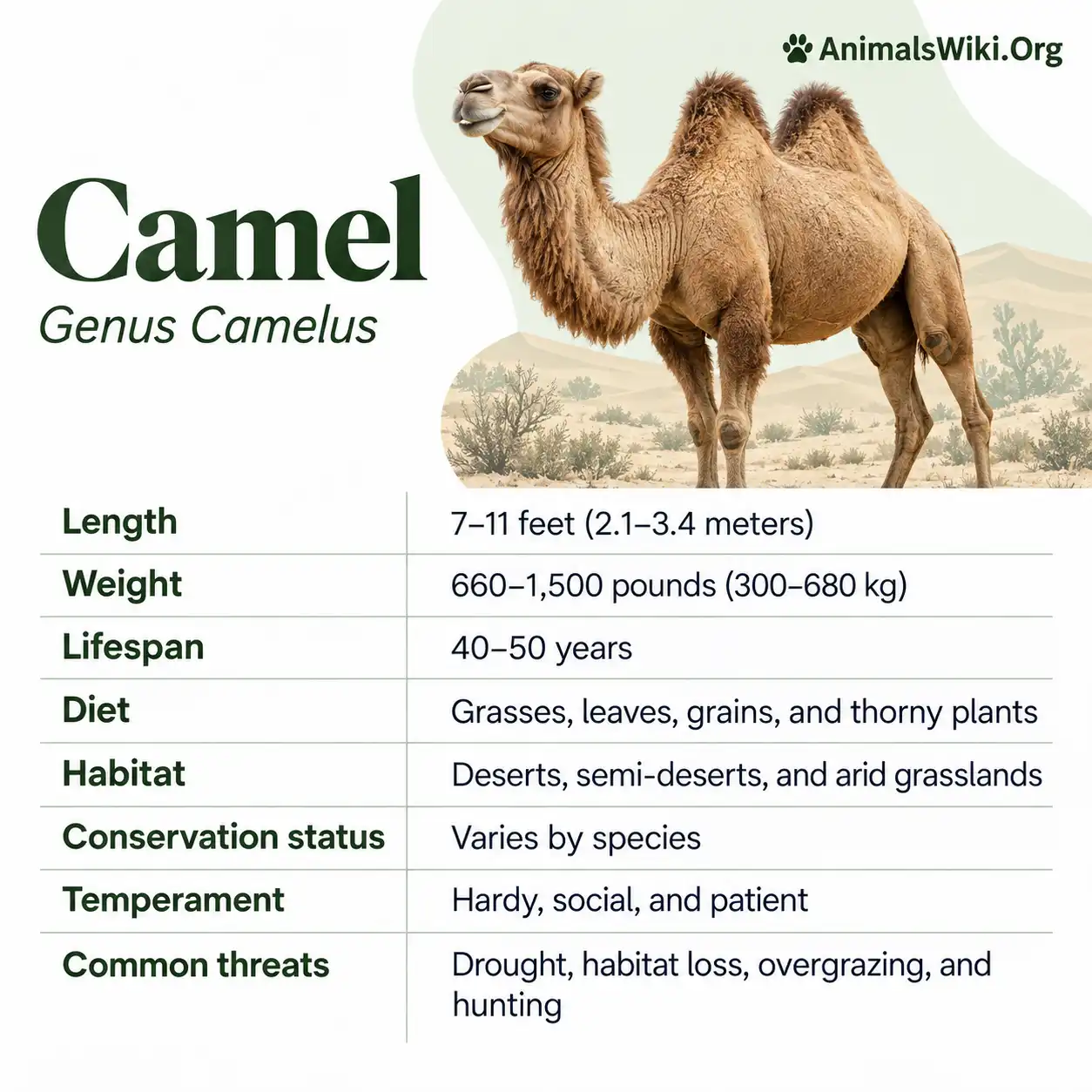
Camel, The Remarkable Desert Survivors of Africa & Asia
The camel is one of the world’s most remarkable desert-adapted mammals, famous for its distinctive humps, long legs, broad padded feet, exceptional endurance, and extraordinary ability to survive in hot, dry environments where water and food may be scarce.
For thousands of years, camels have also played an important role in human societies.
They have been used for:
- Transportation
- Riding
- Carrying heavy loads
- Milk
- Meat
- Fiber and hair
- Trade
- Agriculture
- Desert travel
Their ability to cross vast dry landscapes earned camels the famous nickname:
“Ships of the Desert.”
But one of the most common beliefs about camels is incorrect.
Camels do not store water in their humps.
A camel’s hump primarily stores fat.
This concentrated energy reserve allows the animal to survive when food is limited without distributing large amounts of insulating fat across the entire body.
Camels possess numerous additional adaptations for desert survival.
Their bodies can tolerate substantial dehydration.
Their kidneys conserve water efficiently.
Their long eyelashes and closable nostrils help protect them during blowing sand.
Their broad feet spread their weight across soft ground.
Their long legs raise much of the body away from extremely hot desert surfaces.
Camels can also tolerate changes in body temperature that would be challenging for many mammals, reducing the need to cool themselves continuously through sweating.
There are three living camel species generally recognized today:
- Dromedary camel (Camelus dromedarius)
- Wild Bactrian camel (Camelus ferus)
- Domestic Bactrian camel (Camelus bactrianus)
The easiest visible difference is the number of humps.
A dromedary has one hump.
A Bactrian camel has two humps.
Dromedaries are especially associated with the hot deserts of North Africa, the Middle East, and surrounding regions.
Bactrian camels are adapted to the harsh continental environments of Central Asia, where temperatures can become extremely cold during winter as well as hot during summer.
Camels therefore should not be thought of simply as animals adapted to heat.
Some are adapted to environments with extraordinary temperature extremes.
Camels belong to the family Camelidae, which also includes their South American relatives:
- Llamas
- Alpacas
- Guanacos
- Vicuñas
Together, these animals demonstrate an extraordinary evolutionary history stretching across continents.
This comprehensive guide explores camel facts, species, humps, size, weight, habitat, distribution, diet, water conservation, desert adaptations, feet, eyelashes, teeth, speed, behavior, reproduction, baby camels, lifespan, dromedary camels, Bactrian camels, wild camels, camel vs. llama differences, human uses, conservation, and much more.
Camel Facts
| Feature | Information |
|---|---|
| Common Name | Camel |
| Animal Type | Mammal |
| Family | Camelidae |
| Genus | Camelus |
| Living Species | 3 commonly recognized |
| Dromedary Humps | 1 |
| Bactrian Humps | 2 |
| Diet | Herbivorous |
| Main Habitats | Deserts, semi-deserts, steppes and drylands |
| Distribution | Primarily Africa and Asia; introduced populations elsewhere |
| Body Covering | Hair |
| Feet | Broad, padded, two-toed |
| Young | Calf |
| Reproduction | Live birth |
| Major Adaptation | Extreme water and temperature conservation |
| Hump Contents | Primarily fat |
| Typical Lifespan | Often several decades |
| Famous Nickname | Ship of the Desert |
What Is a Camel?
A camel is a large herbivorous mammal belonging to the family Camelidae.
True camels belong to the genus:
Camelus
They are highly adapted to dry environments and can survive conditions that would severely challenge many other large mammals.
Their distinctive characteristics include:
- Long neck
- Long legs
- Humps
- Broad feet
- Thick lips
- Long eyelashes
- Water-conserving physiology
Scientific Classification of Camels
A simplified classification is:
| Classification | Name |
|---|---|
| Kingdom | Animalia |
| Phylum | Chordata |
| Class | Mammalia |
| Order | Artiodactyla |
| Family | Camelidae |
| Genus | Camelus |
Camels are even-toed ungulates, although their feet differ considerably from the hard hooves of animals such as deer and cattle.
Types of Camels
Three living species are generally recognized within the genus Camelus.
Dromedary Camel
Scientific name: Camelus dromedarius
The dromedary is the familiar one-humped camel.
It is adapted particularly well to hot, dry climates.
Dromedaries make up the overwhelming majority of the world’s domestic camel population.
Domestic Bactrian Camel
Scientific name: Camelus bactrianus
The domestic Bactrian camel has:
two humps
It is associated particularly with Central Asia.
Compared with dromedaries, it usually has:
- Heavier body
- Thicker coat
- Shorter legs relative to body size
- Strong adaptations to cold winters
Wild Bactrian Camel
Scientific name: Camelus ferus
The wild Bactrian camel is a distinct wild species rather than simply a population of escaped domestic Bactrian camels.
It survives in extremely harsh desert environments of Central Asia.
Wild Bactrian camels are rare and face serious conservation pressures.
One-Humped Camel vs. Two-Humped Camel
The easiest distinction is:
| Camel | Humps |
|---|---|
| Dromedary | 1 |
| Bactrian | 2 |
However, they differ in much more than hump number.
Dromedaries are generally better associated with extremely hot desert conditions.
Bactrian camels are strongly adapted to continental environments where winters can become bitterly cold.
What Does a Camel Look Like?
Camels possess a distinctive body shape.
Typical characteristics include:
- Long curved neck
- Relatively small head
- Long legs
- One or two humps
- Broad feet
- Thick lips
- Long eyelashes
- Short tail
- Hair varying in thickness according to species and season
Their unusual appearance reflects adaptations for survival in demanding environments.
Why Do Camels Have Humps?
Camel humps are primarily fat-storage structures.
When food becomes scarce, stored fat can be metabolized for energy.
Concentrating fat in humps rather than spreading thick insulating fat across the entire body can also be advantageous in hot environments.
Do Camels Store Water in Their Humps?
No.
This is one of the most widespread camel myths.
Camel humps store:
fat, not a reservoir of drinking water.
Camels survive dehydration because of adaptations throughout their bodies, including their:
- Blood
- Kidneys
- Digestive system
- Temperature regulation
- Water-conservation mechanisms
What Happens to a Camel’s Hump Without Food?
When a camel uses its stored fat, the hump can become:
- Smaller
- Softer
- Less upright
After adequate feeding, fat reserves can be restored and the hump becomes fuller again.
Does Camel Fat Produce Water?
When stored fat is metabolized, chemical reactions produce a certain amount of metabolic water.
However, this does not mean the hump is a water tank.
Its primary function is energy storage.
How Big Are Camels?
Camel size varies by:
- Species
- Sex
- Age
- Nutrition
- Individual genetics
Adult camels can stand roughly around 1.8–2 meters or more at the shoulder, with the hump increasing their overall height.
Large males can weigh several hundred kilograms, with exceptionally large individuals becoming very heavy.
How Much Does a Camel Weigh?
Depending on species and sex, adult camels commonly weigh several hundred kilograms.
Large males can exceed the mass of smaller females by a substantial margin.
Bactrian camels are generally more heavily built than dromedaries.
Male vs. Female Camel
Male camels are usually:
- Larger
- Heavier
- More muscular
than females of the same species.
Adult males may also show distinctive behaviors and physical changes during the breeding season.
What Is a Male Camel Called?
An adult male camel is commonly called a:
bull
What Is a Female Camel Called?
An adult female camel is commonly called a:
cow
What Is a Baby Camel Called?
A baby camel is called a:
calf
Camel Head
The camel’s head is relatively small compared with its large body.
Important features include:
- Large eyes
- Long eyelashes
- Small ears
- Flexible nostrils
- Tough lips
- Strong teeth
Each contributes to survival in demanding habitats.
Why Do Camels Have Long Eyelashes?
Long eyelashes help protect the eyes from:
- Sand
- Dust
- Wind
- Bright desert conditions
Camels possess protective eyelid structures that further shield the eye.
Do Camels Have Three Eyelids?
Camels are often described as having three eyelids.
More precisely, in addition to the normal upper and lower eyelids, they possess a nictitating membrane, sometimes informally called a third eyelid.
This protective membrane can help shield the eye while maintaining some visibility.
Can Camels Close Their Nostrils?
Camels can narrow or close their nostrils substantially.
This helps reduce the amount of blowing sand and dust entering the nasal passages.
It is especially useful during desert winds and sandstorms.
Camel Ears
Camel ears are relatively small and covered with hair.
The hair helps limit the entry of:
- Sand
- Dust
- Debris
Camel Lips
Camels have thick, strong, highly mobile lips.
These allow them to feed on tough desert vegetation that many animals would avoid.
They can consume:
- Dry grasses
- Shrubs
- Thorny plants
- Leaves
- Salt-tolerant vegetation
Their lips help manipulate rough and prickly food.
Can Camels Eat Thorns?
Yes.
Camels can consume many thorny desert plants.
Their mouths possess tough tissues and specialized structures that help them handle abrasive vegetation.
This does not mean they are completely immune to injury, but their mouths are exceptionally well adapted for rough forage.
Camel Teeth
Camels possess teeth suited to processing tough vegetation.
They have:
- Incisors
- Canine-like teeth
- Premolars
- Molars
Their dentition changes as they mature.
Adult male camels can possess particularly prominent canine teeth.
Do Camels Chew Cud?
Camels regurgitate and rechew partially digested food in a process similar to cud chewing.
However, they are not true ruminants like cattle.
They are often described as pseudoruminants because their digestive anatomy differs from the four-chambered stomach arrangement of true ruminants.
Camel Digestive System
Camels have a specialized multi-compartment digestive system.
This helps them extract nutrients efficiently from:
- Dry grasses
- Fibrous plants
- Low-quality forage
Microorganisms within the digestive tract help break down plant material.
What Do Camels Eat?
Camels are primarily herbivores.
Their diet can include:
- Grasses
- Leaves
- Shrubs
- Twigs
- Seeds
- Desert vegetation
- Thorny plants
- Salt-tolerant plants
Their ability to eat coarse vegetation helps them survive where food quality is low.
Do Camels Eat Cactus?
Camels can consume certain tough and thorny plants, but “camels eat cactus” is often used as a generalized desert image.
True cacti are native primarily to the Americas, whereas camels evolved in the Old World.
Camels introduced into areas with cactus may potentially consume some species, but cactus is not the defining natural food of African and Asian camels.
Do Camels Eat Meat?
Camels are adapted primarily for herbivory.
Reports of unusual consumption of animal material do not change their fundamental classification as plant-eating mammals.
Where Do Camels Live?
Camels are associated primarily with:
- Deserts
- Semi-deserts
- Dry grasslands
- Steppes
- Arid shrublands
Domestic camels occur across large areas of:
- North Africa
- East Africa
- Middle East
- South Asia
- Central Asia
Do Camels Live in the Sahara Desert?
Yes.
Dromedary camels are strongly associated with the Sahara and surrounding dry regions.
They have been extremely important for transportation and trade across North African deserts.
Do Camels Live in Arabia?
Yes.
The dromedary has played a major historical and cultural role throughout the Arabian Peninsula.
Are There Camels in Pakistan?
Yes.
Domestic dromedary camels occur in Pakistan and are particularly associated with arid and semi-arid regions.
They are used for purposes including:
- Transport
- Milk
- Meat
- Agriculture
- Livelihoods
Do Camels Live in Cold Deserts?
Yes.
Bactrian camels demonstrate that camel adaptations extend far beyond hot deserts.
Central Asian habitats can experience:
- Hot summers
- Freezing winters
- Snow
- Strong winds
- Extreme temperature changes
Their thick winter coats help them survive cold conditions.
Do Camels Live in Australia?
Yes.
Australia has a large population of free-ranging feral dromedary camels descended from domestic animals introduced during the nineteenth century.
They are not native to Australia.
Are There Wild Dromedary Camels?
There are no generally recognized surviving truly wild populations of the original wild dromedary.
Modern dromedaries are domesticated or descended from domesticated animals.
Australia’s free-ranging dromedaries are therefore:
feral, not truly wild in evolutionary origin.
Camel Desert Adaptations
Camels survive desert conditions through a combination of anatomical, physiological, and behavioral adaptations.
Important adaptations include:
- Humps storing fat
- Efficient kidneys
- Concentrated urine
- Dry feces
- Broad padded feet
- Long legs
- Protective eyelashes
- Closable nostrils
- Tough lips
- Thick coat
- Temperature tolerance
- Exceptional dehydration tolerance
No single adaptation explains camel survival.
Their success results from the entire system working together.
How Do Camels Survive Without Water?
Camels conserve water exceptionally well.
They reduce water loss through:
- Efficient kidneys
- Concentrated urine
- Dry feces
- Controlled sweating
- Temperature regulation
- Moisture recovery within the nasal passages
They can also tolerate levels of dehydration that would be dangerous for many other mammals.
How Long Can a Camel Go Without Water?
There is no single fixed number.
The answer depends heavily on:
- Temperature
- Activity
- Food moisture
- Species
- Body condition
- Shade
- Workload
Under favorable conditions, camels can survive for extended periods without drinking.
In extreme heat while working hard, they require water much sooner.
Claims that every camel can survive a specific number of weeks without water under all conditions are misleading.
How Much Water Can a Camel Drink?
A severely dehydrated camel can drink an extraordinary amount of water in a relatively short period.
Large camels may consume well over 100 liters when extremely thirsty.
The exact amount depends on:
- Body size
- Degree of dehydration
- Water availability
Their ability to rehydrate rapidly is one of their most remarkable physiological adaptations.
Why Doesn’t a Camel’s Blood Become Too Thick?
Camels possess distinctive red blood cells.
Unlike the circular red blood cells typical of most mammals, camel red blood cells are:
oval or elliptical
This shape contributes to their ability to function during significant dehydration and rapid rehydration.
Camel Red Blood Cells
Camel red blood cells are unusual among mammals.
Their elliptical shape helps them tolerate dramatic changes in the concentration and volume of body fluids.
This is particularly valuable when a dehydrated camel suddenly drinks a large amount of water.
Camel Kidneys
Camel kidneys are extremely efficient at conserving water.
They can produce highly concentrated urine.
This reduces the amount of water lost when waste products are removed from the body.
Camel Urine and Feces
Water conservation means camel waste can contain relatively little water.
Their:
- Urine can be highly concentrated.
- Feces can be very dry.
Every saved drop can matter in an arid environment.
Do Camels Sweat?
Yes.
Camels can sweat when necessary.
However, their bodies tolerate considerable temperature fluctuation before relying heavily on evaporative cooling.
Because sweating consumes water, delaying excessive sweating helps conserve moisture.
Camel Body Temperature
A camel’s body temperature can fluctuate more than that of many mammals.
Allowing body temperature to rise during hot daytime conditions reduces the need to cool continuously through sweating.
At night, body temperature can fall again as the environment becomes cooler.
This physiological flexibility saves water.
Why Do Camels Have Long Legs?
Long legs help elevate the body away from the intensely heated desert surface.
Ground temperatures can be much higher than the air above.
Long legs also allow efficient movement across open terrain.
Camel Feet
Camel feet are among their most important desert adaptations.
Each foot has two toes supported by a broad, flexible pad.
When the camel steps down, the foot spreads.
This distributes body weight across a larger surface area.
Why Don’t Camels Sink in Sand?
Their broad padded feet spread their weight over the sand.
This reduces pressure on the ground compared with a narrow hard hoof.
The same basic principle explains why snowshoes help humans move across soft snow.
Do Camels Have Hooves?
Camels are even-toed ungulates, but their feet differ from the hard hooves of horses or cattle.
Their toes have nail-like structures, while much of their weight is supported by broad padded surfaces.
Camel Chest Pads and Calluses
Camels possess thickened areas of skin on parts of the body that contact the ground while resting.
These callosities help protect them when kneeling or lying on:
- Hot ground
- Rough surfaces
- Sand
Some of these pads develop naturally as the animal matures.
Why Do Camels Kneel?
Camels commonly kneel to:
- Rest
- Allow riders to mount
- Allow loads to be placed or removed
Their limb anatomy and protective callosities make this posture practical.
Camel Coat
Camel hair helps protect against environmental extremes.
A camel’s coat can:
- Reduce heat gain from intense sunlight
- Provide insulation
- Protect skin
Bactrian camels develop especially thick winter coats.
Do Camels Get Cold?
Yes, but Bactrian camels are highly adapted to cold.
Their dense winter coats provide substantial insulation.
When warmer weather arrives, much of the thick coat is shed.
How Fast Can a Camel Run?
Camels can run surprisingly fast for large animals.
They are capable of substantial bursts of speed and can maintain useful travel speeds over long distances.
Exact speed varies by:
- Individual
- Species
- Terrain
- Training
- Distance
Racing dromedaries are particularly athletic.
Camel Walking
Camels commonly use a pacing gait.
The legs on the same side of the body can move in a coordinated pattern.
This produces the characteristic swaying movement experienced by riders.
The motion contributed to the camel’s nickname:
Ship of the Desert.
Can Camels Swim?
Yes.
Camels are capable of swimming.
One particularly interesting example involves the Kharai camels of western India, which are known for swimming through coastal waters to reach mangrove feeding areas.
Camel Behavior
Camels are social mammals.
Domestic herds may contain:
- Females
- Young
- Adult males
- Human-managed groups
Wild camel social organization varies with resources and reproductive conditions.
Are Camels Intelligent?
Camels can:
- Learn routines
- Remember locations
- Recognize familiar individuals
- Respond to handlers
- Navigate familiar landscapes
They possess behavioral abilities suited to complex social and environmental conditions.
Are Camels Friendly?
Individual temperament varies.
A well-handled domestic camel may be calm around people.
However, camels are large, powerful animals and can become:
- Defensive
- Aggressive
- Excited
- Territorial
especially under stressful conditions or during breeding season.
Do Camels Spit?
Yes, but what appears to be “spitting” can involve more than saliva.
An irritated camel may expel:
- Saliva
- Partially digested stomach contents
toward a perceived threat.
It is a defensive or aggressive behavior.
Why Do Camels Spit?
Possible reasons include:
- Irritation
- Fear
- Aggression
- Social conflict
- Defense
Domestic animals may direct this behavior toward people when stressed or provoked.
Do Camels Bite?
Yes.
Camels possess powerful jaws and large teeth.
Bites can cause serious injury.
They should therefore be treated with appropriate caution.
Are Camels Dangerous?
Camels are not predators, but their size and strength mean they can injure people.
Potential dangers include:
- Biting
- Kicking
- Crushing
- Charging
- Aggressive breeding behavior
Experienced handling is important.
Camel Communication
Camels communicate through:
- Vocalizations
- Body posture
- Facial expressions
- Scent
- Physical interactions
They can produce:
- Grunts
- Groans
- Roars
- Other low-frequency sounds
Why Do Camels Make Strange Sounds?
Camel vocalizations can occur during:
- Social contact
- Stress
- Breeding
- Mother-calf communication
- Aggressive interactions
The famous deep camel groan is only one part of their vocal repertoire.
Camel Reproduction
Camels reproduce sexually and give birth to live young.
Breeding patterns are influenced by:
- Season
- Climate
- Food
- Species
- Management
Males can become particularly competitive during breeding periods.
Camel Pregnancy
Camel pregnancy is long.
Gestation typically lasts roughly:
12–14 months, depending on species and individual circumstances.
Usually a single calf is born.
Twins are possible but uncommon.
How Many Babies Do Camels Have?
Usually:
one calf
per pregnancy.
Baby Camel
A newborn camel calf is relatively well developed.
Soon after birth, it begins:
- Attempting to stand
- Walking
- Nursing
Maternal care is important during early development.
Do Baby Camels Have Humps?
Camel calves possess the anatomical region that develops into the adult hump, but a newborn’s hump is not initially a large, fully developed fat-filled structure.
As the calf grows and accumulates fat, the hump becomes increasingly prominent.
Do Baby Camels Drink Milk?
Yes.
Camel calves nurse from their mothers.
Camel milk provides:
- Energy
- Protein
- Fat
- Water
- Essential nutrients
Camel Milk
Camel milk is an important food in many pastoral societies.
It is consumed:
- Fresh
- Fermented
- Processed into other products
Its nutritional composition varies with:
- Species
- Diet
- Lactation stage
- Environment
How Long Do Camels Live?
Domestic camels can often live for several decades.
A commonly cited broad lifespan is approximately:
40–50 years
although lifespan varies with health, species, environment, and management.
Camel Predators
Historically, large predators capable of attacking camels included:
- Lions in some regions
- Tigers in parts of Asia
- Wolves
- Other large carnivores
Today, predator pressure varies enormously by region.
Calves are generally more vulnerable than healthy adults.
How Do Camels Defend Themselves?
Camels can defend themselves using:
- Large body size
- Powerful kicks
- Strong bites
- Long legs
- Aggressive displays
Running can also help them avoid threats.
Camel vs. Dromedary
A dromedary is a camel.
Specifically, it is the one-humped species:
Camelus dromedarius
Therefore:
All dromedaries are camels, but not all camels are dromedaries.
Dromedary vs. Bactrian Camel
| Feature | Dromedary | Bactrian Camel |
|---|---|---|
| Humps | 1 | 2 |
| Build | Generally lighter | Generally heavier |
| Legs | Relatively long | Relatively shorter |
| Coat | Usually shorter | Thick winter coat |
| Climate Association | Hot arid regions | Cold and hot continental deserts |
| Main Historical Range | Africa/Middle East/South Asia | Central Asia |
Camel vs. Llama
Camels and llamas belong to the same family, Camelidae.
However:
| Feature | Camel | Llama |
|---|---|---|
| Native Region | Old World | South America |
| Hump | Present in true camels | Absent |
| Size | Generally much larger | Smaller |
| Main Adaptation | Deserts/steppes | Andean environments |
| Genus | Camelus | Lama |
Camel vs. Alpaca
Alpacas are smaller South American camelids primarily associated with fiber production.
They lack humps.
Camels are substantially larger and belong to a different camelid lineage.
Camel Relatives
Living members of Camelidae include:
- Dromedary
- Domestic Bactrian camel
- Wild Bactrian camel
- Llama
- Alpaca
- Guanaco
- Vicuña
Camel Evolution
Camelid evolutionary history is surprisingly complex.
The earliest camelid ancestors evolved in North America.
Over millions of years, different camelid lineages spread into:
- Asia
- Africa
- South America
The North American camelid lineages eventually disappeared.
Modern true camels survived in the Old World, while llamas, alpacas, guanacos, and vicuñas survived in South America.
Did Camels Evolve in the Desert?
Modern camels possess extraordinary desert adaptations, but camelid evolution did not begin in today’s Sahara or Arabian deserts.
The family’s early evolutionary history traces back to North America.
Later camelid lineages spread and evolved in very different environments.
Why Are Camels Called Ships of the Desert?
The phrase reflects their historical importance for long-distance desert travel.
Camels can:
- Carry people
- Carry goods
- Travel long distances
- Cross sandy terrain
- Survive dry conditions
Their swaying gait also resembles the rolling movement of a ship.
Camels and Humans
Humans have depended on camels for thousands of years.
Uses include:
- Riding
- Caravan transport
- Milk
- Meat
- Hair
- Leather
- Racing
- Agriculture
- Tourism
Camels transformed trade across many arid landscapes.
Camel Caravans
Before modern motorized transportation, camel caravans carried goods across enormous desert regions.
Trade goods could include:
- Salt
- Spices
- Textiles
- Metals
- Food
- Luxury goods
Camels helped connect distant settlements and civilizations.
Can Camels Carry Heavy Loads?
Yes.
Camels have long been used as pack animals.
The safe load depends on:
- Camel size
- Health
- Terrain
- Temperature
- Travel distance
- Equipment
Responsible management is necessary to avoid overloading.
Camel Racing
Camel racing is practiced in several regions, particularly in parts of the Middle East.
Racing camels are selectively bred and trained for:
- Speed
- Endurance
- Athletic performance
Dromedaries are commonly used.
Camel Hair
Camel hair has traditionally been used to produce:
- Textiles
- Blankets
- Clothing
- Rugs
- Rope
Bactrian camels develop particularly thick coats suitable for cold climates.
Camel Conservation
Conservation concerns differ sharply between domestic and wild camels.
Domestic dromedaries and Bactrian camels are widespread livestock animals.
The wild Bactrian camel, however, has a very restricted population and is threatened.
Potential threats include:
- Habitat degradation
- Competition with livestock
- Hybridization with domestic camels
- Human disturbance
- Illegal hunting
- Water scarcity
- Climate-related environmental change
Why Are Wild Bactrian Camels Important?
Wild Bactrian camels represent a distinct evolutionary lineage.
Protecting them preserves:
- Genetic diversity
- Unique desert adaptations
- Natural ecological relationships
Their survival should not be confused with the abundance of domestic Bactrian camels.
40 Interesting Camel Facts
- Camels are mammals.
- They belong to the family Camelidae.
- True camels belong to the genus Camelus.
- Three living camel species are generally recognized.
- Dromedaries have one hump.
- Bactrian camels have two humps.
- Camel humps store primarily fat.
- Camels do not store tanks of water in their humps.
- Stored hump fat provides energy during food shortages.
- Camels can tolerate substantial dehydration.
- Their kidneys conserve water efficiently.
- Camel urine can be highly concentrated.
- Camel feces can be extremely dry.
- Camels can rapidly drink large quantities of water when dehydrated.
- Their red blood cells are oval or elliptical.
- Long eyelashes protect their eyes from sand.
- Camels can narrow their nostrils against blowing sand.
- Their ears contain protective hair.
- Camels have thick, tough lips.
- They can eat thorny vegetation.
- Camels have broad padded feet.
- Their feet spread over soft sand.
- Long legs raise the body away from hot ground.
- Camels possess protective callosities where the body contacts the ground.
- Camels are herbivores.
- They regurgitate and rechew food.
- They are not true ruminants.
- Dromedaries are associated especially with hot deserts.
- Bactrian camels tolerate extremely cold winters.
- Some camels can swim.
- Camels can run surprisingly fast.
- Camel calves are born after a long pregnancy.
- A baby camel is called a calf.
- Camels usually give birth to one calf.
- Camel milk is important to many pastoral cultures.
- Camels have transported people and goods for thousands of years.
- They are called Ships of the Desert.
- Camelid ancestors originally evolved in North America.
- Llamas and alpacas are relatives of camels.
- The wild Bactrian camel is a rare and threatened wild species.
Did You Know?
A camel’s most famous survival feature—the hump—is not actually where it stores its drinking water.
The widespread image of a camel carrying a reservoir of water inside its hump sounds logical.
After all, camels can survive remarkably dry environments.
But the reality is much more interesting.
The hump contains primarily:
fat.
When food becomes scarce, the camel can use this stored fat as an energy source.
Keeping much of this fat concentrated around the back rather than distributing thick insulating fat throughout the entire body can also help with heat management.
So where does the camel’s extraordinary ability to survive dehydration come from?
The answer is:
almost everywhere else in its body.
Its kidneys conserve water.
Its digestive system minimizes moisture loss.
Its feces can become exceptionally dry.
Its urine can become highly concentrated.
Its nasal passages help recover moisture from exhaled air.
Its body can tolerate substantial dehydration.
Its temperature can fluctuate, reducing the need for constant evaporative cooling.
Its oval red blood cells continue functioning under dramatic changes in hydration.
And when water finally becomes available, a severely dehydrated camel can drink an enormous quantity relatively quickly.
The camel therefore does not survive because it carries a hidden water bottle on its back.
It survives because its entire body has evolved into an extraordinarily efficient water-management system.
The hump is only one component—and its primary cargo is fat.
Frequently Asked Questions About Camels
What is a camel?
A camel is a large herbivorous mammal belonging to the family Camelidae and genus Camelus.
Is a camel a mammal?
Yes.
How many camel species are there?
Three living species are generally recognized: the dromedary, domestic Bactrian camel, and wild Bactrian camel.
What are the two main types of domestic camel?
The dromedary and domestic Bactrian camel.
How many humps does a camel have?
It depends on the species. Dromedaries have one, while Bactrian camels have two.
Which camel has one hump?
The dromedary.
Which camel has two humps?
Bactrian camels.
What is inside a camel’s hump?
Primarily fat.
Do camels store water in their humps?
No.
Why do camels have humps?
Humps store fat that can be used for energy when food is scarce.
What happens when a camel uses its hump fat?
The hump can become smaller and less firm.
Can the camel’s hump grow again?
It can become fuller again when the camel rebuilds its fat reserves.
Where do camels live?
Camels occur primarily in arid and semi-arid regions of Africa and Asia, with introduced populations elsewhere.
Do camels live in deserts?
Yes.
Do camels live in the Sahara?
Dromedary camels are widely associated with the Sahara.
Do camels live in cold places?
Bactrian camels can survive extremely cold Central Asian winters.
Are there camels in Australia?
Yes. Australia has a large feral dromedary population.
Are Australian camels wild?
They are more accurately described as feral because they descend from domesticated camels.
Are there wild camels?
Yes. The wild Bactrian camel is a genuinely wild species.
Are there wild dromedaries?
No surviving population is generally recognized as the original truly wild dromedary.
What do camels eat?
They eat grasses, leaves, shrubs, twigs, thorny plants and other vegetation.
Are camels herbivores?
Yes.
Can camels eat thorns?
Yes. Their tough lips and mouth tissues help them handle thorny vegetation.
Do camels eat cactus?
Camels can consume some thorny plants, but true cacti are not the characteristic natural food of Old World camels.
Do camels chew cud?
They regurgitate and rechew food, although they are not true ruminants like cattle.
How do camels survive in the desert?
They conserve water, tolerate dehydration, store fat in humps, possess broad feet, regulate body temperature efficiently, and have protective eyes and nostrils.
How long can a camel survive without water?
It varies greatly according to temperature, food, workload, health and environmental conditions.
How much water can a camel drink?
A large severely dehydrated camel can drink well over 100 liters under some circumstances.
Why can camels drink so much water?
Their physiology is adapted to rapid rehydration after significant dehydration.
What shape are camel red blood cells?
They are characteristically oval or elliptical.
Why are camel red blood cells unusual?
Their shape helps them function through substantial changes in hydration and blood concentration.
Do camels sweat?
Yes, but they can delay heavy sweating by tolerating greater body-temperature fluctuations.
How do camel kidneys save water?
They produce highly concentrated urine, reducing water loss.
Why is camel dung so dry?
Their digestive system conserves as much water as possible.
Why do camels have long legs?
Long legs elevate the body above hot desert surfaces and support efficient travel.
Why do camels have big feet?
Their broad padded feet distribute weight over soft sand.
Do camels have hooves?
Their feet differ from conventional hard hooves. They have two toes and broad padded supporting surfaces.
Why don’t camels sink into sand?
Their broad feet spread their weight across a larger area.
Why do camels have long eyelashes?
They help protect the eyes from blowing sand and dust.
Do camels have three eyelids?
They possess upper and lower eyelids plus a protective nictitating membrane often called a third eyelid.
Can camels close their nostrils?
They can narrow them substantially to help keep out sand.
Why do camels have hairy ears?
Hair helps reduce the entry of sand and debris.
Do camels have teeth?
Yes.
Can camels bite?
Yes. Their bites can be powerful and dangerous.
Are camels dangerous?
They can be. Camels are large animals capable of biting, kicking and crushing.
Why do camels spit?
They may expel saliva or stomach contents when irritated, threatened or involved in social conflict.
Is camel spit really spit?
It can include saliva as well as regurgitated digestive material.
Are camels friendly?
Temperament varies by individual, handling and circumstances.
Are camels intelligent?
They are capable of learning, memory, recognition and navigation.
How fast can camels run?
They can achieve substantial running speeds, particularly racing dromedaries, though exact performance varies.
Can camels swim?
Yes.
Why do camels kneel?
They kneel to rest and to allow riders or loads to be placed on them.
Does kneeling hurt camels?
Their bodies possess specialized callosities that protect pressure points when resting on the ground.
What is a baby camel called?
A calf.
What is a male camel called?
A bull.
What is a female camel called?
A cow.
How long is a camel pregnant?
Pregnancy commonly lasts roughly 12–14 months.
How many babies does a camel have?
Usually one calf.
Are camel twins possible?
Yes, but twins are uncommon.
Do baby camels have humps?
The hump region is present, but newborn calves do not begin with the large fat-filled humps seen in well-conditioned adults.
Do baby camels drink milk?
Yes.
Can humans drink camel milk?
Yes. Camel milk is an important traditional food in many regions.
How long do camels live?
They can often live around 40–50 years, although lifespan varies.
What predators eat camels?
Historically, large predators such as wolves, lions and tigers could prey on camels in parts of their ranges.
How do camels defend themselves?
They can kick, bite, run and use their large body size defensively.
What is a dromedary?
A dromedary is a one-humped camel species, Camelus dromedarius.
Is a dromedary a camel?
Yes.
What is a Bactrian camel?
A Bactrian camel is a two-humped camel adapted particularly well to Central Asian environments.
What is the difference between dromedary and Bactrian camels?
Dromedaries have one hump and are associated mainly with warmer dry regions. Bactrian camels have two humps and stronger adaptations to cold continental climates.
Are camels related to llamas?
Yes.
Are camels related to alpacas?
Yes.
Are camels related to horses?
They are both hoofed mammals in a broad everyday sense, but they belong to different evolutionary orders and are not close relatives.
Where did camels evolve?
The camelid family originated in North America before different lineages spread into other continents.
Did camels originally come from Africa?
No. The deeper evolutionary history of camelids begins in North America.
Why are camels called Ships of the Desert?
Because they have historically transported people and cargo across vast desert landscapes.
What are camels used for?
They are used for transport, milk, meat, fiber, racing, agriculture and tourism.
Can camels carry people?
Yes. They have been riding animals for thousands of years.
Can camels carry cargo?
Yes. They have historically been important pack animals.
Why are camels important to desert cultures?
They provide transportation, food, materials and livelihoods in environments where many other livestock species struggle.
Are camels endangered?
Domestic camels are widespread, but the wild Bactrian camel is threatened and has a much smaller population.
What threatens wild camels?
Threats can include habitat degradation, hunting, livestock competition, hybridization, disturbance and environmental change.
Why should wild Bactrian camels be protected?
They represent a distinct wild camel lineage with unique genetic and ecological importance.
Conclusion
The camel is one of the clearest examples of how evolution can shape an animal for survival in an extreme environment.
Its famous hump is only the beginning.
Rather than storing water, the hump stores fat that can provide energy when food becomes scarce.
The camel’s true water-saving abilities are distributed throughout its body.
Its kidneys produce concentrated urine.
Its digestive system minimizes moisture loss.
Its body tolerates substantial dehydration.
Its temperature can fluctuate to reduce unnecessary sweating.
Its unusual red blood cells continue functioning through dramatic changes in hydration.
When water finally becomes available, a thirsty camel can rehydrate with extraordinary speed.
Its external anatomy is equally specialized.
Broad padded feet spread over soft sand.
Long legs elevate the body away from scorching ground.
Thick eyelashes and protective eyelids shield the eyes.
Flexible nostrils help keep out blowing sand.
Tough lips allow the camel to browse vegetation that appears almost impossibly thorny.
Yet camels are more diverse than the classic image of a one-humped animal crossing a hot desert.
The dromedary is strongly associated with the warm drylands of Africa, Arabia and South Asia.
The Bactrian camel, by contrast, can endure brutally cold Central Asian winters.
Its heavy body and thick seasonal coat reveal that camel survival is not simply about resisting heat.
It is about coping with some of the harshest and most unpredictable environments on Earth.
Camels have also shaped human history.
For thousands of years, they have carried:
- People
- Food
- Water
- Trade goods
- Equipment
across landscapes where wheeled transport was once extremely difficult.
They provided milk, meat, fiber and mobility to communities living across vast dry regions.
Caravan routes supported trade and cultural exchange across continents.
The camel therefore became more than a domesticated animal.
In many regions, it became part of the foundation of desert civilization.
Their evolutionary history is just as surprising.
Camelid ancestors did not originally evolve in the Sahara or Arabian Peninsula.
Their deeper story began in North America.
From those ancient ancestors, different lineages eventually spread across the world.
True camels became established across Eurasia and Africa, while other camelids gave rise to the llamas, alpacas, guanacos and vicuñas of South America.
Today, domestic camels remain widespread and economically important.
But the story is very different for the genuinely wild Bactrian camel, whose survival depends on protecting some of Central Asia’s harshest remaining desert landscapes.
From its fat-filled hump and elliptical red blood cells to its sand-spreading feet and extraordinary ability to conserve water, the camel demonstrates that desert survival is not the result of one remarkable feature.
It is the result of an entire body shaped for endurance.



