Alpaca Facts
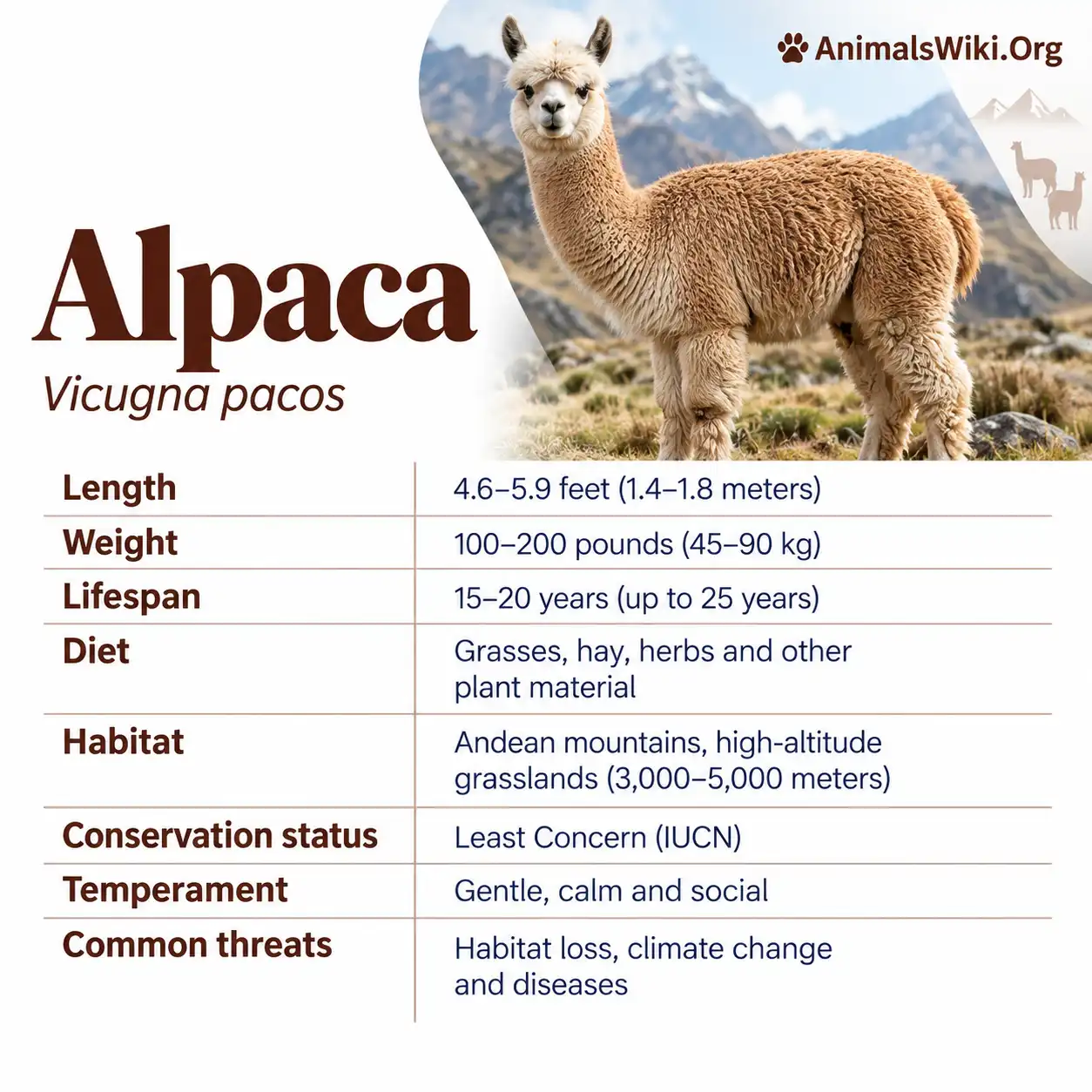
| Feature | Details |
|---|---|
| Common Name | Alpaca |
| Scientific Name | Vicugna pacos |
| Family | Camelidae |
| Order | Artiodactyla |
| First Domesticated | Approximately 6,000–7,000 years ago in the Andes |
| Native Habitat | High-altitude Andean grasslands (puna and altiplano) |
| Geographic Range | Peru, Bolivia, Chile, Ecuador, Argentina; globally farmed |
| Average Size | 81–99 cm (32–39 inches) at shoulder |
| Average Weight | 55–90 kg (121–198 lbs) |
| Lifespan | 15–20 years (wild and domesticated) |
| Diet | Herbivore — grasses, hay, shrubs |
| Fleece | Primary product — among the world’s finest natural fibers |
| Conservation Status | Domesticated; wild ancestor (Vicugna vicugna) — Least Concern |
| Defining Feature | Extraordinarily soft fleece; gentle disposition; expressive face |
| Two Breeds | Huacaya (fluffy, crimped fleece) & Suri (silky, lustrous fleece) |
1. Alpaca Species Overview & Classification
There are animals that attract attention through fear, through spectacle, or through sheer magnificence. And then there are animals that attract attention through something altogether more disarming — through a combination of extraordinary appearance, gentle temperament, and an expression of wide-eyed curiosity that makes it almost impossible to look at them without smiling. The Alpaca is emphatically in this second category.
With their impossibly fluffy coats, their long necks, their enormous dark eyes, and their slightly bewildered expressions, alpacas have become one of the world’s most universally beloved animals — internet sensations, farm tourism magnets, therapeutic companions, and the source of one of the most prized natural fibers in the world. But behind the undeniable cuteness lies a genuinely fascinating creature with a 7,000-year relationship with human civilization, a remarkable adaptation to some of Earth’s most extreme environments, and a role in Andean culture that goes far deeper than the novelty photos might suggest.
The Alpaca (Vicugna pacos) belongs to the family Camelidae — making it a distant cousin of the Bactrian and Dromedary camels of Asia and Africa. More immediately, it is a close relative of the llama, guanaco, and vicuña — the four South American camelids that have inhabited the Andes for millions of years. Of these four, the alpaca is the most exclusively domesticated and the most specifically adapted to a single purpose: producing extraordinary fleece.
Unlike llamas — which are larger, stronger, and bred primarily as pack animals — alpacas were selectively bred over millennia by the indigenous peoples of the Andes with a singular focus: the production of the finest, softest, warmest natural fiber available anywhere in the world. The result is an animal whose fleece rivals cashmere and silk in quality, whose gentle temperament makes it suitable for farming across the globe, and whose expressive face has made it a cultural phenomenon of the social media age.
Alpaca Species Classification Table
| Classification Level | Details |
|---|---|
| Kingdom | Animalia |
| Phylum | Chordata |
| Class | Mammalia |
| Order | Artiodactyla (Even-toed ungulates) |
| Family | Camelidae |
| Subfamily | Camelinae |
| Genus | Vicugna |
| Species | Vicugna pacos |
| Wild Ancestor | Vicugna vicugna (Vicuña) |
| Domesticated | ~6,000–7,000 years ago |
| Two Breeds | Huacaya & Suri |
Two Distinct Breeds
The alpaca world divides into two distinct breeds, each with dramatically different fleece characteristics:
Huacaya (pronounced wah-KY-ah) — The vastly more common breed, comprising approximately 90% of the global alpaca population. Huacaya alpacas have a dense, crimped, fluffy fleece that grows perpendicular to the body, giving them a rounded, teddy-bear appearance. Their fiber has a natural crimp that makes it particularly suitable for spinning into yarn.
Suri (pronounced SOO-ree) — The rarer and more prized breed, comprising approximately 10% of the global population. Suri alpacas have a long, silky, lustrous fleece that hangs in pencil-like locks alongside the body, giving them a completely different — more elegant and flowing — appearance. Suri fiber is finer, shinier, and considered by many textile experts to be the superior of the two, with a drape and luster more closely comparable to silk.
2. Alpaca Physical Description & Unique Features
The alpaca is a medium-sized animal with a body plan that immediately announces its camelid ancestry — that characteristic long neck, the elegant head carriage, the proud bearing — while simultaneously expressing something uniquely its own through the extraordinary volume of fleece that covers virtually every surface.
Size and Build
Adult alpacas stand approximately 81–99 cm (32–39 inches) at the shoulder — significantly smaller than llamas, which stand roughly 120 cm at the shoulder. Body length typically ranges from 120–150 cm. Weight falls between 55 and 90 kg (121–198 lbs), with males generally being larger and heavier than females. Despite their fluffy appearance, alpacas are well-muscled and surprisingly solid animals beneath their fleece.
The Famous Fleece
The alpaca’s defining physical feature — and the reason for its entire existence as a domesticated species — is its extraordinary fleece. A single adult alpaca can produce between 3 and 5 kg (6.6–11 lbs) of fiber per shearing, with exceptional animals occasionally producing significantly more.
Alpaca fiber has several properties that make it genuinely remarkable among natural fibers:
- Extreme softness — comparable to the finest cashmere; grades of baby alpaca fiber (from the animal’s first shearing) are among the softest natural materials available
- Warmth without weight — alpaca fiber is hollow, giving it exceptional insulating properties at very low weight
- Hypoallergenic — unlike wool, alpaca fiber contains no lanolin, making it suitable for people with wool sensitivities
- Durability — alpaca fiber is significantly stronger than merino wool
- Natural color range — alpacas naturally produce fiber in 22 recognized natural colors, from white through cream, fawn, brown, and black, eliminating the need for dyeing in many applications
Face and Expression
Perhaps no feature of the alpaca is more immediately captivating than its face. Large, dark, softly luminous eyes set above a slightly elongated muzzle and framed by a magnificent halo of fluffy fiber give alpacas an expression of gentle curiosity that humans universally find irresistible. The lips are split (a characteristic camelid feature), and the teeth — designed for grazing — are distinctive, with lower incisors that press against a hard dental pad on the upper jaw rather than opposing upper incisors.
Feet
Alpacas have two-toed feet with soft, leathery pads rather than hooves — significantly more environmentally gentle than hooved animals, as they cause less soil compaction and grassland damage. Each toe has a small nail rather than a hoof, and the soft pad gives them sure-footed traction on rocky Andean terrain.
Did You Know? Alpaca fiber comes in 22 recognized natural colors — more natural color variations than any other fiber-producing animal in the world. This extraordinary palette, ranging from brilliant white to jet black with every shade of fawn, brown, gray, and silver in between, means that alpaca textiles can be produced in a stunning range of colors without any dyeing whatsoever — a major environmental advantage over conventionally dyed wool.
3. Alpaca Habitat & Geographic Range
The alpaca is a creature of extreme environments — specifically adapted over thousands of years of both natural evolution and human selective breeding to thrive in the high-altitude grasslands of the South American Andes. Understanding where alpacas come from and how they are built for their native environment explains both their remarkable physiological adaptations and their extraordinary fleece.
The Andean Altiplano
The alpaca’s native habitat is the altiplano and puna — the high-altitude grassland ecosystems of the central and southern Andes, predominantly in Peru, Bolivia, Chile, and Argentina. These ecosystems exist at elevations typically ranging from 3,500 to 5,000 meters (11,500 to 16,400 feet) above sea level — altitudes where the air is thin, temperatures fluctuate dramatically between day and night, ultraviolet radiation is intense, and resources are scarce.
In these extreme conditions, the alpaca has evolved and been selectively bred for:
- Oxygen efficiency — specialized red blood cells (oval-shaped rather than round, like those of most mammals) that carry oxygen more efficiently at low atmospheric pressure
- Thermal regulation — a fleece dense enough to insulate against overnight temperatures that can plunge to -20°C (-4°F) while being shed seasonally to cope with daytime temperatures that can reach 30°C (86°F)
- Dietary efficiency — the ability to extract maximum nutrition from the tough, nutrient-poor grasses of high-altitude grasslands
Geographic Distribution
Habitat Range by Country/Region
| Country/Region | Population | Habitat Type | Altitude Range |
|---|---|---|---|
| Peru | ~70% of world population (~4 million) | Altiplano, puna grasslands | 3,500–5,000 m |
| Bolivia | ~15% of world population (~900,000) | Altiplano | 3,600–4,800 m |
| Chile | ~5% (~350,000) | Andean altiplano | 3,500–5,000 m |
| Argentina | ~5% (~350,000) | Puna grasslands | 3,500–4,500 m |
| Ecuador, Colombia | Small populations | Páramo grasslands | 3,000–4,500 m |
| USA, Australia, UK, NZ | Growing global farms | Lowland pastures (adapted) | Sea level–1,500 m |
Peru’s Dominance
Peru is unquestionably the heart of the alpaca world — home to approximately 70% of the global alpaca population (roughly 4 million animals) and the source of the vast majority of the world’s finest alpaca fiber. The Puno region around Lake Titicaca in southeastern Peru is particularly significant — the high-altitude grasslands here have been alpaca grazing land for thousands of years and remain the primary source of the world’s premium alpaca fiber.
Did You Know? Alpacas are one of the very few domesticated animals specifically adapted to function at extreme altitude. Their oval-shaped red blood cells — unique among mammals — allow them to carry oxygen approximately three times more efficiently than round-celled mammals like humans. This adaptation allows alpacas to remain active and productive at elevations where most large mammals struggle to function.
4. Alpaca Diet & Feeding Behavior
The alpaca is a remarkably efficient and environmentally gentle feeder — adapted by millions of years of evolution and thousands of years of selective breeding to extract maximum nutrition from the sparse, tough vegetation of high-altitude Andean grasslands.
What Alpacas Eat
Alpacas are strict herbivores — grazers and browsers that feed on a wide variety of plant material. In their native Andean habitat, their diet consists primarily of:
- Ichu grass (Stipa ichu) — the tough, hardy bunch grass that dominates Andean puna ecosystems; the primary food source for wild vicuñas and domesticated alpacas in their native range
- Various other native grasses and sedges
- Shrubs and low-growing vegetation available at high altitude
- Lichens and mosses when other vegetation is scarce
In farm settings worldwide, the diet shifts to more available alternatives:
- Pasture grasses — the primary food source in most farm settings
- High-quality hay — particularly important in winter or when pasture is limited
- Mineral supplements — particularly selenium, copper, and other trace minerals critical for fiber quality and overall health
- Occasional grain or pellets — used strategically but not as a primary food source (overfeeding grain can cause health issues)
Diet Breakdown Table
| Food Type | % of Diet (Wild/Andean) | % of Diet (Farmed) | Notes |
|---|---|---|---|
| Native grasses (ichu and similar) | 70–80% | — | Primary wild food source |
| Pasture grasses | — | 60–70% | Primary farmed food source |
| Hay | 10–15% | 20–30% | Year-round supplement; essential in winter |
| Shrubs and browse | 10–15% | 5–10% | Supplementary variety |
| Mineral supplements | Trace | <5% | Critical for health and fiber quality |
| Grain/pellets | None | <5% | Used sparingly; treats or lactation support |
The Remarkable Digestive Efficiency
Alpacas are pseudo-ruminants — they have a three-chambered stomach (rather than the four chambers of true ruminants like cattle) and chew their cud, but their digestive process is considerably more efficient than cattle or sheep. This efficiency means alpacas can extract significantly more nutrition per kilogram of food consumed than most livestock — a critical adaptation for high-altitude environments where vegetation is sparse.
This same efficiency makes alpacas environmentally superior to many other fiber-producing animals — they consume less food per kg of body weight, produce less methane per kg of food consumed, and their soft padded feet cause dramatically less soil compaction than hooved livestock.
“The alpaca is possibly the most perfectly engineered fiber animal on Earth. Its combination of extraordinary fleece quality, dietary efficiency, environmental gentleness, and temperament makes it the ideal livestock for sustainable fiber production.” — Dr. Claire Whitehead, Veterinary Camelid Specialist, University of Edinburgh
5. Alpaca Reproduction & Life Cycle
The alpaca’s reproductive biology reflects its adaptation to the demanding conditions of the Andean altiplano — where resources are seasonal and unpredictable, and where the timing of births must align precisely with the most favorable environmental conditions.
Sexual Maturity
Female alpacas (called hembras or simply “females”) typically reach sexual maturity at 12–24 months of age, though most responsible breeders wait until females are 18–24 months before breeding, to ensure the female is fully developed. Males (called machos or “males”) mature slightly later — often at 2–3 years — and most males are not used for breeding until they have been evaluated for fiber quality, conformation, and temperament.
The Unique Reproductive Strategy
Alpacas are induced ovulators — unlike most mammals where ovulation occurs cyclically on a predictable schedule, female alpacas only release eggs in response to the act of mating itself. This “on-demand” ovulation system means that:
- Females are potentially receptive to mating throughout most of the year (no defined heat cycle)
- Breeding can be carefully timed by farmers to align births with optimal weather conditions
- Multiple matings may be required for conception
Gestation and Birth
- Gestation period: Approximately 335–345 days (11–11.5 months) — one of the longest gestations relative to body size among domestic animals
- Birth timing: In the wild/native range, births are concentrated in the dry season (November–May) when conditions are most favorable
- Birth: Almost always a single cria (baby alpaca) — twins are extremely rare (less than 1% of births) and often do not survive
- Birth weight: Typically 5–8 kg (11–18 lbs)
- Birthing time: Females preferentially give birth in the morning hours — a behavioral adaptation that ensures the cria has the maximum number of daylight hours to dry off and bond before potentially cold nights
The Cria — Baby Alpacas
Baby alpacas are called crias — one of the animal kingdom’s most universally adorable youngsters. Crias are precocial — born fully developed and able to stand and walk within the first hour of life, a critical survival adaptation for a high-altitude environment where lying still means freezing.
Crias are typically weaned at approximately 6 months of age, at which point they are separated from their mothers and join juvenile groups.
First Shearing — Precious Baby Alpaca
An alpaca’s first shearing (at approximately 12 months) produces what the industry calls “baby alpaca” fiber — not necessarily from a young animal, but the term refers to the finest grade of alpaca fleece, typically from the first or second shearing when the fiber is at its finest. Baby alpaca fiber averages 18–20 microns in diameter — comparable to the finest cashmere.
Alpaca Lifespan Comparison
| Animal | Average Lifespan (Wild/Natural) | Average Lifespan (Farmed/Captivity) |
|---|---|---|
| Alpaca (Vicugna pacos) | ~15 years | 15–20 years |
| Llama (Lama glama) | 15–20 years | Up to 25 years |
| Vicuña (Vicugna vicugna) | 15–20 years | Up to 20 years |
| Cashmere Goat | 10–12 years | Up to 15 years |
| Merino Sheep | 10–12 years | Up to 20 years |
| Bactrian Camel | 20–25 years | Up to 40 years |
Did You Know? Alpaca births almost always occur between 7 AM and 2 PM local time — a behavioral adaptation so consistent that experienced alpaca breeders plan around it. The instinctive preference for morning births means crias have the maximum daylight hours to dry off, bond with their mothers, and find their first feeding before the potentially lethal cold of the Andean night descends.
6. Social Behavior & Communication
Alpacas are genuinely social animals — herd animals in every sense of the word — and understanding their social structure and communication reveals a far more complex inner life than their placid exterior might suggest.
Herd Structure
In both wild populations (as vicuñas, their ancestor) and domestic herds, alpacas live in structured social groups with clear hierarchies. A typical herd consists of:
- A dominant male who controls territory and breeding rights
- Female groups with their offspring — the core of the herd’s social structure
- Bachelor groups — young males and non-dominant adult males that live together at the periphery of breeding herds
The social bonds within alpaca herds are strong and meaningful — alpacas that are separated from herd companions show genuine signs of stress and distress, and solitary alpacas almost invariably suffer both physically and psychologically. This is why responsible alpaca keeping requires maintaining herds of at least three animals.
Communication — The Full Repertoire
Alpacas communicate through an impressive range of signals that experienced keepers learn to read with precision:
Vocalizations:
- Humming — the most common alpaca sound; a gentle, melodic hum used to communicate contentment, mild concern, or social connection; mothers and crias hum constantly to maintain contact
- Screaming/alarm call — a loud, sharp vocalization used to alert the herd to genuine predator threats; unmistakable and alarming to humans who hear it for the first time
- Clicking/clucking — a gentle sound used by mothers communicating with newborn crias
- Orgling — a distinctive gurgling sound made by males during mating; entirely unique to camelids
- Spitting sound — the anticipatory sound preceding the notorious spitting behavior
Body Language:
- Tail position — a high, raised tail indicates alertness or excitement; a relaxed tail indicates contentment
- Ear position — forward ears indicate curiosity or alertness; flat ears indicate aggression or submission
- Neck position — a high, arched neck in a male indicates dominance display; a lowered neck indicates submission
The Notorious Spit: Alpacas are famous — sometimes infamously — for their ability and willingness to spit. The spit itself is not the simple saliva spit that might be imagined, but rather a regurgitated mixture of stomach contents with a distinctly unpleasant odor. Spitting is used primarily as a social regulation mechanism within the herd — typically between competing animals for resources or in female rejection of unwanted male attention. Humans are not typically targeted unless they behave in ways the alpaca perceives as threatening, though this varies with individual animals. Well-socialized, frequently handled alpacas rarely spit at humans.
7. Predators & Defense Mechanisms
The Andean altiplano may seem remote and isolated, but it is home to a range of predators capable of threatening alpaca herds — particularly calves and isolated individuals.
Natural Predators
- Puma (Cougar) (Puma concolor) — the primary large predator in the Andes; capable of taking adult alpacas but typically targets young or weakened animals
- Andean condor (Vultur gryphus) — primarily a scavenger but occasionally threatens very young crias
- Andean fox (Lycalopex culpaeus) — a significant threat to newborn crias
- Spectacled bear (Tremarctos ornatus) — occasional opportunistic predator
- Culpeo and other smaller predators — primarily threaten crias
Defense Strategies
The Herd Alarm System — When any member of the herd detects a threat, the alarm vocalization spreads instantly through the entire group. All heads come up; all attention focuses on the threat. The herd then moves collectively away from danger — the coordinated response of multiple alert animals is significantly more effective than individual vigilance.
Guardian Animal Association — Alpacas have developed an extraordinary relationship with llamas as herd guards. Llamas — being larger, bolder, and naturally more aggressive than alpacas — are frequently kept with alpaca herds both in the Andes and on farms worldwide, where they actively patrol the herd’s perimeter and confront predators (including domestic dogs) that would otherwise threaten alpacas.
Spitting as Defense — While primarily a social regulation behavior, spitting can be used defensively against perceived threats, particularly by females protecting crias.
Flight — The primary physical defense; alpacas are surprisingly fast for their size, capable of reaching speeds of approximately 56 km/h (35 mph) in full sprint over short distances.
“Alpacas are far more perceptive and emotionally intelligent animals than most people realize. They recognize individual humans, remember experiences (both positive and negative) for years, and have genuinely complex social lives within their herds. They deserve far more scientific attention than they typically receive.” — Dr. Meredith Bruford, Animal Behavior Specialist, Cardiff University
8. Relationship with Humans
The Ancient Andean Partnership
The relationship between alpacas and humans is one of the longest and most intimate human-animal partnerships in the Western Hemisphere. Archaeological and genetic evidence indicates that alpacas were domesticated from wild vicuñas approximately 6,000–7,000 years ago in the high Andes — a process that likely took centuries of gradual taming, selective breeding, and mutual adaptation.
For the Inca civilization — which dominated the Andes from approximately the 13th to 16th centuries AD — alpacas were not merely livestock but sacred animals of profound cultural and economic significance. The finest alpaca fiber — particularly from the rare Suri breed — was reserved exclusively for Inca royalty and for ritual use. Garments woven from this “fiber of the gods” (as Inca records describe it) were considered more valuable than gold. The Inca state maintained vast herds of tens of thousands of alpacas managed by specialized herders called llamayoc, and alpaca textiles formed a crucial component of both the imperial economy and the religious ritual system.
The Colonial Disruption
The arrival of Spanish conquistadors in the 16th century was catastrophic for Andean camelids. European cattle, sheep, and horses — introduced by the Spanish — competed with alpacas for grazing land and brought diseases against which the native camelids had no immunity. It is estimated that alpaca populations dropped by as much as 90% within the first century of Spanish colonization — one of history’s most devastating losses of domestic animal biodiversity.
The survivors retreated to the highest and most remote Andean grasslands, where European livestock could not compete at extreme altitude. These remnant populations became the foundation of the modern alpaca industry.
The Modern Global Industry
The 19th and 20th centuries saw a dramatic rehabilitation of alpaca’s global reputation — driven largely by the fashion industry’s growing recognition of alpaca fiber’s extraordinary qualities. Today, alpaca is a significant global luxury fiber industry:
- World alpaca population (2026): approximately 7–8 million animals, with the majority in Peru
- Annual global fiber production: approximately 5,000–6,000 tonnes of clean fiber
- Primary export market: Peru exports approximately 80% of the world’s raw alpaca fiber
- Key importing markets: Italy, United Kingdom, Germany, Japan, USA
Therapy and Recreation
Beyond fiber production, alpacas have found a remarkable contemporary role as therapy animals. Their calm temperament, gentle nature, and undeniable visual appeal make them effective in:
- Care facility visits — alpacas are increasingly used in nursing homes and disability care settings
- School programs — educational farm visits
- Equine-assisted therapy equivalents — formal alpaca-assisted therapy programs
The “cute factor” — genuinely undeniable — has made alpaca farm visits one of the fastest-growing agritourism experiences in the UK, USA, Australia, and New Zealand.
Did You Know? The Inca Empire used alpaca fiber as both currency and tribute — herds of thousands of animals were maintained by the state specifically to produce fiber for redistribution through the Inca’s extraordinary social welfare system. Garments woven from Suri alpaca fiber were literally more valuable than gold in Inca society, reserved for the emperor, his court, and ritual offerings to the gods. When the Spanish discovered this, they attempted to substitute European textiles — but Andean weavers consistently preferred their own superior fiber.
9. Alpaca Conservation Status & Threats
The Domesticated Alpaca
The alpaca itself (Vicugna pacos) is a domesticated animal — it exists only in managed herds and has no truly wild population. As a domesticated species, it does not have a formal IUCN conservation status, and with approximately 7–8 million animals worldwide and a growing global farming industry, the species as such faces no extinction threat.
The Wild Ancestor — The Vicuña
The alpaca’s wild ancestor — the vicuña (Vicugna vicugna) — has a more complex conservation history:
- Listed as Least Concern on the IUCN Red List as of 2026
- Wild population estimated at approximately 350,000 animals
- The vicuña was severely over-hunted in the 19th and 20th centuries for its extraordinarily fine fiber — population dropped from pre-colonial millions to fewer than 10,000 animals by the 1960s
- International protection (CITES listing) and Peruvian national legislation have enabled dramatic population recovery since the 1970s
Key Threats to Alpaca Farming and Culture
1. Climate Change The most serious long-term threat to alpaca herding is climate change — which is dramatically affecting the Andean altiplano ecosystems on which most of the world’s alpacas depend. Changing precipitation patterns, glacial retreat affecting water availability, more extreme temperature fluctuations, and drought are all impacting the high-altitude grasslands that alpacas have grazed for millennia.
2. Loss of Genetic Diversity Commercial pressure to produce white fiber (for dyeing) has led to a significant increase in white-fleeced alpacas at the expense of the extraordinary natural color range for which the species is biologically capable. This genetic bottleneck reduces the resilience of alpaca populations.
3. Hybridization Pressure In some Andean regions, uncontrolled breeding between alpacas and llamas produces hybrid offspring with inferior fiber — a gradual degradation of alpaca fiber quality that affects the livelihoods of traditional herding communities.
4. Rural Poverty and Urban Migration As young Andean people move to cities for economic opportunities, traditional alpaca herding communities are losing the expertise and labor that sustainable high-altitude herding requires.
10. Famous Alpacas Around the World
Macgyver — The World’s Most Expensive Alpaca
In 2014, a Suri alpaca named Macgyver was sold at auction in Australia for AU$215,000 — at the time the highest price ever paid for an alpaca anywhere in the world. Macgyver’s extraordinary fiber quality — exceptionally fine even for a Suri — and his genetic potential as a breeding animal drove the record price. His sale demonstrated the extraordinary commercial value of elite alpaca genetics.
Snowflake — The UK’s Most Famous Farm Animal
Snowflake, a Huacaya alpaca resident at a farm in the English Cotswolds, became a viral social media sensation in the mid-2010s when photographs of her particularly expressive face circulated globally. She was subsequently featured in multiple national newspaper articles and became a symbol of the UK’s rapidly growing alpaca farm tourism industry.
Joséphine — The French Fashion Icon
A Suri alpaca named Joséphine kept by a luxury fiber atelier in the French Alps became internationally known after being featured in a major Vogue France fashion editorial in 2019 — photographed alongside high-fashion garments made from her fleece. The story — tracing a single luxury sweater from a specific named animal through artisan spinning and hand-knitting — became a landmark piece of fashion journalism about ethical luxury production.
The Twitterpated Alpaca Collective — Social Media Fame
No discussion of famous alpacas is complete without acknowledging the extraordinary collective social media fame of the species as a whole. Alpaca content — videos of their expressive faces, their comedic spitting behavior, their interactions with humans — consistently generates some of the highest engagement rates of any animal content on platforms including TikTok, Instagram, and YouTube. Several individual alpacas with dedicated social media accounts have accumulated millions of followers.
11. Role in Ecosystem & Food Chain
As Grazers
In their native Andean altiplano ecosystem, alpacas — and their wild relatives the vicuñas — play important ecological roles as primary consumers, converting the tough vegetation of high-altitude grasslands into animal biomass.
Their soft padded feet make them significantly less damaging to fragile high-altitude soils than cattle or other hooved livestock — an ecological advantage that becomes particularly important at the thin, fragile soils of the puna ecosystem. Well-managed alpaca herding at appropriate densities has been shown to be compatible with maintaining altiplano grassland biodiversity in ways that cattle grazing is not.
As Prey
In the Andean ecosystem, alpacas — and the vicuñas from which they descended — are prey for pumas and Andean foxes. In this role, they help support apex predator populations that are themselves ecologically important for controlling smaller prey species populations.
Dung as Fertilizer
Alpacas have a behavioral characteristic that makes them particularly valuable in managed grassland ecosystems: they use communal dung piles called dung middens. Rather than distributing waste randomly across grazing areas (as cattle and sheep do), alpacas consistently return to specific dung areas — sometimes dozens of animals using the same pile. This behavior:
- Concentrates nutrients in specific areas
- Makes dung collection for fertilizer extremely easy
- Reduces the spread of intestinal parasites compared to random defecation patterns
Alpaca dung is an excellent, low-odor, easy-to-handle fertilizer that has become commercially popular in organic gardening markets globally.
Seed Dispersal
Through their feeding on native grasses and plants and their movement across grassland landscapes, alpacas contribute to seed dispersal — transporting seeds attached to their fleece or through their digestive systems to new locations, contributing to plant diversity across grazing areas.
12. Alpaca Discovery & Evolution Timeline
~45 million years ago — The ancestors of all camelids (family Camelidae) first evolve in North America — a fact that surprises most people, given that modern camelids are associated with South America, Asia, and Africa.
~3 million years ago — During the Great American Biotic Interchange (when North and South America connected via the Isthmus of Panama), the ancestors of South American camelids cross into South America. The four South American camelids — llama, alpaca (domesticated), guanaco, and vicuña — all evolve from these migrants.
~2 million years ago — The original North American camelid lineages go extinct, leaving South America and Asia/Africa as the last refuges of the family Camelidae.
~10,000 years ago — Wild vicuñas and guanacos are hunted by early Andean peoples for meat and fiber; the relationship between humans and camelids begins.
~6,000–7,000 years ago — Archaeological evidence (from sites including Telarmachay Cave in Peru’s Junín region) confirms the beginning of alpaca and llama domestication — among the earliest animal domestications in the Western Hemisphere.
~5,000 years ago — Sophisticated Andean textile traditions using alpaca and llama fiber are well established; archaeological textiles of extraordinary complexity survive from this period.
1200–1533 AD — The Inca Empire establishes state control over massive alpaca and vicuña herds; alpaca fiber production becomes centrally organized and economically fundamental to the Inca state.
1532–1572 — Spanish conquest of the Inca Empire; massive alpaca population collapse from disease, displacement, and competition with European livestock.
1836 — British textile manufacturer Sir Titus Salt discovers the commercial potential of Peruvian alpaca fiber; establishes the first large-scale alpaca textile industry in Bradford, Yorkshire, England — creating a global market for alpaca fiber.
1960s–1970s — Vicuña (wild ancestor of the alpaca) faces near-extinction from over-hunting; international conservation action begins.
1980s — First significant alpaca export programs begin taking animals from Peru to North America and Australia for farm establishment.
1990s–2000s — Rapid growth of alpaca farming in the USA, Australia, New Zealand, and UK; the global alpaca industry expands dramatically.
2009 — The World Alpaca Federation is formally established, coordinating international breed standards, fiber grading, and industry development.
2020s–2026 — Alpaca fiber’s profile in sustainable luxury fashion continues to grow; climate change impacts on Andean herding communities intensify concern; global farmed population continues to expand.
13. Alpaca Comparison with Similar Species
| Feature | Alpaca (Vicugna pacos) | Llama (Lama glama) | Vicuña (Vicugna vicugna) |
|---|---|---|---|
| Primary Purpose | Fiber production | Pack animal, fiber, meat | Wild ancestor; conservation fiber |
| Size | Medium — 55–90 kg | Large — 130–200 kg | Small — 35–65 kg |
| Fiber Quality | Excellent — 18–30 microns | Coarser — 25–40 microns | Finest — 12–14 microns |
| Temperament | Gentle, timid | More assertive, bold | Wild; cannot be domesticated |
| Ears | Small, straight | Long, banana-shaped | Small, pointed |
| Face | Short muzzle, fluffy face | Longer muzzle, less fluffy | Elegant, fine-featured |
| Domestication | ~7,000 years ago | ~7,000 years ago | Not domesticated |
| Wild Population | None (fully domesticated) | None (fully domesticated) | ~350,000 (Least Concern) |
| Conservation Status | Domesticated | Domesticated | Least Concern |
| Spitting | Occasional (mostly within herd) | More frequent | Minimal (rarely interacts with humans) |
14. Best Places to See Alpacas in the Wild
In Their Native Andean Habitat
- 🇵🇪 Lake Titicaca Region, Puno, Peru — the absolute heartland of alpaca culture; the high-altitude puna grasslands around the world’s highest navigable lake support the densest concentration of alpacas on Earth. Hundreds of thousands of animals graze these plains, tended by Quechua and Aymara herding families whose ancestors have done the same for millennia. Visiting herding communities here is one of the most culturally authentic alpaca experiences available.
- 🇵🇪 Huacahina and Cusco Region, Peru — the Sacred Valley of the Inca and surrounding highlands offer excellent alpaca encounters integrated with extraordinary Inca archaeological heritage. Many trekking routes through the region pass through active herding areas.
- 🇵🇪 Machu Picchu Surroundings — alpacas actually roam within the Machu Picchu archaeological site itself, grazing the terraces and posing for photographs with a nonchalance that suggests they know exactly how photogenic they are.
- 🇧🇴 Bolivian Altiplano — the high-altitude plains between La Paz and the Chilean border support large alpaca herds in landscapes of extraordinary desolate beauty; the Salar de Uyuni region offers particularly dramatic settings for alpaca encounters.
- 🇨🇱 Lauca National Park, Chile — a spectacular high-altitude national park near the Bolivian border that protects both domesticated alpacas and wild vicuñas in a UNESCO Biosphere Reserve setting.
Global Farm Experiences
- 🇬🇧 Cotswolds Alpaca Farms, England — the UK now has over 40,000 registered alpacas and hundreds of farm visitor experiences; the Cotswolds region has a particularly high concentration of quality alpaca farms offering walks, feeding experiences, and fleece-to-garment demonstrations.
- 🇺🇸 Vermont and Oregon, USA — both states have growing alpaca farming communities with visitor-friendly operations.
- 🇦🇺 Victoria and New South Wales, Australia — Australia’s alpaca farming industry has grown significantly; farm visitor experiences are widely available.
- 🇳🇿 South Island, New Zealand — New Zealand alpaca farms set against dramatic mountain landscapes offer some of the world’s most scenically spectacular farm visits.
15. Fun facts about Alpacas
- 🦙 Alpacas hum constantly — it is their primary method of communication and a sign of contentment
- 🦙 A baby alpaca is called a cria — one of the most adorable words in the animal kingdom, matched perfectly by the animal it describes
- 🦙 Alpaca fiber is hypoallergenic — it contains no lanolin, making it suitable for most people with wool allergies
- 🦙 Alpacas are one of the few livestock animals with oval-shaped red blood cells — an adaptation for oxygen efficiency at high altitude
- 🦙 The Suri alpaca produces fiber so lustrous and silky that it was historically mistaken for silk by early European traders
- 🦙 Alpacas use communal dung piles — sometimes dozens of animals use the same spot, making waste collection remarkably easy
- 🦙 Alpaca fiber comes in 22 natural colors — more than any other fiber-producing animal
- 🦙 A well-maintained alpaca fleece takes approximately one year to regrow fully after shearing
- 🦙 Alpacas can reach speeds of approximately 56 km/h (35 mph) in full sprint
- 🦙 The Inca considered alpaca fiber more valuable than gold — garments woven from Suri alpaca fiber were reserved exclusively for royalty
- 🦙 Alpacas are excellent swimmers — a skill rarely needed but available
- 🦙 A group of alpacas is called a herd — but “a fluffiness of alpacas” would be equally appropriate
16. Frequently Asked Questions About Alpacas
Q1: What is the difference between an alpaca and a llama?
Alpacas and llamas are both South American camelids but differ significantly in size, purpose, and fiber quality. Alpacas are smaller (55–90 kg), bred primarily for their extraordinarily fine fiber, and have a short, fluffy face with small ears. Llamas are larger (130–200 kg), bred primarily as pack animals, and have a longer face with distinctive banana-shaped ears. Llama fiber is coarser and less valued than alpaca fiber. Both animals can spit, but llamas tend to be more assertive while alpacas are generally more timid. A useful memory aid: alpaca = fine fiber; llama = large pack animal.
Q2: Is alpaca fiber really better than cashmere?
In many respects, yes — alpaca fiber compares very favorably with cashmere and in some ways exceeds it. Alpaca fiber is hypoallergenic (no lanolin, unlike wool and some cashmere), warmer at equivalent weight, available in a wider natural color range, and generally more durable than cashmere. The finest baby alpaca grades average 18–20 microns in diameter — comparable to the finest cashmere. The primary reason cashmere has historically been better-known in luxury markets is marketing and tradition rather than any genuine fiber superiority.
Q3: Do alpacas really spit?
Yes — but the behavior is often misunderstood. Alpacas spit primarily at each other, as a social regulation mechanism for establishing hierarchy and resolving conflicts over food or space. They do not typically spit at humans without provocation — well-socialized alpacas that are regularly and gently handled rarely spit at people. The “spit” is not simple saliva but rather a regurgitated mixture of stomach contents — unpleasant to experience and smell. If an alpaca flattens its ears and makes a gurgling sound, it is warning you; back away.
Q4: How often are alpacas sheared?
Alpacas are typically sheared once per year — usually in spring (April–June in the Northern Hemisphere; October–December in the Southern Hemisphere) before the warmer months. Shearing is essential for the animal’s welfare — an unshorn alpaca can suffer serious heat stress in summer and the fleece can become matted and heavy. Professional shearers typically shear an alpaca in 3–5 minutes using electric clippers; the process is painless for the animal when done correctly.
Q5: Can alpacas be kept as pets?
Yes — but with important caveats. Alpacas are herd animals and experience genuine psychological distress when kept alone; a minimum of three animals is required for their wellbeing. They need adequate pasture (approximately 0.4–0.6 hectares per animal), appropriate fencing, access to fresh water and hay, annual shearing, regular veterinary care including vaccinations and parasite control, and protection from predators. They are not suitable for indoor keeping or as companion animals in the way that dogs and cats are. For the right setting — rural property with appropriate facilities — they are fascinating, rewarding animals.
Q6: What are the two types of alpaca?
The two alpaca breeds are Huacaya (pronounced wah-KY-ah) and Suri (SOO-ree). Huacaya alpacas have dense, crimped, fluffy fleece that grows perpendicular to the body — giving them their characteristic round, teddy-bear appearance. They comprise approximately 90% of the global population. Suri alpacas have long, silky, lustrous fleece that hangs in pencil-like locks alongside the body. Suri fiber is considered by many to be the finer of the two and commands higher prices, but Suri animals are more delicate and require more careful management.
Q7: Where does most of the world’s alpaca fiber come from?
Peru produces approximately 70–80% of the world’s alpaca fiber and is home to around 4 million of the world’s 7–8 million alpacas. The Puno region around Lake Titicaca in southeastern Peru is the primary production area. Bolivia is the second largest producer. While alpaca farming has expanded significantly to the USA, Australia, UK, New Zealand, and other countries over the past three decades, Andean production remains dominant for both volume and the finest quality grades.
Q8: Is alpaca farming ethical and sustainable?
When done well, alpaca farming is among the most sustainable forms of livestock fiber production available. Alpacas are gentle on pasture (soft padded feet), efficient converters of vegetation to fiber, produce valuable fertilizer from their communal dung piles, and the fiber they produce requires significantly less processing than cotton or synthetic fibers. However, as with any industry, ethical standards vary significantly. The key factors to look for are: transparent supply chain traceability, certified fair-trade practices for Andean producer communities, adequate animal welfare standards (including annual shearing and appropriate herd sizes), and honest fiber content labeling. Seek out certified ethical producers and brands when purchasing alpaca products.