Badger Facts
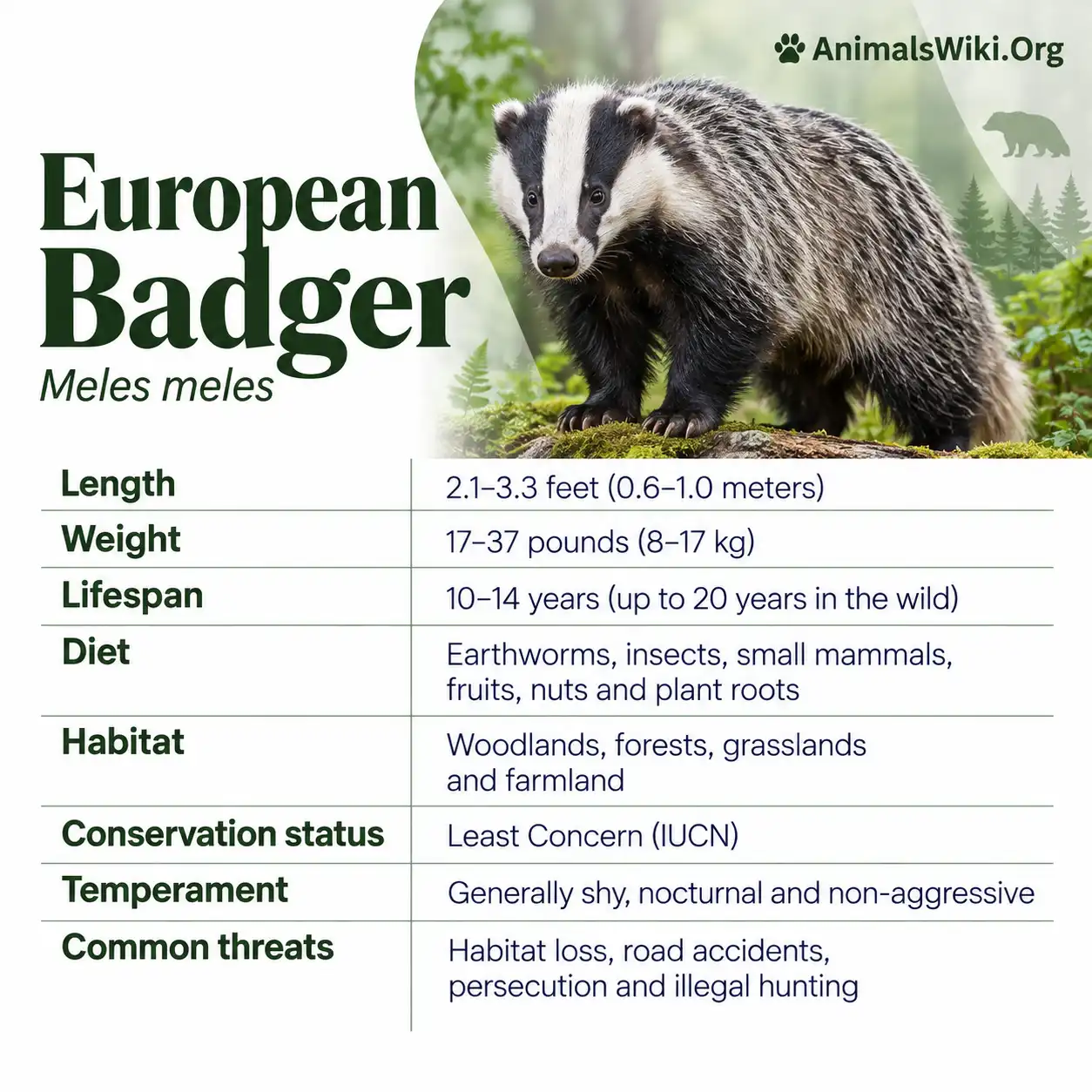
| Feature | Details |
|---|---|
| Common Name | Badger (European Badger focus species) |
| Scientific Name | Meles meles (European Badger) |
| Family | Mustelidae (weasel family) |
| Order | Carnivora |
| First Described | 1758 (by Carl Linnaeus) |
| Native Habitat | Deciduous woodlands, grasslands, farmland, hedgerows across Europe and Asia |
| Geographic Range | Europe (Ireland to Russia); Asia (China, Japan, Central Asia) |
| Average Size | 60–90 cm body length; 12–20 cm tail |
| Average Weight | 7–13 kg (males larger); up to 17 kg before winter |
| Lifespan | 5–8 years (wild); up to 19 years (captivity) |
| Diet | Omnivore — earthworms, insects, fruit, roots, small mammals, carrion |
| Conservation Status | Least Concern (IUCN) — European Badger |
| Defining Feature | Bold black-and-white facial stripes; extraordinary digging ability; complex social sett system |
| Number of Species | 11 species across 6 genera worldwide |
1. European Badger Species Overview & Classification
In the dim light of a summer evening, at the edge of a British woodland, something moves in the undergrowth. A low, grizzled shape emerges from an opening in the earth — deliberate, unhurried, supremely confident. The broad, muscular body. The short, powerful legs. And above all, the face — unmistakable, unforgettable, striped in bold black and white like nature’s own warning label: this animal will not be trifled with.
The Badger is one of Europe’s most instantly recognizable wild mammals — and one of its most misunderstood, most persecuted, and most resilient. For centuries it has been dug from its burrows, baited with dogs, blamed for agricultural problems, and subjected to government culling programs. And through all of it, the badger has persisted — burrowing deeper, maintaining its complex social structures, continuing its ancient patterns of life with a stubbornness that has made its name synonymous with persistence in English culture.
But the badger deserves better than its reputation as merely stubborn. It is, on closer examination, a genuinely extraordinary animal — one of the world’s most sophisticated social mammals, capable of maintaining underground colonies that have been continuously occupied for centuries; one of nature’s most talented engineers, digging burrow systems extending hundreds of meters; and one of ecology’s most important earthworm predators, consuming enough worms annually to significantly regulate soil invertebrate populations across the landscapes it inhabits.
The European Badger (Meles meles) is the focus of this article and the species most people think of when they say “badger” — but it represents just one of eleven badger species distributed across Europe, Asia, Africa, and the Americas. From the Honey Badger of Africa (arguably the world’s most fearless animal, according to the Guinness World Records) to the American Badger of the Great Plains, the badger family expresses remarkable diversity around a common theme: powerful, low-slung, burrowing predators with a remarkable talent for aggressive self-defense.
Species Classification Table
| Classification Level | Details |
|---|---|
| Kingdom | Animalia |
| Phylum | Chordata |
| Class | Mammalia |
| Order | Carnivora |
| Family | Mustelidae |
| Subfamily | Melinae (Old World badgers) / Taxidiinae (American badger) / Mellivorinae (Honey badger) |
| Genus | Meles (European); Taxidea (American); Mellivora (Honey); Arctonyx (Hog); others |
| Species (focus) | Meles meles — European Badger |
| Described By | Carl Linnaeus, 1758 |
Major Badger Species of the World
| Species | Scientific Name | Range | IUCN Status |
|---|---|---|---|
| European Badger | Meles meles | Europe, Western Asia | Least Concern |
| Asian Badger | Meles leucurus | Central, East Asia | Least Concern |
| Japanese Badger | Meles anakuma | Japan | Least Concern |
| Honey Badger (Ratel) | Mellivora capensis | Africa, Middle East, South Asia | Least Concern |
| American Badger | Taxidea taxus | North America | Least Concern |
| Hog Badger | Arctonyx collaris | South, Southeast Asia | Vulnerable |
| Burmese Ferret-Badger | Melogale personata | Southeast Asia | Least Concern |
| Palawan Stink Badger | Mydaus marchei | Philippines | Least Concern |
2. European Badger Physical Description & Unique Features
The badger’s body is an engineering masterpiece designed around a single operational priority: digging. Every aspect of its anatomy — from its wedge-shaped head to its shovel-like claws — reflects millennia of evolutionary optimization for excavating earth with speed, power, and precision.
Size and Build
The European Badger is a robustly built, medium-sized carnivore with a body length of 60–90 cm and an additional 12–20 cm of tail. Weight varies considerably with season — adults typically weigh 7–13 kg in summer, building to 14–17 kg before winter as fat reserves accumulate. Males (boars) are generally larger and heavier than females (sows).
The body shape is immediately distinctive — low-slung and wide, with a flattened profile that reduces resistance when moving through tunnels. The chest and shoulders are powerfully muscled — housing the enormous muscle groups that drive the digging forelimbs. The hips are narrower than the shoulders, creating the tapered rear-body profile that allows badgers to reverse efficiently in their tunnels.
The Bold Face
The European Badger’s face is one of the animal kingdom’s most striking — a pale grey or white base interrupted by two bold black stripes running from the base of the snout, through the eyes, over the ears, and continuing down the back of the neck. This pattern — often described as resembling a painted face — is unique, instantly recognizable, and has been the subject of considerable scientific debate regarding its function.
Proposed functions of the facial stripe pattern include:
- Warning coloration (aposematism) — signaling to potential predators that the animal is dangerous and not worth attacking
- Species recognition — helping badgers identify other badgers in low-light conditions
- Camouflage disruption — breaking up the facial outline in woodland settings
The reality is probably a combination of all three, with the warning function being most widely supported by the scientific evidence.
The Digging Apparatus
The badger’s front feet are genuine engineering tools:
- Five powerful claws per foot, non-retractable, curved, and extremely robust
- Claws measuring up to 3 cm (1.2 inches) in length on adult males
- Foreleg muscles disproportionately large relative to body size
- Wrist bones fused in a configuration that transmits maximum force to the digging stroke while preventing wrist joint injury
A badger can excavate several kilograms of soil per minute when motivated — a rate that exceeds most mechanical digging tools at the same scale.
Fur and Coloration
The body fur is grizzled grey — individual hairs banded black and white, creating the overall grey-white effect when seen from a distance. The underside is darker — typically dark brown to black. The tail is short and bushy, cream-white in color.
The fur is surprisingly coarse and bristly — adapted for durability in the rough underground environment of the sett — and provides reasonable insulation against cold without the extreme softness of dedicated cold-climate mammals.
Scent Glands
Badgers possess well-developed subcaudal scent glands — pouches beneath the tail that produce a musky secretion used for scent-marking territory, communicating social status, and individual identification within the clan. These glands are large enough to be palpable when handling a badger and produce a secretion with a strong, distinctive odor that any regular user of badger-inhabited countryside learns to recognize.
Did You Know? The European Badger is one of very few wild mammals in Britain that can be heard approaching before it is seen — not because it makes significant noise itself, but because of the distinctive sound of its heavy, flat-footed walk on dry leaves. Experienced wildlife watchers learn to freeze at the sound of deliberate leaf-crunching in woodland at dusk — it is often a badger conducting its evening emergence with characteristic purposefulness.
3. European Badger Habitat & Geographic Range
The European Badger is one of the most habitat-flexible large carnivores in Europe — found in environments ranging from dense deciduous woodland to open farmland, coastal cliffs to suburban gardens, at elevations from sea level to 2,000 meters (6,600 feet) in mountainous regions.
Preferred Habitats
Despite this flexibility, badgers show consistent preferences for specific habitat features:
Deciduous and mixed woodland — the classic badger habitat; provides soft, easily excavated soil for sett construction, abundant earthworm populations, cover from human disturbance, and structural complexity for foraging.
Woodland edges and hedgerows — transition zones between woodland and grassland or farmland that offer the best of both habitat types; woodland cover for the sett and grassland for earthworm foraging.
Pasture and grassland — particularly improved agricultural pasture (intensively managed grassland), which supports extremely high earthworm densities that badgers exploit heavily.
Farmland mosaic — the mixture of arable fields, pasture, hedgerows, and woodlots that characterizes much of European agricultural landscape provides excellent badger habitat.
Suburban and urban areas — badgers have proven highly adaptable to human presence; urban badger populations exist in many British and European cities, where they exploit garden earthworm populations and supplementary feeding by householders.
Geographic Range
Habitat Range by Region
| Region | Countries | Habitat Type | Population Status |
|---|---|---|---|
| Western Europe | UK, Ireland, France, Germany, Netherlands | Deciduous woodland, farmland | High density; UK has world’s highest density |
| Iberian Peninsula | Spain, Portugal | Mediterranean woodland, scrub | Moderate density |
| Scandinavia | Sweden, Norway, Denmark | Mixed forest, farmland | Moderate; range expanding north |
| Central Europe | Poland, Czech Republic, Austria | Mixed forest, agricultural | Good populations |
| Eastern Europe | Russia, Ukraine, Romania | Boreal forest, steppe margins | Lower density |
| Asia Minor | Turkey, Israel, Iran | Woodland, scrub | Fragmented populations |
| East Asia | China, Korea | Forest, farmland | Asian badger species |
| Japan | Japan | Forest, rural areas | Japanese badger species |
The United Kingdom — A Badger Stronghold
The United Kingdom holds a position of extraordinary significance in the global context of badger conservation — it supports approximately 400,000–500,000 European Badgers, representing one of the highest densities of the species anywhere in its range. This remarkable abundance reflects a combination of favorable habitat (the mosaic of woodland and pasture across much of lowland Britain), legal protection (the Protection of Badgers Act 1992 makes deliberate disturbance or killing of badgers a serious criminal offense), and the generally high earthworm biomass of British agricultural soils.
Ireland similarly supports significant badger populations, though the species’ presence there is complicated by its role in tuberculosis transmission to cattle — a controversy that has dominated Irish badger policy for decades.
Did You Know? The European Badger has been continuously present in Britain for at least 250,000 years — fossil evidence confirms badger occupation of British landscapes before the last Ice Age. After the ice retreated, badgers recolonized from Continental European refugia. Some of the large, established badger setts in Britain may have been continuously occupied for hundreds of years — making them among the oldest continuously used animal homes on Earth.
4. European Badger Diet & Feeding Behavior
The badger is often described as a carnivore — and it is classified within the order Carnivora — but its actual dietary habits are so broadly omnivorous that “opportunistic omnivore” comes considerably closer to the truth. The badger is one of nature’s most pragmatic feeders: it eats what is available, what is abundant, and what is easiest to access, adjusting its diet dramatically with the seasons.
The Earthworm Foundation
In western and northern Europe, earthworms form the dietary backbone of the European Badger — often comprising 50–80% of the total diet by biomass across the year. This extraordinary dependence on a single prey type reflects the remarkable abundance of earthworms in European soils: a single hectare of good pasture can support up to 4 million earthworms, representing an almost unlimited food source for an animal capable of smelling them through several centimeters of soil.
A single adult badger may consume 200 earthworms in a night’s foraging — extracting them from the soil surface with its sensitive snout and tongue during the humid conditions that bring worms to the surface. On optimal nights of warm, damp weather, badger clans can consume thousands of earthworms across their foraging territory.
The Full Dietary Range
Beyond earthworms, the badger’s diet spans an impressive and sometimes surprising range:
Diet Breakdown Table
| Food Type | % of Diet (annual average) | Season of Peak Consumption | Notes |
|---|---|---|---|
| Earthworms | 50–80% | Spring and autumn | Declines in dry summer; lowest in winter |
| Fruit and berries | 5–15% | Late summer and autumn | Blackberries, elderberries, fallen apples, plums |
| Cereals and roots | 5–10% | Summer, autumn | Wheat, maize, bulbs, tubers |
| Insects and larvae | 5–10% | Spring and summer | Bee nests particularly targeted; wasp larvae |
| Small mammals | 3–8% | Year-round | Rabbits, hedgehogs, voles, mice |
| Carrion | 2–5% | Year-round | Opportunistic |
| Birds and eggs | 1–3% | Spring (breeding season) | Ground-nesting species; eggs opportunistically taken |
| Frogs and reptiles | 1–3% | Spring and summer | Seasonal availability |
The Controversial Hedgehog Predation
One of the most discussed aspects of badger diet is their predation of hedgehogs — a relationship that has conservation implications given the declining hedgehog populations in Britain. Badgers are one of the few predators capable of unrolling and consuming a hedgehog, exploiting the gaps between the defensive spines with their powerful claws and jaws. The relationship between badger density and hedgehog abundance is actively studied and debated, with some evidence suggesting that areas of very high badger density correlate with reduced hedgehog populations.
Bee and Wasp Nest Excavation
The badger’s powerful claws and thick skin make it uniquely equipped to raid bee and wasp nests — tear open the nest structure and consume larvae, pupae, honeycomb, and any adults that fail to sting through the dense fur. This behavior is most common in late summer when wasp nests are at maximum size. The badger appears largely indifferent to stings — its thick skin and dense fur provide considerable protection, and the reward in calories from a large wasp nest justifies the discomfort of the occasional sting that does penetrate.
“The badger is the supreme ecological generalist of the European carnivore guild — equally at home eating earthworms in the rain and raiding a wasp nest or ransacking a field of wheat. This dietary flexibility is precisely what has allowed it to thrive in a human-modified landscape where specialists struggle.” — Dr. Chris Newman, Wildlife Conservation Research Unit, University of Oxford
5. European Badger Reproduction & Life Cycle
The badger’s reproductive biology contains one of the most extraordinary features in the entire mammalian world — a reproductive strategy called delayed implantation that gives the species remarkable flexibility in timing births to match optimal environmental conditions.
Mating and Delayed Implantation
European Badgers can mate at almost any time of year — matings have been recorded in every month — but the primary mating season falls in February to May following the birth of that year’s cubs. After fertilization, however, the development of the embryo does not proceed immediately. Instead, the blastocyst (fertilized egg at early developmental stage) enters a state of suspended development called diapause — remaining dormant in the uterus for weeks to months before finally implanting in the uterine wall and resuming development.
Implantation is triggered by day length cues in December, with all females in a clan implanting at approximately the same time regardless of when mating occurred. This means that all cubs in a clan are born within a similar time window — typically January to March — when conditions are optimal for early cub development.
This reproductive strategy — mating in spring, implantation in winter, birth in late winter — gives badgers extraordinary flexibility while ensuring births are consistently timed to the most favorable season.
Birth and Early Development
- Gestation post-implantation: Approximately 6–7 weeks
- Litter size: Typically 1–5 cubs (average 2–3)
- Birth weight: Approximately 75–132 grams
- Born: January–March in the deep sett, typically in a dedicated nesting chamber lined with fresh bedding
- Eyes open: At approximately 4–5 weeks
- First emergence above ground: At approximately 8–10 weeks (April–May)
The cubs’ first appearance above ground in April and May — tumbling around the sett entrance in the evening light, play-fighting, exploring, and generally being among the most charming sights in European wildlife — is one of the most eagerly anticipated events in the British wildlife calendar, drawing dedicated badger-watchers to watching hides at sett entrances throughout spring.
Development and Maturity
- Weaning: Approximately 12 weeks (April–May)
- Independence: Cubs begin foraging independently from approximately 3–4 months but remain associated with the clan throughout their first year
- Sexual maturity: Females reach sexual maturity at approximately 12–15 months; males at approximately 12–18 months
- Dispersal: Some young animals (particularly males) disperse from their birth clan to establish themselves in new territories or join other clans; others remain in their natal clan throughout their lives
Lifespan Comparison
| Animal | Average Lifespan (Wild) | Average Lifespan (Captivity) |
|---|---|---|
| European Badger | 5–8 years | Up to 19 years |
| American Badger | 4–9 years | Up to 14 years |
| Honey Badger | 7–8 years | Up to 24 years |
| Otter (Lutra lutra) | 3–5 years | Up to 16 years |
| Wolverine (Gulo gulo) | 7–12 years | Up to 17 years |
| Red Fox (Vulpes vulpes) | 3–5 years | Up to 14 years |
Did You Know? The European Badger’s delayed implantation system means that a female mated in May and a female mated in October will both give birth in the same January–March window — because all embryos receive the same implantation trigger (declining day length in December) regardless of when fertilization occurred. This is one of the most sophisticated reproductive timing mechanisms in the mammalian world, studied by reproductive biologists as a model for understanding how mammals synchronize reproduction with environmental conditions.
6. Social Behavior & Communication
The European Badger’s social system is one of the most complex and most thoroughly studied of any wild carnivore — a system of clan living centered on shared underground burrow systems that challenges many assumptions about the social lives of carnivores.
The Clan System
European Badgers live in social groups called clans — typically consisting of 4–12 individuals (though clans of up to 30 have been recorded in exceptional habitats). Each clan occupies and collectively defends a territory averaging 30–150 hectares depending on habitat quality and food abundance.
The clan is fundamentally organized around the shared sett — the complex underground burrow system that serves as the group’s home, nursery, and social hub. All members of the clan contribute to sett maintenance, sleep together in the same underground chambers, and share the territory’s foraging resources.
The Extraordinary Sett
A well-established badger sett is an engineering achievement of remarkable sophistication:
- Multiple entrances — up to 50 or more in large, long-established setts
- Tunnels extending 50–100+ meters in total length
- Separate chambers for sleeping, nursing cubs, and waste disposal
- Bedding — fresh vegetation (grass, leaves, bracken) regularly dragged underground and periodically aired and replaced
- Depth — main sleeping chambers often 1–3 meters below the surface, providing thermal stability and protection from the surface
- Age — some setts in Britain have been in continuous occupation for centuries, with each generation of badgers expanding and maintaining the structure
The social significance of the sett cannot be overstated — it is the physical and social center of clan life, and all members of the clan spend daylight hours underground within it.
Social Interactions
Within the clan, badgers maintain relationships through extensive allogrooming (mutual grooming) — one of the clearest behavioral indicators of social bond strength in mammals. Clan members groom each other extensively, particularly at the sett entrance before the evening foraging period.
Play is common among cubs and juveniles — tumbling, chasing, and mock-fighting that develops both social bonds and physical skills.
Aggression between clan members is generally low — the shared territorial interest and close genetic relationships within clans (most members are related) create a broadly cooperative social environment. Aggression between members of different clans, however, can be intense — territorial boundaries are vigorously defended.
Communication
Scent is the primary communication channel:
- Subcaudal gland secretions mark territory boundaries and communicate individual identity
- Mutual scenting (musking) — clan members actively scent-mark each other, creating a shared clan odor that functions as a group identity signal
- Dung pits (latrines) at territory boundaries serve as scent stations and territorial markers
Vocalizations — badgers produce a surprisingly varied vocal repertoire for typically quiet animals:
- Churring — a low, rolling sound of contentment
- Kecker — a rapid chattering sound indicating alarm or irritation
- Wicker — a high-pitched sound made by cubs calling for their mother
- Barking — a loud, sharp bark of alarm
- Growling/snarling — threat vocalizations in confrontational situations
7. Predators & Defense Mechanisms
The adult European Badger has very few effective natural predators — a function of its powerful build, formidable claws, thick loose skin, and aggressive defensive response. Its position at or near the top of its local food chain has significantly shaped its behavior and ecology.
Natural Predators
Historical and current large predators:
- Grey Wolf (Canis lupus) — the primary historical natural predator of badgers across Europe; wolf predation on badgers has been documented in areas of wolf recovery in Eastern and Central Europe
- Eurasian Lynx (Lynx lynx) — documented to occasionally take badgers in areas of overlap
- Golden Eagle (Aquila chrysaetos) — can take cubs venturing near the sett entrance
- Red Fox — occasionally takes very young cubs but generally avoids confrontation with adults
- Domestic dogs — the most significant current predator of badgers in many areas
The Formidable Defense
The European Badger is, pound-for-pound, one of the most difficult animals to kill in European wildlife. Its defensive capabilities include:
Physical toughness — the badger’s skin is unusually thick and loose, a combination that means biting and claw attacks that would seriously wound many carnivores of equivalent size cause far less damage. The skin can be gripped and bitten without the underlying muscle being seriously damaged — a critical defense against bite-based predators.
Claws and jaw strength — when cornered, a badger fights back with considerable ferocity; its claws can inflict serious wounds and its jaw muscles are powerful enough to maintain a grip that is very difficult to break.
Low center of gravity — the badger’s broad, low body makes it extremely difficult to flip or roll — a significant defensive advantage against larger predators attempting to expose the more vulnerable underside.
Retreat to sett — the badger’s first defensive response to perceived threat is retreat underground, where its digging ability means it can rapidly excavate itself deeper than any pursuing predator can follow.
Musking — when severely stressed, badgers can release the contents of their subcaudal scent glands — producing an intensely unpleasant odor that deters some predators.
Why Badgers Were Historically Baited
The badger’s extraordinary defensive capability made it the target of the cruel and now-illegal sport of badger baiting — in which badgers were removed from their setts and forced to fight dogs. The practice highlighted the badger’s remarkable ability to withstand attack and fight back effectively — an animal that could hold its own against multiple dogs simultaneously and inflict serious wounds on them. This fighting capability, while a matter of scientific fascination in behavioral ecology, was catastrophically exploited by humans for entertainment purposes for centuries.
8. Relationship with Humans
Ancient Coexistence
The badger has shared the European landscape with humans for tens of thousands of years — fossil evidence places them alongside Neanderthal humans in European caves, and the relationship between humans and badgers has been complex, contested, and culturally rich throughout recorded history.
Indigenous European peoples — the Celts, Germanic tribes, Slavic peoples — all incorporated the badger into their cultural landscape through folklore, practical use, and symbolic significance. Badger hair was used for shaving brushes (and still is in premium products), badger fat was a traditional remedy for joint pain and skin conditions, and badger meat was occasionally consumed, particularly in times of food scarcity.
Badger baiting — setting dogs against badgers extracted from their setts — was a widespread entertainment across medieval and early modern Europe, particularly in Britain. The practice was widespread enough to generate dedicated vocabularies, breeding programs for baiting dogs, and significant economic activity around organized events. It was eventually banned in Britain in 1835 under the Cruelty to Animals Act, though illegal baiting continues to be prosecuted under modern legislation.
Scientific Interest
The badger has been one of the most intensively studied wild mammals in Europe — particularly in Britain, where long-term population studies have generated extraordinary scientific insights.
The Wytham Woods badger study near Oxford University — running continuously since 1987 — is one of the longest-running studies of a wild mammal population in history. Researchers have individually marked and tracked hundreds of badgers across multiple generations, generating data on population dynamics, social behavior, reproductive success, dispersal, and disease that have produced dozens of major scientific publications and fundamentally shaped understanding of carnivore social evolution.
The Bovine Tuberculosis Controversy
The most significant and most contentious aspect of the modern human-badger relationship is the role of badgers in the transmission of bovine tuberculosis (bTB) to cattle — a disease that costs the British agricultural industry over £100 million annually and results in the slaughter of tens of thousands of cattle.
Scientific evidence confirms that badgers can carry and transmit Mycobacterium bovis (the bTB pathogen) to cattle, though the relative contribution of badger-to-cattle transmission versus cattle-to-cattle transmission remains debated. This evidence has driven periodic government culling programs in both England and Ireland — programs that are themselves highly controversial, actively opposed by wildlife organizations and significant sections of the public, and subject to ongoing scientific dispute about their effectiveness.
The badger culling debate has become one of the most divisive wildlife policy questions in modern British environmental politics — pitting farming communities against conservation organizations, generating significant media coverage, and producing a body of scientific literature that itself reflects the complexity of the question.
Legal Protection
The European Badger receives significant legal protection across most of its range:
- UK: The Protection of Badgers Act 1992 makes it a criminal offense to willfully kill, injure, or take a badger; to interfere with a badger sett; or to possess a live or dead badger or any part thereof without a license. Penalties include unlimited fines and up to 6 months imprisonment.
- EU member states: Protected under various national wildlife laws; listed on Appendix III of the Berne Convention
Did You Know? The word “badger” as a verb — meaning to persistently pester or harass someone — derives directly from the cruel practice of badger baiting. The practice involved repeatedly pulling a badger from its box and re-releasing dogs onto it — “badgering” the animal relentlessly. The linguistic legacy of this cruelty survives in everyday English long after the practice itself was banned, making the badger one of the very few animals whose scientific name describes what it does (meles — Greek for “badger”) and whose common name gave rise to a verb describing what was historically done to it.
9. European Badger Conservation Status & Threats
IUCN Status
- European Badger (Meles meles): Least Concern — widespread and generally stable across its range
- Hog Badger (Arctonyx collaris): Vulnerable — declining across Southeast Asia due to hunting and habitat loss
- American Badger (Taxidea taxus): Least Concern — stable across most of North American range
- Honey Badger (Mellivora capensis): Least Concern — but declining in some parts of range
Key Threats to the European Badger
1. Road Mortality Road kill is the single greatest documented cause of badger mortality across Britain and much of Europe. Badgers are highly vulnerable to road traffic — they are low-slung (easy to miss in headlights), nocturnal, and show limited road-avoidance behavior. Studies in Britain estimate that tens of thousands of badgers are killed on roads annually. The impact is particularly severe for young badgers dispersing to establish new territories — a life stage that requires crossing unfamiliar terrain, increasing road-crossing frequency.
2. Illegal Persecution Despite strong legal protection in Britain, illegal badger baiting — using dogs to attack badgers extracted from their setts — continues to be prosecuted annually. The RSPCA and police wildlife crime units regularly investigate and prosecute baiting cases. Illegal snaring and shooting also occur.
3. Culling Programs Government-sanctioned badger culling for bovine tuberculosis control in Britain has directly reduced badger populations in culled areas. The effectiveness and ethical justification of culling remains controversial among scientists and the public.
4. Habitat Loss The loss of traditional mixed-woodland-and-pasture countryside to intensive arable agriculture reduces habitat quality for badgers — both through the loss of woodland sett sites and the reduction in earthworm populations in intensively farmed soils.
5. Persecution in Asia Across East and Southeast Asia, badger species face significant hunting pressure — for meat, for traditional medicine, and for the pet trade. Hog badgers in particular are significantly threatened by unsustainable hunting across their Southeast Asian range.
10. Famous Badgers Around the World
Oxford Badgers — Science’s Most Studied Population
The badger population of Wytham Woods near Oxford, England — studied continuously since 1987 by researchers from Oxford University’s Wildlife Conservation Research Unit — is without doubt the most scientifically famous badger population on Earth. Individual animals have been marked, monitored, and followed for their entire lives across multiple decades, producing an unparalleled dataset on badger social evolution, reproductive strategies, and population dynamics. Papers from this study have been published in the world’s most prestigious scientific journals, and the project continues to generate new insights more than 35 years after its inception.
Brian May’s Badger Advocacy
Rock musician and astrophysicist Brian May — lead guitarist of Queen — became Britain’s most prominent public opponent of government badger culling, founding and actively supporting Save Me Trust and becoming a vocal, high-profile advocate for badger protection. May’s celebrity profile brought significant media attention to the culling controversy and helped mobilize public opposition to the policy.
Hufflepuff’s Badger — The Fictional Icon
The Hogwarts House of Hufflepuff in J.K. Rowling’s Harry Potter series uses the badger as its mascot — representing the Hufflepuff values of patience, hard work, loyalty, and fair play. The association of the badger with these qualities — connecting the animal’s real-world reputation for persistence and determination to positive human virtues — introduced the badger to a global audience of millions of readers who might otherwise have had little reason to think about the animal.
The Viral Badger Song
In 2003, a Flash animation called “Badger Badger Badger” by Jonti Picking (Weebl) became one of the internet’s earliest viral phenomena — a looping animation of dancing badgers accompanied by an infectious repetitive song. The animation was viewed hundreds of millions of times and introduced a generation of early internet users to the word “badger” in a context entirely removed from natural history — while simultaneously making the animal one of the most culturally recognized in the early internet era.
11. Role in Ecosystem & Food Chain
Earthworm Regulation
The badger’s most ecologically significant role is as a major predator of earthworms — and through this predation, an indirect regulator of soil health. By consuming millions of earthworms annually across their territories, badger clans prevent any single earthworm species from dominating soil communities, maintaining the diversity of soil invertebrate communities that support plant growth, decomposition, and the food web based on soil fauna.
Sett as Habitat — Engineering the Underground
The badger’s most dramatic ecological contribution is the sett itself — one of the most significant wildlife habitat structures in European woodlands. A large, established badger sett with multiple entrances and chambers provides shelter and nesting sites for a remarkable diversity of other species:
- Rabbits frequently use badger setts — either in separate chambers or (in the badger’s absence) throughout the sett system
- Foxes regularly den in badger setts, often sharing the underground space with badgers in a relationship of uneasy tolerance
- Various bird species nest in sett entrance holes — including Shelduck in some coastal areas
- Invertebrates colonize the soil disturbance around sett entrances
- Bats occasionally roost in the tunnel entrances during the day
In this way, the badger functions as an ecosystem engineer of considerable importance — its engineering activity creating habitat that supports species far beyond its own ecological niche.
Seed Dispersal
Through their consumption of berries and fruit (particularly blackberries, elderberries, and fallen apples) and their wide-ranging nightly foraging movements, badgers contribute to seed dispersal across their territories — passing seeds through their digestive systems and depositing them far from the parent plant.
Role as Prey
While adult badgers have few effective predators in most of modern Europe (following wolf extirpation from most of the continent), they remain available as prey for recovering wolf populations in Eastern and Central Europe. Cubs are occasionally taken by foxes and golden eagles. Through road mortality, dead badgers provide carrion that supports ravens, red kites, buzzards, and foxes.
12. European Badger Discovery & Evolution Timeline
~25–30 million years ago — The family Mustelidae (weasels, otters, martens, badgers) diverges from other carnivore families during the Oligocene epoch; early mustelids are small, generalist predators.
~15–20 million years ago — The badger lineages diverge within Mustelidae; early forms ancestral to modern Old World badgers (Melinae) and the American badger (Taxidiinae) begin to differentiate.
~5–10 million years ago — Meles (the genus containing the European badger) appears in the fossil record; early Meles species are found across Europe and Asia in Miocene and Pliocene deposits.
~2.5 million years ago — Meles meles in its modern form appears in the fossil record; European badgers survive multiple Pleistocene ice ages, retreating to southern refugia during glacial maxima and re-expanding northward during warm interglacials.
~250,000 years ago — Fossil evidence confirms badger presence in Britain; coexistence with Neanderthal humans in European cave environments is documented.
~40,000 years ago — Anatomically modern humans arrive in Europe and begin their long coexistence with the European Badger; badger remains are found in early human archaeological sites.
Pre-medieval era — Badgers integrated into European cultural life; badger baiting develops as a popular entertainment; badger products (fat, hair, meat) used across European cultures.
1758 — Carl Linnaeus formally describes Meles meles in Systema Naturae, establishing the scientific name that remains in use today.
1835 — Cruelty to Animals Act (Britain) makes badger baiting illegal for the first time; legislation that is frequently violated in practice but establishes the legal principle of protection.
1987 — Wytham Woods long-term badger study begins at Oxford University — destined to become the world’s longest-running wild badmal population study.
1992 — Protection of Badgers Act (UK) provides comprehensive legal protection; makes killing, injuring, or disturbing badgers a serious criminal offense.
2003 — “Badger Badger Badger” Flash animation becomes one of the internet’s first major viral phenomena, embedding badger cultural recognition in a new generation.
2011 — “Honey Badger Don’t Care” YouTube video goes massively viral, introducing the honey badger to global popular culture.
2013–2026 — Government badger culling programs in England become one of Britain’s most controversial wildlife policy issues; ongoing scientific debate about effectiveness and ecological impact.
13. European Badger Comparison with Similar Species
| Feature | European Badger (Meles meles) | Honey Badger (Mellivora capensis) | American Badger (Taxidea taxus) |
|---|---|---|---|
| Range | Europe, Western Asia | Africa, Middle East, South Asia | North America |
| Weight | 7–17 kg | 7–16 kg | 4–12 kg |
| Facial pattern | Black-and-white stripes | White top, black bottom | Brown with white stripe on head |
| Primary diet | Earthworms, fruit, omnivore | Honey, bee larvae, snakes, carrion | Ground squirrels, prairie dogs, rodents |
| Social structure | Clan groups (4–12) | Solitary | Solitary |
| Sett complexity | Highly complex; multi-century occupation | Simple burrows; frequently relocates | Simple burrows; frequently changes location |
| Fearlessness | Formidable but reactive | Legendary; will attack lions | Bold but less famous for fearlessness |
| IUCN Status | Least Concern | Least Concern | Least Concern |
| Famous for | Wind in the Willows; bTB controversy | “Honey Badger Don’t Care” viral video | Great Plains ecosystem role |
14. Best Places to See Badgers in the Wild
United Kingdom — The Best Country for Badger Watching
The UK supports the highest density of European Badgers anywhere in the species’ range and has a well-developed tradition of badger watching at sett entrances — a genuinely accessible and extraordinary wildlife experience.
- 🇬🇧 Wytham Woods, Oxfordshire, England — the most scientifically famous badger location in the world; not generally open for public badger watching but the surrounding Oxfordshire countryside has excellent populations
- 🇬🇧 The Cotswolds, England — one of Britain’s best badger-watching regions; numerous setts in the ancient woodland-and-pasture landscape; several wildlife organizations offer guided badger watches
- 🇬🇧 New Forest National Park, Hampshire, England — excellent badger populations in diverse woodland habitats; organized badger watching events regularly available
- 🇬🇧 Scottish Highlands — badgers present throughout lowland and upland areas; remote locations offer undisturbed watching opportunities
- 🇮🇪 County Clare, Ireland — excellent badger populations; some of the best undisturbed watching opportunities in the British Isles
Continental Europe
- 🇩🇪 Black Forest, Germany — excellent badger populations in the mixed woodland of one of Europe’s finest wildlife landscapes
- 🇸🇪 Southern Sweden — badgers at the northern edge of range; accessible watching opportunities in farmland and woodland mosaic
- 🇵🇱 Białowieża Forest, Poland/Belarus — Europe’s last primeval lowland forest; excellent badger populations in a UNESCO World Heritage setting
Honey Badger Watching
- 🇰🇪 Masai Mara, Kenya — the East African savannah offers some of the best honey badger sighting opportunities; typically encountered during dawn and dusk game drives
- 🇿🇦 Kruger National Park, South Africa — honey badgers present throughout; considered a significant sighting
- 🇮🇳 Kanha and Pench Tiger Reserves, India — honey badger present in the Indian subcontinent form
15. European Badger Fun Facts for Kids
- The European Badger’s delayed implantation means it can mate in spring and give birth the following winter — one of the most extraordinary reproductive timing mechanisms in the mammal world
- A badger sett may be continuously occupied for hundreds of years — some British setts are estimated to be medieval in origin
- The badger can eat 200 earthworms in a single night
- The Honey Badger holds the Guinness World Record as the world’s most fearless animal
- Badger skin is famously loose — a defensive adaptation that allows the animal to turn and bite back even when being gripped by a predator
- The Dachshund dog breed was specifically developed to hunt badgers underground
- The word “badger” as a verb (meaning to pester) comes from the cruel practice of badger baiting
- Badgers are unusually clean animals — they regularly air and change their bedding, and use dedicated latrines away from the sett
- A badger clan’s shared scent functions like a group identity — members regularly scent-mark each other to maintain the clan odor
- Hufflepuff House at Hogwarts uses the badger as its mascot
- Badgers can run at up to 30 km/h (19 mph) over short distances — faster than many people expect
- The collective noun for badgers is “a cete” — one of English’s most obscure and satisfying collective nouns
16. Frequently Asked Questions About European Badgers
Q1: What do badgers eat?
European Badgers are highly flexible omnivores — their diet shifts dramatically with the seasons. Earthworms form the backbone of the diet, comprising 50–80% of food consumed across the year in western Europe. Beyond worms, badgers eat a remarkably diverse range: fruits and berries (particularly blackberries and elderberries in autumn), cereals and roots, insects and larvae (bee and wasp nests are particular favorites), small mammals (rabbits, hedgehogs, voles), carrion, birds’ eggs, and frogs. This dietary flexibility is a key reason badgers thrive in the human-modified landscape of modern Europe.
Q2: Are badgers dangerous to humans?
European Badgers are not aggressive toward humans under normal circumstances — a healthy, undisturbed badger will avoid human contact entirely. However, cornered, injured, or threatened badgers can bite and scratch severely; badger bites are deep and can cause significant tissue damage. The main human-safety consideration is the theoretical role of badgers in transmitting bovine tuberculosis — though documented direct transmission from badger to human is extremely rare. Badgers should be admired from a respectful distance and never cornered or handled by members of the public.
Q3: Why is there a badger culling controversy in the UK?
The controversy centers on the role of badgers in transmitting bovine tuberculosis (bTB) to cattle — a disease costing the British farming industry over £100 million annually and resulting in the slaughter of thousands of cattle. Scientific evidence confirms badgers can carry and transmit the disease, but the proportion of cattle infections attributable to badger-to-cattle transmission (versus cattle-to-cattle) is disputed. Government culling programs in England have faced opposition from wildlife organizations who argue culling is ineffective, unethical, and diverts resources from cattle vaccination and improved biosecurity. The debate involves genuine scientific uncertainty combined with strong competing interests from farming and conservation communities.
Q4: How long do badgers live?
In the wild, European Badgers typically live 5–8 years — though some individuals have been documented to reach 14–15 years in good conditions. Road mortality is the primary cause of premature death, followed by illegal persecution and disease. In captivity, badgers can live significantly longer — up to 19 years has been documented. The Wytham Woods long-term study has tracked individual badgers through their entire lives, providing exceptionally detailed data on age-specific survival rates.
Q5: What is a badger’s home called?
A badger’s burrow system is called a sett — and it is far more than a simple burrow. A well-established sett is an extensive underground network of tunnels and chambers, potentially extending hundreds of meters in total length, with multiple entrances, separate sleeping and nursery chambers, and dedicated bedding areas. Some large setts have been in continuous occupation for centuries, with each generation of badgers extending and maintaining the structure. The sett is the social center of the clan’s life — all members sleep there together during the day and cubs are born and raised in its deepest, most protected chambers.
Q6: What is the difference between a badger and a honey badger?
Despite sharing the name “badger” and some superficial similarities, the European Badger (Meles meles) and the Honey Badger (Mellivora capensis) are only distantly related within the family Mustelidae. Key differences include: the Honey Badger is native to Africa and South Asia rather than Europe; it is primarily solitary rather than clan-living; it has a dramatically different diet (honey, bee larvae, snakes, scorpions, carrion); and it is famous for its extraordinary fearlessness — documented to attack animals as large as lions and buffalo when threatened. The Honey Badger holds the Guinness World Record as the world’s most fearless animal — a reputation the more domestically inclined European Badger, for all its tenacity, does not quite match.
Q7: Do badgers hibernate?
European Badgers do not fully hibernate — they remain active throughout winter, though their activity level decreases significantly in cold weather. They spend much more time underground in winter (sometimes not emerging for days or weeks during very cold spells) and rely on the fat reserves accumulated during autumn feeding. They do not enter the deep torpor of true hibernation — their body temperature remains relatively normal and they can be roused relatively easily. This “semi-dormancy” or “torpor” is distinct from the true hibernation of animals like hedgehogs and dormice.
Q8: How do I attract badgers to my garden?
Badgers regularly visit gardens, particularly in areas adjacent to countryside. To make your garden badger-friendly: leave gaps in fences or walls at ground level (badgers require an opening of approximately 20 cm); avoid badger-deterrent chemicals on lawns (these can harm the earthworm populations badgers depend on); consider supplementary feeding with peanuts or mealworms placed near a known access point (never bread and milk — this causes digestive problems); and avoid disturbing nocturnal activity with bright lights. If badgers have a sett in your garden, you have significant legal obligations — consult the Badger Trust for guidance, as disturbing a sett is a criminal offense.