Chipmunk Facts
| Feature | Details |
|---|---|
| Common Name | Chipmunk (Eastern Chipmunk — focus species) |
| Scientific Name | Tamias striatus (Eastern Chipmunk) |
| Family | Sciuridae (squirrel family) |
| Order | Rodentia |
| First Described | 1758 (by Carl Linnaeus) |
| Native Habitat | Deciduous woodlands, forest edges, gardens, suburban areas |
| Geographic Range | Eastern North America (Canada to Gulf of Mexico); other species across North America and Asia |
| Average Size | 14–19 cm body length; 8–11 cm tail |
| Average Weight | 70–142 grams |
| Lifespan | 2–3 years (wild); up to 8 years (captivity) |
| Diet | Omnivore — seeds, nuts, berries, fungi, insects, small vertebrates |
| Conservation Status | Least Concern (IUCN) |
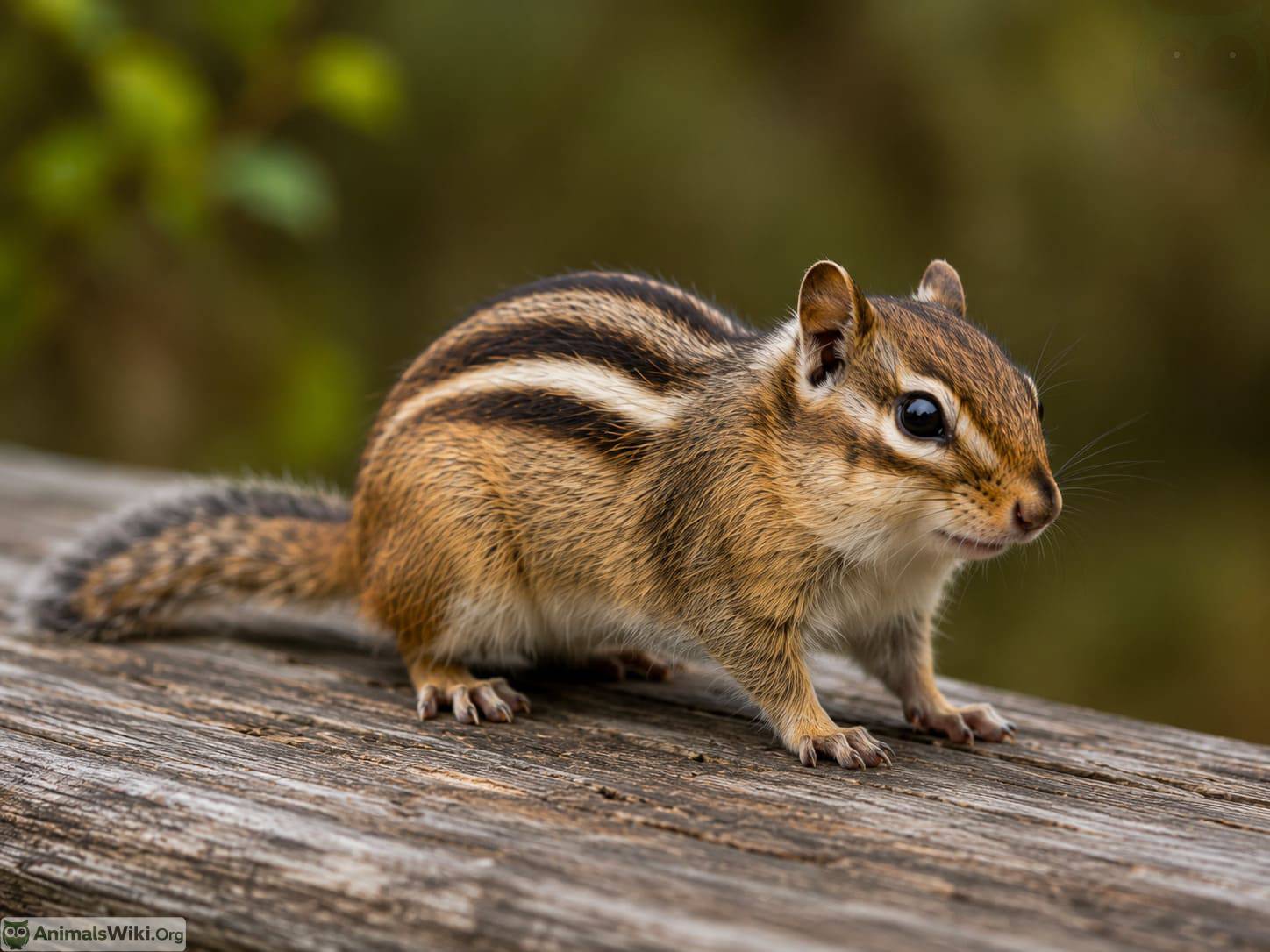
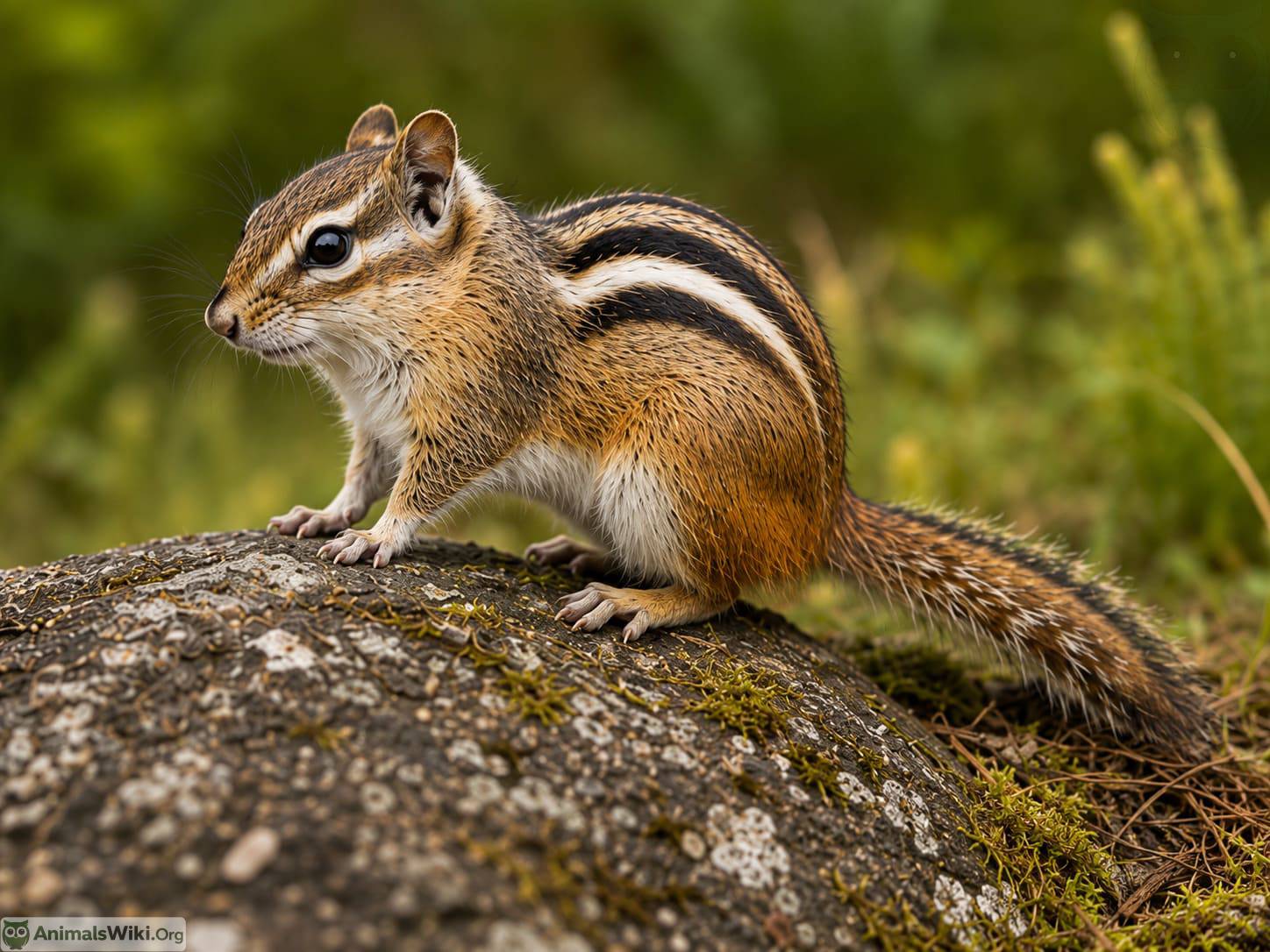
| Defining Feature | Five bold black-and-white stripes running from head to tail; expandable cheek pouches |
| Number of Species | 25 species; 24 in North America, 1 in Asia |
1. Species Overview & Classification
There is a particular kind of wildlife encounter that requires no binoculars, no wilderness expedition, no predawn alarm clock, and no specialized knowledge whatsoever — one that delivers a genuinely wonderful experience of wild animal behavior to anyone who simply sits quietly on a park bench, a hiking trail, or even a suburban garden step. The Chipmunk encounter is one of those moments.
A flash of russet-brown darts between tree roots. Two seconds of absolute stillness — a tiny form sitting bolt upright, its five bold stripes vivid in the dappled light, its enormous dark eyes fixed on you with an expression of alert calculation. Then a rapid pattering of feet, a flash of that distinctive striped back, and it is gone — only to reappear moments later two meters away, stuffing something into cheek pouches already bulging with the morning’s harvest.
The chipmunk is the most immediately accessible wild mammal encounter available to most North Americans — and for good reason. These small, strikingly marked rodents are abundant, bold, diurnal (active by day), and perfectly adapted to the human-modified landscapes that most people actually inhabit. Unlike wolves or mountain lions or bears, you do not need to travel anywhere special to see a chipmunk. You simply need to be outdoors.
But accessibility does not mean ordinariness. The chipmunk, examined closely, is a genuinely remarkable animal — one that solves the twin challenges of winter cold and food scarcity through a combination of extraordinary food hoarding, physiological flexibility, and behavioral sophistication that rewards serious attention. A single Eastern Chipmunk may cache up to 8,000 individual food items in a season in burrows extending more than a meter underground. It can fill its cheek pouches with seeds until its head appears nearly three times its normal width. It enters a state of winter torpor so carefully regulated that it wakes periodically through winter to eat from its underground cache — managing its own physiology with a precision that has fascinated physiologists for decades.
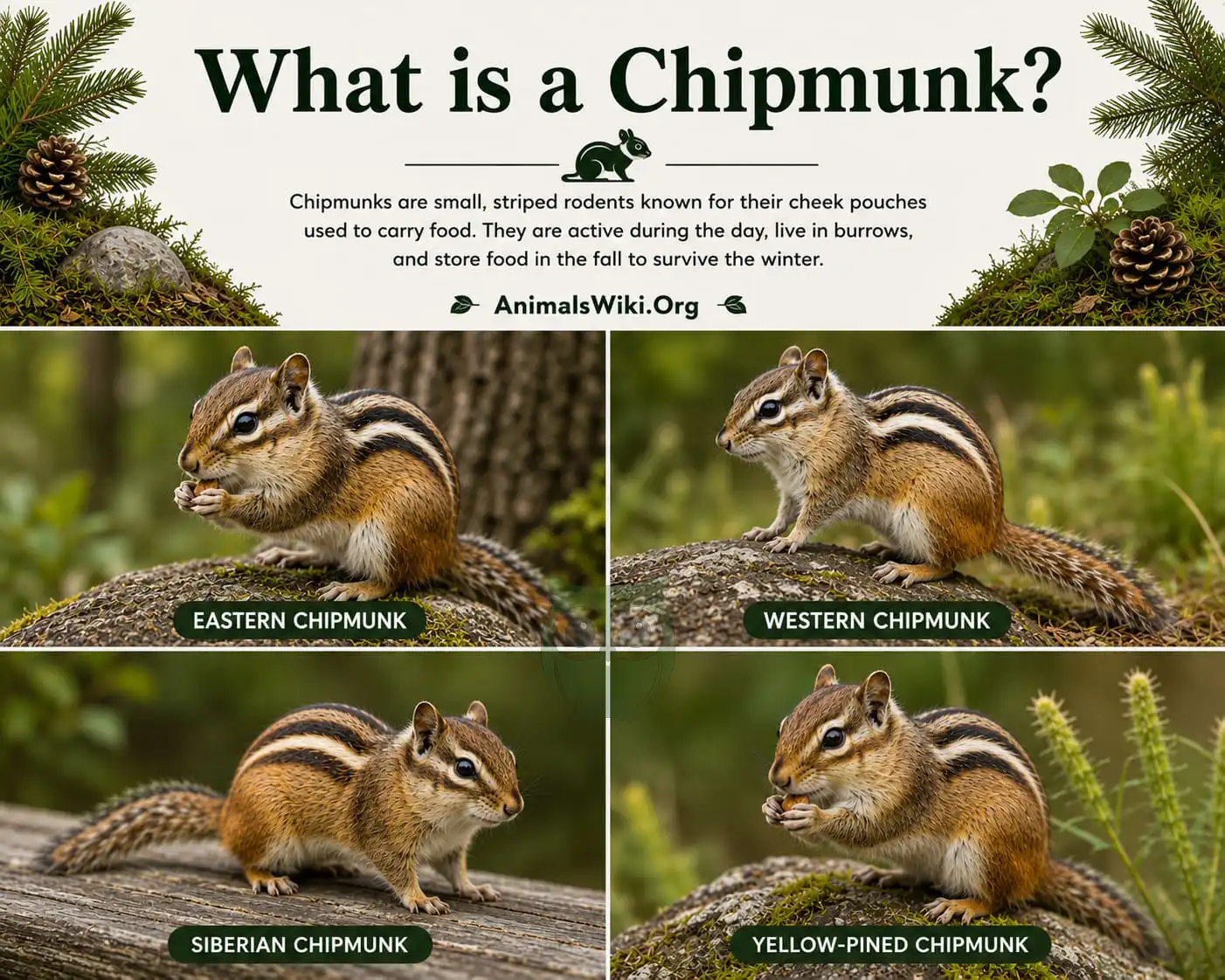
The Eastern Chipmunk (Tamias striatus) is the focus of this guide — the largest, most studied, and most culturally familiar of the 25 chipmunk species that collectively inhabit North America and a small part of Asia. But the chipmunk family as a whole, across its 25 species, represents one of the most successful and ecologically important small mammal groups in the Northern Hemisphere.
Species Classification Table
| Classification Level | Details |
|---|---|
| Kingdom | Animalia |
| Phylum | Chordata |
| Class | Mammalia |
| Order | Rodentia |
| Family | Sciuridae |
| Subfamily | Xerinae (ground squirrels and relatives) |
| Tribe | Marmotini |
| Genus | Tamias (all chipmunks) |
| Focus Species | Tamias striatus — Eastern Chipmunk |
| Described By | Carl Linnaeus, 1758 |
Key Chipmunk Species
| Species | Scientific Name | Range | Notable Feature |
|---|---|---|---|
| Eastern Chipmunk | Tamias striatus | Eastern North America | Largest; most studied; most culturally familiar |
| Least Chipmunk | Neotamias minimus | Western North America | Smallest North American chipmunk |
| Yellow-pine Chipmunk | Neotamias amoenus | Pacific Northwest USA | Vivid coloration; mountain conifer forests |
| Cliff Chipmunk | Neotamias dorsalis | SW USA | Rocky canyon habitat specialist |
| Siberian Chipmunk | Eutamias sibiricus | Russia, N. China, Korea, Japan | Only Asian species; introduced to Europe |
| Alpine Chipmunk | Neotamias alpinus | California Sierra Nevada | Highest altitude chipmunk; above 8,000 ft |
| Lodgepole Chipmunk | Neotamias speciosus | California | Conifer forest specialist |
| Uinta Chipmunk | Neotamias umbrinus | Rocky Mountains | Montane forest species |
2. Physical Description & Unique Features
The chipmunk’s appearance is so instantly recognizable — those bold stripes, that upright alert posture, those comically expandable cheeks — that it hardly requires description. Yet the details of its anatomy, examined carefully, reveal an animal that is as functionally precise as it is visually striking.
Size and Build
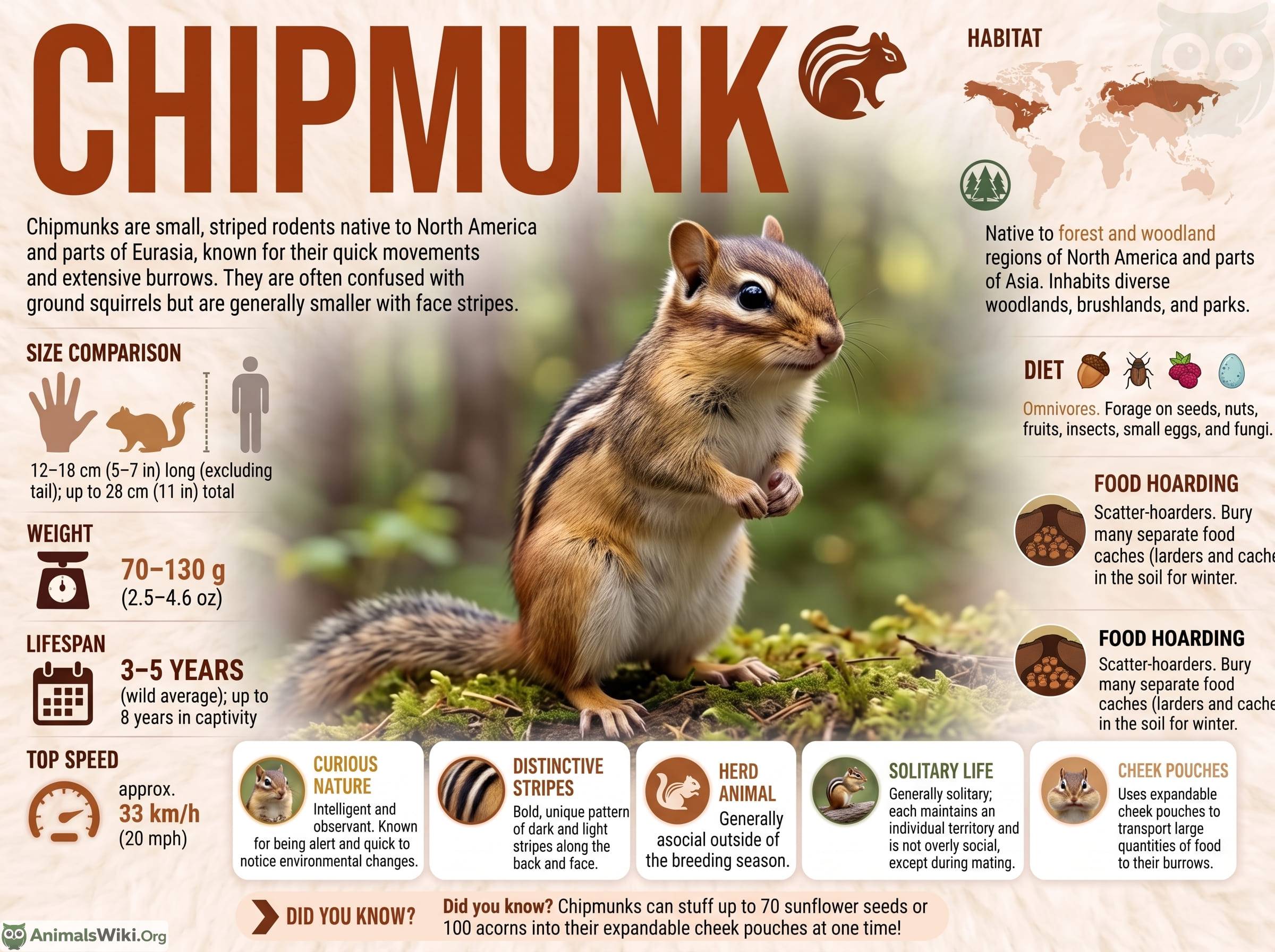
The Eastern Chipmunk is the largest of the 25 chipmunk species — adults measuring 14–19 cm (5.5–7.5 inches) in body length, with an additional 8–11 cm (3–4.5 inches) of tail. Weight ranges from 70–142 grams — roughly the weight of a small chocolate bar — though individuals may weigh significantly more in autumn as fat reserves accumulate before winter.
The body is compact and cylindrical — adapted for moving rapidly through tunnel systems as well as across the forest floor. The legs are short but powerful, built for rapid acceleration and precise navigation through complex terrain. The tail is moderately bushy — considerably less so than tree squirrels — and carried at a characteristic upright angle when the animal is moving, giving the chipmunk its distinctive running posture.
The Iconic Stripes
The chipmunk’s most immediately recognizable feature is its five dark and four light alternating stripes running from the base of the neck to the rump. In the Eastern Chipmunk, these consist of:
- Five dark (blackish-brown) stripes — two along each flank and one running down the center of the back
- Four paler stripes (whitish to cream) — alternating between the dark stripes
The head adds two additional dark eye stripes running from the snout through the eyes toward the ears — giving the face a distinctly masked appearance that has contributed to the chipmunk’s anthropomorphic cultural associations.
The function of the striped pattern is primarily camouflage — the stripes create a disruptive coloration effect that breaks up the animal’s outline in dappled woodland light, making it significantly harder to track visually against the patterned forest floor background. The pattern is particularly effective when the chipmunk is stationary — its most vulnerable period — and becomes a blur of movement when it runs.
The Extraordinary Cheek Pouches
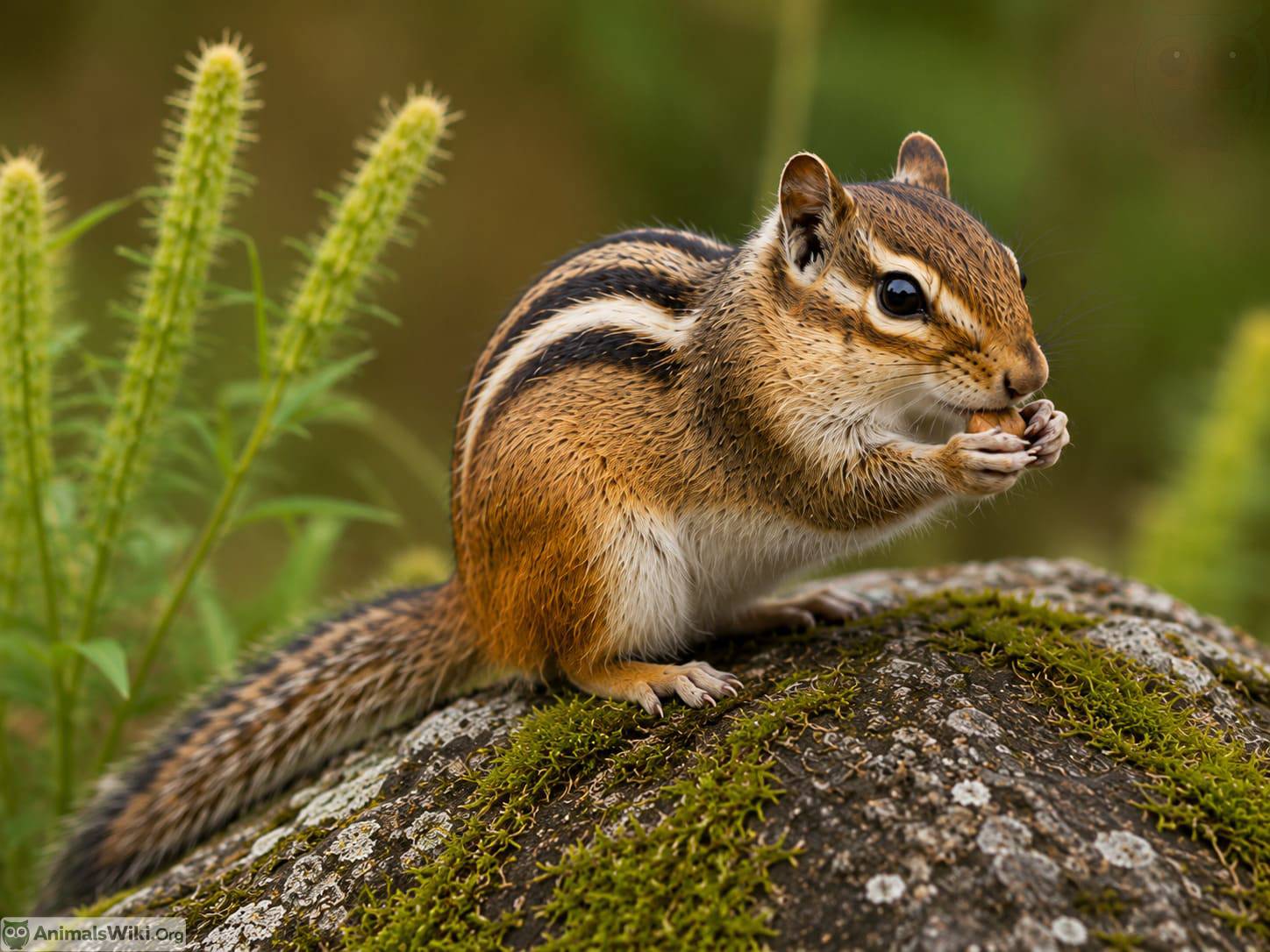
No single feature of the chipmunk’s anatomy is more functionally remarkable than its cheek pouches — elastic, muscular sacs extending from the cheeks back along the jaw to the shoulders. When empty, the pouches are barely visible — the face looks normal-sized. When fully loaded, they can expand to contain a volume of seeds and nuts equal to the entire volume of the rest of the animal’s head, giving fully loaded chipmunks their comically distorted, almost spherical-headed appearance.
The cheek pouches are not simple bags — they are lined with fur (unlike the naked pouches of pocket gophers), allowing them to carry dry items without contamination. Food is transferred from the pouches to underground cache sites by squeezing the pouches against the chest — a characteristic muscular action that empties them in seconds.
A single Eastern Chipmunk has been documented carrying up to 70 sunflower seeds in its cheek pouches simultaneously — a load representing a significant fraction of its own body weight.
The Eyes and Senses
The chipmunk’s large, dark eyes are positioned high on the sides of the skull — providing excellent all-around vision for predator detection. The visual field is nearly 360 degrees, with limited binocular overlap in front. Color vision is present and functional — helping chipmunks identify ripe fruits and distinguish different seed types.
The sense of smell is exceptional — chipmunks locate buried caches through soil by scent, detect predator presence, and identify conspecifics through olfactory signals. The whiskers (vibrissae) provide tactile information in burrow environments where vision is limited.
Did You Know? A chipmunk’s cheek pouches are so expandable that when fully loaded they can contain up to 70 sunflower seeds — expanding the animal’s head to nearly three times its normal width. High-speed video footage of chipmunks emptying their pouches at cache sites — rapidly squeezing both sides simultaneously with their forepaws — has become popular internet content, generating millions of views across platforms.
3. Natural Habitat & Geographic Range
Chipmunks collectively inhabit an enormous geographic range across the Northern Hemisphere — from the deciduous woodlands of the eastern United States to the boreal forests of Canada, from the mountain conifer forests of the Pacific coast to the steppes of Siberia. The 25 species partition this range among themselves with remarkable ecological precision — each adapted to specific habitat conditions within the broader chipmunk niche.
Eastern Chipmunk Habitat
The Eastern Chipmunk occupies deciduous and mixed woodlands across eastern North America — favoring habitats that provide three essential resources:
Cover — dense ground vegetation, rock piles, fallen logs, and complex forest structure providing escape routes from aerial predators
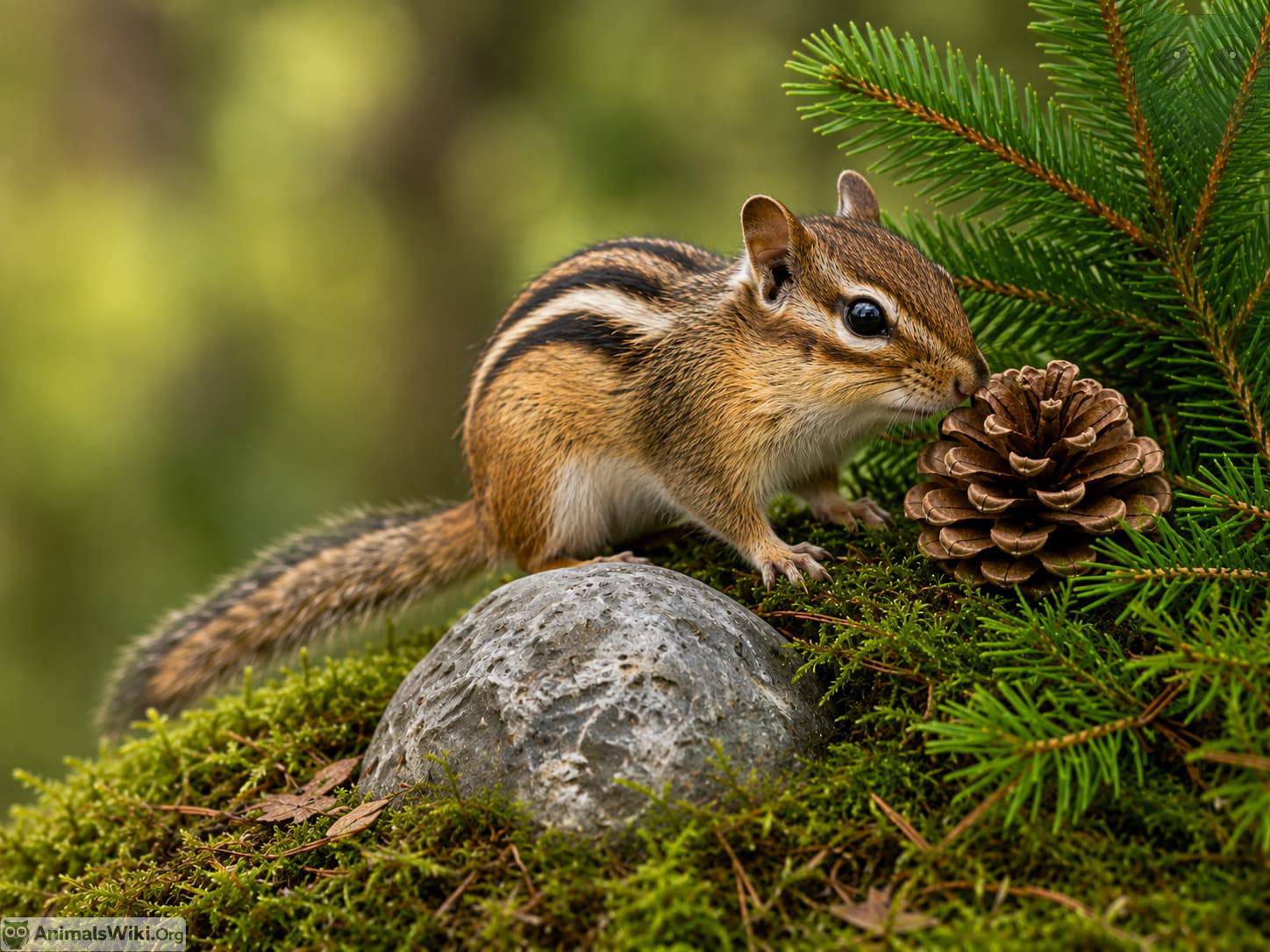
Food — the mast-producing trees (oaks, beeches, hickories, maples) whose nuts and seeds form the foundation of the diet and the winter cache
Soil — well-drained, loose soils suitable for burrow construction; heavy clay or waterlogged soils are avoided
Within these broad requirements, the Eastern Chipmunk shows remarkable habitat flexibility — adapting to suburban gardens, cemetery grounds, hedgerows, forest edges, and even the margins of urban parks with populations that often reach much higher densities than in undisturbed woodland.
Western Species Habitat Diversity
The western North American chipmunk species show extraordinary habitat diversity among themselves:
- Alpine Chipmunk (Neotamias alpinus) — restricted to alpine zones above 2,400 meters (8,000 feet) in California’s Sierra Nevada; one of the highest-living small mammals in North America
- Cliff Chipmunk (Neotamias dorsalis) — specialist of rocky canyon walls and talus slopes in the American Southwest
- Yellow-pine Chipmunk (Neotamias amoenus) — open ponderosa pine forests of the Pacific Northwest
- Lodgepole Chipmunk (Neotamias speciosus) — dense lodgepole pine forests of the Sierra Nevada
Habitat Range by Region
| Region | Primary Species | Habitat Type | Population Status |
|---|---|---|---|
| Eastern USA and Canada | Tamias striatus (Eastern) | Deciduous woodland, suburbs | Abundant; stable |
| Pacific Northwest USA/Canada | Neotamias amoenus and relatives | Conifer forest, mountain meadows | Generally stable |
| Rocky Mountains | Multiple species | Montane forest, subalpine | Stable; some at-risk |
| Sierra Nevada, California | Multiple species | Conifer forest to alpine | Some species declining |
| Great Basin | Multiple species | Sagebrush, pinyon-juniper | Stable to declining |
| Alaska and Yukon | Neotamias minimus (Least) | Boreal forest, tundra margins | Stable |
| Siberia, Korea, Japan, China | Eutamias sibiricus | Boreal forest, scrub | Stable; introduced Europe |
Did You Know? The Siberian Chipmunk (Eutamias sibiricus) — the only chipmunk species native to Asia — has been introduced to several European countries as escaped or released pets and now maintains self-sustaining wild populations in France, Germany, the Netherlands, Belgium, and several other European nations. While charming, these introduced populations raise conservation concerns regarding disease transmission and competition with native wildlife.
4. Diet & Feeding Behavior
The chipmunk’s dietary strategy is a masterwork of opportunistic omnivory combined with extraordinary forward planning — a combination that allows these small animals to survive in seasonal environments where food abundance and scarcity alternate dramatically across the year.
What Chipmunks Eat
Chipmunks are true omnivores — eating almost anything edible that they can find, carry, and process. The diet shifts dramatically with season and habitat:
Seeds and nuts are the dietary foundation and the primary component of winter caches. The Eastern Chipmunk shows strong preferences for:
- Acorns (particularly from white oaks)
- Beechnuts
- Hickory nuts
- Maple seeds (samaras)
- Cherry pits
- Sunflower seeds (from gardens and bird feeders)
Berries and fruit are consumed heavily in late summer and early autumn:
- Wild berries (blueberries, raspberries, blackberries)
- Garden fruits (strawberries, small apples)
- Cherries
Fungi — mushrooms and other fungi are regularly consumed; chipmunks appear able to tolerate fungi toxic to humans and other mammals
Insects and invertebrates — consumed particularly in spring when other food is scarce:
- Caterpillars
- Beetles and larvae
- Earthworms
- Snails
Small vertebrates — occasionally consumed:
- Nestling birds and bird eggs
- Small salamanders and frogs
- Occasionally small mice and voles
The Remarkable Caching Behavior
The most extraordinary aspect of chipmunk feeding behavior is not what they eat but how comprehensively they prepare for not eating — the systematic hoarding of food in underground caches that sustains them through winter torpor.
The Eastern Chipmunk is a larder hoarder — storing the vast majority of its winter food in a single main cache chamber in its burrow, rather than hiding food in scattered individual locations (as squirrels do). This strategy concentrates the food resource but requires the chipmunk to protect it — which it does by maintaining its burrow as a secure, defended territory.
A single Eastern Chipmunk may cache:
- Up to 8,000 individual seeds and nuts
- Total cache mass reaching 1–2 kg (nearly equal to the chipmunk’s own weight)
- Stored in a main cache chamber lined with dry nesting material to reduce moisture damage
Diet Breakdown Table
| Food Type | % of Annual Diet | Peak Season | Notes |
|---|---|---|---|
| Seeds and nuts | 45–60% | Autumn (caching) | Primary winter cache material |
| Berries and fruit | 15–25% | Late summer–autumn | Mostly consumed fresh; some cached |
| Fungi | 5–10% | Summer–autumn | Varied species; some cached dried |
| Insects and invertebrates | 8–15% | Spring–summer | Critical protein source after hibernation |
| Green plant material | 3–8% | Spring | Buds, shoots; spring emergence food |
| Small vertebrates/eggs | 2–5% | Spring–summer | Opportunistic; protein supplement |
“The chipmunk’s larder-hoarding strategy represents one of the most sophisticated examples of forward planning in the rodent world. The animal is essentially creating a personal supermarket underground — carefully selected, organized, and maintained for months of future use.” — Dr. Jennifer Verdolin, Animal Behavior Scientist and Author
5. Reproduction & Life Cycle
The chipmunk’s reproductive strategy reflects its position as a small, prey-vulnerable mammal in a seasonal environment — breeding rapidly, producing multiple offspring, and investing heavily in early development to get young animals to independence before their first winter.
Breeding Seasons
The Eastern Chipmunk has two distinct breeding seasons per year — an unusual arrangement among North American mammals that maximizes reproductive output:
First breeding season: March–April — immediately following emergence from winter torpor; females become receptive within days of emergence
Second breeding season: June–July — a second mating opportunity for females who successfully raised a first litter
This double-breeding system allows productive females to potentially raise two litters per year under good conditions — a significant reproductive advantage in a species where annual mortality rates can exceed 50%.
Courtship and Mating
Chipmunk mating is energetic and competitive. Multiple males track and pursue receptive females — the female’s readiness signaled by distinctive vocalizations and scent signals that attract males from considerable distances. Males compete vigorously for mating access, with dominant males achieving more copulations but subordinate males employing persistence strategies to also achieve some reproductive success.
The mating itself is brief — females are receptive for only a few hours during each breeding season — but during this window may mate with multiple males, resulting in litters where different pups can have different fathers (a phenomenon called multiple paternity).
Gestation and Birth
- Gestation period: Approximately 31–32 days
- Litter size: Typically 3–5 pups (range 2–8)
- Birth weight: Approximately 3 grams — extraordinarily small relative to adult weight
- Born: Blind, naked, and completely helpless in the burrow’s nest chamber
Development of Pups
The development of chipmunk pups is rapid — driven by the necessity of reaching independence before winter:
| Stage | Timing | Development |
|---|---|---|
| Birth | Day 0 | Blind, naked, ~3 grams; entirely helpless |
| Fur development | Day 7–14 | First fur visible; stripes apparent by day 14 |
| Eyes open | Day 28–35 | First vision; ears functional slightly earlier |
| First above-ground appearance | Day 40–45 | Begin short excursions from burrow |
| Weaning | Day 42–49 | Begin independent foraging |
| Full independence | ~Day 60 | Juveniles disperse to establish own territories |
| Sexual maturity | ~10–12 months | First breeding in spring following birth year |
Winter Torpor — The Critical Survival Strategy
Unlike many hibernators that enter a single deep torpor lasting the entire winter, the Eastern Chipmunk enters a more dynamic torpor — alternating between periods of deep sleep (body temperature dropping to near-ambient) and periodic waking to feed from its underground cache.
During deep torpor phases:
- Body temperature drops to approximately 5–7°C (41–45°F)
- Heart rate reduces from ~350 beats/minute to approximately 4 beats/minute
- Breathing rate drops dramatically
- Metabolic rate falls to approximately 5% of normal
Every few days to a week, the chipmunk partially rouses, eats from its cache, and may urinate before returning to torpor. This cycle of sleep and waking continues throughout winter — typically October/November through March/April depending on latitude and weather conditions.
Lifespan Comparison
| Animal | Average Lifespan (Wild) | Average Lifespan (Captivity) |
|---|---|---|
| Eastern Chipmunk | 2–3 years | Up to 8 years |
| Siberian Chipmunk | 2–3 years | Up to 9 years |
| Least Chipmunk | 2–3 years | Up to 6 years |
| Eastern Gray Squirrel | 6–12 years | Up to 20 years |
| American Red Squirrel | 3–5 years | Up to 8 years |
| Golden-mantled Ground Squirrel | 3–6 years | Up to 7 years |
Did You Know? During deep winter torpor, a chipmunk’s heart rate drops from its active rate of approximately 350 beats per minute to just 4 beats per minute — a reduction of nearly 99%. Yet the animal periodically rouses, consumes food from its cache, and manages its own physiological state with precision — regulating the depth and duration of torpor periods in response to temperature, food availability, and internal biological clocks. Physiologists study this remarkable self-regulation for insights into how mammals can safely reduce their own metabolism.
6. Social Behavior & Communication
The chipmunk’s social system presents an interesting paradox — it is a species of considerable individual boldness and frequent inter-individual interaction, yet fundamentally solitary in its territorial and hibernation arrangements. Understanding how chipmunks navigate between these poles reveals a nuanced social intelligence.
Territorial Organization
Each adult chipmunk maintains and defends a home territory centered on its burrow system. Territory sizes vary with habitat quality — in rich woodland with abundant food, territories may be as small as 0.1 hectares; in poorer habitat, they may extend to 0.5 hectares or more.
The burrow is the territorial anchor point — the focus of all defensive behavior and the location of the critical winter cache. Intrusions near the burrow entrance provoke the most vigorous territorial responses; intrusions at the territory periphery during foraging are tolerated more readily.
Burrow Architecture
The Eastern Chipmunk’s burrow is a surprisingly sophisticated structure:
- Main entrance — often hidden under a rock, log, or root; no soil mound (excavated soil is carried away in the cheek pouches and scattered, leaving no obvious surface sign)
- Escape tunnels — one or more secondary tunnels that can be used for rapid exit when threatened; often lacking obvious entrances from the surface
- Nest chamber — a roughly spherical chamber approximately 30 cm diameter, lined with dry leaves and grass
- Cache chamber(s) — one or more chambers storing the winter food supply
- Latrine areas — designated areas for waste within the burrow system
- Total tunnel length — up to 3.5 meters in established burrows
Communication Signals
Vocalizations are the chipmunk’s primary communication channel — and the Eastern Chipmunk produces a range of remarkably loud calls for such a small animal:
- “Chip” call — the sharp, single-note alarm call that gives the animal its name; repeated rhythmically at 130+ calls per minute when a predator is detected nearby; carries surprisingly far through woodland
- “Chuck” call — a lower-pitched, slower repetition; given in response to distant or less immediate threats
- “Trill” call — a rapid, high-frequency vocalization given in intense alarm situations (close aerial predator)
- Ultrasonic vocalizations — high-frequency calls below human hearing threshold; used in close-range social interactions and by pups calling to mothers
Scent marking communicates territory boundaries and individual identity through:
- Facial gland secretions rubbed onto objects
- Cheek gland secretions
- Urine marking at territory boundaries
Body posture communicates threat level:
- Tail flicking accompanies alarm calls — a visual signal to other chipmunks
- Upright posture with head raised — vigilance posture; scanning for threats
- Flattened posture — submission or extreme alarm
7. Predators & Defense Mechanisms
The chipmunk’s small size and diurnal activity pattern make it one of the most heavily predated small mammals in North American woodland — a fact that has shaped virtually every aspect of its behavior, ecology, and physical design.
Natural Predators
The chipmunk faces predation from an extraordinary diversity of predators spanning all size classes and hunting strategies:
Avian predators:
- Red-tailed Hawk (Buteo jamaicensis) — the most significant aerial predator across much of the range
- Cooper’s Hawk and Sharp-shinned Hawk — specialized woodland bird hunters
- American Kestrel — takes chipmunks in open habitats
- Great Horned Owl — primary nocturnal threat; occasionally active at dawn and dusk
- Barred Owl — important woodland predator
Mammalian predators:
- Red Fox (Vulpes vulpes) — significant and widespread predator
- Gray Fox (Urocyon cinereoargenteus) — arboreal capability makes it particularly effective
- Domestic and feral cats — one of the most significant causes of chipmunk mortality near human settlements
- Weasels and Long-tailed Weasels — small enough to pursue chipmunks into burrows
- Mink — particularly in wetter habitats
- Raccoon — opportunistic; raids burrows
- Red Squirrel — occasionally takes young chipmunks
Reptilian predators:
- Rat snake (Pantherophis spp.) — enters burrows; significant predator
- Black Racer (Coluber constrictor) — surface predator
- Timber Rattlesnake (Crotalus horridus) — takes chipmunks in appropriate habitats
Defense Strategies
The alarm call system — the chipmunk’s most important defense is its extraordinary vocal alarm system. The “chip” alarm call not only alerts the calling individual’s neighbors to predator presence but also — through the precise rate and pattern of calls — communicates information about the type, distance, and urgency of the threat. Research has demonstrated that chipmunks discriminate between aerial and terrestrial predators in their calls, producing different call types that trigger different responses in listening animals.
Burrow refuge — the first response to most threats is rapid retreat to the burrow — a strategy that is highly effective against most predators but vulnerable to specialized burrowers (snakes and weasels) that can pursue underground.
Camouflage and freezing — when a predator is spotted at sufficient distance, the chipmunk may freeze in place rather than running — relying on the disruptive camouflage of its stripes against the patterned forest floor background.
Scatter caching by some species — western chipmunk species that scatter-cache (hide food in multiple locations) rather than larder-hoard show broader territorial ranges and more dispersed burrow systems that may reduce predation risk compared to the larder-hoarding Eastern Chipmunk’s predictable burrow focus.
Did You Know? The Eastern Chipmunk’s alarm call — the sharp “chip” sound that gives the animal its name — is one of the most information-rich vocalizations of any small mammal. Research has shown that the rate of chipping communicates specific information: very rapid chipping (130+ per minute) indicates an immediate, close aerial predator such as a hawk directly overhead; slower, more deliberate chipping indicates a terrestrial predator at moderate distance; and a brief single chip indicates a distant or departed threat. Neighboring chipmunks distinguish these nuances and respond appropriately — a system of acoustic communication remarkably sophisticated for a small woodland rodent.
8. Relationship with Humans
Indigenous Cultural Relationships
The chipmunk has been part of the North American human landscape for tens of thousands of years — familiar to virtually every indigenous culture within its range. For many Native American peoples, the chipmunk was not merely a small woodland animal but a culturally significant figure embedded in oral tradition, folklore, and symbolic systems.
The most widespread indigenous story type featuring the chipmunk is the “How the Chipmunk Got Its Stripes” narrative — appearing in variations across dozens of Native American traditions including Iroquois, Anishinaabe, Cherokee, Ojibwe, and many others. In the Iroquois version, a chipmunk is striped by a bear’s claws as punishment for taunting; in Ojibwe traditions, the stripes represent the marks left by a grateful bear; in Cherokee tellings, the stripes come from a dark finger drawn along the chipmunk’s back by a creator figure.
These stories reflect the chipmunk’s status as a familiar, recognizable, and culturally embedded animal — small enough to be non-threatening but distinctive enough in appearance to invite explanation and narrative elaboration.
Various indigenous peoples also made practical use of chipmunks — consuming them as food during lean seasons, using their fur for small decorative items, and observing their behavior for ecological indicators of seasonal change and nut crop quality.
Scientific Relationship
The chipmunk has been a valuable model organism in several areas of scientific research:
Hibernation physiology — the Eastern Chipmunk’s dynamic torpor-and-waking cycle has been extensively studied as a model for understanding the physiological mechanisms of mammalian hibernation; research with implications for human medicine (organ preservation, hypothermic surgery)
Food caching and memory — chipmunk spatial memory and cache-recovery behavior has been studied as a model for understanding hippocampal function and spatial cognition in mammals
Population ecology — long-term chipmunk population studies at sites including Hubbard Brook Experimental Forest in New Hampshire have generated valuable data on how small mammal populations respond to forest management, mast crop variation, and climate change
Disease ecology — chipmunks are significant hosts for Lyme disease (Borrelia burgdorferi) and other tick-borne pathogens; understanding chipmunk population dynamics is important for modeling disease risk in human-frequented areas
Modern Human Relationship
For most contemporary North Americans, the chipmunk is the most familiar wild mammal encounter of daily life — a ubiquitous presence in parks, gardens, hiking trails, and campgrounds that generates an enormous affection for wildlife in people who might otherwise have little regular contact with wild animals.
This familiarity has made the chipmunk a significant figure in:
- Nature education — an accessible, unthreatening, and engaging first wildlife encounter for children
- Garden wildlife — both enjoyed and occasionally resented for bulb-digging and bird feeder raiding
- Wildlife photography — one of the most frequently photographed wild animals in North America; their boldness and photogenic appearance make them accessible subjects
9. Conservation Status & Threats
IUCN Status
- Eastern Chipmunk (Tamias striatus): Least Concern — abundant and widespread
- Most North American species: Least Concern — stable across the majority of range
- Alpine Chipmunk (Neotamias alpinus): Vulnerable — restricted high-altitude range vulnerable to climate change
- Lodgepole Chipmunk (Neotamias speciosus): Least Concern but some concern about climate impacts
- Siberian Chipmunk (Eutamias sibiricus): Least Concern — stable in native range; introduced elsewhere
Key Threats
1. Climate Change — The Most Significant Long-Term Threat Climate change poses existential risks to high-altitude chipmunk species whose ranges are constrained to specific elevational bands. As temperatures warm, the suitable climate conditions for species like the Alpine Chipmunk shift upward — but there is a hard ceiling at mountaintop. Studies in Yosemite National Park have documented dramatic upward range shifts in several chipmunk species over the past century, with some formerly widespread species becoming restricted to ever-smaller high-elevation refugia.
Research published in major journals has used chipmunk range shifts as some of the clearest biological evidence for climate change impacts on biodiversity — making the chipmunk an important indicator species for ecological monitoring.
2. Habitat Loss and Fragmentation Forest clearance and urban development reduce available chipmunk habitat — both through direct habitat loss and through fragmentation that isolates populations and prevents recolonization of locally extirpated areas. Road networks create barriers to dispersal and generate road mortality.
3. Predation by Domestic and Feral Cats Cat predation is estimated to kill billions of small mammals annually in North America — and chipmunks, as diurnal, ground-active, abundant animals in suburban areas, are among the most heavily impacted species. The cumulative impact of cat predation in suburban and rural areas is a significant population pressure on chipmunk populations near human settlements.
4. Disease — Lyme Disease Irony While chipmunks are among the most important reservoir hosts for Lyme disease (carrying the bacterium without becoming ill), they are themselves susceptible to other tick-borne and wildlife diseases. Emerging fungal diseases affecting North American wildlife and novel pathogens introduced through the exotic pet trade represent potential future threats.
5. Invasive Species In parts of Europe where the Siberian Chipmunk has been introduced, native wildlife faces competition and potential disease introduction from these established populations — creating conservation complications that blur the line between “charismatic invasive” and genuine ecological concern.
10. Famous Chipmunks Around the World
Alvin, Simon, and Theodore — The Most Famous Chipmunks in History
The trio of Alvin and the Chipmunks — created by Ross Bagdasarian Sr. in 1958 — is without question the most culturally influential representation of chipmunks in human history. The fictional chipmunk brothers (Alvin the reckless leader, Simon the intellectual, Theodore the sweet-natured youngest) were originally created as novelty music acts using sped-up vocals and have since appeared in:
- Multiple album releases beginning in 1958, with the debut single “The Chipmunk Song (Christmas Don’t Be Late)” reaching #1 on the Billboard Hot 100
- Animated television series (1983–1990 and 2015–2019)
- Four live-action/CGI theatrical films (2007, 2009, 2011, 2015) collectively grossing over $1.3 billion at the global box office
- Countless merchandise lines spanning six decades
The cultural impact of Alvin and the Chipmunks on public perception of chipmunks — embedding specific personality archetypes and the characteristic high-pitched vocal quality in popular imagination — is arguably unparalleled in the representation of any small mammal in entertainment history.
Chip ‘n’ Dale — Disney’s Enduring Duo
Chip and Dale — the two Disney chipmunks who have appeared in films, television series, comic books, and theme parks since their introduction in 1943 — represent the second most culturally significant fictional chipmunk franchise. Originally created as antagonists to Donald Duck, the pair evolved into beloved protagonists in their own right, most recently reimagined in the “Chip ‘n Dale: Rescue Rangers” revival film (Disney+, 2022). The duo’s long-running rivalry with Donald Duck and their characterization as a bold-and-cautious partnership have made them among the most recognized cartoon animals globally.
The Wytham/Hubbard Brook Research Chipmunks
While not named or individually famous, the chipmunk populations studied at Hubbard Brook Experimental Forest in New Hampshire and at multiple long-term ecological research sites across North America have generated some of the most important scientific data on small mammal ecology, forest ecosystem dynamics, and climate change biological indicators — making these anonymous research subjects among the most scientifically significant chipmunk populations in the world.
“Chubby Chipmunk” Viral Content
Numerous individual chipmunks with exceptionally full cheek pouches have achieved viral social media fame — videos and photographs of chipmunks with comically overstuffed cheeks regularly generate millions of views and shares across Instagram, TikTok, and YouTube. Several individual chipmunks who regularly visit garden feeders have achieved modest ongoing social media fame through their owners’ documentation of their feeding behavior and cheek-pouch loading.
11. Role in Ecosystem & Food Chain
Seed Dispersal — The Forest’s Inadvertent Gardener
The chipmunk’s most ecologically significant role is as a seed disperser — and specifically as what ecologists call a “scatter hoarder with cache abandonment” — a type of seed disperser whose behavior directly promotes forest regeneration.
When a chipmunk caches seeds and nuts, it creates many more cache sites than it will actually retrieve and consume. Seeds in unretrieved caches that are buried at appropriate depths in suitable soils germinate and grow — making the chipmunk a primary agent of tree reproduction for the mast-producing species (oaks, beeches, hickories) that depend on animal-mediated seed dispersal for effective reproduction.
Studies have documented that a single Eastern Chipmunk may disperse thousands of seeds annually — contributing meaningfully to forest composition and structure over time. In forests where large-seeded tree species need to colonize new areas following disturbance, chipmunk caching behavior can be the difference between rapid and slow reforestation.
Prey Species — Supporting the Predator Guild
The chipmunk’s extraordinary abundance makes it one of the most important prey species in North American woodland food webs — sustaining populations of hawks, foxes, snakes, weasels, and owls that would be significantly reduced without this reliable small mammal prey base.
Population fluctuations in chipmunk numbers (driven by mast crop variation — the boom-and-bust cycles of acorn and beechnut production) directly impact predator populations — creating cascading effects through the food web. In mast years, chipmunk populations boom, supporting elevated predator numbers; in poor mast years, populations crash, and predators dependent on chipmunks must shift prey or experience reduced reproductive success.
Fungal Spore Dispersal
Chipmunks that consume fungi carry fungal spores through their digestive systems — depositing them at locations distant from the parent fungi in their feces. Many forest fungi are mycorrhizal — forming essential symbiotic relationships with tree roots. Chipmunk-mediated spore dispersal may significantly contribute to the establishment of mycorrhizal networks in regenerating forest areas, making these small animals important facilitators of forest ecosystem recovery.
Disease Vector Role
The chipmunk’s role as a reservoir host for tick-borne diseases — particularly Lyme disease (Borrelia burgdorferi), Anaplasmosis, and Ehrlichiosis — makes it ecologically significant in a public health context. Chipmunks are highly competent reservoirs for these pathogens, infecting feeding ticks at high rates. In areas with dense chipmunk populations, tick infection rates with Lyme spirochetes are correspondingly elevated — making chipmunk population dynamics relevant to human disease risk modeling.
12. Myths, Culture & Pop Culture Appearances
Indigenous North American Mythology
The chipmunk appears in the oral traditions of dozens of Native American peoples — almost invariably in stories explaining its distinctive stripes. These origin stories reflect the animal’s unique visual appearance and its place as one of the most familiar wild animals in North American woodland cultures.
Iroquois tradition tells that a chipmunk boasted that a bear could not catch it and was nearly captured — the bear’s claws raking across the chipmunk’s back as it escaped into a burrow, leaving the black claw marks visible as stripes to this day.
Anishinaabe (Ojibwe) tradition has the chipmunk’s stripes as the marks of a grateful bear’s paw — left as a blessing rather than as punishment.
Cherokee tradition involves a darker bear whose finger, drawn along the chipmunk’s back in disapproval, left permanent marks.
The consistency of bear-and-chipmunk narratives across diverse, geographically separated cultures reflects not narrative diffusion but the same ecological observation: that bears and chipmunks occupy the same woodland spaces, that the chipmunk is small and vulnerable yet bold and quick, and that the dramatic stripe markings demand explanation.
Pop Culture Appearances
- Alvin and the Chipmunks — the most culturally impactful chipmunk franchise in history; debut single “The Chipmunk Song” (1958) sold over 4 million copies in seven weeks; theatrical films collectively grossed over $1.3 billion globally; continues to produce new content
- “Chip ‘n Dale: Rescue Rangers” (Disney+, 2022) — meta-fictional revival of the Disney chipmunk duo; positive critical reception; introduced the characters to a new generation
- Over The Hedge (DreamWorks, 2006) — features RJ the raccoon and forest animal friends including chipmunks dealing with suburban habitat encroachment; significant box office success; engaging environmental themes
- “Bagpuss” (BBC, 1974) — beloved British animated series featuring the little mice (functionally chipmunk-like characters) in Professor Yaffle’s setting; iconic piece of British children’s television
- “Animal Crossing” series (Nintendo) — features Rosie, Mint, and other chipmunk-type villager characters as fan favorites across the game series
- Social Media — chipmunk cheek-pouch loading videos are among the most consistently viral small mammal content on TikTok, Instagram, and YouTube; several individual chipmunks with distinctive behaviors have achieved modest social media celebrity
- Western Michigan Broncos — not chipmunks, but chipmunk imagery appears in various North American nature organizations, park services, and wildlife education materials across the species’ range
Did You Know? The “Chipmunk Song (Christmas Don’t Be Late)” by Alvin and the Chipmunks — released in 1958 — sold over 4 million copies in just seven weeks, making it one of the fastest-selling singles in recording history at that time. The distinctive high-pitched vocal effect was created by recording vocalist David Seville at slow speed and playing the tape back at double speed — a studio technique that transformed a simple novelty concept into one of the most recognized vocal sounds in Christmas music history.
13. Discovery & Evolution Timeline
~35 million years ago — The family Sciuridae (squirrels) diverges from other rodents; early sciurids are small, generalist rodents in a world of very different mammalian fauna.
~20–25 million years ago — The Marmotini tribe — containing ground squirrels, marmots, prairie dogs, and chipmunks — begins diverging within Sciuridae during the Miocene epoch.
~15 million years ago — Early chipmunk-like forms appear in the fossil record of North America; the distinctive striped small ground squirrel niche begins to be occupied.
~5 million years ago — The three chipmunk genera (Tamias, Neotamias, Eutamias) diverge as North American climate cools and diversifies; Western species radiate rapidly in the complex mountain environments of the Pacific ranges.
~3 million years ago — The Siberian Chipmunk (Eutamias sibiricus) diverges from North American relatives following the closing of the Bering land bridge; establishes itself across the boreal forests of Asia.
~10,000 years ago — Chipmunks recolonize northern portions of their range as ice sheets retreat following the last Ice Age; modern range boundaries established.
Pre-colonial era — Chipmunks are abundant and familiar across their range; integrated into the cultural life of virtually every Native American people within their distribution.
1743 — Early European natural history descriptions of North American chipmunks appear in French Jesuit accounts of exploration in eastern Canada; the animals described with wonder at their remarkable cheek pouches.
1758 — Carl Linnaeus formally describes Tamias striatus in Systema Naturae — establishing the scientific name that remains valid today.
1817 — American naturalist George Ord provides a more detailed formal description of the Eastern Chipmunk’s biology and behavior; lays foundation for systematic North American mammalogy.
1958 — Alvin and the Chipmunks created by Ross Bagdasarian; “The Chipmunk Song” becomes one of the fastest-selling singles in recording history; chipmunks enter global popular culture at an entirely new level.
1970s–1990s — Long-term ecological research at Hubbard Brook Experimental Forest and other sites generates foundational data on chipmunk population ecology and forest ecosystem dynamics.
2000s–2010s — Climate change research using chipmunk range shifts as indicators; studies in Yosemite document dramatic upward range shifts consistent with warming temperatures.
2026 — Chipmunks remain among North America’s most abundant small mammals and most familiar wildlife encounters; some high-altitude species show concerning population trends linked to climate change.
14. Comparison with Similar Species
| Feature | Eastern Chipmunk (T. striatus) | American Red Squirrel (T. hudsonicus) | Thirteen-lined Ground Squirrel (I. tridecemlineatus) |
|---|---|---|---|
| Size | 14–19 cm; 70–142 g | 19–23 cm; 140–250 g | 17–29 cm; 100–230 g |
| Stripes | 5 bold; head to rump | None | 13 alternating lines and spots |
| Habitat | Deciduous woodland | Conifer forest | Open grassland, prairie |
| Diet | Omnivore; larder hoards | Seeds; scatter hoards | Omnivore; hibernates deeply |
| Social structure | Solitary territorial | Solitary territorial | Colonial; communal |
| Hibernation | Dynamic torpor; wakes to eat cache | Does not hibernate | True hibernation; no cache |
| Cheek pouches | Very large; expandable | Small | Moderate |
| Climbing | Occasionally climbs | Excellent climber | Rarely climbs |
| IUCN Status | Least Concern | Least Concern | Least Concern |
15. Best Places to See Chipmunks in the Wild
Eastern North America
- 🇺🇸 Acadia National Park, Maine — excellent Eastern Chipmunk populations in beautiful coastal and mountain woodland settings; chipmunks are extremely habituated to human presence and provide extraordinary close-up observation opportunities
- 🇺🇸 Great Smoky Mountains National Park, Tennessee/North Carolina — superb populations in diverse mountain forest habitats; chipmunks common along virtually every trail
- 🇺🇸 Shenandoah National Park, Virginia — excellent Skyline Drive and Appalachian Trail chipmunk encounters throughout the deciduous forests
- 🇺🇸 Adirondack Park, New York — outstanding chipmunk habitat in one of the eastern US’s largest wild areas
- 🇨🇦 Algonquin Provincial Park, Ontario — spectacular boreal and mixed forest with abundant Eastern Chipmunks; excellent canoe and hiking routes through prime habitat
Western North America — Multiple Species
- 🇺🇸 Yosemite National Park, California — multiple species including the Yellow-pine, Lodgepole, and Allen’s Chipmunks across elevational gradients; the park’s long-term population monitoring data make it the world’s best-studied western chipmunk location
- 🇺🇸 Rocky Mountain National Park, Colorado — Least Chipmunk and Uinta Chipmunk in spectacular mountain settings; chipmunks often bold and approachable at visitor centers
- 🇺🇸 Olympic National Park, Washington — Townsend’s Chipmunk in magnificent temperate rainforest settings
- 🇺🇸 Grand Teton National Park, Wyoming — multiple species from sagebrush to alpine; excellent wildlife-watching infrastructure
Asia
- 🇷🇺 Irkutsk region, Russia (near Lake Baikal) — Siberian Chipmunk in boreal forest settings near the world’s deepest lake
- 🇯🇵 Japanese Alps and Nikko National Park — Siberian Chipmunk introduced and established; also overlaps with Ezo Chipmunk range in Hokkaido
16. Chipmunk Fun Facts for Kids
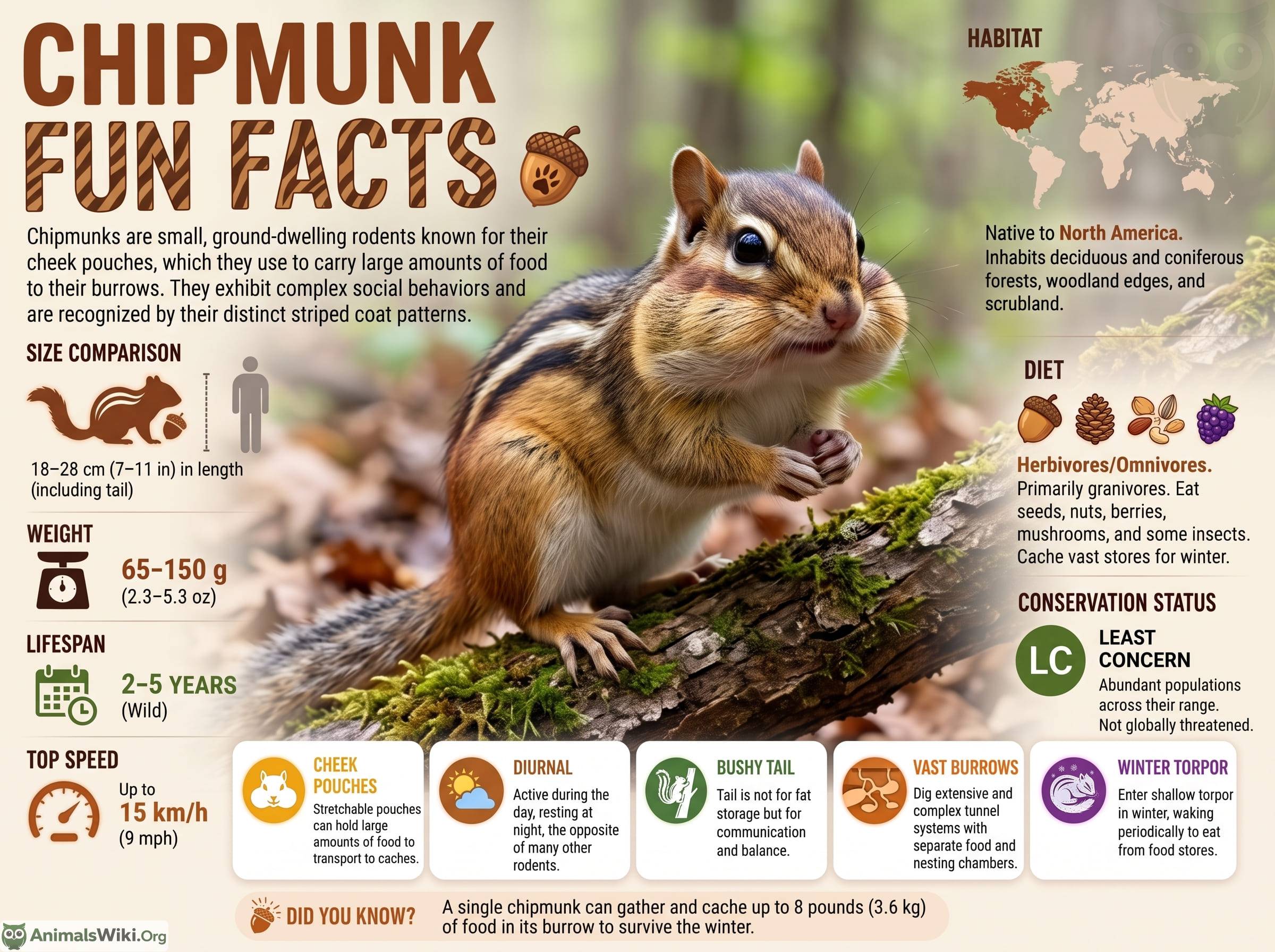
- 🐿️ A chipmunk can carry up to 70 sunflower seeds in its cheek pouches simultaneously — expanding its head to nearly three times normal width
- 🐿️ The name “chipmunk” derives from the Ojibwe word “ajidamoo” — meaning “one who descends trees headfirst”
- 🐿️ A single Eastern Chipmunk may cache up to 8,000 individual seeds and nuts for winter
- 🐿️ During deep winter torpor, a chipmunk’s heart rate drops from 350 beats per minute to just 4 beats per minute
- 🐿️ The five stripes of the Eastern Chipmunk are primarily for camouflage — breaking up its outline in dappled woodland light
- 🐿️ Chipmunks are one of the most important reservoir hosts for Lyme disease in eastern North America
- 🐿️ The “Chipmunk Song” by Alvin and the Chipmunks sold 4 million copies in seven weeks in 1958
- 🐿️ Chipmunks can run at speeds up to 21 km/h (13 mph) — impressive for an animal weighing less than 150 grams
- 🐿️ The chipmunk hides its burrow entrance so effectively — carrying excavated soil away in its cheek pouches — that burrows are often impossible to find without observing the animal entering
- 🐿️ Chipmunks may disperse thousands of seeds annually — making them important contributors to forest regeneration
- 🐿️ There are 25 species of chipmunk — 24 in North America and just one in Asia
- 🐿️ A group of chipmunks has no widely recognized collective noun — they are largely solitary animals, so groups are rarely encountered
17. How You Can Help
Support These Organizations
- National Wildlife Federation (NWF) (nwf.org) — advocacy for wildlife-friendly habitat across North America; certified wildlife habitat program supports chipmunk-friendly gardens
- The Nature Conservancy (nature.org) — protecting forest and mountain habitats critical for chipmunk species across North America
- Wildlife Conservation Society (WCS) (wcs.org) — supporting research on North American wildlife including chipmunk ecology and climate change impacts
- American Bird Conservancy (abcbirds.org) — campaigns for cat containment that would also significantly reduce chipmunk mortality from cat predation
- National Park Foundation (nationalparks.org) — supporting the national park system that protects critical chipmunk habitat across the western species’ range
- Sierra Nevada Research Institute — supporting climate change research on high-altitude chipmunk species in California’s mountains
What You Can Do
- Keep cats indoors — domestic cat predation is one of the most significant mortality factors for chipmunks near human settlements; indoor cats do not kill wildlife
- Plant native trees and shrubs — oaks, beeches, and other mast-producing native species provide the food resources that support chipmunk populations
- Support climate action — the threat to high-altitude chipmunk species from climate change is real and urgent; reducing greenhouse gas emissions is the only long-term solution
- Create chipmunk-friendly gardens — log piles, rock arrangements, and dense native groundcover provide shelter; avoid pesticides that eliminate the insect and earthworm prey chipmunks need
- Report invasive species — in areas outside their native range, Siberian Chipmunks should be reported to local wildlife authorities
- Support tick-borne disease research — understanding the chipmunk’s role in disease ecology helps manage public health risks while maintaining respect for native wildlife
Recommended Documentaries & Books
- “North America” (BBC/Discovery, 2013) — features chipmunk behavior in stunning high-definition cinematography
- “Wild America” (PBS) — classic American wildlife series with excellent chipmunk coverage
- “Nature” (PBS) — multiple episodes cover North American woodland wildlife including chipmunks
- “Chipmunks of North America” by John A. Gurnell — the scientific reference work on chipmunk ecology and behavior
- “A Natural History of North American Mammals” by Fiona Reid — excellent accessible coverage of all chipmunk species
18. Frequently Asked Questions About Chipmunks
Q1: What do chipmunks eat?
Chipmunks are true omnivores with a remarkably diverse diet. The foundation is seeds and nuts — acorns, beechnuts, hickory nuts, and maple seeds — which form the bulk of their diet and their winter food cache. They also eat berries and fruit in late summer, fungi, insects and larvae (particularly important in spring for protein after winter), earthworms, bird eggs, and occasionally small vertebrates. Their cheek pouches allow them to carry large quantities of food efficiently, and a single chipmunk may cache up to 8,000 individual food items in its underground burrow for winter consumption.
Q2: Do chipmunks hibernate?
Chipmunks enter a state called torpor in winter — but it is more complex than simple hibernation. Unlike true hibernators that sleep through winter without waking, Eastern Chipmunks enter dynamic torpor — alternating between periods of deep sleep (heart rate dropping to just 4 beats per minute) and periodic waking to feed from their underground food cache. They typically enter torpor in October–November and emerge in March–April, waking every few days to a week during the winter to eat. This is why they hoard so much food — they genuinely need it as winter provisions, consumed while still underground.
Q3: How many species of chipmunk are there?
There are 25 recognized species of chipmunk, divided into three genera. 24 species are native to North America — ranging from the large Eastern Chipmunk of the eastern forests to tiny specialists in western mountain habitats. Just one species — the Siberian Chipmunk (Eutamias sibiricus) — is native to Asia, where it ranges across Russia, China, Korea, and Japan. The Siberian Chipmunk has also been introduced to several European countries as escaped pets and now maintains wild populations in France, Germany, and elsewhere.
Q4: Why do chipmunks have stripes?
The chipmunk’s distinctive stripes serve primarily as camouflage — the alternating dark and light stripes create a disruptive pattern that breaks up the animal’s outline against the patterned background of the forest floor in dappled light. This makes the animal significantly harder to track visually when it freezes in place. The stripes are most effective when the chipmunk is stationary — its most vulnerable state — and are supplemented by the dark eye stripes that may reduce glare and improve vision. Secondary functions may include species recognition among chipmunks themselves.
Q5: Are chipmunks good pets?
In most of North America, keeping native chipmunks as pets is illegal — they are protected wildlife. The Siberian Chipmunk is legally kept as a pet in many countries. As pets, chipmunks are entertaining and engaging but require considerable specific care: they need large enclosures with tunneling opportunities and climbing structures, a diverse diet, and appropriate hibernation conditions in winter. They are not suitable as cuddly companions — wild instincts remain strong and most do not become fully tame. They have relatively short lifespans (2–3 years wild; up to 9 in captivity with good care). For most people, enjoying wild chipmunks in gardens and parks is a more satisfying relationship.
Q6: How do chipmunks find their cached food in winter?
Chipmunks primarily larder-hoard (keeping most food in a single main cache in their burrow) rather than scatter-hoarding like squirrels — so finding their winter food is relatively straightforward since it is stored right where they sleep. When they do make multiple small caches, they locate them using a combination of spatial memory (remembering the precise location) and smell (detecting buried food through soil). Research shows chipmunk spatial memory for cache locations is genuinely impressive — they can remember dozens of specific locations accurately. The hippocampus (the brain region associated with spatial memory) enlarges seasonally in chipmunks during food-caching periods.
Q7: What is the difference between a chipmunk and a squirrel?
Chipmunks and squirrels are both members of the family Sciuridae but differ in several key ways. Chipmunks are generally smaller, have distinctive stripes on the back and face (squirrels generally do not), spend much more time on the ground (though they can climb), maintain underground burrow systems, and enter winter torpor (most tree squirrels do not hibernate). Tree squirrels are typically larger, lack stripes, are highly arboreal, nest above ground in tree cavities or leaf dreys, and remain active year-round — relying on scatter-cached food found under snow. Ground squirrels are more chipmunk-like but typically lack the bold facial stripes.
Q8: Are chipmunks dangerous to humans?
Chipmunks are not dangerous to humans in any meaningful sense — they are small, non-venomous, and flee from human contact under normal circumstances. They can bite if handled — bites are small but can break skin and theoretically transmit pathogens, so wild chipmunks should not be handled. The more significant health concern is the chipmunk’s role as a reservoir host for tick-borne diseases — particularly Lyme disease. Areas with high chipmunk populations tend to have higher tick infection rates. Standard tick-avoidance precautions (protective clothing, insect repellent, tick checks after outdoor activity) are the appropriate response to this risk, not avoidance of chipmunks themselves.
19. Sources Reserached
The information in this article was researched and verified using the following authoritative sources:
- Wikipedia — Tamias striatus, Chipmunk, Neotamias, Eutamias sibiricus, Alvin and the Chipmunks
- IUCN Red List (iucnredlist.org) — All chipmunk species conservation status assessments
- National Geographic (nationalgeographic.com) — Chipmunk species profiles and behavior features
- Britannica (britannica.com) — Chipmunk, Sciuridae, Tamias
- Smithsonian’s National Zoo (nationalzoo.si.edu) — Eastern Chipmunk species biology and care
- Cornell Lab of Ornithology (allaboutbirds.org) — Chipmunk ecological context
- Hubbard Brook Ecosystem Study (hubbardbrook.org) — Long-term chipmunk population data
- National Park Service (nps.gov) — Chipmunk range and habitat data for Yosemite and other parks
- Journal of Mammalogy — Peer-reviewed research on chipmunk ecology, behavior, and physiology
- Mammal Society of North America — Population data and species accounts
- CDC Lyme Disease (cdc.gov) — Chipmunk role in Lyme disease ecology
- BBC Nature (bbc.co.uk/nature) — Documentary references and species behavior data
- University of Wisconsin — Madison — Chipmunk hibernation physiology research
- Yosemite National Park Research — Long-term chipmunk population monitoring data
- American Society of Mammalogists — Species accounts and taxonomic information
20. Chipmunk Images