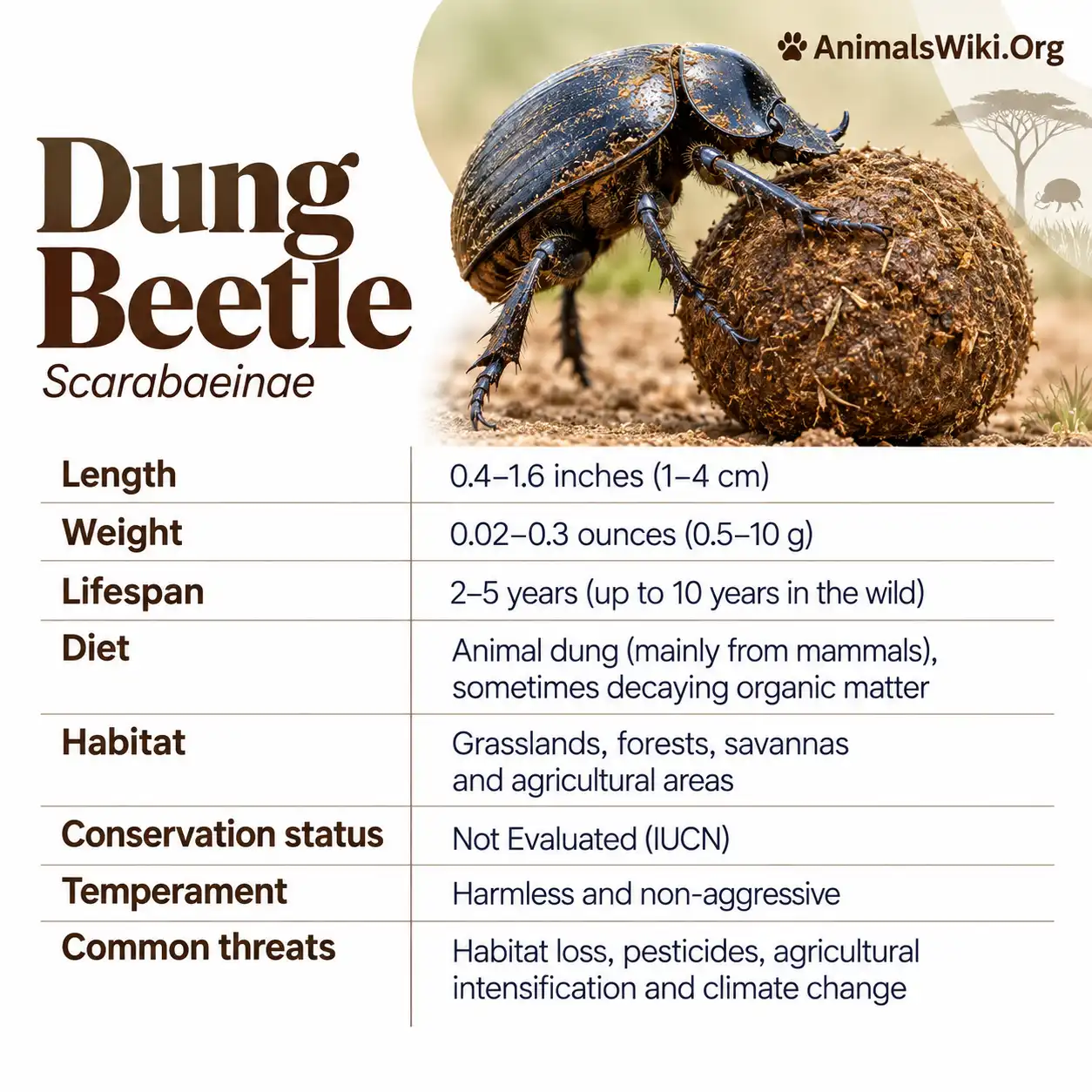
Dung Beetle Facts
| Feature | Details |
|---|---|
| Common Name | Dung Beetle |
| Scientific Name | Scarabaeus sacer (Sacred Scarab — focus species) |
| Family | Scarabaeidae |
| Order | Coleoptera (beetles) |
| First Described | 1758 (by Carl Linnaeus) |
| Native Habitat | Every continent except Antarctica; grasslands, forests, deserts, farmland |
| Geographic Range | Global — found on every inhabited continent |
| Average Size | 1–6 cm depending on species; Scarabaeus sacer approximately 2–4 cm |
| Average Weight | 0.2–3.5 grams depending on species |
| Lifespan | 3 years (adult); full life cycle 1–3 years |
| Diet | Dung (mammal feces) — adults and larvae; some species eat fungi or carrion |
| Conservation Status | Varies by species; many Least Concern; some Critically Endangered |
| Defining Feature | Rolls dung balls many times its own weight; navigates using the Milky Way; worshipped as sacred in ancient Egypt |
| Number of Species | Over 6,000 species worldwide |
1. Dung Beetle Species Overview & Classification
Somewhere on an African savannah right now, a small beetle approximately the size of a walnut is rolling a ball of elephant dung across sun-baked ground. The ball is roughly spherical, approximately ten times the beetle’s own diameter, and the beetle is pushing it backward using its hind legs while its front legs walk forward — a posture of extraordinary physical awkwardness that somehow translates into purposeful, efficient movement. The beetle is navigating, with remarkable precision, in a perfectly straight line. It knows exactly where it is going. It will not deviate from its course. And if you were to observe it from above and trace its path, you would find that it is following a bearing determined not by landmarks, not by magnetic fields, but by the light of the Milky Way.
Welcome to the world of the Dung Beetle — one of nature’s most improbable, most extraordinary, and most ecologically essential animals.
The dung beetle’s improbability is part of its fascination. It is an insect that has built its entire existence around one of the least promising food sources imaginable — mammalian feces — and in doing so has become one of the most ecologically indispensable creatures on Earth. Without dung beetles, the grasslands of Africa, the rainforests of South America, and the farmlands of Europe and Asia would be buried under accumulating dung within weeks. Nutrient cycling would collapse. Parasite loads on livestock would skyrocket. Seed dispersal systems would break down. The entire structure of terrestrial ecosystems would be compromised.
The ancient Egyptians understood something of this importance — though they expressed it in theological rather than ecological terms. To the Egyptians, the Sacred Scarab (Scarabaeus sacer) was not merely an interesting insect. It was a manifestation of the sun god Khepri — the beetle’s act of rolling its dung ball across the ground seen as a perfect metaphor for the sun rolling across the sky. Scarab amulets became the most widely produced religious object in ancient Egyptian history — worn by both the living and the dead as symbols of regeneration and divine protection.
The dung beetle, in short, is an animal that has been both divinely worshipped and scientifically marveled at — and in both cases, the admiration is thoroughly deserved.
Species Classification Table
| Classification Level | Details |
|---|---|
| Kingdom | Animalia |
| Phylum | Arthropoda |
| Class | Insecta |
| Order | Coleoptera |
| Family | Scarabaeidae |
| Subfamily | Scarabaeinae (true dung beetles) |
| Genus (focus) | Scarabaeus |
| Focus Species | Scarabaeus sacer — Sacred Scarab |
| Described By | Carl Linnaeus, 1758 |
| Total Species | ~6,000 worldwide |
The Three Ecological Types of Dung Beetle
All 6,000+ dung beetle species can be organized into three ecological categories based on how they handle dung:
| Type | Behavior | Examples | % of Species |
|---|---|---|---|
| Rollers (Telecoprids) | Roll dung into balls and transport away | Scarabaeus, Gymnopleurus | ~10% |
| Tunnelers (Paracoprids) | Dig tunnels directly below dung pat; bury dung | Onthophagus, Copris | ~55% |
| Dwellers (Endocoprids) | Live and breed within the dung pat itself | Aphodius, Psammodius | ~35% |
2. Dung Beetle Physical Description & Unique Features
The dung beetle’s body is a masterpiece of functional engineering — compact, powerful, and precisely adapted for its extraordinary lifestyle. Examining its anatomy reveals an insect designed for strength, chemical detection, and efficient movement in one of the most demanding physical and chemical environments in the insect world.
Size and Build
Dung beetles vary enormously in size across their 6,000+ species — from tiny Aphodius species measuring just 3–5 mm to the enormous Heliocopris dominus (the Giant African Dung Beetle) reaching 5–6 cm in length and weighing several grams. The focus species, Scarabaeus sacer, is a mid-sized roller measuring approximately 2–4 cm and weighing 1–3 grams.
The body plan is the classic beetle form — a robust, oval-shaped structure divided into the characteristic insect three sections (head, thorax, abdomen) and protected by hardened wing covers (elytra) that enclose and protect the delicate flight wings folded beneath. The overall impression is of a compact, armored vehicle — built for power and durability rather than speed or agility.
The Remarkable Front Legs
The most functionally significant anatomical features of a roller dung beetle are its front legs (forelegs) — which in males are dramatically modified into flattened, paddle-like shovels bearing a row of tooth-like projections along the outer edge. These modified forelegs serve as:
- Excavating tools — for scraping and cutting dung material
- Shaping implements — for molding the dung ball into its characteristic sphere
- Walking aids — the beetle walks on these flattened forelegs during ball-rolling
In the tunneling species, the forelegs and middle legs are adapted for powerful excavation — digging through soil with impressive speed and force.
Sensory Systems — Smell Above All
The dung beetle’s sensory world is dominated by smell. Its antennae are elaborate, club-shaped structures bearing thousands of microscopic chemoreceptors — sensory cells capable of detecting the specific volatile compounds produced by fresh mammalian dung at extraordinary distances.
Research has demonstrated that dung beetles can detect dung from dozens of meters downwind — arriving at fresh dung deposits within seconds to minutes of their production in areas with high dung beetle populations. The chemical specificity of detection is also remarkable — different dung beetle species show preferences for specific dung types (herbivore versus omnivore versus carnivore dung, and among herbivores between different species) that reflect evolutionary specialization on specific host animals.
The compound eyes provide reasonable visual acuity for detecting large objects (dung pats, competitors, predators) and crucially for navigational orientation — including the extraordinary ability of roller species to use celestial cues for straight-line navigation.
The Scarab’s Horns
Many dung beetle species — particularly males of tunneling species in the genus Onthophagus — bear elaborate horns on the head and pronotum (the plate covering the thorax). These horns, which can exceed the beetle’s own body length in the most extreme cases, are used in male-male combat for control of tunnels and access to females. The diversity of horn shapes and sizes among the 2,000+ Onthophagus species has made this genus a textbook example of rapid evolutionary diversification and sexual selection.
Did You Know? The dung beetle is the strongest animal on Earth relative to its body weight — capable of pulling a load of 1,141 times its own body weight. This extraordinary strength, documented in a 2010 study published in the Proceedings of the Royal Society B, is necessary for dragging dung balls over rough terrain. To put this in human terms, it would be equivalent to a person pulling 80 tons — roughly the weight of six double-decker buses.
3. Dung Beetle Habitat & Geographic Range
The dung beetle’s extraordinary ecological success is reflected in its near-global distribution — present on every continent except Antarctica, in virtually every terrestrial ecosystem that supports mammals producing dung. From equatorial rainforests to Mediterranean scrubland, from subarctic tundra margins to the driest hot deserts, some dung beetle species has found a way to exploit the available dung resource.
Habitat Preferences
Different dung beetle groups show distinct habitat preferences shaped by the interaction of temperature, moisture, soil type, and the specific dung resources available in each habitat:
African savannah and grassland — the global epicenter of dung beetle diversity and abundance; the combination of enormous megafaunal biomass (elephants, rhinos, buffalo, wildebeest, zebra) and open terrain makes African savannah the optimal dung beetle environment. South Africa alone has over 800 species.
Tropical and subtropical forest — high diversity but lower individual abundance; forest dung beetles are often specialized on specific mammals and show extraordinary species diversity at small spatial scales
European agricultural farmland — historically rich in dung beetles associated with domestic livestock; significantly impacted by veterinary drug use and changed farming practices
Mediterranean scrubland — the home range of Scarabaeus sacer; warm, dry, open habitat with abundant mammalian herbivores
Desert environments — specialized desert dung beetles have evolved remarkable water conservation adaptations; some Namib Desert species collect water from morning fog using their body surface
South American cerrado and grassland — second only to Africa in dung beetle diversity; extraordinary radiation of species associated with South American megafauna
Habitat Range by Continent
| Continent | Approximate Species Count | Key Habitats | Notable Feature |
|---|---|---|---|
| Africa | ~2,000 species | Savannah, forest, desert | Global diversity hotspot; megafauna hosts |
| South America | ~1,500 species | Cerrado, rainforest, grassland | Second highest diversity; forest specialists |
| Asia | ~700 species | Forest, grassland, farmland | High Onthophagus diversity |
| Europe | ~300 species | Farmland, Mediterranean scrub | Declining due to agriculture |
| North America | ~100 species | Grassland, forest, desert | Lower diversity; some introduced species |
| Australia | ~500 species | Grassland, woodland | Native species not adapted to cattle dung |
| Antarctica | 0 species | N/A | Only beetle-free continent |
Australia — A Special Case
Australia presents one of the most dramatic examples of dung beetle ecological importance — and the consequences of their absence. Australia’s native dung beetles evolved alongside native marsupials producing small, dry dung pellets. When European settlers introduced cattle and sheep — producing large, wet dung pats entirely unlike any dung in Australian evolutionary history — there were no native dung beetles capable of processing this new resource.
The result was ecological disaster: millions of cattle dung pats accumulated annually, creating perfect breeding grounds for bush flies (Musca vetustissima), destroying pasture, contributing to livestock disease, and generating massive fly plagues. The problem became so severe that Australia launched a deliberate Dung Beetle Introduction Program beginning in 1968, deliberately importing 53 African and European dung beetle species adapted to cattle dung — one of the most successful biological control programs in agricultural history.
Did You Know? Australia deliberately imported 53 foreign dung beetle species to deal with a cattle dung crisis created by European colonization. Before the program, Australian pasturelands were accumulating up to 700 million cattle dung pats per day — with no native beetle capable of processing them. The introduced species have since saved the Australian cattle industry an estimated AU$1 billion annually in fly control and pasture improvement — making this one of the greatest return-on-investment biological control programs ever implemented.
4. Dung Beetles Diet & Feeding Behavior
The dung beetle’s dietary specialization on feces is one of the animal kingdom’s most striking examples of ecological niche exploitation — transforming an apparently unpromising resource into the foundation of a spectacularly successful global insect group. But the details of how dung beetles select, process, and utilize dung reveal a sophistication that goes far beyond simple waste consumption.
What Dung Beetles Actually Eat
The term “dung beetle” is somewhat misleading regarding exactly what part of dung is consumed. Dung itself is complex material — containing:
- Partially digested plant fiber (relatively indigestible)
- Microbial communities (bacteria, fungi, protozoa) — highly digestible and nutritious
- Liquid component (gut secretions, water) — valuable for both nutrition and moisture
- Undigested seeds and nutrients — variable value
Adult dung beetles do not actually eat the fibrous component of dung — they cannot digest it. Instead, they feed primarily on the liquid fraction — the nutrient-rich fluid component that they extract by pressing dung against a filtering structure near the mouth. Larvae, by contrast, have different mouthparts capable of processing the fibrous component with the help of specialized gut microbes.
The Remarkable Dung Selection Process
Far from eating any available dung indiscriminately, dung beetles show sophisticated dung preferences — selecting specific dung types based on moisture content, microbial community, chemical composition, and freshness. Research has documented:
Freshness preference — most species strongly prefer freshly deposited dung (within minutes of production) which retains maximum liquid content and microbial activity. Dung beetles detecting fresh dung from downwind can arrive at a deposit within seconds to minutes in high-competition environments.
Dung type specialization — different species show preferences for dung from specific animal types. Some are generalists (accepting dung from any available mammal); others are specialists on specific host types. Many Scarabaeus species show strong preference for elephant dung — the largest, moistest, most nutritionally rich dung available in African ecosystems.
Moisture content selection — tunneling species in particular select dung pats of optimal moisture content for larval provisioning; too dry and larvae cannot feed; too wet and fungal contamination kills larvae.
Diet Breakdown Table
| Food Component | % of Adult Diet | % of Larval Diet | Notes |
|---|---|---|---|
| Dung liquid fraction | 70–85% | 20–30% | Primary adult food; extracted by pressing |
| Microbial biomass in dung | 10–20% | 30–40% | Bacteria and fungi; highly nutritious |
| Dung solid/fiber fraction | <5% | 25–40% | Adults cannot digest well; larvae can |
| Fungal growth on dung | 0–10% | 5–15% | Some species specifically cultivate fungi |
| Carrion/rotting material | <5% (some spp.) | — | Some species partially carrion-feeding |
The Ball-Rolling Process — A Masterclass in Insect Engineering
The ball-rolling behavior of roller dung beetles is among the most remarkable behavioral sequences in the insect world:
Step 1 — Arrival and assessment: The beetle arrives at fresh dung, assesses quality through chemical detection, and begins feeding briefly to assess suitability.
Step 2 — Ball construction: Using the flattened forelegs as shovels and guides, the beetle cuts, scrapes, and accumulates dung material — repeatedly walking around the accumulating ball while pressing and shaping it against the flattened forelegs until a roughly spherical shape is achieved.
Step 3 — Navigation establishment: Before beginning to roll, the beetle climbs atop the ball and performs a brief orientation dance — rotating its body while looking upward to establish its navigational bearing using celestial cues (sun during day; moon and Milky Way at night).
Step 4 — Rolling: Climbing down behind the ball, the beetle pushes it backward using its hind legs while its front legs walk forward — maintaining continuous contact and course-correction. The beetle rolls in a straight line regardless of terrain obstacles — going over small stones, around large obstacles, but maintaining its celestial bearing consistently.
Step 5 — Burial: At a sufficient distance from the original dung pat (reducing competition), the beetle excavates a burial chamber and interrs the ball for consumption or breeding.
“The dung beetle is, in ecological terms, one of the most valuable animals on Earth. Their services — nutrient cycling, parasite control, soil aeration, secondary seed dispersal — have been valued at billions of dollars annually if replaced by artificial means. And yet most people have never given them a second thought.” — Dr. Marcus Byrne, Dung Beetle Researcher, University of the Witwatersrand
5. Dung Beetle Reproduction & Life Cycle
The dung beetle’s reproductive biology is as extraordinary as every other aspect of its life — a carefully engineered system that uses dung not merely as food but as the primary material for constructing and provisioning the next generation’s entire early life.
Mating Strategies — Rollers vs. Tunnelers
Roller species (like Scarabaeus sacer) show a distinctive mating system centered on the dung ball:
After constructing a dung ball, a male may be joined by a female who rides on top of the ball as it is rolled away from the original dung pat. Alternatively, males may steal balls from other males — triggering contests that involve attempted hijacking and defense. Once at a suitable burial site, the pair mates in or near the burial chamber, and the female takes primary responsibility for provisioning and tending the brood ball.
Tunneler species (like Onthophagus species) show more complex mating systems:
Males compete for tunnel access using their horns in head-to-head shoving matches; the winner controls the tunnel entrance and mates with females entering to provision brood chambers. However, small males (often genetically programmed to not grow horns — called minor males) use an alternative satellite strategy — tunneling secondary access passages into established tunnels to access females without competing with the dominant horned male. This alternative male morphology (major vs. minor males) in Onthophagus has been studied as a textbook example of evolutionary biology’s conditional strategies and developmental plasticity.
Brood Ball Construction and Oviposition
The female (or the pair together) constructs a carefully shaped brood ball — a specifically molded sphere of dung that will serve as both food and development chamber for a single larva. The brood ball construction is remarkably sophisticated:
- The ball is shaped to a precise size — specific to the species and calibrated to provide exactly the food quantity the single larva will need
- The surface is smoothed and compressed — reducing moisture loss and fungal invasion
- A single egg is placed in a specially constructed egg chamber within the ball
- The female in many species remains with the brood ball — actively maintaining its condition, repelling fungal growth, and managing moisture during larval development
Life Cycle Stages
| Stage | Duration | Location | Notes |
|---|---|---|---|
| Egg | 3–7 days | Within brood ball | Single egg per brood ball |
| Larva (3 instars) | 4–12 weeks | Within brood ball | Feeds entirely on brood ball material |
| Pupa | 3–8 weeks | Within brood ball casing | Transformation to adult form |
| Teneral adult | 1–3 weeks | Underground | Soft-bodied; cuticle hardening |
| Adult (active) | 1–3 years | Above ground and underground | Feeding, breeding, dispersal |
The Remarkable Maternal Care
Some dung beetle species — particularly in the genus Copris and Heliocopris — show remarkably sophisticated maternal care that is exceptional among insects:
- The female remains with her brood balls in the underground chamber for weeks to months
- She actively manages the microclimate of the chamber — adjusting humidity and temperature by opening or closing tunnel entrances
- She repels fungal invasion by grooming the brood ball surface and secreting antifungal compounds
- She detects and repairs damage to brood balls caused by competing beetles or soil movement
In Copris lunaris, females remain with their brood for such extended periods that the larvae they tend become adults while the mother is still alive — a level of extended maternal care remarkable in any insect.
Dung Beetle Lifespan Comparison
| Animal | Lifespan (Adult active phase) | Total Lifespan (Egg to death) |
|---|---|---|
| Sacred Scarab (S. sacer) | 1–3 years | 2–4 years |
| Onthophagus taurus | 1–2 years | 1–2 years |
| Aphodius spp. | 3–6 months | ~1 year |
| Heliocopris dominus | 2–3 years | 3–4 years |
| Common Housefly | 15–30 days | 28–45 days |
| Monarch Butterfly | 6–8 months (migrating gen.) | 8–9 months total |
Did You Know? Some female dung beetles in the genus Copris provide maternal care so dedicated that they remain in the underground brood chamber with their offspring for months — grooming the brood balls to prevent fungal infection, repairing damage, and managing the chamber environment. This level of extended parental care in an insect rivals that seen in some vertebrate animals and represents one of the most sophisticated examples of insect maternal behavior ever documented.
6. Social Behavior & Communication
Dung beetles occupy a fascinating behavioral middle ground — while not forming the complex permanent social colonies of ants or bees, they engage in rich competitive and cooperative interactions centered on the ephemeral, highly contested resource of fresh dung.
The Dung Pat as Social Arena
A fresh dung pat in an African savannah — particularly a large elephant deposit — is one of the most competitive small-scale environments in the insect world. Within minutes of a large dung deposit, hundreds to thousands of beetles from dozens of species may be present simultaneously — competing for position, material, and mating opportunities in a frantic scramble that dissipates as rapidly as it assembles.
Within this competitive arena, beetle behavior shows remarkable sophistication:
Resource assessment — beetles rapidly assess the quality and quantity of the dung deposit and adjust their behavior accordingly. At a large, rich deposit, investment in ball construction is worthwhile. At a small, poor deposit, eating in place may be more efficient than ball-rolling.
Competition and theft — dung ball theft (kleptoparasitism) is extremely common among roller species. As a beetle pushes its carefully constructed ball away from the dung source, other beetles — both from the same species and from others — may attempt to hijack it. Defense of the ball against theft consumes significant time and energy; some beetles have been documented losing and regaining the same ball multiple times.
Cooperative ball rolling — male-female pairs in some species cooperate during ball rolling, with both partners pushing together — increasing rolling speed and potentially reducing theft risk. Research has shown that when pairs cooperate, ball-rolling speed is significantly faster than when a single beetle rolls alone.
Navigation — The Most Extraordinary Behavioral Feature
The dung beetle’s navigational ability is the most scientifically extraordinary aspect of its behavior — representing a level of sensory capability that challenged and ultimately transformed understanding of animal navigation.
Daytime navigation — roller dung beetles use the sun’s position as a compass for straight-line navigation away from the dung pat. Even on overcast days, they can extract polarization patterns from cloudy sky that effectively indicate the sun’s position.
Night-time navigation — the most extraordinary discovery came in 2013, when researchers at the University of the Witwatersrand demonstrated that the African dung beetle Scarabaeus satyrus navigates at night using the light of the Milky Way — the first animal ever documented to use the galaxy as a navigational reference. The beetles can orient correctly on starry nights but become disoriented when the Milky Way is obscured — demonstrating unambiguously that they are using the galaxy’s light band as their navigational reference.
The orientation dance — before beginning to roll, beetles perform a distinctive behavior called the orientation dance — climbing to the top of the dung ball and rotating their bodies while looking upward to establish their celestial bearing. Research using planetarium projectors and artificial polarized light sources has confirmed that this dance is the moment at which the beetle establishes its navigational reference.
7. Predators & Defense Mechanisms
Despite their formidable ecological importance, dung beetles themselves are significant prey items for a range of predators — their predictable congregation at dung deposits and their relative immobility during ball-rolling making them vulnerable targets.
Natural Predators
Birds:
- Fork-tailed Drongo (Dicrurus adsimilis) — follows large herbivores in Africa specifically to catch the dung beetles that arrive at fresh deposits
- African Hoopoe (Upupa africana) — probes soil near dung pats for tunneling beetle species
- Rollers and bee-eaters — take beetles in flight
- Various ground-feeding birds worldwide exploit dung beetle concentrations at fresh dung
Mammals:
- Meerkats, mongooses, and genets — actively dig for buried dung beetle brood balls
- Armadillos (in the Americas) — dig for tunneling beetles
- Honey badger — digs extensively for beetle larvae and pupae
- Bat-eared foxes in Africa specifically target dung beetle concentrations at large dung deposits
Invertebrates:
- Parasitoid flies (Phoridae family) — lay eggs on dung beetles; larvae parasitize the beetle
- Predatory beetles and ground beetles — prey on dung beetle adults
- Robber flies (Asilidae) — intercept beetles in flight
Defense Strategies
Straight-line navigation as defense — the roller’s straight-line departure from the dung source is not only an efficient navigation strategy but also a defensive one. Moving directly away from the crowd reduces time in the high-competition, high-predation zone around the dung deposit.
Chemical defense — some dung beetle species sequester toxic or deterrent compounds from the dung they consume; the smell of dung itself may deter some predators
Thanatosis (death-feigning) — many beetle species, when grabbed, go completely limp and play dead — a response that may deter predators expecting struggling, live prey
Burial — the act of burying dung balls removes both the beetle and its reproductive investment from predator access; underground pupae are significantly safer than surface-exposed adults
Armor — the thick, hardened elytra (wing covers) provide considerable physical protection against predators, and the compact, rounded body shape makes a dung beetle difficult to grip and crush
Did You Know? The fork-tailed drongo of sub-Saharan Africa has evolved a remarkable behavioral specialization — following large herbivores such as elephants and buffalo specifically to catch the dung beetles that arrive at fresh dung deposits within seconds of production. Individual drongos have been observed waiting within meters of large herbivores, flying to fresh dung deposits before the dung has even fully landed, and capturing beetles mid-roll. This remarkable behavioral specialization makes the drongo one of the few predators specifically adapted to exploiting the dung beetle community.
8. Relationship with Humans
Ancient Egyptian Worship — The Sacred Scarab
The relationship between the dung beetle and humanity’s most sophisticated ancient civilization is one of the most remarkable human-animal cultural relationships in history — and one that makes the dung beetle arguably the most historically significant insect on Earth.
The Sacred Scarab (Scarabaeus sacer) was the most revered animal in ancient Egyptian religion — identified with Khepri, the self-created god of the morning sun, whose name derives from the Egyptian verb kheper meaning “to come into being” or “to transform.” The parallel between the scarab rolling its dung ball across the ground and the sun god Khepri rolling the sun across the sky was so compelling to Egyptian theological minds that it became one of the foundational metaphors of Egyptian cosmology.
Khepri was depicted in art as either a scarab beetle or a man with a scarab head — representing the sun in its morning aspect (rising, self-creating). The sun itself was sometimes depicted as a great scarab rolling across the sky. The scarab’s behavior of burying its brood ball underground and producing living offspring from it — apparently spontaneous generation of life from apparently inert material — reinforced the associations with creation, regeneration, and resurrection.
Scarab amulets became the most numerous religious objects in ancient Egyptian material culture:
- Worn as protective jewelry by both living people and placed on mummies
- Used as official seals — many government documents were authenticated with scarab seal impressions
- The heart scarab — a large scarab amulet placed over the heart of the mummified dead — was one of the most important funerary objects in Egyptian burial practice
- Millions of scarab amulets have been excavated from Egyptian archaeological sites; they were produced in faience, stone, gold, silver, and glass
Agricultural Importance — Calculated at Billions
In modern scientific and economic terms, the dung beetle’s relationship with humans is primarily defined by its extraordinary agricultural and ecological economic value.
Studies published in leading scientific journals have attempted to quantify the ecosystem services provided by dung beetles:
United States cattle industry — a 2002 study published in BioScience estimated that dung beetles provide $380 million annually in dung burial, nutrient cycling, and fly control services to the US cattle industry alone
Global ecosystem service value — subsequent analyses have suggested that the global economic value of dung beetle services exceeds several billion dollars annually when nutrient recycling, soil improvement, parasite control, and secondary seed dispersal are all included
Australian biological control success — the Australian Dung Beetle Project (1968–1984) has been estimated to generate AU$1 billion annually in ongoing agricultural benefit from the introduced species
The Veterinary Drug Crisis
The most significant contemporary human-dung beetle relationship crisis is the impact of veterinary antiparasitic drugs on dung beetle populations — particularly ivermectin and related compounds used to treat internal parasites in livestock worldwide.
When cattle or other livestock are treated with ivermectin, the drug passes through the animal’s digestive system and is excreted in dung at concentrations toxic to dung beetles — killing adult beetles that enter treated dung and preventing larval development in buried brood balls. In areas of intensive livestock management with high ivermectin use, dung beetle populations have been severely reduced or locally eliminated — creating cascade effects on soil health, nutrient cycling, and fly populations.
This largely invisible environmental crisis has prompted significant scientific and regulatory attention in Europe, Australia, and parts of North America — though comprehensive solutions remain challenging to implement.
9. Dung Beetle Conservation Status & Threats
IUCN Status
- Sacred Scarab (Scarabaeus sacer): Least Concern — widespread across Mediterranean and African range
- Most species: Data Deficient or Least Concern — insufficient data for many of the 6,000+ species
- Several species: Endangered or Critically Endangered — particularly island endemics and highly specialized species
Key Threats
1. Habitat Loss The destruction of tropical forests (primary habitat for hundreds of specialist dung beetle species) and the conversion of African savannah to agriculture removes both the habitat structure and the large mammal communities that generate the dung resource. Forest dung beetles are often highly specialized on specific forest-dwelling mammals — losing those mammals or their forest habitat can rapidly drive locally endemic beetle species to extinction.
2. Loss of Large Mammals The defaunation of terrestrial ecosystems — the ongoing loss of large mammals from hunting, habitat fragmentation, and conflict with agriculture — is arguably the most serious long-term threat to dung beetle diversity globally. Dung beetles that evolved alongside specific large mammals are directly threatened by those mammals’ declines. As elephants, rhinos, wild horses, and other megafauna disappear from ecosystems, the specialized dung beetle communities that depended on their dung disappear with them.
This phenomenon — the “empty forest syndrome” — leaves structurally intact forests that lack their mammalian fauna, and by extension their dung beetle communities, creating degraded ecosystems that appear healthy to the eye but have lost critical ecological functions.
3. Veterinary Antiparasitic Drugs As detailed above, ivermectin and related avermectins used in livestock management kill dung beetles at concentrations found in treated animal dung. This represents a global agricultural chemical impact on dung beetle populations that is difficult to quantify but potentially enormous in scale.
4. Agricultural Intensification The conversion of traditional mixed-farming landscapes to intensive monoculture agriculture reduces dung beetle habitat in two ways: by eliminating the livestock (and therefore the dung) that supported diverse dung beetle communities, and by replacing the structural complexity of traditional farmland with simplified, pesticide-treated monocultures.
5. Climate Change Climate shifts are affecting dung beetle communities through changes in temperature, rainfall patterns, and the seasonal timing of dung availability. Desert-margin species are at particular risk from expanding aridity; montane species face upward range displacement similar to the chipmunk climate change scenario.
10. Famous Dung Beetles Around the World
The Milky Way Navigator — Scarabaeus satyrus
Scarabaeus satyrus achieved global scientific fame in 2013 when researchers Marie Dacke and colleagues at Lund University published their landmark paper in Current Biology demonstrating that this South African dung beetle navigates at night using the Milky Way — the first animal ever demonstrated to use the galaxy as a navigational reference. The study — which involved filming beetles in a Johannesburg planetarium with the star field manipulated to include or exclude the Milky Way band — won the Ig Nobel Prize for Astronomy and Biology in 2013 and generated international media coverage. The paper remains one of the most-cited recent publications in behavioral ecology.
The World’s Strongest Animal — Onthophagus taurus
The horned dung beetle Onthophagus taurus holds the Guinness World Record for being the world’s strongest animal relative to body weight — capable of pulling 1,141 times its own body weight. This extraordinary strength was documented by researchers at the University of Nebraska who studied male horn combat and found that the physical demands of male-male tunnel contests had driven the evolution of extraordinary strength. The discovery attracted significant media attention and remains the benchmark for comparative animal strength studies.
The Australian Conservation Success Story
The Australian Dung Beetle Project, operating from 1968–1984 under the leadership of Dr. George Bornemissza of CSIRO, introduced 53 African and European dung beetle species to Australia to address the cattle dung accumulation crisis. Of these, 23 species became successfully established — transforming the management of cattle dung in Australian pastures, dramatically reducing bush fly populations, and improving soil health across millions of hectares. The project is widely studied in conservation biology courses as a model for successful biological control and is credited with saving the Australian cattle industry billions of dollars.
The Ancient Egyptian Sacred Scarab
While no specific individual beetle achieved named fame, the collective cultural significance of Scarabaeus sacer in ancient Egyptian civilization makes the species the most historically significant insect in human history. The tens of millions of scarab amulets produced over 3,000+ years of Egyptian civilization, and the theology built around the beetle’s behavior, represent a sustained human-insect cultural relationship of unparalleled depth and duration.
11. Role in Ecosystem & Food Chain
The Essential Recyclers
The dung beetle’s ecological role is one of the most quantitatively important of any single animal group in terrestrial ecosystems — providing services that, if removed, would rapidly degrade ecosystem function in measurable and severe ways.
Dung burial and nutrient cycling — the primary and most important service. By burying dung underground, dung beetles:
- Return nutrients (nitrogen, phosphorus, potassium) to the soil in a form directly accessible to plant roots
- Move nutrients from the surface (where rain can wash them away) to the root zone (where plants can use them)
- A study in South Africa found that dung beetles bury up to 80% of large herbivore dung within 24 hours of deposition in areas with healthy beetle communities
Soil aeration and water infiltration — the tunnels created by tunneling dung beetle species dramatically improve:
- Soil porosity — increasing water infiltration rates in compacted pasture soils
- Oxygen availability in deeper soil layers
- Root penetration ability for grasses and other vegetation
Research in livestock pastures has demonstrated that areas with healthy dung beetle communities show significantly better soil structure and water-holding capacity than areas with depleted beetle populations.
Parasite control — many livestock parasites (roundworms, tapeworms, liver flukes) pass through the fecal stage in their life cycles. By burying dung rapidly, dung beetles:
- Interrupt parasite life cycles that require a period of free development on the dung surface
- Reduce livestock parasite burdens significantly in areas with active beetle communities
- Studies in South Africa and the UK have demonstrated measurable reductions in internal parasite loads in livestock on pastures with healthy beetle populations
Fly control — many pest fly species (including the dreaded bush fly in Australia and horn flies in North America) breed in dung. By competing with flies for dung resource and physically disrupting dung pat structure through tunneling and ball removal, dung beetles dramatically reduce fly breeding success.
Secondary seed dispersal — seeds that pass through large herbivore digestive systems are often deposited in dung. Dung beetles that bury dung balls containing seeds effectively plant those seeds at appropriate depths — contributing to plant community composition and tree recruitment in grassland and savannah ecosystems.
12. Discovery & Evolution Timeline
~130 million years ago — The order Coleoptera (beetles) is already the largest insect order on Earth; early scarab-like forms begin to appear in the fossil record.
~65–70 million years ago — The family Scarabaeidae diverges and begins its extraordinary diversification; early members are associated with decaying plant matter rather than dung.
~30–40 million years ago — True dung-feeding behavior evolves in Scarabaeinae as the diversification of large mammals increases the dung resource available across terrestrial ecosystems.
~20 million years ago — The diversification of African megafauna (early relatives of elephants, rhinos, and bovids) drives an extraordinary radiation of African dung beetle species; the continent becomes the global center of dung beetle diversity.
~65,000–10,000 years ago — The Pleistocene megafauna extinctions in the Americas, Australia, and Europe eliminate many large mammal species that had supported specialized dung beetle communities; some beetle species likely go extinct with their host mammals.
~3,100 BC — Earliest Egyptian scarab amulets documented in the archaeological record; the Sacred Scarab enters Egyptian religious iconography at the beginning of the dynastic period.
~1550–1070 BC — The New Kingdom of Egypt produces the most elaborate and theologically developed scarab worship; heart scarabs become universal funerary practice; scarab imagery diffuses across the ancient Near East.
~23–79 AD — Roman naturalist Pliny the Elder describes dung beetle biology in Naturalis Historia; first significant European scientific description of the behavior.
1758 — Carl Linnaeus formally describes Scarabaeus sacer in Systema Naturae; the Sacred Scarab enters the Linnaean scientific classification system.
1837 — Charles Darwin notes dung beetles’ ecological role during the voyage of the Beagle; his observations contribute to early thinking about ecological relationships.
1968 — Australia launches the Dung Beetle Introduction Program — one of history’s most successful biological control interventions.
1984 — The Australian program concludes after successfully establishing 23 species; long-term monitoring confirms dramatic ecological benefits.
2002 — Major study published in BioScience quantifies the economic value of US dung beetle services at $380 million annually.
2010 — Onthophagus taurus documented as the world’s strongest animal relative to body weight — 1,141 times its own mass.
2013 — Landmark paper in Current Biology documents Milky Way navigation in Scarabaeus satyrus — the first animal demonstrated to navigate using the galaxy; wins Ig Nobel Prize.
2020–2026 — Growing recognition of the impact of veterinary antiparasitic drugs on dung beetle populations; regulatory debate in Europe and Australia about drug use timing and impact mitigation.
13. Dung Beetle Comparison with Similar Species
| Feature | Sacred Scarab (S. sacer) | *Onthophagus taurus (Horned Dung Beetle) | *Aphodius rufipes (Dung Fly-Beetle) |
|---|---|---|---|
| Type | Roller | Tunneler | Dweller |
| Size | 2–4 cm | 0.5–1.5 cm | 1–1.5 cm |
| Behavior | Rolls dung balls; buries away from source | Digs tunnels directly under dung pat | Lives and breeds within dung pat |
| Horns | None | Dramatic horns in males | None |
| Navigation | Celestial (sun/Milky Way) | Limited; stays near dung source | None needed |
| Maternal care | Moderate | High; females tend brood | Minimal |
| Dung preference | Large mammal dung; prefers elephant | Cattle, sheep dung | Very broad; accepts any mammal dung |
| Range | Mediterranean, Africa | Worldwide (introduced) | Europe, Asia, introduced globally |
| IUCN Status | Least Concern | Least Concern | Least Concern |
| Ecological Service | Nutrient cycling; dispersal | Soil aeration; parasite control | Rapid processing; competition |
14. Best Places to See Dung Beetles in the Wild
Africa — The Global Epicenter
- 🇿🇦 Kruger National Park, South Africa — the finest location in the world for observing dung beetle diversity and behavior. With 800+ species present in South Africa and abundant megafauna (elephants, rhinos, buffalo, hippos) producing enormous quantities of dung daily, fresh elephant dung in Kruger can attract hundreds of beetles within minutes. Morning game drives regularly provide extraordinary dung beetle viewing opportunities as a bonus to large mammal sightings.
- 🇿🇦 Addo Elephant National Park, South Africa — particularly excellent for observing the Sacred Scarab and other roller species in action; the dense elephant population produces abundant high-quality dung
- 🇰🇪 Masai Mara, Kenya — during the wildebeest migration (July–October), when millions of animals cross the ecosystem, dung beetle activity is extraordinary — the ground literally moving with beetles at high-density grazing sites
- 🇹🇿 Serengeti National Park, Tanzania — similar benefits to the Masai Mara; spectacular during migration season
- 🇧🇼 Chobe National Park, Botswana — home to one of Africa’s largest elephant populations; enormous quantities of elephant dung make this a premier dung beetle observation site
Other Notable Locations
- 🇧🇷 Cerrado and Pantanal, Brazil — excellent South American dung beetle diversity; tapir, peccary, and capybara dung support specialized communities
- 🇮🇳 Kanha Tiger Reserve, India — Asian dung beetle communities associated with elephant, deer, and bison
- 🇦🇺 Queensland pastoral regions, Australia — introduced African species in action; excellent opportunity to see the biological control story in practice
- 🇲🇦 Moroccan and Tunisian steppe — excellent Scarabaeus sacer habitat in Mediterranean North Africa
15. Dung Beetle Fun Facts for Kids
- The dung beetle is the world’s strongest animal relative to body weight — pulling 1,141 times its own mass
- Dung beetles navigate using the Milky Way — the first animal ever discovered to use the galaxy for navigation
- They are worshipped as sacred gods in ancient Egyptian religion — no other insect has been more culturally revered
- A fresh elephant dung pat in Africa can attract 4,000 beetles within 15 minutes of deposition
- Dung beetles provide ecosystem services worth billions of dollars annually globally
- Australia deliberately imported 53 foreign species to solve a cattle dung crisis — and it worked brilliantly
- Some female dung beetles provide months of maternal care to their offspring — exceptional in the insect world
- The beetle’s navigation dance — performed atop the dung ball — establishes a celestial bearing before rolling begins
- Without dung beetles, livestock farms would be buried in dung within weeks and fly populations would explode
- There are over 6,000 species of dung beetle — found on every continent except Antarctica
- Some dung beetles can roll balls 50 times their own weight across rough terrain
- Dung beetle ball theft is so common that it drove the evolution of faster rolling speeds — theft risk increases the longer a beetle is near the dung source
16. Frequently Asked Questions About Dung Beetles
Q1: What do dung beetles eat?
Dung beetles feed primarily on mammalian feces — but specifically on the liquid fraction and microbial communities within dung rather than the fibrous plant material. Adults extract the nutrient-rich fluid from dung by pressing it against a filtering structure near the mouth, while larvae have different mouthparts capable of processing the fibrous component with help from specialized gut microbes. Different species show strong preferences for specific dung types — many prefer herbivore dung (particularly elephant and cattle dung for its high liquid content) over carnivore dung. Some species supplement their diet with fungi, carrion, or decaying plant material.
Q2: How do dung beetles navigate in a straight line?
Dung beetles use celestial navigation — orienting using the position of the sun during the day and the moon and Milky Way at night. Before beginning to roll their dung ball, beetles perform an orientation dance — climbing atop the ball and rotating their body while looking upward to establish a compass bearing. They then maintain this bearing during rolling using photoreceptors sensitive to polarized light patterns from the sky. The 2013 discovery that Scarabaeus satyrus can navigate using the Milky Way — demonstrated by experiments in a South African planetarium — was the first documented case of any animal using the galaxy for navigation.
Q3: How strong are dung beetles?
The horned dung beetle Onthophagus taurus holds the Guinness World Record as the world’s strongest animal relative to body weight — capable of pulling a load of 1,141 times its own body weight. This extraordinary strength evolved in the context of male-male combat for tunnel control. To put this in human terms, it would be equivalent to a person pulling approximately 80 tonnes — roughly six double-decker buses. The strength is concentrated in the hind legs and thorax, which provide the pulling force during both tunnel fighting and dung ball rolling.
Q4: Why did ancient Egyptians worship dung beetles?
The ancient Egyptians associated the Sacred Scarab (Scarabaeus sacer) with Khepri — the self-created god of the morning sun — because the beetle’s act of rolling its dung ball across the ground perfectly mirrored the sun’s movement across the sky. The beetle’s apparent ability to generate living young from inert dung material (without understanding the egg-laying process) reinforced associations with spontaneous creation and regeneration. Scarab amulets were worn as protective jewelry by the living and placed on mummies to protect the dead; the heart scarab was a critical funerary object intended to prevent the deceased’s heart from testifying against them in the afterlife judgment.
Q5: Why did Australia import foreign dung beetles?
Australia’s native dung beetles evolved alongside native marsupials producing small, dry dung pellets — completely different from the large, wet dung pats produced by introduced European cattle and sheep. Without beetles adapted to process cattle dung, Australia’s pastures accumulated hundreds of millions of dung pats daily — creating perfect breeding grounds for the bush fly and other pest species. From 1968–1984, CSIRO imported 53 African and European beetle species adapted to cattle dung; 23 established successfully and now process enormous quantities of cattle dung annually, saving the Australian cattle industry an estimated AU$1 billion annually in fly control and pasture improvement — one of history’s most successful biological control programs.
Q6: How many species of dung beetle are there?
There are approximately 6,000 described species of dung beetle in the subfamily Scarabaeinae, with scientists estimating that additional undescribed species exist particularly in tropical forest ecosystems. They are divided into three ecological types: rollers (approximately 10% of species; roll dung balls away from the source), tunnelers (approximately 55%; dig tunnels directly below dung and bury it underground), and dwellers (approximately 35%; live and breed within the dung pat itself). Africa hosts the greatest diversity (approximately 2,000 species) followed by South America (approximately 1,500 species). They are found on every continent except Antarctica.
Q7: What happens to ecosystems without dung beetles?
The consequences of removing dung beetles from ecosystems are dramatic and well-documented. Without beetle processing: dung accumulates on the soil surface — preventing grass growth and degrading pasture; fly populations explode — bush fly plagues in Australia before introduced beetles illustrated this dramatically; nutrients are lost — instead of being cycled into soil by burial, they are washed away by rain; parasite loads increase on livestock — beetles interrupt parasite life cycles dependent on dung exposure; and soil structure degrades — losing the aeration and water infiltration benefits of beetle tunneling. Studies have estimated the value of US dung beetle services at $380 million annually — representing real losses if beetle populations decline.
Q8: Do dung beetles carry disease?
Dung beetles are not significant disease vectors for humans — they do not bite and their interactions with human populations are minimal. They are associated with the pathogens in the dung they process, but do not transmit these to humans under normal circumstances. Ironically, dung beetles reduce disease risk by rapidly burying dung that might otherwise support fly populations carrying human and livestock pathogens. The beetles themselves can carry bacterial communities from dung, and direct handling of dung beetles (or the dung they process) warrants standard hygiene precautions — hand washing is advisable after contact. They pose no meaningful disease risk to humans enjoying them as wildlife.