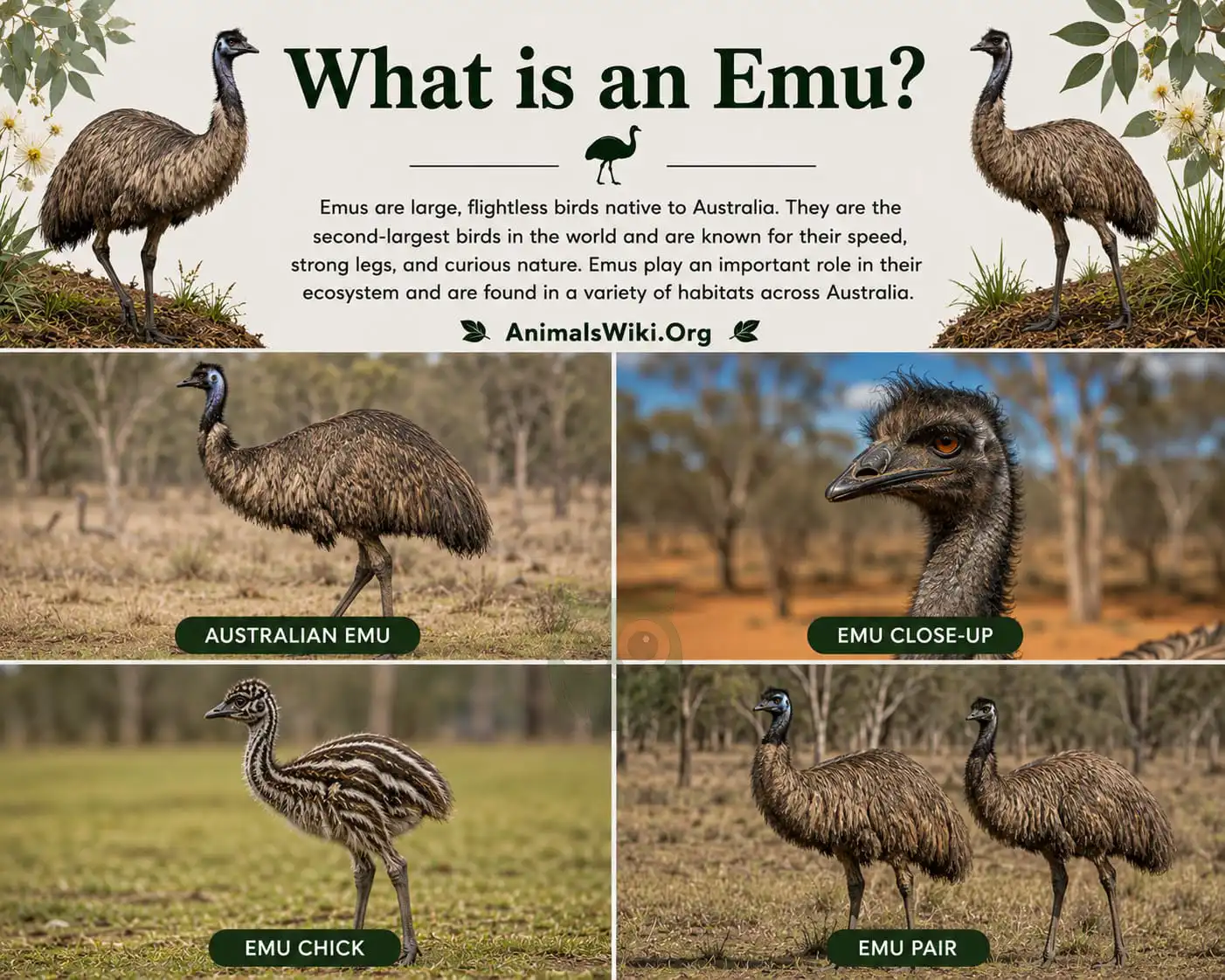
What is an Emu?
Emu Facts
| Feature | Details |
|---|---|
| Common Name | Emu |
| Scientific Name | Dromaius novaehollandiae |
| Family | Dromaiidae |
| Order | Casuariiformes |
| First Described | 1790 (by John White) |
| Native Habitat | Open grasslands, woodlands, scrubland, savannah across mainland Australia |
| Geographic Range | Throughout mainland Australia; absent from dense forest and arid desert interior |
| Average Height | 1.5–1.9 meters (5–6.2 feet) |
| Average Weight | 30–60 kg (66–132 lbs) |
| Lifespan | 10–20 years (wild); up to 35 years (captivity) |
| Diet | Omnivore — seeds, fruits, flowers, insects, small vertebrates |
| Conservation Status | Least Concern (IUCN) |
| Defining Feature | Second tallest bird on Earth; cannot fly; males incubate eggs and raise chicks alone; Australia’s national bird |
| Running Speed | Up to 50 km/h (31 mph); can maintain 48 km/h over long distances |
1. Species Overview & Classification
There is something genuinely prehistoric about encountering an emu in the wild. The sheer scale of the animal — nearly two meters tall, shaggy brown feathers rippling in the hot Australian wind, those extraordinary dinosaur eyes regarding you with an expression of ancient, unhurried intelligence — triggers something deep in the human response to large animals. This is a creature that looks as though it belongs in a different geological era. And in a very real sense, it does.
The Emu (Dromaius novaehollandiae) is Australia’s largest native bird and the second tallest bird on Earth after the ostrich — a magnificent, flightless giant that has roamed the Australian continent for millions of years. It is also one of the most distinctively Australian animals imaginable — featuring on the Australian coat of arms, appearing on the fifty-cent coin, and embedded in the cultural consciousness of a nation that has both revered and occasionally been at war with it.
That last point is literal. In 1932, the Australian government deployed soldiers armed with Lewis guns to fight the emus of Western Australia in what history now records, with a certain rueful humor, as the Great Emu War — a military campaign against a bird that ended in something approaching a draw, with the emus largely failing to notice that they were being fought. The episode speaks volumes about both the emu’s resilience and its peculiar relationship with the humans who share its continent.
But the emu deserves examination beyond the anecdote. It is an animal of remarkable physiological sophistication — capable of running at 50 km/h and sustaining that pace over long distances; capable of surviving weeks without food or water in drought conditions; capable of swimming competently across rivers; and possessed of a reproductive system so unusual — in which the male alone incubates the eggs and raises the chicks while the female moves on — that it represents one of the most dramatic reversals of typical bird sex roles in the avian world.
The emu is not merely Australia’s largest bird. It is one of the world’s great birds — ecologically essential, culturally profound, physiologically extraordinary, and visually unforgettable.
Species Classification Table
| Classification Level | Details |
|---|---|
| Kingdom | Animalia |
| Phylum | Chordata |
| Class | Aves |
| Order | Casuariiformes |
| Family | Dromaiidae |
| Genus | Dromaius |
| Species | Dromaius novaehollandiae |
| Subspecies | 3 recognized (novaehollandiae, rothschildi, woodwardi) |
| Described By | John White, 1790 |
Ratite Family — The Flightless Giants
The emu belongs to the group called ratites — a diverse assembly of large, flightless birds united by the absence of the keel (carina) on the sternum to which flight muscles attach in flying birds. The major living ratites are:
| Species | Scientific Name | Range | Height | Conservation Status |
|---|---|---|---|---|
| Ostrich | Struthio camelus | Africa | 2.1–2.8 m | Least Concern |
| Emu | Dromaius novaehollandiae | Australia | 1.5–1.9 m | Least Concern |
| Southern Cassowary | Casuarius casuarius | NE Australia, New Guinea | 1.5–1.8 m | Vulnerable |
| Common Rhea | Rhea americana | South America | 1.2–1.4 m | Near Threatened |
| Greater Kiwi | Apteryx mantelli | New Zealand | 0.35–0.65 m | Endangered |
The ratites’ distribution across the southern continents was long explained by the breakup of the ancient supercontinent Gondwana — but recent genetic research suggests that ratite flightlessness evolved independently multiple times rather than being inherited from a single flightless ancestor, making the group a remarkable example of convergent evolution across geological time.
2. Physical Description & Unique Features
The emu’s physical presence is immediate, unmistakable, and faintly unsettling in the best possible way — a reminder that birds are the living descendants of theropod dinosaurs and that some of them never quite abandoned the Mesozoic aesthetic.
Size and Build
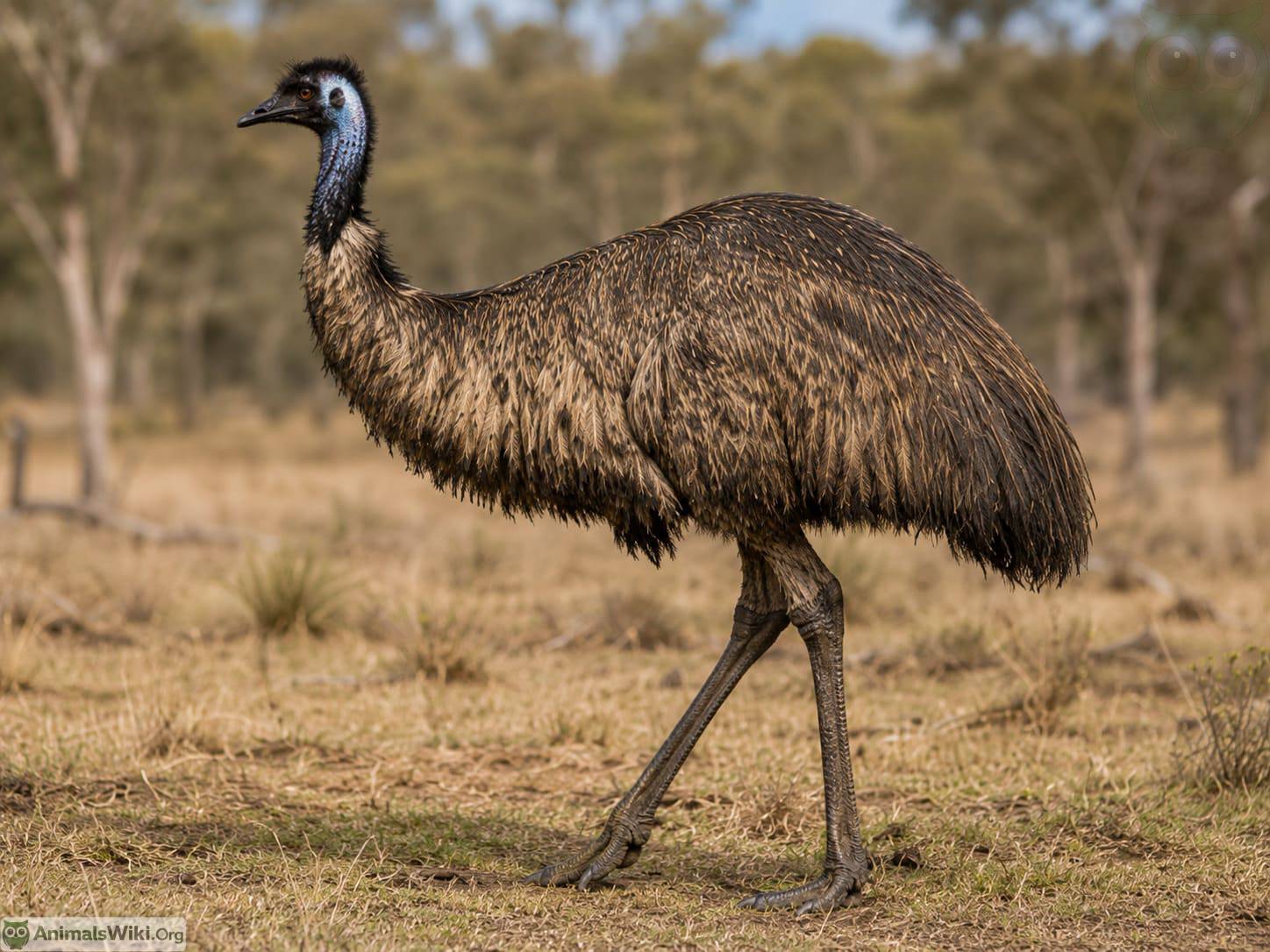
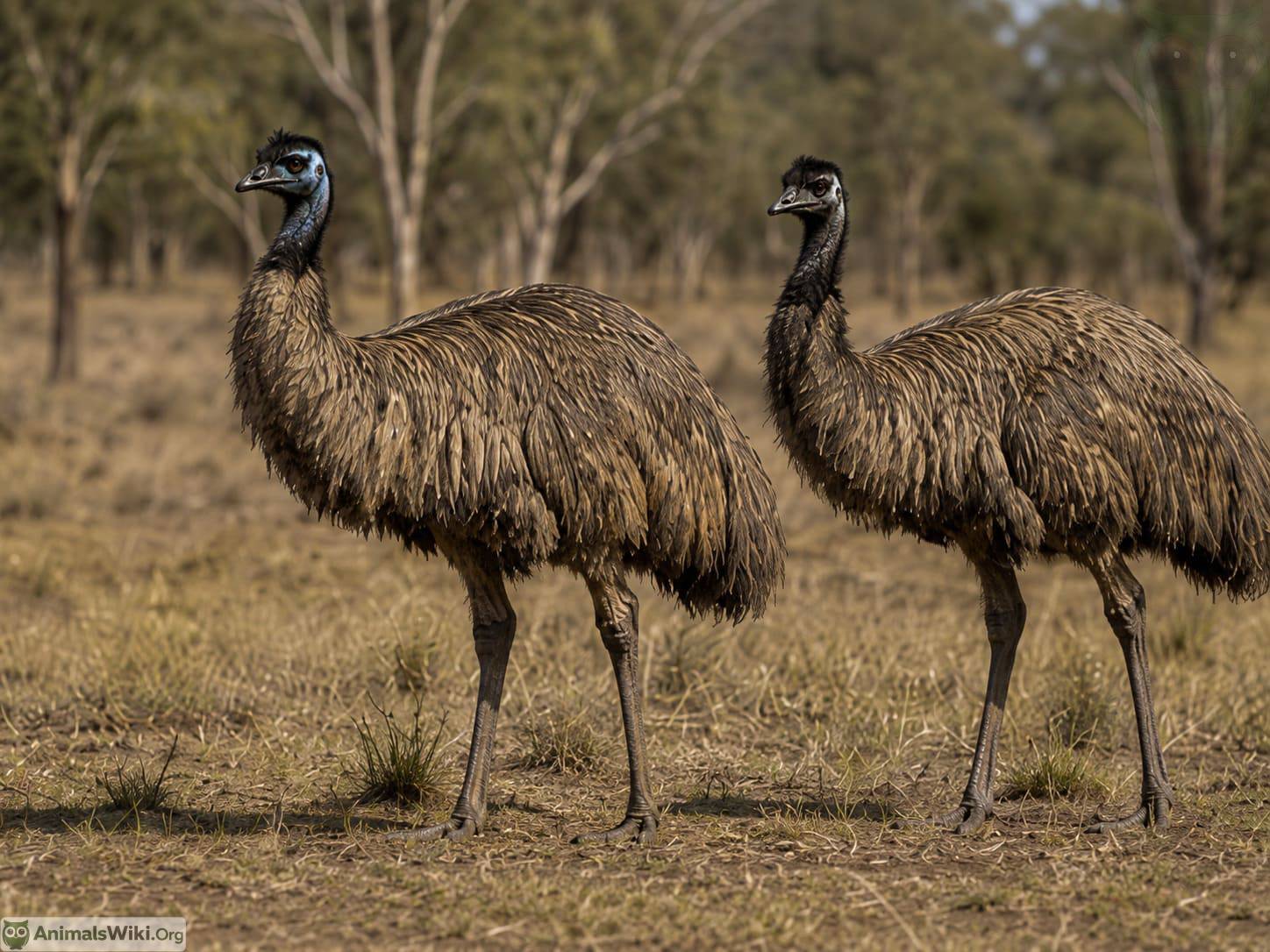
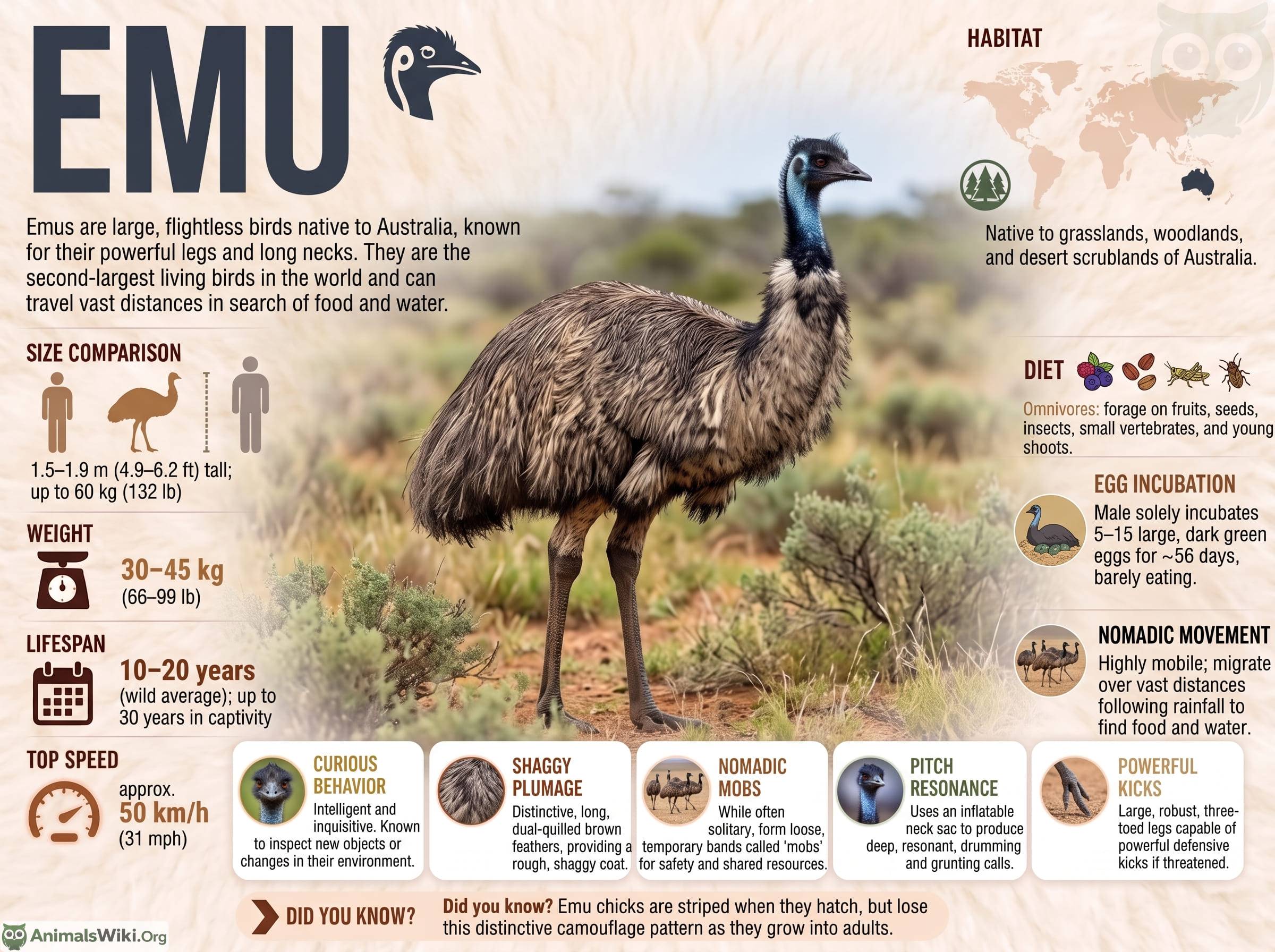
Adult emus stand 1.5–1.9 meters (5–6.2 feet) tall — measured to the top of the head — making them the second tallest birds on Earth after ostriches. Body length (from beak to tail) is typically 1.0–1.3 meters. Weight ranges significantly: 30–60 kg (66–132 lbs), with females typically being slightly larger than males — a reversal of the typical bird pattern and consistent with the emu’s unusual sex-role reversal in reproduction.
The body shape is unmistakably ratite — a large, barrel-shaped torso on long, powerful legs, with a relatively small head perched atop a long, flexible neck. The neck is partially bare — covered in blue-grey skin that becomes more intensely blue during breeding season when blood flow to the skin increases. This vivid blue neck coloration serves as a visual signal of reproductive readiness.
The Vestigial Wings
The emu has wings — but they are extraordinarily reduced. Each wing measures just 20–23 cm (8–9 inches) — tiny relative to the body size — and is entirely useless for flight. The wing feathers are unusual: each shaft produces two equally sized feathers rather than the single feather typical of most birds, giving the plumage a distinctly shaggy, almost hair-like appearance rather than the smooth, aerodynamically organized feather surface of flying birds.
These vestigial wings are not entirely functionless, however:
- They are used for thermoregulation — flapped to increase air circulation around the body in extreme heat
- They may assist with balance during rapid turns when running
- They contain a small claw-like structure at the tip — a vestige of the original forelimb digits
The Famous Feathers
The emu’s body plumage is a rich brown to grey-brown — a color that provides excellent camouflage in the dry Australian grassland and scrubland. The individual feathers have a loose, flowing structure quite different from the tightly interlocked barbules of flying birds — another consequence of flight feathers’ aerodynamic requirements being absent.
The plumage is surprisingly effective as insulation — the emu’s body temperature remains stable in both the extreme heat of the Australian summer and the cold of winter nights, a thermoregulatory achievement facilitated by the feather structure’s ability to both trap warm air and allow ventilation.
The Extraordinary Legs
The emu’s legs are massively powerful — the primary locomotion tool in an animal that has transferred all of its evolutionary investment from wings to legs. The legs contain large, well-developed muscle groups capable of generating the force needed to both sustain high running speeds and deliver the powerful forward kick that constitutes the emu’s primary defensive weapon.
Each foot has three toes (the inner toe with its long claw being particularly significant as a weapon) — compared to the ostrich’s two toes; the emu’s three-toed foot provides better stability on varied terrain.
The Eyes
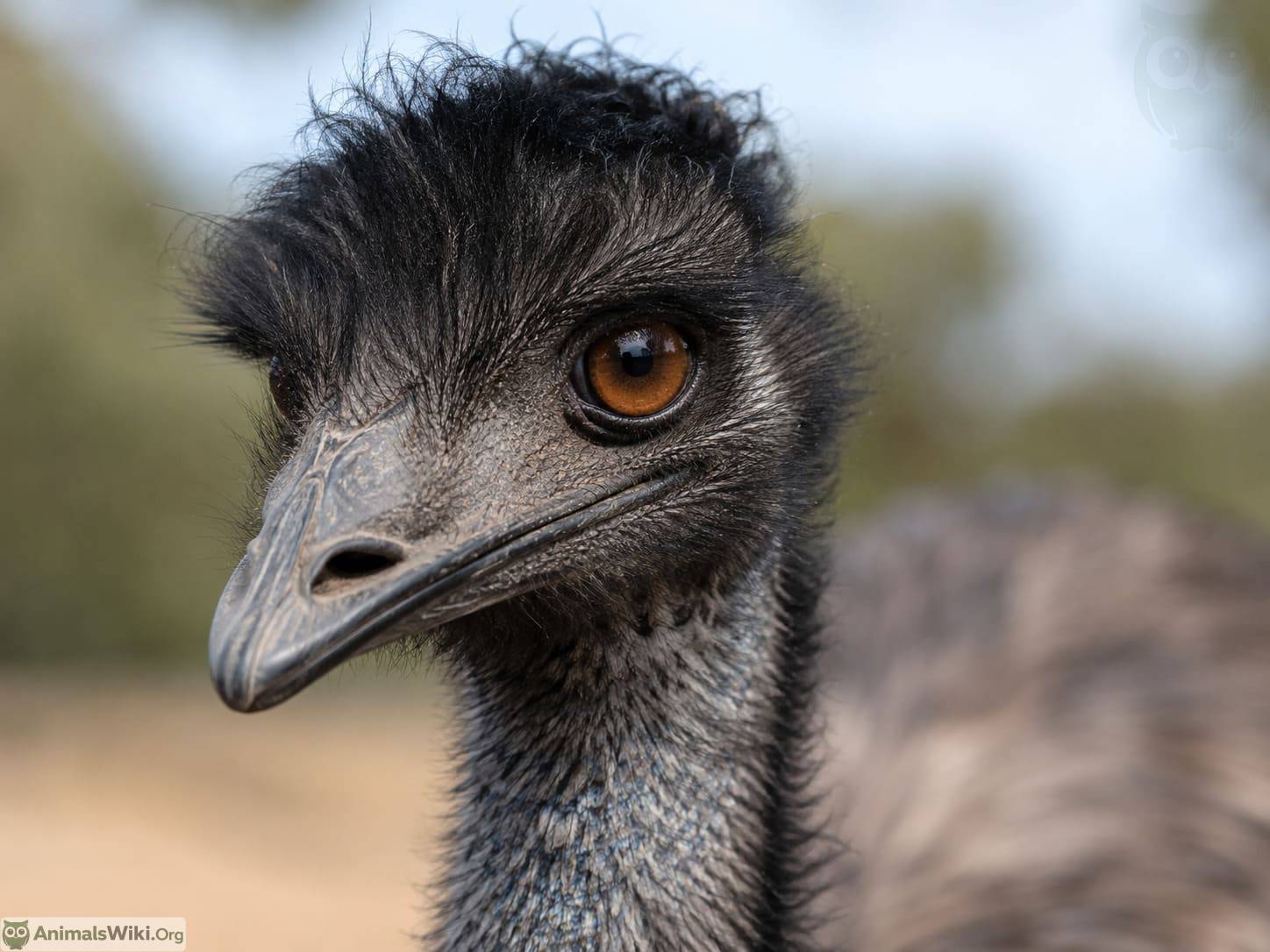
The emu’s eyes are large and prominent — with a distinctive golden-hazel iris and a disconcerting directness of gaze that many people find both compelling and slightly unnerving. The eyes contain a nictitating membrane (a transparent third eyelid) that sweeps horizontally across the eye — protecting it from dust and debris during movement through scrubland. Vision is excellent — emus can detect movement at significant distances and have good color vision.
Did You Know? The emu has two sets of eyelids — one for blinking normally (like all birds) and one transparent nictitating membrane that sweeps horizontally across the eye. During the Great Emu War of 1932, military observers noted that emus seemed extraordinarily difficult to kill even with machine gun fire — a result of their tough, dense feather coat, resilient physiology, and remarkable ability to continue running even after sustaining what should have been fatal wounds.
3. Natural Habitat & Geographic Range
The emu is one of Australia’s most wide-ranging native vertebrates — found across virtually the entire Australian continent with the exception of the densest tropical rainforests and the most extreme desert interior. This broad distribution reflects the species’ remarkable physiological flexibility and dietary opportunism.
Preferred Habitats
Eucalyptus woodland and open forest — perhaps the most consistently occupied habitat type across the emu’s range; the combination of scattered tree cover, shrubby understory, and open ground suits the emu’s feeding and movement requirements well
Grassland and grassy savannah — particularly important in inland Australia; large open areas allow the emu’s long stride and high running speed to be fully expressed
Shrubland and mallee — the low, dense scrub of southern and central Australia supports significant emu populations
Agricultural land — particularly wheat-growing regions of Western Australia and New South Wales, where seasonal grain availability draws large aggregations of emus — sometimes to the significant displeasure of farmers
Coastal areas — emus are found along much of Australia’s coastline, where coastal heath and scrub provide suitable habitat
What Emus Avoid
- Dense tropical rainforest — unsuitable for a large, ground-dwelling bird that requires open sightlines
- Extreme desert core — the driest, most barren areas of central Australia support very low emu densities or none at all; the animals avoid areas without accessible water for extended periods
- Urban centers — though emus regularly appear at the margins of towns and cities and occasionally venture into suburban areas
Geographic Range
Habitat Range by State/Region
| Region | Habitat Type | Population Status | Notes |
|---|---|---|---|
| Western Australia | Woodland, wheat belt farmland | High; historically significant | Site of the Great Emu War (1932) |
| Queensland | Savannah, woodland, grassland | High | Large seasonal movements |
| New South Wales | Grassland, woodland, farmland | Moderate–High | Seasonal aggregations in grain areas |
| South Australia | Mallee, woodland, farmland | Moderate | Significant semi-arid populations |
| Victoria | Woodland, grassland | Moderate; declining near urban areas | More restricted than historically |
| Northern Territory | Savannah, woodland | Moderate | Less studied populations |
| Tasmania | Absent | Extinct (island subspecies) | Tasmanian emu extinct ~1850 |
| Kangaroo Island | Absent | Extinct | Island subspecies extinct ~1827 |
Seasonal Movements
One of the emu’s most remarkable behavioral characteristics is its propensity for long-distance seasonal movements — sometimes covering hundreds of kilometers in response to rainfall patterns, food availability, and breeding requirements. These movements are not true migrations (they are not consistently directional or seasonally timed) but rather nomadic responses to the unpredictable and spatially variable rainfall patterns of the Australian interior.
Emus appear to detect rainfall from long distances — possibly through infrasound (low-frequency sound waves produced by storms, inaudible to humans) — and orient toward rain events that produce the fresh plant growth and insect blooms on which they feed. This remarkable ability to respond to rainfall events over vast distances has shaped human-emu conflicts in agricultural areas, where grain crops represent an irresistible food source to large aggregations of nomadic emus.
Did You Know? Emus are exceptional swimmers — capable of crossing significant rivers and even entering the sea when necessary. Despite their imposing size and apparently ungainly build, emus enter water readily and swim with an efficient, buoyant stroke driven by their powerful legs. Indigenous Australians used rivers as natural barriers during emu hunts, driving birds toward water where they could be caught more easily as they swam.
4. Diet & Feeding Behavior
The emu is a dietary opportunist of considerable sophistication — an animal that has evolved to exploit the seasonally and spatially variable food resources of the Australian landscape with impressive flexibility. Its diet changes dramatically with season, location, and what happens to be abundantly available.
What Emus Eat
Emus are omnivores — eating both plant material and animal matter — though plant material dominates the diet across most of the year. Research into emu diet through gut content analysis and fecal examination has revealed a remarkably diverse food list:
Seeds — the single most important food category across much of the range; particularly important are the seeds of native grasses, shrubs, and introduced crops. Emus consume seeds of extraordinary diversity — documented to eat the seeds of over 60 plant species in some study areas.
Fruits and berries — consumed enthusiastically when available; the emu plays an important role as a seed disperser for many Australian plants whose seeds pass intact through the digestive system
Flowers and soft plant parts — shoots, leaves, and flowers consumed particularly in spring when plants are actively growing
Insects and invertebrates — consumed opportunistically and in large quantities when available; grasshoppers and caterpillars are particularly favored during population outbreaks
Small vertebrates — occasionally consumed; lizards and small mammals taken when encountered
Charcoal — emus regularly consume charcoal from burnt vegetation; this behavior is thought to aid digestion by absorbing toxins from the diverse plant material consumed
Stones (gastroliths) — emus swallow stones that remain in the gizzard and help grind hard seeds; stones up to 4 cm in diameter have been recorded in emu gizzards
The Remarkable Feeding Adaptations
Dietary switching — emus show rapid, dramatic dietary switching in response to food availability. During locust plagues, individual emus have been documented consuming primarily locusts for days at a time; during grain harvest periods, virtually nothing but grain. This flexibility is central to the species’ success across diverse Australian environments.
Water efficiency — in drought conditions, emus can reduce water consumption dramatically — surviving on dry seeds and the water content of succulent plant material for extended periods. Their kidneys are highly efficient at water conservation, producing concentrated urine and minimizing water loss.
Crop storage — like other birds, emus have a crop — an expandable portion of the esophagus in which food is stored before passing to the stomach. The emu’s crop can accommodate a surprisingly large food load — allowing rapid consumption of food when it is available for later processing.
Diet Breakdown Table
| Food Type | % of Annual Diet | Peak Season | Notes |
|---|---|---|---|
| Seeds | 40–55% | Autumn–winter | Most important year-round category |
| Fruits and berries | 15–25% | Summer–autumn | Important seed dispersal role |
| Flowers and plant shoots | 10–20% | Spring | Peak in early growing season |
| Insects and invertebrates | 10–20% | Spring–summer | Grasshopper outbreaks particularly important |
| Fungi | 2–5% | Autumn | Consumed when available |
| Small vertebrates/eggs | 1–3% | Year-round | Opportunistic |
| Charcoal and minerals | <2% | Year-round | Digestive supplement |
“The emu is one of Australia’s great ecological engineers — its enormous digestive capacity and nomadic movements make it one of the continent’s most important seed dispersers, moving plant propagules across vast distances in ways that no other animal can replicate.” — Dr. Kris Hulvey, Ecologist, University of Melbourne
5. Reproduction & Life Cycle
The emu’s reproductive biology is one of the most extraordinary in the bird world — a complete reversal of the typical avian sex roles that places the entire burden of incubation and chick-rearing on the male, while the female moves on to potentially mate with additional partners.
Breeding Season
Emu breeding season in mainland Australia typically falls between May and August — the cooler months of the Australian winter. This timing ensures that chicks hatch in the warmer spring months (August–October) when food availability is increasing and conditions are optimal for rapid chick growth.
Courtship and Pair Formation
Courtship in emus begins with female-initiated displays — an unusual situation consistent with the broader sex-role reversal in this species. Females perform a low booming vocalization (produced by an inflatable throat pouch) and engage in pursuit displays — following potential mates and driving away competing females with aggressive chasing and kicking.
Males initially respond cautiously — moving away from approaching females before eventually accepting a partner. The pair bond is relatively brief — the two birds remain together for approximately 5–6 months encompassing courtship, nesting, and egg-laying, after which the female’s direct involvement in reproduction essentially ends.
Nest Construction and Egg Laying
The male builds the nest — a shallow platform of sticks, grass, bark, and leaves on the ground, typically in a sheltered location with good visibility of the surrounding area. Nest diameter is approximately 1 meter.
The female lays the eggs — typically 5–15 eggs in a clutch (occasionally up to 24 in particularly good conditions). The eggs are spectacular — large and oval, with a distinctive dark emerald-green to dark green-blue color that darkens toward the end of incubation. Each egg weighs approximately 700–900 grams — roughly equivalent to 10–12 chicken eggs.
The Male’s Extraordinary Incubation Commitment
After the female has laid her clutch — a process taking several weeks — something remarkable happens. The male takes over the nest completely and the female departs.
The male emu’s incubation commitment is one of the most extreme examples of parental dedication in the bird world:
- Incubation period: 54–56 days (nearly 8 weeks)
- The male rarely if ever leaves the nest during this period
- He does not eat, drink, or defecate significantly — entering a physiological state that allows him to survive on stored body fat
- He loses approximately one-third of his body weight during incubation (from ~45 kg to ~30 kg)
- He turns the eggs approximately 10 times per day to ensure even temperature distribution
- He maintains nest temperature using his body heat throughout the incubation period
Meanwhile, the female may mate with additional males during the same season — potentially contributing eggs to multiple nests tended by different males simultaneously. This reproductive system — called sequential polyandry — is relatively rare in birds and represents one of the clearest examples of sex role reversal in the avian world.
Chick Development
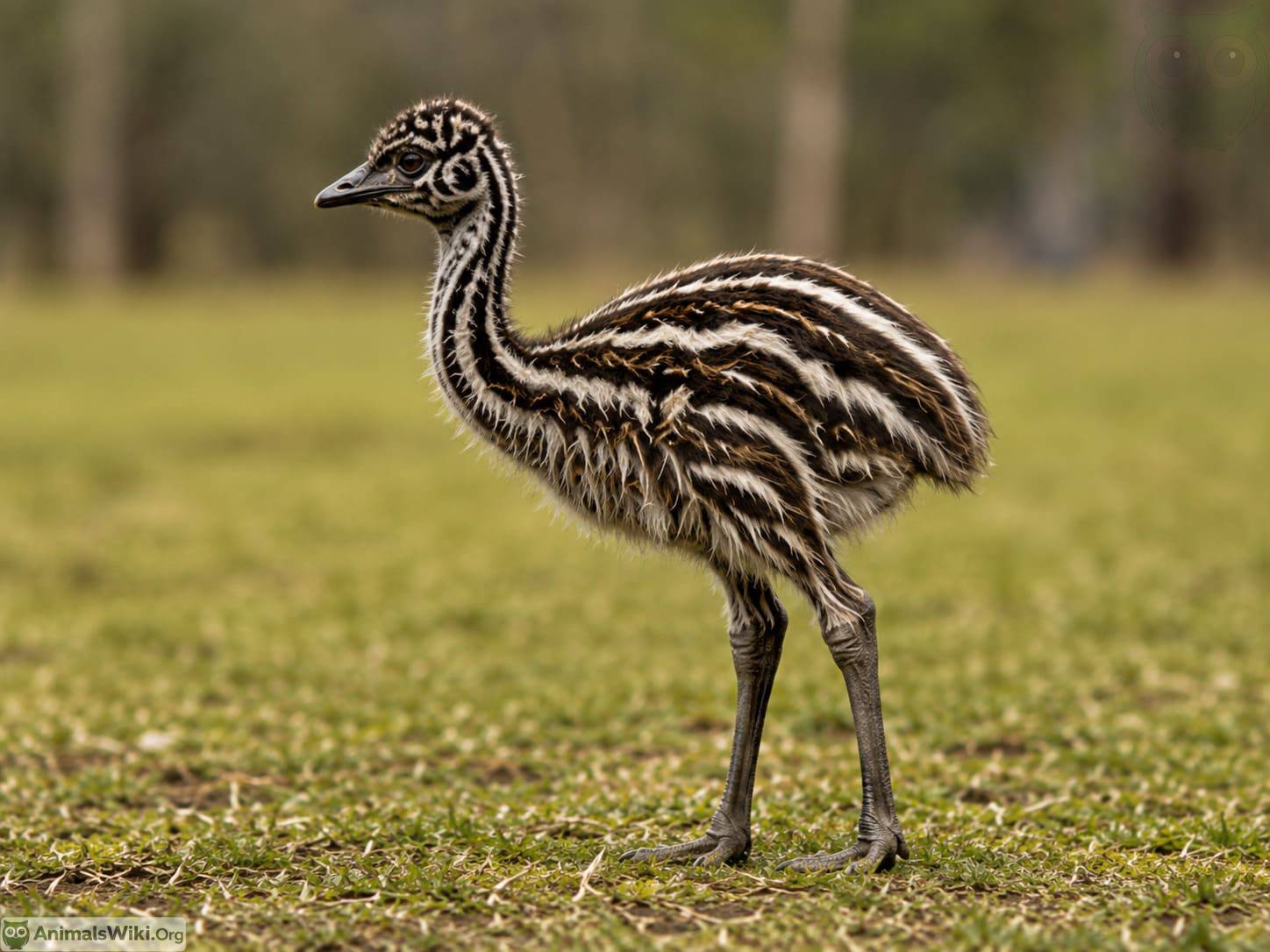
- Hatching: Chicks are precocial — fully feathered (with distinctive brown and cream striped down), eyes open, and mobile within hours of hatching
- Striped pattern: Hatchlings have bold brown and cream stripes providing camouflage; this pattern fades over the first 3 months as adult coloration develops
- Father’s care: The male continues sole care of chicks for approximately 7 months — defending them aggressively against predators and leading them to food and water
- Weaning: Chicks gradually become independent from approximately 7 months; full separation from the father occurs at around 18 months as the next breeding season approaches
- Sexual maturity: Approximately 18–24 months of age
Lifespan Comparison
| Bird Species | Average Lifespan (Wild) | Average Lifespan (Captivity) |
|---|---|---|
| Emu | 10–20 years | Up to 35 years |
| Ostrich | 30–40 years | Up to 50 years |
| Cassowary | 12–19 years | Up to 40 years |
| Common Rhea | 10–15 years | Up to 20 years |
| Wandering Albatross | 30–50 years | Up to 70 years |
| Emperor Penguin | 15–20 years | Up to 25 years |
Did You Know? During the 54–56 day incubation period, the male emu survives almost entirely on stored body fat — losing approximately one-third of his body weight without leaving the nest to eat or drink. This extraordinary physiological commitment to parental care is among the most extreme examples of incubation dedication in the bird world — equivalent to a 90 kg human losing 30 kg in 8 weeks while remaining sedentary in all weather conditions.
6. Social Behavior & Communication
The emu’s social life defies simple categorization — combining periods of solitary or pair behavior with dramatic aggregations of hundreds or thousands of birds, and expressing a communication repertoire of surprising richness for a bird so often dismissed as simply large and slow.
Social Structure
Emus are generally non-territorial and flexible in their social arrangements — adapting their grouping behavior to the distribution of food and water resources across the landscape. Outside the breeding season, emus are frequently found:
Alone or in pairs — the most common arrangement in stable, food-rich environments where resources are evenly distributed
In small groups of 5–20 — particularly during movements between feeding and watering areas
In large aggregations of hundreds to thousands — at particularly rich food sources (locust outbreaks, grain fields, areas of fresh growth after rain) or during seasonal movements toward water
The famous “emu highways” of inland Australia — centuries-old movement corridors marked by the passage of generations of emus — reflect the species’ tendency to follow established routes across the landscape, sometimes creating visible tracks in the vegetation.
Communication — A Richer Language Than Expected
The emu communicates through a combination of vocalizations, visual displays, and physical contact that is richer than its placid exterior suggests:
The boom — the female emu’s primary vocalization; produced by an inflatable throat pouch that resonates and amplifies a low-frequency sound audible up to 2 km away; used primarily in courtship and territorial contexts
The grunt — a softer sound produced by both sexes in low-intensity social interactions; contact call between individuals in close proximity
The drumming sound — produced by a specialized tracheal pouch; a deep, resonant call used in alarm contexts and during confrontation
Hissing — an alarm and threat vocalization; typically accompanied by neck erection and feather raising
Visual displays:
- Neck inflation — the blue-grey neck skin becomes more intensely colored and inflated during threat and courtship
- Feather raising — the body feathers are raised to increase apparent size during threat or alarm
- Upright posture — maximum height presentation signals confidence and dominance
7. Predators & Defense Mechanisms
The adult emu’s size and physical capabilities place it near the top of its local food web — an adult emu in good condition has few effective natural predators in modern Australia. But history and ecological change have significantly altered the predator community that emus evolved alongside.
Natural Predators
Historical (now extinct or absent from much of the range):
- Thylacine (Tasmanian Tiger) (Thylacinus cynocephalus) — the apex marsupial predator of Australia, extinct since 1936 and formerly the primary natural predator of adult emus
- Marsupial lion (Thylacoleo carnifex) — extinct Pleistocene predator capable of taking large prey including emus
Current predators:
- Dingo (Canis lupus dingo) — the primary current natural predator of emus; dingoes hunt cooperatively and can take adults, though chicks and juveniles are more vulnerable
- Wedge-tailed Eagle (Aquila audax) — Australia’s largest bird of prey; capable of taking chicks and juveniles, and documented to mobbing attack adults; a significant predator of emu eggs
- Monitor lizards (Goannas) (Varanus spp.) — significant egg predators
- Fox (Vulpes vulpes) — introduced; significant predator of eggs and chicks
- Feral pig (Sus scrofa) — introduced; significant egg predator
The Emu’s Defensive Arsenal
Kicking — the emu’s primary and most formidable defense. The emu delivers a powerful forward-directed kick using the full force of its enormous leg muscles, directed by the long, sharp inner claw. This kick is capable of:
- Disemboweling a dingo or medium-sized predator
- Breaking human bones — multiple documented cases of serious injury to humans from emu kicks
- Delivering impacts generating force comparable to a kangaroo kick
The kick is directed forward and downward — unlike the cassowary’s infamous backward kick — but is no less dangerous for this difference in direction.
Running — the emu’s first response to most threats is simply to outrun them. At 50 km/h (31 mph), an emu can outpace virtually any terrestrial predator in Australia. They can maintain high speeds over long distances — capable of sustaining 48 km/h for extended periods.
Size and presence — adult emus are simply too large for most predators to consider seriously; their height advantage and imposing presence deter all but the most committed predators.
The boom call — in alarm situations, the emu’s resonant boom call alerts other emus and may deter predators by signaling that the alarm has been raised
8. Relationship with Humans
Indigenous Australian Relationships — Tens of Thousands of Years
The emu’s relationship with Australia’s Aboriginal and Torres Strait Islander peoples is one of the oldest and most profound human-animal relationships on Earth — stretching back tens of thousands of years and encompassing food, ceremony, art, navigation, and cosmology.
As food — the emu was one of the most important food animals for many Aboriginal groups across Australia. Every part of the bird was utilized: the meat was eaten fresh or preserved; the fat was rendered and used both as food and as a body treatment, hair conditioner, and waterproofing agent; the feathers were used in ceremonial dress and decoration; the bones were fashioned into tools; the eggs (each equivalent to 10–12 chicken eggs) were a highly valued food source; the eggshells were used as water containers.
Hunting methods were sophisticated and varied by region:
- Waterhole ambush — emus visiting permanent water sources in dry periods were ambushed; hunters constructed blinds near water
- Emu calling — skilled hunters mimicked emu vocalizations to attract birds
- Driving to water — coordinated group hunts drove emus toward rivers or the sea, where they could be caught while swimming
- Disguise hunting — some accounts describe hunters wearing emu skins and mimicking emu movements to approach within striking distance
In ceremony and cosmology — the emu is deeply embedded in Aboriginal ceremonial life across Australia. The Emu in the Sky — a dark constellation formed by the dark dust clouds of the Milky Way rather than by stars — is one of the most significant astronomical features in Aboriginal astronomy. Different Aboriginal groups use the position and appearance of the Emu in the Sky to determine seasonal timing — when the emu is visible on the horizon in a specific posture, it signals the laying season and the appropriate time for egg collecting. This astronomical knowledge represents one of humanity’s oldest observational astronomy traditions.
Rock art and painting — emu tracks (the distinctive three-toed footprint) appear among the oldest rock art in Australia, and emu figures feature prominently in bark painting and other traditional art forms across the continent.
The Great Emu War — 1932
The most celebrated and most absurd episode in the human-emu relationship is undoubtedly the Great Emu War — a military operation that deserves more attention in world history than it typically receives.
By 1932, large flocks of emus — estimated at up to 20,000 birds — were moving into the Campion district of Western Australia, attracted by grain crops and summer water. Farmers, many of them veterans of World War I, appealed to the government for military assistance. Major G.P.W. Meredith of the Royal Australian Artillery was dispatched with two soldiers and two Lewis guns (World War I-era machine guns) and 10,000 rounds of ammunition.
The results were deeply humiliating for the military operation. The emus:
- Scattered immediately when fired upon, making concentrated fire ineffective
- Survived wounds that would have killed most animals, their loose feather structure and robust physiology absorbing bullets without fatal effect
- Divided into small groups that were impossible to engage en masse
- Simply walked away from the machine gun positions with apparent indifference
After several failed engagements, Major Meredith reportedly admitted: “If we had a military division with the bullet-carrying capacity of these birds, it would face any army in the world. They could face machine guns with the invulnerability of tanks. They are like Zulus whom even dum-dum bullets could not stop.”
The operation was suspended twice and eventually abandoned. The emus, by all accounts, won.
Commercial Emu Industry
The emu has become a significant commercial farming animal globally — raised for:
- Emu oil — rendered from emu fat; used in cosmetics, dietary supplements, and traditional medicine; marketed for anti-inflammatory properties
- Emu meat — low-fat, high-protein red meat comparable to lean beef; marketed as a health food product
- Emu leather — distinctive patterned leather from the emu’s leg skin; used in accessories and clothing
- Feathers — used in decoration and fashion
- Eggs — both as food and as decorated artwork (emu eggshells are popular for carving)
Emu farming operations exist in Australia, North America (USA), Europe, China, and numerous other countries.
Did You Know? The famous Great Emu War of 1932 ended in what is widely described as an emu victory. Major Meredith and his two soldiers fired over 2,500 rounds of machine gun ammunition and estimated they killed approximately 500 emus — but the remaining 19,500 birds continued their incursion into farmland as before. The Australian parliament was asked to renew the operation multiple times in subsequent years; each time, the military declined further engagement. The emus continue to thrive in Western Australia to this day.
9. Conservation Status & Threats
IUCN Status
The Emu (Dromaius novaehollandiae) is classified as Least Concern on the IUCN Red List — with an estimated population of approximately 625,000–725,000 individuals across mainland Australia and a broadly stable population trend.
However, this broadly positive assessment masks some significant regional and subspecific concerns:
- Tasmanian Emu (Dromaius novaehollandiae diemenensis) — EXTINCT since approximately 1850; hunted to extinction by European settlers within decades of colonization
- King Island Emu (Dromaius novaehollandiae baudinianus) — EXTINCT since approximately 1822
- Kangaroo Island Emu (Dromaius baudinianus) — EXTINCT since approximately 1827
The rapid extinction of multiple island populations within decades of European contact stands as a stark warning about the vulnerability of isolated populations to hunting and habitat modification.
Key Threats to the Mainland Population
1. Habitat Loss and Fragmentation The clearing of native woodland and scrub for agriculture has reduced and fragmented emu habitat across much of southern and eastern Australia. While emus adapt to modified landscapes better than many species, the loss of connected habitat corridors reduces the effectiveness of their nomadic movement strategies.
2. Vehicle Collisions Road mortality is a significant source of emu deaths — particularly in agricultural areas where roads cross emu movement corridors. Emus are typically undeterred by approaching vehicles and road collisions are frequent, often damaging the vehicles involved as well as killing the birds.
3. Predation by Introduced Species Feral foxes and pigs — both introduced to Australia by European settlers — are significant predators of emu eggs and chicks. Fox predation in particular has contributed to reduced breeding success in some areas, particularly at the edges of the species’ range.
4. Drought and Climate Change As Australia’s climate continues to change, with projections suggesting increased frequency and severity of drought events, the water availability that underpins emu population dynamics is becoming more variable and less predictable. Severe, prolonged droughts can cause significant emu mortality and reproductive failure.
5. Lethal Control Emus are still legally killed as agricultural pests in Western Australia under permit — the only Australian state that maintains a legal emu culling program. The conflicts between emus and grain farmers that prompted the Great Emu War continue in a less militarized but still significant form today.
10. Famous Emus Around the World
The Great Emu War Birds — Western Australia, 1932
While no individual emus were named during the Great Emu War, the collective emu army of the Campion district has achieved immortality in popular culture and military history as perhaps the only non-human combatants to be credited with defeating a modern military force. Their story has been told in books, documentaries, satirical articles, and academic papers — making these anonymous Western Australian birds the most historically famous emu population in the world.
Spot — The Famous Emu of Longreach, Queensland
Spot, a semi-tame emu resident at the Longreach Stockman’s Hall of Fame in Queensland, became famous among Australian tourists for decades as the institution’s unofficial mascot — greeting visitors, occasionally entering the gift shop uninvited, and demonstrating the species’ characteristic fearlessness around humans. Multiple generations of Spot (the name was maintained across successive resident emus) became part of the visitor experience at one of Australia’s most significant outback cultural institutions.
Kevin — The Internet Emu
Kevin — an emu resident at various Australian wildlife parks whose interactions with keepers and visitors were extensively documented on social media and YouTube — became an internet sensation in the 2010s. Videos of Kevin’s curious investigations of cameras, his interactions with domestic animals, and his characteristic combination of boldness and bewilderment generated millions of views and introduced global audiences to the emu’s distinctive personality.
Australia’s National Bird Debate
While the emu is technically one of two animals on the Australian coat of arms (the other being the red kangaroo), Australia does not have an official designated national bird. A national bird vote conducted by BirdLife Australia in 2023 selected the superb fairywren rather than the emu — a somewhat surprising outcome that generated considerable discussion but left the emu’s status as Australia’s de facto bird symbol firmly intact through its coat of arms and currency representation.
11. Role in Ecosystem & Food Chain
Seed Dispersal — The Walking Garden
The emu’s most ecologically significant role is as a long-distance seed disperser — one of the most important in the entire Australian ecosystem. An animal that can travel hundreds of kilometers in a season, consuming fruits and seeds at one location and depositing them — intact and viable after passing through the digestive system — at another location far distant, is performing an ecological service of continental significance.
Studies have documented that emus disperse the seeds of dozens of plant species — including many whose seeds are too large for smaller animals to transport effectively. Some Australian plants appear to have evolved specifically for emu dispersal — producing large, nutritious fruits designed to be attractive to emus and whose seeds germinate better after passing through an emu’s digestive system (a process called endozoochory).
The loss of emus from island populations (as has occurred on Tasmania and various smaller islands) has been linked to changes in plant community composition — with the plants that relied on emu dispersal showing reduced reproduction and regeneration following emu extinction.
Nutrient Distribution
As emus move across the landscape, they consume food in one location and deposit waste — enriched with nitrogen and other nutrients — at distant locations. This movement of nutrients across spatial scales that individual plants cannot achieve represents an important ecosystem function — redistributing concentrated nutrients from food-rich areas to nutrient-poor areas.
Insect Population Regulation
During locust and grasshopper outbreaks — periodic events in Australian grasslands — emus can consume enormous quantities of these insects, potentially contributing to outbreak regulation. Individual emus have been documented consuming thousands of grasshoppers per day during peak outbreak conditions.
As Prey
Emu eggs, chicks, and occasionally adults support populations of:
- Wedge-tailed eagles — Australia’s apex avian predator
- Dingoes — Australia’s apex terrestrial predator
- Monitor lizards — important egg predators
- Various introduced predators — foxes and pigs
Through road mortality, adult emus also contribute significant biomass to scavenger communities — wedge-tailed eagles, ravens, and various other species exploit road-killed emus throughout their range.
12. Myths, Culture & Pop Culture Appearances
Aboriginal Australian Cultural Significance
As discussed in the human relationships section, the emu occupies a position of profound cultural importance in Aboriginal Australian traditions — a relationship too rich and complex to fully summarize but including:
The Emu in the Sky — the most famous Aboriginal astronomical feature; a dark constellation formed by the dark interstellar dust clouds of the Milky Way rather than by individual stars. Different groups across Australia recognize this formation and use its position to determine seasonal timing for food collection. The Emu Constellation’s visibility and position signal different things in different traditions — from the laying season to the appropriate time for ceremonies to the coming of rain.
Emu Dreaming — in the Dreaming traditions of various Aboriginal groups, the Emu Ancestor is a significant figure whose travels across the landscape in the Dreaming time created landscape features and established behavioral patterns observed in emus today.
Ceremonial use — emu feathers feature in ceremonial dress and decoration across many Aboriginal traditions; emu fat is used in ceremonial preparation; emu eggs feature in ceremonial contexts.
The Australian Coat of Arms
The emu and the red kangaroo have appeared together on the Australian coat of arms since 1912 — selected because both animals are believed to be incapable of walking backward, symbolizing Australia’s forward-moving national character. While the biological accuracy of this claim is debatable (both species can move backward when necessary), it has become one of the most widely cited facts about both animals in popular culture.
Pop Culture Appearances
- “The Great Emu War” (multiple documentaries and satirical features) — the 1932 military-emu conflict has generated an extraordinary volume of popular culture content; documentaries, satirical news articles, animated explainers, and academic papers have all addressed the episode; it remains one of the most-referenced events in Australian natural history
- “Bluey” (Australian children’s animation, 2018–present) — the wildly popular Australian animated series features emus as background characters in various episodes, reflecting the bird’s status as an immediately recognizable element of the Australian landscape
- Video games — emus appear in various Australian-themed games and as animal encyclopedia entries in virtually all wildlife simulation games
- Social media — emu content — particularly videos of emus investigating cameras, wandering into unexpected places, and demonstrating their characteristic fearlessness — generates consistent viral engagement; the “emu stare” has become an internet meme format
- Sporting mascots — the emu appears as a mascot for various Australian sporting teams and events, reinforcing its status as a national symbol
- Australian currency — the emu has appeared on Australian coins and banknotes at various points in the currency’s history, most notably on the 50-cent coin
Did You Know? The Emu in the Sky — the dark constellation formed by the dust clouds of the Milky Way that Aboriginal Australians have recognized for tens of thousands of years — is oriented differently from Western star constellations. While Western astronomy identifies constellations by the patterns of bright stars, Aboriginal astronomical traditions identified patterns in the dark spaces between stars. The Emu is one of the best-documented examples of this tradition — a sky figure defined by darkness rather than light, and one of the oldest continuously observed astronomical features in human history.
13. Discovery & Evolution Timeline
~80 million years ago — The supercontinent Gondwana begins to break apart; the ancestors of modern ratites are distributed across the separating landmasses, beginning the evolutionary isolation that will eventually produce diverse flightless bird lineages on different southern continents.
~60 million years ago — Australia separates from Antarctica; the bird lineages that will eventually produce the emu begin their independent evolution on the isolated Australian continent.
~20–30 million years ago — Early ratite-like birds on the Australian continent; the ancestors of modern emus and cassowaries diverge from each other.
~10 million years ago — Dromaius (the emu genus) appears in the fossil record; early emu species are documented from fossil sites in South Australia.
~1–2 million years ago — Modern emu (Dromaius novaehollandiae) populations established across mainland Australia; island populations diverge from the mainland population.
~65,000 years ago — First Aboriginal Australians arrive on the continent; the emu’s relationship with humans begins — one of the longest human-animal relationships in history.
1688 — William Dampier, the English buccaneer and explorer, provides one of the first written European descriptions of the emu following his voyage along the Australian coast — though his description is brief and somewhat confused
1790 — John White, surgeon-general of the First Fleet, formally describes the species in his Journal of a Voyage to New South Wales — providing the scientific description that remains the basis for the formal taxonomic record.
1827 — Kangaroo Island Emu goes extinct — first recorded emu extinction in the historical era.
1850 — Tasmanian Emu goes extinct — second historical-era extinction.
1912 — The emu takes its place on the Australian coat of arms.
1932 — The Great Emu War — the most famous human-emu conflict in history; ends in what is diplomatically described as a military stalemate.
1960s–1970s — Commercial emu farming begins in Australia; eventually spreads globally.
1992 — The emu receives formal legal protection across most of Australia under the Protection of the Environment and Biodiversity Conservation Act.
2013 — Research using the Emu in the Sky Aboriginal astronomical tradition helps researchers understand how indigenous Australians used dark nebulae as navigational and calendrical tools — leading to significant academic recognition of Aboriginal astronomical knowledge.
2023 — Australian national bird vote conducted by BirdLife Australia; emu does not win but maintains its de facto national bird status.
2026 — Emu population broadly stable at approximately 625,000–725,000 animals on mainland Australia; commercial farming operations across multiple continents continue to expand.
14. Comparison with Similar Species
| Feature | Emu (D. novaehollandiae) | Ostrich (S. camelus) | Cassowary (C. casuarius) |
|---|---|---|---|
| Height | 1.5–1.9 m | 2.1–2.8 m | 1.5–1.8 m |
| Weight | 30–60 kg | 63–145 kg | 29–70 kg |
| Range | Australia | Africa | NE Australia, New Guinea |
| Habitat | Open woodland, grassland | African savannah, desert | Dense tropical rainforest |
| Toes | 3 per foot | 2 per foot | 3 per foot (inner toe: lethal dagger) |
| Egg color | Dark emerald green | Cream-white | Dark green |
| Incubation | Male only (54–56 days) | Both sexes (42–46 days) | Male only (49–52 days) |
| Running speed | 50 km/h | 70 km/h | 50 km/h |
| Most dangerous | Powerful forward kick | Powerful kick | Razor claw; most dangerous bird |
| IUCN Status | Least Concern | Least Concern | Vulnerable |
| Famous for | Great Emu War; coat of arms | Fastest land bird | World’s most dangerous bird |
15. Best Places to See Emus in the Wild
Australia — The Only Place
- 🇦🇺 Kangaroo Island, South Australia — wait, the emu is actually extinct here; but the island demonstrates how quickly island populations can be lost. The mainland Flinders Chase National Park on the island’s western end is excellent for other wildlife.
- 🇦🇺 Mungo National Park, New South Wales — spectacular outback landscape with excellent emu populations in classic semi-arid habitat; the dramatic lunettes (ancient lake deposits) provide a stunning backdrop for emu encounters
- 🇦🇺 Flinders Ranges National Park, South Australia — excellent emu populations in iconic Australian outback landscape; morning and evening encounters with emus at waterholes are a highlight of visits
- 🇦🇺 Kakadu National Park, Northern Territory — emus present in the savannah and woodland habitats of Australia’s largest national park; excellent dawn encounters possible
- 🇦🇺 Shark Bay World Heritage Area, Western Australia — excellent coastal emu populations; the open scrubland habitat makes sightings relatively straightforward
- 🇦🇺 Great Ocean Road region, Victoria — emus are frequently encountered in the farmland and open woodland of southwestern Victoria; roadside sightings are common
- 🇦🇺 Outback Queensland and New South Wales — traveling the Outback Way or Gibb River Road almost guarantees emu encounters; large groups are regularly seen at permanent waterholes
- Australian zoos and wildlife parks — for guaranteed close-up encounters: Taronga Zoo (Sydney), Melbourne Zoo, Australia Zoo (Queensland), and Healesville Sanctuary (Victoria) all maintain excellent emu exhibits
16. Emu Fun Facts for Kids
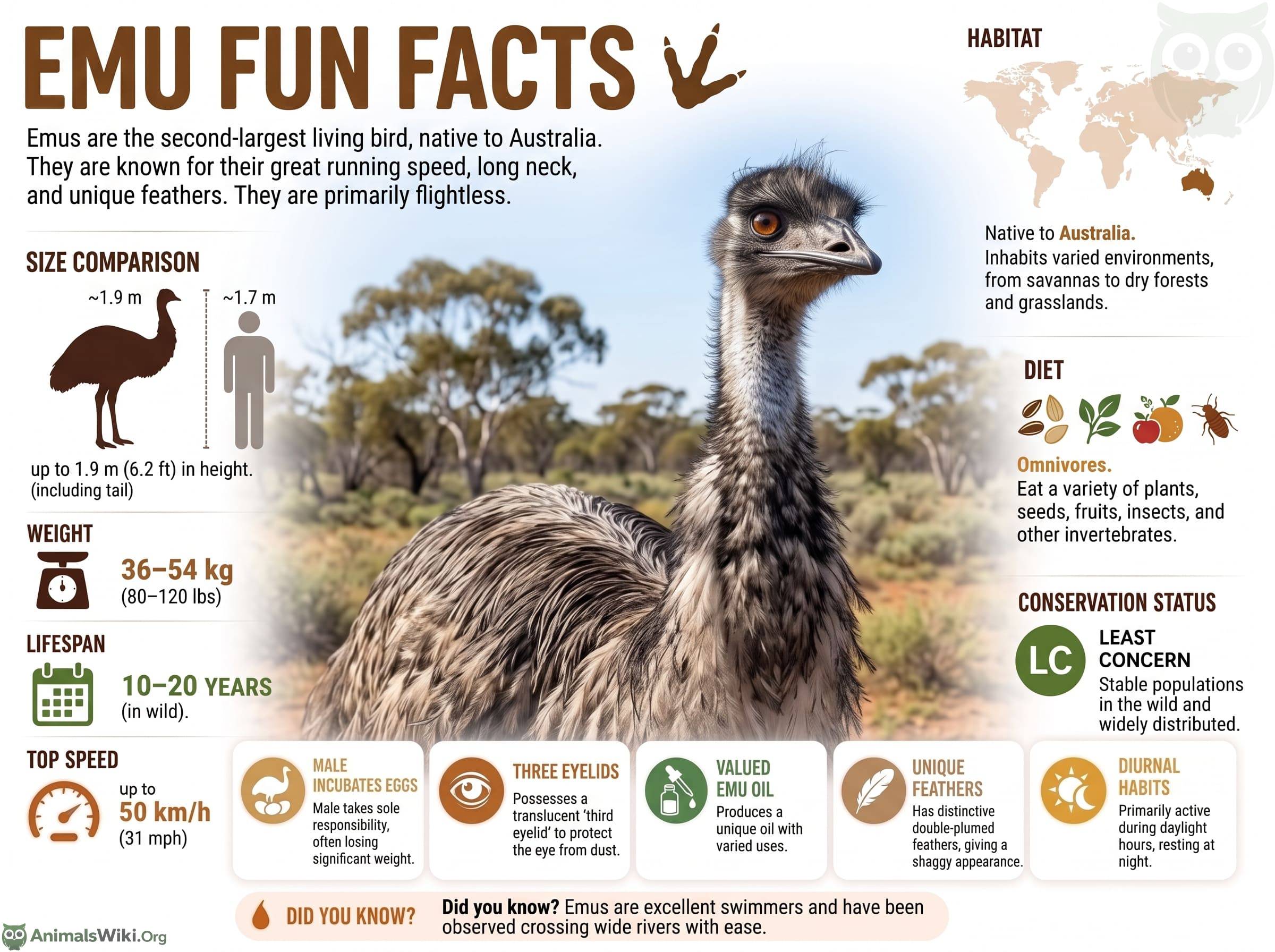
- 🦤 The emu is the second tallest bird on Earth — after only the ostrich
- 🦤 Male emus lose one-third of their body weight during the 54-56 day incubation period — never leaving the nest to eat
- 🦤 The emu cannot fly but can run at 50 km/h and sustain that pace over long distances
- 🦤 Emus appear on the Australian coat of arms because they supposedly cannot walk backward — symbolizing forward progress
- 🦤 The Great Emu War of 1932 ended in what the Australian military characterized as a tactical withdrawal; most historians characterize it as an emu victory
- 🦤 Emus are excellent swimmers — they cross rivers readily and have been observed entering the sea
- 🦤 The Emu in the Sky — formed by dark dust clouds of the Milky Way — is one of the oldest continuously observed astronomical features in human history
- 🦤 Female emus may mate with multiple males in a single season — leaving each male to incubate and raise chicks alone
- 🦤 Emu eggs are dark emerald green — among the most distinctively colored eggs of any bird
- 🦤 Emus swallow stones up to 4 cm diameter to help grind hard seeds in their gizzard
- 🦤 An adult emu kick can disembowel a dingo — making the emu one of Australia’s most dangerous animals to approach carelessly
- 🦤 Emus may detect rainfall from enormous distances — possibly through infrasound — explaining their ability to appear rapidly at areas of fresh growth far from their previous location
17. How You Can Help
Support These Organizations
- Birdlife Australia (birdlife.org.au) — Australia’s leading bird conservation organization; active in monitoring emu populations and advocating for habitat protection
- Australian Wildlife Conservancy (australianwildlife.org) — protecting large areas of Australian wildlife habitat including emu country; manages private nature reserves across the continent
- World Wildlife Fund Australia (wwf.org.au) — working to protect Australian woodland and grassland ecosystems critical for emu populations
- Wildlife Victoria (wildlifevictoria.org.au) — wildlife rescue and rehabilitation organization handling injured emus across Victoria
- WIRES (Wildlife Information Rescue and Education Service) (wires.org.au) — Australia’s largest wildlife rescue organization; handles injured and orphaned emus across New South Wales
- Save the Bilby Fund — while focused on bilbies, their work protecting Australian semi-arid ecosystems also benefits emu habitat
What You Can Do
- Drive carefully in emu country — road mortality is significant; reduce speed on rural roads and be particularly alert at dawn and dusk when emu movement is highest
- Support wildlife-friendly farming — advocate for agricultural practices that maintain movement corridors for emus and minimize lethal conflict; the current system of lethal control in Western Australia requires ongoing policy scrutiny
- Visit Australian national parks and wildlife reserves — ecotourism revenue supports the management of protected areas where emus live
- Never feed wild emus — feeding habituates emus to human presence near roads and settlements, dramatically increasing road mortality risk
- Report injured emus — contact WIRES (1300 094 737) or Wildlife Victoria (03 8400 7300) if you encounter an injured emu
- Support climate action — the projected increase in drought frequency and severity in Australia is a significant long-term threat to emu population stability
Recommended Documentaries & Books
- “Australia” (BBC, 2008) — landmark BBC natural history series with exceptional emu footage
- “Wild Australia” (various ABC productions) — multiple productions featuring emus in diverse habitats
- “The Emu War” (various documentary treatments) — multiple productions covering the extraordinary 1932 military conflict
- “The Life of Birds” by David Attenborough — excellent ratite coverage including the emu
- “Australia’s Amazing Wildlife” by various authors — comprehensive guide including emu natural history
18. Frequently Asked Questions About Emus
Q1: Can emus fly?
No — emus are completely flightless. Their wings have been reduced through evolution to tiny vestigial structures measuring just 20–23 cm — far too small to generate lift for a bird weighing up to 60 kg. The wing feathers have also lost the aerodynamic interlocking structure of flying bird feathers. However, emus compensate magnificently for flightlessness with their running ability — reaching 50 km/h and sustaining high speeds over long distances — and their swimming ability, which allows them to cross significant rivers. Their vestigial wings are used for thermoregulation (fanning to cool the body in extreme heat) and possibly for balance during rapid turns.
Q2: What happened in the Great Emu War?
In 1932, the Australian government deployed Major G.P.W. Meredith and two soldiers with Lewis machine guns to the Campion district of Western Australia, where approximately 20,000 emus were damaging wheat crops. The military engagement was a disaster for the human side — emus scattered when fired upon, survived wounds that should have been fatal due to their tough feather coat and resilient physiology, and simply continued their agricultural incursion. After firing over 2,500 rounds and killing an estimated 500 birds (a fraction of the total), the operation was suspended. The emus continued to thrive. The episode is now widely described as an emu victory.
Q3: Who incubates emu eggs?
The male emu alone incubates the eggs — one of the most extreme examples of paternal care in the bird world. After the female lays her clutch (typically 5–15 dark green eggs), she departs and the male takes over the nest completely. He sits on the eggs for 54–56 days — nearly 8 weeks — without leaving to eat, drink, or defecate significantly, surviving on stored body fat and losing approximately one-third of his body weight in the process. The female, meanwhile, may mate with additional males in the same season. After hatching, the male continues sole care of the chicks for approximately 7 months.
Q4: Why do emus appear on the Australian coat of arms?
The emu and the red kangaroo were chosen for the Australian coat of arms in 1912 because both animals are believed to be incapable of walking backward — symbolizing Australia’s progressive, forward-looking national character. The emu’s inability to walk backward is something of a popular myth (emus can and do move backward when necessary, though they rarely do so), but the symbolism has become embedded in Australian national identity. Both animals are uniquely Australian and represent the continent’s distinctive wildlife heritage.
Q5: What do emus eat?
Emus are omnivores with a highly flexible diet that changes dramatically with season and location. The core diet consists of seeds (most important), fruits and berries, flowers and shoots, and insects (particularly during grasshopper and caterpillar outbreaks). They also consume fungi, small vertebrates, eggs, and swallow stones (gastroliths) to help grind hard seeds in their gizzard. Emus also regularly eat charcoal from burnt vegetation — believed to help absorb plant toxins. In agricultural areas, they are drawn strongly to grain crops, which has been the primary source of human-emu conflict throughout the agricultural era.
Q6: Are emus dangerous?
Adult emus are potentially dangerous animals and should be treated with respect. Their primary weapon is a powerful forward kick delivered by enormous legs with sharp claws — capable of causing serious injury to humans and fatal injury to medium-sized predators like dingoes. Documented cases of broken bones and lacerations from emu kicks exist. Emus are not aggressive toward humans under normal circumstances but become dangerous when:
- Cornered or feeling threatened
- Males are protecting nests or chicks
- Animals are habituated to humans and associate people with food Never approach a wild emu closely, never corner one, and never attempt to handle one without appropriate training and equipment.
Q7: How fast can emus run?
Emus can reach speeds of 50 km/h (31 mph) at top speed and can maintain approximately 48 km/h over extended distances. This makes them one of the fastest running birds in the world — slower than the ostrich (which reaches 70 km/h) but significantly faster than any human. Emus also have remarkable endurance — they are capable of traveling hundreds of kilometers over weeks or months during nomadic movements in response to rainfall and food availability. Their three-toed feet and powerful leg muscles are optimized for both speed and long-distance travel across varied terrain.
Q8: How big are emu eggs and what do they look like?
Emu eggs are among the most distinctive in the bird world — large, oval, and dark emerald green to dark blue-green in color. Each egg measures approximately 13 cm × 9 cm (roughly the size of a large avocado) and weighs 700–900 grams — equivalent to approximately 10–12 chicken eggs. The color darkens progressively during the 54–56 day incubation period as the shell changes chemical composition. Emu eggs are prized by collectors and artisans — the dark green shells are carved into detailed artwork, a significant craft tradition in both Indigenous and non-Indigenous Australian communities.
19. Sources Researched
The information in this article was researched and verified using the following authoritative sources:
- Wikipedia — Dromaius novaehollandiae, Emu, Ratite, Great Emu War, Dromaiidae
- IUCN Red List (iucnredlist.org) — Emu conservation status and population assessment
- BirdLife Australia (birdlife.org.au) — Population data, distribution maps, and conservation information
- National Geographic (nationalgeographic.com) — Emu biology and behavior features
- Britannica (britannica.com) — Emu, Ratite, Dromaius novaehollandiae
- Australian Museum (australian.museum) — Emu species account and cultural significance
- CSIRO Australia — Research on emu ecology, seed dispersal, and movement patterns
- Smithsonian Institution (si.edu) — Ratite biology and evolution
- ABC Australia (abc.net.au) — Great Emu War historical documentation and contemporary emu coverage
- Australian Broadcasting Corporation Natural History — Documentary research references
- Journal of Ornithology — Peer-reviewed research on emu behavior, ecology, and physiology
- Emu — Austral Ornithology — The premier Australian ornithology journal (named after the bird); multiple research papers
- Parks Australia / Australian Government — National park management and emu population data
- Journal of Biogeography — Ratite evolution and biogeography research
- Astronomy and Indigenous Knowledge — Academic papers on Aboriginal astronomy and the Emu in the Sky constellation
20. Emu Images