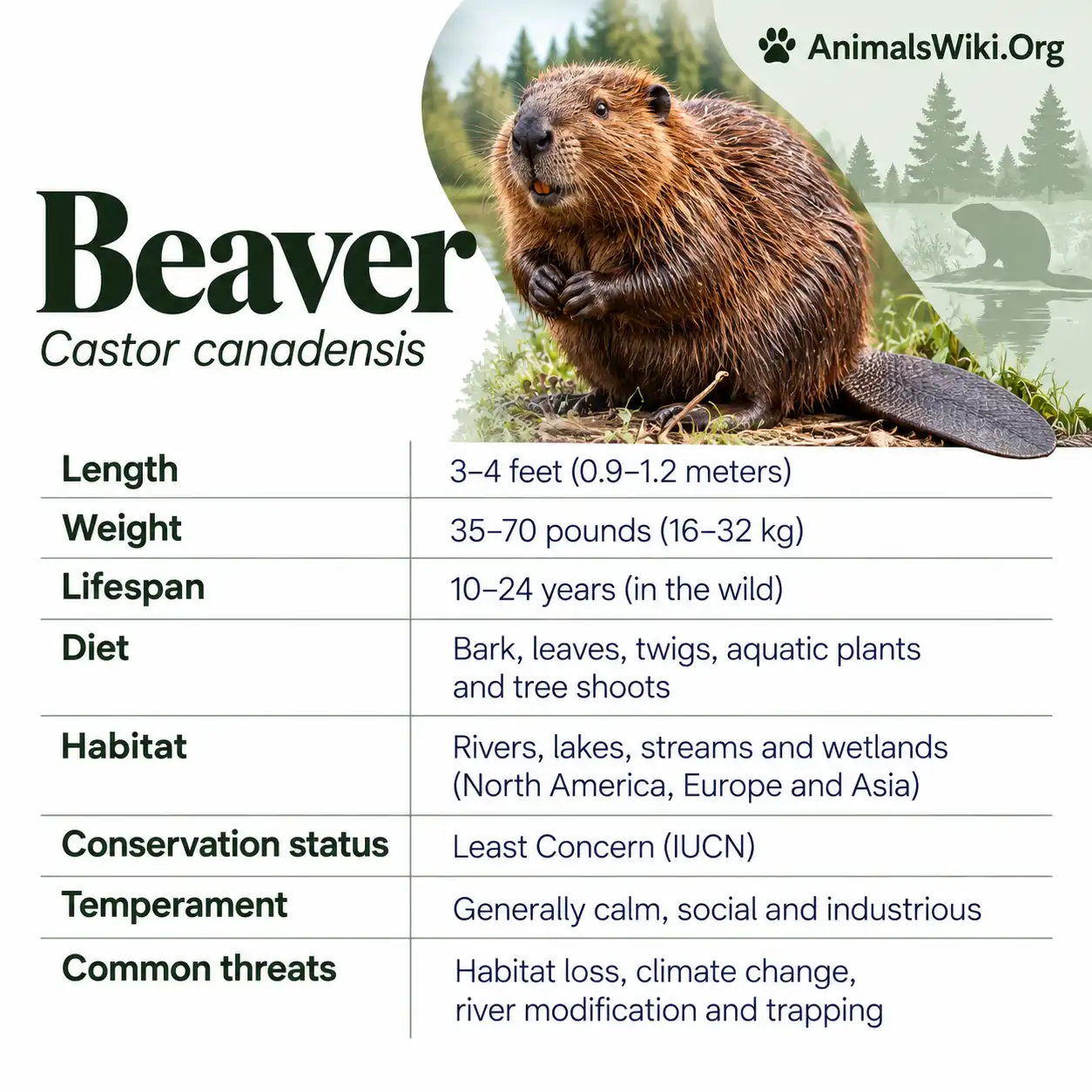
Beaver Facts
| Feature | Details |
|---|---|
| Common Name | Beaver (North American Beaver — focus species) |
| Scientific Name | Castor canadensis (North American Beaver) |
| Family | Castoridae |
| Order | Rodentia |
| First Described | 1820 (by Georges Cuvier) |
| Native Habitat | Freshwater streams, rivers, lakes, wetlands; forest adjacent to water |
| Geographic Range | North America from Alaska and Canada south through most of the continental US; introduced to South America and Europe |
| Average Size | 74–90 cm body length; tail 25–50 cm |
| Average Weight | 11–32 kg; average ~20 kg |
| Lifespan | 10–15 years (wild); up to 24 years (captivity) |
| Diet | Herbivore — bark, cambium, leaves, aquatic plants, roots |
| Conservation Status | Least Concern (IUCN) — recovered from near-extinction |
| Defining Feature | World’s second-largest rodent; builds dams, lodges, and canals; flat paddle-shaped tail; orange iron-reinforced incisors; profound ecosystem engineer |
| Number of Species | 2 (North American Beaver C. canadensis; Eurasian Beaver C. fiber) |
1. Beaver Species Overview & Classification
In a small stream in a temperate forest somewhere in North America, a family of animals is quietly reshaping the landscape. They have been doing this for three nights — felling trees with their extraordinary teeth, dragging the logs to the stream, weaving them together with mud and smaller branches into a structure that, while it follows no blueprint drawn on paper, conforms to engineering principles that achieve exactly what it needs to achieve. The water behind the dam is rising. In a few weeks, it will form a pond of several hectares where previously there was only a narrow stream. Within months, that pond will support aquatic insects, amphibians, fish, waterfowl, and dozens of other species that were not here before. The surrounding trees, no longer drying out in the summer droughts that periodically stressed them, will grow more vigorously. The water table across the surrounding landscape will rise measurably. And during the next major flood event, the water stored in the beaver pond will buffer the downstream community against the surge that would otherwise have caused significant damage.
The beaver does not plan any of this. It builds because it is driven by instinct to build — responding to the sound of running water with an innate compulsion to dam it. Yet the ecological consequences of this compulsion are among the most profound produced by any non-human animal on Earth. The beaver is the definitive ecosystem engineer — an animal whose physical modifications to its environment create habitat for dozens of other species, alter hydrology at watershed scale, store carbon in waterlogged soils, buffer against drought and flood, and produce the kind of complex wetland ecosystems that human engineers spend billions of dollars attempting to replicate.
The North American Beaver (Castor canadensis) is the focus of this guide — the second-largest rodent in the world, a species that was hunted to near-extinction for its fur in the 17th–19th centuries and has since recovered to a population estimated at 10–15 million individuals, recolonizing much of its former range and demonstrating in the process what genuine ecological recovery looks like. Its close relative — the Eurasian Beaver (Castor fiber) — was reduced to fewer than 1,200 individuals across eight isolated populations by the early 20th century and is now the subject of one of the most successful mammal reintroduction programs in European history.
The beaver’s story is simultaneously a tale of near-extinction driven by human greed, a model of conservation recovery, and an emerging narrative of rewilding — the deliberate reintroduction of beavers to landscapes from which they were extirpated, to restore the ecological functions their engineering provides. Understanding the beaver means understanding what an ecosystem without apex engineers looks like — and recognizing how much we have lost, and how much we can recover, by allowing these extraordinary animals to do what they have done for millions of years.
Species Classification Table
| Classification Level | Details |
|---|---|
| Kingdom | Animalia |
| Phylum | Chordata |
| Class | Mammalia |
| Order | Rodentia |
| Family | Castoridae |
| Genus | Castor |
| Focus Species | Castor canadensis — North American Beaver |
| Described By | Georges Cuvier, 1820 |
| Common name | Beaver |
The Two Living Beaver Species
| Species | Common Name | Range | Population | IUCN Status |
|---|---|---|---|---|
| Castor canadensis | North American Beaver | North America; introduced to South America, Finland, Austria | ~10–15 million | Least Concern |
| Castor fiber | Eurasian Beaver | Europe and northern Asia; reintroduced across Europe | ~1.5–2 million | Least Concern |
North American vs. Eurasian Beaver — Distinct Species
The two beaver species are not interfertile — they cannot interbreed and produce viable offspring — despite their similar appearance:
- Chromosome difference: North American Beavers have 40 chromosomes; Eurasian Beavers have 48 — one of the most significant chromosome number differences between closely related mammal species
- Morphological differences: Eurasian Beavers have slightly longer, narrower muzzles; less rounded heads; slightly longer nasal bones; differences in skull architecture are used to distinguish museum specimens
- Castoreum: The chemical composition of the castoreum (scent gland secretion used in territory marking) differs significantly between the two species; this chemical difference allows them to identify members of their own versus the other species
These differences reflect a divergence time of approximately 7.5 million years — long enough for substantial genetic incompatibility despite superficially similar body plans.
Did You Know? The beaver builds dams in response to the sound of running water — not in response to seeing flowing water or detecting a flood risk; it is the acoustic signal of running water that triggers the dam-building instinct. Research has demonstrated that placing a speaker playing the sound of running water near a beaver will cause it to begin piling debris over the speaker — even in a completely dry environment. This acoustic trigger means that beavers cannot easily be “redirected” away from a stream they are damming, as the sound of the water will continue to drive dam-building behavior regardless of other environmental conditions.
2. Beaver Physical Description & Unique Features
The beaver is one of the most immediately recognizable mammals in North America and Europe — its combination of compact, rounded body, large flat tail, and distinctive orange teeth creating a silhouette unlike any other rodent.
Size and Build
The North American Beaver is the second-largest rodent in the world — exceeded only by the South American Capybara (Hydrochoerus hydrochaeris):
- Body length: 74–90 cm (29–35 inches) — not including the tail
- Tail length: 25–50 cm (10–20 inches)
- Total length: approximately 1.0–1.3 meters (3.3–4.3 feet)
- Weight: 11–32 kg (24–71 lbs); average approximately 20 kg for adults; exceptional individuals exceed 30 kg; the largest recorded North American Beaver weighed 45 kg (99 lbs)
- Build: Stocky, robust, with a broad, rounded head; the body is distinctly tapered — broader at the hindquarters than at the shoulders
Sexual dimorphism: Negligible — unlike most mammals, male and female beavers are almost identical in size and appearance; sex can only be determined by internal examination (both sexes have a single external cloacal opening)
The Iconic Flat Tail
The beaver’s paddle-shaped tail is one of the most immediately recognizable anatomical structures of any mammal — a broad, flat, leathery appendage covered in overlapping scales (similar to fish scales) with scattered coarse hairs:
Dimensions: Typically 25–50 cm long, 10–18 cm wide, and approximately 1–2 cm thick at the base; the tail narrows toward the tip
Functions:
- Swimming rudder — provides directional control during swimming; the tail is moved horizontally to steer; the combination of tail steering and webbed hind-foot propulsion makes beavers remarkably agile swimmers
- Alarm signal — the tail slap on the water surface is one of the most distinctive and instantly recognizable animal warning signals in North American nature; the loud crack carries hundreds of meters; other beavers immediately dive when they hear a tail slap from a family member
- Fat storage — the tail stores fat reserves that fuel the beaver through lean periods; a well-fed beaver’s tail is noticeably thicker than a malnourished individual’s
- Thermoregulation — the tail’s surface area and blood vessel density allow some heat exchange with the environment; the tail temperature is regulated separately from core body temperature
What the tail is NOT: Many people believe beavers use their flat tail to pat mud onto dams — this is entirely false; beavers use their front paws and their nose/chin to push mud into place; the tail is never used in dam construction
The Extraordinary Incisors — Orange Iron-Reinforced Teeth
The beaver’s incisors are among the most remarkable teeth in the mammalian world — and the most critical tool for their entire ecological enterprise:
Color: The incisors are distinctively bright orange to orange-brown — not a stain but an intrinsic feature of the enamel; the orange color results from iron compounds (iron oxide and other iron-containing minerals) incorporated into the enamel during tooth development; this iron incorporation makes the enamel of beaver incisors significantly harder and more wear-resistant than white mammal teeth
Self-sharpening mechanism: The front surface of the incisor (the orange enamel face) is harder than the dentine behind it; as the beaver bites, the softer dentine wears faster than the hard enamel front — naturally maintaining a chisel-sharp cutting edge at all times; the beaver never needs to sharpen its teeth because they sharpen themselves through normal use
Continuous growth: Like all rodent incisors, beaver teeth grow continuously throughout life — they are never lost or permanently worn down; the growth rate keeps pace with wear under normal use; if the opposing tooth is lost and wear ceases, a beaver’s incisor can grow into a complete circle over months, eventually preventing the animal from eating and causing death
Size: The incisors are proportionally enormous — approximately 5 cm long exposed, with significant additional length embedded in the skull; in an animal of 20 kg, the incisors are among the largest teeth relative to body size of any rodent
Cutting capability: A beaver can fell a tree 10 cm in diameter in approximately 5 minutes; larger trees take proportionally longer; the widest tree on record felled by a beaver was approximately 1.5 meters in diameter — though this is exceptional; most trees felled are 5–20 cm in diameter
The Webbed Hind Feet
The beaver’s hind feet are webbed — the webbing extending between all five toes, creating a broad swimming paddle:
- The webbed hind feet are the primary swimming propulsion organ — thrust is generated by downward and backward kicks of the hind legs
- On land, the webbed feet are somewhat awkward — beavers move slowly and clumsily on land, rarely venturing far from water
- The second claw on each hind foot is a double (split) claw — used for grooming fur and combing castor (scent gland secretion) through the coat
The Specialized Coat
The beaver’s fur coat is one of the most remarkable of any aquatic mammal:
Two-layer system:
- Outer guard hairs — long, coarse, waterproof hairs that shed water and protect against abrasion; these are the hairs that made beaver fur so valuable commercially
- Dense underfur — extremely fine, dense, soft underfur that traps air and provides thermal insulation; this underfur remains dry even when the outer coat is wet — providing excellent insulation during aquatic activity
Self-maintenance: The beaver maintains its coat through elaborate grooming using the specialized split second claw on the hind feet and its front paws; it spreads castoreum (from the castor glands) and oil (from the oil glands) through the coat to maintain waterproofing; this grooming is essential for survival — a beaver with a compromised coat loses insulation and can succumb to hypothermia
The Castor Glands — Chemical Communication
The beaver has two pairs of specialized glands:
Castor glands — produce castoreum, a yellowish-brown, strongly-scented secretion used in territory marking; the chemical composition of castoreum is highly complex — containing over 24 different chemical compounds including phenols, alcohols, ketones, and acids; the specific composition is individual-specific and species-specific
Oil glands (anal glands) — produce a clear oil used to maintain coat waterproofing; often mixed with castoreum in scent marking behavior
Did You Know? Castoreum — the scent gland secretion of beavers — has been used as a food flavoring and fragrance ingredient for decades. The FDA lists castoreum as Generally Recognized as Safe (GRAS) as a food additive; it has historically been used as a vanilla, raspberry, and strawberry flavoring in some commercial food products. In perfumery, castoreum provides a distinctive leather-like, smoky note that has been used in classic perfume formulations for centuries. However, castoreum is no longer commonly used in food production — the expense of harvesting (requiring physical manipulation of live or recently killed beavers) makes synthetic alternatives far more economical; most modern vanilla and fruit flavorings use synthetic compounds or plant-derived extracts.
3. Beaver Habitat & Geographic Range
The beaver is fundamentally an animal of freshwater systems — specifically streams, rivers, and lakes surrounded by trees whose bark and wood provide both food and building material. This simple habitat requirement, combined with the beaver’s extraordinary ability to modify its environment to suit its needs, has made the beaver one of the most widespread mammals in its historical range.
Fundamental Habitat Requirements
All beaver habitat must provide:
Running or still fresh water of sufficient depth (at least 60–80 cm) to allow underwater entry to the lodge and food cache; if natural water depth is insufficient, the beaver creates it by building a dam
Trees within transport distance of the water — primarily hardwood species whose bark provides food and whose wood provides construction material; ideal species include aspen, willow, cottonwood, alder, birch, maple, and cherry; conifers are used for construction but not primarily as food (bark is less palatable); beavers rarely range more than 100 meters from water when felling trees
Appropriate substrate for dam and lodge construction — mud, clay, and sand at the water margin and bank for lodge construction material; lodges can also be built directly in bank burrows in areas with appropriate soil structure
Freedom from prolonged freezing of the entire water body — beavers require access to liquid water throughout winter for swimming, food cache access, and breathing; in extreme climates, they build dams specifically to create sufficient water depth to prevent complete freezing
Where Beavers Build
Within any suitable landscape, beavers select dam sites based on a consistent set of criteria:
Stream gradient — beavers prefer low-gradient streams where a relatively small dam creates a large pond; steep streams are avoided (dams would need to be very tall to create meaningful ponds, and the hydraulic pressure on a tall dam may be beyond the beaver’s engineering capability)
Valley width — broader valleys create larger ponds for the same dam height; beavers prefer wider valley floors where possible
Substrate — soft substrates (mud, clay, silt) at the stream bottom provide anchoring material for dam construction; hard rock streambeds are less suitable
Existing vegetation — areas with abundant suitable tree species adjacent to the proposed pond site are preferred; beavers assess food availability before committing to a dam location
North American Beaver Range
Castor canadensis historically occupied virtually all of North America north of the Mexican desert — from the Arctic treeline south through the continental United States to the northern edge of the subtropical zone:
Current range:
| Region | Status | Notes |
|---|---|---|
| Alaska and Canada | Abundant | Core range; highest densities in boreal forest regions |
| Pacific Northwest (US) | Recovered | Significant populations in Oregon, Washington, Idaho |
| Rocky Mountain states | Recovered | Important montane populations; significant restoration interest |
| Great Lakes region | Abundant | Among highest US densities |
| New England | Recovered | Dramatic recovery from near-extirpation; now very abundant |
| Southeastern US | Present; lower density | Limited by reduced hardwood forest adjacent to water |
| Texas and Southwest | Limited; patchy | Restricted to riparian corridors in otherwise unsuitable terrain |
Introduced populations:
- Argentina and Chile (introduced 1946 for fur farming): Devastating invasive population; approximately 100,000+ individuals in Tierra del Fuego; causing enormous ecological damage to sub-Antarctic forest; the subject of major international eradication efforts
- Finland (introduced North American Beavers for fur farming, 1937): Competed with and largely displaced native Eurasian Beavers in Finland; ongoing management challenge
Eurasian Beaver Range
Castor fiber historically occupied virtually all of Europe and northern Asia — from Britain and Iberia through Eurasia to Mongolia and China. By the early 20th century, hunting had reduced the species to approximately 1,200 individuals in eight isolated populations. The subsequent recovery and reintroduction program has been one of the most successful mammal conservation stories in European history:
Current distribution: Reintroduced populations now established across much of Germany, France, Poland, the Netherlands, Belgium, Sweden, Norway, Finland, Belarus, Ukraine, Russia, Romania, and other European countries; the UK saw its first licensed beaver populations established in Scotland (River Tay, 2009) and England (River Otter, Devon, 2015) with significant ongoing expansion
4. Beaver Diet & Feeding Behavior
The beaver’s diet is entirely plant-based — specifically focused on the bark, cambium, and wood of trees and shrubs, supplemented by aquatic and semi-aquatic vegetation. This herbivorous diet drives the beaver’s most dramatic ecological impacts — tree felling and food caching — while also defining the habitat conditions the beaver requires to survive.
What Beavers Eat
Bark and cambium — the primary food for most of the year; the cambium layer (the thin, living tissue between the outer bark and the wood) is the most nutritious part of a tree, rich in sugars, starches, and other nutrients produced by photosynthesis; beavers peel back the outer bark to access the cambium layer; preference is strongly toward the most nutritious species:
Most preferred species (food trees):
- Aspen/Trembling Aspen (Populus tremuloides) — the single most important food species for North American Beavers; highly palatable cambium; actively selected when available
- Willows (Salix spp.) — equally or more preferred in some areas; highly palatable; regenerate rapidly after cutting (encouraging repeated use)
- Cottonwood (Populus spp.) — major food species in river systems
- Alder (Alnus spp.) — important food in many areas; also used for construction
- Birch (Betula spp.) — important particularly in northern boreal forests
- Maple (Acer spp.) and Cherry (Prunus spp.) — consumed where aspen and willow are unavailable
Wood and structural material — while primarily consuming bark and cambium, beavers also ingest wood fiber during feeding and use wood extensively for dam and lodge construction; conifers (spruce, pine, fir) are felled primarily for construction and are less commonly eaten (the resin and less palatable cambium of most conifers limits their food value)
Aquatic and semi-aquatic plants — increasingly important in summer when aquatic vegetation is abundant and fresh:
- Water lilies (Nuphar, Nymphaea) — rhizomes are a highly favored summer food
- Cattails/bulrushes (Typha spp.) — consumed in quantity; roots particularly valued
- Pondweeds (Potamogeton spp.) — submerged aquatic plants consumed regularly
- Sedges and rushes — grazed at pond margins
- Various aquatic grasses and emergent vegetation
Terrestrial grasses and forbs — grazed in summer at pond margins and meadows adjacent to the pond; significant supplementary food source in productive wetland environments
The Winter Food Cache — Genius Preparation
The beaver’s most remarkable feeding behavior — and one of the most extraordinary animal food storage strategies in nature — is the winter food cache:
What it is: In autumn (September–November in most of the range), beavers cut large quantities of branches and small trees and drag them to the pond entrance of their lodge, anchoring them in the mud of the pond bottom; this underwater cache of fresh branches remains unfrozen and accessible beneath the ice throughout winter, providing the family with food without requiring dangerous exposure trips to the surface
Scale: A family of four to eight beavers may build a cache containing hundreds of branches weighing several tonnes in total — an enormous investment of time and energy in pre-winter food preparation
How it works in winter: When the pond freezes, the beavers swim under the ice from the lodge to the cache, retrieve branches, bring them back to the lodge, eat the bark, and deposit the stripped sticks — which are then often used to reinforce the lodge structure
Timing: The urgency of cache building is remarkable — beavers significantly increase their daily activity in autumn specifically for food cache construction; the amount of time spent in pre-winter preparation is one of the most dramatic seasonal behavioral shifts of any North American mammal
Digestive Adaptations
Beavers are hindgut fermenters — like horses and rabbits, they digest plant cellulose using microbial fermentation in an enlarged cecum (part of the large intestine):
Cecotrophy — beavers practice cecotrophy (eating their own cecal droppings) — consuming soft fecal pellets directly from the anus; these cecal droppings are rich in microbial protein, B vitamins, and partially digested nutrients; by re-ingesting cecal material, beavers extract significantly more nutrition from their food than a single pass through the digestive system would provide; this behavior is normal and essential for beaver nutrition
Diet Breakdown Table
| Food Type | % of Diet (Summer) | % of Diet (Winter) | Notes |
|---|---|---|---|
| Aspen/Poplar bark and cambium | 15–25% | 40–60% | Most preferred; primary winter cache food |
| Willow bark and cambium | 15–25% | 20–30% | Equally preferred; important year-round |
| Other hardwood bark | 10–15% | 10–20% | Birch, alder, maple, cherry; secondary importance |
| Aquatic plant roots and rhizomes | 20–30% | 5–10% | Water lily, cattail; summer importance |
| Aquatic plant stems and leaves | 15–25% | 2–5% | Summer; pondweeds, aquatic grasses |
| Terrestrial grasses and forbs | 5–10% | <2% | Summer grazing at pond margins |
5. Beaver Reproduction & Life Cycle
The beaver’s reproductive biology is calibrated to the challenges of its boreal and temperate environment — a monogamous pair bond, a small litter of relatively well-developed young, and a family structure that maintains juveniles in the family for two years before dispersal.
Monogamy — Rare and Remarkable
The beaver is one of the very few rodents — and one of the minority of mammals — that maintains long-term monogamous pair bonds:
- Beaver pairs typically remain together for life (or until one partner dies)
- Both parents invest substantially in offspring care
- The monogamous pair bond is maintained by active territorial defense that excludes other adults from the territory
This monogamous system is unusual in rodents (most of which are polygamous) and reflects the demands of the beaver’s ecological niche — the investment required to build and maintain a dam-lodge complex is so substantial that cooperative effort by both parents is necessary, and the benefits of the territory (dam, lodge, food cache, established pond) are so valuable that defending a specific partner’s investment is advantageous for both members of the pair.
Mating Season
Mating occurs in winter — typically January–March in most of the North American range; mating takes place in the water, beneath the ice of the frozen pond; the specific timing allows young to be born in spring when conditions for growth are optimal.
Mate guarding: Paired males become more aggressive and more active in scent marking in the weeks before mating — guarding their mate from potential competitors.
Gestation and Birth
- Gestation period: Approximately 100–110 days
- Birth season: April–June — the late spring timing allows kits to emerge into a world of rapidly growing vegetation and warming temperatures
- Litter size: 1–6 kits (average 2–4); larger litters in high-quality habitats with abundant food
- Birth weight: Approximately 250–600 grams per kit — relatively large and well-developed at birth for a rodent
- Birth location: Inside the lodge, in the dry sleeping chamber above the waterline
Kit Development
Beaver kits are precocial by rodent standards — born with eyes open, fully furred, and capable of swimming within hours of birth:
| Stage | Timing | Development |
|---|---|---|
| Birth | Day 0 | 250–600 g; eyes open; fully furred; mobile |
| First swimming | Day 1–3 | Can swim; closely supervised by parents |
| First foraging | Week 2–3 | Begin sampling solid food alongside nursing |
| Weaning | Week 6–8 | Fully on solid food |
| Dam and lodge participation | Months 3–6 | Begin contributing to family construction activities |
| First winter | Months 5–9 | Spend first winter in family lodge with parents |
| Year-old yearlings | Year 1–2 | Remain in family group; contribute to construction and food caching |
| Dispersal | Year 2 | Leave family territory to establish own; most dangerous period |
| Sexual maturity | Year 2–3 | Capable of reproduction after establishing own territory |
| First breeding | Year 3–4 | First litter produced after pair bond established |
The Family Structure — Two-Year Juvenile Period
The beaver maintains one of the most extended juvenile dependency periods of any rodent:
The beaver family typically consists of:
- The adult pair (mated parents)
- Current year’s kits (born this spring)
- Yearlings (born last spring; now approximately 1 year old)
This means up to 4 generations may briefly overlap before yearlings disperse: the pair, two-year-olds about to disperse, yearlings, and new kits.
Why yearlings stay: The second year in the family territory provides yearlings with:
- Continued learning of construction and foraging skills
- Protection during a second winter
- Opportunity to grow to a size that improves dispersal survival
- Behavioral learning from experienced parents
Dispersal — the most dangerous period in a young beaver’s life:
- Two-year-old beavers (sometimes called “sub-adults”) must leave the family territory
- They may travel 5–20 km or more overland to find unoccupied territory
- During overland dispersal, they are highly vulnerable to predators (wolves, coyotes, bears, eagles)
- Many dispersing young beavers are killed before establishing a territory
- Successfully dispersed beavers must find both an appropriate water body and a mate
Lifespan
- Wild: Typically 10–15 years; maximum documented approximately 20 years
- Captivity: Up to 24 years documented
6. Social Behavior & Communication
The beaver’s social system is unusual among rodents — centered on the monogamous pair bond, the stable multi-year family unit, and a sophisticated territorial communication system using scent marking.
The Beaver Colony — Family Territory
The fundamental social unit — the beaver colony — is the family group occupying a territory centered on the lodge, pond, and food cache:
Territory size: Highly variable; typically encompasses several hundred meters of stream or shoreline; the extent of the territory is determined by the food resources available within comfortable transport distance of the water
Territory defense: Active and aggressive defense against other adult beavers; both male and female defend the territory, though males are typically more active in scent marking and border patrol
Territory stability: Established colonies may occupy the same pond for decades — as long as food resources remain adequate; when local food resources are depleted, the family may abandon the dam and move to a new location, leaving the old dam to gradually deteriorate (and eventually contributing to the ecological succession of the former pond into meadow, then scrubland, then forest — over decades)
Scent Marking — The Territorial Communication System
The beaver’s primary social communication mechanism is scent marking using castoreum from the castor glands:
Scent mounds: Beavers construct distinctive scent mounds at territory boundaries — piles of mud, vegetation, and debris scraped from the pond bottom and shore, on which castoreum is deposited; a typical territory boundary may have 5–15+ scent mounds; the mounds are regularly refreshed (new castoreum deposited) by resident beavers
What scent marks communicate:
- Territory occupancy — the presence and freshness of scent marks signals that the territory is actively occupied
- Individual identity — the specific chemical composition of castoreum is individually distinctive; resident beavers can identify whether a scent mark was deposited by their own family or by a stranger
- Sex and reproductive status — castoreum composition varies between sexes and with reproductive condition
- Species identity — the two beaver species have distinctively different castoreum compositions; North American Beavers show strong avoidance responses to North American castoreum but ambiguous responses to Eurasian castoreum, and vice versa
The tail slap alarm: The most dramatic beaver communication is the tail slap — bringing the flat tail down forcefully on the water surface with a loud crack:
- The sound carries hundreds of meters across still water
- Any beaver hearing a tail slap immediately dives and seeks cover
- After submerging, the alarmed beaver surfaces briefly to look for the threat before diving again or escaping underwater
- Tail slaps are produced in response to perceived threats — predators, approaching humans, unusual disturbances
Lodge Behavior — The Dry Chamber
Inside the lodge, beaver family behavior is intimate and cooperative:
Sleeping arrangement: The entire family shares the sleeping chamber — the body heat of multiple animals in the insulated lodge maintains a temperature above freezing even when external temperatures are extremely cold; in winter, internal lodge temperatures can be 20–30°C warmer than outside air temperature
Grooming: Social grooming within the family maintains coat condition and reinforces social bonds; the split second claw is used for fur combing
Food sharing: Food retrieved from the winter cache is consumed communally in the lodge; all family members have access to the food cache
7. Predators & Defense Mechanisms
The beaver’s predator community varies by region but includes some of North America’s and Europe’s most capable large carnivores. The beaver’s defense strategy is centered primarily on the aquatic refuge provided by its pond system — and on the early warning provided by its exceptional acoustic sensitivity.
Natural Predators
North American Beaver predators:
Gray Wolf (Canis lupus) — the most important large predator of beavers in wilderness areas; wolves hunt beavers at the water’s edge and on land during dispersal; in Yellowstone National Park, the reintroduction of wolves has been shown to influence beaver behavior and pond site selection
American Black Bear and Grizzly Bear (Ursus americanus and U. arctos) — consume beavers when encountered; bears also excavate lodge entrances to access beavers during winter
Coyote (Canis latrans) — important predator of dispersing sub-adult beavers and kits caught away from water
Lynx (Lynx canadensis) and Bobcat (Lynx rufus) — ambush predators that take beavers at water’s edge
River Otter (Lontra canadensis) — occasionally preys on beaver kits; competes for aquatic territory
Golden Eagle and Bald Eagle — take young beavers and occasionally adults caught on land
Mink (Neovison vison) — enters burrows and lodges to prey on kits
Mountain Lion (Puma concolor) — occasional predator, particularly in western North America
Eurasian Beaver predators:
Wolf (Canis lupus) — primary predator in areas where wolves are present
Brown Bear (Ursus arctos) — significant predator in Scandinavian and Russian populations
Eurasian Lynx (Lynx lynx) — ambush predator at water margins
Wolverine (Gulo gulo) — occasional predator in northern forests
Defense Mechanisms
The Aquatic Refuge — Primary Defense: The pond system created by the beaver is itself the most important anti-predator structure — a deep, cold water environment that provides immediate refuge from virtually all terrestrial predators:
- The lodge entrance is always underwater — predators that cannot dive cannot access the sleeping chamber
- The pond’s depth and area prevent most predators from following a swimming beaver
- In winter, the ice surface provides a physical barrier between the sleeping family and predators; wolves can occasionally access lodges by breaking through ice, but this is rare
Acoustic Sensitivity: Beavers have exceptional hearing — able to detect the subtle sounds of approaching predators at considerable distance; the combination of acute hearing and the immediate availability of a water refuge (beavers rarely venture far from water) allows rapid escape responses
The Tail Slap: As described in the communication section, the tail slap simultaneously warns all family members and may startle a predator long enough to allow the alarmed beaver to dive to safety
Nocturnal Activity: Beavers are primarily crepuscular and nocturnal — most active at dawn, dusk, and through the night; this timing reduces exposure to diurnal visual predators (eagles, humans) while accepting some increased risk from nocturnal predators (owls, nocturnal mammals)
Dam and Lodge Engineering: The physical structures beavers build incidentally provide significant anti-predator benefits:
- The lodge walls of tightly interwoven sticks and mud are extremely difficult to penetrate even for large, powerful predators
- The multiple underwater entrances provide escape routes in different directions
- The deep water around the lodge prevents predators from approaching silently
8. Relationship with Humans
Indigenous North American Relationships
Indigenous peoples of North America have coexisted with beavers for thousands of years — the beaver featuring prominently in material culture, oral traditions, spiritual practices, and subsistence economies across dozens of nations:
As food — beaver was an important protein source for many Indigenous nations; beaver meat was consumed fresh, smoked, and dried; the tail (rich in fat) was particularly prized; in many traditions, specific hunting protocols governed beaver harvesting to maintain sustainable populations
As material — beaver pelts were used for clothing, blankets, and trade items; the remarkably insulating quality of beaver fur made it one of the most valued materials in pre-contact North American trade networks; beaver castor glands were used medicinally
In oral tradition and cosmology — the beaver appears in the creation stories and spiritual frameworks of numerous Indigenous nations:
- The beaver is a central figure in Haudenosaunee (Iroquois) cosmology as one of the animals that helped create the world
- In Ojibwe tradition, the beaver (amik) is a clan animal representing industriousness, family, and abundance
- Many Algonquian nations have oral traditions describing the beaver as a teacher of engineering and persistence
- The Great Spirit Nanabozho (in Anishinaabe tradition) transforms the beaver from a mythological giant into the modern beaver as a consequence of their interactions
Sustainable harvesting traditions — many Indigenous nations practiced what would today be recognized as sustainable wildlife management — rotating beaver hunting across different watersheds, observing taboos on excessive harvesting, and maintaining populations at levels consistent with continued ecosystem productivity
The Fur Trade — The Most Devastating Human-Beaver Interaction
The North American fur trade was the most consequential commercial enterprise in early North American history — and the beaver was its primary commodity and primary casualty:
The felt hat crisis — the European fur trade was driven primarily by the fashion for felt hats made from beaver underfur; beaver underfur, when processed into felt, produces the finest, most durable, most water-resistant hat material available in pre-industrial Europe; from approximately 1550 to 1850, the fashion for beaver felt hats among European elites drove an insatiable demand for beaver pelts
Scale of the trade:
- European beavers were essentially extirpated by the 17th century, making North American beavers the only available supply
- The Hudson’s Bay Company (founded 1670) made its fortune almost entirely from beaver pelts; the company’s coat of arms features four beavers
- Estimates suggest that 40–60 million beaver pelts were exported from North America between 1600 and 1900
- By the mid-1800s, beavers had been eliminated from most of their former range in the eastern United States and were severely reduced everywhere
The near-extinction: By approximately 1900, North American Beaver populations had been reduced to an estimated 100,000 individuals — less than 1% of the pre-contact population estimated at 60–400 million
The recovery — following fur trade decline (due to both beaver scarcity and the replacement of beaver felt hats by silk hats in European fashion from the 1840s onward), beaver populations began recovering; the recovery accelerated through the 20th century as protection and reintroduction programs took effect; current population approximately 10–15 million — a remarkable but still small fraction of historical abundance
The Eurasian Beaver — Europe’s Conservation Success Story
The Eurasian Beaver (Castor fiber) experienced an even more dramatic near-extinction:
Historical range and decline: Originally ranging from Britain and the Iberian Peninsula through all of Europe and northern Asia; by 1900, reduced to approximately 1,200 individuals in eight isolated populations — in the Elbe River (Germany), Rhône River (France), Biebrza River (Poland), Neman River, Dnepr River, Pripyat River, Voronezh River, and the Ural River region of Russia
The remarkable recovery:
- The Voronezh State Nature Biosphere Reserve (Russia) was established in 1927 specifically to protect the last Russian beaver population and became the center of captive breeding programs
- Reintroduction programs began in the 1920s–1930s and have expanded dramatically since
- By 2021, the Eurasian Beaver population had recovered to approximately 1.5–2 million individuals across reintroduced populations in over 25 European countries
- The UK reintroductions — in the River Tay (Scotland, licensed 2009) and River Otter (Devon, England, 2015) — have attracted enormous public attention and demonstrated the ecological benefits of beaver reintroduction in a highly agricultural European landscape
Modern Human-Beaver Conflict
The same ecological engineering capability that makes beavers ecologically valuable also makes them sources of conflict with human land use:
Dam flooding — beaver dams flood agricultural land, roads, rail infrastructure, and timber operations; dam removal is costly and often ineffective (beavers rebuild rapidly)
Tree felling — beavers fell trees including ornamental and cultivated trees; in urban areas, loss of valued landscape trees causes significant conflict
Road and rail undermining — beaver burrows and dams can undermine road and rail embankments, creating safety hazards
Solutions:
- Flow devices (pond levelers) — pipe systems installed through beaver dams that maintain pond water at a level that prevents flooding while allowing the beaver to keep the dam; the most effective and humane long-term solution
- Tree protection — wire mesh around valued individual trees prevents beaver felling while leaving the population intact
- Coexistence programs — the Beaver Institute and similar organizations provide technical assistance to landowners managing beaver conflicts through non-lethal means
9. Beaver Conservation Status & Threats
IUCN Status
- North American Beaver (Castor canadensis): Least Concern — recovered from near-extinction to approximately 10–15 million individuals; stable or increasing in most of range
- Eurasian Beaver (Castor fiber): Least Concern — recovered from approximately 1,200 individuals (1900) to approximately 1.5–2 million (2021); one of the most successful large mammal conservation recoveries in history
Despite Least Concern status for both species, significant threats and management challenges remain.
Current Threats and Challenges
1. Habitat Loss While beaver populations have recovered significantly, the quality and extent of suitable riparian (streamside) habitat continues to decline:
- Agricultural encroachment on riparian areas eliminates the streamside trees beavers require
- Channelization of streams for flood control eliminates the slow-moving, low-gradient conditions beavers prefer
- Water abstraction reduces stream flows to levels insufficient for beaver pond creation
2. Trapping Legal trapping of North American Beavers continues across most of their range for:
- Fur — though the global fur market has declined significantly, beaver pelt trapping continues
- Population control — in areas of human-beaver conflict, beavers are trapped and killed as conflict management
- Food — some traditional and subsistence hunting continues
Trapping pressure is not currently threatening species-level viability but affects local population densities in intensively trapped areas.
3. The Introduced Population Problem — South America The North American Beaver introduction to Tierra del Fuego, Argentina (1946) for fur farming represents one of the most ecologically damaging wildlife introductions in the Americas. Key facts:
- 50 animals were introduced; the population has grown to approximately 100,000+
- The sub-Antarctic Nothofagus (southern beech) forests of Tierra del Fuego evolved without large herbivores or ecosystem engineers; the trees cannot regenerate after beaver flooding and felling
- Beaver ponds have converted vast areas of native forest to wetland
- The Argentinian and Chilean governments have committed to eradication — a massive undertaking given the population size and the challenging terrain
- Eradication is considered feasible but would require sustained effort over many years at enormous cost
4. Disease
- Tularemia (Francisella tularensis) — a bacterial disease that occasionally causes significant local mortality in beaver populations; humans can contract tularemia through contact with infected beavers or contaminated water
- Giardia — beavers are commonly associated with Giardia contamination of waterways (though the relationship is more complex than often portrayed in popular accounts); drinking untreated surface water from beaver ponds is a genuine infection risk
5. Vehicle Collisions Dispersing beavers crossing roads at night are vulnerable to vehicle collisions; this is a source of mortality in areas where beaver populations are expanding into new territories.
Conservation Success Stories
Yellowstone Reintroduction Cascade: The reintroduction of wolves to Yellowstone National Park in 1995 produced an extraordinary cascade of ecosystem effects that included beaver recovery — one of the most celebrated examples of trophic cascade in ecology:
- Wolves reduced deer and elk browsing pressure on riparian willows and aspens
- Willow and aspen recovery along stream banks provided increased food for beavers
- Beaver colonies increased substantially in Yellowstone following wolf reintroduction
- Increased beaver dams improved aquatic habitat for fish and waterfowl
- The entire riparian ecosystem showed measurable improvement linked through the wolf → ungulate → vegetation → beaver chain
English Beaver Reintroduction: The River Otter Beaver Trial (Devon, England, 2015–2020) — a rigorously monitored scientific trial of licensed beaver reintroduction — demonstrated quantifiable ecological benefits:
- Beaver dams reduced downstream flood peaks by up to 30% during storm events
- Pond creation increased aquatic invertebrate diversity
- Fish populations in and around beaver ponds increased significantly
- Water quality improvements measurable downstream of beaver territories
- The positive results contributed to the legal protection of beavers in England (2022) and their formal recognition as a native species
10. Famous Beavers Around the World
The Jefferson River Beaver — Lewis and Clark’s Encounter
During the Lewis and Clark Expedition (1804–1806), the explorers encountered vast numbers of beavers throughout the Missouri River system and its tributaries — numbers that were already being reduced by the advancing fur trade. Lewis and Clark’s journals contain multiple references to beaver abundance, noting ponds, dams, and lodges at almost every campsite; the Jefferson River in Montana was particularly noted for extraordinary beaver density. Their accounts document a beaver population that likely numbered in the tens of millions at that time — a population that would be reduced to near-extinction within a century.
Castor — The Most Famous Individual Eurasian Beaver
No individual Eurasian Beaver has achieved greater fame in conservation circles than the beavers of the River Tay, Scotland — the first wild beavers confirmed as breeding in the UK since their extinction approximately 400 years ago. Although the Tay beavers were initially present without official license (likely escaped or released illegally), their population was eventually licensed and formally recognized as a reintroduction. The Tayside beaver population has grown significantly and has been studied intensively, contributing crucial data on British beaver ecology and management.
The Padjelanta Beaver — Sweden’s Comeback Symbol
Swedish beavers — extirpated in 1871 and reintroduced from Norwegian stock in 1922 — have recovered to one of the largest Eurasian Beaver populations in the world (estimated 130,000+ individuals in Sweden by the 2010s). The Swedish beaver recovery has become one of the most frequently cited examples of successful wildlife reintroduction in Scandinavian conservation history and has transformed riparian ecology across Sweden.
Justin and Amik — Canada’s Cultural Ambassadors
The beaver (Castor canadensis) was formally designated the national animal of Canada in 1975 — a recognition of the beaver’s historical and ecological importance to the country. The beaver appears on the Canadian nickel (the five-cent coin), on the Royal Canadian Mounted Police badge, on the original Hudson’s Bay Company coat of arms, and in countless other Canadian national symbols. Canadian “beaver” jokes and cultural references permeate the country’s self-image to an extraordinary degree — the beaver is arguably the world’s most nationally symbolic rodent.
The most famous fictional Canadian beaver is arguably “Justin Beaver” — a running internet joke playing on the homophone with pop star Justin Bieber — which has generated millions of memes and social media posts introducing the concept of the Canadian national animal to global internet audiences who might never have encountered it otherwise.
The Voronezh Beavers — Saving a Species
The beavers of the Voronezh State Nature Biosphere Reserve in Russia occupy a uniquely important place in conservation history — this small population of approximately 30 individuals (in the 1920s, near the time of reserve establishment) was the last significant Eurasian Beaver population in Russia and became the source population for breeding programs that subsequently supplied reintroduction efforts across the former Soviet Union and Europe. Without the Voronezh population and the conservation vision that protected it, the Eurasian Beaver’s recovery would have been far more difficult or impossible.
11. Role in Ecosystem & Food Chain
Beavers as Ecosystem Engineers — Transforming Landscapes at Watershed Scale
The beaver’s ecosystem engineering function is so profound and so extensively documented that ecologists have coined the term “keystone species” — an animal whose influence on the ecosystem is disproportionately large relative to its own abundance — partly in reference to the beaver’s extraordinary impact. Some ecologists prefer the term “ecosystem engineer” — an animal that physically modifies the environment in ways that create habitat for other species.
The cascade of ecological effects produced by a single beaver dam is extraordinary:
Hydrology transformation:
- A beaver dam creates a pond that stores water in the landscape; a typical beaver pond may hold 10,000–100,000+ cubic meters of water
- The pond raises the water table in the surrounding land — trees within the pond’s hydrological influence receive more moisture even during dry periods; stream flows downstream of beaver ponds are more stable through the year because the pond releases water slowly rather than allowing rapid runoff
- During flood events, beaver ponds absorb the peak of the flood, releasing it slowly — natural flood attenuation that reduces peak downstream flow by documented amounts of 20–30% in multiple studies; the River Otter trial in Devon documented this effect quantitatively for the first time in a British context
- During drought, the stored water in beaver ponds maintains stream flow in downstream reaches that would otherwise dry up
Carbon storage:
- The waterlogged soils created by beaver ponds have extraordinarily low decomposition rates; organic matter (dead vegetation, leaf litter, aquatic organisms) accumulates in these anoxic sediments rather than decomposing to CO₂
- Beaver ponds are net carbon sinks — sequestering organic carbon in waterlogged sediments at rates that can be significant at landscape scale
- Research in North America has suggested that the historical reduction in beaver populations (from 60–400 million to 100,000 animals) represented a massive release of stored carbon from former beaver pond sediments — a rarely discussed component of historical land use change
Biodiversity enhancement: The pond created by a beaver dam supports dramatically higher biodiversity than the stream it replaced:
| Species Group | Benefit from Beaver Ponds |
|---|---|
| Amphibians | Frogs, salamanders, toads — pond breeding habitat; population-level benefits documented across multiple studies |
| Waterfowl | Ducks, herons, kingfishers — nesting, feeding, and staging habitat; beaver ponds are among the most productive waterfowl habitats in temperate North America |
| Fish | Complex responses — some trout species may be reduced in fast-water specialists but overall fish diversity typically increases; beaver ponds provide critical overwintering habitat in northern climates |
| Aquatic invertebrates | Dramatic increases in diversity and abundance; the pond substrate and emergent vegetation support invertebrate communities absent from streams |
| Riparian birds | Woodpeckers use dead trees killed by flooding; kingfishers fish in ponds; warblers nest in shrubby pond margins; documented increases in riparian bird diversity |
| Mammals | Muskrats, mink, otters, moose — all benefit from beaver pond habitat; moose in particular are strongly associated with beaver pond vegetation |
| Aquatic plants | Dramatic increase in aquatic and emergent vegetation diversity and abundance in beaver ponds versus streams |
Nitrogen and nutrient cycling:
- Beaver pond sediments are sites of active denitrification — the microbial conversion of nitrate (a form of nitrogen pollution from agricultural runoff) to atmospheric nitrogen gas; beaver ponds downstream of agricultural land can remove significant quantities of excess nutrients from stream water
- This nutrient removal function is particularly valuable in agricultural landscapes where nitrate pollution of waterways is a significant environmental problem
The “Beaver Meadow” — Long-Term Landscape Legacy
When a beaver family depletes the food resources around their pond (typically after 5–15 years of occupancy), they abandon the dam; the dam gradually deteriorates; the pond drains and fills with sediment; and over decades, the former pond becomes a “beaver meadow” — a flat, fertile, waterlogged meadow floored with the rich accumulated sediments of the former pond:
- Beaver meadows are among the most productive terrestrial habitats in temperate North America — extraordinarily fertile, well-watered, and species-rich
- They attract ungulates (deer, elk, moose) for grazing and produce exceptional diversity of flowering plants and grasses
- They remain important wildlife habitats for decades to centuries after beaver abandonment
- The sediment accumulated in beaver meadows represents a long-term nutrient store that slowly releases fertility to the surrounding landscape
This centuries-long legacy of former beaver activity explains why many of North America’s most fertile valley-floor meadows and agricultural soils are located exactly where historical beaver populations were most abundant.
12. Beaver Discovery & Evolution Timeline
~35–40 million years ago — The family Castoridae (beavers) appears in the fossil record in North America; early castorids are small, probably semi-aquatic animals without the elaborate dam-building behavior of modern beavers.
~24 million years ago — Castorids diversify substantially; the genus Palaeocastor in North America is a burrowing species that creates distinctive corkscrew-shaped burrows preserved as “Devil’s Corkscrews” (geological formations called Daemonelix found in Nebraska and Wyoming).
~10–12 million years ago — The genus Castor (the modern beaver genus) appears in the fossil record in Europe and Asia; the modern body plan — including the semi-aquatic adaptations — is established.
~7.5 million years ago — The North American (C. canadensis) and Eurasian (C. fiber) lineages diverge as the genera disperses across continents; the 40/48 chromosome difference between the species originates in this period.
~2–3 million years ago — The Giant Beaver (Castoroides ohioensis) appears in North America; this extraordinary animal reaches lengths of 2.5 meters and weights of 100+ kg — the largest rodent in North American history; its incisor size is comparable to a banana; it appears not to have built dams.
~12,000–10,000 years ago — The Giant Beaver goes extinct at the end of the Pleistocene, along with other North American megafauna; Castor canadensis survives and occupies the ecological space.
Pre-contact era — Beaver populations across North America estimated at 60–400 million individuals; Indigenous peoples manage beaver as a food and material resource through sustainable harvest practices over thousands of years.
1534 — Jacques Cartier makes his first voyage to North America; reports back to France about the extraordinary abundance of beaver, sparking European commercial interest in the North American fur trade.
1600s — The European beaver felt hat fashion drives massive expansion of the North American beaver fur trade; French and English colonial enterprises are largely structured around fur trade economics driven by beaver demand.
1670 — The Hudson’s Bay Company is chartered; it will become the world’s most important commercial fur trading enterprise, built almost entirely on beaver pelts; its coat of arms features four beavers.
Late 1700s–early 1800s — Beaver extirpated from most of the eastern United States and significantly reduced across the rest of North America; estimated population falls to perhaps 100,000 individuals — less than 0.1% of historical abundance.
1840s — Silk hats replace beaver felt hats in European fashion; the demand collapse that begins reducing commercial trapping pressure; beaver populations begin a slow initial recovery.
1900 — Eurasian Beaver reduced to approximately 1,200 individuals in eight isolated refugia; North American Beaver at its lowest point.
1920s — Protection and reintroduction programs begin for Eurasian Beaver; the Voronezh Reserve in Russia established partly for beaver conservation; reintroductions begin in Sweden, Germany, and other European countries.
1937 — Beaver appears on the Canadian five-cent coin — the nickel.
1946 — 50 North American Beavers introduced to Tierra del Fuego, Argentina for fur farming; the population that will grow to 100,000+ and cause catastrophic ecological damage begins.
1975 — Canada formally designates the beaver as its national animal.
1995 — Wolves reintroduced to Yellowstone National Park; the trophic cascade affecting beaver populations begins.
2001 — North American Beaver population recovering strongly; IUCN assesses as Least Concern.
2009 — Licensed Eurasian Beaver reintroduction to the River Tay, Scotland — the first beavers legally present in Britain for approximately 400 years.
2015 — River Otter Beaver Trial begins in Devon, England — the most rigorously monitored beaver reintroduction study in history; results will demonstrate quantifiable flood attenuation and biodiversity benefits.
2020 — River Otter trial concludes with positive results; beavers granted legal protection in England (2022); population expansion continuing.
2021 — Eurasian Beaver population estimated at 1.5–2 million — the most successful large mammal conservation recovery in European history.
2026 — North American Beaver population approximately 10–15 million; Eurasian Beaver continuing to recover; beaver reintroduction programs active across the UK, continental Europe, and parts of the US; Tierra del Fuego eradication program ongoing; growing scientific and public recognition of beavers as essential ecosystem engineers and climate adaptation tools.
13. Beaver Comparison with Similar Species
| Feature | North American Beaver (C. canadensis) | Eurasian Beaver (C. fiber) | Capybara (H. hydrochaeris) | Muskrat (O. zibethicus) |
|---|---|---|---|---|
| Order/Family | Rodentia/Castoridae | Rodentia/Castoridae | Rodentia/Caviidae | Rodentia/Cricetidae |
| Size | 74–90 cm; 11–32 kg | 73–135 cm; 11–30 kg | 106–134 cm; 35–66 kg | 22–40 cm; 0.6–2 kg |
| Range | North America | Europe and N Asia | South America | North America; introduced Europe |
| Tail | Broad, flat, paddle-shaped | Similar but slightly narrower | Vestigial | Laterally compressed; rat-like |
| Dam building | Yes — extensive | Yes — extensive | No | Sometimes (small structures) |
| Lodge building | Yes — elaborate | Yes — elaborate | No | Simple dome nests |
| Chromosomes | 40 | 48 | 66 | 54 |
| Social structure | Monogamous family | Monogamous family | Large, mixed-sex groups | Loosely colonial |
| Diet | Herbivore (bark, aquatic plants) | Herbivore (bark, aquatic plants) | Herbivore (grasses, aquatic plants) | Omnivore (plants, invertebrates) |
| IUCN Status | Least Concern | Least Concern | Least Concern | Least Concern |
| National symbol | Canada | No (but features in heraldry) | No | No |
| Famous for | Dam building; Canadian symbol | European recovery; rewilding | World’s largest rodent | Smaller dam builder; fur trade |
14. Best Places to See Beavers in the Wild
North America — The Easiest Continent for Beaver Watching
Beavers are widespread and relatively easy to observe in North America if you know when and where to look:
- 🇨🇦 Algonquin Provincial Park, Ontario, Canada — one of the premier beaver-watching locations in North America; Ontario’s oldest provincial park; enormous beaver population; active lodges, dams, and ponds visible throughout the park; Highway 60 corridor through the park passes multiple active beaver ponds visible from the road; canoe routes through the interior encounter beaver activity at virtually every pond; best time: dawn and dusk in summer and autumn when beavers are most visible; autumn (September–October) is particularly good when beavers are intensively building and caching
- 🇨🇦 Banff National Park, Alberta, Canada — the Vermilion Lakes near the town of Banff have a well-known beaver population visible from the roadside boardwalks; the mountain setting provides spectacular backdrop; Banff town itself has had beavers building in urban ponds in some years
- 🇺🇸 Yellowstone National Park, Wyoming/Montana/Idaho, USA — the Lamar Valley and adjacent areas have demonstrated significant beaver recovery following wolf reintroduction; beaver ponds are visible from road pullouts; the ecological story of wolf-willow-beaver recovery makes Yellowstone beavers particularly meaningful to observe; best time: early morning and evening in summer
- 🇺🇸 Olympic National Park, Washington, USA — the Hoh River and Sol Duc areas have significant beaver populations in old-growth forest streams; remote but extraordinarily rewarding
- 🇺🇸 Adirondack Park, New York, USA — one of the largest beaver populations in the eastern United States; hundreds of active beaver ponds throughout the park; accessible by canoe from numerous put-in points; best time: any season; ponds visible year-round with evidence of activity
Europe — Witnessing the Recovery
- River Tay, Perthshire, Scotland — the most established UK beaver population; the Tayside area has multiple sites with active beaver lodges, dams, and feeding areas; guided beaver watching tours available particularly at Loch Freuchie and the River Earn; evening tours at dusk provide the best sightings; Wildlife Trust of Scotland and local guides offer managed beaver watching experiences
- River Otter, Devon, England — the site of the groundbreaking River Otter Beaver Trial; the beaver population here is expanding; guided beaver watching walks available from local wildlife organizations; the Devon landscape context shows how beavers reintegrate into a pastoral European countryside
- 🇩🇪 Elbe River Biosphere Reserve, Germany — one of the last refugia of the Eurasian Beaver before the recovery; now an important population in one of Germany’s most significant river conservation areas
- 🇷🇴 Danube Delta, Romania — the Eurasian Beaver has been reintroduced to the Danube Delta and is establishing populations in this UNESCO World Heritage wetland; combine beaver watching with extraordinary bird diversity
- 🇸🇪 Southern Sweden (Skåne region) — Sweden has one of Europe’s largest Eurasian Beaver populations; beaver ponds and lodges are widespread in southern Swedish forest; specialist wildlife guiding available
Best Viewing Tips
Timing: Beavers are most active at dawn and dusk — plan visits for these periods; sitting quietly at the water’s edge for 30–60 minutes at dusk is the most reliable approach
Location: Active beaver ponds (with fresh stick piles near the lodge entrance, freshly chewed stumps, and muddy scent mounds at the shore) are the most reliable locations; the pond edge near the lodge entrance is where beavers typically first appear in the evening
Silence: Beavers have excellent hearing; even quiet conversation will alarm them; remaining still and quiet is essential for close observation
Wind direction: Approach from downwind; beavers have a good sense of smell
Equipment: Binoculars are useful for observation across the pond; a headlamp (red light mode) is useful for twilight viewing without alarming the beavers
15. Beaver Fun Facts for Kids
- 🦫 Beavers build dams in response to the sound of running water — playing a recording of running water near a beaver will cause it to try to dam the speaker
- 🦫 A beaver’s orange incisors are orange because they contain iron compounds that make the enamel harder and more wear-resistant than white teeth
- 🦫 Beavers are the second-largest rodent in the world — exceeded only by the South American Capybara
- 🦫 A beaver can fall a 10 cm tree in approximately 5 minutes using only its teeth
- 🦫 The North American Beaver is Canada’s national animal and has appeared on the Canadian five-cent coin since 1937
- 🦫 Beaver populations were reduced from an estimated 60–400 million pre-contact to approximately 100,000 by 1900 — one of the most dramatic animal population collapses in history
- 🦫 Beaver ponds can reduce downstream flood peaks by up to 30% — making beavers a natural flood control system
- 🦫 The Eurasian Beaver was reduced to approximately 1,200 individuals in 1900 and has since recovered to approximately 1.5–2 million — one of the greatest wildlife conservation recoveries in history
- 🦫 Castoreum — the beaver’s scent gland secretion — has historically been used as a food flavoring and perfume ingredient and is FDA-listed as Generally Recognized as Safe
- 🦫 Beavers are monogamous — one of the very few rodents that maintain long-term pair bonds
- 🦫 The Giant Beaver (Castoroides ohioensis) — an extinct Pleistocene relative — reached 2.5 meters in length and over 100 kg in weight
- 🦫 Beavers practice cecotrophy — eating their own cecal droppings to extract additional nutrients from their food
16. Frequently Asked Questions About Beavers
Q1: Why do beavers build dams?
Beavers build dams in response to the sound of running water — it is a powerful, innate behavioral drive triggered acoustically. The purpose of the dam is to create a pond of sufficient depth that the beaver can swim safely, maintain an underwater entrance to its lodge (protecting it from most terrestrial predators), and store a food cache that remains unfrozen throughout the winter. Without a pond of adequate depth, a beaver cannot safely access its lodge or food cache during winter, and cannot escape from most predators. The dam is therefore an essential survival structure — but the beaver builds it because it hears running water, not because it consciously plans to create a pond for protection.
Q2: Do beavers really slap their tails?
Yes — the beaver tail slap is one of the most distinctive animal warning signals in North American nature. When a beaver detects a potential threat (predator, human, unusual disturbance), it brings its flat, paddle-shaped tail down forcefully on the water surface — producing a loud crack that carries hundreds of meters across still water. Other beavers hearing the slap immediately dive and seek cover. The tail-slapping beaver itself typically dives immediately after the slap. The sound is distinctive enough that experienced naturalists can identify it immediately and know a beaver has been disturbed. Tail slapping is also sometimes used in social interactions between beavers, though the alarm function is most commonly observed.
Q3: How does a beaver dam benefit other wildlife?
A beaver dam creates a pond that dramatically increases local biodiversity. The transformation from a stream to a pond creates habitat for amphibians (frogs, salamanders, toads) that require still water for breeding; waterfowl (ducks, herons, kingfishers) that need open water for feeding and nesting; increased aquatic invertebrates that support the entire food web; fish habitat diversification; and riparian vegetation (willows, cattails, water lilies) that supports insects, birds, and mammals. The trees killed by flooding (standing dead wood) provide nest sites for woodpeckers and cavity-nesting birds. Moose, mink, otter, and many other mammals are closely associated with beaver pond habitats. Estimates suggest that beaver ponds support dramatically higher biodiversity than the streams they replace — making a single beaver family an ecosystem engineer equivalent to creating a nature reserve.
Q4: How did the beaver fur trade shape North American history?
The beaver fur trade was arguably the single most important economic driver of European exploration and colonization of North America in the 17th and 18th centuries. European demand for beaver felt (used to make fashionable hats) drove French and English colonial enterprises to compete aggressively for control of fur trade territories and Indigenous trading partners across the continent. Trade routes followed beaver habitat — the major rivers and lakes of eastern and central North America. Wars were fought between colonial powers partly over fur trade territory (the French and Indian Wars, for example). The Hudson’s Bay Company — still in existence — was chartered specifically to exploit the beaver fur trade in 1670 and controlled vast territories of what is now Canada. The patterns of exploration, colonization, Indigenous trade relationships, and European-Indigenous conflict that shaped modern North America were substantially structured around the geography and economics of beaver populations.
Q5: Are beavers related to the Capybara?
Beavers (family Castoridae) and Capybaras (family Caviidae) are both rodents (order Rodentia) but are not closely related within the rodents — they diverged from a common ancestor approximately 50 million years ago and belong to very different rodent subgroups. They are about as closely related within Rodentia as a rabbit and a squirrel are — both rodents, but from very different lineages. The Capybara is the world’s largest rodent (up to 66 kg); the beaver is the second-largest (up to 32 kg normally, though exceptional individuals can be heavier). Both are semi-aquatic and herbivorous, but these similarities reflect convergent evolution in similar ecological niches rather than close ancestry.
Q6: What is the difference between North American and Eurasian Beavers?
While visually similar, North American (Castor canadensis) and Eurasian (Castor fiber) Beavers are distinct species that cannot interbreed — primarily because of a significant chromosomal difference (40 vs 48 chromosomes). Physical differences include: slightly longer, narrower muzzle in Eurasian Beavers; differences in skull bone proportions; Eurasian Beavers tend to be slightly larger on average; the chemical composition of their castoreum (scent gland secretion) is distinctly different between species; and Eurasian Beavers have slightly different nasal bone proportions. Both species build dams and lodges, are monogamous, and have similar ecological impacts. The two species diverged approximately 7.5 million years ago — long enough to develop significant genetic incompatibility.
Q7: Why are beavers being reintroduced to the UK?
Beavers were extinct in Britain for approximately 400 years (hunted to extinction by the early 1600s for fur and castoreum, with habitat loss contributing). They are being reintroduced because scientific evidence demonstrates that they provide significant ecological services: flood attenuation (reducing downstream flood peaks by up to 30% in documented trials), water quality improvement (removing agricultural nitrate through pond denitrification), biodiversity enhancement (creating pond habitat for amphibians, waterfowl, fish, and invertebrates), and carbon storage (in waterlogged pond sediments). The River Otter Beaver Trial (Devon, 2015–2020) rigorously documented these benefits and provided the scientific basis for the UK government granting beavers legal protection in England in 2022 and supporting continued expansion. Scotland similarly granted full legal protection to beavers in 2019.
Q8: Is it true that beaver secretions are used in food and perfume?
Yes — castoreum (the secretion from beaver castor glands) has been used in both food flavoring and perfumery. The FDA lists castoreum as Generally Recognized as Safe (GRAS) as a food additive, and it has historically been used to add vanilla, raspberry, and strawberry notes to some commercial food products. In perfumery, castoreum provides a distinctive leathery, animalic note used in classic fragrances. However, castoreum is now rarely used in commercial food production — the cost and practical challenges of harvesting it (requiring physical manipulation of beavers) make synthetic flavor chemicals and plant-derived extracts far more economical. The claim that “castoreum is commonly used in vanilla ice cream” circulates widely online but is not accurate for modern commercial food production, though historical use was documented. In niche perfumery, castoreum is still used in some classic and artisanal fragrances.