Asian Elephant Facts
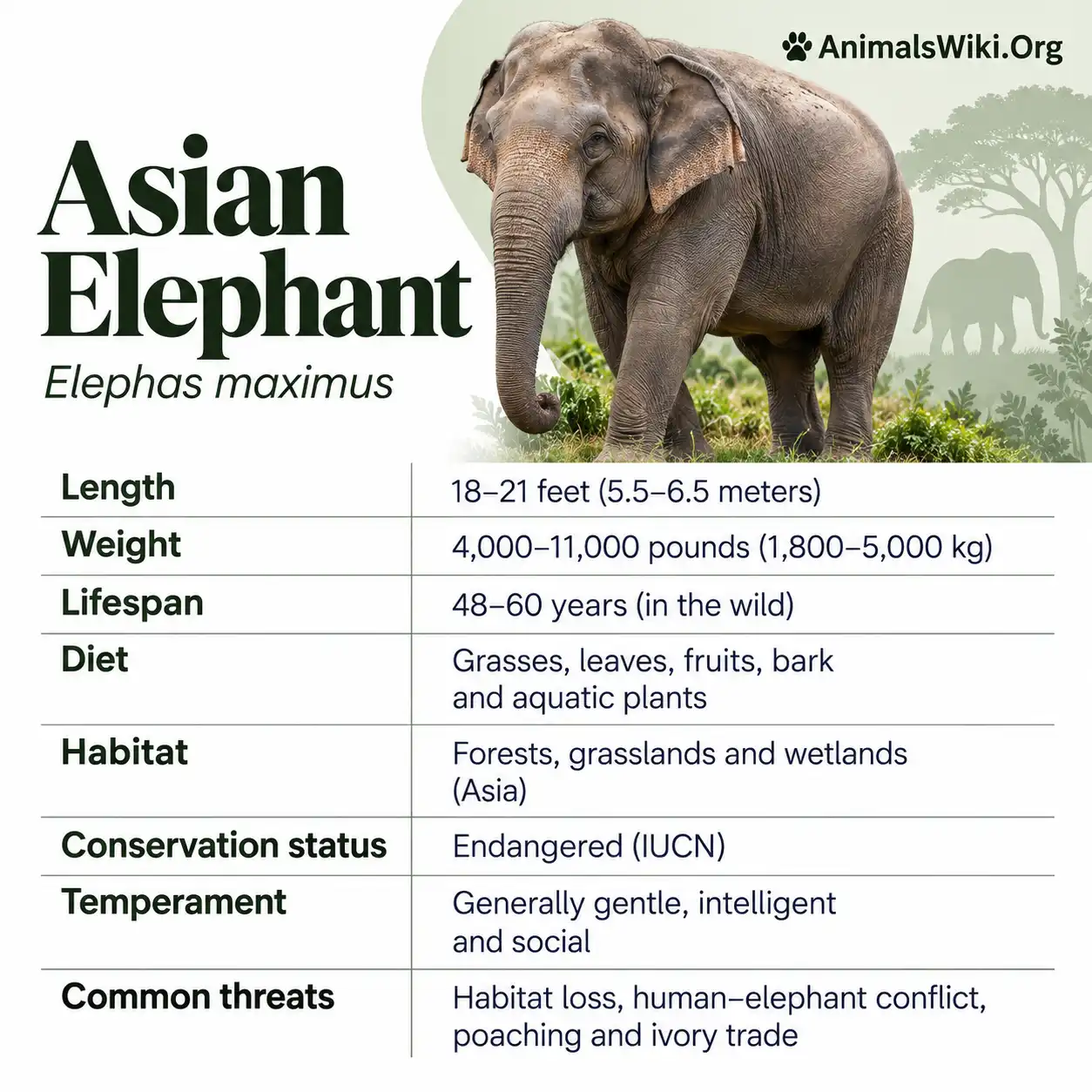
| Feature | Details |
|---|---|
| Common Name | Asian Elephant (Indian Elephant — most widespread subspecies) |
| Scientific Name | Elephas maximus |
| Family | Elephantidae |
| Order | Proboscidea |
| First Described | 1758 (by Carl Linnaeus) |
| Native Habitat | Tropical and subtropical forest; grassland; scrubland; wetlands |
| Geographic Range | South and Southeast Asia — 13 countries from India to Borneo |
| Average Size | Males: 2.4–3.5 m shoulder height; Females: 2.0–2.4 m |
| Average Weight | Males: 3,500–5,000 kg; Females: 2,000–3,000 kg |
| Lifespan | 48–60 years (wild); up to 80 years (captivity) |
| Diet | Herbivore — grasses, leaves, bark, roots, fruits; 150–200 kg per day |
| Conservation Status | Endangered (IUCN) — population declining |
| Defining Feature | Asia’s largest land animal; domed head; smaller ears than African relative; single trunk “finger”; deep cultural and religious significance across Asia; most domesticated elephant species |
| Global Population | Approximately 40,000–50,000 wild individuals; 15,000–16,000 in captivity |
1. Asian Elephant Species Overview & Classification
In the ancient forests of South and Southeast Asia, beneath canopies of dipterocarp trees that have stood for centuries, an animal moves with the quiet purposefulness of something that knows exactly where it is going and has been going there — along the same routes, between the same water holes, through the same forest corridors — for longer than most human institutions have existed. It navigates by memory more than by any other sense — a mental map built over decades of accumulated experience, a knowledge base that encompasses the location of water sources that appear only in drought years, the identity of hundreds of individual elephants encountered over half a century, the precise routes through the forest that avoid human settlements, and the acoustic signatures of family members heard at distances of several kilometers.
The Asian Elephant (Elephas maximus) — the largest land animal in Asia and the most culturally significant wild animal in the most populous continent on Earth — is simultaneously one of the most familiar and one of the most endangered large mammals in the world. Familiar because centuries of domestication and religious iconography have embedded the elephant’s image so deeply into Asian cultural consciousness that it appears in creation myths, royal insignia, temple architecture, folktales, and modern national symbols across a dozen countries. Endangered because those same centuries of human expansion across Asia have compressed the elephant’s habitat into a shrinking patchwork of forest fragments, created one of the most intractable human-wildlife conflict situations on the planet, and left a wild population of only approximately 40,000–50,000 animals — fewer than one-tenth the number of African Bush Elephants remaining.
The Asian Elephant’s story is one of the most complex in wildlife conservation — a species that has lived alongside humans for millennia, contributed more to human civilization than perhaps any other wild animal (through millennia of domesticated labor, cultural practice, and religious tradition), and is now facing extinction precisely because the human civilizations it helped build have outgrown the landscape it needs to survive.
Yet it is also a story of remarkable cultural depth, extraordinary cognitive sophistication, and genuine conservation hope — in countries where the elephant is genuinely valued by local communities and where effective management programs have been implemented, populations have stabilized and even recovered. The Asian Elephant’s future depends on whether the cultural reverence in which it is held across Asia can be translated into the practical conservation actions needed to secure the forests, manage the conflicts, and protect the wild populations that remain.
Species Classification Table
| Classification Level | Details |
|---|---|
| Kingdom | Animalia |
| Phylum | Chordata |
| Class | Mammalia |
| Order | Proboscidea |
| Family | Elephantidae |
| Genus | Elephas |
| Species | Elephas maximus |
| Described By | Carl Linnaeus, 1758 |
| Common Name | Asian Elephant |
| Closest Living Relative | Woolly Mammoth (Mammuthus primigenius) — EXTINCT |
The Four Subspecies of Asian Elephant
| Subspecies | Scientific Name | Range | Population | Notes |
|---|---|---|---|---|
| Indian Elephant | E. m. indicus | India, Bangladesh, Bhutan, Nepal, Myanmar, Thailand, Malaysia, Indonesia (Kalimantan) | ~26,000–30,000 | Most numerous; widest range |
| Sri Lankan Elephant | E. m. maximus | Sri Lanka | ~6,000–7,000 | Largest subspecies; highest proportion of tuskless males |
| Sumatran Elephant | E. m. sumatranus | Sumatra (Indonesia) | ~2,400–2,800 | Critically Endangered; smallest subspecies |
| Borneo Elephant | E. m. borneensis | Borneo (Malaysian Sabah; possibly Indonesian Kalimantan) | ~1,000–1,500 | Smallest Asian Elephant; gentlest temperament; possibly introduced from Java |
The Asian-African Evolutionary Divide
One of the most frequently misunderstood aspects of elephant biology is the closer genetic relationship between Asian Elephants and the extinct Woolly Mammoth than between Asian Elephants and African Elephants:
- Asian Elephant and Woolly Mammoth share a common ancestor from approximately 6–7 million years ago
- African Elephants (Loxodonta) and the Elephas/Mammuthus lineage diverged approximately 7–8 million years ago
This means that when you look at an Asian Elephant, you are looking at the closest living relative of the Woolly Mammoth — genetically, the two are more similar to each other than either is to African Elephants. The extinct giant of the Ice Age tundra and the living giant of the Asian forest are evolutionary cousins separated by time and climate, not by as much genetic distance as their dramatically different appearances might suggest.
Did You Know? The Asian Elephant is more closely related to the extinct Woolly Mammoth than to the African Elephant. Genetic analyses have confirmed that Asian Elephants and Woolly Mammoths share approximately 99.6% of their DNA — making them closer relatives than humans are to chimpanzees (who share ~98.7%). This extraordinary genetic similarity has led to ongoing scientific discussions about the possibility of using preserved Woolly Mammoth DNA (from well-preserved permafrost specimens) in conjunction with Asian Elephant reproductive biology to produce mammoth-like animals through gene editing — most notably through the Colossal Biosciences project, which is using CRISPR technology to introduce mammoth-specific genes into Asian Elephant cell lines.
2. Asian Elephant Physical Description & Unique Features
The Asian Elephant’s physical form is immediately distinguishable from its African relatives — not merely smaller, but fundamentally different in a dozen anatomical details that reflect millions of years of independent evolution in the forests and grasslands of Asia.
Size and Build
The Asian Elephant is Asia’s largest land animal — yet significantly smaller than the African Bush Elephant:
Males (bulls):
- Shoulder height: 2.4–3.5 meters (7.9–11.5 feet)
- Body length: 5.5–6.4 meters (18–21 feet)
- Weight: 3,500–5,000 kg (7,700–11,000 lbs); exceptional individuals up to 5,400 kg
- Largest recorded: A bull in Assam, India, documented at approximately 5,400 kg and 3.2 meters shoulder height
Females (cows):
- Shoulder height: 2.0–2.4 meters (6.6–7.9 feet)
- Weight: 2,000–3,000 kg (4,400–6,600 lbs)
Sexual dimorphism: Pronounced — males are typically 1.5–2 times heavier than females; adult bulls are dramatically larger and more robustly built, with a more prominent forehead dome and typically bearing tusks (in tusk-bearing populations)
The Domed Head — The Most Distinctive Feature
The most immediately recognizable anatomical difference between Asian and African Elephants is the head shape:
Asian Elephant: The highest point of the body is the top of the head — a prominent, twin-domed skull with a central indentation (a longitudinal groove running down the center of the forehead between the two domes); the neck appears relatively short; the head appears large relative to the body
African Elephant: The highest point is the shoulders — the back slopes downward toward the head; the skull is less prominently domed; the neck appears relatively longer
This difference in head shape reflects different skull architecture — the Asian Elephant’s larger brain case relative to body size requires a more prominent forehead dome
The indented forehead — the distinctive twin-dome-with-central-groove pattern of the Asian Elephant’s forehead has been used as a symbol in Asian art for millennia and is one of the most recognizable features distinguishing Asian from African Elephants even in stylized artistic representations
The Ears — Smaller and Differently Shaped
Asian Elephant ears are dramatically smaller than African Elephant ears — typically 1/3 to 1/4 the surface area of African ears:
- Shape: More rounded and irregular; often described as resembling the shape of India (the parallel with African ears being shaped like Africa is often noted)
- Function: Primarily thermoregulatory, as in African Elephants, but the smaller surface area reflects the Asian Elephant’s more forested habitat where shade reduces the thermoregulatory demand for large radiating surfaces
- Acoustic function: The ears also serve in detecting sound; the fan-like movement of the ears is used in social signaling
The Trunk — One “Finger”
The Asian Elephant’s trunk is anatomically similar to the African Elephant’s — approximately 40,000 muscles, extraordinary flexibility and strength — but with one immediately practical difference:
African Elephant trunk: Two “finger-like” protrusions at the tip — allowing a pincer-like grip for delicate manipulation
Asian Elephant trunk: One “finger” at the top of the tip — providing an equally precise but slightly different manipulation mechanism; the single-finger grip works differently from the pincer grip but is equally effective for the food types and forest environment typical of the Asian Elephant
Trunk length: Proportionally slightly shorter than the African Elephant’s relative to body size, consistent with the more forested habitat where a slightly shorter trunk is more maneuverable
The Back — Arched, Not Saddle-Shaped
Asian Elephant back: The back curves upward — convex or arched shape; the highest point is typically the mid-back or the head, not the shoulders
African Elephant back: The back curves downward — concave or saddle-shaped; the shoulders are the highest point
This difference in back shape has been exploited by humans for thousands of years — the naturally arched Asian Elephant back is better suited for carrying loads and riders (the load sits more naturally in the center of the back), which partially explains why Asian Elephants were domesticated for labor while African Elephants were not domesticated to the same extent.
Skin
Color: Typically dark grey, often mottled with pinkish or paler patches particularly on the ears, trunk, and face — these depigmented patches are characteristic of Asian (particularly Indian) Elephants and have cultural significance (extremely pale or “white” elephants are considered sacred in several Southeast Asian cultures)
Hair: Asian Elephants are notably more hairy than African Elephants — particularly evident in calves, which have a distinctly fluffy appearance; adult Asian Elephants have more visible hair on the body and notably more prominent eyelashes and tail hair than African Elephants; this hairiness reflects the closer genetic relationship with the Woolly Mammoth
Skin texture: Similar to African Elephants — thick (up to 2.5 cm), wrinkled, and sensitive despite its apparent toughness
Tusks — Males Only (Mostly)
The tusk situation in Asian Elephants is considerably more complex than in African Elephants:
In African Elephants: Both males and females typically develop tusks (though female tusks are smaller)
In Asian Elephants:
- Most females have no visible tusks (or only small “tushes” barely visible outside the lip) — this is normal, not an indication of abnormality
- Most Sri Lankan males are tuskless (makhna) — tusklessness in males is dramatically more common in Sri Lanka than in mainland Asian elephant populations (approximately 90% of Sri Lankan male elephants are tuskless)
- Most Indian and other mainland males develop tusks of varying sizes
- The high proportion of tuskless males in Sri Lanka may reflect thousands of years of selection against tusked males (who were preferentially captured for royal use or killed for ivory) — a similar evolutionary dynamic to the tuskless females in heavily poached African populations
“White Elephants”: Extremely rare individuals with very pale (pinkish or whitish) skin — prized as sacred animals in Thailand, Myanmar, and Laos throughout recorded history; actual albino elephants are extraordinarily rare; most “white elephants” are heavily depigmented rather than truly albino
Did You Know? Asian Elephant calves are distinctly fluffy compared to African Elephant calves — they are born with a coat of reddish-brown or dark brown hair that is visible and abundant, giving them a distinctly cuddly appearance that their African counterparts largely lack. This greater hairiness in calves (which decreases with age as adults become relatively less hairy) reflects the genetic proximity of Asian Elephants to the Woolly Mammoth — which was covered in dense fur as an adaptation to Pleistocene cold. The calf’s fluffy appearance represents a developmental vestige of the evolutionary pathway that produced the Woolly Mammoth’s famous coat.
3. Asian Elephant Habitat & Geographic Range
The Asian Elephant’s habitat encompasses one of the most biodiverse and most threatened biome complexes on Earth — the tropical and subtropical forests of South and Southeast Asia, a region that has lost the majority of its original forest cover to some of the fastest human population growth and most intensive agricultural development in history.
Habitat Diversity
Despite their primary association with tropical forest, Asian Elephants are remarkably flexible in their habitat use:
Tropical rainforest — the primary habitat in much of Southeast Asia; elephants use all forest strata from the understory to the edge; they require areas large enough to provide year-round food and water access; in Borneo and Sumatra, lowland dipterocarp forest is the critical habitat
Tropical dry forest and deciduous forest — the most important habitat type for the Indian Elephant across much of the Indian subcontinent; teak forest, sal forest, and mixed deciduous forest provide both browse and grass depending on season
Grassland and savannah — Asian Elephants, particularly in India and Nepal, extensively use the terai grasslands (tall grass elephant grass habitats along the Himalayan foothills); the floodplain grasslands of Assam, Bengal, and Nepal’s Terai-Duar system support some of the highest elephant densities
Scrubland and secondary forest — elephants readily use degraded and secondary forest, making them more tolerant of habitat disturbance than many other large mammals; this flexibility is both a conservation asset (they can persist in modified landscapes) and a conflict driver (they enter agricultural areas)
Wetlands and riverine areas — strongly associated with rivers, seasonal floodplains, and wetlands across the range; water access is essential and elephants concentrate along waterways in the dry season
Montane forest — elephants have been recorded at elevations exceeding 3,000 meters in parts of India, Myanmar, and elsewhere; they use mountain forests particularly as corridors between lowland areas
Critical Habitat Requirements
All Asian Elephant populations share essential habitat requirements:
Large area — Asian Elephant home ranges vary enormously (from 50–500 km² for females to 300–3,000 km² for adult males) and require habitat connectivity rather than isolated patches; minimum viable population sizes require areas of several thousand km² of connected habitat
Year-round water access — unlike some desert-adapted animals, Asian Elephants cannot survive without regular water access; water sources must be available within daily travel distance throughout the dry season
Diverse vegetation — the diversity of food types consumed seasonally requires habitat that includes grassland (for wet-season grazing), forest (for dry-season browse), and transitional habitats
Low disturbance level — while tolerant of modified habitats, Asian Elephants are sensitive to human presence and noise in ways that constrain their range use; heavily disturbed or frequently accessed areas are avoided
Geographic Range by Country
| Country | Population Estimate | Key Habitats | Trend |
|---|---|---|---|
| India | ~27,000–30,000 | Western Ghats, Northeast India, Terai, Andaman Islands | Stable in key areas; declining overall |
| Sri Lanka | ~6,000–7,500 | Dry zone forests; national parks | Stable to slightly increasing in protected areas |
| Indonesia | ~2,400–2,800 (Sumatra); ~1,000–1,500 (Borneo) | Sumatra: lowland forest; Borneo: Sabah forest | Declining rapidly (Sumatra); more stable (Borneo) |
| Malaysia | ~1,500–2,000 | Peninsular Malaysia forest; Sabah | Declining; significant HWC |
| Myanmar | ~4,000–5,000 | Northern forests; Ayeyarwady watershed | Declining; significant poaching |
| Thailand | ~3,000–4,000 wild; ~2,500–3,000 captive | Western Forest Complex; Dong Phayayen | Slowly recovering in some areas |
| Bangladesh | ~268–600 | Chittagong Hill Tracts | Severely fragmented; declining |
| Nepal | ~200–250 | Terai-Duar grasslands | Slowly recovering |
| Bhutan | ~500–700 | Southern foothills | Relatively stable |
| Cambodia | ~400–600 | Cardamom Mountains; northeast forests | Declining |
| Laos | ~800–1,000 wild; ~400–500 captive | Northern forests | Declining |
| Vietnam | ~100–130 | Central Highlands; Yok Don area | Critically low; declining |
| China | ~300–400 | Southern Yunnan Province | Slowly recovering |
The Elephant Corridor Crisis
One of the most critical issues for Asian Elephant conservation is the fragmentation of habitat into isolated patches separated by human-dominated land — and the consequent importance of wildlife corridors that allow elephants to move between patches:
What corridors are: Strips of suitable habitat or modified land through which elephants can travel safely between larger habitat blocks; corridors may be narrow (a few hundred meters wide) or broad; they may pass through forest, agricultural land, or even modified urban fringes
Why corridors matter: Isolated elephant populations in small habitat patches face:
- Genetic isolation — inbreeding reduces fitness over generations
- Local extinction risk — small populations can be eliminated by drought, disease, or conflict events that larger populations would survive
- Behavioral restriction — elephants cut off from traditional migration routes cannot access seasonal resources
India’s Elephant Corridors Project: The Wildlife Trust of India has identified and mapped 88 elephant corridors across India — many of which are partially or severely blocked by human development; securing these corridors is one of the most urgent priorities in Asian Elephant conservation
4. Asian Elephant Diet & Feeding Behavior
The Asian Elephant’s dietary requirements are as impressive in scale as those of its African relative — a feeding machine of almost industrial proportions that consumes the equivalent of a substantial fraction of its body weight in vegetation every day.
What Asian Elephants Eat
Grasses — the primary dietary component during the wet season when fresh grass is available; Asian Elephants are classic grazers when grassland vegetation is growing actively; the terai grasslands of India and Nepal support extraordinarily large elephants largely because of the abundant, high-quality grass
Browse (leaves, twigs, bark) — the primary food during dry seasons when grass quality deteriorates; Asian Elephants browse from a remarkable diversity of tree and shrub species; bark stripping is particularly important in dry conditions and is one of the most ecologically visible elephant impacts on forest vegetation
Bamboo — highly significant in many parts of the range; bamboo is both nutritious and available year-round; elephants in Northeast India, Myanmar, and parts of Southeast Asia consume substantial quantities of bamboo shoots and stems; the bamboo-elephant relationship is one of the most important dietary associations in Asian Elephant ecology
Roots and tubers — excavated using the tusks (in tusked individuals) or using the feet; roots provide both nutrients and water in dry conditions; in some areas, root excavation is the primary dry-season feeding strategy
Fruits — consumed seasonally; Asian Elephants are important seed dispersers for numerous forest tree species; the consumption of fallen fruit is a regular foraging activity
Crops — agricultural crops raided at forest margins; maize, sugarcane, bananas, rice, and root vegetables are preferentially consumed; crop raiding is one of the most serious human-wildlife conflict drivers (see conservation section)
Salt and mineral licks — essential supplement; elephants visit mineral-rich soil deposits, riverbank exposures, and natural salt licks to obtain sodium and other minerals not adequately available in vegetation
The Water Requirement
Asian Elephants’ daily water requirement of approximately 150–200 liters is met through:
- Direct drinking at rivers, ponds, and water holes
- Water in food — fresh vegetation contains significant water; bamboo shoots in particular are rich in water
- Excavation — in dry conditions, elephants excavate water from dry riverbeds
Daily Feeding Pattern
Asian Elephants in forest habitats show a more complex daily activity pattern than savannah African Elephants:
Pre-dawn to mid-morning: Most active foraging period; cooler temperatures allow more energy-efficient activity
Mid-morning to mid-afternoon: Reduced activity; shade-seeking; some foraging continues; social interactions
Late afternoon to dusk: Second active foraging period
Night: Continued foraging; elephants are partially nocturnal — particularly in areas where daytime human presence is high; in conflict zones, elephants become largely nocturnal to avoid human encounters during daylight hours
The Crop Raiding Reality
Crop raiding is not merely a behavioral problem but a nutritional reality — agricultural crops (particularly maize, sugarcane, and rice) are nutritionally superior to wild vegetation in many dimensions:
- Higher calorie density
- Higher protein content
- Lower fiber and toxin content
- More predictable location and availability
From the elephant’s perspective, a maize field is an extraordinarily efficient food source — calorie-dense, non-toxic, reliably located, and accessible. The human cost of this efficiency is severe — a single elephant can consume or destroy an entire small farm’s annual food supply in a single night’s raid.
Diet Breakdown Table
| Food Type | % of Diet (Wet Season) | % of Diet (Dry Season) | Notes |
|---|---|---|---|
| Grasses | 60–75% | 20–40% | Wet season primary food; quality declines rapidly when dry |
| Bamboo | 5–15% | 10–20% | Year-round but most important in NE India/SE Asia |
| Browse (leaves, twigs) | 15–25% | 30–45% | Dry season primary food; high diversity of species |
| Bark | 2–5% | 10–20% | Major dry season food; tree-killing impact |
| Roots and tubers | 2–5% | 5–10% | Excavated with tusks or feet |
| Fruits | 3–8% | 3–8% | Seasonal; critical for seed dispersal |
| Crops (where available) | Variable | Variable | High nutritional value; major conflict driver |
5. Asian Elephant Reproduction & Life Cycle
The Asian Elephant’s reproductive biology parallels the African Elephant’s in its fundamental parameters — long gestation, extended maternal investment, low reproductive rate — while differing in specific timing and context.
Sexual Maturity
Females: Sexual maturity at approximately 9–12 years; first calves typically born at 14–17 years in wild populations; captive females may reach maturity slightly earlier
Males: Reach sexual maturity at approximately 10–14 years; competitively active in mating from approximately 20–25 years; full dominance and peak breeding success in bulls of 35–45 years
Musth in Asian Elephants
As in African Elephants, sexually mature Asian Elephant bulls experience musth — the periodic state of heightened testosterone and aggression associated with reproductive competition:
Similarities to African Elephant musth:
- Temporal gland secretion (temporal streaming)
- Urine dribbling and strong odor
- Dramatically elevated testosterone
- Increased aggression
- Active search for estrous females
Differences from African Elephant musth:
- Asian Elephant musth cycles can vary significantly in duration and timing between individuals
- The duration of musth in young bulls may be shorter (weeks) compared to older bulls (months)
- Captive musth is a significant welfare and safety challenge — captive bulls in musth become dangerous and require specific management protocols; musth-related incidents are a significant cause of elephant handler (mahout) injury and death
Gestation
- Gestation period: Approximately 18–22 months — similar to African Elephants, ranging around 22 months in the longest documented cases; consistently the longest gestation of any land mammal
- Birth weight: Approximately 90–100 kg (slightly lighter than African Elephant calves on average)
- Litter size: Single calf invariably; twins extremely rare and typically result in the death of one or both calves
- Calving interval: Approximately 4–5 years under good conditions; longer in poor-condition populations or areas with high human disturbance
The Birth and Early Development
Allomothering — as in African Elephants, the birth of a calf is a social event; other females in the family group assist with the birth and immediately begin protective behavior around the newborn; younger females serving as “allomothers” gain experience that will be valuable for their own reproductive success
Neonatal characteristics:
- Well-developed at birth; mobile within 1–2 hours
- Notably hairy compared to African Elephant calves — the reddish-brown downy coat of newborn Asian Elephants is one of their most endearing features
- Eyes open at birth; visual system functional
- Capable of nursing within hours
Development timeline:
| Stage | Timing | Key Development |
|---|---|---|
| Birth | Day 0 | ~90–100 kg; hairy; mobile within 1–2 hours |
| First solid food | Weeks 2–4 | Begin exploring and sampling vegetation |
| Callosities and hair reduction | Months 3–6 | Hair thins progressively; more typical elephant appearance |
| First mud bathing | Months 1–3 | Very early; often facilitated by mother |
| Weaning | Years 4–6 | Nursing continues 4–6 years |
| Family independence | Years 8–12 | Males begin ranging independently; females remain in family |
| Sexual maturity (female) | Years 9–12 | Reproductive cycling begins |
| Tusk development (male) | Years 5–15 | Gradual; full development takes many years |
Captive Breeding — A Complex Reality
Approximately 15,000–16,000 Asian Elephants live in captivity — in temple herds, logging camps, tourist facilities, and zoos worldwide. Captive Asian Elephant reproduction is considerably more complex than wild reproduction:
- Musth management — captive bulls in musth are extremely dangerous; many facilities separate musth bulls from handlers and other elephants
- Female reproductive challenges — captive females often show reproductive suppression — reduced cycling and fertility compared to wild animals; the causes include social stress, inadequate space, nutritional issues, and lack of normal social stimulation
- Genetic management — captive populations in zoos are managed through Species Survival Plans (SSPs) coordinating breeding between institutions to maintain genetic diversity
- Welfare debates — the keeping of elephants in captivity — particularly in substandard facilities in range countries — is one of the most contested welfare issues in the zoo and animal tourism industries
6. Social Behavior & Communication
The Asian Elephant’s social system shares the fundamental matriarchal, multi-level structure of African Elephant society — but is shaped by the different challenges of forest life, closer proximity to human settlements, and a history of domestication that has influenced both the behavior of captive animals and, through domestication-driven selection, potentially some characteristics of wild populations.
The Matriarchal Family Group
As with African Elephants, the fundamental social unit is the family group of related females and their young, led by the most experienced female (the matriarch):
Typical family size: 5–12 individuals — somewhat smaller on average than African Elephant families, possibly reflecting the more fragmented and patchy resources of forest habitats versus open savannah
Composition: A matriarch, her daughters of various ages, and young males typically up to 10–14 years; the family stays in close proximity most of the time, resting together, feeding in the same area, and defending each other
Bond groups and clans: As in Africa, Asian Elephant families associate in bond groups of 2–5 related families, which in turn belong to larger clan groups sharing a home range
The Matriarch’s Critical Role
Research on Asian Elephants — particularly long-term studies in Mudumalai Tiger Reserve (India) by Dr. Raman Sukumar and colleagues and in Borneo by various research teams — confirms the same fundamental importance of experienced matriarchs documented in Africa:
- The matriarch holds critical knowledge of water sources that may only be visited in severe drought years
- She maintains knowledge of human threat patterns — distinguishing between harmless and threatening human activities with precision that younger elephants lack
- She maintains social knowledge of dozens to hundreds of individual elephants encountered over decades
- Her death — which poachers typically cause, as the largest-tusked individuals are matriarchs — disrupts family function in ways that extend for years
Male Social Structure — Different from Africa
Asian Elephant male social behavior differs from the African pattern in several important respects:
Solitary versus group-living: While African Elephant bulls frequently form loose bachelor groups, Asian Elephant bulls tend to be more solitary when not in musth; adult bulls associate with family groups primarily during musth
Male zones: In areas where human presence is intense, adult bulls often occupy different habitat from female-led family groups — larger bulls can access human-dominated landscapes more flexibly and exploit agricultural areas that family groups with vulnerable calves avoid
The tusked versus tuskless dynamic: In areas with significant human disturbance (including historical capture pressure), the social dynamics between tusked and tuskless males are complex; tuskless males may occupy different social niches and forage differently
Communication — Forest Adaptations
Asian Elephants inhabit forest environments where visual communication is limited by vegetation density; their communication system is correspondingly more heavily weighted toward acoustic and olfactory channels:
Infrasound communication: As in African Elephants, infrasound calls travel through both air and ground; research in India has documented Asian Elephant infrasound communication with characteristics similar to African Elephants; ground-borne seismic signals detected through the feet are probably particularly important in forest habitats where airborne sound dispersal is limited by vegetation
Chirping and squeaking — contact calls used in forest environments where visual contact is limited; the chirp is a distinctive Asian Elephant vocalization less commonly documented in African Elephants; it is used particularly for mother-calf and family member contact maintenance
Rumbling — the low-frequency social rumble is the most frequent Asian Elephant vocalization, as in Africa; constant low-level rumbling maintains family cohesion during movement through dense vegetation
Trunk signals — the trunk is even more important for close-range communication in Asian Elephants than in African Elephants due to the visual limitations of forest; elephants touching each other’s mouths, temporal glands, and genitals with the trunk trunk convey detailed chemical and tactile social information
Chemical communication — temporal gland secretions, urine, and dung provide olfactory information across the range; in the complex social and conflict environment of human-elephant coexistence, chemical communication may also play a role in “information transfer” about human activities
The Special Case of Domesticated Elephants
Approximately 15,000–16,000 Asian Elephants live in captivity — many in conditions that profoundly affect their behavior and social structure. Key observations:
Mahout relationship — the bond between an elephant and its mahout (keeper/trainer/rider) is one of the most complex and most culturally significant human-animal relationships in the world; long-term mahout-elephant relationships (some lasting decades) show behavioral characteristics reminiscent of the elephant’s natural social bonds
Captive social deprivation — elephants kept in social isolation or in inappropriate social groupings show behavioral abnormalities (stereotypies, aggression, hyperactivity) consistent with the social deprivation documented in other highly social mammals
Temple elephants — the elephants maintained at Hindu and Buddhist temples across South and Southeast Asia live in particularly complex social environments — high human contact, often limited natural social interaction with other elephants, ceremonial stress, and inadequate space and dietary diversity; temple elephant welfare has become a significant welfare advocacy issue
7. Predators & Defense Mechanisms
The adult Asian Elephant’s predator situation is broadly similar to the African Elephant’s — essentially invulnerable to any natural predator — but the specific predator community and forest habitat create somewhat different dynamics.
Natural Predators
Tiger (Panthera tigris) — the primary natural predator of Asian Elephants; tigers large enough to take elephant calves operate throughout much of the Asian Elephant’s range; documented tiger attacks on juvenile and young elephants are relatively rare but occur; adult elephants are essentially invulnerable to tiger predation; the ecological relationship between tigers and elephants has shaped the behavior of both species over millions of years of co-evolution
Asian Lion (Panthera leo persica) — historically significant predator in parts of the Indian subcontinent; the Asian Lion’s range now restricted to Gir Forest (Gujarat, India) barely overlaps with elephant range, but historically lions were important elephant calf predators across much of the Indian subcontinent
Leopard (Panthera pardus) — occasional predation on very young or very small elephant calves; adult leopards are far too small to threaten older juveniles
Dhole (Asian Wild Dog, Cuon alpinus) — pack-hunting dholes have been documented harassing elephant family groups; direct predation on calves is possible but rare; family group defense typically deters dholes effectively
Saltwater and Mugger Crocodiles — significant predators at water crossings; ambush attacks on calves and juveniles at river crossings are documented; adult elephants are essentially immune to crocodile predation in most circumstances
Humans — historically and currently the most significant source of Asian Elephant mortality, through poaching, conflict killing, and accidents
Defense Mechanisms
Family group defensive clustering — as in Africa, the family group is the primary anti-predator structure; calves are immediately surrounded and protected when threat is detected; adult females form an outward-facing defensive ring
Forest navigation as defense — Asian Elephants’ intimate knowledge of their forest environment allows them to navigate to areas where predators cannot follow effectively; dense vegetation and steep terrain provide natural refuges
Acoustic early warning — infrasound and rumble communication allows family members separated by dense vegetation to coordinate threat responses without visual contact; the matriarch’s coordinating role is particularly important in forest environments where the herd may be spread across larger areas
Charge and pursuit — as in Africa, charging behavior against predators (and humans) is one of the most formidable deterrents in the Asian forest; an Asian Elephant charge through forest vegetation is extraordinarily destructive and intimidating; documented chases of tigers, leopards, and humans extend for considerable distances
Nocturnal behavior as anti-predator strategy — in areas with high human threat (the primary modern predator), Asian Elephants become predominantly nocturnal — avoiding human settlements during daylight hours; this behavioral adaptation reduces lethal conflict but increases crop raiding risk at night
8. Relationship with Humans
The Longest Domestication in History
The relationship between humans and Asian Elephants is one of the longest, deepest, and most complex human-animal relationships in the world — spanning at least 4,000 years of domestication and an even longer history of cultural and spiritual significance.
First domestication: The earliest evidence of elephant domestication comes from the Indus Valley Civilization (approximately 2500–1500 BC), where elephant images on seals and possible evidence of elephant management suggest early contact; formal domestication for labor and military purposes is clearly established by approximately 1500 BC
Military history — Asian Elephants were the tanks of the ancient world — used in military campaigns from India through Persia and into the Mediterranean world:
- Porus of the Punjab deployed 200 war elephants against Alexander the Great at the Battle of the Hydaspes (326 BC) — one of the most famous ancient battles
- The Mauryan Empire under Chandragupta Maurya (321–297 BC) maintained a war elephant corps of up to 9,000 animals — the largest force of war elephants ever assembled
- Elephants spread westward — the Seleucid and Ptolemaic empires both maintained war elephant forces; the Carthaginian use of war elephants against Rome (via Hannibal) used African Forest Elephants, which are now extinct in North Africa, but the tactics were learned from the Indian tradition
Labor use — beyond war, Asian Elephants have been used for millennia in forestry, construction, agriculture, transportation, and ceremony:
- Logging in the teak forests of Myanmar (Burma), Thailand, and India was dependent on elephant labor well into the 20th century and continues in limited contexts; elephants can move logs through terrain inaccessible to machinery
- Temple ceremonies throughout South and Southeast Asia use ceremonially decorated elephants in religious processions
- Royal elephant corps were maintained by virtually every major South and Southeast Asian kingdom
Religious and Cultural Significance
No other wild animal is more deeply embedded in the religious and cultural consciousness of Asia than the elephant:
Ganesha — The Elephant-Headed God: Ganesha (Ganapati) — the elephant-headed son of Shiva and Parvati in Hindu mythology — is one of the most widely worshipped deities in Hinduism and is venerated across South and Southeast Asia. He is the god of beginnings, wisdom, knowledge, and the removal of obstacles — worshipped at the beginning of any significant undertaking.
The origin myth of Ganesha’s elephant head varies across different Hindu traditions but the most common narrative involves Shiva unknowingly beheading his own son (whom he did not recognize) and replacing his head with that of an elephant — the most powerful and wisest of animals. The specific choice of the elephant head carries profound meaning — the elephant’s intelligence, memory, strength, and gentle nature make it the ideal form for a deity of wisdom and beginnings.
Ganesha is depicted with:
- Elephant head with one broken tusk (which he used to write the Mahabharata epic, dictated by the sage Vyasa)
- Four arms holding various symbolic objects
- A large, rounded belly representing prosperity and the universe
- A mouse as his vehicle (vahana) — representing the ability to penetrate even the smallest obstacles
The cultural reach of Ganesha is extraordinary — from India through Nepal, Sri Lanka, Thailand, Indonesia (including Bali), Cambodia, and wherever Hinduism and Buddhism have historically spread; Ganesha worship extends into Japanese Buddhism (as Kangiten), into Jain tradition, and into various syncretic religious practices across Asia.
Buddhism and the White Elephant: The white elephant holds special significance in Buddhist tradition — specifically in the story of the birth of Siddhartha Gautama (the Buddha):
The night before the Buddha’s birth, his mother Queen Maya dreamed that a white elephant carrying a white lotus flower circled her three times and entered her womb — symbolizing the entry of a great being into the world. This dream is one of the most celebrated in Buddhist iconography and is depicted in temple art across the Buddhist world.
In Theravada Buddhist countries (Thailand, Myanmar, Laos, Cambodia, Sri Lanka), white (albino or heavily depigmented) elephants are royal property — they cannot be owned or used by commoners; historically, any white elephant found in a kingdom was automatically the property of the king. The number of royal white elephants in a king’s possession was a measure of his divine mandate and legitimacy. The phrase “white elephant” entered English as a metaphor for a burdensome possession that is expensive to maintain and difficult to dispose of — supposedly because receiving a gift of a royal white elephant from a Thai king was both an honor and a financial disaster (the recipient was obliged to maintain a royal animal at enormous cost).
Elephants in Southeast Asian Royal Symbolism:
- The three-headed elephant (Erawan/Airavata) is the mount of the Hindu god Indra and appears in the royal symbolism of Thailand, Laos, and Cambodia
- Laos was historically known as “Lane Xang” — meaning “Land of a Million Elephants” — and the elephant appears in Laotian national symbols
- The Sri Lanka flag features a stylized lion, but elephants appear throughout Sri Lankan cultural and religious imagery
- India’s national heritage includes the elephant in the Lion Capital of Ashoka — the national emblem of India
The Mahout Tradition
The mahout — the elephant keeper, trainer, and rider — represents one of the world’s most ancient and most specialized human-animal professional relationships:
Training and bond: Mahouts typically begin working with their elephants when both are young; the relationship develops over years or decades into one of the most complex and most documented human-animal bonds; experienced mahouts can communicate with their elephants through hundreds of verbal commands, pressure signals, and subtle body language cues developed over years of daily interaction
Hereditary profession: In many traditions (particularly in India, Myanmar, and Thailand), the mahout profession is hereditary — skills, knowledge, and specific animal relationships passed from father to son over generations; some mahout families have specific knowledge of traditional elephant medicine, behavior interpretation, and management practices developed over centuries
Modern challenges: The decline of traditional elephant working contexts (particularly logging) has left many mahouts and their elephants without traditional livelihoods; the transition to tourism-based work has created welfare concerns in many facilities; many mahouts and their elephants now work in conditions that neither serves their welfare nor preserves the traditional relationship
The Tourism Industry — Welfare Concerns
The massive Asian elephant tourism industry — particularly in Thailand, but also in India, Sri Lanka, Myanmar, and other countries — has become one of the most contentious welfare issues in wildlife tourism:
Problematic practices at some facilities:
- Elephant riding with heavy saddles and unnatural gait demands
- “Trekking camps” using elephants for tourist riding in ways that cause physical injury
- Chains and restraints used to confine elephants in inadequate space
- “Crush” training (phajaan) — the traditional training method involving physical coercion to break the elephant’s spirit and make it submissive; documented in undercover video and condemned by welfare organizations
- Performance shows requiring unnatural behaviors
Welfare-focused alternatives:
- Elephant sanctuaries offering observation-only experiences without riding, performance, or close contact
- Conservation camps providing space, natural habitat access, and positive reinforcement training
- The Elephant Nature Park in Chiang Mai (founded by Sangduen “Lek” Chailert) is the most famous welfare-focused elephant sanctuary; its model has been widely replicated
9. Asian Elephant Conservation Status & Threats
IUCN Status
Asian Elephant (Elephas maximus): Endangered — assessed 2008 (assessment overdue for update as of 2026); population of approximately 40,000–50,000 wild individuals; declining throughout range
Sumatran Elephant (E. m. sumatranus): Critically Endangered — population has declined by approximately 70% in 25 years; fewer than 2,800 individuals remain
Key Threats
1. Habitat Loss and Fragmentation — The Primary Driver
Across the Asian Elephant’s range, deforestation and habitat conversion are the most fundamental threats:
- Indonesia/Sumatra: Palm oil expansion has eliminated over 70% of lowland Sumatran forest since 1970; Sumatran Elephant habitat has been reduced to fragmented remnants; some surveys suggest fewer than 1,000 Sumatran Elephants remain in small, isolated subpopulations
- India: Forest cover loss to agriculture, mining, and infrastructure has compressed elephant habitat into increasingly fragmented blocks; the Elephant Reserve system covers over 60,000 km² but many reserves are poorly connected
- Southeast Asia broadly: Forest cover losses across Myanmar, Cambodia, Laos, Vietnam, and Thailand have been severe; the countries that still hold significant wild elephant populations are those that have retained the largest forest blocks
2. Human-Elephant Conflict (HWC) — The Most Complex Threat
Human-elephant conflict is simultaneously the most significant source of elephant mortality in many range countries and one of the greatest barriers to community support for elephant conservation:
Scale of the problem:
- In India alone, approximately 400–500 people are killed by elephants annually — making elephants the most dangerous large mammal in India in terms of human fatalities
- Elephants destroy crops worth millions of dollars annually across range countries; this economic impact falls disproportionately on the poorest farming communities
- Retaliatory killing of elephants in response to crop raiding and human casualties is a significant source of elephant mortality
Why HWC is increasing:
- Shrinking habitat forces elephants into smaller areas adjacent to human settlements
- Loss of corridors between forest patches forces elephants to cross agricultural land
- Increasing human populations in former buffer zones around protected areas
- Climate-driven drought forces elephants to seek food and water in human-settled areas during severe dry seasons
Solutions being developed:
- Early warning systems — GPS collars on select elephants linked to mobile phone alert systems for nearby farmers
- Beehive fences — effective in some contexts but less well-tested in Asia than Africa
- Chili and tobacco barriers — deterrent plants along field margins
- Community compensation schemes — government and NGO programs compensating farmers for losses; effectiveness varies by country
- Farmer education — teaching communities which deterrents are effective and how to behave during elephant encounters to minimize risk
3. Poaching
Unlike the African Elephant situation where ivory poaching is the primary mortality driver, Asian Elephant poaching has multiple drivers:
- Ivory poaching — affects only tusked males; in tusk-bearing populations, adult bulls are targeted; in some areas this has severely skewed sex ratios toward females, reducing reproductive rates
- Skin poaching — particularly acute in Myanmar, where Asian Elephant skin has been extensively traded to China for use in skin-based traditional medicine products; documented since approximately 2014; estimated to have killed hundreds of elephants in Myanmar in recent years; perhaps the fastest-growing poaching threat to Asian Elephants
- Meat and body part trade — various body parts are used in traditional medicine across range countries; tail hair is traded as a good luck charm; the cumulative impact of body part demand is significant
4. Captive Welfare and Population Sustainability
The large captive population (~15,000–16,000) faces its own conservation challenges:
- Captive populations are not reproductively self-sustaining in most countries — the birth rate in captivity does not replace deaths; Thailand’s captive population, for example, has been declining for decades
- Wild capture to supplement captive populations is illegal in most countries but continues; the IDA estimates that 50–100 elephants are illegally captured from the wild annually in Southeast Asia
- Captive elephant welfare remains deeply problematic in many facilities
5. Disease
- Elephant Endotheliotropic Herpesvirus (EEHV) — a fatal herpesvirus that primarily kills calves and young elephants; it is the leading cause of death in Asian Elephants in North American and European zoos; in wild and captive Asian populations, EEHV kills a significant proportion of calves; vaccine development is an active research priority
- Tuberculosis — documented in captive Asian Elephant populations worldwide; complex welfare, zoonotic, and conservation implications
- Foot problems — extremely common in captive elephants; one of the most significant welfare issues and causes of premature death
10. Famous Asian Elephants Around the World
Kandula — King Dutugamunu’s War Elephant
The most famous elephant in Sri Lankan history is Kandula — the war elephant of King Dutugamunu (161–137 BC), whose military campaigns unified Sri Lanka under a single Buddhist ruler. Kandula is celebrated in Sri Lanka’s most important historical chronicle, the Mahavamsa, which describes his courage and loyalty in battle; he is remembered as a hero of Sri Lankan national history. Kandula’s story — including his legendary battlefield behavior and his deep bond with the king — has been told and retold in Sri Lankan culture for over 2,000 years.
Airavata — The Divine White Elephant
Airavata (sometimes Erawan in Thai tradition) is the mythological white elephant that serves as the mount of the Hindu god Indra — the king of the gods and god of storms, lightning, and war. Airavata is typically depicted with multiple heads (three in Thai tradition, four or more in some Indian traditions) and emerged from the churning of the cosmic ocean (Samudra Manthan) alongside the goddess Lakshmi, the divine physician Dhanvantari, and other divine gifts.
Airavata’s image appears in the royal symbolism of Thailand, Laos, and Cambodia and is one of the most recognizable sacred animals in Southeast Asian iconography. The three-headed elephant (Erawan) is particularly prominent in Thai cultural imagery.
Surus — Hannibal’s Famous Elephant
The most famous elephant from the Carthaginian general Hannibal’s crossing of the Alps (218 BC) was reputedly named Surus (“the Syrian”) — apparently the only elephant to survive the crossing and subsequent Italian campaigns intact. Surus was reportedly the elephant Hannibal rode in battle. Historical accounts suggest he may have been an Asian (Syrian) elephant rather than one of the African Forest Elephants that constituted most of Hannibal’s war elephant force — if so, Surus was one of the most historically significant individual Asian Elephants outside Asia.
Chang — Thailand’s White Elephant
Chang (meaning elephant in Thai) has been the name of multiple significant Thai royal white elephants through history. The most internationally recognized use of the elephant in Thai national symbolism was on the Thai national flag until 1916 — a white elephant on a red background — making Thailand the only modern nation to have had a white elephant as its primary national symbol. The current Thai flag no longer features the elephant, but it remains central to Thai cultural identity.
Thong Dee — The Elephant Nature Park’s Story
Thong Dee and the dozens of elephants rescued by the Elephant Nature Park in Chiang Mai, Thailand have become internationally famous through the park’s social media presence and extensive documentary coverage. The park’s founder Sangduen “Lek” Chailert has been recognized by Time Magazine as one of the world’s most influential people and has received multiple international conservation awards; her work rescuing elephants from abusive logging camps, street begging, and tourism facilities and providing them with sanctuary conditions has fundamentally changed international public understanding of Asian elephant welfare.
Lin Wang — The World’s Oldest Captive Elephant
Lin Wang — an Asian Elephant who served as a war elephant for Japan during World War II before being captured by Chinese Nationalist forces and eventually transferring to Taipei Zoo in Taiwan — lived to the extraordinary age of 86 years, dying in 2003. Lin Wang was the longest-lived elephant in captivity in recorded history and became beloved by Taiwanese people as a national icon; his death was mourned nationwide. Lin Wang’s remarkable longevity (made possible in part by excellent care at Taipei Zoo) provides some of the strongest evidence for the upper potential lifespan of Asian Elephants.
Raja — Sri Lanka’s Most Sacred Elephant
Raja — the tusked male elephant who carried the sacred Tooth Relic of the Buddha in the famous Esala Perahera procession in Kandy, Sri Lanka for over 50 years (1945–1988) — is considered the most important ceremonial elephant in Sri Lankan history. The Perahera procession, in which a replica casket said to contain the Buddha’s tooth is carried on the back of a decorated tusked elephant through the streets of Kandy, is one of the largest religious processions in Asia; the role of carrier of the sacred relic is the highest honor an elephant can receive in Sri Lanka. Raja was declared a National Treasure by the Sri Lankan government, and after his death he was taxidermied and placed on permanent display at the Kandy National Museum, where his mounted body remains one of the most visited exhibits in Sri Lanka.
11. Role in Ecosystem & Food Chain
Asian Elephants as Forest Engineers
The Asian Elephant’s ecological role in tropical forest ecosystems parallels the African Elephant’s ecosystem engineering function — with important forest-specific modifications:
Forest gap creation — elephants pushing over trees, breaking large branches, and bark-stripping creates forest gaps that allow light penetration to the forest floor; these gaps promote the growth of pioneer plant species and create a mosaic of vegetation ages and structures that supports higher overall biodiversity; forests without elephant disturbance tend toward denser canopy closure and lower understory diversity
Path creation — Asian Elephants create and maintain trail networks through forest that are used by dozens of other species; elephant trails follow the most energetically efficient routes through difficult terrain and represent decades to centuries of accumulated landscape knowledge; other animals (tigers, leopards, deer, smaller mammals) preferentially use elephant trails for their own movement
Water hole creation — elephants excavate water in dry riverbeds, creating water access for dozens of other species in dry conditions; the water holes maintained by elephants are essential dry-season resources for smaller animals that cannot excavate their own water
Mineral lick maintenance — regular elephant visits to mineral lick sites maintain these concentrations of mineral-rich soil in accessible condition; many other species (deer, wild boar, birds) use the same mineral licks that elephants have maintained
Seed Dispersal — “Farmers of the Forest”
The Asian Elephant’s role as a seed disperser is one of the most ecologically important functions of any forest animal in Asia:
Large-fruit specialists: Many tropical forest trees produce large fruits specifically adapted for elephant dispersal; their seeds are too large for birds or smaller mammals to swallow; elephants are the only animal capable of dispersing these seeds through gut passage
Dispersal distance: An elephant moving several kilometers per day and defecating every 1–2 hours disperses seeds across areas that no other disperser can match; some documented seed dispersal distances for elephant-dispersed trees exceed 65 km
Germination enhancement: Gut passage through an elephant appears to enhance germination rates for some seed species — possibly by scarifying the seed coat or by conditioning the seed with specific microbial communities from the elephant’s gut
Dung as nutrient package: The nutrient-rich dung deposited around the seed creates a fertilized microsite that improves seedling establishment probability; dung beetles and other decomposers process the dung into the soil in forms accessible to plant roots
The defaunation crisis: Loss of elephants from forest areas is associated with dramatic changes in tree community composition over decades as large-seeded trees fail to recruit; forests empty of elephants are qualitatively different from forests with elephants — less diverse, with different dominant species
Elephants and Tigers — A Keystone Relationship
The ecological relationship between Asian Elephants and Tigers (Panthera tigris) is one of the most important in Asian forest ecosystems:
Shared habitat: Both species require large areas of intact forest; areas that support viable tiger populations almost invariably also support elephant populations; the two species’ habitat requirements overlap closely
Tiger prey enhancement: Elephant trail networks, water holes, and forest gaps enhance the habitat for deer, wild boar, and other tiger prey species; healthy elephant populations indirectly support healthy tiger populations by improving habitat quality for the prey base
Mutual avoidance: Elephants and tigers largely avoid each other in the wild; tigers occasionally attack elephant calves, but healthy elephant family groups effectively deter tiger attacks; the two species have co-evolved a complex behavioral accommodation over millions of years
Conservation alignment: Because elephants and tigers share habitat requirements, conserving elephant habitat is simultaneously conserving tiger habitat; “elephant corridors” in India function as wildlife corridors for tigers and many other species
12. Asian Elephant Discovery & Evolution Timeline
~55 million years ago — The order Proboscidea first appears in the fossil record in North Africa; the earliest proboscideans are small, pig-like animals without tusks or elongated trunks.
~35 million years ago — The family Elephantidae ancestors begin developing; the proto-trunk and elongated incisors appear progressively in successive lineages.
~20 million years ago — The Gomphotheriidae and early Elephantidae spread from Africa into Eurasia; proboscideans begin colonizing Asia.
~10 million years ago — The genus Elephas — the lineage containing modern Asian Elephants — appears in the fossil record of Africa and southern Asia; early Elephas species are larger and more diverse than the single surviving species.
~6–7 million years ago — The Elephas/Mammuthus lineage diverges from the Loxodonta (African Elephant) lineage; the Asian Elephant and Woolly Mammoth share their most recent common ancestor.
~5–6 million years ago — The Mammuthus (mammoth) lineage diverges from Elephas; early mammoths initially inhabit Africa before moving into Eurasia.
~2–3 million years ago — Modern Elephas maximus begins to take shape; the species’ distinctive features (domed head, small ears, single trunk finger) are established.
~1.8 million years ago — Asian Elephants spread across South and Southeast Asia; the four modern subspecies begin differentiating in their respective regions.
~50,000–12,000 years ago — The Pleistocene megafaunal extinction eliminates Asian proboscidean relatives including the Stegodon and various dwarf elephant species on Mediterranean and Southeast Asian islands; Elephas maximus survives.
~2500–1500 BC — Indus Valley Civilization evidence suggests earliest human-elephant contact and possible early domestication.
~1500 BC — Clear evidence of elephant domestication for labor, transport, and military use in the Indian subcontinent; the Vedic texts include elephant management references.
~500 BC — The Arthashastra by Chanakya (Kautilya) — the ancient Indian treatise on statecraft — includes extensive discussion of war elephant management, care, and tactical deployment; the most systematic ancient document on elephant management ever written.
326 BC — Battle of the Hydaspes — Porus deploys war elephants against Alexander the Great; one of the most famous ancient military encounters; establishes the international reputation of Indian war elephants.
~300 BC — The Mauryan Empire under Chandragupta Maurya maintains the largest war elephant corps ever assembled — up to 9,000 animals; elephants are a central pillar of Mauryan military power.
~150 BC — Sri Lankan chronicles document Kandula, the war elephant of King Dutugamunu; the most famous individual elephant in South Asian history.
1758 — Carl Linnaeus formally describes Elephas maximus in Systema Naturae.
Early 19th century — European colonial naturalists systematically study Asian Elephants; the first scientific descriptions of subspecies and behavioral characteristics are produced.
1873 — P.T. Barnum purchases Jumbo from London Zoo; while Jumbo was African, the event dramatizes elephant-human relations in the Western world and contributes to elephant conservation awareness.
Early 20th century — Logging industry in Myanmar (Burma), Thailand, and India employs tens of thousands of Asian Elephants in teak operations; the “golden age” of working elephant populations.
1950s–1970s — Mechanization begins replacing elephant labor in logging; significant numbers of working elephants lose their traditional economic purpose; transition to ceremonial and tourism use begins.
1986 — First formal IUCN Red List assessment of Asian Elephants as a threatened species.
1975 — CITES Appendix I listing — all commercial trade in Asian Elephants and their parts is prohibited.
2003 — Lin Wang — the world’s oldest elephant in captivity — dies at Taipei Zoo at age 86.
2008 — IUCN reassesses Asian Elephant as Endangered.
2014 — Myanmar skin poaching crisis emerges; hundreds of Asian Elephants killed specifically for their skin.
2023 — Colossal Biosciences receives significant funding for the mammoth de-extinction project using Asian Elephant cells; revives international interest in Asian Elephant-Woolly Mammoth genetic relationship.
2026 — Wild Asian Elephant population approximately 40,000–50,000 individuals; captive population ~15,000–16,000; Sumatran Elephant in critical condition; significant recovery programs underway in India, Sri Lanka, Bhutan, and Nepal.
13. Asian Elephant Comparison with Similar Species
| Feature | Asian Elephant (E. maximus) | African Bush Elephant (L. africana) | African Forest Elephant (L. cyclotis) | Woolly Mammoth (M. primigenius) — EXTINCT |
|---|---|---|---|---|
| Shoulder height (male) | 2.4–3.5 m | 3.2–4.0 m | 2.2–2.7 m | ~3.4 m |
| Weight (male) | 3,500–5,000 kg | 4,700–6,000 kg | Up to 3,000 kg | ~6,000 kg |
| Ears | Small; rounded | Very large; Africa-shaped | Medium; oval | Small (cold climate) |
| Head highest point | Head (domed) | Shoulders | Shoulders | Shoulders (with hump) |
| Back shape | Arched (convex) | Saddle-shaped (concave) | Saddle-shaped | Humped |
| Trunk tip | One “finger” | Two “fingers” | Two “fingers” | Presumably one (from DNA) |
| Tusks | Males mostly; many tuskless | Both sexes typically | Straighter; pointing down | Both sexes; strongly curved |
| Skin | Grey; pinkish patches | Grey; no pink patches | Grey | Brown to black fur |
| Hair | Moderate (more than African) | Sparse | Sparse | Dense fur coat |
| Genetic distance from each other | Closer to Woolly Mammoth than to African | More distant from Asian than vice versa | Closest to African Bush | Closest to Asian Elephant |
| Range | South/SE Asia | Sub-Saharan Africa | Congo Basin, W Africa | Pleistocene Eurasia/N America |
| IUCN Status | Endangered | Endangered | Critically Endangered | EXTINCT (~4,000 years ago) |
| Domestication history | ~4,000 years; extensive | Limited | None | None |
14. Best Places to See Asian Elephants in the Wild
India — The Best Country for Wild Asian Elephant Encounters
India holds approximately 60% of the world’s wild Asian Elephant population and has the most developed wildlife tourism infrastructure for elephant observation:
- 🇮🇳 Kabini / Nagarhole National Park, Karnataka — one of India’s most celebrated wildlife destinations; high elephant density; excellent forest habitat; the Kabini reservoir attracts large numbers of elephants during dry season as they gather to drink and bathe; elephant sightings are almost guaranteed; combine with tiger watching; best time: October–May (dry season concentrations); boat safaris on the reservoir at dawn and dusk provide extraordinary elephant encounters
- 🇮🇳 Jim Corbett National Park, Uttarakhand — India’s oldest national park; significant elephant population in the Dhikala range; the open grasslands and riverine forest provide excellent viewing; also good for tigers; best time: November–June; the Ramganga River attracts large elephant herds in summer
- 🇮🇳 Kaziranga National Park, Assam — UNESCO World Heritage Site; famous for one-horned rhinos but also supports a significant elephant population; the Brahmaputra floodplain grasslands provide extraordinary wildlife density; elephant herds in the tall grass can include dozens of individuals; best time: November–April (after monsoon floods recede)
- 🇮🇳 Bandipur and Mudumalai Tiger Reserves, Karnataka/Tamil Nadu — the Nilgiri Biosphere Reserve (including Bandipur, Mudumalai, Wayanad, and Nagarhole) has the largest elephant population of any protected complex in Asia; regular encounters with large herds along the main roads; excellent safari infrastructure; best time: April–June (dry season)
- 🇮🇳 Periyar Tiger Reserve, Kerala — the Periyar Lake boat safari is one of India’s most distinctive wildlife experiences; elephants regularly wade into the lake and can be observed from close range from the boat; Kerala’s rich elephant heritage makes this culturally as well as ecologically interesting
Sri Lanka
- 🇱🇰 Minneriya and Kaudulla National Parks — the annual “Gathering” at Minneriya and neighboring Kaudulla (August–October) is one of Asia’s most spectacular wildlife events — hundreds of Sri Lankan Elephants converging on the Minneriya reservoir as it shrinks in the dry season; gatherings of 200–500+ elephants have been documented; the largest gatherings of Asian Elephants anywhere in the world
- 🇱🇰 Yala National Park — Sri Lanka’s most visited park; high elephant density; excellent leopard watching; the combination of wildlife diversity and accessibility makes this one of the best overall wildlife parks in Asia
Nepal
- 🇳🇵 Chitwan National Park — UNESCO World Heritage Site; the terai grasslands support significant elephant populations; elephant sightings from jeep safaris and the park’s famous elephant-back safaris (welfare concerns about this format are acknowledged); also excellent for one-horned rhinos and tigers; best time: October–May
Southeast Asia
- 🇲🇾 Kinabatangan River, Sabah, Borneo — the Borneo Elephant (E. m. borneensis) — the smallest and arguably the most “endearing” Asian Elephant subspecies — can be observed from boats on the Kinabatangan River; river safaris in the early morning and late afternoon regularly encounter elephant herds at the river bank; the forest along the Kinabatangan represents a critical remaining habitat corridor for the Borneo Elephant; this is one of the most important conservation tourism destinations for any elephant subspecies
- 🇹🇭 Khao Yai National Park, Thailand — UNESCO World Heritage Site; significant wild elephant population; forest elephant encounters in this accessible park near Bangkok provide a very different experience from the tourist elephant facilities that dominate Thailand’s elephant tourism
- 🇮🇩 Way Kambas National Park, Sumatra — the home of the Sumatran Elephant Centre (CEWS) — a conservation facility that manages rescued and orphaned Sumatran Elephants; one of the most important conservation programs for the Critically Endangered Sumatran Elephant; visitor access supported to fund conservation
Welfare-Focused Captive Experiences
For those specifically interested in elephant welfare:
- Elephant Nature Park, Chiang Mai, Thailand (elephantnaturepark.org) — the world’s most famous elephant sanctuary; no riding or performances; observation, bathing alongside, and walking with elephants in large, natural enclosures; founded by Lek Chailert; the gold standard for ethical elephant tourism
- Samui Elephant Sanctuary, Thailand and similar facilities following the ENP model across Thailand
- Uda Walawe Elephant Transit Home, Sri Lanka — government orphan rehabilitation facility; one of the most credible captive elephant programs in Asia
15. Asian Elephant Fun Facts for Kids
- 🐘 The Asian Elephant is more closely related to the extinct Woolly Mammoth than to the African Elephant — sharing approximately 99.6% of DNA with the mammoth
- 🐘 Ganesha — the elephant-headed Hindu deity — is worshipped by approximately 1.2 billion people worldwide, making the Asian Elephant arguably the most religiously significant animal in the world
- 🐘 Asian Elephant calves are born fluffy — covered in reddish-brown hair that reflects their genetic proximity to the Woolly Mammoth
- 🐘 The largest captive Asian Elephant on record — Lin Wang of Taipei Zoo — lived to 86 years old
- 🐘 Approximately 90% of male Sri Lankan Elephants are tuskless — a higher proportion than any other elephant population; likely reflecting thousands of years of selection against tusked males
- 🐘 Asian Elephants communicate through chirping — a unique vocalization distinct from anything documented in African Elephants
- 🐘 Colossal Biosciences is using Asian Elephant cells as the biological platform for attempts to resurrect the Woolly Mammoth through CRISPR gene editing
- 🐘 The word “white elephant” in English — meaning a burdensome possession — derives from the tradition of Thai kings gifting sacred white elephants to courtiers they wished to ruin through the expense of maintaining a royal animal
- 🐘 The Asian Elephant’s closest endangered relative — the Sumatran subspecies — has lost approximately 70% of its population in 25 years; fewer than 2,800 individuals remain
- 🐘 An Asian Elephant’s trunk has one “finger” at the tip; an African Elephant’s has two — this difference in basic anatomy is one of the most reliable field identification features
- 🐘 Asian Elephants in conflict zones have become almost entirely nocturnal — an extraordinary behavioral adaptation to avoid human encounters during daylight hours
- 🐘 Sri Lanka’s annual “Gathering” at Minneriya National Park — hundreds of elephants converging on a shrinking reservoir — is one of the largest aggregations of Asian Elephants anywhere in the world
18. Frequently Asked Questions About Asian Elephants
Q1: What is the difference between Asian and African Elephants?
Asian and African Elephants are distinct genera that diverged approximately 7–8 million years ago. Key differences: ear size — African Elephant ears are dramatically larger (up to 3–4 times the area of Asian ears); head shape — the Asian Elephant’s highest point is the domed head; the African Elephant’s highest point is the shoulders; back shape — Asian Elephants have an arched (convex) back; African Elephants have a saddle-shaped (concave) back; trunk — Asian Elephants have one “finger” at the trunk tip; African Elephants have two; tusks — most female Asian Elephants have no visible tusks; female African Elephants typically do have tusks; skin — Asian Elephants often show pinkish depigmented patches on ears, trunk, and face; African Elephants generally do not; hair — Asian Elephants are noticeably hairier, particularly as calves; size — African Elephants are on average larger.
Q2: Why is the Asian Elephant more closely related to the Woolly Mammoth than to the African Elephant?
Both Asian Elephants and Woolly Mammoths belong to the evolutionary lineage that diverged from the African (Loxodonta) lineage approximately 7–8 million years ago; the Asian Elephant (Elephas maximus) and Woolly Mammoth (Mammuthus primigenius) then diverged from each other approximately 5–6 million years ago. This means the African Elephant is the more distant relative — the Asian Elephant and Woolly Mammoth share a more recent common ancestor. DNA analysis has confirmed that Asian Elephants and Woolly Mammoths share approximately 99.6% of their genome — an extraordinary degree of similarity that has made Asian Elephant cells the biological platform for attempts to resurrect mammoth characteristics through gene editing (the Colossal Biosciences project).
Q3: What is the significance of the elephant in Hinduism?
The elephant is central to Hinduism primarily through Ganesha — the elephant-headed son of Shiva and Parvati, and one of the most widely worshipped deities in all of Hinduism. Ganesha is the god of beginnings, wisdom, and the removal of obstacles — worshipped before any significant undertaking. His elephant head symbolizes intelligence, memory, and strength — qualities associated with the elephant across Asian cultures. Beyond Ganesha, elephants appear throughout Hindu iconography: as the mount of the god Indra (the divine white elephant Airavata); in temple architecture (elephant-shaped foundation columns and decorative friezes); in royal symbolism (the elephant is a symbol of kingly power, wisdom, and good governance in classical Hindu political philosophy).
Q4: How many Asian Elephants are left in the wild?
The wild Asian Elephant population is estimated at approximately 40,000–50,000 individuals across the species’ range of 13 countries — dramatically less than the African Elephant population and representing a small fraction of historical Asian Elephant numbers. The Sumatran subspecies is in the most critical condition with fewer than 2,800 individuals (down approximately 70% over 25 years) and classified as Critically Endangered. The Borneo subspecies numbers only approximately 1,000–1,500. The largest national populations are in India (~27,000–30,000) and Sri Lanka (~6,000–7,500). All populations face ongoing threats from habitat loss and human-wildlife conflict.
Q5: Is it ethical to ride elephants in Asia?
The consensus among wildlife veterinarians, animal welfare scientists, and ethical tourism organizations is that elephant riding is not compatible with elephant welfare in most contexts. Key concerns: the saddle and riders exert weight and pressure on the elephant’s spine (which is not anatomically designed for bearing weight centrally the way a horse’s is); the training required to make elephants accept riders typically involves coercive methods; elephants kept for riding are often chained, kept in inadequate space, and deprived of normal social interaction. The responsible alternative is to visit observation-based sanctuaries (following the Elephant Nature Park model) that allow elephant encounters without riding, performances, or coercive training. These facilities provide meaningful elephant experiences while demonstrating that ethical elephant tourism is economically viable.
Q6: What is the “Gathering” of elephants in Sri Lanka?
The “Gathering” refers to the annual congregation of Sri Lankan Elephants at Minneriya National Park (and sometimes the adjacent Kaudulla National Park) during the dry season (typically July–October) as the Minneriya reservoir shrinks and its grassy margins become the primary food and water source in the area. At peak gatherings, 200–500+ individual elephants converge on the reservoir over periods of weeks — the largest regular aggregation of Asian Elephants anywhere in the world. The ecological trigger is simple — shrinking water concentrates elephants at the remaining source — but the behavioral spectacle is extraordinary; herds interact, calves play, bulls compete, and the social dynamics of Sri Lankan Elephant society are played out at remarkable scale.
Q7: What is Elephant Endotheliotropic Herpesvirus (EEHV) and why is it important?
EEHV is a group of herpesviruses that causes acute hemorrhagic disease in Asian Elephants — primarily affecting calves and young elephants under 8 years old; the disease can kill within days of symptom onset. EEHV is the leading cause of death for Asian Elephants in captivity in North America and Europe, killing young elephants in zoos at an alarming rate; it also affects wild populations. The virus appears to be latent in most adult Asian Elephants (who carry it without becoming ill) but becomes lethal when it activates in young, immunologically naive individuals. Intensive research on EEHV diagnosis, treatment, and vaccine development is underway; antiviral drugs can be effective if disease is caught early; a vaccine is in development. EEHV research is one of the most urgent priorities in Asian Elephant veterinary science.
Q8: What is being done to address human-elephant conflict?
Human-elephant conflict (HWC) is the most complex challenge in Asian Elephant conservation and multiple approaches are being developed and implemented:
Physical barriers: Electric fences (effective but expensive and requiring maintenance); beehive fences (elephants avoid bee-defended barriers, pioneered by Dr. Lucy King in Africa and being tested in Asia); chili and tobacco barriers along field margins.
Early warning systems: GPS collars on selected elephants linked to mobile phone alert systems that warn nearby farmers when a tagged elephant approaches; allows farmers time to take deterrence action or stay safe.
Rapid response teams: Trained teams in conflict-prone areas that can respond to elephant presence and guide them away from settlements.
Compensation schemes: Government and NGO programs compensating farmers for crop losses and structural damage caused by elephants; effectiveness varies by timeliness and adequacy of compensation.
Community-based conservation: Programs that generate direct economic benefit for communities living alongside elephants — through tourism revenue, ecosystem service payments, or conservation employment — change the economic calculus from “elephants are a liability” to “elephants are an asset.”
Land use planning: Maintaining wildlife corridors that allow elephants to move between habitat patches without crossing agricultural land; securing forest buffers around protected areas.