African Elephant Facts
| Feature | Details |
|---|---|
| Common Name | African Elephant (African Bush Elephant — focus species) |
| Scientific Name | Loxodonta africana (African Bush Elephant) |
| Family | Elephantidae |
| Order | Proboscidea |
| First Described | 1797 (by Johann Friedrich Blumenbach) |
| Native Habitat | Savannah, grassland, woodland, forest, desert margins, wetlands |
| Geographic Range | Sub-Saharan Africa (37 countries) |
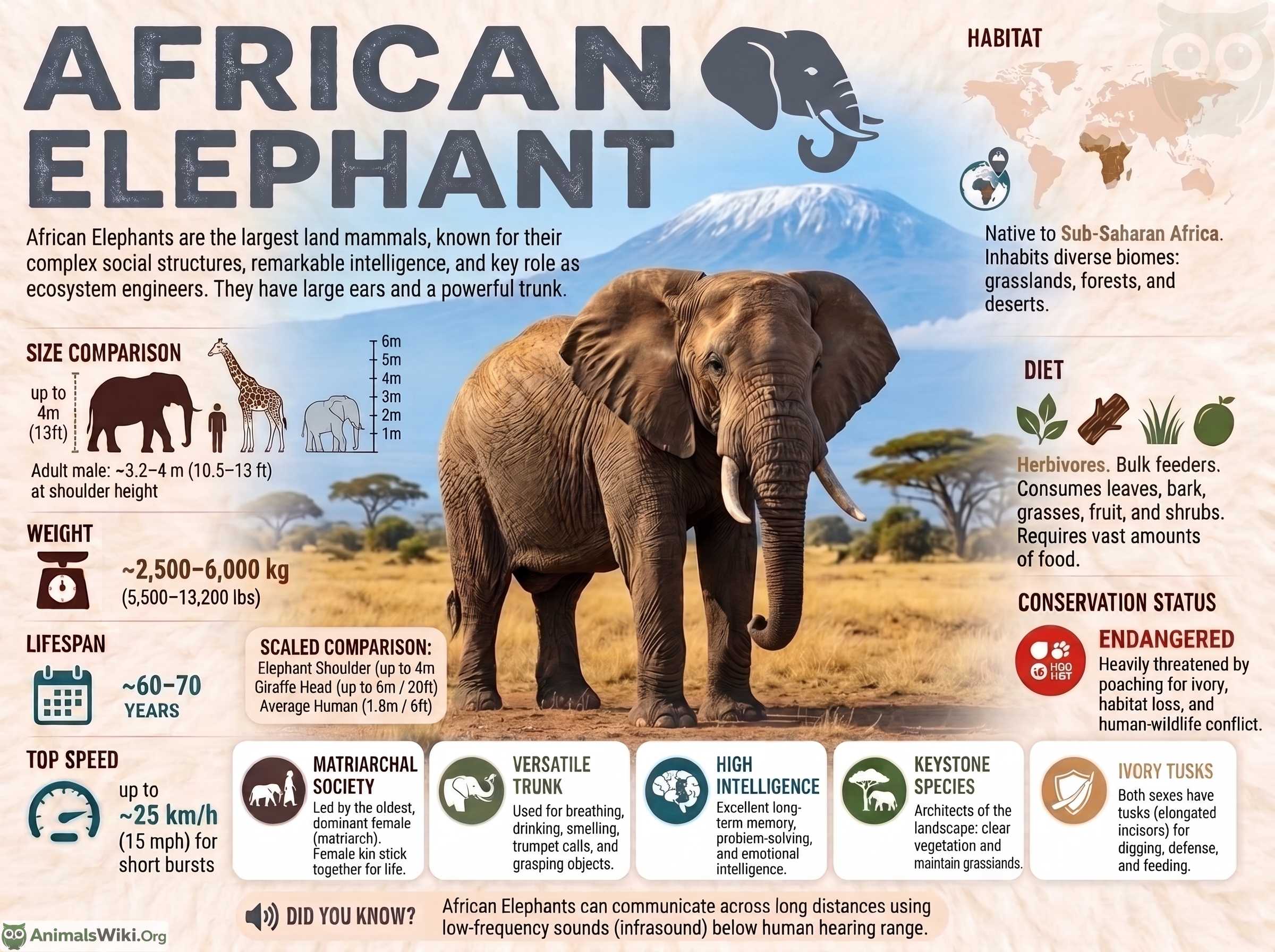
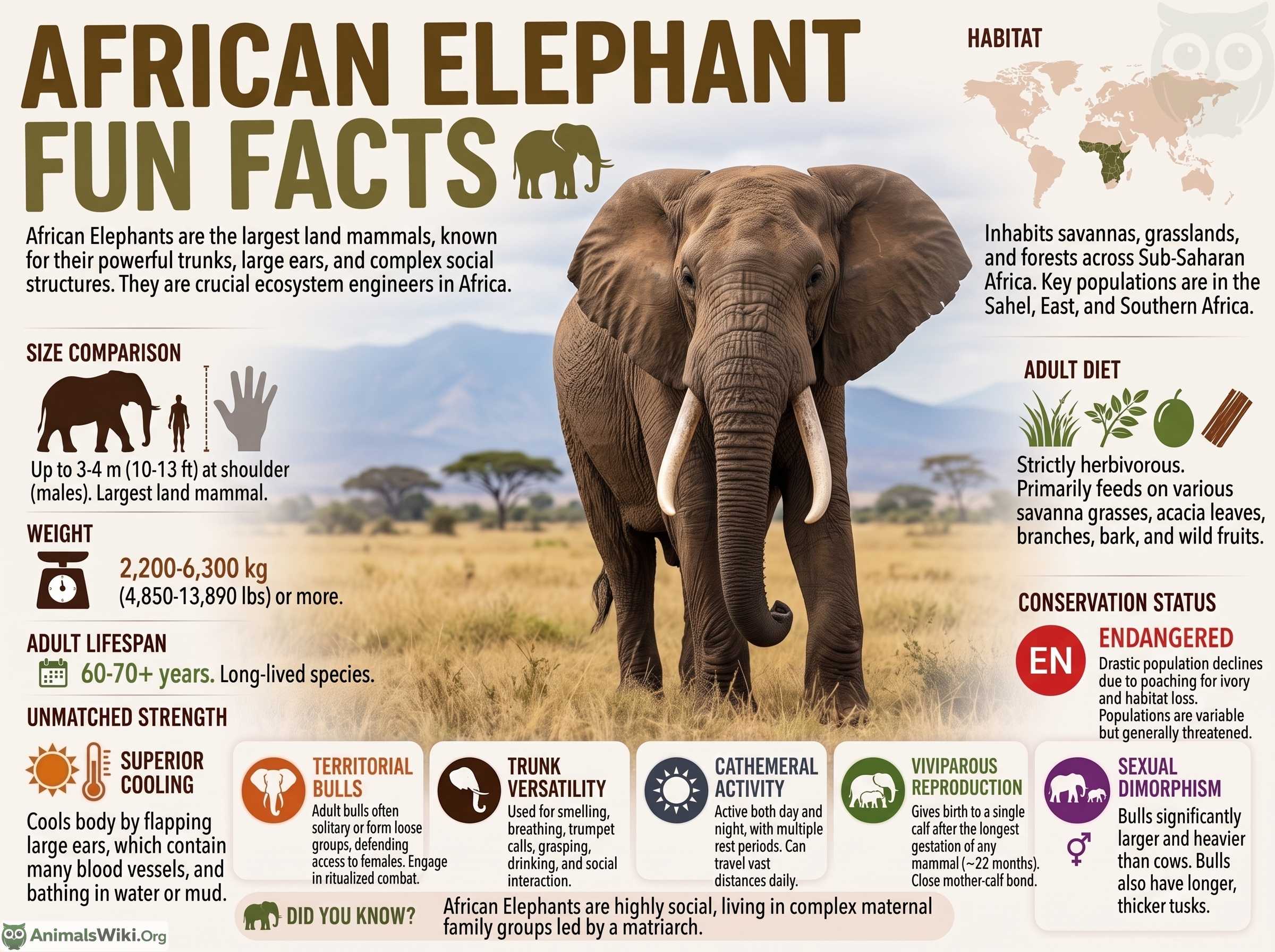
| Average Size | Males: 3.2–4.0 m shoulder height; Females: 2.4–2.8 m |
| Average Weight | Males: 4,700–6,000 kg; Females: 2,700–3,500 kg; largest recorded: 10,400 kg |
| Lifespan | 60–70 years (wild); up to 80 years (captivity) |
| Diet | Herbivore — grasses, leaves, bark, roots, fruits; up to 150–200 kg per day |
| Conservation Status | Endangered (L. africana); Critically Endangered (L. cyclotis — Forest Elephant) |
| Defining Feature | World’s largest land animal; largest ears of any mammal; prehensile trunk with 40,000+ muscles; complex cognition; matriarchal society |
| Global Population | Approximately 415,000–500,000 (savannah); 100,000–150,000 (forest) |
1. Species Overview & Classification
There is an animal walking across the African savannah right now whose footsteps send vibrations through the ground detectable by other members of its species several kilometers away. An animal that mourns its dead — returning to the bones of deceased family members and touching them with its trunk in behavior that even the most cautious scientists describe as grief. An animal that recognizes itself in a mirror — passing the standard test for self-awareness used in comparative psychology. An animal that uses tools, demonstrates empathy, communicates through infrasound frequencies below human hearing, and maintains social relationships of extraordinary complexity across family groups, bond groups, and clans that may involve dozens to hundreds of individuals known personally to each other.
An animal that is, by virtually any measure we care to apply, one of the most cognitively sophisticated and emotionally complex non-human beings that has ever existed on Earth.
The African Elephant — specifically the African Bush Elephant (Loxodonta africana) — is the world’s largest living land animal. It is the surviving representative of one of evolution’s most extraordinary experiments — the order Proboscidea, which once encompassed dozens of species including the mammoths, mastodons, stegodons, and gomphotheres that roamed every continent except Antarctica and Australia. Today, only three elephant species remain — and all three are threatened with extinction — in one of the most urgent and most complex conservation crises of the 21st century.
The African Elephant’s story encompasses everything that makes conservation both inspiring and heartbreaking — a species of extraordinary cognitive depth whose ivory has driven it to the edge of extinction, whose habitat is being compressed by one of the fastest-growing human populations on Earth, yet which also represents some of conservation’s most significant successes — populations that have recovered substantially in protected areas where management has been effective, demonstrating that it is still possible to coexist with these magnificent animals if the political will and resources can be marshalled.
Understanding the African Elephant means engaging simultaneously with cutting-edge cognitive science, ancient evolutionary history, complex community-based conservation, and some of the most profound ethical questions about humanity’s relationship with the natural world. Few animals demand more of us — intellectually, ethically, and practically — and few would reward our response more generously.
Species Classification Table
| Classification Level | Details |
|---|---|
| Kingdom | Animalia |
| Phylum | Chordata |
| Class | Mammalia |
| Order | Proboscidea |
| Family | Elephantidae |
| Genus | Loxodonta |
| Species | L. africana (Bush/Savannah) and L. cyclotis (Forest) |
| Focus Species | Loxodonta africana — African Bush/Savannah Elephant |
| Described By | Johann Friedrich Blumenbach, 1797 |
The Three Living Elephant Species
| Species | Scientific Name | Range | Size | IUCN Status |
|---|---|---|---|---|
| African Bush Elephant | Loxodonta africana | Sub-Saharan Africa (savannah/woodland) | Up to 6,000 kg | Endangered |
| African Forest Elephant | Loxodonta cyclotis | Congo Basin and West Africa | Up to 3,000 kg | Critically Endangered |
| Asian Elephant | Elephas maximus | South and Southeast Asia | Up to 5,000 kg | Endangered |
The African Forest Elephant — A Separate Species
The recognition of the African Forest Elephant (Loxodonta cyclotis) as a species distinct from the African Bush Elephant was formally established through genetic analysis in 2001 and has been progressively confirmed by subsequent molecular studies — though the two species’ ranges do overlap in some areas of Central and West Africa and hybridization occurs. The two species differ in:
- Size — Forest Elephants are significantly smaller (typically 2.4–2.8 meters shoulder height versus 3.2–4.0 meters for Bush Elephants)
- Tusk orientation — Forest Elephant tusks are straighter and point downward; Bush Elephant tusks curve outward and upward
- Ear shape — Forest Elephant ears are smaller and more oval; Bush Elephant ears are larger and shaped like the African continent
- Habitat — Forest Elephants inhabit dense tropical forest; Bush Elephants primarily inhabit savannah, woodland, and grassland
- Conservation status — Forest Elephants are Critically Endangered (worse than Bush Elephants) due to severe poaching pressure and extensive deforestation of the Congo Basin
Did You Know? The African Elephant has the largest brain of any land animal — weighing approximately 5 kg (11 lbs) — and the cerebral cortex (the part associated with complex cognition) has as many neurons as a human brain, though organized differently. Research has demonstrated that African Elephants can pass the mirror self-recognition test (one of the standard assessments for self-awareness), demonstrate empathy toward injured or distressed group members, appear to show grief behaviors at the death of family members, and solve complex multi-step problems requiring planning and tool use. They may be the most cognitively complex non-primate land animals alive.
2. Physical Description & Unique Features
The African Elephant’s physical form is the product of 55 million years of proboscidean evolution — a body plan refined through successive generations of increasingly massive, increasingly capable animals to produce the most powerful and most cognitively sophisticated terrestrial herbivore that has ever lived.
Size — Unrivaled on Land
The African Bush Elephant is the undisputed world’s largest living land animal:
Males (bulls):
- Shoulder height: 3.2–4.0 meters (10.5–13.1 feet) — the height of a single-story building
- Body length: 5.5–7.5 meters (18–25 feet)
- Weight: 4,700–6,000 kg (10,360–13,230 lbs); exceptional individuals exceed this range
- Largest reliably documented: The Fénykövi Elephant shot in Angola in 1955 — 4.21 meters at the shoulder and estimated 10,400 kg — the largest land animal recorded in modern times
Females (cows):
- Shoulder height: 2.4–2.8 meters (7.9–9.2 feet)
- Weight: 2,700–3,500 kg (5,950–7,700 lbs)
- Females are significantly smaller than males — pronounced sexual dimorphism
Growth: African Elephants continue growing throughout their lives — though growth rate slows dramatically after sexual maturity, old bulls continue adding mass and height into their 40s and 50s. The largest males encountered in any elephant population are typically the oldest.
The Trunk — 40,000 Muscles, Infinite Capability
The elephant’s trunk is the most extraordinary appendage of any land animal — a fusion of the elongated nose and upper lip into a prehensile organ of remarkable sensitivity, strength, and precision:
Muscle count: Approximately 40,000 individual muscles — more than the entire human body’s 650 muscles; none of these are bones — the trunk is pure muscle and connective tissue, giving it extraordinary flexibility in every direction simultaneously
Sensory capability:
- Olfaction: The trunk’s tip contains approximately 2,000 olfactory receptor genes — nearly five times the human complement; elephants have the most acute sense of smell of any animal tested; they can detect water sources at 19+ km distance and identify individual humans by scent
- Touch: The trunk tip is extraordinarily sensitive — capable of feeling the temperature and texture of objects with near-finger-like precision; the African Elephant’s trunk tip has two “fingers” (compared to the Asian Elephant’s one) providing even greater manipulative precision
Strength: A large bull’s trunk can lift over 350 kg — sufficient to topple small trees; it can also pick up a single grain of rice without damaging it — a dynamic range of force application unmatched by any other animal appendage
Functions: The trunk performs an extraordinary range of functions:
- Drinking — sucking up to 15 liters of water in a single drink and squirting it into the mouth
- Breathing — functioning as a snorkel when crossing deep water
- Feeding — grasping, pulling, stripping, and delivering food to the mouth
- Social interaction — greeting, comfort, play, and dominance assertion through trunk touching
- Communication — producing vocalizations including roars, rumbles, and infrasound
- Tool use — picking up sticks and branches for scratching, fly-swatting, and object manipulation
- Dust bathing — drawing up dust and spraying it onto the skin for sun protection and parasite control
The Ears — Natural Air Conditioners
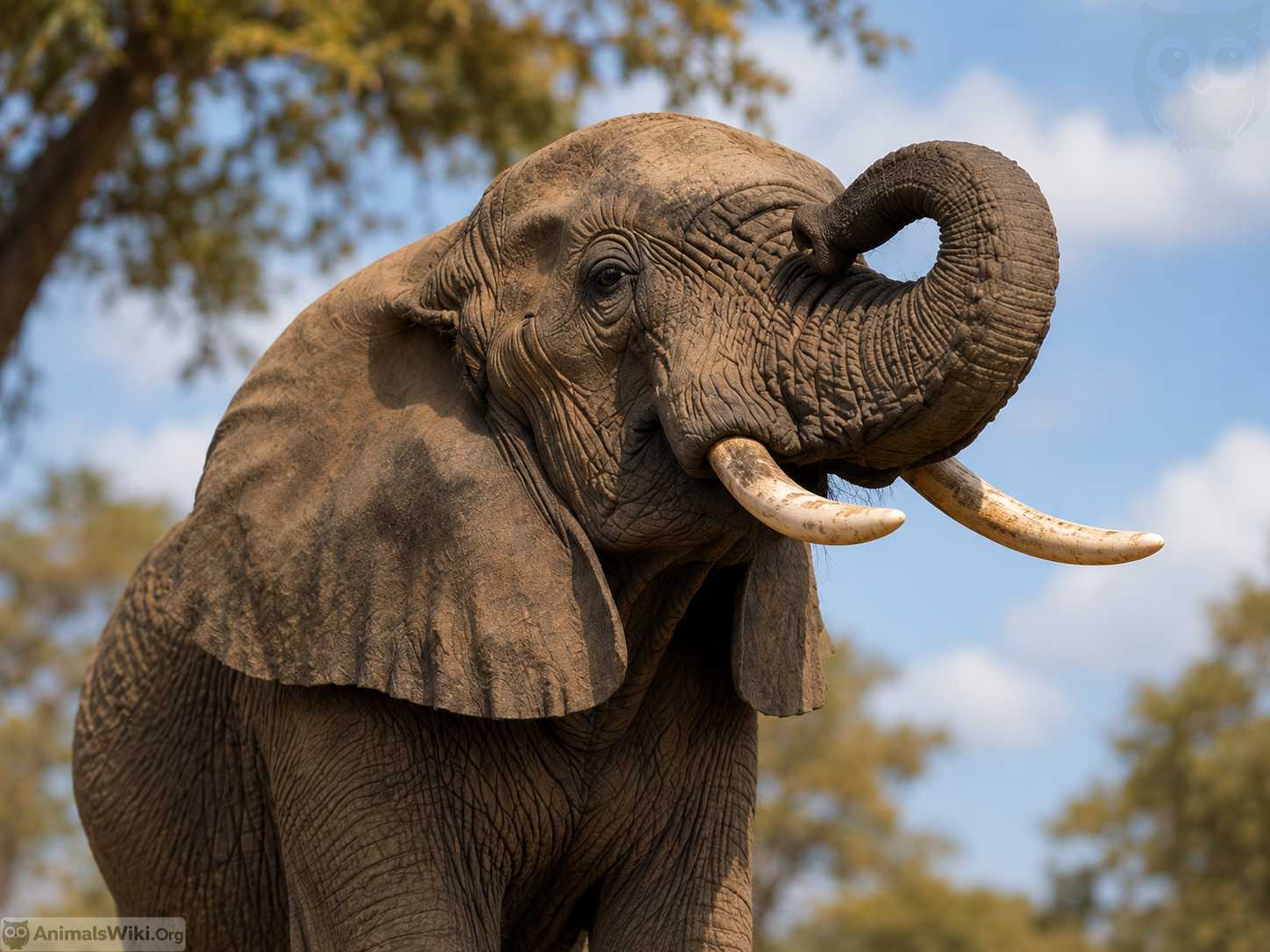
The African Elephant’s ears are the largest of any living animal — each ear measuring approximately 1.5–2 meters in height and 1.0–1.5 meters in width — total ear area of 1.5–2.5 m² per animal. The famous shape — resembling the outline of the African continent — is one of the most recognizable animal silhouettes in the world.
The ears’ primary function is thermoregulation — not hearing:
Heat dissipation mechanism: The ear’s inner surface is laced with an extraordinarily dense network of blood vessels; as blood circulates through these surface vessels, heat is radiated to the air; the elephant fans its ears continuously in hot conditions — moving up to 3°C of body heat per hour; at 35°C ambient temperature, an elephant without ear-fanning would rapidly overheat
The African-Asian ear difference: African Elephants’ ears are dramatically larger than Asian Elephants’ — reflecting the hotter, more exposed savannah environments of Africa versus the shaded forest habitats of Asia; more heat dissipation surface area is required in the African environment
Hearing function: Despite their size, elephant ears are not proportionally better at hearing than smaller ears — the acoustic function of the large ear flap is secondary to thermoregulation; elephant acoustic sensing relies more on bone conduction (detecting ground vibrations through the feet) than on conventional airborne sound detection
The Tusks — Ivory, Weapon, and Social Symbol
African Elephant tusks are elongated upper incisors — modified teeth that grow continuously throughout the animal’s life and can reach extraordinary lengths in old bulls:
Record tusks: The largest documented African Elephant tusks measured 3.5 meters (11.5 feet) in length and weighed 117 kg (258 lbs) each — an extraordinary anatomical achievement; most adult bull tusks are considerably more modest at 1.5–2.5 meters
Functions:
- Digging — excavating mineral-rich soil at salt licks; digging for water in dry riverbeds; uprooting roots for food
- Bark stripping — stripping bark from trees for food
- Combat — used in male-male competition; tusk wounds from fighting bulls can be severe and occasionally fatal
- Defense — used against predators; a charging elephant’s tusks are formidable weapons
- Carrying — used as a rest for the trunk during long walks (the trunk is heavy and tiring to hold extended)
Handedness: Like humans, elephants show tusk laterality — preferentially using one tusk over the other; the “master tusk” typically shows more wear; approximately 60% of elephants show right tusk dominance
Tuskless elephants: A significant and growing phenomenon — in populations that have experienced heavy ivory poaching, tusk-free individuals have increased in frequency dramatically because tuskless elephants were not killed by poachers; in Mozambique’s Gorongosa National Park, where 90% of elephants were killed during the civil war primarily for ivory, the post-war population includes over 50% tuskless females — a dramatic evolutionary response to decades of selection pressure against tusked individuals
Skin
The African Elephant’s skin is extraordinarily thick — up to 3 cm (1.2 inches) in places — yet paradoxically extremely sensitive; elephants react to the touch of a fly on their skin, detecting the precise location of even minor stimuli
Skin care: Elephants spend significant time on skin care — not vanity but genuine physiological necessity:
- Mud bathing — provides sunscreen, insulation, and relief from biting insects; a mud-coated elephant is protected from UV radiation and ectoparasites
- Dust bathing — similar protective function
- Water bathing — regular bathing in rivers and water holes maintains skin condition
- The characteristic grey color of elephant skin is largely the color of dust, mud, and dirt coating the skin; clean elephant skin is darker
Did You Know? The African Elephant’s feet function as seismic sensors — detecting infrasound vibrations traveling through the ground from other elephants kilometers away. The foot pads contain specialized sensory receptors (Pacinian corpuscles) that detect ground vibrations; these signals travel up the leg bones to the inner ear through bone conduction. Elephants communicate through these ground-borne seismic signals as well as through airborne infrasound, effectively having two parallel long-range communication channels — one airborne, one ground-borne — that together create a sophisticated acoustic landscape beyond the perception of most other animals.
3. Natural Habitat & Geographic Range
The African Elephant occupies a broader range of habitat types than any other living terrestrial megafauna — from the hyper-arid margins of the Namib Desert to the dense tropical rainforests of the Congo Basin, from the alpine moorlands of Mount Kilimanjaro to the coastal wetlands of Mozambique.
Habitat Diversity
Savannah and grassland — the quintessential elephant habitat; the open, grass-dominated landscapes of East and southern Africa support the largest elephant concentrations; the mosaic of grassland and acacia woodland provides both food diversity and the open sight-lines that elephants’ visual monitoring capability exploits
Woodland — miombo woodland (dominant across much of central-southern Africa), mopane woodland, and other woodland types support substantial elephant populations; woodland habitat is particularly important for browse (leaves and bark) that supplements the grass diet
Forest — the African Forest Elephant (L. cyclotis) is specifically adapted to dense tropical rainforest; forest elephant populations in the Congo Basin and West Africa inhabit the most biodiverse forest on Earth; they use forest clearings (bais or salines in Central African terminology) for mineral access and social congregation
Desert and semi-arid — remarkable populations of desert-adapted elephants exist in Namibia’s Damaraland and the Kaokoveld — animals that have adapted to survive on much less water and food than typical savannah elephants, traveling enormous daily distances to find resources in areas that would seem impossibly hostile to most large mammals
Wetlands and riverine areas — elephants are strongly drawn to water and frequently concentrate along rivers, lake shores, and wetlands; the Okavango Delta and the Zambezi River system support some of Africa’s highest elephant densities
Montane areas — elephants have been recorded at 4,000+ meters elevation on Mount Kilimanjaro and the Rwenzori Mountains; high-altitude vegetation, including afromontane forest and even moorland, is exploited by some populations
Geographic Range
| Region | Key Countries | Key Protected Areas | Population Status |
|---|---|---|---|
| East Africa | Kenya, Tanzania, Uganda | Amboseli, Tsavo, Serengeti, Selous | Some populations stable/recovering |
| Southern Africa | Botswana, Zimbabwe, Zambia, South Africa, Namibia | Chobe, Hwange, Kruger, Etosha | Botswana and Zimbabwe have largest populations |
| Central Africa | DRC, Cameroon, CAR, Gabon | Virunga, Dzanga-Ndoki, Lopé | Forest elephants; severely threatened |
| West Africa | Ghana, Senegal, Côte d’Ivoire, Mali | Comoé, Niokolo-Koba | Severely reduced; highly fragmented |
| North/Sahel | Chad, Niger, Cameroon (north) | Waza, Zakouma | Small, isolated, recovering populations |
Total Population
The total African Elephant population is estimated at approximately 415,000–500,000 individuals for the Bush Elephant and approximately 100,000–150,000 for the Forest Elephant — with significant uncertainty in both figures. Both figures represent dramatic declines from historical populations estimated in the millions before the ivory trade era.
Botswana holds the largest single-country population — approximately 130,000+ individuals — representing roughly one-quarter of the continent’s savannah elephants; the concentration of such a high proportion of the species’ remaining population in a single country creates significant conservation vulnerability.
4. Diet & Feeding Behavior
The African Elephant’s dietary requirements are staggering in scale — feeding machines of almost industrial proportions whose daily consumption fundamentally shapes the landscapes they inhabit.
What African Elephants Eat
Grass — the primary dietary component for savannah elephants across most of the year; elephants are bulk grazers that consume enormous quantities of grass; they use their trunks to pull bunches of grass from the ground, kick the roots free of soil, and stuff large bundles into the mouth
Browse (leaves, twigs, shoots) — highly important, particularly in dry seasons when grasses are dry and unpalatable; elephants browse from a remarkable diversity of tree and shrub species using their trunks to pull down branches and strip leaves
Bark — consumed in large quantities particularly in dry seasons; bark stripping is one of the most ecologically visible impacts of elephants on woodland — heavily used trees can be completely bark-stripped and killed; the diet switching from leaves to bark in dry conditions reflects the caloric demands of maintaining such large bodies
Roots — excavated using the tusks; roots provide water as well as nutrients in dry conditions; elephants in the Kalahari and other arid areas invest considerable effort in root excavation
Fruits — consumed when available; elephants are important fruit dispersers for numerous African tree species; large fruits that cannot be dispersed by any other animal are consumed and their seeds deposited in dung; the Marula fruit (Sclerocarya birrea) is particularly favored — and the popular but largely mythological idea that elephants become drunk from fermented Marula fruits has been scientifically debunked (the caloric requirement to produce intoxication would require vastly more than any elephant could consume)
Aquatic vegetation — regularly consumed when elephants enter water; aquatic grasses, sedges, and water plants provide minerals and variety
Mineral-rich soil — deliberately consumed at mineral licks; elephants excavate mineral-rich soil and rock using their tusks, consuming material to supplement dietary mineral deficiencies, particularly sodium; some mineral lick sites have been used for so long that the excavations constitute significant geological features
Water — not food per se, but elephants drink 150–200 liters of water per day and may travel remarkable distances to find water; locating water is one of the matriarch’s most critical knowledge functions
Daily Consumption
The scale of elephant feeding is almost difficult to comprehend:
- Daily food consumption: 150–200 kg (330–440 lbs) of food per day for an adult bull — approximately the weight of two adult humans
- Daily water: 150–200 liters — a full bathtub’s worth
- Feeding hours: Approximately 16–18 hours per day are spent feeding or moving to food; elephants spend more waking time feeding than any other activity
Digestive Efficiency — Surprisingly Low
Despite their enormous feeding requirements, elephant digestion is surprisingly inefficient:
- Elephants are hindgut fermenters (like horses) rather than ruminants (like cattle); food passes through the digestive system relatively quickly without the extended fermentation that cattle achieve
- Only approximately 44–50% of consumed plant material is digested and absorbed; the remainder passes through as dung
- This low digestive efficiency means that elephants must consume very large quantities to meet their nutritional needs — which is why they need 150–200 kg of food per day
- The high dung output (approximately 100–150 kg of dung per elephant per day) is ecologically significant — elephant dung is a major nutrient source and seed dispersal mechanism in African ecosystems
Seasonal Dietary Shifts
Elephants shift their diet composition markedly with seasons:
Wet season: Primarily grazing on nutritious green grass; grass constitutes up to 70–80% of the diet; body condition improves rapidly during this period
Dry season: Grass quality declines dramatically as grass dries; elephants shift to browse, bark, and roots; they excavate dry riverbeds for water; they may travel enormous distances (some populations track rainfall and vegetation hundreds of kilometers)
Diet Breakdown Table
| Food Type | % of Diet (Wet Season) | % of Diet (Dry Season) | Notes |
|---|---|---|---|
| Grass | 70–80% | 30–50% | Primary wet season food; quality declines sharply when dry |
| Browse (leaves, twigs) | 15–25% | 30–40% | Increases in dry season; high diversity of species used |
| Bark | 2–5% | 15–25% | Major dry season food; tree-killing impact |
| Roots | 1–3% | 5–10% | Excavated with tusks; important water source |
| Fruits | 2–5% | 2–5% | Seasonal; critical for seed dispersal |
| Aquatic vegetation | 2–5% | 1–3% | Associated with water visits |
5. Reproduction & Life Cycle
The African Elephant’s reproductive biology is calibrated to the slow, careful pace of a long-lived, highly social, cognitively complex animal — with one of the longest gestations, most extended maternal investments, and most delayed sexual maturities of any mammal.
Sexual Maturity
Females (cows): Reach sexual maturity at approximately 10–12 years — earlier in populations with abundant food, later in poor-condition populations; first calves are typically born when females are 12–15 years old
Males (bulls): Reach sexual maturity at approximately 10–14 years but are competitively excluded from mating by larger, older bulls until they are 25–35 years old; the “musth” phenomenon (see below) begins occurring in young bulls from approximately 20 years but achieves full intensity in older, larger individuals
Musth — The Male Reproductive State
Musth is one of the most dramatic and most dangerous behavioral states of any mammal — a period of heightened testosterone (up to 60× normal levels) and extreme aggression that occurs annually in sexually mature bull elephants:
Physiological characteristics during musth:
- Temporal gland secretion — a dark, oily secretion oozing from the temporal glands on the sides of the head; the secretion has a strong, distinctive odor detectable by other elephants at great distance
- Continuous urine dribbling — a green-tinged urine dribbles continuously from the penis during musth; the odor communicates musth status to nearby elephants
- Swollen temporal glands — the glands themselves swell visibly on the sides of the head
- Extreme testosterone elevation — up to 60 times normal circulating levels
Behavioral characteristics:
- Extreme aggression toward other males (including those much larger than the musth male)
- Intensified search for and pursuit of estrous females
- Reduced time spent feeding
- Bulls in full musth have killed other bulls, humans, and even rhinoceroses with seemingly disproportionate ferocity
Competitive significance: Research by Joyce Poole at Amboseli has demonstrated that musth is the key mechanism by which large, old bulls achieve mating success; females actively prefer musth males, and musth bulls drive non-musth bulls away from estrous females regardless of the size difference; musth functions as a costly, honest signal of male quality — only males in excellent physical condition can sustain the metabolic and physical demands of full musth
Gestation — The Longest of Any Land Mammal
- Gestation period: 22 months (approximately 658 days) — the longest gestation of any living land mammal; the long gestation produces an extraordinarily well-developed calf at birth
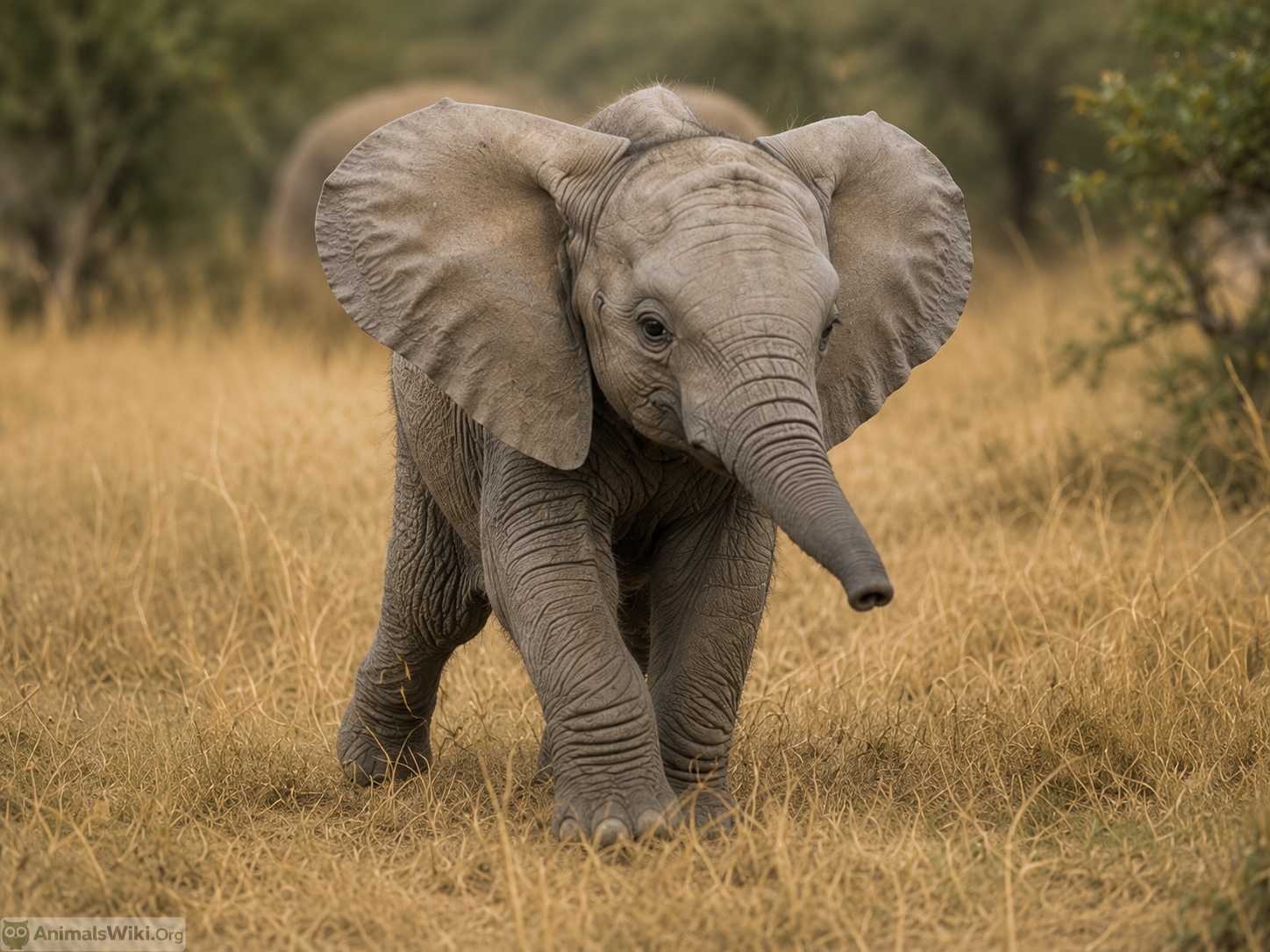
- Birth weight: Approximately 100–120 kg (220–265 lbs) — one of the heaviest mammal neonates
- Birth: Single calves are the rule; twins are extremely rare (approximately 1 in 100 births)
- Birth season: Not strongly seasonal in most populations, though some areas show birth peaks associated with wet seasons
The Birth — A Community Event
The birth of an elephant calf is a social event for the entire family group:
- Allomothering begins immediately — other family members gather around the new calf; allomothers (typically younger females in the family, often the calf’s older sisters) assist with the birth, help the calf stand, and begin learning the maternal behaviors they will need for their own offspring
- The calf is on its feet within 1–2 hours of birth — essential for keeping up with the moving herd
- Nursing begins within hours; elephant milk is extraordinarily rich — approximately 15% fat (compared to human milk at 3–4%)
Maternal Investment — The Elephant Mother
The elephant mother’s investment in her calf is among the most extensive of any mammal:
Nursing duration: Calves nurse for 4–6 years — among the longest nursing periods of any land mammal; nursing may continue even after the birth of a subsequent calf (up to 4–6 years younger)
Protection and teaching: For the first 10+ years of life, the calf is under continuous maternal and allomaternal supervision; calves learn:
- Which foods to eat
- Where water sources are located
- How to navigate the home range
- Social rules and relationships
- How to interact with predators
- Seasonal migration routes
The knowledge transfer: The most critically important thing an elephant mother transmits to her calf is ecological and social knowledge — the mental map of the landscape, the memory of distant water sources, the identity and status of hundreds of other elephants. This knowledge transfer requires years and represents one of the most important reasons why the killing of older, experienced elephants (as poaching typically targets the largest, tusk-bearing individuals) is so catastrophically damaging to population function.
Calving Interval
Females produce a calf approximately every 4–5 years — a long calving interval reflecting the extended nursing period and recovery time. Over a reproductive lifespan of approximately 35–40 years (from first birth to last), a female may produce 7–9 calves in total — a very low lifetime reproductive output for such a large mammal.
Lifespan and the Molar Progression
One of the most remarkable aspects of elephant biology is their unique dental replacement system — unlike most mammals (which have two sets of teeth: baby teeth and adult teeth), elephants produce six sets of molars sequentially throughout their lives:
- Each molar set progresses forward in the jaw over time — new molars form at the rear of the jaw and move forward as older molars wear down
- When the sixth and final set of molars wears out, the elephant can no longer chew food effectively — it gradually loses condition and dies of starvation
- The sixth molar typically wears out at approximately 60–70 years of age — creating a biological “clock” that determines maximum lifespan
This dental limitation means that very old elephants seek softer foods — they preferentially use riverine and wetland vegetation where soft aquatic plants supplement their diet; some very old individuals are observed spending most of their time in water, finding softer food
Maximum recorded age: Approximately 80 years (captivity); 65–70 years appears to be the practical maximum for wild individuals
6. Social Behavior & Communication
The African Elephant’s social system is the most complex of any non-primate land mammal — a multi-level society of extraordinary sophistication built on long-term relationships, cultural knowledge transmission, and acoustic communication across multiple frequency ranges.
The Matriarchal Family Group — Foundation of Elephant Society
The basic unit of elephant society is the family group — typically consisting of 8–15 individuals comprising a matriarch (the oldest, most experienced female), her daughters, her daughters’ daughters, and young males under approximately 14 years of age:
The Matriarch’s Role: The matriarch is the most important individual in the family — not merely the social leader but the living memory of the family group; she holds:
- Knowledge of water sources across the home range, including those visited only in severe drought years
- Knowledge of dozens to hundreds of individual elephants encountered over 50+ years
- Knowledge of human threat — distinguishing between threatening and non-threatening human activities, languages, and behaviors
- Knowledge of seasonal resource locations across potentially thousands of square kilometers
- Knowledge of safe routes through areas of human-wildlife conflict
Research by Karen McComb and colleagues at Amboseli has demonstrated that families led by older matriarchs are more successful at navigating threats, finding resources, and maintaining family cohesion than those led by younger, less experienced females. When a matriarch is killed (typically by poachers targeting the largest, most impressive ivory), the family effectively loses its navigational computer — a loss whose consequences extend for years.
The Bond Group and Clan
Above the family group, elephant society is organized into:
Bond Groups — two to five closely related family groups that maintain preferential association and coordinate movement and activity; bond group members show the most intense greeting ceremonies when reuniting after separation
Clans — multiple bond groups sharing a home range; clan members recognize each other and show social tolerance; clan boundaries overlap less with non-clan members
The total social network of an adult elephant may encompass recognition of hundreds of individuals — maintained through memory of direct encounters and acoustic signatures developed over decades
Communication — A Symphony Across Frequencies
Elephant communication is one of the most sophisticated and most multi-modal of any terrestrial mammal:
Infrasound communication (below 20 Hz): The discovery by Katy Payne in 1984 that elephants communicate through infrasound — sound frequencies below the threshold of human hearing — transformed understanding of elephant social life. Key infrasound facts:
- Elephant infrasound calls travel several kilometers through air; they also travel even further through the ground as seismic waves
- Elephants detect airborne infrasound through their large ears; they detect ground-borne infrasound through their feet (detected by foot pads and transmitted through the skeleton to the inner ear)
- Infrasound is used for: coordinating family movement; advertising musth status; maintaining contact between groups out of visual range; responding to threats; reproductive calling by estrous females
- Individual elephants can be identified by their infrasound “voice” — the specific acoustic characteristics of their calls
Audible vocalizations:
- Rumbles — the most frequent communication; a resonant, low-frequency sound produced by the larynx; used constantly in social context; can contain infrasound components
- Roar and trumpet — loud, high-pitched calls produced during excitement, disturbance, or threat; the trumpet is one of the most recognizable animal sounds
- Screaming — produced in extreme distress or pain
- Chirping and squeaking — produced by calves in various social contexts
Chemical communication:
- Temporal gland secretions — communicate musth status, individual identity, and emotional state
- Urine — carries information about reproductive status, individual identity, and stress levels
- Dung — examined by elephants for information about other individuals
- Elephants’ extraordinary olfactory capability means that chemical communication is as rich and as information-dense as their acoustic communication
Touch:
- The trunk is the primary touch organ for social communication
- Greeting ceremonies involve extensive mutual trunk touching, exploration, and mouth examination
- Comforting a distressed individual through trunk touch is one of the most documented empathic behaviors
- Mothers maintain near-constant tactile contact with young calves through touch
Grief and Death Rituals
One of the most emotionally compelling aspects of elephant behavior is their documented response to death:
- Elephants show intense interest in the remains of deceased elephants — approaching bones and skulls, touching them carefully with the trunk and feet, sometimes remaining at a death site for extended periods
- Family members of recently deceased elephants show behavioral changes consistent with grief — reduced feeding, reduced activity, altered social behavior
- Elephants have been documented touching the bones of their own dead family members with what observers consistently describe as gentle deliberateness — touching and turning bones, returning repeatedly over days
- Whether this constitutes grief in the human sense is philosophically contested but behaviorally unmistakable — the response to death is qualitatively different from the response to any other type of object encounter
Self-Awareness — The Mirror Test
In 2006, researchers Josh Plotnik, Frans de Waal, and Diana Reiss published results demonstrating that African Elephants pass the mirror self-recognition test — recognizing themselves in a mirror rather than treating the reflection as another elephant. This places elephants in the small company of great apes, dolphins, and certain corvids as animals with demonstrated self-awareness by this standard — and suggests cognitive complexity that we are only beginning to characterize.
7. Predators & Defense Mechanisms
The adult African Elephant is essentially invulnerable to predation by any animal other than humans — its size, intelligence, and social organization make it nearly impregnable to any natural predator. The situation is dramatically different for calves.
Natural Predators
Lions (Panthera leo) — the only natural predator of African Elephants, and even lions are restricted to attacking vulnerable individuals:
- Calves under approximately 5 years old are the primary targets; a pride of lions attacking a young calf that has become separated from the family can overwhelm it
- Sick, injured, or severely compromised adults have been killed by lions, but this is unusual
- Family groups are essentially impossible for even a large lion pride to attack successfully — the coordinated defense of the family group (described below) renders group-living elephants safe from lion predation
Spotted Hyena (Crocuta crocuta) — significant predator of newborn calves in the hours after birth before they are mobile enough to stay with the herd; hyena harassment of family groups with young calves is common and dangerous
Nile Crocodile (Crocodylus niloticus) — ambush attacks on elephants at water’s edge; primarily targets calves and young juveniles; adult elephants are too large and too powerful for crocodile predation
Humans — historically and currently the most significant source of elephant mortality; see conservation section
The Defense System — Group Protection as Military Doctrine
Elephant group defense is one of the most impressive cooperative defense systems in the animal kingdom:
Threat detection: The entire family group functions as a collective early-warning system; the matriarch’s experience is central — she can identify the threat level of specific situations (human presence, lion presence, approaching storm) and communicate this assessment to the group through behavior and vocalizations
Calf protection: At the first sign of threat, calves are immediately surrounded by adult females; the calves are physically herded into the center of the group; adult females arrange themselves in an outward-facing defensive ring
The mock charge: The initial response to a perceived threat is typically a mock charge — a demonstration charge where the elephant stops short of contact; this is accompanied by a loud trumpet call, raised head, spread ears (to maximize apparent size), and direct visual contact with the threat; mock charges from multiple family members simultaneously are extremely intimidating
The full charge: If the threat does not retreat, the full charge follows — several tonnes of muscle moving at 25 km/h (15 mph) with lowered head and extended tusks; a genuine elephant charge is one of the most formidable events in nature; few predators hold their ground
Chasing predators: Lion prides and hyena clans that persistently threaten elephant family groups may be actively chased across considerable distances; elephants’ memory means that threatening predators are remembered and actively avoided or pursued on subsequent encounters
8. Relationship with Humans
Ancient Human-Elephant Coexistence
The relationship between humans and African Elephants is as old as modern Homo sapiens itself — the two species sharing the African continent for the full 300,000+ year history of anatomically modern humans. This coexistence has been simultaneously symbiotic and deeply conflicted throughout recorded history:
Hunter-gatherer relationships — the San (Bushmen) and other early hunter-gatherer peoples of Africa hunted elephants as a significant food source; elephant meat from a single individual could feed an entire community for weeks; the elephant appears in San rock art throughout southern Africa in contexts suggesting both practical and spiritual significance
Ancient Egypt and Carthage — the African Forest Elephant (now restricted to the Congo Basin) was historically present in North Africa; the Carthaginian general Hannibal Barca famously crossed the Alps with 37 war elephants in 218 BC during the Second Punic War — one of the most celebrated military campaigns in ancient history; these were almost certainly African Forest Elephants rather than Asian Elephants; the North African elephant population was subsequently hunted to extinction for military use
Ancient Rome — Roman spectacles included elephant performances and elephant combat in the Colosseum; the Romans were the first to document elephant cognition with some sophistication; the elder Pliny wrote that elephants “surpass all other animals in wit and mind”
The Ivory Trade — The History of Exploitation
The ivory trade has been the defining relationship between humans and African Elephants for centuries — and its history is a chronicle of progressive devastation:
Pre-colonial Africa — indigenous ivory trading existed across Africa for millennia; elephant teeth were traded between coastal and interior communities; the scale was modest relative to the elephant population
Colonial era (1800s–early 1900s) — European colonial expansion drove explosive growth in the ivory trade; ivory was used for piano keys, billiard balls, cutlery handles, jewelry, and hundreds of other luxury products; the East African ivory trade centered on Zanzibar exported hundreds of tonnes of ivory annually at its peak; elephant populations across East and Central Africa were dramatically reduced; some areas lost essentially their entire elephant population by the early 20th century
The 1970s–1980s crisis — the combination of African independence (reducing colonial hunting restrictions), increasing global ivory demand (particularly from Japan and China), and the proliferation of automatic weapons produced a catastrophic poaching crisis; African Elephant populations crashed from an estimated 1.3 million animals in 1979 to approximately 600,000 by 1989 — a loss of over half the continental population in a single decade
CITES ivory ban (1989) — international public outrage at the elephant population crash, driven substantially by television footage of ivory poaching and organized advocacy by organizations including the Elefriends campaign and WWF, produced the landmark international ivory trade ban adopted at the CITES meeting in Lausanne in 1989; most commercial international ivory trade was banned overnight; elephant populations in many countries began recovering immediately
The 1997 and 1999 “one-time” ivory sales — in a controversial decision, CITES allowed Zimbabwe, Botswana, and Namibia to sell stockpiled ivory to Japan in 1997 and again in 2008; critics argued these sales stimulated demand and undermined the ivory ban; subsequent research suggested they were associated with increased poaching across Africa
The 2008–2015 poaching crisis — a massive increase in ivory poaching driven primarily by Chinese demand killed approximately 100,000 African Elephants in just three years (2010–2012); the Forest Elephant population of Central Africa lost approximately 64% of its population between 2002 and 2013; this crisis represented the most devastating period for elephants since the 1980s
2016–present — Chinese ivory ban (2017) dramatically reduced demand; ivory prices fell; poaching rates have decreased substantially but not to zero; some populations are recovering but the Forest Elephant crisis remains acute
Human-Elephant Conflict
Human-Wildlife Conflict (HWC) involving elephants is one of the most significant and most complex challenges in African conservation:
The conflict: As human agricultural settlement expands into former elephant habitat, elephants raid crops — particularly maize, sorghum, and root vegetables that represent high-energy food resources; a single elephant raiding a small farm’s maize crop for a single night can destroy a family’s entire annual food supply; the economic and food security consequences are severe; retaliatory killing of elephants is a natural human response
Scale: Elephant crop raiding occurs across virtually all elephant range countries; in some areas the conflict is so severe that it fundamentally determines whether local communities support or oppose elephant conservation
Solutions being developed:
- Beehive fences — strings of beehives along farm boundaries, discovered by Dr. Lucy King and the Elephants and Bees Project; elephants are frightened of bees and actively avoid bee-dense areas; beehive fences are effective, relatively cheap, and provide honey as an additional income source for farmers
- Chili pepper barriers — dried chili pepper and engine oil mixtures applied to fencing or burned produce capsaicin smoke that elephants avoid
- GPS-based early warning systems — elephant GPS collars linked to farmer alert systems; when a collared elephant approaches a farm, the farmer receives a mobile phone alert with time to take deterrence measures
- Community conservancies — land management models in which local communities receive direct financial benefit from elephant conservation (through tourism revenue, trophy hunting fees, or payment for ecosystem services) create economic incentives to tolerate elephant presence
9. Conservation Status & Threats
IUCN Status
- African Bush Elephant (L. africana): Endangered — assessed 2021; significant decline from historical population; key driver: poaching and habitat loss
- African Forest Elephant (L. cyclotis): Critically Endangered — assessed 2021; population declined approximately 86% over 31 years; among the most severe population crashes of any large mammal
Key Threats
1. Ivory Poaching — The Existential Threat
Despite the 1989 CITES ivory ban and reduced poaching rates since 2015, illegal ivory poaching remains the most significant single driver of African Elephant population decline:
- Scale: An estimated 20,000–30,000 African Elephants are killed for ivory annually in recent years (down from peak estimates of 40,000+ per year in 2011–2013)
- Organized crime involvement: The ivory trade is dominated by sophisticated transnational criminal organizations; the supply chain runs from poachers (typically local, impoverished, armed) through traffickers to export markets
- Demand drivers: China (despite the 2017 ban), Vietnam, Thailand, and other Asian markets drive most demand; ivory carving traditions give ivory cultural significance in these markets
- Impact on population structure: Poachers target the largest-tusked individuals — typically the oldest, most experienced bulls and matriarchs; this removes the most reproductively and socially important individuals first; the demographic disruption caused by losing experienced matriarchs has cascading effects on family function, navigation, and cultural knowledge transmission
2. Habitat Loss and Fragmentation
Africa’s human population — approximately 1.4 billion in 2026 and projected to reach 2.5 billion by 2050 — requires agricultural land, settlements, and infrastructure at a rate that directly competes with elephant habitat:
- Agricultural expansion — conversion of savannah and woodland to cropland; reducing available elephant range
- Infrastructure development — road, rail, and energy infrastructure bisecting elephant ranges; roads increase poacher access to remote areas and create mortality from vehicle collisions
- Human settlement — expanding settlement into wildlife corridors that connect protected areas; the isolation of elephant populations in increasingly small habitat islands reduces genetic diversity and population viability
- Fencing — permanent fencing around agricultural and residential areas blocks elephant migration routes
3. Human-Wildlife Conflict
As described above, HWC is simultaneously a conservation threat (through retaliatory killing) and a social justice issue; the people most affected by elephant crop raiding are among the most food-insecure communities in Africa
4. Climate Change
- Drought frequency — increasing drought events reduce vegetation productivity and water availability; dry-season food and water stress increases elephant mortality
- Habitat transformation — climate-driven changes in African vegetation communities may reduce the extent and quality of elephant habitat
- Conflict escalation — drought conditions drive elephants into human-settled areas in search of food and water; conflict intensity increases during drought years
Conservation Successes
Amboseli National Park, Kenya — the most intensively studied elephant population in the world (studied continuously since 1972 by the Amboseli Elephant Research Project, founded by Cynthia Moss and colleagues); population has increased from approximately 600 individuals in the 1970s to over 1,800 today; critical research site for understanding elephant cognition and social behavior
Northern Botswana — Botswana’s population has grown to approximately 130,000 individuals — the largest national elephant population in the world — through strong anti-poaching enforcement and wildlife management
Kruger National Park, South Africa — recovered population now numbering approximately 20,000+ individuals; conservation management challenges around population management in a finite protected area
Kenya’s elephant population — recovered from approximately 16,000 in the 1980s to approximately 36,000 today through strong anti-poaching enforcement, community conservancy programs, and international support
10. Famous African Elephants Around the World
Ahmed — Kenya’s Protected Bull
Ahmed — a massive bull elephant with enormous tusks famous in the Marsabit region of northern Kenya — was so culturally and nationally significant that President Jomo Kenyatta issued a presidential decree in 1970 placing him under personal presidential protection; rangers were assigned specifically to guard Ahmed 24 hours a day until his natural death in 1974. His taxidermied remains are displayed at the National Museum of Kenya in Nairobi. Ahmed was one of the first individual animals to receive explicit presidential protection in African history.
Echo — Amboseli’s Most Famous Matriarch
Echo (EB)— the matriarch of the EB family in Amboseli National Park, Kenya — was the most intensively studied and most famous individual elephant in the history of elephant research. Born approximately 1945, she led her family for decades through droughts, poaching crises, and habitat changes. Echo was the subject of a National Geographic documentary and numerous scientific publications by Cynthia Moss and colleagues. She died of natural causes in 2009 at approximately 64 years of age. Her death was mourned by the Amboseli research community that had known her for 37 years, and her family’s subsequent leadership challenges demonstrated in real time the importance of experienced matriarchs to family function.
Satao — Africa’s Most Famous Tusker
Satao — a “tusker” bull (an elephant with tusks long enough to touch the ground) living in Tsavo East National Park, Kenya — became internationally famous through photographs published by wildlife photographer Mark Deeble in 2013–2014; his images of this extraordinary animal with his massive, ground-sweeping tusks went viral globally. Satao was killed by poisoned arrow from poachers in May 2014 — his face cut off for the ivory. The global reaction to his death was one of the most significant wildlife conservation public engagement moments of the decade, driving significant attention and donations to Kenyan elephant conservation organizations.
Jumbo — The First Global Animal Celebrity
Jumbo — a male African Elephant who lived at the London Zoo from 1865 to 1882 before being sold to P.T. Barnum’s circus — was the world’s first genuine international animal celebrity. Standing approximately 3.3 meters at the shoulder, Jumbo was considerably larger than most zoo elephants and drew enormous crowds; his sale to Barnum generated a national uproar in Britain with Queen Victoria reportedly expressing personal distress. The word “jumbo” — now a generic English word meaning “very large” — derives entirely from this individual elephant’s name, making Jumbo one of the very few individual animals to contribute a word to the English language. Jumbo was killed by a freight train in St. Thomas, Ontario, Canada in 1885.
The Tsavo Elephants — Literary Fame
The elephants of Tsavo National Park in Kenya achieved literary fame through the work of Daphne Sheldrick — whose David Sheldrick Wildlife Trust pioneered the hand-raising and rehabilitation of orphaned elephant calves at Tsavo. The Trust has raised and successfully reintroduced over 200 orphaned elephant calves to the wild since its founding — the most successful elephant orphan rehabilitation program in the world. Individual orphaned calves with names like Dika, Ilingwesi, Olmeg, and dozens of others have been followed by global supporters who “adopt” them through the Trust’s adoption program.
11. Role in Ecosystem & Food Chain
Elephants as Ecosystem Engineers — Transforming Landscapes
The African Elephant is one of the most significant ecosystem engineers of any animal on Earth — physically transforming the landscape at scales that influence the entire savannah ecosystem:
Vegetation transformation:
- Elephants knock down trees — pushing over large trees to access leaves and bark; this tree-felling creates clearings in woodland that transition to grassland; the mosaic of woodland and grassland maintained by elephant tree-felling is essential for numerous other species (including savannah lions, cheetahs, and open-country birds) that cannot use dense woodland
- Bark stripping kills trees that survive being pushed over; bark-stripped trees become standing dead wood, providing nest sites for birds and habitat for insects and small mammals
- Browsing pressure on specific tree species influences woodland composition — elephants’ dietary preferences shape which tree species dominate landscapes over decades
Water access:
- In the dry season, elephants excavate water from dry riverbeds and water holes — digging into sandy substrates with their tusks and feet to access subsurface water; these excavations provide drinking water for dozens of other species that cannot dig; the elephant-created water holes are critical dry-season resources for impalas, zebras, warthogs, and many other species
Nutrient cycling:
- Each elephant produces approximately 100–150 kg of dung per day — an enormous nutrient package distributed across the landscape; elephant dung is colonized by over 100 species of dung beetles (one of the most important decomposer guilds in savannah ecosystems); dung beetles’ burial of elephant dung cycles nutrients into the soil and aerates compacted ground
- Urine from thousands of elephants across a landscape represents a significant mineral input to savannah soils
Elephants as Seed Dispersers
African Elephants are among the most important long-distance seed dispersers in African ecosystems:
- Elephants can travel 50–70 km per day during seasonal movements; seeds consumed at one end of this travel and deposited at the other end are dispersed across distances no other African seed disperser can match
- Large-fruited tree species (including the Marula, Acacia, and many others) are almost entirely dependent on elephants for long-distance seed dispersal
- Research has demonstrated that the genetic structure of some African tree populations reflects centuries of elephant-mediated seed dispersal — gene flow patterns that would not exist in the absence of elephants
- Removal of elephants from forest ecosystems (“empty forest syndrome”) is associated with changes in tree species composition as large-fruited species fail to recruit
“The Elephant — Without Whom the Forest Cannot Survive”
This statement — attributed to various African conservation contexts — reflects a scientific reality: many African forest and woodland ecosystems are fundamentally structured by elephant activity. Long-term studies in areas where elephants have been removed (through poaching or management interventions) consistently show:
- Woodland thickening — in the absence of elephant tree-felling and bark-stripping, woodland becomes denser; species diversity typically decreases
- Grass decline — as woodland thickens, grass cover decreases; species dependent on open grassland decline
- Prey decline — as grass declines, grazing animals decline; predator populations follow
- Tree community shift — without elephant seed dispersal, large-fruited trees fail to maintain their populations; smaller-fruited, bird-dispersed species become relatively more abundant
12. Myths, Culture & Pop Culture Appearances
African Cultural Traditions — Elephants as Spiritual Beings
The African Elephant is one of the most culturally significant animals across the continent — featuring in the spiritual traditions, political symbolism, and artistic output of dozens of African cultures:
Central African spiritual traditions — among the Baka, Aka, and other forest peoples of Central Africa, the Forest Elephant is associated with forest spirits and is a central figure in initiation ceremonies and spiritual practice; the elephant’s apparent intelligence and social complexity gives it a quasi-human status in many traditions
West African royalty symbolism — the elephant is widely used as a symbol of royal power, wisdom, and longevity across West African kingdoms; the Ashanti of Ghana, the Yoruba of Nigeria, and many other West African peoples use elephant imagery in royal regalia, court art, and political symbolism; the elephant’s combination of enormous power and social intelligence makes it a natural metaphor for ideal kingship
East African Maasai traditions — while the Maasai are primarily pastoralists who have historically been in conflict with elephants (who compete with cattle for water and grass), the elephant is respected as a powerful spirit animal and its wisdom is invoked in certain ceremonial contexts
The Ganesh connection — Hindu influence in East Africa — the Hindu elephant-headed god Ganesh (Ganesha) — one of the most widely worshipped deities in Hinduism — has influenced elephant symbolism in East Africa through the substantial South Asian diaspora in Kenya, Tanzania, and Uganda; the association of the elephant with wisdom, luck, and the removal of obstacles has been embraced by some African communities in these areas
Ancient Western Mythology
Pliny the Elder’s Natural History — the Roman encyclopedist Pliny the Elder (23–79 AD) wrote extensively about elephants in his Naturalis Historia, describing them with a combination of factual accuracy and mythological embellishment that established the elephant’s reputation for extraordinary intelligence in the Western tradition; Pliny recorded that elephants worshipped the moon, understood human language, and possessed a form of moral virtue; while specific claims were wrong, his overall characterization of extraordinary elephant intelligence has been substantially vindicated by modern cognitive science
The Medieval Bestiary tradition — medieval European bestiaries (illustrated books of animals with moral lessons) featured the elephant prominently; typical bestiary elephant lore included the belief that elephants had no knee joints (they sleep leaning against trees), that females gave birth in water to avoid dragons, and that they were terrified of mice; the accurate element was the consistent emphasis on elephant intelligence and memory
Pop Culture Appearances
- “Dumbo” (Disney, 1941 and 2019) — the flying elephant with enormous ears that can be used as wings; loosely based on a fictional circus elephant; the original animated film and the 2019 live-action remake both contributed to public sympathy for captive elephant welfare; while factually fictional, the films’ emotional impact on public attitudes toward elephant captivity and the circus industry has been significant
- “Echo” (various National Geographic and BBC productions) — the famous matriarch of the EB family in Amboseli was the subject of multiple BBC and National Geographic documentaries that introduced millions of viewers to elephant family life, matriarchal society, and individual elephant personalities; these programs are widely credited with fundamentally changing Western public attitudes toward elephants as cognitively complex animals deserving of moral consideration
- “The Elephant Whisperer” by Lawrence Anthony (2009) — memoir of Lawrence Anthony, who rescued a herd of traumatized elephants at Thula Thula reserve in KwaZulu-Natal; the book and the story of the elephants appearing at his house upon his death have become one of the most celebrated elephant stories in popular conservation literature
- “Ivory Game” (Netflix, 2016) — award-winning documentary on the ivory poaching crisis; generated significant public attention to ivory trade issues at a critical moment in the poaching crisis
- “Dynasties” (BBC, 2018) — David Attenborough narrated episode featuring elephant family dynamics in Amboseli; extraordinary footage of matriarch-led family decision-making
- “Planet Earth” series (BBC) — multiple episodes across multiple series have featured African Elephants; the spectacular footage from Amboseli, Chobe, and other sites has shaped global public understanding of elephant ecology
- Various conservation games and apps — elephants feature as key species in numerous conservation-themed games; their symbolic importance makes them natural flagship species for gaming contexts
- Corporate and political symbolism — the elephant is used as a symbol by organizations worldwide; most famously, the Republican Party of the United States uses an elephant as its symbol (since a Thomas Nast cartoon in 1874); Côte d’Ivoire, Botswana, and several other African nations feature elephants in national imagery
Did You Know? When conservation icon Lawrence Anthony — known as the “Elephant Whisperer” for his work rehabilitating traumatized elephants at Thula Thula reserve in South Africa — died in March 2012, two separate herds of elephants that he had rescued and cared for arrived at his house within days of his death, despite having had no contact with him for over a year. The herds walked for approximately 12 hours through the bush to reach his house and spent two days near his home before departing. How the elephants knew he had died remains unexplained — they were not on the property at the time of his death and could not have heard or smelled anything associated with the event. The incident is one of the most extraordinary documented examples of apparent elephant grief and awareness.
13. Discovery & Evolution Timeline
~55 million years ago — The order Proboscidea (elephants and their relatives) first appears in the fossil record; the earliest proboscideans are small, roughly pig-sized animals without the elongated trunk or tusks of later forms.
~35–40 million years ago — Proboscideans begin diversifying substantially; the proto-trunk begins developing in some lineages as an elongation of the nose and upper lip.
~25 million years ago — The first true Elephantidae (true elephants) appear; tusks are established as a consistent feature; the family begins radiating across Africa and subsequently into Eurasia.
~7–8 million years ago — The mammoth lineage (Mammuthus) diverges from the main elephant lineage; early mammoths are African animals before moving to Eurasia.
~6 million years ago — The African Elephant (Loxodonta) lineage diverges from the Asian Elephant (Elephas) lineage; the evolutionary separation of the two living elephant genera is established.
~3–4 million years ago — Loxodonta diversifies within Africa; ancestors of both the Bush and Forest Elephant are established.
~1.5–2 million years ago — The African Bush Elephant (Loxodonta africana) and African Forest Elephant (Loxodonta cyclotis) lineages diverge; the two species evolve in their respective habitats.
~12,000 years ago — The Woolly Mammoth (Mammuthus primigenius) and most other Pleistocene megafauna begin going extinct; the causes are debated (climate change + human hunting); the extinction of mammoths and mastodons leaves only the three living elephant species.
Pre-colonial Africa — African Elephants are present across virtually all of sub-Saharan Africa and into North Africa; population estimated in the millions; indigenous hunting maintains sustainable offtake; elephant ivory is traded along East African coastal routes.
218 BC — Hannibal Barca crosses the Alps with 37 war elephants — almost certainly African Forest Elephants from Carthage’s North African supply; the campaign represents the most famous use of African Elephants in ancient warfare.
~1st–7th centuries AD — North African elephant population eliminated through hunting for military use and Roman arena spectacles.
~1650–1850 — Colonial-era ivory trade expands; elephant populations across East and Central Africa begin declining; Zanzibar becomes the center of the East African ivory trade.
1865 — Jumbo arrives at London Zoo; becomes the world’s first international animal celebrity.
1907 — Carl Akeley develops the revolutionary diorama display method at the American Museum of Natural History; produces the elephant dioramas that remain iconic today; Akeley is also one of the founders of what becomes Virunga National Park — Africa’s first national park, established 1925.
1972 — Cynthia Moss begins the Amboseli Elephant Research Project — the longest continuously running elephant research program in the world; 50+ years of data have produced foundational knowledge of elephant cognition, social organization, and ecology.
1979 — Aerial survey estimates 1.3 million African Elephants continent-wide; subsequent surveys reveal rapid decline.
1984 — Katy Payne discovers that elephants communicate through infrasound — one of the most significant discoveries in animal communication research.
1989 — CITES ivory ban passes at the Lausanne convention; international ivory trade banned; elephant populations begin recovering in many areas.
2001 — Genetic analysis confirms African Bush and African Forest Elephants as distinct species.
2006 — Plotnik, de Waal, and Reiss publish results showing African Elephants pass the mirror self-recognition test.
2008–2013 — Major poaching crisis; estimated 100,000+ elephants killed; Forest Elephant population crashes by 64%.
2017 — China closes its domestic ivory market — the most significant single action in ivory demand reduction in history.
2021 — IUCN updates African Elephant assessments: Bush Elephant Endangered; Forest Elephant Critically Endangered.
2026 — Elephant conservation remains one of Africa’s most complex and most important conservation challenges; populations recovering in some areas, continuing to decline in others; climate change emerging as an increasingly significant additional pressure.
14. Comparison with Similar Species
| Feature | African Bush Elephant (L. africana) | African Forest Elephant (L. cyclotis) | Asian Elephant (Elephas maximus) | Woolly Mammoth (Mammuthus primigenius) — EXTINCT |
|---|---|---|---|---|
| Size (male) | Up to 6,000 kg; 4.0 m shoulder | Up to 3,000 kg; 2.7 m shoulder | Up to 5,000 kg; 3.5 m shoulder | Up to 6,000+ kg; 3.5 m shoulder |
| Ears | Very large; shaped like Africa | Smaller; more oval | Much smaller; rounded | Small; adapted to cold |
| Tusks | Long; curved outward/upward | Straighter; pointing downward | Males only (some populations); smaller | Long; strongly curved |
| Trunk “fingers” | Two | Two | One | One (presumed) |
| Highest point | Shoulders | Shoulders | Top of head (domed) | Shoulders with pronounced hump |
| Skin | Grey; sparse hair | Grey; sparse hair | Grey; slightly more hair | Covered in dense brown fur |
| Habitat | Savannah, woodland | Tropical rainforest | Forest, grassland, scrub | Cold steppe-tundra |
| Range | Sub-Saharan Africa | Congo Basin, W Africa | South/SE Asia | Pleistocene Eurasia/N America |
| IUCN Status | Endangered | Critically Endangered | Endangered | EXTINCT (~4,000 years ago) |
| Closest relative | L. cyclotis | L. africana | Elephas (more distant from both) | Elephas (sister group) |
15. Best Places to See African Elephants in the Wild
East Africa
- 🇰🇪 Amboseli National Park, Kenya — arguably the world’s premier elephant watching destination; extraordinary views of large elephant herds against the backdrop of Mount Kilimanjaro; the most intensively studied elephant population in the world; the Amboseli Elephant Research Project has individually identified nearly every elephant in the population; elephants are highly habituated to vehicles and approachable; best time: dry season (June–October and January–February) when vegetation is lower and elephants concentrate at water; the famous “big tuskers” of Amboseli are among the most photographed elephants in the world
- 🇰🇪 Tsavo East and West National Parks, Kenya — massive parks supporting large elephant populations; the red elephants of Tsavo (their grey skin dusted red with Tsavo’s distinctive red laterite soil) are iconic; less vehicle traffic than Amboseli; wilder experience
- 🇹🇿 Serengeti National Park, Tanzania — large elephant population integrated into the world’s greatest wildlife ecosystem; elephants visible throughout the park but most concentrated in the western Corridor and near the Grumeti River
- 🇹🇿 Tarangire National Park, Tanzania — exceptional elephant density in the dry season; the Tarangire River attracts hundreds of elephants during the dry season months; considered by many wildlife photographers to be the best elephant photography destination in Africa during dry season
Southern Africa
- 🇧🇼 Chobe National Park, Botswana — the Chobe River frontage supports some of the densest elephant concentrations in Africa; boat safaris on the Chobe River provide remarkable close-up encounters with elephants drinking, bathing, and swimming; the herds regularly number in the hundreds; Botswana’s commitment to anti-poaching has produced the largest national elephant population in the world
- 🇿🇼 Hwange National Park, Zimbabwe — Zimbabwe’s largest national park; large elephant population; the park’s waterholes (some artificially pumped) concentrate extraordinary numbers of elephants in the dry season; some of the largest bull elephants in Africa are found here
- 🇿🇦 Kruger National Park, South Africa — South Africa’s flagship park; substantial elephant population of approximately 20,000 animals; easily accessible from Johannesburg; excellent road network for self-drive; elephants viewable reliably throughout the park
- 🇳🇦 Etosha National Park, Namibia — waterholes in this semi-arid park produce exceptional concentrated elephant sightings; the dry, pale landscape provides distinctive photographic conditions; floodlit waterholes at some camps allow remarkable nocturnal elephant viewing
West and Central Africa
- 🇬🇦 Lopé National Park, Gabon — the best accessible site for African Forest Elephant observation; elephants use the park’s forest clearings (bais) for mineral access; the Lopé-Okanda forest-savannah mosaic is a UNESCO World Heritage Site
- 🇨🇲 Dzanga-Sangha Special Reserve, CAR — Dzanga Bai (“the village of elephants”) is one of the world’s most extraordinary wildlife spectacles — a large forest clearing regularly visited by 50–100+ Forest Elephants simultaneously; the most important site in the world for Forest Elephant research and observation; requires specialist organization due to remoteness
16. African Elephant Fun Facts for Kids
- 🐘 The African Elephant is the world’s largest land animal — bulls can weigh up to 6,000 kg (the weight of six family cars)
- 🐘 The elephant’s trunk contains approximately 40,000 individual muscles — more than the entire human body
- 🐘 African Elephants communicate through infrasound — low-frequency sounds below human hearing that travel through air and ground for several kilometers
- 🐘 Elephants have the longest gestation of any land mammal — 22 months (658 days), nearly twice the length of a human pregnancy
- 🐘 Elephants are one of only a handful of animals to pass the mirror self-recognition test — demonstrating self-awareness
- 🐘 The word “jumbo” in English comes from the name of a famous individual elephant at London Zoo in the 1860s–1880s
- 🐘 An elephant’s daily food requirement is 150–200 kg — approximately the weight of three adult humans
- 🐘 Elephants produce 100–150 kg of dung per day — an enormous nutrient package that supports over 100 species of dung beetles
- 🐘 The largest elephant ever recorded weighed an estimated 10,400 kg — heavier than two adult hippos
- 🐘 Tuskless elephants have increased from less than 4% to over 50% of the female population in heavily poached areas — one of the fastest evolutionary responses to human pressure ever documented
- 🐘 Elephants appear to mourn their dead — returning to the bones of deceased family members and touching them gently with the trunk in behavior scientists cautiously describe as grief
- 🐘 An old elephant whose final set of molars has worn out cannot chew food effectively and gradually starves — their dental wear pattern creates a natural biological clock limiting maximum lifespan
17. How You Can Help
Support These Organizations
- Save the Elephants (savetheelephants.org) — founded by Iain Douglas-Hamilton; the world’s foremost elephant research organization; GPS tracking programs, anti-poaching intelligence, community conservation; based at Samburu, Kenya; the most direct link between scientific research and field conservation for African Elephants
- David Sheldrick Wildlife Trust (sheldrickwildlifetrust.org) — the most successful elephant orphan rescue and rehabilitation program in the world; has rescued and reintroduced over 200 orphaned calves to the wild; the Foster an Elephant program allows direct financial support for individual named elephants; highly accessible entry point for supporters
- Elephants Without Borders (elephantswithoutborders.org) — conducting the Great Elephant Census and other systematic continental surveys; anti-poaching and human-elephant conflict mitigation; transboundary conservation across southern Africa
- Elephants and Bees Project (elephantsandbees.com) — Dr. Lucy King’s program developing and deploying beehive fences for human-elephant conflict mitigation; one of the most innovative and most locally empowering conservation solutions currently operational
- WWF — African Elephant Program (wwf.org) — major funding and advocacy for anti-poaching, habitat protection, and ivory demand reduction; campaigns in key demand countries (China, Vietnam, Thailand)
- WCS (Wildlife Conservation Society) (wcs.org) — major elephant conservation programs across multiple African countries; Forest Elephant research in the Congo Basin; community-based conservation
- African Wildlife Foundation (awf.org) — community-based conservation; training and equipping wildlife rangers; human-elephant conflict mitigation programs
What You Can Do
- Never buy ivory — the most fundamental individual action; do not purchase ivory products (jewelry, carvings, piano keys, decorative items) in any market; if you encounter ivory for sale, report it to TRAFFIC (traffic.org) or your national wildlife authorities; avoid purchasing antique ivory (which provides cover for laundering new ivory)
- Support demand reduction in key markets — ivory demand in China, Vietnam, and Thailand drives the majority of poaching; supporting organizations working in these countries to reduce demand is one of the highest-leverage actions available; WildAid’s demand reduction campaigns in Asia have demonstrated measurable effectiveness
- Foster an elephant — the David Sheldrick Wildlife Trust’s Elephant Orphan Project allows you to foster a specific, named orphaned elephant for a modest annual donation; following your fostered elephant’s story creates a personal connection that sustains long-term support
- Choose responsible African wildlife tourism — visiting Africa for wildlife tourism and choosing operators that contribute to community conservation generates direct economic incentive for elephant protection; the Community-Based Natural Resource Management programs in Botswana, Namibia, Zimbabwe, and Kenya demonstrate that local communities that benefit economically from elephant tourism become the elephants’ most effective protectors
- Advocate for habitat connectivity — support policies and organizations that maintain or restore wildlife corridors between protected areas; isolated elephant populations in small habitat fragments are not viable long-term
- Engage with the science — following the research of the Amboseli Elephant Research Project, Save the Elephants’ tracking programs, and other research initiatives; sharing accurate scientific information about elephant cognition and conservation needs raises the level of public discourse
Recommended Documentaries & Books
- “Dynasties” (BBC, 2018) — episode featuring Amboseli elephant matriarch; extraordinary footage; David Attenborough narration
- “Echo of the Elephants” (BBC/National Geographic) and subsequent Echo documentaries — the most comprehensive documentary portrait of an individual elephant family ever produced
- “The Ivory Game” (Netflix, 2016) — award-winning documentary on ivory poaching; essential viewing for understanding the conservation crisis
- “Secrets of the Elephants” (National Geographic/Disney+, 2023) — recent documentary on elephant cognition and social behavior
- “Elephant Memories: Thirteen Years in the Life of an Elephant Family” by Cynthia Moss — the foundational popular account of the Amboseli research; essential reading for anyone serious about understanding elephant society
- “The Amboseli Elephants” edited by Cynthia Moss, Harvey Croze, and Phyllis Lee — comprehensive scientific account of 40+ years of Amboseli research
- “The Elephant Whisperer” by Lawrence Anthony — extraordinary memoir of elephant rehabilitation; the story of the elephants’ return after Anthony’s death is one of the most remarkable in conservation literature
18. Frequently Asked Questions About African Elephants
Q1: What is the difference between African and Asian Elephants?
African and Asian Elephants are distinct species from separate genera that diverged approximately 6 million years ago. Key differences include: ears — African Elephants have enormous ears shaped like the African continent; Asian Elephants have much smaller, rounded ears; head shape — African Elephants’ highest point is their shoulders; Asian Elephants have a domed head as their highest point; trunk — African Elephants have two “finger”-like protrusions at the trunk tip; Asian Elephants have one; back shape — African Elephants have a concave (saddle-shaped) back; Asian Elephants have a more convex (arched) back; tusks — both male African Elephants typically bear tusks; in Asian Elephants, tusks are typically found only in some males and are generally smaller; size — African Bush Elephants are on average larger than Asian Elephants.
Q2: How intelligent are African Elephants?
African Elephants demonstrate cognitive abilities that rival those of great apes by many measures. They pass the mirror self-recognition test (self-awareness). They demonstrate empathy — responding to distressed family members with comfort behavior. They appear to show grief behaviors at the death of family members. They use tools — picking up branches to swat flies, using sticks to scratch, and manipulating objects for various purposes. They demonstrate problem-solving requiring planning and understanding cause-and-effect. They maintain social memories of hundreds of individuals over decades. They teach — calves learn which foods to eat, which humans to fear, and how to navigate the landscape primarily through instruction from experienced family members. Elephant cognition is an active area of research and new capabilities continue to be documented.
Q3: Why are elephants killed for ivory?
Elephant ivory — the material of elephant tusks — is highly valued in certain cultures, particularly in East Asia (China, Japan, Vietnam, Thailand) where it has been used for centuries in decorative carvings, religious objects, jewelry, and status symbols. Ivory is valued for its whiteness, workability, and cultural associations with purity and luxury. Despite the 1989 CITES international ivory trade ban, illegal poaching driven by black-market demand has continued at significant scale. China’s 2017 domestic ivory market closure significantly reduced demand and poaching rates, but the illegal trade continues, driven by remaining demand in Vietnam, Thailand, and other markets. The only sustainable solution is reduction of demand in consumer markets combined with anti-poaching enforcement in range countries.
Q4: What is musth?
Musth is a periodic state of heightened testosterone and extreme aggression that occurs in sexually mature male (bull) elephants. During musth, a bull’s testosterone levels rise to approximately 60× normal levels; he secretes a strong-smelling oily substance from temporal glands on the sides of his head; dribbles urine continuously; and becomes extremely aggressive toward other males and potentially dangerous to humans. Musth bulls actively search for estrous females and drive other males away. Research has shown that estrous females actively prefer musth males as mating partners — musth functions as an honest signal of male competitive quality. Young bulls begin experiencing musth from approximately 20 years of age; full musth intensity develops in large, old bulls of 30+ years.
Q5: How do elephants communicate over long distances?
African Elephants use infrasound — sound frequencies below 20 Hz, below the threshold of human hearing — for long-distance communication. These infrasound calls are produced by the larynx and radiate outward in all directions. They travel through air at distances of several kilometers and through the ground as seismic waves at even greater distances. Elephants detect airborne infrasound through their large ears; they detect ground-borne infrasound through their foot pads, which contain specialized sensory receptors; the signal travels up the leg bones to the inner ear through bone conduction. This dual detection system allows elephants to receive information about distant family members, musth bulls, and other events through two simultaneous channels.
Q6: How much do elephants eat and drink daily?
An adult African Elephant consumes approximately 150–200 kg (330–440 lbs) of food per day — roughly the weight of two to three adult humans. This enormous consumption requires approximately 16–18 hours of feeding or foraging per day. Elephants drink approximately 150–200 liters of water daily — a full bathtub’s worth. Because their digestive system is relatively inefficient (only approximately 44–50% of consumed food is absorbed), they must process enormous volumes of vegetation. About 100–150 kg of dung is produced daily per elephant — one of the most ecologically significant nutrient contributions of any individual land animal.
Q7: What is happening to elephant populations?
African Elephant populations have experienced dramatic declines over the past century due primarily to ivory poaching and habitat loss. The continental population declined from an estimated 1.3 million in 1979 to approximately 600,000 by 1989 — prompting the CITES ivory trade ban. Following the ban, populations in many countries began recovering. A second major poaching crisis from approximately 2008–2014 killed an estimated 100,000+ elephants and caused a 64% decline in Forest Elephant populations. China’s 2017 ivory market closure reduced poaching rates substantially. Current status: the African Bush Elephant is classified as Endangered with approximately 415,000–500,000 individuals; the African Forest Elephant is Critically Endangered with approximately 100,000–150,000 individuals, having lost the vast majority of its population over recent decades. Conservation outcomes vary dramatically by country and protected area — some populations are recovering strongly while others continue to decline.
Q8: Why is the matriarch so important to elephant family survival?
The matriarch — the oldest, most experienced female leading an elephant family group — is essential to family function in ways that go far beyond leadership. She is the family’s living memory — carrying knowledge accumulated over 50+ years of experience that no other family member possesses: knowledge of water sources visited only in severe drought years, knowledge of which humans are threatening versus non-threatening, knowledge of the identities and relationships of hundreds of individual elephants encountered over decades, and knowledge of seasonal resources and migration routes across potentially thousands of square kilometers. Research at Amboseli has demonstrated that families led by older matriarchs are significantly more successful at surviving droughts, avoiding threats, and reproducing than families led by younger, less experienced females. When poachers kill a matriarch — as typically happens, since matriarchs tend to have the largest tusks — they destroy not just an individual but the accumulated ecological and social knowledge that her family depends on for survival.
19. Sources & References
The information in this article was researched and verified using the following authoritative sources:
- Wikipedia — Loxodonta africana, African elephant, African forest elephant, Jumbo (elephant), Echo (elephant), Musth, Proboscidea, Ivory trade
- IUCN Red List (iucnredlist.org) — African Bush Elephant and African Forest Elephant conservation status assessments (2021)
- Save the Elephants (savetheelephants.org) — population data, tracking research, and conservation program information
- Amboseli Elephant Research Project — Dr. Cynthia Moss and colleagues; 50+ years of published research on elephant behavior, ecology, and cognition
- Moss, C. (1988) — Elephant Memories: Thirteen Years in the Life of an Elephant Family — William Morrow; foundational popular account
- Payne, K. et al. (1986) — “Infrasonic calls of the Asian elephant” — Behavioral Ecology and Sociobiology — landmark infrasound discovery paper
- Plotnik, J., de Waal, F., Reiss, D. (2006) — “Self-recognition in an Asian elephant” — Proceedings of the National Academy of Sciences
- McComb, K. et al. (2001) — “Matriarchs as repositories of social knowledge in African elephants” — Science
- National Geographic (nationalgeographic.com) — African Elephant species profile and conservation features
- Britannica (britannica.com) — African elephant, Proboscidea, Ivory
- CITES (cites.org) — Ivory trade ban documentation and implementation data
- WWF (wwf.org) — African Elephant population data and conservation program information
- African Wildlife Foundation (awf.org) — Human-elephant conflict mitigation program data
- David Sheldrick Wildlife Trust (sheldrickwildlifetrust.org) — Elephant orphan rehabilitation program data
- BBC Nature (bbc.co.uk/nature) — Documentary references and species behavior data
- TRAFFIC (traffic.org) — Ivory trade monitoring and enforcement data
20. African Elephant Images