Giraffe Facts
| Feature | Details |
|---|---|
| Common Name | Giraffe |
| Scientific Name | Giraffa camelopardalis (and 3–4 recognized species per modern genetic taxonomy) |
| Family | Giraffidae |
| Order | Artiodactyla |
| First Described | 1758 (by Carl Linnaeus) |
| Native Habitat | Savanna, open woodland, acacia scrubland, grassland with scattered trees |
| Geographic Range | Sub-Saharan Africa, primarily eastern and southern regions |
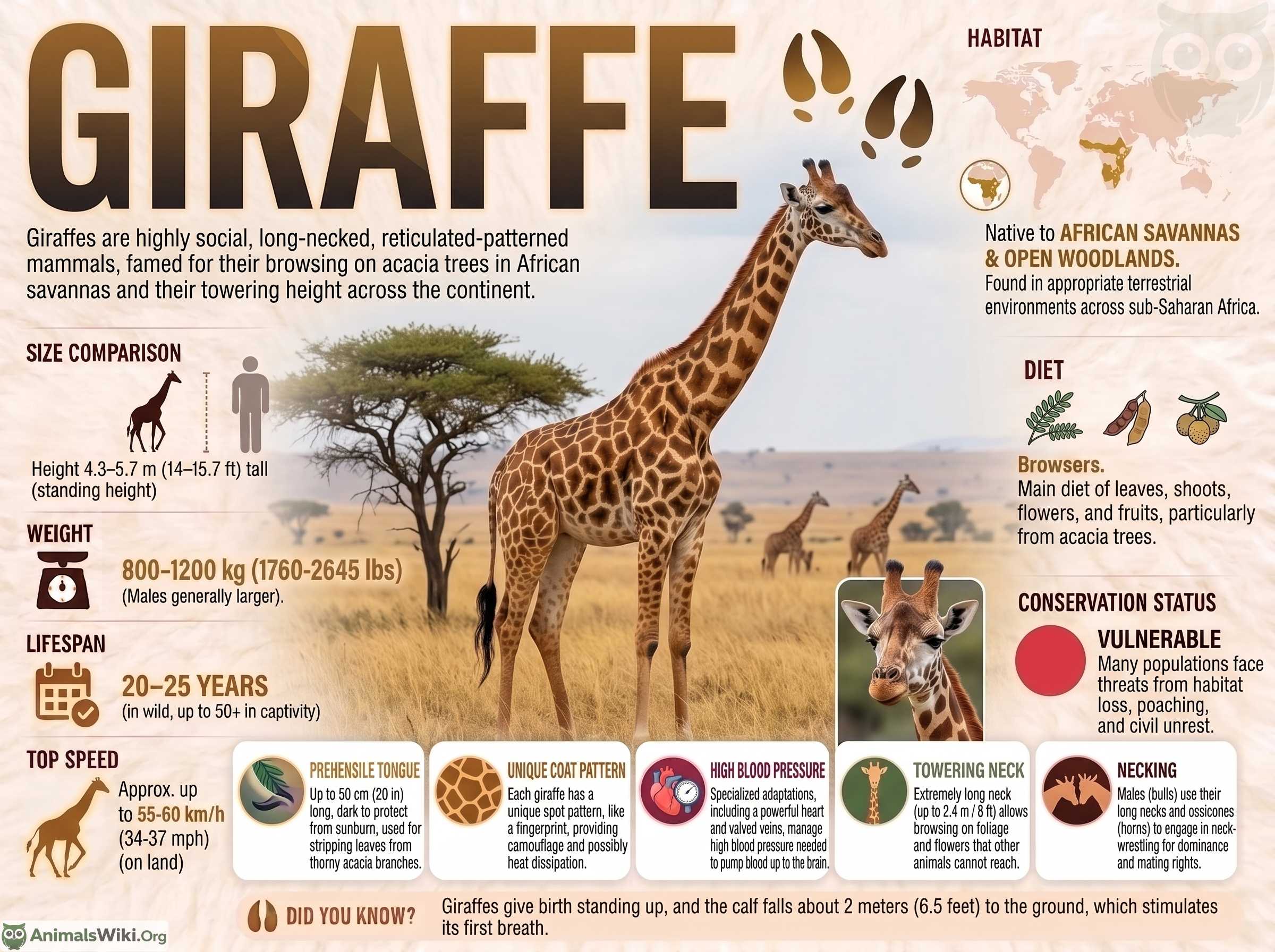
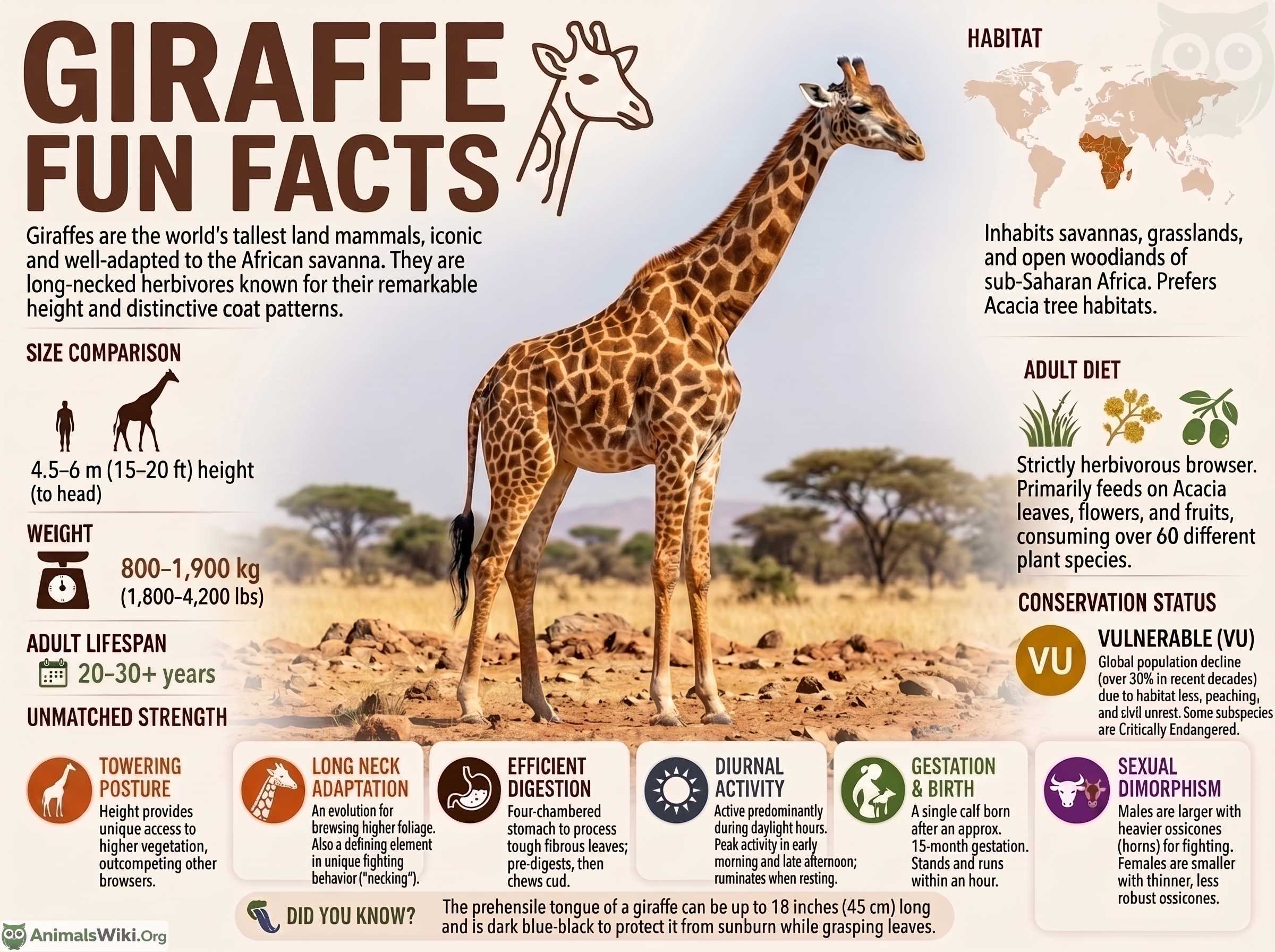
| Average Size | Males: 4.6–5.5 m tall; Females: 4.0–4.7 m tall |
| Average Weight | Males: 800–1,930 kg; Females: 550–1,180 kg |
| Lifespan | 20–25 years (wild); up to 28 years (captivity) |
| Diet | Herbivore — primarily acacia leaves, shoots, and buds |
| Conservation Status | Vulnerable (IUCN, species complex); some subspecies Critically Endangered |
| Defining Feature | Extraordinarily long neck and legs; distinctive coat patterning; tallest land animal on Earth; prehensile bluish-black tongue |
| Number of Species/Subspecies | 4 species recognized under modern genetic taxonomy (or 1 species with 9 subspecies under traditional taxonomy) |
1. Species Overview & Classification
Late afternoon on the Serengeti plains, and the low sun throws impossibly long shadows across the grass. Above the acacia canopy — above the tree line itself — a head appears, moving with unhurried, almost dreamlike grace, chewing thoughtfully on a mouthful of thorny leaves that would shred the mouth of almost any other animal. The rest of the body follows a moment later: a neck rising nearly two meters on its own, mounted on legs longer than most adult humans are tall, the whole structure moving in a slow-motion gait that looks, from a distance, like nothing so much as a building learning to walk.
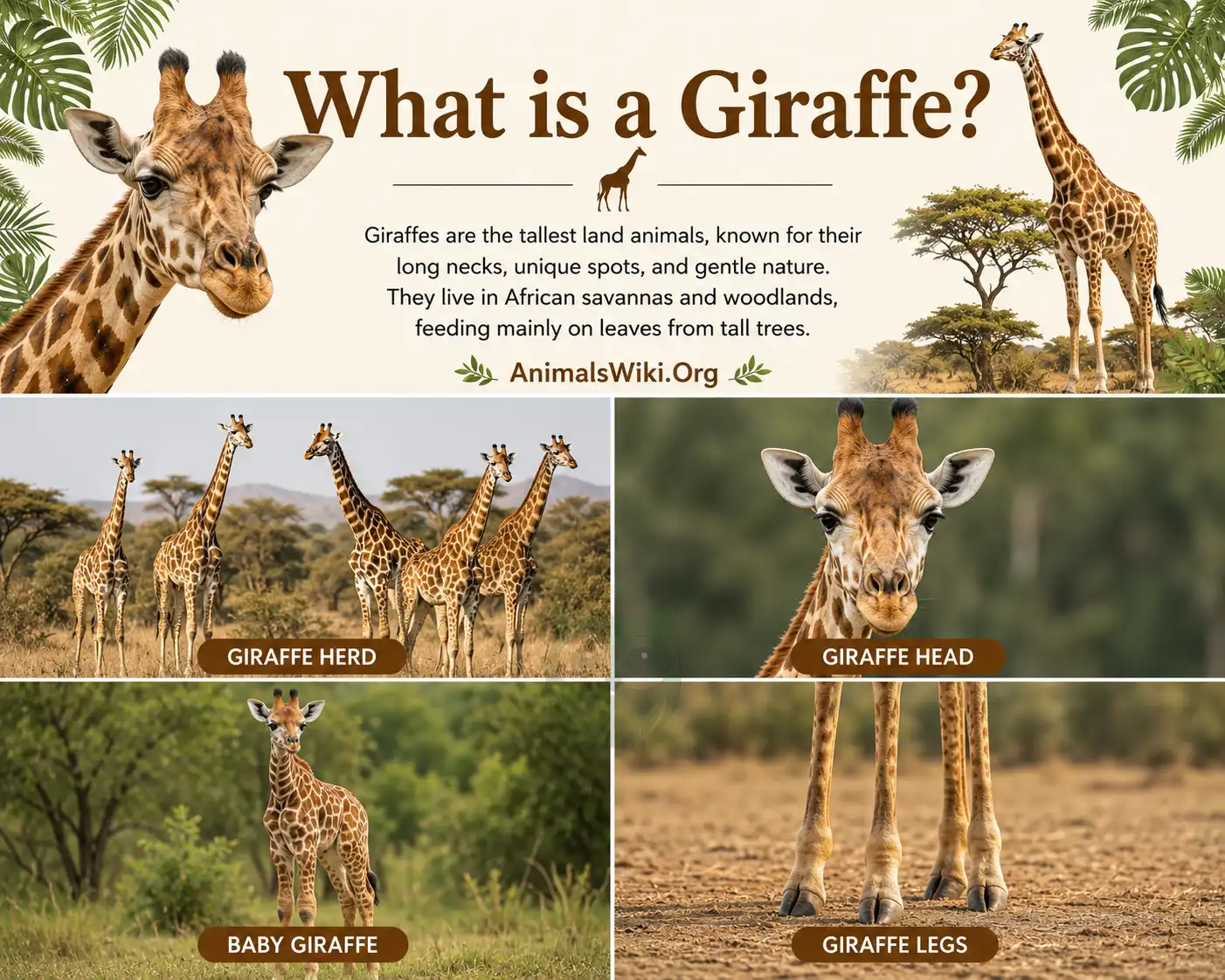
The giraffe (Giraffa camelopardalis) is the tallest living land animal on Earth — a towering, patch-coated browser whose body plan is so extreme, so seemingly improbable, that it has fascinated observers since antiquity. A mature bull giraffe can stand nearly 5.5 meters (18 feet) tall, wield a 45–50 cm (18–20 inch) prehensile tongue capable of stripping leaves from the thorniest acacia branches, and deliver a kick powerful enough to kill a lion. Yet for all its size and strength, the giraffe is a fundamentally gentle, highly social browsing specialist — one whose entire anatomy, from its unique cardiovascular adaptations to its distinctive gait, exists to solve a single evolutionary problem: how to safely and efficiently move blood, structure, and movement through a body of truly extraordinary height.
Long treated by science as a single species with numerous subspecies, the giraffe has, since the 2010s, been the subject of a significant taxonomic re-evaluation: genetic research has revealed that what was once considered one species may in fact represent four distinct species, each as genetically differentiated from the others as, for example, brown bears are from polar bears — a finding with profound implications for how giraffe conservation is understood and prioritized, since several of these newly recognized species and subspecies are far rarer, and far more urgently threatened, than the giraffe’s popular image as a common, thriving African icon would suggest.
Species Classification Table
| Classification Level | Details |
|---|---|
| Kingdom | Animalia |
| Phylum | Chordata |
| Class | Mammalia |
| Order | Artiodactyla |
| Family | Giraffidae |
| Genus | Giraffa |
| Species | Giraffa camelopardalis (traditional); 4 species under revised genetic taxonomy |
| Described By | Carl Linnaeus, 1758 |
| Closest Living Relative | Okapi (Okapia johnstoni) — the only other living member of family Giraffidae |
Giraffe Species and Subspecies (Modern Genetic Taxonomy)
| Species | Range | Population (approx.) | Notes |
|---|---|---|---|
| Northern Giraffe (G. camelopardalis) | West/Central/Northeast Africa | ~5,900 | Includes Nubian, Kordofan, West African subspecies; most threatened overall |
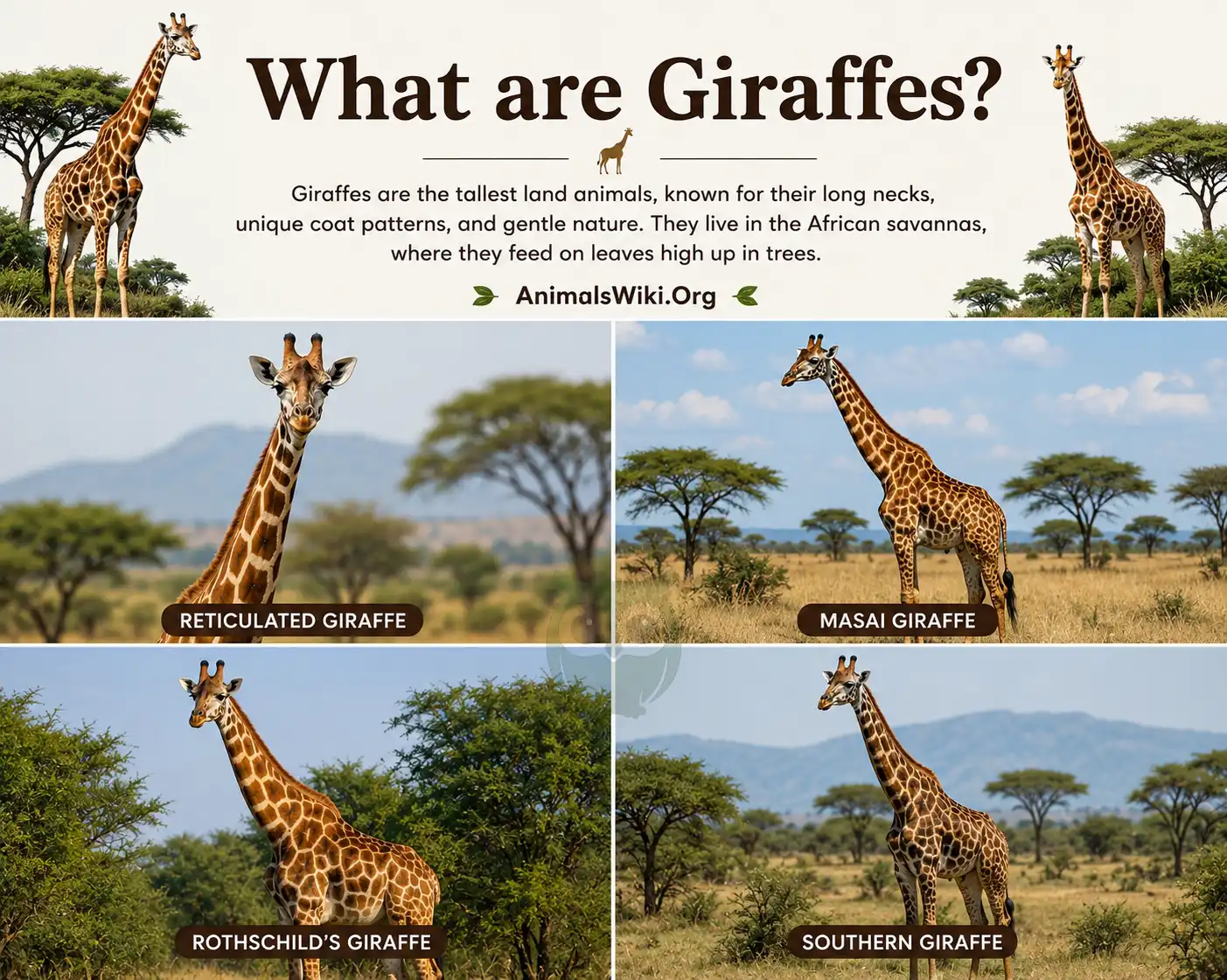
| Reticulated Giraffe (G. reticulata) | Kenya, Somalia, Ethiopia | ~15,900 | Distinctive sharp-edged, net-like coat pattern |
| Masai Giraffe (G. tippelskirchi) | Kenya, Tanzania | ~45,000 | Jagged, irregular star-shaped patches; largest population |
| Southern Giraffe (G. giraffa) | Southern Africa (Namibia, Botswana, South Africa, Zimbabwe) | ~53,000 | Includes Angolan and South African subspecies; most stable population |
Note: Some taxonomic authorities still treat all giraffes as a single species (G. camelopardalis) with 8–9 subspecies; the four-species model is increasingly used in conservation science following genetic studies published from 2016 onward.
The Name “Giraffe”
The English word “giraffe” derives from the Arabic word “zarafah” (زرافة), meaning “fast-walker” or possibly derived from an older term referencing the animal’s assembled, composite-seeming body. The scientific name camelopardalis reflects an ancient belief — held by the Romans, who first encountered the animal in significant numbers — that the giraffe was a hybrid of a camel and a leopard: camel-like in body shape and desert-country origin, leopard-like in its spotted coat pattern.
Did You Know? No two giraffes have exactly the same coat pattern — much like human fingerprints, each individual’s patchwork of patches is unique, and researchers use these patterns to identify and track individual wild giraffes over years or even decades without the need for tagging.
2. Physical Description & Unique Features
The giraffe’s body is one of the most anatomically extreme of any living land mammal — a cascade of specialized adaptations required simply to make an animal of this height biologically viable.
Size and Build
Males (bulls):
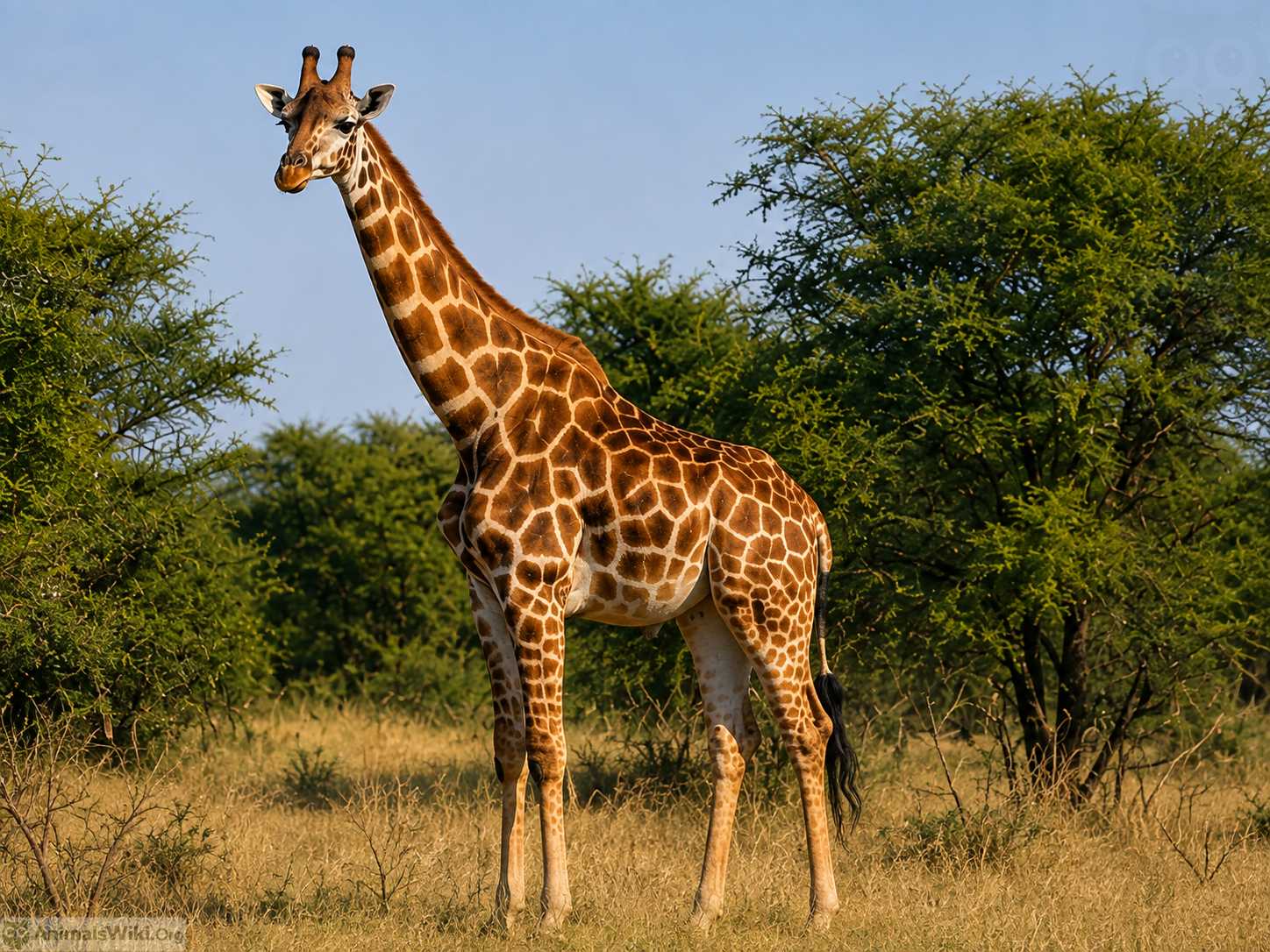
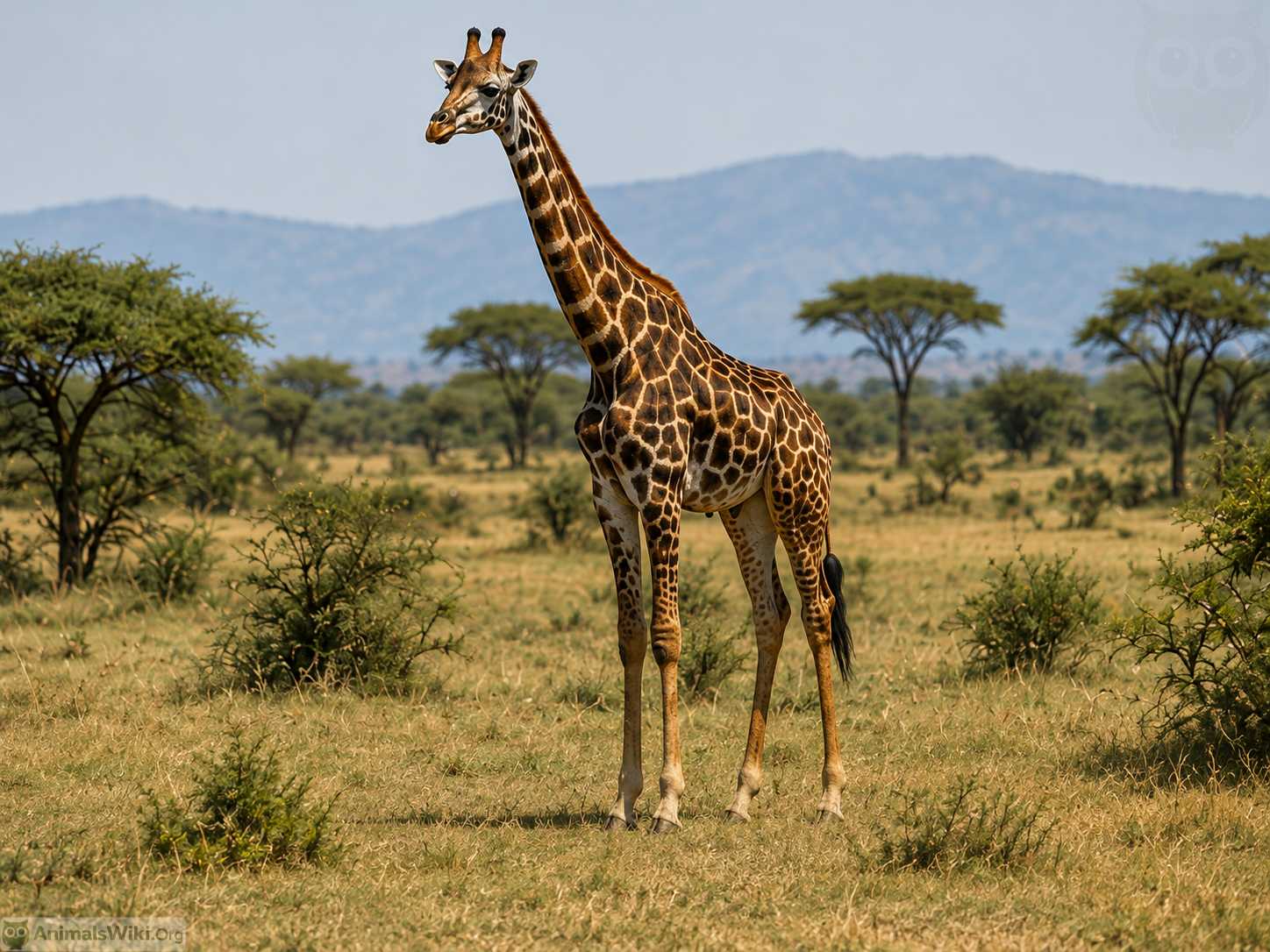
- Height: 4.6–5.5 m (15.1–18 feet) to the top of the head/ossicones
- Weight: 800–1,930 kg (1,764–4,255 lbs); large Masai Giraffe bulls are typically the heaviest
- Neck length: Up to 2.4 m (nearly 8 feet) on its own
Females (cows):
- Height: 4.0–4.7 m (13.1–15.4 feet)
- Weight: 550–1,180 kg (1,213–2,601 lbs)
Sexual dimorphism: Males are noticeably taller and considerably heavier than females; males also have thicker, more heavily calcified ossicones (the horn-like structures atop the head, described below), which develop bald patches at the tip from repeated head-to-head combat
The Neck — Solving an Engineering Puzzle
Despite its extraordinary length, the giraffe neck contains only seven cervical vertebrae — precisely the same number found in humans and nearly all other mammals; each individual vertebra, however, is dramatically elongated, some measuring over 25 cm (10 inches) in length. This arrangement gives the giraffe extreme reach for browsing high into the tree canopy, while remaining within the basic mammalian body plan.
The neck’s cardiovascular challenge: Pumping blood roughly two meters upward to the brain, against gravity, and then keeping it from rushing downward too rapidly when the head is lowered to drink, has required an extraordinary set of adaptations:
- Powerful heart: A giraffe’s heart can weigh up to 11 kg (24 lbs) and generates blood pressure roughly twice that of humans — the highest blood pressure of any mammal — to push blood the full height of the neck to the brain
- Jugular vein valves: Multiple one-way valves along the jugular vein prevent blood from rushing backward into the brain when the head is lowered
- The “rete mirabile” (wonderful net): A dense network of blood vessels at the base of the brain acts as a pressure-regulating buffer, preventing dangerous blood pressure spikes when the giraffe lowers its head suddenly to drink
- Tight skin and specialized leg tissue: Thick, tight skin around the lower legs functions similarly to a compression garment, preventing blood from pooling in the extremities and maintaining adequate circulatory pressure
The Legs — Supporting Great Height
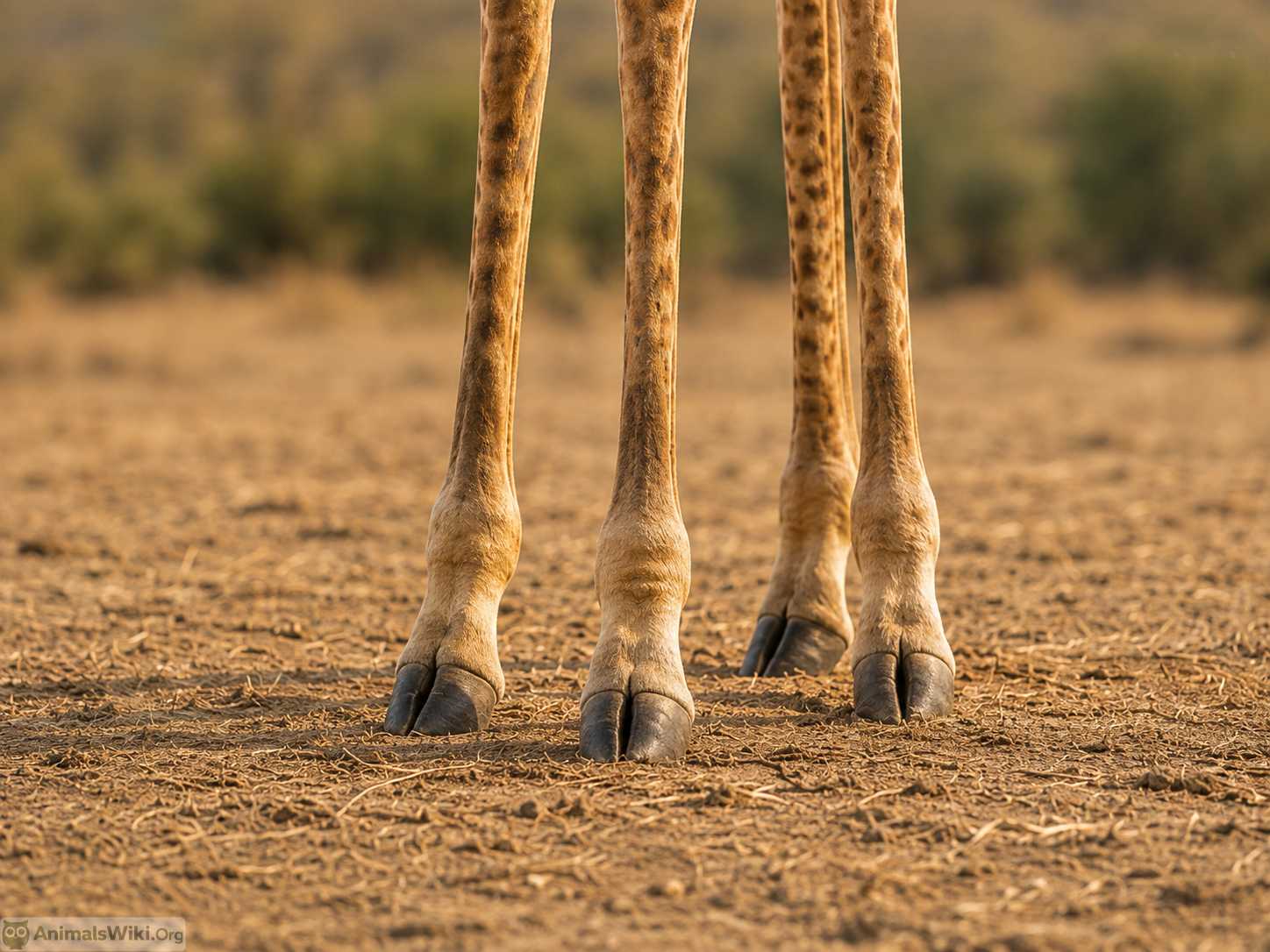
Giraffe legs are proportionally as remarkable as the neck:
- Front legs are slightly longer than hind legs, contributing to the sloped-back profile characteristic of the species
- Leg length alone can approach 1.8 m (6 feet) — taller than many adult humans
- Giraffes can run at speeds of 50–60 km/h (31–37 mph) in short bursts despite their ungainly appearance, and sustain 16 km/h (10 mph) over longer distances
Ossicones — Not Antlers, Not Horns
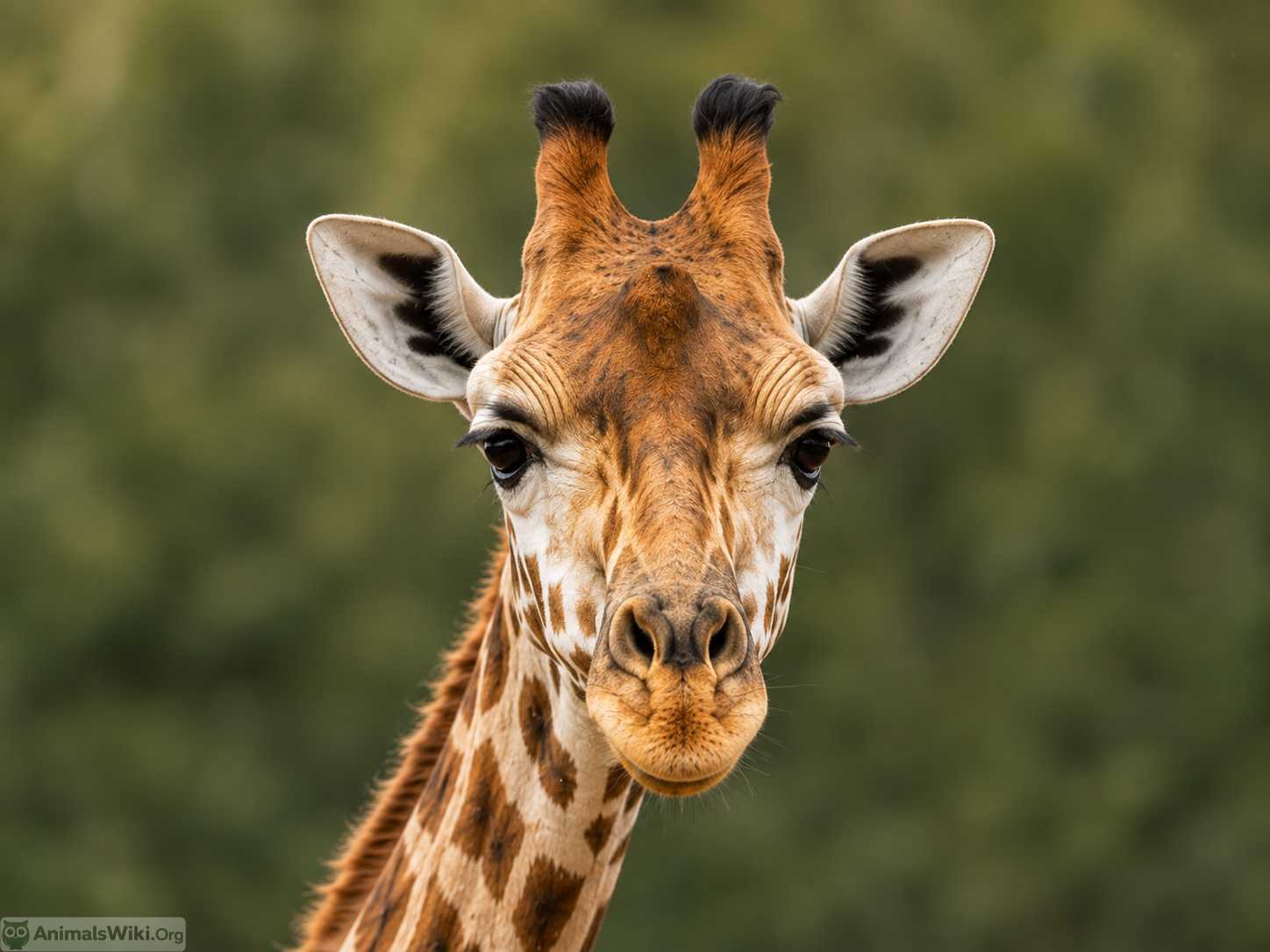
Both male and female giraffes possess ossicones — permanent, bone-and-skin-covered protrusions atop the skull, distinct from both antlers (which are shed) and true horns (which have a keratin sheath):
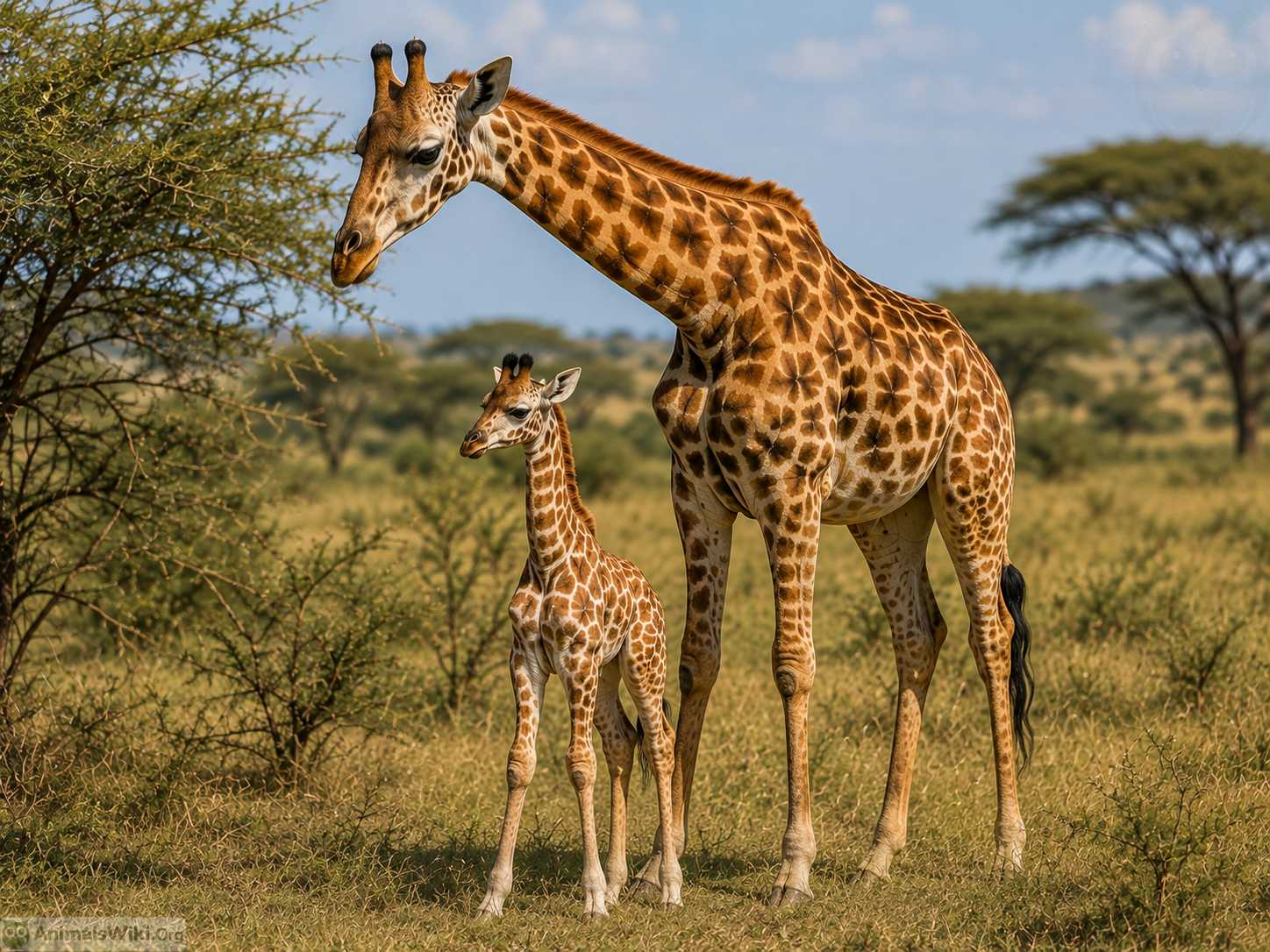
- Ossicones are present at birth, though initially flattened against the skull (an adaptation that eases birth) and erect within days
- Bulls typically develop a third median ossicone on the forehead with age, and their ossicones become bald and heavily calcified at the tips from repeated combat (“necking,” described in the Social Behavior section)
- Ossicone shape and thickness is one of the most reliable ways to distinguish males from females at a distance
Coat Patterning
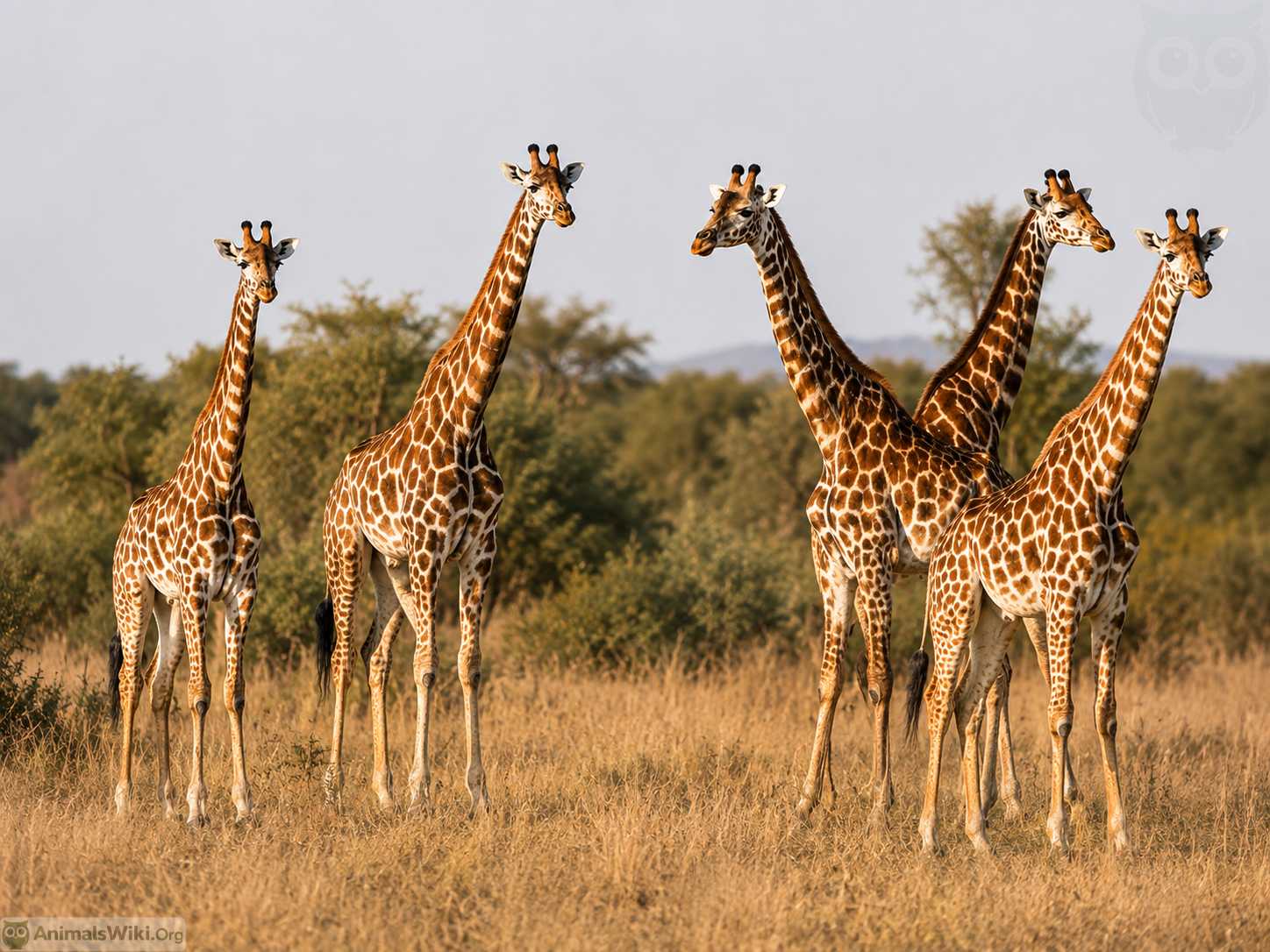
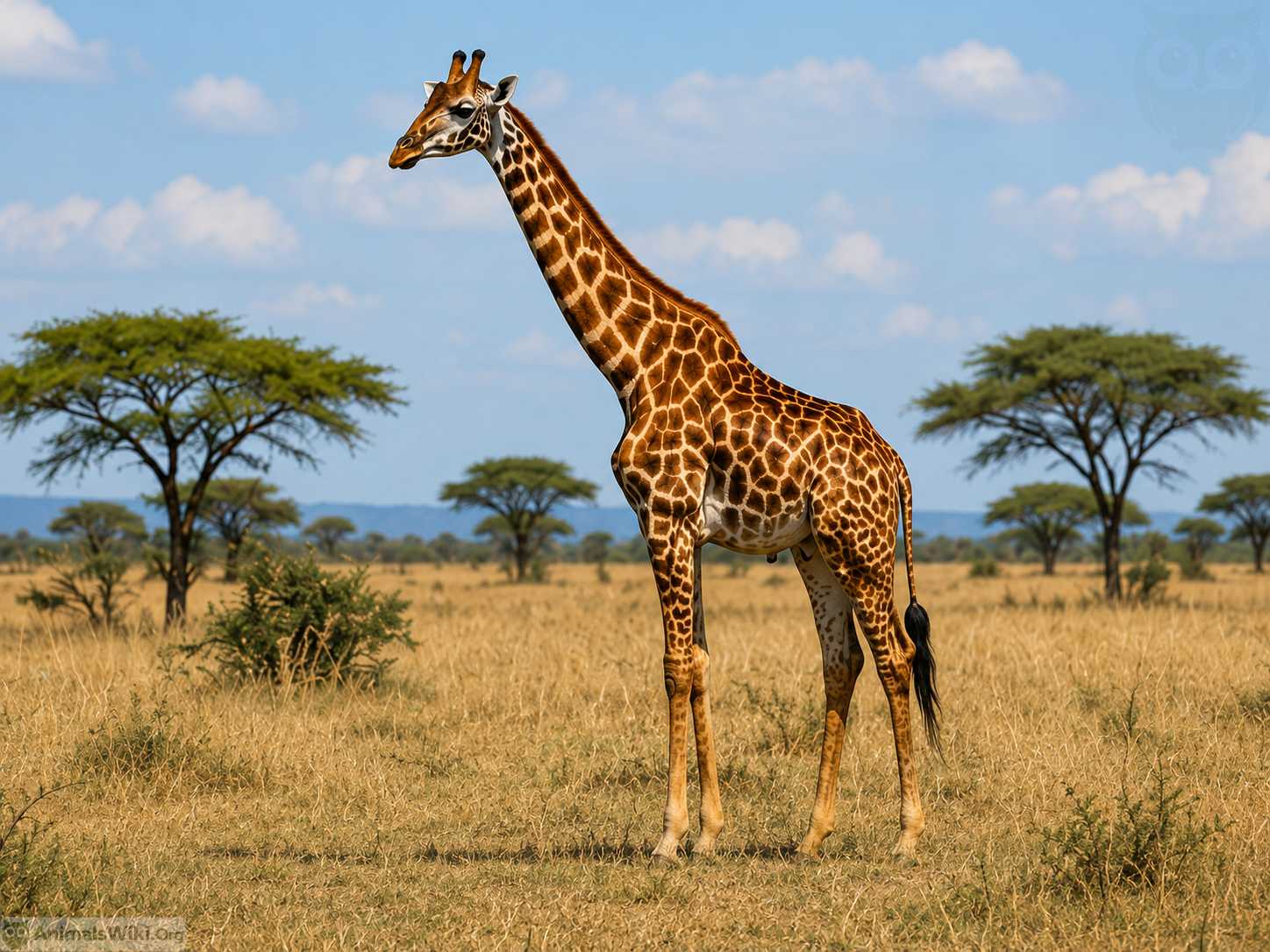
Giraffe coat patterns vary distinctly by species/subspecies and are a primary field identification tool:
| Species | Pattern Description |
|---|---|
| Reticulated Giraffe | Sharp-edged, polygonal patches separated by narrow, bright white lines forming a net-like (“reticulated”) pattern |
| Masai Giraffe | Irregular, jagged, vine-leaf or star-shaped patches with ragged edges |
| Southern Giraffe | Rounded or blotchy patches with less defined edges, often extending down the legs |
| Northern Giraffe | Large, pale, rectangular-ish patches with a lighter overall coat |
Function of coat patterning: Patterning is believed to serve as camouflage (breaking up the animal’s outline against dappled acacia-woodland light and shadow), a means of individual recognition among giraffes themselves, and possibly a role in thermoregulation, since blood vessels beneath the darker patches may help radiate heat.
The Tongue and Mouth — Adapted for Thorny Browsing
- Tongue length: 45–50 cm (18–20 inches); highly prehensile, capable of wrapping around branches and stripping leaves
- Tongue color: Distinctively dark blue-black, particularly toward the tip; the widely repeated explanation that this coloration prevents sunburn during extended tongue exposure while browsing is a long-standing hypothesis, though the pigmentation’s exact function remains an area of ongoing scientific interest
- Thick saliva: Giraffe saliva is unusually thick and is thought to help coat and protect the mouth and tongue from acacia thorns
- Tough lip and mouth tissue: Specialized, leathery tissue in the mouth and lips allows giraffes to browse directly among sharp acacia thorns with minimal injury
3. Natural Habitat & Geographic Range
The giraffe is a habitat specialist of Africa’s savanna and open woodland biome — closely tied to the availability of tall, scattered trees (particularly acacias) that provide both food and, at height, relative safety from most browsing competitors.
Preferred Habitat Features
Open savanna woodland — the core giraffe habitat; scattered acacia and other tall trees interspersed with open grassland provide both browse and visibility for predator detection
Semi-arid scrubland and thornveld — particularly important for Reticulated and Northern Giraffe populations in drier regions of East and Central Africa
Riverine woodland — dense tree growth along seasonal and permanent watercourses provides critical dry-season browse when open savanna vegetation is scarce
Avoidance of dense closed-canopy forest — giraffes generally avoid thick forest, where their height offers no browsing advantage and movement is restricted
Habitat Types Occupied
| Habitat | Primary Giraffe Use | Species | Key Features |
|---|---|---|---|
| Acacia savanna | Primary year-round habitat | All species | Scattered tall acacia trees |
| Thornveld/scrubland | Feeding, especially in dry regions | Reticulated, Northern | Sparse, thorny vegetation |
| Riverine woodland | Dry-season refuge | All species | Reliable browse near water |
| Mixed bushveld | Year-round habitat | Southern | Dense shrub and tree mix |
| Open grassland with scattered trees | Feeding, travel corridors | Masai, Southern | Wide sightlines for predator detection |
Geographic Range
Current range by species:
| Region | Key Countries | Primary Species | Population Status |
|---|---|---|---|
| East Africa | Kenya, Tanzania | Masai, Reticulated | Largest overall numbers; Masai declining in parts of range |
| Horn of Africa | Somalia, Ethiopia | Reticulated | Fragmented; some populations poorly monitored |
| West Africa | Niger, Chad | Northern (West African subspecies) | Critically small; among the rarest large mammal populations in Africa |
| Central Africa | Chad, Cameroon, DR Congo | Northern (Kordofan subspecies) | Severely reduced by conflict and poaching |
| Northeast Africa | South Sudan | Northern (Nubian subspecies) | Extremely reduced; among the most endangered giraffe populations |
| Southern Africa | Namibia, Botswana, South Africa, Zimbabwe, Zambia | Southern | Most stable and increasing population overall |
Historical Range Contraction
Giraffes have disappeared from at least seven African countries where they were historically present, and their overall African range has contracted significantly since the mid-20th century, even as some southern African populations have grown substantially under strong protected-area management — a pattern that has led conservationists to describe the giraffe’s situation as a “silent extinction”: a decline severe enough, in aggregate, to warrant serious concern, but one that has received far less public attention than more visibly charismatic African megafauna such as elephants and rhinos.
4. Diet & Feeding Behavior
The giraffe is a highly selective browser, with a diet built almost entirely around the leaves, shoots, and seed pods of trees and shrubs — a niche its extraordinary height allows it to exploit with little direct competition from other large herbivores.
What Giraffes Eat
Acacia leaves — by far the most important food source across nearly the entire giraffe range; giraffes are remarkably adapted to feed on thorny acacia species that few other large herbivores can process efficiently, using their prehensile tongue, tough mouth tissue, and thick saliva to strip leaves from between sharp thorns
Other browse species — depending on region, giraffes also feed on Combretum, Terminalia, Commiphora, and numerous other woody shrub and tree species; total dietary breadth can include over 100 different plant species across a giraffe’s range, though a much smaller number typically dominate actual intake
Fruits and seed pods — consumed opportunistically when available, particularly from acacia and other legume-family trees
Fresh shoots and new growth — preferentially targeted, particularly following rains, when new leaf growth offers higher protein and moisture content than older foliage
Bones (osteophagia) — giraffes have been documented chewing on bones, particularly during dry seasons; this behavior is believed to supplement calcium and phosphorus intake, nutrients that may become limiting in the giraffe’s primarily leaf-based diet
Feeding Height and Reach
Giraffes typically feed at heights of 2–6 meters (6.5–20 feet) — well above the reach of most other African browsers such as kudu and impala, giving giraffes access to a browse layer that is largely uncontested by other herbivores; this height-based niche partitioning is a major reason giraffes coexist so successfully with other large herbivores across the same landscape without significant dietary competition.
Feeding technique:
- The giraffe positions its head near a branch and wraps its long, prehensile tongue around a cluster of leaves
- The head is drawn backward, using the tongue and lips to strip leaves from between thorns while leaving the thorns themselves largely undisturbed
- Giraffes often favor the downwind side of a tree while feeding, and research has suggested some acacia species release chemical defense signals when browsed, prompting giraffes to move to new trees or approach from a different direction
Sexual Differences in Feeding Behavior
Male and female giraffes show measurable differences in feeding posture and target height:
- Males more often feed with the neck extended upward, targeting the tallest, most exclusive browse layer
- Females more frequently feed with the neck held horizontally or angled downward, targeting lower and midlevel browse — a pattern thought to reduce competition between the sexes and possibly reflect the different nutritional priorities of pregnancy and lactation
Water Intake
Giraffes are remarkably water-efficient and can survive for extended periods — potentially several days to weeks — without drinking, obtaining most of their moisture from the leaves they consume, particularly fresh growth after rain. When giraffes do drink, they must adopt an awkward, splay-legged posture to lower the head to water level — one of the moments of greatest vulnerability to predators in the giraffe’s daily routine, discussed further in the Predators section.
Daily Food Consumption
- Adult giraffes consume approximately 34–75 kg (75–165 lbs) of browse daily, depending on body size and forage quality
- Giraffes spend 16–20 hours per day feeding or engaged in feeding-related activity, reflecting the relatively low nutritional density of a leaf-based diet
- Feeding occurs throughout the day and night, with giraffes resting only briefly and in short intervals
5. Reproduction & Life Cycle
Giraffe reproductive biology reflects the species’ long lifespan, extended calf dependency, and the physical demands of giving birth to a calf that will, within hours, be one of the tallest newborn animals on Earth.
Sexual Maturity
Females: Reach sexual maturity at approximately 3–4 years, with first calving typically occurring around 4–5 years of age
Males: Physiologically capable of breeding from approximately 3–4 years, but rarely achieve actual mating success until 7–10 years, once they have grown large enough and gained sufficient social rank to out-compete rival males
Courtship and Mating
Giraffes do not form long-term pair bonds; mating is largely opportunistic and driven by male competition for access to females in estrus:
The flehmen response: A male giraffe assesses a female’s reproductive status by tasting her urine and then curling the upper lip in a distinctive flehmen grimace, drawing air across the vomeronasal organ to detect hormonal cues indicating estrus
Male competition: Dominant males, typically the largest and highest-ranking in a given area, secure the majority of mating opportunities; the “necking” combat described in the Social Behavior section is the primary mechanism by which male dominance — and thus breeding access — is established
Gestation and Birth
- Gestation period: Approximately 400–460 days (13–15 months) — among the longest gestation periods of any land mammal
- Birth position: Famously, giraffe calves are born while the mother remains standing, meaning the newborn calf falls approximately 1.5–2 meters (5–6.5 feet) to the ground at birth — a fall that is thought to help rupture the umbilical cord and stimulate the calf’s first breath
- Litter size: Single calf; twins are extremely rare
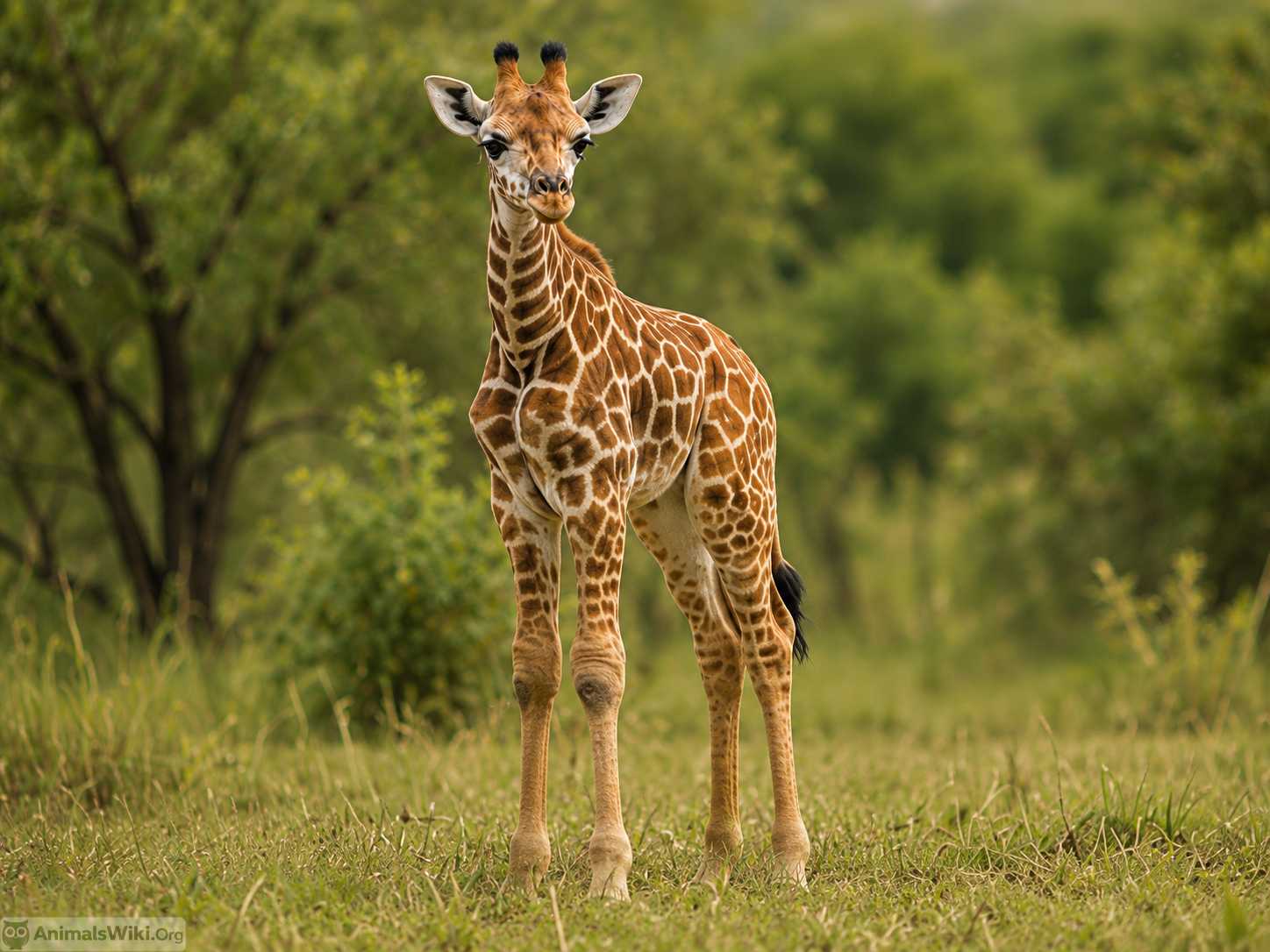
- Birth weight: Approximately 50–75 kg (110–165 lbs)
- Birth height: Newborn calves stand approximately 1.8 m (6 feet) tall at birth — already taller than most adult humans
Calf Development
Giraffe calves are remarkably precocial, a critical adaptation given the high predation risk faced by young calves on the open savanna:
| Stage | Timing | Development |
|---|---|---|
| Birth | Day 0 | ~1.8 m tall; standing within 30–60 minutes; walking within hours |
| First weeks | Weeks 1–2 | Highly vulnerable; hidden by mother in cover during the day |
| “Calving pool”/nursery groups | Weeks 2+ | Calves gather in loosely supervised nursery groups (crèches) while mothers forage |
| Weaning | 6–13 months | Gradual transition to solid browse; nursing may continue intermittently for a year or more |
| Independence | 12–16 months | Increasing independence from mother, particularly in males |
| Sexual maturity | 3–4 years | Reproductive capability begins |
The giraffe “crèche” (calving pool) system: Similar in concept to the crèche systems of some other social mammals, groups of giraffe mothers frequently leave their calves together in a loosely guarded nursery group — sometimes supervised by a single female — while the other mothers forage at some distance; this arrangement allows mothers to feed adequately while still providing a measure of collective calf protection.
Lifespan and Mortality
- Wild: Typically 20–25 years
- Captivity: Up to 28 years documented
- Calf mortality: Extremely high in the first weeks and months of life — some studies estimate that as few as 25–50% of giraffe calves survive their first year, primarily due to predation by lions, hyenas, and other large carnivores during the vulnerable early period before the calf gains sufficient size and speed to better evade predators
6. Social Behavior & Communication
Giraffe social structure has historically been described (somewhat inaccurately) as loose and largely unstructured; more recent, sustained research has revealed a considerably more complex and organized social system than earlier studies suggested.
Fission-Fusion Social Groups
Giraffes live in what biologists term a fission-fusion society — group membership is fluid, with individuals regularly joining and leaving loosely associated groups rather than maintaining a single, fixed herd:
- Typical group size: Ranges widely, from a handful of individuals to loose aggregations of 20 or more, with membership shifting over hours or days
- Female social bonds: Recent long-term research has found that female giraffes form stable, preferential social bonds with specific other females, maintained over years — a finding that overturned decades of assumption that giraffe social structure was largely random and non-selective
- Matrilineal groupings: Related females, including mothers, daughters, and grandmothers, are frequently found associating together over long periods, suggesting a more kin-structured society than previously recognized
Male Social Behavior and Dominance
Adult males are typically more solitary or loosely associated with other males than females are with each other, and male dominance hierarchies are established primarily through a distinctive combat behavior:
“Necking” — the giraffe’s signature combat display:
- Two males stand side by side and swing their necks and ossicone-topped heads at each other in powerful blows
- Necking can range from relatively gentle, ritualized sparring between young or evenly matched males to serious, prolonged combat between mature bulls contesting dominance or mating access
- Combat can occasionally result in serious injury, and rare fatalities have been documented from necking encounters involving mature, well-matched bulls
- Winners of necking contests gain access to receptive females and higher social rank; losers typically retreat without further contest
Communication — A Multi-Modal, Partly Subtle System
Vocalizations: Giraffes were long believed to be largely silent, but research has documented a range of vocalizations, including:
- Grunts, snorts, and hisses — used in close-range social interaction and as alarm signals
- Humming sounds at night — low-frequency vocalizations recorded during nighttime hours, the function of which remains an active area of scientific investigation; some researchers hypothesize a role in maintaining group contact in darkness
- Infrasonic communication — some researchers have hypothesized that giraffes may use very low-frequency sounds, similar to those documented in elephants, though this remains less thoroughly confirmed than in elephant research
Visual signals:
- Body posture and head position — used extensively in dominance and courtship interactions
- Tail-raising — associated with alertness or alarm
- Coat pattern and individual recognition — giraffes are believed to use visual recognition of individual coat patterns to identify specific herd members
Olfactory signals: Scent marking and the flehmen response (described in the Reproduction section) play a significant role in reproductive and social communication among giraffes.
7. Predators & Defense Mechanisms
Adult giraffes, owing to their extreme size, are relatively safe from most African predators, but calves face substantial predation risk, and even adult giraffes remain vulnerable at specific, predictable moments.
Natural Predators
Lions (Panthera leo) — the primary predator of adult giraffes; lions typically hunt giraffes in coordinated prides, often targeting the legs to bring down an adult, since a giraffe’s powerful kick can seriously injure or kill an attacking lion; lion predation on giraffes is more common in some ecosystems (such as certain areas of the Serengeti-Mara ecosystem) than others
Spotted Hyenas (Crocuta crocuta) — significant predators of giraffe calves, and occasionally weakened, sick, or very young adults; hyenas frequently scavenge giraffe carcasses from lion kills as well
Leopards (Panthera pardus) — occasional predators of very young giraffe calves, though adult giraffes are far too large for leopards to threaten under normal circumstances
African Wild Dogs (Lycaon pictus) — documented predation on giraffe calves in some regions, though giraffes are not a primary prey species for wild dogs
Nile Crocodiles (Crocodylus niloticus) — occasionally take giraffes, particularly at the moment of drinking, when the animal’s awkward, splay-legged drinking posture leaves it especially vulnerable near water’s edge
Defense Strategies
The kick: The giraffe’s primary and most formidable defense is a powerful kick delivered by the front or hind legs; a full-force giraffe kick can break bones, and there are documented cases of giraffes killing attacking lions with a single well-placed kick — making adult giraffes a genuinely risky prey choice even for Africa’s apex predators
Height as vigilance advantage: A giraffe’s exceptional height provides outstanding visual range across the savanna, allowing early detection of approaching predators at distances far greater than most other herbivores can achieve; giraffes are frequently used as informal “sentinels” by other savanna species, which take cues from giraffe alertness and flight behavior to detect approaching danger
Speed: Despite their ungainly appearance, giraffes can reach speeds of 50–60 km/h (31–37 mph) in short sprints — sufficient to outrun lions over open ground, though not necessarily over sustained distances
Vulnerability while drinking: The single greatest exception to the giraffe’s general safety from predation is the awkward, splay-legged posture required to lower the head to drinking water — a position from which a giraffe cannot quickly rise or flee, and one that predators, particularly lions and crocodiles, are known to specifically exploit
Group vigilance: Loose herd association, even within the fission-fusion social system, provides a measure of collective predator detection, with alarm behavior from one individual often triggering heightened vigilance across a wider group
8. Relationship with Humans
Ancient Fascination and Early Historical Encounters
The giraffe has captivated human observers since antiquity, prized above nearly any other African animal for its sheer novelty and improbable form:
Ancient Egypt: Giraffes appear in Egyptian art and hieroglyphics dating back thousands of years, and were kept and displayed by Egyptian rulers as exotic curiosities
Ancient Rome: The Romans encountered giraffes through North African trade and conquest, and giraffes were displayed in Roman arenas and processions as extraordinary exotic imports; the enduring belief that the giraffe was a camel-leopard hybrid, reflected in its scientific name camelopardalis, dates from this era
Medieval and early modern diplomatic gifts: Giraffes were prized as extraordinarily prestigious diplomatic gifts between rulers for centuries, given their rarity, size, and the difficulty of transporting them safely across long distances; a famous giraffe sent from Egypt to Florence in 1487 as a gift to Lorenzo de’ Medici caused a sensation in Renaissance Italy, and a giraffe presented to King Charles X of France in 1827 (known as “Zarafa”) became a nationwide cultural phenomenon, inspiring fashion, hairstyles, and decorative motifs across France
Traditional African Cultural Significance
Giraffes hold deep cultural significance across many African societies within their range:
- Symbolism — the giraffe is frequently associated with grace, vision, foresight, and communication in various African oral traditions, owing to its height and far-seeing vantage
- Rock art — giraffes are among the most frequently depicted animals in ancient African rock art, including sites in the Sahara and southern Africa dating back thousands of years, reflecting the animal’s long-standing presence in the cultural imagination of the continent
- Traditional use — in some communities, giraffe hide, tail hair (used for jewelry, bracelets, and fly whisks), and other materials have held traditional practical and ceremonial value
Giraffes in Modern Zoos and Tourism
Giraffes are among the most popular exhibits at zoos worldwide, prized for their unique appearance and generally docile, approachable demeanor in captivity, and giraffe safaris are a major driver of wildlife tourism revenue across East and Southern Africa, ranking among the most sought-after “iconic” sightings for safari visitors alongside the traditional “Big Five.”
Conflict and Human Impact
Habitat loss and fragmentation — agricultural expansion, human settlement growth, and infrastructure development across giraffe range have fragmented populations and disrupted traditional movement corridors
Poaching — giraffes are poached for meat, hide, tail hair (used in jewelry and fly whisks, and increasingly sought for bracelets marketed to tourists), and, in some regions, for bones and body parts entering illegal wildlife trade
Civil conflict — armed conflict and instability in parts of the giraffe’s Central and Northeast African range, including South Sudan and Chad, has severely impacted some of the rarest giraffe populations, compounding the effects of habitat loss and poaching
9. Conservation Status & Threats
IUCN Status
Giraffe (species complex): Vulnerable overall — the IUCN’s 2016 reassessment marked a significant shift from the giraffe’s earlier “Least Concern” listing, driven by data revealing a much steeper overall population decline than previously understood.
Status by species/subspecies varies considerably:
| Species/Subspecies | Approximate Status |
|---|---|
| Northern Giraffe (overall) | Critically Endangered |
| Kordofan Giraffe | Critically Endangered |
| Nubian Giraffe | Critically Endangered |
| West African Giraffe | Vulnerable (population recovered significantly through dedicated conservation) |
| Reticulated Giraffe | Endangered |
| Masai Giraffe | Endangered |
| Southern Giraffe (overall) | Least Concern / stable-increasing |
The “Silent Extinction”
Overall giraffe numbers across Africa declined by an estimated 30–40% between the late 1980s and mid-2010s — from approximately 150,000–160,000 individuals to roughly 97,000–117,000 — a decline that occurred with far less public awareness or conservation funding than comparable declines in more high-profile species such as elephants and rhinos, leading conservationists to describe the situation as a “silent extinction.” Total numbers have since stabilized and, in some regions, modestly increased through concentrated conservation efforts, though considerable regional variation remains.
Current Threats
1. Habitat Loss and Fragmentation
Agricultural expansion, human population growth, and infrastructure development across sub-Saharan Africa continue to reduce and fragment giraffe habitat, disrupting the traditional movement patterns giraffes rely on to access seasonal browse and water resources.
2. Poaching and Illegal Hunting
Giraffes are targeted for bushmeat, hide, and tail hair, the latter increasingly used in jewelry and bracelets marketed to tourists; in some regions, poaching pressure has intensified as giraffe meat has become a substitute target where more heavily protected species face stricter enforcement.
3. Civil Conflict and Political Instability
Some of the most endangered giraffe populations — including the Nubian Giraffe in South Sudan and Kordofan Giraffe across parts of Central Africa — inhabit regions affected by ongoing or recent armed conflict, which severely hampers conservation monitoring, anti-poaching enforcement, and habitat protection efforts.
4. Climate Change
Increasing drought frequency and severity across giraffe range affects the availability and quality of browse, particularly for populations already living at the margins of suitable habitat in semi-arid regions.
5. Disease
Giraffe populations in some areas have been affected by localized outbreaks of skin disease (giraffe skin disease, believed to be caused by a nematode parasite and associated bacteria) that can cause severe lesions on the legs; while generally not fatal on its own, the condition may compound stress from other threats.
10. Famous Giraffes Around the World
“Zarafa” — The Giraffe Who Enchanted Paris
Presented as a diplomatic gift from the Ottoman viceroy of Egypt, Muhammad Ali Pasha, to King Charles X of France in 1827, the giraffe known as Zarafa traveled overland and by boat from Marseille to Paris — walking part of the final journey on foot, accompanied by enormous public crowds — and became a nationwide sensation. Her arrival inspired a wave of “giraffe fever” across French fashion, hairstyles, and decorative arts, and she lived at the Jardin des Plantes menagerie in Paris for 18 years, becoming one of the most famous individual animals of 19th-century Europe.
“Marius” — A Controversial Conservation Case
A young male giraffe at the Copenhagen Zoo, Marius became the subject of significant international controversy in 2014 when the zoo made the decision to euthanize him due to concerns over genetic diversity within European zoo breeding programs, and subsequently publicly dissected and fed his remains to the zoo’s lions; the case sparked extensive global debate over captive breeding management practices, genetic diversity programs, and zoo ethics.
The “Twiga” of the Twiga Walking Safaris — Rothschild’s Giraffes of Kenya
The Giraffe Centre in Nairobi, Kenya, established to protect the endangered Rothschild’s Giraffe (a population within the broader Northern Giraffe lineage), has become one of the most visited wildlife conservation education sites in East Africa, allowing visitors close, hand-feeding encounters with giraffes as part of an ongoing breeding and habitat restoration program.
April the Giraffe — A Global Livestream Phenomenon
In 2017, a giraffe named April, resident at Animal Adventure Park in New York state, became a global viral sensation when her pregnancy and eventual birth were livestreamed continuously online, drawing millions of concurrent viewers worldwide during the final days before calving — one of the most-watched wildlife livestream events in internet history.
11. Role in Ecosystem & Food Chain
Ecosystem Engineers of the Savanna Canopy
Giraffes occupy a distinctive and largely uncontested browsing niche — the upper canopy layer of savanna woodland — giving them an outsized ecological role in shaping tree growth and structure across their range.
Shaping tree architecture: Sustained giraffe browsing pressure over generations has measurably shaped the growth form of acacia and other browse trees across giraffe range, with some research suggesting that heavily browsed acacia populations develop denser, more heavily defended (thornier) growth in response to sustained herbivory pressure — a long-term co-evolutionary relationship between giraffes and their primary food trees
Seed dispersal: Giraffes contribute to the dispersal of seeds from the fruits and pods they consume, depositing them at new locations through their droppings across large home ranges, supporting forest and woodland regeneration across the savanna landscape
Nutrient cycling: As with other large herbivores, giraffe droppings represent a significant source of nutrient redistribution across savanna ecosystems, supporting soil fertility and plant growth in areas where giraffes concentrate feeding activity
Giraffes as Prey — Supporting Predator Communities
While adult giraffes are relatively safe from most predators, they nonetheless form an important, if occasional, prey resource for lions, and giraffe calves are a genuinely significant food source for lions, hyenas, and leopards across much of the species’ range; giraffe carcasses, whether from predation or natural mortality, also provide substantial scavenging opportunities for hyenas, vultures, jackals, and other scavenger species, given the very large body mass of a single giraffe carcass relative to most other savanna herbivores.
Sentinel Role for Other Species
The giraffe’s exceptional height and correspondingly excellent predator-detection range benefits not only giraffes themselves but numerous other savanna species that share giraffe habitat; zebras, wildebeest, and other herbivores are frequently observed taking behavioral cues from nearby giraffe alertness and flight responses, effectively using giraffes as an early-warning sentinel system across the shared savanna landscape.
12. Myths, Culture & Pop Culture Appearances
The Camel-Leopard Myth
As referenced in the Species Overview section, the giraffe’s scientific name camelopardalis directly reflects the ancient Roman belief that the animal was a hybrid offspring of a camel and a leopard — combining the camel’s body shape and desert-country associations with the leopard’s spotted coat. This belief persisted in various forms across European natural history writing for well over a thousand years, well into the medieval and early modern periods, before more accurate zoological classification took hold.
African Rock Art and Traditional Symbolism
As noted in the Human Relationships section, giraffes are among the most frequently depicted large animals in ancient African rock art traditions, appearing in sites across the Sahara and southern Africa; in various African oral and symbolic traditions, the giraffe’s height and far-seeing vantage have made it a recurring symbol of vision, grace, and foresight.
Pop Culture Appearances
- “The Lion King” (Disney, 1994) — giraffes appear among the savanna wildlife cast in the film’s opening “Circle of Life” sequence, one of the most iconic depictions of African savanna wildlife in animated film history
- “Madagascar” (DreamWorks, 2005) — features Melman the Giraffe, a prominent hypochondriac giraffe character, as one of the film’s four central protagonists, introducing giraffes to a new generation of family audiences
- Toys “R” Us mascot “Geoffrey the Giraffe” — one of the most recognizable retail mascots in American commercial history, used continuously by the toy retailer from the 1960s onward
- “Zarafa” (2012 animated French film) — a feature film directly inspired by the true story of the giraffe Zarafa’s journey from Africa to the court of Charles X in 1827
- World Giraffe Day — an annual international awareness event held on June 21st (the longest day or night of the year in each hemisphere, chosen to honor the world’s tallest animal), organized by the Giraffe Conservation Foundation to raise awareness of giraffe conservation needs
- April the Giraffe’s viral livestream (2017) — one of the most-watched live wildlife broadcasting events in internet history, discussed further in the Famous Giraffes section
Did You Know? Despite being one of the most recognizable and beloved animals in the world — the subject of beloved children’s characters, popular zoo exhibits, and a major retail mascot — the giraffe’s steep, decades-long population decline across much of Africa went largely unnoticed by the general public until conservation scientists began publicizing the “silent extinction” framing in the mid-2010s, a striking gap between the animal’s cultural ubiquity and the public’s awareness of its actual conservation status in the wild.
13. Discovery & Evolution Timeline
~25–30 million years ago — Early ancestors of the giraffe family (Giraffidae) appear in the fossil record, at a time when the family was considerably more diverse than it is today.
~7–8 million years ago — Fossil evidence shows the beginnings of significant neck elongation within the giraffid lineage leading to the modern giraffe, alongside other giraffid lineages (including the ancestors of the modern okapi) that retained comparatively short necks.
~1 million years ago — The modern giraffe genus becomes established across Africa, with the ancestors of today’s regional populations beginning to differentiate.
Ancient Egypt (thousands of years ago) — Giraffes appear in Egyptian art and hieroglyphic records, reflecting some of the earliest documented human cultural engagement with the species.
1st century BCE–1st century CE — Romans encounter giraffes through North African contact and display them in arenas and public spectacles; the camel-leopard hybrid belief, reflected in the later scientific name, becomes established in Western natural history thought.
1487 — A giraffe sent as a diplomatic gift to Lorenzo de’ Medici in Florence causes widespread public fascination across Renaissance Italy.
1758 — Carl Linnaeus formally describes the giraffe as Cervus camelopardalis in the 10th edition of Systema Naturae (later reclassified into the genus Giraffa).
1827 — The giraffe Zarafa arrives in Paris as a gift to King Charles X, triggering a nationwide cultural sensation across France.
19th–early 20th century — European colonial expansion and big-game hunting significantly reduce giraffe populations across large parts of Africa, alongside broader habitat conversion pressures.
Mid-20th century — Giraffes are widely classified as a single species (Giraffa camelopardalis) with up to 9 recognized subspecies, a taxonomic framework that remains in common use even today.
1980s–2016 — Giraffe populations across Africa decline by an estimated 30–40%, largely unnoticed by broad public and conservation attention, later termed the “silent extinction.”
2016 — Landmark genetic research (led by the Giraffe Conservation Foundation and academic partners) proposes reclassifying giraffes into four distinct species, based on genetic divergence comparable to that seen between other widely recognized separate mammal species; the same year, the IUCN reclassifies the giraffe from Least Concern to Vulnerable.
2018–2019 — Individual giraffe subspecies receive updated, more precise IUCN conservation assessments, revealing that several — including the Nubian and Kordofan populations — are Critically Endangered.
2019 — Giraffes are listed under CITES Appendix II, regulating international trade in giraffe parts and products for the first time.
2022–2026 — Ongoing conservation programs, including translocations to re-establish giraffe populations in parts of their historical range, continue across multiple African countries; the four-species taxonomic model gains increasing acceptance and use within conservation science and policy, even as debate over the appropriate taxonomic framework continues among researchers.
14. Comparison with Similar Species
| Feature | Giraffe (Giraffa spp.) | Okapi (Okapia johnstoni) | Eland (Taurotragus oryx) | Gerenuk (Litocranius walleri) |
|---|---|---|---|---|
| Family | Giraffidae | Giraffidae | Bovidae | Bovidae |
| Height | 4.0–5.5 m | 1.5–2.0 m (shoulder) | 1.5–1.8 m (shoulder) | 0.8–1.0 m (shoulder) |
| Weight | 550–1,930 kg | 200–350 kg | 400–950 kg | 28–52 kg |
| Neck | Extremely elongated | Moderate length | Standard bovid proportions | Elongated for a bovid |
| Habitat | Open savanna, woodland | Dense Congo rainforest | Savanna, woodland | Arid scrubland |
| Coat pattern | Patched, species-specific | Zebra-striped legs, dark body | Faint vertical stripes | Plain reddish-brown |
| Feeding style | High-canopy browsing | Low-to-mid forest browsing | Mixed grazing/browsing | Bipedal browsing (stands on hind legs) |
| Social structure | Fission-fusion groups | Largely solitary | Loosely herding | Small family groups |
| Conservation | Vulnerable (species complex) | Endangered | Least Concern | Near Threatened |
| Closest relative | Okapi | Giraffe | Other large antelope | Other gazelle-relatives |
15. Best Places to See Giraffes in the Wild
East Africa
- 🇰🇪 Maasai Mara National Reserve, Kenya — excellent Masai Giraffe viewing amid classic savanna scenery, particularly during the annual wildebeest migration season
- 🇰🇪 Giraffe Centre, Nairobi, Kenya — dedicated conservation center for the endangered Rothschild’s (Northern) Giraffe, offering close hand-feeding encounters and conservation education
- 🇰🇪 Samburu National Reserve, Kenya — one of the best locations to see the distinctive net-patterned Reticulated Giraffe
- 🇹🇿 Serengeti National Park, Tanzania — large, stable Masai Giraffe population across sweeping open plains
Southern Africa
- 🇳🇦 Etosha National Park, Namibia — reliable Southern (Angolan) Giraffe sightings, particularly around waterholes during the dry season
- 🇿🇦 Kruger National Park, South Africa — abundant Southern Giraffe population; one of the most accessible major giraffe-viewing destinations in Africa
- 🇧🇼 Okavango Delta and Chobe National Park, Botswana — strong Southern Giraffe numbers amid diverse wetland and woodland habitat
Rare Subspecies Viewing
- 🇳🇪 Koure Giraffe Reserve, Niger — the last remaining population of the West African Giraffe, one of the most dramatic giraffe conservation success stories, recovered from as few as 49 individuals in the 1990s to several hundred today
- 🇺🇬 Murchison Falls National Park, Uganda — home to a notable population of the rare Rothschild’s (Nubian-lineage) Giraffe
16. Giraffe Fun Facts for Kids
- 🦒 The giraffe is the tallest living land animal on Earth, with mature bulls reaching up to 5.5 meters (18 feet) in height
- 🦒 Despite its extraordinarily long neck, a giraffe has only seven neck vertebrae — exactly the same number found in humans
- 🦒 A giraffe’s tongue is 45–50 cm long, prehensile, and distinctively dark blue-black in color
- 🦒 A giraffe’s heart can weigh up to 11 kg and generates the highest blood pressure of any mammal, needed to pump blood the full height of the neck to the brain
- 🦒 Newborn giraffe calves fall roughly 1.5–2 meters to the ground at birth, since mothers give birth standing up
- 🦒 No two giraffes have exactly the same coat pattern — as individual as a human fingerprint
- 🦒 What was long considered a single giraffe species is now understood, based on genetic research, to actually be four distinct species
- 🦒 A giraffe’s kick is powerful enough to kill an attacking lion
- 🦒 Giraffe populations across Africa declined by an estimated 30–40% between the 1980s and mid-2010s — a decline so overlooked by the public that conservationists call it the “silent extinction”
- 🦒 The scientific name Giraffa camelopardalis reflects the ancient belief that giraffes were hybrids of camels and leopards
- 🦒 A giraffe named April became a global sensation in 2017 when her pregnancy and birth were livestreamed to millions of viewers worldwide
- 🦒 Giraffes can survive for days or even weeks without drinking water, obtaining most of their moisture from the leaves they eat
17. How You Can Help
Support These Organizations
- Giraffe Conservation Foundation (GCF) (giraffeconservation.org) — the world’s only NGO dedicated specifically to giraffe conservation across Africa; leads research, translocations, and community-based conservation programs
- African Wildlife Foundation (awf.org) — broad African wildlife conservation, including giraffe habitat protection programs
- World Wildlife Fund (WWF) (worldwildlife.org) — supports habitat protection and anti-poaching efforts across giraffe range
- San Diego Zoo Wildlife Alliance (sandiegozoowildlifealliance.org) — supports giraffe research and captive breeding programs, including genetic diversity management
- Local community conservancies in Kenya, Niger, and Namibia — many of the most successful giraffe recovery programs (notably the West African Giraffe recovery in Niger) have been driven by community-based conservation models
What You Can Do
- Support giraffe-specific conservation funding — because giraffe conservation has historically received far less attention and funding than more high-profile African megafauna, direct support for dedicated giraffe programs like GCF has an outsized impact relative to funding directed toward better-resourced species
- Choose responsible safari and tourism operators — supporting tour operators and lodges that contribute directly to local conservancies and community conservation programs helps fund on-the-ground giraffe protection
- Raise awareness of the “silent extinction” — simply sharing accurate information about giraffe population decline helps address the public awareness gap that has historically limited giraffe conservation funding
- Avoid purchasing giraffe-part products — including tail-hair jewelry and bracelets of uncertain origin sometimes marketed to tourists, to avoid inadvertently supporting poaching
- Support habitat corridor and translocation programs — advocacy and funding for initiatives that reconnect fragmented giraffe habitat and reintroduce giraffes to historical range directly supports population recovery
Recommended Documentaries & Books
- “Giraffes: Africa’s Gentle Giants” (PBS Nature) — dedicated natural history coverage of giraffe biology and behavior
- “Giraffe” segments in BBC’s “Africa” and “Planet Earth” series — extensive high-quality footage of wild giraffe behavior
- “Giraffe Reflections” by Dale Peterson and Karl Ammann — an accessible natural history exploration of giraffe biology and conservation
- Research and reports from the Giraffe Conservation Foundation — the most authoritative technical source on current giraffe population status and conservation strategy
18. Frequently Asked Questions About Giraffes
Q1: How tall is a giraffe, and why is its neck so long?
Male giraffes can reach heights of up to 5.5 meters (18 feet), making the giraffe the tallest living land animal on Earth. Despite the neck’s extraordinary length, it contains only seven cervical vertebrae — the same number found in humans — with each vertebra dramatically elongated rather than the giraffe having additional neck bones. The long neck is generally understood to have evolved to allow giraffes to browse high into the tree canopy, reaching food largely uncontested by other herbivores, though some researchers have also proposed that the neck plays a role in the male “necking” combat behavior used to establish dominance and mating access.
Q2: How does a giraffe’s cardiovascular system handle the height of its neck?
A giraffe’s heart can weigh up to 11 kg and generates blood pressure roughly twice that of a human, allowing blood to be pumped the full height of the neck to reach the brain. To prevent dangerous pressure surges when the giraffe lowers its head to drink, the species has evolved a network of specialized adaptations, including one-way valves in the jugular veins that prevent backward blood flow, and a dense network of blood vessels at the base of the brain (the “rete mirabile”) that buffers sudden pressure changes. Tight skin around the lower legs also helps prevent blood from pooling in the extremities.
Q3: How many species of giraffe are there?
Under traditional taxonomy, giraffes have long been classified as a single species (Giraffa camelopardalis) with up to 9 recognized subspecies. However, genetic research published from 2016 onward has proposed reclassifying giraffes into four distinct species — the Northern Giraffe, Reticulated Giraffe, Masai Giraffe, and Southern Giraffe — based on genetic divergence comparable to that seen between other widely recognized separate mammal species. This revised classification is increasingly used in conservation science, though some taxonomic authorities continue to use the traditional single-species framework.
Q4: Why are giraffes considered a “silent extinction”?
Giraffe populations across Africa declined by an estimated 30–40% between the late 1980s and mid-2010s, dropping from roughly 150,000–160,000 individuals to as few as 97,000. This decline occurred with far less public awareness, media coverage, or conservation funding than comparable declines documented in more high-profile African species such as elephants and rhinos — a gap that led conservationists at the Giraffe Conservation Foundation to coin the term “silent extinction” to describe the giraffe’s under-recognized conservation crisis. Some giraffe subspecies, including the Nubian and Kordofan Giraffe, are now classified as Critically Endangered.
Q5: How is a giraffe calf born, given the mother’s height?
Female giraffes give birth standing up, meaning the newborn calf falls approximately 1.5–2 meters (5–6.5 feet) to the ground at birth. This fall is thought to help rupture the umbilical cord and stimulate the calf’s first breath. Despite this dramatic entry into the world, giraffe calves are remarkably precocial: they are typically standing within 30–60 minutes of birth and walking within hours — critical adaptations given the substantial predation risk young giraffes face on the open savanna, where calf mortality in the first year can reach 25–50% in some populations.
Q6: What is “necking” behavior in giraffes?
Necking is the primary combat and dominance-establishment behavior among male giraffes, in which two bulls stand side by side and swing their necks and ossicone-topped heads at each other in powerful blows. Necking ranges from relatively gentle sparring between young or evenly matched males to serious combat between mature bulls contesting dominance or access to receptive females; while rarely fatal, serious injuries and occasional deaths have been documented in encounters between well-matched, mature bulls. Winners of necking contests gain higher social rank and greater mating access.
Q7: Are giraffes dangerous to lions?
Yes — while lions are the primary natural predator of adult giraffes, a giraffe’s kick is powerful enough to break bones and, in documented cases, has been fatal to attacking lions, making adult giraffes a genuinely risky prey choice even for Africa’s apex predator. Lions typically hunt giraffes in coordinated groups and often target the legs to bring an adult down, since a direct frontal assault risks serious injury from the giraffe’s kick. Giraffe calves, lacking this defensive capability and size, face substantially higher and more straightforward predation risk from lions, hyenas, and leopards.
Q8: What do giraffes eat, and how do they handle thorny acacia trees?
Giraffes are browsers, feeding primarily on the leaves, shoots, and seed pods of acacia and other trees — with acacia making up the overwhelming majority of the diet across most of the giraffe’s range. Giraffes are uniquely adapted to feed on thorny acacia species that few other large herbivores can process efficiently: a highly prehensile, 45–50 cm tongue wraps around leaf clusters and strips them from between the thorns, while thick saliva and tough, leathery mouth tissue help protect the mouth from injury. Giraffes typically feed at heights of 2–6 meters, well above the reach of most other African browsers, giving them access to a largely uncontested browse layer.
19. Sources & References
The information in this article was researched and verified using the following authoritative sources:
- Wikipedia — Giraffe, Giraffa, Northern giraffe, Reticulated giraffe, Masai giraffe, Southern giraffe, Okapi
- IUCN Red List (iucnredlist.org) — Giraffe species and subspecies conservation status assessments
- Giraffe Conservation Foundation (giraffeconservation.org) — Population data, taxonomic research, and conservation program details; the leading authority on giraffe conservation science
- National Geographic (nationalgeographic.com) — Giraffe biology, behavior, and conservation features
- Britannica (britannica.com) — Giraffe, Giraffidae
- Fennessy, J. et al. (2016) — “Multi-locus Analyses Reveal Four Giraffe Species Instead of One” — Current Biology; the landmark genetic study proposing the four-species taxonomy
- San Diego Zoo Wildlife Alliance (sandiegozoowildlifealliance.org) — Giraffe care, diet, and captive breeding information
- BBC Nature / BBC Earth — Documentary references, including “Africa” and “Planet Earth” series footage
- Smithsonian’s National Zoo (nationalzoo.si.edu) — Giraffe biology and conservation education resources
- Journal of Zoology / African Journal of Ecology — Peer-reviewed research on giraffe social structure, feeding ecology, and cardiovascular adaptations
20. Giraffe Images