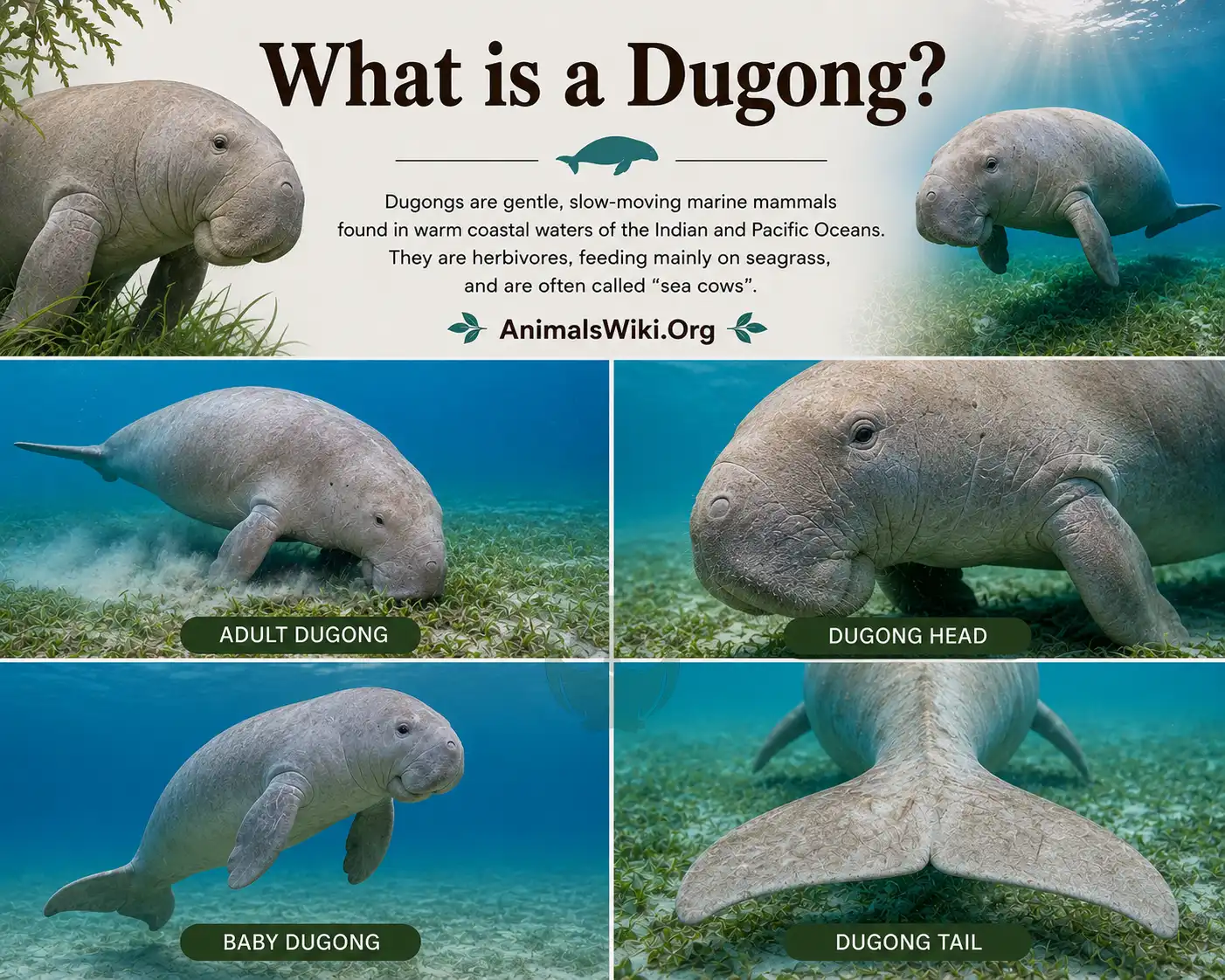
Dugong Facts
| Feature | Details |
|---|---|
| Common Name | Dugong / Sea Cow |
| Scientific Name | Dugong dugon |
| Family | Dugongidae |
| Order | Sirenia |
| First Described | 1776 (by P.L.S. Müller) |
| Native Habitat | Shallow, warm coastal waters; seagrass beds; estuaries; bays |
| Geographic Range | Indo-Pacific — from East Africa to the Pacific Islands; 40+ countries |
| Average Size | 2.4–3.3 meters body length |
| Average Weight | 230–420 kg |
| Lifespan | 70+ years |
| Diet | Primarily seagrass — one of the most exclusively herbivorous marine mammals |
| Conservation Status | Vulnerable (IUCN) — declining globally |
| Defining Feature | The only surviving member of family Dugongidae; whale-like fluked tail (unlike manatees); entirely dependent on seagrass; inspiration for mermaid mythology; one of the closest living relatives of the elephant |
| Global Population | Unknown — estimated tens of thousands; declining |
1. Species Overview & Classification
Somewhere in the warm, shallow waters of a tropical bay, moving slowly through a sunlit seagrass meadow, an animal grazes. It has been grazing in this meadow, or meadows like it, since before the pyramids were built. Its ancestors grazed seagrass in shallow tropical seas when woolly mammoths still roamed the steppes of Eurasia. Its lineage stretches back through 50 million years of marine mammal evolution — to a time when the order Sirenia was represented by dozens of species across the world’s warm coastlines. Today, only four sirenian species remain, and the dugong is the sole survivor of the family Dugongidae — the last living representative of a once-diverse lineage that included Steller’s Sea Cow (Hydrodamalis gigas), a gigantic cold-water sirenian that was hunted to extinction within 27 years of its discovery by European naturalists.
The Dugong (Dugong dugon) is one of the ocean’s most ancient, most gentle, and most threatened large mammals. It is a strict herbivore — one of the few truly herbivorous marine mammals — whose entire existence is organized around the seagrass meadows of the tropical Indo-Pacific coast. It is also, almost certainly, the primary inspiration for the mermaid mythology that has pervaded human maritime culture across the Indo-Pacific, the Middle East, and the Mediterranean for thousands of years — sailors encountering the dugong’s habit of surfacing vertically to breathe and nursing its young at the surface mistaking the dark shape for a half-human, half-fish creature of the depths.
The dugong’s conservation situation is genuinely alarming. The species occupies a vast geographic range — from East Africa to the Pacific Islands, through the waters of more than 40 countries — yet population data across most of this range is fragmentary or absent. The largest known population — in the waters of Shark Bay and the wider northwest shelf of Australia — may number in the tens of thousands; but populations across most of the dugong’s range in the Middle East, East Africa, Southeast Asia, and the Pacific are declining, fragmented, and in many areas effectively functionally extinct. The dugong is a species that is simultaneously widespread and profoundly endangered — a conservation paradox that makes its management one of the most complex challenges in marine mammal conservation.
Species Classification Table
| Classification Level | Details |
|---|---|
| Kingdom | Animalia |
| Phylum | Chordata |
| Class | Mammalia |
| Order | Sirenia |
| Family | Dugongidae |
| Genus | Dugong |
| Species | Dugong dugon |
| Described By | P.L.S. Müller, 1776 |
| Common Names | Dugong; Sea Cow; Sea Pig (historical); Mermaid’s inspiration |
The Order Sirenia — Dugong’s Family
The dugong belongs to the order Sirenia — named after the Sirens of Greek mythology:
| Family | Species | Common Name | Range | Status |
|---|---|---|---|---|
| Dugongidae | Dugong dugon | Dugong | Indo-Pacific | Vulnerable |
| Dugongidae (EXTINCT) | Hydrodamalis gigas | Steller’s Sea Cow | North Pacific | Extinct 1768 |
| Trichechidae | Trichechus manatus | West Indian Manatee | Caribbean/SE US | Vulnerable |
| Trichechidae | Trichechus inunguis | Amazonian Manatee | Amazon River | Vulnerable |
| Trichechidae | Trichechus senegalensis | West African Manatee | West Africa | Vulnerable |
The Surprising Evolutionary Relatives
One of the most remarkable and most counterintuitive facts about dugong evolution is the identity of their closest living relatives:
Dugongs (and all Sirenians) are most closely related to:
- Elephants (Loxodonta and Elephas spp.) — most closely related
- Hyraxes (Procavia spp.) — small, rock-dwelling mammals of Africa and the Middle East
- Aardvarks (Orycteropus afer) — the nocturnal insectivores of Africa
This grouping — Afrotheria — shares a common ancestor from approximately 100 million years ago and represents one of the earliest divergences within placental mammals. The evolutionary path that led from a small, four-legged Afrothere ancestor to the fully aquatic, seagrass-grazing dugong took approximately 50 million years — during which the sirenian lineage progressively lost their hind limbs, developed a fluked tail, and transitioned from terrestrial to fully marine life.
Did You Know? The dugong is one of the closest living relatives of the elephant — more closely related to elephants than to whales or dolphins, despite living in the ocean. The evolutionary connection is visible in some anatomical similarities: dugongs have toenails on their flippers (vestigial remnants of the toes of their terrestrial ancestors), teeth that bear some resemblance to elephant molars in their structure, and dense, heavy bones (pachyostosis) similar to the bone density patterns seen in elephants. The two lineages diverged approximately 100 million years ago, long before the sirenian ancestors entered the water.
2. Physical Description & Unique Features
The dugong’s physical form is the product of approximately 50 million years of adaptation to shallow tropical marine environments — a body plan that has traded the versatility of terrestrial life for extraordinary efficiency in its specific aquatic niche.
Size and Build
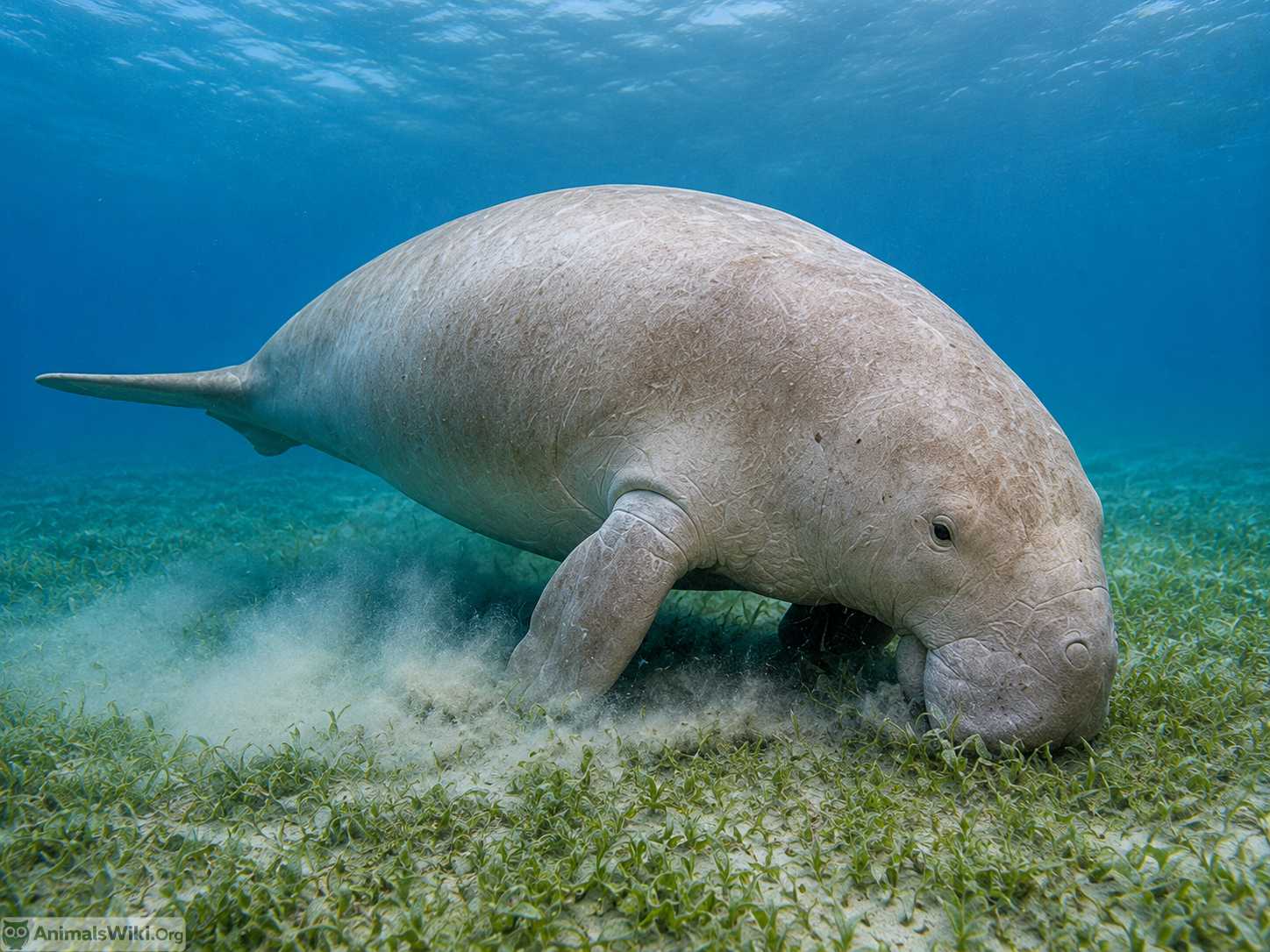
The dugong is a large, robustly built marine mammal of submarine torpedo shape:
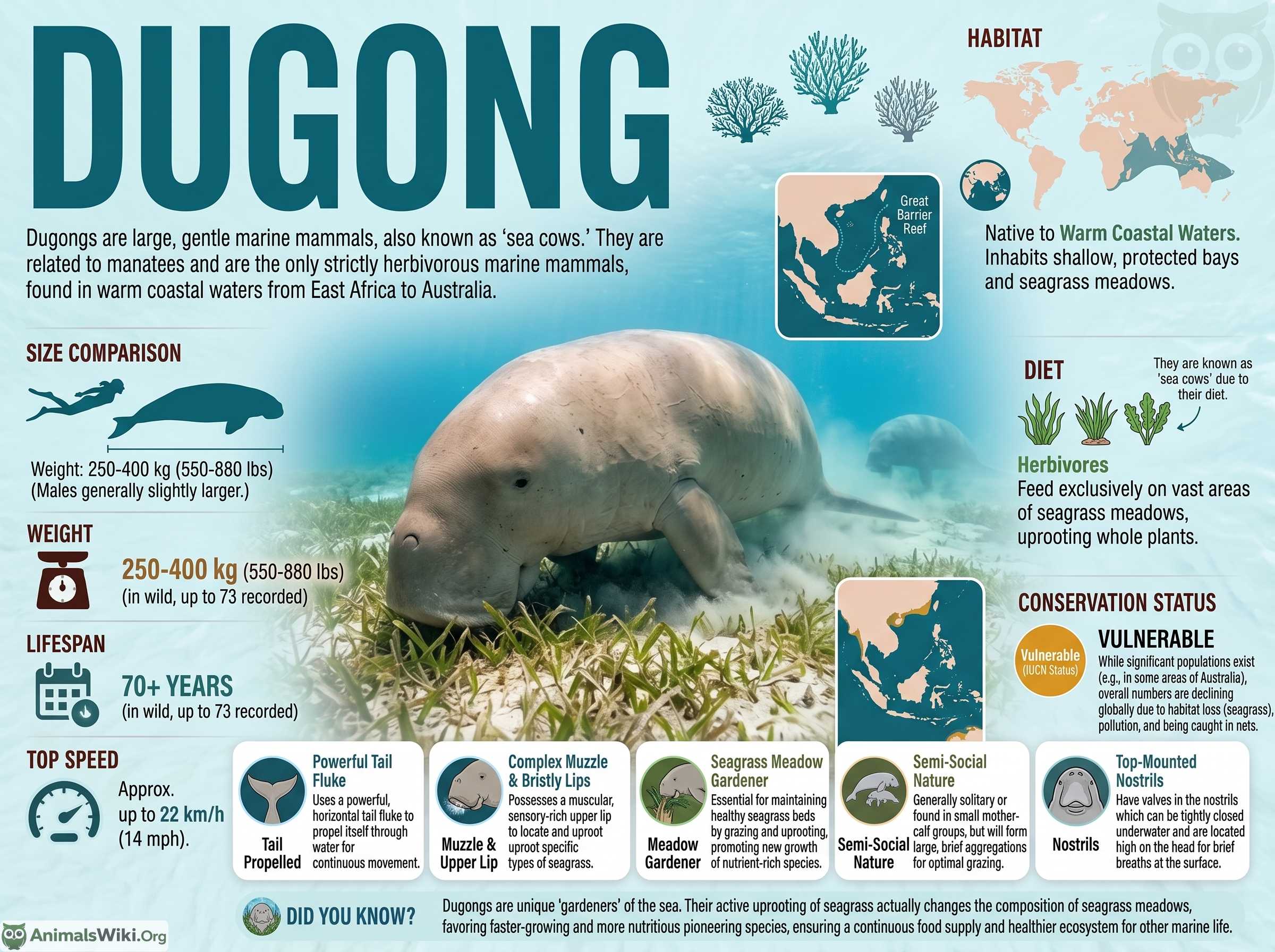
- Body length: 2.4–3.3 meters (7.9–10.8 feet); exceptional individuals occasionally longer
- Weight: 230–420 kg (507–926 lbs); the heaviest documented individual weighed approximately 500 kg
- Body shape: Fusiform (torpedo-shaped) — broadest at the midsection, tapering toward the tail flukes
- Girth: The dugong’s body is distinctly rotund — the impression is of an animal somewhat like a very large, smooth sausage with flippers at the front and flukes at the rear
Sexual dimorphism: Relatively modest — females are typically slightly larger than males on average, though the difference is not dramatic; the most reliable external sex distinction is the presence of tusk eruptions (visible projections of the upper incisor teeth) in adult males; females also have tusk eruptions in old age but these are typically less developed
The Diagnostic Tail — The Dugong-Manatee Distinction
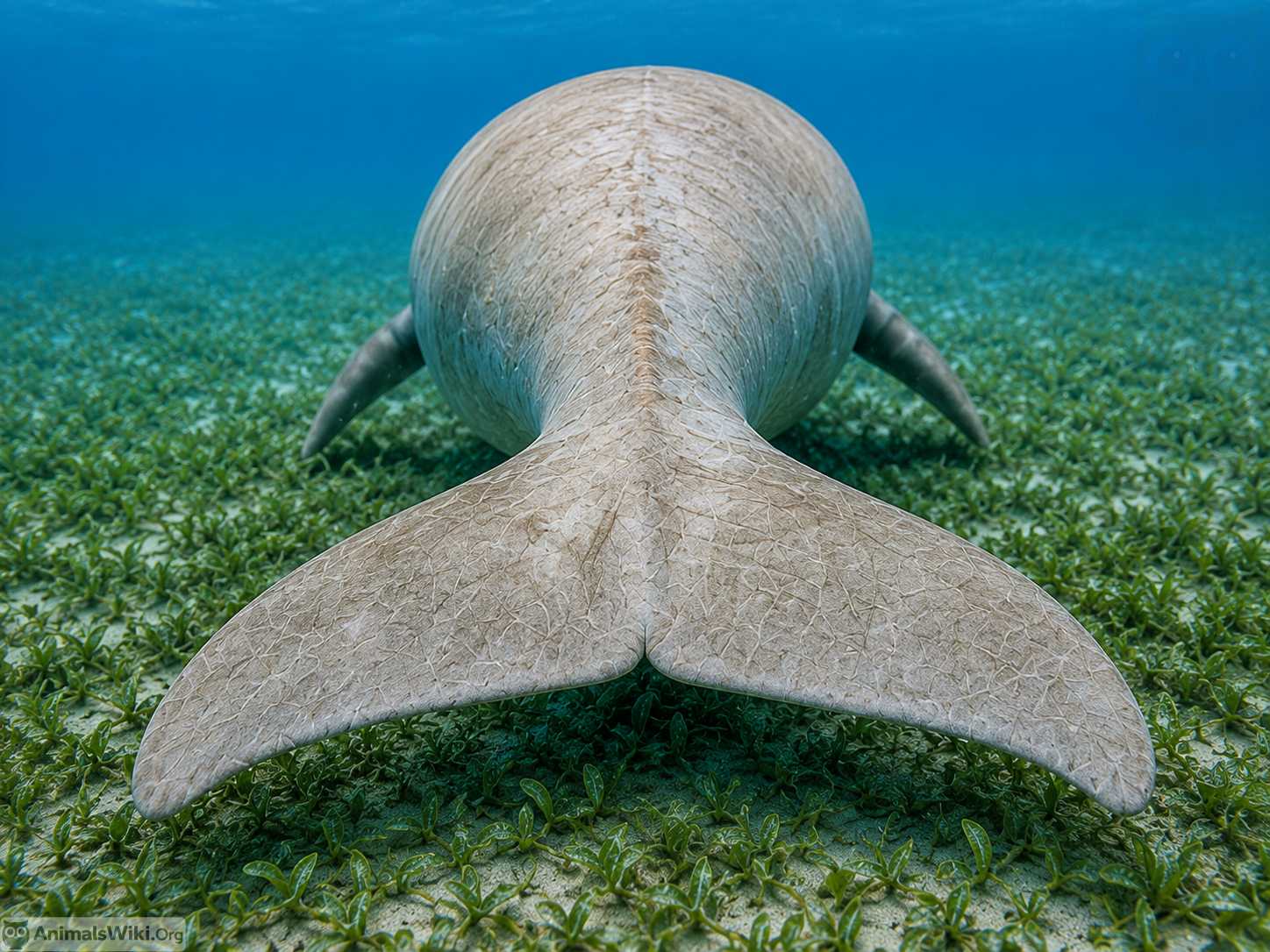
The most immediately reliable field identification feature distinguishing a dugong from a manatee is the tail shape:
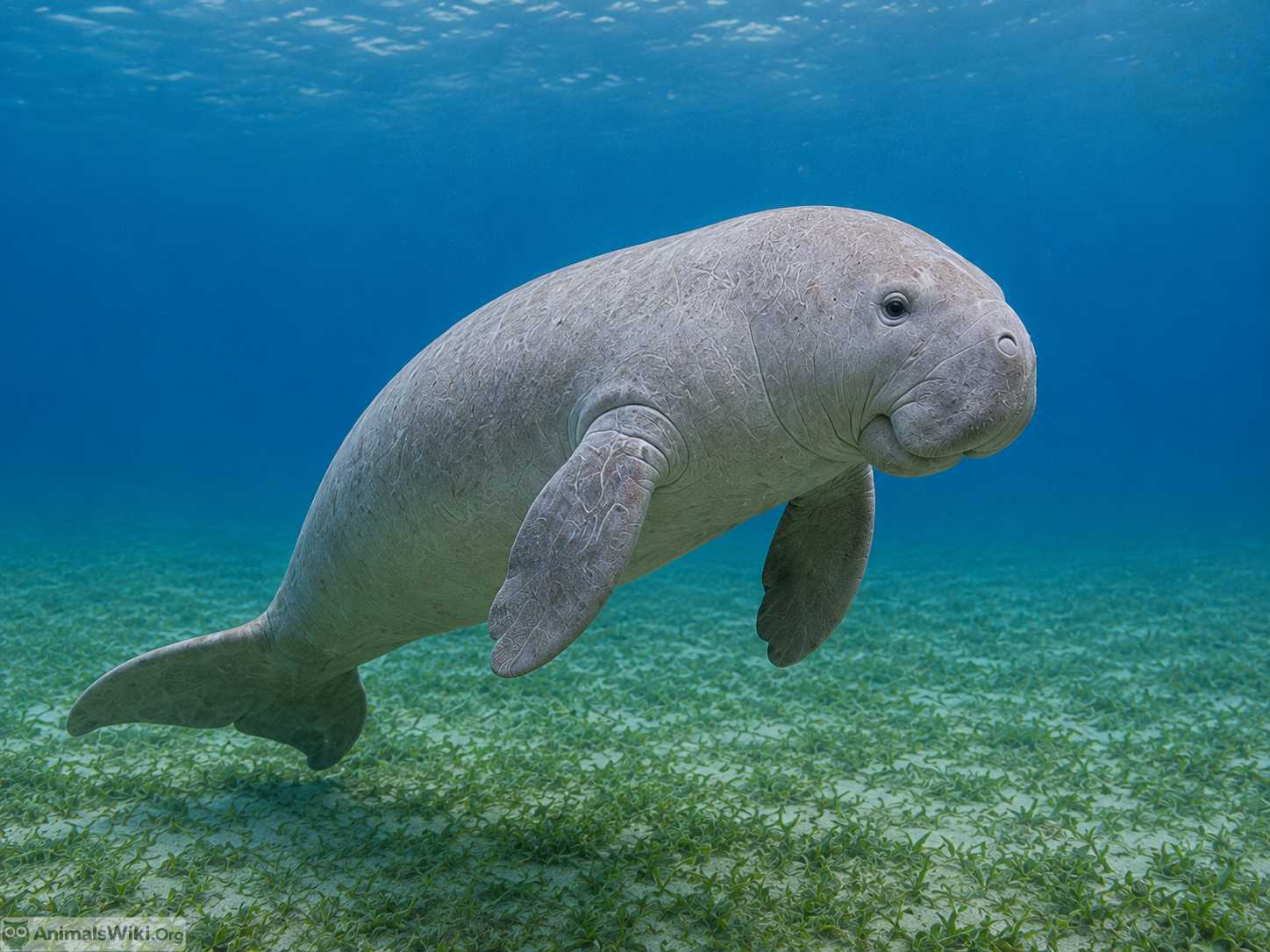
Dugong tail: Fluked — deeply notched in the center, creating two distinct pointed lobes; resembles a whale or dolphin fluke; the horizontal fluke is moved up and down to propel the animal
Manatee tail: Paddle-shaped — rounded and spatula-like; not notched; resembles a large rounded paddle
This tail difference is the most consistent and reliable way to distinguish a dugong from a manatee at a distance. When a large sirenian lifts its tail as it dives — the fluked tail is a dugong; the paddle tail is a manatee.
The Head — Distinctive Drooping Snout
The dugong’s head is immediately distinctive:
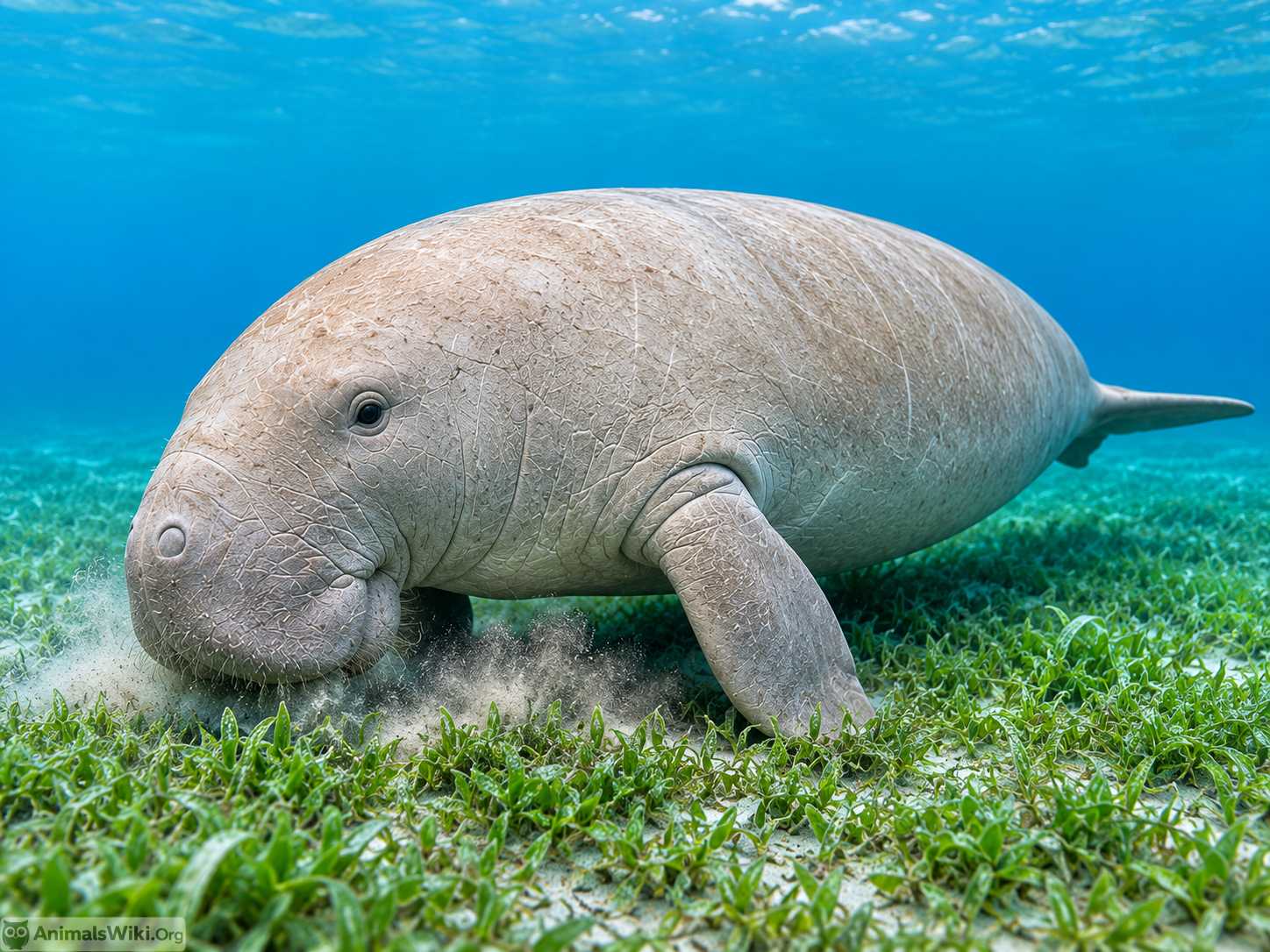
The rostrum (snout): The dugong’s snout is deflected downward at an acute angle — the downward-angled rostrum is an adaptation for bottom-feeding on seagrass; the angle of deflection directs the mouth toward the sea bottom when the dugong is in a near-horizontal swimming position
The broad, disc-like muzzle: The dugong’s muzzle is broad, flat, and muscular — a rostral disc covered in thick, sensitive bristles (vibrissae) that function as touch and chemosensory organs for detecting seagrass
The upper lip: The dugong’s upper lip is very large, muscular, and prehensile — it grasps seagrass plants and rips them from the substrate; the lip’s muscular capability is one of the dugong’s most important feeding adaptations
The nostrils: Located at the top of the snout — valved to close during diving; the dugong breathes by surfacing and exposing just the top of the snout
Eyes: Small relative to body size; the dugong’s eyes are small and set toward the sides of the head; visual acuity is limited; the dugong appears to rely more on tactile and acoustic senses than vision for navigation and social interaction
Ears: No external ear structures — the dugong has tiny ear openings on either side of the head, visible as small holes; hearing is via bone conduction through the jaw as well as through the ear openings
The Flippers — Vestigial Toenails Intact
The dugong’s forelimbs have been modified into paddle-like flippers — used primarily for maneuvering and slow movement rather than primary propulsion (which is provided by the fluked tail):
- The flippers contain the bones of a five-fingered limb (the same bones as a human arm and hand) completely encased in the flipper tissue
- Remarkably, the dugong retains vestigial toenails on its flippers — small nail-like structures on the leading edge; this feature reflects the terrestrial ancestry of sirenians and their close relationship with elephants (which also have toenails)
- The flippers are used to “walk” slowly along the seafloor during bottom-feeding
Skin
Color: Dugong skin is typically brownish-grey to grey overall; the color may vary somewhat between individuals and populations; the belly is typically paler than the dorsal surface; algae and other growth on the skin can give a greenish tinge in some individuals
Texture: Smooth, relatively hairless; the skin is thick and tough
Bristles/vibrissae: The dugong’s body bears sparse bristle-like sensory hairs (vibrissae) distributed across the body; the muzzle has a dense field of vibrissae that are critical for sensory-based feeding
Scars: Adult dugongs frequently carry propeller scars from boat strikes — these scars are used by researchers to individually identify animals in photo-identification studies; the prevalence of propeller scars in dugong populations across their range is a sobering indicator of the scale of boat-strike mortality and injury
The Tusks
Adult male dugongs (and very old females) have erupted upper incisor teeth — the tusks:
- In males, tusks begin erupting around puberty and become more prominent with age
- Large old males may have tusks projecting several centimeters beyond the lip
- Tusks are used in male-male competition and as defensive weapons against predators
- The tusks are structurally similar to elephant tusks — both are modified incisors; this reflects the close evolutionary relationship between the two orders
Bone Density — Ballast for Bottom Feeding
One of the dugong’s most unusual internal anatomical features is its extremely dense, heavy bones (a condition called pachyostosis):
- Dugong bones are some of the densest of any mammal — they lack the hollow marrow cavity of most mammal bones
- This extreme bone density makes the dugong negatively buoyant — it sinks rather than floating in water
- The pachyostosis functions as ballast — weighting the animal down toward the seagrass beds it grazes; without this ballast, the dugong would need to expend significant energy to stay near the bottom while feeding
- The dense bones are one of the anatomical links to the dugong’s Afrothere relatives — elephant bones also show similar density patterns
Did You Know? Dugongs have toenails on their flippers — small nail-like structures that represent the evolutionary legacy of their terrestrial ancestors’ toes. This seemingly trivial feature is one of the anatomical links connecting dugongs to their closest relatives — elephants — which also have prominent toenails on their feet. Both groups are members of Afrotheria, the ancient mammalian superorder, and the shared retention of nail-like structures in both the fully aquatic dugong and the fully terrestrial elephant reflects their common ancestry from a nail-bearing terrestrial ancestor approximately 100 million years ago.
3. Natural Habitat & Geographic Range
The dugong is one of the most geographically widely distributed marine mammals in the world — yet simultaneously one of the most habitat-restricted, being entirely dependent on a single resource type that is itself severely threatened.
The Seagrass Dependency
The dugong’s habitat requirements reduce, ultimately, to a single essential element: seagrass. Dugongs cannot survive without access to productive seagrass meadows — the distribution of the species is entirely determined by the distribution of their food:
Seagrass requirements:
- Shallow water — seagrass requires sunlight to photosynthesize; it grows only where light penetrates to the seafloor; this restricts productive seagrass meadows to depths typically less than 10–15 meters, occasionally to 30+ meters in very clear water
- Warm water — seagrass grows most productively in warm tropical and subtropical waters; the dugong’s range is accordingly tropical and subtropical
- Clear water — turbidity (water cloudiness) reduces light penetration and limits seagrass depth range; coastal development, agricultural runoff, and cyclones all increase turbidity and damage seagrass
- Stable substrate — seagrass anchors in sandy, muddy, or silty sediments; hard rock bottoms do not support seagrass growth
Preferred water depth: Most dugong feeding occurs at 1–5 meters depth — shallow enough for comfortable bottom-foraging with brief breath-hold dives; dugongs can dive to 35+ meters but this is exceptional and energetically costly
Key Habitat Types
Sheltered bays and estuaries — the most important dugong habitat; protected from large swells; support extensive seagrass meadows; allow undisturbed feeding
Shallow coastal shelf areas — open coastal areas with extensive shallow-water seagrass; particularly important in the large embayments of Australia (Shark Bay, Moreton Bay, Hervey Bay)
Lagoons and coral reef lagoons — the protected lagoon environments within coral reef systems; some of the most productive dugong habitat in the Indo-Pacific is found in reef lagoon systems
Mangrove-fringed estuaries — the shallow seagrass areas adjacent to mangrove forests; the combination of mangrove and seagrass habitat supports high dugong density in some areas
Geographic Range — 40+ Countries
The dugong has the most extensive range of any sirenian — distributed across the Indo-Pacific from East Africa in the west to the Pacific Islands (including Vanuatu, Solomon Islands, and Palau) in the east, and from the waters of Japan in the north to Australia in the south:
| Region | Key Countries | Population Status |
|---|---|---|
| East Africa | Tanzania, Mozambique, Kenya, Madagascar | Severely depleted; declining |
| Red Sea | Egypt, Saudi Arabia, Yemen, Eritrea | Moderate; declining |
| Persian/Arabian Gulf | UAE, Qatar, Bahrain, Iran, Kuwait | Second-largest known population; threatened |
| Indian subcontinent | India, Sri Lanka | Very low; declining |
| Southeast Asia | Philippines, Indonesia, Malaysia, Vietnam, Thailand | Severely depleted; some functionally extinct |
| New Guinea | Papua New Guinea | Limited data; probably declining |
| Australia | Western Australia, Queensland, Northern Territory | Largest known population; partially stable |
| Pacific Islands | Palau, Solomon Islands, New Caledonia, Vanuatu | Small; variable |
| Japan (Okinawa) | Japan | Critically low; fewer than 10 individuals in Okinawa |
The Australian Dugong Population — The Species’ Stronghold
Australia holds by far the largest known dugong population in the world — estimated at approximately 70,000–80,000+ individuals in the most optimistic assessments, with the largest concentrations in:
- Shark Bay, Western Australia — a UNESCO World Heritage Area; the most intensively studied dugong population in the world; estimated 10,000+ individuals; the basis for much of what is known about dugong behavior, ecology, and biology
- Torres Strait — the waters between Australia and Papua New Guinea; historically one of the most important dugong habitats; subject to significant traditional hunting
- Gulf of Carpentaria, Northern Territory — significant population; poorly monitored
- Hervey Bay and the Great Sandy Strait, Queensland — important southeastern Australia population; proximity to Brisbane creates significant management challenges
- Moreton Bay, Queensland — the southernmost significant population; an area of intensive research; significant urbanization pressure
Did You Know? The dugong’s global range spans 40+ countries and the coastlines of two ocean basins — yet the species is considered Vulnerable to extinction across this vast range. This apparent paradox reflects the fact that most dugong populations outside Australia are either very small, severely declining, or functionally extinct at local scales. In Okinawa, Japan, the dugong population has declined to fewer than 10 individuals — one of the world’s most critically low large mammal populations. In Vietnam, Cambodia, and parts of Southeast Asia, the dugong may already be functionally extinct in areas where it was common within living memory.
4. Diet & Feeding Behavior
The dugong is one of the most strictly herbivorous of all marine mammals — a dietary specialist whose entire physiology, anatomy, and behavior is organized around the consumption of a single food type: seagrass.
The Seagrass Diet — Almost Exclusively
Seagrass constitutes approximately 97–99% of the adult dugong’s diet:
Which seagrass species are preferred: Dugongs show strong selectivity among seagrass species — not all seagrasses are equally preferred:
- Halophila spp. — the most strongly preferred genus across the dugong’s range; small, soft-leaved seagrasses with high nitrogen content and low fiber; easily digestible and highly nutritious per unit dry weight
- Halodule spp. — frequently preferred, particularly where Halophila is unavailable; somewhat larger leaves but still relatively digestible
- Cymodocea spp. — consumed regularly; moderate preference
- Thalassia spp. — consumed but less preferred; tougher leaves with higher fiber content
- Syringodium, Posidonia and other large-leaved genera — consumed when preferred species are scarce; the low palatability of Posidonia (which dominates some Australian seagrass beds) may limit dugong use of areas where it dominates
Why smaller seagrasses are preferred: The strong preference for small, soft-leaved Halophila species reflects their nutritional superiority — higher nitrogen (protein) content, lower fiber content, and greater digestibility than larger, tougher seagrass species; the selection reflects genuine nutritional optimization by an animal with a slow metabolism and a large daily food requirement
The Root and Rhizome Feeding Strategy
A remarkable aspect of dugong feeding behavior is that they typically consume the entire seagrass plant — including the roots and rhizomes below the sediment surface — rather than merely grazing the leaves:
The feeding trench: Dugongs excavate the seagrass bed as they feed — using their muscular rostral disc and upper lip to root through the sediment, extracting the entire plant including its underground parts; the characteristic feeding trails (elongated furrows in the sediment surface, with uprooted seagrass visible) are one of the most reliable signs of dugong presence and are used by researchers to track dugong activity
Why root and rhizome feeding:
- The underground parts of the seagrass plant are higher in starch and lower in fiber than the leaves — nutritionally superior for certain species
- Root and rhizome feeding extracts the maximum caloric value from each plant consumed
- The feeding behavior varies with seagrass species — for large Posidonia beds, dugongs sometimes graze leaves only (leaf-only cropping); for small Halophila beds, whole-plant consumption is typical
Feeding trail length: Individual dugongs leave distinctive feeding trails that can be hundreds of meters long — visible from aerial surveys as sinuous furrows through the seagrass bed; these trails have been used to estimate dugong feeding rates and habitat use patterns
Daily Food Requirements
The dugong’s food requirement is substantial:
- Adult dugongs consume approximately 25–40 kg of seagrass per day (wet weight) — equivalent to approximately 5–8% of their body weight daily
- At an average seagrass density, this means a dugong must feed over hundreds of square meters of seagrass bed each day
- The dugong’s large daily food requirement makes it highly sensitive to seagrass loss — even moderate reductions in seagrass density force dugongs to range more widely or into suboptimal habitats
Dietary Supplements
The small fraction of the dugong’s diet not consisting of seagrass includes:
- Algae — occasionally consumed; particularly red and green macroalgae; typically when seagrass is scarce
- Invertebrates — occasional consumption of invertebrates associated with seagrass beds (crabs, polychaete worms, sea squirts); probably incidental to seagrass feeding rather than intentional
- Jellyfish — very occasionally reported; the significance is unclear
Digestive System
The dugong’s digestive system is adapted for processing large quantities of fibrous plant material:
The simple stomach — unlike ruminants (which have multi-chambered stomachs for plant fermentation), dugongs have a relatively simple stomach with a highly developed pyloric portion for mechanical processing
The extremely long intestine — the dugong’s intestine is extraordinarily long relative to body size — up to 20–25 meters in large adults; this extended intestine provides the digestion time needed to extract maximum nutrition from fibrous seagrass
Hindgut fermentation — seagrass cellulose is broken down by microbial fermentation in the large intestine; the gut microbiota of dugongs includes specialized bacteria capable of fermenting seagrass cell walls
Low metabolic rate — the dugong’s metabolic rate is significantly lower than expected for a mammal of its size; this metabolic depression reduces the daily caloric requirement but also limits the animal’s activity level and thermal tolerance
5. Reproduction & Life Cycle
The dugong’s reproductive biology is the most important factor in understanding both its ecological role and its conservation vulnerability — with one of the slowest reproductive rates of any marine mammal, dugong populations recover extremely slowly from any source of elevated mortality.
Sexual Maturity — Delayed
- Females: Sexual maturity at approximately 8–18 years — the wide range reflects population-level variation related to food availability and body condition; well-fed populations in productive seagrass environments reach maturity earlier
- Males: Physical maturity at approximately 8–12 years; tusk eruption begins at puberty
The extraordinary range in female maturity age (8–18 years) means that in degraded habitats with poor food quality, females may not begin reproducing until they are nearly two decades old — dramatically reducing lifetime reproductive output in stressed populations.
Mating System
Dugong mating behavior is relatively poorly studied due to the difficulty of observing underwater behavior in turbid, open-water conditions. What is known:
Competitive mating: Males compete for access to females; male-male competition involves tusk displays and jousting — males confronting each other and attempting to inflict tusk wounds; older males with larger tusks typically prevail; the tusk wounds visible on many adult males provide evidence of the intensity of male competition
Mating “scrums”: Aggregations of multiple males competing for a single estrous female are documented; sometimes called “mating herds” or “mating scrums”; the female may be pursued by multiple males simultaneously; these events are energetically costly for all participants
Non-territorial: Male dugongs do not appear to maintain territories; they range widely in search of estrous females rather than defending a fixed area
Gestation and Birth
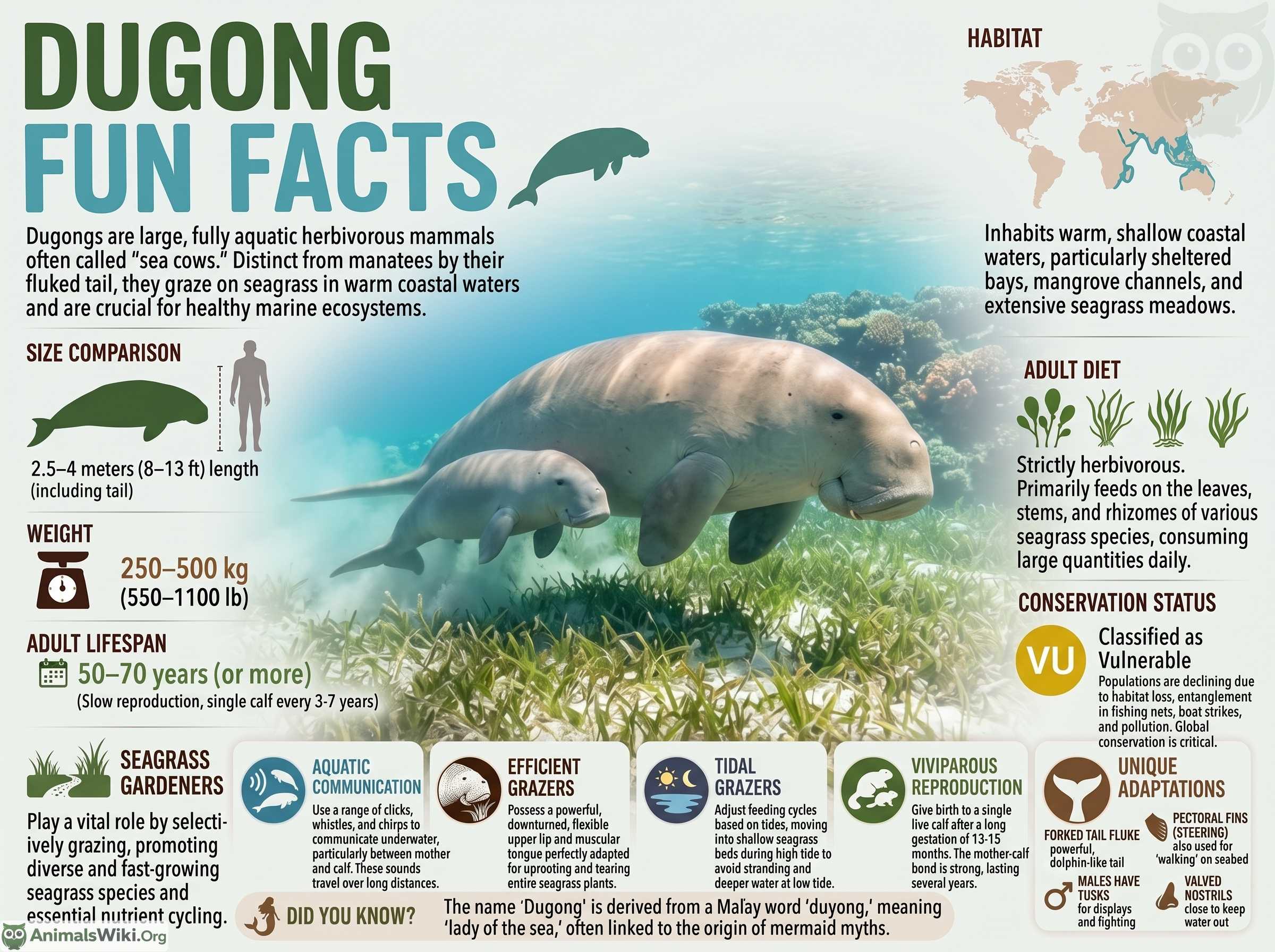
- Gestation period: Approximately 13–15 months — one of the longer gestations among marine mammals
- Birth season: Variable and not strongly seasonal in most populations; some evidence of birth peaks associated with warmer water temperatures
- Litter size: Single calf — always; twins have not been documented
- Birth weight: Approximately 30–35 kg
- Birth length: Approximately 1.0–1.2 meters
- Birth location: In shallow water; calves are born tail-first (as in other cetaceans and sirenians) to minimize drowning risk during delivery
The Calf — Extended Maternal Investment
The dugong calf’s development is extraordinarily slow — reflecting the species’ life history of slow growth, delayed maturity, and exceptional longevity:
Nursing: Calves nurse for 14–18 months — the mammary glands are located under the armpits (axillary position) of the mother; calves nurse while the mother feeds at the surface; calves are occasionally observed nursing while the mother grazes, the calf hanging at her side
Calf position during swimming: The calf swims in a slipstream position adjacent to the mother — slightly behind and to one side; this position reduces the hydrodynamic drag on the calf and allows it to keep pace with the mother with less effort; the characteristic mother-calf slipstream position is one of the most recognizable behaviors of dugongs observed from boats or aircraft
Learning seagrass selection: During the extended nursing period, calves learn which seagrass species to eat and where productive seagrass beds are located — this information is apparently transmitted from mother to calf through observation and experience; in populations where traditional knowledge of good feeding areas has been disrupted (through hunting of experienced females), this cultural transmission of habitat knowledge may be impaired
The Calving Interval — The Conservation Critical Factor
The most important single reproductive parameter for dugong conservation is the calving interval — the time between successive births:
- Typical calving interval: 3–7 years — the longest calving interval of any marine mammal except the great whales
- Typical productive female lifetime: Given the 10–18 year maturity age and 70+ year maximum lifespan, a female might produce 5–8 calves in her entire lifetime under optimal conditions
This extraordinarily low reproductive rate means that even modest increases in adult mortality can cause dugong populations to decline:
- If annual adult mortality exceeds approximately 5–8%, dugong populations decline rather than remaining stable or growing
- Recovery from population depletion is correspondingly slow — decades to centuries, depending on the degree of depletion and the quality of remaining habitat
Lifespan — Exceptional for a Marine Mammal
The dugong is one of the longest-lived marine mammals:
- Maximum documented lifespan: Approximately 73 years (determined from growth layer groups in tusk cross-sections; methodology similar to aging in elephants)
- Typical lifespan in healthy populations: 50–70 years is probably realistic for individuals that survive past the vulnerable juvenile stage
The long lifespan combined with delayed maturity creates a life history that is remarkably parallel to large whales and elephants — slow, deliberate reproduction with heavy investment in each offspring and long lifespans that represent decades of reproductive potential.
6. Social Behavior & Communication
The dugong’s social life is considerably more complex and more flexible than the animal’s solitary reputation might suggest — ranging from extended periods of essentially solitary foraging to dramatic temporary aggregations of hundreds of animals.
Social Organization — Flexible and Context-Dependent
Solitary foraging: For most of the time, most dugongs forage individually or in small groups (pairs or trios) — the seagrass meadow is an evenly distributed food resource that does not require cooperative exploitation; individual foraging maximizes the area each animal can cover without competition
Cow-calf pairs: The most consistent and most enduring dugong social unit is the mother-calf pair — the calf accompanies its mother for 14–18 months or more; this pair is the social foundation of dugong life
Small associations: Dugongs occasionally form loose associations of 5–10 individuals — particularly at productive feeding sites or during social activities; these associations are not cohesive social groups with stable membership but rather temporary aggregations at shared resources
Large aggregations: The most dramatic social phenomenon documented in dugongs is the occasional formation of large herds of hundreds of animals — called “mega-herds” in some literature:
- Aggregations of 100–500+ dugongs have been documented at specific sites in Australia (particularly in northern Australian waters)
- The triggers for these aggregations appear to include exceptionally productive seagrass blooms following flood events that deposit nutrients, temperature-driven habitat concentration, and possibly social factors associated with mating
- These mega-herds are spectacular but rare events; they have been documented most reliably from aerial surveys
Communication — Limited but Present
Dugong communication is poorly studied due to the difficulty of conducting behavioral research on animals that spend most of their time submerged in often-turbid water. What is documented:
Vocalizations:
- Dugongs produce a range of sounds including chirps, whistles, barks, and squeaks
- Sounds are used for mother-calf communication — the calf produces distinctive chirping calls when separated from the mother; the mother responds with vocalizations that guide the calf back
- Adult-adult communication through vocalizations appears to occur during mating events and possibly during aggregations, though documentation is limited
- The frequency range of dugong vocalizations is primarily 200 Hz to 18 kHz — within the range of human hearing; unlike dolphins and toothed whales, dugongs do not appear to use high-frequency echolocation
Touch: Physical contact between mother and calf is frequent — the calf maintains close physical proximity to the mother for extended periods; contact appears to be an important bonding mechanism
Tusk displays: Adult males use tusk size displays in competitive interactions — facing rivals and displaying the tusk projections from the upper jaw; tusk length communicates competitive status without requiring physical combat in many encounters
The Dugong “Surfacing” — Behavioral Signature
The dugong’s breathing pattern is one of its most distinctive behavioral signatures:
- Dugongs surface approximately every 1–3 minutes during active foraging
- They can remain submerged for 6–8 minutes at rest (maximum documented approximately 11 minutes)
- The surfacing pattern — rising slowly to the surface, exposing the top of the snout to breathe, then descending — is the behavior most often described by human observers
- The habit of surfacing vertically with the upper body above water (observed nursing positions and social interactions at the surface) is thought to be the primary origin of mermaid mythology
7. Predators & Defense Mechanisms
Adult dugongs face relatively limited predation from natural predators — their large size provides significant protection — but calves and juveniles are vulnerable, and even adults can be taken by the largest marine predators.
Natural Predators
Tiger Shark (Galeocerdo cuvier) — the most significant natural predator of dugongs across the Indo-Pacific range; tiger sharks are large enough to attack and kill adult dugongs; research at Shark Bay, Western Australia has documented extensive dugong behavioral responses to tiger shark presence (avoiding seagrass areas with high shark density during periods of peak shark activity); dugong bite wounds consistent with tiger shark attacks are documented on surviving individuals
Saltwater Crocodile (Crocodylus porosus) — significant predator of dugongs in northern Australian waters and parts of Southeast Asia; attacks on calves and juveniles are most common; adult crocodiles are large enough to take adult dugongs
Killer Whale (Orca, Orcinus orca) — documented predation on dugongs in some areas; group hunting by orca pods can overcome even large adult dugongs; less common than tiger shark predation across most of the range
Large sharks — bull sharks and other large shark species occasionally attack dugongs, particularly calves and injured adults
Predator Avoidance Behavior
Research at Shark Bay has produced some of the most detailed documentation of dugong predator avoidance behavior of any marine mammal:
The “landscape of fear”: Dugongs modify their habitat use based on perceived predation risk — avoiding areas where tiger sharks are common even when those areas have better seagrass than lower-risk areas; this behavioral modification — the “landscape of fear” effect — means that predators shape dugong distribution and habitat use even without directly killing large numbers of animals
Depth selection: When tiger sharks are active (typically in warm-water months), dugongs shift to deeper feeding areas where sharks hunt less effectively — sacrificing feeding efficiency for safety
Group size effects: Dugongs may form larger groups in higher-predation-risk periods and areas — the “many eyes” effect potentially providing better predator detection; the relationship between group size and predation risk is consistent with predator-driven grouping observed across many prey species
Defense Mechanisms
Size — the primary passive defense; at 230–420 kg, adult dugongs are large enough that most predators cannot easily overpower them; the dense, heavy bones (pachyostosis) make dugong skulls particularly resistant to crushing
Tusks — adult males use their tusks defensively against predators; documented tusk wounds on sharks associated with dugong interactions suggest dugongs do fight back
Depth diving — diving to deeper water removes dugongs from the shallow-water hunting zones of many coastal predators
Swimming speed — dugongs can reach approximately 10 km/h in sustained swimming and up to 22 km/h in short bursts; this speed is insufficient to outrun a tiger shark but may provide some escape capability in short distances
Human association — in some areas, dugongs have learned to associate with human vessel presence as a predator deterrent; this behavioral adaptation (paralleling similar patterns in other large herbivores that associate with human presence for safety from predators) has complex implications for conservation management
8. Relationship with Humans
Ancient Human Relationships — Tens of Thousands of Years
The relationship between humans and dugongs is one of the most ancient human-marine mammal interactions documented — with evidence of dugong hunting and consumption at coastal archaeological sites in the Indo-Pacific spanning 50,000+ years:
Indigenous Australian relationships: The traditional custodians of Australia’s coastal regions have hunted dugongs for thousands of years — and in Torres Strait Islander and some Aboriginal Australian communities, traditional dugong hunting continues today as a legally protected customary practice. Key aspects:
- Torres Strait Islander culture — the dugong (kuba in some Torres Strait languages) is central to the culture, ceremony, and diet of Torres Strait Islander communities; dugong hunting is a traditional male prestige activity; dugong meat and fat are important foods for ceremonial events; dugong bones and other parts are used in art and material culture
- Yolŋu and other Arnhem Land peoples — the dugong is hunted using traditional techniques including harpoons; dugong hunting knowledge is transmitted across generations as part of cultural heritage
- Legal status in Australia — dugong hunting by Torres Strait Islander and Aboriginal Australian peoples with traditional rights is legal under Australian law; it is exempt from the wildlife protection legislation that applies to non-Indigenous hunting; this exemption reflects recognition of Indigenous rights and the cultural significance of traditional hunting; management of traditional take in the context of dugong conservation is a complex and sensitive issue
Pacific Islander relationships: Dugong hunting is or was traditional practice in many Pacific Island communities — in Palau, Vanuatu, Solomon Islands, and other countries; the cultural significance of dugong hunting varies by community but is often associated with prestige, ceremony, and food security
Southeast Asian relationships: Coastal communities across Southeast Asia have hunted dugongs for centuries — for meat, oil (used for fuel and medicine), hide (used for leather), and bones (used in traditional medicine); commercial and subsistence dugong hunting across Southeast Asia was a major factor in the severe depletion of regional populations during the 20th century
Middle Eastern and East African relationships: Dugong hunting by coastal communities in the Persian Gulf, Red Sea, and East African coast has been documented historically; in some Gulf communities, dugong was an important traditional food source; commercial hunting and incidental catch in nets have severely reduced these populations
The Mermaid Connection — Dugongs as Sirens
The dugong is almost certainly the primary natural inspiration for the mermaid mythology that pervades maritime cultures from Southeast Asia and the Pacific through the Indian Ocean to the Mediterranean:
The visual similarity: When a dugong surfaces vertically at sea — rising to breathe, briefly revealing the upper body above the waterline — particularly when observed from a boat at some distance in poor light conditions, the silhouette can resemble a human figure from the waist up above the water. When a nursing female holds her calf to her chest while floating upright at the surface — a documented behavior — the image of a human-like figure cradling an infant is striking.
The geographic correlation: Mermaid mythology is most ancient and most richly developed in the coastal regions of the Indo-Pacific — exactly the region where dugongs are most abundant; the mythology becomes less elaborate and less ancient in regions where dugongs are absent; this geographic correlation strongly supports the dugong as the primary inspiration.
Historical accounts: Several historical European explorers explicitly recorded encountering creatures they believed might be mermaids in the Indo-Pacific — accounts that, when examined for geographic location and behavioral description, are consistent with dugong sightings; Christopher Columbus famously recorded seeing “three mermaids” in Caribbean waters (1493) — though this may have been manatees rather than dugongs.
Commercial Exploitation — The Decline
19th–20th century commercial hunting: The dugong was commercially hunted across much of its range during the 19th and early 20th centuries — primarily for:
- Oil — dugong body oil was valued as a lubricant, lamp oil, and for waterproofing; a large dugong could yield significant oil
- Meat — sold in local markets across Southeast Asia and the Pacific
- Hide — the thick dugong skin was used for leather products
- Bones — used in traditional medicine
Commercial hunting caused dramatic population declines across Southeast Asia, East Africa, and the Pacific during this period — many populations that were abundant in the 19th century are now absent or functionally extinct.
Incidental catch in fishing nets: Throughout the 20th and into the 21st century, bycatch in shark nets, gill nets, and other fishing gear has been a major source of dugong mortality — dugongs become entangled in nets and drown; this continues to be one of the most significant mortality sources in areas where small-scale fisheries operate in dugong habitat
9. Conservation Status & Threats
IUCN Status
Dugong (Dugong dugon): Vulnerable (IUCN 2015 assessment) — but many subpopulations are locally Endangered or Critically Endangered; the global Vulnerable assessment reflects the large Australian population; without Australia’s population, the species would likely be assessed as Endangered or Critically Endangered globally
Key Threats
1. Seagrass Loss and Degradation — The Existential Threat
The loss and degradation of seagrass meadows is the most fundamental threat to the dugong — because without seagrass, dugongs simply cannot survive. Seagrass is threatened by:
- Coastal development — dredging, land reclamation, and coastal construction directly destroy seagrass beds and increase water turbidity
- Agricultural runoff — nutrients from agricultural land stimulate algae growth that smothers seagrass; Australia’s Great Barrier Reef catchment area runoff has caused significant seagrass loss
- Climate change — increasing water temperature, more intense cyclones (which physically destroy seagrass beds through storm surge and sedimentation), and ocean acidification all threaten seagrass globally; in Queensland, major cyclone events (e.g., Cyclone Hamish 2009, Cyclone Yasi 2011) have caused massive seagrass losses that have taken years to recover, directly causing dugong starvation deaths
- Increased turbidity — from coastal development, dredging, and catchment land clearing reduces light penetration, limiting seagrass depth range and productivity
2. Hunting — Both Direct and Incidental
- Traditional hunting — in Torres Strait, parts of New Guinea, the Pacific Islands, and Southeast Asia; the take may be locally significant even where legal
- Illegal commercial hunting — continues in parts of Southeast Asia and East Africa despite legal protection
- Bycatch — entanglement and drowning in fishing nets (gill nets, shark nets, trawl nets, crab pots); probably the most significant mortality source in the non-Australian range
3. Vessel Strikes
Collisions with boats and vessel propellers are a documented mortality source across the range; the characteristic propeller scars on surviving dugongs provide evidence of the scale of encounters; vessel strikes cause direct mortality and non-lethal injuries
4. Pollution
- Organochlorine pollution — dugongs bioaccumulate organochlorine compounds from their seagrass food; effects on reproduction and immune function are documented in contaminated populations
- Plastic ingestion — dugongs occasionally ingest plastic debris associated with seagrass beds; the scale of the impact is uncertain but potentially significant
- Oil spills — coastal oil spills can directly contaminate seagrass beds and affect dugongs through food contamination
5. Noise Pollution
Shipping and boat traffic generate underwater noise that may interfere with dugong acoustic communication and echolocation; the specific impact on dugongs is less well-studied than in cetaceans but potentially significant in high-traffic areas
6. Climate Change
- Increasing cyclone intensity — more powerful cyclones destroy seagrass beds; the recovery time from major cyclone events can exceed 10 years for some seagrass communities
- Marine heatwaves — extreme water temperature events kill seagrass; massive seagrass dieback events associated with marine heatwaves have been documented in Australia (e.g., the 2011 Shark Bay seagrass dieback caused by the most extreme marine heatwave on record)
- Sea level rise — rising seas may increase turbidity and reduce light penetration in shallow seagrass beds
10. Famous Dugongs Around the World
Pig — Shark Bay’s Research Icon
The Shark Bay dugong population in Western Australia has been the subject of continuous research since the 1980s — making it the most intensively studied dugong population in the world and one of the most important long-term marine mammal research programs in the southern hemisphere. Researchers including Helene Marsh, Amanda Hodgson, and the Monkey Mia Research Institute have individually identified hundreds of dugongs using natural markings and propeller scars, producing a photo-identification database that spans over 40 years for some individual animals. These long-term identifications have provided unprecedented data on dugong lifespan, reproductive history, social structure, and habitat use.
Moo — Singapore’s Famous Dugong
Moo — a young dugong that appeared in Singapore’s waters in 2015 and was regularly observed by recreational divers and fishermen — became one of the most famous individual dugongs in Southeast Asia. Her presence in Singapore’s heavily degraded coastal waters generated enormous public interest and media coverage in a region where dugongs are now essentially absent. Moo’s appearances prompted discussions about Singapore’s coastal seagrass restoration and marine conservation programs. Moo was eventually found dead, apparently from boat strike injuries, in 2016 — her death generating significant public mourning and renewed attention to dugong conservation in Southeast Asian waters.
Okinawa’s Last Dugongs
The Okinawan dugong (Dugong dugon — the population is not taxonomically distinct but is considered a culturally and geographically distinct population) represents one of the most critically low large mammal populations in the world — with fewer than 10 individuals estimated to remain in Okinawa’s coastal waters. These animals have been the subject of intense conservation and legal advocacy — including lawsuits in US federal courts attempting to stop the construction of a US military base at Henoko Bay, an area of critical dugong habitat. The Okinawan dugong has become a symbol of the conflict between military and development interests and cultural and environmental conservation values in Japan.
The Okinawan dugong holds special cultural significance for the Ryukyuan people of Okinawa — known as zaan in Okinawan language, the dugong has been a culturally important animal in the islands for centuries and its near-extinction is mourned as a cultural as well as ecological loss.
Dugong of the Arabian Gulf
The Arabian Gulf (Persian Gulf) holds what is probably the second-largest dugong population in the world — centered in the waters of Bahrain, Qatar, UAE, and Saudi Arabia; the Gulf population has been estimated at approximately 5,000–7,000 individuals though this figure is uncertain. These dugongs are significant because they represent the largest dugong population outside Australia — but they face severe and increasing threats from coastal development, oil and gas infrastructure, fishing bycatch, and pollution that make their long-term future uncertain.
11. Role in Ecosystem & Food Chain
Dugongs as Ecosystem Engineers — Seagrass Management
The dugong’s role in seagrass ecosystems is one of the most important but most poorly understood ecological functions of any marine mammal. Recent research has begun to reveal the extraordinary complexity of the dugong-seagrass interaction:
Seagrass community structure: The dugong’s feeding behavior — particularly the whole-plant excavation style that removes roots and rhizomes — creates feeding patches in the seagrass bed that influence the community structure of the seagrass meadow:
- Patch creation and maintenance: Dugong feeding creates open patches in the seagrass canopy; these patches allow light penetration to the sediment surface, creating conditions that favor the establishment of early-colonizing seagrass species (particularly Halophila, the most preferred dugong food)
- Nutrient cycling: By excavating the sediment during feeding, dugongs bring nutrients from deeper sediment layers to the surface — potentially stimulating productivity in the patches they create
- Succession management: Dugong feeding appears to maintain seagrass communities in early to intermediate successional stages — preventing the dominance of late-succession large-leaved seagrass species that are less nutritious for dugongs; this creates a feedback loop in which dugong feeding maintains the seagrass community in a state that is most productive for the dugongs themselves
The “cultivating” hypothesis: Research at Shark Bay has suggested that dugongs may actually cultivate their preferred seagrass species — by creating feeding patches that promote Halophila growth and suppress the establishment of less-preferred species; if this hypothesis is supported, dugongs would join a small group of animals (including beavers and elephants) that actively engineer their food resources through behavioral modification of the environment.
Nutrient Transport
Dugongs consume seagrass in shallow seagrass beds and defecate as they move through the water — transporting nutrients from concentrated seagrass beds to surrounding water and sediment areas; this nutrient transport function contributes to the productivity of the broader coastal ecosystem adjacent to seagrass beds.
As Prey — Supporting Marine Predator Populations
Dugongs are an important prey species for tiger sharks — the apex predator of shallow tropical coastal ecosystems across the Indo-Pacific. Research at Shark Bay has demonstrated that the presence of a large dugong population sustains a substantial tiger shark population; the dugong’s abundance and predictable habitat use makes them a reliable prey source for sharks.
The ecological relationship between dugongs and tiger sharks is one of the best-studied predator-prey systems in any marine ecosystem — the long-term research at Shark Bay has produced landmark papers on the landscape of fear, trophic cascades, and the ecological consequences of apex predator loss in marine systems.
12. Myths, Culture & Pop Culture Appearances
The Mermaid Myth — The Dugong’s Most Important Cultural Legacy
As discussed in the relationship with humans section, the dugong is almost certainly the primary inspiration for mermaid mythology across the Indo-Pacific and beyond. The implications of this cultural connection are profound — the dugong has, through the mermaid mythology it inspired, contributed more to human imagination and cultural production than perhaps any other marine mammal.
The mermaid archetype appears in:
- Ancient Assyrian and Babylonian mythology — the fish-tailed deity Atargatis (also Derceto), considered one of the earliest mermaid figures, is associated with the coastal waters of the Eastern Mediterranean and Red Sea where dugongs historically occurred
- Ancient Greek tradition — the Sirens (from which the order Sirenia takes its name) are part-woman, part-bird or part-fish creatures associated with dangerous coastal waters; while the connection to dugongs is less direct for Greek Sirens than for some other traditions, the naming of dugong’s order reflects the mythological association
- Indigenous Pacific mythology — dugong-inspired mythological beings appear in the traditional stories of numerous Pacific and Southeast Asian peoples; in some Filipino traditions, the Sirena and Sireno (female and male sea spirits) are associated with the dugong-inhabited coastal waters of the archipelago
- Malay and Indonesian tradition — the Puteri Duyung (mermaid princess) of Malay folklore inhabits the coastal waters where dugongs occur; traditional Malay fishing communities have elaborate traditions associating sea spirits with dugong-like qualities
Ryukyuan and Japanese Cultural Significance
In Okinawa and the broader Ryukyu Islands chain, the dugong (zaan in Okinawan) is a culturally significant animal whose decline is mourned as a cultural loss:
- The dugong appears in Ryukyuan folk art and craft — as a design motif on pottery, textiles, and other traditional crafts
- Okinawan environmental activists have used the dugong as a symbol of Ryukyuan cultural identity and environmental heritage in campaigns against the US military base construction at Henoko Bay
- The legal case brought in US federal courts to protect the Okinawan dugong from base construction impacts argued that the dugong’s cultural significance to the Ryukyuan people gave it protected status under US law — a landmark case in the intersection of indigenous cultural rights and environmental law
The Dugong in Indigenous Australian Culture
The dugong is central to the cultural identity of Torres Strait Islander peoples — appearing in:
- Traditional art — dugong images in traditional Torres Strait Islander art including the distinctive tombstone (gravestone) art tradition
- Dance and ceremony — dugong hunting and its associated ceremonies are important elements of Torres Strait Islander cultural practice
- Oral tradition — stories about dugong hunting, the behavior of dugongs, and the relationship between people and dugongs are part of the cultural heritage transmitted across generations
Pop Culture Appearances
- “Finding Nemo” and “Finding Dory” (Pixar) — while the films’ marine cast does not include a dugong, the films’ extraordinary impact on public awareness of marine life conservation includes the broader context of Indo-Pacific marine ecosystems where dugongs live; the films’ popularity has contributed to public interest in marine mammal conservation generally
- “Dugong Protection” campaigns — multiple international environmental organizations have used dugong imagery in ocean conservation campaigns; the combination of the mermaid myth association and the dugong’s genuine visual appeal makes it an effective conservation communication subject
- Japanese media coverage of the Okinawan dugong — the near-extinction of the Okinawan dugong has been covered extensively in Japanese media and has been the subject of documentary films, news investigations, and cultural commentary in Japan
- Social media — dugong videos (particularly footage of feeding, mother-calf pairs, and interactions with snorkelers) consistently generate high engagement on wildlife-focused social media platforms; the underwater visibility of dugongs in clear tropical water makes for compelling nature photography
- Children’s literature — dugongs appear in numerous Australian children’s books focused on marine conservation and Great Barrier Reef ecology; they serve as gentle, relatable marine ambassadors in environmental education contexts
- Steller’s Sea Cow connection — the story of Steller’s Sea Cow — the largest sirenian ever recorded, hunted to extinction within 27 years of European discovery — is regularly featured in extinction awareness media and natural history content; its connection to the dugong (as the last surviving member of the same family) makes the dugong the living emblem of this extinction cautionary tale
Did You Know? Steller’s Sea Cow (Hydrodamalis gigas) — a massive sirenian related to the dugong that was discovered by European naturalists in 1741 in the waters of the Commander Islands in the North Pacific — was hunted to complete extinction by 1768 — just 27 years after its discovery. Steller’s Sea Cow was the largest sirenian that ever lived, reaching up to 9 meters in length and an estimated 10 tonnes in weight — roughly the size of a small whale. It was immediately identified as an exceptionally valuable source of meat, oil, and hide by the Russian fur trade expeditions operating in the North Pacific; within less than three decades, the entire species had been wiped out. The dugong is the last member of the family Dugongidae — the direct ecological and evolutionary successor to Steller’s Sea Cow — and its extinction would end a family lineage that has existed for over 50 million years.
13. Discovery & Evolution Timeline
~100 million years ago — The superorder Afrotheria diverges from other placental mammal lineages; the common ancestor of elephants, hyraxes, aardvarks, and sirenians exists as a terrestrial mammal in Africa.
~55–60 million years ago — The order Sirenia diverges from other Afrothere lineages; early sirenian ancestors begin transitioning from terrestrial to aquatic life; the transition is thought to have been driven by the availability of rich coastal aquatic vegetation in the warm shallow seas surrounding ancient Africa.
~50 million years ago — Prorastomus and related early sirenians are present in fossil deposits from Jamaica and other Caribbean/Atlantic sites; these earliest sirenians still retain four functional limbs; they are essentially four-legged, amphibious mammals that spend time in shallow coastal water.
~45–50 million years ago — The transition to fully aquatic life accelerates; hind limbs reduce dramatically; the body elongates; the fluked tail develops; the earliest true aquatic sirenians appear.
~30–35 million years ago — The family Dugongidae diverges from the family Trichechidae (manatees); the two sirenian families begin their independent evolutionary trajectories; dugongids retain the fluked tail while trichechids develop the paddle tail.
~20–25 million years ago — Dugong genus ancestors appear; the modern dugong body plan is essentially established; seagrass dependence is well-established in the lineage.
~5–10 million years ago — Hydrodamalis (giant sirenians leading to Steller’s Sea Cow) diverges from Dugong; the two lineages separate — Hydrodamalis adapting to cold northern waters while Dugong remains in tropical Indo-Pacific waters.
~50,000 years ago — The first modern humans reach Australia and the Indo-Pacific; the long coexistence between humans and dugongs begins; Indigenous hunting of dugongs commences.
~3,000 BC — The earliest documented mermaid mythology — the Assyrian goddess Atargatis — appears in the ancient Near East, associated with coastal waters where dugongs occurred historically.
~1597 — The first European descriptions of dugong-like animals in the Indo-Pacific emerge from Dutch trading expeditions in Asian waters.
1776 — P.L.S. Müller formally describes Dugong dugon — establishing the scientific name that remains in use.
1741 — Georg Wilhelm Steller discovers the giant Steller’s Sea Cow (Hydrodamalis gigas) in the Commander Islands during the Bering Expedition.
1768 — Steller’s Sea Cow is driven to extinction — the most rapid documented extinction of a large marine mammal; a cautionary tale directly relevant to dugong conservation.
Late 19th–early 20th century — Commercial hunting of dugongs across Southeast Asia, the Pacific, and the Indian Ocean causes severe population declines; many populations are effectively eliminated.
1970s — Growing scientific and conservation awareness of dugong population declines; initial conservation legislation in Australia and some other range countries.
1980s — Systematic research programs on dugong biology begin at Shark Bay, Western Australia; the foundations of modern dugong science are established.
1994 — IUCN assesses dugong as Vulnerable — the first formal international recognition of the species’ threatened status.
2007 — US federal court case (Okinawa Dugong v. Rumsfeld/Gates) — legal action attempting to use US federal law to protect the Okinawan dugong from US military base construction impacts; landmark case in international environmental law.
2011 — Major seagrass loss event in Shark Bay following an unprecedented marine heatwave; thousands of dugongs displaced; recovery monitoring begins.
2022 — IUCN updates confirm continued Vulnerable status; growing recognition that many regional populations meet Endangered or Critically Endangered thresholds.
2026 — Global dugong conservation programs expanding; seagrass conservation increasingly recognized as central to dugong survival; climate change impacts on seagrass beds creating growing urgency; Okinawan population remains critically close to extinction.
14. Comparison with Similar Species
| Feature | Dugong (D. dugon) | West Indian Manatee (T. manatus) | Amazonian Manatee (T. inunguis) | Steller’s Sea Cow (H. gigas) — EXTINCT |
|---|---|---|---|---|
| Order/Family | Sirenia/Dugongidae | Sirenia/Trichechidae | Sirenia/Trichechidae | Sirenia/Dugongidae |
| Length | 2.4–3.3 m | 2.7–3.6 m | 2.5–3.0 m | Up to 9 m |
| Weight | 230–420 kg | 200–600 kg | 350–480 kg | Up to ~10,000 kg |
| Tail shape | Fluked (like a whale) | Paddle-shaped (rounded) | Paddle-shaped | Fluked |
| Snout | Deflected downward; disc-like | Rounded; mobile upper lip | Similar to W. Indian | Blunt; lacks distinct disc |
| Tusks | Males (and old females) | None | None | None |
| Range | Indo-Pacific (40+ countries) | Caribbean; SE USA; Gulf of Mexico | Amazon River basin | North Pacific — EXTINCT 1768 |
| Habitat | Shallow marine; seagrass | Coastal marine; freshwater | Freshwater rivers | Cold coastal marine/kelp |
| Diet | Seagrass (97–99%) | Seagrass; aquatic plants | Aquatic plants | Kelp; aquatic plants |
| IUCN Status | Vulnerable | Vulnerable | Vulnerable | EXTINCT |
| Key difference | Fluked tail; marine-only | Paddle tail; freshwater tolerant | Freshwater specialist | Extinct; far larger |
| Mermaid connection | Primary inspiration | Secondary (Caribbean) | No | No |
15. Best Places to See Dugongs in the Wild
Australia — The World’s Best Dugong Watching Destination
Australia holds the world’s largest dugong population and offers the most developed and most reliable dugong watching experiences:
- 🇦🇺 Shark Bay, Western Australia — the world’s premier dugong watching destination; UNESCO World Heritage Area; population estimated at 10,000+ dugongs; aerial boat tours from Denham and Monkey Mia regularly encounter dugongs; the Monkey Mia Research Institute has studied individual dugongs for over 40 years; snorkeling tours at specific sites allow in-water encounters; the clear, turquoise waters of Shark Bay provide extraordinary underwater visibility; best time: year-round; summer (December–March) provides best water visibility
- 🇦🇺 Hervey Bay, Queensland — significant southern Queensland dugong population; dugong watching tours operate from Hervey Bay township; aerial tours provide good sighting rates; the bay’s large expanse of shallow water supports hundreds of dugongs; accessible from Brisbane (approximately 4 hours drive)
- 🇦🇺 Moreton Bay, Queensland — the southernmost significant dugong population in Australia; accessible from Brisbane; boat tours operate from Redcliffe and Manly; snorkeling with dugongs possible at Moreton Island sites under appropriate conditions
- 🇦🇺 Coral Bay, Western Australia (adjacent to Ningaloo Reef) — Ningaloo Marine Park’s shallow lagoon supports a local dugong population; snorkeling with dugongs is possible at specific sites; the combination of Ningaloo’s extraordinary biodiversity (whale sharks, manta rays, coral) with dugong encounters makes this one of Australia’s most comprehensive marine wildlife destinations
Middle East
- 🇶🇦 Qatar (Al-Shaheen area) and UAE (Abu Dhabi coastal waters) — the Arabian Gulf holds significant dugong populations accessible through specialist diving and wildlife boat tours; Abu Dhabi’s marine waters are increasingly recognized as important dugong habitat
Southeast Asia and Pacific
- 🇵🇭 Palawan, Philippines — the clear waters around Palawan and its associated islands support one of the most accessible Southeast Asian dugong populations; dive operators in Puerto Princesa and El Nido occasionally encounter dugongs
- 🇵🇼 Palau — dugongs are present in Palau’s extraordinary marine environment; encounters possible during diving expeditions particularly in shallower lagoon areas
- 🇯🇵 Okinawa, Japan — the critically endangered Okinawan dugong population is essentially impossible to observe in the wild; the few remaining individuals are so scarce and disturbed that any attempt to observe them would be inappropriate; the dugong museum at Cape Maeda Diving Center and cultural materials in Okinawa Prefectural Museum provide cultural and educational context
Snorkeling and Diving Tips
- Morning hours are best for dugong observations — animals are often actively feeding in clear, calm conditions
- Look for feeding trails — the characteristic furrows in the seagrass bed indicate recent dugong feeding activity
- Approach quietly — dugongs are sensitive to engine noise; operators that approach slowly and turn off engines well before reaching dugongs are most successful
- Maintain respectful distance — don’t chase or approach too closely; allow dugongs to approach you rather than pursuing them
16. Dugong Fun Facts for Kids
- 🌊 The dugong is one of the closest living relatives of the elephant — more closely related to elephants than to whales or dolphins
- 🌊 The dugong is almost certainly the primary inspiration for mermaid mythology across the Indo-Pacific and beyond
- 🌊 Dugongs have toenails on their flippers — vestigial remnants of their terrestrial ancestors’ toes
- 🌊 The dugong is the only surviving member of the family Dugongidae — Steller’s Sea Cow, its closest relative, was driven to extinction in 1768
- 🌊 Dugongs can live for over 70 years — one of the longest lifespans of any marine mammal
- 🌊 The calving interval of 3–7 years makes the dugong one of the slowest-reproducing marine mammals — populations recover extremely slowly from depletion
- 🌊 Dugongs consume approximately 25–40 kg of seagrass per day — rooting up the entire plant including roots and rhizomes
- 🌊 The dugong’s bones are extremely dense (pachyostosis) — functioning as ballast to keep the animal near the seafloor while feeding
- 🌊 In Okinawa, Japan, fewer than 10 dugongs remain — one of the most critically low large mammal populations on Earth
- 🌊 The dugong’s intestine can reach 20–25 meters in length — extraordinarily long for an animal of its size
- 🌊 Dugongs have been documented living to at least 73 years — aged by counting growth layers in their tusks
- 🌊 Dugong feeding trails — elongated furrows excavated in seagrass beds — can be hundreds of meters long and are visible from the air
17. How You Can Help
Support These Organizations
- WWF — Dugong Conservation Programs (wwf.org) — major international advocacy and field programs for dugong conservation across the Indo-Pacific range; seagrass habitat protection campaigns; bycatch reduction advocacy
- Save the Dugong Foundation (savedugong.org.au) — Australian organization specifically focused on dugong conservation; community awareness programs; advocacy for seagrass protection
- Dugong and Seagrass Conservation Project — UNEP-coordinated international program working across the dugong’s range; monitoring, community engagement, and bycatch reduction across 40+ range countries
- Great Barrier Reef Foundation (barrierreef.org) — protecting the seagrass ecosystems of the Great Barrier Reef that are critical for Queensland dugong populations
- Shark Bay World Heritage Area management (environment.gov.au) — the most important single dugong habitat on Earth; supporting the management programs that protect Shark Bay’s extraordinary ecosystem
- World Seagrass Association (worldseagrass.org) — international scientific organization promoting seagrass conservation and research; protecting the habitat that dugongs depend on is the most fundamental conservation action
What You Can Do
- Protect seagrass — the single most important thing for dugong conservation is protecting seagrass; advocate for policies that reduce coastal development impacts on seagrass; support organizations working on catchment-level water quality improvements that protect seagrass from agricultural runoff; reduce personal contribution to nutrient pollution through fertilizer use and wastewater management
- Choose sustainable seafood — fishing gear bycatch is the most significant source of dugong mortality outside Australia; choosing seafood certified by the Marine Stewardship Council (MSC) prioritizes fisheries with lower bycatch rates; reducing consumption of seafood from regions and fisheries with documented dugong bycatch
- Drive boats responsibly in dugong habitat — slow down in seagrass areas; observe speed limits in marine parks; follow boat exclusion zones around dugong feeding areas; propeller strikes from boats are a significant cause of dugong injury and death
- Support climate action — climate change threatens seagrass through marine heatwaves, increasing cyclone intensity, and sea level rise; climate action is seagrass protection is dugong conservation
- Advocate for the Okinawan dugong — the critically low Okinawan population needs international attention; supporting organizations advocating for protection of Okinawan dugong habitat (particularly the Henoko Bay issue) helps the most critically endangered dugong population
- Engage with mermaid mythology — the dugong-mermaid connection is one of the most compelling conservation communication stories available; sharing the accurate story of how dugongs inspired mermaid legends engages people who might otherwise be indifferent to marine conservation
Recommended Documentaries & Books
- “Ocean Giants” (BBC, 2011) — documentary series on large marine mammals including dugongs; extraordinary underwater footage
- “Blue Planet II” (BBC, 2017) — relevant ocean ecosystem context; seagrass ecosystem coverage
- “The Dugong — Last of the Sea Cows” (various natural history channels) — dedicated dugong natural history features
- “Dugong: Status Report and Action Plans for Countries and Territories” by Helene Marsh et al. — the definitive scientific reference; comprehensive population and conservation data
- “Sea Mammals: The Past and Present Lives of Our Oceans’ Warm-Blooded Creatures” by Annalisa Berta — comprehensive coverage including dugong evolutionary history
18. Frequently Asked Questions About Dugongs
Q1: What is a dugong and how is it different from a manatee?
Both dugongs and manatees belong to the order Sirenia — the sea cows — but they are in different families and have several key differences. The most immediately reliable field identification is the tail shape: dugongs have a fluked tail (deeply notched, like a whale or dolphin) while manatees have a paddle-shaped tail (rounded, like a spatula). Additionally, dugongs have a more distinctly downward-deflected snout than manatees; male dugongs have erupted tusk-like teeth; and dugongs are exclusively marine animals while manatees can tolerate freshwater and are found in rivers as well as coastal seas. Geographically, dugongs occur in the Indo-Pacific while manatees occur in the Caribbean, West Africa, and the Amazon River.
Q2: Why is the dugong called a sea cow?
The name “sea cow” derives from the dugong’s grazing behavior — like a cow grazing grass in a field, the dugong slowly grazes on seagrass meadows on the seafloor; the visual parallel between a herd of cows grazing a field and a group of dugongs grazing a seagrass bed struck early European observers; the name became standard. The genus name Dugong comes from the Malay word duyung, meaning “lady of the sea” or “mermaid” — reflecting the animal’s connection to mermaid mythology in Malay-speaking coastal communities. The order name Sirenia comes from the Greek Sirens — sea creatures of mythology — again reflecting the mermaid/sea spirit connection to these animals.
Q3: Is the dugong really the inspiration for mermaids?
The evidence that dugongs are the primary inspiration for mermaid mythology is strong, though not absolutely definitive. The key evidence includes: the geographic correlation — mermaid mythology is oldest and most elaborate in the Indo-Pacific regions where dugongs are most abundant; the behavioral similarity — a dugong surfacing vertically to breathe, particularly a nursing female holding a calf to her chest at the surface, closely resembles a half-human figure from a distance; historical accounts — several European explorers explicitly described seeing “mermaids” in regions where dugongs occur, with descriptions that match dugong behavior; and the naming of the order Sirenia after the mythological Sirens — reflecting the scientific community’s recognition of this connection. In the Caribbean, manatees may have played a similar role in inspiring local mermaid mythology.
Q4: How long can a dugong live?
Dugongs are remarkably long-lived animals — with a maximum documented lifespan of approximately 73 years, determined by counting growth layers in tusk cross-sections (similar to tree ring aging). In healthy populations, individuals commonly live 50–70 years. The combination of this exceptional longevity with very slow reproduction (sexual maturity at 8–18 years; calving interval of 3–7 years) means that dugong populations recover very slowly from any elevation in adult mortality — a single individual female represents decades of reproductive potential that is irreplaceable if she dies prematurely.
Q5: What do dugongs eat?
Dugongs are among the most exclusively herbivorous marine mammals — approximately 97–99% of their diet consists of seagrass. They strongly prefer small, soft-leaved seagrass species — particularly Halophila and Halodule — over larger, tougher species. A characteristic dugong feeding behavior is whole-plant consumption — they excavate the seagrass including roots and rhizomes from the sediment, leaving distinctive feeding furrows visible from the surface. Adult dugongs consume approximately 25–40 kg of seagrass daily. The small remainder of their diet includes algae, occasionally invertebrates encountered during feeding, and very rarely jellyfish.
Q6: Why are dugongs endangered?
Dugongs face multiple threats: seagrass loss from coastal development, agricultural runoff, and climate change (particularly marine heatwaves and intense cyclones that physically destroy seagrass beds) is the most fundamental threat — without seagrass, dugongs cannot survive; bycatch in fishing nets (entanglement and drowning) is probably the most significant mortality source outside Australia; hunting (traditional and illegal commercial) continues across parts of the range; vessel strikes cause injury and death; pollution (particularly organochlorine compounds) bioaccumulates in dugong tissue; and climate change threatens both the seagrass habitat and the dugong’s thermal requirements. The species’ extremely slow reproduction makes it exceptionally sensitive to even modest increases in adult mortality.
Q7: Where can I see dugongs in the wild?
The best place to see dugongs in the wild is Shark Bay, Western Australia — a UNESCO World Heritage Area holding approximately 10,000+ dugongs and offering reliable boat-based and aerial watching tours from the town of Denham and Monkey Mia. Other good Australian locations include Hervey Bay and Moreton Bay in Queensland and Ningaloo Reef, Western Australia. Outside Australia, Palau and Palawan (Philippines) offer occasional encounters in Indo-Pacific diving. The Arabian Gulf (particularly Bahrain and UAE waters) holds the second-largest population but access for wildlife watching is less developed. Snorkeling and diving tours in clear-water tropical areas where seagrass beds are present offer the best in-water encounters — look for the characteristic feeding furrows as an indicator of dugong activity.
Q8: What is the connection between the dugong and Steller’s Sea Cow?
Steller’s Sea Cow (Hydrodamalis gigas) was a massive sirenian — the largest member of the Dugongidae family, reaching up to 9 meters in length and an estimated 10,000 kg — that lived in the cold waters of the North Pacific, particularly around the Commander Islands in what is now Russia. It was discovered by European naturalists in 1741 during the Bering Expedition; it was hunted to extinction by 1768 — just 27 years after its discovery — by Russian fur trade hunters who valued it as a reliable food source in remote waters. The dugong is Steller’s Sea Cow’s closest living relative — the last surviving member of the family Dugongidae. This connection is one of the most powerful conservation cautionary tales in natural history: the family’s largest member was wiped out in less than three decades when first encountered by commercial hunters, and the family’s remaining species now faces a similarly dire trajectory in many parts of its range.
19. Sources Researched
The information in this article was researched and verified using the following authoritative sources:
- Wikipedia — Dugong dugon, Dugong, Sirenia, Steller’s Sea Cow, Dugongidae, Seagrass
- IUCN Red List (iucnredlist.org) — Dugong (Dugong dugon) conservation status assessment; Marsh, H. et al. 2015
- Marsh, H., O’Shea, T.J., and Reynolds, J.E. (2011) — Ecology and Conservation of the Sirenia: Dugongs and Manatees — Cambridge University Press; the definitive scientific reference
- WWF (wwf.org) — Dugong species profile, population data, and conservation program information
- National Geographic (nationalgeographic.com) — Dugong biology, behavior, and conservation features
- Britannica (britannica.com) — Dugong, Sirenia, Sea cow
- UNEP Dugong and Seagrass Conservation Project — Range-wide population status data and conservation program documentation
- Shark Bay Marine Park research publications — Long-term Shark Bay dugong population study results; Heithaus, M., Wirsing, A., and colleagues
- Heithaus, M.R. et al. (various) — Research on dugong predator-prey interactions and landscape of fear at Shark Bay; published in Ecology, Marine Ecology Progress Series, and related journals
- Journal of Mammalogy and Marine Mammal Science — Multiple peer-reviewed papers on dugong biology, behavior, and conservation
- CITES (cites.org) — Appendix I listing information for dugongs
- Great Barrier Reef Marine Park Authority (gbrmpa.gov.au) — Queensland dugong population data and seagrass conservation information
- BBC Nature (bbc.co.uk/nature) — Documentary references and species behavior data
- Okinawa Prefectural Government — Okinawan dugong population data and conservation information
20. Dugong Images