Chimpanzees are among the most intelligent, socially complex, and fascinating animals on Earth. Famous for their remarkable problem-solving abilities, sophisticated social relationships, tool use, expressive faces, and close evolutionary relationship with humans, chimpanzees provide scientists with extraordinary insights into primate behavior and evolution.
The common chimpanzee is scientifically known as Pan troglodytes. It is one of the living great apes and occurs naturally across parts of western and central Africa.
Chimpanzees inhabit a surprisingly broad variety of environments. Although strongly associated with tropical rainforest, populations can also occupy woodland, forest-savanna mosaics, and other habitats where sufficient food, water, and suitable sleeping sites are available.
Chimpanzees are omnivores. Fruits make up a major portion of their diet, but they also consume leaves, seeds, flowers, bark, insects, honey, eggs, and occasionally vertebrate prey. Some populations cooperatively hunt monkeys and other small mammals.
Their intelligence is particularly remarkable. Wild chimpanzees use sticks to extract termites, stones to crack nuts, leaves as sponges for collecting water, and other objects as tools. Different populations can possess different tool-use traditions, providing evidence of socially transmitted behaviors often described as forms of chimpanzee culture.
Chimpanzee society is equally complex. Rather than living in one permanently cohesive troop, they form fission-fusion communities in which individuals repeatedly separate into smaller parties and reunite.
Chimpanzees are also among humanity’s closest living evolutionary relatives. Humans and chimpanzees share a very recent common ancestor compared with most other animals, although chimpanzees are not human ancestors and humans did not evolve from modern chimpanzees.
This comprehensive guide explores chimpanzee facts, scientific classification, subspecies, habitat, distribution, diet, size, weight, lifespan, intelligence, tool use, communication, social behavior, strength, reproduction, babies, DNA, human similarities, hunting, sleeping, predators, adaptations, conservation, and chimpanzee vs. gorilla and bonobo differences.
Chimpanzee Facts
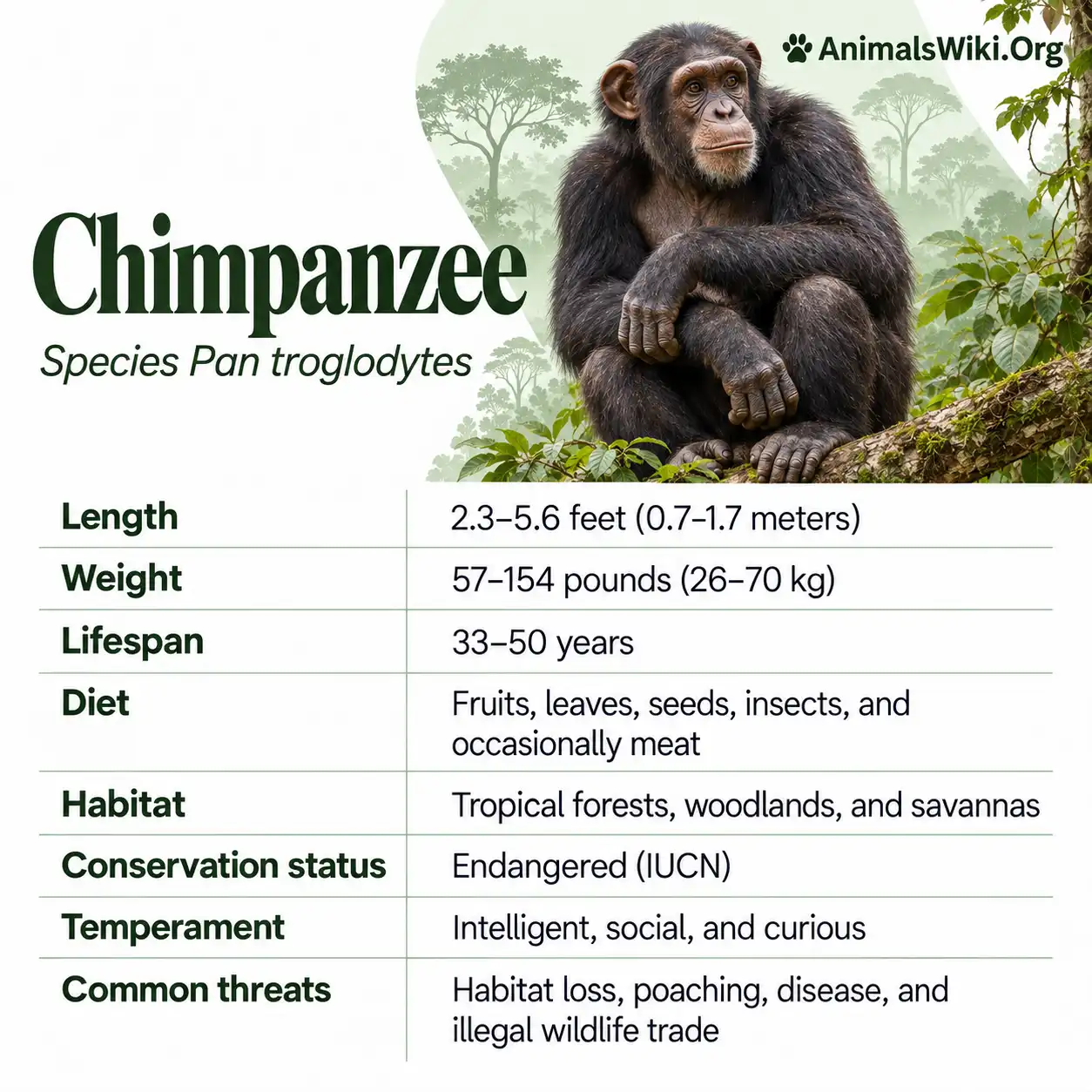
| Feature | Information |
|---|---|
| Common Name | Chimpanzee |
| Scientific Name | Pan troglodytes |
| Animal Type | Mammal |
| Kingdom | Animalia |
| Phylum | Chordata |
| Class | Mammalia |
| Order | Primates |
| Family | Hominidae |
| Genus | Pan |
| Species | Pan troglodytes |
| Number of Recognized Subspecies | Four commonly recognized |
| Native Range | Western and Central Africa |
| Habitat | Tropical forest, woodland and forest-savanna mosaics |
| Diet | Omnivore |
| Main Food | Fruit |
| Lifestyle | Highly social |
| Social System | Fission-fusion communities |
| Locomotion | Knuckle-walking and climbing |
| Famous Abilities | Intelligence, tool use and complex social behavior |
| Reproduction | Live birth |
| Young | Infant |
| Lifespan | Often several decades; some individuals survive much longer |
| Closest Living Relatives | Bonobos and humans within the great-ape lineage |
| Conservation Status | Endangered |
| Major Threats | Habitat loss, hunting, wildlife trafficking and disease |
What Is a Chimpanzee?
A chimpanzee is a highly intelligent African great ape belonging to the species Pan troglodytes.
Chimpanzees possess:
- Long powerful arms
- Shorter legs
- Opposable thumbs
- Grasping hands
- Grasping feet
- Dark hair
- Bare faces
- Large brains
- Expressive facial muscles
- Strong shoulders
- No external tail
Their bodies are adapted for both terrestrial and arboreal movement.
Chimpanzees can climb extremely well but also spend considerable time traveling across the ground.
Scientific Classification of Chimpanzees
| Classification | Name |
|---|---|
| Kingdom | Animalia |
| Phylum | Chordata |
| Class | Mammalia |
| Order | Primates |
| Suborder | Haplorhini |
| Family | Hominidae |
| Genus | Pan |
| Species | Pan troglodytes |
Chimpanzees belong to Hominidae, the great-ape family.
This family also contains:
- Humans
- Gorillas
- Orangutans
- Bonobos
Chimpanzees and bonobos belong to the genus Pan.
Chimpanzee vs. Bonobo: Are They the Same Species?
No.
Chimpanzees and bonobos are separate species.
The common chimpanzee is:
Pan troglodytes
The bonobo is:
Pan paniscus
They are each other’s closest living relatives.
Both are also extremely closely related to humans.
Despite superficial similarities, chimpanzees and bonobos differ in:
- Body proportions
- Geographic distribution
- Social behavior
- Group dynamics
- Certain aspects of feeding and conflict
Chimpanzee Subspecies
Four chimpanzee subspecies are commonly recognized.
Western Chimpanzee
Pan troglodytes verus
Occurs primarily in western Africa.
Nigeria-Cameroon Chimpanzee
Pan troglodytes ellioti
Occurs around Nigeria and Cameroon.
Central Chimpanzee
Pan troglodytes troglodytes
Occurs in central African forests.
Eastern Chimpanzee
Pan troglodytes schweinfurthii
Occurs farther east across parts of central and eastern Africa.
Populations differ genetically, geographically, and behaviorally.
What Does a Chimpanzee Look Like?
Chimpanzees have muscular bodies covered primarily in dark brown or black hair.
The:
- Face
- Ears
- Fingers
- Palms
- Soles
have little or no hair.
Young chimpanzees may have relatively pale facial skin that often darkens with age.
Chimpanzees have long arms that extend well beyond the knees when standing.
Their shoulders are highly mobile, assisting climbing and swinging.
Do Chimpanzees Have Tails?
No.
Chimpanzees do not have external tails.
This is one of the major characteristics distinguishing apes from most monkeys.
Other living great apes—including gorillas, orangutans, bonobos, and humans—also lack external tails.
Chimpanzee Size
Adult chimpanzee body size varies according to:
- Sex
- Population
- Age
- Nutrition
When standing upright, an adult chimpanzee can reach approximately 1–1.7 meters (3.3–5.6 feet) depending on how posture is measured.
However, chimpanzees normally move on all fours rather than continuously standing upright.
Chimpanzee Weight
Adult males commonly weigh roughly 40–60 kg (88–132 lb) in the wild, while females are generally smaller.
Body weights vary significantly between individuals and populations.
Chimpanzees living under managed care can sometimes become substantially heavier than wild individuals.
Male vs. Female Chimpanzee
| Feature | Male Chimpanzee | Female Chimpanzee |
|---|---|---|
| Body Size | Generally larger | Generally smaller |
| Musculature | Usually heavier and more robust | Usually lighter |
| Social Role | Strong involvement in male alliances and territorial behavior | Strong maternal relationships and offspring care |
| Community Range | Usually remains in natal community | Females often transfer to another community |
| Parental Care | Variable indirect/social roles | Primary caregiver |
Chimpanzee social roles are complex, so these are general patterns rather than absolute rules.
Where Do Chimpanzees Live?
Wild chimpanzees live naturally in Africa.
Their distribution extends across parts of western and central Africa.
Countries within the species’ broader range include:
- Senegal
- Guinea
- Sierra Leone
- Liberia
- Côte d’Ivoire
- Ghana
- Nigeria
- Cameroon
- Gabon
- Republic of the Congo
- Democratic Republic of the Congo
- Uganda
- Tanzania
- Other countries within the regional range
Their modern distribution is fragmented because suitable habitat has disappeared from many areas.
Chimpanzee Habitat
Chimpanzees can occupy several habitat types.
These include:
- Tropical rainforest
- Secondary forest
- Woodland
- Swamp forest
- Montane forest
- Forest-savanna mosaics
- Relatively dry woodland
This adaptability is impressive.
Nevertheless, chimpanzees still require sufficient food, water, sleeping sites, and connected habitat.
Do Chimpanzees Live in Rainforests?
Yes.
Tropical rainforest is one of the most important chimpanzee habitats.
Forests provide:
- Fruit
- Leaves
- Insects
- Water
- Nesting trees
- Shade
- Protection
However, describing chimpanzees exclusively as rainforest animals is inaccurate because some populations inhabit considerably drier landscapes.
What Do Chimpanzees Eat?
Chimpanzees are omnivores.
Fruit generally forms a major part of their diet.
They also consume:
- Leaves
- Seeds
- Nuts
- Flowers
- Bark
- Plant stems
- Honey
- Termites
- Ants
- Other insects
- Eggs
- Small vertebrates
Diet varies between populations and seasons.
Do Chimpanzees Eat Meat?
Yes.
Chimpanzees occasionally eat meat.
Some populations hunt animals including:
- Monkeys
- Small antelope
- Bushpigs
- Other small mammals
The amount of meat consumed is relatively small compared with plant foods.
Fruit remains much more important overall.
Do Chimpanzees Hunt Monkeys?
Yes.
Some chimpanzee communities actively hunt monkeys.
Red colobus monkeys are especially well-known prey at certain long-term research sites.
Hunting may involve multiple chimpanzees pursuing prey through trees.
After a successful hunt, meat can become socially valuable and may be shared among individuals.
How Do Chimpanzees Find Food?
Chimpanzees rely on:
- Vision
- Smell
- Memory
- Experience
- Social information
They can remember locations of productive fruit trees and move through large home ranges to exploit seasonal resources.
Their ability to plan travel around changing food availability demonstrates impressive spatial memory.
Chimpanzee Tool Use
Chimpanzees are among the most accomplished nonhuman tool users.
Wild chimpanzees use tools for:
- Extracting insects
- Opening nuts
- Collecting water
- Accessing honey
- Investigating objects
- Display behavior
- Personal care
Tool use differs between populations.
This makes chimpanzees especially important for studying the origins of technology and culture.
How Do Chimpanzees Catch Termites?
Some chimpanzees use a technique often called termite fishing.
A chimpanzee may:
- Select a suitable twig or plant stem.
- Modify the tool.
- Insert it into a termite mound.
- Wait for termites to grip the tool.
- Pull it out.
- Eat the termites.
Some communities use sophisticated multi-tool techniques.
Young chimpanzees learn these skills partly through observation and repeated practice.
Do Chimpanzees Use Stone Tools?
Yes.
Some West African chimpanzees use stones as hammers and anvils to crack hard nuts.
The chimpanzee places a nut on a stable surface and strikes it with a suitable stone or wooden hammer.
Successful nut cracking requires:
- Tool selection
- Coordination
- Force control
- Practice
- Understanding of suitable surfaces
Young chimpanzees can take years to become highly proficient.
Do Chimpanzees Make Tools?
Yes.
Chimpanzees do not simply pick up random objects.
They may deliberately modify plant materials before using them.
For example, they can:
- Remove leaves
- Shorten sticks
- Fray ends
- Select appropriate lengths
- Combine tools in sequences
This demonstrates that chimpanzee technology can involve planning and modification.
Do Chimpanzees Use Leaves as Tools?
Yes.
Leaves can be used as sponges.
A chimpanzee may chew or fold leaves into an absorbent mass and dip it into water.
The soaked leaves are then brought to the mouth.
Leaves can also be used for cleaning or other purposes.
Chimpanzee Intelligence
Chimpanzees possess sophisticated cognitive abilities.
Research has demonstrated abilities involving:
- Problem solving
- Memory
- Tool use
- Planning
- Social learning
- Numerical discrimination
- Cooperation
- Competition
- Object manipulation
- Social strategy
Their intelligence evolved to solve challenges within complicated ecological and social environments.
Are Chimpanzees Smarter Than Other Animals?
“Intelligence” consists of many different abilities, so ranking entire species with a single measure can be misleading.
Chimpanzees are nevertheless considered among the most cognitively sophisticated nonhuman animals.
Their strengths are especially evident in:
- Tool use
- Social cognition
- Memory
- Problem solving
- Flexible behavior
Other animals, such as dolphins, elephants, parrots, corvids, and other primates, show different forms of sophisticated cognition.
Do Chimpanzees Have Culture?
Researchers use the term culture for socially transmitted behaviors that differ between populations and cannot be explained simply by ecology or genetics.
Chimpanzee communities can differ in:
- Tool use
- Grooming traditions
- Feeding techniques
- Social customs
- Communication behaviors
Some communities crack nuts.
Others do not.
Some use particular grooming gestures absent elsewhere.
These differences provide some of the strongest evidence for nonhuman animal culture.
Do Chimpanzees Teach Their Young?
Young chimpanzees learn extensively by:
- Watching
- Following
- Practicing
- Interacting with mothers and other community members
Evidence also suggests that adults can sometimes facilitate learning by tolerating tool sharing or modifying behavior around inexperienced youngsters.
Most learning occurs gradually over years.
Chimpanzee Memory
Chimpanzees can possess impressive short-term and spatial memory.
They need to remember:
- Food locations
- Travel routes
- Social relationships
- Dominance relationships
- Previous interactions
- Tool sites
Memory is essential in a society containing numerous individuals with changing alliances.
Chimpanzee Social Structure
Chimpanzees live in communities that can contain dozens of individuals.
However, the entire community does not remain together continuously.
Instead, they use a fission-fusion social system.
Large communities repeatedly split into smaller temporary parties and later reunite.
Party composition changes according to:
- Food
- Reproductive opportunities
- Social relationships
- Hunting
- Territorial activity
What Is a Chimpanzee Group Called?
A large stable social unit is usually called a community.
The smaller temporary groups traveling together are often called parties.
The word “troop” may be used informally, but “community” better describes chimpanzee social organization.
Chimpanzee Hierarchy
Chimpanzee communities contain social hierarchies.
Adult males often form particularly noticeable dominance relationships.
A high-ranking male is frequently called the alpha male.
However, physical strength alone does not determine status.
Successful males may depend on:
- Alliances
- Grooming
- Coalition partners
- Social support
- Strategic behavior
Chimpanzee politics can therefore be remarkably complex.
What Is an Alpha Chimpanzee?
An alpha male is the highest-ranking adult male in a chimpanzee community.
He may receive social advantages, but his position can be unstable.
Challengers may form alliances.
The alpha must continually manage relationships.
Dominance can therefore involve both physical power and social strategy.
Do Chimpanzees Fight?
Yes.
Chimpanzees can display aggression within and between communities.
Conflicts may involve:
- Food
- Rank
- Mates
- Social disputes
- Territory
Chimpanzees can also cooperate, reconcile, groom, play, share food, and maintain long-term relationships.
Aggression represents only one component of a much richer social system.
Are Chimpanzees Territorial?
Yes.
Chimpanzee communities can defend territories.
Groups of males may patrol territorial boundaries.
During patrols, chimpanzees can move quietly and monitor neighboring areas.
Encounters with members of rival communities can become aggressive and occasionally fatal.
Territorial behavior is one of the most intensively studied aspects of chimpanzee society.
Chimpanzee Grooming
Grooming is extremely important.
Chimpanzees pick through one another’s hair and remove:
- Dirt
- Dead skin
- Parasites
But grooming is much more than hygiene.
It also strengthens relationships.
Chimpanzees may groom:
- Friends
- Relatives
- Alliance partners
- High-ranking individuals
Grooming can therefore function almost like social currency.
Chimpanzee Communication
Chimpanzees communicate using:
- Vocalizations
- Facial expressions
- Gestures
- Touch
- Body posture
- Drumming
- Displays
Different signals convey different information.
Chimpanzees can communicate:
- Excitement
- Fear
- Aggression
- Submission
- Food discovery
- Social intentions
Communication is strongly influenced by context.
What Is a Chimpanzee Pant-Hoot?
The pant-hoot is one of the most recognizable chimpanzee vocalizations.
It can travel considerable distances through forests.
Chimpanzees may pant-hoot during:
- Travel
- Excitement
- Social reunions
- Food discovery
Individuals have distinctive voices, allowing community members to recognize callers.
Why Do Chimpanzees Drum on Trees?
Chimpanzees sometimes strike tree trunks or buttress roots with their hands and feet.
Drumming creates loud sounds that travel through forests.
It may communicate:
- Location
- Movement
- Individual identity
- Excitement
Some individuals appear to develop distinctive drumming patterns.
Do Chimpanzees Have Language?
Chimpanzees possess sophisticated communication systems but do not naturally use language with the open-ended grammar and complexity characteristic of humans.
Research involving captive apes has shown that chimpanzees can learn symbols or gestures under specialized conditions.
However, human language remains distinctive in its scale, syntax, productivity, and cultural complexity.
Chimpanzee Facial Expressions
Chimpanzees have highly expressive faces.
Expressions can signal:
- Fear
- Excitement
- Submission
- Playfulness
- Aggression
However, interpreting chimpanzee expressions through human facial conventions can be misleading.
For example, a display that resembles a human smile may occur during fear or submission rather than happiness.
Do Chimpanzees Laugh?
Chimpanzees produce laughter-like vocalizations during:
- Play
- Tickling
- Social interaction
The sound differs from typical human laughter but may share deep evolutionary origins with laughter in humans and other great apes.
Young chimpanzees are especially playful.
Do Chimpanzees Cry?
Chimpanzees experience distress and produce emotional vocalizations, but they are not known to shed emotional tears in exactly the human manner.
Their emotions should therefore not be judged solely by whether tears appear.
Behavior, vocalization, posture, and social responses provide much better evidence.
How Strong Is a Chimpanzee?
Chimpanzees are very powerful relative to humans of similar body mass, particularly in pulling and climbing movements.
Research suggests their muscles can produce roughly 1.3–1.5 times greater dynamic force or power per unit muscle mass than human muscle under comparable conditions.
Popular claims that chimpanzees are five or ten times stronger than humans are generally exaggerated.
Their apparent strength also reflects:
- Long arms
- Powerful shoulders
- Climbing adaptations
- Muscle architecture
- Explosive movement
Can Chimpanzees Walk on Two Legs?
Yes.
Chimpanzees can walk bipedally for short distances.
However, their normal terrestrial locomotion is knuckle-walking.
When knuckle-walking, they support the front of the body on the knuckles rather than the palms.
Their anatomy remains highly adapted for both climbing and quadrupedal movement.
Can Chimpanzees Climb Trees?
Yes.
Chimpanzees are excellent climbers.
Their:
- Long arms
- Mobile shoulders
- Powerful upper bodies
- Grasping hands
- Grasping feet
allow effective movement through trees.
Young chimpanzees are especially agile.
Large adult males may spend relatively more time on the ground because of their greater body mass.
Can Chimpanzees Swim?
Chimpanzees generally avoid deep water and are not naturally strong swimmers like humans or some monkeys.
Their dense muscular bodies and locomotor anatomy make swimming difficult.
However, individual captive apes have demonstrated that some can learn forms of swimming.
Swimming should therefore not be described as completely impossible, but it is not a normal chimpanzee specialization.
Where Do Chimpanzees Sleep?
Chimpanzees usually construct sleeping nests.
They bend and interweave branches and leaves to create platforms.
Most nighttime nests are built in trees, although ground nesting occurs in some populations.
A chimpanzee generally constructs a new sleeping nest frequently.
Why Do Chimpanzees Build Nests?
Nests can provide:
- Comfortable sleeping surfaces
- Support
- Protection from some ground threats
- Improved insulation
- Reduced exposure to insects
Nest building is a learned skill.
Young chimpanzees gradually practice until they can construct effective nests independently.
Chimpanzee Reproduction
Chimpanzees reproduce relatively slowly.
Females generally give birth to a single infant after a gestation of approximately eight months.
Twins occur but are uncommon.
Because young chimpanzees remain dependent for years, females usually have long intervals between successful births.
This slow reproductive rate makes population recovery difficult after major declines.
Baby Chimpanzees
A baby chimpanzee is called an infant.
Newborns cling closely to their mothers.
Initially they hold onto the mother’s underside.
As they grow, they increasingly ride on her back.
The mother provides:
- Milk
- Protection
- Transportation
- Social support
- Learning opportunities
The mother-infant relationship is among the strongest relationships in chimpanzee society.
How Long Do Baby Chimpanzees Stay With Their Mothers?
Chimpanzees develop slowly.
Infants are dependent on their mothers for several years.
Youngsters may continue maintaining strong relationships with their mothers long after weaning.
Maternal relationships can influence:
- Survival
- Social development
- Rank
- Learning
- Future relationships
Chimpanzee childhood is long compared with most mammals.
Do Chimpanzee Fathers Care for Babies?
Chimpanzee fathers generally do not provide the intensive direct care seen in humans or some other primates.
Because females may mate with multiple males, paternity can be uncertain.
However, males can interact socially with youngsters, tolerate them, protect community members, or form relationships with particular juveniles.
The mother remains the primary caregiver.
Chimpanzee Lifespan
Chimpanzees are long-lived mammals.
Wild individuals can survive into their 40s and 50s, although average life expectancy is lower because many die earlier.
Some individuals under managed care have survived beyond 60 years.
Lifespan is influenced by:
- Disease
- Injury
- Food availability
- Social conflict
- Predation
- Human activity
Do Chimpanzees Age Like Humans?
Chimpanzees show several age-related changes familiar in humans.
Older chimpanzees may experience:
- Gray hair
- Reduced activity
- Tooth wear
- Changes in muscle condition
- Changes in social behavior
Because of the close evolutionary relationship between chimpanzees and humans, aging is an important field of comparative research.
Chimpanzee DNA and Humans
Chimpanzees are among humans’ closest living evolutionary relatives.
Comparisons often state that human and chimpanzee DNA sequences are approximately 98–99% similar in directly comparable regions.
However, the exact percentage depends on:
- Which DNA is compared
- Whether insertions and deletions are counted
- Analytical method
A single percentage therefore simplifies a complicated genomic relationship.
Did Humans Evolve From Chimpanzees?
No.
Humans did not evolve from modern chimpanzees.
Humans and chimpanzees share an extinct common ancestor.
After ancestral populations separated millions of years ago, different evolutionary lineages eventually produced:
- Modern humans
- Modern chimpanzees and bonobos
A useful analogy is cousins sharing grandparents rather than one cousin descending from the other.
How Closely Related Are Chimpanzees and Humans?
Humans, chimpanzees, and bonobos share a relatively recent evolutionary ancestor.
The human lineage separated from the lineage leading to modern Pan roughly 6–8 million years ago, although estimates vary as fossil and genetic evidence is refined.
Chimpanzees therefore provide valuable comparative information about great-ape evolution.
But modern chimpanzees have also undergone millions of years of their own evolution.
Chimpanzee vs. Human
| Feature | Chimpanzee | Human |
|---|---|---|
| Scientific Name | Pan troglodytes | Homo sapiens |
| Family | Hominidae | Hominidae |
| Typical Locomotion | Knuckle-walking/climbing | Habitual bipedal walking |
| Arms | Relatively long | Relatively shorter |
| Feet | Grasping | Specialized for walking |
| Brain | Large for an animal | Much larger relative to body |
| Tool Use | Sophisticated | Extremely complex |
| Language | Complex communication | Symbolic grammatical language |
| Culture | Social traditions | Extremely cumulative culture |
Humans and chimpanzees share many inherited characteristics but also possess profound biological and behavioral differences.
Chimpanzee vs. Gorilla
| Feature | Chimpanzee | Gorilla |
|---|---|---|
| Genus | Pan | Gorilla |
| Size | Smaller | Much larger |
| Build | Agile and muscular | Extremely robust |
| Diet | Omnivorous, fruit-heavy | Primarily plant-based |
| Social System | Fission-fusion | More cohesive groups |
| Tool Use | Extensive | Documented but generally less elaborate |
| Climbing | Excellent | Good, especially younger individuals |
| Tail | None | None |
Both are African great apes but belong to separate evolutionary lineages.
Chimpanzee vs. Bonobo
| Feature | Chimpanzee | Bonobo |
|---|---|---|
| Scientific Name | Pan troglodytes | Pan paniscus |
| Distribution | North/west of Congo River region | Primarily south of Congo River |
| Build | Generally more robust | More slender |
| Face | Variable | Often dark from youth |
| Social Patterns | Strong male alliances common | Female alliances especially influential |
| Conflict | Can include severe territorial aggression | Generally different intergroup/social patterns |
| Species | Separate | Separate |
Both species display complex social behavior and should not be reduced to simple stereotypes such as “aggressive chimpanzee” versus “peaceful bonobo.”
Chimpanzee vs. Monkey
Chimpanzees are apes, not monkeys.
Major differences include:
| Feature | Chimpanzee | Typical Monkey |
|---|---|---|
| Group | Great ape | Monkey |
| Tail | None | Many species have tails |
| Shoulder Mobility | Very high | Generally less specialized |
| Brain Size | Relatively large | Varies |
| Body Structure | Ape anatomy | Monkey anatomy |
Not every monkey has a tail, so the distinction involves evolutionary relationships rather than one physical feature.
Chimpanzee vs. Orangutan
Chimpanzees live naturally in Africa.
Orangutans live in Southeast Asia.
Orangutans are much more strongly adapted for arboreal life and usually have reddish-orange hair.
Chimpanzees generally live in larger, more socially dynamic communities.
Both demonstrate sophisticated intelligence and tool use.
Chimpanzee vs. Baboon
Baboons are monkeys.
Chimpanzees are great apes.
Baboons possess tails and elongated dog-like muzzles.
Chimpanzees lack tails and are more closely related to humans.
Both can live in complicated social groups but evolved independently within different primate branches.
Chimpanzee Predators
Adult chimpanzees are powerful and social, giving them relatively few natural predators.
Potential predators can include:
- Leopards
- Large snakes, particularly for young chimpanzees
- Humans
Leopards are among the most important natural predators capable of attacking chimpanzees.
Infants are more vulnerable than healthy adults.
Are Chimpanzees Apex Predators?
Chimpanzees are not generally classified as conventional apex predators.
Although they hunt and eat vertebrates, most of their diet consists of plant foods—especially fruit.
They also coexist with large carnivores such as leopards.
Chimpanzees are better understood as highly adaptable omnivorous primates rather than specialized top predators.
Are Chimpanzees Dangerous?
Chimpanzees can be dangerous.
Adult chimpanzees possess:
- Powerful muscles
- Large canine teeth
- Strong jaws
- Strong arms
- Fast reflexes
Wild chimpanzees generally should be observed only under controlled wildlife-tourism or research conditions.
Captive chimpanzees can also inflict severe injuries.
Their intelligence and familiarity should never be mistaken for domestication.
Are Chimpanzees Aggressive?
Chimpanzees can display serious aggression, but describing the entire species simply as aggressive is misleading.
Their behavior also includes:
- Grooming
- Play
- Cooperation
- Food sharing
- Reconciliation
- Adoption
- Long-term friendships
- Maternal care
Aggression occurs within a much more complex social system.
Do Chimpanzees Have Emotions?
Chimpanzees display behavioral and physiological evidence associated with a broad range of emotional states.
Their behavior can reflect:
- Fear
- Excitement
- Affection
- Frustration
- Distress
- Playfulness
- Social attachment
Scientists study these states carefully without assuming that every chimpanzee experience is identical to a human emotional experience.
Do Chimpanzees Grieve?
Chimpanzees sometimes show striking behavioral changes following the death of close companions.
Observed behaviors can include:
- Remaining near a body
- Reduced activity
- Inspection
- Changes in social behavior
- Mothers carrying deceased infants for extended periods
Researchers investigate these behaviors as part of the study of primate responses to death and social loss.
Chimpanzee Adaptations
Chimpanzees possess numerous adaptations.
Long Arms
Help with climbing and movement through trees.
Grasping Hands
Allow precise manipulation of objects and tools.
Grasping Feet
Improve climbing.
Opposable Thumbs
Support controlled handling.
Powerful Shoulders
Provide climbing strength.
Large Brain
Supports complex cognition and social behavior.
Forward-Facing Eyes
Provide strong depth perception.
Omnivorous Diet
Allows flexible feeding.
Social Learning
Enables knowledge to spread between individuals.
Tool Use
Provides access to otherwise difficult foods.
Complex Communication
Supports social relationships and coordination.
Together, these traits allow chimpanzees to succeed in complex forest environments.
Chimpanzee Conservation Status
The common chimpanzee is classified as Endangered.
Populations have declined and become fragmented across much of their historical range.
Although chimpanzees still occupy a large geographic area, this should not be mistaken for population security.
Several major threats continue to affect them.
Why Are Chimpanzees Endangered?
Habitat Loss
Forests are cleared or fragmented by:
- Agriculture
- Logging
- Roads
- Mining
- Infrastructure
- Human settlement
Hunting
Chimpanzees can be killed for bushmeat.
Illegal Wildlife Trade
Infants may be captured for illegal trade, often after adults are killed.
Disease
Chimpanzees are biologically similar enough to humans to be vulnerable to numerous infectious diseases.
Habitat Fragmentation
Separated populations can become small and genetically isolated.
Human-Wildlife Conflict
Chimpanzees entering farms may be persecuted.
Disease and Chimpanzees
Disease is an unusually important conservation issue because chimpanzees are closely related to humans.
Respiratory infections and other pathogens can potentially spread between people and great apes.
Responsible tourism and research programs therefore use measures such as:
- Maintaining distance
- Limiting visitor numbers
- Health screening
- Hygiene
- Masks in appropriate circumstances
Protecting chimpanzees can require protecting them from human pathogens as well as habitat destruction.
Illegal Chimpanzee Trade
Young chimpanzees are sometimes captured for the illegal wildlife trade.
Capturing an infant can involve the killing of protective adults.
The impact is therefore much greater than the removal of one individual.
Chimpanzees reproduce slowly, so populations cannot quickly replace such losses.
Why Are Chimpanzees Important?
Chimpanzees perform important ecological roles.
Because they eat large quantities of fruit, they can disperse seeds through forests.
Seed dispersal helps:
- Forest regeneration
- Plant distribution
- Genetic exchange among plants
Chimpanzees are also scientifically important for understanding:
- Primate evolution
- Cognition
- Tool use
- Social behavior
- Communication
- Human evolutionary history
Protecting chimpanzees simultaneously protects many other species sharing their forests.
Chimpanzees and Seed Dispersal
A chimpanzee may swallow fruit and later deposit seeds far from the parent tree.
This movement can help plants colonize new areas.
Large-bodied fruit-eating animals are particularly important for plants producing seeds too large for smaller animals to swallow.
Chimpanzees can therefore act as important forest gardeners.
40 Interesting Chimpanzee Facts
- The chimpanzee’s scientific name is Pan troglodytes.
- Chimpanzees are mammals.
- They are primates.
- Chimpanzees are great apes.
- They are not monkeys.
- Chimpanzees do not have tails.
- They live naturally in Africa.
- Four subspecies are commonly recognized.
- Chimpanzees inhabit forests and woodland mosaics.
- They are omnivores.
- Fruit forms a major part of their diet.
- Chimpanzees eat insects.
- Some chimpanzees hunt monkeys.
- They can cooperate during hunts.
- Chimpanzees use tools.
- Some use sticks to collect termites.
- Some use stones to crack nuts.
- They can make leaf sponges.
- Tool traditions differ among communities.
- Chimpanzees show evidence of culture.
- They live in fission-fusion communities.
- Community membership can include dozens of individuals.
- Adult males form alliances.
- Chimpanzees groom one another socially.
- Grooming helps maintain relationships.
- They communicate using gestures.
- They also use facial expressions.
- Pant-hoots can travel long distances.
- Chimpanzees sometimes drum on trees.
- They usually travel on the ground by knuckle-walking.
- They can walk upright for short distances.
- Chimpanzees are excellent climbers.
- They build sleeping nests.
- Baby chimpanzees remain dependent on mothers for years.
- Females usually give birth to one infant.
- Chimpanzees are among humans’ closest living relatives.
- Humans did not evolve from modern chimpanzees.
- Chimpanzees and humans share an extinct common ancestor.
- Chimpanzees are classified as Endangered.
- Protecting chimpanzees also protects important African forest ecosystems.
Did You Know?
Different chimpanzee communities can have their own traditions.
One population may crack nuts using stone hammers, while another population living elsewhere may not perform the behavior.
Some communities use sticks to extract termites. Others use specialized tools for ants, honey, or water.
Chimpanzees can also differ in grooming customs and social gestures.
Young chimpanzees spend years watching older community members and gradually learning these behaviors.
Because many of these differences are socially transmitted rather than simply genetically inherited, researchers often describe them as examples of chimpanzee culture.
This means that protecting a chimpanzee population may preserve more than animals and genes—it can also preserve unique behavioral traditions developed and transmitted across generations.
Frequently Asked Questions About Chimpanzees
What is a chimpanzee?
A chimpanzee is an African great ape belonging to the species Pan troglodytes.
Are chimpanzees monkeys?
No. Chimpanzees are great apes.
What is the scientific name of a chimpanzee?
The scientific name is Pan troglodytes.
Where do chimpanzees live?
Wild chimpanzees live in parts of western and central Africa.
Do chimpanzees live in rainforests?
Yes, although some populations also inhabit woodland and forest-savanna mosaics.
What do chimpanzees eat?
They eat fruit, leaves, seeds, insects, honey, and occasionally vertebrate prey.
Are chimpanzees omnivores?
Yes.
Do chimpanzees eat meat?
Yes, but meat represents only a relatively small portion of their overall diet.
Do chimpanzees hunt?
Some populations hunt monkeys and other mammals, sometimes cooperatively.
Do chimpanzees use tools?
Yes. Wild chimpanzees use numerous types of tools.
What tools do chimpanzees use?
They use sticks, stones, leaves, branches, and other objects for tasks such as insect extraction, nut cracking, and collecting water.
Do chimpanzees make tools?
Yes. They sometimes deliberately modify objects before using them.
Are chimpanzees intelligent?
Yes. They demonstrate sophisticated problem solving, memory, social cognition, tool use, and learning.
Do chimpanzees have culture?
Different populations maintain socially transmitted behavioral traditions that researchers describe as cultural behaviors.
How strong is a chimpanzee?
Chimpanzees are exceptionally powerful for their size. Research suggests their muscle performance is roughly 1.3–1.5 times greater than human muscle per comparable unit in certain dynamic measures.
Are chimpanzees five times stronger than humans?
Claims of five or ten times greater strength are generally exaggerated.
Can chimpanzees walk upright?
Yes, but usually only for relatively short periods. Their normal ground locomotion is knuckle-walking.
Can chimpanzees climb trees?
Yes. They are excellent climbers.
Can chimpanzees swim?
They are not naturally strong swimmers, although individual apes can learn forms of swimming.
Do chimpanzees have tails?
No.
Where do chimpanzees sleep?
They usually construct sleeping nests from branches and leaves.
Do chimpanzees build a new nest every night?
Chimpanzees frequently construct new nighttime nests, although exact nesting behavior varies.
What is a group of chimpanzees called?
The stable social group is generally called a community, while smaller temporary groups are called parties.
What is fission-fusion society?
It is a social system in which a large community repeatedly divides into smaller parties that later reunite.
What is an alpha chimpanzee?
An alpha male is the highest-ranking adult male within a community.
Do chimpanzees fight?
Yes. Conflicts occur both within and between communities, but chimpanzees also display extensive cooperation and reconciliation.
How do chimpanzees communicate?
They communicate through vocalizations, gestures, facial expressions, body posture, touch, and drumming.
What is a chimpanzee pant-hoot?
A pant-hoot is a loud, distinctive vocalization used in several social contexts.
Can chimpanzees talk?
They do not naturally use human-like spoken language, although they possess complex communication and can learn certain symbols or gestures in research settings.
Do chimpanzees laugh?
They produce laughter-like vocalizations during play and tickling.
What is a baby chimpanzee called?
A baby chimpanzee is called an infant.
How long is a chimpanzee pregnant?
Gestation lasts approximately eight months.
How many babies do chimpanzees have?
Females usually give birth to one infant at a time. Twins are uncommon.
How long do baby chimpanzees stay with their mothers?
Young chimpanzees remain dependent for several years and can maintain close maternal relationships much longer.
How long do chimpanzees live?
Wild chimpanzees can live for several decades, with some reaching their 40s or 50s and exceptional individuals surviving longer.
Are chimpanzees related to humans?
Yes. Chimpanzees are among humans’ closest living evolutionary relatives.
How much DNA do humans share with chimpanzees?
Directly comparable DNA sequences are often described as roughly 98–99% similar, although the exact figure depends on the comparison method.
Did humans evolve from chimpanzees?
No. Humans and modern chimpanzees evolved from an extinct common ancestor.
When did humans and chimpanzees separate?
The evolutionary lineages are generally estimated to have diverged roughly 6–8 million years ago, although exact estimates vary.
What is the difference between a chimpanzee and a bonobo?
They are separate species with differences in distribution, anatomy, and social behavior.
What is the difference between a chimpanzee and a gorilla?
Gorillas are much larger and primarily plant-eating, while chimpanzees are smaller, more omnivorous, and live in a different social system.
What is the difference between a chimpanzee and a monkey?
Chimpanzees are apes and lack tails. Monkeys belong to different primate evolutionary branches.
Are chimpanzees dangerous?
They can be. Adult chimpanzees are powerful wild animals capable of causing severe injuries.
What animals hunt chimpanzees?
Leopards are among their most important natural predators, while young chimpanzees face additional risks.
Are chimpanzees endangered?
Yes. The common chimpanzee is classified as Endangered.
Why are chimpanzees endangered?
Major threats include habitat destruction, hunting, illegal wildlife trafficking, disease, and population fragmentation.
Why are chimpanzees important?
They disperse seeds, influence forest ecosystems, and provide valuable scientific insights into primate behavior, cognition, culture, and evolution.
Conclusion
Chimpanzees (Pan troglodytes) are among the most extraordinary animals living today.
Their significance extends far beyond their close evolutionary relationship with humans.
Chimpanzees possess sophisticated intelligence, powerful memories, complicated social relationships, diverse communication systems, impressive physical abilities, and some of the most advanced tool-use traditions documented outside our own species.
A chimpanzee can strip leaves from a twig to create an insect-catching tool, select a stone for cracking nuts, turn leaves into a drinking sponge, construct a sleeping nest, remember productive fruit trees, recognize numerous community members, maintain alliances, and learn traditions by watching others.
Their societies can be equally sophisticated.
Chimpanzees live in flexible fission-fusion communities where friendships, kinship, rank, cooperation, competition, grooming, alliances, and reconciliation influence daily life. Mothers invest years in raising offspring, giving young chimpanzees the time necessary to learn the complicated ecological and social skills required for adulthood.
Their relationship with humans is scientifically important but often misunderstood.
Humans did not evolve from modern chimpanzees. Instead, the human lineage and the lineage leading to chimpanzees and bonobos separated from a shared ancestral population millions of years ago. Since then, each lineage has followed its own evolutionary path.
Chimpanzees are therefore not primitive versions of humans. They are modern great apes with their own evolutionary history and remarkable adaptations.
Unfortunately, their future is increasingly influenced by human activity.
Forest destruction, fragmentation, hunting, wildlife trafficking, disease, and expanding infrastructure threaten populations across Africa. Their slow reproduction makes recovery particularly difficult because a female invests many years in each offspring.
Protecting chimpanzees requires protecting large, connected landscapes while reducing illegal hunting and wildlife trade, managing disease risks, and supporting coexistence between people and great apes.
Conserving chimpanzees can also protect entire forest communities. As fruit-eating animals, chimpanzees disperse seeds and contribute to forest regeneration, while the landscapes protected for them provide habitat for countless other plants and animals.
From their sophisticated tools and cultural traditions to their lifelong relationships and extraordinary intelligence, chimpanzees demonstrate the remarkable complexity that can evolve in a highly social great ape.
Understanding them not only teaches us about one of Africa’s most fascinating mammals—it also provides an extraordinary window into the evolutionary history and diversity of the great-ape family to which humans themselves belong.