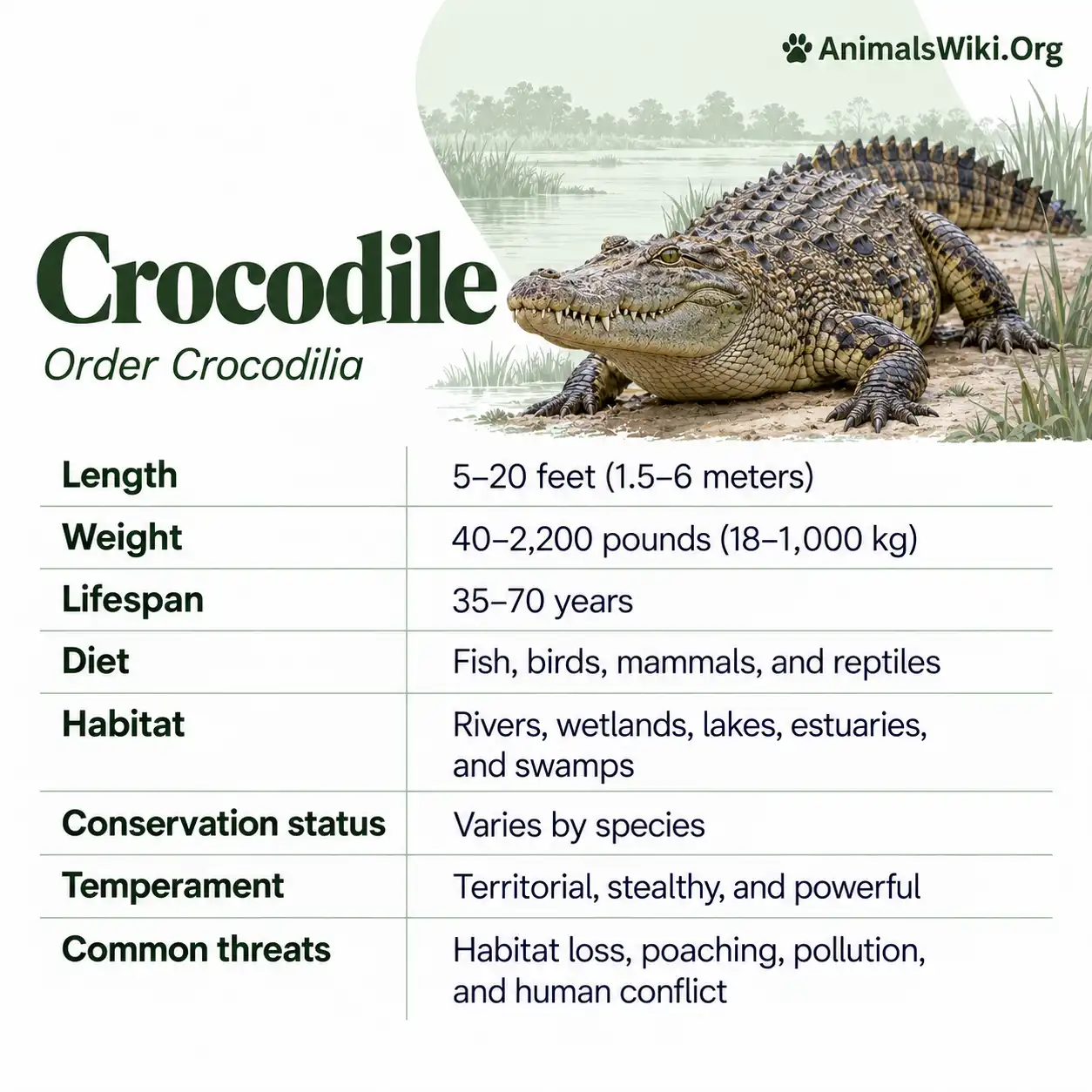
Crocodiles are among the world’s most powerful and recognizable reptiles. With heavily armored bodies, enormous jaws, muscular tails, remarkable senses, and an ability to disappear almost completely beneath the water, crocodiles are highly specialized ambush predators that have survived through an extraordinary period of evolutionary history.
True crocodiles belong to the family Crocodylidae. They are part of the larger order Crocodylia, which also includes alligators, caimans, and gharials.
Living crocodiles occur naturally across tropical and subtropical regions of Africa, Asia, Australia, and the Americas. Different species inhabit rivers, lakes, wetlands, swamps, estuaries, mangroves, and coastal environments.
The saltwater crocodile (Crocodylus porosus) is the largest living reptile and can exceed 6 meters in exceptional cases. The Nile crocodile (Crocodylus niloticus) is another enormous species and one of Africa’s most formidable aquatic predators.
Crocodiles are famous for their tremendous bite strength, but their success involves much more than powerful jaws. Eyes and nostrils positioned near the top of the skull allow them to watch and breathe while most of the body remains underwater. Sensitive pressure receptors help detect disturbances in water, while the muscular tail provides explosive acceleration.
Despite their fearsome reputation, crocodiles also display surprisingly sophisticated parental behavior. Females guard nests, respond to calls from hatchlings, and may carefully carry babies in their mouths.
This comprehensive guide explores crocodile facts, species, habitat, distribution, diet, size, weight, bite force, speed, hunting, swimming, teeth, lifespan, reproduction, eggs, babies, adaptations, behavior, predators, conservation, crocodile attacks, and crocodile vs. alligator differences.
Crocodile Facts
| Feature | Information |
|---|---|
| Common Name | Crocodile |
| Animal Type | Reptile |
| Kingdom | Animalia |
| Phylum | Chordata |
| Class | Reptilia |
| Order | Crocodylia |
| Family | Crocodylidae |
| Diet | Carnivore |
| Distribution | Africa, Asia, Australia and the Americas |
| Main Habitat | Rivers, lakes, wetlands, swamps, estuaries and mangroves |
| Lifestyle | Semi-aquatic |
| Body Covering | Tough scales and bony armor |
| Reproduction | Egg-laying |
| Young | Hatchling |
| Hunting Style | Primarily ambush predation |
| Famous Feature | Extremely powerful jaws |
| Largest Species | Saltwater crocodile |
| Major Threats | Habitat loss, conflict with humans, illegal killing and environmental change |
What Is a Crocodile?
A crocodile is a large or medium-sized semi-aquatic reptile belonging to the family Crocodylidae.
Crocodiles possess a highly recognizable body structure:
- Long snout
- Powerful jaws
- Numerous conical teeth
- Armored skin
- Short strong legs
- Webbed feet
- Long muscular tail
- Eyes high on the head
- Nostrils near the top of the snout
This body design is exceptionally effective for an animal that spends substantial amounts of time at the boundary between land and water.
Scientific Classification of Crocodiles
| Classification | Name |
|---|---|
| Kingdom | Animalia |
| Phylum | Chordata |
| Class | Reptilia |
| Order | Crocodylia |
| Family | Crocodylidae |
True crocodiles should not be confused with every member of Crocodylia.
The order also includes:
- Alligators
- Caimans
- Gharials
All are crocodilians, but not all crocodilians are crocodiles.
How Many Species of Crocodiles Are There?
Modern taxonomy generally recognizes roughly 13–14 living species of true crocodiles, depending on how certain populations and recently separated lineages are classified.
Well-known species include:
- Saltwater crocodile
- Nile crocodile
- American crocodile
- Morelet’s crocodile
- Orinoco crocodile
- Cuban crocodile
- Siamese crocodile
- Mugger crocodile
- Philippine crocodile
- New Guinea crocodile
- Freshwater crocodile
- West African crocodile
- Slender-snouted crocodiles
Taxonomy continues to change as genetic research reveals previously overlooked differences between populations.
What Does a Crocodile Look Like?
Crocodiles have long, low bodies adapted to movement through water.
Their skin is covered in thick scales.
The back contains rows of tough structures reinforced with bony plates called osteoderms.
The head is relatively flat, and the eyes and nostrils are positioned high on the skull.
This arrangement allows a crocodile to remain almost entirely submerged while still:
- Seeing
- Breathing
- Listening
- Monitoring the shoreline
The tail contains powerful muscles and provides the main force for swimming.
Why Do Crocodiles Have Armored Skin?
Crocodile skin provides physical protection.
The osteoderms beneath portions of the skin create natural armor.
These structures can:
- Protect the body
- Strengthen the back
- Participate in heat exchange
- Store minerals
The belly is generally less heavily armored than the upper body.
Crocodile skin is therefore much more complex than a simple layer of scales.
Crocodile Size
Crocodile size varies enormously by species.
Small species may remain around 1.5–2.5 meters long as adults.
Large species can exceed 5 meters.
Exceptional male saltwater crocodiles can surpass 6 meters (nearly 20 feet).
Sex also matters.
Male crocodiles are generally larger than females.
What Is the Largest Crocodile?
The saltwater crocodile (Crocodylus porosus) is the largest living crocodilian and the largest living reptile.
Large males commonly exceed 4 meters, and exceptional individuals can grow beyond 6 meters.
Extremely large crocodile size claims should be treated carefully unless the animal was reliably measured.
Historical stories sometimes describe enormous individuals far beyond scientifically documented sizes.
Saltwater Crocodile
The saltwater crocodile occurs from parts of South and Southeast Asia through northern Australia and surrounding regions.
It is famous for:
- Enormous size
- Powerful jaws
- Territorial behavior
- Ability to tolerate saltwater
- Long-distance marine movement
Despite its name, it also inhabits freshwater rivers and wetlands.
Large males rank among the most formidable predators alive today.
Nile Crocodile
The Nile crocodile (Crocodylus niloticus) is one of Africa’s largest predators.
It inhabits:
- Rivers
- Lakes
- Wetlands
- Marshes
Large individuals can capture substantial prey, including antelope and other mammals approaching the water.
Fish remain an important part of the diet, particularly for smaller individuals.
Nile crocodiles are also responsible for serious conflict with people in some regions.
Mugger Crocodile
The mugger crocodile (Crocodylus palustris) is native to South Asia.
Its range includes parts of:
- India
- Pakistan
- Sri Lanka
- Nepal
- Iran
Muggers inhabit freshwater habitats including rivers, lakes, reservoirs, and marshes.
Compared with several other crocodiles, they possess relatively broad snouts.
Are There Crocodiles in Pakistan?
Yes.
The mugger crocodile, also called the marsh crocodile, occurs in Pakistan.
Populations are associated with suitable wetlands, rivers, reservoirs, and other freshwater habitats.
Habitat protection and reduction of human-crocodile conflict are important for conserving remaining populations.
American Crocodile
The American crocodile (Crocodylus acutus) occurs in parts of:
- Florida
- Mexico
- Central America
- Caribbean islands
- Northern South America
It can tolerate brackish and saltwater environments particularly well.
The species should not be confused with the American alligator, although their ranges overlap in southern Florida.
Where Do Crocodiles Live?
Crocodiles naturally occur in tropical and subtropical parts of:
- Africa
- Asia
- Australia
- North America
- Central America
- South America
They are strongly associated with water.
Habitats include:
- Rivers
- Lakes
- Marshes
- Swamps
- Wetlands
- Estuaries
- Mangroves
- Lagoons
- Coastal waters
Habitat preferences differ between species.
Crocodile Habitat
An ideal crocodile habitat generally provides:
- Water
- Suitable prey
- Basking areas
- Nesting sites
- Vegetation or cover
- Appropriate temperature
Crocodiles are ectothermic and depend heavily on environmental heat.
They frequently move between water and land to regulate body temperature.
Can Crocodiles Live in Salt Water?
Some species can tolerate saltwater extremely well.
The saltwater crocodile is the best-known example.
Crocodiles possess specialized salt glands on their tongues that help remove excess salt.
This adaptation allows some species to travel through marine environments.
Alligators have less effective salt-excreting mechanisms and are generally more strongly associated with freshwater.
What Do Crocodiles Eat?
Crocodiles are carnivores.
Diet depends heavily on:
- Species
- Age
- Body size
- Habitat
- Available prey
Young crocodiles may eat:
- Insects
- Crustaceans
- Frogs
- Small fish
Larger crocodiles can consume:
- Fish
- Turtles
- Snakes
- Birds
- Wild pigs
- Deer
- Antelope
- Monkeys
- Livestock
- Other crocodilians
Large adults are capable of overpowering substantial prey.
How Do Crocodiles Hunt?
Crocodiles are primarily ambush predators.
A typical hunt may involve:
- Remaining almost completely submerged.
- Watching animals near the shoreline.
- Moving slowly without creating obvious waves.
- Approaching within striking distance.
- Launching forward explosively.
- Grabbing prey with the jaws.
- Dragging it toward or into the water.
The initial attack can happen extremely quickly.
Stealth is therefore just as important as strength.
Crocodile Bite Force
Crocodiles possess some of the strongest directly measured bites among living animals.
Large saltwater crocodiles have produced bite forces exceeding 16,000 newtons, or roughly 3,700 pounds-force, in scientific measurements.
Their skulls, jaw muscles, and teeth are highly adapted for gripping and crushing.
However, bite-force figures vary with animal size and measurement method.
The largest individuals generally produce the greatest forces.
Why Is a Crocodile’s Bite So Strong?
Several features contribute:
Massive Jaw Muscles
Powerful muscles close the jaws.
Strong Skull
The skull withstands enormous forces.
Conical Teeth
Teeth penetrate and hold struggling prey.
Large Body Size
Large individuals can generate tremendous muscular force.
Interestingly, the muscles responsible for opening the jaws are much weaker than those responsible for closing them.
Crocodile Teeth
Crocodiles possess dozens of sharp conical teeth.
Rather than slicing food like a knife, the teeth are particularly effective for:
- Grabbing
- Piercing
- Holding
Crocodiles generally do not chew food thoroughly.
They tear large prey into manageable pieces and swallow those pieces.
Smaller prey may be swallowed whole.
Do Crocodiles Regrow Their Teeth?
Yes.
Crocodiles replace teeth repeatedly throughout their lives.
A replacement tooth develops beneath or alongside a functional tooth.
When the older tooth is lost, another can eventually take its place.
An individual crocodile may go through thousands of teeth during its lifetime.
What Is the Crocodile Death Roll?
The death roll is a spinning maneuver used by crocodilians.
After gripping prey, a crocodile may rotate rapidly along the long axis of its body.
This can help:
- Tear flesh
- Break pieces from large prey
- Subdue struggling animals
The maneuver can also be used during conflicts with other crocodilians.
It is one of the most famous behaviors associated with crocodiles.
How Fast Can a Crocodile Swim?
Crocodiles are powerful swimmers.
Exact maximum speeds are difficult to measure reliably in the wild, but short bursts are much faster than their normal cruising speeds.
The muscular tail provides most of the propulsion.
The legs are often held close to the body while swimming rapidly.
Crocodiles are therefore far more agile in water than their heavy appearance might suggest.
How Fast Can Crocodiles Run on Land?
Crocodiles can move surprisingly quickly over short distances.
They use several forms of terrestrial locomotion, including:
- Belly crawling
- High walking
- Rapid running
Some species can even perform a bounding or galloping motion.
However, crocodiles are not long-distance pursuit predators.
Their primary advantage is explosive short-range movement.
Can Crocodiles Climb?
Surprisingly, yes.
Smaller crocodiles and juveniles can climb sloping tree trunks, branches, banks, and other structures.
Their climbing ability is limited compared with specialized arboreal animals, but crocodilians are more capable climbers than their body shape might suggest.
Can Crocodiles Jump?
Yes.
Crocodiles can propel themselves upward using powerful tails and hind limbs.
They may launch partially out of the water to:
- Capture prey
- Reach food
- Negotiate obstacles
The movement can be surprisingly explosive.
How Long Can Crocodiles Stay Underwater?
Crocodiles can remain submerged for extended periods.
During ordinary activity, dives may last only several minutes.
When resting and conserving oxygen, they can remain underwater substantially longer.
Submergence time depends on:
- Activity
- Temperature
- Stress
- Body size
A crocodile actively fighting prey consumes oxygen much faster than one resting motionless underwater.
How Do Crocodiles Breathe?
Crocodiles breathe using lungs.
They cannot extract oxygen directly from water like fish.
Their nostrils are positioned high on the snout, allowing them to breathe while almost completely submerged.
Valves can close the nostrils during dives.
A specialized structure in the throat also helps keep water away from the airway when the mouth is open underwater.
Can Crocodiles Breathe Underwater?
No.
Crocodiles must breathe atmospheric air.
They can hold their breath for long periods, but eventually they must surface.
Their ability to remain nearly invisible at the surface creates the impression of an animal perfectly adapted to the boundary between air and water.
Crocodile Eyes
Crocodile eyes are positioned high on the head.
This allows an animal to observe its surroundings while most of its body remains submerged.
Their eyes are adapted for relatively low-light conditions.
Crocodiles also possess a protective nictitating membrane that can cover the eye underwater.
It functions somewhat like a transparent protective eyelid.
Can Crocodiles See at Night?
Yes.
Crocodiles have strong low-light vision.
Their eyes contain a reflective layer called the tapetum lucidum, which helps improve vision in dim conditions.
When illuminated at night, crocodile eyes can produce a noticeable eye shine.
Nighttime can be an important hunting period for many crocodiles.
Can Crocodiles Hear?
Yes.
Crocodiles possess well-developed hearing.
Their ears are located behind the eyes and can be protected by movable flaps.
Hearing is important for:
- Detecting prey
- Communication
- Courtship
- Parent-offspring interactions
Baby crocodiles even communicate before and after hatching.
How Do Crocodiles Detect Movement in Water?
Crocodiles possess highly sensitive sensory structures around their jaws and body.
These integumentary sensory organs can detect small changes in water pressure and movement.
This helps crocodiles locate disturbances caused by potential prey.
Their hunting system therefore combines:
- Vision
- Hearing
- Smell
- Touch
- Water-pressure detection
Crocodile Behavior
Crocodiles may appear motionless for long periods, but their behavior is more complex than it looks.
Common behaviors include:
- Basking
- Swimming
- Territorial displays
- Hunting
- Courtship
- Nest guarding
- Parental care
- Vocal communication
Social interactions vary by species, age, size, and season.
Large males can be highly territorial.
Why Do Crocodiles Bask?
Crocodiles are ectothermic.
They depend on external heat sources to regulate body temperature.
Basking in sunlight allows them to warm up.
When they become too hot, they may:
- Enter water
- Seek shade
- Open their mouths
These behavioral adjustments help maintain suitable body temperatures.
Why Do Crocodiles Sit With Their Mouths Open?
A crocodile resting with its mouth open is not necessarily preparing to attack.
This behavior is called gaping.
Because crocodiles cannot sweat like humans, holding the mouth open can help release heat.
It functions partly as a thermoregulatory behavior.
Are Crocodiles Social?
Crocodiles are not social in the same way as wolves or primates, but they do interact.
Groups may gather where:
- Food is concentrated
- Basking sites are limited
- Water levels decline
- Breeding occurs
Dominance relationships can develop.
Large males often control preferred territories.
How Do Crocodiles Communicate?
Crocodiles use:
- Bellows
- Growls
- Hisses
- Grunts
- Water vibrations
- Body postures
- Head movements
- Tail movements
Communication becomes especially important during breeding.
Crocodilians are among the most vocal reptiles.
Crocodile Reproduction
Crocodiles reproduce sexually and lay eggs.
Breeding behavior can include:
- Vocal displays
- Head slaps
- Water vibrations
- Physical courtship
After mating, the female selects a nesting area.
Depending on species, she may construct:
- A mound nest
- A hole nest
The eggs are then covered and guarded.
Crocodile Eggs
Crocodile eggs have hard or leathery shells and are laid on land.
A clutch may contain dozens of eggs, although clutch size varies substantially by species and female size.
The mother often remains near the nest.
Eggs are vulnerable to:
- Monitor lizards
- Mammals
- Birds
- Other predators
- Flooding
- Temperature extremes
Parental protection greatly improves their chances.
Crocodile Temperature-Dependent Sex Determination
One of the most fascinating crocodile facts involves the development of males and females.
In crocodilians, incubation temperature influences the sex of developing embryos.
This phenomenon is called temperature-dependent sex determination.
The exact temperature patterns vary among crocodilian species.
This reproductive system also means that changing nest temperatures can have important consequences for population demographics.
Baby Crocodiles
Baby crocodiles are called hatchlings.
Before hatching, they may produce calls from inside the eggs.
These sounds can:
- Synchronize hatching
- Alert the mother
The female may uncover the nest when hatching begins.
In some cases, she gently picks up hatchlings in her enormous jaws and transports them to water.
This behavior demonstrates a surprisingly delicate side to an otherwise formidable predator.
Do Crocodiles Care for Their Babies?
Yes.
Crocodiles show more parental care than many reptiles.
Females may:
- Guard nests
- Assist during hatching
- Carry hatchlings
- Protect nursery areas
- Respond to distress calls
Parental care can continue for weeks or months depending on species and circumstances.
Despite this protection, many young crocodiles do not survive to adulthood.
What Eats Baby Crocodiles?
Young crocodiles face numerous predators.
These can include:
- Large fish
- Birds
- Monitor lizards
- Snakes
- Turtles
- Mammals
- Larger crocodiles
Their vulnerability decreases dramatically as they grow.
A very large adult crocodile has relatively few natural predators.
Crocodile Lifespan
Crocodiles are relatively long-lived reptiles.
Many species can live for several decades.
Large species may potentially survive 50–70 years or longer, although exact maximum wild lifespans are difficult to document.
Growth slows with age but can continue for much of life.
Do Crocodiles Stop Growing?
Crocodiles grow rapidly when young and much more slowly as adults.
The popular claim that crocodiles grow continuously at the same rate throughout life is incorrect.
Growth slows substantially as the animal ages.
Food, temperature, genetics, sex, and habitat all influence final body size.
Crocodile Adaptations
Crocodiles possess an extraordinary collection of adaptations.
Eyes High on the Skull
Allow vision while mostly submerged.
Elevated Nostrils
Allow breathing with minimal exposure.
Nostrils That Close
Protect the airway underwater.
Powerful Tail
Provides swimming propulsion.
Strong Jaws
Capture and hold prey.
Replaceable Teeth
Maintain effective hunting equipment.
Armored Skin
Provides physical protection.
Sensitive Jaw Receptors
Detect water movement.
Nictitating Membrane
Protects the eyes underwater.
Countershading and Camouflage
Help conceal the animal.
Slow Metabolism
Allows long periods between meals.
Salt Glands
Help certain species tolerate marine environments.
These adaptations have made crocodiles remarkably successful semi-aquatic predators.
Crocodile vs. Alligator
This is one of the most commonly searched reptile comparisons.
| Feature | Crocodile | Alligator |
|---|---|---|
| Family | Crocodylidae | Alligatoridae |
| Snout | Often narrower/V-shaped | Usually broader/U-shaped |
| Teeth With Mouth Closed | Lower fourth tooth often visible | Lower teeth generally less visible |
| Salt Tolerance | Generally higher | Generally lower |
| Color | Often olive/tan | Often darker |
| Distribution | Africa, Asia, Australia & Americas | Mainly U.S. and China |
| Typical Habitat | Fresh, brackish or salt water depending on species | Primarily freshwater |
These are useful general differences, but species vary.
Crocodile vs. Alligator Size
The largest crocodiles become significantly larger than the largest alligators.
Saltwater crocodiles can exceed 6 meters in exceptional cases.
American alligators are large reptiles but generally do not approach the maximum dimensions of giant saltwater crocodiles.
Size alone, however, is not a reliable identification method for smaller individuals.
Crocodile vs. Alligator Bite Force
Both possess extremely powerful bites.
Large crocodiles, particularly saltwater crocodiles, have produced some of the highest directly measured bite forces among living animals.
Animal size has a major influence on bite force.
A very large crocodile will naturally generate far greater force than a much smaller individual.
Crocodile vs. Gharial
The gharial has an extremely long and narrow snout specialized primarily for catching fish.
Crocodiles generally have broader, more robust jaws.
Adult male gharials develop a distinctive bulbous structure near the tip of the snout called a ghara.
Gharials are highly aquatic and are members of a different crocodilian lineage.
Crocodile vs. Caiman
Caimans are crocodilians belonging to the alligator family.
They are native to Central and South America.
Most caiman species are smaller than the largest crocodiles, although the black caiman can become very large.
Caimans and crocodiles can coexist in parts of the Americas.
Crocodile vs. Komodo Dragon
Crocodiles and Komodo dragons are both large reptiles but have very different lifestyles.
| Feature | Crocodile | Komodo Dragon |
|---|---|---|
| Group | Crocodilian | Monitor lizard |
| Lifestyle | Semi-aquatic | Primarily terrestrial |
| Main Weapon | Jaws and ambush | Bite, teeth and physical strength |
| Tail | Powerful swimming organ | Used for balance and defense |
| Habitat | Wetlands and waterways | Dry islands and woodland |
| Largest Species | Saltwater crocodile | Komodo dragon |
They represent very different branches of reptile evolution.
Crocodile vs. Shark
Crocodiles are reptiles.
Sharks are cartilaginous fish.
Both can function as powerful aquatic predators, but their anatomy is fundamentally different.
Crocodiles breathe air using lungs and must surface.
Sharks obtain oxygen from water using gills.
Some large crocodiles can enter marine habitats where sharks also occur.
Are Crocodiles Dinosaurs?
No.
Crocodiles are not dinosaurs.
However, crocodilians and dinosaurs belong to the larger evolutionary group Archosauria.
Modern birds are living dinosaurs, while crocodilians are their closest living non-avian archosaur relatives.
Crocodile ancestors and dinosaur ancestors diverged deep in the Triassic Period.
Are Crocodiles Living Fossils?
The phrase “living fossil” is often used informally for crocodiles because their basic body plan resembles ancient crocodilian relatives.
However, modern crocodiles are not unchanged prehistoric animals.
They have continued evolving throughout their history.
Ancient crocodyliforms were extraordinarily diverse and included:
- Terrestrial forms
- Marine forms
- Small species
- Giant predators
- Unusual herbivorous or omnivorous lineages
Modern crocodilians represent only a surviving portion of that ancient diversity.
Did Crocodiles Live With Dinosaurs?
Ancient relatives of modern crocodilians lived alongside dinosaurs.
Crocodylomorphs originated more than 200 million years ago.
Some survived the mass extinction event approximately 66 million years ago that eliminated non-avian dinosaurs.
Modern crocodile species evolved much later.
Therefore, saying today’s crocodile species literally walked alongside dinosaurs would be misleading, but their ancient lineage certainly did.
Are Crocodiles Apex Predators?
Large adult crocodiles can function as apex predators in many ecosystems.
They can influence populations of:
- Fish
- Reptiles
- Birds
- Mammals
Their carcasses and feeding behavior can also redistribute nutrients.
However, ecological roles differ between species, body sizes, and habitats.
Young crocodiles occupy much lower positions in food webs.
Do Crocodiles Attack Humans?
Some crocodile species can be extremely dangerous to humans.
The greatest risks are associated particularly with large:
- Nile crocodiles
- Saltwater crocodiles
Attacks usually occur in or near crocodile habitat.
Risk increases around:
- Riverbanks
- Water crossings
- Fishing areas
- Swimming locations
- Nesting territories
Crocodiles are wild predators and should never be approached, fed, or treated as harmless.
Why Do Crocodiles Attack Humans?
Potential causes include:
- Predatory behavior
- Territorial defense
- Nest defense
- Opportunistic attacks
- Close encounters at the water’s edge
Large crocodiles are capable of viewing human-sized animals as potential prey.
Local wildlife safety guidance is essential in crocodile habitat.
Crocodile Conservation
Crocodile conservation presents an interesting history.
During the twentieth century, several crocodile populations declined dramatically because of hunting and the skin trade.
Legal protection, regulated trade, habitat conservation, farming programs, and monitoring helped some populations recover.
However, other species remain highly threatened.
Conservation status therefore varies dramatically between crocodile species.
Threats to Crocodiles
Major threats can include:
Habitat Destruction
Wetlands are drained or converted.
Hunting
Illegal killing continues in some areas.
Human-Crocodile Conflict
Animals may be killed after attacks or livestock losses.
Fishing Gear
Crocodiles can become entangled.
Pollution
Contaminated waterways affect aquatic ecosystems.
Egg Collection
Nest harvesting can reduce recruitment.
Climate Change
Temperature changes may influence nesting, habitat, prey, and sex ratios.
Why Are Crocodiles Important?
Crocodiles can play major ecological roles.
They help regulate prey populations and influence aquatic food webs.
Their nesting and movement can alter local habitats.
Crocodile carcasses and leftover prey also provide nutrients for other organisms.
Protecting crocodiles often requires conserving wetlands, which simultaneously benefits:
- Fish
- Birds
- Amphibians
- Turtles
- Mammals
- Aquatic plants
40 Interesting Crocodile Facts
- Crocodiles are reptiles.
- True crocodiles belong to Crocodylidae.
- Crocodiles are crocodilians.
- Not every crocodilian is a crocodile.
- Alligators are close relatives.
- Crocodiles are carnivores.
- They are primarily ambush predators.
- Their eyes are positioned high on the head.
- Their nostrils are also positioned high on the snout.
- Crocodiles breathe with lungs.
- They cannot breathe underwater.
- They can remain submerged for long periods.
- Their tails provide most swimming propulsion.
- Crocodiles possess extremely powerful jaws.
- Saltwater crocodiles have produced some of the strongest directly measured bites among living animals.
- Crocodile teeth are designed primarily for gripping.
- They repeatedly replace lost teeth.
- Crocodiles usually swallow smaller prey whole.
- They use death rolls to tear large prey.
- Crocodiles have armored skin.
- Their armor contains osteoderms.
- Crocodiles are ectothermic.
- They bask to warm themselves.
- Gaping helps release heat.
- Crocodiles have excellent low-light vision.
- They possess a protective nictitating membrane.
- They can detect tiny water disturbances.
- Crocodiles communicate vocally.
- Baby crocodiles call from inside eggs.
- Females often guard nests.
- Mothers may carry hatchlings in their mouths.
- Incubation temperature influences offspring sex.
- Saltwater crocodiles are the largest living reptiles.
- Nile crocodiles are among Africa’s largest predators.
- Mugger crocodiles occur in Pakistan.
- Some crocodiles tolerate saltwater.
- Crocodilians are close living relatives of birds within Archosauria.
- Their ancient relatives lived alongside dinosaurs.
- Some crocodile species remain seriously threatened.
- Crocodiles play important roles in wetland ecosystems.
Did You Know?
A crocodile’s terrifying jaws can also perform surprisingly delicate work.
A large female may be capable of delivering an enormously powerful bite, yet when her eggs begin hatching, she can carefully pick up tiny hatchlings in those same jaws.
She may carry them from the nest toward water without crushing them.
The babies can even call from inside their eggs before hatching, helping alert the mother that they are ready to emerge.
This combination of extreme predatory power and parental care makes crocodiles much more behaviorally complex than their reputation as simple prehistoric killers suggests.
Frequently Asked Questions About Crocodiles
What is a crocodile?
A crocodile is a semi-aquatic reptile belonging to the family Crocodylidae.
Are crocodiles reptiles?
Yes.
Where do crocodiles live?
They inhabit tropical and subtropical regions of Africa, Asia, Australia, and the Americas.
Do crocodiles live in Pakistan?
Yes. Mugger crocodiles occur in Pakistan.
Do crocodiles live in Africa?
Yes. Africa contains species including the Nile crocodile and West African crocodile.
Do crocodiles live in America?
Yes. American crocodiles and several other crocodilians inhabit the Americas.
Do crocodiles live in Australia?
Yes. Australia has saltwater and freshwater crocodiles.
Can crocodiles live in saltwater?
Some species can. Saltwater crocodiles are particularly well adapted to marine and brackish environments.
What do crocodiles eat?
They eat fish, reptiles, birds, mammals, crustaceans, amphibians, and other prey depending on size and species.
Are crocodiles carnivores?
Yes.
How do crocodiles hunt?
They primarily use stealth and ambush, often attacking from water.
How strong is a crocodile bite?
Large crocodiles have some of the strongest directly measured bites among living animals, with large saltwater crocodiles producing forces above 16,000 newtons in scientific testing.
How many teeth does a crocodile have?
The number varies by species, but crocodiles generally possess dozens of teeth at a time.
Do crocodiles regrow teeth?
They repeatedly replace teeth throughout life.
Do crocodiles chew their food?
They generally do not chew in the mammalian sense. They swallow smaller prey whole or tear larger prey into pieces.
What is a crocodile death roll?
It is a rapid spinning maneuver used to tear or subdue prey.
How fast can crocodiles swim?
They can accelerate rapidly in short bursts, although normal swimming is considerably slower.
Can crocodiles run?
Yes. They can move quickly over short distances on land.
Can crocodiles climb?
Smaller crocodiles can climb sloping trunks, branches, and steep banks.
Can crocodiles jump?
Yes. They can launch themselves partially from the water.
Can crocodiles breathe underwater?
No. They have lungs and must breathe air.
How long can crocodiles stay underwater?
They can remain submerged for extended periods, particularly while resting, but exact duration depends on activity and conditions.
Can crocodiles see underwater?
Their eyes are protected by nictitating membranes, and they can function underwater, although their sensory system also relies heavily on detecting water movement.
Can crocodiles see at night?
Yes. They have excellent low-light vision.
Are crocodiles cold-blooded?
They are ectothermic, meaning environmental heat strongly influences body temperature.
Why do crocodiles open their mouths?
Gaping helps with temperature regulation and does not always indicate aggression.
Do crocodiles lay eggs?
Yes.
What is a baby crocodile called?
A baby crocodile is called a hatchling.
Do crocodiles care for their babies?
Yes. Females often guard nests and young.
Do crocodile mothers carry babies in their mouths?
Yes. Some females gently transport hatchlings in their jaws.
How is a baby crocodile’s sex determined?
Incubation temperature influences sex in crocodilians.
How long do crocodiles live?
Many species can live for several decades, and large crocodiles may survive 50–70 years or potentially longer.
What is the biggest crocodile species?
The saltwater crocodile is the largest living crocodile and reptile.
How big can a saltwater crocodile get?
Exceptional males can exceed 6 meters in length.
What is the difference between a crocodile and an alligator?
Crocodiles generally have narrower snouts, greater salt tolerance, and different tooth visibility when the mouth is closed, although exact traits vary among species.
Are crocodiles dinosaurs?
No. Crocodiles and dinosaurs are separate archosaur lineages.
Did crocodiles live with dinosaurs?
Ancient crocodilian relatives lived alongside dinosaurs, although modern crocodile species evolved much later.
Are birds related to crocodiles?
Yes. Birds and crocodilians are the two surviving major branches of Archosauria.
Are crocodiles apex predators?
Large adults can function as apex predators in many aquatic ecosystems.
What animals eat crocodiles?
Eggs and juveniles have numerous predators. Large adults have relatively few natural enemies, although other large crocodiles and certain apex predators can occasionally kill them.
Are crocodiles dangerous to humans?
Large species can be extremely dangerous. Nile and saltwater crocodiles are particularly important sources of serious human-crocodile conflict.
Why are crocodiles important?
They help regulate aquatic food webs and contribute to the ecological functioning of wetlands, rivers, and other freshwater or coastal habitats.
Conclusion
Crocodiles are among the most specialized and successful large predators associated with the world’s rivers, wetlands, estuaries, and tropical waterways.
Their basic appearance immediately reveals their aquatic lifestyle.
Eyes and nostrils sit high on the skull, allowing a crocodile to watch the shoreline while almost completely submerged. A huge muscular tail drives the body through water, sensitive receptors detect tiny disturbances, and powerful jaws allow the animal to seize prey in an explosive ambush.
Their strength can be extraordinary.
Large saltwater crocodiles possess some of the strongest directly measured bites among living animals, while their continuously replaced teeth provide an effective system for gripping struggling prey throughout life.
Yet crocodiles are more than powerful jaws.
They communicate through sounds and vibrations, regulate their body temperature through complex behavior, guard nests, respond to their offspring, and may gently transport tiny hatchlings using the same jaws capable of overpowering large animals.
Their evolutionary history is equally fascinating.
Crocodilians belong to the archosaur lineage that also produced dinosaurs and birds. Ancient crocodilian relatives lived alongside dinosaurs, survived enormous environmental changes, and evolved into forms far more diverse than the semi-aquatic crocodilians alive today.
Modern crocodiles now range from relatively small species to the enormous saltwater crocodile—the largest living reptile.
They also remain important components of aquatic ecosystems.
As predators, they influence prey populations and food webs. Protecting them often means conserving entire wetland systems that simultaneously support fish, amphibians, birds, turtles, mammals, and countless other organisms.
Some crocodile populations have recovered dramatically following legal protection and conservation, while other species remain highly threatened by habitat destruction, hunting, fishing interactions, pollution, and conflict with people.
Understanding crocodiles therefore requires seeing them not simply as dangerous prehistoric-looking predators, but as complex, highly adapted reptiles occupying important ecological roles in some of the planet’s richest aquatic environments.