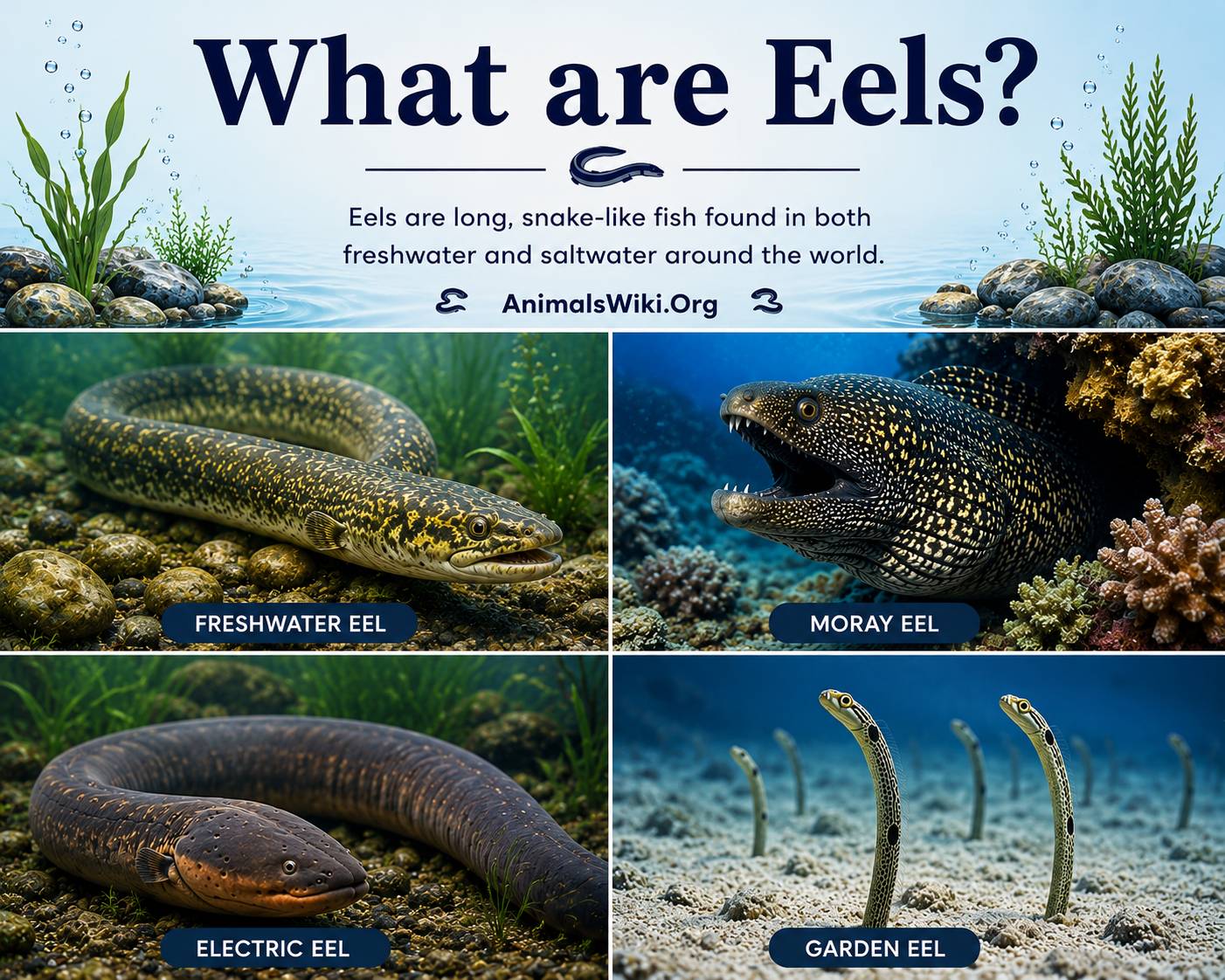
What are Eels?
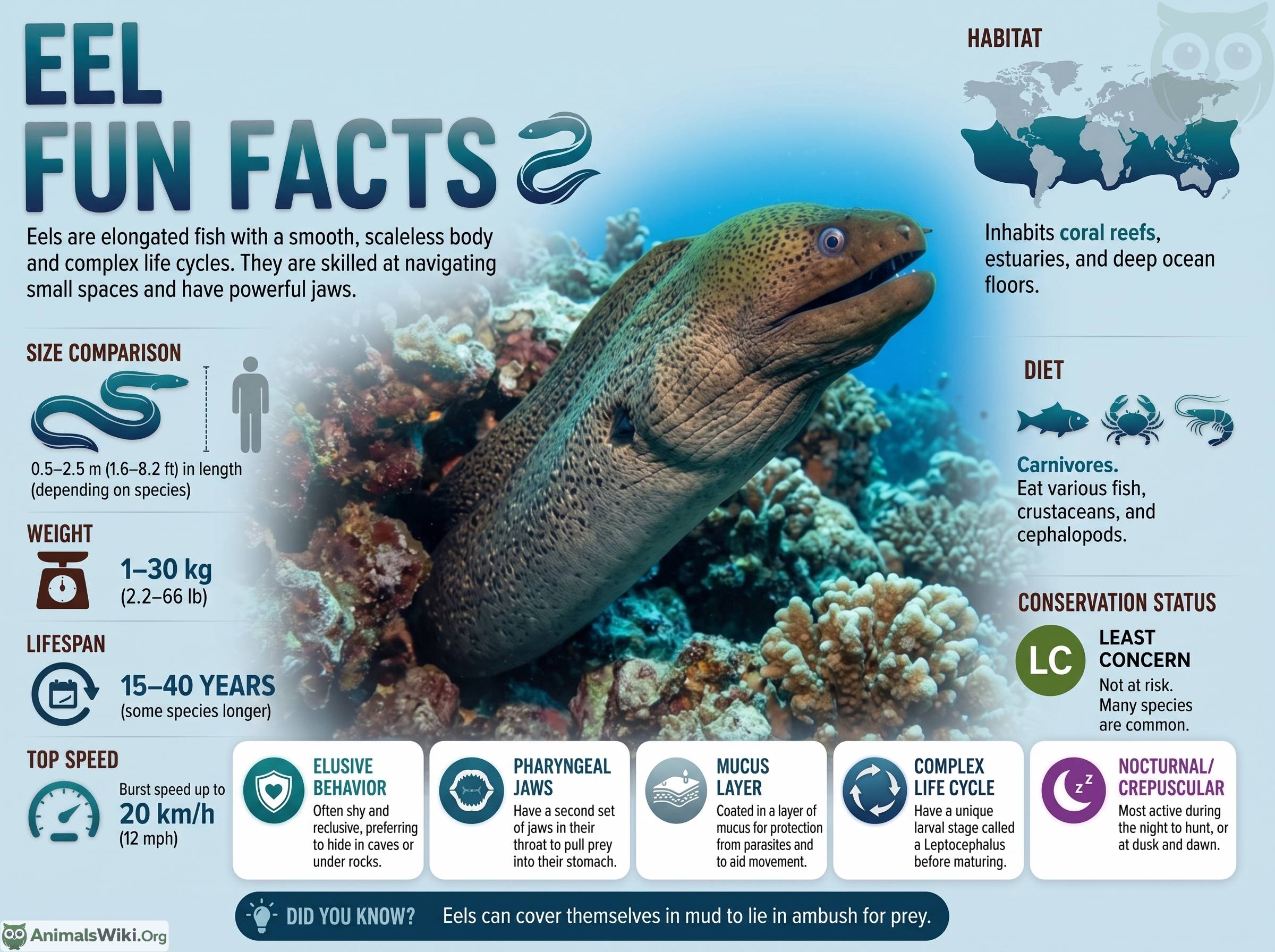
Eel Facts
| Feature | Details |
|---|---|
| Common Name | Eel |
| Scientific Name | Order Anguilliformes (European eel: Anguilla anguilla) |
| Kingdom / Class | Animalia / Actinopterygii (ray-finned fishes) |
| Number of Species | Over 800 known species |
| Average Length | 30 cm – 3 m (species-dependent) |
| Average Weight | 30 g – 25 kg (species-dependent) |
| Lifespan | 5 – 85+ years |
| Diet | Carnivorous — fish, crustaceans, worms, invertebrates |
| Habitat | Freshwater rivers, saltwater oceans, coral reefs, deep sea |
| Geographic Range | Every ocean; all continents except Antarctica |
| Conservation Status | Varies — European eel: Critically Endangered (IUCN) |
| Reproduction | Spawns once in a lifetime (semelparous in many species) |
| Defining Feature | Elongated snake-like body; some species generate electric current |
1. Introduction: What is Eel?
Imagine a creature that has roamed Earth’s waters for more than 200 million years, survived mass extinctions, drifted across entire ocean basins to reproduce, and remained so biologically mysterious that scientists still debate the finer points of its sex life and migratory routes. That creature is the eel — one of nature’s most captivating, bizarre, and underappreciated animals.
Eels are not snakes. They are not worms. They are fish — but fish that evolution has stretched, flattened, and sculpted into sinuous masterpieces of aquatic design. With over 800 known species spread across the world’s oceans, rivers, and coral reefs, eels occupy an extraordinary range of ecological niches. Some glow in the dark. Some generate enough electricity to stun a horse. Some migrate thousands of miles to a single patch of ocean to spawn and then die.
Whether you’re a student writing a report, a nature lover watching a documentary, or simply someone who caught a glimpse of an eel slithering through a tidal pool, this guide will give you everything you’ve ever wanted to know — and quite a few things you never expected to learn — about one of the planet’s most ancient and fascinating fish.
2. Species Overview & Classification
Eels belong to the order Anguilliformes, a diverse group of ray-finned fish that includes more than 800 species across 19 families and 111 genera. The word “eel” is used loosely in everyday language — electric eels (Electrophorus electricus), for example, are not true eels at all, but a species of knifefish native to South America. True eels all share one key trait: an elongated, limbless body with continuous dorsal, caudal, and anal fins that merge seamlessly.
Species Classification Table
| Family | Common Examples | Habitat | Notable Trait |
|---|---|---|---|
| Anguillidae | European Eel, American Eel | Freshwater & marine | Catadromous migration |
| Muraenidae | Moray Eel | Tropical marine reefs | Pharyngeal jaw system |
| Congridae | Conger Eel, Garden Eel | Marine/saltwater | Some reach 3 m in length |
| Ophichthidae | Snake Eel, Worm Eel | Sandy marine floors | Burrow tail-first into sand |
| Synaphobranchidae | Cutthroat Eel | Deep sea | Extreme depth tolerance |
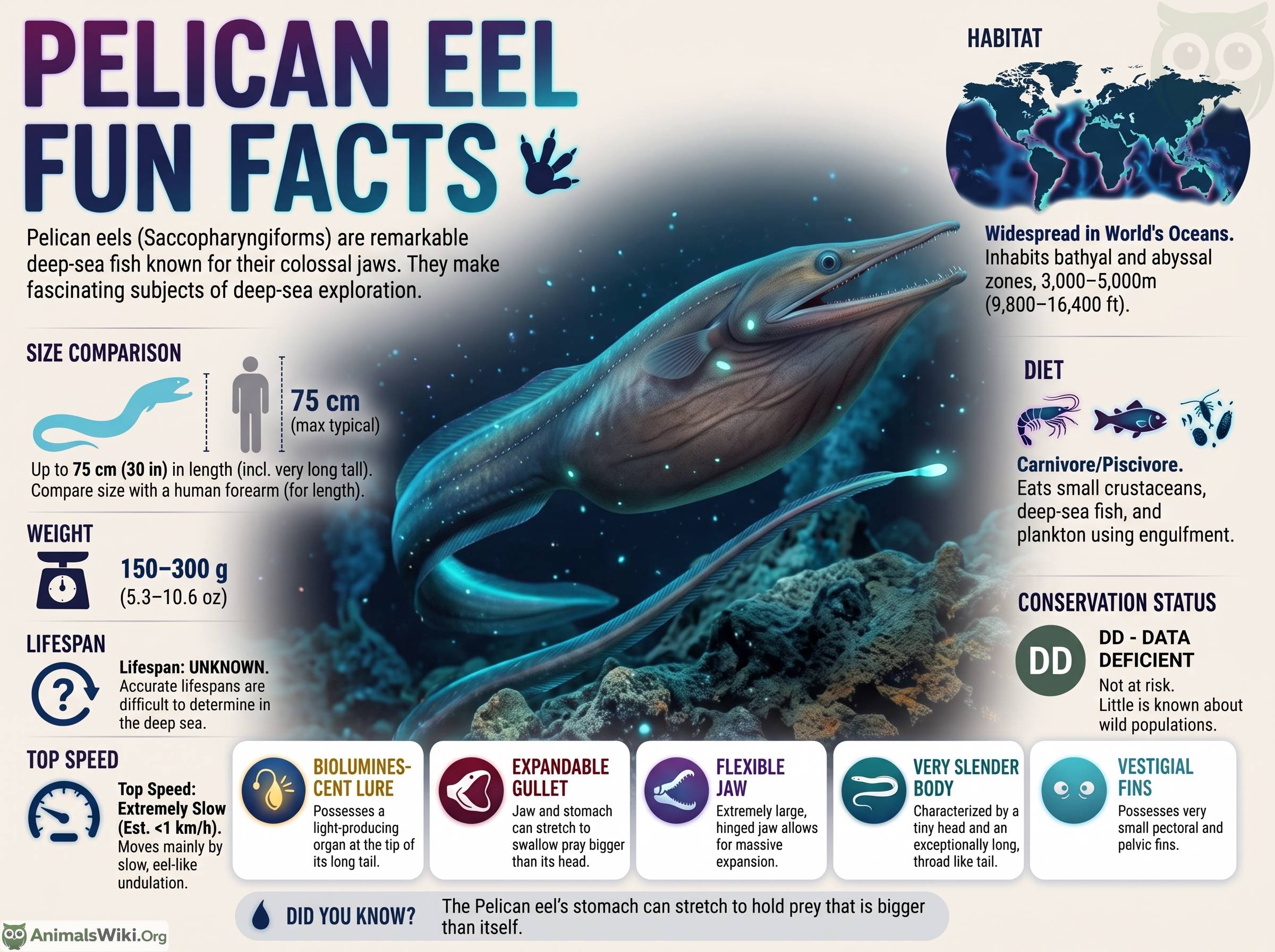
| Saccopharyngidae | Gulper Eel | Deep ocean | Expandable jaw/stomach |
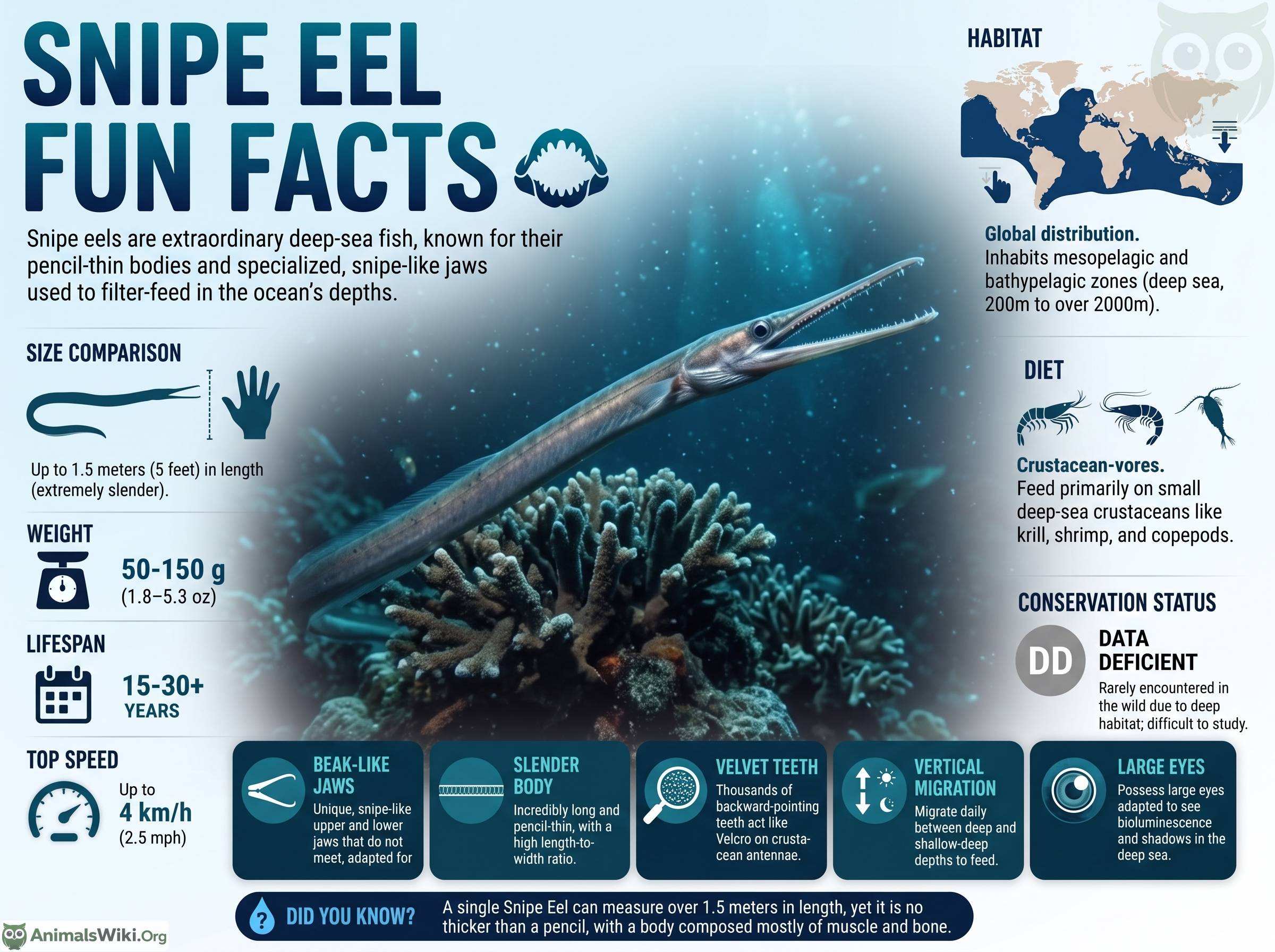
| Nemichthyidae | Snipe Eel | Open ocean | Extremely elongated snout |
The most scientifically studied species include the European eel (Anguilla anguilla), the American eel (Anguilla rostrata), the giant moray (Gymnothorax javanicus), and the conger eel (Conger conger). Each represents a remarkable evolutionary story.
“Eels are among the most enigmatic vertebrates on Earth. Their biology forces us to confront how much we still don’t know about the natural world.” — Dr. David Righton, Marine Ecologist, Centre for Environment, Fisheries and Aquaculture Science (CEFAS)
3. Physical Description & Unique Features
At first glance, an eel looks deceptively simple — a long, slimy tube of muscle. Look closer, and you’ll find one of the most sophisticated body plans in the animal kingdom.
Body Structure
Most true eels have a cylindrical or slightly compressed body, covered in tiny, deeply embedded scales (or no scales at all in some species). Their dorsal, caudal, and anal fins are fused into a single continuous fin running most of the body’s length. They have no pelvic fins, and their pectoral fins are either small or absent depending on species.
Eels move through a form of locomotion called undulatory locomotion — generating wave-like contractions along their muscular body. This makes them extraordinarily maneuverable, capable of swimming forwards, backwards, and even tying themselves into a loose knot to generate leverage when tearing prey apart.
Skin & Coloration
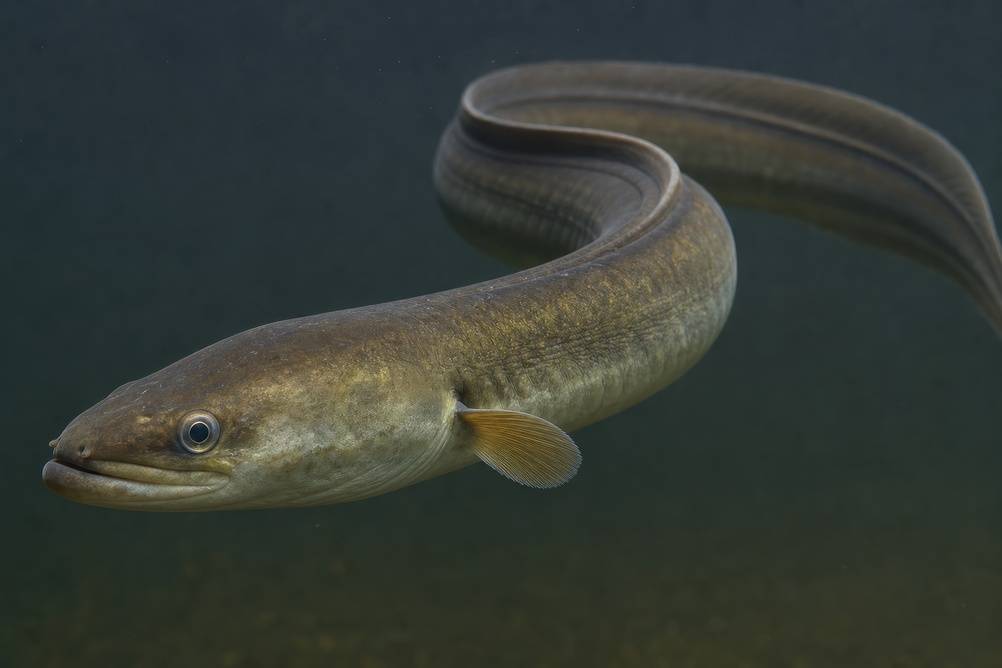
Eel skin is thick and mucus-coated, providing protection against parasites and helping them breathe partially through their skin in low-oxygen environments. Coloration varies dramatically by species and life stage. The European eel shifts from yellowish-brown in its freshwater “yellow eel” phase to silver-black when it enters its oceanic breeding migration as a “silver eel.”
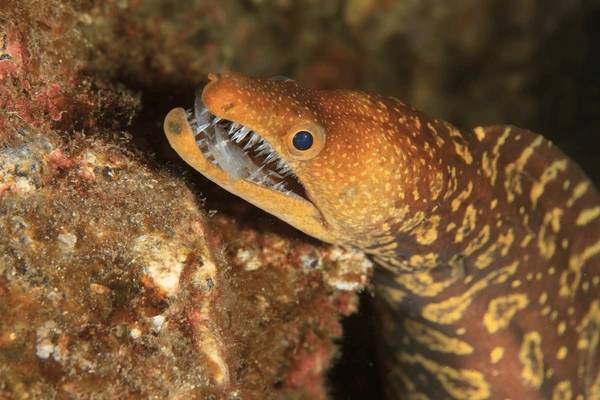
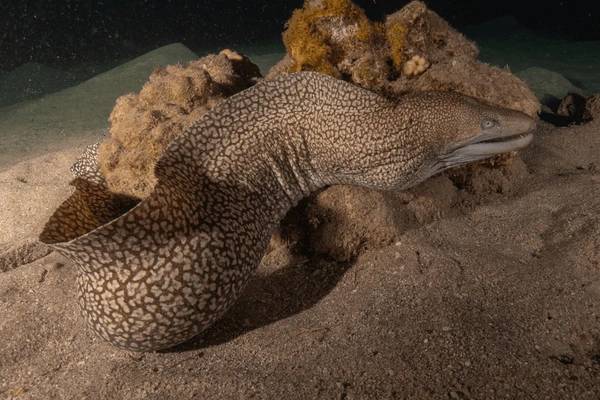
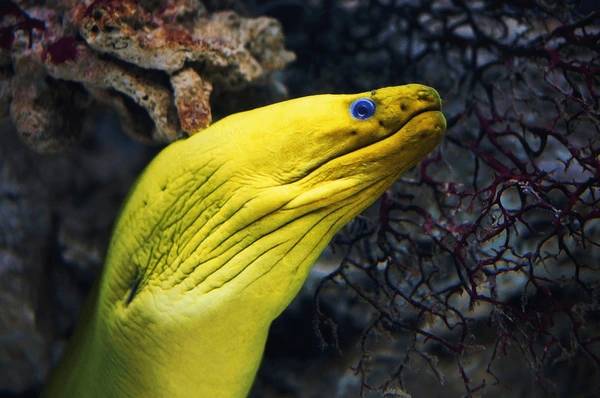
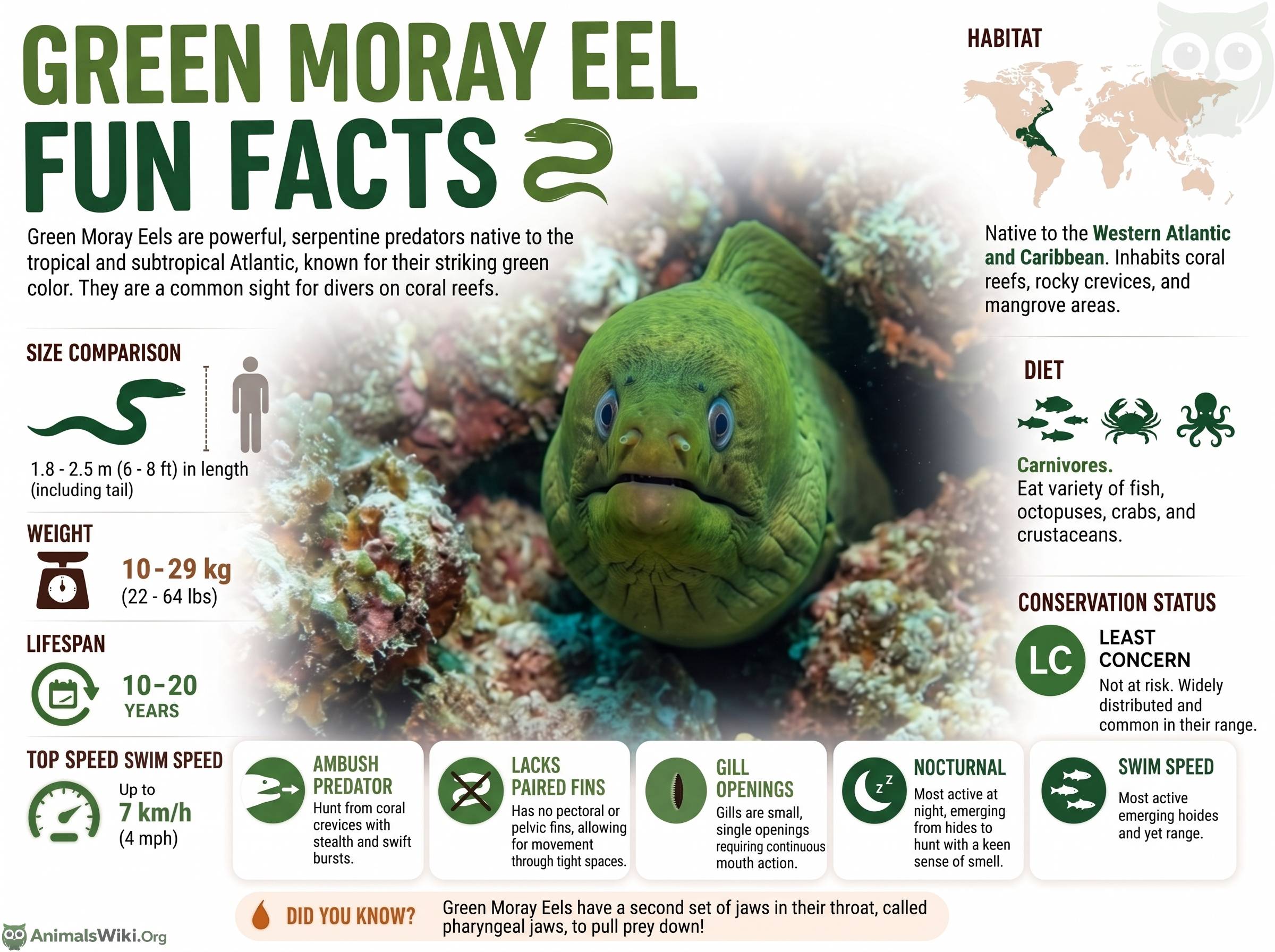
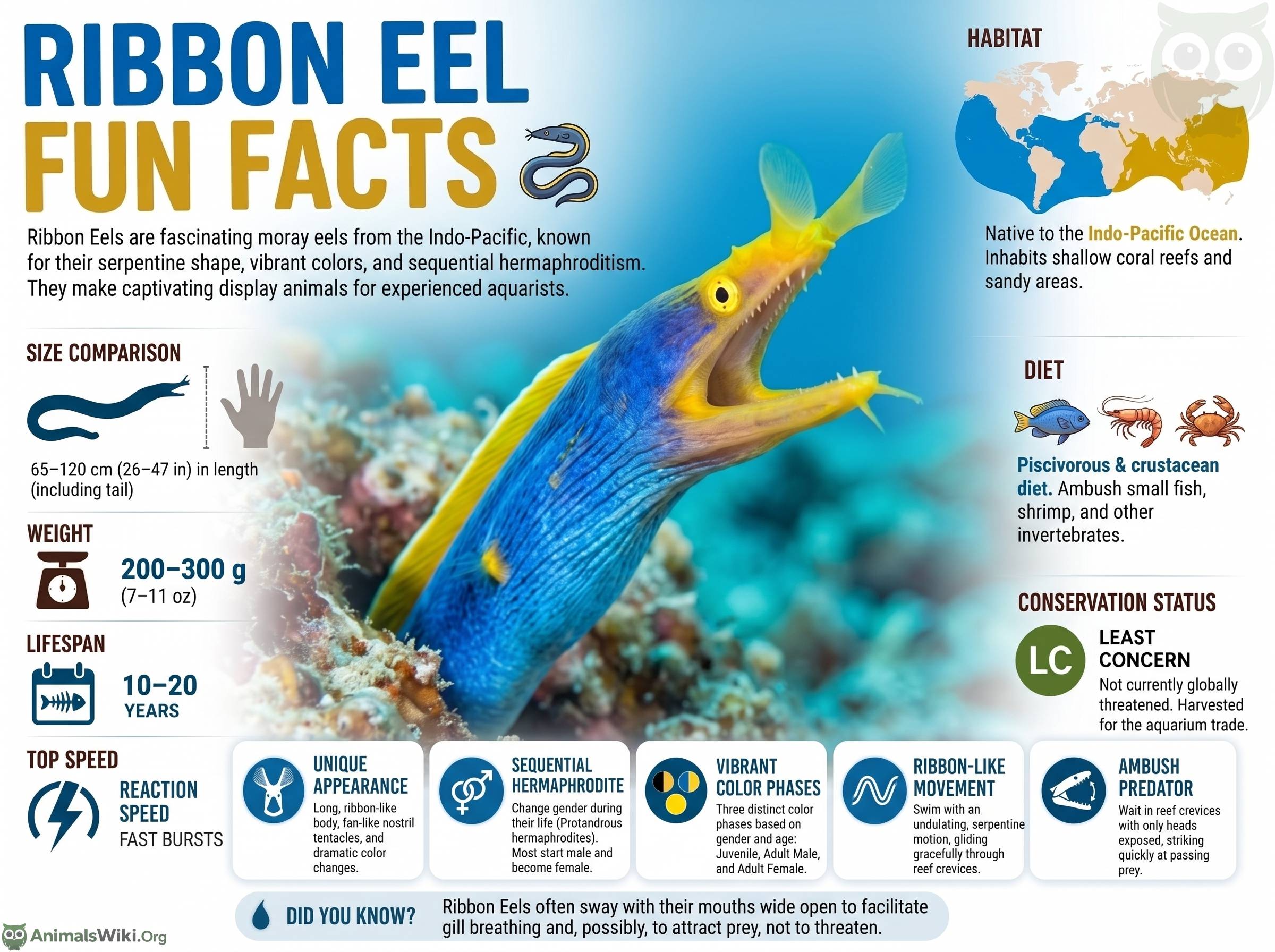
Moray eels are perhaps the most visually striking, displaying dazzling patterns of spots, stripes, and marbling in colors from jet black and deep green to bright yellow and electric blue.
DID YOU KNOW? The moray eel has two sets of jaws — its primary oral jaws and a second set of pharyngeal jaws (located in its throat) that shoot forward to grab prey. This “Alien-style” jaw system is unique among vertebrates.
Size Range
Size varies enormously across the eel family:
- Snipe eels (Nemichthys scolopaceus) can reach 120 cm but weigh almost nothing
- European eels average 60–80 cm for males, up to 150 cm for females
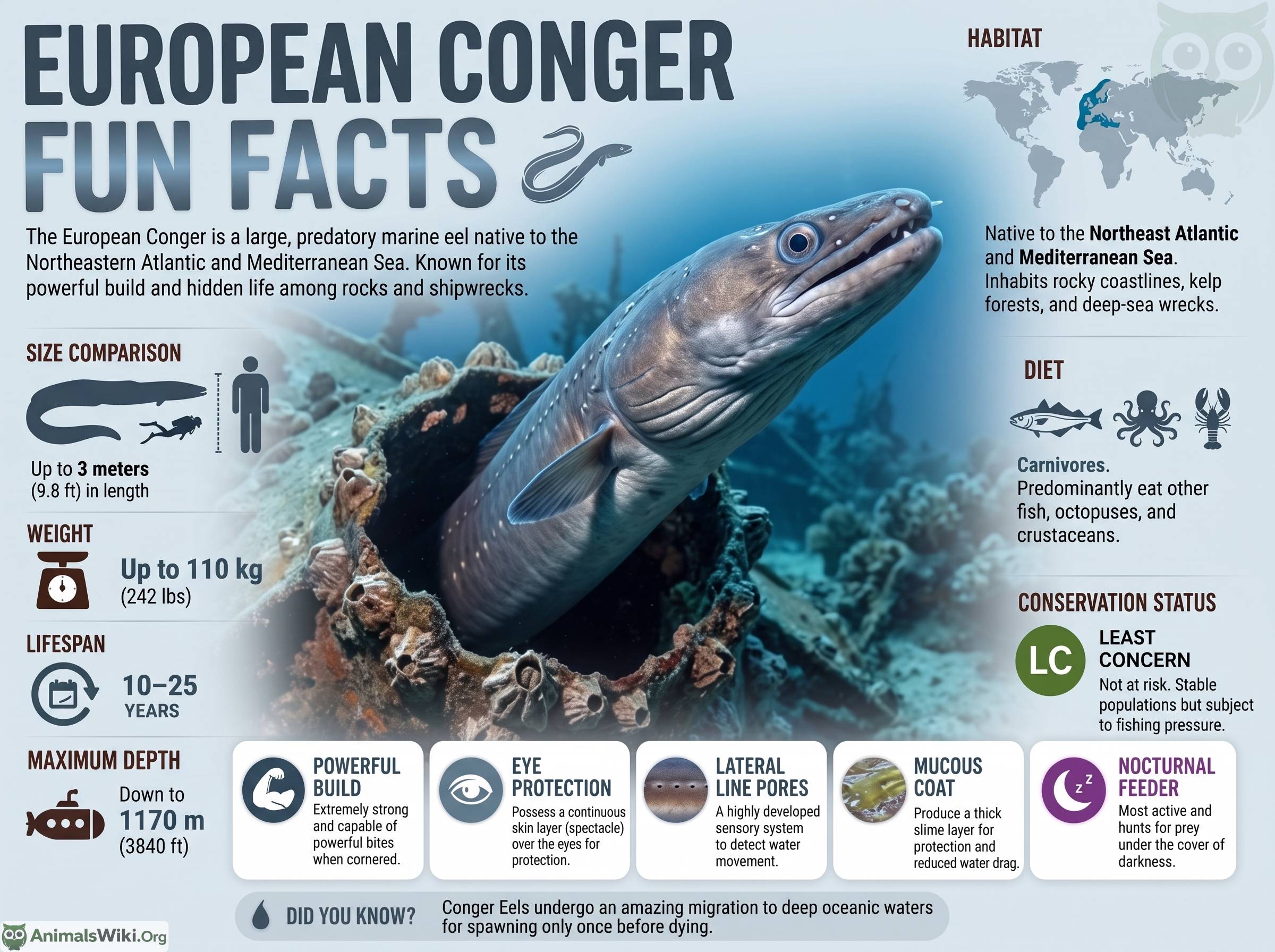
- Conger eels are among the largest, reaching up to 3 metres and 110 kg
- Slender giant moray (Strophidon sathete) is the longest moray, reaching 4 metres
- Gulper eels have mouths that can open wide enough to swallow prey larger than themselves
4. Natural Habitat & Geographic Range
Few animals occupy as diverse a range of environments as eels. They are found in every ocean on Earth, from sunlit tropical shallows to crushing deep-sea trenches, and in freshwater rivers and lakes across multiple continents.
Habitat Range by Continent
| Continent/Region | Notable Species | Habitat Type |
|---|---|---|
| Europe | European Eel | Rivers, lakes, estuaries, Atlantic Ocean |
| North America | American Eel, Moray Eel | Eastern rivers, Gulf reefs, Atlantic |
| Asia | Japanese Eel, Giant Moray | Rivers, coastal reefs, Indo-Pacific Ocean |
| Africa | African Longfinned Eel | Rivers, estuaries, Indian Ocean coast |
| Australia/Pacific | Short-finned Eel, Longfinned Eel | Freshwater rivers, Pacific reefs |
| Deep Ocean (Global) | Gulper Eel, Snipe Eel, Cutthroat Eel | Bathypelagic zone (200–2,000 m depth) |
| Tropical Reefs (Global) | Moray Eels (many species) | Coral crevices, rocky reefs |
Catadromous Migration: One of Nature’s Greatest Journeys
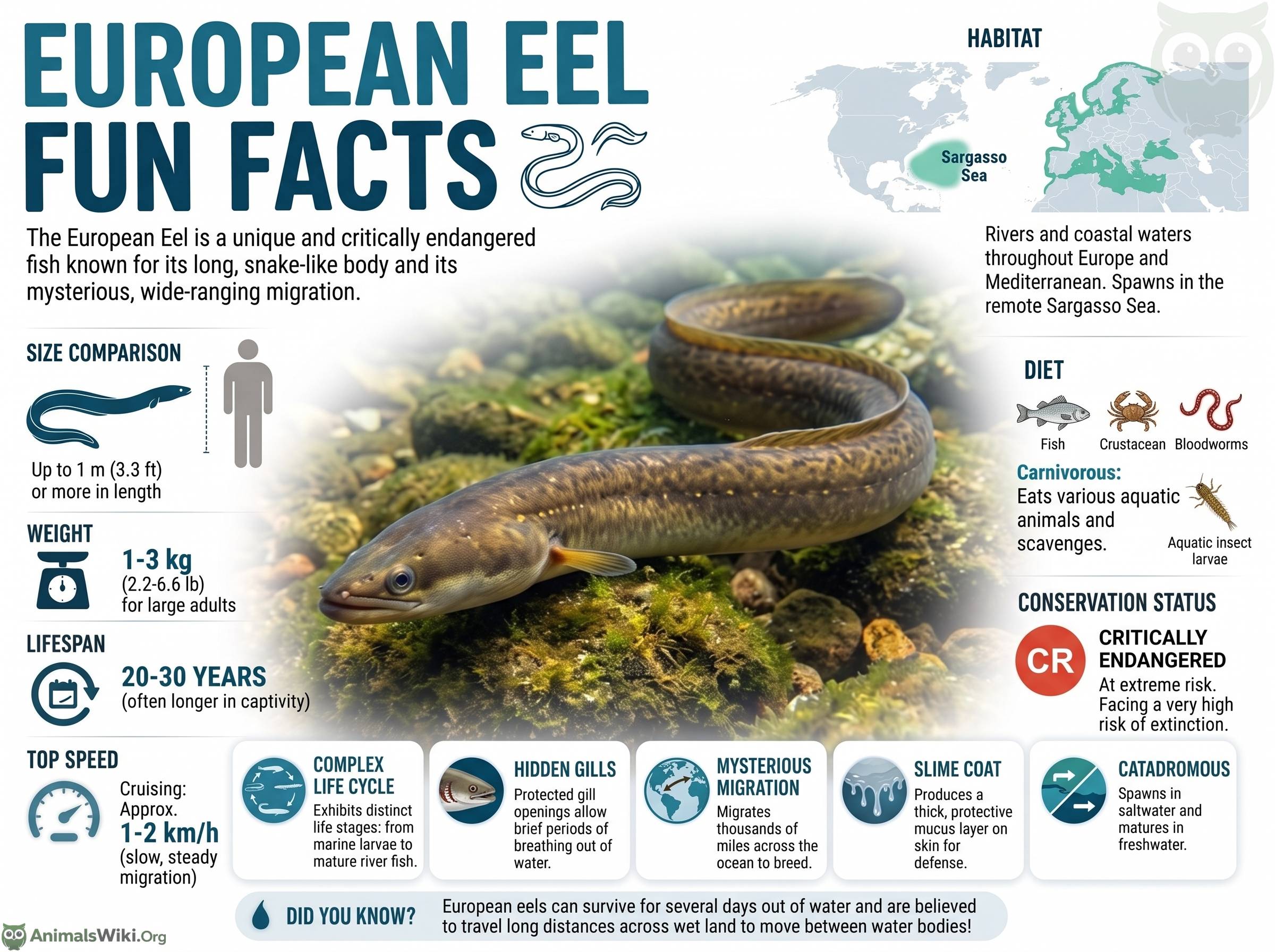
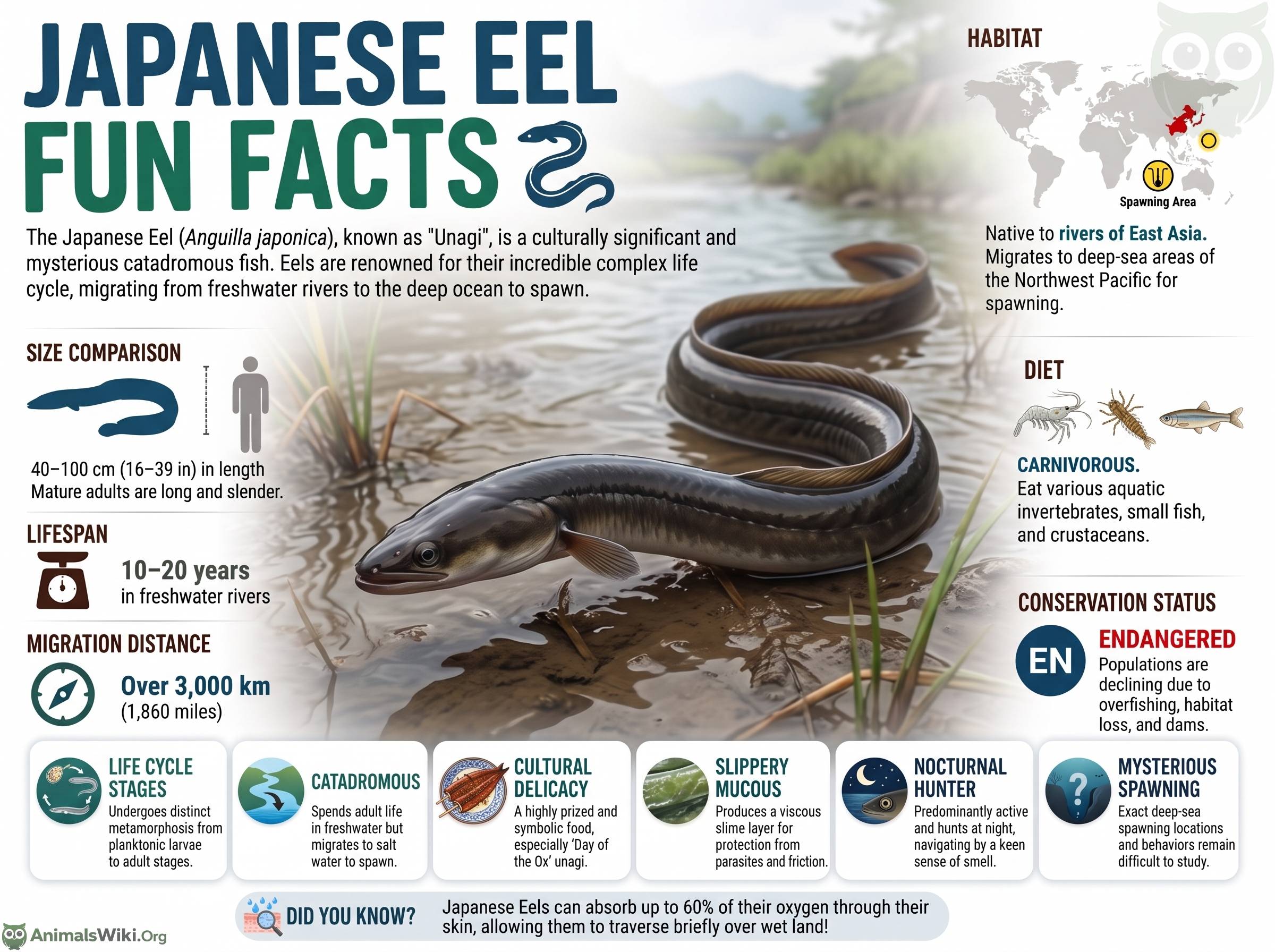
Many freshwater eels are catadromous — they live their adult lives in fresh water but migrate to the ocean to spawn. The European and American eel both spawn in the Sargasso Sea, a region of the North Atlantic Ocean near Bermuda. European eel larvae (leptocephali) then drift on ocean currents — a journey of 5,000–6,000 kilometres — before reaching European rivers, sometimes two to three years later.
This migration was one of the great biological mysteries of the 20th century. For decades, nobody had ever witnessed an eel spawning in the wild. We know the Sargasso Sea is the breeding ground largely because that is where the smallest larvae are always found.
DID YOU KNOW? A European eel’s larvae drift from the Sargasso Sea to European rivers on ocean currents — a journey of up to 6,000 km that can take three years to complete. No human has ever witnessed the spawning event in the wild.
5. Diet & Feeding Behavior
Eels are opportunistic carnivores, meaning they eat whatever they can catch. Their diet varies significantly by species, size, and habitat, but most are night hunters who rely on exceptional senses of smell rather than eyesight.
Diet Breakdown Table
| Prey Type | Species That Consume It | Frequency |
|---|---|---|
| Fish | Conger, Moray, American Eel | Very common — primary prey for large adults |
| Crustaceans (crabs, shrimp) | Most species | Common across all habitats |
| Cephalopods (squid, octopus) | Moray, Conger | Moderate — especially reef-dwelling species |
| Worms & invertebrates | European Eel, Snake Eel | Very common — especially juveniles |
| Carrion (dead animals) | Conger, Moray | Occasional — important scavenging role |
| Zooplankton | Larval eels (leptocephali) | Larval stage only |
| Insects & amphibians | American Eel, Longfinned Eel | In freshwater environments |
Hunting Techniques
Different species have evolved wildly different hunting styles. Moray eels are ambush predators — lurking in reef crevices and lunging with astonishing speed. Their two sets of jaws (pharyngeal jaws) give them a grip from which few prey animals escape. Conger eels are powerful open-water hunters that can tackle large fish. Garden eels (Heteroconger hassi) stand half-upright from burrows in sandy sea floors, feeding on passing zooplankton — one of the most unusual feeding postures in the ocean.
Most eels have an excellent sense of smell — their nostrils can detect tiny chemical traces in the water, helping them locate prey, navigate, and find mates across vast distances.
6. Reproduction & Life Cycle
The reproductive biology of eels is one of the most dramatic and scientifically intriguing stories in all of zoology.
Life Stages of the European Eel
1. Egg & Larva (Leptocephalus) Stage Adult eels spawn in the Sargasso Sea. The eggs hatch into transparent, leaf-shaped larvae called leptocephali, which drift in ocean currents for months to years.
2. Glass Eel Stage As larvae approach coastlines, they transform into glass eels — tiny, nearly transparent juveniles with no pigmentation. They begin entering river mouths and estuaries.
3. Elver Stage Glass eels develop pigmentation and become elvers — small, pigmented juvenile eels that actively migrate upstream into freshwater rivers and lakes.
4. Yellow Eel Stage Eels spend most of their adult lives in freshwater as yellow eels — so named for their yellowish-brown belly. This phase can last anywhere from 6 to 20 years, or even longer.
5. Silver Eel Stage When eels reach sexual maturity (triggered by factors still not fully understood), they undergo a dramatic transformation — eyes enlarge, bellies turn silver, digestive systems shrink, and reproductive organs develop. They stop eating and begin their epic migration back to the Sargasso Sea, swimming thousands of kilometres without feeding.
6. Spawning & Death Adult eels spawn once and die — a life strategy called semelparity. They join the ranks of Pacific salmon as among the most poignant examples of self-sacrifice in the animal world.
“The European eel’s life cycle is arguably the most extraordinary migration story on the planet — and one of the least understood.” — Professor Kim Aarestrup, Technical University of Denmark, DTU Aqua
DID YOU KNOW? A female European eel can produce up to 8–10 million eggs in a single spawning event — yet their populations have declined by more than 90% since the 1980s.
7. Social Behavior & Communication
Eels are generally solitary animals, not known for complex social structures. However, there are fascinating exceptions.
Garden eels (Heteroconger hassi) are one of the ocean’s most unusual social species. Hundreds — sometimes thousands — of individual garden eels live in neighboring burrows in sandy sea floors, creating vast “gardens” of waving, upright eels. They maintain strict personal space but form loose colonies that provide protection from predators. When threatened, they retract rapidly into their burrows simultaneously, creating a striking visual spectacle.
Moray eels have been observed engaging in cooperative hunting with grouper fish — a remarkable example of interspecies collaboration. The grouper signals to the moray with a specific headshake, inviting it to help flush prey out of reef crevices. This behavior has been documented off the coast of the Red Sea and is considered one of the most sophisticated cooperative hunting strategies observed outside of mammals.
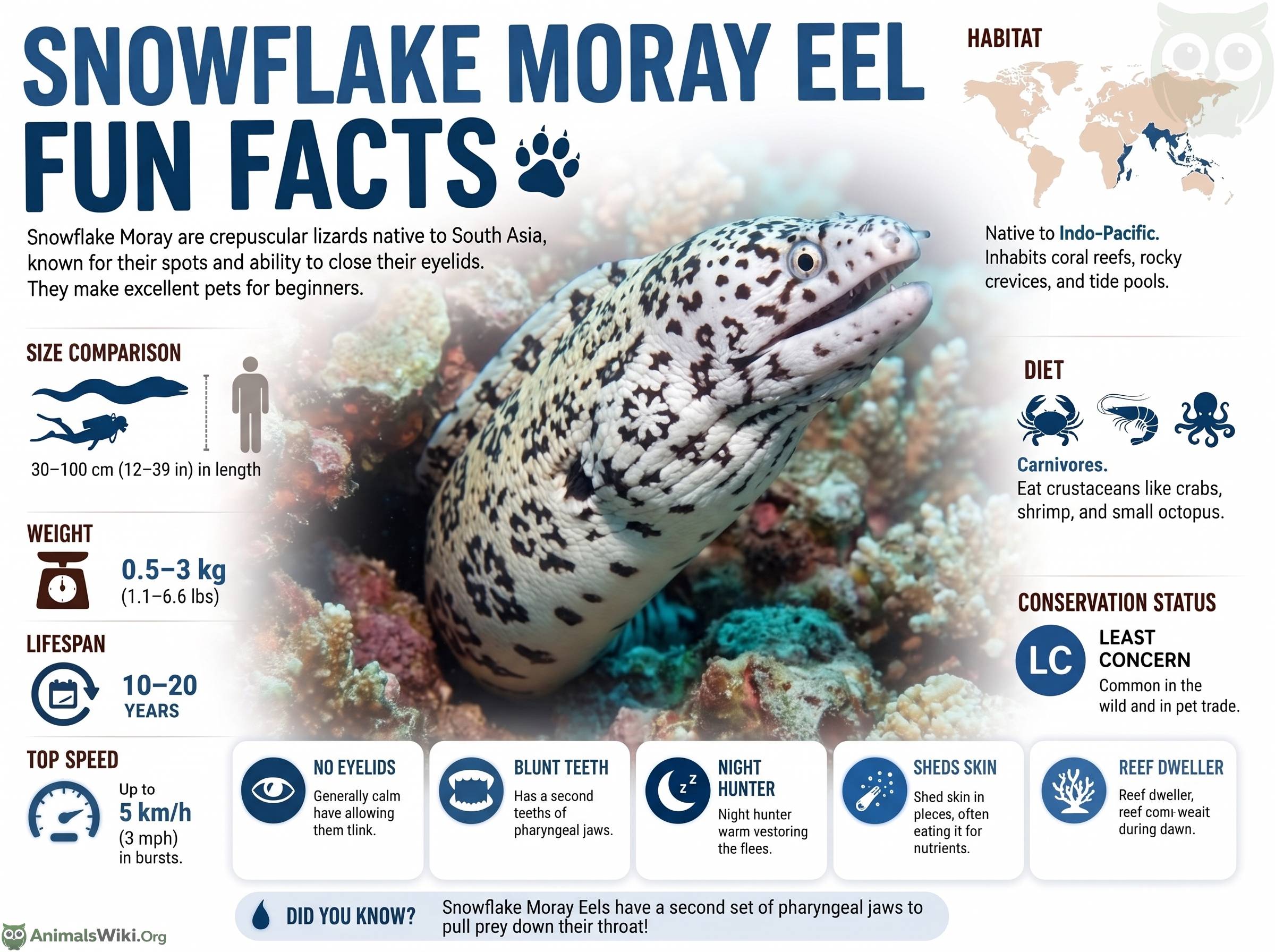
Communication in eels relies heavily on chemical signaling (pheromones) and body posturing. The wide-open gape of a moray eel — often mistaken for aggression — is actually the eel breathing, pumping water over its gills. True threat displays involve a specific body coiling and jaw presentation.
8. Predators & Defense Mechanisms
Despite their fearsome reputation, eels face significant predation pressure throughout their lives.
Primary Predators
- Birds: Herons, egrets, cormorants, and ospreys prey heavily on glass eels and elvers in rivers and estuaries
- Larger fish: Pike, perch, bass, and larger eels prey on juvenile eels in freshwater
- Marine mammals: Dolphins and seals eat adult eels in coastal waters
- Other eels: Larger moray and conger eels will readily eat smaller species
- Humans: By far the greatest threat — commercial fishing, habitat destruction, and poaching
Defense Strategies
Eels employ a range of anti-predator strategies:
Camouflage — Many species are patterned to match their environment. Moray eels blend into reef rock and coral. Snake eels mimic the appearance and behavior of venomous sea snakes.
Burrowing — Most eels retreat into crevices, burrows, or mud when threatened, making them difficult for predators to extract.
Mucus — The thick, slippery mucus coating of most eels makes them extraordinarily difficult to grasp. It also has mild antimicrobial properties.
Electric shock — True eels’ most famous relative, the electric eel (Electrophorus electricus) of South America (technically a knifefish, not a true eel), can generate shocks of up to 860 volts — enough to stun a horse. Within true eels, the electric stargazer generates mild electric fields for navigation.
Toxicity — Moray eel blood contains ichthyotoxin, a toxic protein that is harmful if consumed raw. Cooking destroys the toxin, but eating raw moray blood or organs can cause serious illness.
DID YOU KNOW? The electric eel is not actually a true eel. It belongs to a separate order of fish — the Gymnotiformes, or knifefish — but earned its common name from its eel-like appearance. It can generate electrical discharges of up to 860 volts.
9. Eels & Humans: Historical & Modern Relationships
Ancient History
Humans and eels have a relationship stretching back thousands of years. Archaeological evidence from prehistoric sites in Europe and Asia shows that eels were a significant food source for early human populations. In ancient Egypt, eels were considered sacred — associated with the god Atum — and were sometimes mummified alongside pharaohs.
Ancient Romans prized eels so highly that wealthy citizens kept them in elaborate fishponds (vivaria). The Roman general Lucullus reportedly kept his pet moray eels in jeweled tanks and wept when they died. Roman fishmongers sold eels at prices equivalent to small fortunes.
Medieval & Early Modern Europe
In medieval Europe, eels were one of the most important food fish. River eels were used as currency and as payment of rents and taxes — English historical records show estates paying “rents” of thousands of eels to landlords. Ely, the cathedral city in England, derives its very name from the Old English Elig — “eel island” — reflecting just how abundant eels once were in the Fens.
Modern Uses
Today, eels remain a major food source and economic commodity:
- Japanese cuisine: The freshwater eel dish unaju/unagi (grilled eel over rice) is one of Japan’s most beloved traditional foods, consumed in massive quantities — Japan accounts for roughly 70% of global eel consumption
- European cuisine: Jellied eels are a traditional East London dish. Smoked eel is a delicacy in the Netherlands, Germany, and Scandinavia
- Scientific research: Eels are studied extensively in neuroscience, physiology, and migration biology
- Aquaculture: Eel farming (particularly of Japanese eel Anguilla japonica) is a multi-billion dollar industry, though it faces severe sustainability challenges
10. Conservation Status & Threats
The story of eel conservation is one of the most urgent — and heartbreaking — in modern wildlife management.
IUCN Conservation Status by Species
| Species | IUCN Status | Population Trend |
|---|---|---|
| European Eel (Anguilla anguilla) | Critically Endangered | Decreasing |
| Japanese Eel (Anguilla japonica) | Endangered | Decreasing |
| American Eel (Anguilla rostrata) | Endangered | Decreasing |
| Giant Moray (Gymnothorax javanicus) | Least Concern | Stable |
| African Longfinned Eel (Anguilla mossambica) | Least Concern | Unknown |
| New Zealand Longfinned Eel (Anguilla dieffenbachii) | Vulnerable | Decreasing |
Key Threats
Overfishing & Illegal Trade The demand for glass eels in Asian markets (where they are raised in aquaculture farms) has fueled a massive and largely illegal global trade. Glass eels are among the most valuable wildlife commodities on Earth by weight — prices have reached €1,000 per kilogram or more. Criminal networks traffic them across continents in breathable water bags.
Habitat Destruction Drainage of wetlands, channelization of rivers, and destruction of estuaries have eliminated vast areas of eel habitat across Europe and North America.
Dams & Migration Barriers Hydroelectric dams and weirs block eel migration routes, preventing adults from reaching the sea to spawn and stopping juveniles from reaching freshwater habitats. Even “eel-friendly” turbines cause significant mortality.
Climate Change Shifts in ocean currents may be disrupting the Sargasso Sea spawning grounds and the drift routes of eel larvae, potentially causing recruitment failures on a massive scale.
Pollution Eels bioaccumulate environmental pollutants — PCBs, heavy metals, and pesticides — which impair reproduction and immune function.
“We are watching the European eel slip toward extinction in slow motion, and the window for intervention is closing fast.” — Dr. Håkan Wickström, Department of Aquatic Resources, Swedish University of Agricultural Sciences
11. Role in the Ecosystem & Food Chain
Eels are keystone predators and prey in many aquatic ecosystems, and their decline has measurable ripple effects throughout food webs.
As predators, eels regulate populations of crustaceans, invertebrates, and small fish. Moray eels are critical reef ecosystem regulators — without them, populations of certain reef fish and invertebrates can spike and destabilize coral ecosystems.
As prey, eels are essential food for herons, otters, dolphins, seals, and many commercial fish species. The collapse of eel populations in European rivers has been linked to measurable declines in certain otter and heron populations.
Eels also play a unique nutrient cycling role. When adult silver eels die after spawning in the open ocean, their bodies release massive quantities of marine nutrients. Larvae that drift back toward continents carry marine nutrients into freshwater systems — a phenomenon called marine-derived nutrient transport.
12. Myths, Culture & Folklore Around the World
Few animals have inspired as much cultural mythology as the eel.
Maori Culture (New Zealand) The giant longfinned eel (tuna in te reo Maori) holds deep spiritual significance in Maori tradition. The mythological figure Tuna is an eel-god, and many traditional stories tell of eels transforming into other creatures or serving as guardians of rivers. Eels were historically harvested in elaborate ceremonial traps, and the practice of tangi tuna (eel mourning) acknowledged the spiritual weight of the catch.
Japanese Culture In Japan, eels (unagi) are associated with strength and stamina. The tradition of eating grilled eel on Doyo no Ushi no Hi (the midsummer “Day of the Ox”) stretches back to at least the 18th century, when scholar Hiraga Gennai reportedly popularized it as a cure for summer fatigue. The eel is also a symbol of slipperiness and elusiveness in Japanese proverbs.
European Folklore In medieval Europe, eels were believed to spontaneously generate from mud, horse hair, or the slime of rivers — a belief that persisted for centuries because no one had ever witnessed eel eggs or spawning. This confusion inspired the phrase “slippery as an eel” and lent eels an air of supernatural mystery.
Pacific Island Cultures Across Polynesia, eels frequently appear in creation myths. In some Hawaiian traditions, the first coconut tree grew from the buried head of a giant eel — linking these mysterious fish to one of the most important food plants of the Pacific.
Ancient Greece & Rome Greek philosopher Aristotle (384–322 BC) — one of history’s greatest naturalists — was so baffled by eel reproduction that he concluded they “arise spontaneously from the guts of wet soil.” This misconception persisted in scientific literature for nearly 2,000 years.
13. Famous Eels: Named Individuals & Pop Culture
Famous Named Eels
“Sabrina” the Giant Moray (Hawaii) A well-documented giant moray eel named Sabrina resided in Hanauma Bay Nature Preserve, Oahu, Hawaii, for over a decade and became a beloved fixture for divers and snorkelers, known for approaching familiar humans peacefully.
“Aunty” — New Zealand Longfinned Eel Several New Zealand rivers contain individual longfinned eels that have been named by local communities and estimated to be over 100 years old — among the oldest individual fish ever documented in New Zealand freshwater systems.
Pop Culture Appearances
Finding Nemo / Finding Dory (Pixar) Though not a central character, moray eels make memorable cameo appearances in the Pixar universe, typically portrayed as menacing reef inhabitants.
The Little Mermaid (Disney) Flotsam and Jetsam — Ursula’s sinister moray eel henchmen — are among Disney’s most memorable villains’ sidekicks, cementing the moray eel’s cultural image as sleek and dangerous.
David Attenborough’s Blue Planet II (BBC, 2017) The series features stunning footage of garden eels, moray eels, and the extraordinary cooperative hunting behavior between morays and grouper fish — one of the most talked-about sequences in nature documentary history.
“Tuna” in Maori Art The eel-god Tuna appears across traditional Maori carving, weaving, and oral literature — one of the few animals to achieve true mythological deity status in any world culture.
14. Evolution & Discovery Timeline
~200 million years ago — Ancestral eel-like fish appear in fossil record during the Triassic period.
~100 million years ago — True eels of order Anguilliformes diverge from other fish lineages during the Cretaceous period.
384–322 BC — Aristotle observes that eels seem to appear spontaneously in rivers, concluding they generate from mud — one of history’s most famous scientific errors.
1684 AD — Italian naturalist Francesco Redi conducts early experiments challenging spontaneous generation in eels but cannot locate eel reproductive organs, deepening the mystery.
1777 — Italian biologist Mondini correctly identifies eel ovaries for the first time.
1874 — Polish scientist Szymon Syrski correctly identifies eel testes — finally confirming that eels do have distinct sexes, but are simply slow to develop reproductive organs.
1893 — Danish marine biologist Johannes Schmidt begins a legendary multi-decade research program to discover the European eel’s breeding ground.
1922 — Johannes Schmidt publishes his landmark finding: the Sargasso Sea is the spawning ground of the European eel. He proves this by collecting progressively smaller larvae as ships sailed toward Bermuda.
1970s–1980s — European eel populations begin their catastrophic decline.
2008 — European eel is classified as Critically Endangered by the IUCN.
2010s–present — Satellite tagging studies begin tracking silver eels into the Atlantic, but no tagged eel has ever been confirmed to reach the Sargasso Sea — the full migration remains unconfirmed by direct observation.
2024–2026 — International scientific programs using advanced acoustic and satellite tags continue attempting to close the final chapter of eel migration science.
15. Species Comparison Table
| Feature | European Eel | American Eel | Giant Moray Eel |
|---|---|---|---|
| Scientific Name | Anguilla anguilla | Anguilla rostrata | Gymnothorax javanicus |
| Max Length | Up to 150 cm | Up to 120 cm | Up to 300 cm |
| Max Weight | ~6 kg | ~7 kg | ~30 kg |
| Habitat | Freshwater / Atlantic | Freshwater / Atlantic | Tropical marine reefs |
| Diet | Fish, crustaceans, worms | Fish, crustaceans, invertebrates | Fish, octopus, crustaceans |
| Lifespan | Up to 85 years | Up to 43 years | Up to 30 years |
| IUCN Status | Critically Endangered | Endangered | Least Concern |
| Migration | Catadromous — Sargasso Sea | Catadromous — Sargasso Sea | Non-migratory |
| Unique Feature | Longest freshwater lifespan of any eel | Widest freshwater range in the Americas | Pharyngeal jaw system |
16. Best Places to See Eels in the Wild
1. Hanauma Bay Nature Preserve, Hawaii, USA One of the world’s most accessible snorkeling spots, Hanauma Bay is home to several species of moray eel that regularly interact with snorkelers in the shallows. Giant moray and yellowmargin moray eels are commonly spotted in reef crevices.
2. The Azores, Portugal The waters around the Azores archipelago in the North Atlantic are rich in conger eels and moray eels. Diving here also puts you geographically close to the Atlantic migration routes of European silver eels.
3. Great Barrier Reef, Australia The world’s largest coral reef system hosts dozens of moray eel species. Dive operators regularly encounter giant moray, honeycomb moray, and zebra moray eels in reef crevices.
4. Westman Islands (Vestmannaeyjar), Iceland Surprisingly close to the Arctic, the waters around Iceland’s Westman Islands support populations of European eels and conger eels in cold-water kelp forest ecosystems.
5. Loire River, France Once one of Europe’s most important eel rivers, the Loire still supports conservation-managed populations of European eels. River tours and guided ecology walks during migration seasons offer viewing opportunities.
6. Whanganui River, New Zealand A sacred river to the Maori people, the Whanganui is one of New Zealand’s most important eel habitats. Guided river trips with Maori cultural context offer a profound encounter with New Zealand longfinned eels.
7. Red Sea, Egypt & Jordan The coral reefs of the Red Sea — particularly around Ras Mohammed National Park and the Gulf of Aqaba — are home to spectacular moray eel populations and offer easy diving access for wildlife enthusiasts.
8. Suruga Bay, Japan Japan’s deepest bay is home to extraordinary biodiversity, including garden eels on sandy slopes, moray eels on rocky reefs, and conger eels in deeper waters. Shimoda and Numazu are popular diving base camps.
17. How You Can Help: Conservation Action
The eel’s decline is alarming, but there are meaningful actions that individuals, communities, and governments can take.
What You Can Do
Make sustainable seafood choices. Avoid eating wild-caught eel or products containing wild eel. If you eat eel, look for responsibly sourced farmed alternatives with Marine Stewardship Council (MSC) or Aquaculture Stewardship Council (ASC) certification. The Monterey Bay Aquarium’s Seafood Watch program recommends avoiding most eel products entirely.
Support river restoration projects. Many conservation organizations fund programs to remove or bypass obsolete dams and weirs, restoring eel migration routes. Donate to or volunteer with such programs in your region.
Reduce pollution. Eels accumulate pollutants from agricultural runoff, industrial discharge, and plastic waste. Supporting clean water legislation, reducing single-use plastics, and choosing organic produce all reduce eel habitat degradation.
Citizen science. Programs like the Eel Survey run by conservation organizations in the UK and Europe allow volunteers to monitor eel populations in local rivers, providing vital data for management decisions.
Key Organizations
- The Sustainable Eel Group (SEG) — International organization promoting sustainable eel management: sustainableeelgroup.org
- WWF (World Wildlife Fund) — Campaigns for freshwater habitat protection and sustainable fisheries: wwf.org
- IUCN Freshwater Fish Specialist Group — Sets global conservation priorities for eels and other freshwater fish: iucnffsg.org
- The Anguilla Society — UK-based organization focused exclusively on European eel conservation
18. Documentaries, Books & Further Reading
Documentaries
Blue Planet II (BBC, 2017) — David Attenborough narrates stunning eel footage, including the remarkable moray-grouper cooperative hunting sequence. Available on BBC iPlayer and Netflix.
The Secret Life of Rivers (BBC Natural World series) — Features European eel migration and the challenges facing freshwater ecosystems.
Mission Blue (Netflix, 2014) — Covers ocean conservation broadly, with context for marine eel habitats and reef ecosystems.
Books
“The Book of Eels” by Patrik Svensson (2020) — A beautifully written blend of natural history and personal memoir, widely regarded as the finest popular science book ever written about eels. Highly recommended for all ages.
“Consider the Eel” by Richard Schweid (2002) — A cultural and scientific exploration of the eel’s relationship with humans across history.
“Freshwater Eels of the World” by Katsumi Tsukamoto & Mari Kuroki (2014) — A rigorous scientific treatment for researchers and serious naturalists.
“Four Fish” by Paul Greenberg (2010) — Includes important chapters on the eel’s role in global seafood markets and the sustainability crisis.
19. Eel Fun Facts for Kids
- The European eel can live for over 85 years in freshwater — making it one of the longest-lived freshwater fish on Earth
- Aristotle was so mystified by eel reproduction that he declared they were born from “the guts of wet soil” — and this theory persisted for nearly 2,000 years
- An adult female European eel can produce up to 10 million eggs in a single spawning
- The Sargasso Sea — where European and American eels go to spawn — is the only sea on Earth with no coastline, entirely surrounded by ocean currents
- Moray eels have a second set of jaws in their throat, like the creature in the Alien films
- Eels can breathe partially through their skin, allowing them to survive short periods out of water
- Some New Zealand longfinned eels are estimated to be 100+ years old
- The global illegal glass eel trade is worth an estimated $2.5 billion annually — one of the world’s most lucrative wildlife trafficking markets
- Eel blood contains a protein called ichthyotoxin that is toxic when raw, but destroyed by cooking
- Japan consumes roughly 70% of the world’s eel supply each year
- The word “eel” derives from Old English ael, which is itself related to Proto-Germanic roots meaning “slippery”
- Garden eels anchor themselves in sandy burrows using their tail tip, which is coated in a specialized sticky mucus
DID YOU KNOW? Some freshwater eels in New Zealand have been aged at over 100 years old, making them among the oldest individual fish ever documented in freshwater ecosystems. These ancient individuals are now protected under Maori custom law in several river systems.
DID YOU KNOW? The Sargasso Sea — where all European and American eels go to spawn and die — is the world’s only sea with no land borders. It exists as a body of water defined entirely by four surrounding ocean currents, and is home to a unique ecosystem including floating sargassum seaweed that shelters eel larvae.
20. Frequently Asked Questions About Eels
Q1. Are eels dangerous to humans?
Most eels pose little threat to humans unless provoked. Moray eels have powerful jaws and can inflict serious wounds if handled or cornered — their bites rarely release (due to backward-curving teeth) and may require medical attention. However, unprovoked attacks are extremely rare. Electric eels (which are not true eels) can deliver shocks powerful enough to stun or, in rare cases, incapacitate a person. Treat all eels with respectful distance in the wild.
Q2. Is eel safe to eat?
Yes, cooked eel is safe and is a culinary delicacy in many cultures. Raw eel blood and organs contain ichthyotoxin, a protein toxic to humans, but this is destroyed by heat. The primary concern with eating eel today is sustainability — most wild-caught and farmed eels are sourced from critically or dangerously declining populations. Conservation organizations recommend avoiding eel consumption unless from a verified sustainable source.
Q3. How do eels reproduce if no one has ever seen them spawn?
We know eels spawn in the Sargasso Sea because researchers have found progressively smaller and younger larvae as ships sail toward Bermuda. We have never directly observed a wild European or American eel spawning event. Scientists infer the location and general timing from larval distribution data and from tagged silver eels tracked partway across the Atlantic. It remains one of nature’s most enduring scientific mysteries.
Q4. Are eels really fish?
Yes, eels are fish — specifically ray-finned fish (class Actinopterygii) in the order Anguilliformes. Despite their snake-like appearance, they breathe through gills, have fins (though modified), and share all the fundamental biology of other fish. Electric eels are technically a separate group (knifefish), but are colloquially called eels due to their appearance.
Q5. How long can eels live?
Lifespan varies dramatically by species. European eels in freshwater have been reliably documented living to 85 years or more. New Zealand longfinned eels may reach 100 years or beyond. American eels typically live up to 43 years. Moray eels in captivity have lived up to 30 years, but their wild lifespan is less well understood.
Q6. Why are eels endangered?
The European, Japanese, and American eels are all classified as Endangered or Critically Endangered primarily due to: overfishing (especially illegal glass eel trafficking), habitat destruction (draining of wetlands and estuaries), dams blocking migration routes, pollution accumulation, and potential disruption of larval drift routes due to climate-driven changes in ocean circulation.
Q7. Can eels live on land?
Eels cannot live on land permanently, but some species — particularly the European eel and New Zealand longfinned eel — can survive brief periods out of water by breathing partially through their skin. They have been documented crossing short stretches of wet grass or mud to move between water bodies, typically at night. This ability allows them to access isolated lakes and ponds that have no river connection.
Q8. What is a glass eel?
A glass eel is an early juvenile stage of catadromous eel species (such as the European and American eel). Newly metamorphosed from the leaf-shaped larval (leptocephalus) stage, glass eels are nearly transparent, about 6–9 cm long, and migrate from the ocean into rivers and estuaries. They are the most commercially exploited life stage, harvested en masse (often illegally) for aquaculture stocking.
Q9. Do eels have bones?
Yes, eels have bones — they are vertebrate animals with a full skeleton. However, their spine is highly flexible, composed of numerous small vertebrae, which gives them their characteristic fluid, snake-like movement. Eating whole cooked eel requires care to avoid small bones, which is why eel is often filleted or heavily processed before serving.
Q10. What is the difference between a moray eel and a regular eel?
Moray eels (family Muraenidae) are a specific family within the broader order Anguilliformes. They are distinguished from other eels by several features: they lack pectoral fins entirely, have a distinctive spotted or patterned skin rather than scales, possess the remarkable pharyngeal jaw system, and are exclusively marine (saltwater) animals associated with coral reefs and rocky shorelines. “Regular” freshwater eels (family Anguillidae) are catadromous migrants with smooth scaleless skin and a more uniform coloration.
21. Sources Researched
The facts and information in this article were drawn from and cross-referenced with the following reputable sources:
- Eel Images — shutterstock.com
- IUCN Red List of Threatened Species — iucnredlist.org (species conservation status, population data)
- National Geographic — nationalgeographic.com (habitat, behavior, and ecology)
- WWF (World Wildlife Fund) — wwf.org (conservation threats and initiatives)
- Britannica — britannica.com (taxonomy, history, and cultural references)
- Wikipedia — wikipedia.org (general reference, species lists, historical context)
- Smithsonian Ocean — ocean.si.edu (marine species biology)
- NOAA Fisheries (National Oceanic and Atmospheric Administration) — fisheries.noaa.gov (American eel data, fisheries management)
- DTU Aqua (Technical University of Denmark) — aqua.dtu.dk (eel migration research)
- Sustainable Eel Group — sustainableeelgroup.org (conservation policy and sustainable trade)
- CEFAS (Centre for Environment, Fisheries and Aquaculture Science, UK) — cefas.co.uk (European eel research)
- Te Ara — The Encyclopedia of New Zealand — teara.govt.nz (Maori cultural context and New Zealand longfinned eel)
- Monterey Bay Aquarium Seafood Watch — seafoodwatch.org (sustainable seafood recommendations)
- Svensson, Patrik. “The Book of Eels.” HarperCollins, 2020 (cultural and scientific history)
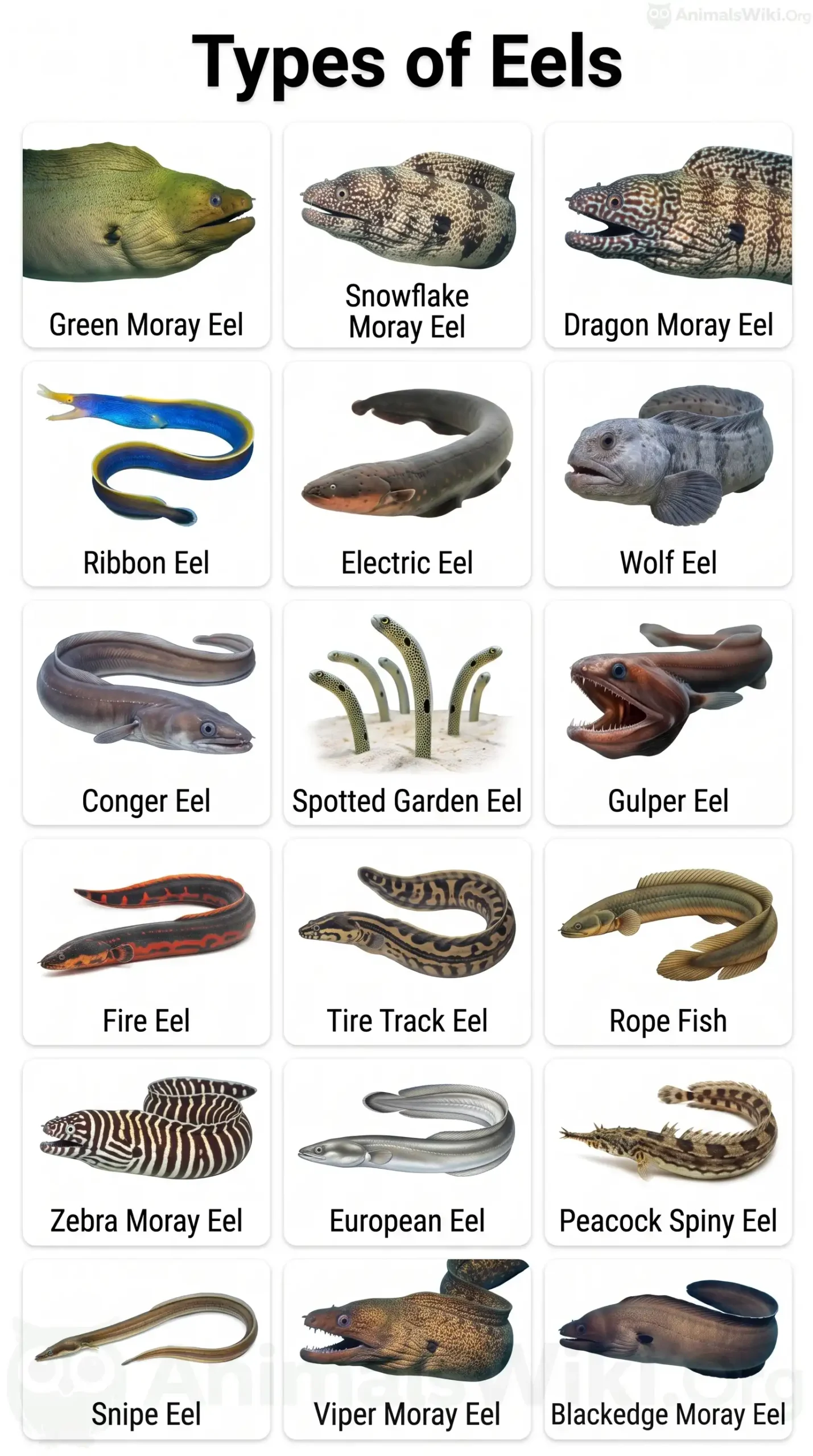
Eel Images (Shutterstock)