
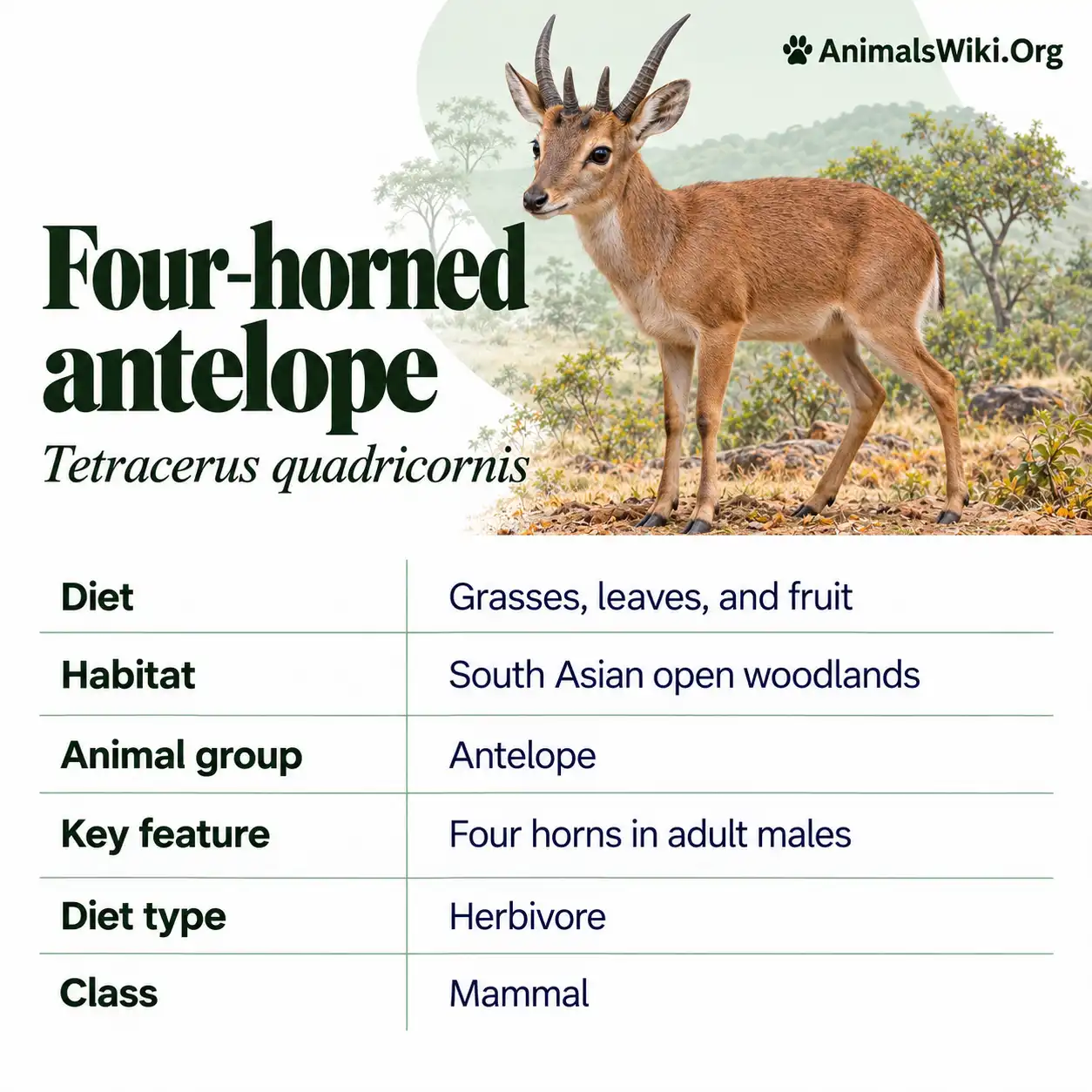
Four-horned Antelope, Habitat, Diet, Horns, and Conservation
The four-horned antelope is one of the most unusual hoofed mammals in the world. Native to the Indian subcontinent, this small, shy antelope is famous for a feature that sets it apart from almost every other wild horned mammal: adult males typically grow two pairs of horns instead of one. Its scientific name is Tetracerus quadricornis, and it is also widely known as the chousingha.
Despite its distinctive appearance, the four-horned antelope is difficult to observe in the wild. It prefers wooded landscapes, dry deciduous forests, scrub, and grassy clearings where it can feed while remaining close to protective vegetation. Rather than gathering into large herds, it is generally solitary, cautious, and quick to disappear when it detects danger.
The species lives mainly in India, with a smaller and scattered presence in Nepal. Habitat loss, the fragmentation of forests, hunting pressure, and the conversion of natural landscapes can threaten local populations. Although the animal occurs in some protected areas, its secretive behavior and uneven distribution make reliable population estimates challenging.
Learning about the four-horned antelope reveals much more than the origin of its name. Its feeding habits, unusual horns, reproductive behavior, ecological role, and conservation needs provide a fascinating picture of a specialized mammal that deserves greater attention.
Four-horned Antelope Facts
| Feature | Details |
|---|---|
| Common name | Four-horned antelope |
| Other common name | Chousingha or chowsingha |
| Scientific name | Tetracerus quadricornis |
| Animal group | Mammal |
| Class | Mammalia |
| Order | Artiodactyla, often classified within Cetartiodactyla in modern systems |
| Family | Bovidae |
| Subfamily | Bovinae |
| Genus | Tetracerus |
| Diet | Herbivore |
| Main foods | Grasses, leaves, shoots, and fruits |
| Native range | India and Nepal |
| Typical habitat | Dry deciduous forest, wooded grassland, scrub, and hilly terrain |
| Shoulder height | Approximately 55–65 cm |
| Body mass | Commonly reported around 17–22 kg |
| Horns | Usually four in adult males |
| Social behavior | Mostly solitary |
| Reproduction | Gives birth to one or sometimes more young |
| Main threats | Habitat loss, fragmentation, hunting, and disturbance |
| Conservation status | Vulnerable in the IUCN assessment cited below |
| Main ecological role | Plant consumer and prey species |
The measurements above are approximate because published sources differ slightly, and individuals vary by age, sex, and location. Taxonomic databases recognize Tetracerus quadricornis as a valid species.
1. What Is a Four-horned Antelope?
The four-horned antelope is a small wild bovid native to the forests and open woodland landscapes of India and Nepal. It belongs to the family Bovidae, the same broad family that includes cattle, sheep, goats, and numerous antelope species.
Its most recognizable characteristic is the pair of horn sets found on many adult males. Most horned antelopes have one pair, but the four-horned antelope can develop two pairs on its forehead. This unusual arrangement makes the species easy to distinguish when the horns are clearly visible.
The animal is relatively small compared with many familiar antelopes. It has a slender body, narrow legs, a short tail, and a coat that commonly appears yellowish-brown, tawny, or reddish-brown. The underside is generally lighter than the back, helping the animal blend into a landscape of dry grass, leaf litter, and woodland shadows.
The four-horned antelope is also known for its secretive nature. It tends to avoid unnecessary movement in exposed areas and often remains near vegetation that can provide cover. Even in places where it is present, visitors may find it difficult to see.
Unlike highly social hoofed mammals that travel in large herds, this antelope is usually encountered alone or occasionally with another individual. Its relatively solitary lifestyle is consistent with its preference for quiet, well-covered habitat.
The species is scientifically notable because it is the only living member of its genus, Tetracerus. This means there are no other currently recognized living species in the genus to compare directly with it.
Why the Species Matters
The four-horned antelope is important for several reasons:
-
Distinctive biology: Its unusual horn arrangement makes it a notable example of variation in mammalian horn development.
-
Regional wildlife value: It is part of the native mammal diversity of the Indian subcontinent.
-
Forest ecosystem function: It feeds on vegetation and can serve as prey for large carnivores.
-
Conservation significance: Its presence can reflect the condition and connectivity of suitable woodland habitat.
Because the species is elusive, it may receive less public attention than large, highly visible mammals such as tigers, elephants, or gaur. However, small and secretive herbivores also contribute to the functioning of natural ecosystems.
2. Why Is It Called the Four-horned Antelope?
The name describes its most unusual physical feature. Many adult males develop two pairs of horns, giving them a total of four. The front pair is generally positioned nearer the forehead, while the second pair develops farther back on the head.
The name can be misleading if interpreted too literally for every individual. Four prominent horns are not necessarily visible in every animal, and females generally lack horns. Young males may also have undeveloped or inconspicuous horns.
The species is commonly called chousingha, with spelling variations such as chowsingha appearing in English-language references. The scientific name also reflects its four-horned appearance: quadricornis is associated with the idea of four horns.
Its unusual name has helped make the animal memorable, but the horns are only one part of its identity. Its forest-dwelling habits, small body, shy behavior, and restricted geographic range are equally important for understanding the species.
3. Scientific Classification and Taxonomy
Scientific classification places the four-horned antelope among the even-toed hoofed mammals and within the bovid family. The scientific name Tetracerus quadricornis is recognized by established taxonomic databases.
| Taxonomic level | Classification |
|---|---|
| Kingdom | Animalia |
| Phylum | Chordata |
| Class | Mammalia |
| Order | Artiodactyla |
| Family | Bovidae |
| Subfamily | Bovinae |
| Genus | Tetracerus |
| Species | Tetracerus quadricornis |
Modern classification systems sometimes use Cetartiodactyla for the broader order that includes even-toed ungulates and cetaceans. Older and still widely used references may list the animal under Artiodactyla. This difference reflects classification conventions rather than a disagreement about the animal’s identity.
Is It a True Antelope?
In everyday language, the four-horned antelope is an antelope, and it is widely described that way in wildlife references. More precisely, it is a member of Bovidae, the family of hollow-horned ruminants.
Common names do not always correspond perfectly to narrow taxonomic groupings. The word “antelope” is used for many different bovids, while the family itself also includes cattle, goats, and sheep.
Is It the Only Species in Its Genus?
Yes. The genus Tetracerus is generally described as monotypic, meaning it contains just one living species: Tetracerus quadricornis. This gives the animal a distinctive position among the world’s hoofed mammals.
Are There Subspecies?
Some taxonomic references recognize three subspecies. Examples listed in taxonomic databases include Tetracerus quadricornis quadricornis and Tetracerus quadricornis iodes.
Subspecies classifications describe geographically or genetically differentiated populations within a species. However, the number and boundaries of subspecies can vary between references, especially when a species has a scattered distribution and has not been studied equally across its entire range.
For a general wildlife article, it is safest to use Tetracerus quadricornis as the accepted species name and avoid presenting every proposed subspecies as universally settled.
4. Physical Appearance and Identification
The four-horned antelope is a compact, lightly built mammal with a body adapted for moving through woodland, scrub, and grassy clearings. Its modest size and muted coat help it remain inconspicuous in its natural surroundings.
Body Size and Weight
Published descriptions generally place the species at around 55–65 centimeters at the shoulder, with body mass often reported in the range of approximately 17–22 kilograms. Some references provide slightly different measurements, so these figures should be treated as typical ranges rather than fixed limits.
Its small body makes it noticeably lighter than larger Indian bovids such as gaur and nilgai. It is also smaller than many well-known African antelopes.
The animal’s relatively narrow body and fine legs give it an alert, delicate appearance. These features are useful in habitats where it must move between trees, shrubs, and patches of open ground.
Coat Color
The coat is generally tawny, yellowish-brown, reddish-brown, or golden-brown, although its exact appearance varies. The back may look darker than the underside, which is usually pale.
These colors offer useful camouflage in dry forests. Fallen leaves, sandy soil, dry grass, and patches of sunlight create a mixture of brown and gold shades that can conceal a motionless animal.
Coat color alone is not a reliable way to identify the species because many other mammals share similar brown coloring. The animal’s size, body shape, geographic location, and, in adult males, its distinctive horns provide more useful clues.
Head and Face
The head is relatively small compared with the body. The muzzle is narrow, and the ears help the animal detect sounds in its surroundings. Dark markings around the muzzle or face may be noticeable in some individuals.
Its eyes are positioned to provide a broad view of the surrounding environment, a useful feature for an animal that needs to detect predators without remaining constantly in motion.
Legs and Hooves
The four-horned antelope has slender legs ending in cloven hooves. Like other even-toed ungulates, it bears weight on two main toes on each foot.
Its feet help it move across woodland floors, grassy slopes, and uneven ground. It is not specialized for the steepest rocky terrain in the way some mountain-dwelling ungulates are, but it can use hilly and undulating landscapes where suitable vegetation and cover occur.
Differences Between Males and Females
The most conspicuous difference between adult males and females is the presence of horns. Males typically develop horns, while females generally do not.
This is an example of sexual dimorphism, meaning males and females of the same species differ in certain physical characteristics. Body size and other visible traits can also vary, but the horns provide the clearest identification feature.
Young males may not yet display the full horn arrangement of mature individuals. Therefore, the absence of four clearly visible horns does not automatically mean that an animal is a different species.
How to Recognize a Four-horned Antelope
Look for a combination of characteristics rather than relying on a single feature:
-
A small, slender antelope with narrow legs.
-
A tawny or reddish-brown coat and a paler underside.
-
A short tail and compact body.
-
A preference for wooded or scrubby habitat.
-
Two pairs of horns in a typical adult male.
-
Solitary or near-solitary behavior.
The combination of four horns and its native Indian-subcontinent range makes a mature male especially distinctive.
5. The Four-horned Antelope’s Unique Horns
The four-horned antelope is famous because its adult males can possess two pairs of horns. This is an unusual arrangement among living wild horned mammals and one of the species’ most remarkable identifying characteristics.
How Are the Four Horns Arranged?
The horns occur in two pairs on the head:
-
Front pair: Located toward the front of the head, generally closer to the forehead.
-
Rear pair: Positioned farther back, usually shorter than the front pair.
The horns are typically smooth, pointed, and relatively short compared with those of many larger bovids. Their exact length and prominence can vary from animal to animal.
The arrangement is not simply a matter of having two unusually large horns. The presence of two separate pairs is what makes the species stand out.
Do All Four-horned Antelopes Have Four Horns?
No. The name describes the characteristic horn development of adult males, not every member of the species.
Females generally lack horns. Young males may have small or incompletely developed horns, and individuals may differ in how conspicuous their rear pair appears.
For this reason, photographs showing a female or juvenile may not display the feature most people associate with the species.
What Are the Horns Made Of?
Like the horns of other bovids, the visible horn consists of a keratin covering surrounding a bony core attached to the skull. Keratin is the same broad type of structural protein found in hair, nails, and the outer layers of skin.
Bovid horns generally grow from a permanent bony base and are not shed annually like the antlers of deer. The horn structure therefore differs fundamentally from a deer’s antlers, even when both animals use head structures during competition.
What Are the Horns Used For?
The exact function of each horn pair has not been established in every detail. In bovids, horns can play roles in competition between males, display, and defense. The four-horned antelope’s horn arrangement is especially associated with adult males and may be important in reproductive competition.
However, it would be misleading to claim that each pair has a completely separate, proven function. More detailed behavioral research would be needed to establish exactly how the two pairs contribute to different interactions.
Do the Horns Make the Animal Dangerous?
The horns are sharp, but the four-horned antelope is a small, shy wild mammal. It is not known as a habitual aggressor toward people. Like any wild animal, it should be observed from a respectful distance.
A threatened or cornered animal may behave unpredictably. The safest response is to leave it an unobstructed escape route rather than attempting to approach or handle it.
Four Horns Versus Deer Antlers
A four-horned antelope should not be confused with a deer simply because both are hoofed mammals.
| Feature | Four-horned antelope | Typical deer |
|---|---|---|
| Family | Bovidae | Cervidae |
| Head structure | Permanent horns in males | Usually branched antlers in males |
| Annual shedding | Horns are not normally shed annually | Antlers are generally shed and regrown |
| Typical structure | Horns have a keratin covering over a bony core | Antlers are bone |
| Female head structures | Females generally lack horns | Many females lack antlers, though exceptions exist |
| Signature feature | Two pairs of horns in typical adult males | Branched antlers in many species |
This distinction is useful when identifying wildlife, especially in regions where deer and antelope share similar habitats.
6. Habitat and Preferred Environment
The four-horned antelope is most closely associated with wooded landscapes rather than completely open plains. It uses dry deciduous forests, scrub forests, grassland patches, and hilly terrain where vegetation provides both food and cover.
Dry Deciduous Forests
Dry deciduous forests are important habitats for the species. These forests lose much of their foliage during the dry season, creating a changing mixture of shade, leaf litter, shrubs, and open ground.
The antelope can feed along forest edges and in patches where grasses and low-growing plants are available. Trees and bushes provide places to hide when it senses danger.
The seasonal changes in these forests can influence food availability and how visible animals are to observers. When vegetation is dense, the antelope may remain almost completely hidden. In more open periods, it may be easier to detect, although it can still be very cautious.
Woodland Edges and Grassland Patches
The four-horned antelope is not simply a deep-forest animal. Woodland edges, small clearings, and grassland patches can provide valuable feeding opportunities.
A mixture of open and covered areas allows the animal to find food while retaining access to nearby shelter. Completely exposed ground may offer fewer places to hide, while extremely dense vegetation can make movement and feeding more difficult.
The balance between cover and food is therefore important. Habitat quality depends not only on the total area of forest but also on its structure and connection to other suitable patches.
Scrub and Hilly Terrain
Scrublands and undulating terrain can also support the species when they contain suitable vegetation, cover, and access to water. Its range includes landscapes that differ in rainfall, elevation, and plant communities.
Hills and rocky slopes may offer secluded areas away from intensive human activity. Nevertheless, the animal’s presence depends on local habitat conditions rather than elevation alone.
Why Is Cover Important?
Cover serves several purposes:
-
It helps the antelope avoid detection by predators.
-
It allows the animal to remain hidden while resting.
-
It provides access to a range of feeding sites.
-
It may reduce exposure to people and other sources of disturbance.
-
It helps maintain the connected habitat patches needed for movement.
A forest that still appears green from above may be unsuitable if its understory has been heavily grazed, roads divide it into small sections, or human activity prevents wildlife from using it safely.
Does the Four-horned Antelope Live in Deserts?
It is not generally considered a desert specialist. Although it has a brown coat and can occur in dry landscapes, its characteristic habitats include woodland and forested terrain.
The distinction matters because the four-horned antelope is adapted to a particular combination of vegetation, cover, and food availability. It should not be assumed to thrive in any hot, dry environment simply because it tolerates seasonal dryness.
Does It Need Water Nearby?
Older natural-history accounts frequently describe the species as occurring near water and being rarely far from it. This suggests that water availability can influence habitat suitability, although the exact dependence will vary with local conditions and season.
Protecting woodland without considering nearby water sources, seasonal streams, and local vegetation may therefore leave some important habitat requirements unmet.
7. Geographic Distribution
The four-horned antelope is native to the Indian subcontinent. Its distribution is broad in geographic terms but scattered, with local populations separated by unsuitable habitat and human-modified landscapes.
India contains the majority of its known range, extending from areas near the Himalayan foothills through central India and into parts of peninsular India. Nepal supports a smaller population, especially in suitable lowland forest landscapes.
India
India is the principal country for the species. It has been reported across multiple regions, including parts of central, western, southern, and northern India where suitable woodland habitat remains.
The exact distribution is not continuous. A species can occur across a large region on a map while occupying only separated pockets within it.
Protected areas can provide important refuges, but records from one reserve should not be assumed to represent the status of populations across an entire state or region.
Nepal
The four-horned antelope also occurs in Nepal, where it is associated with suitable lowland and forested landscapes. Published descriptions mention its presence in protected areas such as Bardia, Banke, Chitwan, and Parsa national parks.
The existence of records in these parks is valuable, but it does not mean the species is abundant throughout Nepal. Its distribution is patchy, and local surveys are needed to establish where viable populations persist.
Why Is Its Distribution Patchy?
Several factors can contribute to a scattered range:
-
Natural differences in forest type and vegetation.
-
Seasonal changes in food and water availability.
-
Historical habitat loss.
-
Conversion of woodland to farmland or settlements.
-
Roads and other infrastructure that fragment habitat.
-
Hunting and disturbance in accessible areas.
-
Isolation of small populations.
When habitat patches become separated, animals may have fewer opportunities to move between them. Over time, isolation can increase the risk that a local population disappears without being naturally replenished by nearby groups.
Is It Found Outside India and Nepal?
India and Nepal are the commonly recognized present-day range countries in major species accounts. It should not be described as a native antelope of Africa, Europe, or the Americas.
Individual animals may be kept in captivity, but a zoo or managed collection outside the native range does not make that country part of the species’ natural geographic distribution.
Distribution Is Not the Same as Abundance
A map showing the species across several Indian states does not reveal how many animals remain. It also does not tell us whether populations in each area are stable, declining, or isolated.
Reliable conservation assessment requires more than confirming that the species has been recorded in a region. Researchers also need information about population size, breeding, habitat quality, mortality, and movement between local populations.
8. Diet and Feeding Habits
The four-horned antelope is a herbivore. Its diet includes grasses, leaves, shoots, and fruits, with the exact mix depending on the vegetation available in its habitat. Natural-history references describe it as both a grazer and a browser.
What Does a Four-horned Antelope Eat?
Its food may include:
-
Fresh grasses.
-
Young shoots.
-
Leaves from shrubs and low branches.
-
Fallen or accessible fruits.
-
Other soft plant material available in its habitat.
It is not necessary for every individual to eat the same plants throughout the year. Seasonal rainfall, plant growth, and local vegetation determine which foods are easiest to find.
Grazing and Browsing
Grazing means feeding mainly on grasses and other low-growing vegetation. Browsing means eating leaves, shoots, and similar material from shrubs or trees.
The four-horned antelope uses both strategies. This flexibility can help it exploit a woodland environment where food occurs at different heights and changes with the seasons.
An animal that relies only on one type of food may be particularly vulnerable when that food becomes scarce. A mixed feeding strategy can provide alternatives, although it cannot compensate for the complete loss of suitable habitat.
How Does It Find Food?
The antelope searches for edible vegetation while moving through its home area. Its small size and cautious behavior allow it to feed in places where larger or more conspicuous herbivores might be easier to detect.
It may use clearings and forest edges to reach grasses while retaining access to nearby cover. The arrangement of feeding sites and hiding places can therefore influence where it spends its time.
Does It Chew Its Food Twice?
Like other bovids, the four-horned antelope is a ruminant. Ruminants have a specialized digestive system that allows microorganisms in the foregut to help break down plant material.
Food is first swallowed and then can be brought back to the mouth as cud for further chewing. This process helps the animal extract nutrients from vegetation that would be difficult for many mammals to digest efficiently.
Ruminant digestion is particularly useful for animals that consume fibrous plant matter. It does not mean that every plant is equally nutritious or that the animal can survive on poor-quality vegetation indefinitely.
Does Its Diet Change With the Seasons?
It is reasonable to expect its food choices to change with seasonal plant availability. Young grasses and shoots may become more abundant after rainfall, while some plants become less accessible during dry periods.
However, the precise seasonal diet varies among locations, and detailed dietary research is limited compared with that available for some more intensively studied mammals. It is best to describe the species’ overall feeding habits confidently while avoiding unsupported claims about a single universal menu.
Does It Compete With Livestock?
Competition can occur when wild herbivores and domestic animals rely on the same limited vegetation. If livestock grazing becomes intensive, it may reduce the availability of grasses and shoots or alter the structure of the understory.
The effect on four-horned antelopes depends on grazing pressure, plant productivity, the type of livestock, and how much natural habitat remains. It would be inaccurate to assume that every area with cattle or goats necessarily has severe competition, but overgrazing can be a concern where resources are limited.
9. Water Requirements and Survival
Water is an important part of habitat quality for the four-horned antelope. Historical wildlife accounts describe it as associated with well-watered woodland and as rarely found far from water.
Why Does Water Matter?
Water supports normal body functions and can influence the availability of edible vegetation. Streams, pools, and other water sources may also create localized feeding opportunities when plants are growing.
In dry seasons, reliable water may become more important as surface sources shrink and vegetation dries. The degree of dependence is likely to vary according to climate, diet, and local habitat.
Can It Survive Without Drinking Every Day?
There is not enough robust species-specific evidence to assign a universal number of days that a four-horned antelope can survive without drinking. Claims that it can go a fixed number of days without water should therefore be treated cautiously unless they are supported by a reliable study.
Some herbivores obtain part of their water from food, but this does not establish that the four-horned antelope can routinely survive long periods without access to drinking water.
How Does It Cope With Seasonal Dryness?
The animal’s ability to feed on different kinds of vegetation may help it adjust as the availability of particular plants changes. Access to cover and a suitable range of feeding sites can also be important.
Nevertheless, it is not immune to drought. Severe water shortages can affect vegetation, body condition, reproduction, and survival, particularly where natural habitat has already been reduced.
Conservation plans should consider seasonal water availability without assuming that artificial water points alone can replace healthy native woodland.
10. Behavior and Social Life
The four-horned antelope is generally solitary and secretive. It is not typically known for gathering in the large herds associated with some open-country antelopes. Observers may encounter an individual alone or occasionally see two animals together.
A Mostly Solitary Lifestyle
Living alone can reduce the need to compete directly with many group members for food. In a wooded habitat with scattered feeding sites, a solitary animal can move quietly between patches of vegetation.
However, solitary behavior does not mean that individuals never interact. Males and females must encounter each other to reproduce, and males may compete with rivals.
The social organization of a species can also vary by season, age, and local conditions. A single observation should not be taken as proof that the animal is always alone.
Is It Territorial?
Some accounts describe territorial behavior or scent marking, but the extent of territoriality and the size of home ranges are not well established across the species’ range. One Nepal wildlife account describes the animal as territorial and reports marking vegetation with scent, while other natural-history summaries emphasize that territory formation is uncertain.
This is an important distinction: evidence that an animal marks an area does not automatically prove that it defends a fixed territory throughout the year.
More detailed field research is needed to understand how males and females use space, how home ranges overlap, and whether these patterns change with food availability or breeding activity.
Is It Active During the Day?
Some references describe the four-horned antelope as diurnal, meaning active during daylight. In practice, activity patterns may vary with temperature, disturbance, and local conditions.
An animal living in a hot environment may adjust when it feeds or moves to avoid the warmest periods. Human activity can also change the times at which wildlife uses open areas.
It is therefore better not to claim that every population follows an identical daily schedule.
How Does It React to Danger?
The four-horned antelope is cautious and difficult to approach. Its first response to a possible threat may involve pausing, watching, or attempting to remain concealed.
If the threat becomes too close, it can flee rapidly into cover. Its brown coloring and familiarity with its surroundings may help it escape detection before a predator gets close.
The precise response depends on the situation. A distant sound may trigger alertness, while a nearby predator or person may cause immediate flight.
Does It Live in Groups?
It does not usually form large, permanent herds. Small temporary associations may occur, but a solitary animal is a typical sighting.
This differs from the behavior of many open-country grazing animals, where large groups can help individuals detect predators. The four-horned antelope’s woodland lifestyle places greater emphasis on cover and cautious movement.
11. Communication and Senses
The four-horned antelope relies on environmental information to find food, recognize danger, and interact with other members of its species. Sight, hearing, smell, and body language are likely to contribute to these tasks, as they do in other hoofed mammals.
Sight and Vigilance
Its eyes help it monitor the surroundings while feeding. Remaining alert is particularly important for an animal that can be preyed upon by larger carnivores.
A four-horned antelope may stop feeding when it notices unusual movement or sound. This cautious behavior can make it difficult to photograph because even a small disturbance may cause it to retreat.
Hearing
Hearing helps an animal detect movement that it cannot see clearly through vegetation. Sounds from approaching animals, falling branches, or people may provide early warning.
Not every sound signals a threat, so animals must respond to environmental information in ways that balance safety with the need to feed and move.
Smell and Chemical Signals
Scent can be important in the social behavior of many bovids. It may help animals detect the presence of others or convey information through scent-marked vegetation.
However, the exact chemical signals used by the four-horned antelope and the roles they play in different social interactions remain incompletely documented.
Body Language
Posture, head movement, orientation, and movement speed can all communicate information in hoofed mammals. A rigid stance may indicate alertness, while a rapid retreat can signal that the animal perceives a threat.
During encounters between males, posture and movement may be relevant to displays or competition. Detailed species-specific observations remain important before assigning a precise meaning to every gesture.
12. Speed, Movement, and Adaptations
The four-horned antelope is built for moving through woodland and scrub rather than for life in extremely open plains or high mountains. Its relatively light body, longish legs, and cloven hooves allow it to travel over uneven ground and escape quickly when necessary.
Can the Four-horned Antelope Run Fast?
It can run to escape danger, but a reliable, widely accepted maximum speed figure is not established in the sources used for this article. It is better not to give an exact speed in kilometers per hour without strong evidence.
The important point is that speed is one part of its defense. A sudden burst of movement toward dense cover may be more useful than maintaining a long, high-speed run across open terrain.
Camouflage
Its tawny or reddish-brown coat blends into dry leaves, grass, soil, and the warm colors of many woodland landscapes. Camouflage is particularly useful when the animal remains still.
Camouflage does not make the antelope invisible. Its effectiveness depends on lighting, vegetation, distance, and whether a predator is already looking directly at it.
A Small Body
A small body may allow the animal to move through vegetation and use narrow spaces that are less convenient for larger herbivores. Its modest size also means it requires less food than a much larger bovid, although the amount of food needed still depends on body condition and environmental conditions.
Cloven Hooves
Its hooves provide support and traction on a range of natural surfaces. They help it walk and run across forest floors, grass, and uneven ground.
They are not a guarantee against slipping or injury. Rough terrain, damaged vegetation, and human-made barriers can still pose risks.
Secrecy as a Defense
Avoiding detection can be as important as escaping after a predator appears. The species’ cautious behavior and preference for cover reduce the amount of time it must spend exposed.
The combination of camouflage, alertness, rapid movement, and knowledge of its surroundings makes the animal well suited to woodland survival. These are general ecological interpretations, however, rather than proof that every behavior has been experimentally measured in this species.
13. Reproduction and Mating
The four-horned antelope reproduces sexually, like other mammals. Although its basic reproductive biology is understood, several details remain less thoroughly documented than those of better-studied ungulates.
Breeding observations from different locations suggest that mating activity can occur during the warmer or rainy parts of the year, but the timing is not necessarily identical throughout its range. Reports from Indian protected areas have described different seasonal breeding windows.
How Do Males Find Females?
During the breeding period, males and females may encounter each other within suitable habitat. Scent, movement, and visual signals may help individuals recognize potential mates.
A male may approach a female and display particular movements. Some field accounts describe low vocalizations and close interactions during courtship, but the full sequence of courtship behavior has not been documented equally well in all populations.
Do Males Fight for Mates?
Competition between males is possible. Natural-history observations indicate that males can become aggressive toward other males during the rut, or breeding period.
The horns may be relevant to these interactions, although the details of how each horn pair is used require careful observation. It would be inaccurate to claim that all male encounters end in physical combat or that the species follows one universal mating ritual.
When Is the Breeding Season?
There is no single breeding calendar that should be assumed for every population. Reports from different Indian locations describe breeding activity during different parts of the year, including periods around the monsoon season.
Seasonal rainfall can influence vegetation and food availability, which may affect the condition of adults and the timing of reproduction. Local climate, habitat, and individual condition may all contribute to variation.
How Old Is a Four-horned Antelope When It Reproduces?
Available descriptions suggest that individuals may reach sexual maturity relatively early compared with some larger mammals, but exact ages should be interpreted cautiously. One official report discusses captive females giving birth before two years of age, while also noting uncertainty about maturity.
Age at first reproduction can vary by sex, nutrition, body condition, and whether observations come from captivity or the wild. Captive records do not necessarily represent the typical timing of reproduction in natural populations.
14. Pregnancy, Birth, and Young Development
The four-horned antelope gives birth to live young after a period of pregnancy. The young depend on their mother for milk and protection during their early development.
Some sources report that twins can occur, and certain accounts describe births of one to three young. Because detailed field observations are limited, the number of young should not be presented as identical for every pregnancy.
Gestation
Gestation is the period between conception and birth. Older accounts give an approximate pregnancy length of around seven and a half to eight months, but this figure should be treated as a reported estimate rather than a precise universal value for every population.
Birth and Early Care
A newborn is vulnerable to predators, environmental conditions, and disturbance. Remaining close to suitable cover can help reduce the risk of detection.
The mother provides milk and maternal care. Like other mammals, the young must grow stronger and develop the ability to move effectively before becoming more independent.
The species’ secretive behavior makes it difficult for researchers to observe every stage of maternal care in the wild. For that reason, claims about exact hiding periods or a fixed sequence of developmental milestones should be made only when supported by reliable observations.
How Many Babies Does It Have?
Reports vary. Some describe one or two young, while other accounts report that a litter can occasionally contain more. Twins are mentioned in older wildlife literature, but the typical litter size is not sufficiently documented across all populations to justify a single exact figure.
When Do Young Become Independent?
Young animals gradually become less dependent on their mothers as they grow and begin feeding more effectively on vegetation. The exact age at which independence occurs is not well established for all wild populations.
Development depends on nutrition, predation risk, and the condition of the habitat. A young animal in a protected environment may experience different conditions from one living in a fragmented landscape with frequent disturbance.
Why Is Reproductive Research Important?
Understanding reproduction helps conservationists estimate whether a population can replace animals lost to mortality. If adults are killed faster than young animals can survive to maturity, a population may decline even when some births continue.
Researchers also need to know whether isolated populations are breeding successfully. A forest patch can contain animals without necessarily supporting a stable, self-sustaining population over the long term.
15. Lifespan and Survival
The lifespan of the four-horned antelope is not documented as precisely as that of some common domestic or laboratory mammals. Older natural-history summaries report a lifespan of around ten years, but this should not be treated as a guaranteed lifespan for every wild animal.
Lifespan in the Wild
Wild animals face several sources of mortality, including predators, injury, disease, food shortages, and human activity. Habitat fragmentation can add risks by restricting movement or increasing contact with people and roads.
An individual that survives its vulnerable early years may live longer than one exposed to repeated disturbance or poor habitat. Local conditions therefore matter when considering lifespan.
Lifespan in Captivity
The four-horned antelope is described as uncommon in captivity, and some sources note that it can be delicate under captive conditions.
Captive lifespan should not automatically be used as a substitute for wild lifespan. Food, veterinary care, enclosure design, stress, breeding management, and other factors differ between captive and wild environments.
What Determines Survival?
Several factors influence whether an individual survives:
-
Access to suitable food and water.
-
Availability of dense cover and safe resting areas.
-
Exposure to predators.
-
Habitat quality and connectivity.
-
Disturbance from people and livestock.
-
Disease and injury.
-
The animal’s age and physical condition.
The same factors can affect an entire population. Conservation efforts are most effective when they improve the conditions needed for animals to survive and reproduce, rather than focusing only on protecting a few visible individuals.
16. Predators and Natural Threats
The four-horned antelope is a potential prey animal for large carnivores living in its range. Wildlife accounts list predators such as tigers, leopards, wolves, and dholes, although the actual risk varies by location and the local predator community.
Tigers
Where tiger ranges overlap with suitable four-horned antelope habitat, a tiger may pose a predation risk. Tigers are powerful carnivores capable of hunting a variety of prey animals.
However, the presence of tigers does not prove that they rely heavily on this particular antelope. Predators generally select from the prey available to them, and their diets vary with habitat and prey abundance.
Leopards
Leopards are adaptable predators that occupy many woodland and forest landscapes in the Indian subcontinent. They can hunt animals of different sizes and may pose a risk to small and medium-sized ungulates.
The antelope’s camouflage and cautious behavior can reduce the likelihood of detection, but they cannot eliminate predation.
Wolves and Dholes
Wolves and dholes may occur in some landscapes occupied by the four-horned antelope. Their distribution and habitat preferences vary, so they should not be assumed to threaten every population equally.
Dholes are social wild canids, while wolves also display flexible hunting behavior. Their actual impact on four-horned antelopes depends on prey availability, habitat structure, and local ecological conditions.
How Does the Antelope Escape?
The species can rely on several general defenses:
-
Detecting suspicious movement or sound.
-
Remaining still or concealed in vegetation.
-
Fleeing rapidly when a threat approaches.
-
Using woodland cover to obstruct a predator’s view.
-
Avoiding prolonged exposure in open areas.
These strategies may improve its chances of survival, but young animals and individuals caught in exposed locations remain vulnerable.
Are Humans a Greater Threat Than Predators?
In many areas, human activities create long-term pressures that natural predators do not. Habitat destruction, hunting, roads, and disturbance can affect entire populations rather than individual animals.
Predation is a normal part of a functioning ecosystem. The conservation challenge is to maintain enough connected, healthy habitat for the antelope and its predators to coexist without the prey species being pushed into an unsustainable decline.
17. Ecological Importance
The four-horned antelope contributes to woodland ecosystems through its feeding behavior and its role in the food web. Although its precise ecosystem-wide effects have not been fully quantified, several ecological functions are reasonable to identify.
Plant Consumption
By feeding on grasses, shoots, leaves, and fruits, the antelope removes plant material from its surroundings. Herbivory can influence which plants are eaten and how vegetation is distributed, although the magnitude of its effect depends on population density and local conditions.
It would be an overstatement to claim that the species alone controls the growth of forest vegetation. Its influence is part of a larger system involving many herbivores, plants, soil conditions, rainfall, and disturbances.
A Link in the Food Web
The species can serve as prey for carnivores. When herbivores are available in suitable numbers, they contribute to the food resources supporting predator populations.
This does not mean every predator depends on the four-horned antelope. Instead, the species is one of several possible prey animals within its ecosystem.
Contribution to Biodiversity
A healthy woodland is not defined only by the presence of large, famous species. It also supports smaller mammals, reptiles, birds, insects, fungi, and a wide variety of plants.
Protecting habitat for the four-horned antelope can benefit other organisms that depend on the same woodland structure. The animal may therefore serve as one indicator of the value of maintaining native habitat.
Conservation as an Ecosystem Effort
Protecting the antelope means protecting more than an unusual horned mammal. It can involve maintaining native vegetation, limiting illegal hunting, reducing habitat fragmentation, and supporting responsible management of protected areas.
Such measures can help a broader community of wildlife, although the needs of different species must still be considered individually.
18. Population and Conservation Status
The four-horned antelope is listed as Vulnerable in the IUCN assessment cited here. The assessment reports a historical estimate of fewer than 10,000 mature individuals and identifies habitat loss as a major concern. The assessment is old, so its figures should not be presented as a verified count for 2026.
How to interpret its population status
IUCN status in the cited assessment: Vulnerable
The classification reflects concern about extinction risk, not a precise count of every living animal.
The historical estimate of fewer than 10,000 mature individuals is not a current 2026 census.
How Many Four-horned Antelopes Are Left?
There is no sufficiently reliable, up-to-date global census in the sources consulted here to state an exact number of four-horned antelopes alive in 2026.
An older assessment estimated fewer than 10,000 mature individuals. That is a historical conservation estimate, not a confirmed count of the present-day total population.
It is also important to distinguish mature individuals from all individuals. A mature-individual estimate concerns animals considered capable of reproduction under the assessment’s criteria. A total-population estimate may include young animals and other age classes.
Why Is Counting Them Difficult?
Several characteristics make population surveys challenging:
-
The species is shy and difficult to observe.
-
Its distribution is scattered across a large region.
-
Many individuals live in wooded habitats where visibility is limited.
-
Local populations may be small and separated.
-
Survey methods differ between locations.
-
Records of presence do not necessarily establish population size.
A survey may confirm that the species still occurs in a forest without providing a dependable estimate of how many animals live there.
Is the Population Increasing or Decreasing?
The IUCN assessment cited here identifies a continuing decline associated with habitat loss and other pressures. However, a reliable current trend for every local population cannot be inferred from that historical assessment alone.
Some protected populations may persist under relatively favorable conditions, while other populations may be exposed to more severe habitat degradation or hunting pressure.
The most useful conservation picture comes from repeated surveys that apply consistent methods over time. A single count is much less informative than a series of counts that shows whether the population is stable, increasing, or declining.
Why Does Vulnerable Matter?
A Vulnerable classification indicates that the species faces a meaningful risk of extinction in the wild under the criteria and evidence used by the assessment. It is not the same as being Critically Endangered, but it is also not a declaration that the species is safe.
The category can draw attention to the need for habitat protection, population monitoring, and control of avoidable mortality. Conservation action is especially important when the species’ range is fragmented and local populations may be isolated.
Does the Species Live in Protected Areas?
Yes. Published accounts record the species in several protected areas in India and Nepal. Protected landscapes can provide habitat where hunting and habitat destruction are managed, although the level of protection and its effectiveness differ between sites.
The presence of a protected area is not enough on its own. Effective conservation requires suitable habitat, enforcement, monitoring, and attention to pressures outside reserve boundaries.
19. Major Threats to Survival
The four-horned antelope faces several threats associated with changes to its natural habitat and direct human pressure. Its small, scattered populations can be particularly vulnerable when woodland patches are degraded or become isolated.
1. Habitat Loss
The conversion of native woodland to agricultural land, settlements, roads, and other developments can remove habitat that the species needs for feeding, shelter, and reproduction.
When suitable forest is cleared, the antelope may lose access to both food and protective cover. Even if some trees remain, the area may no longer provide the combination of resources it needs.
Habitat loss is particularly serious when it affects a local population’s entire usable range. A large species with extensive movement opportunities may sometimes relocate, but a small population surrounded by unsuitable land may have few alternatives.
2. Habitat Fragmentation
Fragmentation occurs when a large habitat is divided into smaller, disconnected patches. Roads, farms, buildings, and other barriers can separate animals that once occupied a more continuous landscape.
Small isolated populations may face several problems:
-
Fewer potential mates.
-
Reduced opportunities for movement.
-
Greater vulnerability to local disasters.
-
Less opportunity for recolonization after a local decline.
-
Increased exposure to human activity along habitat edges.
Protecting isolated patches is important, but maintaining or restoring connections between them may also be necessary.
3. Hunting and Poaching
Illegal hunting can remove animals directly from the population. A species that occurs at low density may be especially vulnerable when even a relatively small number of individuals are killed repeatedly.
The four-horned antelope’s unusual horns may make it attractive to collectors or trophy hunters in some contexts. Historical wildlife references identify hunting as a concern, although the intensity of this pressure varies across its range.
Effective enforcement, public awareness, and cooperation with local communities can help reduce illegal killing.
4. Competition With Livestock
Domestic cattle, goats, and other grazing animals can use some of the same vegetation as wild herbivores. Where livestock numbers are high, overgrazing may reduce food availability or alter the plant community.
The effects depend on local conditions. Moderate grazing in one landscape may have a different impact from heavy, continuous grazing in a small forest patch.
Conservation managers need to consider how grazing is distributed, which plants are available, and whether wildlife can reach feeding areas without excessive disturbance.
5. Roads and Infrastructure
Roads and other infrastructure can divide habitat, increase human access, and create opportunities for hunting or disturbance. Vehicles may also cause direct mortality when animals cross roads.
The impact of a road depends on its location, traffic volume, design, and the behavior of local wildlife. Avoiding new barriers in important habitat and using suitable wildlife-crossing measures where needed can reduce some risks.
6. Human Disturbance
Frequent human presence can cause animals to avoid otherwise suitable habitat. Logging, intensive recreation, unmanaged tourism, and repeated movement through sensitive areas may affect how wildlife uses its environment.
A species that already relies on concealment may be particularly difficult to monitor if it becomes more cautious in response to disturbance. This can create a conservation challenge: a lack of sightings may reflect changes in behavior as well as a decline in abundance.
7. Small and Isolated Populations
A population can remain present for years while becoming increasingly vulnerable. If few animals remain in a small habitat patch, random events, disease, or an imbalance in the number of breeding adults may have a disproportionate effect.
Small populations also need enough suitable habitat and safe movement opportunities to support successful reproduction over the long term.
8. Gaps in Scientific Information
Limited research is itself a challenge. Without reliable estimates of abundance, reproduction, mortality, and movement, it is difficult to know whether a conservation measure is working.
The species’ elusive behavior makes surveys demanding. Researchers need methods suited to woodland environments and repeated monitoring that can distinguish a true population change from differences in observation conditions.
9. Climate and Environmental Change
Changes in rainfall, temperature, and vegetation can affect the distribution of food and water. The degree to which climate change will affect particular populations depends on local habitat, the availability of alternative areas, and the ability of the animals to move.
Climate effects should not be treated as a proven cause of every local decline. They are one potential pressure that conservation planners may need to evaluate alongside habitat loss and direct human activity.
20. Conservation and Protection
Protecting the four-horned antelope requires an approach that combines habitat conservation, enforcement, population monitoring, and collaboration with the people who live near its range.
Because the species is distributed in scattered populations, a single reserve or isolated project cannot necessarily protect every group. Conservation planning must account for the needs of different landscapes.
Protect Native Woodland
The first priority is to conserve suitable habitat. This includes dry deciduous forest, woodland edges, scrub, and other landscapes where the antelope can find food and cover.
Protection should preserve the structure of native vegetation, not simply the presence of trees. A degraded forest with little understory may not provide the same benefits as a healthy woodland with a variety of plants and feeding sites.
Maintain Habitat Connections
Where practical, conservation projects should protect corridors and stepping-stone habitat between suitable patches. These connections may help animals move between areas and reduce the isolation of small populations.
Not every proposed corridor will be suitable. Its value depends on vegetation, barriers, human activity, and whether animals can use it safely.
Strengthen Anti-Poaching Measures
Enforcement can reduce illegal hunting, but successful protection also requires reliable reporting, trained personnel, and cooperation with nearby communities.
Anti-poaching work is most effective when it is part of a wider conservation plan that also protects habitat and monitors population trends.
Improve Wildlife Surveys
Repeated surveys can help establish whether populations are stable or declining. Depending on local conditions, researchers may use direct sightings, camera traps, sign surveys, or other appropriate techniques.
Each method has limitations. For example, the number of photographs recorded by a camera trap is not automatically equal to the number of animals in the population. Surveys must account for detectability, repeat observations, and the species’ behavior.
Consistent methods over time make it easier to compare results and evaluate conservation efforts.
Support Local Communities
People living near wildlife habitat can play a major role in conservation. Community participation may include reporting illegal activity, helping protect forest areas, supporting responsible tourism, and taking part in habitat restoration.
Conservation projects should also recognize local needs. Measures that ignore livelihoods or impose costs without consultation may be difficult to sustain.
Manage Livestock Grazing
Where grazing pressure is affecting native vegetation, managers can work with local communities to develop appropriate grazing arrangements. Depending on the site, this might include seasonal restrictions, designated grazing areas, or restoration of heavily degraded habitat.
The aim is not to assume that livestock and wildlife can never coexist. It is to maintain enough suitable vegetation and cover for wild animals while considering legitimate local resource needs.
Protect More Than the Antelope
Habitat management for the four-horned antelope can also benefit other woodland wildlife. Protecting native vegetation, reducing fragmentation, and limiting illegal hunting can support a broader range of mammals, birds, reptiles, and plants.
However, the needs of other species may differ. Conservation plans should use local ecological evidence rather than assuming that a single action will benefit every animal equally.
What Can Individuals Do?
People can support conservation by learning about native wildlife, avoiding products linked to illegal wildlife trade, following rules in protected areas, and supporting credible conservation programs.
Visitors should never attempt to approach, feed, chase, or handle a wild antelope. Keeping a respectful distance protects both the animal and the observer.
For wildlife photographers, patience and responsible conduct are particularly important. A photograph is never worth forcing an animal away from its shelter or disrupting its normal behavior.
21. Four-horned Antelope vs. Other Indian Herbivores
The Indian subcontinent supports a variety of hoofed mammals, including several antelopes, deer, and wild bovids. Some may share parts of the same landscape, but they differ in size, appearance, behavior, and habitat preferences.
| Feature | Four-horned antelope | Nilgai | Blackbuck | Chital |
|---|---|---|---|---|
| Scientific name | Tetracerus quadricornis | Boselaphus tragocamelus | Antilope cervicapra | Axis axis |
| Animal family | Bovidae | Bovidae | Bovidae | Cervidae |
| Typical size | Small | Large | Medium-sized | Medium-sized deer |
| Adult male head feature | Usually two pairs of horns | One pair of short horns | One pair of ringed, spiral horns | Branched antlers |
| Typical coat | Tawny or reddish-brown | Females tawny; males often bluish-gray | Males often dark above with pale underside; females generally brown | Reddish-brown with white spots |
| Common habitat | Wooded areas and dry deciduous forest | Open woodland, scrub, and agricultural landscapes | Open grassland and lightly wooded areas | Forest edges, open woodland, and grassland |
| Social tendency | Usually solitary | Often seen alone or in small groups | Often social | Commonly social |
| Native range | India and Nepal | Indian subcontinent | Indian subcontinent | Indian subcontinent and parts of nearby Asia |
The table provides general identification guidance. Individual appearance and local habitat use can vary, and these species do not necessarily occur together in every region.
Four-horned Antelope vs. Nilgai
The nilgai is considerably larger and has a more robust body. Adult male nilgai commonly develop a bluish-gray appearance, while females tend to be tawny. The four-horned antelope is much smaller and is best known for the two pairs of horns found in adult males.
Both are bovids, but their body size and typical habitat use make them relatively easy to distinguish when seen clearly.
Four-horned Antelope vs. Blackbuck
Blackbucks are well known for the long, spiral horns of adult males and their association with open grasslands and plains. The four-horned antelope has a smaller body and a different horn arrangement.
Blackbucks are also often seen in groups, while the four-horned antelope is generally solitary and secretive.
Four-horned Antelope vs. Chital
The chital, or spotted deer, belongs to the deer family rather than the bovid family. Its reddish-brown coat with white spots is distinctive, and adult males grow branched antlers.
The four-horned antelope lacks the chital’s characteristic white spots and has permanent horns rather than annually shed antlers.
Why Correct Identification Matters
Correct identification helps researchers and wildlife observers record species accurately. Confusing one species with another can distort survey results, distribution maps, and estimates of abundance.
When photographing an animal, useful details include the head, horns or antlers, coat pattern, body size, and habitat. A clear photograph of these features can be more valuable for identification than a distant image showing only the animal’s outline.
22. Interesting Facts About the Four-horned Antelope
Adult males typically develop two pairs of horns, a feature that makes the species exceptional among living horned mammals.
2. It is a relatively small bovid.
Its compact body and slender legs distinguish it from much larger native bovids such as the nilgai and gaur.
3. It prefers wooded habitat.
Dry deciduous forests, scrub, and woodland edges offer food as well as places to hide.
4. It is difficult to observe.
Its cautious behavior and scattered distribution make it challenging to study in the wild.
5. It is mainly found in India.
India holds most of the species’ known range, with a smaller and scattered presence in Nepal.
6. Females generally lack horns.
The famous four-horned appearance is associated mainly with mature males, rather than every member of the species.
More Quick Facts
-
Its scientific name is Tetracerus quadricornis.
-
It belongs to the family Bovidae.
-
It is a herbivore that eats grasses, leaves, shoots, and fruits.
-
It is usually seen alone rather than in a large herd.
-
It can occur in hilly terrain as well as woodland.
-
It is a ruminant, meaning it has a specialized digestive system for processing plant material.
-
Its tawny coat can help it blend into dry vegetation and leaf litter.
-
Its horns are permanent structures, unlike the antlers of deer.
-
Its population is difficult to estimate because it is secretive and occurs in scattered groups.
-
Habitat fragmentation can isolate local populations.
-
The species is classified as Vulnerable in the IUCN assessment cited in this article.
-
It is the only living species generally recognized in the genus Tetracerus.
-
The word “chousingha” is another common name for the animal.
-
Protecting suitable woodland is central to its long-term conservation.
These facts summarize well-established characteristics while avoiding unsupported claims about exact population totals, maximum running speed, or universal behavior patterns.
23. Frequently Asked Questions About the Four-horned Antelope
1. What is a four-horned antelope?
The four-horned antelope is a small wild bovid native to India and Nepal. Its scientific name is Tetracerus quadricornis, and it is famous for the two pairs of horns typically found in adult males.
2. Why is it called the chousingha?
Chousingha, also spelled chowsingha, is a common name for the four-horned antelope. The name is associated with its distinctive four-horned appearance.
3. What is the scientific name of the four-horned antelope?
Its scientific name is Tetracerus quadricornis. It is the only living species generally recognized in the genus Tetracerus.
4. Where does the four-horned antelope live?
It is native to the Indian subcontinent, primarily India, with a smaller and scattered distribution in Nepal. It inhabits suitable woodland, scrub, dry deciduous forests, and some hilly landscapes.
5. How many horns does a four-horned antelope have?
Adult males typically have four horns arranged in two pairs. Females generally lack horns, and young males may not have fully developed horns.
6. Do female four-horned antelopes have horns?
Females generally do not have horns. The characteristic four-horned appearance is primarily a feature of adult males.
7. How big is a four-horned antelope?
It is a small antelope, commonly reported at approximately 55–65 centimeters at the shoulder and around 17–22 kilograms in body mass. Measurements vary among published descriptions and individual animals.
8. What does the four-horned antelope eat?
It eats grasses, leaves, young shoots, fruits, and other suitable plant material. Its diet combines grazing and browsing, allowing it to use different vegetation sources.
9. Is the four-horned antelope a herbivore?
Yes. It is a herbivore and a ruminant. Its specialized digestive system helps it process plant material.
10. Is the four-horned antelope endangered?
The IUCN assessment cited in this article classifies the species as Vulnerable. This indicates a meaningful extinction risk, but it is not the same category as Endangered or Critically Endangered.
11. How many four-horned antelopes are left in the wild?
A reliable global population count for 2026 is not established in the sources consulted. An older IUCN assessment estimated fewer than 10,000 mature individuals, but that historical figure should not be presented as a current census.
12. What is the main threat to the four-horned antelope?
Habitat loss and fragmentation are major concerns. Hunting, disturbance, and competition for vegetation can add pressure, depending on local conditions.
13. What animals prey on the four-horned antelope?
Potential predators include tigers, leopards, wolves, and dholes in areas where their ranges overlap. The predators affecting each population vary by location.
14. Is the four-horned antelope dangerous to humans?
It is generally shy and avoids people. Its horns can be sharp, so it should not be approached or handled. A wild animal that feels trapped may react unpredictably.
15. Does the four-horned antelope live in herds?
It is generally solitary and is often seen alone. Small or temporary associations can occur, but it is not typically known for large, permanent herds.
16. Is the four-horned antelope a deer?
No. It belongs to the family Bovidae, while deer belong to the family Cervidae. Its horns are permanent structures, unlike the antlers that most male deer shed and regrow.
17. Can the four-horned antelope survive in deserts?
It is not considered a desert specialist. Its typical habitat includes wooded areas, dry deciduous forest, scrub, and landscapes that provide appropriate food and cover.
18. How long does a four-horned antelope live?
Older natural-history sources report a lifespan of around ten years, but this should be treated as an approximate historical figure rather than a guaranteed lifespan for wild or captive animals.
19. How many babies does a four-horned antelope have?
Reports vary, with one or two young commonly described and twins documented in natural-history accounts. Some sources give a broader possible range, but the typical litter size is not firmly established across all populations.
20. How long is the pregnancy of a four-horned antelope?
Older references report a gestation period of roughly seven and a half to eight months. The estimate should be treated cautiously because reproductive information is limited.
21. Is the four-horned antelope active at night?
Some references describe it as diurnal, or active during daylight. Its activity may vary with temperature, disturbance, and local habitat conditions, so it is not advisable to assume identical daily patterns across its range.
22. Can the four-horned antelope run fast?
It can run to escape danger, but a dependable maximum speed figure is not established in the sources used for this article. Its ability to flee into cover is more important to describe than an unsupported numerical speed.
23. Is the four-horned antelope found in Nepal?
Yes. It has been recorded in Nepal, including suitable lowland forest landscapes and protected areas such as Bardia, Banke, Chitwan, and Parsa national parks. Its distribution there is scattered.
24. What is the conservation status of the four-horned antelope in India?
Its global status in the IUCN assessment cited here is Vulnerable. India has legal wildlife protections and protected areas, but effective conservation also depends on enforcement, habitat quality, and monitoring of local populations.
25. Why is the four-horned antelope important to the ecosystem?
It consumes vegetation and can serve as prey for carnivores. It is also part of the native biodiversity of the Indian subcontinent, so protecting its habitat can benefit other woodland species.
26. Is the four-horned antelope rare?
It is generally considered uncommon and difficult to observe. Its scattered distribution and secretive behavior mean that a lack of sightings does not automatically prove local extinction, but neither does a single sighting establish a healthy population.
27. Is the four-horned antelope kept in zoos?
It occurs in captivity, but published species accounts describe it as uncommon in captive collections. Captive management can be challenging, and zoo records should not be confused with the size of wild populations.
28. What is the difference between horns and antlers?
Bovid horns consist of a keratin covering over a bony core and are generally permanent. Deer antlers are made of bone and are usually shed and regrown each year. The four-horned antelope has horns, not antlers.
29. How can the four-horned antelope be protected?
Important measures include conserving native woodland, preventing illegal hunting, maintaining habitat connections, monitoring local populations, managing excessive grazing, and involving nearby communities in conservation.
30. What is the most unusual fact about the four-horned antelope?
Its most unusual feature is the presence of two pairs of horns in typical adult males. Combined with its small size, secretive behavior, and restricted native range, this makes it one of the most distinctive bovids of the Indian subcontinent.
Four-horned Antelope (Tetracerus quadricornis)
The four-horned antelope is a remarkable mammal whose unusual appearance reflects just one part of its natural history. Known scientifically as Tetracerus quadricornis, this small bovid is adapted to the wooded landscapes of India and Nepal, where it feeds on vegetation, remains close to cover, and generally lives a solitary life.
Its four-horned appearance makes it instantly memorable, but its conservation needs deserve equal attention. Habitat loss, fragmentation, hunting, and disturbance can affect local populations, while the species’ secretive behavior makes accurate surveys difficult.
Although an older IUCN assessment estimated fewer than 10,000 mature individuals and classified the species as Vulnerable, that estimate should not be mistaken for a verified population count in 2026. Reliable monitoring remains essential for understanding how populations are changing and where conservation action is most urgently needed.
Protecting the four-horned antelope means preserving the native woodland, scrub, and connected habitats on which it depends. By supporting responsible wildlife management and better scientific research, conservationists can help ensure that this extraordinary four-horned mammal remains part of the Indian subcontinent’s natural heritage.



