
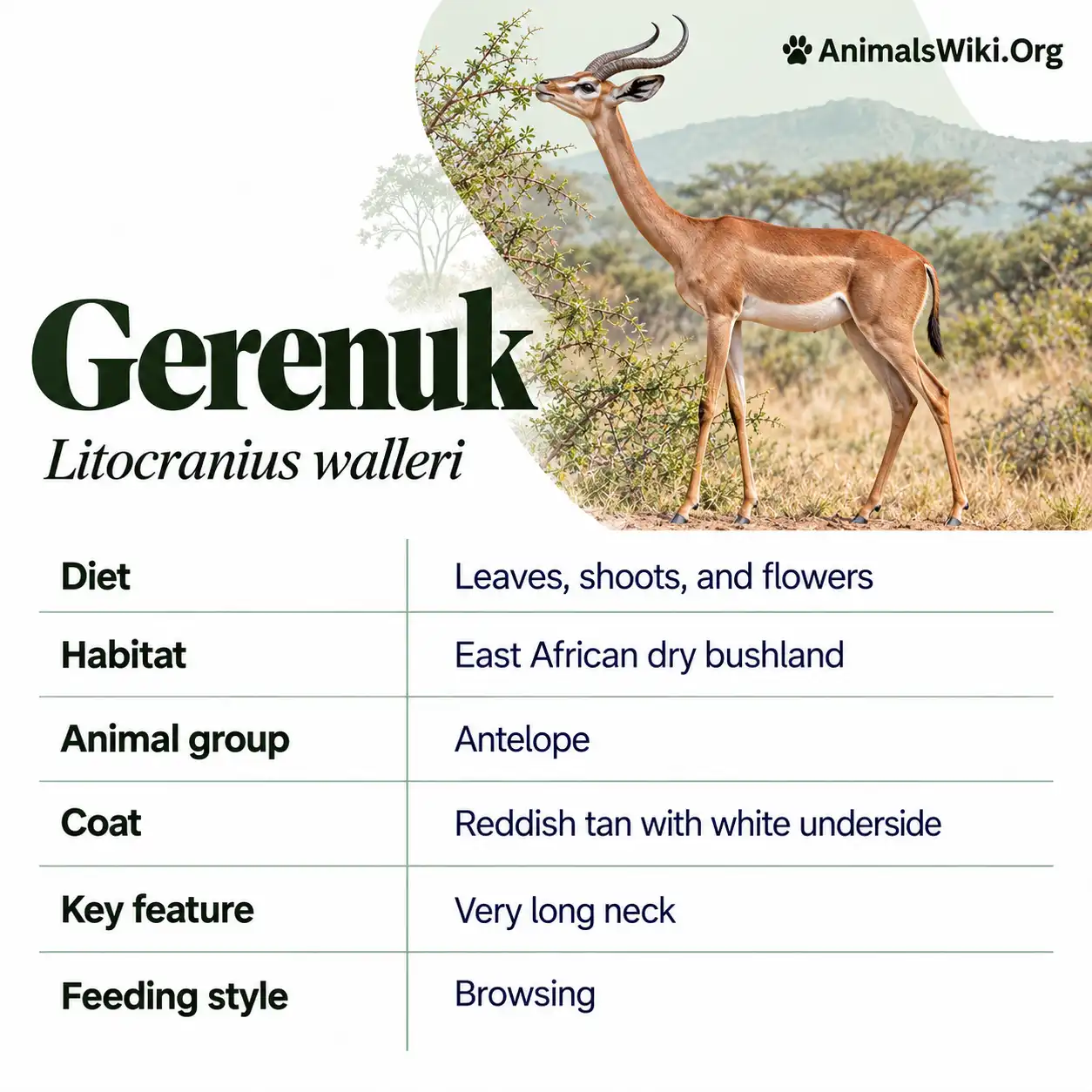
Gerenuk, The Long-Necked Antelope That Stands Tall to Survive
The gerenuk is an African antelope with an extraordinary way of reaching its food. Instead of keeping all four feet on the ground, it rises onto its hind legs, stretches its slender neck, and carefully selects leaves from shrubs and small trees. Watching one feed can feel like seeing an animal briefly transform into something entirely different.
Its unusual proportions make the gerenuk easy to recognize. A small head, large eyes, oversized ears, long legs, and an exceptionally narrow neck give it an elegant silhouette. These features are more than decoration: together, they support a specialized browsing lifestyle in dry African landscapes.
Often called the giraffe gazelle, the gerenuk occupies a feeding niche that many similarly sized antelopes cannot use as effectively. It also obtains much of its moisture from vegetation, reducing its dependence on regular visits to open water.
Yet specialization brings challenges. Suitable shrubs, safe cover, and connected habitat must remain available for these animals to thrive. The gerenuk is currently classified as Near Threatened, making its future an important conservation concern.
This guide explores the gerenuk’s appearance, behavior, habitat, reproduction, and place in the wider ecosystem.
Gerenuk Facts
| Feature | Information |
|---|---|
| Common name | Gerenuk |
| Other names | Giraffe gazelle; Waller’s gazelle |
| Scientific name | Litocranius walleri |
| Animal type | Mammal |
| Family | Bovidae |
| Native region | Eastern Africa and the Horn of Africa |
| Main habitat | Dry thornbush, shrubland, and lightly wooded semiarid country |
| Diet | Leaves, shoots, buds, flowers, and some fruits |
| Feeding strategy | Selective browsing, often while standing upright |
| Adult weight | Commonly around 30–50 kilograms, varying by sex and individual |
| Shoulder height | Roughly 80–105 centimeters across commonly reported measurements |
| Horns | Normally present only in males |
| Pregnancy | Approximately six to seven months |
| Typical birth | One calf |
| Social organization | Small female groups, young animals, and territorial adult males |
| IUCN status | Near Threatened |
| Distinctive adaptation | Long neck combined with sustained upright feeding |
What Is a Gerenuk?
A gerenuk is a medium-sized, plant-eating antelope native to northeastern and eastern Africa. It belongs to Bovidae, the family that also includes cattle, sheep, goats, and many other antelopes.
Its scientific name is Litocranius walleri. The gerenuk is recognized as the living representative of the genus Litocranius in the classification followed here.
The animal is particularly associated with browsing: feeding on woody plants and their leaves rather than relying on grass. Its body shape allows it to reach above the feeding level available to many other antelopes of similar mass.
Understanding the gerenuk begins with that relationship between anatomy and food. Its long neck is useful, but so are its balance, slender muzzle, and ability to select small pieces of vegetation.
Together, these traits create a distinctive way of making a living in dry bush country.
What Does the Name Gerenuk Mean?
The name gerenuk comes from Somali and is commonly translated as “giraffe-necked.” That description neatly captures the animal’s most obvious feature.
Another familiar name, giraffe gazelle, makes the same comparison. “Waller’s gazelle” is also used in wildlife literature and zoological collections.
These names can help readers identify the animal, but they should not be interpreted as evidence that it is a miniature giraffe or a giraffe–gazelle hybrid. It is a distinct antelope with its own evolutionary history.
Common names often describe appearance rather than precise relationships. The gerenuk is a good example: its neck recalls a giraffe, while its body and face retain recognizable antelope characteristics.
For searches, educational materials, and animal records, including the scientific name helps avoid confusion between similar-looking species.
Gerenuk Classification and Regional Forms
Gerenuks are mammals, even-toed hoofed animals, and members of the bovid family. Within that family, they belong among the antelopes related to gazelles.
Two regional forms are commonly discussed:
- Southern gerenuk — Litocranius walleri walleri
- Northern gerenuk — Litocranius walleri sclateri
Not every taxonomic source treats these forms identically. Some classifications have proposed recognizing them separately, while the Mammal Diversity Database includes sclateri within Litocranius walleri.
For a general wildlife article, treating the gerenuk as one species while acknowledging regional variation provides a clear approach.
Taxonomic differences also remind us that scientific names are working descriptions based on evidence. They can change as researchers compare anatomy, geographic patterns, and genetics.
Regardless of naming decisions, conserving populations across the range matters. Protecting one locality does not preserve every regional population or its ecological setting.
How to Recognize a Gerenuk
The easiest identification feature is the combination of a very long neck and a relatively small head. Its eyes appear large, and its broad ears stand out prominently on either side.
The coat is generally brown or reddish brown above, with paler sides and a whitish underside. Pale markings around the eyes and muzzle help define the face.
The legs are long and slender, reinforcing the animal’s stretched appearance. A short tail ends in darker hair.
Males have ridged, curved horns, while females normally lack them. Adult males also tend to have a more substantial neck than females.
When identifying a distant animal, look at the complete outline rather than one detail. Long neck, narrow face, large ears, and slim body together are more reliable than coat color alone, especially under changing light.
Gerenuk Size: Shoulder Height Versus Feeding Reach
Gerenuks are much smaller than giraffes, despite the comparison in their common name. Adults generally weigh a few dozen kilograms, with males usually heavier than females.
Published measurements vary, partly because sources describe different sexes, individuals, or body dimensions. Another source of confusion is the difference between shoulder height and upright feeding reach.
A gerenuk standing normally on four feet is far shorter than the height its mouth can reach when it rises onto its hind legs.
This distinction matters when reading impressive claims about the animal being more than two meters tall. Such figures generally refer to feeding posture or reach, rather than ordinary shoulder height.
A useful mental picture is a slender antelope whose body remains modest in size but whose working feeding height expands dramatically when it stands upright.
Why Does the Gerenuk Have Such a Long Neck?
The long neck extends the gerenuk’s access to leaves. It allows the animal to browse above the level available to shorter-necked herbivores while its feet remain on the ground.
When combined with upright posture, the effect becomes even more pronounced. The animal can investigate branches that would otherwise require a much larger body to reach.
However, the neck does not work alone. A long neck attached to an animal unable to balance or select leaves would provide different benefits.
The gerenuk’s feeding system depends on coordinated anatomy and behavior. Its body positions the head, while its mouth selects the food.
This illustrates an important principle in animal adaptations: several modest changes can combine into an impressive capability. The feeding performance emerges from the whole animal, rather than from one exaggerated feature.
How Does a Gerenuk Stand on Two Legs?
A feeding gerenuk shifts its weight onto its hind limbs and raises the front of its body. It then extends upward, sometimes using its forelegs against vegetation while reaching for leaves.
Its hind limbs and spinal flexibility support this posture. Anatomical work has examined features of the lower back associated with the ability to achieve the required alignment.
The result is sustained upright feeding rather than a brief accidental rear.
There is still an important distinction between standing bipedally and moving habitually on two legs. Gerenuks normally travel on four limbs. Their upright position is primarily associated with feeding.
Calling them “walking antelopes” can therefore create the wrong impression. Their remarkable ability concerns how they position themselves at a food source, not a human-like style of everyday locomotion.
Why Upright Feeding Is Useful
The advantage of standing upright is access. Leaves that remain out of reach for another similarly sized browser may become available to a gerenuk.
This can reduce direct overlap in feeding height without eliminating competition altogether. Different animals may still eat some of the same plants or visit the same shrubs.
The benefit also depends on the vegetation. A landscape needs branches and foliage within the animal’s usable reach. Extra height provides little help if all suitable food has disappeared.
This is why photographs of the posture tell only part of the story. The surrounding plant community is just as important as the animal’s balance.
The San Diego Zoo describes gerenuks and dibatags as examples of long-necked antelopes that use upright feeding to reach leaves unavailable to many other animals.
A Mouth Designed for Selective Browsing
The gerenuk’s narrow muzzle allows it to investigate vegetation precisely. Flexible lips and a mobile tongue help it select leaves among twigs and thorns.
This precision is useful in thornbush habitats, where nutritious plant material may be surrounded by physical defenses.
The animal is not simply swallowing branches indiscriminately. Feeding involves choosing plant parts, positioning the head, and removing manageable bites.
Its mouth therefore complements the height provided by its legs and neck. Reaching a branch is only useful if the animal can take suitable food from it.
Mpala’s field guide also describes gerenuks using their forelegs to pull branches within reach.
Taken together, these behaviors show how feeding can be an active manipulation of the environment. The animal adjusts both its own position and, at times, the position of the plant.
Where Do Gerenuks Live?
Gerenuks occur in parts of eastern Africa and the Horn of Africa. Their principal range includes areas of Ethiopia, Somalia, Kenya, and northeastern Tanzania, with Djibouti also included in broad species distribution records.
These country names describe an overall range, not continuous occupation of every landscape within them.
A suitable patch may support animals while nearby farmland, dense forest, settlement, or unsuitable vegetation does not.
Local distribution also changes through time. An old record demonstrates that an animal occurred somewhere, but it does not establish that a healthy population remains there today.
For readers using range maps, this distinction is essential. A shaded country or broad polygon should be interpreted as a guide to regional occurrence.
Reliable local information is needed to understand present distribution, population condition, and the connections between occupied areas.
What Is the Gerenuk’s Natural Habitat?
Gerenuks are strongly associated with dry thornbush and semiarid shrubland. Lightly wooded country with suitable browse can also provide habitat.
They are not best understood as animals of endless, treeless grassland. Their feeding strategy depends on access to woody vegetation.
Equally, very dense woodland may not provide the same conditions as relatively open bush country. The arrangement of shrubs, feeding opportunities, and visibility matters.
A useful gerenuk landscape therefore contains more than a certain amount of green cover. It must provide vegetation of the right kind and structure.
This helps explain why habitat descriptions that simply say “savanna” can be too broad. Savannas vary enormously, from grass-dominated plains to landscapes with substantial shrubs and trees.
For gerenuks, the browsing layer is a central feature of habitat quality.
What Do Gerenuks Eat?
The gerenuk diet consists mainly of leaves and shoots from shrubs and trees. Buds, flowers, and some fruits also contribute.
It is a selective browser rather than a typical grass grazer. Tender plant parts are especially important, although the available menu changes with habitat and season.
Early field research in Tsavo National Park investigated food habits by observing free-ranging animals in different vegetation types. That approach helped connect feeding choices with the plants available in the surrounding habitat.
Such observations matter because a list of plants alone does not show how the animal uses a landscape.
Researchers also need to know which parts are eaten, when they are selected, and whether those foods remain available through difficult periods.
The gerenuk’s food supply is therefore a changing resource rather than a fixed menu.
How the Gerenuk Diet Changes With the Seasons
Seasonal rainfall changes the availability and condition of browse. Plants may produce new leaves during wetter periods and lose them as conditions dry.
Gerenuks respond by changing the mixture of plants they use. Research summaries describe seasonal differences between feeding on deciduous vegetation and relying more heavily on evergreen plants during dry periods.
This flexibility operates within a specialized browsing lifestyle. The animal can adjust among woody plants without becoming a grass-dependent grazer.
For conservation, that means a diverse plant community can provide value beyond the amount of vegetation visible at one moment.
A shrub that appears less important during a productive wet season may become useful when other plants lose their leaves.
Maintaining seasonal food options helps explain why conserving a functioning habitat requires more than preserving a single favored food plant.
Do Gerenuks Need to Drink Water?
Gerenuks can obtain virtually all their normal water requirements from the vegetation they eat under suitable conditions.
This reduces their dependence on regular visits to drinking places. It is an important advantage in environments where open water can be scarce or widely separated.
However, the phrase “gerenuks do not need water” is misleading. They still require water for the same basic biological processes as other mammals. Their food supplies much of it.
This distinction also prevents another misunderstanding: water independence does not mean independence from rainfall.
Rain affects leaf production, plant moisture, and the condition of feeding habitat. A prolonged drought can therefore create problems even for an animal that seldom drinks.
The gerenuk’s adaptation changes the route by which water enters its body; it does not remove the need for hydration.
How Gerenuks Digest Their Food
Gerenuks are ruminants. They use a specialized digestive system in which microbes help process plant material.
Rumination includes bringing partially processed food back to the mouth and chewing it again. This supports the breakdown of material that would otherwise be difficult to digest efficiently.
However, the digestive systems of browsing mammals should not be assumed to function identically simply because their diets look similar.
Research comparing food passage in nondomestic ruminants included a gerenuk and highlighted complexities in broad categories used to describe digestion.
Because that study included only one gerenuk, it should not be treated as a complete description of every individual.
Its broader lesson is useful: feeding labels such as “browser” describe what an animal eats, while detailed digestive research examines how that food moves through and is processed by the body.
Daily Activity: Feeding, Resting, and Watching
Gerenuks spend much of their active time moving between browsing opportunities and selecting food. Resting and vigilance are also necessary parts of the day.
They are commonly described as mainly active during daylight, although behavior can vary with local conditions.
Observing activity is more complicated than noting whether an animal is standing. A motionless gerenuk may be alert, resting, digesting, or preparing to move.
Studies of daytime activity in Tsavo compared gerenuks and giraffes, helping place their routines within a wider browsing community.
For wildlife watchers, patient observation often reveals this changing rhythm. An animal may feed for a while, pause with its head raised, walk a short distance, and resume feeding from another plant.
The pattern shows how nutrition and safety remain linked throughout ordinary daily behavior.
Do Gerenuks Live in Herds?
Gerenuks usually occur in small groups rather than the immense herds associated with some African grazers.
Groups can contain females and their young. Young males may associate with one another, while adult males often occupy territories.
Field research in Tsavo described female groups with changing membership, territorial adult males, and small groups of subadult males.
This organization should not be confused with a permanent household in which the same animals always remain together.
Group composition can change as individuals mature, reproduce, or move through the landscape.
Small-group living also affects how people encounter the species. A suitable area may contain gerenuks without presenting a dramatic gathering.
Their quiet behavior and bushy surroundings help explain why observers can overlook them while noticing larger or more conspicuous animals nearby.
Male Territories and Scent Communication
Adult male gerenuks use scent as part of their social behavior. Glands near the eyes produce secretions that can be placed on vegetation.
Other scent glands occur around the knees and feet. These provide additional ways for chemical information to enter the environment.
A scent mark can remain after the animal has moved away. It therefore allows communication without a face-to-face encounter.
Territory use also shapes contact between males and females. Female groups may move through areas occupied by territorial males.
The importance of scent is easy to miss because human observers tend to focus on visible displays and sounds. For the animals, however, information deposited on a twig can be meaningful.
Protecting natural behavior means allowing space for these less conspicuous interactions as well as feeding and reproduction.
How Gerenuks Reproduce
Gerenuks can breed through the year rather than depending on one brief, universal breeding season.
Males may mate with multiple females. Their behavior includes investigating reproductive cues and maintaining close contact with receptive females.
As in other wildlife, the presence of mating does not guarantee that a calf will survive to adulthood. Pregnancy, birth, milk production, food availability, and protection from danger all influence the outcome.
The timing of reproduction can also vary among individuals and places.
For readers comparing gerenuks with strongly seasonal antelopes, this is a useful distinction. There is no need to assume that every population follows the same narrow annual timetable.
At the same time, year-round breeding potential should not be mistaken for unlimited reproduction. Females still face the energetic demands of raising young.
Pregnancy and Birth
Gerenuk pregnancy is generally reported as approximately six to seven months. A female normally gives birth to one calf.
Birth occurs in a place offering concealment, where the newborn can remain relatively hidden during its earliest stage.
The single-calf pattern differs from species in which twins are common. Each pregnancy therefore represents a substantial investment in one young animal.
For conservation, birth numbers are only the beginning of the story. A population needs enough calves to survive, grow, and eventually reproduce.
The condition of the mother matters throughout that process. Suitable food during pregnancy and nursing supports both her survival and the development of her calf.
Zoological accounts describe this extended period of maternal care, emphasizing the importance of concealment and repeated nursing visits.
Why Gerenuk Calves Hide
Young gerenuks use concealment during their first weeks. Their mothers leave them in cover while moving away to feed, returning to provide milk and care.
Remaining still can help prevent a calf from attracting attention. Its hiding place is therefore an important part of its immediate protection.
This behavior also explains why an apparently solitary calf should not automatically be assumed abandoned. The mother may be elsewhere nearby.
As the calf develops, its movement, feeding, and interaction with other animals change gradually.
The transition from hidden newborn to independent browser involves more than gaining height. It includes learning to select food, navigate vegetation, and respond to danger.
For observers, avoiding unnecessary approach is especially important at this stage. A closer photograph is not worth disrupting the conditions that help a young animal remain concealed.
Growing Up and Becoming Independent
Gerenuk calves begin investigating plant food while still dependent on milk. Nursing continues for months as their digestive and feeding abilities develop.
Weaning and sexual maturity are gradual life-history transitions, and their timing can differ between males and females.
A young male becoming physically capable of reproduction does not necessarily mean it can immediately hold a territory or breed successfully.
Similarly, a young female needs sufficient condition to carry a pregnancy and raise a calf.
These distinctions matter because maturity is sometimes presented as one exact birthday. In reality, physiological development, social position, and breeding success are related but separate processes.
A healthy population needs survival through all of these stages. Looking only at the number of newborns overlooks the challenges between birth and successful adulthood.
How Long Do Gerenuks Live?
Gerenuk lifespan figures vary among sources. Some references describe around a decade or somewhat longer, while field estimates may be lower.
The difference is understandable. A maximum recorded age, an estimated typical lifespan, and the average age at death are not the same measurement.
Wild animals face predation, injury, food shortages, and other pressures. Individuals under professional care experience a different combination of conditions.
For that reason, a lifespan figure should be treated as context rather than a guarantee.
Age also influences what an animal contributes to the population. A breeding adult, a newly independent juvenile, and an older animal have different survival prospects and reproductive roles.
Understanding longevity is therefore most useful when combined with information about age structure and survival, rather than presented as an isolated impressive number.
What Animals Prey on Gerenuks?
Gerenuks share their range with several predators. Large cats and African wild dogs can threaten adults, while smaller carnivores may pose risks to calves.
Predator pressure varies with location, cover, and the animals present.
The gerenuk’s response involves more than running quickly. Detecting danger, remaining concealed, and moving through bush are all relevant.
This makes comparisons based only on maximum speed less useful than they first appear. A chase in dense vegetation differs from one across a bare plain.
Natural predation is also part of the ecological system, rather than automatically a sign that conservation is failing.
Managers need to examine the broader pattern of births, survival, habitat, and human-caused mortality before deciding what is limiting a local population.
Gerenuks, Giraffes, and Other Browsers
Gerenuks live alongside other herbivores, but sharing a landscape does not mean using every resource in exactly the same way.
A giraffe generally reaches much higher vegetation. Smaller browsers use lower feeding opportunities. The gerenuk’s upright posture extends the range it can investigate between those extremes.
There can still be overlap in food plants and feeding heights. Resource partitioning reduces some direct competition without creating perfectly separate menus.
The relationship also changes with season. When food becomes scarce, animals may concentrate on the remaining suitable plants.
For a reader trying to understand an African bushland community, feeding height offers a useful starting point. Body size, mouth shape, plant preference, and seasonal behavior then add further detail.
The landscape supports multiple strategies, with the gerenuk contributing one especially distinctive approach.
Gerenuk Versus Giraffe: Key Differences
| Feature | Gerenuk | Giraffe |
|---|---|---|
| Family | Bovidae | Giraffidae |
| General size | Medium-sized antelope | Very large browsing mammal |
| Normal posture | Walks on four legs; often rises to feed | Usually feeds while standing on four legs |
| Feeding adaptation | Long neck plus upright stance | Exceptional overall height and long neck |
| Male head structures | Ridged bovid horns | Skin-covered ossicones |
| Typical social impression | Small groups or territorial males | Variable social groupings |
| Shared feature | Selective feeding on woody vegetation | Selective feeding on woody vegetation |
The resemblance in neck length is visually striking, but the two animals represent different evolutionary solutions to browsing.
Is the Gerenuk Endangered?
The gerenuk’s global IUCN category is Near Threatened.
That category is different from Endangered, but it does not mean the species is secure or free from conservation concerns.
Habitat loss, fragmentation, and hunting are important pressures. Population conditions also vary across the range.
A local population may be doing relatively well while another becomes isolated or declines. A global category summarizes the species at a broad scale; it cannot describe every site in equal detail.
The practical value of a Near Threatened classification is that it encourages attention before the situation becomes more severe.
For gerenuks, maintaining habitat and improving knowledge of local populations can help prevent quieter declines from progressing unnoticed.
How Many Gerenuks Are Left?
An estimate of approximately 95,000 gerenuks appears frequently in conservation summaries. However, it should not be presented as a fresh worldwide count conducted in 2026.
Gerenuks are difficult to survey. They occur in small groups, use vegetation that can conceal them, and occupy landscapes where field coverage may be incomplete.
Aerial and ground surveys can therefore produce different results, depending on what observers can detect.
A responsible population statement includes a date, geographic coverage, and an explanation of the method.
Without those details, a precise-looking number can create more confidence than the evidence warrants.
For general readers, the better-supported conclusion is that the species has conservation concerns and needs improved monitoring across its range. A rounded historical estimate cannot substitute for that continuing work.
Habitat Loss and Fragmentation
Habitat loss removes feeding areas and cover. Fragmentation divides remaining habitat into smaller or less connected pieces.
For a selective browser, losing shrubs and small trees can mean losing both food and concealment.
A landscape may still look “natural” from a distance while no longer providing the vegetation structure that gerenuks use.
Fragmentation also changes the relationship between surviving patches. Animals may need to cross roads, disturbed ground, or heavily used areas to move between them.
This is why conserving isolated pockets can be insufficient.
The central question is not simply how many hectares remain. It is whether those hectares contain suitable browse, allow natural movement, and support the different stages of the animal’s life.
Land-use planning can help retain these functions before connections become difficult to restore.
Hunting and Illegal Wild Meat Trade
Hunting pressure is another concern in parts of the gerenuk’s range.
Its effects depend on intensity, local abundance, protection, and the ability of the population to replace lost animals.
Small, poorly monitored populations can be especially difficult to assess. If removals are not recorded and population estimates are weak, managers may not recognize a decline promptly.
Research and conservation work around Tanzania’s Lake Natron ecosystem has highlighted the need to understand population size, habitat change, and hunting-related pressures together.
This demonstrates why practical conservation requires local information.
A general species profile can identify the threat, but decisions about a particular area need evidence from that landscape, including knowledge from people who live and work there.
Why Drought Still Matters
The gerenuk’s ability to obtain moisture from plants is impressive, but it does not make the animal immune to drought.
A prolonged dry period can change the amount and quality of available browse. It may also affect the distribution of people, livestock, and wildlife.
Those changes can increase pressure on the remaining productive areas.
The important connection is between water in the environment and water in food. If vegetation becomes less available or less suitable, relying on plant moisture offers fewer benefits.
Conservation responses should therefore protect functioning habitat rather than treating drinking-water provision as the complete answer.
Understanding local plant responses, seasonal refuges, and access to different feeding areas helps reveal where animals may be most vulnerable during difficult conditions.
Why Local Population Studies Matter
A species-wide conservation category cannot replace research at individual sites.
A study in Ethiopia’s Geralle National Park examined the population size and structure of gerenuks alongside beisa oryx. Its findings demonstrated the importance of this landscape for these antelopes.
Studies of this kind add detail that a broad range map cannot supply. They help identify where animals remain, how the population is structured, and what habitats they use.
However, one favorable local result should not be extended automatically across the species’ entire distribution.
Repeated surveys are needed to establish trends. Comparisons are strongest when researchers use compatible methods and account for seasonal differences.
Local studies therefore contribute pieces of a larger picture. Their value increases when findings can inform protection and future monitoring.
Protecting Connected Landscapes
Connected habitat allows animals to use more than one patch of suitable vegetation.
For gerenuks, understanding these connections requires information about where animals occur and which parts of the landscape are becoming difficult to cross.
A 2026 project in northern Tanzania focuses specifically on mapping movement bottlenecks and developing community-led monitoring.
That approach addresses a practical conservation question: which connections need attention before local populations become more isolated?
Connectivity work should be tested through observation rather than assumed successful because a corridor appears on a map.
Researchers and communities need to know whether animals actually use an area and whether disturbance prevents movement.
This focus on usable space helps turn a broad conservation goal into specific decisions about land management.
Community Scouts and Wildlife Monitoring
Community-based monitoring can provide information from places that visiting researchers cannot observe continuously.
Scouts may record sightings, document threats, and communicate with residents and livestock keepers.
Marwell Wildlife’s work in northern Kenya illustrates how a monitoring program focused on one species can also gather useful information about gerenuks and other animals.
However, more sightings do not automatically prove population growth. Changes in patrol effort, access, visibility, and animal distribution can affect the number recorded.
That is why consistent methods and careful interpretation matter.
The wider value is the connection between observation and local participation. People who spend substantial time in the landscape can help detect changes, while monitoring results can inform discussions about conservation needs and practical concerns.
Gerenuks in Zoos and Conservation Centers
Gerenuks are maintained in some professional zoological and conservation collections.
Their care requires more than providing ordinary grazing space. Their shy behavior, specialized feeding, social needs, and health must all be considered.
White Oak Conservation has studied gerenuk nutrition, behavior, genetics, endocrinology, and assisted reproduction.
This research helps explain aspects of biology that can be difficult to examine in free-ranging animals.
Nevertheless, maintaining animals under professional care is only one component of conservation. It does not replace the protection of wild populations and their habitat.
A well-managed collection can contribute knowledge, education, and genetic management. Its strongest conservation role comes when those contributions connect with the needs of the species in its native range.
What Reproductive Research Can Contribute
Assisted reproduction research has investigated ways to support the genetic management of gerenuks under professional care.
A published study examined reproductive physiology and artificial insemination, emphasizing that successful techniques require knowledge of the species’ reproductive biology.
The purpose is broader than producing an individual calf. Genetic management considers relationships among animals and the representation of founders across generations.
Such work also has limits. A reproductive technique does not solve habitat loss, hunting, or the isolation of wild populations by itself.
Its contribution is best understood as one tool within a larger conservation effort.
Studying a species carefully before applying a technique also reduces the temptation to assume that methods developed for domestic animals will transfer directly to a specialized wild antelope.
How to Watch and Photograph Gerenuks Responsibly
A feeding gerenuk offers an excellent opportunity to observe natural behavior, especially when it rises slowly onto its hind legs.
The best approach is to allow that behavior to happen without pressure.
Keep a comfortable distance, use binoculars or a longer lens, and follow the guidance of reserve staff or experienced guides.
Avoid surrounding an animal with vehicles or blocking its route through the vegetation. If it repeatedly stops feeding and watches the observers, giving it more space can improve the encounter.
Calves deserve particular caution because remaining hidden is part of their normal early behavior.
For photography, include some surrounding habitat when possible. A picture showing the animal’s relationship with a shrub can explain its feeding adaptation more clearly than a tightly cropped portrait alone.
Common Gerenuk Myths and Facts
| Myth | Fact |
|---|---|
| A gerenuk is a small giraffe. | It is an antelope belonging to Bovidae. |
| It walks everywhere on two legs. | It normally travels on four legs and rises mainly to feed. |
| Gerenuks do not need water. | They need water but obtain much of it from food. |
| Both sexes have horns. | Horns normally occur in males. |
| It is mainly a grass eater. | It is a selective browser of woody vegetation. |
| All dry African habitats are suitable. | Suitable browse and vegetation structure are important. |
| A hidden calf must be abandoned. | Mothers normally leave young calves concealed while feeding. |
| Near Threatened means no protection is needed. | Significant threats and monitoring needs remain. |
Frequently Asked Questions About Gerenuks
What is a gerenuk best known for?
The gerenuk is best known for its exceptionally long neck and its ability to stand upright on its hind legs while feeding. This posture allows it to reach leaves above the normal feeding height of many similarly sized antelopes.
Is a gerenuk a gazelle?
The gerenuk is closely associated with gazelles within the bovid family and is commonly called the giraffe gazelle. Its scientific genus is Litocranius, which distinguishes it from antelopes classified in genera such as Gazella.
How do you pronounce gerenuk?
A common English pronunciation is gair-uh-nook. Pronunciation can vary slightly by accent. The name is derived from Somali and refers to the animal’s giraffe-like neck.
Where are gerenuks found?
Gerenuks occur in parts of eastern Africa and the Horn of Africa, particularly Ethiopia, Somalia, Kenya, and northeastern Tanzania. Broad distribution records also include Djibouti. Their occurrence is patchy within the overall range.
Why do gerenuks stand on their back legs?
Standing upright increases feeding reach. Combined with a long neck, this allows a gerenuk to take leaves from shrubs and branches that would otherwise be beyond the reach of an antelope of its size.
Can gerenuks walk on two legs?
Their normal method of travel uses all four legs. Upright posture is mainly a feeding behavior. It should not be confused with the habitual two-legged walking seen in humans or other animals specialized for bipedal travel.
What does a gerenuk eat?
Gerenuks browse on leaves, shoots, buds, flowers, and some fruits. They select food from shrubs and trees, with choices changing according to season and local vegetation.
Do gerenuks eat grass?
Grass is not their normal dietary foundation. They are specialized browsers, so describing them as ordinary grazers gives a misleading impression of their food requirements and the habitat they depend on.
Can a gerenuk survive without drinking?
Under suitable conditions, gerenuks can meet virtually all their normal water needs through the vegetation they consume. This reduces dependence on open water, but they still need hydration and can be affected by drought.
How tall is a gerenuk?
Normal shoulder height is roughly around a meter, with variation among sexes and references. Its upright feeding reach is much greater. Figures describing extended reach should not be mistaken for its height while standing on four feet.
Do female gerenuks have horns?
Female gerenuks normally do not have horns. Males carry curved, ridged horns that are useful for identification and play a role in interactions with other males.
Are gerenuks related to giraffes?
Both are hoofed mammals, but they belong to different families. Gerenuks are bovids, while giraffes belong to Giraffidae. Their similar-looking necks do not make the gerenuk a kind of giraffe.
How many calves does a gerenuk have?
A female normally gives birth to one calf after a pregnancy of approximately six to seven months. The calf initially remains concealed while its mother feeds and returns to nurse it.
Do gerenuks breed only once a year?
Gerenuks can breed throughout the year. Individual breeding intervals depend on reproduction, maternal condition, and the demands of raising a calf. Year-round potential does not mean that every female gives birth at the same frequency.
Why does a baby gerenuk stay alone?
Young calves normally remain hidden while their mothers browse elsewhere. This reduces conspicuous movement around the calf. An apparently solitary newborn should therefore not automatically be considered abandoned.
Are gerenuks social animals?
Yes, but their groups are usually small. Females may occur with young and other females, while young males can associate together. Adult males often occupy territories.
Are gerenuks aggressive?
They generally avoid people and danger when given space. Males may compete with one another, including interactions involving their horns. As with other wildlife, they should be observed without approaching or attempting to handle them.
What is the gerenuk’s conservation status?
The gerenuk is classified as Near Threatened. Habitat loss, fragmentation, and hunting contribute to conservation concern. Local population conditions vary, so some areas may require more urgent attention than others.
Why are gerenuks difficult to count?
They often occur in small groups and use vegetation that conceals them. Visibility, survey method, and observer coverage affect detection. Reliable estimates therefore require careful study rather than simply counting animals seen during a visit.
Are gerenuks suitable pets?
No. Gerenuks are wild antelopes with specialized dietary, social, environmental, and veterinary needs. Their management in professional institutions should not be confused with keeping a domestic companion animal.
What is the difference between a gerenuk and a dibatag?
Both are slender African antelopes associated with dry habitats and elevated browsing. They are distinct animals with different classifications and identifying features. Similar feeding behavior alone is insufficient to identify either species.
How can people help protect gerenuks?
Support credible conservation work, respect habitat and reserve rules, and share accurate information. Efforts that improve local monitoring, maintain connected habitat, and involve surrounding communities can address the conditions that influence wild populations.
Gerenuk (Litocranius walleri)
The gerenuk shows how a distinctive body plan can open up feeding opportunities in a demanding environment. Its long neck attracts attention, but its full survival strategy includes balance, precise browsing, plant-based hydration, concealment, and flexible social behavior.
Its conservation needs are just as connected. Protecting the animal means retaining suitable shrubs, safe cover, and usable links between habitat patches. It also means understanding local populations rather than relying on an old worldwide estimate.
For wildlife enthusiasts, the gerenuk offers more than an unusual photograph. Watching one select leaves reveals a close relationship between anatomy, behavior, and landscape.
Maintaining that relationship is the real goal of conservation: allowing this remarkable antelope to keep feeding, reproducing, and standing tall in its native African habitat.



