
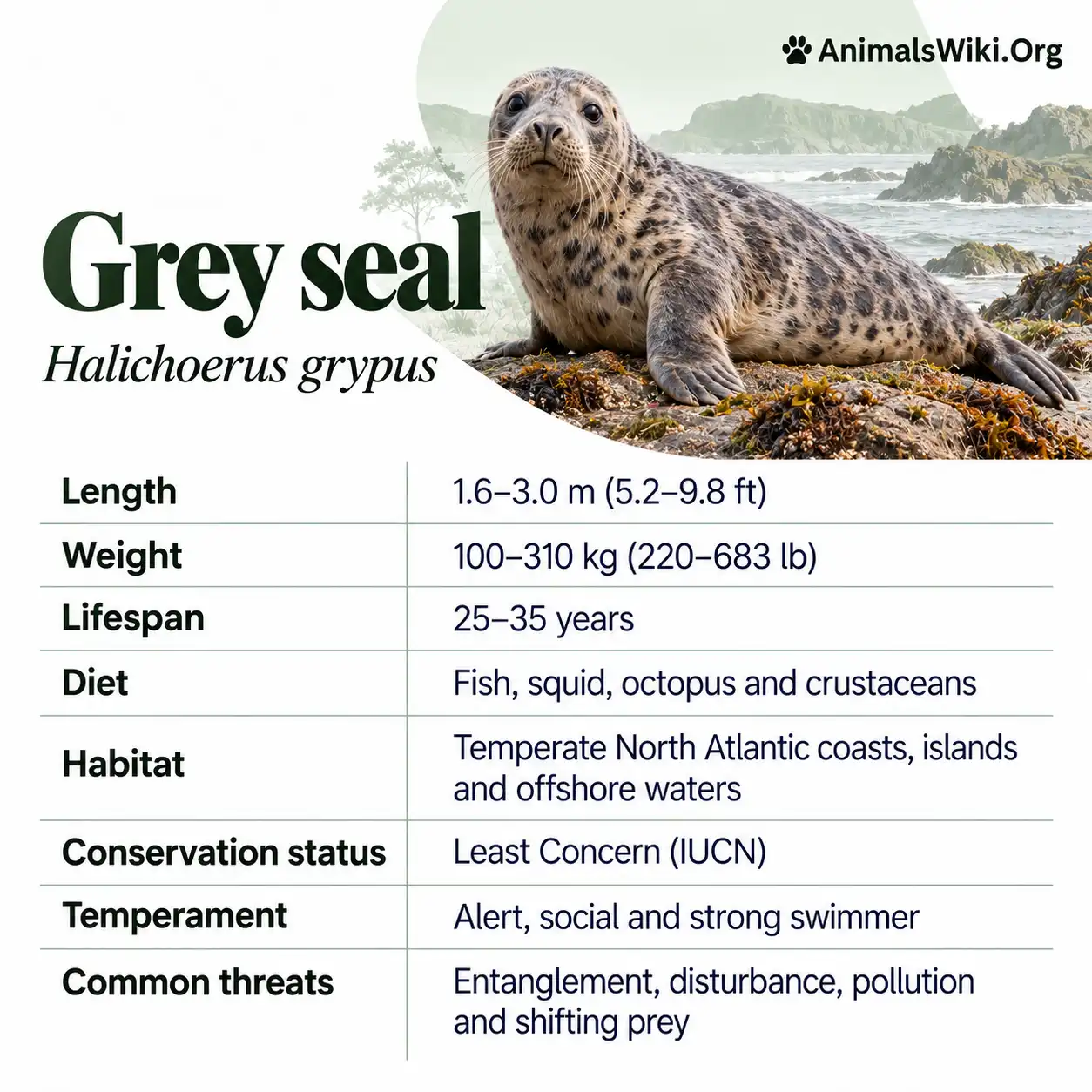
Grey Seal, The Powerful Swimmer of the North Atlantic
The grey seal is a large marine mammal recognized by its long muzzle, spotted coat, and powerful body. Found on both sides of the North Atlantic and in the Baltic Sea, it divides its life between underwater feeding trips and periods resting on beaches, rocks, islands, or ice.
Also spelled gray seal, this animal is sometimes called the horsehead seal because adult males develop an especially long, curved facial profile. Its scientific name, Halichoerus grypus, refers to that distinctive nose.
Yet appearance is only the beginning of its story. Grey seals make repeated journeys to feeding areas, raise pups during a short and demanding nursing period, and possess remarkable communication abilities. Researchers have documented underwater clapping and demonstrated that some grey seals can learn to modify their vocalizations.
Their conservation history is equally interesting. Protection has helped populations recover in several regions, but recovery does not remove every concern. Pollution, entanglement, disturbance, disease, and changing marine conditions continue to affect these animals.
Grey seals are currently classified as Least Concern globally. However, regional trends require careful attention, especially where new monitoring results differ from earlier patterns. Understanding the species means looking beyond a single population estimate or a crowded breeding beach.
This guide explores grey seal identification, habitat, diet, reproduction, pup development, behavior, and conservation.
Grey Seal Facts
| Feature | Information |
|---|---|
| Common name | Grey seal |
| Alternative spelling | Gray seal |
| Other name | Horsehead seal |
| Scientific name | Halichoerus grypus |
| Animal group | Mammal |
| Family | Phocidae |
| Seal type | True seal |
| Distribution | North Atlantic and Baltic Sea |
| Adult size | Commonly around 2–3 meters, depending on sex and population |
| Weight | Males can exceed 300 kilograms; females are generally smaller |
| Diet | Primarily fish, with other marine prey |
| Young | Usually one pup |
| Nursing period | Approximately three weeks |
| Newborn coat | Long, pale lanugo |
| Lifespan | Can reach several decades |
| Global conservation status | Least Concern |
1. What Is a Grey Seal?
A grey seal is an air-breathing marine mammal belonging to the species Halichoerus grypus. It is the only living species placed in the genus Halichoerus.
Its family, Phocidae, contains the true seals. Other members include harbor seals, harp seals, elephant seals, and monk seals.
Like other mammals, grey seals maintain their internal temperature, give birth to live young, and feed their offspring milk. Their aquatic adaptations allow them to hunt beneath the surface, but they must return to the air to breathe.
Their lives also remain connected to solid resting surfaces. Breeding, nursing, molting, and resting bring them onto shore or ice.
This combination makes them neither fully terrestrial nor permanently submerged animals. Their success depends on using both environments effectively.
A productive feeding area and a secure resting site therefore serve different but connected purposes. Understanding both helps explain why protecting grey seals involves the surrounding sea as well as the beaches where people see them.
2. Grey Seal or Gray Seal: Which Spelling Is Correct?
Both grey seal and gray seal are correct names for the same species.
“Grey” is widely used in British English and several other English varieties. “Gray” is the usual American spelling.
The scientific name, Halichoerus grypus, remains unchanged. It provides a consistent reference when comparing research from different countries.
A British article about grey seal pups and an American article about gray seal pups may therefore describe the same animal, although their regional populations and breeding schedules can differ.
The spelling itself does not identify a subspecies or separate biological group.
This distinction is useful when searching for information. Using both spellings can uncover research and educational material from different parts of the species’ range.
However, readers should pay more attention to the location, date, and purpose of a source than to its spelling. Those details determine whether its measurements, breeding dates, or population figures apply to the animals being discussed.
3. Why Are Grey Seals Called Horsehead Seals?
Adult male grey seals develop a long muzzle with a conspicuously curved profile. Viewed from the side, the face can resemble a horse’s head.
This feature gives the species its alternative name, horsehead seal.
Females generally have a more slender head and less exaggerated facial profile. Young animals also lack the fully developed appearance of a large adult male.
Consequently, not every grey seal looks equally horse-like. Age and sex influence how strongly the feature appears.
The scientific name is commonly translated as “hook-nosed sea pig,” another reference to the animal’s distinctive face.
These names are useful identification clues, but they are descriptions rather than strict rules. An observer should combine head shape with other features, including body size, nostrils, coat, and geographic location.
A female or juvenile grey seal can otherwise be overlooked when someone expects every individual to resemble a massive, dark adult bull.
4. Grey Seal vs. Harbor Seal
Grey seals and harbor seals share parts of the North Atlantic, making them easy to confuse.
The most helpful difference is usually the face. Grey seals have a longer muzzle and a more elongated head. Harbor seals generally have a shorter, rounded, doglike profile.
Grey seals also tend to be larger, particularly adult males.
| Feature | Grey seal | Harbor seal |
|---|---|---|
| Scientific name | Halichoerus grypus | Phoca vitulina |
| Head | Long and elongated | Rounded and compact |
| Muzzle | Longer, especially in males | Shorter |
| Nostrils | More nearly parallel | Usually form a V shape |
| General size | Usually larger | Usually smaller |
| Newborn appearance | Commonly pale and fluffy | Usually born after shedding natal lanugo |
Size alone can mislead because young grey seals overlap with adult harbor seals. Viewing distance also changes apparent proportions.
Several features should agree before an identification is considered reliable. The long head and muzzle are particularly useful when a clear side view is available.
5. How Big Do Grey Seals Grow?
Grey seals show sexual size differences, with adult males generally larger and heavier than females.
Large males can exceed 300 kilograms, while females usually remain considerably smaller. Length and weight also vary among geographic populations.
These differences matter when interpreting a species profile. A maximum male weight is not an appropriate estimate for a typical female or juvenile.
Body condition adds further variation. A seal carrying substantial reserves before breeding can weigh more than the same animal after a demanding period of fasting.
Length is more stable than weight, but it still changes with age and differs between individuals.
A useful broad description is that grey seals are large true seals, commonly around two meters or more as adults, with the largest males substantially exceeding that length.
Their size makes them impressive coastal predators, although they remain much smaller than the largest elephant seals.
6. Grey Seal Coat Colors and Markings
Despite their name, grey seals are not uniformly gray.
Their coats can include silver, brown, dark gray, and pale backgrounds with contrasting spots or patches. Males often appear darker, while females commonly have darker markings against a lighter background.
Individual variation is considerable, so coat color should not be used as the sole method of identifying the species.
The markings also have scientific value. Researchers can use suitable photographs of natural coat patterns to recognize particular animals.
This allows repeated observations to be connected without physically marking every seal.
Photo identification works best when comparable body areas are visible. Wetness, sand, light, and viewing angle can make the same pattern look different.
The coat therefore tells two stories at once: it contributes to the animal’s appearance and can provide a record of individual identity.
For long-lived animals returning to familiar coastal areas, that record can become valuable evidence about movement and survival.
7. How Long Do Grey Seals Live?
Grey seals can live for several decades.
NOAA gives a broad lifespan of approximately 25–35 years, while other accounts describe older individuals. Such figures refer to longevity rather than the age every newborn can expect to reach.
The distinction matters because survival varies strongly across life stages.
A pup must successfully complete nursing, the postweaning period, and its first independent feeding trips. Animals that survive those early challenges may have the opportunity to reach much older ages.
Researchers also distinguish between an average, a median, and a maximum recorded age. These measurements answer different questions and should not be used interchangeably.
A maximum demonstrates what is possible for an exceptional individual. It does not describe the typical outcome for an entire birth cohort.
For a general wildlife account, the clearest message is that grey seals are potentially long-lived animals whose populations contain individuals with very different survival histories.
8. Where Do Grey Seals Live?
Grey seals inhabit the North Atlantic, including waters along parts of northeastern North America, northern and western Europe, and the Baltic Sea.
Their range includes eastern Canada and the northeastern United States, as well as coastlines around the British Isles, Iceland, Norway, and neighboring European regions.
They are not native Antarctic seals and should not be confused with leopard seals, Weddell seals, or crabeater seals.
Their distribution is also uneven. Suitable feeding habitat, resting surfaces, breeding sites, and human disturbance influence where animals occur.
A broad range map does not mean every beach within that area supports a breeding colony.
Some places are important for resting or feeding, while others play a central role in reproduction.
The species’ geographic range therefore contains a variety of sites with different functions. Understanding those functions is more informative than treating every coastal sighting as evidence of a permanent local population.
9. The Three Major Population Regions
Grey seals are commonly discussed in three broad population regions:
- Western North Atlantic
- Eastern North Atlantic
- Baltic Sea
These divisions help researchers organize monitoring and describe regional differences.
They are not simply labels for whichever group happens to be resting together on one beach. They refer to much larger geographic units.
Within each region, breeding colonies and local groups can have their own histories and movement patterns.
This matters when reading abundance figures. A number for Canadian grey seals cannot be presented as the worldwide total, and a count from one European colony cannot describe the entire eastern Atlantic.
The same principle applies to threats. Pollution has been especially significant in the Baltic, while other regions have different combinations of habitat, fisheries, and disturbance concerns.
Regional detail turns a general species description into an accurate account of how the animals actually live across their range.
10. Grey Seal Habitat
Grey seals use rocky coasts, offshore islands, sandy beaches, reefs, and other suitable haul-out surfaces.
Some populations also breed on ice. This makes the species more varied in its breeding habitat than a simple image of seals on a beach might suggest.
In the United Kingdom, important breeding areas include exposed islands, beaches, dunes, and coastal cave systems.
Different habitats create different challenges. A sheltered beach may offer relatively easy access, while a rocky island can expose animals to difficult terrain and rough seas.
Suitable habitat must also connect with feeding opportunities. A secure resting place is valuable, but seals must still obtain enough food from the surrounding marine environment.
This relationship helps explain why conservation extends beyond a colony’s visible boundary.
The beach, nearby waters, travel routes, and feeding grounds form connected parts of the animal’s environment. Protecting only the place where pups are photographed would overlook much of its life.
11. Why Grey Seals Haul Out
Hauling out means leaving the water to rest on land, ice, or another suitable surface.
For grey seals, this supports resting, breeding, nursing, and molting. A seal on a beach is therefore not automatically stranded.
The number of animals ashore changes with season and local conditions. Breeding or molting can produce large concentrations, while the same site may be less crowded at another time.
A resting seal may look inactive, but rest is part of its normal energy budget.
Repeatedly making animals enter the water can interrupt that activity and change how they use a site.
The term also helps explain why a beach count is incomplete. Animals feeding or traveling offshore are not visible to observers counting only hauled-out seals.
Understanding hauling out therefore improves both wildlife observation and interpretation of population surveys: the visible group is a temporary sample of animals using the area.
12. Do Grey Seals Migrate?
Grey seals can travel long distances, but their movements are not best described as one uniform migration followed by every individual.
Tracking studies reveal a combination of extensive travel and repeated local feeding trips.
In one North Sea study, animals made journeys far from their starting areas while also returning repeatedly to particular haul-out sites and offshore feeding locations.
This combination is important. A seal can show strong attachment to a familiar place while still being capable of substantial travel.
Movement also connects colonies and national coastlines. An animal recorded at one location may later appear somewhere quite different.
Consequently, a decrease at a resting site does not automatically prove that all missing animals have died. Some may be using another area.
Researchers need repeated counts, tracking, and other evidence to separate changes in distribution from changes in total abundance.
13. How Grey Seals Swim
Grey seals use coordinated movements of the hind flippers and rear body to propel themselves through water. Their foreflippers help with steering and control.
Their flexible bodies allow turns and changes in orientation while pursuing prey.
This contrasts with their appearance on land, where movement depends on body undulation rather than an upright walking gait.
The difference is a consequence of specialization. A body effective for underwater travel does not need to move like a land-running mammal.
Their flippers also serve purposes beyond propulsion. Grey seals can use their clawed foreflippers when handling surfaces or prey.
Swimming behavior changes according to the task. Traveling, investigating an object, approaching a resting place, and hunting require different movements.
The animal’s apparent slowness while resting should therefore not be mistaken for poor physical ability.
Once submerged, a grey seal operates in the environment for which its streamlined shape and flexible movements are especially well suited.
14. Grey Seal Diving and Seabed Feeding
Grey seals frequently feed near the seabed, although their diving behavior varies with habitat.
Scientists describe seabed-associated dives as benthic and dives within the water column as pelagic.
Research on free-ranging grey seals has documented both types, with the balance influenced by the environment the animals used.
This flexibility matters because prey occupy different parts of the sea. Flatfish and other bottom-associated animals create different hunting opportunities from fish moving above the seabed.
A dive profile can help reveal what a seal is doing, but interpretation improves when depth, location, and habitat information are considered together.
A deep or long dive is not automatically a successful feeding event.
The more useful biological question is how effectively the animal matches its diving behavior to accessible prey.
That relationship connects physical capability with the local environment and helps explain why different seals can use different feeding strategies.
15. What Do Grey Seals Eat?
The grey seal diet consists mainly of fish, with other marine animals also consumed.
Reported prey include sandeels, cod-related fishes, flatfish, herring, and various other locally available species. Crustaceans and cephalopods can also form part of the diet.
The importance of each food varies geographically and seasonally.
Scottish research has found sandeels especially important in several North Sea sampling regions, while the balance of other prey differs among areas.
This is why there is no single worldwide menu that accurately describes every grey seal.
A species-wide list describes possible prey. A regional diet study describes what sampled animals actually consumed under particular conditions.
Both are useful, but they should not be confused.
Grey seals are adaptable predators, yet their success still depends on prey being sufficiently abundant, accessible, and worth the energy required to find and capture.
16. Why Individual Feeding Habits Differ
Grey seals do not all use the sea in exactly the same way.
Research has examined seasonal variation and individual consistency in feeding niches, using chemical information from tissues and whiskers.
Other tracking work has documented repeated use of particular feeding habitats over multiple years.
These findings help explain how a broadly flexible species can contain individuals with more consistent personal strategies.
An animal that repeatedly succeeds in one feeding area may continue using it, while another relies on a different habitat or prey opportunity.
This matters when evaluating ecological effects. Treating every seal as an identical consumer can hide important differences.
It also helps explain why the behavior of a few individuals should not automatically be assigned to an entire population.
A grey seal population is a collection of animals making individual choices within shared environmental constraints, rather than a single feeding strategy multiplied by the number of seals present.
17. How Scientists Discover What Grey Seals Eat
Direct observation captures only part of grey seal feeding, so scientists combine several approaches.
Fish bones and other hard remains in digestive material can help identify recently consumed prey.
Chemical techniques provide another perspective. Fatty acid analysis can help estimate diet over longer periods, while stable isotopes reveal aspects of feeding relationships.
Each method has limitations. Some prey leave more recognizable remains, and a sample from one location may not represent an animal’s entire feeding history.
Tracking adds geographic context by showing where sampled seals travel.
Combining methods therefore produces a stronger understanding than relying on one type of evidence.
This is particularly important when research informs fisheries management. Questions about prey consumption require measurements appropriate to the location, season, and population involved.
The aim is to connect what animals eat with where they feed and how those relationships change over time.
18. Grey Seals and Fisheries
Grey seal feeding can overlap with commercially important fish populations, creating both scientific questions and practical conflict.
The effects differ among ecosystems.
Fisheries and Oceans Canada reports that grey seal predation is limiting Atlantic cod recovery in the southern Gulf of St. Lawrence, while emphasizing that similar results have not been found everywhere.
That regional qualification is essential.
Confirming that seals eat cod does not establish the same population effect in every sea. Researchers must consider the amount consumed, prey size, overlap, and other influences on fish survival.
Individual specialization also matters. Studies of seals interacting with fishing gear indicate that particular animals can develop repeated behaviors.
Effective assessment therefore requires more detail than counting seals near boats.
The strongest management decisions connect diet, movement, fish population dynamics, and human activities within the specific ecosystem being considered.
19. Do Grey Seals Eat Other Marine Mammals?
Although fish dominate their general diet, some grey seals have been documented preying on other marine mammals.
Reported cases include attacks on harbor seals and harbor porpoises. Researchers have also investigated predation involving grey seal pups.
These observations demonstrate a wider predatory capacity than the familiar image of a fish-eating seal suggests.
However, documented capability does not establish that every individual regularly behaves this way.
The frequency, location, and ecological importance of such predation require separate investigation.
This distinction prevents unusual behavior from becoming an exaggerated species-wide description.
It also matters when discussing harbor seal declines. Predation by grey seals can be a relevant research question without being assumed to explain every decline.
Grey seals are capable predators with variable individual behavior, and understanding that variation requires evidence from particular animals and populations.
20. Grey Seal Social Behavior
Grey seals can gather in large groups, especially during breeding and molting.
Outside those periods, they may occur alone, in small groups, or in larger aggregations.
A crowded resting site does not mean all animals interact peacefully. Space, access, reproductive behavior, and individual responses can produce threats or disputes.
Research on newly weaned grey seals has also investigated recognition of familiar animals and changes in aggression.
This shows that social behavior includes more than anonymous crowding.
Familiarity can influence interactions, while the significance of recognition varies with age and context.
A seal colony is therefore best understood as a changing social setting. Individuals differ in their experiences and immediate priorities.
Patient observation reveals this complexity through spacing, movements, attention, and responses to neighbors.
The same beach can contain resting animals, nursing pairs, competing males, and newly independent pups, each facing different demands.
21. Grey Seal Sounds and Vocal Learning
Grey seals produce a variety of calls and other sounds associated with social interactions.
Their vocal abilities have also attracted scientific interest because researchers have demonstrated vocal production learning.
In a controlled study, grey seals learned to modify aspects of their calls and copy features of sound sequences, including human vowel-like sounds.
This is evidence of vocal flexibility, not proof that wild seals understand human language.
The distinction is important because an unusual imitation can otherwise become an exaggerated claim about speech.
Researchers study these abilities to understand how animals control and learn vocal output.
Separate work has examined how acoustic input influences call development in wild grey seal pups.
Together, these studies make grey seals valuable subjects for investigating communication and learning.
Their sounds are therefore more than background noise at a breeding colony; they provide insight into a complex behavioral system.
22. Can Grey Seals Clap Underwater?
Yes. Researchers have documented a wild male grey seal forcefully bringing its foreflippers together underwater to produce a loud clap.
The observation demonstrated a form of percussive signaling: producing a signal through a physical action rather than a vocal call.
The behavior attracted attention because seals are familiar as animals trained to clap above water, but the documented underwater action occurred in the wild.
Its significance lies in communication.
Researchers interpreted the sound within the context of social signaling, although the full range of circumstances and functions still requires study.
It would be inaccurate to assume that every clap means the same thing or that all grey seals perform it equally often.
The discovery adds another layer to the species’ behavioral repertoire. Communication can involve visible posture, vocal sound, and sound created by movement.
A seal beneath the surface may therefore be signaling in ways a shore-based observer cannot see or hear.
23. Grey Seal Breeding Seasons
Grey seal births occur seasonally, but the timing differs across the range.
Many eastern Atlantic colonies breed during autumn, while western Atlantic births commonly occur during winter. Baltic breeding is concentrated later in winter into early spring.
These are broad patterns, not a single calendar applying to every colony.
Local timing matters when assessing whether a pup is appearing during an expected season.
Females usually give birth to one pup, and breeding areas may become crowded as many animals reproduce within a relatively short period.
Males compete for reproductive opportunities, particularly at land-based colonies.
The annual schedule connects reproduction with earlier feeding and energy storage. A female arrives with resources accumulated before the nursing period.
Consequently, conditions experienced before breeding can influence what happens after birth.
The colony is therefore the visible setting of a reproductive process that depends on much more than the few weeks animals spend together on shore.
24. Newborn Grey Seal Pups
A newborn grey seal commonly weighs around 15–16 kilograms and carries long, pale fur called lanugo.
The coat gives pups their familiar fluffy appearance, but it is temporary.
During the following weeks, the animal grows rapidly and replaces the natal coat with a shorter coat.
Newborn development differs from that of harbor seals, whose pups normally enter the water shortly after birth.
Grey seal pups are usually associated with a period of nursing and development on the breeding surface before beginning independent life at sea.
That surface may be a beach, island, rocky site, or ice, depending on the population.
The pale pup seen in photographs is therefore one stage in a rapid developmental sequence.
Its immediate needs are maternal milk, suitable resting space, and the opportunity to build reserves before the next stage of independence.
25. Nursing and Rapid Pup Growth
Grey seal mothers nurse their pups for approximately three weeks.
During this short period, milk supplies the energy and nutrients needed for rapid growth and reserve accumulation.
Research on lactation has measured milk production, maternal energy output, and changes in pup body composition.
The results reveal a demanding transfer of resources.
Grey seals are an example of mammals capable of supporting lactation largely through stored body nutrients while fasting.
The mother’s previous feeding success therefore contributes directly to her ability to raise a pup.
The short nursing period also means lost time can matter. A pup has a limited interval in which to obtain its maternal investment.
Growth is consequently more than an increase in visible size. The pup is preparing for a period without milk and for the physiological demands of independent feeding.
Successful nursing helps provide the reserves needed to cross that transition.
26. Mother–Pup Relationships
A breeding colony contains many pups, making mother–pup interactions an important area of research.
Scientists have examined vocal recognition using recordings and playback experiments, including work at Sable Island.
These studies ask whether mothers respond differently to their own pup, a familiar pup, and an unfamiliar pup.
Recognition should not be simplified into one ability that functions identically across every population. Research indicates geographic variation in some grey seal recognition patterns.
Behavior also occurs within a physical setting. Crowding, access routes, and movement around the colony influence which animals encounter one another.
The practical importance is clear: a pup’s relationship with its mother is essential during nursing.
Disturbance can interfere with the conditions under which that care occurs.
Observing from outside the colony allows these interactions to continue while also giving a more accurate view of natural behavior than approaching closely would provide.
27. Why a Weaned Pup May Remain Alone
After nursing ends, a grey seal pup may remain on land without its mother.
This postweaning period can include an extended fast while the animal uses stored reserves and continues developing.
A lone pup is therefore not automatically abandoned.
Researchers have documented considerable variation in the duration of this fast. One study found that body condition at weaning influenced how long pups remained before departing.
The important distinction is between a dependent pup that still needs maternal milk and a normally weaned pup progressing toward independence.
An observer may not be able to determine that distinction confidently.
This is why intervention should be based on specialist assessment rather than the presence of a lone animal.
The absence of a mother can be normal at one developmental stage and concerning at another.
Condition, age, behavior, and local context must be considered together.
28. The First Feeding Trips
Leaving the colony does not mean a young grey seal immediately performs like an experienced adult.
It must develop effective diving, movement, and prey-capture behavior while living on finite energy reserves.
Research has investigated the relationship between age, body mass, and diving capacity during the postweaning transition.
Other studies have followed young animals after departure to examine how movement and dive behavior develop at sea.
This combination reveals independence as a process rather than one moment.
The first successful meals must cover not only immediate activity but also the continuing demands of growth.
Individual differences matter. Pups leave with different reserves and encounter different conditions.
Understanding this stage helps explain why a successful birth count does not guarantee the same number of recruits into older age classes.
A population’s future depends partly on what happens after the pups disappear from the beaches where they were counted.
29. What Eats Grey Seals?
Grey seals are predators, but they are also prey for larger marine animals.
White sharks are important predators in parts of the western North Atlantic, particularly around Cape Cod.
The recovery and seasonal presence of both seals and sharks have allowed researchers to investigate their renewed ecological relationship.
Predation risk can influence more than survival. It can also affect when and where seals travel between the water and resting sites.
Studies of Cape Cod grey seals have examined movement in relation to daily and seasonal changes in white shark activity.
This demonstrates that habitat use reflects a balance between obtaining food and avoiding danger.
The relationship is part of a functioning marine food web.
Grey seals transfer energy from fish and other prey to larger predators, connecting different levels of the coastal ecosystem.
30. Grey Seals and Baltic Sea Ice
Grey seals can breed on both land and ice, but the availability of alternatives does not mean habitat changes have no consequences.
Research on Baltic grey seals has compared breeding conditions and examined the effects of declining ice coverage.
The findings indicate that changes in ice can influence reproductive success.
A land-breeding site can differ from an ice platform in crowding, exposure, disease conditions, and other features affecting pups.
Canadian observations also describe shifts away from some ice-breeding areas toward nearby islands as winter ice has declined.
These responses demonstrate flexibility, but flexibility should not be confused with an absence of cost.
The relevant question is whether alternative sites provide conditions that support successful reproduction.
For conservation, the species’ ability to use several surfaces is useful, yet the quality and availability of those surfaces still matter.
31. Pollution and Grey Seal Health
The Baltic grey seal provides an important example of how pollution can affect marine mammals.
Research has connected historical contaminant exposure, especially to PCBs, with reproductive abnormalities and population-level concerns.
PCBs are persistent chemicals that can move through food webs and accumulate in animal tissues.
Modern studies have used models to investigate maternal transfer and longer-term effects on grey seal populations.
Other work has examined relationships between PCB exposure and hormone concentrations.
These findings require careful interpretation. A statistical association does not automatically prove every step of a causal pathway.
Nevertheless, the combined evidence demonstrates why chemical exposure is relevant to conservation.
The concern is not restricted to immediately visible illness. Reproductive performance can be affected even when animals are still present and feeding.
Long-term health monitoring therefore adds information that a simple abundance count cannot provide.
32. Entanglement, Disturbance, and Disease
Grey seals can become caught in fishing gear or other marine debris.
Entanglement may restrict movement, interfere with feeding, cause wounds, or prevent an animal from reaching the surface.
Disturbance creates another pressure. Repeated close approaches can interrupt resting and affect the use of breeding or haul-out habitat.
Disease can also produce serious events. Researchers documented H5N1 avian influenza in harbor and grey seals during the 2022 New England outbreak.
These threats differ in mechanism, but they can overlap within the same population.
An animal coping with injury may have less capacity to meet energetic demands, while environmental conditions can influence exposure and recovery.
The conservation response therefore needs several approaches: reducing avoidable entanglement, protecting resting areas, monitoring health, and investigating unusual mortality.
No single action replaces the others because the pressures operate through different parts of the animal’s life.
33. Are Grey Seals Endangered?
Grey seals are globally classified as Least Concern.
This means the species does not currently meet the global Red List criteria for a threatened category.
It does not mean every regional population is secure or that conservation measures are unnecessary.
Historical exploitation and pollution have affected grey seals differently across their range, and national assessments can differ from the global classification.
Recovery in some regions is an important conservation outcome.
However, a recovering species still requires monitoring because changing conditions can alter its trajectory.
The most accurate description combines the global status with regional evidence.
For readers, the useful distinction is between extinction risk for the species as a whole and the condition of a particular population or breeding area.
Both deserve attention, but they answer different conservation questions.
34. What Recent Scottish Surveys Show
Research released in June 2026 raised concern about grey seal abundance in Scotland.
The latest August census showed a decline of more than one-third in counts compared with the previous census period, largely influenced by a low Orkney count.
Researchers emphasized that the interpretation is more complicated than for harbor seals.
Grey seal counts naturally vary substantially, and temporary movement to England or continental Europe could contribute to lower Scottish summer numbers.
The same reporting indicated that Scottish pup production appeared to have leveled off at approximately 55,000 in 2023.
These observations are important, but they do not establish an equivalent percentage decline in the global grey seal population.
The key lesson is to distinguish what was counted, when it was counted, and what movement could explain.
Continued monitoring is needed to determine how much reflects redistribution and how much reflects a change in population size.
35. How Researchers Count and Recognize Grey Seals
Researchers use several methods to study grey seal numbers and movements.
Pup surveys help estimate reproductive output, while models connect those observations with survival and other demographic information.
Photographic identification provides a different form of evidence by recognizing individual coat patterns.
Computer-assisted systems can compare standardized pattern areas and account for complications such as viewing angle and surface appearance.
Tracking devices add information about movements between observation sites.
Each method answers a different question. A pup count describes births; photo identification records individual sightings; tracking reveals movement beyond the survey area.
Combining methods helps avoid misleading conclusions.
For example, a seal missing from one resting site may still be alive elsewhere.
Understanding that distinction is essential for a mobile marine mammal whose visible presence changes with season, behavior, and the conditions at each site.
36. How to Observe Grey Seals Responsibly
Responsible observation allows seals to continue their normal activities.
Watch from a distance, use binoculars or magnification, and avoid approaching animals for close photographs.
Keep dogs away and do not stand between seals and the water.
Never offer food or attempt to move a pup. An apparently lonely animal may be resting normally, while a dependent pup needs professional assessment.
If you suspect injury, entanglement, or illness, contact the relevant local marine mammal rescue organization.
Provide the location and observations without trying to capture the animal.
British Divers Marine Life Rescue emphasizes the importance of giving pups space and seeking advice when their condition raises concern.
The best encounter is one that does not cause a seal to leave its resting place or change its behavior because of your presence.
Quiet observation protects the animal and often reveals more natural behavior.
Frequently Asked Questions About Grey Seals
1. What is the scientific name of the grey seal?
The scientific name is Halichoerus grypus. Grey seals belong to the family Phocidae, which contains the true seals, and are the only living species in their genus.
2. Are grey seals and gray seals the same animal?
Yes. Grey seal and gray seal are different English spellings for the same species. The spelling does not identify a separate population, subspecies, or type of seal.
3. Why are grey seals called horsehead seals?
Adult males develop a long, curved muzzle and elongated facial profile. This appearance resembles a horse’s head, although females and juveniles usually show the feature less strongly.
4. Where do grey seals live?
They inhabit both sides of the North Atlantic and the Baltic Sea. Important regions include eastern Canada, the northeastern United States, the British Isles, and parts of northern Europe.
5. Do grey seals live in Antarctica?
No. Grey seals are North Atlantic and Baltic animals. Antarctic species such as Weddell seals and leopard seals have different distributions, appearances, and ecological relationships.
6. How large do grey seals grow?
Adults commonly measure around two meters or more, with substantial variation. Large males can exceed 300 kilograms, while females are generally smaller and lighter.
7. What do grey seals eat?
Their diet consists mainly of fish, including sandeels, flatfish, herring, and cod-related species. Other marine prey are also consumed, and the mixture changes by region and season.
8. Do grey seals eat cod?
Yes. However, the ecological effect varies. Grey seal predation is significant for cod recovery in the southern Gulf of St. Lawrence, but that finding should not be generalized to every region.
9. Can grey seals eat other seals?
Some individuals have been documented preying on other seals. This demonstrates predatory capability, but it does not mean every grey seal regularly uses that feeding strategy.
10. How long do grey seals live?
They can live for several decades. Broad accounts commonly describe lifespans around 25–35 years, while some recorded individuals are older. Maximum age is different from average survival.
11. What is a baby grey seal called?
A baby grey seal is called a pup. Newborns usually have long, pale lanugo fur, which is replaced during their early development.
12. How much does a newborn grey seal weigh?
A newborn commonly weighs approximately 15–16 kilograms. Rich maternal milk supports rapid growth during the following weeks, helping the pup build reserves for life after weaning.
13. How many pups does a female have?
A female normally gives birth to one pup during a breeding season. Producing and nursing that pup requires substantial resources accumulated before the nursing period.
14. When are grey seal pups born?
Timing varies geographically. Many eastern Atlantic colonies breed in autumn, western Atlantic births commonly occur in winter, and Baltic births occur later in winter into early spring.
15. How long do grey seal pups nurse?
Nursing lasts approximately three weeks. During this short period, the mother transfers substantial energy to the pup, supporting growth and the accumulation of reserves.
16. Why do grey seal pups remain alone after weaning?
After nursing ends, pups can remain on land during a normal postweaning fast. They use stored reserves while continuing to develop before departing for independent life at sea.
17. Is a lone grey seal pup abandoned?
Not necessarily. It may be weaned or temporarily separated from its mother. Condition and developmental stage matter, so seek advice from a marine mammal response organization before intervening.
18. Should you return a seal pup to the water?
No. Do not push, carry, or chase a pup into the sea. Keep people and dogs away and contact an appropriate rescue organization if you are concerned.
19. Can grey seals clap underwater?
Yes. Researchers documented a wild male producing loud underwater claps with its foreflippers. The behavior is interpreted as percussive signaling within the species’ broader communication repertoire.
20. Can grey seals copy human sounds?
Controlled research has demonstrated that some grey seals can modify their calls to copy features of human vowel sounds and melodies. This does not mean they understand human language.
21. Do grey seals migrate?
They make both local feeding trips and long-distance movements. Some repeatedly return to familiar resting and feeding areas, so their movements are more varied than one uniform annual migration.
22. How can you distinguish a grey seal from a harbor seal?
Look for the grey seal’s longer muzzle and elongated head. Harbor seals generally have rounder, shorter faces and V-shaped nostrils. Size is useful but should not be the only clue.
23. What predators eat grey seals?
White sharks are important predators in parts of the western North Atlantic. Predator relationships differ geographically and can influence seal movements as well as survival.
24. Are grey seals endangered?
They are globally classified as Least Concern. Regional populations can still experience problems, and recent Scottish monitoring demonstrates why continued assessment remains important.
25. Why are grey seals important?
They are predators of fish and other marine animals, prey for larger predators, and subjects of valuable research on movement, communication, health, and changing coastal ecosystems.



