
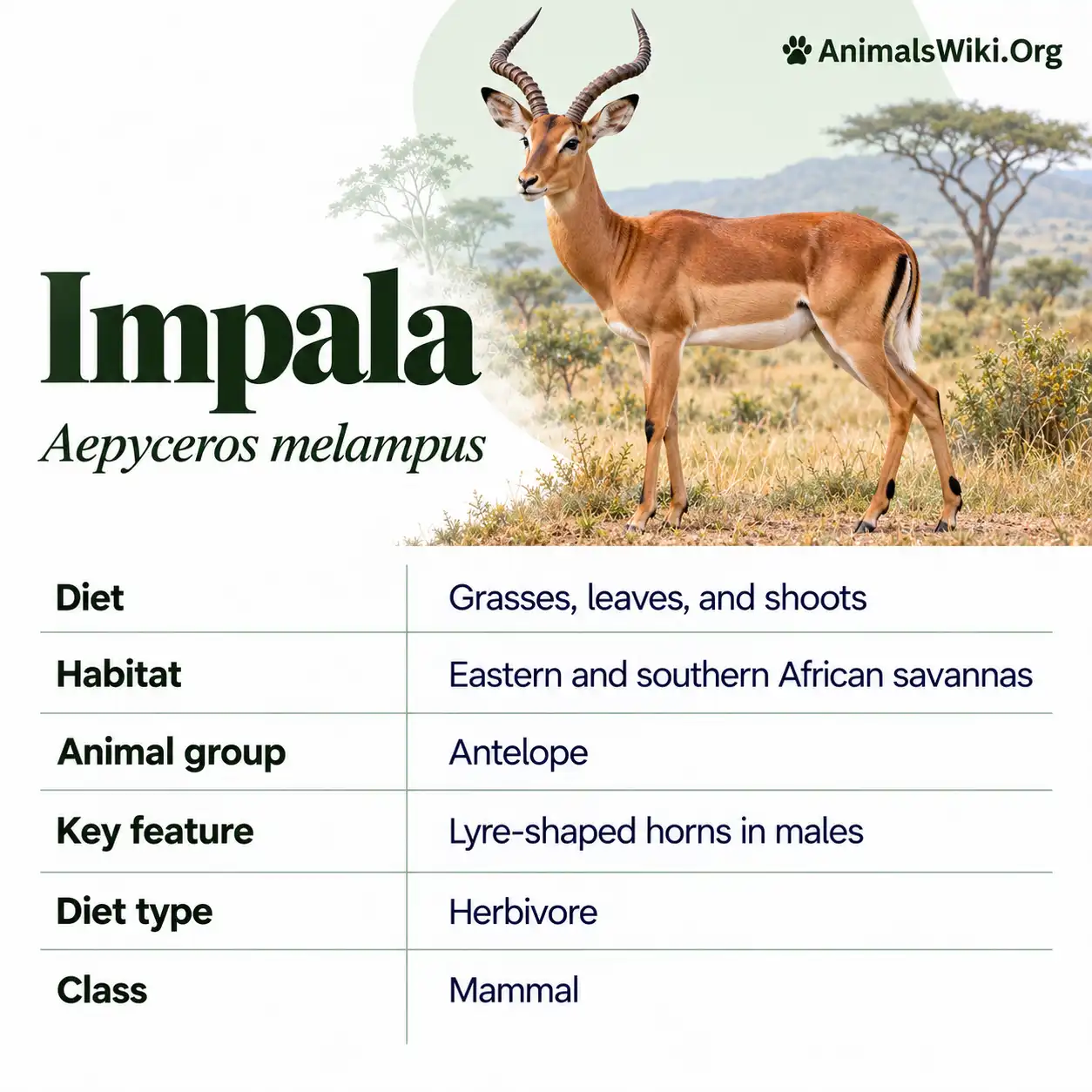
Impala, A Complete Guide to Africa’s Graceful and Adaptable Antelope
An impala herd can look wonderfully peaceful. Some animals lower their heads to feed, others rest beneath scattered trees, and a few stand alert with their ears pointing toward an unfamiliar sound. Then something changes. One animal gives an alarm, heads rise across the herd, and the quiet scene becomes a rush of reddish-brown bodies and white tails.
The impala is one of the most familiar antelopes of eastern and southern Africa. Its elegant shape, distinctive rump markings and impressive leaps make it easy to recognize. Males carry curved, ridged horns, while females have a smoother profile without horns.
Yet the species is much more than an attractive safari sighting. Impalas adjust their diets between grass and leafy vegetation, reorganize their social groups as conditions change, and spend considerable time grooming to remove parasites. Their behavior reveals a constant balance between finding food, avoiding predators and reproducing successfully.
The impala also presents an important conservation lesson. A species can be abundant overall while particular populations or regional forms remain vulnerable. The widespread common impala and the geographically restricted black-faced impala do not face identical circumstances.
This guide explains impala identification, scientific classification, distribution, feeding, adaptations, social behavior, reproduction and ecological importance. It also separates older population estimates from recent regional information and explains why taxonomy and conservation figures require careful interpretation.
Impala Facts
| Feature | Details |
|---|---|
| Common name | Impala |
| Scientific name | Aepyceros melampus |
| Other common name | Rooibok |
| Animal group | Mammal; antelope |
| Family | Bovidae |
| Tribe | Aepycerotini |
| Native region | Eastern and southern Africa |
| Typical adult weight | Roughly 40–65 kg, varying with sex and population |
| Shoulder height | Approximately 80–95 cm |
| Coat | Reddish-brown above, paler sides and white underparts |
| Horns | Present in males; absent in females |
| Diet | Mixed feeder: grasses, leaves, shoots and other plant material |
| Social organization | Female groups, bachelor groups and territorial males |
| Gestation | Approximately 194–200 days |
| Usual offspring | One lamb or calf |
| Main predators | Several large African carnivores |
| Overall conservation status | Least Concern |
| Important exception | Black-faced impala is assessed separately as Vulnerable |
| Longevity caution | Captive maximum records exceed typical wild survival |
The size figures are practical field ranges rather than strict limits. Mpala’s field guide reports males as generally heavier than females, while modern taxonomic sources recognize the impala within its own tribe, Aepycerotini.
What Is an Impala?
The impala is a medium-sized, even-toed hoofed mammal belonging to the family Bovidae. This family also includes cattle, buffalo, goats, sheep and many other antelopes.
Although an impala may resemble a large gazelle at first glance, it belongs to a separate evolutionary lineage. It is the only living species generally recognized in the genus Aepyceros.
The word “antelope” is a broad common term rather than a single formal taxonomic rank. It brings together many bovids that differ considerably in appearance and ecology. A tiny forest antelope, a large eland and an impala are all called antelopes, despite their different lifestyles.
Impalas are especially successful in landscapes containing both grass and woody vegetation. This combination gives them access to different foods and allows them to adjust their feeding as seasons change.
Their success should not be confused with an absence of challenges. Every individual must survive predators, parasites, nutritional shortages and competition. A species can be adaptable while its members still face demanding daily decisions.
For observers, impalas offer an accessible introduction to animal behavior. A herd may display feeding, rumination, grooming, courtship, territorial defense and maternal care within a relatively short period. Watching carefully reveals far more than simply counting how many animals are present.
Identification and Physical Appearance
Coat Color and Body Shape
An impala has a slender body, long legs and a relatively small head supported by an elongated neck. The upper coat is usually reddish-brown, with lighter coloring along the sides and white hair on the underside.
Pale markings also occur around parts of the face, including the eyes, chin and inner ears. These contrasts become especially noticeable when an animal turns toward an observer.
Coat appearance changes with lighting. An impala standing in warm evening sunlight may look considerably redder than the same animal photographed in shade. Dust, age and individual variation can also affect the impression of color.
Identification is therefore strongest when body shape and markings are considered together.
The Distinctive Rump Markings
One of the most useful identification features is the rear view. Impalas have dark markings associated with the tail and a vertical black stripe on the back of each thigh.
Against the pale rump, these markings create a memorable pattern. Guides sometimes compare it to a letter or familiar symbol, but that resemblance is only a visual aid.
The important features are the actual placement of the stripes, the pale surrounding hair and the animal’s overall proportions. A distant photograph can distort the pattern, so it should not be the only characteristic used.
Male Impala Horns
Male impalas carry long, ridged horns that curve outward, backward and upward in a lyre-like shape. Their appearance changes as the animal grows.
Young males begin with short developing horns. Older males generally have a more substantial horn profile, although horn size alone does not provide a precise age.
The African Wildlife Foundation gives a broad male horn-length range of approximately 40–90 cm. Horn measurements also depend on the measurement method, so figures from different references should be compared carefully.
Horns are permanent structures, unlike the antlers of deer, which are shed and regrown. A bovid horn has a bony core covered by a keratin sheath.
Differences Between Males and Females
Female impalas do not have horns. Males are also generally heavier and may appear more muscular, particularly around the neck during breeding activity.
However, a young male can resemble a female before its horns become conspicuous. Distance and vegetation may hide the horns of an adult, too.
Reliable sex identification combines several observations: horn presence, body proportions, age and behavior. A photograph showing only the back half of an animal may not provide enough information.
Black Tufts Above the Hind Feet
Impalas have distinctive black hair tufts associated with scent glands on their lower hind limbs. These features are useful in close photographs and distinguish impalas from several superficially similar antelopes.
They also remind us that animal markings can have roles beyond what humans can see. Smell is an important part of communication, even when its contribution is invisible to an observer.
Scientific Classification and Subspecies
Scientific Classification
| Taxonomic level | Classification |
|---|---|
| Kingdom | Animalia |
| Phylum | Chordata |
| Class | Mammalia |
| Order | Artiodactyla |
| Family | Bovidae |
| Subfamily | Antilopinae in the Mammal Diversity Database treatment |
| Tribe | Aepycerotini |
| Genus | Aepyceros |
| Species | Aepyceros melampus |
Some references place impalas in a separate subfamily, Aepycerotinae. Others include their tribe within Antilopinae.
These differences concern the rank assigned to an evolutionary lineage. They do not mean that one source considers an impala to be a deer while another considers it a bovid.
The species was described in 1812. The Mammal Diversity Database currently recognizes one living impala species and includes the black-faced form within it.
The Traditional Two-Subspecies Treatment
Many conservation accounts recognize two subspecies:
- Common impala: Aepyceros melampus melampus.
- Black-faced impala: Aepyceros melampus petersi.
Under this treatment, the common impala occupies a broad eastern and southern African range. The black-faced impala is associated with a much smaller southwestern African range.
The 2016 South African regional assessment follows this two-subspecies arrangement. It remains useful for understanding the terminology used in conservation literature.
Why Some Sources Recognize More Regional Forms
Recent genetic-management guidance distinguishes southern common, East African and black-faced impalas, using the name Aepyceros melampus rendilis for the East African form.
ConGen Africa’s guidance explains that traditional conservation authorities commonly recognize two subspecies, while its management framework recognizes three evolutionary units corresponding to those regional forms.
Other authors have proposed treating the black-faced impala as a separate species, Aepyceros petersi. The Mammal Diversity Database does not currently adopt that split. These alternatives should be explained rather than presented as a universally settled classification.
What Genetic Research Adds
A 2024 study sequenced 119 impala genomes and found substantial population structure. Animals that look broadly similar can therefore carry meaningful regional genetic differences.
The research also identified signs of recent demographic problems in certain sampled populations, including Etosha black-faced impalas and eastern populations from Samburu and Lake Mburo.
These findings do not create a fresh head count. They reveal aspects of population history and genetic condition that cannot be measured by counting visible animals alone.
Distribution and Habitat
Where Do Impalas Live?
Impalas occur across parts of eastern and southern Africa. Their range includes suitable areas in countries such as Kenya, Tanzania, Uganda, Zambia, Zimbabwe, Botswana, Mozambique, Malawi and South Africa, with additional populations elsewhere in the broader region.
Their distribution is uneven within those countries. A country appearing on a range map does not mean that impalas occupy every habitat inside its borders.
Natural occurrence must also be distinguished from human-assisted distribution. Wildlife ranching, reintroductions and other translocations have moved animals between places.
For that reason, an impala sighting does not automatically demonstrate that the location lies within the species’ historical native range.
The Black-Faced Impala’s Restricted Range
The black-faced form is associated with northwestern Namibia and southwestern Angola. Its much smaller geographic distribution helps explain why its conservation needs differ from those of the widespread common form.
Current information from Angola is less complete than information from several Namibian populations. Absence of recent records should not be casually converted into proof of extinction, nor should historical occurrence be treated as confirmation of a healthy present population.
Preferred Habitat
Impalas commonly use savanna, open woodland, wooded grassland and transitions between grassland and trees.
These transition areas are sometimes called ecotones. They can provide grass for grazing, woody plants for browsing, resting places and a mixture of visibility and cover.
An impala is not simply an animal of treeless plains. Nor is it primarily a specialist of dense rainforest.
The Uganda Wildlife Authority identifies open woodland, often near water, as characteristic habitat and highlights Lake Mburo National Park as a place where visitors can see the species.
Habitat Quality Changes Through the Year
A patch that offers excellent food during the wet season may become less useful when grasses mature and dry.
Trees and shrubs can then provide alternative foods, but not every woody plant is equally nutritious or accessible. Heavy browsing pressure can also reduce the value of a small patch.
Good impala habitat therefore includes more than an attractive-looking stand of vegetation. Its value depends on seasonal food quality, access to water, disturbance and the ability to move between resources.
Population Estimates and Conservation Status
Are Impalas Endangered?
The impala is globally categorized as Least Concern. Widely cited global information describes an overall stable population, although trends vary among regions and individual populations.
The black-faced impala is assessed separately as Vulnerable. A general statement that “impalas are not threatened” overlooks this important distinction.
The Widely Quoted Two-Million Estimate
An overall population of approximately two million impalas is frequently repeated.
This is an older estimate, not a coordinated count completed in 2026. ConGen Africa explicitly traces the figure to the 2016 IUCN assessment and East’s 1999 antelope status compilation.
The appropriate wording is therefore “a widely cited estimate of approximately two million,” with the source dates explained. Publishing it as “exactly two million impalas remain today” would imply a precision and freshness that the evidence does not support.
Dated Population Information
| Population or assessment | Date associated with information | Reported figure or status | Important limitation |
|---|---|---|---|
| Overall impala population | Estimate cited in the 2016 assessment, drawing on older information | Approximately two million | Not a new 2026 census |
| Kruger National Park | 2023 estimate reported in the 2025 regional assessment | Approximately 123,998–168,451 animals | One park, not the global population |
| Black-faced impala in Namibia | 2017 assessment information repeated in a 2023 study | Approximately 3,000–4,000 mature animals | Older mature-individual estimate; Angola information incomplete |
| South African regional assessment | 2025 | Least Concern; regional trend increasing | Does not establish the trend everywhere |
The Endangered Wildlife Trust’s 2025 regional assessment provides the Kruger estimate and increasing regional trend. The black-faced figure comes from assessment information summarized in a 2023 veterinary research paper.
Total Animals Versus Mature Individuals
A total-population estimate can include lambs, juveniles and adults. A mature-individual estimate concerns animals capable of reproduction under the assessment’s definitions.
These categories should not be compared as though they measure the same thing. Birth timing and juvenile survival affect the proportion of a population that is mature.
Neither category is identical to genetic effective population size, a separate concept describing how a population’s breeding structure influences genetic change.
Wild, Captive and Managed Animals
Private land does not automatically mean captivity. Impalas on a large conservancy can live under conditions very different from animals in a small breeding enclosure or zoo.
Likewise, a fenced reserve can contain free-ranging wildlife while still requiring active management.
Population reports should explain their boundaries and definitions. Zoo animals, intensively bred color variants, reintroduced herds and native free-ranging populations should not be combined without clarification.
Impala Diet and Feeding
What Do Impalas Eat?
Impalas are mixed feeders. Their diet includes grasses and non-grass plant material, particularly leaves and shoots.
They may also consume herbs, flowers, fruits and other available plant parts. The combination changes with season and location.
Mixed feeding gives them more flexibility than a diet restricted entirely to grass or woody browse. However, flexibility does not mean they can thrive on any vegetation.
Food still needs to be digestible, sufficiently nutritious and available in enough quantity.
Grazing During Favorable Conditions
When fresh grass is available, impalas can devote much of their feeding to it.
Young leaves and shoots often offer better nutritional value than old stems. An area with short fresh growth may therefore be more attractive than a taller area containing much more dry plant material.
This explains why the green appearance and growth stage of vegetation matter alongside its height.
Browsing When Grass Quality Declines
As grasses mature or dry, impalas can increase their consumption of woody and other broad-leaved plants.
Stable-isotope research in Kruger National Park confirmed that impalas used a mixture of grass and browse and differed from more specialized grazing buffalo and browsing kudu.
A separate seasonal study in Hluhluwe–Umfolozi found increased consumption of C3 plant material during winter. These findings support dietary flexibility while also showing why one fixed grass-to-browse percentage cannot describe the species everywhere.
How Researchers Study Impala Diet
Direct observation can identify feeding plants, but researchers cannot follow every bite taken over a long period.
Stable carbon isotopes provide another approach because many tropical grasses and woody plants have different chemical signatures. Those signatures can help estimate the relative contribution of different plant groups.
Different samples represent different time windows. Feces, hair and tooth enamel do not necessarily describe the same period of an animal’s life.
This is an important reason that two dietary studies can produce different results without either being wrong.
Diet Flexibility Still Has Limits
Research in mopane woodland found that food digestibility was important in seasonal dietary change.
The lesson is practical: available vegetation is not automatically usable nutrition. A drought may leave leaves or stems standing while still reducing the quality of the food an impala can obtain.
Water, Digestion and Daily Activity
How Impalas Obtain and Use Water
Impalas frequently occur near water and drink when suitable sources are available. Their dependence on drinking changes with environmental conditions and the moisture content of food.
Fresh vegetation supplies water as well as nutrients. When that vegetation dries, the relationship between feeding areas and drinking sites can become more important.
It is therefore inaccurate to describe the species as either completely water independent or bound to an identical daily drinking schedule everywhere.
Ruminant Digestion
An impala is a ruminant. Microorganisms within its digestive system help process plant material, and swallowed food can later be returned to the mouth for additional chewing.
This process is called rumination or chewing the cud.
An impala resting in the shade may consequently still be processing food. Resting is not simply unused time; it can be an essential part of obtaining nutrients.
Digestive adaptation also helps explain why disturbance matters. Repeatedly forcing animals to stand, move or flee can interrupt more than their immediate feeding.
Daily Activity
Impalas spend their time feeding, moving, resting, ruminating, grooming and interacting.
They are often conspicuous during daylight, but activity can extend beyond it. Temperature, disturbance, food distribution and perceived danger can change the daily pattern.
A visitor seeing resting animals at midday should not assume that the species feeds only in the morning. Short observations capture one part of a longer cycle.
Running, Jumping and Other Adaptations
A Body Built for Agile Movement
Long legs and a relatively light build allow impalas to move quickly through suitable terrain.
Their escape movements can include rapid running, changes of direction and substantial leaps. These abilities are useful in habitats containing grass, shrubs and scattered obstacles.
Successful escape depends on coordination as well as power. An animal must choose a direction, avoid collisions and respond to the movements of predators and companions.
Why Impalas Leap
A startled herd can scatter through a series of bounds and kicks. The display is dramatic, but it should not be assigned one universal purpose.
Some movements help animals negotiate obstacles. Others may contribute to signaling, locating companions or responding to immediate danger.
The African Wildlife Foundation describes leaping as part of impala antipredator behavior and herd coordination. Those interpretations should not be expanded into a claim that every jump successfully confuses a predator.
How High and Far Can They Jump?
Popular wildlife accounts often give leap distances around 9–10 meters and heights approaching 3 meters.
These are best understood as reported upper capabilities, not the dimensions of every escape leap. Distance and height describe different movements, and they should not be combined into an imaginary jump that achieves both maxima simultaneously.
IFAW summarizes the commonly reported figures of up to 10 meters horizontally and 3 meters vertically.
How Fast Can an Impala Run?
Published speed claims vary considerably, and many popular accounts do not explain how they were measured.
It is safer to describe the impala as a fast, agile runner than to present an unsourced top speed as a verified athletic record.
A chase also depends on the initial distance between predator and prey, acceleration, footing, turning and stamina. Maximum speed is only one component.
Senses and Early Warning
An impala that detects a threat early has more options than one surprised at close range.
Turning ears, raised heads and changes in body posture can reveal attention to a sound or movement. The presence of companions also creates opportunities to notice another animal’s reaction.
Early warning can prevent a chase altogether. This makes vigilance as important to survival as the spectacular leap that attracts human attention.
Social Organization and Communication
The Main Social Groups
Impalas commonly form three broad social arrangements:
- Groups containing females and young.
- Bachelor groups containing males.
- Territorial males associated with defended areas.
These categories are useful, but membership and group size can change. A herd is not necessarily a permanent unit containing the same individuals throughout life.
Mpala’s field guide describes groups joining and separating and notes that habitat influences group size.
Female Groups
Females may feed, rest and move in groups with their young.
Group living can increase opportunities to detect danger, although it also brings competition for food. The balance changes with the size of the group and the quality of the feeding area.
Individuals still make their own decisions within the group. A herd can spread out, gather tightly, split or join another group as circumstances change.
Bachelor Groups
Males that are not holding breeding territories may associate in bachelor groups.
These groups can contain animals of different ages. Young males gain experience through social interactions, while mature males may move between nonterritorial and territorial situations.
Being physically capable of reproduction does not mean that a male immediately gains access to receptive females.
Territorial Males and the Rut
During strong breeding activity, a male may spend considerable time patrolling, displaying, challenging rivals and attempting to keep females within his area.
These activities are costly. Time spent defending and watching is time unavailable for feeding and grooming.
Territorial success is therefore temporary and conditional. A male must maintain sufficient condition while responding to competitors and moving females.
Vocal, Visual and Chemical Signals
Impalas communicate through several channels.
Alarm snorts can draw attention to danger. Breeding males produce conspicuous vocalizations. Posture, horn presentation and movement convey information during social encounters.
Scent also matters. Dung, urine and glandular secretions provide information that can persist after the animal has moved away.
The result is a communication system far richer than a simple distinction between “quiet feeding” and “running away.”
Grooming and Parasite Control
Grooming Is a Survival Activity
Impalas spend noticeable time licking, nibbling and scratching their coats.
These actions help remove ticks and other material. Grooming is therefore an important part of maintaining condition rather than merely keeping the coat attractive.
Ticks can impose costs through feeding and irritation, and the time invested in removing them has practical value.
Experimental Evidence
A 1996 study tested the role of oral grooming by limiting some impalas’ ability to reach parts of their bodies.
Animals prevented from grooming accumulated substantially more ticks. In another experiment, grooming increased after exposure to ticks and declined after ticks were removed.
These experiments provide stronger evidence than the simple observation that clean-looking animals groom often: they show that grooming itself contributes to parasite removal.
What Is Allogrooming?
Allogrooming occurs when one animal grooms another.
Impalas exchange grooming around the head and neck, helping reach areas that an individual cannot easily clean with its own mouth.
Research describes an unusually reciprocal pattern in which partners alternate grooming bouts. This is a valuable example of cooperation with a direct physical benefit.
The Cost of Watching Instead of Grooming
A territorial male cannot devote unlimited attention to rivals and females while also maintaining the same grooming routine.
Research comparing territorial males and females linked reduced grooming in males with greater tick loads.
The finding illustrates a biological trade-off: investing effort in current breeding opportunities can create costs elsewhere in the animal’s life.
Mothers Face Similar Trade-Offs
A mother may need to nurse, feed, watch for predators and groom herself or her young.
Research on maternal care has specifically examined the balance between vigilance and grooming in impalas. These activities compete for time, even though both can protect health and survival.
Reproduction and Breeding
Breeding Seasons Differ Across the Range
Impalas do not follow one identical reproductive calendar throughout Africa.
In many southern African populations, breeding and births are strongly seasonal. In parts of equatorial East Africa, births can occur throughout the year, with broader peaks.
A study comparing African ungulates found impala births more synchronized in southern than eastern Africa. Rainfall patterns and seasonal forage availability help explain the difference.
Courtship and Mating
Males assess females’ reproductive condition using behavioral and chemical information. Courtship can include following, characteristic postures and repeated interactions.
The mating system is polygynous: a successful male can mate with more than one female.
However, successful mating opportunities depend on more than horn size. Territory location, physical condition, competition and the movement of receptive females all matter.
Pregnancy and Birth
Gestation is approximately 194–200 days, usually producing one offspring.
A newborn weighs only a small fraction of an adult. AnAge lists an average birth mass of approximately 5.55 kg and gestation of 198 days.
These are reference values rather than measurements every mother and youngster must match.
Why Birth Timing Matters
A lactating female needs substantial nutrition. Giving birth when useful forage is available can help support milk production and maternal recovery.
A concentrated birth season may also change the relationship between predators and young prey. However, the advantages and costs of synchrony differ among landscapes.
Research on impala reproductive chronology has examined both resource seasonality and predation risk, supporting a more complex explanation than rainfall alone.
Can Impalas Delay Birth Until Rain Arrives?
The claim that a female can hold a fully developed lamb indefinitely while waiting for rain is not a sound general explanation.
Birth timing reflects conception timing, gestation and environmental influences on reproduction. Researchers have documented regional and annual variation without establishing an unlimited ability to postpone delivery.
The close association between births and seasonal rain can be explained without turning a popular bush story into a physiological fact.
Development of Young Impalas
What Is a Baby Impala Called?
“Lamb” is commonly used for a young impala. “Calf” and “fawn” also appear in wildlife accounts.
The terms describe the same early life stage. Consistent use within an article is more helpful than suggesting that each term identifies a different animal.
Birth and Early Concealment
A female may separate from the group before giving birth. The newborn initially relies heavily on maternal care and a relatively quiet setting.
The period before rejoining other animals varies. It should not be described as an identical number of hours for every mother and young.
Early separation can reduce disturbance around birth, while later group association provides a different set of benefits.
Nursery Groups
Young impalas often gather in groups known as nurseries or crèches.
They may rest, move, play and interact together while remaining dependent on their own mothers for milk.
A nursery should not automatically be interpreted as a system in which every female nurses every youngster. Grouping and communal milk provisioning are different behaviors.
Animal Diversity Web describes these groups as settings in which young impalas play, groom and move together.
Growth and Learning
Youngsters develop coordination through ordinary movement and social interaction.
They also begin encountering the food plants, warning signals and spatial routines used by adults. Development involves more than increasing body size: the animal must become effective at feeding, responding to danger and navigating social situations.
| Stage | Main requirements | Typical changes |
|---|---|---|
| Newborn | Milk and close maternal care | Standing and early movement |
| Early young | Nursing, rest and protection | Increasing mobility |
| Nursery stage | Social contact and continued maternal support | Play, grooming and group movement |
| Growing juvenile | Increasing plant intake | Less dependence on milk |
| Subadult | Independent feeding and social experience | Developing adult social roles |
Weaning and Reproductive Maturity
Weaning generally occurs over several months, often around four to six months in species summaries.
Eating vegetation begins before milk dependence has completely ended. The transition is gradual.
Females can reach reproductive maturity during their second year, while males may be physiologically capable earlier than they become successful territorial breeders. Maturity and actual breeding success should therefore be kept separate.
Lifespan and Survival
How Long Do Impalas Live?
Wild impalas can live into their teens, but survival differs between individuals, sexes and populations.
A quoted “lifespan” may describe a typical adult range, a maximum observed age or an estimate from birth. Those are not interchangeable.
Young animals face different risks from established adults, and breeding males may experience substantial costs associated with competition.
Captive Longevity
AnAge records a captive impala that lived at least 25.6 years, with the longevity data rated high quality.
That record demonstrates potential longevity under managed conditions. It does not mean that wild impalas normally live for a quarter of a century.
Reliable food, veterinary care and the absence of natural predators can alter captive survival. Conversely, captive management introduces its own environmental and health conditions.
What Determines Survival?
Predation, nutrition, parasites, disease and injury all influence survival.
Their effects can interact. An animal in poor condition may have less energy for movement, while heavy parasite burdens can add further costs.
The most useful survival studies follow known animals or age classes over time. A single maximum-age record cannot reveal how many youngsters survive their first year or why a local population is declining.
Predators and Hunting Encounters
What Eats Impalas?
Impalas are prey for several large carnivores, including leopards, cheetahs, lions, spotted hyenas and African wild dogs.
Young animals can also be vulnerable to smaller predators. The importance of each predator varies by landscape and age class.
A list of predators should not be interpreted as a fixed ranking. Leopards may be important in one setting, while wild dogs or another carnivore dominate recorded kills elsewhere.
Stalking and Pursuit
A stalking predator benefits from approaching close before being detected. A pursuit predator may continue chasing after the prey has begun moving.
These strategies create different problems for an impala. Early detection can undermine an ambush, while endurance, route choice and group movement can become important during a longer pursuit.
Dense vegetation can conceal a predator but also provide obstacles during escape. Open ground improves sightlines while changing the available cover.
Feeding Versus Vigilance
An impala watching for danger cannot always feed at the same rate as an animal keeping its head down.
Experimental research has examined this relationship directly, documenting a trade-off between food acquisition and vigilance. The cost of safety is therefore measurable in feeding behavior.
This helps explain why “always remain alert” is not a realistic survival strategy. An animal that never feeds effectively also places its future at risk.
Predation and Conservation
Predators are part of functioning ecosystems. Their presence alone does not demonstrate that an impala population is being mismanaged.
However, habitat confinement can change predator–prey relationships. A fenced population with limited food and movement options may face different pressures from animals in a connected landscape.
Management decisions require evidence about the full system, including reproduction, resources and human activity.
Competitors and Ecological Relationships
Competition With Other Herbivores
Impalas share habitat with many other plant-eating mammals.
Their mixed diet can reduce dependence on one food category, but overlap still occurs. During scarcity, other grazers and browsers may use plants that impalas also need.
Competition is not established simply by seeing two species together. Researchers must determine whether shared resource use reduces access, condition or performance.
Livestock Relationships
Livestock can affect impalas through grazing, browsing, disturbance and habitat change.
The outcome depends on stocking intensity, season, vegetation and access to water. Light use in one setting may have different effects from concentrated use during drought.
A practical conservation approach evaluates these conditions locally rather than assuming that livestock presence always has one predictable effect.
Relationships With Larger Herbivores
Large animals can alter vegetation height and structure, changing the feeding environment for smaller species.
Such changes may create opportunities in some places and reduce resources in others. Benefits can also appear after a delay, such as when grazing is followed by plant regrowth.
The same pair of species can therefore experience competition and indirect benefits at different times.
Mixed-Species Associations
Being near other animals can provide additional warning cues. It can also increase the number of individuals using a feeding area.
An association should not automatically be described as friendship or cooperation. Animals may simply be responding independently to the same food or safety conditions.
Understanding the relationship requires observing what changes when the species are together.
Ecological Importance of Impalas
Supporting Carnivore Food Webs
Impalas transfer energy from vegetation to carnivores and scavengers.
Where they are abundant, they can form an important part of the prey community. Their ecological value is not reduced because they are familiar or numerous.
A local loss may alter carnivore feeding opportunities, although the effect depends on the availability of alternative prey.
Grazing and Browsing Effects
By consuming both grasses and broad-leaved plants, impalas influence more than one component of vegetation.
They remove selected tissues rather than cutting every plant evenly. This selective feeding can affect plant growth and the distribution of feeding pressure.
The outcome depends on animal density and plant responses. Moderate use and heavy concentrated use should not be assumed to have identical effects.
Nutrient Cycling
Dung and urine return nutrients to the environment.
Because animals move between feeding and resting places, they redistribute those nutrients across the landscape. Repeated use of particular locations can create uneven patterns of enrichment.
These processes also support organisms associated with dung and decomposition, connecting the impala to less visible parts of the ecosystem.
Seed Dispersal
Impalas can move viable seeds through their digestive systems.
A study of acacia seed dispersal found that impalas were important dispersers of one studied tree species. This illustrates that browsing can involve both consuming plant material and transporting future plants.
The effect is plant specific. Passing through an impala does not guarantee that every seed germinates or becomes an established seedling.
Why Common Species Matter
Conservation discussions often focus on rare animals, but common species contribute through their abundance.
Many feeding events, movements and predator encounters accumulate into a substantial ecological role.
Protecting impalas therefore includes maintaining ordinary ecosystem processes, not merely preventing the disappearance of a recognizable animal.
Threats to Impalas
Habitat Loss and Fragmentation
Cultivation, settlement and infrastructure can remove habitat or divide it into smaller pieces.
A remaining patch may still look suitable while lacking a reliable connection to water or seasonal food.
Fragmentation also limits the movement of animals between populations. Its consequences can emerge gradually, even when the initial number of animals appears stable.
Illegal Hunting and Snares
Illegal hunting removes animals directly, while snares can injure or kill wildlife moving along established routes.
The impact depends on the rate of removal and the population’s ability to replace those losses.
Abundance does not make a local population immune to sustained hunting, particularly when habitat quality is also declining.
Drought and Nutritional Stress
Impalas can change their diets, but severe drought can reduce several food sources at once.
Reduced forage quality affects adults and can also limit successful reproduction and juvenile development.
When fences or land conversion prevent movement, animals may be unable to reach better conditions elsewhere.
Genetic Risks From Translocations
Moving animals can help establish or restore populations, but it can also mix distinct regional lineages.
ConGen Africa identifies unregulated translocations, lineage mixing and isolation as genetic-management concerns. These risks are particularly important for the geographically restricted black-faced form.
The goal should be healthy populations appropriate to their setting, rather than simply increasing the number of animals carrying the impala name.
Selective Breeding for Unusual Colors
Some ranching operations breed unusual coat colors.
Those animals should not automatically be treated as representatives of a naturally distinct conservation population. Selection for a commercial appearance can differ from maintaining the diversity and ecological functioning of wild populations.
The 2016 regional assessment specifically warned that artificial selection and inappropriate mixing could compromise populations used in conservation translocations.
Impala Conservation and Management
Maintain Habitat Connections
Large protected areas are important, but animals also need suitable conditions between them.
Connected landscapes provide options when local resources deteriorate and can permit movement between populations.
Conservation planning should therefore consider seasonal needs and functional routes, not only the total area shown as protected on a map.
Protect the Black-Faced Form
The restricted black-faced impala needs attention separate from the overall species category.
Priorities include reliable monitoring, habitat protection, reducing illegal hunting and careful decisions about animal movements.
Uncertainty about populations in parts of the historical range makes targeted surveys especially valuable.
Use Genetic Information Carefully
Genetic differences can guide decisions about which animals to move and which populations should retain distinct management.
However, genetic units are tools for conservation, not a reason to invent a new universally accepted species count.
The strongest approach combines genetics with geography, ecology, population history and practical management needs.
Monitor More Than Head Counts
A population can remain numerically large while becoming isolated or losing useful variation.
Monitoring should also consider recruitment, adult survival, habitat condition and connectivity.
For smaller populations, identifying the causes of change matters as much as documenting the change itself.
Make Translocations Evidence Based
Animal capture and movement require specialist planning.
A 2023 field study in Etosha investigated safer immobilization methods for black-faced impalas, demonstrating that the procedures used during conservation work can themselves affect outcomes.
Successful movement is more than transporting animals to a new site. Their health, origin, destination and long-term role all require consideration.
Impalas Compared With Similar Antelopes
Impala Versus Thomson’s Gazelle
These animals can occur in the same broad region, but they differ in size, markings and habitat use.
| Feature | Impala | Thomson’s gazelle |
|---|---|---|
| Scientific genus | Aepyceros | Eudorcas |
| General size | Larger | Smaller |
| Side markings | Usually lacks a broad black flank stripe | Broad dark flank stripe is characteristic |
| Male horns | Long, curved, lyre-shaped | Generally shorter and more slender |
| Female horns | Absent | May be small or absent |
| Typical setting | Woodland–grassland mixtures | Often more open short-grass environments |
| Feeding | Flexible grazing and browsing | Strong use of grasses, with other vegetation also eaten |
A partly hidden animal can be difficult to identify, so no single feature should replace a combined assessment.
Impala Versus Springbok
Springbok belong to a different genus and are associated primarily with southern African landscapes.
Both animals can make dramatic leaps, but their displays and anatomy are not identical. Springbok possess a distinctive dorsal skin fold used in display; impalas do not share that feature.
A leaping antelope is therefore not automatically a springbok. Location, markings, horns and body proportions remain important.
Common Versus Black-Faced Impala
The black-faced form generally has more conspicuous dark facial markings and a restricted southwestern distribution.
However, appearance alone can be misleading. Research has documented common impalas with dark facial features, making geography and genetic information important in management decisions.
This is particularly relevant for animals moved outside their natural range.
Watching Impalas Responsibly
Look Beyond the First Photograph
A resting herd can reveal grooming exchanges, rumination, subtle alarm responses and changes in social spacing.
A male repeatedly walking the same area may be patrolling. Two animals nibbling each other’s necks may be exchanging grooming rather than fighting.
Patient observation allows these distinctions to emerge.
Give Mothers and Young Space
A young impala separated briefly from adults is not automatically abandoned.
Approaching can interrupt maternal behavior or cause unnecessary movement. Observers should remain at a respectful distance and follow the advice of guides or wildlife authorities.
An animal that appears trapped or injured should be reported rather than handled by an untrained visitor.
Do Not Provoke Running or Jumping
Chasing animals to obtain dramatic photographs wastes their energy and changes the behavior being recorded.
The most informative wildlife observation allows animals to continue making their own choices.
Responsible viewing also means leaving routes open, keeping noise low and avoiding repeated interruptions to feeding or resting groups.
Frequently Asked Questions About Impalas
1. What is an impala?
An impala is a medium-sized African antelope belonging to the family Bovidae. It is known for its reddish-brown coat, white underside, dark rump markings and agile movements. Males have prominent curved horns, while females are hornless.
2. What is the scientific name of the impala?
Its scientific name is Aepyceros melampus. Most current general treatments recognize one living species in the genus Aepyceros. Some authors have proposed different treatment of regional forms, especially the black-faced impala.
3. Is an impala a gazelle?
An impala is an antelope, but it belongs to a different lineage from true gazelles. Similar body proportions can cause confusion. Modern classifications place impalas in the tribe Aepycerotini, reflecting their distinct evolutionary position.
4. Where do impalas live?
They live in suitable habitats across parts of eastern and southern Africa. Countries within their range include Kenya, Tanzania, Uganda, Zambia, Zimbabwe, Botswana, Mozambique and South Africa. Their occurrence within each country is uneven.
5. What habitat do impalas prefer?
They commonly use open woodland, wooded grassland and savanna containing a mixture of grass and woody vegetation. This combination supports both grazing and browsing. Access to water and seasonal feeding opportunities also influences habitat use.
6. What do impalas eat?
They eat grasses, leaves, shoots and other plant material. As mixed feeders, they can adjust the balance between grass and browse. The exact diet depends on season, local vegetation and the nutritional quality of available plants.
7. Are impalas herbivores?
Yes. Their normal diet is plant based. Their digestive system is adapted for ruminant feeding, including microbial fermentation and chewing cud. They are prey animals rather than predators that hunt other animals for food.
8. Do female impalas have horns?
No. Female impalas are hornless, while males develop permanent horns. Very young males may have horns too small to notice clearly, so a distant animal without obvious horns is not necessarily an adult female.
9. Do impalas shed their horns?
They do not shed their horns annually. Impala horns are bovid horns, consisting of a bony core and keratin covering. They differ from deer antlers, which are shed and regrown as part of a regular cycle.
10. Why do impalas jump?
Leaping forms part of their movement and response to danger. It can help them cross obstacles and may contribute to communication or herd coordination. Different jumps can occur in different contexts, so one explanation should not be applied to every leap.
11. How far can an impala jump?
Popular accounts report horizontal leaps of approximately 9–10 meters under exceptional circumstances. Such figures describe upper capabilities rather than ordinary movement. Jump distance and jump height should also be treated as separate measurements.
12. How fast can an impala run?
Impalas are fast runners, but published numerical claims vary and often lack measurement details. Their escape ability also depends on acceleration, turning, footing and early warning. A precise unsourced speed should not be treated as a verified record.
13. What is a male impala called?
A male is commonly called a ram. Adult males can be recognized by their horns and generally heavier build. A territorial ram may spend substantial time displaying, patrolling and responding to rivals during breeding activity.
14. What is a female impala called?
A female is commonly called a ewe. Females often associate in groups with other females and young. They are hornless and usually lighter than adult males, although age and body condition also influence appearance.
15. What is a baby impala called?
“Lamb” is widely used, while “calf” and “fawn” also appear in wildlife writing. These terms do not refer to separate kinds of impala. The youngster remains dependent on maternal care during its early development.
16. How long is an impala pregnant?
Pregnancy lasts approximately 194–200 days, or about six and a half months. Summaries often round this to six or seven months. A female normally gives birth to one youngster at a time.
17. Do impalas give birth only during the rainy season?
Births are often associated with favorable seasonal conditions, but the pattern differs geographically. Southern African populations commonly show stronger synchronization, while some East African populations produce young throughout the year with broader peaks.
18. Can an impala postpone birth until rain arrives?
The popular claim should not be presented as an established ability to delay delivery indefinitely. Conception timing, gestation and environmental influences on reproduction explain much of the relationship between births and rain. Actual physiology is more constrained than the story suggests.
19. Why do young impalas gather in nurseries?
Nursery groups bring youngsters together for resting, movement and social interaction. The young still depend on maternal milk. A group of lambs does not necessarily mean that unrelated females routinely nurse or collectively parent every youngster.
20. When are impalas weaned?
Weaning generally occurs over several months, commonly around four to six months in species accounts. Young animals begin eating vegetation before milk feeding ends completely. The shift toward independent feeding is gradual rather than instantaneous.
21. How long do impalas live?
Wild impalas can reach their teens, but many die younger. AnAge records a captive animal living at least 25.6 years. That exceptional captive record should not be presented as the usual lifespan of a wild impala.
22. What animals hunt impalas?
Predators include leopards, cheetahs, lions, spotted hyenas and African wild dogs. Young animals may also face smaller predators. The contribution of each predator changes between places and age classes, so there is no universal ranking.
23. Why do impalas groom each other?
Mutual grooming helps remove parasites from areas such as the head and neck that are difficult to reach alone. Impalas often alternate grooming bouts. Research also shows that grooming contributes directly to controlling tick burdens.
24. Are impalas endangered?
The species overall is categorized as Least Concern. The black-faced impala is assessed separately as Vulnerable. A broad statement about the species should therefore preserve the distinction between widespread populations and the more restricted form.
25. How many impalas are left?
A widely repeated overall estimate is approximately two million, but it draws on older assessment information. It is not a fresh 2026 census. Recent regional estimates provide more specific information for particular places, such as Kruger National Park.
26. How many subspecies of impala are there?
Traditional conservation accounts commonly recognize common and black-faced impalas. Recent genetic-management guidance also distinguishes an East African form. Some authors propose species-level differences, so the answer depends on the taxonomic framework being followed.
27. Are black-colored impalas the same as black-faced impalas?
No. A selectively bred dark coat is not automatically evidence that an animal belongs to the black-faced subspecies. Regional ancestry and conservation identity cannot reliably be established from unusual coloration alone.
28. Why are impalas important?
They consume vegetation, cycle nutrients, disperse some seeds and support predators and scavengers. Their abundance can make these contributions substantial. Maintaining healthy impala populations helps preserve ecological processes across savanna and woodland landscapes.
Impala (Aepyceros melampus)
The impala combines graceful movement with remarkable flexibility. It can shift between grazing and browsing, reorganize its social associations and use an intricate mixture of vigilance, communication and grooming to meet daily challenges.
Its familiar appearance can conceal important differences. Regional populations have distinct histories, and the restricted black-faced impala needs attention that an overall Least Concern label does not fully express.
Understanding the species also requires careful use of numbers. Older global estimates, recent park counts, mature-individual figures and captive records describe different things.
Protecting impalas means maintaining the habitats, connections and genetic diversity that allow populations to function over time. When those conditions remain intact, these antelopes continue to support the food webs and seasonal rhythms of the African landscapes they inhabit.



