Piranha Facts
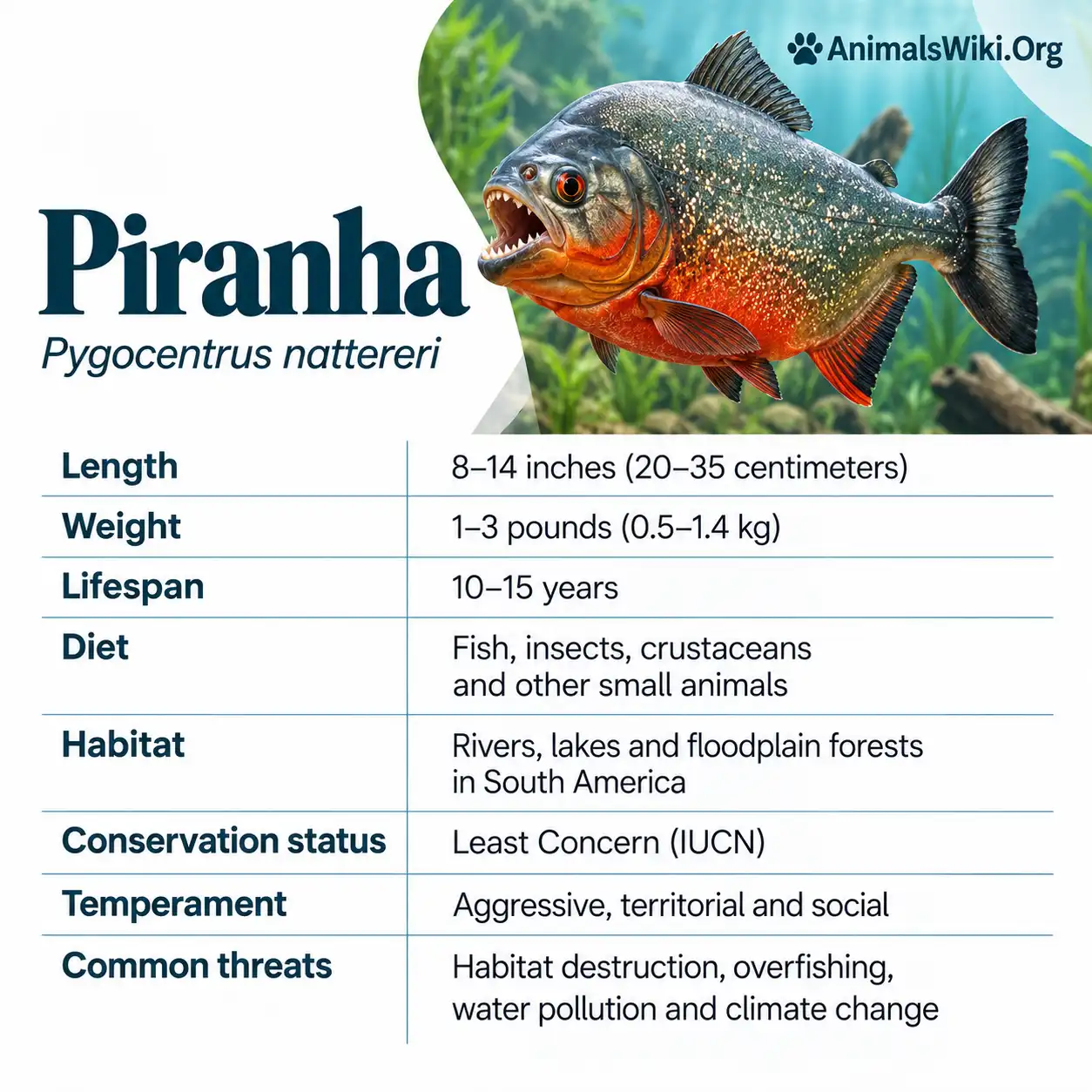
| Feature | Details |
|---|---|
| Common Name | Piranha |
| Scientific Name | Family Serrasalmidae (piranha genera: Pygocentrus, Serrasalmus, Pristobrycon, and others) |
| Family | Serrasalmidae |
| Order | Characiformes |
| First Described | 1819 (Red-Bellied Piranha, by Georges Cuvier) |
| Native Habitat | Freshwater rivers, floodplains, lakes, and streams |
| Geographic Range | South America (Amazon, Orinoco, and Paraná-Paraguay river basins) |
| Average Size | 15–35 cm (6–14 inches) depending on species |
| Average Weight | 0.5–3.5 kg depending on species |
| Lifespan | 8–10 years (wild); up to 25 years (captivity, for some species) |
| Diet | Omnivore/carnivore — fish, insects, crustaceans, plant matter, carrion, seeds |
| Conservation Status | Least Concern (most species); not extensively individually assessed for several species |
| Defining Feature | Interlocking razor-sharp triangular teeth; powerful bite force relative to body size; schooling behavior; wildly exaggerated popular reputation for human aggression |
| Number of Species | Approximately 30–60 species classified as “true piranhas,” depending on taxonomic treatment |
1. Piranha Species Overview & Classification
In the tea-colored, tannin-stained waters of a quiet Amazonian tributary, where sunlight filters down in dappled shafts through overhanging vegetation, a tight, coordinated school of silvery, red-bellied fish moves with quiet, unhurried purpose beneath the surface. To a visitor who has only ever encountered this animal through decades of horror films and exaggerated adventure stories, the scene might seem almost disappointingly calm — no frenzied churning of water, no sudden explosive violence, just a school of modestly sized fish going about the entirely unremarkable business of foraging, resting in the shade of submerged roots, and occasionally investigating a piece of drifting fruit that has fallen from the canopy above. This is the piranha in its actual, everyday reality — an animal whose genuine biology, ecology, and behavior differ so dramatically from its lurid popular reputation that few other creatures in the animal kingdom have suffered such a profound and enduring gap between myth and fact.
The piranha is a group of freshwater fish native to the river systems of South America, belonging to the family Serrasalmidae — a diverse family that also includes the piranhas’ considerably larger, entirely herbivorous relatives, the pacus, discussed further in the Comparison section. Piranhas are found across three major South American river basins — the Amazon, the Orinoco, and the Paraná-Paraguay system — and while popular culture has long fixated almost exclusively on the piranha’s undeniably impressive dentition and its wildly exaggerated reputation as a ravenous, human-devouring predator, the scientific reality is a considerably more nuanced, more ecologically interesting, and in most respects far less dramatic picture: the great majority of piranha species are opportunistic omnivores that pose minimal genuine danger to humans under normal circumstances, and the sensationalized “flesh-stripping feeding frenzy” image popularized by decades of film and literature reflects a small number of exceptional, heavily provoked, or otherwise unusual circumstances rather than typical piranha behavior.
Understanding the piranha requires separating genuine biological fact from more than a century of accumulated cultural exaggeration — a process that reveals an animal whose real story is, in many respects, considerably more scientifically interesting than its Hollywood caricature: a genuinely important, ecologically integrated predator and scavenger species that plays a meaningful role in Amazonian and broader South American freshwater ecosystem health, exhibits surprisingly complex schooling behavior with functions extending well beyond simple predatory coordination, and possesses a bite mechanism and dental structure that remain subjects of genuine ongoing scientific research interest even after more than two centuries of formal scientific study.
Species Classification Table
| Classification Level | Details |
|---|---|
| Kingdom | Animalia |
| Phylum | Chordata |
| Class | Actinopterygii (ray-finned fishes) |
| Order | Characiformes |
| Family | Serrasalmidae |
| Notable Genera | Pygocentrus, Serrasalmus, Pristobrycon, Catoprion |
| Described By | Georges Cuvier, 1819 (Red-Bellied Piranha) |
| Closest Relatives | Pacus (herbivorous members of the same family) |
Notable Piranha Species
| Species | Scientific Name | Range | Notes |
|---|---|---|---|
| Red-Bellied Piranha | Pygocentrus nattereri | Amazon, Paraguay, Essequibo basins | Most widely studied and popularly recognized species |
| Black Piranha | Serrasalmus rhombeus | Amazon and Orinoco basins | One of the largest piranha species; powerful bite force |
| San Francisco Piranha | Pygocentrus piraya | São Francisco River, Brazil | Largest member of genus Pygocentrus |
| Wimple Piranha | Catoprion mento | Amazon and Orinoco basins | Highly specialized scale-eating diet |
| Pirambeba (White Piranha) | Serrasalmus spp. (various) | Widespread across range | Generalist term for several lighter-colored species |
The Name “Piranha”
The word “piranha” derives from a Tupi language term used by Indigenous peoples of Brazil, generally translated as something close to “tooth fish” or “fish tooth” — a direct and entirely fitting linguistic reference to the animal’s most distinctive and functionally significant anatomical feature, discussed extensively in the Physical Description section.
Did You Know? Despite the piranha’s fearsome global reputation, the animal was reportedly encountered without significant incident during Theodore Roosevelt’s own 1913–1914 Amazon expedition — though Roosevelt’s own subsequent written account of the trip, describing a dramatically staged feeding-frenzy demonstration arranged specifically for his benefit by local guides using a starved, corralled group of piranhas and a sick cow, is now widely credited by historians as one of the single most influential sources in cementing the piranha’s exaggerated “man-eating monster” reputation in Western popular imagination for the following century.
2. Piranha Physical Description & Unique Features
The piranha’s physical anatomy reflects a genuinely effective, if popularly overstated, predatory and scavenging toolkit, centered above all on the animal’s famous dental structure and powerful jaw musculature.
Size and Build
Piranha size varies considerably across the group’s numerous species:
- Body length: Typically 15–35 cm (6–14 inches) for most commonly encountered species; the largest species, including the San Francisco Piranha and large Black Piranha individuals, can approach or exceed 40–50 cm (16–20 inches)
- Weight: Generally 0.5–3.5 kg (1–7.7 lbs), varying considerably by species and individual age/condition
- Body shape: A deep-bodied, laterally compressed (flattened side-to-side) build, broadly typical of the wider Characiformes order to which piranhas belong, providing an efficient combination of maneuverability and a somewhat intimidating profile-view silhouette that has likely contributed to the group’s outsized popular reputation relative to its generally modest actual body size
The Famous Teeth — A Genuine Anatomical Marvel
The piranha’s dental structure is, without question, the single most distinctive, most scientifically interesting, and most popularly (if often inaccurately) discussed feature of the animal’s anatomy:
Interlocking, triangular teeth: Piranha teeth are distinctively triangular and razor-sharp, arranged in a single row along each jaw in a tightly interlocking pattern — when the jaws close, the upper and lower teeth mesh together with remarkable precision, creating an effective, scissor-like cutting action well suited to slicing through flesh, scales, and even relatively tough plant material depending on the specific species and its particular dietary specialization
Continuous tooth replacement: Piranhas replace their teeth throughout their lives, though in a genuinely distinctive pattern compared to many other fish species — rather than replacing individual teeth in a scattered, asynchronous manner, piranhas typically shed and replace an entire quadrant of teeth simultaneously on one side of the jaw at a time, a synchronized replacement pattern that has been the subject of specific scientific research interest given its relative rarity among vertebrates more broadly
Bite force research: Scientific research measuring piranha bite force — most notably a widely cited study examining the Black Piranha — has documented bite forces that are genuinely remarkable relative to the animal’s modest body size, with some research suggesting piranha bite force, when scaled proportionally to body mass, may exceed that of considerably larger predatory animals, including some documented comparisons to large sharks when adjusted for relative body size — a finding that has attracted significant scientific and popular media attention as a genuinely noteworthy, well-substantiated example of the piranha’s authentic biological impressiveness, distinct from its more exaggerated popular mythology
Body Coloration
Piranha coloration varies considerably by species and, to some degree, by age and specific population:
- Red-Bellied Piranha: Characterized by a silvery-grey back and flanks contrasting with a vivid reddish-orange belly and lower fins, among the most visually striking and popularly recognized piranha color patterns
- Black Piranha: Displays a considerably darker, more uniformly grey-to-black overall coloration, particularly pronounced in larger, more mature individuals
- Juvenile coloration: Many piranha species display notably different, often more mottled or spotted juvenile coloration that gradually transitions toward the adult color pattern with age, a common pattern among numerous fish species more broadly
Fins and Swimming Adaptations
Piranhas possess a well-developed adipose fin (a small, fleshy fin located between the dorsal fin and tail, characteristic of the broader Characiformes order) along with a generally robust fin structure supporting efficient schooling movement and the relatively quick, agile swimming bursts associated with their predatory and scavenging feeding strategy, discussed further in the Diet section.
Sensory Adaptations
Piranhas possess well-developed lateral line systems — a sensory structure common to fish more broadly, allowing detection of water vibration and movement — believed to play a significant role in both prey/carrion detection and in coordinating the schooling behavior described extensively in the Social Behavior section, alongside reasonably well-developed vision suited to the often somewhat turbid, tannin-stained water conditions characteristic of much of the piranha’s native Amazonian and South American river habitat.
3. Piranha Habitat & Geographic Range
Piranhas are freshwater specialists confined entirely to South America’s major river systems, showing considerable habitat flexibility across the diverse aquatic environments found within their extensive native range.
Preferred Habitat Features
Slow-moving to moderately flowing freshwater — the core piranha habitat requirement; piranhas are found across a range of river, stream, floodplain lake, and backwater environments, generally favoring calmer water over fast, turbulent rapids
Vegetation and submerged structure — dense aquatic vegetation, submerged tree roots, and other underwater structural cover provide important shelter, ambush opportunity, and juvenile refuge habitat across much of the piranha’s range
Seasonally flooded forest (várzea and igapó) — a particularly significant and ecologically distinctive habitat type across much of the Amazon basin, in which seasonal river flooding temporarily submerges vast areas of forest, creating rich, temporary aquatic habitat that piranhas and numerous other Amazonian fish species actively exploit during the flood season, described further in the Ecosystem Role section
Variable water chemistry tolerance — piranhas show considerable tolerance for the varied water chemistry conditions found across South American river systems, including both the darker, more acidic “blackwater” rivers (colored by dissolved plant tannins) and the more sediment-rich “whitewater” rivers characteristic of different portions of the Amazon basin
Habitat Types Occupied
| Habitat | Primary Piranha Use | Notes |
|---|---|---|
| Main river channels | Year-round habitat | Primary adult habitat for many species |
| Floodplain lakes (várzea) | Seasonal habitat, feeding | Rich seasonal food resource during flood periods |
| Flooded forest | Seasonal feeding, shelter | Access to fruit, seeds, and displaced terrestrial prey |
| Slow tributary streams | Breeding, juvenile habitat | Calmer water; vegetation cover |
| Reservoir and dam-created lakes | Adapted habitat | Increasingly significant given widespread regional dam construction |
Geographic Range
Current range by river system:
| River Basin | Key Countries | Notes |
|---|---|---|
| Amazon Basin | Brazil, Peru, Colombia, Ecuador, Bolivia | The largest and most species-rich piranha range, encompassing the majority of recognized piranha species |
| Orinoco Basin | Venezuela, Colombia | Significant Red-Bellied Piranha and Black Piranha populations |
| Paraná-Paraguay Basin | Brazil, Paraguay, Argentina | Southern range extent; distinct regional species assemblages |
| São Francisco River | Brazil (interior) | Isolated basin; home to the endemic San Francisco Piranha |
Introduced Populations Outside South America
While piranhas are entirely native to South America, escaped or deliberately released aquarium specimens have occasionally established themselves, or been documented as isolated individual sightings, in warmer freshwater bodies in parts of the southern United States and a small number of other regions with suitable climate conditions; however, unlike some of the more successfully established invasive species covered elsewhere in this guide series, piranhas have generally failed to establish persistent, self-sustaining breeding populations in these introduced contexts, largely due to insufficiently warm year-round water temperatures in most of the regions where isolated specimens have been recorded, meaning documented “piranha sightings” in non-native waters typically represent individual released or escaped aquarium fish rather than evidence of genuine invasive population establishment — an important distinction frequently lost in sensationalized regional media coverage of such sightings.
4. Piranhas Diet & Feeding Behavior
Contrary to the piranha’s popular reputation as a purely and voraciously carnivorous predator, the reality of piranha diet across the group’s numerous species is considerably more varied, opportunistic, and — in a genuinely significant proportion of cases — includes substantial plant material, reflecting a broadly omnivorous rather than strictly predatory feeding strategy.
What Piranhas Eat
Fish — a significant dietary component for many piranha species, including both live prey capture and, notably, substantial scavenging of already-dead or dying fish, which represents a considerably larger proportion of typical piranha feeding activity than popular imagination generally assumes
Insects and aquatic invertebrates — a major dietary component, particularly for smaller or juvenile piranhas, and for several species throughout their lives
Crustaceans — consumed opportunistically across various piranha species
Carrion — piranhas are highly effective and ecologically significant scavengers, readily consuming already-dead animal matter of various kinds encountered in their aquatic environment, a role discussed further in the Ecosystem Role section
Fruit, seeds, and plant material — genuinely significant for numerous piranha species, particularly during the seasonal flooding periods described in the Habitat section, when submerged forest provides abundant fallen fruit and seeds; several piranha species consume substantial quantities of plant material as a regular part of their diet, a dietary reality considerably at odds with the animal’s purely carnivorous popular reputation, and one that connects piranhas ecologically to their entirely herbivorous pacu relatives, discussed in the Comparison section
Fins and scales (specialized species) — certain specialized piranha species, most notably the aptly named Wimple Piranha, have evolved a highly specific dietary specialization centered on consuming the scales and fins of other fish rather than pursuing more conventional whole-prey predation, a genuinely unusual and specialized feeding ecology (sometimes termed “lepidophagy” for scale-eating specifically) found in relatively few fish groups worldwide
The “Feeding Frenzy” Reality Check
Perhaps no aspect of piranha biology has been more thoroughly distorted by popular culture than the animal’s supposed tendency toward violent, indiscriminate “feeding frenzy” behavior:
- Genuine but context-dependent behavior: Piranhas are indeed capable of rapid, coordinated group feeding activity, particularly when a substantial, already-compromised or dead food source (such as a sick, injured, or already-deceased animal) becomes available in the water — a genuine behavioral phenomenon, but one that occurs under fairly specific conditions rather than representing typical, everyday piranha behavior toward healthy animals or, particularly, toward humans
- Water level and food scarcity as key triggers: Research and field observation suggest that the most intense feeding frenzy behavior is most likely to occur during dry-season conditions, when receding water levels concentrate fish populations into smaller, food-scarce pools, increasing both competitive pressure among piranhas and the relative accessibility of struggling, stressed prey animals — conditions considerably different from the typical, food-abundant wet-season river conditions under which most human river encounters with piranhas actually occur
- Roosevelt’s staged demonstration: As referenced in the Species Overview section, one of the most historically influential single sources of the exaggerated modern piranha feeding-frenzy reputation was a demonstration reportedly staged specifically for Theodore Roosevelt during his 1913–1914 Amazon expedition, in which local guides are widely understood to have deliberately corralled a large number of piranhas in a confined area and starved them for a period before introducing a sick animal, producing a dramatic, camera-ready feeding display considerably more extreme than anything typically representative of natural piranha feeding behavior under normal river conditions
Feeding Behavior Patterns
Opportunistic, generalist foraging: The genuine, scientifically documented reality of typical piranha feeding behavior is considerably closer to that of an opportunistic omnivore and scavenger than a specialized, aggressive apex predator — most piranha feeding activity involves individual or small-group foraging on readily available food items, including a substantial proportion of plant material, insects, and scavenged carrion, rather than coordinated, aggressive pursuit of large live prey
Coordinated group feeding on larger food items: When a substantial food source does become available — whether a larger dead animal or, less commonly, a genuinely vulnerable live prey animal — schooling piranhas are capable of rapid, coordinated feeding activity that can process the available food source with genuine speed and efficiency, a behavior that likely represents the biological kernel of truth underlying the considerably more exaggerated popular “feeding frenzy” mythology.
5. Piranha PiranhaReproduction & Life Cycle
Piranha reproductive biology follows patterns broadly typical of many South American freshwater fish, closely tied to the region’s pronounced seasonal wet-dry hydrological cycle, and involving external fertilization following courtship and egg deposition.
Sexual Maturity
Piranhas typically reach sexual maturity at approximately 1–2 years of age, varying somewhat by species and environmental/nutritional conditions.
Breeding Season and Seasonal Timing
Piranha breeding activity in most populations is closely tied to the seasonal wet-dry hydrological cycle characteristic of the Amazon basin and broader South American river systems, with breeding activity typically concentrated around the rainy season, when rising water levels create expanded, resource-rich floodplain and vegetated habitat particularly favorable for egg deposition and subsequent larval and juvenile development, discussed further below.
Courtship and Egg-Laying
- Nest preparation: Many piranha species construct or select a relatively simple nest site among aquatic vegetation or in a cleared area of substrate, where eggs will subsequently be deposited
- Egg deposition: Female piranhas typically deposit eggs among vegetation or on prepared substrate, with external fertilization by the male occurring at or near the time of egg deposition, broadly consistent with the reproductive pattern common across the wider Characiformes order
- Clutch size: Piranha egg clutches can be substantial, with some species producing several thousand eggs per breeding attempt, reflecting a broader reproductive strategy — common among many fish species facing significant egg and larval predation pressure — of producing large numbers of offspring to offset high early-life mortality rates
Parental Care — A Notable Departure from Typical Fish Behavior
Unlike many fish species, which provide little or no parental care beyond the act of spawning itself, several piranha species display genuine parental guarding behavior, with one or both parents actively defending the nest site and developing eggs against potential predators for a period following spawning — a behavioral trait that, while not unique among fish more broadly, represents a genuinely more elaborate level of parental investment than is typical across many other freshwater fish groups, and one of the more scientifically interesting aspects of piranha reproductive biology.
Larval and Juvenile Development
| Stage | Timing | Development |
|---|---|---|
| Egg | Days 1–3 (species/temperature dependent) | Development within egg; parental guarding in some species |
| Hatching (larval stage) | Day 2–4 | Tiny, minimally developed larvae |
| Early juvenile development | Weeks 1–8 | Rapid growth; developing characteristic body shape and early dentition |
| Juvenile schooling | Months 2–12+ | Juveniles often form dense schools, providing collective predator defense |
| Sexual maturity | 1–2 years | Reproductive capability begins |
Juvenile schooling as a survival strategy: Juvenile piranhas, which face substantial predation pressure from a wide range of larger fish, birds, and other predators discussed in the Predators section, frequently form particularly dense, tightly coordinated schools during this vulnerable early life stage — a behavioral pattern understood by researchers to provide significant collective predator-avoidance benefit through the general “safety in numbers” and predator-confusion principles common to schooling behavior across numerous fish species more broadly.
Lifespan
- Wild: Typically 8–10 years, though precise wild longevity data remains somewhat limited for several piranha species given the practical challenges of long-term individual tracking in the piranha’s often remote, difficult-to-access native river habitat
- Captivity: Some piranha species have been documented living considerably longer in well-managed aquarium care, with certain individuals reportedly reaching 20–25 years or more under optimal captive conditions.
6. Social Behavior & Communication
Piranha social behavior centers substantially on the group’s well-documented and, in recent decades, increasingly scientifically reconsidered schooling behavior — a social structure whose actual underlying function has been the subject of genuinely significant scientific reassessment relative to earlier, more simplistic assumptions.
Schooling — Reconsidering the Purpose
For much of the 20th century, piranha schooling behavior was popularly and even, to some degree, scientifically assumed to function primarily as a coordinated hunting strategy, reinforcing the group’s popular predatory reputation. However, more recent scientific research — notably including detailed field and behavioral studies conducted by researchers including biologist Anne Magurran — has substantially revised this understanding:
- Schooling as predator defense, not hunting coordination: Current scientific understanding suggests that piranha schooling functions primarily as a defensive strategy against the piranha’s own predators — including larger fish, caimans, river dolphins, and various birds, discussed in the Predators section — rather than as a coordinated offensive hunting formation; in other words, piranhas school substantially because they themselves are prey to numerous larger predators, and the traditional “safety in numbers” and predator-confusion benefits of schooling behavior, well documented across numerous other schooling fish species, appear to represent the primary evolutionary driver of piranha group behavior, rather than any cooperative hunting advantage
- A significant reversal of popular assumption: This research finding represents a genuinely notable example of scientific understanding directly overturning a long-standing popular assumption about the piranha — the animal’s famous schooling behavior, long assumed to reflect its supposed ferocity and cooperative predatory aggression, instead appears to reflect its actual, considerably more mundane and ecologically ordinary status as a mid-level prey species within a river ecosystem that includes numerous predators capable of consuming piranhas themselves
School Size and Structure
Piranha schools can range considerably in size, from smaller, looser aggregations of a dozen or so individuals to considerably larger groups numbering in the hundreds under favorable habitat and resource conditions; school composition and cohesion can shift depending on factors including water conditions, food availability, and the relative predation pressure present in a given local environment, with piranhas in habitats featuring higher predator density generally showing more tightly cohesive schooling behavior, consistent with the predator-defense function described above.
Individual Recognition and Coordination
Piranha schools rely substantially on the visual and lateral-line sensory systems described in the Physical Description section to maintain group cohesion and coordinate movement, a sensory coordination mechanism broadly consistent with that documented across numerous other schooling fish species.
Aggression Within Schools
While piranha schooling is understood to serve primarily a defensive function, some degree of competitive interaction and occasional aggression does occur within schools, particularly around limited food resources or during periods of resource scarcity — behavior that, notably, likely contributes to the group’s popular reputation for aggression considerably more than any genuine coordinated aggressive behavior directed outward at potential prey or threats.
Communication
Piranha communication relies substantially on visual cues (body position and movement within the school) and lateral-line-detected water vibration and movement patterns, rather than the more elaborate vocal or chemical communication systems documented in many of the terrestrial and avian species covered elsewhere in this guide series; some fish in the broader Characiformes order, including certain piranha species, have also been documented producing audible sounds through specialized swim-bladder mechanisms, though the specific communicative function and significance of piranha sound production remains an area of less thoroughly documented scientific understanding compared to some other aspects of piranha biology.
7. Predators & Defense Mechanisms
As detailed extensively in the Social Behavior section, piranhas — despite their popular reputation as fearsome apex predators — are themselves a genuinely significant prey species for numerous larger predators across their South American river habitat, a reality directly connected to the schooling defense strategy discussed above.
Natural Predators
Larger fish species — including various large catfish species and other predatory fish sharing piranha habitat, representing significant predators particularly of smaller or juvenile piranhas
Caimans — several caiman species found across South American river systems are significant piranha predators, capable of preying on piranhas of various sizes
River dolphins — the Amazon river dolphin (boto) and related freshwater dolphin species are documented significant predators of piranhas across much of the Amazon basin
Wading and fishing birds — herons, kingfishers, and various other fish-eating bird species prey on piranhas, particularly smaller individuals encountered in shallower water
Giant otters — as detailed in the Otter guide within this series, the highly social, cooperative giant otter is a significant predator of piranhas and other fish across substantial portions of the Amazon basin, with piranhas representing a meaningful component of giant otter diet in various parts of their shared range
Larger piranhas (cannibalism) — piranhas themselves, particularly larger individuals, are documented predators of smaller or juvenile piranhas, including, in some cases, individuals from within the same school, representing a further predation pressure specifically affecting the species’ most vulnerable early life stages
Defense Strategies
Schooling as primary defense: As detailed extensively in the Social Behavior section, current scientific understanding identifies coordinated schooling behavior as the piranha’s primary and most significant defensive strategy against the considerable range of predators described above, functioning through the classic “safety in numbers” and predator-confusion mechanisms well documented across schooling fish species more broadly
Sharp teeth as a genuine defensive tool: While popularly associated primarily with predatory feeding, the piranha’s famous dentition, described extensively in the Physical Description section, also serves a genuine defensive function, capable of inflicting significant injury on an attacking predator and potentially deterring further attack
Rapid, agile swimming: Piranhas possess reasonably capable swimming speed and maneuverability, allowing effective evasive response to detected threats within their aquatic environment
Habitat selection and vegetation cover: Utilizing dense aquatic vegetation and submerged structural cover, described in the Habitat section, provides piranhas with meaningful concealment and escape-route availability when evading predators
Camouflage: The generally silvery, countershaded coloration common across many piranha species provides a reasonable degree of visual camouflage within the often turbid, variably lit water conditions characteristic of much of their native river habitat.
8. Relationship with Humans
Indigenous Cultural Relationships
Piranhas have held varied practical and cultural significance among Indigenous peoples across the Amazon basin and broader South American piranha range for thousands of years:
As a traditional food source: Piranha meat has been, and in many communities continues to be, consumed as a genuine traditional food source across substantial portions of the piranha’s native range, with various Indigenous and traditional fishing communities developing established techniques for piranha capture and preparation
Traditional tool and craft use: The piranha’s famously sharp teeth have historically been utilized by various Indigenous communities across the Amazon basin for practical purposes, including as cutting tools, historically employed for tasks including hair-cutting and other precision cutting applications where the teeth’s natural sharpness offered genuine practical utility
Linguistic legacy: As detailed in the Species Overview section, the animal’s very name derives directly from Indigenous Tupi language terminology, reflecting the deep, long-standing relationship between Amazonian Indigenous peoples and the species well predating European contact and subsequent Western scientific classification.
The Exaggerated Western “Man-Eater” Reputation
As detailed extensively throughout this guide, and particularly in the Diet and Discovery sections, the piranha’s modern global popular reputation as a ferociously dangerous, man-eating predator is substantially a product of Western popular culture exaggeration rather than genuine, representative biological or historical fact:
- The Roosevelt account’s outsized influence: As detailed in the Species Overview and Diet sections, Theodore Roosevelt’s widely read written account of a staged, artificially provoked feeding demonstration during his 1913–1914 Amazon expedition is broadly credited by historians and biologists as one of the single most influential sources shaping Western popular perception of piranha danger for the following century, disproportionately affecting global popular imagination relative to its actual representativeness of typical piranha behavior
- Actual human injury statistics: While genuine piranha bite injuries to humans do occur, they are, according to available regional data and scientific assessment, considerably rarer and typically far less severe than popular mythology suggests — most documented human piranha bite incidents involve minor injuries occurring under specific circumstances, such as when humans handle caught piranhas (particularly while removing hooks), enter water during unusual dry-season conditions of concentrated fish populations and food scarcity described in the Diet section, or, in some documented cases, disturb piranhas guarding nests during the breeding season described in the Reproduction section — circumstances considerably more specific and limited than the popular image of piranhas as an ever-present, indiscriminate danger to anyone entering South American freshwater
- Genuine fatality rarity: Confirmed human fatalities directly and solely attributable to piranha attack remain exceedingly rare in the available historical and medical record, a reality standing in sharp, well-documented contrast to the piranha’s dominant popular cultural reputation
The Modern Aquarium Trade
Several piranha species, particularly the Red-Bellied Piranha, have become genuinely popular within the international freshwater aquarium hobby, valued by many aquarists specifically for the species’ striking appearance and, notably, precisely the same schooling behavior discussed extensively in the Social Behavior section, which provides engaging, visually dynamic group tank behavior; piranha ownership is subject to varying legal restriction across different countries and, within the United States, different states, reflecting ongoing (if, per the Habitat section, generally not strongly supported by actual establishment risk in most temperate regions) regulatory caution regarding potential invasive species concerns.
Ecotourism
Piranha fishing and, increasingly, responsible piranha-viewing experiences have become a genuinely significant component of Amazon basin ecotourism, with many river tour operators across Brazil, Peru, and other regional countries offering guided piranha fishing excursions as a popular visitor activity, often explicitly marketed around the opportunity to directly experience and demystify the species’ famous reputation through actual hands-on encounter — a modern tourism dynamic that has, in its own way, contributed meaningfully to gradually improving broader public understanding of the piranha’s genuine, considerably more mundane biological reality.
9. Piranha Conservation Status & Threats
IUCN Status
The great majority of piranha species, including the well-studied Red-Bellied Piranha, are currently classified as Least Concern by the IUCN, reflecting generally widespread distribution, substantial population numbers, and the species’ broad ecological adaptability across its considerable native South American range. Several less-studied or more range-restricted species have not been comprehensively individually assessed, reflecting the broader challenge of conducting detailed conservation status research across the Amazon basin’s extraordinary freshwater fish diversity, which includes many thousands of species considerably less well studied than the relatively high-profile, well-known piranha group.
Current Threats
1. Habitat Degradation from Deforestation
Amazon basin deforestation, driven substantially by agricultural expansion, cattle ranching, and logging, represents a significant broader threat to the health and integrity of the river and floodplain ecosystems piranhas depend upon, both through direct habitat alteration and through broader watershed-level impacts on water quality, sediment load, and the seasonal flooding dynamics described extensively in the Habitat section.
2. Dam Construction and River Fragmentation
The construction of hydroelectric dams across significant portions of the Amazon and other South American river systems has altered natural river flow patterns, disrupted the seasonal flooding cycles central to piranha reproduction and feeding ecology (described in the Reproduction and Diet sections), and fragmented previously continuous river habitat, with potential implications for piranha population connectivity and genetic diversity, though the specific population-level impact on piranha species specifically has received comparatively less dedicated research attention than dam impacts on some other, more conservation-prioritized Amazonian fish species.
3. Water Pollution
Mining activity (including gold mining, which frequently involves mercury contamination), agricultural runoff, and other sources of water pollution across the Amazon basin and broader South American piranha range pose ongoing, locally significant threats to water quality and the broader aquatic food web piranhas depend upon.
4. Overfishing (Localized)
While piranhas as a group are not generally considered to face significant overfishing pressure at the broader population level given their overall abundance and reproductive capacity, localized overharvesting for the traditional food fishery and, to a lesser extent, aquarium trade collection described in the Human Relationships section can create meaningful local population pressure in specific, heavily fished areas.
5. Climate Change
Broader climate change impacts on Amazon basin precipitation patterns and the region’s characteristic wet-dry seasonal hydrological cycle — a cycle to which piranha breeding and feeding ecology is closely tied, as described extensively throughout this guide — represent a significant longer-term threat consideration, with potential implications for the timing and reliability of the seasonal flooding events central to piranha reproductive success and floodplain feeding opportunity.
A Notably Different Conservation Profile
It is worth noting, in the context of the many more acutely threatened species covered elsewhere in this guide series, that the piranha group as a whole represents a genuinely different and considerably less urgent conservation profile — reflecting both the group’s overall ecological adaptability and abundance and, candidly, the comparatively limited historical conservation research and advocacy attention directed toward a group of species whose popular cultural reputation as a “villain” species has likely reduced the broader public conservation sympathy and funding priority that has been more readily extended to many of the more overtly charismatic, popularly beloved species covered throughout this broader guide series.
10. Famous Piranhas Around the World
The Roosevelt Expedition Piranhas
While not individually named or identified animals, the piranhas involved in the staged 1913–1914 feeding demonstration conducted for Theodore Roosevelt during his Amazon expedition — described extensively throughout this guide — deserve recognition as, collectively, among the most historically consequential individual animal encounters in the entire history of the piranha’s Western popular reputation, given the outsized and disproportionate influence this single staged event exerted on global popular perception of the species for the following century.
“Jaws”-Era Piranha Cinema Influence
While not referring to any specific individual animal, the broader wave of piranha-focused horror and adventure cinema that followed the significant commercial success of “Jaws” (1975) — discussed further in the Pop Culture section — deserves collective recognition as one of the most significant cultural forces shaping the piranha’s enduring popular reputation, with numerous piranha-themed films across subsequent decades continuing to draw on and further amplify the same exaggerated “man-eating monster” mythology substantially traceable to the Roosevelt account and earlier 20th-century sensationalized popular writing.
Research Piranhas of Behavioral Science
Beyond any individually celebrated animal, the various research populations of piranhas maintained and studied by ichthyologists and behavioral ecologists — including those involved in the influential schooling-behavior research described extensively in the Social Behavior section — deserve recognition for their significant, if less publicly visible, contribution to substantially revising and correcting the scientific and, gradually, broader public understanding of genuine piranha biology and behavior.
11. Role in Ecosystem & Food Chain
Piranhas as Ecologically Significant Scavengers
As detailed extensively in the Diet section, piranhas play a genuinely significant ecological role as efficient scavengers within their river ecosystems, rapidly consuming already-dead animal matter and thereby contributing meaningfully to nutrient cycling and the efficient processing of organic material within the aquatic environments they inhabit — an ecological function broadly analogous, in principle, to the scavenging roles played by various other species covered throughout this guide series, including jackals and vultures, adapted specifically to the freshwater Amazonian and South American riverine context.
Population Control of Weak, Injured, or Diseased Fish
Through their documented tendency to preferentially target already weakened, injured, sick, or otherwise compromised prey animals — a pattern consistent with the opportunistic feeding ecology described in the Diet section — piranhas likely contribute to a degree of natural population health regulation among the broader fish communities they share habitat with, a dynamic broadly consistent with the general ecological principle that predation and scavenging pressure targeting compromised individuals can contribute to overall population health and genetic fitness within shared prey communities.
Seed Dispersal
Given the significant plant material component of many piranha species’ diets, described extensively in the Diet section, piranhas contribute to a modest degree of seed dispersal within the seasonally flooded forest ecosystems they inhabit, consuming fallen fruit and subsequently depositing viable seeds at new locations — a seed dispersal function considerably less prominent than that of some of the larger, more thoroughly studied Amazonian frugivores, but nonetheless representing a genuine, if modest, ecological contribution.
Piranhas as Prey — Supporting the Broader Amazonian Food Web
As detailed extensively in the Predators section, piranhas form a genuinely significant prey resource for numerous larger predators across the Amazon basin and broader South American river systems, including caimans, river dolphins, giant otters, and various large fish and bird species, representing an important intermediate trophic link connecting smaller aquatic invertebrate and fish prey populations to some of the region’s most significant apex and near-apex predators.
Indicator Species Considerations
Given piranhas’ relatively broad ecological tolerance and generalist feeding ecology, described extensively throughout this guide, the species is generally considered a less sensitive indicator of specific water quality or habitat degradation issues compared to some more specialized or environmentally sensitive Amazonian fish species; nonetheless, significant shifts in piranha population density or distribution can still provide researchers with meaningful, if less precisely diagnostic, signals regarding broader ecosystem-level changes within the river systems they inhabit.
12. Piranha Discovery & Evolution Timeline
~25–30 million years ago — Fossil and molecular evidence places the broader Characiformes order, and the emerging Serrasalmidae family lineage that would eventually include both piranhas and their entirely herbivorous pacu relatives, within the South American freshwater fish fossil record, reflecting the family’s long, deep evolutionary history within the continent’s river systems.
~10–15 million years ago — Genetic and morphological evidence suggests the specific evolutionary transition toward the piranha lineage’s distinctive predatory/scavenging dental adaptation — the interlocking, triangular tooth structure described extensively in the Physical Description section — becomes established as a derived trait distinguishing piranhas from their more broadly herbivorous serrasalmid relatives, representing a genuinely significant and well-documented example of dietary ecological divergence within a single freshwater fish family.
Pre-Columbian era — Indigenous peoples across the Amazon basin and broader South American piranha range establish long-standing practical, culinary, and linguistic relationships with piranhas, including the Tupi-language naming convention that gives the animal its modern common name, as detailed in the Species Overview section.
1819 — French naturalist Georges Cuvier formally describes the Red-Bellied Piranha, among the earliest formal Western scientific descriptions within the piranha group, establishing the foundational modern taxonomic framework for subsequent piranha classification research.
19th century — Continued European natural history exploration and documentation of Amazon basin wildlife, including various piranha species, progressively expands formal Western scientific understanding of the group’s diversity and distribution across South America’s major river systems.
1913–1914 — Theodore Roosevelt’s Amazon expedition includes the staged feeding demonstration described extensively throughout this guide, subsequently documented in Roosevelt’s own widely read written account and becoming, in retrospect, one of the single most historically influential events in shaping the piranha’s exaggerated modern Western popular reputation.
1975 — Release of Steven Spielberg’s “Jaws,” whose massive commercial and cultural success establishes the broader “aquatic predator horror” film genre framework that would soon be applied directly to piranhas in subsequent creature-feature cinema.
1978 — Release of “Piranha,” directed by Joe Dante and produced by Roger Corman, the most significant and enduringly influential piranha-focused horror film, substantially cementing and further amplifying the species’ exaggerated popular danger reputation for subsequent generations of audiences.
1980s–2000s — Continued scientific research progressively documents and refines understanding of genuine piranha ecology, diet, and behavior, including foundational field research increasingly challenging the popular “aggressive predator” characterization in favor of a more accurate, considerably more nuanced omnivore/scavenger ecological profile.
2010s — Publication of significant behavioral research, including notably influential work associated with researcher Anne Magurran, substantially reframing scientific understanding of piranha schooling behavior as primarily a predator-defense mechanism rather than a coordinated hunting strategy, representing a genuinely significant scientific reassessment of one of the species’ most fundamental behavioral characteristics; the same decade also sees release of the “Piranha 3D” franchise revival, continuing the species’ enduring popular cinema horror-villain tradition in parallel with this ongoing scientific reassessment.
2022–2026 — Continued growth in Amazon basin ecotourism featuring responsible piranha fishing and viewing experiences, ongoing broader Amazon deforestation and dam-construction conservation concern relevant to piranha habitat, and continued gradual public science-communication efforts working to correct and contextualize the species’ still-dominant, substantially exaggerated popular cultural reputation.
13. Piranha Comparison with Similar Species
| Feature | Piranha (Pygocentrus/Serrasalmus spp.) | Pacu (various Serrasalmidae genera) | Bull Shark (Carcharhinus leucas) | Electric Eel (Electrophorus spp.) |
|---|---|---|---|---|
| Family/Order | Serrasalmidae/Characiformes | Serrasalmidae/Characiformes | Carcharhinidae/Carcharhiniformes | Gymnotidae/Gymnotiformes |
| Diet | Omnivore/opportunistic carnivore | Herbivore (fruit, seeds, plants) | Carnivore (fish, marine mammals) | Carnivore (fish) |
| Teeth | Sharp, triangular, interlocking | Blunt, human-like molars (for cracking nuts/seeds) | Serrated, triangular | Minimal specialized dentition |
| Habitat | South American freshwater rivers | South American freshwater rivers | Coastal/estuarine; tolerates freshwater | South American freshwater rivers |
| Size | 15–50 cm | Up to 1 m; considerably larger than piranha | 2.1–3.5 m | Up to 2.5 m |
| Danger to humans | Greatly exaggerated; genuine risk low | Minimal; occasional accidental bite from powerful jaws | Genuine, well-documented danger | Genuine risk from electric shock |
| Social structure | Schooling (defensive function) | Often solitary or loosely grouped | Largely solitary | Largely solitary |
| Conservation | Least Concern (most species) | Least Concern (most species) | Near Threatened | Least Concern |
| Closest relative in this guide | Pacu | Piranha | N/A | N/A |
14. Best Places to See Piranhas in the Wild
Brazil
- 🇧🇷 Pantanal wetlands, Brazil — one of the most accessible and popular locations for guided piranha fishing and viewing experiences, offered alongside the region’s exceptional broader wildlife density
- 🇧🇷 Amazon River tributaries near Manaus, Brazil — numerous river lodge and tour operators throughout the central Amazon region offer guided piranha fishing excursions as a standard component of broader Amazon ecotourism itineraries
Peru
- 🇵🇪 Tambopata National Reserve and Manu Biosphere Reserve, Peru — significant Amazon basin piranha populations accessible through established regional ecotourism infrastructure, often combined with broader wildlife and river tour experiences
Other South American Locations
- 🇧🇴 Pampas del Yacuma, Bolivia — a popular ecotourism destination offering accessible piranha fishing experiences within a broader Amazon basin wetland wildlife-viewing context
- 🇻🇪/🇨🇴 Orinoco basin locations, Venezuela/Colombia — supports significant Red-Bellied and Black Piranha populations, though with generally more limited dedicated tourism infrastructure compared to the more developed Brazilian and Peruvian Amazon ecotourism sectors
Practical Note for Responsible Piranha Encounters
Given the considerable gap between piranha popular reputation and genuine biological reality documented extensively throughout this guide, visitors interested in piranha encounters are generally encouraged to seek out reputable, experienced local guides and tour operators, both for genuine safety best practice around handling caught fish (given the animal’s genuinely sharp teeth, even if its popular danger reputation is considerably overstated) and for the opportunity to receive accurate, science-based context regarding the species’ actual ecology and behavior directly from knowledgeable local guides with genuine, firsthand regional experience.
15. Fun Facts About Piranhas
- The piranha’s exaggerated “man-eating monster” reputation is substantially traceable to a single staged feeding demonstration arranged for Theodore Roosevelt during his 1913–1914 Amazon expedition
- Confirmed human fatalities directly attributable to piranha attack are exceedingly rare in the documented historical record, despite the animal’s fearsome global reputation
- Many piranha species eat a substantial amount of fruit, seeds, and other plant material — they are genuine omnivores, not purely carnivorous predators
- Piranha schooling behavior is now understood by scientists to function primarily as defense against the piranha’s own predators, not as a coordinated hunting strategy
- Piranha bite force, when scaled proportionally to body size, has been documented in scientific research as genuinely remarkable — comparable in some proportional measurements to considerably larger predatory animals
- Piranhas typically shed and replace an entire quadrant of teeth simultaneously, rather than losing individual teeth one at a time like most other fish
- The Wimple Piranha has evolved an extremely specialized diet centered on eating the scales and fins of other fish, rather than pursuing conventional whole-prey predation
- Several piranha species display genuine parental guarding behavior, actively defending eggs and nest sites — a level of parental investment unusual among many other freshwater fish
- Piranhas released or escaped into non-native waters, including parts of the southern United States, have generally failed to establish self-sustaining populations due to insufficiently warm year-round water temperatures
- The word “piranha” comes directly from a Tupi Indigenous language term meaning roughly “tooth fish”
- Indigenous Amazonian communities have historically used piranha teeth as genuine practical cutting tools, including for hair-cutting
- The 1978 horror film “Piranha” and its subsequent franchise sequels significantly amplified and cemented the species’ exaggerated popular danger reputation for generations of movie audiences following the success of “Jaws”
18. Frequently Asked Questions About Piranhas
Q1: Are piranhas really as dangerous to humans as movies suggest?
No — this represents one of the most significant gaps between popular reputation and genuine biological reality of any animal covered in this guide series. While piranhas do possess genuinely sharp teeth and a powerful bite, confirmed human fatalities directly attributable to piranha attack are exceedingly rare in the documented historical and medical record. Most documented human piranha bite incidents involve relatively minor injuries occurring under specific circumstances — such as handling caught fish, entering water during unusual dry-season conditions of fish concentration and food scarcity, or disturbing nest-guarding piranhas during breeding season — rather than the indiscriminate, ever-present danger popularly depicted in film and literature.
Q2: Where did the exaggerated “man-eating piranha” reputation actually come from?
A significant portion of the modern Western popular reputation for piranha danger is traceable to a specific historical event: a feeding demonstration reportedly staged for Theodore Roosevelt during his 1913–1914 Amazon expedition, in which local guides are widely understood to have deliberately corralled and starved a group of piranhas before introducing a sick animal to produce a dramatic feeding display. Roosevelt’s own subsequent written account of this artificially engineered demonstration is credited by historians and biologists as a major influence in establishing the species’ exaggerated danger reputation in Western popular imagination, later significantly amplified by subsequent horror cinema, most notably the 1978 film “Piranha” and its franchise sequels.
Q3: What do piranhas actually eat?
Piranhas are genuinely omnivorous and opportunistic feeders, not purely predatory carnivores as popular reputation suggests. Their diet includes fish (both live prey and, significantly, scavenged carrion), insects, crustaceans, and — for many species — a substantial proportion of fruit, seeds, and other plant material, particularly during seasonal flooding periods when submerged forest provides abundant fallen fruit. Some specialized piranha species have even more unusual diets; the Wimple Piranha, for example, specializes in eating the scales and fins of other fish rather than pursuing conventional whole-prey predation.
Q4: Why do piranhas school together if they’re not hunting cooperatively?
This is one of the more scientifically significant recent revisions to piranha biology understanding. For much of the 20th century, piranha schooling was popularly assumed to reflect coordinated predatory hunting behavior. However, more recent scientific research has found that piranha schooling functions primarily as a defensive strategy against the piranha’s own numerous predators — including larger fish, caimans, river dolphins, and giant otters — rather than as an offensive hunting formation. In other words, piranhas school substantially because they themselves are prey to a considerable range of larger animals, and schooling provides the classic “safety in numbers” and predator-confusion benefits well documented across many other schooling fish species.
Q5: How sharp are piranha teeth, and how strong is their bite?
Piranha teeth are genuinely remarkable — triangular, razor-sharp, and arranged in a tightly interlocking pattern that creates an effective, scissor-like cutting action when the jaws close. Scientific research measuring piranha bite force, notably including a widely cited study on the Black Piranha, has documented bite forces that are genuinely impressive relative to the animal’s modest body size, with some proportional comparisons suggesting piranha bite force, when scaled to body mass, may exceed that of considerably larger predatory animals. Piranhas also replace their teeth in a distinctive pattern, typically shedding and replacing an entire quadrant of teeth simultaneously rather than losing individual teeth one at a time.
Q6: Can piranhas survive and establish populations outside South America?
Generally, no — despite occasional media reports of piranha “sightings” in non-native waters, including parts of the southern United States, these typically represent individual escaped or released aquarium fish rather than evidence of genuine established, self-sustaining wild populations. Piranhas require consistently warm year-round water temperatures to survive and reproduce successfully, and most regions where isolated specimens have been documented outside South America lack sufficiently warm winter water conditions to support genuine long-term population establishment, unlike some other invasive species that have successfully colonized new regions.
Q7: Do piranhas take care of their eggs and young?
Several piranha species do display genuine parental guarding behavior, with one or both parents actively defending the nest site and developing eggs against potential predators for a period following spawning — a notably more elaborate level of parental investment than is typical across many other freshwater fish species, which often provide little to no care beyond the initial act of spawning. This nest-guarding behavior is also relevant to human safety considerations, since some documented piranha bite incidents involving humans have occurred specifically when swimmers or waders inadvertently disturbed piranhas actively guarding a nearby nest during the breeding season.
Q8: Are piranhas endangered or threatened?
No — the great majority of piranha species, including the well-studied Red-Bellied Piranha, are currently classified as Least Concern by the IUCN, reflecting the group’s generally widespread distribution, substantial population numbers, and considerable ecological adaptability across its native South American range. This stands in notable contrast to many of the more acutely threatened species covered elsewhere in this guide series. That said, piranhas do face ongoing, broader environmental pressures common to the Amazon basin and other South American river systems more generally, including deforestation, dam construction, and water pollution, even if these pressures have not yet driven the group as a whole toward significant elevated conservation concern.