
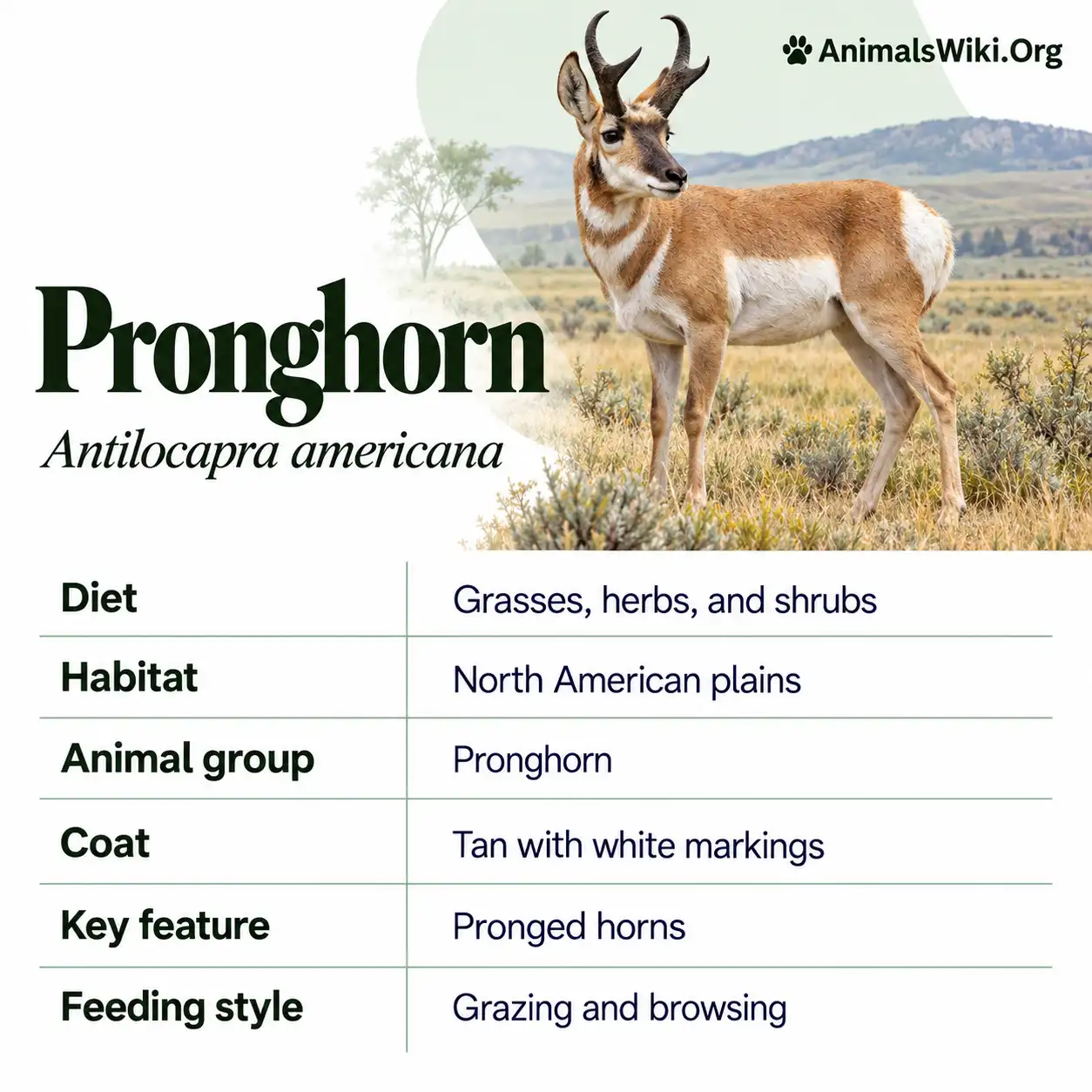
Pronghorn, North America’s Remarkable Runner
The pronghorn is a fast-moving, sharp-eyed mammal of North America’s grasslands, shrublands, and open deserts. Its tan-and-white coat, distinctive horns, and ability to race across wide landscapes make it one of the continent’s most recognizable wild herbivores.
Although frequently called a “pronghorn antelope,” it is not a true antelope. It belongs to its own family, Antilocapridae, and is the only living representative of a once more diverse group.
Speed is its most celebrated characteristic, but there is much more to the animal. Pronghorn have unusual horn sheaths that are shed and replaced, seasonal social groups, selective feeding habits, and migration routes that connect distant habitats.
Their survival also reveals the limits of speed. A pronghorn can outrun many threats across open ground, yet a fence, busy highway, or blocked winter route can create a barrier it cannot easily overcome.
This guide explains pronghorn biology, behavior, reproduction, habitat, and conservation. It also separates well-supported facts from familiar claims about antelope ancestry, extinct predators, and supposedly effortless survival on the plains.
Pronghorn Facts
| Feature | Details |
|---|---|
| Common name | Pronghorn |
| Other names | Pronghorn antelope; American antelope |
| Scientific name | Antilocapra americana |
| Family | Antilocapridae |
| Animal type | Even-toed hoofed mammal |
| Native continent | North America |
| Main countries | Canada, United States, and Mexico |
| Typical shoulder height | Approximately 0.9–1 meter |
| Typical adult weight | Often approximately 40–60 kilograms |
| Diet | Herbivorous; primarily forbs and browse, with variable grass consumption |
| Digestive system | Ruminant with a four-compartment stomach |
| Horn characteristic | Permanent bony cores with replaceable outer sheaths |
| Young animal’s name | Fawn |
| Pregnancy | Approximately eight months |
| Typical offspring | Commonly twins; single births also occur |
| General lifespan | Often described as approximately 7–10 years in the wild |
| Global conservation category | Least Concern |
| Important conservation issue | Maintaining access to connected seasonal habitats |
What Is a Pronghorn?
A pronghorn is a wild North American hoofed mammal adapted to open environments.
Its scientific name is Antilocapra americana. Adults have a relatively lean body, long legs, large eyes, and a coat patterned with reddish-tan, white, and dark markings.
The animal’s identity is distinctive enough that it belongs to a separate family rather than sharing the family of deer, goats, or true antelope.
This makes it an important survivor of North America’s evolutionary history.
However, “survivor” should not imply that the modern species has remained completely unchanged for millions of years. Its lineage has a long history, while living populations continue to experience natural selection and environmental change.
Pronghorn are also more than exceptionally fast runners. Their daily lives involve finding suitable food, monitoring danger, choosing mates, raising young, and moving between resources.
Understanding those activities gives a fuller picture than speed alone.
Is a Pronghorn an Antelope?
Despite the familiar name pronghorn antelope, pronghorn are not true antelope.
Most animals commonly called antelope belong to the family Bovidae, which also includes cattle, sheep, and goats. Pronghorn belong to Antilocapridae.
Their resemblance reflects similarities in body form and ecological demands rather than membership in the same family.
Both may have slender limbs, horns, and adaptations for living in open landscapes. Those similarities make the everyday comparison understandable.
Nevertheless, the distinction matters when explaining anatomy and evolution.
| Feature | Pronghorn | True antelope |
|---|---|---|
| Family | Antilocapridae | Bovidae |
| Native distribution | North America | Primarily Africa and Eurasia |
| Horn covering | Outer sheath is periodically replaced | Usually retained rather than shed annually |
| Living family diversity | One surviving species | Many species |
Using “pronghorn antelope” as a familiar common name is different from stating that the animal is scientifically a bovid antelope.
Classification and Closest Living Relatives
Pronghorn are mammals within the even-toed hoofed group.
Their distinctive family contains only one living species, although numerous extinct relatives are known.
| Classification level | Pronghorn |
|---|---|
| Kingdom | Animalia |
| Phylum | Chordata |
| Class | Mammalia |
| Family | Antilocapridae |
| Genus | Antilocapra |
| Species | Antilocapra americana |
Among living animals, giraffids—the family containing giraffes and the okapi—are recognized as their closest relatives.
That relationship does not mean a pronghorn is a small giraffe or that modern giraffes descended from modern pronghorn.
Both lineages have their own histories following shared ancestry.
This distinction helps avoid a common mistake in evolutionary explanations: related living species are usually cousins on a family tree, rather than one being the direct ancestor of the other.
The pronghorn’s isolation among living relatives makes its survival especially significant.
What Does a Pronghorn Look Like?
Pronghorn have a reddish-tan upper coat with contrasting white areas on the belly, throat, and rump.
Their faces contain dark markings, particularly in adult males. Bucks commonly show a black cheek or jaw patch that helps distinguish them from does.
The white rump patch is especially conspicuous when the hairs stand erect.
Large eyes sit high on the head, supporting a broad view of the surroundings. The ears are upright and mobile.
The body is compact compared with the long, slender legs.
This combination suits movement through open landscapes where detecting a threat early and traveling quickly can be valuable.
Appearance varies with age, sex, season, and individual condition.
A distant animal should therefore be identified using several features together rather than horn size alone.
A hornless-looking animal can still be a pronghorn, especially when small female horns are difficult to see.
How Big Is a Pronghorn?
Pronghorn are medium-sized hoofed mammals.
Many adults stand approximately 0.9–1 meter at the shoulder and weigh around 40–60 kilograms, although individuals vary.
Males generally weigh more than females.
These figures are useful reference ranges rather than strict boundaries for every population. Age, sex, condition, and geographic variation influence measurements.
Shoulder height also differs from the animal’s full height when its head is raised.
The lean outline can make a pronghorn appear lighter than another mammal of similar height.
Its build should not be confused with poor condition simply because it lacks the heavy body of a bison or the larger frame of an elk.
For wildlife assessment, observers need to understand the species’ normal proportions.
Changes in movement, muscle, body condition, and behavior provide more information than a simple comparison with a different hoofed animal.
Why Are Pronghorn Horns Unusual?
Each pronghorn horn has a permanent bony core covered by an outer sheath made largely of keratin.
Keratin is the structural material also found in mammalian hair and nails.
The unusual feature is that the outer sheath is shed and replaced. The underlying bony core remains.
Adult males typically develop conspicuous horns with a forward-pointing prong and a longer tip curving backward.
Females may have much smaller horns, and some lack visible headgear altogether.
Consequently, the statement that every female has a miniature version of the male’s horns is inaccurate.
Horn development also varies with age and individual condition.
The pronghorn’s headgear combines features that make familiar categories less tidy than they first appear.
It is not simply a deer antler covered in black material, nor is it identical to a bovid horn that remains covered by the same growing sheath throughout life.
Pronghorn Horns vs Deer Antlers
Horns and antlers differ in structure and development.
Deer antlers are bone. They grow from permanent skull structures and are usually shed and regrown as complete antlers.
Pronghorn retain their bony horn cores while replacing the outer covering.
| Feature | Pronghorn headgear | Deer antlers |
|---|---|---|
| Main visible outer material | Keratin sheath | Bone |
| Permanent underlying structure | Bony horn core | Pedicle supporting antler growth |
| What is shed | Outer sheath | The antler |
| Typical adult male form | Pronged horn sheath | Often branched antler |
| Female occurrence | Variable | Uncommon in most deer species, with notable exceptions |
This comparison explains why saying “pronghorn shed their horns” is incomplete.
The phrase is understandable in casual conversation, but the anatomical detail matters: the outer sheath is replaced while the core remains.
That replacement cycle is one of the species’ most distinctive characteristics.
How Fast Can a Pronghorn Run?
Pronghorn are widely recognized as North America’s fastest land mammals.
Many wildlife accounts describe running speeds around 45–55 miles per hour, approximately 72–89 kilometers per hour.
Published top-speed claims vary, and they should not be treated as precisely measured records applying to every individual.
Terrain, distance, age, condition, and measurement method all affect the result.
The distinction between maximum speed and sustained running is also important. An animal’s brief sprint does not describe the pace it maintains over a long journey.
Pronghorn are remarkable because they combine high speed with strong endurance.
Nevertheless, visitors should never chase them to test those abilities.
Being capable of running quickly does not make repeated disturbance harmless. Flight requires energy and can separate animals from feeding areas, companions, or young.
Their speed is a biological adaptation, not an invitation for pursuit.
Why Are Pronghorn Such Good Distance Runners?
Running requires muscles to receive energy and oxygen.
Pronghorn have an exceptional capacity to support aerobic activity, meaning activity fueled substantially through oxygen-dependent metabolism.
A classic physiological study examined whether their performance resulted primarily from unusually economical movement or from an exceptional ability to supply oxygen.
The research demonstrated very high aerobic capacity.
This helps explain why the animal’s reputation should not be based only on long legs or a streamlined body.
The cardiovascular system, lungs, blood, muscles, and movement mechanics operate together.
However, high endurance does not mean a pronghorn can run indefinitely or maintain its maximum speed for an arbitrary distance.
Fatigue, temperature, terrain, and physical condition still matter.
The impressive feature is the coordinated system supporting performance.
Understanding that system gives a more accurate explanation than claiming that one enlarged organ alone produces the animal’s abilities.
Did Pronghorn Evolve to Escape Extinct Cheetahs?
One well-known hypothesis connects pronghorn speed with extinct North American predators, especially the cat Miracinonyx, often called the American cheetah.
The idea is plausible enough to have attracted scientific investigation, but it should not be presented as a fully demonstrated explanation for every aspect of pronghorn evolution.
Researchers continue to examine the extinct cat’s relationships, habitat use, and diet.
The term “American cheetah” can also encourage assumptions based too directly on the living African cheetah.
A predator’s body shape does not reveal its entire ecology.
The careful conclusion is that extinct predators may have influenced the evolution of fast-running North American herbivores, while the specific historical relationships remain subjects of research.
Modern pronghorn still experience predation.
They are not animals whose only meaningful threat disappeared thousands of years ago.
Eyesight and Early Detection
Pronghorn have large eyes positioned to provide a broad view of their surroundings.
This is valuable in open country, where seeing movement at a distance can provide time to respond.
Their survival strategy combines detection with rapid movement.
Speed is more useful when an animal notices danger before a predator is already close.
However, excellent eyesight does not provide perfect awareness. Terrain, vegetation, light, attention, and predator behavior influence what can be detected.
Claims comparing vision with a particular pair of binoculars are usually simplifications.
A more useful explanation is that pronghorn are strongly adapted to monitoring open landscapes.
This also helps explain why dense cover or poorly placed barriers can change their experience of a habitat.
An area may contain food while offering visibility or escape options that make it less attractive than an apparently similar open area nearby.
Where Do Pronghorn Live?
Pronghorn are native to North America, occurring in parts of Canada, the United States, and Mexico.
Their modern distribution is concentrated in western and central regions of the continent.
They are associated with landscapes such as the Great Plains, sagebrush country, intermountain basins, and northern Mexican deserts.
However, not every suitable-looking area contains a population.
Historical declines, land conversion, barriers, and restoration efforts have shaped the present range.
Distribution should also be distinguished from abundance.
A species can occur across several countries while individual populations remain isolated or vulnerable.
Some populations are large enough to support carefully regulated hunting programs, while others require intensive recovery work.
The broad geographic range therefore does not describe one uniform conservation situation.
Understanding where pronghorn live requires looking at regional populations and the connections among their seasonal habitats.
What Habitat Does a Pronghorn Need?
Pronghorn generally favor open grasslands and shrublands with good visibility.
Suitable habitat needs to provide food, room to move, and access to resources across seasons.
This does not mean the ideal landscape is completely bare.
Forbs, shrubs, and patches of taller vegetation can be important, particularly for feeding and fawn concealment.
The needs of an adult scanning for predators differ from those of a newborn remaining hidden.
Habitat quality therefore involves variety at an appropriate scale.
A landscape dominated by one uniform vegetation type may not provide everything required throughout the year.
Researchers and managers consider feeding areas, birth sites, winter range, migration corridors, and stopovers together.
This broader view prevents the mistake of measuring habitat only by the number of open acres.
Accessible, connected, and seasonally useful land matters more than open space alone.
What Do Pronghorn Eat?
Pronghorn are herbivores, but describing them simply as grass eaters is misleading.
Forbs—broad-leaved herbaceous plants—are important in many diets. Shrubs and other browse can also make substantial contributions.
Grass consumption varies with location and season and is often smaller than people expect.
Plant selection changes as vegetation develops and nutritional demands shift.
A female supporting growing fawns may face different requirements from an animal maintaining itself during another season.
Research using plant DNA in fecal samples has documented seasonal diet composition across pronghorn populations in Idaho.
Such work shows why one fixed percentage should not be applied to the entire species.
The important point is selective feeding.
Pronghorn choose among available plants and plant parts rather than consuming every type of vegetation equally.
Protecting diverse native forage can therefore be more valuable than assuming any grassy field is adequate habitat.
Digestion and Water
Pronghorn are ruminants with a four-compartment stomach.
Microorganisms help break down plant material, and the animals regurgitate partly processed food to chew it again.
This digestive system supports the use of fibrous vegetation, but nutritional quality still matters.
A stomach capable of fermentation cannot compensate indefinitely for an unsuitable diet.
Water needs vary with temperature, activity, reproductive condition, and moisture obtained from plants.
In dry environments, succulent vegetation can contribute meaningfully to hydration.
However, this should not become the blanket claim that pronghorn never need drinking water.
Water availability and drought can strongly influence survival, especially in desert populations.
Food and water are also connected. Rain affects plant growth, which changes both nutrient availability and the moisture animals obtain while feeding.
The relevant conservation unit is the functioning landscape, not a water source considered separately from vegetation and movement.
Social Groups Through the Seasons
Pronghorn social organization changes through the year.
Males may occur alone or in bachelor groups, while females and young associate in smaller groups.
Winter can bring larger mixed groups containing different ages and sexes.
These patterns vary with population density, resources, and local conditions.
A large winter gathering is not necessarily a permanent herd whose members remain together throughout their lives.
Group living can provide advantages through shared vigilance, but it also involves interactions over food, space, and mating opportunities.
The balance changes seasonally.
For observers, this means that behavior seen during one visit should not be assumed to describe the entire year.
A solitary male during the breeding season and a large winter group may represent normal parts of the same population’s annual cycle.
Long-term observation reveals those changes more clearly than a single photograph.
Communication and the White Rump Patch
The pronghorn’s white rump patch is among its most noticeable markings.
When the hairs stand erect, the patch becomes more conspicuous and can help signal alarm to nearby animals.
Communication also involves posture, movement, scent, and vocalization.
An animal suddenly raising its head may be gathering information rather than preparing to flee immediately.
Other group members can respond to that change.
This shared awareness is part of life in open environments where threats may be detected at a distance.
Nevertheless, one signal should not be translated into an exact human emotion without context.
An approaching person, vehicle, predator, or unfamiliar object may produce different responses.
For wildlife viewers, repeated alert behavior is useful information: the animals may need more space.
Remaining motionless does not necessarily mean a pronghorn is relaxed or comfortable with continued approach.
Breeding Season and Mate Choice
The breeding season, often called the rut, commonly occurs in late summer or autumn, with regional variation.
Males may defend territories, compete within dominance relationships, or remain associated with groups of females.
There is no single rigid breeding arrangement used identically by all populations.
Resource distribution, density, and sex ratio can influence the system.
Females also participate actively in mate choice rather than simply belonging permanently to the first male nearby.
Competition can involve displays, chasing, and physical encounters.
These activities require energy and can alter how much time animals spend feeding or resting.
The breeding season therefore connects social behavior with body condition and the demands of the following months.
Descriptions of spectacular male contests should not overshadow the wider process.
Successful reproduction depends on females, resources, pregnancy, and the survival of young as well as competition among bucks.
Pregnancy, Twins, and the Fawn Hiding Strategy
Pregnancy lasts approximately eight months.
Females commonly produce twins, although single births also occur.
In many northern populations, births are concentrated in late spring or early summer.
Newborns initially rely on concealment rather than immediately following their mother everywhere.
A doe may leave fawns hidden separately and return to nurse them.
This is an important anti-predator strategy, not evidence that the mother has lost interest.
A fawn lying alone in vegetation should therefore not automatically be treated as abandoned.
People who approach, handle, feed, or move it can interfere with normal care.
If an animal appears injured or is in immediate danger, the appropriate response is to contact the responsible wildlife authority.
The central lesson is simple: absence of the mother from view does not establish absence of maternal care.
Observation from a distance protects the strategy the animals naturally use.
Lifespan and the Challenges of Early Life
Pronghorn are often described as living approximately 7–10 years in the wild, although some individuals live longer.
Potential lifespan differs from average survival.
Fawns face different risks from established adults, and recruitment can vary greatly between years.
Weather, vegetation, maternal condition, predators, and disturbance all influence early survival.
A population count alone does not reveal whether enough young are reaching adulthood.
This is why researchers monitor reproduction and survival alongside abundance.
A 2026 study of a declining Oklahoma population documented low early fawn survival and substantial predation, particularly by coyotes.
Those findings describe a specific study, not a universal mortality rate for every pronghorn population.
Their broader value is showing how detailed monitoring can identify the processes limiting population growth.
The number of adults present today is only part of understanding the population’s future.
What Predators Hunt Pronghorn?
Predators can include coyotes, mountain lions, wolves, and other carnivores, depending on location and the age of the prey.
Very young fawns can also face threats that differ from those experienced by adults.
Coyotes are particularly important in some studies of fawn mortality.
A fast adult is not representative of every life stage.
Predators can exploit concealment failures, close approaches, poor condition, difficult terrain, or the vulnerability of newborns.
This explains why speed does not eliminate predation.
Nor does the presence of predators automatically explain every population decline.
Habitat quality, weather, disease, and barriers can interact with predation.
Management decisions need evidence about the particular population rather than assumptions based only on which carnivores occur nearby.
A healthy ecosystem includes predator–prey relationships, while conservation seeks to understand when additional pressures make those relationships more difficult for vulnerable populations.
Do Pronghorn Migrate?
Some pronghorn migrate between seasonal ranges, while others remain relatively resident.
Movement strategies vary across populations and can change with environmental conditions.
Migration can provide access to better forage, less restrictive snow conditions, and suitable breeding or wintering areas.
The route itself matters because animals need to travel between useful places.
A protected summer range is insufficient if winter habitat becomes inaccessible.
Stopover areas can also be important, allowing animals to feed and recover during movement.
This means a migration corridor is more than a narrow line connecting two points on a map.
It is a functioning landscape containing resources and opportunities to pass safely.
Modern tracking has revealed extensive pronghorn movements and the obstacles encountered along them.
Conserving migration requires cooperation across property boundaries, roads, public lands, and jurisdictions.
The Path of the Pronghorn
The Path of the Pronghorn is a well-known migration associated with the Greater Yellowstone region.
Animals using this route move between summer areas near Grand Teton and seasonal habitats farther south and east.
The route has become an important example of why conservation must extend beyond park boundaries.
Pronghorn encounter development, roads, fences, and narrow passage points along the journey.
A bottleneck can matter disproportionately because many animals may depend on a small amount of usable space.
Protecting a large area elsewhere does not necessarily compensate for blocking that passage.
The migration is also a practical demonstration of the difference between protecting animals and protecting their ability to move.
Both are necessary.
Tracking, land-use planning, crossing structures, and cooperation with landholders can help maintain the ecological connection between seasonal ranges.
Why Are Fences Difficult for Pronghorn?
Pronghorn commonly prefer to move under fences rather than jump over them.
They are not physically incapable of jumping, but their usual crossing behavior differs from that of many deer.
A fence with little clearance, tightly woven wire, or unsuitable crossing points can therefore become a substantial obstacle.
The effects include delay, repeated searching, injury, and complete loss of access.
During severe weather, those consequences can become especially serious.
An animal that cannot reach usable winter habitat may face increasing energy demands while food becomes harder to obtain.
Fence modification can preserve livestock management while improving wildlife passage.
A 2026 U.S. Fish and Wildlife Service account described a Wyoming project replacing more than 24 miles of restrictive fencing with more wildlife-compatible designs.
This illustrates how a relatively ordinary feature of working landscapes can have major ecological consequences.
Roads and Wildlife Crossings
Roads affect pronghorn through collision risk, traffic disturbance, and associated barriers.
Even where animals are not struck, a busy road can interfere with access to habitat.
Crossing structures can help, but effectiveness depends on location, design, fencing, and the animals’ behavior.
A structure built without understanding movement routes may receive less use than expected.
Pronghorn may also need time to become accustomed to a new crossing.
Research in the Greater Yellowstone ecosystem documented behavioral responses and gradual acclimation to structures built within a historical migration corridor.
This shows why monitoring after construction matters.
Installing infrastructure is an action; demonstrating that it restores movement is an outcome.
Good projects evaluate both.
The broader objective is to reduce risk while maintaining connections, rather than simply counting how many crossings have been built.
Winter, Snow, and Access to Food
Winter can create difficult conditions for pronghorn.
Deep or crusted snow can restrict movement and make preferred plants less accessible.
Cold conditions also increase the importance of conserving energy and reaching suitable range.
The challenge is therefore not temperature alone.
An animal may tolerate cold while still struggling because it cannot move efficiently or obtain enough food.
Barriers compound the problem when they prevent a response to changing conditions.
This is why winter range and migration corridors are closely connected conservation priorities.
A route that appears unnecessary during mild weather may become essential during a severe season.
Climate-related changes can also alter the timing and severity of conditions.
Planning should preserve flexibility so animals can respond across the landscape.
Protecting only the locations used during an average year may overlook the places needed during an unusually demanding one.
Pronghorn and Their Ecological Role
Pronghorn contribute to ecosystems through selective feeding, movement, nutrient return, and their role as prey.
Their preference for forbs and browse means their use of vegetation can differ from that of large grass-focused grazers.
This distinction can help different herbivores share a landscape, although competition still depends on local conditions.
Their dung and urine return nutrients to the environment, while carcasses provide resources for scavengers and decomposers.
They also connect seasonal habitats through migration.
The ecological importance of a population therefore extends beyond the number of animals standing in one field.
A healthy population can maintain interactions across a much larger area.
Conversely, a population confined behind barriers may remain visible while losing part of its former ecological role.
Conservation benefits from considering behavior and processes alongside abundance.
Keeping animals present is important; allowing them to function within the ecosystem is equally valuable.
Historical Decline and Recovery
Pronghorn experienced major declines as North American landscapes changed.
Unregulated hunting, settlement, habitat conversion, and barriers reduced populations and eliminated them from some areas.
Later protection, regulated management, habitat work, and reintroductions supported recovery.
This history is important because present abundance should not be mistaken for uninterrupted security.
Recovery also occurred unevenly.
A successful reintroduction in one region does not mean the same methods will work automatically elsewhere.
Animals require suitable habitat, space, and access to resources after release.
The history of pronghorn at Wind Cave, for example, illustrates how reintroduction outcomes were affected by the amount of space available.
Restoration is therefore more than transporting animals to a place where they once occurred.
The conditions that allow survival and reproduction need to be present as well.
Continued monitoring helps determine whether those conditions remain adequate.
Is the Pronghorn Endangered?
The pronghorn species is globally classified as Least Concern.
However, that overall category does not describe every subspecies or local population.
Some have much smaller ranges and face more serious conservation problems.
The Sonoran and peninsular pronghorn are particularly important examples.
It is therefore possible for the species to be relatively widespread overall while a particular form remains endangered.
This distinction also applies to different assessment systems.
An IUCN category, a national endangered-species listing, and a local management designation answer different questions.
They should not be combined into one vague statement that all pronghorn are either safe or endangered.
Accurate reporting identifies the animal group, geographic scope, and assessment being discussed.
The practical conclusion is that overall recovery has not removed the need for targeted conservation.
Protecting migration routes and vulnerable populations remains important even where larger populations persist.
The Sonoran Pronghorn
The Sonoran pronghorn, Antilocapra americana sonoriensis, occurs in the Sonoran Desert region of Arizona and northwestern Mexico.
It faces the combined challenges of a restricted population, severe drought, habitat fragmentation, and limited access to resources.
A major drought in 2002 reduced the U.S. population dramatically and helped drive intensive recovery efforts.
Those efforts include managed breeding, releases, monitoring, and support during difficult conditions.
Recovery requires cooperation among wildlife agencies, land managers, researchers, and other partners.
The work also demonstrates why desert adaptation does not make an animal immune to drought.
Rain influences vegetation, which affects food quality, moisture intake, and the ability of females to support fawns.
The success of a release depends on what happens afterward.
Monitoring survival and reproduction helps determine whether conservation actions are producing a self-sustaining population rather than only increasing the number of animals temporarily present.
The Peninsular Pronghorn
The peninsular pronghorn, Antilocapra americana peninsularis, is associated with Mexico’s Baja California peninsula.
Its restricted distribution and historical decline make it an important conservation priority.
It should not be treated as simply another large population within the broader species.
Recovery programs have involved managed breeding and efforts to support populations in suitable habitat.
Zoos and conservation organizations have participated, but breeding alone cannot replace protection of the environment in which animals must eventually live.
Food, water, connected space, and reduced disturbance remain central.
Population estimates can change quickly and may distinguish wild, managed, and semi-managed animals.
For that reason, an old headline figure should not be presented as a permanent current total.
The useful conservation message is the continued need for coordinated management of a geographically restricted form, even while the pronghorn species remains Least Concern overall.
Coexistence, Research, and Practical Conservation
Pronghorn conservation often takes place in working landscapes rather than exclusively inside parks.
Private landholders, ranchers, Tribal nations, government agencies, and conservation groups can all influence access to habitat.
Practical measures include maintaining suitable forage, modifying barriers, protecting crossing points, and considering movement during development planning.
Research helps identify where those actions matter most.
GPS collars can reveal migration routes, delays at fences, seasonal range use, and responses to changing conditions.
However, tracking data still need interpretation.
A location tells researchers where an animal was, while field observations, vegetation information, and survival monitoring help explain why it was there.
Combining methods provides a stronger basis for decisions.
Current USGS migration reports illustrate this approach by mapping seasonal ranges, routes, and barriers across western populations.
The goal is to turn information into functioning connections that animals can continue using.
Responsible Pronghorn Viewing
Pronghorn are best observed from a distance with binoculars or a camera lens.
Avoid approaching closely, surrounding groups, or positioning people and vehicles across their route.
Do not chase animals to see how fast they run.
Repeated flight uses energy and can interfere with feeding, resting, or maternal care.
Fawns require particular restraint. A young animal lying alone may be behaving normally while its mother remains elsewhere.
Keep pets under control and follow local wildlife-viewing rules.
Feeding is also inappropriate.
Human food and sudden access to concentrated feeds can create health problems, while attracting animals toward roads or settlements adds further risk.
An animal that raises its head repeatedly, stops feeding, or moves away is providing useful information about the interaction.
Give it more space.
The most rewarding observation is often one in which natural behavior continues without an obvious response to the viewer.
Common Pronghorn Myths
| Myth | More accurate explanation |
|---|---|
| A pronghorn is a true antelope | It belongs to the separate family Antilocapridae |
| It is a type of deer | It is neither a deer nor a bovid |
| Every female has obvious horns | Female headgear is variable and may be absent |
| It sheds the entire bony horn | The outer sheath is replaced while the core remains |
| Speed makes it safe from predators | Fawns and adults can still be prey |
| Extinct cheetahs fully explain its evolution | That connection remains a hypothesis under investigation |
| It eats mainly grass everywhere | Forbs and browse are important in many diets |
| A lone fawn is abandoned | Concealment away from the mother is normal early behavior |
| Pronghorn cannot jump at all | They commonly prefer passing under fences |
| Least Concern means every population is secure | Some subspecies and local populations require intensive conservation |
Frequently Asked Questions About Pronghorn
What is a pronghorn?
A pronghorn is a North American hoofed mammal, scientifically named Antilocapra americana. It is known for its speed, sharp vision, tan-and-white coat, and unusual horn sheaths.
Is a pronghorn an antelope?
It is commonly called an antelope, but it is not a true antelope scientifically. It belongs to Antilocapridae rather than Bovidae.
Is a pronghorn a deer?
No. Deer belong to Cervidae. Pronghorn belong to a separate family and have different headgear, anatomy, and evolutionary history.
What are its closest living relatives?
Its closest living relatives are giraffids, including giraffes and the okapi. That relationship reflects shared ancestry rather than direct descent from a modern giraffe.
How fast can a pronghorn run?
Many wildlife references describe speeds around 45–55 miles per hour. Exact claims vary, and top speed should be distinguished from the pace maintained over longer distances.
Is it faster than a cheetah?
Cheetahs have the advantage in maximum sprint speed. Pronghorn are especially notable for combining high speed with strong endurance. Comparisons depend on distance and conditions.
Did extinct American cheetahs cause its speed?
That is a well-known evolutionary hypothesis. Researchers continue to investigate the extinct predators’ ecology and relationships, so it should not be presented as a completely settled explanation.
Do female pronghorn have horns?
Many have small horns, but some lack visible headgear. Females do not generally carry the large, conspicuously pronged horns typical of adult males.
Do pronghorn shed their horns?
They replace the outer keratin sheaths. The permanent bony cores remain attached, which distinguishes the process from shedding a deer antler.
Why are they called pronghorn?
The name refers to the distinctive forward-pointing prong on the male’s horn sheath, below the longer backward-curving tip.
Where do pronghorn live?
They occur in parts of Canada, the United States, and Mexico, mainly in open western and central North American landscapes.
What do pronghorn eat?
They eat a variety of plants, with forbs and shrubs especially important in many populations. Diet changes with season and local availability.
Do pronghorn chew cud?
Yes. They are ruminants and regurgitate partly processed food to chew it again. Microorganisms in the digestive system help process plant material.
Do they need drinking water?
Yes, although moisture from plants can contribute to hydration. Water requirements vary with temperature, diet, activity, and reproductive condition.
What is a male pronghorn called?
An adult male is called a buck. A female is a doe, and a young pronghorn is a fawn.
Do pronghorn usually have twins?
Twins are common, although single births occur. Reproductive outcomes vary with the female and her circumstances.
How long is a pronghorn pregnant?
Pregnancy lasts approximately eight months. Birth timing varies geographically, with many northern populations producing fawns in late spring or early summer.
Why is a fawn lying alone?
Young pronghorn initially use concealment. Their mother may be feeding elsewhere and returning to nurse. Being alone does not automatically mean abandonment.
What predators hunt pronghorn?
Predators vary by location and age of the prey. Coyotes are particularly important for fawns in some populations, while larger carnivores can also take pronghorn.
How long do pronghorn live?
Wild lifespans are often described as approximately 7–10 years, although some individuals live longer. Average survival differs from maximum possible age.
Can pronghorn jump fences?
They can jump, but often prefer to crawl underneath. Restrictive fencing can therefore block movement even where another hoofed species might cross.
Do all pronghorn migrate?
No. Some populations migrate between seasonal ranges, while others are relatively resident. Environmental conditions can influence movement strategies.
Are pronghorn endangered?
The species is globally Least Concern, but some subspecies and local populations are endangered or require special management.
What is the Sonoran pronghorn?
It is a desert subspecies associated with Arizona and northwestern Mexico. Recovery efforts address drought, population vulnerability, and habitat-related pressures.
Why are wildlife corridors important?
They allow pronghorn to move between feeding, breeding, and winter habitats. Protecting isolated areas is insufficient when the routes connecting them become unusable.
Pronghorn (Antilocapra americana)
The pronghorn is far more than a fast animal on the plains.
It is the only living representative of a distinctive family, with unusual replaceable horn sheaths, exceptional aerobic abilities, selective feeding habits, and complex seasonal movements.
Its biology also demonstrates that speed has limits. A fence, blocked corridor, severe winter, or shortage of suitable forage can create problems that running ability cannot solve.
Conservation therefore depends on connected landscapes, practical cooperation, and attention to vulnerable populations.
The species’ overall recovery is meaningful, but it does not erase the challenges facing Sonoran, peninsular, and isolated local populations.
Understanding pronghorn means appreciating both their remarkable physical abilities and the ecological connections that allow those abilities to support a full life in the wild.



