
Przewalski’s Horse, Habitat, Diet, Behavior and Conservation
Przewalski’s horse has a conservation story unlike that of almost any other large mammal. It disappeared from the wild, survived through a small population in human care, and eventually returned to the landscapes where its ancestors once lived.
Today, these stocky horses once again graze in parts of Central Asia. Their upright manes, pale muzzles, dark legs, and sandy coats give them a distinctive appearance. Their daily lives involve much more than survival in harsh weather: they form social relationships, raise foals, communicate through subtle signals, and influence the grasslands around them.
Often called the Mongolian wild horse or takhi, Przewalski’s horse also helps scientists explore the complicated history of horse evolution and domestication. Ancient DNA has revealed connections that challenge some familiar descriptions of this animal.
Despite its recovery, Przewalski’s horse remains Endangered. Protecting it requires suitable habitat, healthy breeding populations, genetic management, and cooperation with local communities.
This guide explains its appearance, habitat, diet, behavior, reproduction, conservation history, and the research shaping its future.
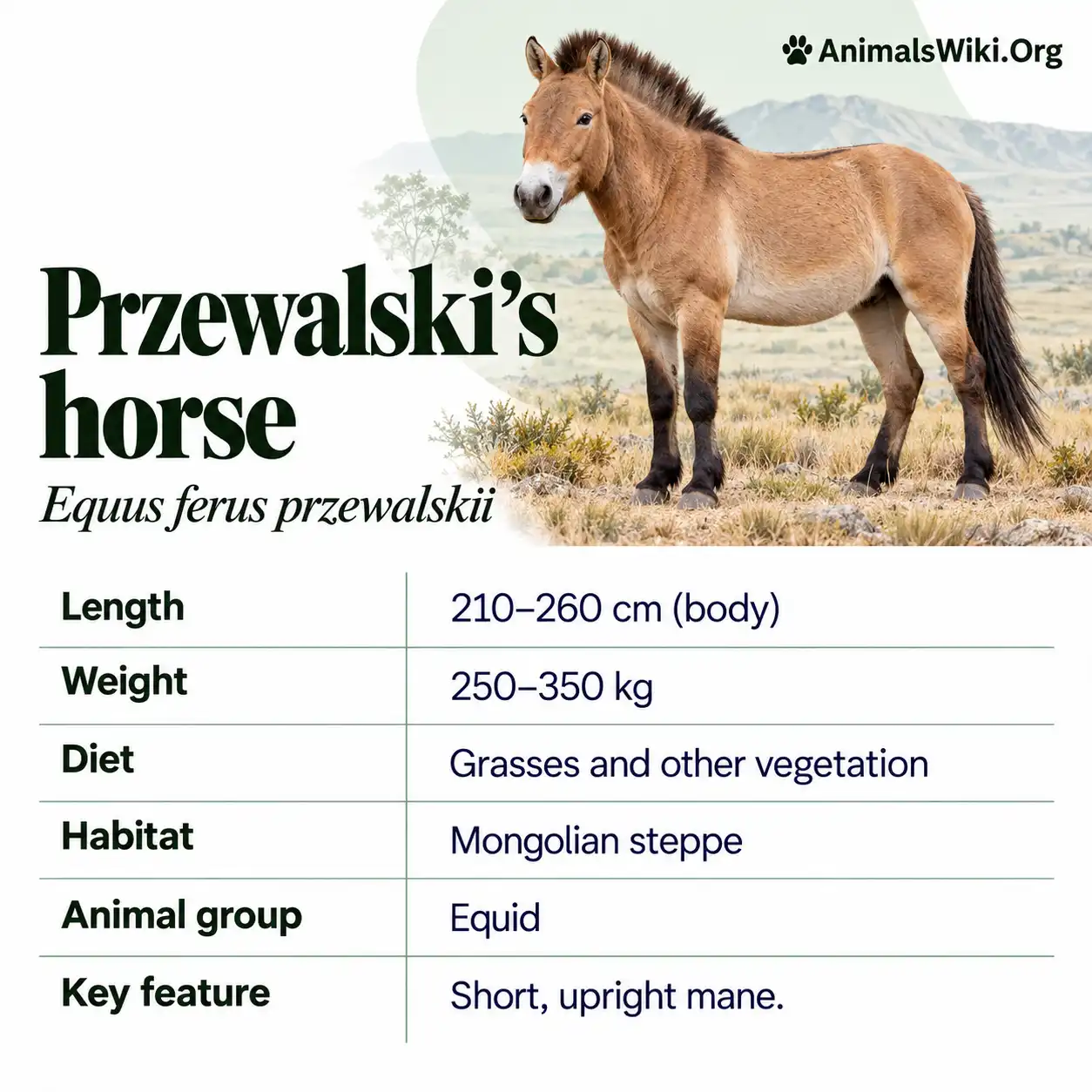
Przewalski’s Horse Facts
| Feature | Details |
|---|---|
| Common name | Przewalski’s horse |
| Other names | Takhi, Mongolian wild horse, Asiatic wild horse |
| Scientific names used | Equus ferus przewalskii and Equus przewalskii |
| Animal group | Mammal |
| Family | Equidae |
| Native region | Central Asia |
| Main habitats | Steppe, grassland, and some semiarid landscapes |
| Diet | Grasses and other vegetation |
| Typical build | Compact body, thick neck, relatively short legs |
| Distinctive features | Upright mane, pale muzzle, dark dorsal stripe |
| Typical reference weight | Approximately 200–300 kilograms; individuals vary |
| Social groups | Family bands and bachelor groups |
| Pregnancy | Approximately 11 months |
| Typical offspring | One foal |
| Conservation status | Endangered |
| Major concerns | Small populations, habitat pressures, severe weather, disease, and genetic diversity |
1. What Is Przewalski’s Horse?
Przewalski’s horse is a distinctive horse lineage native to Central Asia. It belongs to the same family as domestic horses, zebras, and asses, but it has its own evolutionary history and recognizable physical characteristics.
Unlike the many domestic horse breeds developed for riding, racing, or agricultural work, it is maintained through conservation programs intended to preserve its genetic identity and restore viable populations.
The animal is particularly important because it survived the disappearance of its wild populations. Horses kept in managed collections became the foundation for later breeding and reintroduction efforts.
Its recovery should not be confused with the creation of a new breed. Conservationists have worked to preserve an existing lineage and return its descendants to suitable habitat.
Przewalski’s horse therefore represents both a living animal and a continuing effort to repair a major loss from Central Asian ecosystems.
2. How Do You Pronounce Przewalski’s Horse?
The name looks difficult because English spelling conventions do not provide an obvious pronunciation.
A commonly used English approximation is “shuh-VAL-skeez horse.” Other pronunciations occur, reflecting different treatments of the surname and its linguistic history.
The animal was named after the nineteenth-century explorer Nikolai Przewalski, whose name also appears in alternative transliterations. Scientific description followed the collection and examination of specimens.
However, the horse was already known to people living within its range. Its introduction to European scientific literature was not its first recognition by humans.
For readers who prefer a shorter name, takhi is widely used in discussions of Mongolian conservation.
Using the local name also helps keep the animal’s story connected to the landscapes and communities that have known it for generations.
3. Scientific Classification
Przewalski’s horse belongs to Equidae, the horse family.
Its broader classification places it among the Perissodactyla, or odd-toed ungulates. This order also includes rhinoceroses and tapirs, although those animals look quite different from horses.
Two scientific names commonly appear:
- Equus ferus przewalskii, treating it as a subspecies.
- Equus przewalskii, treating it as a separate species.
These alternatives reflect differences in taxonomic interpretation. Readers may encounter both in credible scientific and conservation sources.
The disagreement over rank does not mean researchers are discussing unrelated animals. Both names refer to the horse described in this article.
For conservation purposes, the practical priority is maintaining the distinct population and its evolutionary diversity. Whether a particular authority uses species or subspecies rank, the animal’s vulnerability and need for protection remain substantial.
4. Przewalski’s Horse vs. Domestic Horses and Mustangs
Przewalski’s horse, domestic horses, and mustangs are closely related, but their histories differ.
Domestic horse breeds developed through long relationships with people. Mustangs descend from domestic horses that established free-roaming populations. Przewalski’s horse preserves a separate lineage that conservation programs aim to maintain.
| Feature | Przewalski’s horse | Domestic horse | Mustang |
|---|---|---|---|
| Main identity | Distinct conservation lineage | Domesticated horse lineage | Feral domestic horse population |
| Typical mane | Short and upright | Highly variable | Highly variable |
| Coat appearance | Usually sandy or reddish brown with darker markings | Many colors and patterns | Many colors and patterns |
| Relationship with people | Conservation breeding and reintroduction | Breeding and management for many purposes | Free-roaming, with management varying by location |
| Main conservation context | Recovery from extinction in the wild | Depends on breed or population | Habitat, welfare, and population management |
Living without a rider does not automatically make every horse biologically equivalent to Przewalski’s horse.
Ancestry, genetic identity, and management history provide the more useful distinctions.
5. Is Przewalski’s Horse Truly Wild?
Przewalski’s horse is frequently described as the world’s last surviving wild horse. That description communicates its conservation importance, but its ancient relationship with people is more complicated than older summaries suggested.
A major ancient DNA study published in 2018 connected Przewalski’s horses with horses associated with the Botai culture in ancient Kazakhstan. The researchers interpreted the animals as descendants of horses that people had herded.
Later work questioned aspects of the archaeological evidence for early domestication at Botai. Other researchers have continued to support forms of husbandry there.
The safest explanation is that Przewalski’s horse represents a distinct surviving lineage with a debated ancient management history.
Its conservation value does not disappear because scientific understanding becomes more detailed. Preserving this lineage remains important regardless of how the earliest human–horse relationship is ultimately described.
6. What Does Przewalski’s Horse Look Like?
Przewalski’s horse has a compact body, thick neck, relatively short legs, and a large-looking head.
Its coat is usually sandy, yellowish brown, or reddish brown. The belly and muzzle are lighter, while the mane, tail, and lower legs are darker.
A dark dorsal stripe extends along the back. Some individuals also show faint striping on the legs.
The mane stands upright rather than falling along the neck, and the long forehead hair known as a forelock is generally absent.
These features give the animal an appearance quite different from many familiar riding horses.
However, photographs should still be interpreted carefully. Season, lighting, age, and body condition affect appearance. Foals can look lighter than adults, while a thick winter coat can make an animal appear larger and rounder than it does in summer.
7. How Big Is Przewalski’s Horse?
Przewalski’s horse is relatively small and sturdy compared with many domestic riding and working horses.
A San Diego Zoo Wildlife Alliance reference gives a typical weight of approximately 200–300 kilograms, or around 440–660 pounds. Other profiles report broader weight ranges, reflecting variation among animals and reference populations.
Average shoulder heights in the same reference are approximately 1.37 meters for females and 1.42 meters for males.
Horse height is measured at the withers, where the neck meets the back, rather than at the top of the head.
Its relatively modest height should not be mistaken for weakness. The compact body and muscular limbs support movement across demanding terrain.
Measurements also need context: sex, age, nutritional condition, and individual differences prevent one number from accurately describing every adult.
8. Adaptations to Cold and Wind
Central Asian environments can expose horses to bitter winters, strong winds, and large seasonal changes.
Przewalski’s horses develop thick winter coats that improve insulation. Their appearance changes as the coat grows and later sheds with the seasons.
Behavior also helps them cope. They can adjust where they rest, when they feed, and how they position their bodies during poor weather.
Their survival depends on the interaction between these adaptations and the resources available. A winter coat cannot compensate indefinitely for inaccessible food or prolonged nutritional stress.
This distinction matters because an animal can be well adapted to cold without being safe from every severe winter.
Conservation planning must therefore consider shelter opportunities, forage access, body condition, and the ability to move between usable parts of a landscape.
9. Historical Distribution
Przewalski’s horses are associated with the steppes and adjoining dry regions of Central Asia.
Historical records and scientific research indicate that their distribution contracted substantially before the final disappearance of wild populations. By the period when detailed modern observations became available, surviving animals occupied only a limited portion of their former range.
This creates a challenge when interpreting habitat preferences.
The last place where an animal survives may be a refuge from people rather than its most productive habitat. A population pushed into dry country does not necessarily represent an animal specialized exclusively for desert conditions.
For Przewalski’s horse, historical distribution must therefore be considered alongside evidence about human pressure, grazing opportunities, and water access.
Its conservation story is partly about returning horses to functioning landscapes, rather than simply reproducing the conditions of their final retreat.
10. Where Does Przewalski’s Horse Live Today?
Today, Przewalski’s horses occur in reintroduced populations, semi-reserves, and conservation breeding facilities.
Mongolia is central to the recovery story. China also supports reintroduction programs, while Kazakhstan has become an important recent addition to efforts within the horse’s historical Central Asian range.
Managed populations in other countries help maintain breeding options, genetic representation, and animals potentially suitable for future transfers.
These populations do not all have the same degree of independence. Some horses range through extensive protected landscapes, while others occupy fenced reserves or zoo environments.
The distinction matters when discussing numbers and conservation progress.
An animal living in a breeding facility contributes differently from one reproducing successfully in an open landscape. Both may be valuable, but neither should be used as a substitute for understanding the other.
11. Przewalski’s Horse Habitat
Suitable habitat must supply food, water, space, and opportunities to respond to seasonal conditions.
Steppe grasslands are particularly important because they provide extensive grazing. Some populations also occupy semiarid landscapes containing a mixture of grasses, herbs, and shrubs.
Habitat quality changes over time. A productive spring range may offer limited food later in the year, while snow or ice can temporarily restrict access to vegetation.
Human activity also shapes suitability. Fences, roads, livestock concentrations, and development can interrupt movement or increase competition.
A large protected area is not automatically good horse habitat if essential resources are missing or inaccessible.
For reintroduction, conservationists must assess how the landscape functions throughout the year. The real test is whether horses can maintain condition, reproduce, and survive difficult periods over successive generations.
12. What Does Przewalski’s Horse Eat?
Przewalski’s horse is a herbivore whose diet consists mainly of grasses and other plant material.
It uses its lips and front teeth to select and crop vegetation. The cheek teeth then grind the food before it passes through the digestive system.
The exact diet depends on what grows locally and which plants remain accessible.
Research comparing historical and reintroduced horses found an interesting difference in one Central Asian setting: historical animals showed a stronger seasonal shift between grazing and browsing, while reintroduced animals grazed more consistently throughout the year.
This finding suggests that diet reflects more than fixed biological preference. Human pressure and access to different habitats may also influence what horses eat.
A species profile should therefore describe the general grazing habit while allowing for meaningful variation between places and periods.
13. How Its Digestive System Works
Like other horses, Przewalski’s horse is a hindgut fermenter.
Microorganisms in the large intestine help break down fibrous plant material. This allows the horse to obtain energy from vegetation that would be difficult to process without microbial assistance.
The digestive strategy supports a lifestyle built around repeated feeding rather than a few brief meals.
Food quality still matters. Dry, mature vegetation differs nutritionally from fresh growth, and seasonal changes influence how much useful energy a horse can obtain.
Research on Przewalski’s horses has documented seasonal adjustments in energy intake and the passage of food through the digestive system.
These changes show that feeding biology is flexible. The animal responds to shifting conditions, but that flexibility has limits when forage becomes too scarce or environmental stress lasts too long.
14. Water Needs and Drinking Behavior
Przewalski’s horses require dependable access to water.
Their needs vary with temperature, activity, diet, body condition, and reproductive status. A nursing mare faces different demands from an adult that is not producing milk.
The distribution of water can strongly influence movement. Horses may repeatedly travel between favored grazing areas and drinking sites.
During dry periods, usable water sources become especially important. If animals must concentrate around only a few places, grazing and trampling pressure can increase locally.
Water availability is consequently a major part of habitat assessment.
A release site should not be judged solely by whether water is present on the day of an inspection. Conservationists need to understand how reliable that supply is during drought, freezing weather, and other seasonal challenges that may affect access.
15. A Typical Day in the Life of a Takhi
A Przewalski’s horse spends its day alternating between feeding, moving, resting, drinking, and interacting with companions.
The balance changes with weather, season, insects, social conditions, and the distribution of resources.
There is no universal timetable in which every herd feeds or rests at exactly the same hours. Animals may change their activity when heat, cold, or disturbance makes another pattern more suitable.
Much of their movement is ordinary walking. The dramatic gallop attracts attention, but a healthy horse’s daily life includes long periods of slower, less conspicuous activity.
Researchers studying weather effects in the Mongolian Gobi found that environmental conditions influenced behavior.
This connection explains why daily activity is useful conservation information: changes in feeding or movement can help reveal how animals are responding to the landscape around them.
16. Family Bands and Bachelor Groups
Przewalski’s horses are social animals.
A family band commonly includes a stallion, several mares, and their young. Young males may leave their birth group and associate in bachelor groups before obtaining breeding opportunities.
These relationships are more structured than a random gathering of horses.
Individuals recognize companions, maintain preferred associations, and respond differently to familiar and unfamiliar animals. Social bonds can persist even when groups move across a large landscape.
Larger gatherings may contain multiple family bands rather than one undivided herd.
Research using drone observations has revealed a multilevel society in a studied population, with relationships occurring both within and between smaller groups.
This makes herd size alone an incomplete description. Understanding who associates with whom can reveal important information about the population’s social organization.
17. Leadership and Movement Decisions
The stallion plays an important role in many family bands, particularly during encounters with rivals or threats.
However, it is misleading to imagine that one horse makes every decision.
Observations of Przewalski’s horses show that collective movement can emerge through interactions among group members. One animal begins leaving, others respond, and the group gradually coordinates its activity.
The horse initiating movement is not necessarily the same on every occasion.
Different motivations may matter at different times. Hunger, thirst, familiarity with a route, and the behavior of companions can all influence whether an individual moves.
Social dominance and leadership are also different. An animal that wins access to a resource does not automatically direct every journey.
Watching the process of departure and following gives a more accurate picture than assigning the entire herd a permanent commander.
18. Communication and Social Signals
Przewalski’s horses communicate through sound, smell, touch, and body movement.
Whinnies can help maintain contact, particularly when animals become separated. Quieter calls may occur during close social interactions, while squeals can accompany particular encounters.
Posture adds another layer. Ear position, head movement, neck tension, and the direction an animal faces all contribute to the exchange.
Scent is also important. Horses investigate urine and dung, and stallions may repeatedly mark particular places.
These signals help individuals obtain information without always needing direct physical contact.
No single movement should be translated without context. An ear turned backward may be listening, while tightly flattened ears combined with a threatening posture communicate something different.
Good observation considers the whole interaction, including what happened before the signal and how the other horse responded.
19. Grooming, Play, and Social Bonds
Not every interaction involves competition.
Przewalski’s horses may groom one another by standing close and gently nibbling areas of the neck, back, or body. This provides physical comfort and forms part of their social relationships.
Young horses also play. Running, turning, chasing, and interacting with companions provide opportunities to develop coordination and social experience.
Play can resemble adult behavior without carrying the same immediate purpose. A youngster practicing a kick is not necessarily responding to a genuine predator.
These quieter aspects of behavior matter in conservation care. Animals need opportunities to interact appropriately rather than merely receiving enough food.
Social compatibility is therefore relevant when assembling groups for breeding, acclimatization, or release.
A conservation population consists of relationships as well as individual bodies, and those relationships can affect how horses settle into a new setting.
20. Breeding and Pregnancy
Przewalski’s horse reproduction is influenced by season, physical condition, and social circumstances.
Mares generally produce a single foal following a pregnancy of approximately eleven months. Birth timing often corresponds with more favorable feeding and weather conditions.
Sexual maturity and successful reproduction are not the same milestone. A young animal may be physically capable of breeding before it gains an opportunity within the social system.
Similarly, a mare’s ability to conceive does not guarantee that she will produce a surviving foal every year.
Maintaining pregnancy and nursing require resources. Poor nutrition, illness, or environmental stress can affect reproductive outcomes.
Conservation programs therefore monitor more than the number of matings. Pregnancy, birth, foal survival, and the mother’s condition together provide a more useful picture of breeding success.
21. Birth and Early Foal Development
A newborn Przewalski’s horse foal must become mobile quickly.
Soon after birth, it begins attempting to stand and nurse. Early movement allows it to remain near its mother and eventually accompany the group.
Its first weeks involve a mixture of resting, nursing, exploration, and increasingly confident movement.
A foal may investigate vegetation early, but eating small amounts of grass does not mean that milk is no longer important. Independence develops gradually.
The youngster also learns through contact with other horses. Its mother provides a secure point of reference while it begins interacting more widely.
This early period is particularly important for monitoring reintroduction success.
A birth is encouraging, but the stronger measure is whether the foal grows normally, survives seasonal challenges, and eventually contributes to the next generation.
22. Lifespan and Aging
Przewalski’s horses can live into their twenties, and some individuals in human care survive longer.
However, maximum age, average lifespan, and expected survival in the wild are different measurements. A long-lived zoo animal should not be treated as evidence that every free-ranging horse will reach the same age.
Survival depends on health, nutrition, injury, weather, and other environmental pressures.
Older horses may have increasing difficulty processing coarse vegetation as dental condition changes. Reduced body condition can then make harsh seasons harder to survive.
Age also affects conservation decisions. Programs need a balance of young animals, breeding adults, and older individuals rather than a population concentrated in only one age class.
Understanding lifespan is therefore useful not merely as an interesting fact, but as part of planning a population capable of sustaining itself.
23. Predators and Natural Threats
Wolves are important potential predators in parts of Przewalski’s horse range.
Foals and weakened animals can be especially vulnerable, although risk varies with the landscape, predator behavior, and the condition of the herd.
Adult horses are formidable animals. Alertness, group responses, escape, and defensive kicking can make an attack dangerous for a predator.
Predation is only one part of the survival picture.
Disease, injury, poor nutrition, and severe weather may also cause deaths, sometimes affecting many animals within a short period.
Researchers studying wolves and reintroduced horses in Mongolia have examined how predation relates to location, season, and available prey.
For conservation, the objective is to understand these relationships rather than assume every death has the same cause or that the presence of predators automatically makes a release site unsuitable.
24. Its Role in Grassland Ecosystems
Przewalski’s horses influence their surroundings through grazing, movement, and the return of nutrients.
Feeding changes vegetation structure. Dung becomes a resource for organisms that use animal waste, and repeated movement affects how animals and plants interact across a landscape.
Reintroduction projects can therefore be part of broader ecosystem restoration.
The goal is more ambitious than placing a rare animal behind a boundary. It involves restoring some of the relationships between large grazers and the grasslands they occupy.
These effects still need observation. The ecological outcome depends on horse numbers, other herbivores, rainfall, soil, and the plant community.
A successful project should assess both horse welfare and changes in the wider habitat.
This keeps conservation focused on a functioning ecosystem rather than treating the presence of the horse alone as proof that restoration is complete.
25. Why Przewalski’s Horse Declined
The disappearance of wild populations resulted from several pressures acting together.
Hunting and capture reduced numbers. Competition with domestic livestock restricted access to grazing and water. Habitat changes further limited where the remaining horses could live.
As populations contracted, animals became increasingly vulnerable to additional losses.
A small population has fewer breeding opportunities and less capacity to recover from a severe event. Isolation can also reduce the movement of individuals and genes between groups.
The final decline therefore cannot be explained by a single dramatic cause.
It developed through the interaction of direct killing, resource competition, shrinking distribution, and the difficulties associated with rarity.
Understanding this combination remains relevant today. A growing population can still be at risk if the underlying habitat pressures have not been addressed.
26. Extinction in the Wild and the Beginning of Recovery
Przewalski’s horse disappeared from the wild by the late 1960s. The last widely cited confirmed wild observation dates to 1969.
This was extinction in the wild, rather than complete extinction, because horses remained alive in human care.
That distinction made recovery possible.
The surviving managed population provided descendants that could eventually return to suitable habitat. However, the population was founded by very few animals, creating genetic and demographic challenges that remain relevant.
Its recovery unfolded through many stages: maintaining surviving animals, improving breeding coordination, preparing release sites, transporting horses, and monitoring their descendants.
The story demonstrates why preventing the loss of wild populations is preferable to attempting recovery afterward.
Even when reintroduction succeeds, rebuilding what was lost can require decades of work and cooperation across several countries.
27. How Zoos and Studbooks Helped
Managed breeding was essential to the survival of Przewalski’s horse.
Institutions exchanged animals, maintained breeding groups, and increasingly coordinated decisions rather than treating each collection as an isolated population.
A studbook records identity, ancestry, births, deaths, and related information. Such records help managers understand which animals are related and which lineages are underrepresented.
Prague Zoo has maintained the international studbook since 1959.
This administrative work has practical biological value. Without reliable ancestry records, repeated breeding from a few successful individuals could reduce the contribution of other founders.
Modern genetic tools add information, but they do not make careful recordkeeping unnecessary.
Conservation breeding works best when pedigree knowledge, health assessment, behavioral understanding, and clear long-term goals are used together.
28. Reintroduction in Mongolia
Mongolia is central to the restoration of Przewalski’s horse.
Reintroduction began in 1992, including the arrival of horses at Hustai and the development of work in the Gobi.
Different Mongolian sites provide different conditions. Grassland productivity, water distribution, winter severity, and nearby human land use all influence what the horses experience.
This variation is useful because it reduces reliance on a single location.
The return also depends on Mongolian expertise, institutions, and communities. International transfers are visible milestones, but local monitoring and day-to-day work continue long after the transport aircraft departs.
Successful reintroduction means more than keeping released adults alive. The population must reproduce, raise young, and persist through the changing conditions of its own landscape.
That continuing process is what turns a release into a lasting recovery.
29. Conservation and Reintroduction in China
China also plays an important role in Przewalski’s horse conservation.
Breeding and reintroduction work in Xinjiang has contributed to the broader recovery effort. A scientific review documents the release of an initial group into semi-wild conditions in Kalamaili Nature Reserve in August 2001.
The distinction between managed, semi-wild, and freer-ranging conditions is important. Reintroduction may proceed through stages rather than one immediate transition.
Research in Chinese populations has examined habitat suitability, diet-related biology, and other aspects of adaptation.
These studies help managers understand where horses can live and what changes occur after leaving breeding facilities.
As elsewhere, the most useful outcome is a population supported by suitable habitat and effective monitoring.
A release date marks the beginning of an experiment in recovery, whose success must be evaluated over many subsequent years.
30. Kazakhstan’s Return of the Wild Horses
Kazakhstan has become a major new chapter in the recovery story.
The first group in the current reintroduction program arrived in 2024, with Prague Zoo and several partners coordinating the work.
Horses initially spent time in large acclimatization enclosures at the Alibi reintroduction center. This allowed them to adjust to local vegetation, weather, and surroundings.
In late May 2026, five horses from the acclimatized group were released into the surrounding steppe.
Another important milestone followed in August: two foals were born at the center. Conservation partners reported the first birth on August 22, 2026.
These developments are encouraging evidence of adaptation and reproduction. Their long-term significance will depend on the survival of the young, continuing breeding, and the establishment of a population capable of persisting in the landscape.
31. How a Horse Reintroduction Works
Reintroduction begins long before an animal enters a transport crate.
Conservationists assess the proposed habitat, identify partners, arrange permissions, and consider the needs of nearby communities. Horses must be selected for health, genetic value, and suitability for the planned group.
Transport requires specialist handling and veterinary planning.
After arrival, acclimatization may help animals adjust before release. Monitoring then follows their movements, condition, social relationships, and reproduction.
Each stage addresses a different question.
Can the horse complete the journey safely? Can it eat the available vegetation? Does it find water? Does the group remain stable? Do offspring survive?
A project becomes stronger when these questions produce evidence that can guide later decisions.
Reintroduction is therefore an extended process of preparation, observation, and adjustment rather than a single ceremonial opening of a gate.
32. Genetic Diversity and Hybridization
Przewalski’s horses retain important genetic differences from domestic horses.
One familiar difference concerns chromosome number: Przewalski’s horses have 66 chromosomes, while domestic horses have 64. Despite this difference, they can produce fertile hybrids.
This creates a conservation concern where the populations mix.
Programs aim to preserve the distinct genetic identity of Przewalski’s horse while also retaining as much diversity as possible within its small population.
These are related but separate goals. Avoiding uncontrolled hybridization does not automatically solve the problem of close relatedness among conservation animals.
Good management combines pedigree information, genetic analysis, and decisions about movement between populations.
The purpose is to maintain a healthy, adaptable lineage, rather than simply maximize numbers without regard to ancestry or the long-term consequences of breeding choices.
33. Cloning and Genetic Rescue
Przewalski’s horse has become an important example of conservation cloning.
Two males, Kurt and Ollie, were produced using preserved cells from a stallion named Kuporovitch, whose genetic contribution was underrepresented in the living population.
Kurt was born in 2020 and Ollie in 2023.
The aim is to recover genetic variation that remains available in stored cells but is poorly represented among living breeding animals.
This is not the creation of an extinct species. Przewalski’s horses already survive; the work concerns genetic rescue within that surviving lineage.
The births are also only part of the process. Their conservation value depends on health, development, breeding opportunities, and eventual contribution to the population.
Cloning can complement established conservation methods, but it cannot supply habitat, replace ordinary breeding, or remove the need for careful management.
34. Severe Winters, Disease, and Other Continuing Threats
Recovery has not removed environmental risk.
An extremely severe winter, known in Mongolia as a dzud, can make food difficult to reach and cause major losses. The winter of 2009–2010 produced a severe crash in the reintroduced Gobi population.
This event showed the danger of concentrating a rare animal in too few places.
Disease is another concern, particularly where wildlife and domestic animals interact. Habitat degradation, competition for resources, and barriers to movement can add pressure.
These threats may reinforce one another. An animal weakened by poor nutrition may cope less effectively with infection or cold.
Conservation planning therefore needs several layers of protection: suitable habitat, multiple populations, health monitoring, and the ability to respond when conditions deteriorate.
A population’s resilience depends on how these elements work together.
35. Local Communities and Conservation Research
Przewalski’s horse conservation takes place in lived-in landscapes.
Local residents may depend on livestock, seasonal grazing, and water sources that also matter to wildlife. Conservation becomes more durable when these realities are understood and addressed.
Rangers, herders, veterinarians, researchers, and other local specialists contribute knowledge that cannot be replaced by a distant population estimate.
Research supports this work through tracking, behavioral observation, health assessment, and genetic analysis.
For example, movement data can reveal which areas horses use and where access is restricted. Reproductive records show whether births are translating into a growing population.
The strongest programs connect those findings to practical decisions.
Conservation succeeds over the long term when people have the information, resources, and working relationships needed to care for both the horses and the landscape they share.
36. Watching and Helping Przewalski’s Horses
Responsible observation allows horses to continue their normal behavior.
Visitors should follow local rules, stay with authorized routes or guides where required, and use binoculars or a longer camera lens instead of moving close.
Do not feed, touch, attract, or attempt to ride the animals. Avoid separating group members or blocking movement toward water.
Helping also involves choosing reliable information. Population figures should include a date and clearly distinguish animals in breeding facilities from those living in reintroduced populations.
Support for credible conservation programs can contribute to monitoring, habitat protection, veterinary work, and community cooperation.
The most useful goal is lasting recovery: horses reproducing successfully, maintaining genetic diversity, and continuing to function within suitable ecosystems.
That outcome requires steady work after the excitement surrounding a birth or release has passed.
Frequently Asked Questions About Przewalski’s Horse
1. What is Przewalski’s horse?
Przewalski’s horse is a distinctive horse lineage native to Central Asia. It disappeared from the wild during the twentieth century but survived in human care. Conservation breeding and reintroduction programs have since returned populations to parts of its historical range.
2. What is another name for Przewalski’s horse?
Other names include takhi, Mongolian wild horse, and Asiatic wild horse. “Takhi” is especially common in discussions of Mongolian conservation. Different names generally refer to the same animal, although the exact scientific classification used by authorities can vary.
3. How is Przewalski’s horse pronounced?
A common English approximation is “shuh-VAL-skeez horse.” Other pronunciations occur because the name comes from a surname with different linguistic treatments and transliterations. Using “takhi” provides a shorter alternative frequently used in conservation discussions.
4. Is Przewalski’s horse endangered?
Yes. Przewalski’s horse is classified as Endangered. Reintroduction has improved its position compared with the period when it survived only in human care, but small populations, habitat pressures, environmental extremes, and genetic concerns still require continuing conservation work.
5. Did Przewalski’s horse become extinct?
It became extinct in the wild, rather than completely extinct. Animals remained alive in managed collections, allowing conservationists to breed descendants for later reintroduction. Without that surviving population, the return of the horse to Central Asia would not have been possible.
6. Where does Przewalski’s horse live?
Reintroduced populations occur in Mongolia, China, and Kazakhstan, while other horses live in conservation breeding facilities and reserves elsewhere. These settings differ in size, management, and independence, so not every animal included in a global total lives under the same conditions.
7. What does Przewalski’s horse eat?
Its diet consists mainly of grasses and other vegetation. The exact plants vary with location and availability. Research has also shown that historical and reintroduced horses can differ in seasonal feeding patterns, reflecting access to habitat and changing relationships with people.
8. How large is Przewalski’s horse?
It is a compact horse, with a commonly cited reference weight of approximately 200–300 kilograms. Average shoulder height is around 1.4 meters. Individual size varies with sex, age, and condition, and some sources report a broader range of adult weights.
9. Why does its mane stand upright?
The short, upright mane is a characteristic feature of Przewalski’s horse. It contrasts with the long, falling mane common in many domestic horses. Along with the stocky build, pale muzzle, and dorsal stripe, it helps give the animal its recognizable appearance.
10. Is Przewalski’s horse a pony?
Small size alone does not make it a domestic pony breed. Przewalski’s horse represents its own distinct lineage. Everyday horse terminology based on height should not replace an explanation of its ancestry, scientific classification, and conservation identity.
11. Is it the ancestor of domestic horses?
Przewalski’s horse should not be described as the direct source of modern domestic horse breeds. Ancient genomic research distinguishes its lineage from the lineage that gave rise to most modern domestic horses. Their relationship is more complicated than a simple ancestor–descendant pairing.
12. Was Przewalski’s horse ever domesticated?
Its ancient relationship with people remains debated. Genetic evidence links it to Botai-associated horses, which some researchers interpret as herded or domesticated. Other studies question aspects of that interpretation. An unqualified statement that it was definitely never domesticated oversimplifies the evidence.
13. What is the difference between a takhi and a mustang?
A takhi is Przewalski’s horse, representing a distinct conservation lineage. A mustang descends from domestic horses that established free-roaming populations. Both can live independently, but their ancestry and conservation circumstances differ substantially.
14. Can it breed with a domestic horse?
Yes. Przewalski’s horses and domestic horses can produce fertile hybrids despite having different chromosome numbers. Conservation programs therefore consider contact and breeding between the populations carefully, particularly where preserving the distinct identity of Przewalski’s horse is a priority.
15. How many chromosomes does it have?
Przewalski’s horse has 66 chromosomes, compared with 64 in domestic horses. Chromosome number is an important biological difference, but it is only one aspect of their relationship. Modern conservation also considers whole-genome information, ancestry records, and population history.
16. How long is its pregnancy?
Pregnancy lasts approximately eleven months. Mares usually give birth to one foal. Successful reproduction also depends on maternal condition, available food, health, and the ability of the youngster to survive after birth.
17. How quickly can a foal stand?
A healthy foal begins trying to stand soon after birth and becomes mobile early in life. This helps it remain near its mother. However, rapid mobility does not mean independence: the youngster still relies on nursing, protection, and suitable environmental conditions.
18. Does Przewalski’s horse live in herds?
Yes. It forms social groups, including family bands containing mares, young, and a stallion, as well as bachelor groups. Several bands may associate within a larger gathering while retaining their own internal relationships.
19. How long does Przewalski’s horse live?
Individuals can live into their twenties, and some survive longer in human care. Exact survival varies with health, nutrition, injury, and environmental conditions. A maximum recorded age should not be confused with the average lifespan of a particular wild population.
20. What animals hunt it?
Wolves can prey on Przewalski’s horses in parts of their range, particularly vulnerable young or weakened individuals. Predation risk varies locally. Severe weather, disease, and poor nutrition can also be important causes of mortality.
21. Why did it disappear from the wild?
Hunting, capture, competition with livestock, and habitat pressures contributed to the decline. As numbers and distribution contracted, the remaining population became increasingly vulnerable. Its disappearance reflected several interacting pressures rather than one isolated event.
22. When was it reintroduced to Mongolia?
Reintroduction began in 1992. The work involved international cooperation and continued monitoring within Mongolia. The long-term goal has been to establish populations that reproduce and survive through changing local conditions, rather than depend indefinitely on repeated releases.
23. Have Przewalski’s horses returned to Kazakhstan?
Yes. The current reintroduction program began bringing horses to Kazakhstan in 2024. Releases and additional transfers followed, and two foals were born at the Alibi reintroduction center in August 2026, providing an encouraging sign of adaptation.
24. Has Przewalski’s horse been cloned?
Yes. Kurt and Ollie were produced using preserved cells from a stallion whose genes were underrepresented in the living population. The work aims to support genetic rescue. Its ultimate value depends on successful contribution to future breeding populations.
25. Can Przewalski’s horse be kept as a pet?
It is an endangered wild horse lineage managed through specialized conservation programs, rather than an ordinary companion animal. Its needs include appropriate social groups, substantial space, specialist care, and coordinated breeding decisions. Seeing it in human care does not make it equivalent to a domestic riding horse.
Przewalski’s Horse Endangerd
Przewalski’s horse survived a crisis that removed it completely from the wild. Its return demonstrates the value of coordinated breeding, careful recordkeeping, habitat preparation, scientific research, and local commitment.
Its story is still developing. New foals and successful releases are encouraging, but enduring recovery depends on healthy populations that can reproduce, retain genetic diversity, and cope with difficult conditions.
The takhi is more than a symbol of freedom. It is a social grazer with a distinct evolutionary history and a renewed place in Central Asian landscapes. Protecting that future means continuing the patient work that made its return possible.



