
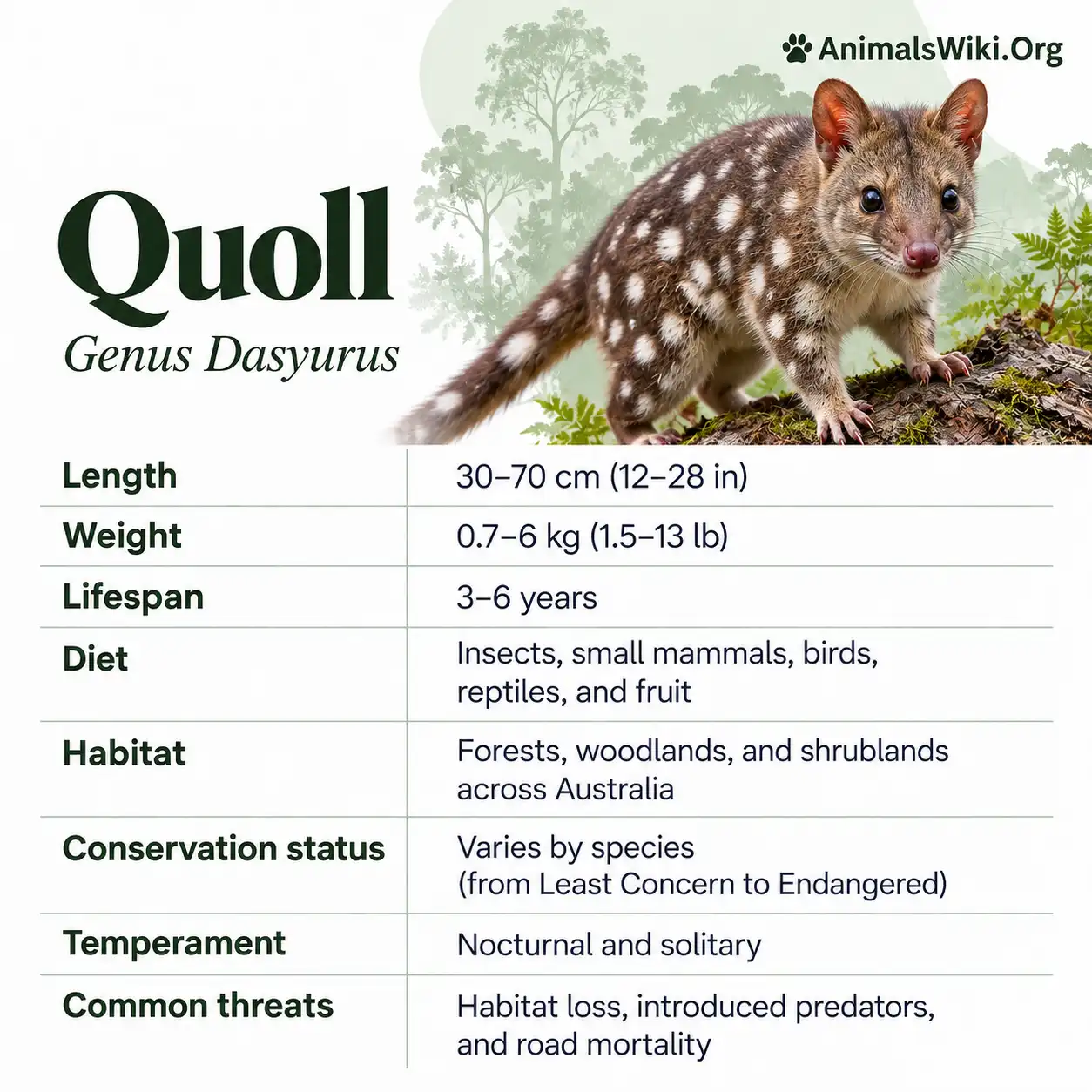
Quoll, The Spotted Carnivorous Marsupials of Australia & New Guinea
The Quoll is one of the most striking carnivorous marsupials of Australia and New Guinea.
Spotted.
Sharp-toothed.
Mostly nocturnal.
Agile.
And equipped with the instincts of a highly efficient:
predator.
Quolls belong to the genus:
Dasyurus.
There are six living species:
- Tiger Quoll — Dasyurus maculatus
- Eastern Quoll — Dasyurus viverrinus
- Northern Quoll — Dasyurus hallucatus
- Western Quoll — Dasyurus geoffroii
- New Guinea Quoll — Dasyurus albopunctatus
- Bronze Quoll — Dasyurus spartacus
Together, these animals form an important group of:
predatory marsupials.
They belong to the family:
Dasyuridae.
That makes them relatives of animals such as:
- Tasmanian Devils
- Antechinuses
- Dunnarts
Quolls are sometimes called:
native cats.
But this name can be misleading.
They are not cats.
True cats belong to the placental mammal family:
Felidae.
Quolls are:
marsupials.
Their resemblance to small cats is largely the result of occupying somewhat similar ecological roles as:
small-to-medium-sized predators.
Depending on species, Quolls can hunt:
- Insects
- Spiders
- Lizards
- Snakes
- Frogs
- Birds
- Small mammals
- Other marsupials
Larger species can take relatively substantial:
vertebrate prey.
They also scavenge:
carrion.
The largest living Quoll is the:
Tiger Quoll, also known as the Spotted-tailed Quoll.
It is the largest living carnivorous marsupial on mainland:
Australia.
Its coat is covered with pale spots.
Unlike most other Quoll species, the Tiger Quoll also has spots extending onto:
its tail.
At the other end of the continent lives another remarkable species:
the Northern Quoll.
This animal faces a very different threat.
The introduced:
Cane Toad.
A Quoll may attack what appears to be ordinary prey.
But Cane Toads possess powerful:
toxins.
An inexperienced Northern Quoll that bites or eats one can be:
poisoned.
This has contributed to severe declines in some populations.
Quolls face other pressures as well.
These include:
- Habitat loss
- Habitat fragmentation
- Introduced predators
- Road collisions
- Poisoning
- Changes in fire regimes
- Human persecution
Their reproductive biology is equally fascinating.
Like other marsupials, Quolls give birth to extremely tiny:
young.
The newborns crawl to the mother’s mammary area and attach to:
teats.
Depending on species, the pouch can become more developed during the breeding season.
After the young grow too large to remain attached, they may be left inside:
dens.
Some species also have extraordinarily intense breeding seasons.
In male Northern Quolls, for example, reproduction can demand so much energy that many males die after their first:
breeding season.
This dramatic life-history strategy is related to a phenomenon called:
semelparity.
Yet not every Quoll species follows exactly the same reproductive pattern.
That is important.
“Quoll” does not describe one uniform animal.
It describes six related species living across different:
ecosystems.
From Tasmania’s forests to northern Australia’s rocky landscapes and New Guinea’s tropical habitats, Quolls represent one of the most fascinating surviving radiations of:
carnivorous marsupials.
This comprehensive guide explores Quoll facts, species, scientific classification, appearance, spots, size, weight, habitat, distribution, diet, hunting, climbing, nocturnal behavior, reproduction, pouch, baby Quolls, male die-off, lifespan, adaptations, predators, Cane Toad poisoning, Quoll vs Tasmanian Devil, Quoll vs Cat, Quoll vs Mongoose, danger to humans, conservation and the extraordinary biology of Australia’s and New Guinea’s spotted marsupial predators.
Quoll Facts
| Feature | Information |
|---|---|
| Common Name | Quoll |
| Genus | Dasyurus |
| Animal Type | Mammal |
| Mammal Group | Marsupial |
| Order | Dasyuromorphia |
| Family | Dasyuridae |
| Living Species | 6 |
| Native Region | Australia & New Guinea |
| Diet | Carnivorous/opportunistic |
| Activity | Mostly nocturnal |
| Lifestyle | Primarily solitary |
| Coat | Brown, black, reddish or grayish with pale spots |
| Largest Species | Tiger Quoll |
| Main Foods | Invertebrates & vertebrate prey |
| Reproduction | Marsupial |
| Young | Joeys |
| Major Threats | Habitat change, invasive species, roads & poisoning |
| Famous Threat | Cane Toads, especially for Northern Quolls |
| Close Relative | Tasmanian Devil |
What Is a Quoll?
A Quoll is a carnivorous marsupial belonging to the genus:
Dasyurus.
Quolls are native to:
Australia and New Guinea.
They occupy ecological roles comparable in some ways to those of small placental carnivores elsewhere in the world.
Is a Quoll a Marsupial?
Yes.
Every Quoll species is a:
marsupial mammal.
Their young are born extremely underdeveloped and continue early development attached to the mother’s:
teats.
Is a Quoll a Cat?
No.
The historical term:
native cat
is misleading.
Quolls are not members of the cat family.
They are marsupials in:
Dasyuridae.
Are Quolls Related to Tasmanian Devils?
Yes.
Quolls and Tasmanian Devils both belong to:
Dasyuridae.
They share a more recent evolutionary ancestry with one another than either does with true:
cats.
Scientific Classification of Quolls
| Classification | Name |
|---|---|
| Kingdom | Animalia |
| Phylum | Chordata |
| Class | Mammalia |
| Order | Dasyuromorphia |
| Family | Dasyuridae |
| Genus | Dasyurus |
How Many Quoll Species Are There?
There are:
six living species.
Tiger Quoll
Dasyurus maculatus
Also known as:
- Spotted-tailed Quoll
- Spot-tailed Quoll
It is the largest living Quoll.
Eastern Quoll
Dasyurus viverrinus
Today its principal natural stronghold is:
Tasmania.
Northern Quoll
Dasyurus hallucatus
Occurs across parts of:
northern Australia.
Western Quoll
Dasyurus geoffroii
Also called the:
Chuditch.
New Guinea Quoll
Dasyurus albopunctatus
Native to:
New Guinea.
Bronze Quoll
Dasyurus spartacus
A relatively poorly known species from:
New Guinea.
Which Is the Largest Quoll?
The:
Tiger Quoll
is the largest living species.
Large males can weigh several:
kilograms.
It is also Australia’s largest living carnivorous marsupial on the mainland.
Which Is the Smallest Quoll?
The smaller Quoll species include the:
Northern Quoll
and New Guinea forms.
Size varies substantially between:
sexes and species.
What Does a Quoll Look Like?
Most Quolls have:
- Pointed snouts
- Rounded ears
- Sharp teeth
- Long tails
- Muscular bodies
- Strong feet
- Pale spots across darker fur
Their appearance is sometimes compared with a cross between a:
cat and mongoose.
But taxonomically they are neither.
Why Do Quolls Have Spots?
The pale spots may help break up the outline of the animal against:
- Vegetation
- Rocks
- Forest shadows
- Leaf litter
They also make Quolls visually distinctive.
Do All Quolls Have Spots?
All living species display some degree of:
spotting.
Pattern, density and visibility vary.
Which Quoll Has Spots on Its Tail?
The:
Tiger Quoll
is particularly distinctive because its white spots extend onto the:
tail.
This is one of the easiest ways to distinguish it from other Australian Quolls.
What Color Are Quolls?
Depending on species and individual, Quolls may be:
- Reddish-brown
- Dark brown
- Black
- Gray-brown
- Bronze
The pale spots contrast with the darker:
coat.
Can Eastern Quolls Be Black?
Yes.
Eastern Quolls occur in different color forms, including:
- Fawn/brown
- Black
Both forms retain contrasting:
white spots.
How Big Is a Quoll?
Size varies dramatically among species.
The smaller Quolls may weigh less than:
1 kg.
Large male Tiger Quolls can weigh:
several kilograms.
How Big Is a Tiger Quoll?
Tiger Quolls can reach around:
70–90 cm or more in total length, including the tail.
Males are substantially larger than:
females.
How Much Does a Tiger Quoll Weigh?
Large adult males can weigh approximately:
3–5 kg, sometimes more.
Females are considerably:
smaller.
Are Male Quolls Bigger Than Females?
Yes.
In many species, males are noticeably:
larger and heavier.
Where Do Quolls Live?
Quolls occur naturally in:
- Australia
- Tasmania
- New Guinea
Distribution differs strongly among species.
Do Quolls Live in Australia?
Yes.
Four living species are native to:
Australia.
They are:
- Tiger Quoll
- Eastern Quoll
- Northern Quoll
- Western Quoll
Do Quolls Live in Tasmania?
Yes.
Tasmania is particularly important for:
- Eastern Quolls
- Tiger Quolls
Do Quolls Live in New Guinea?
Yes.
Two species occur there:
- New Guinea Quoll
- Bronze Quoll
Quoll Habitat
Different Quoll species inhabit:
- Rainforest
- Eucalypt forest
- Woodland
- Grassland
- Rocky country
- Savannah
- Shrubland
- New Guinea tropical habitats
A major requirement is adequate:
food and shelter.
Where Do Quolls Sleep?
Quolls use dens in places such as:
- Hollow logs
- Rock crevices
- Burrows
- Tree hollows
- Caves
- Dense vegetation
Some individuals maintain several:
den sites.
Can Quolls Climb Trees?
Yes.
Quolls are capable:
climbers.
Tiger Quolls in particular can climb well and may search trees for:
prey.
Are Quolls Arboreal?
They are not exclusively tree-dwelling.
Most spend considerable time:
on the ground.
But climbing increases the range of prey and shelter they can access.
Are Quolls Nocturnal?
Most Quolls are primarily:
nocturnal.
They usually hunt and forage after:
dark.
Do Quolls Ever Come Out During the Day?
Yes.
Daytime activity can occur.
It may be influenced by:
- Season
- Hunger
- Weather
- Disturbance
- Reproductive activity
What Do Quolls Eat?
Quolls are primarily:
carnivorous and opportunistic.
Their diet varies with species and body size.
Foods can include:
- Beetles
- Crickets
- Spiders
- Centipedes
- Lizards
- Snakes
- Frogs
- Birds
- Eggs
- Small mammals
- Marsupials
- Carrion
Larger Quolls can tackle larger:
prey.
Do Quolls Eat Insects?
Yes.
Insects are especially important for:
smaller Quoll species.
Do Quolls Eat Rats and Mice?
Yes.
Small mammals can form part of the:
diet.
Do Quolls Eat Birds?
Yes.
Quolls can prey on:
- Birds
- Chicks
- Eggs
Do Quolls Eat Reptiles?
Yes.
They can consume:
- Lizards
- Small snakes
- Other reptiles
Do Quolls Eat Frogs?
Yes.
But this feeding behavior becomes dangerous when the animal mistakes a toxic:
Cane Toad
for suitable prey.
Do Quolls Eat Carrion?
Yes.
Quolls are opportunistic and may scavenge:
dead animals.
Can Quolls Kill Animals Larger Than Themselves?
Large Quolls can attack relatively substantial prey.
However, claims that they routinely overpower animals many times their own size should be treated:
cautiously.
How Do Quolls Hunt?
Quolls use:
- Smell
- Hearing
- Vision
- Stealth
- Speed
- Powerful jaws
They may search through:
- Leaf litter
- Logs
- Rocks
- Trees
- Burrows
for prey.
Do Quolls Have Sharp Teeth?
Yes.
As carnivorous marsupials, they possess sharp teeth suited for:
gripping and cutting animal tissue.
Do Quolls Have a Strong Bite?
Yes.
Especially relative to their size.
The Tiger Quoll possesses a robust skull and strong jaws capable of handling:
vertebrate prey.
Do Quolls Have Good Smell?
Yes.
Smell is important for:
- Finding food
- Detecting other Quolls
- Scent communication
- Locating carrion
Do Quolls Have Good Hearing?
Yes.
Their rounded ears and predatory lifestyle support effective:
hearing.
Quoll Behavior
Quolls are primarily:
solitary.
Adults generally forage alone.
Do Quolls Live in Packs?
No.
They do not normally form permanent hunting:
packs.
Are Quolls Territorial?
They maintain home ranges.
Ranges can overlap, particularly between:
males and females.
Scent marking helps communicate the presence of:
individuals.
How Do Quolls Communicate?
They can communicate through:
- Scent
- Vocalizations
- Body posture
- Physical interactions
Do Quolls Make Sounds?
Yes.
Quolls can produce:
- Hisses
- Growls
- Screeches
- Cough-like sounds
- Other vocalizations
These may be heard during defensive or social:
encounters.
Can Quolls Run Fast?
Quolls are agile and can move quickly when hunting or:
escaping danger.
Reliable standardized maximum-speed measurements are limited, so precise speed rankings are best avoided.
Can Quolls Swim?
Quolls are physically capable of swimming when:
necessary.
They are not specialized aquatic mammals.
Do Quolls Dig?
Yes.
Some species may dig while:
- Hunting
- Accessing prey
- Creating shelter
But they are not specialized excavators on the scale of:
Bilbies or Wombats.
Quoll Reproduction
Quolls have a classic marsupial reproductive system.
After a relatively short pregnancy, the female gives birth to extremely:
tiny young.
Do Quolls Have Pouches?
Yes, although pouch development varies among:
species.
In some Quolls, skin folds around the mammary area become more pronounced during:
breeding.
How Long Is a Quoll Pregnant?
Gestation is short.
Depending on species, it lasts roughly:
three weeks.
How Many Babies Do Quolls Have?
A female can give birth to more young than she has available:
teats.
Only those that successfully attach can continue:
developing.
The number of surviving pouch young varies by species.
What Is a Baby Quoll Called?
A young Quoll can be called a:
joey.
How Small Are Newborn Quolls?
They are:
extremely tiny and underdeveloped.
After birth, they crawl to the mother’s mammary area and attach to:
teats.
How Long Do Quoll Joeys Stay With Their Mother?
Young initially remain attached to the mother.
Later they are left in:
dens
while she hunts.
As they grow, they begin accompanying her and eventually become:
independent.
Do Mother Quolls Carry Babies on Their Backs?
Older young may ride or cling to their mother during parts of:
development.
This creates one of the most memorable sights in Quoll reproduction.
Do Male Quolls Care for the Young?
Parental care is primarily:
maternal.
Why Do Some Male Quolls Die After Mating?
This is one of the most fascinating aspects of Quoll biology.
In some populations and species, especially:
Northern Quolls,
males invest enormous energy into a short, intense breeding period.
They may:
- Travel extensively
- Sleep less
- Compete for females
- Experience elevated physiological stress
- Lose body condition
Many males die after:
their first breeding season.
What Is Semelparity?
Semelparity is a reproductive strategy in which an organism invests heavily in a major reproductive episode and may then:
die.
Male Northern Quolls are notable examples of semelparous reproduction among:
mammals.
Do All Male Quolls Die After Mating?
No.
This is important.
The extreme male die-off associated with semelparity should not be generalized to:
all Quoll species.
Reproductive strategies differ among species and populations.
How Long Do Quolls Live?
Lifespan varies by species and sex.
Some smaller Quolls have relatively:
short lives.
Larger species such as Tiger Quolls can survive for:
several years.
Managed individuals may live longer than many wild animals.
Quoll Adaptations
Spotted Coat
May help disrupt the body outline.
Sharp Teeth
Allow efficient carnivorous feeding.
Strong Jaws
Help subdue and process prey.
Sensitive Smell
Locates prey and carrion.
Strong Hearing
Detects small animals.
Climbing Ability
Provides access to arboreal prey and shelter.
Nocturnal Activity
Allows hunting under darkness.
Flexible Diet
Helps Quolls exploit changing food resources.
Den Use
Provides secure shelter.
Marsupial Reproduction
Allows tiny young to continue developing attached to the mother.
What Animals Eat Quolls?
Potential predators vary geographically and by species.
They can include:
- Dingoes
- Feral Cats
- Red Foxes
- Large snakes
- Raptors
- Other large predators
Young Quolls are especially:
vulnerable.
Do Foxes Kill Quolls?
Yes.
Introduced Red Foxes can compete with and prey upon some Australian:
Quoll species.
Do Feral Cats Kill Quolls?
Feral Cats can prey on smaller Quolls and compete for:
food.
Do Dingoes Kill Quolls?
Dingoes are capable of killing:
Quolls.
Interactions vary according to habitat and species.
Do Snakes Eat Quolls?
Large snakes may prey on:
young or smaller Quolls.
How Do Quolls Defend Themselves?
A threatened Quoll may:
- Run
- Climb
- Hide
- Hiss
- Snarl
- Bite
Its teeth provide an effective:
last defense.
Quolls and Cane Toads
The introduced:
Cane Toad
is one of the best-known threats to Northern Quolls.
Why Are Cane Toads Dangerous to Quolls?
Cane Toads possess toxic secretions from large glands behind:
their heads.
A Quoll that attacks or mouths the toad may absorb enough toxin to become:
seriously ill or die.
Do Cane Toads Kill Northern Quolls?
Yes.
Cane Toad invasion has caused major declines in some Northern Quoll:
populations.
Why Don’t Quolls Know Cane Toads Are Poisonous?
Cane Toads are an introduced species.
Australian predators did not share a long evolutionary history with:
them.
An inexperienced Quoll may therefore treat a Cane Toad as:
ordinary prey.
Can Quolls Learn Not to Eat Cane Toads?
Yes.
This has become an important area of conservation research.
Some programs have used carefully designed:
taste-aversion training
to teach Quolls that Cane Toads are undesirable prey.
What Is Taste-Aversion Training?
Animals are exposed to a non-lethal experience that causes them to associate the smell or taste of Cane Toads with:
illness or unpleasantness.
They may subsequently avoid:
toads.
This approach has been explored as one tool for helping vulnerable predators survive Cane Toad:
invasion.
Quoll vs. Tasmanian Devil
| Feature | Quoll | Tasmanian Devil |
|---|---|---|
| Family | Dasyuridae | Dasyuridae |
| Species | 6 living species | 1 living species |
| Size | Small to medium | Generally larger |
| Diet | Carnivorous | Carnivorous/scavenging |
| Coat | Usually spotted | Mostly black with white markings |
| Tail | Long | Thick |
| Climbing | Generally better | More terrestrial |
| Distribution | Australia & New Guinea | Tasmania |
They are genuine evolutionary:
relatives.
Quoll vs. Cat
| Feature | Quoll | Cat |
|---|---|---|
| Mammal Type | Marsupial | Placental |
| Family | Dasyuridae | Felidae |
| Young | Tiny marsupial joeys | More developed kittens |
| Native Region | Australia/New Guinea | Felids evolved elsewhere |
| Spots | Common | Species/breed dependent |
| Relationship | Not a cat | True cat |
Quoll vs. Mongoose
Both can be:
- Long-bodied
- Agile
- Predatory
- Sharp-toothed
But mongooses are placental mammals.
Quolls are:
marsupials.
Quoll vs. Numbat
Both belong to:
Dasyuromorphia.
But the Numbat specializes overwhelmingly in:
termites.
Quolls are much more generalized:
predators.
Quoll vs. Bilby
Bilbies are primarily:
omnivorous digging marsupials.
Quolls are primarily:
carnivorous predators.
They belong to different marsupial orders.
Quoll vs. Spotted Genet
Their spotted coats and long bodies can create a superficial resemblance.
But genets are placental carnivorans, while Quolls are:
marsupials.
Are Quolls Dangerous to Humans?
Quolls are not normally dangerous to:
people.
They generally avoid human contact.
Do Quolls Attack Humans?
Unprovoked attacks are extremely:
unusual.
Humans are not Quoll prey.
Can a Quoll Bite a Human?
Yes.
A cornered or handled Quoll can deliver a painful:
bite.
Wild animals should never be handled without appropriate expertise.
Can Quolls Be Pets?
Quolls are wild native animals and generally unsuitable as:
ordinary pets.
They have:
- Carnivorous diets
- Strong predatory instincts
- Sharp teeth
- Scent-marking behavior
- Large space requirements
Legal protection also applies in many jurisdictions.
Do Quolls Attack Chickens?
Quolls may occasionally prey on:
poultry.
This has historically contributed to conflict with:
people.
Secure enclosures are a better solution than harming native predators.
Are Quolls Endangered?
There is no single conservation status for:
all Quolls.
Each species has its own:
- Population
- Distribution
- Threats
- Conservation category
Several species have experienced major:
declines.
Current formal status should therefore be verified separately for each species when publishing time-sensitive information.
Why Are Quolls Declining?
Major threats can include:
- Habitat loss
- Habitat fragmentation
- Cane Toad poisoning
- Red Foxes
- Feral Cats
- Road mortality
- Inappropriate fire regimes
- Human persecution
Threat importance differs among:
species.
What Happened to Eastern Quolls on Mainland Australia?
Eastern Quolls disappeared from mainland Australia during the:
20th century.
Tasmania became their principal natural:
stronghold.
Conservation programs have attempted mainland:
reintroductions.
Are Eastern Quolls Extinct?
No.
They survive in:
Tasmania
and in managed or reintroduced populations.
Why Are Tiger Quolls Threatened?
Threats include:
- Habitat loss
- Fragmentation
- Road mortality
- Competition
- Predation
- Human conflict
Because they require relatively large areas, landscape connectivity is particularly:
important.
Why Are Northern Quolls Threatened?
Major threats include:
- Cane Toad poisoning
- Feral predators
- Habitat change
- Fire
- Human disturbance
Cane Toads are especially famous for causing rapid population:
declines.
Why Are Western Quolls Important?
Western Quolls, or:
Chuditch,
once occupied a much larger area of Australia.
Conservation management and reintroduction have helped restore them to some parts of their former:
range.
What Threatens New Guinea Quolls?
Threats are less thoroughly documented than for many Australian Quolls.
Potential pressures include:
- Habitat change
- Hunting
- Introduced species
- Human expansion
Research gaps remain significant.
What Do We Know About Bronze Quolls?
The Bronze Quoll is one of the least-known:
Quoll species.
Its biology, distribution and population trends remain less thoroughly studied than those of many Australian species.
This means uncertain details should not be:
invented.
Quoll Conservation
Conservation strategies can include:
- Habitat protection
- Wildlife corridors
- Fox control
- Feral Cat control
- Cane Toad management
- Taste-aversion programs
- Reintroductions
- Captive breeding
- Roadkill mitigation
- Fire management
- Population monitoring
Why Do Quolls Need Wildlife Corridors?
Fragmented habitat can isolate populations.
Corridors allow animals to:
- Disperse
- Find mates
- Establish territories
- Maintain genetic diversity
This is particularly important for wide-ranging species such as the:
Tiger Quoll.
Can Quolls Be Reintroduced?
Yes.
Reintroduction has been used for species such as:
- Eastern Quolls
- Western Quolls
Success depends on controlling the threats that caused the original:
decline.
Why Are Quolls Important to Ecosystems?
Quolls are:
predators and scavengers.
They help influence populations of:
- Insects
- Small mammals
- Reptiles
- Other prey
They also consume carrion.
Are Quolls Apex Predators?
Usually not in the same sense as:
- Large cats
- Wolves
- Crocodiles
But Quolls can be important:
mesopredators.
In some ecosystems, larger Quolls occupy relatively high trophic positions.
What Is a Mesopredator?
A mesopredator is a medium-sized predator positioned below the largest apex predators in a:
food web.
Quolls are excellent examples in many Australian ecosystems.
50 Interesting Quoll Facts
- Quolls are mammals.
- They are marsupials.
- Quolls belong to the genus Dasyurus.
- They belong to Dasyuridae.
- Tasmanian Devils are their relatives.
- Six living Quoll species are recognized.
- Four species occur naturally in Australia.
- Two occur in New Guinea.
- The Tiger Quoll is the largest living Quoll.
- Tiger Quolls are also called Spotted-tailed Quolls.
- The Western Quoll is also called the Chuditch.
- Quolls are sometimes called native cats.
- Quolls are not true cats.
- Most Quolls have white or pale spots.
- Tiger Quolls have spots extending onto the tail.
- Eastern Quolls can occur in dark and lighter color forms.
- Quolls have pointed snouts.
- They possess sharp carnivorous teeth.
- Quolls are mostly nocturnal.
- They are generally solitary.
- Quolls are predators.
- They also scavenge carrion.
- Smaller Quolls eat many insects.
- Larger Quolls can hunt vertebrates.
- Quolls eat reptiles.
- They can eat birds.
- They can prey on small mammals.
- Quolls can climb.
- They use hollow logs as dens.
- Rock crevices can also provide shelter.
- Quolls have strong senses of smell.
- They communicate using scent.
- Female Quolls give birth to extremely tiny young.
- Newborns attach to teats.
- Older young may remain in dens while their mother hunts.
- Some young may cling to their mother’s back.
- Male Northern Quolls have extremely demanding breeding seasons.
- Many male Northern Quolls die after breeding.
- This reproductive strategy is associated with semelparity.
- Not every male of every Quoll species dies after mating.
- Red Foxes can threaten Australian Quolls.
- Feral Cats can compete with or prey on Quolls.
- Cane Toad toxin can kill Northern Quolls.
- Some Quolls can learn to avoid Cane Toads.
- Taste-aversion training has been explored for conservation.
- Eastern Quolls disappeared from mainland Australia but survive in Tasmania.
- Quolls have been subjects of reintroduction programs.
- Habitat connectivity is important for their survival.
- Quolls are ecologically important predators.
- Their combination of spotted coats, marsupial reproduction and carnivorous hunting makes Quolls some of the world’s most distinctive mammalian predators.
Did You Know?
For a Northern Quoll, one unfamiliar meal can become a matter of life and death.
Night falls over northern:
Australia.
A Northern Quoll emerges from its:
shelter.
It is hungry.
This animal has evolved to investigate and attack many kinds of:
small prey.
A beetle?
Food.
A lizard?
Food.
A frog?
Potentially:
food.
Then the Quoll encounters something its ancestors did not evolve alongside.
A:
Cane Toad.
To the Quoll, it may look like an easy:
meal.
The predator approaches.
Bites.
But behind the toad’s head are large glands containing:
powerful toxins.
The Quoll may have made a fatal:
mistake.
This simple interaction has helped transform entire populations.
As Cane Toads spread into new areas, naive Northern Quolls may attack them.
Some die.
If enough animals disappear, a once-healthy local population can:
collapse.
But researchers discovered something remarkable.
Behavior can sometimes become part of:
conservation.
If a Quoll experiences the smell or taste of a toad alongside a safe but unpleasant sensation, it may form an association:
Toad = bad food.
Later, when it encounters a real Cane Toad, the Quoll may:
avoid it.
The strategy is called:
conditioned taste aversion.
It represents an unusual conservation idea.
Instead of changing:
the habitat
or physically removing every threat, researchers attempt to change:
the predator’s decision.
And Quolls are capable of learning.
That matters because survival in a changing environment does not depend only on:
- Teeth
- Claws
- Strength
Sometimes it depends on:
experience.
The Cane Toad story also reveals something important about invasive species.
The toad does not need to hunt:
Quolls.
It does not chase them.
It does not compete with them in the conventional sense.
It simply exists as:
toxic prey.
The Quoll’s own predatory instinct becomes:
the danger.
That makes the relationship one of the strangest threats faced by any Australian carnivorous:
marsupial.
Frequently Asked Questions About Quolls
What is a Quoll?
A Quoll is a carnivorous marsupial belonging to the genus Dasyurus.
Is a Quoll a mammal?
Yes.
Is a Quoll a marsupial?
Yes.
Is a Quoll a cat?
No.
Why are Quolls called native cats?
Early European settlers used the name because of their predatory lifestyle and superficial resemblance to small cats.
Are Quolls related to cats?
Only distantly as fellow mammals. Quolls are marsupials; cats are placental carnivores.
Are Quolls related to Tasmanian Devils?
Yes. Both belong to Dasyuridae.
What genus do Quolls belong to?
Dasyurus.
How many Quoll species are there?
Six living species.
What are the six Quoll species?
Tiger, Eastern, Northern, Western, New Guinea and Bronze Quolls.
What is the scientific name of the Tiger Quoll?
Dasyurus maculatus.
What is the scientific name of the Eastern Quoll?
Dasyurus viverrinus.
What is the scientific name of the Northern Quoll?
Dasyurus hallucatus.
What is the scientific name of the Western Quoll?
Dasyurus geoffroii.
What is the scientific name of the New Guinea Quoll?
Dasyurus albopunctatus.
What is the scientific name of the Bronze Quoll?
Dasyurus spartacus.
Which is the biggest Quoll?
The Tiger Quoll.
What is another name for the Tiger Quoll?
Spotted-tailed Quoll.
What is another name for the Western Quoll?
Chuditch.
Where do Quolls live?
Australia, Tasmania and New Guinea.
Do Quolls live in Australia?
Yes.
Do Quolls live in Tasmania?
Eastern and Tiger Quolls occur there.
Do Quolls live in New Guinea?
Yes. New Guinea and Bronze Quolls occur there.
What habitats do Quolls use?
Forests, woodlands, rocky landscapes, savannahs, grasslands and other habitats depending on species.
Where do Quolls sleep?
In hollow logs, rock crevices, burrows, tree hollows and other protected dens.
Are Quolls nocturnal?
Mostly.
Do Quolls hunt at night?
Yes, most hunting and foraging occurs after dark.
Can Quolls come out during the day?
Yes.
What do Quolls eat?
Insects, spiders, reptiles, frogs, birds, small mammals and carrion.
Are Quolls carnivores?
Yes, although the exact diet differs among species.
Do Quolls eat insects?
Yes.
Do Quolls eat mice?
Yes, small mammals can be prey.
Do Quolls eat birds?
Yes.
Do Quolls eat snakes?
Some Quolls can prey on small reptiles, including snakes.
Do Quolls eat frogs?
Yes.
Do Quolls eat Cane Toads?
Some attempt to, which can be fatal because Cane Toads are toxic.
Do Quolls eat dead animals?
Yes. They can scavenge carrion.
How do Quolls hunt?
They use smell, hearing, stealth, agility and powerful jaws to locate and capture prey.
Do Quolls have sharp teeth?
Yes.
Do Quolls have strong jaws?
Yes, particularly the larger species.
Can Quolls climb trees?
Yes.
Do Quolls live in trees?
They can climb and use tree hollows, but most species are not exclusively arboreal.
Can Quolls swim?
They can swim when necessary.
Can Quolls dig?
Yes, although they are not specialized burrowers like Wombats or Bilbies.
Are Quolls solitary?
Mostly.
Do Quolls live in packs?
No.
Are Quolls territorial?
They maintain home ranges and use scent communication.
Do Quolls make sounds?
Yes. Hisses, growls and screeches are among their vocalizations.
Are Quolls aggressive?
They can be aggressive toward prey, competitors or threats, but they generally avoid humans.
Do Quolls have pouches?
Females have mammary pouches or protective skin folds whose development varies among species.
How long are Quolls pregnant?
Generally around three weeks, depending on species.
What is a baby Quoll called?
A joey.
How many babies do Quolls have?
Females may give birth to numerous tiny young, but only those that secure available teats can survive early development.
Do Quoll babies live in a pouch?
Young initially remain attached around the mammary area and are protected by the pouch or surrounding folds.
Do baby Quolls ride on their mother’s back?
Older young may cling to or ride on their mother.
Does the mother raise the babies alone?
Maternal care provides the primary parental investment.
Why do male Northern Quolls die after mating?
Their intense breeding period involves extreme energy expenditure, reduced rest and physiological deterioration.
Do all male Quolls die after mating?
No.
What does semelparous mean?
It describes a life-history strategy involving extremely heavy investment in a major reproductive episode, often followed by death.
Are Northern Quolls semelparous?
Males are notable for strong post-breeding mortality and are commonly discussed as an example of mammalian semelparity.
How long do Quolls live?
It varies substantially by species and sex. Smaller species can have very short lifespans, while larger Quolls may survive several years.
What predators eat Quolls?
Potential predators include Dingoes, Foxes, Feral Cats, large snakes and raptors.
Do Foxes kill Quolls?
Yes.
Do Feral Cats kill Quolls?
They can prey on smaller individuals and compete with Quolls.
Do Dingoes kill Quolls?
Yes, potentially.
Why are Cane Toads dangerous to Quolls?
Their toxins can poison a Quoll that bites or eats them.
Can a Quoll survive eating a Cane Toad?
Exposure can be fatal, depending on the amount of toxin and circumstances.
Can Quolls learn not to eat Cane Toads?
Yes. Avoidance learning has been demonstrated and explored in conservation.
What is taste-aversion training?
It teaches an animal to associate a potential prey item with an unpleasant experience so that it avoids that prey later.
Are Quolls dangerous to humans?
Generally no.
Do Quolls attack people?
Unprovoked attacks are very rare.
Can Quolls bite humans?
Yes, particularly if handled or cornered.
Can Quolls be pets?
They are wild animals with specialized needs and are unsuitable as ordinary pets.
Do Quolls attack chickens?
They can occasionally take poultry if enclosures are accessible.
What is the difference between a Quoll and a Tasmanian Devil?
Both are dasyurid marsupials, but Devils are larger and more heavily built, while Quolls are generally more agile and spotted.
What is the difference between a Quoll and a Cat?
Quolls are marsupials; cats are placental mammals.
What is the difference between a Quoll and a Mongoose?
Quolls are marsupials native to Australia and New Guinea; mongooses are placental carnivorans.
What is the difference between a Quoll and a Numbat?
Quolls are generalized carnivorous predators, while Numbats specialize primarily in termites.
What is the difference between a Quoll and a Bilby?
Quolls are carnivorous marsupials; Bilbies are omnivorous burrowing marsupials from a different order.
Are Quolls endangered?
Conservation status differs by species. Several Quolls are threatened or have suffered major range declines.
Why are Quolls threatened?
Habitat loss, invasive predators, Cane Toads, road mortality, fire changes and other human pressures can contribute.
Are Eastern Quolls extinct?
No. They survive naturally in Tasmania, although they disappeared from mainland Australia.
Are Eastern Quolls being returned to mainland Australia?
Conservation programs have attempted mainland reintroductions.
Are Northern Quolls threatened by Cane Toads?
Yes, severely in some regions.
Are Western Quolls being reintroduced?
Yes. Reintroductions have helped restore the species to selected parts of its historical range.
Are Tiger Quolls rare?
They occur at relatively low densities and have experienced habitat loss and fragmentation.
Why are Tiger Quolls important?
They are among Australia’s largest surviving native terrestrial carnivorous marsupials and play an important predatory role.
Are Quolls important to ecosystems?
Yes. They regulate prey, consume carrion and contribute to native food webs.
Are Quolls apex predators?
Usually they are better described as mesopredators, although larger species can occupy high trophic positions locally.
What is the most interesting Quoll fact?
Quolls are spotted marsupial predators whose six surviving species range from Australian forests to New Guinea, and one species—the Northern Quoll—has such an intense reproductive season that many males sacrifice nearly all their remaining energy to a single breeding effort.
Conclusion
The Quoll looks almost like an animal assembled from familiar pieces.
The spots of a:
wild cat.
The pointed face of a:
mongoose.
The hunting instincts of a:
small carnivore.
But underneath those similarities is something completely different.
A:
marsupial predator.
For millions of years, Quolls and their relatives evolved in Australia and New Guinea without becoming:
cats.
They did not need to.
Evolution produced another solution.
Sharp teeth.
Powerful jaws.
Sensitive noses.
Agile bodies.
And tiny newborns that continue developing attached to:
their mothers.
The result is one of the world’s most distinctive groups of:
mammalian predators.
But there is no single Quoll lifestyle.
The Tiger Quoll moves through forests as Australia’s largest surviving mainland carnivorous:
marsupial.
The Eastern Quoll survives naturally in:
Tasmania.
The Western Quoll—or Chuditch—has been returned to parts of landscapes from which it had:
disappeared.
In northern Australia, the Northern Quoll faces an extraordinary enemy.
Not an animal that hunts it.
Not an animal dramatically larger than it.
But something the Quoll itself wants to:
eat.
The Cane Toad.
One bite can expose the predator to:
powerful toxins.
In this strange relationship, the hunter becomes the:
victim.
Yet even here, conservation science has revealed something remarkable.
Quolls can:
learn.
Teach one that Cane Toads are bad food, and that experience may change what happens when it encounters a toad later in:
the wild.
Then there is reproduction.
For some male Northern Quolls, mating season becomes a biological:
sprint.
Travel increases.
Rest decreases.
Energy disappears.
The drive to reproduce becomes so intense that many males do not survive:
afterward.
Few mammals demonstrate the trade-off between reproduction and survival so:
dramatically.
All of this makes the Quoll more than simply Australia’s:
“native cat.”
That old nickname hides what is most interesting about the animal.
A Quoll is not an imitation:
cat.
It represents an entirely different evolutionary experiment in building a:
predator.
Spotted.
Nocturnal.
Sharp-toothed.
Marsupial.
And still hunting through the forests, rocky landscapes and tropical habitats of:
Australia and New Guinea.



