
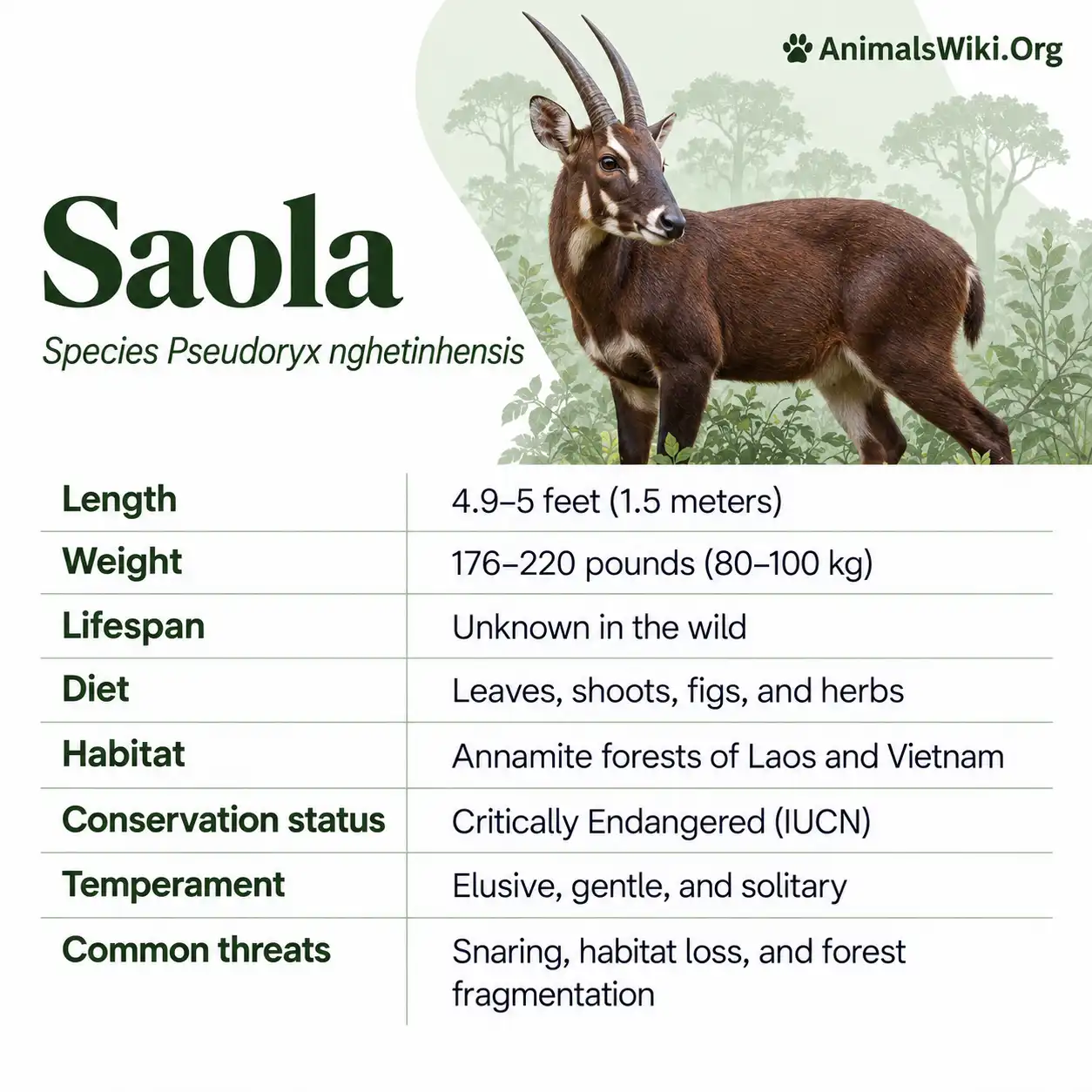
Saola Facts, The Mysterious Asian Unicorn of Vietnam & Laos
The saola is one of the rarest, most mysterious, and least-seen large mammals on Earth.
Known scientifically as:
Pseudoryx nghetinhensis
the saola inhabits the remote forested mountains along the border between:
Vietnam and Laos.
Its extraordinary rarity has earned it one of the most memorable nicknames in wildlife conservation:
the Asian unicorn.
But the saola is not a mythical creature, and it does not have a single horn.
It is a real mammal with two long, nearly parallel horns.
The “unicorn” nickname instead reflects how extraordinarily difficult the animal is to find in the wild.
Even experienced conservationists can spend years working within saola habitat without ever seeing one.
The saola is also remarkable because scientists only formally recognized it in:
1992.
This was an astonishingly recent discovery for a relatively large terrestrial mammal.
Scientists examining wildlife remains in Vietnam encountered unusual skulls bearing long, straight horns unlike those of known regional mammals.
Further investigation revealed that the remains represented an entirely new genus and species of large mammal.
The discovery became one of the most important zoological discoveries of the late 20th century.
The saola belongs to the family:
Bovidae
which also contains:
- Cattle
- Buffalo
- Antelopes
- Goats
- Sheep
Despite sometimes being described informally as an “Asian antelope,” its evolutionary relationships are more complicated.
Genetic and anatomical evidence places it within the cattle-and-antelope family, with particularly important evolutionary connections to the bovine side of that family.
The saola has a striking appearance.
Its body is generally:
- Deep brown
- Chestnut brown
- Dark reddish-brown
with contrasting white markings on the face.
Its facial pattern can include:
- White patches above the eyes
- Pale markings around the muzzle
- White or cream areas on the cheeks
Perhaps its most spectacular features are its horns.
Both males and females possess long, slender horns that rise backward from the head and can appear almost parallel when viewed from the front.
These horns can reach roughly:
35–50 centimeters
in length.
The saola’s face also contains unusually large scent glands positioned in front of the eyes.
These preorbital glands are among its most distinctive anatomical characteristics.
The animal inhabits wet evergreen and montane forests associated with the:
Annamite Mountains
also known as the:
Annamite Range
or Trường Sơn Mountains.
This mountainous region stretches along parts of Vietnam and Laos and contains exceptionally high biodiversity.
The saola appears particularly associated with:
- Evergreen forest
- Moist mountain valleys
- Streams
- River systems
- Dense vegetation
- Remote forest landscapes
Unfortunately, its remote habitat has not protected it from humans.
One of the greatest dangers facing the saola is not necessarily deliberate hunting specifically targeting saolas.
Instead, thousands of wire snares are placed in forests to catch wildlife for:
- Meat
- Local consumption
- Commercial trade
- Traditional uses
A snare cannot distinguish between its intended target and a saola.
For an animal whose total population may already be extremely small, accidental capture of even a few individuals can be catastrophic.
The saola is therefore considered one of the world’s most threatened mammals.
Yet scientists face an extraordinary problem:
we still know remarkably little about it.
Basic questions that are straightforward for lions, elephants, deer, or cattle remain uncertain for the saola.
Its exact wild population is unknown.
Its precise lifespan is unknown.
Much of its social behavior remains unknown.
Its reproductive biology is incompletely understood.
Its movements through the forest remain poorly documented.
There may be very few large mammals for which the gap between scientific importance and direct observation is so enormous.
The saola is therefore not merely rare.
It represents one of the greatest remaining mysteries of modern mammalogy.
This comprehensive guide explores Saola facts, Asian unicorn facts, scientific classification, discovery, appearance, horns, size, weight, habitat, distribution, Annamite Mountains, diet, behavior, reproduction, calves, lifespan, adaptations, predators, rarity, snares, conservation, population, extinction risk, and everything currently known about Pseudoryx nghetinhensis.
Saola Facts
| Feature | Information |
|---|---|
| Common Name | Saola |
| Famous Nickname | Asian unicorn |
| Scientific Name | Pseudoryx nghetinhensis |
| Animal Type | Mammal |
| Family | Bovidae |
| Native Countries | Vietnam and Laos |
| Main Region | Annamite Mountains |
| Habitat | Moist evergreen and montane forest |
| Diet | Herbivorous |
| Main Foods | Leaves and other vegetation |
| Horns | Two long, nearly parallel horns |
| Horns Present In | Males and females |
| Horn Length | Roughly 35–50 cm |
| Discovery Announced | 1992 |
| Famous Feature | Extreme rarity |
| Major Threat | Wire snares and habitat pressure |
| Population | Unknown |
| Conservation Importance | Extremely high |
| Human Danger | No significant threat to humans |
What Is a Saola?
The saola is a rare forest-dwelling hoofed mammal belonging to Bovidae.
Its scientific name is:
Pseudoryx nghetinhensis
It is native to the Annamite Mountains of Vietnam and Laos.
How Do You Pronounce Saola?
English pronunciation varies slightly, but it is commonly rendered approximately as:
sow-la
The name comes from local languages of the region.
Is the Saola a Real Animal?
Yes.
Despite being called the Asian unicorn, the saola is completely real.
It is not:
- Mythical
- Legendary
- Fictional
Its rarity simply means very few people have ever seen one alive.
Why Is the Saola Called the Asian Unicorn?
The nickname refers primarily to its:
extraordinary rarity and elusiveness.
It does not mean the animal has one horn.
In fact, saolas normally possess:
two horns.
Does a Saola Have One Horn?
No.
Both sexes possess a pair of long horns.
The term “Asian unicorn” is therefore metaphorical.
Scientific Classification of the Saola
| Classification | Name |
|---|---|
| Kingdom | Animalia |
| Phylum | Chordata |
| Class | Mammalia |
| Order | Artiodactyla |
| Family | Bovidae |
| Genus | Pseudoryx |
| Species | Pseudoryx nghetinhensis |
Is the Saola a Bovid?
Yes.
The saola belongs to:
Bovidae
the same broad family containing cattle, buffalo, sheep, goats and many antelopes.
Is the Saola an Antelope?
It is sometimes casually described as an antelope-like animal.
However, “antelope” is not a single natural evolutionary group.
The safest description is:
a distinctive wild bovid.
Is the Saola Related to Cows?
Yes.
Both belong to Bovidae.
The saola’s evolutionary position places it among bovids related to the cattle-like branch of the family, although it represents a highly distinctive lineage.
When Was the Saola Discovered?
The saola became known to modern science in:
1992.
Its discovery was extraordinary because finding a previously unknown large mammal near the end of the 20th century was extremely unusual.
How Was the Saola Discovered?
Researchers surveying biodiversity in Vietnam encountered unusual skulls and horns in local households.
The remains did not match known regional mammals.
Scientific investigation demonstrated that they represented a previously undescribed species.
Was a Live Saola Discovered in 1992?
The initial scientific discovery was based primarily on physical remains such as:
- Skulls
- Horns
- Other evidence
rather than scientists simply encountering a living herd in the forest.
This is one reason the discovery story is so unusual.
Why Was the Discovery Important?
New species of:
- Insects
- Fish
- Frogs
- Small reptiles
are discovered relatively frequently.
A completely new genus of large hoofed mammal is much more unusual.
The saola discovery demonstrated how poorly explored parts of the Annamite forests remained.
What Does a Saola Look Like?
A saola has an elegant, antelope-like appearance.
Important characteristics include:
- Dark brown coat
- White facial markings
- Long straight horns
- Slender legs
- Compact hoofed body
- Large facial scent glands
- Relatively long tail
Its face is especially distinctive.
Saola Facial Markings
White markings may occur:
- Above the eyes
- Around the muzzle
- On the cheeks
- Around parts of the face
These contrast strongly with its darker coat.
Saola Horns
The horns are perhaps its most famous physical feature.
They are:
- Long
- Slender
- Dark
- Relatively straight
- Nearly parallel
Both males and females have horns.
How Long Are Saola Horns?
Reported horn lengths are generally around:
35–50 cm
although measurements vary among specimens.
What Are Saola Horns Made Of?
Like other bovid horns, they consist of a bony core covered by a keratin sheath.
Keratin is also found in structures such as:
- Human fingernails
- Hair
- Hooves
Do Saolas Shed Their Horns?
No.
Bovid horns generally continue with the animal rather than being seasonally shed like deer antlers.
Horns vs. Antlers
Saola horns are not antlers.
Horns:
- Have a keratin covering
- Usually persist
- Grow from bony cores
Antlers:
- Are made of bone
- Are typically branched
- Are usually shed and regrown annually in deer
Saola Preorbital Glands
One of the animal’s strangest anatomical characteristics is its unusually large:
preorbital glands.
These are scent glands located in front of the eyes.
What Do Saola Scent Glands Do?
They likely contribute to chemical communication.
Secretions may help with:
- Scent marking
- Individual recognition
- Territorial communication
- Reproductive signaling
However, because wild behavior is so poorly observed, details remain uncertain.
How Big Is a Saola?
The saola is a medium-sized hoofed mammal.
Reported body measurements suggest adults stand roughly:
80–90 cm at the shoulder
with body length around:
1.3–1.5 meters
although available measurements are based on limited specimens.
How Much Does a Saola Weigh?
Estimated adult body weight is often given around:
80–100 kg
but precise species-wide ranges remain uncertain because so few animals have been measured.
Male vs. Female Saola
Both sexes possess long horns.
Reliable information about consistent sex-based differences in:
- Body size
- Behavior
- Social structure
is limited.
Where Do Saolas Live?
Saolas are native to:
Vietnam and Laos.
Their known range lies within the:
Annamite Mountains.
What Are the Annamite Mountains?
The Annamite Range is a mountainous region extending through parts of:
- Vietnam
- Laos
- Cambodia
The saola is particularly associated with forest landscapes along the Vietnam-Laos border.
Saola Habitat
Saolas are associated with moist tropical and subtropical forest environments.
Important habitat features include:
- Evergreen forest
- Mountain valleys
- Streams
- Dense vegetation
- High rainfall
- Remote terrain
Do Saolas Live in Rainforests?
They inhabit wet evergreen forests that can broadly be described as tropical or subtropical rainforest environments.
Do Saolas Live in Mountains?
Yes.
They are strongly associated with mountainous landscapes.
However, they use valleys, stream systems and forested slopes rather than simply living on exposed mountain summits.
Do Saolas Live Near Water?
Observations and habitat evidence suggest an association with:
- Streams
- Rivers
- Moist valleys
Water-rich forest environments may provide both vegetation and suitable microhabitats.
What Do Saolas Eat?
Saolas are herbivores.
Available observations suggest they feed primarily on:
- Leaves
- Tender vegetation
- Forest plants
- Possibly herbs and other browse
Because direct feeding observations are extremely limited, detailed diet lists should be treated cautiously.
Are Saolas Herbivores?
Yes.
Their known anatomy and observations indicate a plant-based diet.
Do Saolas Eat Grass?
They may consume some herbaceous vegetation, but they appear better characterized as forest browsers than specialized open-grassland grazers.
Do Saolas Eat Leaves?
Yes.
Leaves appear to be an important component of the diet.
How Does a Saola Find Food?
A saola likely moves through dense forest searching for suitable vegetation.
Its feeding ecology probably depends heavily on:
- Plant availability
- Rainfall
- Seasonal growth
- Forest structure
However, detailed wild foraging behavior remains poorly documented.
Are Saolas Nocturnal?
Their precise daily activity pattern remains uncertain.
Limited evidence does not justify labeling the entire species strictly:
- Nocturnal
- Diurnal
- Crepuscular
More field data are needed.
Saola Behavior
Very little is known about normal wild behavior.
This is one of the most important facts about the species.
Scientists still have limited information regarding:
- Daily movement
- Social organization
- Territoriality
- Seasonal behavior
- Courtship
- Migration
Are Saolas Solitary?
They have been observed or reported alone and in small numbers, but available evidence is too limited to define their complete social system confidently.
Do Saolas Live in Herds?
There is no evidence that they form large herds comparable with:
- Wildebeest
- Bison
- Domestic cattle
They appear more likely to live alone or in small social units.
How Do Saolas Communicate?
Their enlarged scent glands strongly suggest that:
chemical communication
is important.
They may also use:
- Body posture
- Vocalizations
- Smell
- Physical signals
but detailed communication behavior remains poorly known.
Can Saolas Smell Well?
As forest-dwelling mammals with prominent scent glands, smell is probably important in their lives.
However, exact sensory capabilities have not been quantified in detail.
Saola Reproduction
Very little is known about saola reproduction.
The species is a placental mammal and gives birth to live young.
Available observations suggest reproduction may be seasonal, but scientific information remains limited.
How Long Is a Saola Pregnant?
A precise gestation length has not been securely established from extensive direct research.
Numbers sometimes repeated online should therefore be treated cautiously.
How Many Babies Does a Saola Have?
Available evidence suggests that females likely produce:
one calf at a time
as is common among many similarly sized bovids.
However, direct reproductive records are extremely scarce.
What Is a Baby Saola Called?
A young saola can be called a:
calf
Saola Calf
Almost nothing is known about calf development in the wild.
Questions such as:
- How long calves remain hidden
- When they begin browsing
- How long they nurse
- When they become independent
remain poorly documented.
Saola Lifespan
The natural lifespan of the saola is:
unknown.
There have not been long-term captive populations or sufficient wild monitoring to establish a reliable maximum lifespan.
Why Don’t We Know the Saola’s Lifespan?
To calculate lifespan reliably, scientists generally need:
- Long-term observations
- Known-age animals
- Captive records
- Repeated identification
The saola is so rarely encountered that these datasets simply do not exist.
Saola Adaptations
Long Horns
May contribute to defense and interactions between individuals.
Dark Forest Coloration
The brown coat blends with shadowed vegetation.
White Facial Markings
May contribute to recognition or visual communication.
Large Scent Glands
Likely play an important role in chemical communication.
Forest-Browsing Body
Its relatively slender body and legs allow movement through forest terrain.
Hooves
Provide support and traction in rugged environments.
Saola Predators
Natural predators historically could potentially include large carnivores sharing the region.
However, species-specific predation records are extremely scarce.
Today, the greatest danger comes not from natural predators but from:
humans and human-created snares.
Are Tigers Saola Predators?
Tigers historically occurred in parts of the broader region and could theoretically prey on medium-sized bovids.
However, direct evidence specifically documenting tiger predation on saolas is extremely limited.
It should therefore not be presented as a routine established interaction.
Are Leopards Saola Predators?
Large cats could potentially prey on saolas, particularly younger individuals, but direct observations are lacking.
Are Saolas Dangerous to Humans?
Saolas are not considered dangerous animals.
However, any stressed wild bovid with long horns can potentially injure a person if:
- Cornered
- Restrained
- Frightened
They should never be approached or handled casually.
Why Is the Saola So Rare?
Its rarity probably reflects a combination of:
- Naturally restricted range
- Specialized habitat
- Hunting pressure
- Snaring
- Habitat loss
- Habitat fragmentation
- Low population density
How Many Saolas Are Left?
No reliable current total exists.
This is one of the most important points to understand.
Population figures sometimes repeated online are:
estimates, not direct counts.
The species is so elusive that scientists cannot simply conduct a normal visual census.
Could There Be Fewer Than 100 Saolas?
It is possible that the surviving population is extremely small.
However, without comprehensive detection, giving an exact number would create false certainty.
The safest statement is:
The number of surviving saolas is unknown and believed to be very low.
When Was the Last Saola Seen?
Confirmed encounters are exceptionally rare.
Camera-trap evidence has occasionally provided important confirmation of continued survival.
However, the absence of recent photographs does not automatically prove extinction because the species occupies difficult terrain at very low density.
Why Are Saolas So Difficult to Photograph?
Several factors combine:
- Very low population density
- Dense forest
- Rugged mountains
- Remote habitat
- Large survey areas
- Unknown movement patterns
A camera trap must be placed in exactly the right location during the right period.
Why Don’t Scientists Just Track Saolas?
First, they have to find one.
Capturing an extremely rare and sensitive mammal for tagging also carries significant risks.
Researchers must balance:
the value of information
against:
the risk of harming the animal.
Have Saolas Lived in Captivity?
A few live saolas have been captured or held temporarily by local people.
Unfortunately, they have generally survived poorly in captivity.
There is no established self-sustaining zoo population.
Can You See a Saola in a Zoo?
Generally:
no.
There is no normal zoo population where visitors can reliably see living saolas.
Why Don’t Zoos Have Saolas?
The species:
- Is extraordinarily rare
- Is difficult to locate
- Has responded poorly to captivity
- Requires specialized conservation decisions
Removing wild individuals merely for exhibition would be inappropriate.
Is the Saola Extinct?
There is no adequate basis for simply declaring it extinct.
However, the difficulty of confirming surviving individuals illustrates how precarious its situation is.
Conservationists continue to treat the species as one of the world’s highest-priority mammals.
Is the Saola Critically Endangered?
Yes.
The saola has been assessed as:
Critically Endangered
reflecting its tiny, declining, and highly threatened population.
Why Is the Saola Critically Endangered?
Major threats include:
- Wire snares
- Hunting
- Wildlife trade
- Habitat degradation
- Forest fragmentation
- Infrastructure development
- Extremely small population size
Wire Snares: The Greatest Threat
Wire snares are among the most serious threats to saolas.
Hunters set inexpensive wire loops along wildlife trails.
When an animal walks through the loop, the snare tightens.
The victim may:
- Be injured
- Become immobilized
- Starve
- Die from wounds
- Be killed by hunters
Why Are Snares So Dangerous?
Snares are:
- Cheap
- Easy to manufacture
- Easy to conceal
- Capable of remaining active for long periods
- Indiscriminate
They do not select one species.
A snare intended for a wild pig or deer can capture a saola.
Is the Saola Hunted for Its Horns?
Saolas can be killed by hunting, but their conservation crisis is not simply comparable with rhinoceros poaching.
A major problem is:
indiscriminate snaring for wildlife generally.
The saola may die even when it was not the hunter’s intended target.
Habitat Loss
Forests in the region have been affected by:
- Agriculture
- Roads
- Logging
- Infrastructure
- Development
- Fragmentation
Even where forest remains, heavy snaring can create what conservationists sometimes describe as an:
empty forest
—habitat that appears intact but has lost much of its wildlife.
Roads and Saolas
Road construction can:
- Fragment habitat
- Increase human access
- Facilitate hunting
- Increase wildlife trade
- Separate populations
Remote forests often become more vulnerable once roads penetrate them.
Saola Conservation
Protecting the saola requires a combination of:
- Snare removal
- Strong law enforcement
- Habitat protection
- Community participation
- Wildlife-trade reduction
- Scientific surveys
- International cooperation
Snare Removal
Conservation teams patrol forests and remove wire snares.
In heavily hunted landscapes, patrol teams may find enormous numbers of snares.
Removing them benefits not only saolas but many other animals.
Protected Areas
Important saola habitat occurs within protected landscapes in Vietnam and Laos.
However, simply drawing a protected-area boundary on a map is insufficient.
Effective protection requires:
- Patrols
- Enforcement
- Community cooperation
- Long-term funding
Why Local Communities Matter
People living around saola habitat possess valuable knowledge about:
- Forest trails
- Wildlife
- Hunting activity
- Seasonal conditions
- Remote terrain
Successful conservation depends on working with local communities rather than treating them as outsiders.
Could Captive Breeding Save the Saola?
Conservationists have considered carefully managed conservation breeding as a possible tool.
However, the challenge is enormous.
Scientists would first need to:
- Locate surviving animals
- Capture them safely
- Understand their nutritional needs
- Keep them alive
- Establish compatible breeding pairs
- Reproduce them successfully
With such a rare species, every intervention carries risk.
Why Saving the Saola Matters
Saving the saola would protect more than one species.
Its habitat supports extraordinary biodiversity.
Protecting Annamite forests can also benefit:
- Primates
- Deer
- Pangolins
- Birds
- Reptiles
- Amphibians
- Invertebrates
- Plants
The saola functions as a powerful:
flagship species
for the conservation of the entire region.
Saola vs. Antelope
| Feature | Saola | Typical Antelope |
|---|---|---|
| Family | Bovidae | Bovidae |
| Distribution | Vietnam & Laos | Africa/Asia depending on species |
| Habitat | Dense wet forest | Highly variable |
| Horns | Long and nearly parallel | Extremely variable |
| Population | Extremely small/unknown | Species-dependent |
| Visibility | Exceptionally elusive | Many species commonly observed |
Saola vs. Oryx
The scientific genus name:
Pseudoryx
means approximately:
false oryx.
The saola’s long straight horns superficially resemble those of an oryx.
However, saolas and oryxes are distinct evolutionary lineages.
Saola vs. Deer
Saolas are not deer.
| Feature | Saola | Deer |
|---|---|---|
| Family | Bovidae | Cervidae |
| Head Structures | Horns | Usually antlers in males |
| Shed Annually? | No | Antlers usually yes |
| Famous Species | Pseudoryx nghetinhensis | Deer include many species |
Saola vs. Cow
Saolas and cattle both belong to Bovidae.
However, the saola is:
- Wild
- Forest-adapted
- Much smaller than most domestic cattle
- Evolutionarily distinctive
- Never domesticated
Saola vs. Goat
Both are bovids but belong to different evolutionary branches.
The saola is not a wild goat.
Saola vs. Unicorn
| Feature | Saola | Mythical Unicorn |
|---|---|---|
| Real? | Yes | Mythological |
| Horns | Two | Usually one |
| Habitat | Vietnam & Laos | Myth/legend |
| Animal Type | Bovid mammal | Fictional creature |
| Scientific Name | Pseudoryx nghetinhensis | None |
The saola’s “Asian unicorn” nickname describes its rarity—not its anatomy.
40 Interesting Saola Facts
- The saola is a mammal.
- Its scientific name is Pseudoryx nghetinhensis.
- It belongs to Bovidae.
- It is related broadly to cattle and other bovids.
- The saola became known to science in 1992.
- Its discovery was one of the major zoological discoveries of the late 20th century.
- It occurs naturally in Vietnam and Laos.
- It inhabits the Annamite Mountains.
- It is nicknamed the Asian unicorn.
- It actually has two horns.
- Both males and females possess horns.
- The horns are long and nearly parallel.
- Horns can measure roughly 35–50 cm.
- The coat is generally brown.
- The face has striking pale markings.
- It possesses unusually large preorbital scent glands.
- The scent glands are located in front of the eyes.
- Saolas are herbivores.
- They eat forest vegetation.
- Leaves form an important part of their diet.
- They are associated with wet evergreen forest.
- They often inhabit landscapes containing streams and moist valleys.
- Their normal wild behavior remains poorly known.
- Their exact lifespan is unknown.
- Their exact population is unknown.
- Very few people have ever seen a living saola.
- There is no normal captive zoo population.
- Saolas have survived poorly when captured.
- They are considered Critically Endangered.
- Wire snares are among their greatest threats.
- Snares do not need to target saolas specifically to kill them.
- Habitat fragmentation increases conservation problems.
- Roads can increase hunters’ access to remote forests.
- Camera traps are important tools for searching for saolas.
- A lack of photographs does not automatically prove extinction.
- Their extreme rarity makes research exceptionally difficult.
- Protecting saolas also protects many other Annamite species.
- The genus name Pseudoryx refers to its superficial resemblance to an oryx.
- Saolas are not deer.
- The saola remains one of the greatest mysteries among the world’s large mammals.
Did You Know?
The saola was unknown to modern science until 1992—even though it is roughly the size of a small deer or antelope.
Think about what that means.
Humans had:
- Satellites
- Jet aircraft
- Modern genetics
- Global television
- Advanced computers
before zoologists formally recognized this entire genus of large mammal.
And scientists did not initially discover it by watching a herd walking across an open plain.
The first clues came from unusual:
skulls and horns
encountered during biological surveys in Vietnam.
Those horns belonged to something scientists did not recognize.
The discovery eventually revealed:
Pseudoryx nghetinhensis
—a completely distinctive bovid.
More than three decades later, the story remains almost as mysterious.
We still cannot confidently say exactly how many saolas survive.
We cannot describe their complete social system.
We do not have decades of lifespan records.
We do not have large datasets tracking hundreds of individuals.
We do not even have a stable zoo population where scientists can easily observe them.
The animal was discovered late because its world is almost perfectly designed to hide it:
remote mountains + dense rainforest + low population density + secretive behavior.
That combination explains the nickname:
Asian unicorn.
But unlike a unicorn, the saola is real.
And unlike a mythical animal, it can genuinely disappear forever.
Frequently Asked Questions About Saolas
What is a saola?
The saola is an extremely rare forest-dwelling bovid native to Vietnam and Laos.
What is the scientific name of the saola?
Pseudoryx nghetinhensis.
What does Pseudoryx mean?
The name refers to a “false oryx,” reflecting its superficial resemblance to oryxes.
Is the saola real?
Yes.
Is the saola a mammal?
Yes.
Is the saola an antelope?
It is an antelope-like bovid, but “distinctive wild bovid” is more precise.
Is the saola a cow?
No, but it belongs to the same family as cattle.
Is the saola a deer?
No.
Is the saola a goat?
No.
Is the saola a unicorn?
No.
Why is the saola called the Asian unicorn?
Because it is extraordinarily rare and elusive.
Does the saola have one horn?
No. It has two.
Do female saolas have horns?
Yes.
Do male saolas have horns?
Yes.
How long are saola horns?
Approximately 35–50 cm in reported specimens.
Do saolas shed their horns?
No, not annually like deer shed antlers.
What color is a saola?
Generally dark brown, reddish-brown or chestnut with pale facial markings.
Why does the saola have white facial markings?
They may assist visual recognition or communication, although their precise function is not established.
What are the large glands on a saola’s face?
They are enlarged preorbital scent glands.
What are the scent glands used for?
Probably chemical communication and scent marking.
How big is a saola?
Adults stand roughly 80–90 cm at the shoulder based on limited measurements.
How long is a saola?
Reported body length is roughly 1.3–1.5 meters.
How much does a saola weigh?
Common estimates are around 80–100 kg, though data are limited.
Where do saolas live?
Vietnam and Laos.
Do saolas live anywhere else naturally?
No confirmed natural populations are known outside their Annamite range.
What mountains do saolas live in?
The Annamite Mountains.
What habitat does a saola prefer?
Moist evergreen and montane forest, often associated with streams and valleys.
Do saolas live in rainforests?
Yes, they inhabit wet forest environments.
Do saolas live near rivers?
They appear associated with moist forest landscapes containing streams and waterways.
What do saolas eat?
Primarily leaves and other vegetation.
Are saolas herbivores?
Yes.
Are saolas carnivores?
No.
Do saolas eat grass?
They may consume herbaceous plants, but they are better characterized as forest browsers.
Do saolas eat leaves?
Yes.
Do saolas eat fruit?
Fruit may potentially be consumed depending on availability, but detailed wild dietary information remains limited.
Are saolas nocturnal?
Their full daily activity pattern is insufficiently known.
Are saolas active during the day?
They may be active during different periods, but evidence is too limited to classify them simply as strictly diurnal.
Are saolas solitary?
They appear capable of occurring alone or in small groups, but their social organization is poorly known.
Do saolas form herds?
Large herds have not been documented.
Can saolas run fast?
They are capable forest ungulates, but reliable maximum-speed measurements do not exist.
Can saolas swim?
There is insufficient detailed research to characterize their swimming behavior confidently.
How do saolas communicate?
Scent marking is probably important because of their large facial glands.
Do saolas make sounds?
They can vocalize, but their natural vocal repertoire remains poorly documented.
When was the saola discovered?
Where was the saola discovered?
Vietnam.
How was the saola discovered?
Scientists encountered unusual skulls and horns during wildlife surveys and determined they belonged to an unknown bovid.
Why was discovering the saola surprising?
New large mammal genera are rarely discovered in modern times.
Did local people know about saolas before scientists?
Yes. Local communities possessed knowledge of the animal before its formal scientific description.
How many saolas are left?
No reliable exact population count exists.
Are there fewer than 100 saolas?
The surviving population may be extremely small, but exact figures are uncertain.
Why can’t scientists count saolas?
They occur at extremely low density in dense, remote mountainous forests.
Is the saola extinct?
It has not been conclusively declared extinct.
Is the saola Critically Endangered?
Yes.
Why is the saola endangered?
Snaring, hunting, habitat degradation and fragmentation are major threats.
What is the biggest threat to saolas?
Indiscriminate wire snaring is among the most serious immediate threats.
What is a wire snare?
A simple wire loop designed to tighten around an animal walking through it.
Are snares specifically set for saolas?
Not necessarily. That is part of the problem—they indiscriminately capture many species.
Are saolas poached?
They can be killed through hunting and snaring.
Are saolas hunted for their horns?
Hunting occurs, but the crisis cannot be reduced simply to targeted horn poaching.
Does habitat loss threaten saolas?
Yes.
Do roads threaten saolas?
Roads can fragment habitat and increase human access for hunting.
Does logging threaten saolas?
Forest degradation can reduce and fragment suitable habitat.
Does climate change threaten saolas?
Climate change may alter forest ecosystems, but direct immediate threats such as snaring are especially severe.
Are saolas kept in zoos?
There is no established zoo population.
Can I see a living saola in a zoo?
Generally no.
Have saolas been kept alive in captivity?
A small number have been captured, but survival in captivity has been poor.
Why don’t scientists capture all remaining saolas?
They are extremely difficult to locate, and capture itself could endanger such rare animals.
Can saolas be bred in captivity?
Conservation breeding has been considered, but establishing a viable program would require safely locating and maintaining living animals.
How long do saolas live?
Their natural lifespan is unknown.
How long is saola pregnancy?
A reliably established gestation period based on extensive observation is unavailable.
Do saolas give birth to live young?
Yes.
What is a baby saola called?
A calf.
How many calves do saolas have?
They are thought to produce a single calf, but reproductive data are very limited.
What animals prey on saolas?
Specific natural predation is poorly documented.
Are tigers saola predators?
Historically they could potentially have preyed on saolas, but direct species-specific evidence is limited.
Are saolas dangerous to humans?
They are not considered dangerous, although a frightened animal with long horns could defend itself.
Are saolas aggressive?
Normal wild aggression is poorly documented.
Are saolas related to oryxes?
Both are bovids, but the saola is not a true oryx.
Are saolas related to buffalo?
They belong to the broader bovid family and share evolutionary ancestry with cattle-like bovids.
What makes the saola unique?
Its recent scientific discovery, extreme rarity, distinctive horns, large scent glands, restricted distribution and poorly understood biology make it exceptional.
Why are saolas important?
They represent a unique evolutionary lineage and serve as a flagship for conservation of the biodiverse Annamite forests.
How can the saola be saved?
Reducing snaring, protecting habitat, strengthening enforcement, supporting communities and improving scientific detection are essential.
What would happen if the saola became extinct?
Earth would permanently lose an entire distinctive evolutionary lineage, while its extinction would signal severe ecological damage within the Annamite forests.
Conclusion
The saola occupies a remarkable position between scientific discovery and scientific mystery.
It is not a tiny insect hidden beneath soil.
It is not a microscopic animal requiring powerful magnification.
It is a large, horned mammal weighing roughly as much as an adult human.
Yet modern science did not formally recognize it until:
1992.
That fact alone makes the saola extraordinary.
But what happened after its discovery is equally remarkable.
Scientists learned enough to establish that it is a unique bovid.
They documented its long parallel horns.
They examined its unusually large scent glands.
They identified its forest habitat.
They confirmed its presence in Vietnam and Laos.
And then they encountered one of conservation biology’s greatest problems:
the animal was almost impossible to find.
Even today, some of the simplest questions remain unanswered.
How many survive?
How far does an individual travel?
How large is its territory?
Exactly how long does it live?
How do males and females find each other?
How do mothers raise their calves?
How frequently do they reproduce?
For most famous mammals, these would be basic facts.
For the saola, they remain part of the mystery.
Its nickname—the Asian unicorn—therefore feels appropriate.
Not because it possesses one horn.
It does not.
But because seeing one alive in a wild Annamite forest is an experience so improbable that the animal can seem almost mythical.
Unfortunately, rarity does not provide protection.
A wire snare placed for another animal does not know that the saola it captures may be one of the last members of its species.
That is what makes indiscriminate snaring so dangerous.
A species can survive the loss of individuals when its population is large.
When only a tiny and fragmented population remains, every animal matters.
Every adult female matters.
Every breeding male matters.
Every calf matters.
Every surviving forest matters.
Saving the saola therefore requires protecting more than an animal.
It requires protecting the ecological world that produced it:
the wet, mountainous forests of the Annamites.
Those forests contain evolutionary histories found nowhere else on Earth.
The discovery of the saola in 1992 demonstrated that humanity had not yet documented everything living within them.
Its disappearance would demonstrate something very different:
that we discovered one of Earth’s most remarkable mammals only to lose it within a few decades.
The saola remains one of the rarest large mammals known to science—and one of the strongest reminders that there are still extraordinary animals sharing our planet whose lives we have barely begun to understand.



