
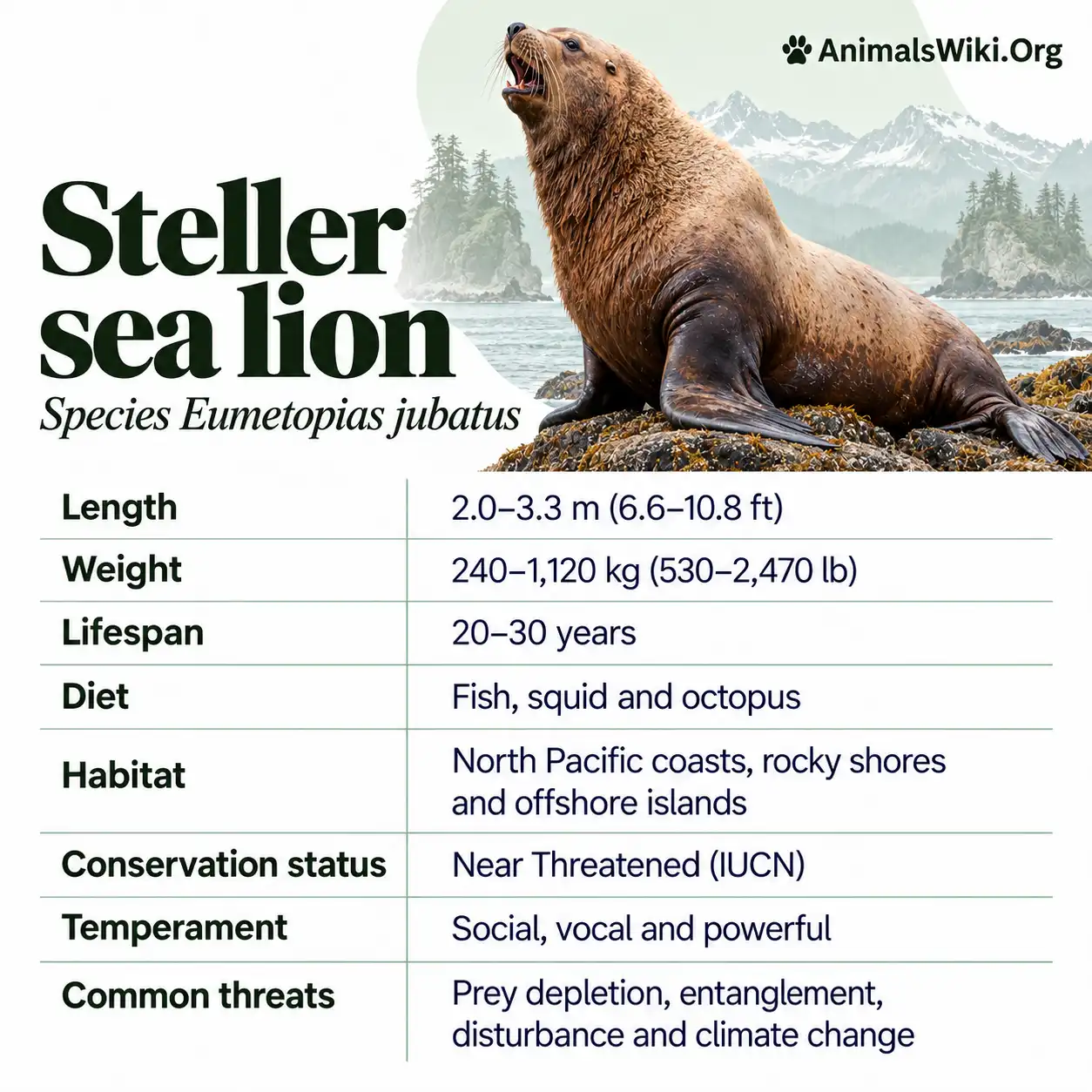
Steller Sea Lion, The Powerful Giant of the North Pacific
The Steller sea lion is the largest living member of the eared seal family. With its enormous body, broad forehead, thick neck, and deep roaring voice, it is one of the most impressive marine mammals along the North Pacific coast.
Also called the northern sea lion, this animal lives across a vast ocean region connecting Japan, Russia, Alaska, Canada, and the western United States. Its world includes exposed islands, rocky headlands, cold coastal waters, and productive offshore feeding grounds.
A resting colony may look peaceful from a distance, but life within it is busy. Males compete for breeding territories, mothers return from feeding trips, and pups call through the crowd. Beneath the surface, the same animals become agile hunters capable of following prey through deep and sometimes turbulent water.
The species also tells an important conservation story. Some populations have recovered substantially, while others remain vulnerable. Understanding those differences is essential: the Steller sea lion cannot accurately be described as either uniformly recovered or uniformly declining.
This guide explores its appearance, size, habitat, feeding behavior, reproduction, ecological importance, and conservation. It also explains how to distinguish it from other sea lions and how to observe these remarkable animals responsibly.
Steller Sea Lion Facts
| Feature | Information |
|---|---|
| Common name | Steller sea lion |
| Other common name | Northern sea lion |
| Scientific name | Eumetopias jubatus |
| Animal group | Marine mammal |
| Family | Otariidae |
| Distinguishing status | Largest living eared seal |
| Main distribution | North Pacific coastal regions |
| Typical appearance | Tawny or reddish-brown coat, broad head, prominent whiskers |
| Diet | Primarily fish and cephalopods |
| Reproduction | Usually one pup per pregnancy |
| Breeding habitat | Land-based colonies called rookeries |
| Social behavior | Often rests and breeds in groups |
| U.S. conservation distinction | Western population endangered; eastern population delisted following recovery |
| Major pressures | Changing food conditions, marine heatwaves, fishing interactions, entanglement, and disturbance |
1. What Is a Steller Sea Lion?
A Steller sea lion is a large marine mammal belonging to Otariidae, the family that includes sea lions and fur seals. Members of this family have visible external ear flaps, distinguishing them from the true seals.
Its scientific name is Eumetopias jubatus. It is the only living species in the genus Eumetopias.
The animal is a pinniped, a member of the broader group containing seals, sea lions, fur seals, and walruses. Its limbs have evolved into flippers, but it still comes onto land for important parts of its life.
Like other mammals, it breathes air, maintains its body temperature, and feeds its young milk. It must surface between dives and cannot extract oxygen from water as a fish does.
Its common name honors the naturalist Georg Wilhelm Steller. The alternative name “northern sea lion” reflects its distribution across the northern Pacific region.
Although enormous, it is not a walrus or an elephant seal. Those animals belong to different pinniped families and have different body structures.
2. What Does a Steller Sea Lion Look Like?
An adult Steller sea lion has a broad, substantial head and a powerful body. Its muzzle carries long whiskers, and small ear flaps project from the sides of the head.
The coat is generally light tan, golden brown, or reddish brown. Color can vary with age, sex, lighting, and whether the animal is wet.
Mature males are especially distinctive. Their necks and shoulders become massive, and longer coarse hair around this region creates a mane-like appearance.
Females have a more slender outline, although they are still large animals.
Pups look different from adults. Their coats are much darker, and their proportions reflect an animal still growing into its powerful swimming body.
Identification is easiest when several features are considered together. Head shape, body size, coat color, and the presence of ear flaps provide stronger evidence than any single characteristic.
A distant dark shape on a rock is not enough to establish the species, particularly where several pinnipeds share the same coastline.
3. How Big Is a Steller Sea Lion?
The Steller sea lion shows pronounced sexual size differences. Adult males are considerably heavier and more heavily built than females.
Large males can approach 3.4 meters in length and exceed 1,000 kilograms. Females are usually shorter and substantially lighter.
These are upper-end descriptions, not the size of every adult. Age, season, reproductive activity, and feeding success influence an individual’s mass.
| Life stage or sex | General size pattern |
|---|---|
| Newborn pup | Already a substantial animal, weighing tens of kilograms |
| Juvenile | Grows progressively larger while developing swimming and feeding skills |
| Adult female | Large but relatively slender compared with mature males |
| Adult male | Extremely heavy, with a thick neck and enlarged shoulders |
The difference is particularly noticeable when a mature bull rests beside females or younger animals.
Body length also tells only part of the story. A male can be only moderately longer than a female while weighing far more because of his thicker chest, neck, and overall build.
Maximum weights should therefore be separated from average adult measurements when comparing sources.
4. Steller Sea Lion vs California Sea Lion
Steller and California sea lions overlap along parts of the western North American coast. They may even use the same resting areas, making comparisons useful.
Steller sea lions are generally larger and lighter in color. Mature males have a broad, blocky head and an exceptionally thick neck.
Adult male California sea lions have a more noticeable raised crest on top of the head. Their familiar barking also differs from the deeper roaring associated with Steller sea lions.
| Feature | Steller sea lion | California sea lion |
|---|---|---|
| General adult size | Larger | Smaller |
| Typical adult coloration | Often pale tan or reddish brown | Often darker brown |
| Mature male head | Broad and substantial | More obvious raised forehead crest |
| Familiar vocal impression | Deep roars and bellows | Repeated barks |
| Shared family | Otariidae | Otariidae |
Sex and age complicate the comparison. A young Steller sea lion may be smaller than an adult male California sea lion.
For reliable identification, compare several features and consider which animals occur locally. Size alone is useful, but it is not infallible.
5. Where Do Steller Sea Lions Live?
Steller sea lions occupy coastal regions around the North Pacific.
Their range stretches from waters near Japan through the Russian Far East, the Aleutian Islands, Alaska, British Columbia, and the western United States.
This distribution forms a broad arc rather than a single continuous coastline occupied equally everywhere. Suitable breeding islands and resting sites are scattered across it.
Alaska contains especially important habitat, but the species should not be thought of as exclusively Alaskan.
Oregon also supports significant breeding colonies. State wildlife researchers describe its rookeries as the largest and most important in U.S. waters south of Alaska.
The animals use both nearshore and offshore environments. A seal lion resting close to land may later feed over a continental shelf or travel between widely separated coastal sites.
Their distribution changes with season, life stage, and food availability. A site crowded during one period may contain far fewer animals later in the year.
This movement makes repeated observations more informative than a single visit.
6. What Habitat Does a Steller Sea Lion Need?
Steller sea lions require access to both marine feeding areas and suitable places to come ashore.
On land, they use rocky ledges, reefs, boulder beaches, and other coastal surfaces. Some locations are exposed to heavy surf, while others provide more sheltered resting conditions.
A rookery is a site where breeding and pup production occur. A haul-out is a place where animals come ashore to rest, without necessarily breeding there.
The distinction is important. A group lying on a shoreline is not automatically a breeding colony.
Habitat quality also extends beyond the rock itself. A site becomes more useful when productive feeding areas are accessible nearby.
For a nursing female, distance matters because she must repeatedly travel between her pup and the sea.
Protecting a colony therefore involves more than preserving a patch of coastline. The animals also depend on the marine environment that supplies their food.
A safe resting ledge cannot compensate indefinitely for deteriorating conditions in surrounding feeding waters.
7. Eastern and Western Populations: Why the Difference Matters
In U.S. conservation management, Steller sea lions are divided into eastern and western distinct population segments.
The boundary is associated with Cape Suckling, Alaska, at approximately 144 degrees west longitude.
These categories describe population origin and management, rather than an invisible barrier that animals never cross.
Research has documented movement, mixing, and the establishment of colonies involving animals from different population backgrounds.
This matters when interpreting a sighting. An animal’s current location does not always reveal where it was born or which population it belongs to.
Population mixing also creates scientific opportunities. Researchers can investigate whether animals from different regions have different survival, movement, or reproductive patterns when they use the same sites.
The eastern and western groups have experienced contrasting conservation outcomes, but each contains additional regional variation.
Consequently, broad labels are useful starting points. They do not replace the detailed information needed to understand individual rookeries, local trends, and the conditions animals encounter throughout their lives.
8. How Do Steller Sea Lions Swim and Move on Land?
A Steller sea lion’s movement changes dramatically between land and water.
In the sea, its streamlined body reduces resistance, and broad front flippers provide propulsion. The animal can turn, accelerate, and maneuver while pursuing prey.
On land, it can rotate its hind flippers beneath the body and support itself on all four limbs.
This ability distinguishes it from true seals, whose hind flippers do not rotate forward in the same way.
Despite its size, a Steller sea lion can negotiate uneven rocky terrain. Its heavy appearance should not be mistaken for an inability to move quickly.
Researchers have examined the hydrodynamic drag of swimming Steller sea lions to understand how body shape and movement influence the cost of travel.
Efficient movement is essential because every feeding trip involves an energy investment. The seal lion must obtain enough food to cover the journey, the hunting effort, and its other needs.
Swimming performance is therefore part of both its hunting ability and its overall energy balance.
9. How Do Steller Sea Lions Stay Warm?
Cold water removes heat from an animal rapidly, so insulation is essential.
Steller sea lions rely strongly on blubber beneath the skin. This layer reduces heat loss and also stores energy.
Their flippers are less insulated than the body. Blood vessels close to the surface allow heat exchange with the environment.
An animal floating with one or more flippers raised may be regulating its temperature. Depending on surrounding conditions, exposed flippers can help absorb or release heat.
This behavior sometimes looks like waving or distress, but it can be entirely normal.
Thermoregulation involves a balance. The animal needs to conserve warmth in cold water while avoiding excessive heat accumulation under different conditions.
Its body does not solve that challenge through insulation alone. Blood circulation, posture, and behavior also contribute.
Understanding these normal behaviors helps observers avoid misinterpreting a healthy animal. A raised flipper, by itself, is not evidence that a sea lion is stranded, trapped, or asking for assistance.
10. How Do Their Senses Work?
Steller sea lions use several senses to navigate and feed.
Their long facial whiskers, called vibrissae, provide tactile information and help them investigate their underwater surroundings.
Hearing is also important. The animals communicate in crowded colonies and experience sound in both air and water.
Researchers have measured underwater hearing sensitivity in male and female Steller sea lions using trained responses to controlled sounds.
Such work helps establish which frequencies the animals can detect. It also provides information relevant to evaluating underwater noise.
A hearing study involving a small number of animals should not be interpreted as describing every individual perfectly, but it offers direct evidence about sensory capability.
Their senses work together rather than independently. Visibility changes with depth, weather, and water clarity, so relying on several kinds of information is useful.
A coastline that appears quiet to a human observer can contain a complex mixture of underwater sound, moving prey, and tactile signals for a hunting sea lion.
11. What Do Steller Sea Lions Eat?
Steller sea lions are carnivores that consume a wide variety of marine animals.
Important prey include fish such as pollock, mackerel, herring, cod, salmon, and rockfish. Squid and octopus also form part of their diet.
Their feeding is flexible, but it is not random. Diet varies among regions and seasons, reflecting the prey available around particular colonies and haul-outs.
Recent research in the Gulf of Alaska has compared sea lion diets with nearby prey resources using DNA-based methods.
This approach helps scientists examine how local feeding opportunities differ and how those differences may relate to other environmental exposures.
A diet list alone does not establish how easy feeding is. Fish may be present but too scattered, too deep, or insufficiently abundant to support efficient hunting.
For a large animal, obtaining enough food is a repeated daily challenge. For a nursing mother, it also affects the amount of energy available for milk production.
The condition of prey populations therefore influences more than the sea lion’s next meal.
12. Why Does Food Quality Matter?
Two fish of similar size may provide different amounts of usable energy.
This difference matters to a predator that must cover the costs of swimming, maintaining body temperature, growing, and reproducing.
Researchers studying young Steller sea lions have examined how prey composition affects energy stores and body condition.
The findings show that nutrition involves more than the total mass of food eaten.
A sea lion may need to consume more of a lower-energy prey to obtain the same energetic return. Whether it can do so depends on prey availability, capture rates, digestion, and time.
Food-quality explanations have played a major role in research on historical population declines. However, they should be treated as hypotheses evaluated alongside other evidence.
Different causes may operate in different regions or periods.
The practical point is clear: a productive feeding environment must supply prey that is accessible and nutritionally adequate, rather than merely containing some fish somewhere in the water.
13. How Do Steller Sea Lions Hunt?
Steller sea lions search for prey in coastal waters, over the seabed, and within the water column.
The method used depends on where prey are concentrated. An animal following schooling fish faces a different task from one investigating food near the bottom.
Small prey can be swallowed whole. Larger prey may require additional handling, sometimes at the surface.
Feeding opportunities also change through time. Seasonal fish concentrations can attract sea lions to particular areas, while shifts in prey distribution can make familiar feeding grounds less useful.
Diet research along Washington’s northwest coast has identified the consumption of young Chinook salmon and demonstrated the value of genetic identification.
Such findings need local context. Detecting a prey species establishes that it was eaten; it does not automatically explain its importance across the sea lion’s entire range.
Hunting success depends on more than locating prey. The animal must capture enough food to justify the effort spent traveling, diving, and recovering at the surface.
14. How Deep Can Steller Sea Lions Dive?
Steller sea lions can make deep dives, but their routine diving behavior varies considerably.
A maximum dive describes demonstrated capability, not what every animal does during an ordinary feeding trip.
Depth and duration are influenced by age, prey, location, and the kind of habitat being used.
Studies of juvenile animals have recorded many relatively short, shallow dives alongside more demanding excursions.
This variation is important because diving develops as an animal grows. A young sea lion does not begin independent life with the experience and performance of an adult.
Researchers use electronic depth recorders to measure these patterns. A sequence of dives can reveal whether an animal repeatedly visits the seabed, searches at changing depths, or remains near the surface.
The most informative question is often not “What is the deepest possible dive?” but “Which depths does this animal need to use successfully?”
That answer connects diving behavior to the habitat and prey supporting survival.
15. How Do They Manage Oxygen Underwater?
A diving Steller sea lion must use a finite oxygen supply until it returns to the surface.
Its underwater behavior therefore reflects a balance between the benefits of searching longer and the costs of remaining submerged.
Experiments with trained Steller sea lions in open water have measured diving oxygen consumption directly.
These studies show that oxygen use during a dive can differ from surface metabolic rates.
The relationship between nutrition and diving is also complex. Research has found that nutritional stress can reduce feeding efficiency and increase the time required to meet energy needs.
An animal cannot always solve a food shortage simply by staying underwater longer.
It may need longer recovery periods or spend more time finding each meal, which can create further demands.
Diving physiology is therefore closely tied to ecology. The depth of prey, the distance traveled, and the animal’s condition all influence how effectively it converts effort into food.
16. Do Steller Sea Lions Migrate?
Steller sea lions make seasonal movements and can travel long distances, but they do not all follow one synchronized migration route.
Some remain associated with a relatively limited region. Others move between widely separated feeding and resting sites.
Research on animals in Alaska has shown substantial variation according to natal rookery, sex, and age.
This means that two sea lions born at different colonies may use the coastline in very different ways.
Movement can also change as an animal matures. A young animal exploring feeding opportunities has different responsibilities from a female repeatedly returning to a dependent pup.
The term “migration” can obscure these distinctions when used too broadly.
A better description is that Steller sea lions combine strong connections to familiar sites with the ability to disperse and relocate.
Their movements link distant coastal habitats. Protecting only the place where an animal was last observed would overlook the other locations it may use during the rest of the year.
17. What Is Life Like in a Colony?
Steller sea lions are social animals that often gather closely together on land.
A colony can contain resting adults, nursing females, calling pups, and animals entering or leaving the water.
Physical crowding creates both opportunities and challenges. Animals have access to familiar resting habitat, but they must also negotiate space and respond to their neighbors.
The behavior of a summer rookery differs from that of a nonbreeding haul-out. Territorial competition and pup care are especially prominent during reproduction.
Social life continues beyond the breeding season. Animals may still rest together after the strongest breeding activity has ended.
To a visitor, the colony may appear disorganized. For the animals, it contains meaningful locations, repeated encounters, and recognizable calls.
A movement at one edge can also affect many others. If a disturbance causes animals to flee, the response may spread through the group.
This is why observing a colony quietly from a distance is important even when most individuals initially appear relaxed.
18. Why Do Steller Sea Lions Make So Much Noise?
Their calls serve important social functions.
Adults produce deep roars, bellows, and other vocalizations, while young animals make higher-pitched calls.
These sounds help maintain contact in a crowded environment where sight alone may be insufficient.
Mother–pup communication is particularly important. A female returning from sea needs to reconnect with her own offspring among many similar-looking animals.
Research on female Steller sea lions has identified individually distinctive features in mother–pup contact calls.
This indicates that the colony’s noise contains information about identity, rather than being a collection of interchangeable sounds.
A human listener may hear a general chorus, while a sea lion receives signals relevant to a specific relationship.
Calls also need to function despite competing sounds from surf, wind, and other animals.
The familiar roar is therefore more than a dramatic feature for wildlife documentaries. Communication helps organize life on the rookery and supports the repeated reunions on which successful maternal care depends.
19. How Do Male Steller Sea Lions Compete for Mates?
Steller sea lions have a polygynous breeding system, meaning successful males can mate with multiple females.
Mature bulls establish and defend territories during the breeding season.
Holding a territory requires sufficient size, condition, and competitive ability. Reaching sexual maturity does not guarantee immediate breeding success.
A younger male may be physically capable of reproduction while still unable to compete effectively with larger adults.
Territorial activity also carries energetic costs. A male investing in defense cannot devote the same amount of time to normal feeding.
Long-term research has examined relationships among age, survival, and territorial status in male Steller sea lions.
Such studies show that reproductive success is part of a broader life-history tradeoff.
The largest bull on the beach is not simply displaying impressive anatomy. His body reflects years of growth and an investment in competition.
Not every male will successfully defend a territory, and success in one breeding season does not guarantee continued success in later years.
20. How Does Pregnancy Work?
Steller sea lions have a seasonal reproductive cycle that includes delayed implantation.
After mating and fertilization, the embryo does not immediately implant and begin continuous development.
Instead, there is a pause before active pregnancy proceeds.
This timing helps coordinate births with the seasonal breeding period.
It also explains why descriptions of pregnancy length can differ. Some figures include the entire interval from mating to birth, while others emphasize the period after implantation.
Researchers have studied reproductive hormones to better distinguish pregnant and nonpregnant females and understand the timing of development.
Such work is useful because observing an animal’s external appearance does not always establish reproductive status.
The cycle also places substantial demands on females. Pregnancy, nursing, and feeding responsibilities can overlap.
A mother’s reproductive success therefore depends on more than conception. She must maintain enough resources to support development, give birth successfully, and provide milk during the period when her offspring remains dependent.
21. When Are Steller Sea Lion Pups Born?
Pups are generally born from late spring into early summer, with timing varying among locations.
Most births occur during a relatively concentrated season rather than being spread evenly throughout the year.
Females usually give birth to one pup. Twins are unusual.
A newborn is already large compared with many land mammals, but it still depends on its mother for nourishment.
Early life unfolds on the rookery, where the pup must cope with uneven ground, weather, neighboring animals, and the movement of adults.
Its dark coat helps distinguish it from the paler adults nearby.
Successful birth is only the beginning of the reproductive process. Growth depends on continued milk intake and the mother’s ability to obtain food.
Researchers studying maternal investment have measured nursing behavior, milk intake, and pup growth to understand these relationships.
The amount of energy transferred from mother to pup connects events at the breeding colony with feeding success in the surrounding ocean.
22. How Do Mothers Care for Their Pups?
Female Steller sea lions must balance time ashore with time feeding at sea.
After an initial period with the newborn, the mother begins making feeding trips and returning to nurse.
The pup remains on land while she is away.
This arrangement requires the young animal to tolerate periods without feeding. It also requires the mother to obtain enough food to support her own needs and milk production.
Research on pup fasting has found differences among subpopulations, highlighting the influence of maternal attendance patterns and local conditions.
A longer absence does not automatically mean poor maternal care. It must be interpreted alongside feeding conditions, trip success, and the pup’s condition.
The underlying challenge is balancing two needs: obtaining food and maintaining contact with a dependent young animal.
That balance becomes especially important when prey are difficult to find.
A pup seen alone is therefore not necessarily abandoned. Temporary separation is a normal part of this species’ reproductive strategy.
23. When Do Young Steller Sea Lions Become Independent?
Independence develops gradually.
A young Steller sea lion must build swimming ability, diving performance, prey-capture skills, and experience using marine habitat.
Nursing can continue for a substantial period, and the timing of weaning varies.
This means a young animal may begin exploring and feeding before maternal support has ended completely.
Studies using satellite dive recorders show that at-sea behavior changes with age. Young animals progressively alter their diving, time at sea, and use of haul-outs.
The transition is therefore more complex than a single moment when a pup suddenly becomes an adult hunter.
Different abilities develop at different rates.
An animal may be capable of a deep dive without routinely using that depth efficiently. It may also travel successfully while still learning where food can be found reliably.
Understanding this gradual development helps explain why early survival is important to population recovery. Producing pups does not guarantee that enough will reach adulthood and reproduce.
24. Do Females Return to Their Birthplace?
Female Steller sea lions often show strong connections to particular breeding sites.
Scientists distinguish natal philopatry, returning to breed near the birthplace, from breeding philopatry, repeatedly using an established breeding location.
Research in southeastern Alaska has followed known-age females to measure these patterns.
Site fidelity can be useful because familiar terrain and nearby feeding areas may support successful reproduction.
However, fidelity does not mean an animal is incapable of moving elsewhere.
Some females change breeding locations, and new colonies can develop.
These choices matter for population dynamics. A colony can increase because more pups survive, because females move into it, or through a combination of processes.
Long-term identification studies help separate these possibilities.
For conservation, the lesson is that traditional rookeries deserve attention while potential new habitat also matters. The distribution of breeding animals can change, even within a species known for returning to familiar sites.
25. How Long Do Steller Sea Lions Live?
Steller sea lions are relatively long-lived animals, and females generally have greater longevity than males.
Commonly cited upper ages are approximately 20 years for males and 30 years for females.
These values describe potential longevity rather than the age every animal reaches.
Many individuals die much earlier, especially during vulnerable young stages.
Age also affects survival and reproductive performance. Long-term research has found evidence of senescence, the decline in performance associated with aging.
The timing and pattern differ between sexes, reflecting their different life histories.
A female may invest repeatedly in pregnancy and nursing. A male may face strong competition and the physical demands of territorial breeding.
When reading lifespan figures, it is useful to distinguish three ideas: maximum age, average age at death, and remaining life expectancy at a particular age.
They answer different questions and should not be treated as interchangeable measurements.
26. What Eats Steller Sea Lions?
Natural predators include killer whales and large sharks.
Predation risk varies with location, age, size, and the circumstances of an encounter.
Young animals can face particularly important risks during the transition to independent life.
Researchers have used specialized implanted transmitters to investigate mortality in juvenile Steller sea lions.
These devices can provide information after an animal dies, helping scientists detect events that would otherwise remain unseen offshore.
Some studies have identified predation as an important cause of juvenile mortality within their study areas.
Those findings need geographic context. Results from a particular region or group should not automatically be applied to every population across the North Pacific.
Predation is also part of a natural food web, rather than automatically evidence of ecological imbalance.
The conservation question is how predation interacts with other pressures and whether enough young sea lions survive to sustain the population.
27. Why Are Steller Sea Lions Important to the Ecosystem?
Steller sea lions occupy a high position in marine food webs.
They consume fish and cephalopods, while some become prey for larger predators.
Their feeding connects different habitats and prey communities, including coastal and offshore environments.
The species also provides information about environmental conditions.
Changes in diet, body condition, survival, or reproduction can help researchers investigate wider ecosystem changes.
However, sea lions are indicators that require interpretation. A change in their numbers may reflect several interacting causes.
For example, fewer animals at a haul-out could mean movement elsewhere rather than mortality. Reduced pup production could involve changes in breeding females, reproductive success, or observation conditions.
Research on predator–prey relationships has therefore combined animal tracking with information about marine habitat.
This broader approach helps explain where risks occur and why.
The value of Steller sea lions extends beyond their impressive appearance. Their lives offer evidence about the functioning of the North Pacific systems that support many other species.
28. Why Did Western Steller Sea Lions Decline?
The western population experienced a severe decline during the late twentieth century.
Scientists have investigated multiple explanations, including changes in prey, nutritional stress, predation, fishing interactions, disease, contaminants, and other environmental factors.
No simple explanation adequately describes every place and period.
Nutritional research has been especially influential because prey availability and quality affect growth, survival, and reproduction.
Experiments show that responses to food limitation depend on season, age, diet, and the duration of the shortage.
This complexity helps explain why a single feeding experiment cannot completely resolve a population-level decline.
An animal’s ability to compensate under one condition may not apply under another.
The most useful understanding combines several kinds of evidence: population trends, individual survival, reproductive performance, diet, and environmental measurements.
The decline remains an important example of how difficult marine conservation can be when the relevant processes occur across enormous areas and much of an animal’s life is hidden underwater.
29. Are Steller Sea Lions Endangered?
The answer depends on which population and assessment system are being discussed.
Under the United States Endangered Species Act, the western distinct population segment remains endangered.
The eastern distinct population segment was removed from the threatened list in 2013 following recovery.
Delisting does not mean the animals have no protection. Other marine mammal protections remain relevant.
| Population or context | Conservation meaning |
|---|---|
| Western U.S. distinct population segment | Listed as endangered |
| Eastern U.S. distinct population segment | Delisted after recovery |
| Individual colonies | Can show different local trends |
| Canadian management | Uses its own national conservation framework |
It is therefore misleading to say simply that every Steller sea lion is endangered under U.S. law.
It is equally misleading to claim the species has fully recovered everywhere.
Conservation outcomes differ across the range, and regional monitoring remains necessary even where past recovery has been encouraging.
Accurate reporting should identify the population, the assessment system, and the date of the information.
30. How Do Marine Heatwaves Affect Steller Sea Lions?
Marine heatwaves are prolonged periods of unusually warm ocean conditions.
They can change prey availability, food-web relationships, and the energetic demands experienced by predators.
The northeast Pacific marine heatwave of 2014–2016 provided an important opportunity to investigate these effects.
Research found reduced survival among Steller sea lions in parts of the Gulf of Alaska following the event.
Responses were not identical across regions, even where warming patterns appeared similar.
This shows why local oceanography and habitat matter. Animals do not experience a temperature anomaly in isolation; they experience its consequences through prey and feeding conditions.
A sea lion may respond by changing what it eats, where it travels, or how long it searches for food.
Those adjustments can help, but they are not unlimited.
For a nursing mother, additional feeding effort must still fit around the need to return to her young.
Future conservation planning increasingly needs to account for these kinds of environmental disruptions.
31. How Do Fisheries Interact With Steller Sea Lions?
Steller sea lions and fisheries sometimes use the same productive waters and target overlapping fish resources.
Interactions can involve accidental capture, contact with gear, or concerns about prey availability.
In some locations, sea lions also concentrate near places where fish movements are restricted, increasing conflict with human activities.
Management responses differ among regions and situations.
Oregon’s wildlife agencies, for example, address sea lion interactions with vulnerable fish populations within a specific legal and ecological setting.
Such cases should not be generalized into a claim that all sea lions everywhere are responsible for declining fisheries.
Likewise, the presence of fishing activity does not by itself establish the cause of a sea lion population decline.
Effective management requires identifying the species involved, the type of interaction, and its consequences.
Monitoring and practical mitigation are more useful than treating either sea lions or fisheries as a single uniform category across the entire Pacific coast.
32. Why Is Entanglement Such a Serious Threat?
Steller sea lions can become entangled in plastic packing bands, fishing line, netting, and other debris.
A loop around the neck may tighten as an animal grows.
The material can cut into tissue, interfere with movement, and cause serious wounds or secondary infection.
Research in southeastern Alaska and British Columbia has documented these interactions, while studies in Oregon show that the types of material involved can vary geographically.
This variation matters for prevention. Understanding the common sources of local entanglement helps identify which practices need to change.
The effects can remain hidden for a long time. An animal may still swim and rest on land while carrying a dangerous injury.
Removing material from a large wild sea lion is difficult and requires trained responders.
Prevention is therefore especially valuable: securing waste, reducing lost fishing gear, and keeping plastic loops out of the marine environment can eliminate hazards before an animal encounters them.
33. Can Pollution and Disease Affect Them?
Steller sea lions can encounter contaminants, infectious organisms, parasites, and naturally produced marine toxins.
The consequences depend on the substance or organism, exposure level, and the animal’s condition.
Diet provides one pathway of exposure because prey can carry material from the wider marine environment.
Recent Gulf of Alaska research has investigated geographic variation in diet alongside exposure to parasites and saxitoxin.
These studies help connect what animals eat with other aspects of their health.
However, finding exposure does not automatically establish the cause of a population decline.
Researchers must distinguish between detecting a substance, showing a health effect, and demonstrating a meaningful impact on survival or reproduction.
Those are related but separate questions.
Health monitoring becomes particularly useful when combined with information about nutrition and environmental conditions.
An animal facing several pressures may respond differently from one exposed to the same threat while otherwise in good condition.
34. Why Is Human Disturbance Dangerous?
A sea lion colony can react suddenly when animals perceive a threat.
People approaching too closely, boats moving near resting animals, or other disturbances may cause individuals to rush toward the water.
In a crowded rookery, that response can injure pups or separate them from their mothers.
Disturbance can also interrupt resting, nursing, and other essential behavior.
Canadian conservation reporting identifies particular concern around breeding colonies because the consequences extend beyond the animal first reacting.
A disturbance does not need to produce an obvious injury to have a cost.
Repeated interruption can alter how animals use a site or increase the effort required to complete normal activities.
For wildlife watchers, the goal is to observe behavior without causing it to change.
If animals lift their heads repeatedly, shift position, call in response to an approach, or begin moving away, more distance is needed.
The most successful encounter is one in which the animals continue their normal activities.
35. How Do Scientists Study Their Diet?
Much of a sea lion’s feeding occurs beyond direct human observation.
Scientists therefore use indirect methods, including examining fecal samples collected at haul-outs.
Traditional analysis identifies hard parts such as fish bones, ear stones, and squid beaks.
DNA methods add another source of information by detecting genetic material from prey.
Captive feeding trials have helped researchers test how reliably prey DNA appears in samples.
This validation matters because digestion can affect different prey remains in different ways.
Combining methods provides a fuller picture than assuming one technique detects every food equally well.
Diet studies can also examine changes across seasons and locations.
However, identifying prey is only one step. Scientists may also need to estimate how much was eaten and how much energy it supplied.
The result is a more detailed understanding of feeding ecology, linking the animals’ meals to the marine habitats supporting them.
36. How Are Steller Sea Lions Counted?
Researchers count Steller sea lions using observations, photographs, and surveys of known rookeries and haul-outs.
Pups and older animals are often recorded separately because they provide different information.
Pup counts help indicate reproductive output, while non-pup counts include a mixture of juveniles and adults.
Survey coverage matters. A count from selected sites should not be presented as a complete total for the entire species.
Timing also matters because some animals are at sea when a survey takes place.
NOAA’s report on 2025 Alaska surveys described vessel-based work in the western and central Aleutian Islands and noted that the planned crewed aircraft survey was canceled because of budget limitations.
This illustrates why reading the methods is essential when comparing annual figures.
A change in a published count can reflect real population change, different coverage, or both.
Reliable trends emerge through repeated surveys interpreted alongside information about how and where the data were collected.
37. Can Injured or Orphaned Steller Sea Lions Be Helped?
Some injured, underweight, or orphaned Steller sea lions can receive professional care.
Rescue decisions depend on the animal’s condition and the circumstances.
A pup alone on a beach is not automatically orphaned, so trained assessment is important before intervention.
Rehabilitation may involve treating illness or injury, supporting nutrition, and reducing the risk that the animal becomes accustomed to people.
Young animals can require extensive care because they are still developing the skills needed for independent life.
The Marine Mammal Center has described cases involving orphaned Steller sea lion pups receiving long-term rehabilitation.
Such work can improve individual welfare and provide information about health and development.
It does not replace protecting natural habitat or preventing avoidable injuries.
The public’s most useful role is to report an animal accurately and leave handling to authorized responders.
Attempting to feed, restrain, or return a large marine mammal to the water can make the situation more dangerous.
38. How Can You Watch Steller Sea Lions Responsibly?
Observe from a distance that allows the animals to remain undisturbed.
Use binoculars or a zoom lens rather than approaching for a closer photograph.
Keep dogs away, avoid feeding, and never block an animal’s path toward the water.
Viewing distances differ by region, and special restrictions may apply around protected rookeries.
In Alaska, NOAA’s regional guidance recommends remaining at least 100 yards from marine mammals on land and at sea.
A distance recommendation is not permission to continue approaching if animals react before that point.
Local closures and posted instructions take priority.
When watching from a boat or kayak, avoid surrounding a group or moving between animals and their resting place.
If you find an injured or entangled sea lion, record the location and contact the appropriate marine mammal response organization.
Responsible observation protects both people and wildlife while making it possible to appreciate natural behavior without interrupting it.
Frequently Asked Questions About Steller Sea Lions
1. Is the correct spelling “Steller” or “Stellar”?
The animal is called the Steller sea lion, named after Georg Wilhelm Steller. “Stellar sea lion” is a common misspelling, although readers may encounter it in informal writing.
2. What is the scientific name of the Steller sea lion?
Its scientific name is Eumetopias jubatus. It is the only living species in the genus Eumetopias and belongs to the eared seal family, Otariidae.
3. Is it the largest sea lion?
Yes. The Steller sea lion is the largest living sea lion and the largest member of the eared seal family. Some other pinnipeds, including elephant seals and walruses, can be larger.
4. Is a Steller sea lion a true seal?
No. It belongs to Otariidae, the eared seal family. True seals belong to Phocidae. Visible ear flaps and the ability to rotate the hind flippers underneath the body are useful distinguishing features.
5. Why do males have such thick necks?
Mature males develop a heavily built neck, chest, and shoulders. These features are associated with their pronounced size differences and competitive breeding life, including the defense of territories.
6. What color is a Steller sea lion?
Adults are commonly tan, golden brown, or reddish brown. Pups are much darker. Wetness, lighting, age, and sex can influence the appearance of the coat.
7. Do Steller sea lions have fur?
Yes. They have a hair coat and molt. However, blubber beneath the skin is particularly important for insulation, unlike the dense underfur system strongly developed in fur seals.
8. Where can you find them?
They occur around the North Pacific, including parts of Japan, Russia, Alaska, Canada, and the western United States. Their distribution includes both breeding colonies and nonbreeding resting sites.
9. Do Steller sea lions live in freshwater?
They are marine mammals, but individuals can enter rivers and other coastal freshwater environments. Their overall life cycle remains connected to the ocean and coastal feeding opportunities.
10. What do they eat most often?
They primarily eat fish and cephalopods. Important foods vary by region and season, so no single prey species accurately describes the diet throughout their entire range.
11. Do Steller sea lions eat salmon?
Yes. Salmon form part of their varied diet in some areas. Their consumption and its ecological significance need to be assessed locally rather than assumed to be identical everywhere.
12. Do they eat other seals?
Occasional consumption of other pinnipeds has been documented. However, fish and cephalopods dominate the usual description of their feeding ecology. They should not be portrayed primarily as seal hunters.
13. Can they breathe underwater?
No. They hold their breath while diving and return to the surface for air. Their underwater performance depends on managing oxygen, movement, and recovery between dives.
14. Do they use echolocation like dolphins?
They are not known to use dolphin-like echolocation. Their hunting involves senses such as vision, hearing, and touch through their whiskers, combined with experience locating prey.
15. Why do they hold flippers out of the water?
This can be normal temperature-regulating behavior. Their relatively uninsulated flippers allow heat exchange with the environment. A raised flipper alone does not establish that the animal is in distress.
16. What is a baby Steller sea lion called?
A baby is called a pup. Females usually produce one pup per pregnancy, and the young initially depends on milk before gradually developing independent feeding skills.
17. Why might a pup be alone?
Its mother may be feeding at sea. Nursing females alternate feeding trips with visits to their young. Being alone does not, by itself, mean the pup has been abandoned.
18. How long do pups nurse?
Nursing duration varies. Many wean around the first year, while some continue nursing longer, occasionally for several years. Independence is a process rather than one uniform event.
19. Do males help raise pups?
Females provide milk and most direct care. Adult males invest heavily in breeding competition and territory defense rather than feeding or nursing young.
20. Are Steller sea lions aggressive?
They can be forceful toward one another, especially during breeding competition, and may defend themselves when approached. They are powerful wild animals that should always be given space.
21. Do they migrate every year?
They make seasonal movements, but not every individual follows the same annual route. Movement patterns differ among sexes, ages, and colonies, with some animals traveling much farther than others.
22. How long can they live?
Potential longevity is commonly described as up to about 20 years for males and 30 years for females. Many individuals die earlier, so these figures should not be treated as average lifespans.
23. What are their main predators?
Killer whales and large sharks are important natural predators. The level of risk differs among regions, and young sea lions can be particularly vulnerable.
24. Are all Steller sea lions endangered?
No. Under U.S. law, the western population remains endangered, while the eastern population was delisted following recovery in 2013. Local population conditions still require monitoring.
25. What should you do if one appears injured?
Keep your distance, note the location, and contact the appropriate wildlife response organization. Do not feed, touch, restrain, or attempt to push the animal into the water.
Steller Sea Lions and the Future of the North Pacific
The Steller sea lion combines enormous strength with a life shaped by delicate ecological relationships.
A mature bull depends on years of growth before becoming a successful competitor. A mother depends on accessible feeding grounds while raising her young. A juvenile must develop enough experience to survive beyond maternal support.
These animals connect rocky breeding islands with the wider ocean. Their survival is influenced by prey, climate, predators, human activity, and the condition of the coastal places they use.
The recovery of the eastern population demonstrates that conservation can produce meaningful results. Continuing difficulties in parts of the western range show why long-term attention remains necessary.
Protecting Steller sea lions requires understanding those differences and preserving the conditions that allow feeding, resting, breeding, and successful pup development.



