
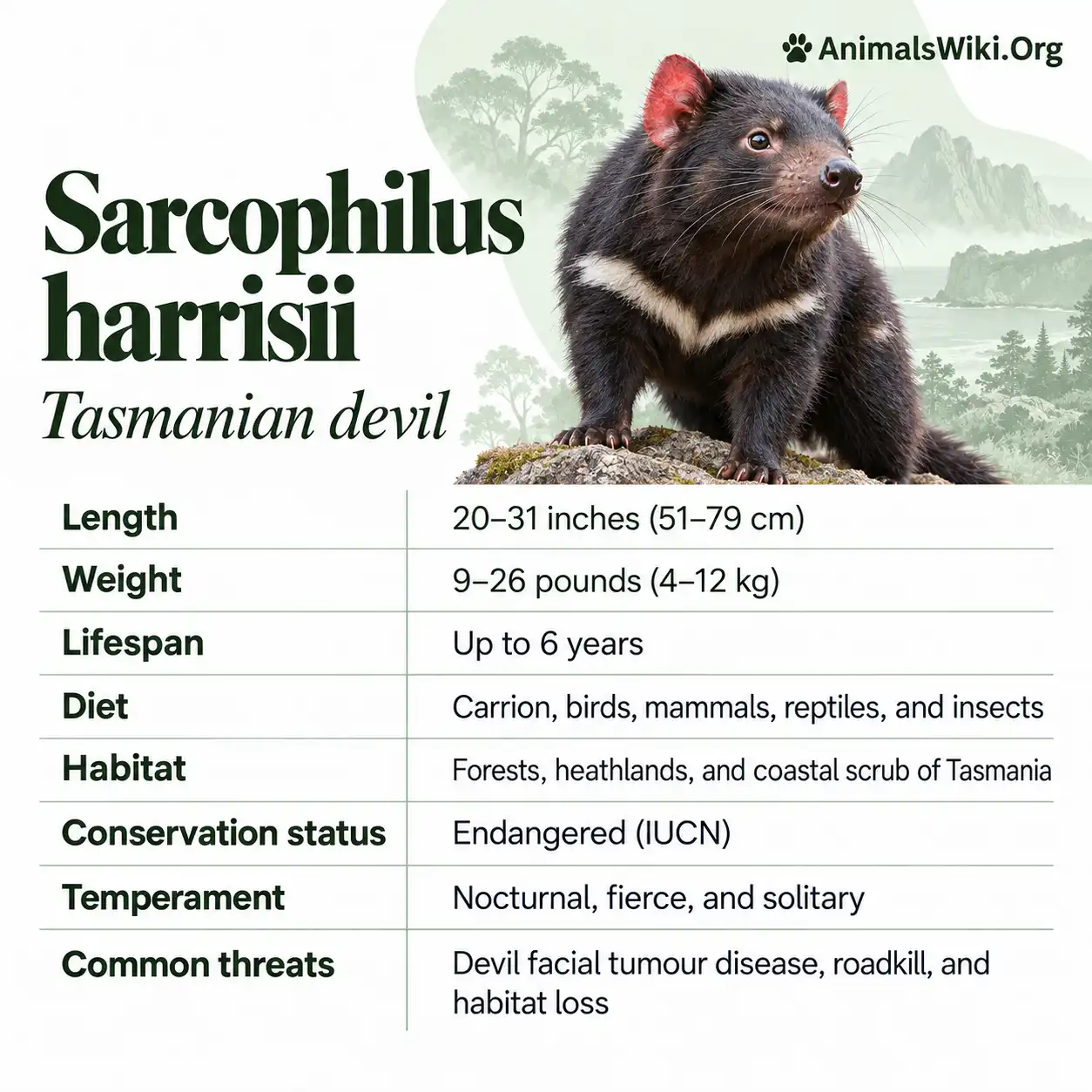
Tasmanian Devil, The Fierce Scavenging Marsupial of Tasmania
The Tasmanian Devil is one of Australia’s most distinctive and misunderstood animals.
Stocky.
Black-furred.
Powerfully built.
Armed with strong jaws.
And capable of producing screams that can sound almost frighteningly:
human.
Its scientific name is:
Sarcophilus harrisii.
The Tasmanian Devil is a:
marsupial.
That means it belongs to the same broad mammalian group as animals such as:
- Kangaroos
- Wallabies
- Koalas
- Wombats
But unlike these famous plant-eaters, the Tasmanian Devil is:
carnivorous.
In fact, it is generally recognized as the:
largest living carnivorous marsupial.
The animal’s fearsome reputation comes partly from its extraordinary vocalizations.
When several Devils gather around a carcass, they may:
- Growl
- Snarl
- Scream
- Bare their teeth
- Lunge
- Produce harsh coughing or screeching sounds
To a person hearing these noises in darkness, the scene can sound:
terrifying.
This behavior helped inspire the animal’s famous name.
Yet the Tasmanian Devil is not the bloodthirsty monster its name might suggest.
Much of its dramatic behavior is:
communication.
Instead of immediately fighting, Devils can use sound, posture and threat displays to establish access to:
food.
Their diet includes both prey they kill themselves and:
carrion.
Carrion is the flesh of animals that are already:
dead.
By consuming carcasses, Tasmanian Devils perform an important ecological service.
They help remove:
dead animal material from the landscape.
And they are extremely efficient at doing so.
Powerful jaws and teeth allow a Devil to consume:
- Flesh
- Skin
- Tendons
- Small bones
- Cartilage
A large meal can disappear with remarkable speed.
Yet one of the Tasmanian Devil’s greatest biological strengths—its willingness to bite other Devils—has also helped create one of its greatest modern threats.
A contagious cancer called:
Devil Facial Tumour Disease, or DFTD,
can spread when living cancer cells are transferred between Devils, particularly through:
biting.
Tumours develop around the:
- Face
- Mouth
- Neck
and can eventually interfere with an animal’s ability to:
eat.
The disease caused devastating declines in many wild Devil populations.
Scientists have therefore spent decades studying:
- Devil genetics
- Cancer biology
- Disease resistance
- Population recovery
- Captive breeding
- Insurance populations
- Reintroduction
The story has become one of the most extraordinary intersections of:
wildlife conservation and cancer research.
This comprehensive guide explores Tasmanian Devil facts, scientific classification, size, weight, habitat, Tasmania distribution, diet, scavenging, bite force, teeth, screaming, behavior, reproduction, pouch, joeys, lifespan, predators, Tasmanian Devil vs Wolverine, Tasmanian Devil vs Honey Badger, Devil Facial Tumour Disease, danger to humans, mainland extinction, conservation, and the remarkable biology of the world’s largest living carnivorous marsupial.
Tasmanian Facts
| Feature | Information |
|---|---|
| Common Name | Tasmanian Devil |
| Scientific Name | Sarcophilus harrisii |
| Animal Type | Mammal |
| Mammal Group | Marsupial |
| Order | Dasyuromorphia |
| Family | Dasyuridae |
| Genus | Sarcophilus |
| Native Modern Stronghold | Tasmania, Australia |
| Diet | Carnivorous |
| Feeding | Predator & scavenger |
| Body Length | Roughly 50–80 cm, excluding tail |
| Weight | Commonly about 5–12 kg |
| Largest Sex | Male |
| Activity | Primarily nocturnal |
| Social Style | Mostly solitary, gatherings at food |
| Famous Feature | Powerful jaws |
| Famous Sound | Screams, growls & snarls |
| Young | Joeys |
| Reproduction | Marsupial; young develop in pouch |
| Pouch Teats | 4 |
| Major Disease | Devil Facial Tumour Disease |
| Major Ecological Role | Scavenger |
| Special Distinction | Largest living carnivorous marsupial |
What Is a Tasmanian Devil?
The Tasmanian Devil is a stocky carnivorous marsupial native to:
Australia.
Its principal natural wild range today is:
Tasmania.
Its scientific name is:
Sarcophilus harrisii.
Why Is It Called a Tasmanian Devil?
Early European settlers encountered an animal that:
- Became active at night
- Produced frightening screams
- Growled around carcasses
- Displayed large teeth
- Behaved aggressively during feeding disputes
These characteristics helped inspire the name:
“Devil.”
The name exaggerates the animal’s actual danger to people.
Is a Tasmanian Devil a Marsupial?
Yes.
It is a:
marsupial mammal.
Females give birth to extremely tiny, underdeveloped young that continue development attached to nipples inside:
a pouch.
Is a Tasmanian Devil a Rodent?
No.
It is not related closely to:
- Rats
- Mice
- Squirrels
It belongs to a completely different mammalian lineage.
Is a Tasmanian Devil a Dog?
No.
Despite occasionally dog-like movements or sounds, it is not a:
canid.
Scientific Classification
| Classification | Name |
|---|---|
| Kingdom | Animalia |
| Phylum | Chordata |
| Class | Mammalia |
| Infraclass | Marsupialia |
| Order | Dasyuromorphia |
| Family | Dasyuridae |
| Genus | Sarcophilus |
| Species | Sarcophilus harrisii |
What Does a Tasmanian Devil Look Like?
Tasmanian Devils have:
- Stocky bodies
- Large heads
- Strong necks
- Short legs
- Rounded ears
- Long whiskers
- Black fur
- Powerful jaws
Many individuals possess white markings on the:
- Chest
- Shoulders
- Rump
The exact pattern varies.
Are All Tasmanian Devils Black?
Their coat is predominantly:
black or very dark brown.
White patches vary among individuals.
Why Do Tasmanian Devils Have White Patches?
The exact evolutionary significance of the markings is not completely established.
They may potentially have roles in:
- Recognition
- Signaling
- Visual communication
But simple claims that every marking has one specific function should be avoided.
Why Do Their Ears Turn Red?
Tasmanian Devil ears contain relatively little fur and visible blood vessels.
When blood flow increases during:
- Excitement
- Stress
- Heat
the ears can appear strikingly:
pink or red.
How Big Is a Tasmanian Devil?
Adults commonly measure roughly:
50–80 cm in head-and-body length
depending on sex and individual size.
The tail adds additional length.
How Much Does a Tasmanian Devil Weigh?
Adults commonly weigh approximately:
5–12 kg.
Large males are generally heavier than:
females.
Are Male Tasmanian Devils Bigger Than Females?
Yes.
Adult males are typically:
larger and heavier.
Is a Tasmanian Devil Bigger Than a House Cat?
A large Devil can be substantially heavier and more powerfully built than an average domestic cat.
Its stocky frame and large head make it appear especially:
robust.
Is the Tasmanian Devil the Largest Carnivorous Marsupial?
Yes.
Following the extinction of the Thylacine, the Tasmanian Devil became the:
largest living carnivorous marsupial.
Where Do Tasmanian Devils Live?
Their main natural wild population occurs on the Australian island state of:
Tasmania.
They use a variety of environments.
Tasmanian Devil Habitat
Tasmanian Devils can inhabit:
- Forest
- Woodland
- Coastal scrub
- Grassland
- Agricultural landscapes
- Mixed vegetation
Access to:
food and secure den sites
is especially important.
Where Do Tasmanian Devils Sleep?
During daylight hours, they commonly rest in:
- Hollow logs
- Caves
- Burrows
- Dense vegetation
- Rock shelters
Young Devils may sometimes use:
trees.
Are Tasmanian Devils Nocturnal?
Primarily:
yes.
They are generally most active from:
dusk through the night.
However, they can occasionally be active during daylight.
Did Tasmanian Devils Ever Live on Mainland Australia?
Yes.
Fossil and archaeological evidence shows that Tasmanian Devils once occurred across:
mainland Australia.
They disappeared from the mainland thousands of years ago.
Why Did Tasmanian Devils Disappear From Mainland Australia?
The exact combination of causes remains debated.
Potential factors include:
- Competition with dingoes
- Human influences
- Climate/environmental changes
- Changes in prey and carrion availability
Their disappearance should not be attributed with absolute certainty to:
one single cause.
Are Tasmanian Devils Back on Mainland Australia?
Conservation projects have introduced Devils into:
managed and fenced environments on mainland Australia.
These programs are intended to support conservation and explore potential ecological restoration.
This does not mean the species has simply returned to unrestricted historical mainland distribution.
What Do Tasmanian Devils Eat?
Tasmanian Devils are:
carnivores.
Their diet includes:
- Carrion
- Wallabies
- Wombats
- Small mammals
- Birds
- Reptiles
- Insects
- Other available animal material
They are both:
hunters and scavengers.
Are Tasmanian Devils Scavengers?
Yes.
Scavenging is an important part of their ecology.
Their powerful jaws allow them to consume parts of carcasses that many other animals leave behind.
Do Tasmanian Devils Hunt?
Yes.
They are capable predators and can kill:
small to medium-sized animals.
However, carrion is also extremely important.
Do Tasmanian Devils Eat Wombats?
They can feed on wombat:
carcasses
and may prey on vulnerable animals under some circumstances.
Do Tasmanian Devils Eat Wallabies?
Yes.
Wallaby carcasses can be an important food source, and Devils can also hunt suitable prey.
Do Tasmanian Devils Eat Birds?
Yes.
Birds and their remains can form part of the diet.
Do Tasmanian Devils Eat Snakes?
They can eat reptiles, including:
snakes.
Do Tasmanian Devils Eat Bones?
Yes.
Their jaws and teeth allow them to crush and consume:
small bones.
Why Do Tasmanian Devils Eat Bones?
Bones contain nutrients, including:
- Fat-rich marrow
- Minerals
- Remaining tissue
Consuming bones also allows Devils to extract more nutrition from:
carcasses.
Do Tasmanian Devils Eat an Entire Animal?
They can consume a remarkable proportion of a carcass, including:
- Muscle
- Organs
- Skin
- Cartilage
- Small bones
This makes them highly effective:
scavengers.
Why Are Tasmanian Devils Important Scavengers?
By consuming dead animals, Devils help:
- Remove carcasses
- Recycle nutrients
- Reduce available food for some introduced scavengers
- Potentially influence disease and carcass decomposition dynamics
Their ecological role extends far beyond simply:
eating dead animals.
Tasmanian Devil Bite Force
The Tasmanian Devil has an exceptionally powerful bite relative to:
its body size.
Its large head, strong jaw muscles and robust teeth allow it to crush:
bone and tough tissue.
Does a Tasmanian Devil Have the Strongest Bite?
Statements claiming it has “the strongest bite of any animal” are:
false.
What makes the Devil remarkable is the strength of its bite:
relative to its body size.
Comparisons depend heavily on:
- Measurement technique
- Bite-force estimate
- Body-size adjustment
- Species being compared
Why Is Its Bite So Strong?
Several anatomical features contribute:
- Large skull
- Powerful jaw muscles
- Strong teeth
- Short, robust jaw mechanics
These adaptations are particularly useful when feeding on:
carcasses.
How Many Teeth Does a Tasmanian Devil Have?
Adult Tasmanian Devils have approximately:
42 teeth.
Their teeth are adapted for:
- Gripping
- Cutting
- Crushing
Can Tasmanian Devils Crush Bones?
Yes.
Their powerful jaws can break and consume:
smaller bones.
Tasmanian Devil Behavior
Tasmanian Devils are generally:
solitary.
Individuals typically travel and forage alone.
But food can bring multiple Devils together.
Do Tasmanian Devils Live in Packs?
No.
They do not form stable cooperative hunting packs like:
Gray Wolves.
Why Do Tasmanian Devils Gather Together?
A large carcass may attract:
several Devils.
When this happens, intense social interactions can occur.
Why Do Tasmanian Devils Scream?
Their famous screams are primarily forms of:
communication.
They may be used during:
- Feeding competition
- Threat displays
- Mating
- Social encounters
The sound is often much more frightening than the actual interaction.
What Sounds Do Tasmanian Devils Make?
They can:
- Scream
- Growl
- Snarl
- Snort
- Hiss
- Cough
- Screech
Their vocal repertoire is:
extensive.
Why Are Tasmanian Devils So Loud?
Vocal communication allows individuals to negotiate:
- Dominance
- Food access
- Personal space
- Reproductive interactions
A dramatic scream may help avoid an even more costly:
physical fight.
Do Tasmanian Devils Fight?
Yes.
They can fight over:
- Food
- Mates
- Space
Biting is common in social conflict.
This behavior has important consequences for:
disease transmission.
Can Tasmanian Devils Climb Trees?
Young Devils are capable:
climbers.
Their climbing ability generally decreases as they become larger and heavier.
Can Tasmanian Devils Swim?
Yes.
They can swim when necessary.
Can Tasmanian Devils Run Fast?
They can move surprisingly quickly for their stocky build.
They are capable of traveling substantial distances while:
foraging at night.
Precise maximum speed figures should be treated cautiously unless supported by direct measurements.
How Far Can Tasmanian Devils Travel?
Individuals may travel:
many kilometers in a single night
while searching for food.
Movement varies according to habitat, food availability, sex and season.
Do Tasmanian Devils Have Good Smell?
Yes.
Their sense of smell is highly important for locating:
carcasses.
Can Tasmanian Devils Smell Dead Animals?
Yes.
Their strong olfactory ability helps them locate carrion across the landscape.
Tasmanian Devil Reproduction
Tasmanian Devils have one of the most dramatic reproductive systems among Australian marsupials.
Females can produce:
many tiny newborns.
But there is a severe limitation.
The pouch contains only:
four teats.
When Do Tasmanian Devils Breed?
Mating generally occurs during:
late summer and early autumn in Tasmania, often around February to April.
Timing can vary.
How Long Is a Tasmanian Devil Pregnant?
Pregnancy is very short compared with placental mammals.
Gestation lasts roughly:
three weeks.
How Many Babies Can a Tasmanian Devil Give Birth To?
A female may give birth to:
20 or more extremely tiny young.
But only a maximum of:
four
can normally survive in the pouch because there are only four teats.
Why Do Tasmanian Devils Have So Many Babies?
Marsupial young are born at an extremely early developmental stage.
The large number creates intense competition to reach:
the pouch.
Only the first few able to attach successfully to available teats survive.
What Is a Baby Tasmanian Devil Called?
A baby Tasmanian Devil is called a:
joey.
How Small Is a Newborn Tasmanian Devil?
Newborns are extraordinarily tiny—only a fraction of the size they will eventually become.
They are:
- Hairless
- Blind
- Extremely underdeveloped
Yet they must crawl from the birth canal toward:
the pouch.
Does a Tasmanian Devil Have a Pouch?
Yes.
Females have a:
rear-opening pouch.
Why Does the Pouch Open Backward?
A backward-facing pouch helps reduce the amount of:
soil and debris
entering while the animal moves and digs close to the ground.
How Many Nipples Does a Tasmanian Devil Have?
Females have:
four teats.
This limits the number of young that can survive in the pouch simultaneously.
How Long Do Joeys Stay in the Pouch?
Young remain attached and developing in the pouch for approximately:
four months.
After leaving the pouch, they continue developing in a:
den.
Does the Mother Care for the Joeys?
Yes.
The mother provides:
- Milk
- Warmth
- Protection
- Den shelter
Eventually the young begin following her and learning to:
forage.
When Do Young Tasmanian Devils Become Independent?
Young generally become independent at roughly:
eight to nine months of age, although development varies.
Tasmanian Devil Lifespan
Tasmanian Devils have relatively short lives compared with many similarly sized mammals.
Wild individuals commonly live around:
five to six years, although some can live longer.
Managed animals may sometimes survive beyond typical wild ages.
Tasmanian Devil Adaptations
Powerful Jaws
Allow the consumption of tough carcass material and bone.
Strong Teeth
Cut flesh and crush hard material.
Large Head
Provides attachment space for powerful jaw muscles.
Strong Sense of Smell
Helps locate carrion.
Dark Coat
Provides useful camouflage during nighttime activity.
Fat-Storing Tail
Body condition can be reflected partly in the tail.
Loud Vocalizations
Allow communication during intense social encounters.
Pouch
Protects highly underdeveloped newborns.
Strong Digestive System
Allows efficient use of nutrient-rich animal material.
Does a Tasmanian Devil Store Fat in Its Tail?
Yes.
A healthy Devil can store:
fat reserves in its tail.
A thin tail may sometimes indicate poor body condition.
What Animals Eat Tasmanian Devils?
Adult Devils have relatively few major natural predators in modern Tasmania.
Young Devils can be more vulnerable.
Historically and ecologically, potential threats can include:
- Large raptors
- Other Devils
- Humans
- Dogs
The species’ greatest modern threat, however, has not been a predator.
It has been:
disease.
What Is Devil Facial Tumour Disease?
Devil Facial Tumour Disease, commonly abbreviated:
DFTD
is a rare form of:
transmissible cancer.
Instead of a virus simply causing cancer inside another animal, the cancer cells themselves can move between Devils and establish new tumours.
Is Tasmanian Devil Cancer Contagious?
In an extraordinary biological sense:
yes.
DFTD is one of the world’s best-known examples of a naturally occurring:
transmissible cancer.
Living tumour cells are transferred from one animal to another.
How Does DFTD Spread?
Transmission occurs primarily when Devils:
bite one another.
Biting is common during:
- Feeding
- Mating
- Social disputes
Tumour cells can enter damaged tissue and establish:
new cancer growth.
Where Do the Tumours Grow?
Tumours commonly develop around:
- Mouth
- Face
- Jaw
- Neck
As they enlarge, they can make it difficult for the Devil to:
eat.
Why Is DFTD So Deadly?
Advanced tumours can:
- Interfere with feeding
- Cause tissue damage
- Spread through the body
- Lead to starvation
- Severely weaken the animal
Historically, infection was associated with extremely high:
mortality.
When Was DFTD Discovered?
The disease was first recognized in wild Tasmanian Devils during the:
1990s.
It subsequently spread across much of Tasmania.
How Much Did DFTD Affect Tasmanian Devils?
Some affected populations experienced extremely severe:
declines.
The disease transformed Tasmanian Devil conservation into an urgent scientific priority.
Is There More Than One Tasmanian Devil Facial Cancer?
Yes.
Scientists later discovered a second independently evolved transmissible cancer known as:
DFT2.
The original disease is often called:
DFT1.
This means transmissible cancer evolved independently at least twice in:
Tasmanian Devils.
Why Can Cancer Spread Between Tasmanian Devils?
Normally, an animal’s immune system recognizes cells from another individual as:
foreign.
DFTD has evolved mechanisms that help tumour cells avoid effective immune rejection.
Low genetic diversity in Devils has also been investigated as part of the disease story, although the biology is more complex than simply saying:
“all Devils are genetically identical.”
Are Tasmanian Devils Developing Resistance?
Researchers have found evidence that wild populations are undergoing:
evolutionary and immune responses to the disease.
Some Devils survive longer after infection than would once have been expected.
This offers hope, but it does not mean DFTD has:
disappeared.
Is There a Vaccine for DFTD?
Scientists have investigated vaccines and immunological treatments.
This remains an active conservation and research area.
Current vaccine deployment or trial status should be checked against the latest research when publishing time-sensitive information.
Why Is DFTD Important to Science?
The disease provides an extraordinary natural system for studying:
- Cancer evolution
- Immune evasion
- Tumour genetics
- Host evolution
- Disease ecology
- Wildlife conservation
The Tasmanian Devil has therefore become important not only to conservation biology but also to:
cancer research.
Are Tasmanian Devils Dangerous to Humans?
Generally:
no.
Their screams and displays can make them seem extremely dangerous.
But wild Devils typically avoid:
people.
Do Tasmanian Devils Attack Humans?
Serious unprovoked attacks are:
rare.
However, a cornered animal has powerful jaws and should never be:
handled.
Can a Tasmanian Devil Bite a Human?
Yes.
A defensive bite could cause:
serious injury.
Can a Tasmanian Devil Kill a Human?
Humans are far too large to be normal prey.
Tasmanian Devils should be respected as wild carnivores, but they are not:
human-hunting predators.
Are Tasmanian Devils Aggressive?
They can be highly confrontational with:
other Devils, especially around food.
But their aggressive displays often function as:
communication.
Their behavior toward humans is usually much more:
avoidant.
Can You Keep a Tasmanian Devil as a Pet?
No.
Tasmanian Devils are:
- Wild carnivores
- Conservation-sensitive animals
- Powerful biters
- Specialized marsupials
They are not suitable:
pets.
Tasmanian Devil vs. Wolverine
| Feature | Tasmanian Devil | Wolverine |
|---|---|---|
| Mammal Type | Marsupial | Placental mammal |
| Family | Dasyuridae | Mustelidae |
| Native Region | Tasmania | Northern Hemisphere |
| Weight | Usually 5–12 kg | Generally much heavier |
| Diet | Carnivore/scavenger | Carnivore/scavenger |
| Bite | Extremely powerful for size | Very powerful |
| Reproduction | Pouch & joeys | Placental young |
| Famous Trait | Screams | Strength & endurance |
Their similar scavenging lifestyles do not mean they are:
close relatives.
Tasmanian Devil vs. Honey Badger
Both animals have reputations for:
fearlessness and toughness.
But they are unrelated beyond being mammals.
A Honey Badger is a:
mustelid placental mammal.
A Tasmanian Devil is a:
dasyurid marsupial.
Tasmanian Devil vs. Thylacine
| Feature | Tasmanian Devil | Thylacine |
|---|---|---|
| Scientific Name | Sarcophilus harrisii | Thylacinus cynocephalus |
| Status | Living | Extinct |
| Body Size | Medium | Much larger |
| Diet | Carnivorous | Carnivorous |
| Marsupial | Yes | Yes |
| Main Modern Range | Tasmania | Formerly Tasmania/mainland historically |
| Ecological Role | Scavenger/predator | Larger predator |
After the Thylacine disappeared, the Tasmanian Devil became the largest surviving:
carnivorous marsupial.
Tasmanian Devil vs. Tasmanian Tiger
The “Tasmanian Tiger” is another name for the:
Thylacine.
It is not another name for the Tasmanian Devil.
The two animals were separate:
marsupial species.
Are Tasmanian Devils Endangered?
Yes.
Tasmanian Devils have experienced major declines, particularly because of:
DFTD.
Their formal conservation category should always be verified against the latest authoritative assessment before publication because status can be reassessed over time.
How Many Tasmanian Devils Are Left?
There is no single precise real-time count of every wild Devil.
Population estimates vary according to:
- Survey year
- Disease prevalence
- Region
- Monitoring method
For SEO content that will remain online for years, it is safer to explain the trend rather than present an unsupported exact:
current population number.
What Threatens Tasmanian Devils?
Major threats include:
- Devil Facial Tumour Disease
- Road mortality
- Habitat changes
- Human disturbance
- Low population density in affected areas
- Potential genetic challenges
Are Cars Dangerous to Tasmanian Devils?
Yes.
Roadkill is a significant problem.
The danger can be increased because Devils are attracted to:
animal carcasses on roads.
A Devil feeding on roadkill can itself be:
hit by a vehicle.
How Can Road Deaths Be Reduced?
Potential measures include:
- Removing carcasses
- Driver awareness
- Wildlife signage
- Lower speeds in important areas
- Road design
- Wildlife-sensitive infrastructure
Tasmanian Devil Conservation
Conservation programs have used a wide range of strategies, including:
- Disease monitoring
- Genetic research
- Captive breeding
- Insurance populations
- Disease-free populations
- Translocations
- Reintroductions
- Roadkill reduction
- Habitat protection
- Vaccine research
- Long-term population monitoring
What Is an Insurance Population?
An insurance population is a protected group maintained so the species has:
healthy backup populations
if wild populations experience catastrophic decline.
For Tasmanian Devils, disease-free insurance populations became particularly important after:
DFTD emerged.
Have Tasmanian Devils Been Released on Islands?
Yes.
Disease-free populations have been established in carefully managed locations, including:
islands and fenced areas.
These can support conservation breeding and preserve genetic diversity.
Have Tasmanian Devils Been Released on Mainland Australia?
Yes.
Devils have been introduced into managed mainland conservation areas.
These projects have generated enormous scientific interest because Devils disappeared from mainland Australia thousands of years ago.
Why Reintroduce Devils to Mainland Australia?
Potential objectives include:
- Establishing additional populations
- Protecting the species from catastrophic threats
- Studying ecological effects
- Restoring aspects of native predator ecology
Such programs require careful:
monitoring.
Why Are Tasmanian Devils Important to Tasmania?
They are important:
- Scavengers
- Predators
- Cultural symbols
- Tourist icons
- Conservation ambassadors
They also represent a unique branch of Australia’s:
marsupial diversity.
Do Tasmanian Devils Help Ecosystems?
Yes.
By consuming carrion, Devils help remove:
dead animal material.
As predators and scavengers, they also influence:
food-web dynamics.
50 Interesting Tasmanian Devil Facts
- The Tasmanian Devil is a mammal.
- Its scientific name is Sarcophilus harrisii.
- It is a marsupial.
- It belongs to Dasyuridae.
- It is the largest living carnivorous marsupial.
- Tasmanian Devils are native to Australia.
- Their main natural wild population occurs in Tasmania.
- Devils once lived on mainland Australia.
- They disappeared from the mainland thousands of years ago.
- Devils have predominantly black fur.
- Many have white chest or rump markings.
- Their ears can become visibly red.
- Males are larger than females.
- Adults commonly weigh around 5–12 kg.
- Devils have large heads for their body size.
- Their jaws are exceptionally powerful.
- Their bite is particularly impressive relative to body size.
- They can crush small bones.
- Adults have about 42 teeth.
- Devils are carnivores.
- They are important scavengers.
- They also hunt live prey.
- They can consume flesh, skin and bone.
- Their sense of smell helps locate carrion.
- They are primarily nocturnal.
- They usually forage alone.
- Several Devils may gather around one carcass.
- Feeding gatherings can become extremely noisy.
- Devils scream.
- They also growl, snarl and hiss.
- Their screams helped inspire their common name.
- Loud displays can reduce the need for direct fighting.
- Devils frequently bite one another.
- Biting helps spread DFTD.
- DFTD is a transmissible cancer.
- Living cancer cells can move between Devils.
- The disease often produces facial tumours.
- A second transmissible Devil cancer, DFT2, has also evolved.
- Scientists study Devils to understand cancer evolution.
- Females have a pouch.
- The pouch opens backward.
- Females have four teats.
- They can give birth to far more than four newborns.
- Only a maximum of four normally secure teats and survive in the pouch.
- Baby Devils are called joeys.
- Newborn joeys are extremely tiny.
- Young Devils can climb better than heavy adults.
- Road collisions are an important threat.
- Conservation programs maintain protected populations.
- The Tasmanian Devil’s combination of powerful scavenging adaptations, unusual marsupial reproduction and transmissible cancer makes it one of the most scientifically fascinating mammals alive today.
Did You Know?
The Tasmanian Devil’s most famous weapon—its bite—also helped one of the strangest cancers on Earth spread through its population.
Imagine a wallaby carcass lying in the Tasmanian bush after:
dark.
A scent moves through the air.
A Tasmanian Devil detects it.
Then another.
And another.
Soon several animals are gathered around:
the carcass.
One growls.
Another:
screams.
A third opens its mouth and displays:
powerful teeth.
The sounds echo through the darkness.
To a human listening nearby, it might sound as though a violent battle is occurring.
But much of what is happening is:
communication.
Who gets access to the carcass?
Who backs away?
Who is dominant?
How close can another animal approach?
Sometimes the confrontation escalates.
One Devil bites:
another.
For thousands of years, biting was simply part of Devil social behavior.
Then something extraordinary happened.
A cell inside one Tasmanian Devil became:
cancerous.
Normally, cancer dies when the animal carrying it dies.
But this cancer acquired the ability to survive as:
living cells transferred between individuals.
A Devil carrying the tumour bit another Devil.
Cancer cells entered the wound.
Instead of being destroyed immediately by the new animal’s immune system, some survived.
They multiplied.
A new tumour grew.
That Devil eventually bit:
another.
And the cancer continued moving through the population.
The disease became known as:
Devil Facial Tumour Disease.
This is not a virus spreading from animal to animal.
The cancer itself is:
transmissible.
The tumour growing on one Devil is genetically descended from cancer cells that originated in:
another Devil.
That makes DFTD one of the strangest diseases known in mammals.
Even more remarkably, researchers later discovered:
another independently evolved transmissible cancer in Tasmanian Devils.
For conservationists, this was devastating.
For scientists, it revealed something extraordinary about:
- Cancer
- Immunity
- Evolution
- Genetics
And the Devils themselves began responding.
Natural selection started favoring individuals better able to survive or tolerate:
the disease.
The result is an evolutionary story unfolding:
in real time.
The animal screaming beside a carcass therefore represents much more than Tasmania’s famous wild scavenger.
It represents an ongoing biological battle between:
host and cancer.
And understanding that battle may help scientists protect not only the Tasmanian Devil but also deepen our understanding of how cancer itself:
evolves.
Frequently Asked Questions About Tasmanian Devils
What is a Tasmanian Devil?
A Tasmanian Devil is a carnivorous marsupial native to Australia and naturally surviving today mainly in Tasmania.
What is the scientific name of the Tasmanian Devil?
Sarcophilus harrisii.
Is a Tasmanian Devil a mammal?
Yes.
Is a Tasmanian Devil a marsupial?
Yes.
Is a Tasmanian Devil a rodent?
No.
Is a Tasmanian Devil a dog?
No.
Is a Tasmanian Devil a bear?
No.
What family does the Tasmanian Devil belong to?
Dasyuridae.
Where do Tasmanian Devils live?
Primarily Tasmania, Australia.
Do Tasmanian Devils live in Australia?
Yes. Tasmania is an Australian island state.
Did Tasmanian Devils live on mainland Australia?
Yes.
When did Tasmanian Devils disappear from mainland Australia?
They disappeared thousands of years ago, before European settlement.
Why did Tasmanian Devils disappear from mainland Australia?
The precise cause remains debated, with dingoes, human activity and environmental changes among proposed factors.
Are Tasmanian Devils returning to mainland Australia?
They have been introduced into managed mainland conservation areas.
What habitat do Tasmanian Devils live in?
Forests, woodlands, scrublands, grasslands and mixed landscapes.
Where do Tasmanian Devils sleep?
In dens, hollow logs, caves, burrows and other sheltered sites.
Are Tasmanian Devils nocturnal?
Primarily yes.
Do Tasmanian Devils come out during the day?
Occasionally.
What do Tasmanian Devils look like?
They have stocky bodies, large heads, black fur, powerful jaws and often white markings.
Why are Tasmanian Devils black?
Dark coloration is a natural characteristic of the species.
Why do Tasmanian Devils have white patches?
Many individuals naturally have variable white markings on the chest or rump.
Why do Tasmanian Devil ears turn red?
Increased blood flow can make the thinly furred ears appear red.
How big is a Tasmanian Devil?
Adults commonly have a head-and-body length of roughly 50–80 cm.
How much does a Tasmanian Devil weigh?
Commonly around 5–12 kg.
Are male Tasmanian Devils bigger?
Yes.
Is a Tasmanian Devil bigger than a cat?
Large males can be heavier and much more robust than an average domestic cat.
Is a Tasmanian Devil the biggest marsupial?
No. Kangaroos are much larger.
Is it the biggest carnivorous marsupial?
It is the largest living carnivorous marsupial.
What do Tasmanian Devils eat?
Carrion and live animal prey.
Are Tasmanian Devils scavengers?
Yes.
Do Tasmanian Devils hunt?
Yes.
Do Tasmanian Devils eat dead animals?
Yes. Carrion is an important food source.
Do Tasmanian Devils eat bones?
Yes.
Can Tasmanian Devils crush bones?
Yes, especially smaller bones.
Do Tasmanian Devils eat wallabies?
Yes, particularly as carrion, although they can also hunt suitable prey.
Do Tasmanian Devils eat wombats?
They can feed on wombat carcasses.
Do Tasmanian Devils eat birds?
Yes.
Do Tasmanian Devils eat snakes?
They can consume reptiles.
Do Tasmanian Devils eat each other?
Cannibalism can occur, particularly involving carcasses or vulnerable individuals, although it is not their primary feeding strategy.
How strong is a Tasmanian Devil bite?
Extremely strong relative to its body size.
Does the Tasmanian Devil have the strongest bite in the world?
No. That claim is misleading. Its bite is especially impressive relative to its size.
How many teeth does a Tasmanian Devil have?
Adults have approximately 42 teeth.
Why are Tasmanian Devil jaws so strong?
Their skull and jaw muscles are adapted to process tough carcasses and bones.
Why do Tasmanian Devils scream?
Mostly for social communication during feeding, mating and conflict.
What does a Tasmanian Devil sound like?
It can scream, growl, hiss, snarl and produce several other harsh vocalizations.
Why are Tasmanian Devils called Devils?
Their nocturnal screams, aggressive feeding displays and visible teeth frightened early European settlers.
Are Tasmanian Devils actually evil?
No. “Devil” is simply a human-given name.
Do Tasmanian Devils live in groups?
They are primarily solitary, although several may gather at food.
Do Tasmanian Devils hunt in packs?
No.
Do Tasmanian Devils fight?
Yes, particularly around food and during reproduction.
Do Tasmanian Devils bite each other?
Yes.
Can Tasmanian Devils climb trees?
Young Devils can climb effectively.
Can Tasmanian Devils swim?
Yes.
Can Tasmanian Devils run?
Yes.
Do Tasmanian Devils have a good sense of smell?
Yes.
How do Tasmanian Devils find dead animals?
Their strong sense of smell helps locate carrion.
How far can Tasmanian Devils travel?
They can cover many kilometers during nightly foraging.
Do Tasmanian Devils have a pouch?
Females do.
Which way does the Tasmanian Devil pouch open?
Backward.
Why does its pouch open backward?
This helps reduce dirt entering the pouch during ground-level activity and digging.
How many nipples does a Tasmanian Devil have?
Four.
How long is a Tasmanian Devil pregnant?
Roughly three weeks.
How many babies does a Tasmanian Devil have?
A female can give birth to many tiny young, but only four can normally secure the four available teats.
Why do only four baby Tasmanian Devils survive?
The mother’s pouch contains only four teats.
What is a baby Tasmanian Devil called?
A joey.
How small is a newborn Tasmanian Devil?
Extremely tiny, hairless and highly underdeveloped.
How do newborn Devils reach the pouch?
They crawl from the birth canal to the pouch shortly after birth.
How long do Tasmanian Devils stay in the pouch?
Approximately four months.
Does the mother care for the joeys after they leave the pouch?
Yes. They continue developing in a den and remain dependent for additional months.
How long do Tasmanian Devils live?
Often around five to six years in the wild, although some individuals can live longer.
What predators eat Tasmanian Devils?
Adults have relatively few natural predators in modern Tasmania; young Devils are more vulnerable.
Are Tasmanian Devils dangerous to humans?
Generally no.
Do Tasmanian Devils attack humans?
Serious unprovoked attacks are rare.
Can a Tasmanian Devil bite a person?
Yes, and its powerful jaws could cause serious injury.
Can a Tasmanian Devil kill a human?
Humans are not normal prey, and Devils are not human-hunting predators.
Can Tasmanian Devils be pets?
No.
Are Tasmanian Devils aggressive?
They can be aggressive toward other Devils, especially around food, but often avoid humans.
What is Devil Facial Tumour Disease?
A transmissible cancer affecting Tasmanian Devils.
Is DFTD really cancer?
Yes.
Is Tasmanian Devil cancer contagious?
Yes, unusually, because living tumour cells themselves can pass between animals.
How does Tasmanian Devil cancer spread?
Primarily through biting.
Is DFTD caused by a virus?
The transmissible tumour consists of living cancer cells passed between Devils rather than simply being a virus-induced cancer.
Where do DFTD tumours grow?
Mostly around the face, mouth, jaw and neck.
Does DFTD kill Tasmanian Devils?
It has historically caused very high mortality in affected populations.
Why does DFTD make eating difficult?
Large facial tumours can damage or obstruct the mouth and surrounding tissues.
When was DFTD discovered?
It was recognized during the 1990s.
Is there more than one Devil cancer?
Yes. DFT1 and the independently evolved DFT2 are recognized transmissible tumour lineages.
Are Tasmanian Devils becoming resistant to DFTD?
Evidence suggests evolutionary and immune responses are occurring in some wild populations.
Is there a vaccine for Tasmanian Devil cancer?
Vaccination and immunological approaches have been researched; the latest trial and deployment status should be verified from current scientific sources.
Why is Tasmanian Devil cancer important to scientists?
It provides a rare opportunity to study transmissible cancer, immune evasion and evolution.
Are Tasmanian Devils endangered?
They have suffered major population declines and remain a conservation priority; the latest formal category should be checked before publication.
How many Tasmanian Devils are left?
There is no precise real-time census of every wild individual.
What is the biggest threat to Tasmanian Devils?
DFTD has been the most dramatic modern threat, with road mortality and other pressures also important.
Do cars kill Tasmanian Devils?
Yes.
Why are Devils often hit by cars?
They may travel across roads or approach road-killed animals to scavenge.
How are Tasmanian Devils being protected?
Through disease research, captive breeding, insurance populations, translocation, habitat management and roadkill reduction.
What is an insurance population?
A protected backup population maintained to reduce the risk of catastrophic species loss.
Are there disease-free Tasmanian Devils?
Conservation programs have maintained disease-free populations.
Are Tasmanian Devils in zoos?
Yes, selected zoological institutions maintain them as part of conservation, education and breeding programs.
What is the difference between a Tasmanian Devil and a Wolverine?
A Devil is a marsupial from Australia; a Wolverine is a much larger mustelid from the Northern Hemisphere.
What is the difference between a Tasmanian Devil and a Honey Badger?
They belong to completely different mammalian lineages despite both having reputations for toughness.
Is a Tasmanian Devil a Tasmanian Tiger?
No.
What is a Tasmanian Tiger?
The Tasmanian Tiger was the Thylacine, an extinct carnivorous marsupial.
Did Tasmanian Devils live with Thylacines?
Yes. Both occurred in Tasmania before the Thylacine became extinct.
Why are Tasmanian Devils important?
They are important scavengers and predators that contribute to Tasmania’s ecosystem.
What is the most interesting Tasmanian Devil fact?
Tasmanian Devils are the world’s largest living carnivorous marsupials, and their natural biting behavior helped spread one of the world’s rare transmissible cancers—turning the species into a major focus of both wildlife conservation and cancer research.
Conclusion
The Tasmanian Devil earned its name because humans heard:
the scream.
They saw:
the teeth.
They watched several black animals fighting and snarling over:
a carcass.
And they imagined something:
terrifying.
But the real animal is far more interesting than the legend.
The Tasmanian Devil is not a miniature monster.
It is a highly specialized:
marsupial scavenger.
Its enormous jaw muscles are not designed for attacking humans.
They allow the animal to process:
carcasses.
Its screams are not evidence of supernatural aggression.
They are part of a complex system of:
communication.
Its fights are not meaningless violence.
They help determine:
- Dominance
- Food access
- Mating opportunities
Yet those same social behaviors produced an unexpected vulnerability.
Biting allowed living cancer cells to move from:
one Devil to another.
A disease unlike almost anything normally seen in mammals began spreading across:
Tasmania.
Populations collapsed.
Scientists responded.
Healthy Devils were moved into protected:
insurance populations.
Breeding programs expanded.
Genomes were studied.
Tumours were sequenced.
Immune responses were investigated.
Animals were released into carefully managed:
populations.
And in the wild, evolution itself began responding.
Some Devil populations showed signs of adapting to:
the disease.
That makes the Tasmanian Devil’s story about more than:
survival.
It is also a story about evolution happening in front of:
our eyes.
A nocturnal scavenger became an important model for understanding:
cancer biology.
A frightening scream became the voice of one of Australia’s most recognizable:
conservation stories.
And an animal once dismissed as vicious demonstrated how important scavengers are to:
healthy ecosystems.
The Tasmanian Devil remains powerful.
It remains noisy.
It remains wild.
But behind the teeth and screams is something even more remarkable:
one of the world’s most extraordinary surviving marsupials.



