Vampire Squid Facts
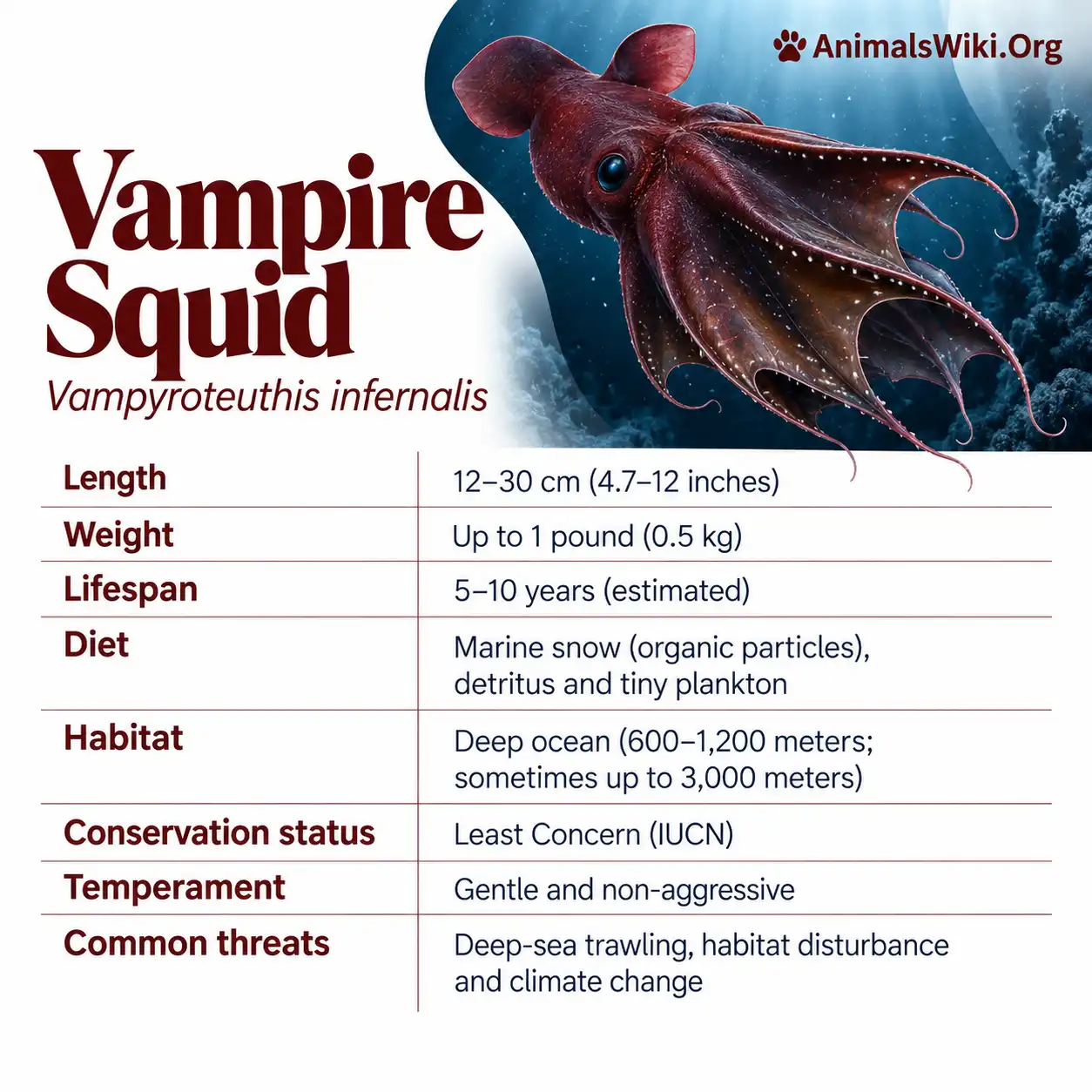
| Feature | Details |
|---|---|
| Common Name | Vampire Squid (also: Vampire Squid from Hell) |
| Scientific Name | Vampyroteuthis infernalis |
| Meaning of Name | “Vampire squid from hell” (Latin/Greek) |
| Family | Vampyroteuthidae (sole member) |
| Order | Vampyromorphida (sole member) |
| First Described | 1903 (by Carl Chun) |
| Habitat | Oxygen Minimum Zone (OMZ) of tropical and subtropical oceans |
| Depth Range | 600 – 1,200 meters (2,000 – 3,900 feet) |
| Body Length | Up to 30 cm (12 inches) including arms |
| Weight | Approximately 100–200 grams |
| Lifespan | Estimated 3–8 years |
| Diet | Marine snow, detritus, dead zooplankton — NOT active predator |
| Bioluminescence | Yes — extensive photophore system across entire body |
| Conservation Status | Not Evaluated (IUCN) |
| Defining Feature | Cloak-like webbing between arms; exists in near-zero oxygen |
1. Vampire Squid Species Overview & Classification
Deep in the ocean’s permanent midnight zone, at depths where pressure is crushing and oxygen is so scarce that most animals cannot survive, drifts one of the most ancient, mysterious, and spectacularly named creatures on Earth. Meet Vampyroteuthis infernalis — the Vampire Squid from Hell.
That name is not hyperbole. It is the animal’s actual scientific name, coined by German biologist Carl Chun in 1903 after he hauled one up from the deep Atlantic. Confronted with a small, jet-black creature with blood-red eyes, a cloak of webbed arms, and spine-like projections lining its mantle, Chun reached for the most evocative vocabulary available to him. The result — Vampyroteuthis infernalis — is arguably the most dramatic scientific name in the entire animal kingdom, and the creature absolutely deserves it.
But here is the twist that makes the Vampire Squid even more fascinating than its terrifying name suggests: it is not actually a squid. And it is not a vampire in any real sense either.
The Vampire Squid occupies a completely unique position in the tree of life. It is the sole member of its own order — Vampyromorphida — and its own family — Vampyroteuthidae. It is neither a true squid (order Teuthida) nor a true octopus (order Octopoda), but rather a living fossil — an animal so ancient and so evolutionarily isolated that it represents an entire branch of the cephalopod family tree by itself. Its lineage diverged from both squids and octopuses hundreds of millions of years ago, making it a genuine living link to the deep past.
Think of it this way: if squids and octopuses are the two great branches of a family tree, the Vampire Squid is the ancient root from which both branches grew.
Species Classification Table
| Classification Level | Details |
|---|---|
| Kingdom | Animalia |
| Phylum | Mollusca |
| Class | Cephalopoda |
| Subclass | Coleoidea |
| Order | Vampyromorphida (sole order in subclass) |
| Family | Vampyroteuthidae (sole family in order) |
| Genus | Vampyroteuthis (sole genus) |
| Species | Vampyroteuthis infernalis (sole species) |
| Described By | Carl Chun, 1903 |
The Vampire Squid is the only known surviving member of its entire order. It has no close living relatives. In evolutionary biology, this makes it what scientists call a monotypic taxon at multiple levels — the only species in its genus, the only genus in its family, and the only family in its order. It is, in a very real sense, evolutionarily alone.
2. Vampire Squid Physical Description & Unique Features
The Vampire Squid is not a large animal — but it is, by any measure, a spectacular one. Every detail of its body is an adaptation to one of Earth’s most extreme environments, and the result is a creature that looks like it was designed by a committee of marine biologists and horror film directors working in close collaboration.
Size and Build
Adult Vampire Squid reach a total length of approximately 30 centimeters (12 inches), including their eight arms. The mantle (the main body section, like a squid’s “head-body”) measures about 15 centimeters (6 inches) alone. Weight typically falls between 100 and 200 grams — roughly the weight of a small apple. Despite this modest size, the Vampire Squid has the largest eyes relative to body size of any animal on Earth — more on that shortly.
The Cape — Webbed Arms
The most visually striking feature of the Vampire Squid is the cloak-like webbing connecting all eight of its arms. This webbing — called the interbrachial web — extends between the arms like the membrane of a bat’s wing, giving the animal a dramatically cloaked appearance when its arms are extended. When the Vampire Squid pulls its arms up and over its mantle, it wraps itself in this dark cape — a defensive posture that gives it its vampire-like appearance and its evocative name.
In addition to the eight webbed arms, the Vampire Squid possesses two retractile filaments — long, thin, thread-like structures that can be extended far beyond the body length. These filaments are unique to the Vampire Squid and are found in no other living cephalopod. Their precise function involves food collection, which we will explore in the diet section.
The Eyes — Windows to the Deep
The Vampire Squid possesses the largest eyes relative to body size of any animal known to science. In a 30 cm animal, the eyes can measure up to 2.5 centimeters (1 inch) in diameter — proportionally enormous. These massive eyes are adapted to gather the absolute maximum amount of light available in the deep sea’s near-total darkness.
The eyes can appear either deep red or bright blue, depending on the angle of light — a striking effect that contributes to the animal’s otherworldly appearance.
Coloration
The Vampire Squid’s body is jet black to deep reddish-purple — some of the darkest pigmentation found in any known cephalopod. This dark coloration provides excellent camouflage in the deep-sea environment and may also serve to absorb the bioluminescent light produced by the animal’s own body, preventing self-illumination from revealing its outline to predators.
Bioluminescence — A Living Light Show
The Vampire Squid is covered in photophores — light-producing organs — distributed across its entire body surface, arms, and even the interior of its webbing. These photophores allow the Vampire Squid to produce bioluminescent light that it controls with remarkable precision, creating patterns of light and darkness that serve multiple functions in communication, predator confusion, and possibly even navigation in the lightless deep.
The light produced ranges from small, sharp points to diffuse glowing patches, and the animal can vary both the intensity and duration of each photophore’s output. In complete darkness, an active Vampire Squid performing bioluminescent displays is described by researchers who have observed it via submersible as one of the most beautiful sights in the natural world.
The Cirri — Arm Decorations
Lining the inner surface of the Vampire Squid’s arms are cirri — soft, fleshy tooth-like projections that give the arms a spiky appearance. These cirri are not teeth and cannot bite — they are sensory structures that help the animal manipulate food items and detect water movements and chemical signals.
Did You Know? The Vampire Squid has the largest eyes relative to body size of any animal on Earth. Its eyes are proportionally comparable to a human having eyes the size of dinner plates — an adaptation that maximizes light capture in the ocean’s perpetual midnight zone.
3. Vampire Squid Natural Habitat & Geographic Range
The Vampire Squid’s habitat is one of the most extreme environments on our planet — a zone that most animals actively avoid and where the Vampire Squid has made its exclusive home for hundreds of millions of years.
The Oxygen Minimum Zone (OMZ)
The Vampire Squid lives primarily in the Oxygen Minimum Zone (OMZ) of the world’s tropical and subtropical oceans — a layer of water, typically found between 600 and 1,200 meters (2,000–3,900 feet) depth, where dissolved oxygen concentrations are so low that most marine animals cannot survive.
The OMZ forms because at these intermediate depths, organic matter sinking from the surface is decomposed by bacteria, consuming virtually all available oxygen. The result is a layer of water with oxygen concentrations as low as 0.5 mL per liter — less than 5% of the oxygen found at the surface. For most animals, this is lethally hypoxic.
The Vampire Squid has evolved a suite of extraordinary adaptations to thrive in these conditions:
- Extremely low metabolic rate — it barely burns energy, requiring very little oxygen
- Highly efficient hemocyanin — its blue, copper-based blood protein carries oxygen far more efficiently than hemoglobin at low concentrations
- Large gill surface area — maximizes oxygen uptake from oxygen-poor water
By inhabiting the OMZ, the Vampire Squid has essentially claimed a vast, food-containing deep-sea habitat for itself — largely free of the competition and predation pressure that characterizes shallower and deeper zones.
Geographic Distribution
The Vampire Squid is found in tropical and subtropical oceans worldwide — wherever the OMZ is well-developed. Its range spans:
Habitat Range by Ocean/Region
| Ocean / Region | Presence | Depth Range | Notes |
|---|---|---|---|
| Tropical Atlantic | Confirmed | 600–1,200 m | Original discovery location |
| Eastern Pacific | Confirmed | 700–1,000 m | Extensively studied via MBARI |
| Western Pacific | Confirmed | 600–1,100 m | Japanese and Philippine waters |
| Indian Ocean | Confirmed | 600–1,200 m | Arabian Sea OMZ especially rich |
| Mediterranean | Rare/marginal | 500–800 m | Occasional records |
| Southern Ocean | Rare | >600 m | Limited observations |
| Gulf of Mexico | Confirmed | 600–900 m | Well-documented population |
Within the OMZ, Vampire Squid undergo diel vertical migration — moving upward slightly at night (toward 600 m) and sinking deeper by day (toward 1,200 m), tracking the movements of the organic particles they feed upon.
Did You Know? The Vampire Squid lives in water with so little oxygen that most marine animals would suffocate within minutes. The oxygen concentration in its habitat — the Oxygen Minimum Zone — can be less than 5% of surface ocean oxygen levels. The Vampire Squid not only survives there — it has claimed the entire zone as its own exclusive realm.
4. Vampire Squid Diet & Feeding Behavior
Here is the biggest surprise about the Vampire Squid — the most dramatically named animal in the ocean, the creature that literally translates to “Vampire Squid from Hell,” feeds on… drifting flakes of marine snow.
Not blood. Not living prey. Not terrified fish fleeing in horror. Just gently drifting organic particles.
The Marine Snow Diet
The Vampire Squid is one of very few animals in the ocean classified as a “detritivore” at its size — an animal that feeds primarily on dead and decaying organic matter rather than living prey. Scientists made this discovery, which upended decades of assumptions about the species, through careful analysis of stomach contents from collected specimens and direct observation via deep-sea submersible.
Marine snow is the term oceanographers use for the continuous gentle rain of organic particles that drifts downward from the ocean surface. It consists of:
- Dead and dying zooplankton (tiny crustaceans, copepods, krill)
- Fecal pellets from zooplankton and larger animals
- Phytoplankton cells and fragments
- Shed mucus and shed exoskeletons (molts)
- Bacteria colonizing all of the above
- Micro-aggregates of organic compounds
This sounds like extremely humble fare for an animal with such a ferocious name — and indeed, the discovery that Vampire Squids are essentially gentle garbage collectors of the deep sea was considered one of the most surprising findings in deep-sea biology of the last two decades.
How They Feed — The Mucus Rope Technique
The Vampire Squid’s two retractile filaments — those long, thread-like structures unique to this species — are the primary food-collection tools. The animal extends these filaments out into the water column, where they are coated in sticky mucus produced by specialized glands. As marine snow particles drift past or contact the filaments, they adhere to the mucus.
Periodically, the Vampire Squid retracts the filament back to its mouth, scraping the accumulated food particles off with its arms and compressing them into a mucus food ball, which is then consumed. The process is gentle, passive, and requires minimal energy — perfectly suited to an animal living on the edge of what is possible in a near-zero-oxygen environment.
Diet Breakdown Table
| Food Source | Estimated % of Diet | Collection Method |
|---|---|---|
| Zooplankton remains (dead) | 30–40% | Mucus filament trapping |
| Fecal pellets (marine snow) | 20–30% | Mucus filament trapping |
| Phytoplankton aggregates | 15–20% | Passive drift contact |
| Bacterial colonies | 10–15% | Associated with all particles |
| Shed exoskeletons (molts) | 5–10% | Mucus filament trapping |
| Mucus aggregates | 5–8% | Passive collection |
“The discovery that vampire squid feed on marine snow completely changed how we understood this animal. Here is one of the ocean’s most visually dramatic creatures — and it turns out to be a gentle garbage collector, harvesting the dead remains drifting down from above. Nature has a remarkable sense of irony.” — Dr. Henk-Jan Hoving, Marine Biologist, GEOMAR Helmholtz Centre for Ocean Research Kiel
5. Vampire Squid Reproduction & Life Cycle
The reproductive biology of the Vampire Squid is as unusual as everything else about this extraordinary animal — marked by remarkable longevity of the reproductive period and an energy efficiency that reflects its low-metabolism deep-sea lifestyle.
Sexual Maturity and Reproduction
The Vampire Squid reaches sexual maturity slowly relative to most cephalopods. Where many squid species mature and reproduce within a year before dying, the Vampire Squid follows a much longer timeline consistent with its low-energy lifestyle.
Unlike most cephalopods, which are semelparous (reproducing once and then dying), the Vampire Squid appears to be capable of iteroparity — reproducing multiple times across its lifespan. Research published in 2015 by scientists at MBARI documented what appears to be a repeating cycle of egg development, spawning, and recovery in female Vampire Squid, suggesting they may reproduce in multiple batches across a lifespan estimated at several years.
This is an extraordinary finding — most cephalopods are famously short-lived, fast-reproducing, and die after a single reproductive event. The Vampire Squid’s apparently multi-year reproductive lifespan is another marker of just how fundamentally different it is from its cephalopod relatives.
Eggs and Development
Female Vampire Squid produce relatively large eggs for a cephalopod of their size — the eggs are released into the water column and are thought to develop there as free-floating, unguarded eggs. Parental care, if any exists, has not been documented. Given the extreme conditions of the deep OMZ, the eggs are thought to have slow development rates consistent with cold temperatures and low metabolic pace.
Estimated Lifespan
| Species | Estimated Lifespan |
|---|---|
| Vampire Squid (Vampyroteuthis infernalis) | 3–8 years (estimated) |
| Common Squid (Loligo vulgaris) | 1–3 years |
| Giant Squid (Architeuthis dux) | 3–5 years |
| Common Octopus (Octopus vulgaris) | 1–2 years |
| Giant Pacific Octopus (Enteroctopus dofleini) | 3–5 years |
| Nautilus (Nautilus pompilius) | 15–20 years |
Did You Know? Unlike virtually all other cephalopods — which breed once and die — the Vampire Squid appears capable of reproducing multiple times across its life. This makes it one of the most biologically unusual cephalopods ever studied, and a crucial link to understanding the evolution of reproduction in this ancient animal group.
6. Social Behavior & Communication
The Vampire Squid is a solitary animal in the deep sea. It does not form schools, aggregations, or mating groups — at least, none that have ever been observed. The sparse, extreme conditions of the Oxygen Minimum Zone make maintaining large social groups energetically impossible, and the Vampire Squid appears to live a largely isolated existence in its vast, dark domain.
Bioluminescent Communication
The most sophisticated behavioral system of the Vampire Squid is its extraordinary bioluminescent communication and display capability. With photophores distributed across essentially its entire body surface — arms, mantle, webbing, and even the fin tips — the Vampire Squid can produce a remarkable range of light displays.
Researchers observing Vampire Squid via deep-sea submersible and ROV have documented several distinct patterns of bioluminescent activity:
- Full-body glow — the entire animal illuminates simultaneously, creating a ghostly halo effect
- Arm-tip illumination — individual arm tips glow while the body remains dark, creating a confusing pattern for potential predators
- Pulsing patterns — rhythmic flashing that may serve as a form of communication
- Photophore “eyes” — large patches near the body surface that may mimic large eyes to deter predators
Whether the Vampire Squid uses bioluminescence for intraspecific communication (signaling to other Vampire Squid) as well as predator deterrence and prey attraction is still a subject of active research. Given the extreme rarity of encounters between individuals in the deep sea, complex social communication seems unlikely — but the sophistication of their light-control system suggests capabilities beyond simple defense.
Sensory Systems
In addition to bioluminescence, Vampire Squid rely heavily on:
- Chemoreception — detecting chemical signals dissolved in water
- Mechanoreception — sensing pressure waves and water movement through their arms and body surface
- Their enormous eyes — maximizing visual input in near-zero light conditions
7. Predators & Defense Mechanisms
Living in the Oxygen Minimum Zone provides the Vampire Squid with significant protection from predation — most animals simply cannot survive there. But some specialized deep-sea predators can tolerate low-oxygen conditions sufficiently to enter the OMZ, making defense mechanisms essential.
Known and Suspected Predators
- Deep-diving sperm whales (Physeter macrocephalus) — the most significant known predator; sperm whales can dive to extraordinary depths and the remains of Vampire Squid have been found in sperm whale stomachs
- Large deep-sea fish — including lanternfishes, deep-sea sharks, and other mesopelagic predators that can briefly tolerate OMZ conditions
- Deep-diving pinnipeds — some seal species dive to the edges of the OMZ
- Other large cephalopods — opportunistic predation by larger squid species cannot be excluded
Defense Arsenal
The Vampire Squid has evolved an impressive and creative suite of defensive behaviors:
1. The Pineapple Posture When threatened, the Vampire Squid’s most dramatic defense is to pull its arms and webbing up and over its mantle — inverting the cloak to cover its entire body. In this position, the cirri (spiny projections on the arm inner surfaces) are displayed outward, giving the animal a spiky, intimidating appearance. This posture is called the “pineapple posture” by researchers and makes the Vampire Squid appear larger, spikier, and less palatable.
2. Bioluminescent Confusion The Vampire Squid can deploy its bioluminescent system as an active defense — creating confusing, misdirecting light patterns that disorient predators. By illuminating arm tips while darkening the body, or flashing the entire body rapidly, it creates a visual confusion that makes it difficult for a predator to accurately target the vulnerable mantle.
3. Ink — Bioluminescent Version Unlike true squid, which squirt black ink to confuse predators, the Vampire Squid ejects a cloud of bioluminescent mucus from the tips of its arms when severely threatened. This glowing cloud persists in the dark water for several minutes, potentially distracting and confusing a pursuing predator while the Vampire Squid retreats.
4. Camouflage Through Darkness The Vampire Squid’s jet-black coloration is itself a defensive adaptation — in the near-total darkness of the deep sea, dark coloration provides excellent camouflage against the black water background. The animal can also control which photophores are active, potentially mimicking the patchy background bioluminescence of the deep-sea environment.
5. OMZ Refuge Perhaps the most elegant defense of all is simply living where predators cannot follow. The extreme oxygen depletion of the OMZ means that most potential predators cannot sustain activity there for extended periods. The Vampire Squid has essentially converted an inhospitable environment into a fortress.
“The vampire squid’s defensive repertoire is one of the most sophisticated we’ve ever documented in a deep-sea invertebrate. The bioluminescent ink alone is extraordinary — instead of darkness, it uses light as its escape mechanism. It’s the deep sea’s version of a smoke bomb, but glowing.” — Dr. Bruce Robison, Senior Scientist, MBARI (Monterey Bay Aquarium Research Institute)*
8. Relationship with Humans
Discovery — Carl Chun and the German Deep-Sea Expedition
The Vampire Squid entered the scientific record in 1903 through the work of Carl Chun, director of the Valdivia Expedition — a landmark German deep-sea research voyage that collected specimens from the deep Atlantic and Indian Oceans between 1898 and 1899. Among the extraordinary haul of deep-sea animals brought back to the surface was a small, dark, webbed cephalopod unlike anything previously described.
Chun, recognizing the animal’s complete uniqueness, described it in 1903 as the sole member of a new family and new order — bestowing upon it the unforgettable name Vampyroteuthis infernalis. The scientific community recognized immediately that this was not merely a new species but a genuinely new branch of the cephalopod family tree.
The MBARI Era — Seeing It Alive
For most of the 20th century, everything known about the Vampire Squid came from dead or dying specimens brought up in trawl nets — their colors faded, their bodies damaged by the pressure change, their behaviors unknown. It was not until the development of deep-sea remotely operated vehicles (ROVs) in the late 20th century that scientists could observe living Vampire Squid in their natural habitat for the first time.
The Monterey Bay Aquarium Research Institute (MBARI), operating from the Monterey Bay in California, has led the world in Vampire Squid observation via their fleet of deep-sea ROVs. Since the 1990s, MBARI researchers have accumulated hundreds of hours of Vampire Squid footage at depth — documenting their bioluminescent displays, defensive postures, feeding behavior, and movement patterns with unprecedented clarity.
It was MBARI research that revealed the marine snow diet, the bioluminescent ink defense, the possibility of multiple reproductive cycles, and dozens of other fundamental facts about this species’ biology.
Modern Scientific Importance
The Vampire Squid is currently one of the most scientifically valuable animals in deep-sea biology for several reasons:
- As a living fossil, it provides insights into ancient cephalopod evolution
- Its OMZ adaptation provides a model for understanding how life functions in low-oxygen environments — increasingly relevant as ocean oxygen depletion expands due to climate change
- Its bioluminescent systems are studied by researchers interested in biological light production
- Its multiple reproductive cycle upends assumptions about cephalopod life history
Did You Know? The Vampire Squid was originally classified as an octopus when first described — because of its eight arms and webbed appearance. It was only later re-examined and recognized as something so unique that it required an entirely new taxonomic order. It remains the only animal in its entire order to this day.
9. Vampire Squids Conservation Status & Threats
IUCN Status
The Vampire Squid is currently listed as Not Evaluated on the IUCN Red List — not because it is considered safe, but because the extreme difficulty of surveying deep-sea populations makes formal population assessment essentially impossible with current technology.
What scientists do know is that the Vampire Squid is widely distributed globally in the tropical and subtropical OMZ, and that it appears to be relatively abundant within its specialized habitat. There is no evidence of dramatic population decline, but the monitoring capacity simply does not exist to state this with certainty.
Key Threats
1. Ocean Deoxygenation — Climate Change The most serious long-term threat to the Vampire Squid is an ironic one: the animal has evolved to thrive in the OMZ — a low-oxygen zone. As climate change warms the oceans, the OMZ is expanding both in depth range and geographic extent. For most deep-sea animals, this is disastrous — their habitat is being squeezed. For the Vampire Squid, however, the picture is complex. While an expanding OMZ might theoretically expand its habitat, the associated changes in ocean chemistry, temperature, and food availability (marine snow composition depends on surface productivity) introduce significant uncertainties.
2. Deep-Sea Trawling Commercial and exploratory deep-sea trawling reaches the depth range of the Vampire Squid in some ocean regions. Trawling in the mesopelagic and bathypelagic zones causes significant bycatch and habitat disturbance, potentially affecting Vampire Squid populations where it occurs.
3. Deep-Sea Mining As interest in deep-sea mineral extraction grows — targeting polymetallic nodules and sulfide deposits — the risk of significant disturbance to deep-sea water column communities increases. The long-term impacts on OMZ-dwelling animals like the Vampire Squid are not yet understood.
4. Climate-Driven Prey Changes The Vampire Squid’s food supply — marine snow — is directly dependent on surface ocean productivity. Climate change is altering the composition, quantity, and distribution of marine snow production globally. Changes that reduce surface productivity or alter particle sinking rates could directly impact Vampire Squid food availability over coming decades.
10. Famous Individuals & Notable Research
Individual Vampire Squid are not named or tracked — they are too small, too deep, and too rarely observed for that level of individual monitoring. But specific research milestones and individual scientific contributions have made the Vampire Squid one of the most celebrated subjects in deep-sea biology.
The MBARI Collection — The World’s Best Vampire Squid Footage Library
The Monterey Bay Aquarium Research Institute has accumulated the world’s largest library of living Vampire Squid observations — with footage from their ROVs Tiburon, Ventana, and Doc Ricketts spanning decades of deep-sea dives in the Eastern Pacific off the California coast. Several specific observations from MBARI footage have become landmark moments in deep-sea biology:
- The first clear footage of the pineapple posture defense
- The first documented bioluminescent ink ejection event
- The first observations of the mucus filament feeding behavior
- The first evidence of multiple reproductive cycles
Dr. Henk-Jan Hoving’s Diet Discovery (2012)
In 2012, marine biologist Dr. Henk-Jan Hoving of MBARI published a landmark paper revealing the Vampire Squid’s true diet — marine snow and detritus — overturning the previous assumption that it was an active predator. This paper, published in the Proceedings of the Royal Society B, is considered one of the most surprising dietary discoveries in cephalopod biology and was covered by major science media worldwide.
Carl Chun’s Original Specimens
The original type specimens collected by Carl Chun during the Valdivia Expedition (1898–1899) are preserved at the Senckenberg Research Institute in Frankfurt, Germany. These specimens — the first Vampire Squid ever brought to science — remain scientifically priceless reference materials over 120 years after their collection.
11. Role in Ecosystem & Food Chain
Despite its dramatic appearance and name, the Vampire Squid plays a gentle and surprisingly important ecological role in deep-sea ecosystems — one that scientists are only beginning to fully appreciate.
Biological Carbon Pump Contribution
The Vampire Squid’s feeding strategy makes it an important participant in the ocean’s biological carbon pump — the process by which carbon from the surface (captured by photosynthesis) is transported to the deep ocean and sequestered there for centuries or millennia.
By consuming marine snow (which is composed of carbon-rich organic material) in the deep OMZ, Vampire Squid incorporate this carbon into their bodies. When they are eaten by deeper-diving predators like sperm whales, or when they die and sink, this carbon is transported even deeper — effectively removing it from circulation and contributing to deep-sea carbon storage.
In this way, even the Vampire Squid’s modest feeding activity contributes to the ocean’s capacity to mitigate climate change by sequestering atmospheric carbon dioxide.
As Prey
The Vampire Squid’s presence in sperm whale stomach contents confirms its importance as a deep-sea prey item for the ocean’s deepest-diving megafauna. Sperm whales feed at extraordinary depths and range across the global ocean — the nutritional contribution of Vampire Squid to sperm whale diets, while probably minor compared to larger squid, exists and has ecological significance.
OMZ Ecology
Within the OMZ itself, the Vampire Squid may play a role in nutrient cycling — releasing waste products that contribute to the chemistry and microbial ecology of this unusual water layer. As one of the most abundant larger animals capable of sustained life in the OMZ, its ecological footprint within this zone is probably more significant than its humble size suggests.
12. Vampire Squids Discovery & Evolution Timeline
~300–400 million years ago — The class Cephalopoda first appears in the fossil record. Early cephalopods include nautilus-like shelled animals that dominated Paleozoic seas.
~200–250 million years ago — The subclass Coleoidea (cephalopods without external shells, including modern squid, octopus, and cuttlefish) diverges and begins to diversify.
~150–200 million years ago (estimated) — The lineage leading to Vampyroteuthis diverges from the ancestors of both modern squid and modern octopuses. This split makes the Vampire Squid a genuinely ancient lineage with no close living relatives.
Jurassic–Cretaceous period — Fossil evidence from this era suggests that Vampyromorphida-like animals were more diverse and widespread in ancient oceans. The modern Vampire Squid may be the sole surviving representative of what was once a more diverse group.
Pre-1898 — The deep oceans remain almost entirely unexplored. The Vampire Squid, living at depths inaccessible to any fishing or research technology, is completely unknown to science.
1898–1899 — The German Valdivia Deep-Sea Expedition, led by Carl Chun, conducts the first systematic deep-sea trawling surveys of the Atlantic and Indian Oceans. Among thousands of collected specimens is a small, dark, webbed cephalopod unlike anything in the scientific literature.
1903 — Carl Chun formally describes Vampyroteuthis infernalis in a landmark publication — establishing a new species, new genus, new family, and new order simultaneously. The name becomes an instant classic of dramatic scientific nomenclature.
1920s–1970s — Occasional specimens collected in deep-sea trawls from around the world slowly expand knowledge of the species’ geographic range. All information comes from dead specimens; living behavior remains completely unknown.
1980s–1990s — The development of deep-sea ROV technology opens the possibility of observing deep-sea animals in their natural habitat for the first time. MBARI begins ROV operations in the Eastern Pacific.
1990s–2000s — MBARI ROVs document living Vampire Squid behavior for the first time — including bioluminescent displays, defensive postures, and movement patterns. The species transitions from a curiosity of dead specimens to a thoroughly documented living animal.
2012 — Dr. Henk-Jan Hoving publishes landmark research confirming the marine snow diet — fundamentally changing the scientific understanding of the species’ ecology.
2015 — Research documents potential multiple reproductive cycles — upending assumptions about cephalopod life history.
2020s–2026 — Climate change research begins focusing on how expanding OMZ zones may affect Vampire Squid populations. The species remains one of deep-sea biology’s most actively studied animals.
13. Vampire Squid Comparison with Similar Species
| Feature | Vampire Squid (Vampyroteuthis infernalis) | Giant Squid (Architeuthis dux) | Dumbo Octopus (Grimpoteuthis spp.) |
|---|---|---|---|
| Classification | Vampyromorphida (unique order) | Teuthida (true squid) | Octopoda (true octopus) |
| Size | Up to 30 cm | Up to 13 meters | 20–30 cm typically |
| Depth | 600–1,200 m (OMZ) | 200–1,000 m | 1,000–5,000 m |
| Diet | Marine snow / detritus | Active predator (fish, squid) | Small invertebrates, crustaceans |
| Bioluminescence | Extensive — entire body | Limited | Some species — fin photophores |
| Defense | Bioluminescent ink, pineapple posture | Ink, escape | Passive camouflage |
| Arms | 8 arms + 2 filaments | 8 arms + 2 long tentacles | 8 arms (webbed) |
| Oxygen Tolerance | Extreme low-oxygen specialist | Normal marine oxygen required | Moderate — deep cold water |
| Reproductive Strategy | Possibly iteroparous (multiple) | Semelparous (once, then dies) | Likely semelparous |
| Conservation Status | Not Evaluated | Least Concern | Not Evaluated |
14. Best Places to “See” a Vampire Squid
Let us be direct: you cannot see a living Vampire Squid without access to a multi-million dollar deep-sea research submersible or ROV system. They live at depths of 600 to 1,200 meters — completely inaccessible to recreational divers, sport fishers, or even most scientific research vessels.
However, there are genuine and accessible ways to experience this extraordinary animal:
Aquariums and Museums with Deep-Sea Exhibits
- 🇺🇸 Monterey Bay Aquarium, California, USA — The world’s closest institutional connection to the Vampire Squid. MBARI (their affiliated research institute) holds the world’s largest Vampire Squid footage archive. The aquarium’s deep-sea exhibits and educational materials feature the species prominently. Preserved specimens and video installations bring this animal within reach of the public.
- 🇬🇧 Natural History Museum, London, UK — Holds preserved Vampire Squid specimens in its world-class marine invertebrate collection. Educational displays on deep-sea life feature the species.
- 🇩🇪 Senckenberg Research Institute, Frankfurt, Germany — Holds the original type specimens collected by Carl Chun during the Valdivia Expedition — the very first Vampire Squid ever brought to science.
- 🇯🇵 Okinawa Churaumi Aquarium, Japan — One of the world’s finest marine aquariums, with exceptional deep-sea displays and educational coverage of deep-sea cephalopods.
- 🇫🇷 Oceanographic Museum of Monaco — Historic oceanographic institution with exceptional deep-sea collections and exhibits.
- 🇺🇸 Smithsonian National Museum of Natural History, Washington DC, USA — Features deep-sea biodiversity in educational exhibits with cephalopod-specific coverage.
Digital and Virtual Access
- MBARI YouTube Channel (youtube.com/mbari) — Hosts extraordinary real ROV footage of living Vampire Squid — the closest most people will ever come to seeing one. Many clips have millions of views.
- NOAA Ocean Explorer (oceanexplorer.noaa.gov) — Live expedition footage and archives featuring deep-sea animals including Vampire Squid.
- BBC Earth YouTube — Clips from Blue Planet and Blue Planet II featuring Vampire Squid bioluminescent displays.
Did You Know? The MBARI YouTube channel has footage of Vampire Squid performing their bioluminescent displays and pineapple posture defense that has been viewed millions of times. It remains some of the most extraordinary wildlife footage ever captured — and it is freely available online.
15. Vampire Squid Fun Facts for Kids
- The Vampire Squid’s scientific name — Vampyroteuthis infernalis — literally translates to “Vampire Squid from Hell” — the most dramatically named animal in science.
- It is not a true squid — it is the sole survivor of an ancient order that diverged from both squids and octopuses hundreds of millions of years ago.
- It has the largest eyes relative to body size of any animal on Earth — proportionally like a human having dinner-plate-sized eyes.
- Instead of black ink like regular squid, it ejects glowing bioluminescent mucus as a defense — using light instead of darkness to confuse predators.
- It lives in water with less than 5% of the oxygen found at the ocean surface — conditions that would kill most marine animals.
- Despite its ferocious name, it feeds primarily on drifting marine snow — flakes of dead organic matter — making it one of the ocean’s most peaceful feeders.
- It may be capable of reproducing multiple times across its lifespan — virtually unique among cephalopods.
- Its blood is blue — it contains copper-based hemocyanin instead of iron-based hemoglobin, giving it extraordinary oxygen-carrying efficiency at low oxygen levels.
- The Vampire Squid’s two retractile filaments — used for collecting marine snow — are found in no other living cephalopod on Earth.
- It is the most culturally famous deep-sea animal in the world that most people have never heard of — until they encounter its name, after which they never forget it.
16. Frequently Asked Questions About Vampire Squids
Q1: Is the Vampire Squid actually a squid?
No — despite its name, the Vampire Squid (Vampyroteuthis infernalis) is not a true squid. It is the sole surviving member of its own ancient order — Vampyromorphida — which diverged from the ancestors of both modern squid and modern octopuses hundreds of millions of years ago. It has characteristics of both groups but belongs to neither. Scientists consider it a living fossil — a survivor of an ancient cephalopod lineage with no close living relatives.
Q2: What does the Vampire Squid eat?
Despite its ferocious name, the Vampire Squid feeds primarily on marine snow — drifting flakes of dead organic matter including dead zooplankton, fecal pellets, shed exoskeletons, and phytoplankton aggregates. It collects this food using two long, sticky retractile filaments unique to this species, which it extends into the water column to trap passing particles. It is a passive, gentle feeder — not an active predator.
Q3: How does the Vampire Squid survive in low-oxygen water?
The Vampire Squid has evolved several extraordinary adaptations for survival in the oxygen-depleted Oxygen Minimum Zone: an extremely low metabolic rate (it barely burns energy), highly efficient hemocyanin (blue, copper-based blood protein that carries oxygen more efficiently than hemoglobin at low concentrations), and large gill surface area that maximizes oxygen uptake. These adaptations allow it to thrive in water with less than 5% of surface oxygen concentrations — conditions lethal to most marine animals.
Q4: Is the Vampire Squid dangerous to humans?
Absolutely not. The Vampire Squid is a small, gentle, deep-sea animal that feeds on drifting organic particles. It has no venom, poses no biting threat of any significance, and lives at depths of 600–1,200 meters — completely inaccessible to humans without specialized research equipment. Its dramatic name and appearance are entirely unrelated to any actual danger.
Q5: How does the Vampire Squid produce bioluminescence?
The Vampire Squid’s body is covered with photophores — specialized light-producing organs distributed across its entire body surface, arms, and webbing. These photophores contain light-producing chemical compounds (typically luciferin, which reacts with oxygen to produce light via luciferase enzymes). The Vampire Squid controls the activity of individual photophores with remarkable precision — varying intensity, duration, and pattern — to create complex light displays for defense, communication, and possibly navigation.
Q6: How was the Vampire Squid discovered?
The Vampire Squid was discovered during the German Valdivia Deep-Sea Expedition (1898–1899), when deep-sea trawl nets brought specimens up from the deep Atlantic and Indian Oceans. German biologist Carl Chun formally described the species in 1903, recognizing it as so unique that it required an entirely new taxonomic order. The dramatic scientific name Vampyroteuthis infernalis was Chun’s inspired choice, reflecting the animal’s dark coloration, red eyes, and cloak-like webbing.
Q7: Is the Vampire Squid endangered?
The Vampire Squid is listed as Not Evaluated on the IUCN Red List — not because it is safe, but because deep-sea population surveys are practically impossible with current technology. It appears to be relatively abundant within its specialized OMZ habitat, but faces potential long-term threats from ocean deoxygenation driven by climate change, deep-sea trawling, and deep-sea mining operations. Conservation scientists argue that better monitoring and legal protections for deep-sea ecosystems are urgently needed.
Q8: How big is the Vampire Squid?
The Vampire Squid is a small to medium-sized cephalopod, reaching a total length of approximately 30 centimeters (12 inches) including its arms. The mantle (body section) alone measures about 15 centimeters (6 inches). Weight is typically 100–200 grams. Despite this modest size, it has the largest eyes relative to body size of any animal on Earth, with eyes up to 2.5 cm (1 inch) in diameter — proportionally enormous for an animal of its size.