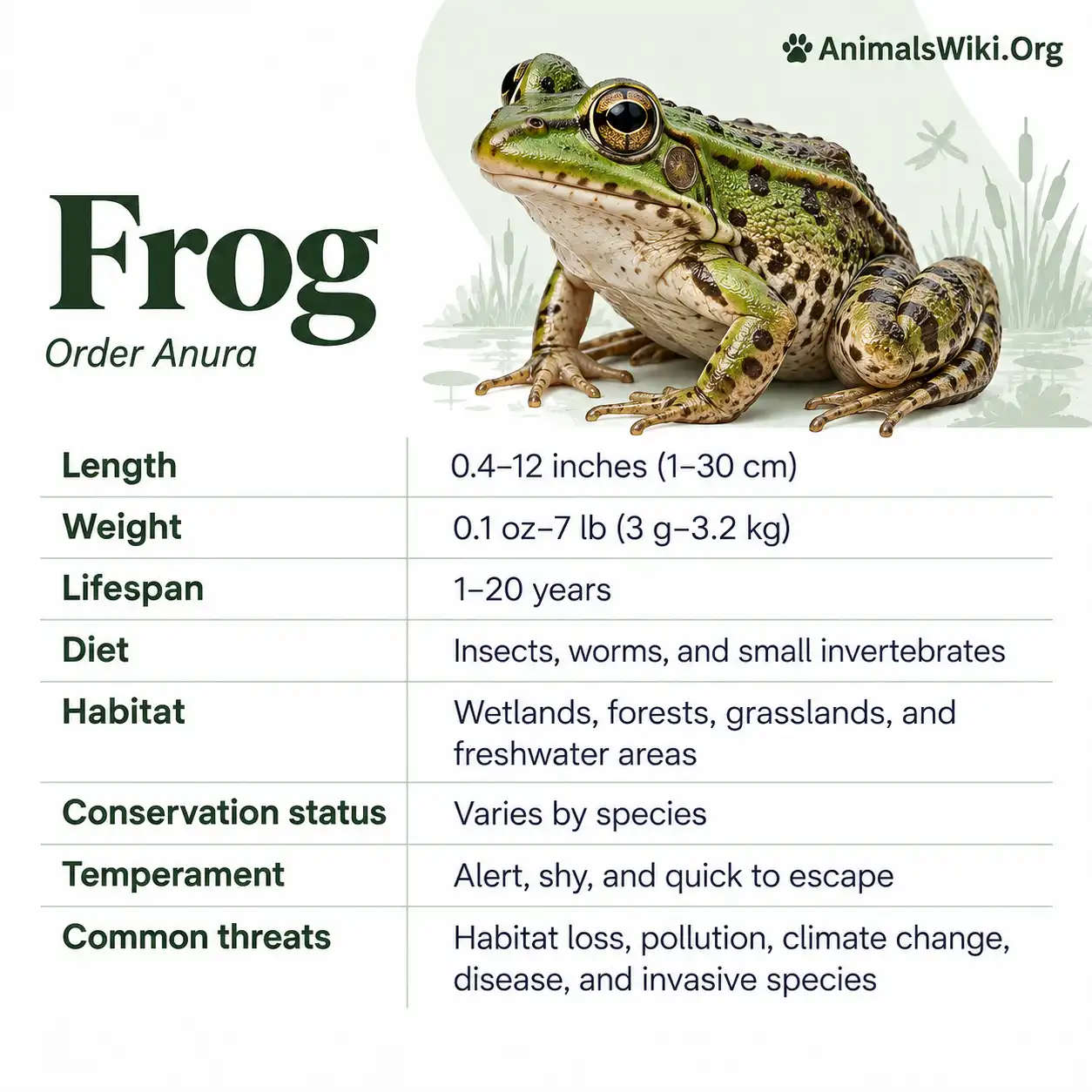
Frogs are among the most diverse, recognizable, and ecologically important amphibians on Earth. Famous for their powerful jumping legs, large eyes, distinctive calls, moist skin, and remarkable transformation from aquatic tadpoles into adults, frogs have adapted to an extraordinary variety of environments.
Frogs belong to the amphibian order Anura, which contains more than 7,000 recognized living species. They occur on every continent except Antarctica and range from tiny species smaller than a human fingernail to enormous frogs weighing several kilograms.
Although frogs are strongly associated with ponds and wetlands, not every frog spends most of its adult life in water. Different species inhabit rainforests, rivers, lakes, swamps, grasslands, mountains, deserts, agricultural landscapes, and trees.
Their life cycle is particularly fascinating. A typical frog begins as an egg, develops into a tadpole, undergoes dramatic metamorphosis, grows legs, loses or reduces its tail, changes its respiratory and digestive systems, and eventually becomes an adult frog.
Frogs also perform vital ecological roles. They consume enormous numbers of insects and other small animals while simultaneously serving as prey for snakes, birds, mammals, fish, reptiles, and other predators.
Because amphibians have permeable skin and often depend on both aquatic and terrestrial environments, changes in frog populations can also provide important clues about environmental conditions.
This comprehensive guide explores frog facts, classification, anatomy, habitat, diet, life cycle, tadpoles, metamorphosis, reproduction, eggs, behavior, jumping, swimming, breathing, communication, hibernation, adaptations, predators, poisonous frogs, types of frogs, frog vs. toad differences, conservation, and frequently asked questions.
Frog Facts
| Feature | Information |
|---|---|
| Common Name | Frog |
| Animal Group | Amphibian |
| Kingdom | Animalia |
| Phylum | Chordata |
| Class | Amphibia |
| Order | Anura |
| Number of Species | More than 7,000 recognized species |
| Distribution | Worldwide except Antarctica |
| Habitats | Freshwater, wetlands, forests, grasslands, mountains, deserts and trees |
| Diet | Mostly carnivorous as adults |
| Young | Tadpole |
| Reproduction | Usually egg-laying |
| Development | Often includes metamorphosis |
| Skin | Thin and permeable |
| Movement | Jumping, hopping, walking, climbing or swimming depending on species |
| Breathing | Lungs, skin and other surfaces depending on life stage/species |
| Activity | Nocturnal, diurnal or crepuscular depending on species |
| Lifespan | Varies enormously among species |
| Largest Living Frog | Goliath frog |
| Major Threats | Habitat loss, disease, pollution, climate change and invasive species |
What Is a Frog?
A frog is a tailless amphibian belonging to the order Anura.
Adult frogs generally possess:
- Short bodies
- Large eyes
- Four limbs
- Powerful hind legs
- Moist skin
- No external tail
- Wide mouths
- Specialized hearing structures
However, frog anatomy varies dramatically among thousands of species.
Some frogs are excellent jumpers.
Others primarily walk.
Some spend much of their lives in trees.
Others are highly aquatic.
A few even survive in remarkably dry environments.
Scientific Classification of Frogs
Frogs do not represent one species or family.
They form an entire amphibian order.
| Classification | Name |
|---|---|
| Kingdom | Animalia |
| Phylum | Chordata |
| Class | Amphibia |
| Order | Anura |
The order Anura contains dozens of families and thousands of species.
Major frog families include groups containing:
- True frogs
- Tree frogs
- Poison dart frogs
- Glass frogs
- Horned frogs
- Narrow-mouthed frogs
- Mantellas
- African bullfrogs
- Many others
This extraordinary diversity makes frogs one of the most successful groups of modern amphibians.
How Many Species of Frogs Are There?
Scientists recognize more than 7,000 living frog species, and new species continue to be described.
The exact total changes as researchers:
- Discover new frogs
- Study DNA
- Reclassify species
- Separate previously combined species
- Revise amphibian taxonomy
Tropical regions contain especially high frog diversity.
Many species occupy very small geographic ranges, sometimes being restricted to a single mountain, forest, island, or watershed.
What Does a Frog Look Like?
A typical adult frog has a compact body with long hind limbs and shorter front limbs.
Common physical characteristics include:
- Large eyes
- Broad mouth
- Visible tympanum in many species
- Four fingers on each forelimb
- Five toes on each hind limb
- Moist skin
- Muscular hind legs
- No adult external tail
However, there is no single body shape shared perfectly by every frog.
Tree frogs may have adhesive toe pads.
Aquatic frogs may have strongly webbed feet.
Burrowing frogs can have compact bodies and specialized feet for digging.
Frog Anatomy
The frog body is highly specialized for amphibious life.
Eyes
Large eyes provide a broad field of vision and help detect moving prey.
Ears
Many frogs possess a visible circular structure called a tympanum behind each eye.
It functions somewhat like an eardrum.
Tongue
Many frogs use a fast, sticky tongue to capture prey.
Legs
Powerful hind limbs can provide explosive jumping force.
Feet
Foot structure depends on lifestyle.
Aquatic species may have webbing, while tree frogs can possess adhesive pads.
Skin
Frog skin is thin, moist, and biologically active.
It plays important roles in respiration, water balance, and protection.
Why Do Frogs Have Moist Skin?
Frog skin must remain appropriately moist because it performs several important physiological functions.
Many frogs can exchange respiratory gases directly through their skin, a process known as cutaneous respiration.
The skin also plays an important role in water balance.
Special glands can produce mucus that helps keep the skin moist.
Because frog skin is permeable, amphibians can be particularly vulnerable to:
- Pollutants
- Chemicals
- Dehydration
- Disease
- Environmental changes
This is one reason frogs can be sensitive indicators of ecosystem disturbance.
Can Frogs Breathe Through Their Skin?
Yes.
Many frogs exchange oxygen and carbon dioxide through their skin.
This is called cutaneous respiration.
Adult frogs may use a combination of:
- Lungs
- Skin
- Mouth/throat surfaces
The relative importance of each method varies among species and environmental conditions.
Tadpoles often rely heavily on gills during aquatic stages.
Do Frogs Have Lungs?
Most adult frogs have lungs.
However, frog lungs are generally simpler than mammalian lungs.
Frogs do not breathe exactly like humans.
Instead of using a diaphragm like mammals, many frogs move air through the mouth and throat region and force it into the lungs.
Some unusual frog species have evolved reduced reliance on lungs, and exceptional species may lack lungs entirely.
Where Do Frogs Live?
Frogs occur on every continent except Antarctica.
They inhabit an enormous range of environments, including:
- Tropical rainforests
- Temperate forests
- Ponds
- Lakes
- Rivers
- Streams
- Swamps
- Marshes
- Grasslands
- Mountains
- Agricultural areas
- Deserts
- Trees
Water is especially important for many species because their eggs and tadpoles develop in aquatic environments.
However, frog lifestyles vary enormously.
Frog Habitat
The ideal frog habitat depends on the species.
Many require a combination of:
- Fresh water
- Moisture
- Vegetation
- Shelter
- Food
- Suitable temperature
- Safe breeding sites
A tree frog may spend most of its adult life above the ground.
An aquatic frog may rarely leave the water.
A desert frog may remain underground for long periods and emerge after rainfall.
This ecological diversity explains how frogs have colonized so many environments.
Frogs in Rainforests
Tropical rainforests contain some of the world’s greatest frog diversity.
Warm temperatures, high humidity, vegetation, abundant insects, and numerous breeding sites create excellent conditions for amphibians.
Rainforest frogs include:
- Tree frogs
- Poison dart frogs
- Glass frogs
- Leaf frogs
- Horned frogs
Some species breed in ponds or streams.
Others deposit eggs on leaves, in tree holes, or inside small pools of water held by plants.
Can Frogs Live in Deserts?
Yes.
Some frogs are remarkably adapted to dry environments.
Desert and semi-arid frogs may survive drought by:
- Burrowing underground
- Reducing activity
- Conserving water
- Forming protective layers
- Emerging rapidly after rainfall
Temporary pools created by storms can become important breeding sites.
These frogs may complete crucial reproductive activities before the pools disappear.
What Do Frogs Eat?
Most adult frogs are carnivorous.
Common prey includes:
- Flies
- Mosquitoes
- Moths
- Beetles
- Crickets
- Grasshoppers
- Spiders
- Worms
- Slugs
- Snails
Larger frogs may eat:
- Small fish
- Other frogs
- Lizards
- Snakes
- Small birds
- Small mammals
Frogs are generally opportunistic and often attack prey small enough to overpower and swallow.
What Do Tadpoles Eat?
Tadpole diets differ substantially among species.
Many tadpoles consume:
- Algae
- Plant material
- Organic debris
- Microorganisms
Others are omnivorous or carnivorous.
Some specialized tadpoles even prey upon other tadpoles or small aquatic organisms.
Their diet may change dramatically during metamorphosis as they transition toward the adult feeding strategy.
How Do Frogs Catch Their Food?
Many frogs are sit-and-wait predators.
They remain still until prey approaches within striking distance.
Then the frog may launch its tongue with remarkable speed.
The sticky surface helps capture the prey and pull it toward the mouth.
Not every frog relies on the same tongue mechanism.
Some actively pursue prey, while others use their jaws more directly.
Do Frogs Have Teeth?
Many frogs possess small teeth along the upper jaw.
Some also have structures called vomerine teeth on the roof of the mouth.
These teeth generally help grip prey rather than chew it.
Frogs usually swallow prey whole.
Some frog groups lack conventional teeth.
The evolution of teeth within frogs is surprisingly diverse.
Do Frogs Chew Their Food?
Generally, no.
Frogs usually swallow prey whole.
Their teeth, when present, primarily help prevent prey from escaping.
Because frogs do not chew like mammals, prey size is limited by what the frog can capture and swallow.
Large frog species can therefore consume surprisingly substantial animals.
Frog Life Cycle
The frog life cycle is one of the most recognizable examples of metamorphosis.
A typical sequence is:
Egg → Tadpole → Tadpole with Legs → Froglet → Adult Frog
However, not every frog follows exactly the same developmental pattern.
Some species have highly unusual reproductive systems.
Stage 1: Frog Eggs
Most frogs reproduce by laying eggs.
Eggs may be deposited:
- In ponds
- In streams
- On vegetation
- On leaves above water
- In foam nests
- Inside tree cavities
- In temporary pools
Eggs are usually surrounded by jelly-like material that helps protect the developing embryos.
Stage 2: Tadpole
A tadpole hatches from the egg.
Typical early tadpoles have:
- A tail
- Aquatic bodies
- Gills
- No functional legs initially
They often look more like small fish than adult frogs.
During this stage, the tadpole feeds and grows.
Stage 3: Tadpole With Legs
As metamorphosis begins, hind legs develop.
Front legs eventually appear.
Internal anatomy also changes.
The digestive system may be reorganized as the animal transitions from a tadpole diet to an adult diet.
Lungs develop or become increasingly functional in many species.
Stage 4: Froglet
A froglet resembles a miniature frog but may retain part of its tail.
The remaining tail tissue is gradually absorbed.
The young frog begins adopting a more adult-like lifestyle.
Stage 5: Adult Frog
Once metamorphosis is complete, the animal has the characteristic adult frog form.
It eventually reaches sexual maturity and can reproduce, beginning the cycle again.
What Is Metamorphosis?
Metamorphosis is the dramatic developmental transformation from the larval stage to the adult form.
During frog metamorphosis:
- Legs grow
- The tail is reduced or absorbed
- Lungs develop or become functional
- Gills disappear in typical species
- Mouth structure changes
- Eyes shift
- The digestive system changes
- Behavior changes
Hormones control much of this transformation.
It is one of the most extraordinary developmental processes among vertebrates.
How Long Does It Take a Tadpole to Become a Frog?
There is no universal answer.
Development can take:
- Several weeks
- Several months
- Much longer in certain species
Temperature, food, species, water conditions, and environmental pressures influence development.
Species breeding in temporary pools may develop rapidly because their aquatic habitat could disappear.
Frog Reproduction
Reproduction varies tremendously among frogs.
In many species, males call to attract females.
A male may grip a female in a mating position known as amplexus.
The female releases eggs, and the male fertilizes them externally.
However, thousands of frog species have produced many variations on this basic system.
Some frogs:
- Guard eggs
- Carry eggs
- Carry tadpoles
- Build foam nests
- Breed inside plants
- Show direct development without a free-swimming tadpole stage
Frog reproduction is remarkably diverse.
Why Do Frogs Croak?
Frogs vocalize primarily for communication.
Male calls commonly serve to:
- Attract females
- Advertise territory
- Warn rival males
- Identify species
Each frog species can have a characteristic call.
This is extremely important in places where many species breed at the same pond.
Females can use calls to locate appropriate mates.
How Do Frogs Make Sounds?
Male frogs often possess a vocal sac.
Air moves between the lungs and vocal structures, producing sound.
The vocal sac inflates and functions as a resonating chamber.
Some species have one large throat sac.
Others have paired sacs.
Calls range from familiar croaks to:
- Chirps
- Whistles
- Trills
- Clicks
- Barks
- Screams
A tropical forest at night can contain dozens of different frog sounds.
Can Female Frogs Croak?
Male frogs are generally the primary callers in many species, particularly during breeding.
However, females of some species can also vocalize.
Therefore, the idea that only male frogs ever make sounds is an oversimplification.
Vocal behavior differs among species.
How Far Can a Frog Jump?
Jumping ability differs enormously.
Some frogs can leap many times their own body length.
Long hind limbs, strong muscles, flexible joints, and specialized tendons help generate jumping force.
Other frogs barely jump at all.
Certain species are adapted more strongly for:
- Walking
- Climbing
- Burrowing
- Swimming
The stereotypical long jump therefore does not apply equally to every frog.
Why Can Frogs Jump So Far?
A jumping frog uses several specialized features.
Powerful Hind Legs
Large muscles generate force.
Long Limb Bones
Long legs increase leverage.
Flexible Joints
Joint movement helps store and release energy.
Strong Tendons
Tendons can contribute to elastic energy storage.
Lightweight Body
A relatively light body can be propelled efficiently.
These adaptations allow some species to make spectacular leaps.
Can Frogs Swim?
Yes.
Many frogs are excellent swimmers.
Aquatic species often have webbed hind feet that function like paddles.
Their powerful hind legs push water backward, moving the body forward.
Not all frogs are equally aquatic.
Tree frogs and terrestrial frogs may swim when necessary but spend much more time away from open water.
Can Frogs Climb Trees?
Many species can.
Tree frogs possess specialized toe pads that help them cling to vegetation and other surfaces.
Their toe pads use complex microscopic structures and mucus to create strong adhesion.
Some species can climb:
- Leaves
- Branches
- Tree trunks
- Rocks
- Smooth vegetation
This adaptation allows them to exploit habitats inaccessible to many ground-dwelling frogs.
Why Do Frogs Have Webbed Feet?
Webbing increases the surface area of the foot.
In aquatic frogs, this creates a more effective paddle.
Species spending less time in water may have reduced webbing.
Tree-dwelling species may instead possess enlarged adhesive toe pads.
Foot anatomy can therefore reveal important information about a frog’s lifestyle.
Are Frogs Nocturnal?
Many frogs are primarily nocturnal.
Nighttime provides:
- Cooler temperatures
- Higher humidity
- Reduced water loss
- Abundant insect prey
- Protection from some visual predators
However, not all frogs are nocturnal.
Several brightly colored poison frogs are active during daylight.
Activity patterns depend strongly on species and habitat.
Do Frogs Sleep?
Frogs experience periods of rest and reduced activity, although their sleep physiology differs from human sleep and remains an interesting area of biological research.
A resting frog may remain almost completely motionless in a sheltered location.
Its activity cycle is influenced by:
- Light
- Temperature
- Moisture
- Season
- Predators
- Food availability
Do Frogs Hibernate?
Frogs living in cold climates may enter prolonged periods of dormancy during winter.
Depending on species, they may shelter:
- Under mud
- Beneath leaves
- Underground
- Inside crevices
- Beneath logs
Metabolism decreases, allowing the animal to conserve energy.
Some species possess astonishing adaptations that allow them to survive partial freezing.
Can Frogs Freeze and Survive?
Certain species can survive substantial freezing of body fluids.
The wood frog is a famous example.
During freezing conditions, protective substances such as glucose accumulate and help reduce cellular damage.
The heart may temporarily stop beating and breathing may become undetectable.
When temperatures rise, the frog can thaw and resume activity.
This is one of the most remarkable cold-weather adaptations among vertebrates.
How Do Frogs Survive Hot Weather?
Frogs in hot and dry environments face the opposite problem: avoiding dehydration.
Adaptations can include:
- Burrowing
- Nocturnal activity
- Reduced metabolism
- Protective skin secretions
- Water storage
- Remaining dormant during drought
Some species enter a state called estivation during extreme heat or dryness.
They become active again when conditions improve.
What Is Estivation?
Estivation is a period of reduced activity used by some animals to survive hot or dry conditions.
A frog may bury itself underground and dramatically reduce its metabolism.
This allows it to conserve both water and energy.
After heavy rainfall, dormant frogs can suddenly emerge, feed, call, and reproduce.
Are Frogs Cold-Blooded?
Frogs are ectothermic.
Their body temperature depends heavily on environmental conditions.
They regulate temperature behaviorally by moving between:
- Sun
- Shade
- Water
- Burrows
- Vegetation
Temperature strongly influences frog activity, digestion, development, and reproduction.
Do Frogs Drink Water?
Frogs generally do not drink water through their mouths in the way mammals do.
Instead, many absorb water directly through specialized areas of their skin.
A highly absorbent region on the underside of the body is sometimes informally called the drinking patch.
This makes skin health extremely important.
Why Are Frogs Slimy?
Many frogs produce mucus through glands in their skin.
This mucus helps:
- Maintain moisture
- Reduce dehydration
- Support skin function
- Potentially provide protection against pathogens
The degree of slipperiness varies among species.
Some frogs also produce defensive chemicals through specialized skin glands.
Are Frogs Poisonous?
Some are.
Certain frog species produce or contain toxic skin chemicals that discourage predators.
The most famous examples are poison dart frogs of Central and South America.
Toxicity differs enormously among species.
Many frogs are harmless.
Even among poison frogs, toxicity can vary according to species, population, and diet.
Poison Dart Frogs
Poison dart frogs are famous for bright colors and chemical defenses.
Colors can include:
- Blue
- Yellow
- Red
- Orange
- Green
- Black
Bright coloration can function as warning coloration, signaling danger to predators.
Interestingly, some poison dart frogs maintained under managed conditions lose much of their toxicity because the chemicals are linked to compounds obtained from their natural diet.
Are Frogs Venomous?
Poison and venom are different.
A poisonous animal causes harm when its toxins are touched, ingested, or otherwise absorbed.
A venomous animal actively delivers toxins through structures such as fangs or stingers.
Most chemically defended frogs are therefore described as poisonous, not venomous.
However, a few unusual frog species have defensive structures capable of delivering toxic secretions in ways that blur the simple distinction.
Frog Predators
Frogs are prey for an enormous variety of animals.
Predators include:
- Snakes
- Birds
- Fish
- Turtles
- Lizards
- Crocodilians
- Mammals
- Larger frogs
- Aquatic insects
- Spiders
Eggs and tadpoles are especially vulnerable.
This high predation pressure has produced extraordinary defensive adaptations.
How Do Frogs Defend Themselves?
Different species use different defenses.
These include:
Camouflage
Brown and green frogs can disappear against vegetation or soil.
Warning Colors
Bright colors can advertise toxicity.
Jumping
Rapid escape can surprise predators.
Toxic Secretions
Some frogs release unpleasant or dangerous chemicals.
Inflating the Body
A frog may make itself appear larger.
Playing Dead
Some species remain motionless when threatened.
Startle Displays
Sudden flashes of bright hidden colors can confuse predators.
Frog defenses are as diverse as frogs themselves.
Frog vs. Toad
One of the most common questions is the difference between a frog and a toad.
Scientifically, toads are frogs.
The order Anura includes both animals commonly called frogs and those commonly called toads.
| Feature | Typical Frog | Typical Toad |
|---|---|---|
| Skin | Often smooth/moist | Often drier and bumpier |
| Legs | Often long | Often shorter |
| Movement | Frequently jumps | Often walks or makes shorter hops |
| Habitat | Often close to water | Often more terrestrial |
| Eggs | Often clusters | Often strings in many true toads |
These are generalizations rather than universal rules.
The true toads belong to the family Bufonidae.
Frog vs. Toad: Are Toads Frogs?
Yes.
From a modern taxonomic perspective, all toads belong within the frog order Anura.
However, not all frogs are called toads.
“Toad” is therefore a common-name distinction rather than a completely separate amphibian order.
Frog vs. Salamander
Frogs and salamanders are both amphibians, but they belong to different orders.
Adult frogs typically lack tails.
Adult salamanders retain long tails.
Salamanders generally have elongated bodies and more similar-sized front and hind limbs.
Frogs typically possess compact bodies and, in many species, enlarged hind legs.
Frog vs. Lizard
Frogs are amphibians.
Lizards are reptiles.
Major differences include:
| Feature | Frog | Lizard |
|---|---|---|
| Class | Amphibia | Reptilia |
| Skin | Moist/permeable | Dry/scaly |
| Eggs | Often aquatic/jelly-like | Usually protected by membranes/shell |
| Development | Often tadpole stage | Direct miniature form |
| Breathing | Skin + lungs in many adults | Lungs |
| Body Temperature | Ectothermic | Ectothermic |
Despite occasionally sharing habitats, they belong to very different vertebrate lineages.
Frog vs. Fish
Tadpoles can superficially resemble fish, but frogs are amphibians.
Fish generally remain aquatic throughout life and possess fins rather than four tetrapod limbs.
A frog’s transition from tadpole to adult demonstrates its membership in the tetrapod vertebrate lineage.
Types of Frogs
There are thousands of frog species, but some well-known groups and examples include:
Tree Frogs
Known for climbing ability and adhesive toe pads.
Poison Dart Frogs
Small colorful frogs famous for chemical defenses.
Glass Frogs
Known for partially transparent undersides in many species.
Bullfrogs
Large, powerful frogs with deep calls.
Goliath Frog
The world’s largest living frog by mass.
Horned Frogs
Robust ambush predators with enormous mouths.
Flying Frogs
Tree frogs capable of controlled gliding using webbed feet and body positioning.
Wood Frog
Famous for surviving freezing conditions.
Tomato Frog
A brightly colored frog from Madagascar.
Red-Eyed Tree Frog
One of the most recognizable rainforest frogs.
What Is the Largest Frog in the World?
The Goliath frog (Conraua goliath) is the largest living frog.
It occurs naturally in parts of Central Africa.
Large individuals can weigh more than 3 kilograms (6.6 pounds) and reach impressive body lengths.
Despite its enormous size, the Goliath frog faces conservation pressures from habitat alteration and human exploitation.
What Is the Smallest Frog in the World?
Some of the world’s smallest frogs measure less than one centimeter as adults.
Paedophryne amauensis from Papua New Guinea is famous for being among the smallest known vertebrates.
Adults are only several millimeters long.
The contrast between such tiny frogs and the giant Goliath frog demonstrates the extraordinary diversity within Anura.
Do Frogs Have Tails?
Adult frogs generally do not have external tails.
Tadpoles do.
During metamorphosis, the tadpole’s tail is gradually absorbed as the body changes into adult form.
There are unusual anatomical exceptions and species with tail-like structures, but the absence of an adult external tail is one of the defining characteristics of Anura.
Do Frogs Have Bones?
Yes.
Frogs are vertebrates and possess internal skeletons.
Their skeleton includes:
- Skull
- Vertebral column
- Limb bones
- Pelvis
- Shoulder girdle
The skeleton is highly modified for the species’ lifestyle.
Jumping frogs have particularly specialized pelvic and hind-limb structures.
Do Frogs Have Ribs?
Frog skeletal anatomy differs substantially from mammalian anatomy.
Most frogs lack the well-developed rib cage familiar in mammals.
Their short vertebral column and compact body reflect their specialized evolutionary history.
Do Frogs Have Ears?
Yes, although they do not have external ear flaps like mammals.
In many species, a visible circular tympanum lies behind the eye.
Sound vibrations reach this membrane and are transmitted internally.
Hearing is especially important because vocal communication plays a major role in frog reproduction.
Do Frogs Blink?
Yes.
Frogs have movable eyelids.
They also possess a transparent or translucent nictitating membrane that can protect the eye while allowing some vision.
This membrane is especially useful when swimming.
Eye movement can also play a surprising role in swallowing.
Do Frogs Use Their Eyes to Swallow?
In many frogs, the eyes can retract downward slightly while swallowing.
This movement helps push food toward the throat.
It is one of the strangest aspects of frog feeding anatomy.
A frog’s large eyes therefore contribute not only to vision but also indirectly to feeding mechanics.
Why Are Frogs Important?
Frogs perform several important ecological functions.
Insect Control
Many frogs consume large numbers of insects.
Food for Predators
Frogs support snakes, birds, fish, mammals, and numerous other animals.
Aquatic Ecosystems
Tadpoles can influence algae, microorganisms, and nutrient cycling.
Terrestrial Ecosystems
Adult frogs transfer energy between aquatic and terrestrial food webs.
Environmental Monitoring
Changes in amphibian populations can reveal environmental problems.
Their ecological importance extends far beyond their small body size.
Frogs as Environmental Indicators
Frogs are often described as bioindicators.
Their permeable skin can make them sensitive to pollutants and environmental changes.
Many species also depend on both aquatic and terrestrial habitats.
A population decline may therefore indicate problems involving:
- Water quality
- Habitat destruction
- Disease
- Pollution
- Climate conditions
- Chemical contamination
However, determining the exact cause of a decline requires careful scientific investigation.
Why Are Frogs Disappearing?
Amphibians have experienced severe declines around the world.
Important threats include:
Habitat Loss
Wetlands and forests are cleared or modified.
Chytrid Fungus
The disease chytridiomycosis has devastated many amphibian populations.
Pollution
Chemicals can affect water and sensitive amphibian skin.
Climate Change
Changing rainfall and temperatures can disrupt breeding and habitat.
Invasive Species
Introduced predators and competitors can threaten native frogs.
Road Mortality
Migrating frogs can be killed while crossing roads.
Wildlife Trade
Some species are collected for food, pets, research, or other markets.
These pressures can interact, making conservation particularly difficult.
Chytrid Fungus and Frogs
One of the most serious threats to amphibians is chytridiomycosis, an infectious disease caused by chytrid fungi.
The disease can damage frog skin.
Because amphibian skin plays critical roles in water and electrolyte balance, severe infection can be fatal.
Chytridiomycosis has contributed to dramatic population declines and extinctions in multiple regions.
It is considered one of the most consequential wildlife diseases documented.
Frog Conservation
Conserving frogs requires protecting both animals and ecosystems.
Important strategies include:
- Protecting wetlands
- Conserving forests
- Restoring breeding ponds
- Improving water quality
- Reducing pollution
- Controlling invasive species
- Monitoring diseases
- Maintaining habitat corridors
- Captive conservation programs for highly threatened species
- Preventing illegal wildlife trade
Because frog species have very different ecological requirements, conservation programs must be tailored to individual populations.
40 Interesting Frog Facts
- Frogs are amphibians.
- They belong to the order Anura.
- There are more than 7,000 recognized frog species.
- Frogs live on every continent except Antarctica.
- Most adult frogs are carnivores.
- Baby frogs are commonly called tadpoles during the larval stage.
- Tadpoles often have gills.
- Tadpoles develop legs during metamorphosis.
- Their tails are usually absorbed during metamorphosis.
- Adult frogs generally lack external tails.
- Many frogs breathe partly through their skin.
- Most adult frogs also possess lungs.
- Frog skin is permeable.
- Frogs are ectothermic.
- Many frogs are nocturnal.
- Some frogs are active during daylight.
- Many frogs can jump several times their body length.
- Aquatic frogs often have webbed feet.
- Tree frogs may have adhesive toe pads.
- Many frogs use sticky tongues to catch prey.
- Frogs generally swallow prey whole.
- Many frog species possess small teeth.
- Frogs have internal skeletons.
- Many frogs have visible tympanic membranes.
- Male frogs often call to attract females.
- Frog calls differ among species.
- Frogs can croak, chirp, whistle, click, bark, or trill.
- Some frogs survive freezing temperatures.
- Desert frogs can survive long dry periods underground.
- Some frogs are poisonous.
- Poison dart frogs are famous for bright warning colors.
- Not every brightly colored frog is dangerously toxic.
- Toads are scientifically part of the frog order.
- The Goliath frog is the largest living frog.
- Some frogs are less than one centimeter long.
- Frogs are important predators of insects.
- Frogs are also important prey.
- Chytrid fungus threatens many amphibian species.
- Habitat destruction is a major threat to frogs.
- Healthy frog populations can be important components of functioning ecosystems.
Did You Know?
A frog can transform almost its entire body during metamorphosis.
A newly hatched tadpole may have a tail, gills, an aquatic lifestyle, and a diet very different from that of an adult.
As metamorphosis progresses, legs develop, lungs become increasingly important, the skull and mouth change, the digestive system is reorganized, and the tail is gradually absorbed.
Eventually, an animal that looked almost like a tiny fish emerges as a four-legged frog capable of living a very different life.
Few familiar animals demonstrate biological transformation as dramatically as frogs.
Frequently Asked Questions About Frogs
What is a frog?
A frog is a tailless amphibian belonging to the order Anura.
Are frogs amphibians?
Yes. Frogs are one of the major groups of living amphibians.
How many species of frogs are there?
Scientists recognize more than 7,000 living species, with the number changing as new species are discovered and taxonomy is revised.
Where do frogs live?
Frogs occur on every continent except Antarctica and inhabit wetlands, forests, grasslands, mountains, deserts, freshwater environments, and trees.
What do frogs eat?
Most adult frogs eat insects and other small animals. Large species can consume fish, reptiles, other frogs, and occasionally small vertebrates.
What do tadpoles eat?
Many eat algae and plant material, although tadpole diets range from herbivorous to omnivorous or carnivorous depending on species.
What is a baby frog called?
The aquatic larval stage is generally called a tadpole.
What is a froglet?
A froglet is a young frog that has developed legs and resembles an adult but may still retain part of its tail.
What is the frog life cycle?
A typical life cycle is egg → tadpole → tadpole with legs → froglet → adult frog.
What is frog metamorphosis?
Metamorphosis is the transformation of a tadpole into the adult body form.
How long does it take a tadpole to become a frog?
It depends on species and environmental conditions and can range from weeks to many months or longer.
Do frogs lay eggs?
Most frog species lay eggs, although reproductive strategies vary widely.
Where do frogs lay eggs?
Depending on species, eggs may be deposited in water, vegetation, foam nests, tree cavities, leaves, or other protected sites.
Why do frogs croak?
Males commonly call to attract mates, advertise territories, and communicate with other frogs.
Do female frogs croak?
Females of some species vocalize, although males produce most breeding calls in many frog species.
Can frogs breathe underwater?
Many frogs exchange gases through their skin, and aquatic species can remain underwater for extended periods. Their exact abilities differ by species and conditions.
Can frogs breathe through their skin?
Yes. Cutaneous respiration is an important part of frog physiology.
Do frogs have lungs?
Most adult frogs have lungs.
Do frogs drink water?
Many absorb water primarily through their skin rather than drinking through the mouth like mammals.
Why are frogs slimy?
Skin mucus helps maintain moisture and supports the protective functions of the skin.
Are frogs cold-blooded?
Frogs are ectothermic, meaning environmental temperatures strongly influence their body temperature.
Do frogs have teeth?
Many species possess small upper-jaw teeth, although dental anatomy varies significantly.
Do frogs chew food?
Usually not. They typically swallow prey whole.
Do frogs have ears?
Yes. Many have visible tympanic membranes behind their eyes.
Do frogs blink?
Yes. They have eyelids and a protective nictitating membrane.
Do frogs use their eyes to swallow?
Many frogs retract their eyes downward during swallowing, helping push prey toward the throat.
How far can frogs jump?
It varies dramatically. Some species can leap many times their body length, while others rarely jump.
Can frogs swim?
Yes. Many species are excellent swimmers.
Can frogs climb?
Many can. Tree frogs are particularly specialized for climbing.
Do frogs sleep?
Frogs have periods of rest and greatly reduced activity, although frog sleep physiology differs from human sleep.
Do frogs hibernate?
Species in cold climates may enter winter dormancy.
Can frogs freeze?
Certain species, including wood frogs, can survive substantial partial freezing using specialized physiological adaptations.
What is estivation?
Estivation is a period of reduced activity that helps some frogs survive extreme heat or drought.
Are frogs poisonous?
Some species produce powerful defensive toxins, while many others are harmless.
Are poison dart frogs poisonous?
Many wild poison dart frog species possess toxic skin compounds, although toxicity varies and can depend strongly on diet.
Are frogs venomous?
Most toxic frogs are described as poisonous rather than venomous.
What animals eat frogs?
Predators include snakes, birds, fish, mammals, turtles, lizards, spiders, insects, and other frogs.
What is the largest frog?
The Goliath frog (Conraua goliath) is the largest living frog.
What is the smallest frog?
Paedophryne amauensis is among the world’s smallest known frogs and vertebrates.
Are frogs and toads the same?
Toads are part of the frog order Anura, although the word “toad” is commonly applied to certain more terrestrial, often rough-skinned frogs.
What is the difference between a frog and a salamander?
Adult frogs generally lack tails and often have enlarged hind limbs. Salamanders retain tails and typically have elongated bodies.
Why are frogs important?
They control insect and other prey populations, provide food for many predators, contribute to nutrient cycling, and are important components of aquatic and terrestrial ecosystems.
Why are frogs endangered?
Many species are threatened by habitat loss, chytrid disease, pollution, climate change, invasive species, and other pressures.
Conclusion
Frogs are far more diverse and biologically remarkable than their familiar image as small animals jumping around ponds might suggest.
With more than 7,000 recognized species, frogs have evolved to survive in tropical rainforests, wetlands, mountains, grasslands, deserts, rivers, trees, and countless other environments across nearly the entire planet.
Their most famous characteristic is their extraordinary life cycle.
A frog may begin life as a tiny egg, hatch as an aquatic tadpole, develop legs, transform its respiratory and digestive systems, absorb its tail, and eventually emerge as an adult adapted to an entirely different lifestyle.
Their adaptations extend much further.
Some frogs climb using adhesive toe pads. Others survive months underground during drought. Certain species can tolerate partial freezing. Some produce powerful defensive toxins, while others rely on camouflage so effective that they nearly disappear against leaves or bark.
Frogs also perform essential ecological roles.
They consume insects and other small animals, provide food for numerous predators, move nutrients between aquatic and terrestrial environments, and contribute to complex food webs.
Unfortunately, amphibians are also among the animal groups experiencing serious conservation challenges.
Habitat destruction, pollution, invasive species, changing environmental conditions, and diseases such as chytridiomycosis have caused severe declines in many frog populations.
Protecting frogs therefore means protecting much more than one familiar group of amphibians. It means conserving wetlands, forests, freshwater systems, and the countless other organisms sharing those ecosystems.
From a tiny frog measuring only a few millimeters to the enormous Goliath frog, from brilliantly colored poison frogs to freeze-tolerant wood frogs, the diversity of Anura demonstrates just how extraordinarily adaptable amphibian life can be.