
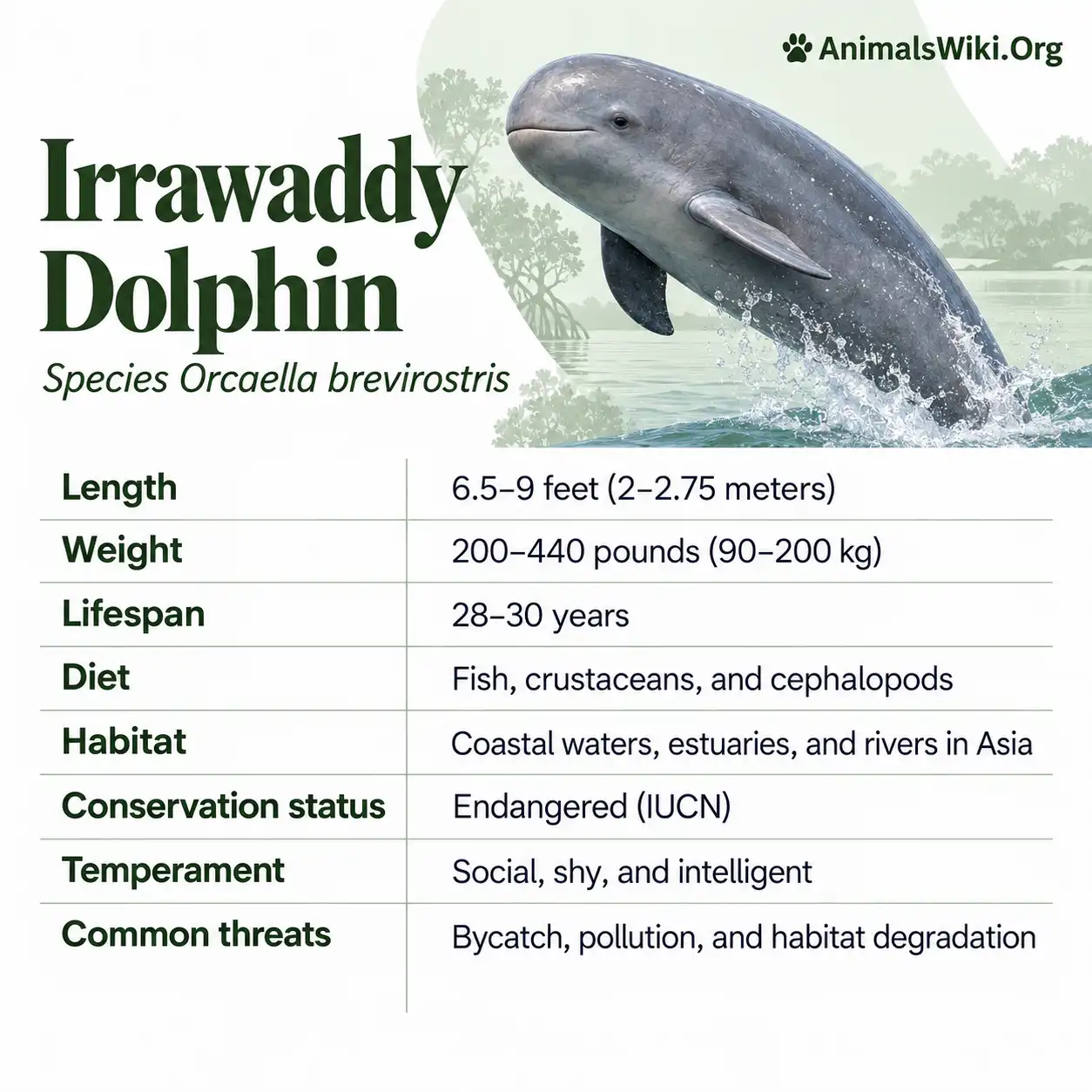
Irrawaddy Dolphin, The Rare Round-Headed Dolphin of Southeast Asia’s Rivers & Coasts
The Irrawaddy dolphin is one of the world’s most unusual and distinctive dolphins—a round-headed, short-beaked aquatic mammal inhabiting rivers, estuaries, bays, and shallow coastal waters across parts of South and Southeast Asia.
Its scientific name is:
Orcaella brevirostris
Unlike the familiar bottlenose dolphin, the Irrawaddy dolphin has no obvious elongated beak.
Instead, it possesses a:
- Rounded forehead
- Blunt face
- Flexible-looking neck
- Small triangular dorsal fin
- Broad paddle-shaped flippers
- Gray body
Together, these characteristics give it an appearance unlike that of many oceanic dolphins.
Despite frequently being called a river dolphin, the Irrawaddy dolphin is not exclusively a freshwater species.
Much of its overall distribution is associated with:
- Shallow coastal waters
- Estuaries
- Bays
- Mangrove environments
- River mouths
However, several famous populations live far inland in major Southeast Asian rivers.
These include populations associated with the:
- Ayeyarwady River in Myanmar
- Mekong River in Cambodia and Laos
- Mahakam River in Indonesia
Irrawaddy dolphins are also famously associated with Chilika Lake, a large brackish lagoon in India.
These geographically separated populations are especially important because some contain only small numbers of animals and face intense human pressures.
Irrawaddy dolphins belong to the oceanic dolphin family:
Delphinidae
This means they are more closely related to many familiar marine dolphins and killer whales than their riverine lifestyle might initially suggest.
Their genus, Orcaella, also contains the closely related:
Australian snubfin dolphin (Orcaella heinsohni)
The Irrawaddy dolphin is a relatively small cetacean.
Adults are generally around 2–2.7 meters long, although size varies between individuals and populations.
They can weigh well over 100 kilograms, with large adults reaching considerably greater masses.
Their diet consists primarily of aquatic animals such as:
- Fish
- Crustaceans
- Cephalopods
They locate prey using one of the most extraordinary sensory systems in the animal kingdom:
echolocation.
Like other toothed whales, Irrawaddy dolphins produce high-frequency sounds and interpret returning echoes to investigate their surroundings and locate prey.
This ability is particularly valuable in rivers and estuaries where water can be:
- Muddy
- Turbid
- Dark
- Visually difficult to navigate
Irrawaddy dolphins are also known for fascinating interactions with humans.
In parts of Myanmar, traditional fishers have historically described cooperative fishing relationships with dolphins.
Dolphins and fishers can coordinate their activities so that fish are driven toward fishing nets, potentially creating feeding opportunities for the dolphins while helping fishers catch fish.
Such behavior represents an extraordinary example of interaction between wild cetaceans and humans.
Unfortunately, the Irrawaddy dolphin faces severe conservation challenges.
Major threats include:
- Accidental entanglement in fishing gear
- Gillnets
- Electrofishing
- Habitat degradation
- Pollution
- Dams
- Declining prey
- Boat disturbance
- Underwater noise
- Habitat fragmentation
Freshwater populations are especially vulnerable because rivers restrict where dolphins can move when their habitat deteriorates.
The loss of only a few breeding adults can have serious consequences for a small isolated population.
The Irrawaddy dolphin therefore represents more than an unusual cetacean.
It is an important indicator of the health of some of Asia’s most biologically and economically important aquatic ecosystems.
This comprehensive guide explores Irrawaddy dolphin facts, scientific classification, appearance, size, weight, distribution, habitat, freshwater populations, diet, hunting, echolocation, behavior, communication, intelligence, reproduction, calves, lifespan, predators, adaptations, cooperative fishing, Irrawaddy dolphin vs bottlenose dolphin differences, Irrawaddy dolphin vs river dolphin differences, conservation, threats, and much more.
Irrawaddy Dolphin Facts
| Feature | Information |
|---|---|
| Common Name | Irrawaddy dolphin |
| Scientific Name | Orcaella brevirostris |
| Animal Type | Mammal |
| Order | Cetacea |
| Family | Delphinidae |
| Genus | Orcaella |
| Diet | Carnivorous |
| Main Foods | Fish, crustaceans and cephalopods |
| Adult Length | Commonly around 2–2.7 m |
| Body Color | Gray to bluish/slate gray |
| Head | Rounded, without a prominent beak |
| Dorsal Fin | Small and rounded/triangular |
| Breathing | Lungs through a blowhole |
| Reproduction | Live birth |
| Young | Calf |
| Sensory Adaptation | Echolocation |
| Main Habitats | Coastal waters, estuaries, bays, lagoons and some large rivers |
| Distribution | South and Southeast Asia |
| Major Threat | Accidental capture in fishing gear |
| Close Relative | Australian snubfin dolphin |
| Scientific Conservation Concern | High, especially for isolated freshwater populations |
What Is an Irrawaddy Dolphin?
The Irrawaddy dolphin is a small toothed whale belonging to the oceanic dolphin family Delphinidae.
Its scientific name is:
Orcaella brevirostris
Although commonly associated with rivers, it occupies both marine-influenced and freshwater environments.
Is the Irrawaddy Dolphin a Mammal?
Yes.
Like all dolphins, it is a mammal.
Irrawaddy dolphins:
- Breathe air
- Are warm-blooded
- Give birth to live young
- Produce milk
- Possess lungs
They cannot extract oxygen directly from water like fish.
Is the Irrawaddy Dolphin a Fish?
No.
Its streamlined body and aquatic lifestyle may resemble a fish superficially, but dolphins are mammals.
Their ancestors evolved from land-dwelling mammals.
Is the Irrawaddy Dolphin a Whale?
Yes, in the broad scientific sense.
Dolphins are members of Cetacea, the group containing:
- Whales
- Dolphins
- Porpoises
Irrawaddy dolphins belong to the toothed-whale lineage.
Scientific Classification of the Irrawaddy Dolphin
| Classification | Name |
|---|---|
| Kingdom | Animalia |
| Phylum | Chordata |
| Class | Mammalia |
| Order | Cetacea |
| Parvorder | Odontoceti |
| Family | Delphinidae |
| Genus | Orcaella |
| Species | Orcaella brevirostris |
What Does an Irrawaddy Dolphin Look Like?
Irrawaddy dolphins have an unusual appearance.
Important characteristics include:
- Rounded forehead
- No obvious long beak
- Small eyes
- Broad flippers
- Thick body
- Small dorsal fin
- Gray coloration
Their rounded head is particularly distinctive.
Why Doesn’t the Irrawaddy Dolphin Have a Long Beak?
Dolphin species evolved different skull and snout shapes depending on their evolutionary histories and ecological adaptations.
The Irrawaddy dolphin has a short, broad facial region rather than the elongated rostrum associated with bottlenose dolphins.
Its scientific species name:
brevirostris
essentially refers to its short snout.
Irrawaddy Dolphin Color
Coloration is generally:
- Gray
- Slate gray
- Bluish gray
The underside may appear somewhat lighter.
Color can vary with:
- Age
- Lighting
- Water conditions
- Individual variation
Irrawaddy Dolphin Head
The head is one of its most recognizable features.
It is:
- Rounded
- Bulbous
- Beakless in appearance
The forehead contains tissues involved in focusing echolocation sounds.
Irrawaddy Dolphin Eyes
The eyes are relatively small.
However, vision is only one part of its sensory system.
In turbid water, echolocation can provide crucial information unavailable through sight alone.
Irrawaddy Dolphin Blowhole
A single blowhole is located on top of the head.
The dolphin must reach the surface to breathe.
How Do Irrawaddy Dolphins Breathe?
They breathe atmospheric oxygen using lungs.
At the surface, the dolphin:
- Exhales through the blowhole.
- Inhales fresh air.
- Closes the blowhole.
- Dives again.
Can Irrawaddy Dolphins Breathe Underwater?
No.
They must surface periodically.
Irrawaddy Dolphin Dorsal Fin
The dorsal fin is relatively small compared with that of many familiar dolphins.
It is generally:
- Low
- Rounded or triangular
- Positioned toward the rear half of the body
This can help identify the species at the surface.
Irrawaddy Dolphin Flippers
Their flippers are comparatively broad and paddle-like.
These provide control while:
- Turning
- Slowing
- Maneuvering
- Maintaining position
Maneuverability is especially useful in shallow and complex aquatic environments.
How Big Is an Irrawaddy Dolphin?
Adults generally reach approximately:
2–2.7 meters
in length.
Males can become somewhat larger than females.
How Much Does an Irrawaddy Dolphin Weigh?
Adults commonly weigh well over:
100 kilograms
with larger individuals potentially approaching roughly 200 kilograms.
Exact body size varies among individuals and populations.
Male vs. Female Irrawaddy Dolphin
Males and females look broadly similar externally.
Males can be somewhat larger.
Sex is not always obvious from a dolphin briefly surfacing at a distance.
Where Do Irrawaddy Dolphins Live?
Irrawaddy dolphins occur across portions of South and Southeast Asia.
Their distribution includes suitable waters associated with countries such as:
- India
- Bangladesh
- Myanmar
- Thailand
- Cambodia
- Indonesia
- Malaysia
- Brunei
- Philippines
Their range is fragmented rather than forming one continuous population.
Irrawaddy Dolphin Habitat
The species generally prefers relatively shallow aquatic habitats.
These include:
- Coastal waters
- Estuaries
- River mouths
- Bays
- Mangrove channels
- Brackish lagoons
- Large rivers
Are Irrawaddy Dolphins Freshwater Dolphins?
Some populations live entirely or extensively in freshwater.
However, the species as a whole is not exclusively freshwater.
This distinction is important.
Irrawaddy dolphins are better described as dolphins capable of inhabiting:
freshwater, brackish and coastal marine environments.
Are Irrawaddy Dolphins True River Dolphins?
Not in the strict evolutionary sense used for specialized river dolphin lineages.
The Irrawaddy dolphin belongs to:
Delphinidae
the oceanic dolphin family.
Therefore, its freshwater populations represent oceanic-family dolphins adapted to river environments rather than members of the classic river dolphin families.
Irrawaddy Dolphins in the Mekong River
The Mekong population is among the world’s most famous Irrawaddy dolphin populations.
These dolphins historically occupied a larger stretch of the river.
Today, their range is greatly reduced.
Their survival is threatened by:
- Gillnet entanglement
- Habitat alteration
- Fishing pressures
- Pollution
- Changes in river flow
- Small population size
Irrawaddy Dolphins in the Ayeyarwady River
Myanmar’s Ayeyarwady River gave the species its common name.
The dolphins are famous there for traditional interactions with local fishers.
They inhabit sections of the river where deep pools and productive fishing grounds provide important habitat.
Irrawaddy Dolphins in the Mahakam River
A small population survives in Indonesia’s:
Mahakam River
in East Kalimantan, Borneo.
Locally, these dolphins are often known as:
pesut Mahakam.
Their isolation makes conservation particularly important.
Irrawaddy Dolphins in Chilika Lake
India’s Chilika Lake supports one of the best-known lagoon populations.
Chilika is a large brackish-water lagoon connected with the Bay of Bengal.
The dolphins are an important symbol of the lagoon’s biodiversity and ecotourism.
Do Irrawaddy Dolphins Live in the Ocean?
Yes, but they are primarily associated with relatively shallow coastal waters rather than the deep open ocean.
Do Irrawaddy Dolphins Live in Saltwater?
Yes.
Populations occur in:
- Marine
- Brackish
- Freshwater
environments.
Why Can Irrawaddy Dolphins Live in Freshwater?
Their physiology allows some populations to survive in low-salinity or freshwater environments.
They have also developed ecological knowledge of:
- River channels
- Deep pools
- Seasonal water levels
- Local prey distributions
What Do Irrawaddy Dolphins Eat?
Irrawaddy dolphins are carnivores.
Their diet can include:
- Fish
- Shrimp
- Other crustaceans
- Squid and other cephalopods
Diet varies by habitat.
A freshwater river population obviously has different prey opportunities from a coastal population.
Are Irrawaddy Dolphins Carnivores?
Yes.
They obtain energy by consuming other animals.
Do Irrawaddy Dolphins Eat Fish?
Yes.
Fish are an important component of the diet.
Do Irrawaddy Dolphins Eat Shrimp?
They can consume shrimp and other crustaceans.
Do Irrawaddy Dolphins Eat Squid?
Coastal individuals may consume cephalopods such as squid where available.
How Do Irrawaddy Dolphins Find Food?
They combine:
- Echolocation
- Hearing
- Vision
- Experience
- Cooperative or individual hunting behavior
Echolocation is particularly important where visibility is poor.
Irrawaddy Dolphin Echolocation
Irrawaddy dolphins are toothed whales and use echolocation.
They emit high-frequency sounds.
These sounds travel through water and strike objects.
Echoes return to the dolphin.
From those echoes, the animal can obtain information about:
- Distance
- Direction
- Size
- Shape
- Movement
of objects and potential prey.
Why Is Echolocation Useful in Rivers?
Many tropical rivers contain:
- Suspended sediment
- Mud
- Organic matter
that reduces underwater visibility.
A dolphin may therefore be unable to see far ahead.
Sound travels efficiently underwater.
Echolocation allows the animal to effectively investigate its surroundings acoustically.
Do Irrawaddy Dolphins Hunt Together?
They can forage individually or in groups.
Group behavior may help concentrate or exploit fish.
Hunting strategy varies according to:
- Habitat
- Prey
- Group size
- Local conditions
Do Irrawaddy Dolphins Spit Water?
Irrawaddy dolphins have been observed producing jets or streams of water in certain behavioral contexts.
Water-spitting behavior may occur during feeding or social activity.
It is one of the unusual behaviors associated with the species.
Cooperative Fishing With Humans
One of the most remarkable aspects of Irrawaddy dolphin behavior occurs in Myanmar.
Traditional fishers in parts of the Ayeyarwady have historically cooperated with wild dolphins.
The interaction can involve:
- Fishers signaling to dolphins.
- Dolphins helping concentrate or drive fish.
- Fishers casting nets.
- Dolphins taking advantage of disturbed or escaping fish.
Both sides can potentially benefit.
Do Irrawaddy Dolphins Really Help Fishermen?
Traditional cooperative fishing behavior has been documented.
However, it does not occur with every Irrawaddy dolphin population or every individual.
It is a localized behavioral tradition.
Why Is Cooperative Fishing Important?
It demonstrates:
- Behavioral flexibility
- Learning
- Human-wildlife cooperation
- Local ecological knowledge
- Cultural transmission possibilities
It also gives communities a strong incentive to protect dolphins.
Irrawaddy Dolphin Behavior
Irrawaddy dolphins can be relatively unobtrusive compared with highly acrobatic oceanic dolphins.
They are often seen:
- Surfacing gently
- Traveling in small groups
- Foraging
- Rolling at the surface
They do not normally perform spectacular aerial displays as frequently as some oceanic dolphin species.
Do Irrawaddy Dolphins Jump?
They can leap or breach, but dramatic aerial behavior is generally less characteristic than in some other dolphins.
Are Irrawaddy Dolphins Social?
Yes.
They commonly occur in small groups, although group size varies.
Larger aggregations may form around:
- Concentrated prey
- Productive feeding sites
- Social activity
How Many Irrawaddy Dolphins Live Together?
Small groups of only a few individuals are common.
However, group size varies by population and circumstances.
Are Irrawaddy Dolphins Intelligent?
Like other dolphins, they possess relatively complex brains and demonstrate:
- Learning
- Social interaction
- Flexible foraging
- Communication
- Behavioral adaptation
The cooperative fishing relationship in Myanmar is particularly compelling evidence of behavioral flexibility.
Irrawaddy Dolphin Communication
They communicate acoustically using various sounds.
These can include:
- Clicks
- Pulsed sounds
- Other vocal signals
Some sounds are involved in echolocation, while others contribute to communication.
Do Irrawaddy Dolphins Whistle?
Their acoustic repertoire differs from the classic whistle-rich communication associated with some dolphins.
Research into population-specific communication continues.
Irrawaddy Dolphin Teeth
Irrawaddy dolphins possess numerous small conical teeth.
These teeth are suited to:
grasping slippery prey
rather than chewing food like human molars.
Do Irrawaddy Dolphins Chew Their Food?
Dolphins commonly seize prey with their teeth and swallow relatively small prey whole or in manageable portions.
Their teeth primarily function as gripping structures.
How Fast Can an Irrawaddy Dolphin Swim?
Reliable maximum-speed figures are less emphasized than for fast open-ocean dolphins.
The Irrawaddy dolphin is adapted more strongly for:
- Maneuverability
- Shallow-water movement
- Efficient foraging
than extreme sustained speed.
Can Irrawaddy Dolphins Swim Backward?
Dolphins can maneuver with considerable precision, including limited backward movement, although forward swimming is their normal locomotion.
How Do Irrawaddy Dolphins Sleep?
Like other cetaceans, dolphins cannot simply become completely unconscious for long periods while submerged because breathing requires conscious control.
They use specialized sleep patterns in which portions of the brain can rest while breathing and environmental awareness are maintained.
Do Irrawaddy Dolphins Need Air While Sleeping?
Yes.
They must continue surfacing to breathe.
Irrawaddy Dolphin Reproduction
Irrawaddy dolphins reproduce sexually.
After mating and pregnancy, the female gives birth to a live calf.
How Long Is an Irrawaddy Dolphin Pregnant?
Gestation is thought to last roughly:
around 14 months
although reproductive information is less complete than for some better-studied dolphins.
How Many Babies Does an Irrawaddy Dolphin Have?
A female generally gives birth to:
one calf
at a time.
Twins would be exceptionally unusual.
What Is a Baby Irrawaddy Dolphin Called?
A baby is called a:
calf
Irrawaddy Dolphin Calf
Calves are born tail-first in many cetacean births, although birth presentation can vary.
After birth, the calf must quickly reach the surface for its first breath.
Do Irrawaddy Dolphins Produce Milk?
Yes.
Females nurse their calves with nutrient-rich milk.
This is one of the defining characteristics of mammals.
Do Irrawaddy Dolphin Mothers Care for Their Calves?
Yes.
Maternal care is prolonged.
A calf must learn:
- Where to travel
- How to forage
- How to interact socially
- Where important habitats occur
from its mother and other dolphins.
How Long Do Irrawaddy Dolphins Live?
Precise maximum lifespan remains less thoroughly established than in some well-studied cetaceans.
They are generally believed capable of living for several decades under favorable conditions.
Irrawaddy Dolphin Predators
Natural predation is poorly documented, especially for inland populations.
Potential marine predators could include large sharks or other large predators.
However, today the most serious threats to many populations come from:
human activities.
Irrawaddy Dolphin Adaptations
Rounded Head
Supports its distinctive skull and echolocation anatomy.
Echolocation
Allows navigation and prey detection in turbid water.
Broad Flippers
Provide excellent maneuverability.
Flexible Neck Region
The neck is relatively mobile compared with that of many streamlined oceanic dolphins.
Small Dorsal Fin
Fits its shallow-water body form.
Saltwater and Freshwater Tolerance
Allows occupation of diverse aquatic environments.
Social Learning
Helps individuals acquire local foraging and habitat knowledge.
Air Breathing
Like all cetaceans, it surfaces through a blowhole to breathe.
Why Does the Irrawaddy Dolphin Have a Flexible Neck?
Unlike many dolphins, the neck region allows relatively noticeable head movement.
This can improve maneuverability and visual investigation in complex shallow environments.
Irrawaddy Dolphin vs. Bottlenose Dolphin
| Feature | Irrawaddy Dolphin | Bottlenose Dolphin |
|---|---|---|
| Scientific Genus | Orcaella | Tursiops |
| Head | Rounded | Rounded melon with distinct beak |
| Beak | Almost absent externally | Prominent |
| Dorsal Fin | Small | Larger and curved |
| Main Habitat | Shallow coasts, estuaries and some rivers | Mainly marine/coastal |
| Body Shape | Stockier | More streamlined |
| Famous Trait | River/coastal adaptability | Intelligence and widespread distribution |
Irrawaddy Dolphin vs. Ganges River Dolphin
These are very different dolphins.
The Ganges river dolphin is a highly specialized true river dolphin.
The Irrawaddy dolphin belongs to the oceanic dolphin family.
| Feature | Irrawaddy Dolphin | Ganges River Dolphin |
|---|---|---|
| Family | Delphinidae | Platanistidae |
| Snout | Short/blunt | Long and narrow |
| Eyes | Small but functional | Extremely reduced vision |
| Habitat | Coastal, brackish and freshwater | Freshwater rivers |
| Distribution | South/Southeast Asia | Indian subcontinent |
Irrawaddy Dolphin vs. Orca
This comparison may sound strange, but both belong to:
Delphinidae
The killer whale, or orca, is actually the largest member of the dolphin family.
The Irrawaddy dolphin is much smaller and occupies very different habitats.
Irrawaddy Dolphin vs. Australian Snubfin Dolphin
These two species are particularly close relatives.
The Australian snubfin dolphin is:
Orcaella heinsohni
The Irrawaddy dolphin is:
Orcaella brevirostris
They were once more commonly treated as belonging to the same species complex, but morphological and genetic evidence supports their recognition as separate species.
Is the Irrawaddy Dolphin Endangered?
The Irrawaddy dolphin is considered a species of serious conservation concern.
The species has been assessed globally as Endangered, while some geographically isolated subpopulations face even more immediate risks.
Because conservation assessments and population estimates can change, current numbers should always be checked against the latest scientific surveys before publication.
Why Are Irrawaddy Dolphins Endangered?
The primary causes are human-related.
Important threats include:
- Gillnets
- Electrofishing
- Habitat degradation
- Dams
- Pollution
- Boat traffic
- Underwater noise
- Prey depletion
- Small population size
Gillnet Entanglement
Gillnets are among the most dangerous threats.
A dolphin can accidentally become entangled while pursuing fish.
Because dolphins breathe air, an entangled animal may be unable to surface.
It can then:
drown.
Even a small number of deaths can be devastating to isolated populations.
Electrofishing
Illegal or destructive fishing methods involving electricity can kill or injure:
- Fish
- Dolphins
- Other aquatic wildlife
Electrofishing is particularly dangerous in restricted river habitats.
Dams and Irrawaddy Dolphins
Dams can alter:
- River flow
- Fish migration
- Sediment movement
- Water depth
- Deep pools
- Connectivity
Such changes can indirectly affect dolphins by changing the ecosystems supporting their prey.
Pollution
Pollutants can enter dolphin habitats through:
- Agriculture
- Industry
- Mining
- Urban wastewater
- Plastic waste
Contaminants can affect both dolphins and their prey.
Boat Traffic
Boats can cause:
- Collision risk
- Noise disturbance
- Behavioral disruption
High-speed traffic can be especially problematic in narrow waterways.
Small Population Problem
A small population faces additional risks.
If only a limited number of animals remain, losing even a few adults can significantly affect reproduction.
Small populations may also experience:
- Reduced genetic diversity
- Demographic instability
- Difficulty finding mates
- Greater vulnerability to disease
- Greater impact from random events
Why Are Freshwater Populations Especially Vulnerable?
A coastal dolphin may have greater ability to move between suitable habitats.
A river population can be trapped within a restricted corridor.
Dams, nets, shallow areas and human development can further fragment that corridor.
Protecting Irrawaddy Dolphins
Effective conservation can include:
- Gillnet restrictions in critical habitat
- Prevention of illegal fishing
- Protected dolphin zones
- Sustainable fisheries
- Pollution control
- Boat-speed regulations
- Community conservation
- Habitat protection
- Scientific monitoring
Community Conservation
Local communities are essential.
Fishers often know:
- Where dolphins feed
- Seasonal movement patterns
- Deep pools
- Fishing conditions
- Changes in dolphin numbers
Combining scientific research with local knowledge can improve conservation.
Responsible Dolphin Tourism
Wild dolphin tourism can provide economic incentives for protection.
However, poorly managed tourism can cause:
- Crowding
- Noise
- Stress
- Boat strikes
- Disrupted feeding
Responsible viewing requires maintaining appropriate distances and minimizing disturbance.
Ecological Importance of Irrawaddy Dolphins
As predators, Irrawaddy dolphins are part of aquatic food webs.
Their survival depends on healthy:
- Fish populations
- River systems
- Estuaries
- Wetlands
- Coastal habitats
Protecting dolphins can therefore benefit many other organisms sharing the same ecosystem.
Cultural Importance
Irrawaddy dolphins have strong cultural significance in several communities.
Their traditional cooperative relationship with fishers in Myanmar is particularly important.
In other regions, they have become symbols of:
- River conservation
- Wetland protection
- Sustainable fishing
- Ecotourism
40 Interesting Irrawaddy Dolphin Facts
- The Irrawaddy dolphin is a mammal.
- Its scientific name is Orcaella brevirostris.
- It belongs to the oceanic dolphin family Delphinidae.
- It is a toothed whale.
- It has a rounded forehead.
- It lacks the prominent beak of a bottlenose dolphin.
- Its dorsal fin is relatively small.
- Its flippers are broad.
- Adults can exceed two meters in length.
- Irrawaddy dolphins breathe through a blowhole.
- They cannot breathe underwater.
- They use echolocation.
- Echolocation is especially useful in muddy rivers.
- They eat fish.
- They also eat crustaceans.
- Coastal individuals may eat cephalopods.
- The species occurs in South and Southeast Asia.
- Some populations live in freshwater.
- Others live in brackish water.
- Others inhabit shallow coastal seas.
- A famous population lives in the Mekong River.
- Another survives in the Ayeyarwady River.
- Another lives in Indonesia’s Mahakam River.
- Irrawaddy dolphins also occur in Chilika Lake.
- The species is not exclusively a river dolphin.
- It belongs to the same family as bottlenose dolphins.
- Killer whales also belong to that dolphin family.
- Its closest living relative is the Australian snubfin dolphin.
- Females generally give birth to one calf.
- Calves drink milk.
- Mothers provide prolonged care.
- Dolphins can live for several decades.
- They are capable of complex social behavior.
- Some Irrawaddy dolphins cooperate with traditional fishers.
- They can produce water jets or spit water.
- Gillnet entanglement is a major threat.
- Dolphins caught underwater in nets can drown.
- Small freshwater populations are especially vulnerable.
- Habitat protection benefits many other aquatic species.
- The Irrawaddy dolphin is one of Asia’s most distinctive and threatened cetaceans.
Did You Know?
Wild Irrawaddy dolphins have developed one of the world’s most extraordinary working relationships between humans and cetaceans.
In parts of Myanmar’s Ayeyarwady River, traditional fishers have historically worked alongside dolphins.
This is not simply a case of dolphins following boats for discarded food.
The interaction can involve genuine coordination.
Fishers may use recognizable signals to attract the attention of dolphins.
The dolphins can then help drive or concentrate fish toward areas where fishers are able to cast their nets.
When the net is thrown, fish become concentrated or disturbed.
The fishers gain a catch.
The dolphins can take advantage of fish that escape or become easier to capture.
In other words:
human and dolphin can both benefit.
What makes the behavior especially fascinating is that it depends on:
- Experience
- Timing
- Recognition
- Learning
- Trust
Young dolphins can observe experienced animals.
Young fishers can learn the fishing tradition from older generations.
This creates the possibility of two cultural traditions—one human and one dolphin—interacting within the same river.
But such relationships are fragile.
If dolphin populations disappear, the behavior disappears with them.
If traditional fishing communities abandon the practice, dolphins lose their human partners.
Protecting the Irrawaddy dolphin therefore protects more than a species.
In places such as the Ayeyarwady, it can also protect a remarkable relationship between:
people, dolphins, rivers, and generations of accumulated knowledge.
Frequently Asked Questions About Irrawaddy Dolphins
What is an Irrawaddy dolphin?
It is a small toothed whale found in shallow coastal, estuarine, brackish and freshwater habitats of South and Southeast Asia.
What is the scientific name of the Irrawaddy dolphin?
Orcaella brevirostris.
Is the Irrawaddy dolphin a mammal?
Yes.
Is an Irrawaddy dolphin a fish?
No.
Is an Irrawaddy dolphin a whale?
Yes. Dolphins belong to Cetacea and are toothed whales.
What family does the Irrawaddy dolphin belong to?
Delphinidae.
Is the Irrawaddy dolphin a true river dolphin?
It lives in rivers in some regions, but taxonomically it belongs to the oceanic dolphin family rather than the specialized classic river dolphin families.
Why is it called the Irrawaddy dolphin?
Its common name is associated with Myanmar’s Irrawaddy/Ayeyarwady River.
What does an Irrawaddy dolphin look like?
It has a rounded head, blunt face, gray body, broad flippers and small dorsal fin.
Does an Irrawaddy dolphin have a beak?
It lacks the conspicuous elongated beak seen in many familiar dolphins.
Why does the Irrawaddy dolphin have a round head?
Its distinctive skull and soft tissues create a rounded forehead adapted partly to its toothed-whale sensory system.
What color is an Irrawaddy dolphin?
Usually gray, slate gray or bluish gray.
How big is an Irrawaddy dolphin?
Adults are commonly around 2–2.7 meters long.
How much does an Irrawaddy dolphin weigh?
Adults can weigh well over 100 kg, with large individuals approaching roughly 200 kg.
Where do Irrawaddy dolphins live?
They inhabit parts of South and Southeast Asia.
Do Irrawaddy dolphins live in rivers?
Yes, some populations do.
Do Irrawaddy dolphins live in oceans?
They inhabit shallow coastal marine environments but are not primarily deep-ocean dolphins.
Can Irrawaddy dolphins live in freshwater?
Yes.
Can Irrawaddy dolphins live in saltwater?
Yes.
Can Irrawaddy dolphins live in brackish water?
Yes.
Where are Irrawaddy dolphins found in India?
They are particularly famous in Chilika Lake in Odisha.
Are Irrawaddy dolphins found in the Mekong?
Yes.
Are Irrawaddy dolphins found in Myanmar?
Yes.
Are Irrawaddy dolphins found in Indonesia?
Yes, including the famous Mahakam River population.
What is the Mahakam dolphin?
The Irrawaddy dolphins of the Mahakam River are locally known as pesut Mahakam.
What do Irrawaddy dolphins eat?
Fish, crustaceans and cephalopods form important parts of their diet.
Are Irrawaddy dolphins carnivores?
Yes.
Do Irrawaddy dolphins eat fish?
Yes.
Do Irrawaddy dolphins eat shrimp?
They can consume crustaceans including shrimp.
Do Irrawaddy dolphins eat squid?
Coastal populations can consume cephalopods.
How do Irrawaddy dolphins find fish?
They use echolocation, hearing, vision and learned foraging strategies.
Do Irrawaddy dolphins use echolocation?
Yes.
What is echolocation?
It is the use of emitted sounds and returning echoes to obtain information about surrounding objects.
Why is echolocation useful in muddy rivers?
Sound remains effective when suspended sediment makes underwater vision poor.
Can Irrawaddy dolphins see?
Yes.
Can Irrawaddy dolphins hear well?
Yes. Hearing is extremely important to dolphins.
Do Irrawaddy dolphins have teeth?
Yes.
What are their teeth used for?
Primarily gripping prey.
Do Irrawaddy dolphins chew?
They generally grip prey and swallow it rather than chewing it like humans.
Can Irrawaddy dolphins spit water?
Water-spitting behavior has been observed.
Do Irrawaddy dolphins jump?
They can, although they are generally less acrobatic at the surface than some oceanic dolphins.
Are Irrawaddy dolphins social?
Yes.
Do Irrawaddy dolphins live in pods?
They commonly form small groups that can loosely be described as pods.
How many dolphins are in an Irrawaddy dolphin group?
Often only a few animals, although group size varies.
Are Irrawaddy dolphins intelligent?
They demonstrate learning, social behavior and flexible foraging strategies characteristic of dolphins.
Do Irrawaddy dolphins communicate?
Yes, primarily through acoustic signals.
Do Irrawaddy dolphins make clicks?
Yes, including echolocation clicks.
Do Irrawaddy dolphins help fishermen?
Some dolphins in Myanmar have participated in traditional cooperative fishing with human fishers.
How do dolphins help fishermen?
They may help concentrate or drive fish toward areas where fishers cast nets.
Why do the dolphins cooperate?
The interaction can provide feeding opportunities for dolphins while increasing fishing success for humans.
Do all Irrawaddy dolphins cooperate with humans?
No. This is a localized behavioral tradition.
Can Irrawaddy dolphins breathe underwater?
No.
How do they breathe?
Through a blowhole on top of the head.
How often do Irrawaddy dolphins breathe?
Breathing intervals vary with activity, diving and individual circumstances.
Can an Irrawaddy dolphin drown?
Yes. Like all dolphins, it can drown if prevented from reaching the surface.
Why are fishing nets dangerous?
Entangled dolphins may be unable to surface to breathe.
How do Irrawaddy dolphins sleep?
They use cetacean sleep adaptations that allow them to continue surfacing and breathing.
Do Irrawaddy dolphins give birth to live babies?
Yes.
What is a baby Irrawaddy dolphin called?
A calf.
How many calves does a female have?
Usually one at a time.
How long is an Irrawaddy dolphin pregnant?
Gestation is estimated at around 14 months.
Do Irrawaddy dolphins nurse their babies?
Yes.
Do dolphin calves drink milk?
Yes.
Do Irrawaddy dolphin mothers care for their calves?
Yes, for an extended period.
How long do Irrawaddy dolphins live?
They are believed capable of living for several decades, although precise longevity is not as well documented as in some other dolphins.
What predators do Irrawaddy dolphins have?
Natural predation is poorly documented; human-related threats are much more important for many populations.
Are Irrawaddy dolphins dangerous to humans?
They are not considered a significant natural threat to people.
Do Irrawaddy dolphins attack people?
They are not known for routine aggressive attacks on humans.
Are Irrawaddy dolphins endangered?
Yes. The species is considered globally Endangered, with some isolated populations facing particularly severe risks.
Why are Irrawaddy dolphins endangered?
Major causes include accidental fishing-net entanglement, destructive fishing, habitat degradation, pollution and small isolated populations.
What is the biggest threat to Irrawaddy dolphins?
Accidental entanglement in fishing gear, particularly gillnets, is among the most serious direct threats.
Does electrofishing kill Irrawaddy dolphins?
Illegal electrical fishing practices can injure or kill aquatic wildlife and damage dolphin prey resources.
Do dams threaten Irrawaddy dolphins?
Dams can alter river ecosystems, connectivity, fish populations and important dolphin habitats.
Does pollution affect Irrawaddy dolphins?
Yes.
Does boat traffic affect Irrawaddy dolphins?
Heavy boat traffic can increase noise, disturbance and collision risk.
Why are small populations dangerous for the species?
Small populations recover slowly and are vulnerable to the loss of even a few reproductive adults.
Can Irrawaddy dolphins become extinct?
Local populations can disappear if mortality remains greater than reproduction, and continued threats place the species at risk.
How can Irrawaddy dolphins be protected?
Important measures include reducing gillnet deaths, preventing destructive fishing, protecting habitat, controlling pollution and involving local communities.
Are Irrawaddy dolphins related to bottlenose dolphins?
Yes. Both belong to Delphinidae.
Are Irrawaddy dolphins related to killer whales?
Yes. Surprisingly, killer whales also belong to the dolphin family.
What is the closest relative of the Irrawaddy dolphin?
The Australian snubfin dolphin is its closest living relative.
Are Irrawaddy dolphins the same as Australian snubfin dolphins?
No. They are separate species.
What is the scientific name of the Australian snubfin dolphin?
Orcaella heinsohni.
What is the difference between an Irrawaddy dolphin and a bottlenose dolphin?
Irrawaddy dolphins have a much shorter facial region, rounder head, smaller dorsal fin and stronger association with shallow estuarine and river environments.
What is the difference between an Irrawaddy dolphin and a Ganges river dolphin?
They belong to different evolutionary families and have dramatically different head, snout and sensory anatomy.
Why are Irrawaddy dolphins important?
They are important aquatic predators, indicators of ecosystem health, culturally significant animals and flagship species for river and coastal conservation.
Conclusion
The Irrawaddy dolphin is one of the most remarkable examples of how adaptable a dolphin can become.
Its ancestors belonged to a lineage of oceanic dolphins.
Yet today members of the species can be found navigating environments ranging from:
- Coastal seas
- Estuaries
- Mangrove channels
- Brackish lagoons
to major freshwater rivers.
Its body reflects this unusual lifestyle.
The prominent beak familiar from bottlenose dolphins is absent.
Instead, the Irrawaddy dolphin possesses a rounded head, broad flippers, stocky body and relatively small dorsal fin.
These characteristics contribute to an animal exceptionally suited to maneuvering through shallow and complicated aquatic environments.
But perhaps its greatest advantage is invisible.
Sound.
A muddy river may appear almost impenetrable underwater.
Vision can become limited after only a short distance.
Yet an Irrawaddy dolphin can send sound pulses into that darkness.
The echoes return carrying information about:
- Fish
- Obstacles
- River structure
- Other objects
The dolphin effectively investigates a world its eyes cannot fully reveal.
Its intelligence and behavioral flexibility are equally impressive.
In Myanmar, generations of fishers and dolphins have shared the same river.
Under extraordinary circumstances, the two species have even learned to fish together.
A human signals.
A dolphin responds.
Fish are concentrated.
A net is cast.
Both species can benefit.
Few wildlife relationships demonstrate so clearly that animal behavior can become intertwined with human culture.
Yet the same dependence on rivers and shallow waters that created these remarkable behaviors has also made the species vulnerable.
Fishing nets can become invisible underwater traps.
A dolphin does not need to be injured by the net itself.
It simply needs to remain trapped long enough to miss its next breath.
For a population containing hundreds of animals, one death matters.
For a population containing only a small number of breeding adults, every death can influence its future.
That is why protecting the Irrawaddy dolphin requires more than protecting individual animals.
It requires protecting:
- Rivers
- Estuaries
- Wetlands
- Fish populations
- Deep pools
- Migration routes
- Local fishing livelihoods
The dolphin’s survival is inseparable from the health of the water around it.
Protecting an Irrawaddy dolphin therefore means protecting an entire aquatic community—and, in many places, the human communities that depend on that ecosystem as well.
With its rounded face, extraordinary echolocation, unusual freshwater populations and remarkable relationships with people, Orcaella brevirostris remains one of Asia’s most distinctive and irreplaceable aquatic mammals.



