
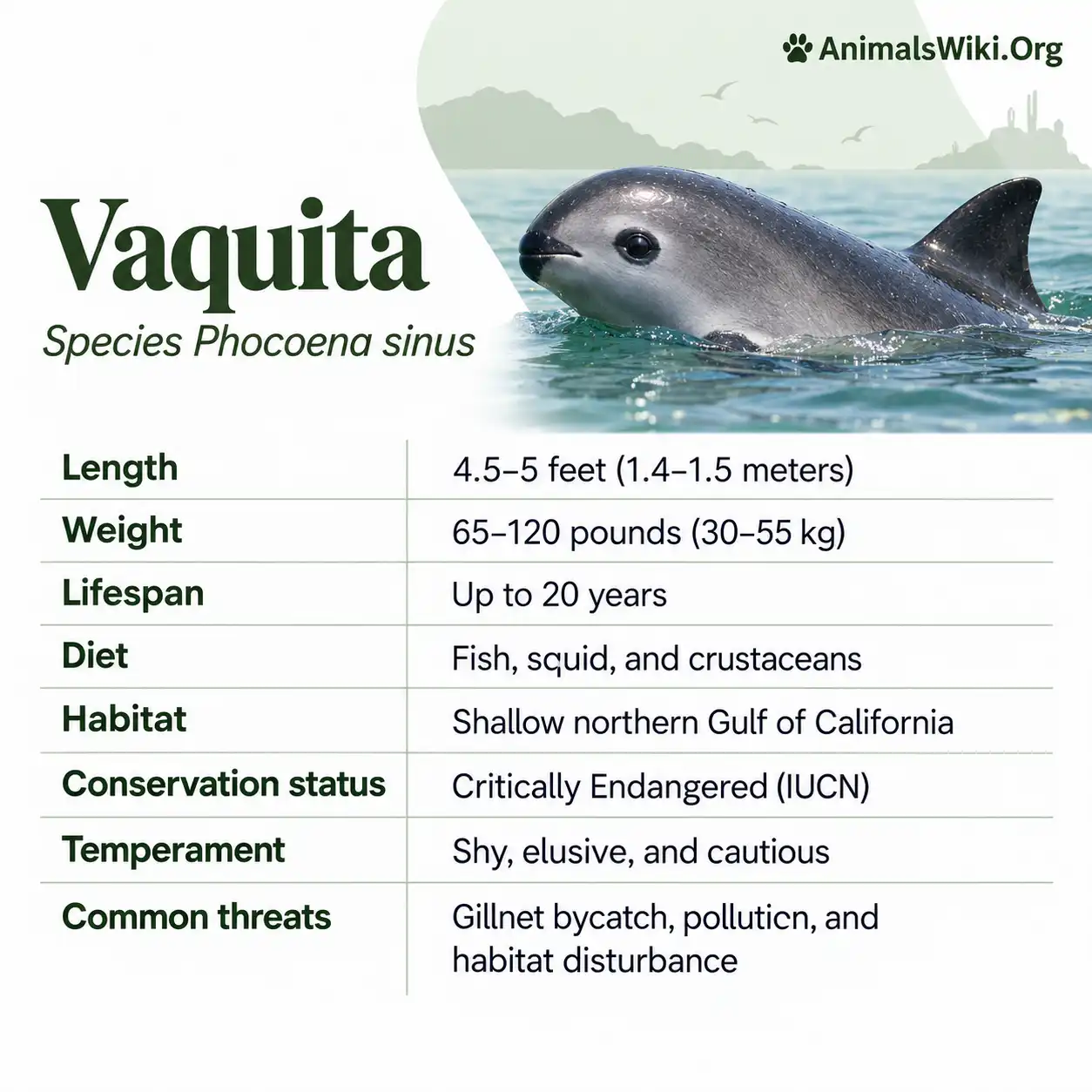
Vaquita Facts, The World’s Rarest Marine Mammal of Mexico’s Gulf of California
The vaquita is a tiny, elusive porpoise found nowhere on Earth except the northern Gulf of California in Mexico.
Its scientific name is:
Phocoena sinus
and it belongs to the porpoise family:
Phocoenidae.
The word vaquita comes from Spanish and means:
“little cow.”
Despite the gentle-sounding name, the vaquita has become the symbol of one of the most urgent marine conservation crises in the world.
It is widely recognized as the rarest marine mammal on Earth.
The vaquita is also the smallest living cetacean—a group that includes:
- Whales
- Dolphins
- Porpoises
An adult is typically only around:
1.2–1.5 meters long
and weighs roughly:
30–55 kilograms, depending on sex and individual size.
Females tend to be larger than males.
The vaquita’s appearance is remarkably distinctive.
It has:
- A small, robust body
- Rounded head
- No obvious beak
- Tall triangular dorsal fin
- Dark patches around the eyes
- Dark markings around the lips
- Gray body
- Paler underside
The dark rings surrounding its eyes are particularly characteristic, giving the animal an instantly recognizable appearance in photographs and illustrations.
Yet seeing a vaquita in the wild is extraordinarily difficult.
The species occupies a tiny geographic range in the northern Gulf of California, also called the Sea of Cortez.
It prefers relatively shallow, productive waters where fish and other prey are abundant.
Unlike whales that migrate across entire oceans, the vaquita’s world is remarkably small.
Its restricted distribution is one reason the species is so vulnerable.
If dangerous fishing gear enters its habitat, the vaquita cannot simply relocate to another ocean.
And fishing gear is at the heart of its conservation crisis.
The primary direct threat to the vaquita is:
entanglement in gillnets.
Gillnets are walls of netting suspended in the water to catch fish.
Unfortunately, a vaquita swimming through the area may not escape once entangled.
Because the vaquita is a mammal, it must surface to breathe.
If a net traps it underwater, it can:
drown.
This threat has been particularly associated with illegal fishing for the:
totoaba (Totoaba macdonaldi)
a large fish that also inhabits the Gulf of California.
Totoaba swim bladders have commanded extremely high prices in illegal wildlife markets.
Gillnets set for totoaba can unintentionally capture vaquitas.
This creates a devastating situation in which one endangered species is killed indirectly by illegal fishing directed at another endangered species.
But there is still an important reason for hope.
Despite its tiny population, surviving vaquitas have continued to reproduce.
Females with calves have been documented during recent monitoring.
Genetic research has also suggested that the species may not necessarily be genetically doomed simply because its population is small—provided human-caused mortality can be stopped.
The fundamental conservation challenge is therefore remarkably clear:
keep vaquitas out of gillnets.
This comprehensive guide explores Vaquita facts, scientific classification, size, weight, appearance, habitat, distribution, Gulf of California range, diet, hunting, echolocation, behavior, reproduction, calves, lifespan, adaptations, predators, vaquita vs dolphin differences, vaquita vs porpoise differences, totoaba fishing, gillnets, population decline, extinction risk, conservation, and everything you need to know about Phocoena sinus.
Vaquita Facts
| Feature | Information |
|---|---|
| Common Name | Vaquita |
| Scientific Name | Phocoena sinus |
| Name Meaning | “Little cow” |
| Animal Type | Mammal |
| Order | Cetacea |
| Family | Phocoenidae |
| Genus | Phocoena |
| Animal Group | Porpoise |
| Native Country | Mexico |
| Natural Range | Northern Gulf of California |
| Other Regional Name | Sea of Cortez |
| Habitat | Shallow coastal marine waters |
| Diet | Carnivorous |
| Main Foods | Fish, squid and crustaceans |
| Adult Length | Roughly 1.2–1.5 m |
| Weight | Roughly 30–55 kg |
| Famous Marking | Dark rings around the eyes |
| Sensory Adaptation | Echolocation |
| Reproduction | Live birth |
| Young | Calf |
| Major Threat | Gillnet entanglement |
| Conservation Status | Critically Endangered |
| Distinction | World’s rarest marine mammal |
What Is a Vaquita?
The vaquita is a very small marine porpoise belonging to the family Phocoenidae.
Its scientific name is:
Phocoena sinus
It occurs naturally only in Mexico’s northern Gulf of California.
What Does Vaquita Mean?
Vaquita is Spanish for:
“little cow.”
The full phrase vaquita marina can be translated roughly as:
“little sea cow.”
However, the vaquita is not actually related to cows or true sea cows such as manatees.
It is a cetacean.
Is a Vaquita a Dolphin?
No.
A vaquita is a:
porpoise.
Dolphins and porpoises are closely related toothed whales, but they belong to different families.
Is a Vaquita a Porpoise?
Yes.
The vaquita belongs to:
Phocoenidae
the porpoise family.
Is a Vaquita a Whale?
In the broad scientific sense, yes.
Porpoises and dolphins are members of the toothed-whale lineage within Cetacea.
Therefore, the vaquita is a:
cetacean and toothed whale.
Is a Vaquita a Fish?
No.
It is a mammal.
Vaquitas:
- Breathe air
- Possess lungs
- Are warm-blooded
- Give birth to live young
- Produce milk
- Nurse their calves
Scientific Classification of the Vaquita
| Classification | Name |
|---|---|
| Kingdom | Animalia |
| Phylum | Chordata |
| Class | Mammalia |
| Order | Cetacea |
| Parvorder | Odontoceti |
| Family | Phocoenidae |
| Genus | Phocoena |
| Species | Phocoena sinus |
What Does a Vaquita Look Like?
The vaquita has a compact, robust body typical of porpoises.
Important features include:
- Rounded head
- No long beak
- Small flippers
- Tall triangular dorsal fin
- Gray body
- Pale underside
- Dark eye rings
- Dark lip markings
Its facial pattern makes it one of the most recognizable small cetaceans.
Vaquita Eye Rings
The dark patches surrounding the eyes are one of the species’ most famous characteristics.
They can give the vaquita an almost permanently wide-eyed appearance.
Vaquita Mouth Markings
Dark coloration also surrounds the lips.
A dark line can extend from the mouth toward the flipper region.
These facial markings contrast with the lighter areas of the head.
What Color Is a Vaquita?
Adults are generally:
- Gray
- Darker gray above
- Lighter gray below
- Whitish or pale underneath
Young animals may show somewhat different coloration.
Vaquita Dorsal Fin
The vaquita has a relatively:
large, tall and triangular dorsal fin
for such a small cetacean.
The dorsal fin may help with stability while swimming.
Its relatively large surface area may also assist heat exchange in the warm waters of the Gulf of California.
Does the Vaquita Have a Beak?
No obvious elongated beak is present.
This is one characteristic distinguishing porpoises from many familiar dolphin species.
Vaquita Teeth
Porpoises possess distinctive teeth that differ from the conical teeth of many dolphins.
Vaquita teeth are relatively:
spade-shaped
rather than sharply conical.
They help grasp small aquatic prey.
How Big Is a Vaquita?
The vaquita is extremely small for a cetacean.
Adults generally measure approximately:
1.2–1.5 meters
in length.
Females are usually larger than males.
Is the Vaquita the Smallest Whale?
The vaquita is generally recognized as the:
smallest living cetacean.
Since Cetacea includes whales, dolphins and porpoises, it can loosely be called the world’s smallest whale, although “smallest cetacean” is scientifically clearer.
How Much Does a Vaquita Weigh?
Adult weight is approximately:
30–55 kg
although body mass varies by:
- Sex
- Age
- Individual condition
Females are generally larger.
Male vs. Female Vaquita
Female vaquitas tend to be:
larger than males.
This is called:
sexual dimorphism.
External differences beyond size are difficult to observe from brief surface sightings.
Where Do Vaquitas Live?
Vaquitas live exclusively in:
the northern Gulf of California, Mexico.
This makes them endemic to Mexico.
What Does Endemic Mean?
An endemic species naturally occurs only within a particular geographic area.
For the vaquita, that area is an exceptionally small portion of one marine region.
Gulf of California
The Gulf of California is a long body of water separating:
the Baja California Peninsula
from:
mainland Mexico.
It is also known as the:
Sea of Cortez.
The region contains extraordinarily rich marine biodiversity.
Vaquita Habitat
Vaquitas generally inhabit:
- Shallow marine waters
- Coastal waters
- Turbid water
- Productive feeding areas
They often occur in waters less than a few dozen meters deep.
Do Vaquitas Live in Freshwater?
No.
They are marine mammals.
Do Vaquitas Live in the Ocean?
Yes, but within an extremely restricted coastal marine range rather than throughout the open ocean.
Do Vaquitas Migrate?
There is no evidence of long-distance migrations comparable with those of many large whales.
They remain within the northern Gulf of California.
Why Is the Vaquita’s Small Range Important?
A tiny distribution makes the species vulnerable.
A widespread whale population might escape a localized threat by moving elsewhere.
Vaquitas cannot simply leave the Gulf of California and establish themselves across another ocean.
Their entire species occupies one small marine region.
What Do Vaquitas Eat?
Vaquitas are carnivores.
Their diet includes small aquatic animals such as:
- Fish
- Squid
- Crustaceans
They feed on species living within the productive northern Gulf ecosystem.
Are Vaquitas Carnivores?
Yes.
They eat other animals.
Do Vaquitas Eat Fish?
Yes.
Fish are an important component of their diet.
Do Vaquitas Eat Squid?
Yes.
Cephalopods such as squid can form part of the diet.
Do Vaquitas Eat Shrimp?
They can consume crustaceans and other suitable small prey.
How Do Vaquitas Find Food?
Vaquitas use:
echolocation.
They produce high-frequency clicking sounds.
Those sounds travel through the water and strike:
- Fish
- Objects
- Seafloor features
- Other animals
Returning echoes provide information about the environment.
Vaquita Echolocation
Echolocation is especially useful because northern Gulf waters can be:
turbid
or visually cloudy.
Instead of depending entirely on sight, the vaquita can effectively investigate its surroundings using sound.
Can Humans Hear Vaquita Echolocation?
Much of the echolocation energy occurs at frequencies above ordinary human hearing.
Specialized underwater acoustic equipment is required to detect and analyze these signals effectively.
Acoustic Monitoring
Because vaquitas are extremely difficult to observe visually, researchers use underwater acoustic detectors.
These instruments can record characteristic echolocation clicks.
Acoustic monitoring helps scientists estimate:
- Presence
- Activity
- Distribution
- Population trends
without needing to see every animal.
Vaquita Behavior
Vaquitas are:
- Shy
- Elusive
- Difficult to approach
- Relatively inconspicuous at the surface
They do not typically perform the spectacular aerial displays associated with some dolphins.
Do Vaquitas Jump Out of the Water?
They can surface actively, but dramatic breaching and repeated jumping are not characteristic behaviors.
Are Vaquitas Social?
Vaquitas are commonly observed:
- Alone
- In pairs
- In small groups
They do not normally form enormous pods.
Are Vaquitas Shy?
Yes.
Their unobtrusive behavior is one reason they are difficult to study.
Are Vaquitas Intelligent?
Like other cetaceans, vaquitas possess a sophisticated mammalian nervous system and specialized sensory abilities.
However, because the species is so rare and difficult to observe, detailed cognitive experiments are neither practical nor appropriate.
How Fast Can a Vaquita Swim?
A reliable maximum speed is not well established.
Their body is adapted for efficient swimming and maneuverability rather than spectacular open-ocean sprinting.
Can Vaquitas Breathe Underwater?
No.
Vaquitas possess lungs.
They must periodically reach the surface.
How Does a Vaquita Breathe?
Air enters through the:
blowhole
on top of the head.
When submerged, the blowhole remains closed.
At the surface, the animal exhales and takes another breath.
Can a Vaquita Drown?
Yes.
This fact is central to understanding its conservation crisis.
If a vaquita becomes entangled in a fishing net and cannot reach the surface:
it can drown.
How Do Vaquitas Sleep?
Like other cetaceans, porpoises must maintain sufficient awareness to continue surfacing for air.
Cetaceans use specialized sleep mechanisms that allow breathing to continue while portions of the brain rest.
Vaquita Reproduction
Vaquitas reproduce slowly.
Females give birth to:
live calves.
Like other mammals, mothers produce milk for their young.
How Long Is a Vaquita Pregnant?
Gestation is thought to last approximately:
10–11 months
although reproductive biology is difficult to study directly because observations are limited.
How Many Babies Does a Vaquita Have?
A female generally produces:
one calf
at a time.
What Is a Baby Vaquita Called?
A baby vaquita is called a:
calf.
Vaquita Calves
Calves depend heavily on their mothers.
They require:
- Milk
- Protection
- Guidance
- Time to develop independent feeding skills
Do Vaquitas Lay Eggs?
No.
They give birth to live young.
Do Vaquita Mothers Produce Milk?
Yes.
Vaquitas are mammals.
Females possess mammary glands and nurse their calves.
How Often Do Vaquitas Reproduce?
Vaquitas reproduce relatively slowly compared with many small animals.
A female cannot replace herself rapidly enough to compensate for high levels of accidental fishing mortality.
This slow reproductive rate is one reason gillnet deaths are so damaging.
Vaquita Lifespan
Vaquitas are believed capable of living approximately:
two decades
with some individuals potentially reaching around 20 years or slightly beyond.
Determining exact maximum longevity is difficult because the species has never been available for extensive long-term observation.
Vaquita Adaptations
Small Body
Helps the animal maneuver efficiently in shallow coastal waters.
Echolocation
Allows it to locate prey in turbid conditions.
Tall Dorsal Fin
Provides stability and may assist thermoregulation.
Gray Coloration
Provides camouflage in marine water.
Dark Facial Markings
Distinctive species-specific coloration.
Spade-Shaped Teeth
Suitable for grasping small prey.
Streamlined Body
Reduces drag during swimming.
Blubber
Provides insulation and energy storage.
Does the Vaquita Have Blubber?
Yes.
Like other cetaceans, vaquitas possess a layer of fat beneath the skin.
Blubber assists with:
- Insulation
- Energy storage
- Streamlining
Vaquita Predators
Natural predators are poorly documented.
Potential marine predators could include:
- Large sharks
- Other large marine predators
However, natural predation is not the primary reason for the species’ catastrophic decline.
The dominant threat is:
human fishing gear.
Are Vaquitas Dangerous to Humans?
No.
Vaquitas are small, shy marine mammals and are not considered dangerous to people.
Vaquita vs. Dolphin
| Feature | Vaquita | Typical Dolphin |
|---|---|---|
| Family | Phocoenidae | Usually Delphinidae |
| Animal Group | Porpoise | Dolphin |
| Face | Rounded, no obvious beak | Many have a pronounced beak |
| Teeth | Spade-shaped | Usually conical |
| Dorsal Fin | Tall and triangular | Often curved/falcate |
| Size | Very small | Highly variable |
| Distribution | Northern Gulf of California only | Species-dependent |
| Social Groups | Usually small | Often larger in many species |
Vaquita vs. Harbor Porpoise
The vaquita and harbor porpoise both belong to the genus:
Phocoena
but they are separate species.
The harbor porpoise is:
Phocoena phocoena
while the vaquita is:
Phocoena sinus.
Harbor porpoises have a much broader Northern Hemisphere distribution.
The vaquita exists only in Mexico’s northern Gulf of California.
Vaquita vs. Whale
A vaquita is much smaller than the large baleen whales people commonly imagine when hearing “whale.”
However, both belong to:
Cetacea.
The vaquita is specifically a small toothed cetacean.
Vaquita vs. Manatee
These animals are completely different.
| Feature | Vaquita | Manatee |
|---|---|---|
| Group | Cetacean | Sirenian |
| Diet | Carnivore | Primarily herbivore |
| Body | Porpoise-like | Large rounded aquatic mammal |
| Tail | Horizontal flukes | Paddle-shaped |
| Feeding | Fish/squid/crustaceans | Aquatic vegetation |
Despite the Spanish nickname “little sea cow,” a vaquita is not a true sea cow.
Is the Vaquita Endangered?
The vaquita is classified as:
Critically Endangered.
It is considered the world’s rarest marine mammal.
Why Is the Vaquita Endangered?
The overwhelmingly important direct threat is:
accidental entanglement in gillnets.
Habitat degradation and other pressures matter, but gillnet mortality has driven the dramatic population collapse.
What Is a Gillnet?
A gillnet is a sheet or wall of netting suspended in water.
Fish attempting to swim through can become caught around:
- Gills
- Fins
- Bodies
Unfortunately, marine mammals can also become trapped.
Why Are Gillnets Dangerous to Vaquitas?
Vaquitas use the same waters where gillnets may be deployed.
A porpoise can become entangled.
Because it needs air, being trapped underwater can quickly become fatal.
What Is the Totoaba?
The totoaba is a large fish native to the Gulf of California.
Its scientific name is:
Totoaba macdonaldi
It is itself endangered.
What Does Totoaba Have to Do With Vaquitas?
Illegal fishers target totoaba for their:
swim bladders.
Gillnets used to capture totoaba can also trap vaquitas.
Thus:
illegal totoaba fishing → gillnets → accidental vaquita deaths.
Why Are Totoaba Swim Bladders Valuable?
They have been sold for high prices in illegal international wildlife markets, particularly because of demand associated with traditional uses and status.
Their value has encouraged organized illegal fishing.
Are Vaquitas Hunted for Their Meat?
Direct hunting is not the main cause of the decline.
Vaquitas are primarily killed:
accidentally as bycatch.
What Is Bycatch?
Bycatch is the accidental capture of an animal that fishers were not intending to catch.
A net may target one fish species but capture:
- Dolphins
- Porpoises
- Turtles
- Sharks
- Seabirds
For the vaquita, bycatch can be fatal.
How Many Vaquitas Are Left?
This question requires special care.
The population is so tiny that researchers cannot conduct a simple exact census.
Recent scientific monitoring indicates that only a very small number survive, likely around the order of ten animals rather than hundreds.
However:
the exact number alive at any given moment is unknown.
Population estimates should therefore always be tied to a specific survey year rather than presented as a permanent exact count.
Are There Only 10 Vaquitas Left?
You will often see numbers around 10 quoted online.
These figures are estimates derived from surveys and statistical analyses rather than a literal count proving exactly ten individuals exist.
A better statement is:
Only around a handful to roughly ten or so vaquitas are believed to survive, but the precise number is uncertain and changes as new monitoring data become available.
Why Is Counting Vaquitas So Difficult?
They are:
- Extremely rare
- Small
- Shy
- Difficult to approach
- Mostly submerged
- Restricted to waters where visual conditions can be challenging
Scientists therefore combine:
- Visual observations
- Acoustic detection
- Statistical modeling
Are Vaquitas Extinct?
No.
Surviving vaquitas have continued to be detected.
However, the species remains at extreme risk of extinction.
Could the Vaquita Go Extinct?
Yes.
With such a tiny population, even a few additional deaths can have enormous consequences.
Will Vaquitas Definitely Go Extinct?
No.
Extinction is not inevitable.
If human-caused mortality—especially gillnet entanglement—is effectively eliminated, the remaining animals retain the potential to reproduce.
Are Vaquitas Still Having Babies?
Yes.
Recent observations of calves have provided critically important evidence that surviving animals continue reproducing.
This is one of the strongest reasons conservationists have not given up.
Is Inbreeding Going to Kill the Vaquita?
A tiny population naturally raises concerns about inbreeding.
However, genetic research suggests the vaquita may carry a relatively low burden of severely harmful genetic variants compared with what might be expected.
This means:
gillnet mortality remains the immediate problem that humans can solve.
Genetics should not be used as an excuse to abandon conservation.
Why Might Vaquitas Be Genetically Resilient?
The species appears to have existed naturally at relatively low population sizes for a long evolutionary period.
Over generations, strongly harmful genetic variants may have been partly removed through natural selection.
That does not mean a tiny population is safe.
It means genetic collapse is not necessarily the immediate unavoidable cause of extinction.
Can the Vaquita Recover?
Biologically:
yes, recovery remains possible.
But it depends on preventing further deaths.
Because reproduction is slow, recovery would take many years.
Can Vaquitas Be Bred in Captivity?
Attempts to establish an emergency captive conservation program demonstrated that capturing and maintaining vaquitas is extremely difficult and risky.
The approach was abandoned after a captured female died following severe stress-related complications.
Current conservation therefore focuses primarily on protecting vaquitas in their natural habitat.
Why Not Put All Vaquitas in Aquariums?
Because capture itself poses substantial danger.
For an animal this rare, losing even one individual during capture is a serious conservation cost.
Protecting their wild habitat is therefore crucial.
Vaquita Conservation
Saving the vaquita requires effective action against:
gillnets within its remaining habitat.
Important measures include:
- Gillnet removal
- Strong enforcement
- Alternative fishing gear
- Protection of critical habitat
- Prevention of illegal totoaba fishing
- Community participation
- International wildlife-trade enforcement
- Continued acoustic monitoring
Gillnet-Free Fishing
One of the most important long-term solutions is helping fishing communities transition toward gear that can catch target species without killing vaquitas.
Conservation cannot succeed sustainably without considering the livelihoods of local fishing communities.
Removing Abandoned Nets
Lost or abandoned fishing nets can continue catching animals.
These are sometimes called:
ghost nets.
Removing them reduces risk to:
- Vaquitas
- Fish
- Turtles
- Other marine wildlife
Enforcement
Regulations alone cannot save the species unless they are effectively enforced.
Critical habitat must genuinely remain free from dangerous nets.
International Wildlife Trade
Because illegal totoaba products can be transported internationally, vaquita conservation extends beyond Mexico.
Reducing demand and disrupting illegal wildlife trafficking are important parts of the solution.
Why Local Fishers Matter
Local fishing communities are essential to any successful conservation strategy.
Solutions need to combine:
vaquita survival + sustainable livelihoods.
Long-term conservation is more likely to succeed when communities participate directly in developing safe fishing methods.
Why the Vaquita Matters
The vaquita is a unique branch of Earth’s evolutionary history.
If it disappears:
Phocoena sinus
will be gone permanently.
No other porpoise can replace it.
Ecological Importance
Vaquitas are predators of small fish, squid and crustaceans.
They participate in the northern Gulf food web and form part of the ecological diversity of one of the world’s most productive marine regions.
Vaquita as a Conservation Symbol
The species has become an international symbol of:
- Bycatch
- Unsustainable fishing
- Illegal wildlife trade
- Marine conservation
- Human responsibility for extinction
Its story demonstrates how an animal can become critically endangered even when people are not deliberately hunting it.
40 Interesting Vaquita Facts
- The vaquita is a marine mammal.
- Its scientific name is Phocoena sinus.
- It is a porpoise.
- It belongs to Phocoenidae.
- It is not technically a dolphin.
- Vaquita means “little cow” in Spanish.
- It lives only in Mexico.
- Its entire natural range is in the northern Gulf of California.
- The Gulf of California is also called the Sea of Cortez.
- The vaquita is the smallest living cetacean.
- Adults are only around 1.2–1.5 meters long.
- Females are generally larger than males.
- Vaquitas have dark rings around their eyes.
- They have dark markings around their mouths.
- They do not possess a prominent dolphin-like beak.
- Their dorsal fin is tall and triangular.
- Vaquitas breathe air.
- They cannot breathe underwater.
- They use echolocation.
- Their echolocation clicks are extremely high-frequency.
- Acoustic detectors help scientists find them.
- Vaquitas eat fish.
- They also eat squid.
- Crustaceans can form part of their diet.
- They generally occur alone, in pairs or small groups.
- They are difficult to observe.
- A baby vaquita is called a calf.
- Females usually produce one calf at a time.
- Mothers nurse calves with milk.
- The vaquita is Critically Endangered.
- It is considered the world’s rarest marine mammal.
- Gillnets are its greatest direct threat.
- Vaquitas trapped in nets can drown.
- Illegal totoaba fishing has contributed heavily to the crisis.
- Vaquitas are not the primary target of totoaba nets.
- Their deaths are largely bycatch.
- Only a very small number survive.
- Surviving females have continued producing calves.
- Genetic research suggests recovery is not automatically impossible.
- Eliminating gillnet deaths offers the species its best chance of survival.
Did You Know?
The vaquita could disappear even though humans are not primarily trying to catch it.
This is what makes its story particularly tragic.
The central problem begins with another animal:
the totoaba.
Totoaba are large fish found in the Gulf of California.
Illegal fishers target them because their swim bladders can be extremely valuable in illicit international markets.
To catch totoaba, fishers may deploy:
gillnets.
A gillnet does not know what species swims into it.
A totoaba enters.
The net catches it.
But a vaquita may enter the same net.
Unlike a fish, the vaquita cannot extract oxygen from water.
It has lungs.
It needs to surface.
The net holds it underwater.
The vaquita drowns.
This means one of Earth’s rarest mammals can die because of fishing directed at a completely different species.
But the story contains another remarkable fact.
Even after their population crashed to extraordinarily low levels:
vaquitas continued producing calves.
The surviving animals have therefore demonstrated something crucial.
They have not stopped trying to survive.
Research into their genetics has also challenged the idea that extinction is automatically unavoidable simply because so few remain.
The greatest immediate obstacle is not that the vaquita has somehow lost the biological ability to survive.
It is that:
dangerous nets remain capable of killing it.
Remove that source of mortality effectively, and the biological possibility of recovery remains.
The vaquita’s future can therefore be summarized in one remarkably simple principle:
A vaquita cannot recover if it dies in a net—but every vaquita kept alive has another chance to reproduce.
Frequently Asked Questions About Vaquitas
What is a vaquita?
The vaquita is an extremely rare marine porpoise found only in Mexico’s northern Gulf of California.
What is the scientific name of the vaquita?
Phocoena sinus.
What does vaquita mean?
“Little cow” in Spanish.
Why is it called a vaquita?
The Spanish name refers to the animal as a “little cow,” sometimes expanded to vaquita marina, or “little sea cow.”
Is the vaquita a mammal?
Yes.
Is the vaquita a fish?
No.
Is the vaquita a dolphin?
No. It is a porpoise.
Is the vaquita a porpoise?
Yes.
Is the vaquita a whale?
It belongs to Cetacea and the toothed-whale lineage.
What family does the vaquita belong to?
Phocoenidae.
What genus does the vaquita belong to?
Phocoena.
Is the vaquita the smallest porpoise?
Yes, and it is generally recognized as the smallest living cetacean.
Is the vaquita the smallest whale?
It is the smallest cetacean, although calling it the smallest porpoise is more precise.
How big is a vaquita?
Adults are roughly 1.2–1.5 meters long.
How much does a vaquita weigh?
Approximately 30–55 kg, depending on sex and individual size.
Are female vaquitas bigger than males?
Yes.
What color is a vaquita?
Gray above and lighter underneath, with distinctive dark facial markings.
Why do vaquitas have black eyes?
Their eyes themselves are not simply black; dark pigmentation surrounding the eyes creates their famous eye-ring appearance.
Why does the vaquita have dark lips?
Dark pigmentation around the mouth forms part of its characteristic facial coloration.
Does the vaquita have a beak?
It lacks the obvious elongated beak found in many dolphins.
Does the vaquita have teeth?
Yes.
What shape are vaquita teeth?
Like other porpoises, their teeth are relatively spade-shaped.
Where do vaquitas live?
Only in the northern Gulf of California, Mexico.
What country has vaquitas?
Mexico.
Are vaquitas found anywhere outside Mexico?
Not naturally.
What is the Sea of Cortez?
Another name for the Gulf of California.
Do vaquitas live in freshwater?
No.
Do vaquitas live in saltwater?
Yes.
Do vaquitas live in deep ocean water?
They are primarily associated with relatively shallow coastal waters.
Do vaquitas migrate?
They do not perform major oceanic migrations.
Why is the vaquita’s habitat so small?
The species evolved within and is naturally restricted to the northern Gulf of California.
What do vaquitas eat?
Small fish, squid and crustaceans.
Are vaquitas carnivores?
Yes.
Do vaquitas eat fish?
Yes.
Do vaquitas eat squid?
Yes.
Do vaquitas eat shrimp?
Crustaceans can form part of their diet.
How do vaquitas hunt?
They use echolocation and other senses to locate prey.
Do vaquitas use echolocation?
Yes.
Why do vaquitas use echolocation?
It helps locate prey and investigate their surroundings, particularly in turbid water.
Can humans hear vaquita echolocation?
Much of it occurs above the normal human hearing range.
How do scientists detect vaquitas?
Using visual surveys and specialized acoustic monitoring equipment.
Are vaquitas social?
They are generally seen alone, in pairs or small groups.
Do vaquitas live in large pods?
Large pods are not typical.
Are vaquitas shy?
Yes. They are highly elusive.
Do vaquitas jump?
They can surface actively but are not known for frequent spectacular aerial displays.
Can vaquitas swim fast?
They are capable swimmers, although reliable maximum-speed measurements are limited.
Can vaquitas breathe underwater?
No.
How do vaquitas breathe?
Through a blowhole on top of the head.
Can vaquitas drown?
Yes.
Why do vaquitas drown in nets?
Entanglement can prevent them from reaching the surface for air.
Do vaquitas sleep?
Yes, using specialized cetacean sleep mechanisms compatible with surfacing to breathe.
Do vaquitas lay eggs?
No.
Do vaquitas give live birth?
Yes.
What is a baby vaquita called?
A calf.
How many calves does a vaquita have?
Usually one at a time.
Do vaquita calves drink milk?
Yes.
How long is vaquita pregnancy?
Approximately 10–11 months is commonly estimated.
How often do vaquitas reproduce?
Their reproductive rate is slow compared with many smaller animals, limiting how rapidly the population can recover.
How long do vaquitas live?
They are believed capable of living around two decades.
What animals eat vaquitas?
Natural predation is poorly documented and is not the main driver of their decline.
Do sharks eat vaquitas?
Large sharks could potentially prey on small cetaceans, but shark predation is not responsible for the conservation crisis.
Are vaquitas dangerous?
No.
Do vaquitas attack humans?
They are not known as dangerous or aggressive toward humans.
Are vaquitas endangered?
They are Critically Endangered.
Are vaquitas the rarest marine mammals?
They are widely regarded as the world’s rarest marine mammal.
Why are vaquitas endangered?
Primarily because of fatal entanglement in gillnets.
Are people hunting vaquitas?
Direct hunting is not the primary problem; most deaths occur as accidental bycatch.
What is bycatch?
The unintended capture of non-target animals in fishing gear.
What is a gillnet?
A wall of netting designed to entangle fish.
Why are gillnets dangerous?
They can accidentally trap air-breathing marine mammals underwater.
What is a totoaba?
Totoaba macdonaldi is a large endangered fish native to the Gulf of California.
Why are totoaba caught?
Illegal fishing targets their valuable swim bladders.
Why does totoaba fishing kill vaquitas?
Gillnets used for totoaba can accidentally entangle vaquitas.
Do vaquitas eat totoaba?
The conservation connection is mainly through shared exposure to fishing gear, not because totoaba is a defining vaquita food.
How many vaquitas are left?
Only a very small number are believed to survive. Exact numbers are uncertain and should be tied to specific scientific survey periods.
Are there exactly 10 vaquitas left?
No exact count can establish that precisely. Figures around ten represent scientific estimates, not a guaranteed literal census.
Are there fewer than 20 vaquitas?
Recent assessments have indicated an extremely small population, far below historical abundance.
Are there only five vaquitas left?
It is inappropriate to state such a precise number without attaching it to a specific recent scientific survey and its uncertainty range.
Are vaquitas extinct?
No.
When will the vaquita become extinct?
There is no scientifically valid exact extinction date.
Will vaquitas definitely go extinct?
No. Recovery remains biologically possible if human-caused mortality is stopped.
Are vaquitas still reproducing?
Yes. Calves have continued to be documented.
Why is seeing vaquita calves important?
It demonstrates that surviving adults remain reproductively capable.
Is inbreeding a problem for vaquitas?
Small populations face genetic risks, but research suggests inbreeding does not make extinction automatically inevitable.
Can vaquitas recover?
Yes, but only if mortality is reduced enough for reproduction to exceed deaths.
How long would vaquita recovery take?
Likely many years or decades because cetaceans reproduce slowly.
Can vaquitas be bred in captivity?
Captive rescue proved extremely risky and is not currently the main conservation strategy.
Are there vaquitas in aquariums?
No established captive population exists.
Are there vaquitas in zoos?
No viable zoo breeding population exists.
Why not capture the remaining vaquitas?
Past attempts demonstrated serious risks from capture and stress.
How can vaquitas be saved?
The most important action is eliminating dangerous gillnets from their remaining habitat while supporting effective alternative fishing methods.
Are gillnets banned in vaquita habitat?
Various restrictions and protections have been introduced, but effective compliance and enforcement remain central challenges.
What are ghost nets?
Lost or abandoned fishing nets that continue catching wildlife.
Can removing ghost nets help vaquitas?
Yes.
Can fishermen help save vaquitas?
Yes. Fishing communities are essential partners in developing and using vaquita-safe fishing methods.
Why is international cooperation needed?
Demand for illegally traded totoaba products extends beyond Mexico, making wildlife trafficking an international issue.
Why should we save the vaquita?
It represents a unique species, an irreplaceable evolutionary lineage and an important component of Gulf of California biodiversity.
What would happen if the vaquita became extinct?
Earth would permanently lose Phocoena sinus, and its disappearance would become another example of a preventable human-driven extinction.
What is the most important fact about vaquitas?
Their population has fallen to an extraordinarily low level primarily because of preventable deaths in fishing nets—and surviving animals are still reproducing, meaning conservation action can still matter.
Conclusion
The vaquita is a tiny animal carrying an enormous conservation message.
It is only around:
1.2–1.5 meters long.
Its entire natural world is confined to one relatively small corner of:
Mexico’s Gulf of California.
It has no enormous tusks.
No spectacular antlers.
No massive body.
No famous roar.
Instead, the vaquita is a quiet little porpoise recognized by:
- Dark eye rings
- Dark lips
- Gray coloration
- Rounded head
- Tall triangular dorsal fin
For thousands of years, this small cetacean survived within the productive waters of the northern Gulf.
Then a technology designed to catch fish transformed its environment.
The gillnet.
For a fish, becoming trapped in a net may mean capture.
For a vaquita, it can mean something even more immediate.
A vaquita has lungs.
It cannot breathe water.
It must reach the surface.
A net that prevents that final movement upward can turn an ordinary feeding trip into a fatal event.
And because so few vaquitas remain, every individual now carries enormous biological importance.
Every surviving female matters.
Every reproductive male matters.
Every calf matters.
That is why reports of new calves are so important.
They demonstrate that the species has not surrendered biologically.
The surviving animals continue:
- Feeding
- Swimming
- Communicating
- Mating
- Giving birth
- Raising calves
The species is still functioning.
The question is whether humans will allow it enough time to recover.
The vaquita’s crisis is sometimes described as overwhelmingly complicated.
The economic, legal and social circumstances surrounding fishing certainly are complicated.
But biologically, the central requirement is remarkably straightforward:
vaquitas must stop dying in gillnets.
If that happens, recovery will not be immediate.
Porpoises do not reproduce like insects or fish.
A population reduced to such an extraordinary level could require decades to rebuild.
But slow recovery is different from impossible recovery.
The vaquita therefore represents both:
a warning and an opportunity.
It warns us how rapidly an entire mammal species can approach extinction through accidental human activity.
But it also reminds us that as long as surviving animals continue reproducing, meaningful conservation can still change the outcome.
The future of the world’s rarest marine mammal will not be determined by whether the vaquita knows how to survive.
It already does.
It will be determined largely by whether humans can make its tiny remaining home safe enough for it to do so.



