
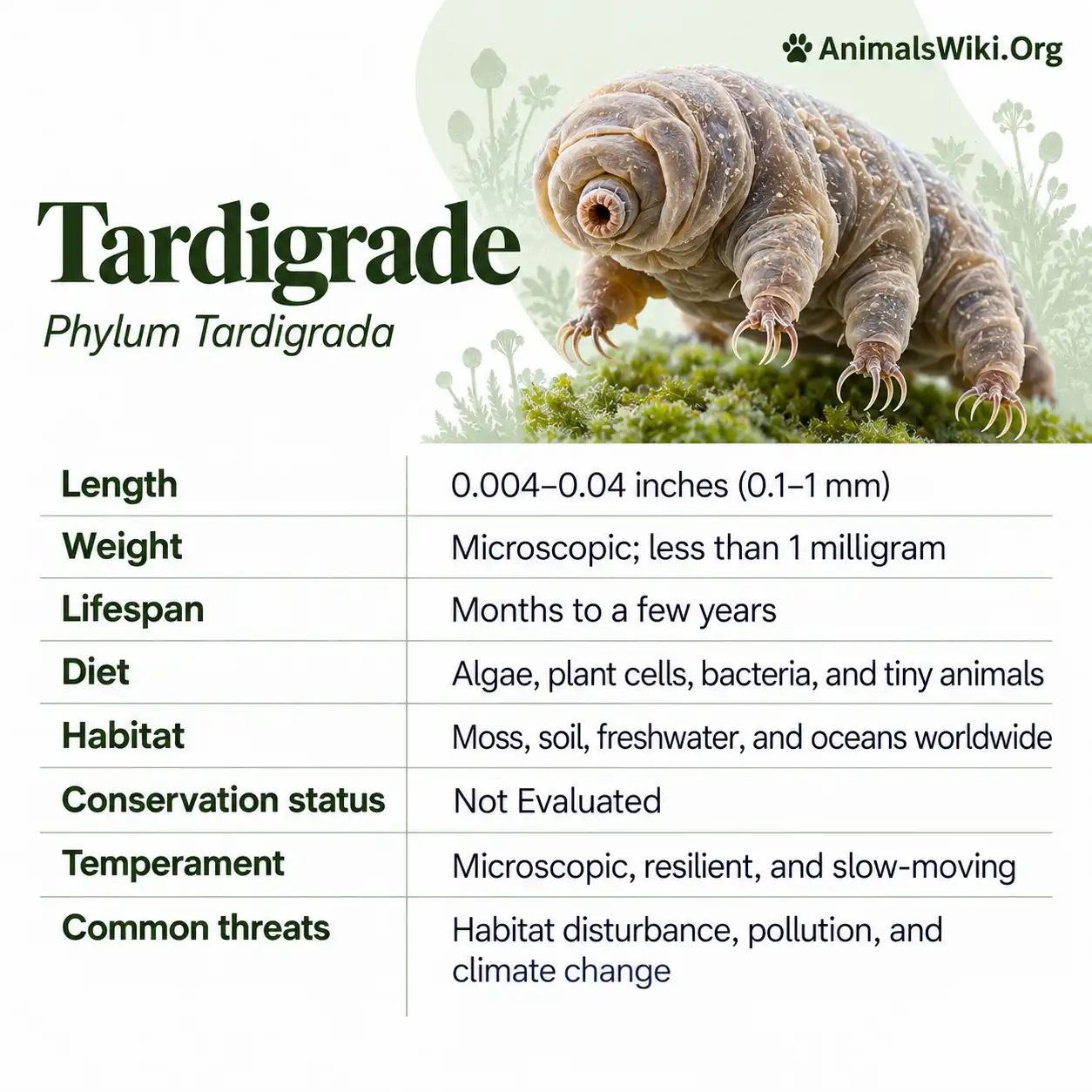
Tardigrade, The Microscopic Water Bears That Survive Extreme Conditions
The tardigrade is one of the smallest yet most extraordinary animals on Earth.
Often called a:
water bear
or:
moss piglet,
a tardigrade is a microscopic eight-legged animal belonging to the phylum:
Tardigrada.
Despite usually measuring less than 1 millimeter long, tardigrades have become famous around the world because some species can survive environmental conditions that would rapidly kill most other animals.
Depending on the species and physiological state, tardigrades can endure remarkable stresses involving:
- Extreme dehydration
- Freezing
- Low oxygen
- High pressure
- Intense radiation
- Exposure to the vacuum of space
But one important fact is frequently misunderstood:
Tardigrades are not indestructible.
Their extraordinary survival abilities usually depend on entering specialized dormant states when environmental conditions become unfavorable.
The most famous of these is associated with:
cryptobiosis.
During severe dehydration, many tardigrades contract into a compact form called a:
tun.
Their metabolism can become extraordinarily low, allowing them to survive until favorable conditions return.
When water becomes available again, the animal can rehydrate and resume activity.
This remarkable transformation has made tardigrades some of the most intensively discussed extremotolerant animals in biology.
Yet their everyday lives are much less dramatic.
Most tardigrades are not normally crawling through boiling water, frozen glaciers, radioactive environments, or outer space.
They usually inhabit tiny films of water surrounding:
- Mosses
- Lichens
- Soil particles
- Leaf litter
- Freshwater vegetation
- Marine sediments
A patch of ordinary moss can therefore contain an entire microscopic world populated by water bears.
Tardigrades possess a short, plump body divided into several segments.
They have:
four pairs of legs
for a total of:
eight legs.
Each leg ends in claws or specialized structures that help the animal grip surfaces.
At the front of the body is a mouth equipped with piercing structures called:
stylets.
Many tardigrades use these stylets to puncture:
- Plant cells
- Algae
- Fungal cells
- Other microscopic food sources
Some species are predators that feed on other tiny organisms, including other microscopic animals.
Scientists have described well over 1,000 tardigrade species, and new species continue to be identified.
They inhabit environments ranging from:
- Tropical forests
- Temperate woodlands
- Gardens
- Mountains
- Polar regions
- Freshwater
- Beaches
- Deep marine sediments
Their enormous geographic distribution does not mean a single tardigrade species lives everywhere.
Instead, the phylum contains many species adapted to different microscopic habitats.
Tardigrades are also genuine animals.
They are not:
- Bacteria
- Protozoa
- Insects
- Mites
- Worms
Although their evolutionary relationships have been debated, tardigrades belong among the molting animals known as:
Ecdysozoa
alongside groups that include arthropods and nematodes.
Their unusual combination of microscopic size, eight legs, molting, specialized mouthparts, and extreme stress tolerance makes them unlike almost anything else people encounter.
This comprehensive guide explores Tardigrade facts, water bear facts, scientific classification, anatomy, size, eight legs, claws, eyes, mouthparts, habitat, diet, feeding, movement, reproduction, eggs, lifespan, cryptobiosis, tun formation, dehydration, freezing, heat, radiation resistance, pressure tolerance, space survival, DNA protection, adaptations, predators, evolution, and whether tardigrades can really survive anything.
Tardigrade Facts
| Feature | Information |
|---|---|
| Common Name | Tardigrade |
| Popular Name | Water bear |
| Other Nickname | Moss piglet |
| Phylum | Tardigrada |
| Animal Type | Microscopic invertebrate |
| Body Form | Short, segmented and plump |
| Number of Legs | 8 |
| Leg Pairs | 4 |
| Typical Size | Usually well under 1 mm |
| Habitat | Water films, moss, lichens, soil, freshwater and marine environments |
| Diet | Varies by species |
| Feeding Structures | Piercing stylets |
| Famous Ability | Extreme stress tolerance |
| Dormant Form | Tun |
| Famous Process | Cryptobiosis |
| Reproduction | Sexual and/or parthenogenetic depending on species |
| Eggs | Yes |
| Molting | Yes |
| Distribution | Worldwide |
| Indestructible? | No |
| Can Some Survive Space Exposure? | Yes, under experimental conditions |
What Is a Tardigrade?
A tardigrade is a microscopic invertebrate belonging to the phylum:
Tardigrada.
Tardigrades are small animals with:
- Eight legs
- Claws
- A segmented body
- Specialized feeding structures
- A complete digestive system
They are best known for the ability of some species to survive severe environmental stress.
Is a Tardigrade an Animal?
Yes.
Tardigrades are genuine multicellular animals.
They belong to:
Kingdom Animalia.
Despite their tiny size, they possess complex structures including:
- Muscles
- Nervous system
- Digestive tract
- Reproductive organs
- Legs
- Claws
- Sensory structures
Is a Tardigrade a Microorganism?
Tardigrades are often casually called microorganisms because they are microscopic.
However, they are specifically:
microscopic animals.
The term microorganism covers many extremely small forms of life, but a tardigrade is not a single-celled microbe.
Is a Tardigrade a Bacterium?
No.
Bacteria are single-celled prokaryotic organisms.
Tardigrades are multicellular animals.
Is a Tardigrade an Insect?
No.
Insects belong to:
Arthropoda
and have six legs as adults.
Tardigrades belong to:
Tardigrada
and have eight legs.
Is a Tardigrade a Mite?
No.
Mites are arachnids.
Although both mites and tardigrades can have eight legs, they belong to completely different animal groups.
Is a Tardigrade a Worm?
No.
Its elongated microscopic appearance may sometimes look worm-like, but tardigrades belong to their own phylum.
Why Are Tardigrades Called Water Bears?
When viewed under a microscope, tardigrades often move with a slow, lumbering gait.
Their rounded bodies and clawed legs reminded early observers of tiny bears.
This inspired the popular name:
water bear.
Why Are Tardigrades Called Moss Piglets?
Their plump appearance and frequent occurrence in moss led to another nickname:
moss piglet.
Scientific Classification of Tardigrades
| Classification | Name |
|---|---|
| Kingdom | Animalia |
| Superphylum | Ecdysozoa |
| Phylum | Tardigrada |
Tardigrada contains multiple classes, orders, families, genera, and more than a thousand described species.
How Many Species of Tardigrades Are There?
Scientists have described:
more than 1,000 species
of tardigrades.
The exact recognized total changes as researchers:
- Discover new species
- Revise classifications
- Reexamine known specimens
- Apply molecular genetics
For evergreen content, it is safer to say well over 1,000 described species rather than treating one exact number as permanent.
What Does a Tardigrade Look Like?
A tardigrade typically looks like a tiny, plump animal with:
- Rounded body
- Four pairs of legs
- Claws
- Small head region
- Short body segments
Under a microscope, some species are transparent or translucent.
Others may appear:
- White
- Yellow
- Greenish
- Orange
- Reddish
- Brown
depending on species, gut contents, pigmentation, and lighting.
How Big Is a Tardigrade?
Most tardigrades are extremely small.
Many adults are around:
0.1–0.5 mm
long.
Some larger species can approach or exceed:
1 mm.
This means many tardigrades are barely visible—or completely invisible—to the unaided eye.
Can You See a Tardigrade With the Naked Eye?
Large tardigrades may theoretically appear as tiny specks under ideal conditions.
However, meaningful observation normally requires:
a microscope.
How Many Legs Does a Tardigrade Have?
Eight.
They possess:
four pairs of legs.
Why Do Tardigrades Have Eight Legs?
The legs allow them to crawl across microscopic surfaces such as:
- Moss leaves
- Sediment particles
- Plant material
- Soil particles
Their body plan evolved within the tardigrade lineage and differs substantially from that of arthropods.
Tardigrade Claws
The ends of tardigrade legs often carry:
claws.
The number, arrangement, and shape of these claws vary among species.
Scientists can use claw anatomy as one feature when identifying tardigrades.
Why Do Tardigrades Have Claws?
Claws help them grip microscopic surfaces.
At their scale, a moss leaf or grain of sediment can form an enormous landscape.
Claws provide traction while the animal moves through these environments.
Do Tardigrades Have Eyes?
Some species possess simple eye spots.
These are far simpler than vertebrate eyes.
Other species lack obvious eyes.
Can Tardigrades See?
Species with eyespots can detect aspects of light, but tardigrade vision is far less sophisticated than human or insect vision.
Their microscopic world relies on multiple sensory cues.
Do Tardigrades Have a Brain?
Tardigrades possess a nervous system with a brain-like anterior concentration of nervous tissue and associated nerve structures.
Although tiny, they are neurologically much more complex than bacteria or single-celled organisms.
Do Tardigrades Have a Heart?
No.
They do not possess a vertebrate-style heart.
At such a small body size, materials can move through the body without requiring the elaborate cardiovascular system found in large animals.
Do Tardigrades Have Blood?
They do not possess blood and a closed circulatory system comparable with humans.
Their body cavity contains fluid that assists internal transport.
Do Tardigrades Have Lungs?
No.
Their extremely small size allows gases to diffuse across body surfaces.
They do not require lungs.
How Do Tardigrades Breathe?
Gas exchange occurs largely through:
diffusion across the body surface.
Oxygen can move into tissues without a complex respiratory system.
Do Tardigrades Have a Mouth?
Yes.
The mouth leads into a specialized feeding apparatus.
Tardigrade Stylets
Tardigrades possess needle-like structures called:
stylets.
These can pierce food sources.
The animal can then suck out cellular contents or ingest material.
Do Tardigrades Have Teeth?
Not teeth in the mammalian sense.
Their feeding apparatus includes stylets and muscular structures specialized for piercing and sucking.
Do Tardigrades Have a Digestive System?
Yes.
They possess a complete digestive tract with:
- Mouth
- Pharyngeal structures
- Gut
- Hindgut
- Anus in many groups
Where Do Tardigrades Live?
Tardigrades occur worldwide.
They have been found in:
- Moss
- Lichens
- Soil
- Leaf litter
- Freshwater
- Ponds
- Streams
- Marine sediments
- Beaches
- Mountain environments
- Polar regions
Do Tardigrades Live in Moss?
Yes.
Moss is one of the most famous tardigrade habitats.
However, the animals require microscopic films of water around the moss rather than simply living on dry vegetation indefinitely in an active state.
Do Tardigrades Live in Water?
Yes.
Tardigrades require water around their bodies to remain normally active.
Aquatic species live in freshwater or marine environments.
Terrestrial species often occupy thin films of water surrounding moss, lichens, and soil particles.
Do Tardigrades Live in the Ocean?
Yes.
Many species are marine.
Marine tardigrades can inhabit:
- Seafloor sediments
- Sand
- Algae
- Coastal environments
Do Tardigrades Live in Freshwater?
Yes.
Freshwater species occur in ponds, lakes, streams, and aquatic vegetation.
Do Tardigrades Live on Land?
Many species inhabit terrestrial environments, but active individuals still depend on microscopic moisture.
Can Tardigrades Live in Your Garden?
Yes.
Suitable mosses, lichens, leaf litter, and moist soils may contain tardigrades.
Are Tardigrades Everywhere?
They are extremely widespread, but saying they literally occur everywhere would be inaccurate.
Suitable microhabitats are required.
What Do Tardigrades Eat?
Diet varies considerably among species.
Tardigrades may feed on:
- Algae
- Plant cells
- Moss cells
- Fungi
- Bacteria-associated material
- Microscopic animals
- Other tardigrades
Are Tardigrades Herbivores?
Some primarily consume plant or algal material.
Others are predators or omnivores.
Therefore, the entire phylum cannot be described simply as herbivorous.
Are Tardigrades Carnivores?
Some species are predatory.
They can feed on tiny organisms such as:
- Nematodes
- Rotifers
- Other tardigrades
Are Tardigrades Cannibals?
Cannibalism has been observed in some predatory tardigrades.
A larger individual may consume another tardigrade under suitable circumstances.
How Do Tardigrades Eat?
A plant-feeding tardigrade can use its stylets to pierce a cell.
The pharyngeal apparatus then helps draw food into the digestive tract.
Predatory species use similar specialized mouthparts to attack microscopic prey.
How Do Tardigrades Move?
They crawl using their eight legs.
Their movement can look surprisingly animal-like under magnification.
The slow walking behavior contributed to the name:
water bear.
Can Tardigrades Swim?
Some can move through water, but many species are primarily adapted to crawling across surfaces rather than efficient long-distance swimming.
How Fast Is a Tardigrade?
Tardigrades are slow at human scale.
Speed varies with:
- Species
- Surface
- Temperature
- Hydration
- Activity
Their locomotion is more important for navigating microscopic habitats than covering long distances.
Tardigrade Reproduction
Reproductive strategies vary greatly.
Depending on species, tardigrades may reproduce through:
- Sexual reproduction
- Parthenogenesis
Some species have distinct males and females.
Others can reproduce without males.
What Is Parthenogenesis?
Parthenogenesis is reproduction in which an embryo develops from an unfertilized egg.
This allows females of some species to reproduce without mating with males.
Do Tardigrades Lay Eggs?
Yes.
Tardigrades reproduce using eggs.
What Do Tardigrade Eggs Look Like?
Eggs vary enormously among species.
Some have beautifully ornamented outer surfaces containing:
- Spikes
- Cones
- Ridges
- Pores
- Geometric patterns
Egg morphology can help scientists identify species.
Where Do Tardigrades Lay Eggs?
Some lay free eggs in the environment.
Others deposit eggs within:
shed cuticles.
The discarded outer skin can therefore become a protective container for developing eggs.
Do Tardigrades Molt?
Yes.
They periodically shed their outer cuticle as they grow.
This molting behavior is one reason they are classified among:
Ecdysozoa
—the molting animals.
How Many Babies Do Tardigrades Have?
Egg number varies greatly among species and reproductive events.
There is no single litter or clutch size applying to all tardigrades.
How Long Do Tardigrades Live?
Active lifespan varies by species and environmental conditions.
Many may live for:
months to a few years
during active life.
However, dormant periods can dramatically complicate the meaning of “lifespan.”
Can Tardigrades Live for 100 Years?
Claims that an individual tardigrade routinely lives for 100 years are misleading.
Dormant tardigrades may survive extended periods under suitable conditions, but extraordinary century-scale lifespan claims are not established as normal biology.
What Is Cryptobiosis?
Cryptobiosis is a reversible state in which an organism’s metabolic activity becomes extremely reduced in response to severe environmental stress.
For tardigrades, this can allow survival during conditions that would otherwise be fatal.
What Does Cryptobiosis Mean?
The word roughly refers to:
hidden life.
The animal appears almost lifeless physiologically, yet retains the capacity to resume activity when favorable conditions return.
What Is a Tardigrade Tun?
A tun is the compact, contracted form adopted by many tardigrades during severe dehydration.
The legs retract.
The body contracts.
Water content drops dramatically.
Metabolic activity becomes extremely low.
The animal effectively enters a survival state.
Why Is the Tun Important?
The tun protects the tardigrade during environmental stress.
It can improve survival during:
- Desiccation
- Freezing
- Radiation exposure
- Vacuum
- Some temperature extremes
depending on species and circumstances.
Do Tardigrades Die When They Dry Out?
Some can survive extreme dehydration by entering anhydrobiosis, a form of cryptobiosis.
When water returns, surviving animals can rehydrate.
What Is Anhydrobiosis?
Anhydrobiosis is a state of suspended activity triggered by:
loss of water.
It is one of the tardigrade’s most famous adaptations.
How Much Water Can a Tardigrade Lose?
During extreme dehydration, certain tardigrades can lose most of their body water.
Their cells must then protect:
- Membranes
- Proteins
- DNA
- Internal structures
from damage.
How Do Tardigrades Survive Drying?
Different species use combinations of protective mechanisms involving:
- Specialized proteins
- Cellular stabilization
- Antioxidant systems
- DNA repair
- Controlled metabolic shutdown
The exact mechanisms differ among species.
Tardigrade-Specific Proteins
Research has identified unusual proteins associated with tardigrade stress tolerance.
Some intrinsically disordered proteins can help protect cellular structures during drying.
These proteins can form protective environments that stabilize sensitive biological molecules.
What Is Dsup?
Dsup means:
damage suppressor.
It is a protein discovered in certain tardigrades.
Research suggests Dsup can associate with chromatin and reduce some forms of DNA damage under experimental conditions.
Does Every Tardigrade Have Dsup?
No.
Tardigrades are a diverse phylum.
Scientists should not assume every stress adaptation discovered in one species occurs identically in every other tardigrade.
Are Tardigrades Immune to Radiation?
No.
This is a common exaggeration.
Some tardigrades tolerate radiation doses far beyond those humans can survive.
But sufficiently intense radiation can still:
injure or kill them.
Why Can Tardigrades Survive Radiation?
Several mechanisms may contribute, including:
- Efficient DNA repair
- Protective proteins
- Antioxidant defenses
- Cellular stress tolerance
Their radiation resistance may partly overlap with adaptations that evolved for surviving dehydration.
Can Tardigrades Survive Freezing?
Some species and life stages can survive extremely low temperatures, particularly in dormant states.
However, survival depends on:
- Species
- Temperature
- Exposure duration
- Hydration state
- Rate of cooling
Can Tardigrades Survive Being Frozen?
Some can survive freezing.
That does not mean every tardigrade survives every freezing experiment.
Can Tardigrades Survive Extreme Heat?
Some dormant tardigrades can tolerate brief exposure to surprisingly high temperatures.
However:
heat can kill tardigrades.
Tolerance falls with longer exposure and varies strongly among species and hydration states.
Can Tardigrades Survive Boiling Water?
The popular claim that tardigrades casually survive boiling is misleading.
Exposure to sufficiently high temperatures for sufficient time is lethal.
They are extraordinarily tolerant animals—not magically heatproof organisms.
Can Tardigrades Survive Space?
Some tardigrades have survived direct exposure to outer-space conditions during experiments.
This is one of their most famous achievements.
Have Tardigrades Actually Been Sent Into Space?
Yes.
Tardigrades have been used in spaceflight experiments investigating their ability to tolerate:
- Vacuum
- Cosmic radiation
- Solar ultraviolet radiation
- Microgravity
Can Tardigrades Survive a Vacuum?
Some dehydrated tardigrades can survive exposure to vacuum for limited periods.
A vacuum is normally devastating to active animals because of dehydration and pressure effects.
Their cryptobiotic state makes exceptional tolerance possible.
Can Tardigrades Live Normally in Space?
No.
This distinction is crucial.
Surviving temporary exposure is not the same as living, feeding, growing, and reproducing indefinitely in open space.
Tardigrades require appropriate environmental conditions to return to normal active life.
Can Tardigrades Survive Without Oxygen?
Some can tolerate periods of very low oxygen by entering specialized states.
But they are animals and require appropriate conditions for long-term active metabolism.
What Is Anoxybiosis?
Anoxybiosis is a reversible state associated with insufficient oxygen.
The response differs from dehydration-induced tun formation.
Can Tardigrades Survive High Pressure?
Some species, especially marine forms, show impressive tolerance to high pressure.
Experimental studies have demonstrated survival at pressures far beyond ordinary atmospheric conditions.
Can Tardigrades Survive the Deep Ocean?
Marine tardigrades naturally inhabit ocean environments, including sediments.
However, pressure tolerance varies by species.
Can Tardigrades Survive Acid?
Extreme chemical conditions can kill tardigrades.
They are not universally resistant to every acid, toxin, or corrosive chemical.
Can Tardigrades Survive Fire?
No.
Direct destructive heating can kill them.
The idea that tardigrades can survive literally anything is false.
Can Tardigrades Survive Lava?
No.
Molten lava reaches temperatures far beyond tardigrade survival limits.
Can Tardigrades Survive a Nuclear Explosion?
Not at the center of a nuclear explosion.
They may tolerate radiation levels far above human limits, but:
- Extreme heat
- Blast forces
- Physical destruction
can still kill them.
Can Tardigrades Survive an Asteroid Impact?
This depends entirely on distance and conditions.
A global catastrophe might leave some microscopic organisms in protected habitats alive, but a tardigrade exposed directly to extreme impact heat and physical destruction would not be invulnerable.
Are Tardigrades Indestructible?
No.
Tardigrades can be killed by:
- Prolonged extreme heat
- Physical crushing
- Predators
- Certain chemicals
- Excessive radiation
- Unfavorable environmental transitions
- Failure to enter dormancy successfully
Their reputation comes from exceptional tolerance, not immortality.
Why Are Tardigrades So Tough?
Their resilience is a combination of:
- Tiny body size
- Cryptobiosis
- Extreme dehydration tolerance
- Protective proteins
- Cellular stabilization
- DNA repair
- Stress-response systems
Different species possess different combinations of these traits.
Tardigrade Predators
Despite their reputation, tardigrades can become prey.
Potential predators include:
- Nematodes
- Mites
- Other microinvertebrates
- Predatory tardigrades
At microscopic scale, tardigrades participate in real food webs.
Do Tardigrades Eat Each Other?
Some predatory species can consume other tardigrades.
Can Tardigrades Hurt Humans?
No meaningful threat is known.
They are microscopic animals and are not parasites of humans.
Do Tardigrades Bite Humans?
No.
Their feeding structures are far too small to bite a human in any meaningful way.
Are Tardigrades Parasites?
Most familiar tardigrades are free-living.
Some species have specialized ecological relationships, but tardigrades are not human parasites.
Can Tardigrades Live Inside Humans?
Humans are not their normal habitat.
They are not adapted to colonizing the human body as common parasites.
Are Tardigrades Harmful?
Generally:
no.
They are harmless to humans.
Tardigrade Evolution
Tardigrades belong to the major animal group:
Ecdysozoa.
This group contains animals that molt their outer covering.
Their closest evolutionary relationships have been debated, particularly regarding:
- Arthropods
- Onychophorans
- Nematodes
Modern molecular studies continue refining our understanding of their position.
Are Tardigrades Related to Insects?
They share distant evolutionary ancestry within Ecdysozoa but are not insects or arthropods.
Are Tardigrades Related to Velvet Worms?
Tardigrades, velvet worms, and arthropods have often been discussed together when studying the evolution of segmented, leg-bearing animals.
Their precise deeper relationships remain an important area of evolutionary research.
How Old Are Tardigrades?
The tardigrade lineage is ancient.
Their microscopic size and delicate bodies make the fossil record poor.
Rare fossil tardigrades preserved in amber provide valuable evidence, but the lineage originated far earlier than these few fossils alone suggest.
Why Are Tardigrade Fossils Rare?
Tiny soft-bodied animals usually decay without fossilizing.
Exceptional preservation is required.
Amber can sometimes trap and preserve microscopic organisms with extraordinary detail.
Tardigrades and Scientific Research
Scientists study tardigrades to understand:
- Desiccation tolerance
- DNA protection
- Protein stabilization
- Radiation biology
- Astrobiology
- Evolution
- Cryobiology
- Stress physiology
Their adaptations may inspire future technologies.
Could Tardigrade Biology Help Humans?
Potentially.
Understanding how tardigrades protect biological material may contribute to research involving:
- Cell preservation
- Pharmaceuticals
- Vaccines
- Biological storage
- Radiation protection
- Space biology
However, translating tardigrade mechanisms into safe human technologies requires substantial research.
Tardigrades and Astrobiology
Tardigrades are interesting to astrobiologists because they demonstrate that animal life can temporarily tolerate environmental extremes far beyond normal terrestrial conditions.
They help researchers ask:
- What limits animal survival?
- Can life survive interplanetary transfer?
- How does radiation affect dormant organisms?
- What biological systems tolerate vacuum?
They do not prove that complex animals can naturally live in outer space.
Tardigrade vs. Mite
| Feature | Tardigrade | Mite |
|---|---|---|
| Phylum | Tardigrada | Arthropoda |
| Legs | 8 | Usually 8 as adults |
| Animal Group | Tardigrade | Arachnid |
| Body | Plump and segmented | Arthropod body |
| Size | Usually microscopic | Microscopic to visible |
| Famous Ability | Cryptobiosis | Highly diverse ecology |
Tardigrade vs. Nematode
| Feature | Tardigrade | Nematode |
|---|---|---|
| Body | Short and plump | Long and worm-like |
| Legs | 8 | None |
| Phylum | Tardigrada | Nematoda |
| Movement | Crawling | Undulating |
| Famous Trait | Extreme stress tolerance | Enormous diversity |
Tardigrade vs. Rotifer
Both can be microscopic animals living in water films.
However, rotifers belong to a completely different animal group and possess characteristic ciliated feeding structures.
Some rotifers also demonstrate impressive desiccation tolerance.
Tardigrade vs. Bacteria
A tardigrade is vastly more complex.
| Feature | Tardigrade | Bacterium |
|---|---|---|
| Cells | Multicellular | Single cell |
| Kingdom | Animalia | Not Animalia |
| Legs | 8 | None |
| Nervous System | Yes | No |
| Digestive System | Yes | No animal-style digestive tract |
| Size | Microscopic animal | Usually much smaller |
50 Interesting Tardigrade Facts
- Tardigrades are animals.
- They belong to the phylum Tardigrada.
- They are commonly called water bears.
- Another nickname is moss piglet.
- Tardigrades have eight legs.
- Their legs occur in four pairs.
- Many are less than half a millimeter long.
- Larger species can approach or exceed 1 mm.
- Tardigrades occur worldwide.
- Many live in moss.
- Others inhabit lichens.
- Some live in freshwater.
- Many species live in the ocean.
- Tardigrades need water films for normal activity.
- They possess claws.
- Claw structures vary among species.
- Some species possess simple eyespots.
- Tardigrades have a nervous system.
- They do not have lungs.
- They do not possess a human-like heart.
- Gas exchange occurs largely across the body surface.
- Tardigrades have a digestive tract.
- They use piercing stylets to feed.
- Some consume plant cells.
- Some eat algae.
- Some are predators.
- Some can eat other tardigrades.
- Tardigrades lay eggs.
- Some reproduce sexually.
- Some reproduce through parthenogenesis.
- They molt their outer cuticle.
- Some deposit eggs inside shed cuticles.
- Tardigrade eggs can have elaborate surface patterns.
- More than 1,000 species have been described.
- Their famous dormant form is called a tun.
- Many can survive extreme dehydration.
- Cryptobiosis involves extremely reduced metabolic activity.
- Some can survive freezing.
- Some tolerate intense radiation.
- Certain tardigrades have survived vacuum exposure.
- Tardigrades have survived experiments involving outer space.
- Space survival does not mean they can live permanently in space.
- Extreme heat can kill tardigrades.
- They cannot survive molten lava.
- They are not immortal.
- Predators can eat them.
- Dsup is a DNA-associated protective protein identified in some tardigrades.
- Scientists study tardigrades for space biology and stress-tolerance research.
- Tardigrades are harmless to humans.
- Their extraordinary abilities make them among Earth’s most famous microscopic animals.
Did You Know?
A tardigrade can transform from an active eight-legged animal into something that appears almost lifeless—and later become active again.
Imagine a tardigrade crawling through a microscopic film of water surrounding a patch of moss.
To the tardigrade, that thin layer of moisture is its world.
Then the moss begins to dry.
For most aquatic animals, losing almost all surrounding water would quickly become fatal.
But some tardigrades respond differently.
As dehydration progresses, the animal:
- Pulls in its legs
- Contracts its body
- Loses most of its internal water
- Activates molecular protection systems
- Dramatically reduces metabolism
Eventually it becomes a compact structure called a:
tun.
At this point, the animal is not living normally.
It is not wandering around.
It is not feeding.
It is not reproducing.
Its biological activity has fallen to an extraordinarily low level.
This state can make the tardigrade resistant to environmental stresses that would destroy an active animal.
Then imagine rain returning.
Water enters the moss.
The tun rehydrates.
Cellular activity increases.
The body expands.
The legs emerge.
And, if the animal successfully survived the dormant period:
the water bear begins walking again.
That ability helps explain many of the spectacular claims surrounding tardigrades.
But the key is not that tardigrades are impossible to kill.
Their real superpower is more interesting:
when their environment becomes temporarily unlivable, some tardigrades can effectively place much of their biology on hold until conditions improve.
Frequently Asked Questions About Tardigrades
What is a tardigrade?
A tardigrade is a microscopic eight-legged invertebrate belonging to the phylum Tardigrada.
What is another name for a tardigrade?
Water bear.
Why is a tardigrade called a water bear?
Its plump body, clawed legs, and lumbering movement resemble a tiny bear under a microscope.
What is a moss piglet?
Another nickname for a tardigrade.
Is a tardigrade an animal?
Yes.
Is a tardigrade alive?
Yes. Active tardigrades are normal living animals, while dormant ones can enter extremely reduced metabolic states.
Is a tardigrade a microorganism?
It is a microscopic multicellular animal and can loosely be described as a microscopic organism.
Is a tardigrade a bacterium?
No.
Is a tardigrade a virus?
No.
Is a tardigrade an insect?
No.
Is a tardigrade an arachnid?
No.
Is a tardigrade a mite?
No.
Is a tardigrade a worm?
No.
How many legs does a tardigrade have?
Eight.
Why does a tardigrade have eight legs?
Its four pairs of legs are part of the characteristic tardigrade body plan and allow crawling across microscopic surfaces.
Does a tardigrade have claws?
Yes, most have claws or related gripping structures.
Does a tardigrade have eyes?
Some species possess simple eyespots.
Can tardigrades see?
Some can detect light, but their visual systems are relatively simple.
Do tardigrades have brains?
They possess an anterior concentration of nervous tissue functioning as a small brain.
Do tardigrades have nerves?
Yes.
Do tardigrades have hearts?
No conventional heart.
Do tardigrades have blood?
Not blood like humans; their internal fluid system functions differently.
Do tardigrades have lungs?
No.
How do tardigrades breathe?
Primarily by gas diffusion across their body surface.
Do tardigrades have mouths?
Yes.
Do tardigrades have teeth?
They possess specialized piercing stylets rather than mammalian-style teeth.
What are tardigrade stylets?
Needle-like feeding structures used to pierce food.
Do tardigrades have stomachs?
They possess a digestive system and gut, although its anatomy differs greatly from a vertebrate stomach.
Do tardigrades poop?
Yes. They produce and eliminate digestive waste.
How big is a tardigrade?
Many are around 0.1–0.5 mm, although some species can approach or exceed 1 mm.
Can you see tardigrades without a microscope?
Large individuals might appear as tiny specks, but a microscope is normally required to see them properly.
Where do tardigrades live?
Moss, lichens, soil, freshwater and marine environments around the world.
Do tardigrades live in moss?
Yes.
Do tardigrades live in water?
Yes, either directly in aquatic environments or within microscopic water films.
Do tardigrades live in oceans?
Yes.
Do tardigrades live in freshwater?
Yes.
Do tardigrades live on land?
Many inhabit terrestrial mosses, lichens, and soils but depend on moisture for normal activity.
Are tardigrades found in Antarctica?
Yes, tardigrades occur in polar environments.
Are tardigrades found in deserts?
Some occur in dry environments where cryptobiosis helps them endure periods without water.
Can tardigrades live in my backyard?
Potentially. Moist moss or lichen may contain them.
How do I find tardigrades?
Researchers and hobbyists often soak moss or lichen samples in water and examine the extracted material under a microscope.
What do tardigrades eat?
Depending on species, algae, plant cells, fungi, microorganisms, or microscopic animals.
Do tardigrades eat plants?
Some feed on plant and algal cells.
Do tardigrades eat bacteria?
Some may ingest material containing microorganisms, but feeding ecology varies widely.
Do tardigrades eat other animals?
Predatory species do.
Do tardigrades eat other tardigrades?
Some can.
Are tardigrades cannibals?
Cannibalism occurs in some predatory species.
How do tardigrades eat?
They use stylets to pierce food and a muscular feeding apparatus to ingest material.
Can tardigrades swim?
Some can move through water, though many are primarily crawlers.
Can tardigrades walk?
Yes.
Why do tardigrades walk?
Their legs and claws allow movement across complex microscopic surfaces.
Are tardigrades fast?
No. At human scale they move extremely slowly.
Do tardigrades reproduce?
Yes.
Do tardigrades have males and females?
Some species do.
Can tardigrades reproduce without males?
Some species reproduce by parthenogenesis.
Do tardigrades lay eggs?
Yes.
What do tardigrade eggs look like?
Many have beautifully ornamented shells with species-specific patterns.
Where do tardigrades lay eggs?
Some deposit them freely, while others lay them within shed cuticles.
Do tardigrades molt?
Yes.
How long do tardigrades live?
Active lifespan varies by species, often from months to a few years, while dormant periods can extend survival.
Can tardigrades live 100 years?
There is no good basis for saying tardigrades normally survive for a century.
Are tardigrades immortal?
No.
Can tardigrades die?
Absolutely.
What kills tardigrades?
Sufficient heat, physical damage, chemicals, extreme radiation, predators, and other unfavorable conditions can kill them.
What is cryptobiosis?
A reversible state of extremely reduced metabolic activity used to survive environmental stress.
What is a tardigrade tun?
The contracted dormant form produced by many tardigrades during dehydration.
Why do tardigrades become tuns?
To improve survival during severe environmental stress.
Are tardigrades dead in tun form?
No. A viable tun retains the capacity to reactivate when conditions improve.
Can tardigrades dry out completely?
Some species can lose most of their body water during anhydrobiosis.
Can dried tardigrades come back to life?
A successfully surviving dormant tardigrade can rehydrate and resume activity. It was not truly dead.
What is anhydrobiosis?
A cryptobiotic response to extreme dehydration.
Can tardigrades survive freezing?
Some species can survive very low temperatures, particularly in appropriate dormant states.
Can tardigrades survive ice?
Some can survive being frozen under suitable conditions.
Can tardigrades survive heat?
Some tolerate short periods of high temperature, especially when dormant, but heat eventually kills them.
Can tardigrades survive boiling?
They should not be described as able to casually survive boiling water. Prolonged high temperatures are lethal.
Can tardigrades survive fire?
No.
Can tardigrades survive lava?
No.
Can tardigrades survive radiation?
Some tolerate radiation doses far beyond human tolerance, but sufficiently high exposure can kill them.
Are tardigrades immune to radiation?
No.
Why are tardigrades radiation resistant?
DNA repair, cellular protection, antioxidants, and specialized proteins contribute to resistance in different species.
What is Dsup?
A damage-suppressor protein identified in certain tardigrades that can help protect DNA from some forms of damage.
Do all tardigrades have Dsup?
No.
Can tardigrades survive space?
Some have survived experimental exposure to outer-space conditions.
Have tardigrades been to space?
Yes.
Can tardigrades survive a vacuum?
Some dehydrated tardigrades can survive temporary vacuum exposure.
Can tardigrades breathe in space?
No. Space survival occurs through extreme dormancy rather than normal breathing and activity.
Can tardigrades live permanently in space?
No evidence shows that tardigrades can live, feed, and reproduce indefinitely in open space.
Can tardigrades survive without oxygen?
Some can tolerate oxygen deprivation for periods by entering specialized physiological states.
Can tardigrades survive underwater?
Aquatic tardigrades naturally live underwater.
Can tardigrades survive high pressure?
Some show extraordinary pressure tolerance.
Can tardigrades survive at the bottom of the ocean?
Marine species can inhabit deep-sea environments, but tolerance varies among species.
Can tardigrades survive acid?
Not all extreme chemicals are survivable. Strong acids and other damaging substances can kill them.
Can tardigrades survive bleach?
No assumption should be made that cryptobiosis protects them against destructive chemicals such as concentrated bleach.
Can tardigrades survive alcohol?
Chemical exposure can kill them depending on concentration and duration.
Can tardigrades survive a nuclear bomb?
They cannot survive the direct extreme heat and physical destruction at the center of a nuclear explosion.
Could tardigrades survive an apocalypse?
Some might survive certain environmental catastrophes if protected in suitable microhabitats, but no animal is universally apocalypse-proof.
Can tardigrades survive an asteroid?
Survival would depend entirely on local environmental conditions.
Why are tardigrades so hard to kill?
Their cryptobiotic abilities and cellular protection systems allow some species to tolerate extraordinary environmental stress.
Are tardigrades the toughest animals on Earth?
They are among the most famous extremotolerant animals, although “toughest” has no single scientific definition.
Are tardigrades extremophiles?
They are often called extremophiles informally, but extremotolerant is often more precise because many do not normally grow and reproduce under the extreme conditions they can temporarily survive.
Can tardigrades hurt humans?
No.
Do tardigrades bite humans?
No meaningful human bite is possible.
Are tardigrades poisonous?
They are not known as a poisoning threat to humans.
Are tardigrades parasites?
Most are free-living rather than human parasites.
Can tardigrades live inside humans?
The human body is not their normal habitat.
Can tardigrades cause disease?
They are not recognized as important human disease-causing organisms.
Can you keep tardigrades as pets?
They can be maintained for observation under laboratory or hobbyist microscope conditions, but caring for them requires appropriate species-specific moisture and food.
Do tardigrades have predators?
Yes.
What eats tardigrades?
Nematodes, mites, other microinvertebrates, and predatory tardigrades may consume them.
Are tardigrades endangered?
Tardigrades comprise many species, so there is no single conservation status applying to the entire phylum.
Why are tardigrades important?
They contribute to microscopic ecosystems and provide valuable insights into evolution, stress tolerance, cryptobiosis, and cellular protection.
Why do scientists study tardigrades?
Their extreme stress tolerance may reveal new principles of biological preservation, DNA protection, and survival under harsh conditions.
Could tardigrades help space exploration?
Potentially. Their biology can help researchers understand how organisms respond to radiation, vacuum, dehydration, and spaceflight.
Could humans get tardigrade powers?
Not simply. Human biology is vastly different, although tardigrade proteins and survival mechanisms may inspire biomedical research.
Could humans use Dsup?
Researchers have experimented with Dsup-related protection in other cell types, but this does not mean humans can currently be made radiation-proof.
Are tardigrades aliens?
No.
They are Earth animals produced by terrestrial evolution.
Did tardigrades come from space?
There is no credible evidence that tardigrades originated in space.
Are tardigrades older than dinosaurs?
The tardigrade lineage is ancient and likely predates dinosaurs by a substantial period, although their fossil record is sparse.
Are tardigrades related to dinosaurs?
Only in the extremely broad sense that both are animals sharing very ancient common ancestry.
Are tardigrades related to humans?
All animals ultimately share evolutionary ancestry, but tardigrades and humans diverged extremely far back in animal evolution.
Are tardigrades related to arthropods?
They share ancestry within Ecdysozoa and are evolutionarily related at a deep level, though tardigrades are not arthropods.
Why are tardigrade fossils rare?
Their tiny, soft bodies rarely fossilize.
Have fossil tardigrades been found?
Yes. Rare specimens have been preserved, including individuals trapped in amber.
What is the coolest fact about tardigrades?
Some species can dry into a tun, dramatically suppress metabolism, survive conditions lethal to most animals, and later resume normal activity after rehydration.
Conclusion
The tardigrade demonstrates that an animal does not need to be large to possess extraordinary adaptations.
A water bear may be smaller than the period at the end of a printed sentence.
Yet inside that microscopic body exists:
- A nervous system
- Digestive tract
- Muscles
- Reproductive organs
- Eight legs
- Claws
- Specialized mouthparts
- Sophisticated cellular survival mechanisms
Under normal conditions, its life can seem almost ordinary.
It crawls through microscopic films of water.
It searches for food.
It feeds.
It molts.
It reproduces.
It lays eggs.
It interacts with other tiny organisms.
Then its environment begins to disappear.
The moss dries.
The water evaporates.
For most aquatic animals, that would be the end.
But some tardigrades possess another option.
Their legs retract.
Their bodies contract.
Water leaves their tissues.
Their metabolism falls dramatically.
Protective molecules help stabilize biological structures.
The active animal transforms into:
a tun.
In this state, the tardigrade can endure environmental stresses far beyond those tolerated by its normally active form.
Scientists have exposed tardigrades to:
- Extreme dehydration
- Freezing
- High pressure
- Radiation
- Vacuum
- Outer-space conditions
and some survived.
That remarkable record has transformed the water bear into an internet legend.
Unfortunately, the legend often becomes exaggerated.
Tardigrades are sometimes described as:
indestructible.
They are not.
Heat can kill them.
Radiation can kill them.
Chemicals can kill them.
Predators can eat them.
Physical destruction can kill them.
A tardigrade dropped into molten lava would not casually walk away.
Its genuine biology is more fascinating than the myth.
The tardigrade’s greatest adaptation is not invincibility.
It is the ability, under appropriate circumstances, to change the rules by which it survives.
Instead of remaining active while its environment becomes impossible, it can temporarily reduce biological activity to extraordinary levels and wait.
Then water returns.
The tun swells.
The legs emerge.
Metabolism resumes.
And the microscopic animal starts walking again.
That transformation explains why tardigrades have fascinated:
- Zoologists
- Geneticists
- Cell biologists
- Astrobiologists
- Space researchers
Understanding how such a tiny animal protects proteins, membranes, cells, and DNA could eventually help researchers develop better methods for preserving biological materials or protecting cells from environmental stress.
But even without those potential applications, tardigrades deserve attention for a simpler reason.
They reveal how inventive evolution can be.
A patch of moss that appears ordinary to us can contain a landscape filled with microscopic animals whose biology challenges our expectations about the limits of survival.
The water bear is therefore not remarkable because it cannot die.
It is remarkable because something so small has evolved such extraordinary ways to remain alive.



