Kākāpō, The Rare Flightless Parrot of New Zealand
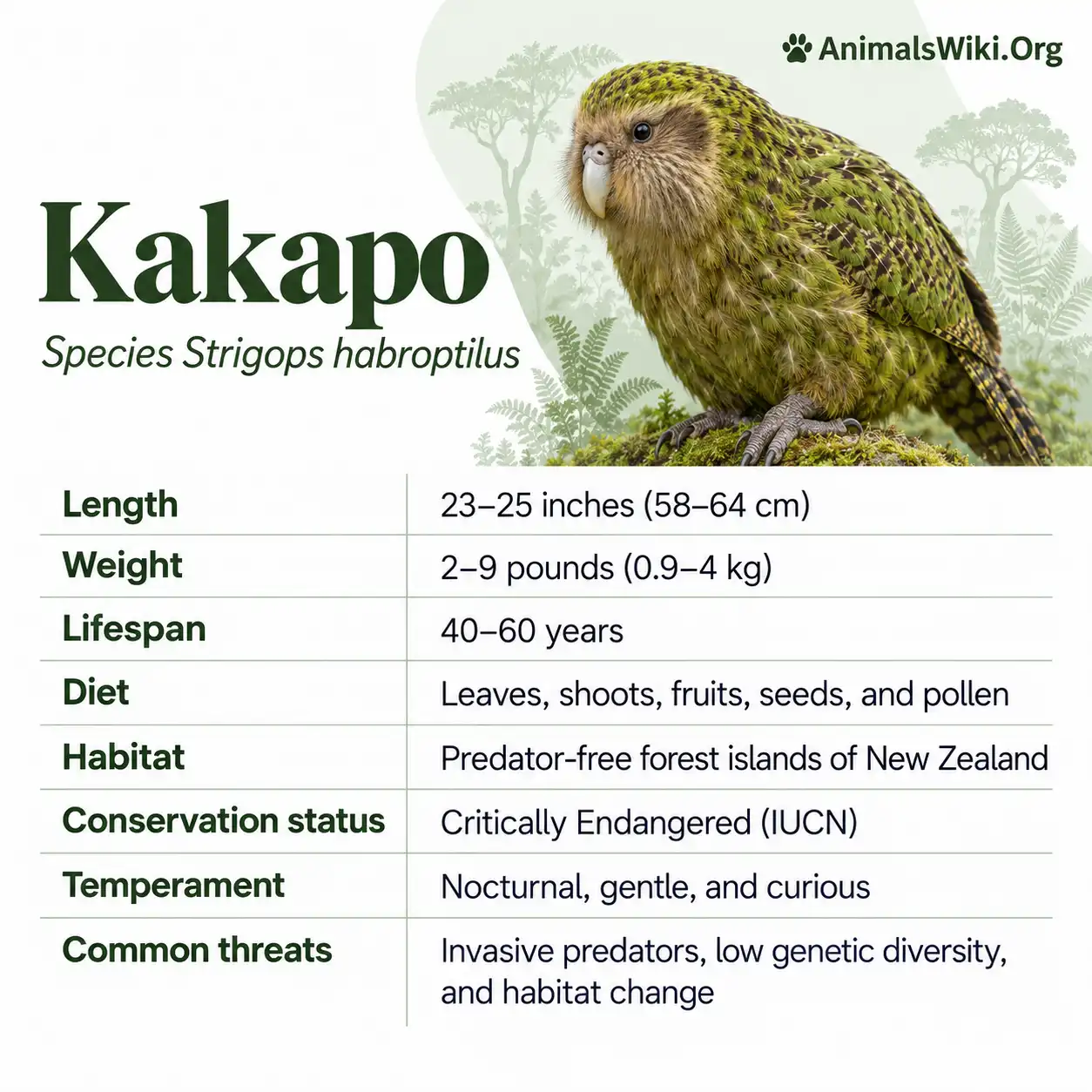
The kākāpō, commonly written kakapo outside New Zealand, is one of the most extraordinary parrots on Earth.
Its scientific name is:
Strigops habroptilus
and it is found naturally only in:
New Zealand.
The kākāpō is famous for an extraordinary combination of characteristics.
It is:
- Flightless
- Nocturnal
- Ground-dwelling
- Large and heavy
- Long-lived
- Green and beautifully camouflaged
- One of the world’s rarest parrots
It is also unlike the colorful, fast-flying tropical parrots many people picture when they hear the word “parrot.”
A kākāpō cannot fly.
Instead, it spends much of its life walking and climbing through vegetation.
Its powerful legs allow it to travel surprisingly long distances across rugged terrain, while its strong feet and claws make it an excellent climber.
A kākāpō can climb high into trees and then descend toward the ground, sometimes using its wings for balance or a controlled drop.
But those wings cannot generate sustained powered flight.
The kākāpō’s flightlessness evolved in the unusual ecological conditions of prehistoric New Zealand.
For millions of years, New Zealand lacked the diversity of native terrestrial mammalian predators found on most continents.
Birds consequently occupied ecological roles that mammals fill elsewhere.
Several New Zealand birds evolved toward:
- Ground living
- Reduced flight
- Complete flightlessness
- Large body size
The kākāpō was one of them.
Unfortunately, adaptations that worked remarkably well in ancient New Zealand became dangerous after humans introduced predatory mammals.
Animals such as:
- Cats
- Rats
- Stoats
could hunt birds and their eggs in ways the kākāpō’s ancestors had not evolved to withstand.
Its instinctive response to danger—often remaining still and relying on camouflage—could be effective against visually hunting native predators.
Against a mammal following scent along the ground, it could be disastrous.
By the late 20th century, the species had approached extinction.
Its survival today is the result of one of the most intensive bird-conservation programs ever attempted.
Remaining kākāpō have been moved to carefully managed predator-free islands and sanctuaries.
Conservationists monitor individual birds, protect nests, manage breeding, provide supplementary food when appropriate, monitor health, and use genetic information to help preserve as much diversity as possible.
Individual kākāpō are often known by:
names.
Their lives and family relationships can be followed across generations.
The species is also famous for another extraordinary characteristic:
its breeding system.
Kākāpō use a mating system called:
lek breeding.
During the breeding season, males gather at traditional display areas.
Each male creates shallow depressions or bowls in the ground and produces deep resonating calls known as:
booms.
These extraordinarily low-frequency calls can travel considerable distances through the night.
Females hear the calls and visit males.
The males provide no conventional pair bond or parental care afterward.
The female alone:
- Builds or selects the nest
- Incubates the eggs
- Feeds the chicks
- Raises the young
Kākāpō do not necessarily breed every year.
Successful breeding is strongly influenced by food availability, particularly major fruiting events of native plants such as:
rimu.
This irregular reproductive schedule makes population recovery particularly challenging.
Yet the species possesses another characteristic that helps conservationists:
extraordinary longevity.
Kākāpō are among the world’s longest-lived birds, and individuals may survive for many decades.
Their slow lifestyle, long lifespan, unusual reproduction, inability to fly, nocturnal behavior, and conservation history make them one of the most remarkable examples of island evolution.
This comprehensive guide explores Kākāpō facts, Kakapo facts, scientific classification, appearance, size, weight, flightlessness, wings, climbing, habitat, New Zealand distribution, diet, nocturnal behavior, booming calls, lek breeding, reproduction, eggs, chicks, lifespan, adaptations, predators, intelligence, conservation, population recovery, and why the world’s heaviest living parrot cannot fly.
Kākāpō Facts
| Feature | Information |
|---|---|
| Common Name | Kākāpō / Kakapo |
| Scientific Name | Strigops habroptilus |
| Animal Type | Bird |
| Order | Psittaciformes |
| Family | Strigopidae |
| Native Country | New Zealand |
| Flying Ability | Flightless |
| Activity | Primarily nocturnal |
| Diet | Herbivorous |
| Main Foods | Leaves, shoots, fruits, seeds and plant material |
| Famous Food | Rimu fruit during important breeding periods |
| Body Color | Mossy yellow-green |
| Body Type | Large, heavy parrot |
| Famous Distinction | Heaviest living parrot |
| Movement | Walking and climbing |
| Mating System | Lek breeding |
| Male Call | Deep booming |
| Nest | Usually ground-based cavity/sheltered site |
| Eggs | Usually a small clutch |
| Parental Care | Female |
| Lifespan | Potentially many decades |
| Main Historical Threat | Introduced mammalian predators |
| Conservation | Intensively managed |
| Natural Distribution | Endemic to New Zealand |
What Is a Kākāpō?
The kākāpō is a large flightless parrot native to New Zealand.
Its scientific name is:
Strigops habroptilus.
It is the only living species in its genus.
The species is one of the most evolutionarily distinctive parrots alive today.
What Does Kākāpō Mean?
The name comes from the Māori language.
It is commonly interpreted as:
night parrot.
This is appropriate because kākāpō are primarily nocturnal.
Is It Kakapo or Kākāpō?
Kākāpō is the Māori spelling using macrons.
Kakapo remains extremely common in international English-language searches and older publications.
For SEO purposes, an article can naturally use both spellings while respecting kākāpō as the preferred New Zealand form.
Is a Kākāpō a Parrot?
Yes.
Kākāpō belong to the parrot order:
Psittaciformes.
However, their appearance and lifestyle differ greatly from many familiar parrots.
Is the Kākāpō a Bird?
Yes.
Despite being unable to fly, it is completely and unmistakably a bird.
Flight is not required for an animal to be classified as a bird.
Scientific Classification of the Kākāpō
| Classification | Name |
|---|---|
| Kingdom | Animalia |
| Phylum | Chordata |
| Class | Aves |
| Order | Psittaciformes |
| Family | Strigopidae |
| Genus | Strigops |
| Species | Strigops habroptilus |
What Does a Kākāpō Look Like?
A kākāpō has an unmistakable appearance.
Important characteristics include:
- Large rounded body
- Moss-green plumage
- Yellowish feather patterns
- Owl-like facial appearance
- Large curved parrot bill
- Short wings
- Strong legs
- Large feet
- Relatively short tail
Its plumage provides excellent camouflage among New Zealand vegetation.
Why Does the Kākāpō Look Like an Owl?
The feathers around its face form a facial disc-like pattern that can appear owl-like.
This resemblance contributed to its genus name:
Strigops
which refers to an owl-like face.
However, kākāpō are:
parrots, not owls.
Kākāpō Color
The plumage is generally a mixture of:
- Yellow-green
- Moss green
- Olive
- Brownish markings
- Black or darker mottling
This irregular coloration helps the bird blend into:
- Moss
- Ferns
- Leaves
- Forest floor vegetation
Kākāpō Feathers
Because kākāpō do not depend on sustained flight, their feathers are relatively soft compared with the stiff aerodynamic flight feathers of powerful flying birds.
Their plumage contributes to their unusually soft appearance.
How Big Is a Kākāpō?
Kākāpō are large parrots.
Adults can reach roughly:
around 58–64 cm in body length
although individual measurements vary.
Their bulky body makes them appear even larger.
How Much Does a Kākāpō Weigh?
Adult body mass varies by:
- Sex
- Season
- Food availability
- Individual condition
Males are generally considerably heavier than females.
Large males can exceed:
3 kilograms
under some conditions.
Is the Kākāpō the World’s Heaviest Parrot?
Yes.
The kākāpō is generally recognized as the:
heaviest living parrot species.
Other parrots can be longer from head to tail, but kākāpō are exceptionally heavy-bodied.
Male vs. Female Kākāpō
Male kākāpō are typically:
- Larger
- Heavier
- More robust
than females.
This difference is especially relevant during breeding because males invest heavily in:
- Display areas
- Booming
- Competition for female attention
while females invest in:
- Egg production
- Incubation
- Chick rearing
Can a Kākāpō Fly?
No.
The kākāpō is:
completely flightless.
Its wings cannot produce the sustained lift required for normal powered flight.
Does a Kākāpō Have Wings?
Yes.
Flightless birds do not necessarily lose their wings entirely.
Kākāpō retain wings that can help with:
- Balance
- Climbing
- Controlled descent
- Movement through vegetation
But the wings are not sufficient for powered flight.
Why Can’t Kākāpō Fly?
Flightlessness evolved because ancestral kākāpō lived in an environment where escaping terrestrial mammalian predators through flight was less important.
Over evolutionary time:
- Body size increased
- Flight muscles became reduced
- Wings became less suitable for flight
- Ground-based living became increasingly important
Energy that would otherwise support powerful flight could be invested elsewhere.
Can Kākāpō Glide?
They may use their wings during downward movement to help control balance and descent.
However, they are not specialized gliders like flying squirrels or certain gliding reptiles.
Can Kākāpō Climb Trees?
Yes.
This is one of the most surprising facts about them.
Despite their heavy bodies, kākāpō are:
excellent climbers.
They use their strong feet, claws, and beaks to climb vegetation and trees.
Why Do Kākāpō Climb Trees?
They may climb to reach:
- Fruit
- Leaves
- Seeds
- Other food
Climbing also allows them to navigate their environment.
Can Kākāpō Run?
They can walk and move surprisingly quickly across the ground when necessary.
Their powerful legs are far more important for locomotion than their wings.
Where Do Kākāpō Live?
Kākāpō are native only to:
New Zealand.
Historically, they occurred across large portions of the country.
Today, surviving birds are concentrated in carefully protected locations managed for conservation.
Are Kākāpō Endemic to New Zealand?
Yes.
They naturally evolved nowhere else.
Kākāpō Habitat
Historically, kākāpō occupied diverse habitats including:
- Forests
- Shrublands
- Mountain environments
- Coastal vegetation
- Grasslands
- Subalpine areas
Their former distribution demonstrates considerable ecological flexibility.
Where Do Kākāpō Live Today?
Modern conservation relies heavily on carefully managed locations protected from introduced mammalian predators.
Birds may also be moved between sites according to:
- Breeding needs
- Habitat quality
- Predator control
- Population management
- Conservation planning
For that reason, an exact list of occupied locations can change over time.
Are Kākāpō Nocturnal?
Yes.
Kākāpō are primarily:
nocturnal.
They usually become active around evening and nighttime.
What Do Kākāpō Do During the Day?
During daylight, they generally rest in sheltered locations.
At night they emerge to:
- Feed
- Walk
- Climb
- Explore
- Breed
Can Kākāpō See in the Dark?
Their sensory system is adapted to nocturnal activity.
They rely on a combination of:
- Vision
- Hearing
- Smell
- Touch
- Spatial memory
Do Kākāpō Have a Good Sense of Smell?
Yes.
Kākāpō have a notably developed sense of smell for birds.
They also possess a distinctive natural scent.
What Does a Kākāpō Smell Like?
Observers have described kākāpō as having a noticeable sweet or musky odor.
Descriptions vary and can be subjective.
Their strong scent may have been less dangerous before introduced mammalian predators arrived.
A predator such as a cat or stoat can follow scent more effectively than many native avian predators.
What Do Kākāpō Eat?
Kākāpō are primarily:
herbivorous.
Their diet can include:
- Leaves
- Shoots
- Fruits
- Seeds
- Ferns
- Plant stems
- Roots
- Pollen
- Plant material
Food choice varies with season and availability.
Do Kākāpō Eat Meat?
Their normal diet is overwhelmingly plant-based.
They are best classified as:
herbivores.
Do Kākāpō Eat Fruit?
Yes.
Fruit can be extremely important.
One particular fruit has major importance for reproduction:
rimu fruit.
What Is Rimu?
Rimu is a native New Zealand conifer:
Dacrydium cupressinum.
It can produce large crops of fruit during mast years.
These fruiting events are closely associated with successful kākāpō breeding.
Why Is Rimu Important to Kākāpō?
Kākāpō reproduction is strongly connected to periods of abundant food.
Large rimu fruit crops provide nutritional resources that can support:
- Egg production
- Incubating females
- Growing chicks
This helps explain why kākāpō do not necessarily breed every year.
How Do Kākāpō Eat?
Their powerful parrot bills help them process vegetation.
A kākāpō may grip plant material and crush or strip it.
Characteristic fibrous remains can sometimes be left after feeding.
Do Kākāpō Drink Water?
They can obtain water from their environment and food, although drinking behavior depends on conditions and available resources.
Kākāpō Behavior
Kākāpō are generally:
- Nocturnal
- Ground-oriented
- Solitary outside breeding interactions
- Curious
- Strong climbers
- Capable walkers
Their personalities can vary noticeably between individuals.
Are Kākāpō Friendly?
Individual birds can become curious or tolerant around familiar conservation workers.
However, they remain wild animals.
“Friendly” should not be interpreted as meaning all kākāpō naturally seek human companionship.
Are Kākāpō Intelligent?
Yes.
As parrots, kākāpō possess sophisticated brains and demonstrate:
- Learning
- Memory
- Individual behavioral differences
- Environmental problem-solving
Their long lives provide substantial opportunity for learning.
Are Kākāpō Social?
They are not highly flock-oriented in the way some parrots are.
Much of their life is relatively solitary.
Breeding creates important temporary social interactions.
Kākāpō Communication
Kākāpō communicate using multiple vocalizations.
The most famous is the male’s:
boom.
Males can also produce higher-pitched calls during breeding displays.
What Is the Kākāpō Boom?
A male produces a deep resonating call during the breeding season.
The call sounds somewhat like a distant:
boom… boom… boom.
Its low frequency allows it to travel through the environment.
Why Do Male Kākāpō Boom?
The purpose is to:
attract females.
Males position themselves at specialized display sites where their calls can carry effectively.
How Far Can a Kākāpō Boom Travel?
Under suitable conditions, the low-frequency booming call can carry for considerable distances.
Terrain and atmospheric conditions affect how far it can be detected.
The important point is that it functions as a long-distance mating advertisement.
What Is Lek Breeding?
A lek is a breeding system in which males display to females rather than forming conventional breeding pairs.
Male kākāpō:
- Establish display areas.
- Prepare bowls in the ground.
- Produce booming calls.
- Wait for females to approach.
- Compete indirectly for mating opportunities.
Kākāpō Bowls and Tracks
Males create shallow bowl-shaped depressions.
These may connect with tracks through vegetation.
The shape and location of the bowls can help project their booming calls.
Do Kākāpō Mate for Life?
No.
They do not form lifelong monogamous pairs.
Their lek mating system is fundamentally different.
Does the Male Help Raise Chicks?
No.
After mating, the female is responsible for:
- Nesting
- Incubation
- Feeding
- Chick care
The male does not provide conventional parental care.
Kākāpō Reproduction
Kākāpō reproduction is unusually slow.
They do not breed reliably every year.
Successful breeding depends heavily on environmental conditions and food abundance.
This naturally slow reproductive strategy becomes a major challenge when a species is critically rare.
When Do Kākāpō Breed?
Breeding often corresponds with major fruiting events of native trees.
Rimu mast events are particularly important in some habitats.
What Is a Mast Year?
A mast year occurs when a plant species produces an unusually large crop of:
- Seeds
- Fruit
across a broad area.
Mast fruiting can provide huge temporary food resources.
How Many Eggs Does a Kākāpō Lay?
A female generally lays a relatively small clutch.
Around:
1–4 eggs
may occur, with clutch size varying.
What Color Are Kākāpō Eggs?
Like many parrots, kākāpō produce:
white eggs.
Where Do Kākāpō Nest?
Females typically nest in sheltered ground-level or low locations such as:
- Natural cavities
- Hollow spaces
- Protected vegetation
- Rock or root cavities
Exact nest sites vary.
How Long Do Kākāpō Eggs Take to Hatch?
Incubation lasts approximately:
about one month
with the female performing incubation.
What Is a Baby Kākāpō Called?
A baby is called a:
chick.
Kākāpō Chicks
Chicks hatch dependent on their mother.
The female must leave the nest periodically to feed before returning to care for them.
Historically, these unattended periods created opportunities for introduced predators to attack:
- Eggs
- Chicks
- Adult females
How Do Kākāpō Mothers Feed Their Chicks?
Females gather food and return to provide nourishment to their chicks.
Modern conservation teams carefully monitor chick development and may intervene when necessary.
Kākāpō Lifespan
Kākāpō are exceptionally long-lived birds.
They can survive for:
many decades.
Some individuals may potentially live for several dozen years or more, and estimates of maximum longevity are unusually high for birds.
Because individual life histories continue to be documented, exact maximum lifespan should be treated cautiously.
Can Kākāpō Live 90 Years?
Kākāpō are often described as capable of living for roughly:
60–90 years
or potentially longer.
However, exact maximum natural longevity remains difficult to establish.
It is safer to describe them as:
one of the world’s longest-lived parrots.
Why Do Kākāpō Live So Long?
Their longevity is likely associated with their:
- Slow life history
- Low natural reproductive rate
- Island evolutionary history
- Relatively slow metabolism and lifestyle
Long lifespan can partly compensate for infrequent breeding under natural conditions.
Kākāpō Adaptations
Flightlessness
Reduces the energetic cost associated with maintaining powerful flight.
Strong Legs
Allow long-distance walking and climbing.
Powerful Feet
Provide grip while climbing.
Camouflage
Moss-green plumage helps conceal the bird in vegetation.
Nocturnal Activity
Allows feeding and movement primarily at night.
Strong Sense of Smell
Assists in navigating and locating environmental cues.
Powerful Bill
Processes tough plant material.
Long Lifespan
Provides repeated opportunities for reproduction across decades.
Booming Call
Allows males to advertise across large distances.
Why Does the Kākāpō Freeze When Threatened?
Remaining motionless can make its camouflage extremely effective.
Against predators relying heavily on vision, this strategy can reduce detection.
Unfortunately, introduced mammals often rely strongly on:
smell.
A motionless kākāpō can therefore still be found.
Natural Predators of the Kākāpō
Before humans introduced terrestrial mammalian predators, kākāpō faced native predators largely from the air.
Their camouflage and freezing behavior could provide protection.
New Zealand’s predator environment changed dramatically after human settlement.
Introduced Kākāpō Predators
Major introduced threats have included:
- Cats
- Rats
- Stoats
Different predators affect kākāpō in different ways.
Why Are Cats Dangerous to Kākāpō?
Cats are efficient ground predators capable of killing adult birds.
A flightless parrot has limited ability to escape once discovered.
Why Are Stoats Dangerous?
Stoats are agile carnivorous mammals capable of attacking:
- Adults
- Chicks
- Eggs
They can enter areas where birds nest and rest.
Why Are Rats Dangerous?
Rats can prey upon:
- Eggs
- Chicks
They may also compete for food resources.
Why Didn’t Kākāpō Evolve Better Defenses?
Evolution responds to historical pressures.
For millions of years, kākāpō ancestors did not face the same terrestrial mammalian predators later introduced by humans.
Their behaviors were well suited to the ecosystem in which they evolved.
The environment changed far faster than evolution could adapt.
Kākāpō vs. Kea
Both are remarkable New Zealand parrots.
| Feature | Kākāpō | Kea |
|---|---|---|
| Flight | Flightless | Strong flyer |
| Activity | Mainly nocturnal | Mainly daytime |
| Body | Heavy and rounded | Athletic |
| Habitat | Managed island/sanctuary populations | South Island mountain regions |
| Diet | Primarily herbivorous | Omnivorous |
| Famous Trait | World’s heaviest parrot | Extreme curiosity/intelligence |
Kākāpō vs. Kiwi
Both are famous flightless New Zealand birds, but they are not close relatives.
| Feature | Kākāpō | Kiwi |
|---|---|---|
| Group | Parrot | Ratite-related bird |
| Bill | Curved parrot bill | Long narrow bill |
| Plumage | Green feathers | Hair-like brown feathers |
| Diet | Mainly plants | Primarily invertebrates/omnivorous |
| Activity | Nocturnal | Mainly nocturnal |
| Flight | Flightless | Flightless |
Kākāpō vs. Owl
The kākāpō’s face can appear owl-like, but it is not an owl.
Owls are predators.
Kākāpō are primarily herbivorous parrots.
Kākāpō vs. Parrot
A kākāpō is a parrot.
Its unusual appearance does not place it outside the parrot group.
What makes it special is the combination of:
- Flightlessness
- Nocturnality
- Large size
- Ground living
- Lek breeding
Is the Kākāpō Endangered?
Yes.
The kākāpō remains one of the world’s rarest birds and is under intensive conservation management.
Its population is dramatically larger than at its lowest known point, but it remains extremely small compared with a secure wild bird population.
How Many Kākāpō Are Left?
The number of living kākāpō changes as:
- Chicks hatch
- Birds die
- Individuals are added to or removed from the managed population count
Because virtually every bird is closely monitored, official conservation programs can maintain unusually precise records.
For evergreen publication, it is better to state:
Only a few hundred kākāpō survive, and the exact current number should be checked against the latest official population update.
Did Kākāpō Almost Become Extinct?
Yes.
By the late 20th century, only a tiny remnant population survived.
Intensive conservation prevented the species from disappearing.
Why Did Kākāpō Become Endangered?
Several factors contributed:
- Introduced predators
- Habitat changes
- Hunting historically
- Slow reproduction
- Infrequent breeding
- Small population size
- Reduced genetic diversity
Kākāpō Conservation
Modern kākāpō conservation is unusually intensive.
Conservationists may:
- Track individual birds
- Monitor nests
- Protect eggs
- Assist weak chicks
- Supplement food
- Manage breeding
- Transfer birds between protected sites
- Monitor disease
- Analyze genetics
- Control predators
Few wild bird species receive such individualized management.
Are Individual Kākāpō Named?
Yes.
One remarkable aspect of the recovery program is that individual birds are known and tracked.
Names make it possible for conservationists and the public to follow:
- Parentage
- Breeding history
- Health
- Movements
- Personality
- Offspring
Kākāpō Genetic Management
A small population contains limited genetic diversity.
Conservationists therefore use genetic information to help make breeding decisions.
The goal is not simply to produce the largest possible number of chicks.
It is also important to preserve:
genetic diversity.
Why Is Genetic Diversity Important?
Genetic diversity can improve a population’s ability to cope with:
- Disease
- Environmental changes
- Reproductive problems
- Harmful inherited variants
When populations become extremely small, genetic diversity can be lost.
Artificial Insemination
Kākāpō conservation has included advanced reproductive techniques such as:
artificial insemination.
This can help conservationists increase the reproductive contribution of genetically valuable males.
Supplementary Feeding
Conservationists sometimes provide carefully controlled supplementary food.
However, feeding must be managed scientifically because nutrition can affect:
- Female condition
- Breeding
- Chick production
- Sex ratios
- Health
Predator-Free Islands
Moving birds to locations without introduced mammalian predators has been central to recovery.
An island can function as a natural protective barrier.
But even predator-free sites require constant:
- Biosecurity
- Monitoring
- Surveillance
A single invading predator could be disastrous.
Kākāpō Disease
When a species has only a small population, disease outbreaks are particularly dangerous.
Conservation teams therefore monitor health closely and may treat individual birds.
Disease management has become an important component of the recovery program.
Climate Change and Kākāpō
Climate change could potentially alter:
- Fruiting cycles
- Plant communities
- Weather
- Habitat
- Breeding opportunities
Because reproduction is tied closely to environmental food cycles, long-term ecological changes deserve careful monitoring.
Why Saving the Kākāpō Matters
The kākāpō represents an irreplaceable branch of parrot evolution.
If it disappeared, Earth would lose:
- Its only living species of Strigops
- A unique flightless parrot
- An unusual lek-breeding parrot
- An important part of Māori and New Zealand natural heritage
No other species could replace it.
Cultural Importance of the Kākāpō
Kākāpō are a taonga, or treasured species, with deep significance to Māori.
Modern conservation increasingly recognizes the importance of partnership with iwi and Māori knowledge in protecting native New Zealand biodiversity.
The species is therefore important not only biologically but culturally.
50 Interesting Kākāpō Facts
- The kākāpō is a parrot.
- Its scientific name is Strigops habroptilus.
- It is native only to New Zealand.
- Kākāpō are flightless.
- They are primarily nocturnal.
- They are the world’s heaviest living parrots.
- Males are generally heavier than females.
- Kākāpō have moss-green plumage.
- Their feathers provide excellent camouflage.
- Their faces can appear owl-like.
- Kākāpō are not owls.
- They have powerful curved parrot bills.
- They have strong legs.
- They are excellent walkers.
- They can climb trees.
- They use their wings for balance and controlled descent.
- They cannot perform sustained powered flight.
- Kākāpō are primarily herbivorous.
- They eat leaves.
- They eat shoots.
- They eat fruit.
- Rimu fruit is important during major breeding seasons.
- Kākāpō do not necessarily breed every year.
- Their reproduction can be linked to mast fruiting.
- Males use a lek breeding system.
- Males create display bowls.
- Males produce deep booming calls.
- The booms attract females.
- Males do not help raise chicks.
- Females incubate the eggs.
- Females care for chicks.
- Kākāpō lay white eggs.
- A baby kākāpō is called a chick.
- Kākāpō can live for many decades.
- They are among the longest-lived parrots.
- They have a strong sense of smell.
- Individual birds can have distinctive personalities.
- Kākāpō are closely monitored by conservationists.
- Individual birds are given names.
- Introduced cats historically killed kākāpō.
- Stoats are dangerous predators.
- Rats can kill eggs and chicks.
- Remaining birds live under intensive conservation protection.
- Predator-free habitats are crucial to their survival.
- Genetic information is used in breeding management.
- Artificial insemination has been used in conservation.
- The population once fell to an extremely dangerous level.
- Conservation has allowed the population to increase.
- Only a few hundred individuals survive.
- The kākāpō is one of the most unusual birds alive today.
Did You Know?
A male kākāpō can spend night after night sitting in a carefully prepared bowl and producing a sound so deep that a female may hear it from far away.
This is one of the strangest mating displays among parrots.
When breeding conditions are suitable, a male selects an area and prepares:
a shallow bowl in the ground.
He may clear connecting tracks through vegetation.
Then, at night, he settles into the bowl.
He inflates specialized air sacs.
And he begins:
BOOM.
Pause.
BOOM.
Pause.
BOOM.
The sound is very low.
Rather than functioning like a bright songbird melody, the boom acts almost like an acoustic beacon.
Its low frequency can travel through the nighttime landscape.
The male may repeat this performance for hours.
And he may continue doing it across many nights.
A female hearing several males can travel through the landscape toward their display areas.
She chooses a male.
They mate.
Then something unusual happens:
the male’s parental involvement ends.
There is no conventional parrot couple raising chicks together.
The female must handle reproduction herself.
She finds a nest.
She lays the eggs.
She incubates them.
She leaves periodically to find food.
She returns.
The chicks hatch.
She feeds them.
The male continues trying to attract other females.
This system is called:
lek breeding.
It is extremely unusual among parrots.
And it is only one part of what makes the kākāpō so extraordinary.
It is a parrot that:
- Cannot fly
- Comes out mainly at night
- Walks through forests
- Climbs trees
- Smells strongly
- Can live for decades
- Booms to attract mates
- May wait years between breeding opportunities
The kākāpō is not simply a strange parrot.
It represents an entirely different evolutionary solution to what being a parrot can mean.
Frequently Asked Questions About Kākāpō
What is a kākāpō?
A kākāpō is a large, nocturnal, flightless parrot native to New Zealand.
What is the scientific name of the kākāpō?
Strigops habroptilus.
Is it spelled kakapo or kākāpō?
Both appear in English, but kākāpō reflects the Māori spelling with macrons.
What does kākāpō mean?
The Māori name is commonly interpreted as “night parrot.”
Is a kākāpō a bird?
Yes.
Is a kākāpō a parrot?
Yes.
Is a kākāpō an owl?
No.
Why does a kākāpō look like an owl?
Its facial feathers create an owl-like appearance.
Where are kākāpō from?
New Zealand.
Are kākāpō found anywhere else naturally?
No.
Are kākāpō endemic to New Zealand?
Yes.
Can kākāpō fly?
No.
Why can’t kākāpō fly?
Flightlessness evolved in New Zealand’s historically mammal-poor predator environment, alongside increased body size and reduced flight capability.
Does a kākāpō have wings?
Yes.
What does a kākāpō use its wings for?
Primarily balance and controlled movement rather than powered flight.
Can kākāpō glide?
They can use their wings to control descent but are not true specialized gliders.
Can kākāpō climb?
Yes.
Can kākāpō climb trees?
Yes, surprisingly well.
Can kākāpō run?
They can move efficiently across the ground using strong legs.
How big is a kākāpō?
Adults are roughly around 58–64 cm long, with individual variation.
How much does a kākāpō weigh?
Weight varies, but large males can exceed 3 kg.
Is the kākāpō the heaviest parrot?
Yes, it is generally considered the world’s heaviest living parrot.
Is the kākāpō the biggest parrot?
It is the heaviest living parrot, although other parrots may be longer.
Are male kākāpō bigger than females?
Yes.
What color is a kākāpō?
Mostly mossy yellow-green with darker mottling.
Why is the kākāpō green?
Its coloration provides camouflage among vegetation.
Are kākāpō nocturnal?
Yes, primarily.
Do kākāpō sleep during the day?
They generally rest during daylight and become active toward evening and night.
Can kākāpō see at night?
Their sensory system is adapted to nocturnal activity.
Do kākāpō have a good sense of smell?
Yes.
Do kākāpō smell?
They possess a noticeable natural scent often described as sweet or musky.
What do kākāpō eat?
Leaves, shoots, fruit, seeds and other plant material.
Are kākāpō herbivores?
Yes, predominantly.
Do kākāpō eat meat?
Meat is not a normal major component of their diet.
Do kākāpō eat fruit?
Yes.
What is the kākāpō’s favorite food?
There is no universal “favorite,” but rimu fruit is particularly important during breeding periods.
What is rimu?
A native New Zealand conifer whose fruit can become an important kākāpō food.
Why is rimu fruit important?
Large fruit crops can help trigger and support successful breeding.
Do kākāpō breed every year?
No.
Why don’t kākāpō breed every year?
Reproduction is closely associated with periods of abundant food.
What is mast fruiting?
A synchronized period when plants produce exceptionally large crops of fruit or seeds.
How do kākāpō mate?
They use a lek mating system.
What is a kākāpō lek?
An area where males advertise to females using displays and booming calls.
Why do kākāpō boom?
Males boom to attract females.
How does a kākāpō make the booming sound?
A male uses specialized anatomy and a display posture to generate deep resonating calls.
Are kākāpō booms loud?
They are extremely low-frequency and designed to travel across the landscape.
Do female kākāpō boom?
The famous mating booms are produced by males.
Do kākāpō mate for life?
No.
Does the male help with the nest?
No.
Does the male raise chicks?
No.
Who raises kākāpō chicks?
The female.
Where do kākāpō nest?
Usually in sheltered cavities or protected sites at or near ground level.
How many eggs do kākāpō lay?
A small clutch, often around 1–4 eggs.
What color are kākāpō eggs?
White.
How long do kākāpō eggs incubate?
Approximately one month.
What is a baby kākāpō called?
A chick.
Can kākāpō have twins?
Birds lay separate eggs rather than giving birth to mammalian twins; multiple chicks can hatch from a clutch.
How long do kākāpō live?
They can live for many decades and are among the longest-lived parrots.
Can kākāpō live 60 years?
Yes, multi-decade lifespans are plausible.
Can kākāpō live 90 years?
Maximum lifespan is uncertain, but estimates commonly extend into very old ages for a bird.
Why do kākāpō live so long?
Their slow life-history strategy and evolutionary ecology are associated with longevity and infrequent reproduction.
Are kākāpō intelligent?
Yes.
Are kākāpō friendly?
Some individuals can be curious or comfortable around familiar humans, but they remain wild birds.
Are kākāpō aggressive?
They are not generally known as dangerous birds, though individuals can defend themselves.
Can a kākāpō bite?
Yes. Like other parrots, it has a powerful bill and could bite.
Are kākāpō dangerous to humans?
No significant danger under normal circumstances.
What eats kākāpō?
Introduced mammals such as cats, stoats and rats have been major threats.
Did kākāpō have natural predators?
They evolved alongside native avian predators, but not the same range of ground-dwelling mammalian predators later introduced by humans.
Why do kākāpō freeze when frightened?
Remaining motionless allows their camouflage to work effectively against visually oriented predators.
Why doesn’t freezing protect them from cats?
Cats can locate prey using smell and other cues.
Why are stoats dangerous to kākāpō?
They are agile mammalian predators capable of killing birds and young.
Why are rats dangerous to kākāpō?
Rats can attack eggs and chicks and compete for resources.
Are kākāpō endangered?
Yes. They remain extremely rare and conservation-dependent.
How many kākāpō are left?
Only a few hundred survive. Because nearly every bird is individually monitored, the exact figure should be checked against the latest official conservation count.
Are there fewer than 1,000 kākāpō?
Yes, the living population remains far below 1,000.
Are there fewer than 500 kākāpō?
Recent populations have remained within the few-hundred range rather than approaching thousands.
Are kākāpō extinct in the wild?
They survive in carefully managed natural environments, but the population depends heavily on conservation intervention.
Did kākāpō nearly become extinct?
Yes.
Why did kākāpō nearly become extinct?
Introduced predators, historical hunting, habitat change, slow reproduction and small population size all contributed.
Who protects kākāpō?
New Zealand conservation programs work alongside iwi and other partners to manage and recover the species.
Are kākāpō individually named?
Yes.
Why are kākāpō given names?
The tiny intensively managed population allows conservationists to identify and monitor individual birds.
Are all kākāpō tracked?
The modern population is intensively monitored, with individual identification central to management.
Do conservationists feed kākāpō?
Supplementary feeding can be used strategically.
Why can’t people simply breed thousands of kākāpō?
Their naturally infrequent reproduction, food-dependent breeding, genetic limitations and complex management make recovery slow.
Is artificial insemination used for kākāpō?
Yes, reproductive technology has been incorporated into conservation efforts.
Why is genetic diversity important?
A genetically diverse population is generally better equipped to cope with disease and environmental change.
Do kākāpō live on predator-free islands?
Protected predator-free or intensively managed habitats are central to modern conservation.
Could kākāpō return to mainland New Zealand?
Long-term restoration of sufficiently safe habitat could expand future options, but predator management is critical.
Why is biosecurity important?
An introduced predator reaching a protected kākāpō population could cause severe losses.
Are kākāpō important to Māori?
Yes. Kākāpō are culturally significant and regarded as taonga.
What does taonga mean?
In this context, it refers to something treasured and culturally significant.
Are kākāpō related to kea?
Both are New Zealand parrots, although they belong to distinct evolutionary lineages.
Are kākāpō related to kiwi?
Only distantly as fellow birds; kākāpō are parrots, whereas kiwi belong to a very different bird lineage.
What is the difference between a kākāpō and a kiwi?
A kākāpō is a green flightless parrot with a curved bill; a kiwi is a brown flightless bird with a long narrow bill.
What makes the kākāpō unique?
Its combination of flightlessness, nocturnal behavior, enormous body mass, longevity, herbivory and lek breeding is unique among living parrots.
Why should kākāpō be saved?
They represent an irreplaceable evolutionary lineage and an important part of New Zealand’s biological and cultural heritage.
Can the kākāpō recover?
Yes. Conservation has already increased the population substantially from its lowest point, although continued intensive protection remains essential.
Conclusion
The kākāpō challenges almost every popular idea of what a parrot should be.
Parrots are supposed to fly.
The kākāpō walks.
Parrots are often imagined calling noisily through tropical forests during daylight.
The kākāpō emerges mainly at night.
Many parrots form recognizable pairs.
Male kākāpō gather at display grounds and send deep booming calls through the darkness.
And while many birds escape predators by taking to the air, a frightened kākāpō may simply:
freeze.
None of these characteristics were originally mistakes.
They were adaptations to an extraordinary place.
For millions of years, New Zealand developed in isolation.
Without the same terrestrial mammalian predators found elsewhere, birds evolved into ecological roles that mammals occupied on other continents.
The ancestors of the kākāpō gradually surrendered flight.
Their bodies became heavier.
Their legs became powerful.
They walked through forests.
They climbed trees.
They hid among green vegetation.
And they survived.
Then their world changed.
Humans arrived.
Predatory mammals followed.
A strategy that had worked for countless generations suddenly became dangerous.
A bird sitting perfectly still might fool a predator searching visually.
It cannot necessarily fool a cat following scent.
The kākāpō population collapsed.
At one point, extinction appeared frighteningly close.
Yet the story did not end there.
Conservationists located surviving birds.
They moved them to safer habitats.
They identified individuals.
They gave them names.
They monitored nests.
They protected eggs.
They cared for chicks.
They studied genetics.
They developed reproductive techniques.
They controlled predators.
And slowly, bird by bird, the population began to grow.
Recovery remains fragile.
A population measured in only a few hundred individuals is not secure.
Disease matters.
Genetic diversity matters.
Predator incursions matter.
Every breeding season matters.
Every successful nest matters.
Every chick matters.
But the kākāpō has already demonstrated something important.
Extinction was not inevitable.
A species that had been pushed extraordinarily close to disappearance could still respond when humans gave it protection, habitat, science and time.
Today, when a male kākāpō sits in a bowl beneath the New Zealand night and sends a deep boom across the landscape, that sound represents more than a mating call.
It is the voice of an evolutionary lineage that almost vanished.
And each breeding season in which that call is answered gives one of the world’s strangest parrots another chance to remain part of Earth’s living wildlife.