
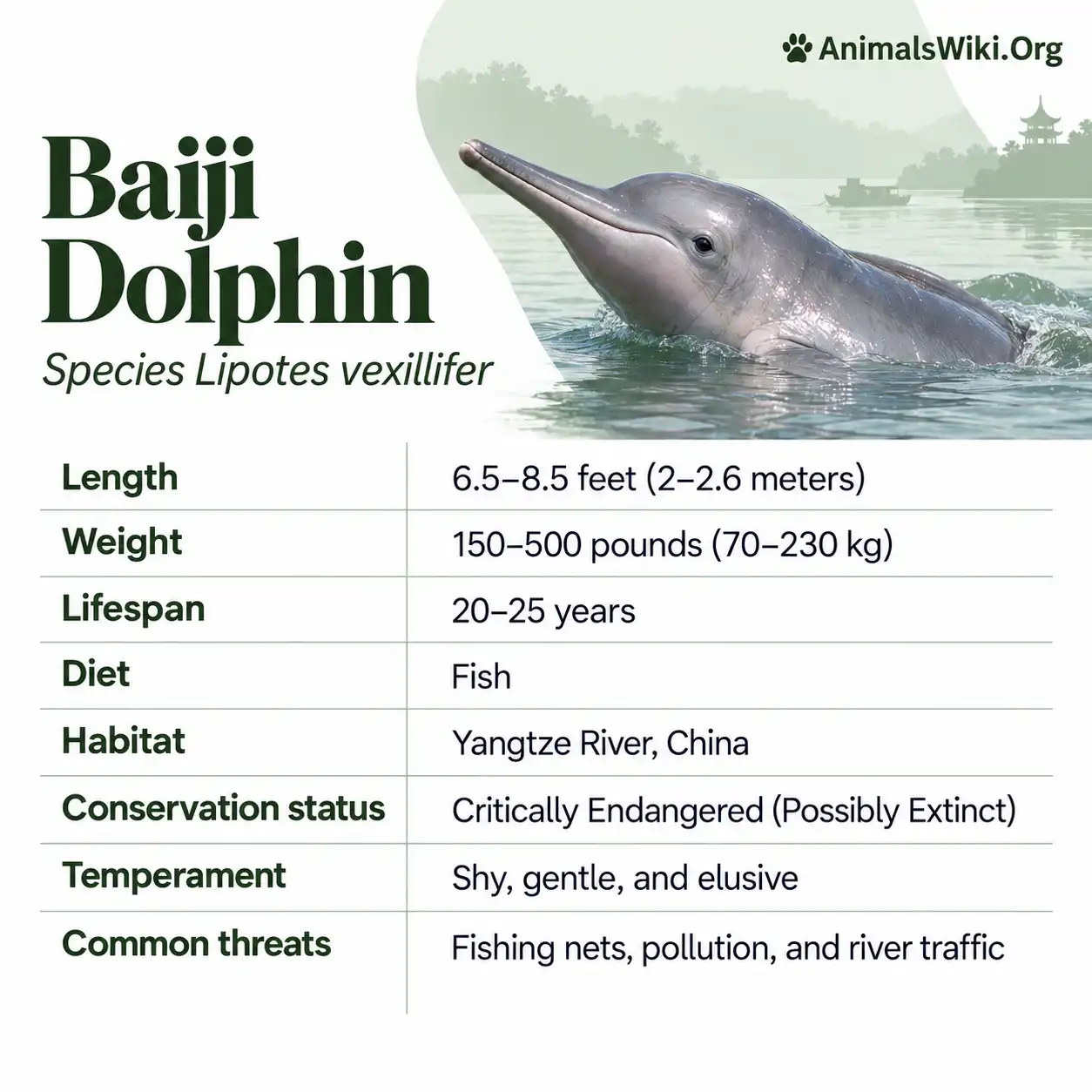
Baiji Dolphin, The Lost River Dolphin of China’s Yangtze River
The Baiji Dolphin, commonly called the Baiji, Yangtze River Dolphin, or Chinese River Dolphin, was one of the world’s most distinctive freshwater mammals.
Its scientific name is:
Lipotes vexillifer
and its historic home was the:
Yangtze River system of China.
Unlike the familiar dolphins of the open ocean, the baiji evolved for life in a vast, muddy freshwater river.
It possessed:
- A long, narrow beak
- Small eyes
- Broad flippers
- A streamlined body
- Pale gray-blue coloration
- Powerful echolocation
- A relatively low triangular dorsal fin
The baiji depended heavily on sound to understand its surroundings.
This was an important adaptation because the Yangtze’s naturally turbid water could make vision far less useful than it is in clear marine environments.
Through echolocation, a baiji could send sounds into the water and interpret returning echoes to detect:
- Fish
- Riverbanks
- Sediment
- Underwater obstacles
- Other objects
For millions of years, this specialized dolphin survived within China’s great river ecosystem.
Then the Yangtze changed dramatically.
Fishing intensified.
Boat traffic increased.
Industrial development expanded.
Pollution grew.
River engineering transformed habitats.
Dams and other structures altered ecological processes.
And fishing equipment capable of accidentally killing dolphins became increasingly common.
Baiji numbers collapsed during the 20th century.
Around 400 individuals were thought to remain in 1980, but surveys in the late 1990s found only a tiny fraction of that number. The last verified records came in the early 2000s, and an intensive six-week visual and acoustic survey of the historical main-river range in 2006 failed to detect a single baiji.
Scientists subsequently concluded that the species was likely:
functionally extinct.
That term is important.
The baiji is frequently described simply as “extinct,” but the scientific and legal situation is more nuanced.
No confirmed living baiji has been documented for more than two decades, and specialists consider survival increasingly unlikely.
However, because proving the absolute absence of every individual in a huge river system is extraordinarily difficult, some official conservation frameworks have continued to retain the species as Critically Endangered or Endangered rather than formally declaring it extinct.
The baiji therefore represents one of the most sobering examples of a modern large-animal disappearance.
Its story is not merely about one dolphin.
It demonstrates how rapidly industrialization, unsustainable fishing, habitat modification, pollution, and heavy river traffic can overwhelm a species uniquely adapted to a single river system.
This comprehensive guide explores Baiji Dolphin facts, scientific classification, appearance, size, weight, Yangtze River habitat, freshwater adaptations, diet, hunting, echolocation, behavior, reproduction, calves, lifespan, threats, population decline, conservation, functional extinction, the 2006 Yangtze survey, and whether any Baiji Dolphins could still survive today.
Baiji Dolphin Facts
| Feature | Information |
|---|---|
| Common Name | Baiji |
| Other Names | Yangtze River Dolphin, Chinese River Dolphin |
| Scientific Name | Lipotes vexillifer |
| Animal Type | Mammal |
| Order | Cetacea |
| Family | Lipotidae |
| Genus | Lipotes |
| Habitat | Freshwater rivers and connected lakes |
| Native Country | China |
| Main Historic Range | Yangtze River system |
| Diet | Carnivorous |
| Main Food | Fish |
| Adult Length | Roughly 1.4–2.5 m |
| Weight | Roughly 42–167 kg |
| Female vs. Male | Females generally larger |
| Main Sensory Adaptation | Echolocation |
| Eyes | Small |
| Reproduction | Live birth |
| Young | Calf |
| Known Longevity | At least about 24 years |
| Major Threats | Fishing mortality and severe river degradation |
| Famous Survey | 2006 Yangtze expedition |
| Current Situation | Likely/functionally extinct |
| Last Verified Records | Early 2000s |
What Was the Baiji Dolphin?
The baiji was a freshwater cetacean belonging to the species:
Lipotes vexillifer.
It evolved specifically for life in the Yangtze River system.
The baiji was not merely an ocean dolphin that occasionally entered freshwater.
It was an:
obligate river dolphin.
Its ecology was deeply connected to freshwater river habitats.
What Does Baiji Mean?
The name baiji comes from Chinese and is commonly associated with the animal’s pale coloration.
It is sometimes translated or interpreted as:
white fin
or white-flag dolphin in English descriptions.
Other Names for the Baiji
The species has been called:
- Baiji
- Yangtze River Dolphin
- Chinese River Dolphin
- White-flag Dolphin
Its scientific name remains:
Lipotes vexillifer.
Is the Baiji a Dolphin?
Yes.
The baiji was a toothed cetacean traditionally grouped among the world’s river dolphins.
However, river dolphins are not simply one closely related group of identical animals.
Different river-dolphin lineages evolved separately.
Was the Baiji a Whale?
In the broad scientific sense:
yes.
Dolphins belong to the toothed-whale lineage of Cetacea.
Therefore, the baiji was simultaneously:
- A mammal
- A cetacean
- A toothed whale
- A river dolphin
Was the Baiji a Fish?
No.
Like every dolphin, the baiji was a:
mammal.
It:
- Breathed air
- Had lungs
- Was warm-blooded
- Gave birth to live young
- Produced milk
- Nursed its calves
Scientific Classification of the Baiji
| Classification | Name |
|---|---|
| Kingdom | Animalia |
| Phylum | Chordata |
| Class | Mammalia |
| Order | Cetacea |
| Parvorder | Odontoceti |
| Family | Lipotidae |
| Genus | Lipotes |
| Species | Lipotes vexillifer |
The disappearance of the baiji is especially significant because it represented a highly distinctive evolutionary lineage.
What Did the Baiji Look Like?
The baiji had the general streamlined shape of a dolphin but several distinctive river adaptations.
It possessed:
- Long narrow beak
- Rounded forehead
- Small eyes
- Broad rounded flippers
- Low dorsal fin
- Gray-blue upper body
- Pale underside
- Powerful tail flukes
Its appearance reflected an animal adapted to maneuvering and hunting in a large freshwater river.
What Color Was the Baiji?
The upper body was generally:
pale blue-gray to gray
while the underside was lighter or whitish.
The pale coloration contributed to some of its traditional names.
Baiji Beak
One of its most distinctive features was its:
long, narrow, slightly upturned beak.
This structure helped the dolphin capture fish and investigate feeding areas.
Baiji Eyes
Baiji had relatively:
small eyes.
This makes ecological sense.
The Yangtze often contains suspended sediment that reduces underwater visibility.
In such an environment, highly sophisticated vision provides less advantage than:
echolocation.
Was the Baiji Blind?
No.
Its eyes were small but functional.
However, sight was less important than sound for navigating and hunting in turbid river water.
Baiji Teeth
The baiji possessed numerous teeth along its long jaws.
These teeth helped:
grasp slippery fish.
Dolphins generally do not chew food in the way humans do.
Their teeth primarily capture and hold prey.
Baiji Dorsal Fin
The dorsal fin was relatively low and triangular.
It helped stabilize the animal while swimming.
How Big Was a Baiji?
Adult size varied significantly between sexes.
Females could reach approximately:
1.85–2.53 meters
while males were generally smaller at roughly:
1.41–2.16 meters.
How Much Did a Baiji Weigh?
Recorded estimates place adult body mass broadly around:
42–167 kilograms.
Females could be considerably heavier than males.
Male vs. Female Baiji
Female baiji were generally:
- Longer
- Heavier
- Larger-bodied
than males.
This is an example of:
sexual dimorphism.
Where Did Baiji Dolphins Live?
The baiji was endemic to:
China.
Its primary habitat was the:
Yangtze River drainage.
Historically, its range also included connected freshwater systems such as:
- Dongting Lake
- Poyang Lake
- Associated river channels
Historical accounts also report the species from the neighboring Qiantang River system.
What Does Endemic Mean?
An endemic species naturally occurs only within a particular geographic region.
The baiji was therefore one of China’s unique native mammals.
Yangtze River Habitat
The Yangtze is one of the world’s great river systems.
It contains:
- Main channels
- Tributaries
- Sandbars
- Eddies
- Floodplain lakes
- Shallow feeding areas
- Deep channels
Baiji were frequently associated with productive areas where currents created favorable conditions for fish.
Did Baiji Live in the Ocean?
No.
The baiji was specialized for:
freshwater river life.
It was not an oceanic dolphin.
Did Baiji Live in Saltwater?
Its characteristic habitat was freshwater.
What Did Baiji Dolphins Eat?
The baiji was primarily:
piscivorous.
That means it ate:
fish.
Fish formed most, if not virtually all, of its known diet.
Was the Baiji a Carnivore?
Yes.
It was a carnivorous predator.
How Did Baiji Dolphins Hunt?
Baiji used a combination of:
- Echolocation
- Long jaws
- Teeth
- Maneuverability
- Knowledge of river currents
to locate and capture fish.
They often searched for prey around:
- Sandbanks
- Tributary mouths
- Eddies
- Shallow feeding zones
Did Baiji Use Echolocation?
Yes.
Echolocation was one of the species’ most important adaptations.
How Did Baiji Echolocation Work?
The dolphin produced high-frequency sounds.
These sounds traveled through water.
When they encountered:
- Fish
- Sediment
- Riverbanks
- Boats
- Underwater structures
some sound energy returned as echoes.
The dolphin’s auditory system could interpret those echoes to build an acoustic picture of its surroundings.
Why Was Echolocation So Important?
The Yangtze can be:
extremely turbid.
Suspended sediment makes underwater vision difficult.
Echolocation allowed the baiji to effectively:
“see with sound.”
Could Baiji Dolphins Communicate?
Yes.
Like other toothed cetaceans, baiji produced acoustic signals.
Their sound repertoire included echolocation clicks and other vocal signals.
However, much of their natural communication remains poorly understood because the species disappeared before modern researchers could study large healthy populations.
Baiji Behavior
Information about natural behavior is limited.
By the time intensive scientific research began, the species was already rare.
Observed baiji were often found:
- Alone
- In pairs
- In small groups
Temporary aggregations of several individuals could occur.
Were Baiji Social?
Yes, but they did not appear to form enormous stable pods like some oceanic dolphin species.
Historical observations reported pairs and small aggregations.
Were Baiji Aggressive?
There is no evidence that baiji posed a meaningful danger to humans.
They were fish-eating river mammals rather than human predators.
How Fast Could Baiji Swim?
Reliable maximum-speed measurements are lacking.
The species was adapted more for navigating a complex river environment than for the sustained high-speed open-ocean swimming of some marine dolphins.
How Did Baiji Breathe?
Like every dolphin, the baiji possessed:
lungs.
It breathed through a:
blowhole
on top of its head.
The dolphin therefore had to surface periodically.
Could Baiji Breathe Underwater?
No.
It could hold its breath while diving but could not extract oxygen directly from water.
Baiji Reproduction
Baiji reproduced sexually and gave birth to:
live calves.
Unfortunately, their reproductive biology was never studied as thoroughly as that of many common dolphins.
How Many Babies Did a Baiji Have?
Females were believed to normally produce:
one calf at a time.
What Was a Baby Baiji Called?
A baby baiji was called a:
calf.
How Big Was a Newborn Baiji?
Newborn calves were estimated to measure approximately:
80 centimeters long.
How Long Was Baiji Pregnancy?
Historical estimates commonly placed gestation somewhere around:
6–12 months.
Because the species was poorly studied, this should not be treated with the same certainty as gestation periods measured extensively in common captive or wild cetaceans.
How Often Did Baiji Reproduce?
Females were thought to reproduce relatively slowly, perhaps producing a calf around:
every two years.
Slow reproduction made it difficult for the population to recover from human-caused mortality.
Did Baiji Mothers Produce Milk?
Yes.
Baiji were mammals.
Mothers nursed their calves with milk.
Did Male Baiji Raise Calves?
Detailed parental behavior is poorly documented.
As in other cetaceans, maternal investment was certainly substantial.
Baiji Lifespan
Precise maximum longevity remains uncertain.
One wild-caught individual was estimated to have reached approximately:
24 years.
Therefore, baiji were capable of living for at least roughly two decades.
Qi Qi — The Famous Baiji
The most famous individual baiji was:
Qi Qi.
He became an extraordinarily important animal for scientific research and public awareness.
Qi Qi lived for many years at the Institute of Hydrobiology in Wuhan.
Because wild baiji were already exceptionally difficult to observe, studying Qi Qi provided scientists with valuable information about:
- Anatomy
- Behavior
- Physiology
- Echolocation
- Husbandry
His death in 2002 marked the end of an extraordinary chapter in baiji research.
Baiji Adaptations
Echolocation
Allowed hunting and navigation in murky water.
Small Eyes
Vision played a reduced role in a turbid environment.
Long Beak
Helped capture fish.
Numerous Teeth
Gripped slippery prey.
Streamlined Body
Reduced resistance while swimming.
Broad Flippers
Helped maneuver through river currents.
Blowhole
Allowed rapid breathing at the surface.
Flexible River Behavior
Enabled the animal to use currents, eddies, sandbanks and tributary mouths.
What Predators Did the Baiji Have?
Natural predation was not considered a major threat.
Humans ultimately became the dominant source of mortality through:
- Fishing
- River development
- Vessel activity
- Habitat degradation
Was the Baiji Dangerous to Humans?
No.
There is no evidence that baiji were dangerous human predators.
Baiji vs. Yangtze Finless Porpoise
These two animals are often confused.
They are completely different species.
| Feature | Baiji | Yangtze Finless Porpoise |
|---|---|---|
| Scientific Name | Lipotes vexillifer | Neophocaena asiaeorientalis asiaeorientalis |
| Group | River dolphin | Porpoise |
| Beak | Long | No prominent beak |
| Dorsal Fin | Present | No true dorsal fin |
| Historic Habitat | Yangtze system | Yangtze system |
| Current Situation | Likely/functionally extinct | Survives but threatened |
This distinction is particularly important when evaluating supposed modern baiji sightings.
A distant finless porpoise can potentially be misidentified.
Baiji vs. Bottlenose Dolphin
| Feature | Baiji | Bottlenose Dolphin |
|---|---|---|
| Main Habitat | Freshwater river | Mostly marine/coastal |
| Eyes | Small | Better developed |
| Beak | Long and narrow | Shorter, robust |
| Range | China | Broad global distribution |
| Current Situation | Likely/functionally extinct | Many surviving populations |
Baiji vs. Amazon River Dolphin
Both are commonly called river dolphins, but they represent separate evolutionary lineages.
The Amazon river dolphin:
- Lives in South America
- Often becomes pinkish
- Still survives
The baiji:
- Lived in China
- Was pale gray-blue
- Is likely/functionally extinct
Baiji vs. Ganges River Dolphin
The Ganges river dolphin survives in South Asia.
It belongs to:
Platanista
while the baiji belonged to:
Lipotes.
Their similar river lifestyles reflect adaptation to broadly similar ecological challenges rather than being the same species.
Why Did the Baiji Decline?
There was no single cause.
Instead, multiple human pressures accumulated.
Major threats included:
- Accidental fishing mortality
- Dangerous fishing practices
- Boat traffic
- Propeller strikes
- Pollution
- Habitat degradation
- River engineering
- Dams
- Reduced or altered prey resources
- Underwater noise
Among these, unsustainable mortality from fisheries is considered one of the most important direct drivers.
Fishing and the Baiji
Fishing pressure became particularly dangerous because baiji could become:
- Entangled
- Hooked
- Injured
- Drowned
Certain fishing methods were especially destructive.
Rolling-Hook Fishing
One particularly dangerous fishing technique involved:
rolling hooks
or unbaited hook lines.
These hooks could accidentally snag passing dolphins.
For a population already reduced to very small numbers, even occasional deaths could be catastrophic.
Gillnets
Fishing nets also posed a risk.
An air-breathing dolphin caught underwater may be unable to surface.
It can therefore:
drown.
Electrofishing
Illegal electrical fishing methods also damaged the Yangtze ecosystem.
Electricity used to stun fish could injure or kill non-target aquatic animals.
Boat Traffic
The Yangtze became one of the world’s busiest commercial waterways.
Heavy vessel traffic created risks including:
- Propeller strikes
- Noise
- Habitat disturbance
- Interference with acoustic perception
For an animal that depended heavily on sound, increasing underwater noise was particularly concerning.
Pollution
Industrialization and urbanization introduced large quantities of pollutants into the Yangtze.
Pollution could affect baiji both directly and indirectly by altering:
- Water quality
- Fish populations
- Food webs
- Reproductive health
- Habitat condition
Dams and River Engineering
Large-scale engineering altered:
- Water flow
- Sediment movement
- Fish migration
- Floodplain connections
- Habitat availability
The baiji had evolved within a naturally dynamic river.
Rapid human modification changed that system profoundly.
Was the Three Gorges Dam Responsible for Baiji Extinction?
It would be misleading to blame the disappearance on one dam alone.
The population was already declining because of multiple pressures.
The broader problem involved:
cumulative transformation of the Yangtze ecosystem combined with direct human-caused mortality.
How Many Baiji Were There?
Historical abundance is uncertain.
By the late 20th century, however, the decline became unmistakable.
Approximately:
400
were thought to survive around 1980.
By 1997–1999, surveys counted only:
13 individuals.
The collapse occurred extraordinarily rapidly.
When Was the Last Baiji Seen?
The last verified records date from the early 2000s.
Specialist records include:
- A pregnant female stranded in 2001
- A confirmed photographed individual in 2002
No scientifically verified living population has subsequently been rediscovered.
What Happened in 2006?
In 2006, scientists launched an intensive survey of the Yangtze.
Researchers used:
- Multiple vessels
- Visual observers
- Acoustic equipment
and searched the historical main-river range for approximately:
six weeks.
They found:
no evidence of surviving baiji.
This result fundamentally changed how scientists viewed the species’ status.
Is the Baiji Extinct?
The most accurate answer is:
The baiji is likely or functionally extinct, but its absolute extinction has not been universally formalized.
The 2006 survey found no evidence of surviving animals.
Subsequent unverified sightings have not provided convincing scientific proof of survival.
What Does Functionally Extinct Mean?
A species can be considered functionally extinct when so few individuals remain that they can no longer maintain a viable reproducing population or perform their former ecological role.
For the baiji, the term has also been used because:
no viable population could be detected.
Is the Baiji Officially Extinct?
Not in every major conservation or legal framework.
The distinction matters.
The IUCN cetacean specialist community treats the species as potentially/functionally extinct, while official listings such as the U.S. Endangered Species Act have continued to retain it as endangered.
Why Not Declare the Baiji Extinct Immediately?
Proving extinction is difficult.
To formally conclude that a species has disappeared, scientists need very strong evidence that:
no individuals remain anywhere within the possible range.
Large rivers are difficult to survey perfectly.
Have Baiji Been Reported Since 2006?
Yes.
There have been occasional claimed sightings.
However:
none has produced definitive scientific confirmation of a surviving population.
Possible explanations include:
- Misidentification
- Yangtze finless porpoises
- Poor-quality observations
- Genuine but unverified sightings
Could a Few Baiji Still Exist?
Scientifically, absolute survival cannot be ruled out with mathematical certainty.
However, after such a long period without confirmed evidence, the possibility of a viable hidden population has become extremely remote.
If One Baiji Were Found, Would the Species Be Saved?
No.
One surviving animal would be scientifically extraordinary, but a species requires enough reproductively compatible individuals to sustain a population.
Finding a single old survivor would not automatically reverse functional extinction.
Why Was the 2006 Survey So Important?
Previous searches had been more limited.
The 2006 expedition systematically covered the baiji’s historical main-river range using both:
eyes and underwater listening equipment.
The failure to detect even one animal provided powerful evidence that the population had collapsed.
Was the Baiji the First Dolphin Driven Extinct by Humans?
The baiji is widely discussed as the first cetacean species whose modern disappearance was driven predominantly by human activity.
Its loss is especially significant because it also represented an entire distinctive mammalian lineage.
Baiji Conservation Attempts
China introduced various protections, including:
- Legal protection
- Fishing restrictions
- Nature reserves
- Conservation planning
- Research programs
Scientists also proposed moving surviving baiji into:
semi-natural protected reserves.
Tian’e-Zhou Oxbow Reserve
One major proposal involved establishing a protected semi-natural population in an oxbow lake connected historically to the Yangtze system.
The concept was to:
- Capture surviving baiji.
- Transfer them to safer habitat.
- Establish a breeding population.
- Protect them from dangerous fishing activity.
- Eventually rebuild the population.
Unfortunately, the strategy was never implemented successfully before the species apparently disappeared.
Why Did Conservation Fail?
Conservation action faced several problems:
- The population was already extremely small.
- Animals were difficult to locate.
- Capturing river dolphins is challenging.
- Funding and logistics were insufficient.
- Debate continued over conservation strategies.
- Threats throughout the Yangtze kept increasing.
- Effective action came too slowly.
By the time intensive rescue efforts gained momentum:
there may no longer have been enough baiji left to save.
Lessons From the Baiji
The baiji provides one of conservation biology’s clearest warnings:
Do not wait until a species reaches its final few individuals before taking decisive action.
Small populations become increasingly vulnerable to:
- Accidental deaths
- Reproductive failure
- Genetic problems
- Demographic randomness
- Environmental disasters
Conservation is usually easier before a population collapses.
The Yangtze Finless Porpoise Lesson
The baiji’s disappearance increased attention on another Yangtze cetacean:
the Yangtze finless porpoise.
Unlike the baiji, the finless porpoise still survives.
Protecting it provides an opportunity to avoid repeating the same conservation failure.
Ecological Importance of the Baiji
The baiji was a fish-eating predator within the Yangtze food web.
It formed part of a complex freshwater ecosystem containing:
- Fish
- Invertebrates
- Birds
- Reptiles
- Porpoises
- Aquatic vegetation
Its disappearance represents the removal of a top-level aquatic predator.
Cultural Importance
The baiji was deeply associated with the Yangtze and Chinese cultural heritage.
It was sometimes called:
the Goddess of the Yangtze
and became a national symbol of freshwater conservation.
Its disappearance therefore represents both:
biological and cultural loss.
50 Interesting Baiji Dolphin Facts
- The baiji was a freshwater dolphin.
- Its scientific name is Lipotes vexillifer.
- It was native to China.
- Its main home was the Yangtze River.
- It was also called the Yangtze River Dolphin.
- Another name is Chinese River Dolphin.
- It was a mammal.
- It breathed air.
- It gave birth to live young.
- A baby baiji was called a calf.
- Baiji mothers produced milk.
- The species had a long narrow beak.
- Its eyes were small.
- The eyes were functional.
- Baiji were not completely blind.
- Echolocation was extremely important.
- Echolocation helped them navigate muddy water.
- It also helped locate fish.
- Baiji were carnivores.
- Fish formed their primary diet.
- Females were larger than males.
- Large females could exceed 2.5 meters.
- Body mass could exceed 150 kg in large individuals.
- Baiji possessed numerous teeth.
- Their upper body was pale gray-blue.
- Their underside was lighter.
- They possessed a blowhole.
- They could not breathe underwater.
- They were often observed alone or in small groups.
- Their natural behavior remains incompletely understood.
- One baiji was known to have reached about 24 years.
- Qi Qi became the world’s most famous captive baiji.
- Qi Qi lived for many years in Wuhan.
- He died in 2002.
- Roughly 400 baiji were thought to remain around 1980.
- Only 13 were counted during surveys in the late 1990s.
- Fishing mortality contributed heavily to their decline.
- Rolling hooks were particularly dangerous.
- Nets could drown baiji.
- Boat traffic increased dramatically on the Yangtze.
- Propeller strikes posed another threat.
- Pollution degraded their habitat.
- River engineering altered the ecosystem.
- A verified baiji was photographed in 2002.
- Scientists conducted a major search in 2006.
- The six-week survey found no baiji.
- Later claimed sightings remain unconfirmed.
- The species is generally regarded as likely or functionally extinct.
- Its disappearance became a global conservation warning.
- Protecting the surviving Yangtze finless porpoise may help prevent history from repeating itself.
Did You Know?
Scientists searched one of the world’s largest rivers for six weeks—and failed to find a single baiji.
By 2006, conservationists knew the situation was desperate.
The baiji had once occupied an enormous stretch of the Yangtze.
Decades earlier, hundreds were thought to survive.
Then the numbers collapsed.
Scientists therefore organized an intensive expedition.
Multiple research vessels traveled through the species’ historical main-river range.
Observers watched the water.
At the same time, specialized acoustic equipment listened beneath the surface.
This was crucial because a river dolphin might be difficult to see.
A baiji could surface briefly.
Turbid water could hide it.
Distance could make visual identification difficult.
But dolphins use sound.
If baiji were still moving through the river, researchers hoped to:
see them or hear them.
The expedition continued for approximately six weeks.
Kilometer after kilometer passed.
Researchers encountered the enormous human transformation of the Yangtze:
- Ships
- Fishing activity
- Cities
- Industrial development
- Engine noise
But one sound was missing.
The baiji.
No convincing visual detection.
No acoustic confirmation.
No population.
The result was devastating.
Scientists concluded that the species was likely functionally extinct.
What makes the story especially painful is that the baiji was not eliminated because humans deliberately decided to exterminate it.
Instead, its decline resulted largely from accumulated pressures:
one net, one hook, one boat strike, one altered habitat, one polluted stretch of river at a time.
A species that had survived evolutionary changes for millions of years disappeared within a period of extraordinarily rapid human transformation.
That is why the baiji remains so important.
Its greatest legacy may be the warning it left behind:
a species does not need to be intentionally hunted to extinction for human activity to erase it.
Frequently Asked Questions About Baiji Dolphins
What is a Baiji Dolphin?
The baiji was a freshwater dolphin native to China’s Yangtze River system.
What is the scientific name of the Baiji Dolphin?
Lipotes vexillifer.
What is another name for the Baiji?
Yangtze River Dolphin.
Is the Baiji also called the Chinese River Dolphin?
Yes.
Was the Baiji a dolphin?
Yes.
Was the Baiji a porpoise?
No.
Was the Baiji a whale?
It belonged to the toothed-whale lineage within Cetacea.
Was the Baiji a mammal?
Yes.
Was the Baiji a fish?
No.
Where did the Baiji live?
Primarily in China’s Yangtze River system.
What country was the Baiji from?
China.
Did Baiji live in freshwater?
Yes.
Did Baiji live in the ocean?
No. They were specialized freshwater dolphins.
Did Baiji live in the Yangtze River?
Yes.
Did Baiji live in lakes?
They historically used connected lake systems including Dongting and Poyang.
What did a Baiji look like?
It had a pale gray-blue streamlined body, long narrow beak, small eyes, broad flippers and a relatively low dorsal fin.
Why did the Baiji have a long nose?
Its elongated beak helped it capture fish in the river environment.
Did Baiji have teeth?
Yes.
Did Baiji have eyes?
Yes.
Was the Baiji blind?
No. Its eyes were small but functional.
Why were Baiji eyes so small?
Vision was less useful in the Yangtze’s turbid water, while echolocation was highly effective.
Did Baiji use echolocation?
Yes.
How did Baiji find fish?
Primarily using sophisticated echolocation combined with their jaws and teeth.
What did Baiji eat?
Mostly fish.
Were Baiji carnivores?
Yes.
Did Baiji eat plants?
Fish formed the known primary diet rather than vegetation.
How big was a Baiji?
Adults ranged roughly from about 1.4 to 2.5 meters depending on sex and individual.
How much did a Baiji weigh?
Approximately 42–167 kg across recorded adult ranges.
Were female Baiji larger?
Yes.
How fast could a Baiji swim?
A reliable maximum speed is not well established.
Did Baiji live in groups?
They were observed alone, in pairs and in small groups.
Did Baiji breathe air?
Yes.
Could Baiji breathe underwater?
No.
How did Baiji breathe?
Through a blowhole.
Did Baiji lay eggs?
No.
Did Baiji give birth?
Yes.
What was a baby Baiji called?
A calf.
How many calves did a Baiji have?
Usually one at a time.
Did Baiji mothers feed their babies milk?
Yes.
How long was Baiji pregnancy?
Historical estimates suggest approximately 6–12 months, although the reproductive biology was poorly known.
How long did Baiji live?
At least one individual was estimated to have reached about 24 years.
Who was Qi Qi?
Qi Qi was a male baiji maintained for many years at the Institute of Hydrobiology in Wuhan and became the best-known individual of the species.
When did Qi Qi die?
Was Qi Qi the last Baiji?
He was the last famous captive baiji, but a wild individual was also photographed in 2002. It cannot be demonstrated that Qi Qi was literally the final living member of the species.
Are Baiji Dolphins extinct?
They are generally considered likely or functionally extinct, but absolute extinction has not been formally accepted in every official conservation framework.
What does functionally extinct mean?
It means a species no longer appears to possess a viable population capable of sustaining itself over time.
When did the Baiji go extinct?
There is no scientifically established exact extinction date.
When was the last confirmed Baiji?
Verified records come from the early 2000s, including 2001 and 2002.
Was a Baiji seen in 2007?
There have been claimed sightings after the 2006 survey, but these have not established a scientifically confirmed surviving population.
Have Baiji been seen recently?
No recent report has provided widely accepted scientific confirmation that the species survives.
Could Baiji still be alive?
A hidden survivor cannot be ruled out with absolute certainty, but the continued absence of confirmed evidence makes survival of a viable population extremely unlikely.
How many Baiji are left?
No surviving individuals are scientifically confirmed.
Are there zero Baiji?
Zero is not directly provable across every part of a large river system, which is why scientists use careful terms such as likely or functionally extinct.
What happened in the 2006 Baiji survey?
Researchers searched the historical main-river range visually and acoustically for approximately six weeks but found no evidence of surviving baiji.
Why did the Baiji go extinct?
The collapse resulted from multiple human pressures, especially fisheries mortality combined with habitat degradation, river development, pollution and vessel activity.
Were Baiji hunted?
Direct killing occurred historically, but accidental fisheries mortality became an especially important threat.
What fishing method killed Baiji?
Dangerous methods included rolling-hook lines and nets, among other fisheries interactions.
Could Baiji drown in nets?
Yes.
Did boats kill Baiji?
Vessel strikes and propeller injuries were among the threats.
Did pollution kill Baiji?
Pollution contributed to the broader degradation of their ecosystem.
Did the Three Gorges Dam make the Baiji extinct?
No single factor should be presented as the sole cause. The disappearance resulted from cumulative pressures across the Yangtze.
Were dams harmful to Baiji?
River engineering and dams could alter habitat, hydrology and prey ecology.
Why couldn’t conservationists save the Baiji?
Effective intensive conservation was implemented too late, when very few animals remained, while threats across the Yangtze continued.
Were there Baiji reserves?
Yes. China established protected areas and explored semi-natural conservation strategies.
Could Baiji be cloned?
No existing technology can restore a healthy baiji population simply by cloning it, and cloning would also face major genetic, reproductive and biological obstacles.
Is Baiji DNA preserved?
Biological samples from studied and preserved animals exist, but preserved DNA is not equivalent to a viable population.
Could scientists bring the Baiji back?
There is currently no practical method capable of recreating and restoring a genetically healthy, self-sustaining baiji population.
Is the Baiji the same as the Yangtze Finless Porpoise?
No.
Are Yangtze Finless Porpoises extinct?
No. They still survive and are the focus of intensive conservation.
How can you tell a Baiji from a Finless Porpoise?
The baiji had a long beak and dorsal fin, whereas the Yangtze finless porpoise lacks a prominent beak and true dorsal fin.
Is the Amazon River Dolphin a Baiji?
No.
Is the Ganges River Dolphin a Baiji?
No.
Are there other river dolphins?
Yes. River-dolphin lineages survive in South America and South Asia.
Why was the Baiji important?
It represented a unique evolutionary lineage and served as a major predator within the Yangtze freshwater ecosystem.
What can we learn from the Baiji?
Its disappearance demonstrates the danger of delaying conservation until a population has already fallen to extremely low numbers.
Could another river dolphin suffer the same fate?
Yes. River cetaceans are especially vulnerable to fishing, dams, pollution, vessel traffic and habitat modification.
Why is the Yangtze Finless Porpoise important now?
It represents a surviving Yangtze cetacean that can still be protected from the fate suffered by the baiji.
What is the most important Baiji fact?
The baiji survived in the Yangtze for an immense evolutionary period but disappeared within decades of intense human pressure, making it one of the clearest modern warnings about freshwater biodiversity loss.
Conclusion
The Baiji Dolphin was built for one extraordinary environment:
China’s Yangtze River.
Its small eyes did not matter much in muddy water.
It had something better.
Sound.
A baiji could send acoustic pulses into the darkness and listen as the river answered.
A fish returned one echo.
A riverbank another.
An underwater obstruction another.
Through sound, the dolphin could navigate a world that human eyes could barely penetrate.
Its long jaws captured fish.
Its streamlined body moved through powerful currents.
Its broad flippers helped it maneuver.
For countless generations, these adaptations worked.
Then the river changed faster than the dolphin could.
Fishing intensified.
Hooks multiplied.
Nets spread through the water.
Ships traveled the river.
Propellers turned.
Industrial pollution increased.
Habitats were modified.
Dams and engineering projects transformed river processes.
Underwater noise grew.
Fish communities changed.
And the number of baiji began falling.
Hundreds became dozens.
Dozens became a handful.
Then scientists searched the river.
For six weeks in 2006, research vessels traveled through the baiji’s historical main range.
People watched.
Equipment listened.
Again and again, the river was searched.
But the dolphin that had evolved to navigate through sound could no longer be heard.
No confirmed population was found.
That is why the baiji’s story should not end simply with:
“Extinct.”
Its deeper lesson is about timing.
Conservation becomes extraordinarily difficult when a species has already fallen to its final few individuals.
A reserve cannot help an animal that can no longer be located.
A breeding program cannot begin if there are no breeding animals available.
A fishing ban introduced after the last viable population disappears cannot reverse the loss.
The baiji therefore became one of the world’s most powerful conservation warnings.
But another cetacean still swims in the Yangtze:
the Yangtze finless porpoise.
Its survival means the baiji’s story can still influence a different ending.
Humans cannot confidently restore the evolutionary lineage represented by Lipotes vexillifer.
But humans can protect other species before they reach the same point.
The greatest legacy of the Baiji Dolphin may therefore be a simple conservation principle:
Do not wait until the river becomes silent before deciding that its wildlife was worth saving.



