Spix’s Macaw, The Rare Blue Parrot Returning to Brazil’s Wild
The Spix’s Macaw is one of the rarest and most famous parrots in the world.
Its scientific name is:
Cyanopsitta spixii
and its natural home is the dry northeastern region of:
Brazil.
With its elegant blue plumage, long tail, curved dark bill, and extraordinary conservation history, the Spix’s Macaw has become an international symbol of both:
extinction and hope.
For years, the species was widely known as a bird that had disappeared from nature.
The last known wild individual vanished around the beginning of the 21st century, leaving Spix’s Macaws surviving only under human care.
But that was not the end of the species.
Conservationists maintained and expanded a captive population.
Birds were carefully bred.
Genetic relationships were studied.
Suitable habitat was protected and restored.
And eventually, captive-bred Spix’s Macaws were returned to their native Brazilian landscape.
This makes the species’ modern story unusually complex.
It has been classified as:
Extinct in the Wild
because its original wild population disappeared.
However, captive-bred birds have subsequently been released into the wild in Brazil as part of a reintroduction program.
Therefore, saying simply that “Spix’s Macaw is extinct” is inaccurate.
The species still exists.
And some individuals have again flown over the landscape where their ancestors evolved.
The Spix’s Macaw is also frequently called the:
Little Blue Macaw.
It should not be confused with the much larger:
Hyacinth Macaw.
Both are blue parrots from Brazil, but they are different species with very different appearances, ecological requirements, and conservation histories.
Spix’s Macaws historically inhabited a specialized environment associated with the:
Caatinga
of northeastern Brazil.
Rather than living in lush Amazon rainforest, they were associated with dry woodland and riverine vegetation.
One particularly important tree was the:
Caraibeira
(Tabebuia aurea).
These trees provided important:
- Nesting cavities
- Shelter
- Habitat structure
The bird’s dependence on a limited habitat contributed to its vulnerability.
Habitat destruction reduced suitable nesting and feeding areas.
Illegal capture for the bird trade placed additional pressure on an already tiny population.
By the time conservationists fully understood how close the species was to extinction, very few wild birds remained.
The last known wild male became internationally famous.
For years, conservationists watched him survive alone in Brazil.
He even associated with a female Blue-winged Macaw.
But eventually:
he disappeared.
The wild population was effectively gone.
Fortunately, Spix’s Macaws still survived in captivity.
Their descendants became the foundation of an ambitious recovery program designed not merely to keep the species alive in aviaries, but to achieve something much harder:
return it to the wild.
This comprehensive guide explores Spix’s Macaw facts, scientific classification, appearance, blue coloration, size, weight, wings, flight, Brazilian range, Caatinga habitat, Caraibeira trees, diet, behavior, calls, reproduction, eggs, chicks, lifespan, adaptations, predators, threats, illegal wildlife trade, extinction in the wild, captive breeding, reintroduction, conservation, and whether Spix’s Macaws live in the wild today.
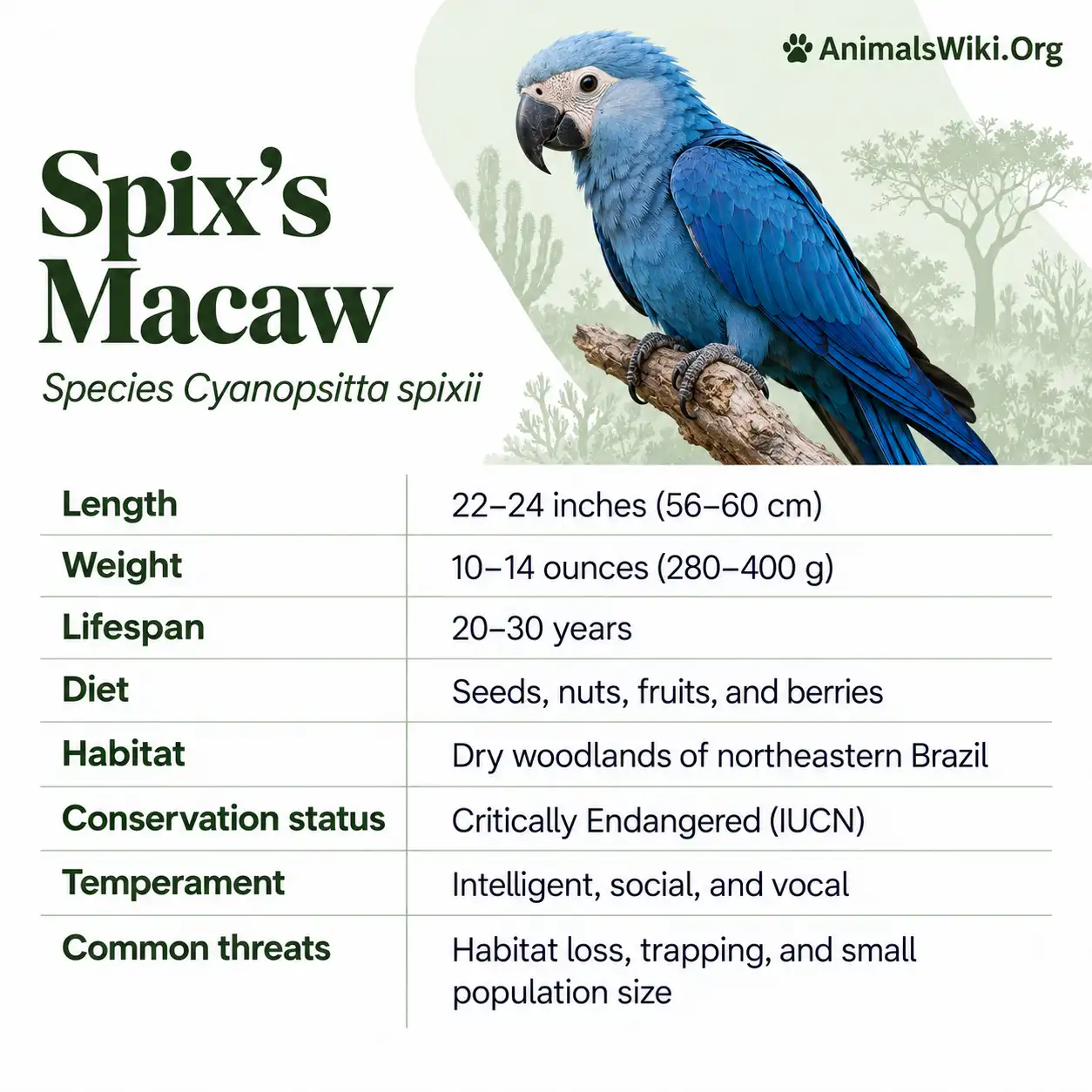
Spix’s Macaw Facts
| Feature | Information |
|---|---|
| Common Name | Spix’s Macaw |
| Other Name | Little Blue Macaw |
| Scientific Name | Cyanopsitta spixii |
| Animal Type | Bird |
| Order | Psittaciformes |
| Family | Psittacidae |
| Native Country | Brazil |
| Native Region | Northeastern Brazil |
| Biome | Caatinga |
| Historic Habitat | Dry riverine woodland |
| Famous Habitat Tree | Caraibeira |
| Body Length | About 55–57 cm |
| Weight | Roughly 300–400 g |
| Color | Various shades of blue |
| Diet | Primarily seeds, fruits and plant material |
| Activity | Diurnal |
| Reproduction | Egg-laying |
| Typical Clutch | Usually a few eggs |
| Young | Chick |
| Major Threats | Habitat loss and illegal capture |
| Historical Situation | Disappeared from the wild |
| Conservation | Intensive captive breeding and reintroduction |
| Famous Distinction | One of the world’s rarest parrots |
What Is a Spix’s Macaw?
The Spix’s Macaw is a medium-sized blue parrot native to northeastern Brazil.
Its scientific name is:
Cyanopsitta spixii.
It belongs to the macaw group of parrots but is smaller than many of the large, spectacular macaws familiar from tropical forests.
Is It Spix’s Macaw or Spixs Macaw?
The grammatically correct English name is:
Spix’s Macaw.
However, people frequently search online for:
Spixs Macaw
without the apostrophe.
Using the correct name throughout an article while naturally including the alternative spelling can help cover both search forms.
Why Is It Called Spix’s Macaw?
The species was named after the German naturalist:
Johann Baptist von Spix.
Spix collected the specimen upon which the species became scientifically known during his travels in Brazil in the early 19th century.
What Is the Scientific Name of Spix’s Macaw?
Cyanopsitta spixii.
The species is the only member of the genus:
Cyanopsitta.
That makes its conservation especially important from an evolutionary perspective.
Is Spix’s Macaw a Parrot?
Yes.
It belongs to the parrot order:
Psittaciformes.
Is Spix’s Macaw a True Macaw?
Yes.
It is generally recognized among the Neotropical macaws, although it is smaller and belongs to its own distinctive genus.
Scientific Classification of Spix’s Macaw
| Classification | Name |
|---|---|
| Kingdom | Animalia |
| Phylum | Chordata |
| Class | Aves |
| Order | Psittaciformes |
| Family | Psittacidae |
| Genus | Cyanopsitta |
| Species | Cyanopsitta spixii |
What Does a Spix’s Macaw Look Like?
The Spix’s Macaw is a slender, elegant blue parrot with:
- Long tail
- Curved bill
- Blue-gray head
- Brighter blue body
- Darker blue wings
- Long flight feathers
- Dark feet
- Pale bare facial skin in adults
Its coloration can vary according to:
- Age
- Lighting
- Feather condition
- Individual differences
What Color Is a Spix’s Macaw?
The species is primarily:
blue.
However, it is not one uniform shade.
Different areas can appear:
- Pale blue-gray
- Medium blue
- Deep blue
- Turquoise-blue
The head tends to appear paler than the wings and tail.
Why Is Spix’s Macaw Blue?
Its blue appearance is produced primarily through microscopic feather structures that interact with light.
In many blue birds, the visible blue is largely:
structural coloration
rather than simply blue pigment deposited in feathers.
Does Spix’s Macaw Have a Long Tail?
Yes.
Like many macaws, it possesses a long tapered tail.
The tail contributes substantially to the bird’s overall length.
Spix’s Macaw Beak
The bill is:
- Strong
- Curved
- Dark-colored
- Adapted for manipulating plant foods
Parrots use their bills almost like an additional limb when:
- Feeding
- Climbing
- Exploring objects
- Manipulating branches
Spix’s Macaw Feet
Like other parrots, Spix’s Macaws possess:
zygodactyl feet.
Two toes point generally forward and two backward.
This arrangement provides excellent gripping ability.
Why Do Parrots Have Two Toes Forward and Two Backward?
Zygodactyl feet help parrots:
- Grip branches
- Climb
- Manipulate food
- Maintain balance
A macaw can often hold food in one foot while using its bill to eat.
How Big Is a Spix’s Macaw?
Adults are approximately:
55–57 centimeters long
from the head to the end of the long tail.
This makes the Spix’s Macaw much smaller than giant macaws such as the Hyacinth Macaw.
How Much Does a Spix’s Macaw Weigh?
Adults generally weigh approximately:
300–400 grams.
Exact weight varies among individuals.
Male vs. Female Spix’s Macaw
Males and females look:
very similar.
There is not dramatic visual sexual dimorphism.
Reliable sex determination may therefore involve:
- DNA testing
- Veterinary examination
- Breeding history
rather than plumage alone.
Can Spix’s Macaws Fly?
Yes.
Unlike the flightless kākāpō, Spix’s Macaw is a capable flying parrot.
Its:
- Long wings
- Strong flight muscles
- Tail
allow efficient movement between trees and feeding areas.
Where Did Spix’s Macaws Live?
The species evolved in:
northeastern Brazil.
Its historical distribution was highly restricted compared with many other parrots.
It was especially associated with riverine woodland within the:
Caatinga biome.
What Is the Caatinga?
The Caatinga is a distinctive seasonally dry biome of northeastern Brazil.
It contains:
- Thorny vegetation
- Dry forests
- Shrublands
- Seasonal waterways
- Drought-adapted plants
This environment is very different from the humid Amazon rainforest.
Did Spix’s Macaws Live in the Amazon Rainforest?
No.
This is a common misconception.
Spix’s Macaw is a Brazilian parrot, but its natural habitat was not the classic Amazon rainforest.
It was associated with the:
semi-arid Caatinga region.
Spix’s Macaw Habitat
Historically, the bird depended strongly on:
riverine woodland.
These greener corridors through otherwise dry landscapes supplied:
- Food
- Nest cavities
- Roosting locations
- Protection
- Travel routes
What Is the Caraibeira Tree?
The Caraibeira, scientifically known as Tabebuia aurea, is a native tree strongly associated with Spix’s Macaw habitat.
Large old trees can develop cavities suitable for:
nesting.
Why Are Caraibeira Trees Important?
They provide:
- Nest holes
- Roosting opportunities
- Habitat structure
Loss of mature trees can therefore remove breeding opportunities even if some surrounding vegetation remains.
What Do Spix’s Macaws Eat?
Their natural diet consists mainly of plant foods.
These include:
- Seeds
- Fruits
- Nuts
- Other plant material
The exact diet changes according to:
- Season
- Local vegetation
- Food availability
Are Spix’s Macaws Herbivores?
They are primarily:
plant-eating parrots.
Their diet is dominated by seeds and fruits.
Do Spix’s Macaws Eat Seeds?
Yes.
Seeds are an important part of their diet.
Their powerful bills allow them to manipulate and crack plant material.
Do Spix’s Macaws Eat Fruit?
Yes.
Fruit is also part of their natural feeding ecology.
Do Spix’s Macaws Drink Water?
Yes.
They require water like other birds, although wild animals can also obtain moisture from food.
In the semi-arid Caatinga, reliable water and riverine habitat can be ecologically important.
Spix’s Macaw Behavior
Wild behavior is incompletely documented because the original population became extremely rare before extensive modern ecological research could occur.
Spix’s Macaws were generally:
- Active during daylight
- Strong flyers
- Social
- Pair-oriented
- Tree-dependent
- Vocal
Are Spix’s Macaws Diurnal?
Yes.
They are primarily active during:
daylight hours.
Are Spix’s Macaws Social?
Yes.
Like many parrots, they can form strong social relationships.
Pair bonding is particularly important during reproduction.
Are Spix’s Macaws Intelligent?
Yes.
Parrots generally possess sophisticated cognitive abilities.
Spix’s Macaws can demonstrate:
- Learning
- Memory
- Social recognition
- Problem-solving
- Environmental exploration
Can Spix’s Macaws Talk?
Captive parrots may imitate sounds, but Spix’s Macaw should not be treated as a domesticated talking-pet species.
Its natural vocalizations are primarily used for communication with other birds.
Spix’s Macaw Calls
The species produces vocal calls that help individuals:
- Maintain contact
- Communicate with partners
- Signal alarm
- Coordinate movement
Calls are especially valuable for birds moving between trees across open habitat.
Spix’s Macaw Reproduction
Spix’s Macaws form breeding pairs.
Pairs use:
tree cavities
for nesting.
Suitable mature trees are therefore essential for successful reproduction.
Where Do Spix’s Macaws Nest?
Historically, nests were strongly associated with cavities in mature:
Caraibeira trees.
Natural tree cavities protect:
- Eggs
- Chicks
- Incubating adults
from weather and some predators.
Do Spix’s Macaws Build Nests?
They do not construct elaborate external nests like many songbirds.
Instead, they use:
existing tree cavities.
How Many Eggs Does a Spix’s Macaw Lay?
Females generally lay:
a small clutch of several eggs.
Around 2–4 eggs is commonly reported under managed breeding conditions, although clutch size can vary.
What Color Are Spix’s Macaw Eggs?
Like many parrots, their eggs are:
white.
Who Incubates the Eggs?
The female performs most or all direct incubation.
The male can support the breeding female by:
- Feeding her
- Guarding the area
- Maintaining pair contact
How Long Do Spix’s Macaw Eggs Take to Hatch?
Incubation lasts roughly:
about 26 days
although small variation is possible.
What Is a Baby Spix’s Macaw Called?
A baby is called a:
chick.
What Do Spix’s Macaw Chicks Look Like?
Newly hatched chicks are:
- Tiny
- Weak
- Sparsely feathered
- Highly dependent on their parents
As they develop, blue feathers gradually emerge.
Do Both Parents Care for the Chicks?
Parrot pairs can cooperate in raising young, with the male often supporting the female and family through feeding and protection.
Spix’s Macaw Lifespan
Precise maximum natural lifespan is difficult to establish because so few wild individuals were scientifically followed throughout their lives.
Under managed conditions, Spix’s Macaws can live for:
several decades.
A lifespan in the region of 20–30 years or more is plausible under appropriate care.
Claims of extremely precise maximum ages should be treated cautiously.
Spix’s Macaw Adaptations
Strong Curved Bill
Helps process seeds and other plant foods.
Zygodactyl Feet
Provide excellent grip.
Long Tail
Assists stability and maneuverability during flight.
Strong Wings
Enable movement between scattered resources.
Tree-Cavity Nesting
Provides protection for eggs and chicks.
Social Communication
Helps pairs and groups maintain contact.
Dry-Habitat Ecology
Allows survival within the seasonally challenging Caatinga environment.
What Animals Prey on Spix’s Macaws?
Potential natural predators can include:
- Birds of prey
- Snakes
- Other nest predators
Eggs and chicks are generally more vulnerable than healthy flying adults.
However, natural predation was not the main reason for the species’ catastrophic decline.
Why Did Spix’s Macaw Become So Rare?
The two most important historical pressures were:
habitat destruction
and:
illegal capture for the bird trade.
Because the original population was already geographically restricted, losses had enormous consequences.
Habitat Loss
Riverine forests were altered by:
- Tree cutting
- Livestock pressure
- Agricultural development
- Human settlement
- Land conversion
Removing old cavity-bearing trees directly reduced nesting opportunities.
Illegal Wildlife Trade
Rare parrots can command high prices in illegal markets.
This creates a dangerous cycle:
- A species becomes rare.
- Rarity makes it more desirable to collectors.
- Prices increase.
- Poachers have greater incentive to capture remaining birds.
- The species becomes even rarer.
For Spix’s Macaw, illegal trapping contributed severely to the collapse.
Was Spix’s Macaw Hunted for Food?
Its major direct exploitation was associated with:
capture for the live bird trade
rather than subsistence hunting for meat.
When Did Spix’s Macaw Disappear From the Wild?
By the late 20th century, only one known wild male remained.
That individual disappeared around:
2000.
For years afterward, there was no known wild population.
The Last Known Wild Spix’s Macaw
The final known wild male became one of the world’s most closely watched birds.
He survived alone in his historic habitat.
Remarkably, he associated with a female:
Blue-winged Macaw.
Conservationists even explored ways of encouraging breeding involving captive Spix’s Macaws.
But the plans did not successfully restore a wild population before the male disappeared.
Was Spix’s Macaw Declared Extinct?
Not globally extinct.
It was classified as:
Extinct in the Wild.
That distinction means:
the species continued to survive in captivity even after the original known wild population disappeared.
What Does Extinct in the Wild Mean?
A species classified as Extinct in the Wild survives only:
- In captivity
- In cultivation
- Or as a naturalized population outside its former natural range
under the strict conservation definition.
Spix’s Macaw became one of the most famous examples.
Did Spix’s Macaw Become Totally Extinct?
No.
Captive birds survived.
This turned out to be crucial.
Without those birds:
the species would probably have disappeared completely.
Captive Spix’s Macaw Population
Spix’s Macaws were maintained by specialized breeding programs around the world.
Conservationists had to manage:
- Pairing
- Genetics
- Disease
- Nutrition
- Reproduction
- Chick survival
- Behavioral development
The objective gradually shifted from merely preventing extinction to:
restoring a wild population.
Why Is Genetic Diversity Important?
When only a small number of animals remain, closely related individuals may produce much of the next generation.
This can lead to:
inbreeding.
Maintaining the greatest possible genetic diversity can improve long-term population health.
Spix’s Macaw Reintroduction
After decades without a known wild population, conservationists began returning captive-bred Spix’s Macaws to Brazil.
This involved far more than simply opening cages.
Before release, birds needed to develop skills related to:
- Flight
- Wild foods
- Predator awareness
- Social behavior
- Navigation
- Habitat use
When Were Spix’s Macaws Released Into the Wild?
A landmark reintroduction took place in:
2022
when captive-bred Spix’s Macaws were released into their native region in Brazil.
This represented a historic step toward restoring the species.
Are Spix’s Macaws Back in the Wild?
Yes, captive-bred individuals have been released into their native Brazilian habitat.
However, the situation requires careful wording.
A reintroduced population is not automatically equivalent to a:
secure, self-sustaining wild population.
Long-term recovery depends on whether released birds can:
- Survive
- Find food
- Avoid predators
- Form pairs
- Breed
- Raise chicks
- Produce future wild generations
Why Is Reintroduction Difficult?
Captive-born birds grow up in a very different environment from wild birds.
They may need to learn:
- Which foods are safe
- Where to forage
- How to recognize danger
- How to navigate
- Where to roost
- How to interact with wild surroundings
Release programs therefore require extensive preparation.
Blue-winged Macaws and Reintroduction
Conservation programs have also used other macaws, including Blue-winged Macaws, in association with reintroduction efforts.
These birds can potentially provide social and ecological cues useful to inexperienced captive-bred Spix’s Macaws.
Habitat Restoration
Releasing birds is pointless if the habitat that originally disappeared remains unsuitable.
Recovery therefore also requires:
- Protecting riverine forest
- Restoring native vegetation
- Protecting Caraibeira trees
- Preventing illegal capture
- Working with local communities
- Maintaining suitable feeding habitat
Community Conservation
Local people are crucial to the species’ future.
Successful conservation benefits from:
- Environmental education
- Local employment
- Habitat stewardship
- Anti-poaching cooperation
- Sustainable land management
A parrot cannot be restored sustainably without protecting the human and ecological landscape around it.
Spix’s Macaw vs. Hyacinth Macaw
These species are frequently confused because both are blue.
| Feature | Spix’s Macaw | Hyacinth Macaw |
|---|---|---|
| Scientific Name | Cyanopsitta spixii | Anodorhynchus hyacinthinus |
| Size | Medium | Very large |
| Weight | Roughly 300–400 g | Over 1 kg |
| Color | Pale-to-medium blue | Deep cobalt blue |
| Facial Skin | Pale/grayish | Bright yellow accents |
| Native Region | Northeastern Brazil | Central/eastern South America |
| Famous Trait | Extreme rarity/reintroduction | Largest flying parrot by length |
Is Spix’s Macaw the Same as the Blue Macaw?
“Blue macaw” is an informal term that can refer to several species.
It may describe:
- Spix’s Macaw
- Hyacinth Macaw
- Lear’s Macaw
- Glaucous Macaw
Therefore, the name alone is not precise.
Spix’s Macaw vs. Lear’s Macaw
Lear’s Macaw is:
- Larger
- Darker blue
- A member of Anodorhynchus
- Also native to northeastern Brazil
Spix’s Macaw is:
- Smaller
- Paler
- The only member of Cyanopsitta
Spix’s Macaw and Rio
The animated movie Rio greatly increased public awareness of rare blue macaws.
Its main blue macaw characters are generally associated with:
Spix’s Macaws.
However, the film is fictional and should not be treated as an accurate guide to the species’ biology.
Is Blu From Rio a Spix’s Macaw?
Yes.
Blu is portrayed as a Spix’s Macaw.
The movie helped introduce millions of people to the species.
Is Jewel From Rio a Spix’s Macaw?
Yes.
Jewel is also portrayed as a Spix’s Macaw.
Did Rio Save Spix’s Macaw?
No movie by itself saved the species.
Actual recovery has depended on decades of work involving:
- Conservation organizations
- Brazilian authorities
- Breeding specialists
- Veterinarians
- Geneticists
- Field biologists
- Local communities
However, popular culture can increase awareness and interest.
Is Spix’s Macaw a Good Pet?
No.
This is an extremely rare conservation-dependent species.
Its significance lies in:
species recovery and conservation, not the pet trade.
Private demand for rare parrots historically contributed to the very pressures that helped destroy the original wild population.
Why Saving Spix’s Macaw Matters
The species represents an entire evolutionary lineage.
Because Cyanopsitta spixii is the only living species in its genus, losing it would erase:
the entire genus Cyanopsitta.
Its conservation also protects parts of the Caatinga ecosystem used by many other organisms.
50 Interesting Spix’s Macaw Facts
- Spix’s Macaw is a parrot.
- Its scientific name is Cyanopsitta spixii.
- It is also called the Little Blue Macaw.
- It is native to Brazil.
- Its natural home is northeastern Brazil.
- It is associated with the Caatinga biome.
- It did not naturally inhabit the classic Amazon rainforest.
- Spix’s Macaws are blue.
- Their heads are generally paler than their wings.
- They possess long tails.
- They have powerful curved bills.
- They have zygodactyl feet.
- Two toes generally face forward and two backward.
- They are capable flyers.
- Adults are roughly 55–57 cm long.
- They weigh only a few hundred grams.
- Males and females look similar.
- DNA can be used to determine sex.
- Their diet is mainly plant-based.
- They eat seeds.
- They eat fruits.
- They nest in tree cavities.
- Caraibeira trees are strongly associated with their historic habitat.
- Females lay white eggs.
- A baby Spix’s Macaw is called a chick.
- Chicks hatch highly dependent on adults.
- The species can live for decades.
- Spix’s Macaws are social birds.
- Pair bonds are important during breeding.
- Habitat destruction contributed to their decline.
- Illegal trapping was a major threat.
- Rarity made them valuable to illegal collectors.
- The original wild population collapsed during the 20th century.
- Only one known wild male remained near the end.
- That male disappeared around 2000.
- The species survived in captivity.
- Captive breeding prevented total extinction.
- Genetic management became crucial.
- Conservationists worked to increase the captive population.
- Habitat was prepared for eventual reintroduction.
- Birds were returned to Brazil before release.
- Captive-bred Spix’s Macaws were released into the wild in 2022.
- Reintroduction does not automatically mean recovery is complete.
- Released birds must learn to survive in natural habitat.
- Habitat restoration remains essential.
- Anti-poaching protection remains important.
- Spix’s Macaw is much smaller than a Hyacinth Macaw.
- Blu from Rio represents a Spix’s Macaw.
- The species is the only living member of Cyanopsitta.
- Its recovery is one of the world’s most ambitious parrot restoration projects.
Did You Know?
For more than two decades, a parrot that had disappeared from nature was being prepared for a return home.
Imagine the Caatinga of northeastern Brazil around the end of the 20th century.
The sun rises over a dry landscape.
Along a river corridor stand old trees.
A flash of blue crosses between them.
But there is something extraordinary about that bird.
It may be:
the last known wild Spix’s Macaw.
There is no thriving flock around him.
No secure population hidden nearby.
Just one known male carrying the visible future of an entire wild population.
Then, around 2000:
he disappears.
No more confirmed wild Spix’s Macaws remain.
For many species, that could have been the final chapter.
But elsewhere, Spix’s Macaws were still alive.
They were living in captivity.
Conservationists began the difficult task of transforming those scattered birds into something far more important:
a recovery population.
They studied pedigrees.
They matched breeding pairs.
They increased numbers.
They protected genetic diversity.
They raised chicks.
Meanwhile, in Brazil, another part of the project was unfolding.
Habitat had to be protected.
Trees had to remain standing.
Local communities had to become partners.
Birds born under human care had to prepare for a world their parents or grandparents may never have experienced.
They had to recognize natural foods.
They had to fly efficiently.
They had to respond to danger.
They had to become:
wild macaws.
Then came the moment that once seemed almost impossible.
In 2022, captive-bred Spix’s Macaws were released into their native Brazilian landscape.
Blue wings again moved through the Caatinga sky.
That did not mean the species was suddenly safe.
A few released birds cannot erase decades of habitat destruction or guarantee a self-sustaining population.
But something extraordinary had happened.
A bird that had vanished from the wild had:
returned.
The Spix’s Macaw therefore represents both sides of modern conservation.
It shows how close human activity can push a species toward complete extinction.
And it shows what can sometimes happen when people refuse to let the final captive individuals become the end of the story.
Frequently Asked Questions About Spix’s Macaw
What is a Spix’s Macaw?
A Spix’s Macaw is a rare blue parrot native to northeastern Brazil.
What is the scientific name of Spix’s Macaw?
Cyanopsitta spixii.
Is it Spix’s Macaw or Spixs Macaw?
Spix’s Macaw is the correct English spelling; “Spixs Macaw” is a common search variation.
What is another name for Spix’s Macaw?
Little Blue Macaw.
Is Spix’s Macaw a parrot?
Yes.
Is Spix’s Macaw a macaw?
Yes.
Why is it called Spix’s Macaw?
It was named after naturalist Johann Baptist von Spix.
Where is Spix’s Macaw from?
Northeastern Brazil.
What biome does Spix’s Macaw live in?
The Caatinga.
Did Spix’s Macaw live in the Amazon?
No. Its natural habitat is associated with northeastern Brazil’s seasonally dry Caatinga.
What habitat does Spix’s Macaw need?
Dry riverine woodland containing suitable feeding and nesting trees.
What is a Caraibeira tree?
A native tree, Tabebuia aurea, strongly associated with the macaw’s historical nesting habitat.
Why are Caraibeira trees important?
Old trees can provide cavities where the birds nest.
What color is Spix’s Macaw?
Various shades of blue.
Is Spix’s Macaw completely blue?
Mostly, although different body regions show different shades.
Why are Spix’s Macaws blue?
Their feather structures interact with light to produce blue structural coloration.
How big is Spix’s Macaw?
About 55–57 cm long.
How much does Spix’s Macaw weigh?
Roughly 300–400 grams.
Are male Spix’s Macaws bigger than females?
Differences are not obvious enough to reliably sex birds visually.
How can you tell a male from a female?
DNA testing is a reliable method.
Can Spix’s Macaw fly?
Yes.
How fast can Spix’s Macaw fly?
A dependable species-specific maximum speed is not well established.
What does Spix’s Macaw eat?
Primarily seeds, fruits and other plant material.
Does Spix’s Macaw eat nuts?
Hard plant foods and seeds can form part of a macaw diet, depending on available native plants.
Does Spix’s Macaw eat meat?
Its natural diet is predominantly plant-based.
Is Spix’s Macaw a herbivore?
It is primarily herbivorous.
Does Spix’s Macaw drink water?
Yes.
Is Spix’s Macaw nocturnal?
No. It is primarily diurnal.
Are Spix’s Macaws social?
Yes.
Are Spix’s Macaws intelligent?
Yes, like other parrots they have strong learning and social abilities.
Can Spix’s Macaw talk?
Individuals may imitate sounds, but the species is a conservation animal rather than an ordinary talking pet.
Where does Spix’s Macaw nest?
In natural tree cavities.
Does Spix’s Macaw build a nest?
It primarily uses existing cavities rather than constructing an elaborate external nest.
How many eggs does Spix’s Macaw lay?
Usually a small clutch, often around 2–4 eggs under managed conditions.
What color are the eggs?
White.
How long do the eggs take to hatch?
Approximately 26 days.
What is a baby Spix’s Macaw called?
A chick.
Do both parents care for chicks?
Breeding pairs cooperate, although the female performs the primary incubation.
How long does Spix’s Macaw live?
It can live for several decades.
Can Spix’s Macaw live 30 years?
Yes, that is plausible under appropriate conditions.
What predators eat Spix’s Macaws?
Potential predators include raptors, snakes and nest predators.
What was the biggest threat to Spix’s Macaw?
Habitat loss and illegal capture were major historical drivers.
Why were Spix’s Macaws captured?
Rare parrots were highly valuable in the illegal bird trade.
Is Spix’s Macaw extinct?
No. The species is not globally extinct.
Was Spix’s Macaw extinct in the wild?
Its original known wild population disappeared, leading to its classification as Extinct in the Wild.
When did Spix’s Macaw disappear from the wild?
The last known wild male disappeared around 2000.
When was the last wild Spix’s Macaw seen?
The final known wild individual disappeared around the beginning of the 21st century.
Did Spix’s Macaw survive in captivity?
Yes.
How did captivity save Spix’s Macaw?
Captive birds provided the breeding population needed to prevent complete extinction and eventually attempt reintroduction.
Were Spix’s Macaws released into the wild?
Yes.
When were Spix’s Macaws reintroduced?
A major release of captive-bred birds took place in Brazil in 2022.
Are Spix’s Macaws living in the wild now?
Reintroduced individuals have lived in their native habitat, but the developing population remains conservation-dependent and should not yet be treated as a fully secure wild population.
Does reintroduction change the Extinct in the Wild status automatically?
No. Formal conservation classifications require assessment and do not automatically change the moment animals are released.
Are Spix’s Macaws breeding in the wild?
Establishing successful natural reproduction is one of the most important measures of long-term reintroduction success.
How many Spix’s Macaws are alive?
The managed global population changes through births, deaths, transfers and releases, so a current official conservation count should be used rather than hard-coding an evergreen number.
Are there fewer than 1,000 Spix’s Macaws?
The species remains extremely rare and conservation-dependent; current exact totals should be verified against the latest official program data.
Can Spix’s Macaw recover?
Potentially, but recovery requires sustained breeding, habitat protection, genetic management and successful reproduction in nature.
Why can’t conservationists simply release all captive birds?
Captive-born animals may not possess all the skills necessary for survival, and releasing too many poorly prepared birds could cause avoidable deaths.
Do released macaws need training?
Preparation can include conditioning related to flight, natural foods, predator recognition and wild behavior.
Why is genetic diversity important?
A tiny founding population can suffer from inbreeding and loss of genetic variation.
What is inbreeding?
It is reproduction between genetically related individuals, which can increase the expression of harmful inherited variants.
Is Spix’s Macaw protected?
Yes. It is the focus of intensive international and Brazilian conservation efforts.
Can you legally own a Spix’s Macaw?
This is a highly protected conservation species, and possession, transfer and breeding are subject to strict legal and conservation controls.
Is Spix’s Macaw a good pet?
No. The species should be viewed as a critically important conservation animal rather than a conventional pet.
Is Spix’s Macaw rare?
Extremely.
Is Spix’s Macaw the rarest parrot?
It is among the world’s rarest parrots, although ranking a single species as “the rarest” depends on current populations and definitions.
Is Spix’s Macaw the same as a Hyacinth Macaw?
No.
Which is bigger, Spix’s Macaw or Hyacinth Macaw?
The Hyacinth Macaw is dramatically larger.
Is Spix’s Macaw the smallest macaw?
It is among the smaller macaws but should not automatically be labeled the absolute smallest without defining the taxonomic comparison.
Is Spix’s Macaw the bird from Rio?
Yes. The fictional blue macaws Blu and Jewel are portrayed as Spix’s Macaws.
Is Blu a real bird?
Blu is fictional, but his species is real.
Is Jewel a real Spix’s Macaw?
Jewel is a fictional character representing the species.
Did the movie Rio accurately show Spix’s Macaw habitat?
It is entertainment rather than a scientific documentary, and the real species is specifically associated with northeastern Brazil’s Caatinga riverine habitat.
Did the movie Rio help conservation?
It increased international public awareness, although actual recovery depends on professional conservation programs.
Why is Spix’s Macaw important?
It represents a unique evolutionary lineage and an extraordinary attempt to restore a species after its original wild population disappeared.
What would happen if Spix’s Macaw went extinct?
The world would lose the only living species in the genus Cyanopsitta.
What can we learn from Spix’s Macaw?
Its history demonstrates both the danger of habitat destruction and wildlife trafficking and the potential value of coordinated captive breeding, habitat restoration and reintroduction.
Conclusion
The Spix’s Macaw came extraordinarily close to becoming a bird known only from:
- Museum specimens
- Photographs
- Scientific descriptions
- Old stories
Its native landscape had changed.
Mature nesting trees disappeared.
Habitat was degraded.
Rare birds were captured.
The population became smaller.
And smaller.
Until eventually, one known wild male remained.
Imagine that bird flying through northeastern Brazil.
Every beat of his blue wings represented an entire wild population.
He searched a landscape where members of his own species had once lived.
But there were no flocks waiting.
No secure breeding population remained.
Then:
he disappeared.
For a moment in evolutionary history, the wild Caatinga contained no known Spix’s Macaws.
Yet the species itself had not vanished.
Elsewhere, blue parrots still lived behind aviary walls.
Their survival created one final opportunity.
Conservationists began breeding them.
Each chick mattered.
Genetics mattered.
Pair selection mattered.
Disease prevention mattered.
And simply producing more birds was not enough.
The ultimate goal was not to create a large collection of captive Spix’s Macaws.
It was to create:
wild Spix’s Macaws.
That required restoring habitat.
Protecting trees.
Working with communities.
Preparing birds for predators.
Teaching captive-born animals to use a landscape their ancestors had understood naturally.
Then, after more than two decades without a known wild population, blue wings once again appeared over the species’ native region.
The 2022 releases did not complete the recovery.
They began its most difficult stage.
The true test is whether released birds can survive, reproduce and eventually establish generations that no longer depend on intensive human management.
The Spix’s Macaw therefore occupies a remarkable place in conservation history.
Its story begins like an extinction story.
But it does not yet have an ending.
For now, it is a story about a species given:
another chance.
And somewhere in Brazil’s Caatinga, every Spix’s Macaw that successfully flies, feeds, pairs and raises another generation brings that chance a little closer to becoming a genuine recovery.