
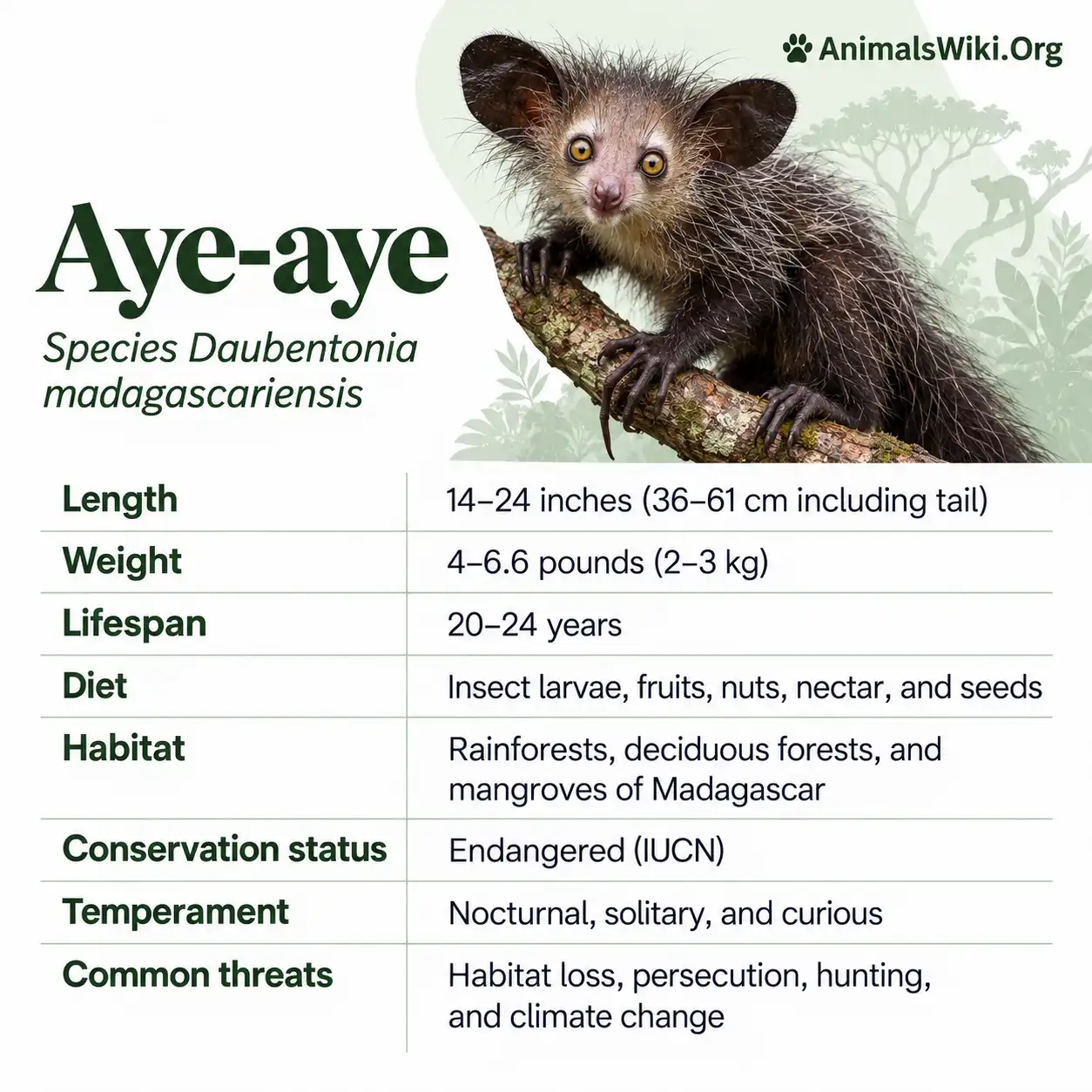
Aye-Aye, The Strange Nocturnal Lemur of Madagascar’s Rainforests
The aye-aye is one of the strangest and most specialized primates on Earth.
Its scientific name is:
Daubentonia madagascariensis
and it is found naturally only on the island of:
Madagascar.
At first glance, an aye-aye hardly resembles the lemurs most people recognize.
It has:
- Huge sensitive ears
- Large nocturnal eyes
- Continuously growing front teeth
- Long claw-like fingers
- An extraordinarily thin middle finger
- A long bushy tail
- Dark shaggy fur
Its appearance has sometimes caused people to compare it with:
- Bats
- Rodents
- Squirrels
- Cats
- Goblins
But the aye-aye is none of these.
It is a:
lemur.
And because lemurs are primates, the aye-aye is also one of our distant primate relatives.
The aye-aye’s most famous feature is its extraordinary:
middle finger.
Long, thin and highly mobile, this finger forms part of one of the most unusual feeding systems known among mammals.
At night, an aye-aye moves through trees searching for hidden insect larvae.
Instead of simply looking for insects, it:
- Rapidly taps wood with its fingers.
- Listens carefully to the resulting sounds.
- Detects subtle differences that may reveal hollow spaces or tunnels.
- Uses its powerful incisors to gnaw through the wood.
- Inserts its elongated middle finger.
- Hooks or extracts the hidden prey.
This behavior is called:
percussive foraging.
It is sometimes described as a biological equivalent of tapping on a wall to discover whether there is an empty space behind it.
The aye-aye occupies an ecological role remarkably similar to that of a:
woodpecker.
Madagascar has no native woodpeckers.
Instead, this bizarre primate evolved a completely different anatomical toolkit capable of exploiting insects hidden inside wood.
Its teeth perform the cutting.
Its ears detect subtle acoustic differences.
Its finger becomes the extraction tool.
The aye-aye is also famous for having incisors that:
continue growing throughout life.
This feature is extremely unusual among primates and helps the animal repeatedly gnaw through hard materials without permanently wearing down its front teeth.
Despite its extraordinary adaptations, the aye-aye faces serious conservation problems.
Madagascar’s forests have been heavily affected by:
- Deforestation
- Agricultural expansion
- Logging
- Habitat fragmentation
- Hunting
- Human-wildlife conflict
The species has also suffered because of local beliefs and taboos in some communities.
In certain areas, aye-ayes have historically been associated with:
- Bad luck
- Death
- Evil omens
These beliefs vary greatly between regions and communities and should never be presented as universal Malagasy culture.
Nevertheless, where negative beliefs occur, aye-ayes may be killed simply because they are encountered.
The reality is very different from the superstition.
An aye-aye is not supernatural.
It cannot predict death.
It does not curse people.
It is simply one of evolution’s most unusual solutions to finding food in a tropical forest.
This comprehensive guide explores Aye-aye facts, scientific classification, appearance, size, weight, Madagascar habitat, distribution, nocturnal behavior, diet, middle finger, teeth, percussive foraging, senses, climbing, reproduction, babies, lifespan, adaptations, predators, folklore, threats, conservation, and why the Aye-aye is one of the strangest primates alive today.
Aye-Aye Facts
| Feature | Information |
|---|---|
| Common Name | Aye-aye |
| Scientific Name | Daubentonia madagascariensis |
| Animal Type | Mammal |
| Order | Primates |
| Infraorder | Lemuriformes |
| Family | Daubentoniidae |
| Genus | Daubentonia |
| Native Country | Madagascar |
| Natural Range | Madagascar only |
| Activity | Nocturnal |
| Lifestyle | Primarily arboreal |
| Diet | Omnivorous |
| Main Foods | Insect larvae, fruits, seeds, nectar and plant foods |
| Body Length | Roughly 30–40 cm |
| Tail Length | Often around 45–55 cm |
| Weight | Roughly 2–3 kg |
| Famous Feature | Extremely thin elongated middle finger |
| Teeth | Continuously growing incisors |
| Feeding Method | Percussive foraging |
| Young | Infant |
| Typical Birth | One infant |
| Major Threat | Habitat loss and killing by humans |
| Conservation Concern | Threatened |
What Is an Aye-Aye?
The aye-aye is a highly specialized nocturnal lemur found only in Madagascar.
Its scientific name is:
Daubentonia madagascariensis.
It is the only living species in its genus:
Daubentonia
and the only surviving member of its family:
Daubentoniidae.
This makes the aye-aye evolutionarily distinctive.
Is an Aye-Aye a Lemur?
Yes.
Despite looking very different from familiar ring-tailed or sifaka-type lemurs, the aye-aye belongs to the lemur evolutionary radiation of Madagascar.
Is an Aye-Aye a Monkey?
No.
Aye-ayes are:
lemurs, not monkeys.
Both belong to the order Primates, but they represent different primate lineages.
Is an Aye-Aye a Primate?
Yes.
That means the aye-aye is distantly related to:
- Other lemurs
- Lorises
- Monkeys
- Apes
- Humans
Is an Aye-Aye a Rodent?
No.
This is a common misconception.
Its large front teeth look somewhat rodent-like, but the aye-aye is:
a primate.
Scientific Classification of the Aye-Aye
| Classification | Name |
|---|---|
| Kingdom | Animalia |
| Phylum | Chordata |
| Class | Mammalia |
| Order | Primates |
| Suborder | Strepsirrhini |
| Infraorder | Lemuriformes |
| Family | Daubentoniidae |
| Genus | Daubentonia |
| Species | Daubentonia madagascariensis |
What Does an Aye-Aye Look Like?
The aye-aye has one of the most distinctive appearances among mammals.
It possesses:
- Dark shaggy fur
- Large rounded ears
- Large eyes
- Long fingers
- Extremely thin middle finger
- Strong hands
- Long bushy tail
- Large front teeth
- Slender body
Its appearance is closely connected to its nocturnal and specialized feeding lifestyle.
Aye-Aye Fur
Adult aye-ayes generally have:
dark brown to blackish fur
with lighter guard hairs that can produce a somewhat grizzled appearance.
The face may appear paler than much of the body.
Aye-Aye Eyes
Aye-ayes have large eyes adapted for:
nighttime activity.
Their eyes help collect available light in dim forest conditions.
Why Does the Aye-Aye Have Big Ears?
The ears are extremely important for feeding.
They help detect subtle sounds created when the animal taps on:
wood.
This allows the aye-aye to identify possible cavities and tunnels containing insect larvae.
Aye-Aye Hands
The hands are among the most specialized of any primate.
Their long fingers assist with:
- Gripping
- Climbing
- Feeding
- Grooming
- Investigating objects
But one finger is particularly extraordinary.
The Aye-Aye Middle Finger
The aye-aye’s middle finger is:
- Extremely thin
- Long
- Flexible
- Highly mobile
It looks almost skeletal.
This unusual structure functions as a precision feeding tool.
Why Is the Aye-Aye’s Middle Finger So Thin?
The narrow finger can enter:
- Small holes
- Insect tunnels
- Cracks
- Cavities
that thicker fingers could not reach.
Once an insect larva is detected, the aye-aye can insert the finger and extract it.
Can an Aye-Aye Rotate Its Middle Finger?
The aye-aye’s specialized finger has extraordinary mobility compared with ordinary primate fingers.
This flexibility allows it to probe irregular cavities from different angles.
Does the Aye-Aye Have Six Fingers?
No.
The aye-aye has the normal basic primate arrangement of:
five digits per hand.
Its unusual elongated fingers can create the visual impression of a strange hand, but it does not normally possess six fingers.
Aye-Aye Teeth
Another remarkable feature is the aye-aye’s:
incisors.
The front teeth grow continuously.
Do Aye-Aye Teeth Keep Growing?
Yes.
The incisors continue growing throughout the animal’s life.
Regular gnawing wears them down.
Why Do Aye-Aye Teeth Keep Growing?
Aye-ayes frequently gnaw through:
- Bark
- Wood
- Hard plant material
Continuously growing incisors compensate for this constant wear.
Is the Aye-Aye the Only Primate With Continuously Growing Teeth?
The aye-aye is exceptionally unusual among living primates because of its continuously growing incisors.
This feature contributes to its superficial resemblance to rodents.
How Big Is an Aye-Aye?
The head-and-body length is approximately:
30–40 centimeters.
But the tail can be even longer.
How Long Is an Aye-Aye’s Tail?
The bushy tail may measure approximately:
45–55 centimeters.
As a result, total length can approach or exceed:
80–90 centimeters.
How Much Does an Aye-Aye Weigh?
Adults generally weigh around:
2–3 kilograms
although individual size varies.
Male vs. Female Aye-Aye
Males and females are broadly similar in appearance.
Males may occupy relatively large home ranges and can overlap with the ranges of females.
Visual sex differences are not dramatic compared with many strongly dimorphic mammals.
Where Do Aye-Ayes Live?
Aye-ayes live naturally only in:
Madagascar.
Madagascar is an island nation off the southeastern coast of Africa.
Are Aye-Ayes Endemic to Madagascar?
Yes.
Wild aye-ayes naturally occur nowhere else.
Aye-Aye Habitat
Aye-ayes can occupy several forest types, including:
- Tropical rainforest
- Deciduous forest
- Secondary forest
- Coastal forest
- Plantation-like habitats near natural forest
Their distribution is broader than was once believed.
Do Aye-Ayes Live in Rainforests?
Yes.
They are particularly famous for inhabiting Madagascar’s eastern rainforests, although they are not restricted exclusively to rainforest.
Do Aye-Ayes Live on the Ground?
They are primarily:
arboreal.
This means much of their life occurs in trees.
However, they can descend and move on the ground when necessary.
Are Aye-Ayes Nocturnal?
Yes.
Aye-ayes are strongly:
nocturnal.
They usually begin becoming active after sunset.
What Do Aye-Ayes Do During the Day?
During daylight, they generally sleep inside:
leaf nests.
These nests are built high in trees.
Aye-Aye Nests
Aye-ayes construct rounded nests from:
- Leaves
- Twigs
- Branches
The nest provides a sheltered place for daytime rest.
An individual may maintain or use multiple nests within its range.
Do Aye-Ayes Sleep in Tree Holes?
They are especially known for sleeping in constructed leafy nests rather than depending entirely on tree cavities.
What Do Aye-Ayes Eat?
Aye-ayes are:
omnivorous.
Their diet can include:
- Insect larvae
- Fruits
- Seeds
- Nuts
- Nectar
- Fungi
- Other plant materials
Food selection changes with season and habitat.
Do Aye-Ayes Eat Insects?
Yes.
Wood-boring insect larvae are among their most famous foods.
Do Aye-Ayes Eat Fruit?
Yes.
Fruit can form an important part of the diet.
Do Aye-Ayes Eat Seeds?
Yes.
Their powerful teeth can help process hard plant foods.
Do Aye-Ayes Eat Meat?
They consume animal matter primarily in the form of:
invertebrates such as insect larvae.
They are not predators of large vertebrate animals.
How Does an Aye-Aye Find Food?
Its most famous technique is:
percussive foraging.
The animal rapidly taps wood and listens for acoustic differences.
What Is Percussive Foraging?
Percussive foraging involves:
- Tapping a surface.
- Listening to the resulting sound.
- Detecting structural differences.
- Locating hidden food.
- Opening the surface.
- Extracting the food.
The aye-aye is exceptionally specialized for this behavior.
Does an Aye-Aye Use Echolocation?
Not in the same way as:
- Bats
- Dolphins
The aye-aye does not emit sonar calls and analyze returning echoes in the classic biological echolocation system.
Instead, it creates mechanical sounds by:
tapping wood
and listens to how the wood responds.
This is more accurately called:
percussive foraging or tap-scanning.
How Fast Does an Aye-Aye Tap?
Aye-ayes can tap wood extremely rapidly while searching for cavities.
The motion can be so fast that the finger appears to vibrate against the surface.
How Does an Aye-Aye Catch a Grub?
Once it detects a larval tunnel, it:
- Gnaws through the wood with its incisors.
- Creates an opening.
- Inserts its thin middle finger.
- Moves the finger through the tunnel.
- Hooks or pulls the larva out.
- Eats it.
This feeding method is extraordinarily unusual among primates.
Why Is the Aye-Aye Compared With a Woodpecker?
Both animals exploit insects hidden inside wood.
A woodpecker uses:
- Beak
- Hearing
- Long tongue
The aye-aye uses:
- Teeth
- Ears
- Long finger
They evolved very different anatomy to solve a similar ecological problem.
Is the Aye-Aye Madagascar’s Woodpecker?
Not literally.
But ecologically, the comparison is useful because the aye-aye occupies part of a feeding niche that woodpeckers occupy elsewhere.
Aye-Aye Behavior
Aye-ayes are generally:
- Nocturnal
- Arboreal
- Mostly solitary
- Exploratory
- Active foragers
They may travel considerable distances through forest while searching for food.
Are Aye-Ayes Solitary?
They are largely solitary.
However, their home ranges can overlap and individuals communicate with one another.
They are not completely antisocial.
Do Aye-Ayes Live in Groups?
They do not normally form stable large groups like some monkeys or lemurs.
Most foraging occurs independently.
Are Aye-Ayes Intelligent?
Yes.
As primates, they possess sophisticated:
- Learning abilities
- Memory
- Manipulation skills
- Problem-solving behavior
Their specialized foraging requires complex sensory and motor coordination.
Aye-Aye Communication
Aye-ayes communicate through:
- Vocalizations
- Scent marking
- Body behavior
Calls can be used during:
- Alarm
- Social encounters
- Mating interactions
Do Aye-Ayes Make Sounds?
Yes.
They produce several vocalizations, including:
- Grunts
- Screeches
- Whimpers
- Contact calls
Different sounds are associated with different contexts.
Do Aye-Ayes Have a Good Sense of Smell?
Yes.
Like other strepsirrhine primates, smell plays an important role in their behavior.
Scent marking can help communicate information about:
- Identity
- Territory
- Reproductive condition
How Do Aye-Ayes Move?
They move primarily by:
- Walking along branches
- Climbing
- Leaping short distances
Their hands and feet provide strong grips on vegetation.
Can Aye-Ayes Jump?
Yes.
They can leap between nearby branches, although they are not specialized for spectacular long-distance leaping like sifakas.
Can Aye-Ayes Swim?
Swimming is not an important part of their normal lifestyle.
They are highly specialized tree-dwelling primates.
Aye-Aye Reproduction
Aye-ayes reproduce relatively slowly.
This creates a conservation problem because populations cannot rapidly replace individuals killed by humans or lost through habitat destruction.
When Do Aye-Ayes Breed?
Breeding is not necessarily restricted to one extremely narrow annual season.
Females signal reproductive readiness behaviorally and chemically.
How Long Is an Aye-Aye Pregnancy?
Gestation lasts approximately:
five to six months.
How Many Babies Does an Aye-Aye Have?
Usually:
one infant at a time.
Twins are not considered typical.
What Is a Baby Aye-Aye Called?
A baby can simply be called an:
infant.
What Does a Baby Aye-Aye Look Like?
Young aye-ayes have:
- Relatively soft fur
- Large ears
- Developing elongated fingers
- Strong dependence on their mother
They gradually acquire the proportions and specialized appearance of adults.
Do Aye-Aye Mothers Care for Their Babies?
Yes.
Maternal care is extensive.
The infant depends on its mother for:
- Milk
- Protection
- Warmth
- Learning
- Transportation during early development
Do Male Aye-Ayes Raise Babies?
Maternal care is the dominant form of parental investment.
Males do not form conventional long-term family units responsible for raising offspring.
How Long Do Baby Aye-Ayes Stay With Their Mother?
Young animals remain dependent for an extended period while learning the skills needed for independent forest life.
Slow development contributes to the species’ relatively low reproductive rate.
Aye-Aye Lifespan
Aye-ayes can live for:
more than 20 years
under managed conditions.
Individuals in human care have survived into their 20s.
Maximum lifespan in the wild is more difficult to establish.
Aye-Aye Adaptations
Elongated Middle Finger
Extracts insects from narrow cavities.
Continuously Growing Incisors
Allow repeated gnawing without permanently wearing away the teeth.
Large Ears
Detect subtle acoustic differences during tap-foraging.
Large Eyes
Improve vision at night.
Strong Hands and Feet
Provide grip in trees.
Long Fingers
Assist climbing and food manipulation.
Bushy Tail
Helps with balance and may provide insulation.
Nocturnal Lifestyle
Allows exploitation of nighttime resources.
Powerful Sense of Smell
Supports communication and environmental awareness.
What Predators Eat Aye-Ayes?
The most important potential natural predator is the:
fossa.
The fossa is Madagascar’s largest native carnivorous mammal and is capable of hunting lemurs.
Large birds of prey may also pose risks, particularly to young animals.
Are Fossas Dangerous to Aye-Ayes?
Potentially, yes.
Fossas are excellent climbers and important predators of Malagasy lemurs.
Do Snakes Eat Aye-Ayes?
Large snakes may potentially threaten young individuals, although snakes are not considered the dominant driver of aye-aye population decline.
Are Humans a Threat to Aye-Ayes?
Yes.
Humans have become one of their most significant threats through:
- Habitat destruction
- Hunting
- Persecution
- Agricultural conflict
Why Are Aye-Ayes Endangered?
Major pressures include:
- Deforestation
- Forest fragmentation
- Agriculture
- Logging
- Hunting
- Killing linked to superstition
- Killing as crop pests
Their naturally slow reproduction makes recovery harder.
Deforestation and Aye-Ayes
Madagascar has experienced extensive forest loss.
When forests disappear, aye-ayes lose:
- Nest trees
- Feeding trees
- Travel routes
- Insect-rich deadwood
- Shelter
Fragmentation can also isolate populations.
Do Farmers Kill Aye-Ayes?
In some regions, aye-ayes may raid crops or valuable trees and can consequently be killed.
This human-wildlife conflict adds another conservation challenge.
Why Are Aye-Ayes Considered Bad Luck?
In some Malagasy communities, traditional beliefs associate aye-ayes with:
- Misfortune
- Death
- Evil omens
However, beliefs differ considerably across Madagascar.
It is inaccurate and disrespectful to suggest that:
all Malagasy people fear or kill aye-ayes.
Does an Aye-Aye Predict Death?
No.
There is no scientific evidence that an aye-aye can:
- Predict death
- Curse humans
- Cause supernatural harm
These are cultural beliefs rather than biological facts.
Does an Aye-Aye Point at People?
The animal’s extremely long finger can make ordinary movements appear like pointing.
Folklore has sometimes attached supernatural meaning to this behavior.
Biologically, the finger evolved primarily for:
feeding and manipulation.
Is an Aye-Aye Dangerous?
Generally:
no.
Aye-ayes do not hunt humans and normally avoid confrontation.
Like any wild animal, however, one could bite if:
- Trapped
- Handled
- Threatened
Do Aye-Ayes Attack Humans?
Attacks are not a normal aspect of aye-aye behavior.
They are nocturnal forest animals that generally prefer avoiding people.
Are Aye-Ayes Venomous?
No.
They possess:
no venom.
Their unusual finger does not inject poison.
Are Aye-Ayes Poisonous?
No.
They are not poisonous animals.
Aye-Aye vs. Lemur
An aye-aye:
is a lemur.
The term “lemur” includes many species with very different appearances and lifestyles.
Aye-Aye vs. Ring-Tailed Lemur
| Feature | Aye-Aye | Ring-Tailed Lemur |
|---|---|---|
| Activity | Nocturnal | Mainly diurnal |
| Appearance | Dark and shaggy | Gray with ringed tail |
| Feeding Specialty | Tap-foraging | Generalized feeding |
| Social Structure | Mostly solitary | Highly social groups |
| Famous Feature | Thin middle finger | Black-and-white ringed tail |
| Native Range | Madagascar | Madagascar |
Aye-Aye vs. Monkey
| Feature | Aye-Aye | Monkey |
|---|---|---|
| Primate | Yes | Yes |
| Lemur | Yes | No |
| Native Madagascar | Yes | Generally no native monkeys |
| Tooth Type | Continuously growing incisors | Normal primate incisors |
| Famous Adaptation | Tap-foraging finger | Varies |
Aye-Aye vs. Rodent
| Feature | Aye-Aye | Rodent |
|---|---|---|
| Group | Primate | Rodentia |
| Continuously Growing Incisors | Yes | Yes |
| Specialized Middle Finger | Yes | No |
| Large Primate Brain | Yes | Different mammalian lineage |
| Madagascar Endemic | Species is | Depends on species |
Their similar incisors are a striking example of different mammal groups evolving similar functional solutions.
Aye-Aye vs. Woodpecker
| Feature | Aye-Aye | Woodpecker |
|---|---|---|
| Animal Type | Mammal | Bird |
| Finds Insects in Wood | Yes | Yes |
| Opens Wood With | Teeth | Beak |
| Extracts Prey With | Finger | Tongue |
| Detects Cavities | Tapping/listening | Tapping/listening |
| Activity | Nocturnal | Usually diurnal |
Why Is the Aye-Aye Important?
The aye-aye demonstrates how evolution can produce extremely specialized adaptations.
It also contributes to forest ecology through:
- Predation on insects
- Seed consumption
- Possible seed dispersal
- Interaction with forest plants
Aye-Aye Conservation
Protecting the species requires:
- Preserving forests
- Restoring habitat corridors
- Reducing hunting
- Reducing persecution
- Working with local communities
- Environmental education
- Research
- Population monitoring
Protected Areas
Aye-ayes occur within several protected areas in Madagascar.
However, simply drawing boundaries on a map is not enough.
Effective protection requires:
- Enforcement
- Community participation
- Habitat management
- Sustainable livelihoods
Captive Conservation
Aye-ayes are maintained at a limited number of specialized zoological and research institutions.
Managed populations can support:
- Education
- Behavioral research
- Veterinary knowledge
- Genetic conservation
- Public awareness
But protecting wild habitat remains essential.
Why Saving the Aye-Aye Matters
If the aye-aye disappeared, Earth would lose:
- The only living Daubentonia
- The only living member of Daubentoniidae
- One of the most specialized primates
- A unique evolutionary experiment in tap-foraging
No other living animal combines exactly the same anatomical toolkit.
50 Interesting Aye-Aye Facts
- The aye-aye is a lemur.
- It is a primate.
- Its scientific name is Daubentonia madagascariensis.
- It lives naturally only in Madagascar.
- It is nocturnal.
- It is primarily arboreal.
- Aye-ayes have very large ears.
- Their eyes are adapted for nighttime activity.
- They have long fingers.
- The middle finger is exceptionally thin.
- The middle finger is highly mobile.
- They use the finger to extract insects.
- Aye-ayes tap on wood.
- They listen for hollow spaces.
- This behavior is called percussive foraging.
- They can detect insect tunnels hidden beneath wood.
- Their incisors grow continuously.
- Continuously growing incisors are extremely unusual among primates.
- The teeth help them gnaw through wood.
- They superficially resemble rodents.
- They are not rodents.
- They are not monkeys.
- They are not bats.
- Their tail is longer than their body.
- The tail is extremely bushy.
- Adults usually weigh only a few kilograms.
- Aye-ayes eat insect larvae.
- They also eat fruit.
- They eat seeds.
- They consume other plant foods.
- They are omnivores.
- They build leafy nests.
- They normally sleep during the day.
- They forage at night.
- They are mostly solitary.
- They communicate using vocalizations.
- Smell is important in communication.
- Females usually have one infant.
- Pregnancy lasts roughly five to six months.
- Young develop relatively slowly.
- Aye-ayes can live beyond 20 years in human care.
- The fossa is an important potential predator.
- Humans are a major threat.
- Deforestation destroys aye-aye habitat.
- Some are killed because of local superstition.
- Others may be killed because of crop conflict.
- Folklore varies greatly across Madagascar.
- Aye-ayes cannot predict death.
- Their feeding niche resembles that of woodpeckers.
- The aye-aye is one of the most evolutionarily distinctive primates alive.
Did You Know?
The aye-aye can effectively “listen” to a piece of wood and discover an insect it cannot see.
Imagine an aye-aye moving through a Madagascar forest after sunset.
The forest is dark.
A grub is buried beneath the surface of a branch.
The insect is invisible.
It makes no obvious movement.
To a human observer, the branch looks completely ordinary.
But the aye-aye has an extraordinary set of tools.
First:
the finger begins tapping.
Tap.
Tap.
Tap.
Tap.
The movement becomes extraordinarily rapid.
The aye-aye’s huge ears listen.
Most sections of wood produce one type of sound.
But one tiny area sounds:
different.
There may be an empty tunnel beneath the surface.
The aye-aye stops.
Its large front teeth begin cutting.
Unlike normal primate incisors, these teeth continue growing throughout life.
The animal gnaws away the wood until a small opening appears.
But the insect is still deeper inside.
Now comes the adaptation that makes the aye-aye famous.
The animal extends its:
long, skeletal middle finger.
The finger slips into the opening.
It bends.
It probes.
It follows the tunnel.
Then it hooks the hidden larva and pulls it toward the mouth.
The entire process uses:
finger + ears + teeth + brain
as one integrated biological tool.
Elsewhere in the world, a woodpecker might solve the same problem with:
beak + tongue.
Madagascar had no native woodpecker filling exactly that role.
Evolution produced something entirely different.
Not another bird.
Not another rodent.
But a nocturnal primate with giant ears, ever-growing teeth, and a finger unlike that of almost any other mammal.
That is what makes the aye-aye so remarkable.
Its strange appearance is not random.
Almost every bizarre feature makes sense once you understand:
how it finds food.
Frequently Asked Questions About Aye-Ayes
What is an aye-aye?
An aye-aye is a nocturnal lemur native to Madagascar.
What is the scientific name of the aye-aye?
Daubentonia madagascariensis.
Is an aye-aye a lemur?
Yes.
Is an aye-aye a primate?
Yes.
Is an aye-aye a monkey?
No.
Is an aye-aye an ape?
No.
Is an aye-aye a rodent?
No.
Is an aye-aye a squirrel?
No.
Is an aye-aye a bat?
No.
Where do aye-ayes live?
Madagascar.
Are aye-ayes found anywhere else naturally?
No.
Are aye-ayes endemic to Madagascar?
Yes.
Do aye-ayes live in rainforests?
Yes, although they can use several types of forest.
Do aye-ayes live in trees?
Yes. They are primarily arboreal.
Do aye-ayes come to the ground?
They can, but most of their activity is associated with trees.
Are aye-ayes nocturnal?
Yes.
Why are aye-ayes nocturnal?
Their sensory adaptations and feeding ecology are strongly suited to nighttime activity.
Where do aye-ayes sleep?
Usually in leafy nests in trees.
Do aye-ayes build nests?
Yes.
What are aye-aye nests made from?
Leaves, twigs and other vegetation.
How big is an aye-aye?
Its body is roughly 30–40 cm long, excluding the long tail.
How long is an aye-aye’s tail?
Often around 45–55 cm.
Is the tail longer than the body?
It often is.
How much does an aye-aye weigh?
Usually around 2–3 kg.
What color is an aye-aye?
Adults are generally dark brown to blackish with lighter hairs.
Why does the aye-aye have big eyes?
Large eyes help with nocturnal vision.
Why does the aye-aye have big ears?
The ears help detect subtle sounds while searching for hidden insects.
Why does the aye-aye have a long middle finger?
It uses the finger to probe narrow cavities and extract food.
Which finger is special on an aye-aye?
The third digit, commonly called the middle finger, is especially thin and elongated.
Does the aye-aye have six fingers?
No.
Can an aye-aye move its middle finger independently?
It has exceptionally specialized control and mobility of the finger.
Does the aye-aye tap trees?
Yes.
Why does an aye-aye tap wood?
To detect hollow spaces and tunnels containing insect larvae.
What is tap-foraging?
It is a feeding method in which an animal taps a surface and interprets the resulting sounds to locate hidden food.
Does an aye-aye use sonar?
Not in the same biological sense as bats or dolphins.
Does an aye-aye echolocate?
Classic echolocation is not the best term. It uses percussive foraging by producing tapping sounds and analyzing the response.
How does an aye-aye find grubs?
It taps wood, listens, gnaws an opening, and extracts larvae with its elongated finger.
Why does the aye-aye have large teeth?
Its incisors are adapted for gnawing through wood and hard plant material.
Do aye-aye teeth keep growing?
Yes.
Why don’t the teeth become too long?
Regular gnawing wears them down.
Are aye-ayes related to rats?
Only very distantly as fellow mammals. They are primates, not rodents.
What do aye-ayes eat?
Insect larvae, fruits, seeds, nectar and other foods.
Are aye-ayes carnivores?
No. They are better described as omnivores.
Are aye-ayes herbivores?
Not exclusively because they also eat animal prey such as insect larvae.
Do aye-ayes eat bugs?
Yes.
Do aye-ayes eat grubs?
Yes.
Do aye-ayes eat fruit?
Yes.
Do aye-ayes eat coconuts?
They can exploit various hard plant foods, including cultivated foods where available, although coconuts should not be treated as their entire natural diet.
Do aye-ayes drink water?
Yes, directly or through moisture obtained from foods.
Are aye-ayes solitary?
Mostly.
Do aye-ayes live in families?
They do not normally form stable family troops like some social primates.
Are aye-ayes territorial?
Individuals use home ranges, and overlap can occur.
Are male aye-ayes bigger than females?
Differences are relatively modest compared with highly sexually dimorphic mammals.
How do aye-ayes communicate?
Through vocalizations, scent marking and behavior.
What sounds do aye-ayes make?
They can produce grunts, cries, screeches and other calls.
Are aye-ayes intelligent?
Yes.
Can aye-ayes solve problems?
Their complex foraging behavior demonstrates sophisticated sensory and motor problem-solving.
Can aye-ayes jump?
Yes, although they primarily climb and move along branches.
Can aye-ayes climb well?
Yes.
Can aye-ayes swim?
Swimming is not a major feature of their normal ecology.
How many babies do aye-ayes have?
Usually one infant at a time.
What is a baby aye-aye called?
An infant.
How long are aye-ayes pregnant?
Approximately five to six months.
Do aye-aye mothers care for babies?
Yes.
Do male aye-ayes raise babies?
Maternal care is much more important.
How long do aye-ayes live?
They can live for more than 20 years under managed conditions.
What eats an aye-aye?
The fossa is an important potential natural predator.
Do fossas eat aye-ayes?
Fossas are capable of preying on lemurs and are a potential aye-aye predator.
Do humans kill aye-ayes?
Unfortunately, yes, in some areas.
Why do people kill aye-ayes?
Reasons can include superstition, hunting and conflict over crops.
Are aye-ayes bad luck?
No scientific evidence supports this belief.
Are aye-ayes evil?
No.
Can an aye-aye curse someone?
No.
Can an aye-aye predict death?
No.
What happens if an aye-aye points at you?
Nothing supernatural. The animal’s unusual fingers are anatomical adaptations, not magical objects.
Are aye-ayes dangerous?
Generally no.
Do aye-ayes attack people?
They normally avoid people rather than hunt or attack them.
Can an aye-aye bite?
Yes. Any wild mammal with powerful teeth could bite when threatened or handled.
Are aye-ayes venomous?
No.
Are aye-ayes poisonous?
No.
Are aye-ayes endangered?
They are a threatened species facing significant conservation pressures.
Why are aye-ayes threatened?
Habitat loss, fragmentation, hunting, persecution and human-wildlife conflict are major concerns.
How many aye-ayes are left?
A precise global wild population is not known well enough to provide a dependable exact count.
Why don’t scientists know exactly how many aye-ayes exist?
They are nocturnal, often solitary, difficult to detect and distributed through challenging forest habitats.
Are aye-ayes rare?
Yes.
Are aye-ayes extinct?
No.
Are aye-ayes protected?
They occur in protected areas and are the focus of conservation efforts.
Are aye-ayes kept in zoos?
Yes, but only a limited number of specialized institutions maintain them.
Can an aye-aye be a pet?
No. Aye-ayes are specialized wild primates with complex welfare and conservation requirements.
Is an aye-aye related to a ring-tailed lemur?
Yes. Both are lemurs, although they represent very different evolutionary branches.
Why does an aye-aye look so strange?
Its appearance reflects extreme adaptations for nocturnal life and specialized feeding.
Why is the aye-aye compared with a woodpecker?
Both locate and extract insects hidden inside wood, although they use completely different anatomy.
Is the aye-aye a living fossil?
That phrase is sometimes used loosely for distinctive ancient lineages, but it can be misleading because aye-ayes have continued evolving like every living species.
Why is the aye-aye important?
It represents a unique branch of primate evolution and performs a specialized ecological role in Madagascar’s forests.
What would happen if aye-ayes became extinct?
Earth would lose the only living member of the family Daubentoniidae and one of the most specialized feeding systems found among primates.
What is the most interesting fact about the aye-aye?
It can locate an insect hidden inside wood by tapping the surface, listening to the resulting sound, gnawing open the wood, and extracting the prey with an extraordinarily thin finger.
Conclusion
The aye-aye is an animal whose appearance initially seems almost impossible to explain.
Why would a primate need:
enormous ears?
Why would it need:
rodent-like teeth that never stop growing?
Why would one finger become:
long, thin and almost skeletal?
And why would a lemur spend the night:
tapping on trees?
Look at each feature separately, and the aye-aye seems bizarre.
Look at them together, and everything changes.
The ears are listening instruments.
The finger is a tapping device.
The teeth are cutting tools.
The same finger becomes a probe.
The eyes support nighttime activity.
The feet grip branches.
The tail helps the animal move through the canopy.
Every strange feature forms part of an extraordinary feeding system.
At night, an aye-aye can sit on a branch containing an insect it cannot see.
The insect is protected by wood.
But the aye-aye does not need to see it.
It taps.
It listens.
It finds the tunnel.
It cuts through the wood.
Then it reaches inside with one of the most specialized fingers in the mammalian world.
Evolution produced an animal capable of doing with:
ears + teeth + finger
what a woodpecker accomplishes with:
ears + beak + tongue.
Unfortunately, the same unusual appearance that fascinates biologists has sometimes contributed to the aye-aye’s persecution.
Humans have associated it with fear and superstition.
Forests have disappeared.
Habitats have fragmented.
Animals have been killed.
Yet there is nothing supernatural about the aye-aye.
It does not predict death.
Its finger carries no curse.
Its enormous eyes do not see the future.
What they reveal instead is something much more remarkable:
the creativity of evolution.
Madagascar’s isolation allowed life to follow evolutionary paths found nowhere else on Earth.
The aye-aye is one of the greatest examples.
Protecting it means preserving more than one unusual lemur.
It means protecting an entire surviving branch of primate evolution.
And every night an aye-aye taps its way through a Madagascar forest, it continues one of the strangest feeding traditions in the mammalian world.



