
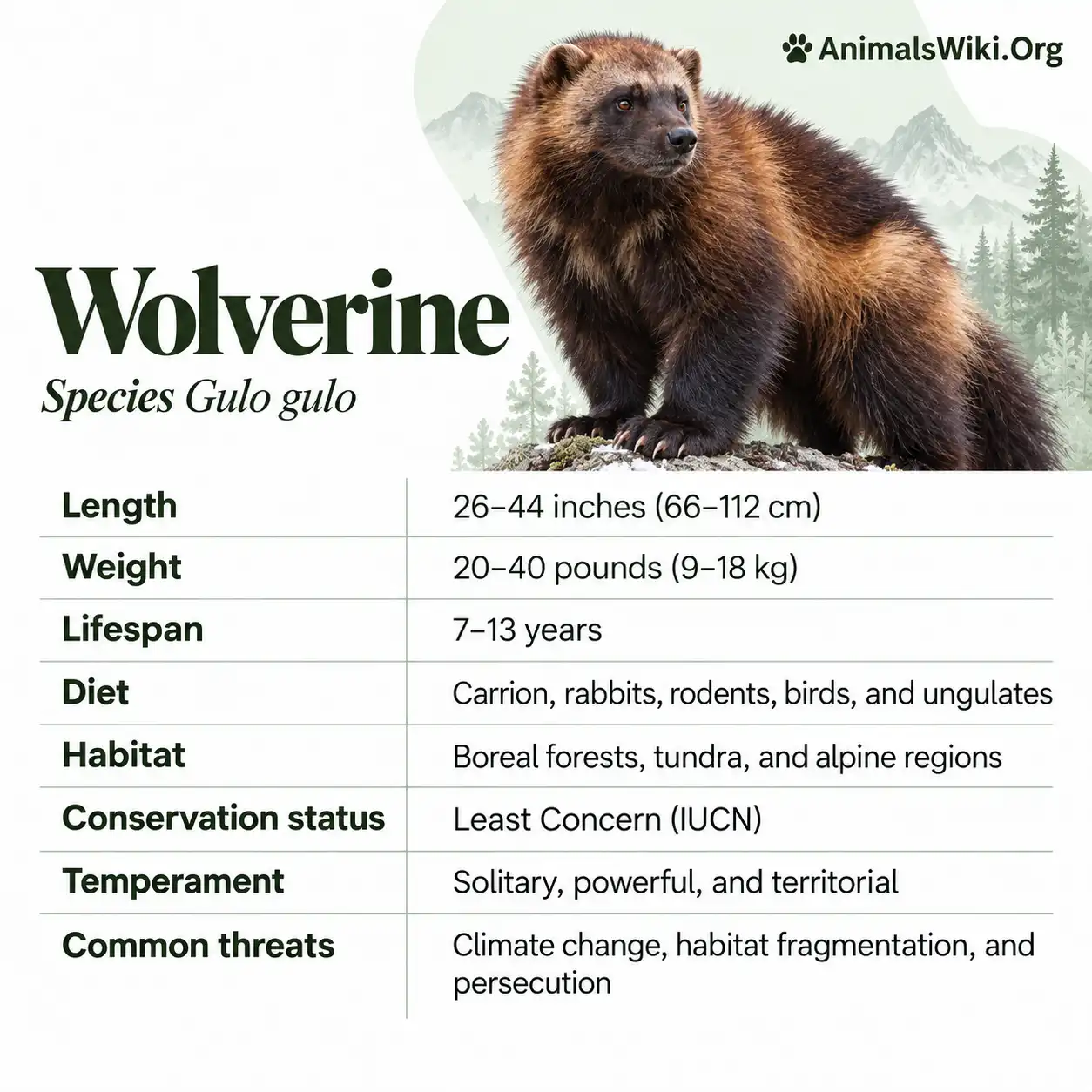
Wolverine, The Powerful Cold-Climate Hunter of the Northern Wilderness
The Wolverine is one of the toughest-looking mammals of the Northern Hemisphere.
Compact.
Muscular.
Broad-footed.
Armed with powerful jaws.
And capable of traveling enormous distances through some of the coldest landscapes on Earth.
Its scientific name is:
Gulo gulo.
Despite its bear-like appearance, the Wolverine is not a:
bear.
It belongs to the family:
Mustelidae.
That makes it a relative of:
- Weasels
- Otters
- Badgers
- Martens
- Ferrets
The Wolverine is generally regarded as the:
largest terrestrial member of the weasel family.
Its reputation is enormous compared with its actual size.
A Wolverine does not weigh hundreds of kilograms.
Many adults weigh only around:
8–18 kg, although large males can exceed this.
Yet the animal has evolved for a world where:
- Snow can become extremely deep
- Winter temperatures fall far below freezing
- Food can be scattered across huge distances
- Carcasses may freeze solid
- Survival may depend on finding a meal many kilometers away
The Wolverine answers these challenges with:
strength, endurance and mobility.
Its broad paws help distribute body weight across:
snow.
Its thick coat protects against:
cold.
Its powerful jaws and teeth allow it to tear:
frozen flesh and bone.
Its strong sense of smell helps locate food hidden beneath:
snow.
And its extraordinary stamina allows it to travel across mountains, forests and tundra with remarkable persistence.
Wolverines are both:
predators and scavengers.
They can hunt animals themselves, but they also make extensive use of carcasses left by:
- Wolves
- Lynx
- Other predators
- Winter mortality
- Human hunters
This scavenging ability is not a weakness.
In harsh northern environments, finding and exploiting every available source of energy can mean the difference between:
life and death.
Wolverines also cache food.
A surplus meal may be carried away and hidden in:
- Snow
- Rock crevices
- Cold ground
- Other concealed locations
Natural refrigeration can preserve the food for:
later.
The species’ relationship with snow goes even deeper during reproduction.
Female Wolverines create complex maternity dens beneath:
deep snow.
These dens can provide insulated tunnels and chambers where tiny kits remain protected from severe winter conditions.
This dependence makes persistent spring snow particularly important for:
Wolverine reproduction.
Wolverines are famous for being aggressive and fearless.
There is some truth behind the reputation.
They are powerful animals capable of defending food from competitors.
But popular culture often exaggerates them into creatures that attack anything they encounter.
In reality, Wolverines generally avoid:
humans.
Their most remarkable characteristic is not reckless aggression.
It is their ability to survive where few medium-sized carnivores could.
This comprehensive guide explores Wolverine facts, scientific classification, size, weight, habitat, range, Arctic and mountain adaptations, broad paws, snow travel, diet, hunting, scavenging, bite, food caching, behavior, reproduction, delayed implantation, kits, snow dens, lifespan, predators, Wolverine vs Badger, Wolverine vs Honey Badger, Wolverine vs Bear, Wolverine vs Wolf, danger to humans, conservation, climate change and the extraordinary biology of one of the Northern Hemisphere’s toughest carnivores.
Wolverine Facts
| Feature | Information |
|---|---|
| Common Name | Wolverine |
| Scientific Name | Gulo gulo |
| Animal Type | Mammal |
| Order | Carnivora |
| Family | Mustelidae |
| Genus | Gulo |
| Diet | Carnivorous |
| Feeding Strategy | Predator & scavenger |
| Distribution | Northern North America, Europe & Asia |
| Habitat | Boreal forest, tundra & mountains |
| Body Length | Roughly 65–105 cm |
| Weight | Commonly around 8–18 kg; large males can be heavier |
| Largest Sex | Male |
| Coat | Thick, dark brown |
| Feet | Broad and snow-adapted |
| Lifestyle | Mostly solitary |
| Activity | Flexible; often active day and night |
| Young | Kits |
| Reproduction | Delayed implantation |
| Major Adaptation | Cold and snow tolerance |
| Family Relatives | Badgers, otters, martens & weasels |
| Special Distinction | Largest mainly terrestrial mustelid |
What Is a Wolverine?
A Wolverine is a powerful northern carnivorous mammal belonging to the:
weasel family.
Its scientific name is:
Gulo gulo.
It is adapted to cold environments across parts of:
- North America
- Europe
- Asia
Is a Wolverine a Weasel?
The Wolverine belongs to the family:
Mustelidae.
So yes, in the broad taxonomic sense it is part of the:
weasel family.
However, it is dramatically larger and more heavily built than the small animals people usually imagine when hearing “weasel.”
Is a Wolverine a Bear?
No.
Its:
- Broad head
- Thick fur
- Stocky body
- Powerful limbs
can make it look like a miniature bear.
But bears belong to:
Ursidae.
Wolverines belong to:
Mustelidae.
Is a Wolverine a Badger?
No.
Wolverines and badgers are both:
mustelids
but they belong to different evolutionary branches within the family.
Scientific Classification of the Wolverine
| Classification | Name |
|---|---|
| Kingdom | Animalia |
| Phylum | Chordata |
| Class | Mammalia |
| Order | Carnivora |
| Family | Mustelidae |
| Genus | Gulo |
| Species | Gulo gulo |
What Does Gulo gulo Mean?
The name Gulo derives from a Latin word associated with:
gluttony.
This reflects the historical perception that Wolverines were exceptionally:
voracious eaters.
That reputation is exaggerated.
Their feeding behavior makes sense for an animal living in environments where food availability can be:
unpredictable.
What Does a Wolverine Look Like?
Wolverines have:
- Stocky muscular bodies
- Broad rounded heads
- Small rounded ears
- Short powerful legs
- Large paws
- Strong claws
- Bushy tails
- Thick dark fur
Many have lighter brown or golden bands extending along the:
sides of the body.
What Color Is a Wolverine?
Most are predominantly:
dark brown.
Color can vary from almost black to lighter brown.
Paler markings may occur on the:
- Face
- Neck
- Flanks
- Chest
Why Does a Wolverine Look Like a Small Bear?
This is an example of superficial similarity rather than close relationship.
A compact body, strong limbs and thick coat are useful adaptations in:
cold environments.
These features produce a somewhat bear-like appearance.
How Big Is a Wolverine?
Adults commonly measure approximately:
65–105 cm in body length, excluding or depending on how the tail is measured.
The bushy tail adds additional length.
How Much Does a Wolverine Weigh?
Many adults fall roughly within:
8–18 kg.
Males are generally considerably larger than females.
Exceptionally large males can exceed:
20 kg.
Are Male Wolverines Bigger Than Females?
Yes.
Sexual size differences are substantial.
Adult males can be approximately:
30–40% heavier
than females, although the exact difference varies.
Is a Wolverine Bigger Than a Dog?
It depends on the dog.
A Wolverine can weigh about as much as a:
medium-sized dog.
However, its body is extremely muscular and compact.
Is a Wolverine Bigger Than a Wolf?
No.
Gray Wolves are dramatically:
larger and heavier.
Is a Wolverine Bigger Than a Badger?
Wolverines are generally larger than most badger species and have a different body shape adapted for extensive travel.
Where Do Wolverines Live?
Wolverines have a circumpolar northern distribution.
They occur across parts of:
- Canada
- Alaska
- Continental United States
- Scandinavia
- Russia
- Other northern Eurasian regions
Their modern distribution is much more restricted than it was historically in some areas.
Do Wolverines Live in Canada?
Yes.
Canada contains some of the world’s most extensive Wolverine:
habitat.
Do Wolverines Live in Alaska?
Yes.
Alaska supports significant Wolverine populations.
Do Wolverines Live in the United States?
Yes.
Outside Alaska, Wolverines occur mainly in parts of the mountainous western United States.
They are uncommon and widely dispersed.
Do Wolverines Live in Europe?
Yes.
They occur particularly in northern parts of:
Scandinavia and European Russia.
Do Wolverines Live in Asia?
Yes.
Their Eurasian range extends across large northern regions, particularly:
Russia.
Wolverine Habitat
Wolverines are strongly associated with:
- Boreal forests
- Tundra
- Alpine environments
- Subarctic regions
- Remote mountain landscapes
They generally favor areas with:
low human disturbance and persistent seasonal snow.
Do Wolverines Live in the Arctic?
Yes.
They occur in Arctic and subarctic landscapes.
However, they are not restricted to the high:
Arctic tundra.
Do Wolverines Live in Mountains?
Yes.
Mountain environments are particularly important near the southern edges of their range.
High elevations can provide:
- Deep snow
- Cooler temperatures
- Remote habitat
- Denning conditions
Do Wolverines Live in Forests?
Yes.
Boreal forests form a major part of their habitat across:
northern regions.
How Do Wolverines Survive Extreme Cold?
Their adaptations include:
- Thick insulating fur
- Compact bodies
- Broad paws
- Strong limbs
- High mobility
- Food caching
- Ability to consume frozen carrion
Together these traits allow survival during:
long northern winters.
Is Wolverine Fur Waterproof?
Wolverine fur is exceptionally dense and resistant to:
frost accumulation.
Its properties help protect the animal in snowy and cold conditions.
Historically, this frost-resistant quality made Wolverine fur particularly valued for:
winter clothing trim.
Why Do Wolverines Have Large Feet?
Their broad paws spread body weight over a larger area.
This reduces sinking into:
soft snow.
Are Wolverine Feet Like Snowshoes?
This is a useful analogy.
Their paws function somewhat like natural:
snowshoes.
This gives Wolverines an advantage when traveling across deep snow.
Can Wolverines Walk on Deep Snow?
Yes.
Their broad paws and relatively low foot loading help them move efficiently across:
snow-covered landscapes.
Can Wolverines Climb?
Yes.
They are capable climbers, particularly when:
young.
Their strong claws also help them negotiate steep and rocky terrain.
Can Wolverines Swim?
Yes.
Like many mustelids, Wolverines are capable:
swimmers.
What Do Wolverines Eat?
Wolverines are primarily:
carnivorous.
Their diet can include:
- Carrion
- Deer
- Caribou
- Moose remains
- Mountain goats
- Sheep
- Rodents
- Hares
- Birds
- Eggs
- Smaller mammals
They consume both animals they kill and animals killed by:
other causes.
Are Wolverines Scavengers?
Yes.
Scavenging is one of their most important:
feeding strategies.
Are Wolverines Hunters?
Yes.
They are also capable predators.
The balance between hunting and scavenging varies according to:
- Season
- Habitat
- Snow conditions
- Prey availability
- Carrion availability
Do Wolverines Eat Reindeer?
Yes.
In parts of Eurasia, Wolverines can prey on or scavenge:
reindeer.
This can create conflict with reindeer herders.
Do Wolverines Eat Caribou?
Yes.
They can scavenge Caribou carcasses and occasionally prey on vulnerable individuals.
Can a Wolverine Kill a Deer?
Yes.
A Wolverine is capable of killing animals larger than itself under favorable conditions.
Deep snow can sometimes give the Wolverine an advantage over:
hoofed prey.
Can a Wolverine Kill a Moose?
Claims require context.
A Wolverine is not normally a specialized predator of healthy adult Moose.
It may feed on:
Moose carcasses
and can potentially attack:
- Calves
- Injured animals
- Severely weakened animals
Descriptions of Wolverines routinely killing healthy adult Moose are exaggerated.
Can Wolverines Kill Animals Bigger Than Themselves?
Yes.
They can sometimes kill prey considerably larger than their own body size.
But this does not mean they routinely overpower every large animal they encounter.
How Does a Wolverine Hunt?
Hunting strategies vary.
A Wolverine may:
- Stalk
- Chase
- Ambush
- Exploit deep snow
- Attack weakened animals
- Search for small prey beneath snow
Its greatest advantages are often:
strength and persistence.
Why Does Deep Snow Help Wolverines Hunt?
Large hoofed animals may sink deeply into soft snow.
A Wolverine’s broad feet can provide better:
snow mobility.
This can reduce the prey’s speed advantage.
Do Wolverines Hunt Under Snow?
They can detect and capture small animals associated with:
snow cover.
Their strong sense of smell helps locate hidden food.
Do Wolverines Eat Frozen Meat?
Yes.
They are well adapted to consuming:
frozen carcasses.
Their strong jaws and teeth can process tough material.
Do Wolverines Eat Bones?
Yes.
They can consume smaller bones and access:
bone marrow.
How Strong Is a Wolverine Bite?
The Wolverine has a very powerful bite for an animal of its size.
Its skull and jaw musculature are adapted for:
- Crushing
- Tearing
- Processing frozen tissue
- Breaking smaller bones
Does a Wolverine Have the Strongest Bite?
Claims that it has the strongest bite of all mammals are:
incorrect.
Its bite is impressive relative to its size, but direct rankings depend on measurement method.
Why Are Wolverine Jaws So Powerful?
Powerful jaws allow Wolverines to exploit food that may be:
- Frozen
- Tough
- Bone-rich
This is particularly valuable during:
winter.
Do Wolverines Cache Food?
Yes.
Food caching is an important Wolverine behavior.
What Is Food Caching?
Caching means storing food for:
later use.
A Wolverine may hide food in:
- Snow
- Rock piles
- Crevices
- Vegetation
- Cold ground
Why Do Wolverines Hide Food?
Food availability in northern environments can be:
unpredictable.
Caching allows an animal to preserve excess food for periods when finding another meal may be difficult.
Does Snow Refrigerate Wolverine Food?
Yes.
Cold snow and frozen ground can act as a form of:
natural refrigeration.
They slow decomposition and may help preserve cached meat.
Can Wolverines Smell Food Under Snow?
Their strong sense of smell helps them locate:
hidden or buried food.
Wolverine Behavior
Wolverines are primarily:
solitary.
Adult individuals maintain very large:
home ranges.
Do Wolverines Live in Packs?
No.
They do not normally form:
packs.
Are Wolverines Territorial?
They maintain large home ranges and use:
scent marking.
Males may have ranges overlapping those of several:
females.
How Large Is a Wolverine Territory?
Home-range size varies dramatically.
A Wolverine may use an area covering:
hundreds of square kilometers.
Male ranges are generally larger than female ranges.
In low-productivity landscapes, ranges can become:
enormous.
Why Do Wolverines Need Huge Territories?
Food in northern environments can be:
widely scattered.
Large ranges allow Wolverines to search for:
- Carcasses
- Live prey
- Mates
- Denning areas
How Far Can Wolverines Travel?
Wolverines are extraordinary long-distance travelers.
An individual can cover:
many tens of kilometers in a short period.
Some tracked animals have made remarkable journeys across:
- Mountain ranges
- Valleys
- Snowfields
Can a Wolverine Cross a Mountain?
Yes.
Wolverines routinely travel across:
rugged mountain terrain.
Their mobility is one of their defining ecological traits.
Are Wolverines Nocturnal?
They can be active during both:
day and night.
Activity depends on:
- Season
- Food
- Human disturbance
- Location
They should not be described as strictly nocturnal.
How Do Wolverines Communicate?
Communication includes:
- Scent marking
- Body posture
- Vocalization
Scent is particularly important for widely dispersed animals.
Do Wolverines Smell Bad?
Like other mustelids, Wolverines possess:
anal scent glands.
These can produce strong-smelling secretions.
This contributes to another common name:
skunk bear.
Why Is a Wolverine Called a Skunk Bear?
Because it combines:
- A bear-like appearance
- Strong mustelid scent secretions
But it is neither a skunk nor a:
bear.
Do Wolverines Growl?
Yes.
They can produce:
- Growls
- Snarls
- Hisses
- Other vocalizations
However, they rely heavily on:
scent communication.
Are Wolverines Fearless?
They are exceptionally:
bold and defensive.
However, “fearless” is a human interpretation.
A Wolverine still evaluates:
risk.
It does not simply attack every larger animal it sees.
Are Wolverines Aggressive?
They can aggressively defend:
- Food
- Space
- Themselves
But they usually avoid unnecessary encounters with:
humans.
Do Wolverines Fight Wolves?
Interactions can occur.
A Wolverine may attempt to:
- Scavenge a wolf kill
- Defend food
- Avoid wolves
A single Wolverine is much smaller than a Gray Wolf, and a wolf pack represents a serious:
danger.
Can a Wolverine Steal Food From Wolves?
Wolverines may scavenge from kills made by:
wolves and other predators.
Whether they can displace the original predator depends on:
- Number of wolves
- Situation
- Hunger
- Individual behavior
Popular stories often exaggerate the Wolverine’s ability to dominate:
entire wolf packs.
Do Wolverines Fight Bears?
They can encounter bears at carcasses.
A Wolverine may behave boldly, but an adult bear is vastly:
larger.
Avoidance is often the safest strategy.
Wolverine Reproduction
Wolverines have an unusual reproductive strategy involving:
delayed implantation.
When Do Wolverines Mate?
Mating commonly occurs during:
late spring through summer.
But the embryos do not immediately begin full development.
What Is Delayed Implantation?
After fertilization, the early embryo remains:
dormant
for a period before attaching to the uterine wall.
This is called:
embryonic diapause or delayed implantation.
Why Do Wolverines Delay Pregnancy?
Delayed implantation allows birth to occur at a season when conditions are more favorable for:
raising young.
Although mating occurs months earlier, active fetal development begins later.
When Are Wolverine Kits Born?
Kits are usually born during:
late winter, commonly around February or March depending on location.
Where Do Wolverines Give Birth?
Females construct maternity dens associated with:
deep snow.
Dens may include extensive tunnels beneath:
- Snow
- Fallen trees
- Rocks
- Avalanche debris
Why Is Deep Snow Important for Wolverine Babies?
Deep snow provides:
- Insulation
- Protection
- Stable temperatures
- Concealment from predators
- Secure den structure
Persistent spring snow is therefore strongly associated with:
Wolverine reproductive habitat.
How Many Babies Do Wolverines Have?
Litters commonly contain around:
2–3 kits, although numbers vary.
What Is a Baby Wolverine Called?
A baby Wolverine is called a:
kit.
What Do Wolverine Kits Look Like?
Newborn kits are:
- Small
- Light-colored
- Dependent
- Poorly developed compared with adults
They grow rapidly while protected in the:
den.
Does the Mother Raise the Kits?
Yes.
The female provides:
- Milk
- Protection
- Den shelter
- Food as the kits grow
Does the Father Help?
Male Wolverines may associate with females and offspring, and paternal interactions have been documented.
However, primary care comes from:
the mother.
How Long Do Wolverine Kits Stay With Their Mother?
Young remain associated with the mother for several months while developing hunting and survival skills.
They generally become increasingly independent during:
their first year.
Wolverine Lifespan
Wild Wolverines can live approximately:
7–12 years, with considerable variation.
Individuals under managed care may live:
longer.
Wolverine Adaptations
Broad Paws
Function like natural snowshoes.
Thick Fur
Provides insulation in extreme cold.
Frost-Resistant Guard Hairs
Reduce ice accumulation.
Powerful Jaws
Process frozen flesh and bone.
Strong Claws
Aid climbing, digging and food handling.
Strong Sense of Smell
Locates carrion beneath snow.
Food Caching
Stores food for lean periods.
Large Home Range
Allows access to widely scattered resources.
Delayed Implantation
Synchronizes births with seasonal conditions.
Snow Dens
Protect vulnerable kits.
Wolverine Predators
Adult Wolverines have relatively few natural predators.
Potential threats include:
- Wolves
- Bears
- Cougars
- Humans
Young Wolverines are more vulnerable.
Do Wolves Kill Wolverines?
Yes.
Wolves are capable of killing:
Wolverines.
A pack represents an especially serious threat.
Do Bears Kill Wolverines?
Large bears can potentially kill Wolverines during competitive encounters.
Do Cougars Kill Wolverines?
Interactions are uncommon, but large predators such as Cougars are physically capable of killing Wolverines.
Can Wolverines Defend Themselves?
Yes.
Their:
- Powerful jaws
- Claws
- Thick build
- Aggressive displays
make them formidable for their size.
But they are not invincible.
Wolverine vs. Honey Badger
| Feature | Wolverine | Honey Badger |
|---|---|---|
| Scientific Name | Gulo gulo | Mellivora capensis |
| Family | Mustelidae | Mustelidae |
| Main Region | Northern Hemisphere | Africa & parts of Asia |
| Climate | Cold | Mostly warmer climates |
| Build | Large, heavy mustelid | Smaller, stocky mustelid |
| Snow Adaptation | Exceptional | Limited |
| Diet | Carnivorous/scavenging | Highly opportunistic omnivore |
| Famous Trait | Cold endurance | Defensive boldness |
Wolverine vs. Badger
Both are mustelids.
But Wolverines are generally:
- Larger
- More wide-ranging
- More cold-adapted
- More dependent on large landscapes
Badgers are generally more specialized for:
digging and burrowing.
Wolverine vs. Bear
| Feature | Wolverine | Bear |
|---|---|---|
| Family | Mustelidae | Ursidae |
| Size | Medium | Large to enormous |
| Body | Stocky | Much larger |
| Diet | Carnivorous/scavenging | Varies by bear species |
| Snow Travel | Excellent | Species-dependent |
| Relationship | Not a bear | True bear |
Wolverine vs. Wolf
A Gray Wolf is:
much larger.
Wolves often hunt cooperatively.
Wolverines generally forage:
alone.
Both may use carrion and can compete at:
carcasses.
Wolverine vs. Tasmanian Devil
| Feature | Wolverine | Tasmanian Devil |
|---|---|---|
| Scientific Name | Gulo gulo | Sarcophilus harrisii |
| Mammal Type | Placental | Marsupial |
| Family | Mustelidae | Dasyuridae |
| Region | Northern Hemisphere | Tasmania |
| Climate | Cold/subarctic | Temperate |
| Weight | Generally larger | Generally smaller |
| Feeding | Hunter & scavenger | Hunter & scavenger |
| Reproduction | Placental | Pouch & joeys |
| Special Adaptation | Snow travel | Powerful scavenging jaws |
Can a Wolverine Beat a Wolf?
A Wolverine can defend itself impressively, but an adult Gray Wolf is substantially:
larger.
A wolf pack would have an overwhelming numerical advantage.
Claims that Wolverines routinely kill healthy adult wolves are:
exaggerated.
Can a Wolverine Beat a Bear?
An adult bear is vastly larger.
A Wolverine may successfully intimidate or exploit a particular situation, but it is not physically stronger than:
a bear.
Can a Wolverine Beat a Mountain Lion?
A Cougar is considerably larger.
Either animal could potentially injure the other, but it would be misleading to portray Wolverines as routinely defeating:
adult Cougars.
Why Are Wolverines Considered So Tough?
Their reputation comes from a combination of:
- Strong jaws
- Powerful claws
- Bold defense
- Cold tolerance
- Extreme endurance
- Long-distance movement
- Ability to exploit frozen carcasses
- Survival in remote landscapes
Their true toughness is primarily:
ecological rather than mythical.
Are Wolverines Dangerous to Humans?
Generally:
no.
Wild Wolverines usually avoid people.
Do Wolverines Attack Humans?
Verified attacks are:
extremely rare.
Humans are not normal Wolverine prey.
Can a Wolverine Kill a Human?
A Wolverine is powerful enough to cause severe injury if cornered.
However, it does not normally:
hunt humans.
What Should You Do If You See a Wolverine?
Give the animal:
space.
Do not:
- Approach it
- Feed it
- Corner it
- Approach a carcass it is using
Allow the Wolverine an escape route.
Can Wolverines Be Pets?
No.
Wolverines are:
- Wild carnivores
- Highly mobile
- Strong
- Destructive when confined
- Equipped with powerful jaws
- Scent-marking animals
They are completely unsuitable as:
ordinary pets.
Are Wolverines Endangered?
Conservation status differs by:
region.
Globally, Wolverines remain widely distributed across northern regions.
However, some populations are:
- Small
- Fragmented
- Isolated
- Vulnerable to habitat change
Current regional legal status should always be checked against the latest assessment.
How Many Wolverines Are Left?
There is no precise count of all wild Wolverines worldwide.
They are:
- Naturally low-density
- Secretive
- Wide-ranging
- Difficult to survey
Population estimates are therefore generally:
regional rather than global.
Why Are Wolverines Rare?
Wolverines naturally occur at:
low densities.
Each individual can require an enormous home range.
This means even very large landscapes may support only:
a relatively small number.
What Threatens Wolverines?
Threats can include:
- Climate change
- Loss of persistent snow
- Habitat fragmentation
- Roads and development
- Human disturbance
- Trapping
- Small isolated populations
- Reduced connectivity
Threat importance varies geographically.
How Does Climate Change Affect Wolverines?
This is particularly important because reproductive females are strongly associated with areas retaining:
deep spring snow.
Warmer conditions can reduce persistent snowpack in parts of their range.
Climate change may also alter:
- Prey
- Carrion availability
- Vegetation
- Competitors
- Habitat connectivity
Why Is Spring Snow Important?
Females use deep snow for:
maternity dens.
If spring snow becomes less reliable, suitable denning habitat may:
decline.
Does Logging Affect Wolverines?
The effect depends on landscape context.
Wolverines can cross various habitat types, but extensive human disturbance and fragmentation can reduce the quality and connectivity of:
remote habitat.
Does Trapping Affect Wolverines?
Yes.
Because Wolverines reproduce relatively slowly and occur at low densities, excessive mortality can affect:
local populations.
Wolverine Conservation
Important strategies include:
- Protecting large connected landscapes
- Maintaining wildlife corridors
- Conserving snow-rich denning habitat
- Managing trapping sustainably
- Reducing disturbance near maternity dens
- Monitoring populations
- Protecting movement routes
- Maintaining genetic connectivity
- Studying climate impacts
Why Do Wolverines Need Wildlife Corridors?
An individual may travel across:
huge areas.
Disconnected mountain ranges and fragmented habitats can prevent animals from:
- Finding mates
- Establishing territories
- Recolonizing empty habitat
Connectivity is therefore extremely important.
50 Interesting Wolverine Facts
- The Wolverine is a mammal.
- Its scientific name is Gulo gulo.
- It belongs to the order Carnivora.
- Wolverines belong to Mustelidae.
- They are members of the weasel family.
- Wolverines are not bears.
- They are not wolves.
- They are not badgers, although badgers are relatives.
- Wolverines are the largest mainly terrestrial mustelids.
- They occur across northern North America and Eurasia.
- Wolverines live in boreal forests.
- They also inhabit tundra.
- Mountain landscapes are important near the southern range.
- Wolverines are strongly adapted to cold.
- Their fur provides excellent insulation.
- Their fur resists frost accumulation.
- Their paws are unusually broad.
- Broad paws help them travel over snow.
- Wolverines can cross enormous distances.
- Males have particularly large home ranges.
- Wolverines are primarily solitary.
- They are both predators and scavengers.
- Carrion is extremely important.
- They can eat frozen meat.
- Powerful jaws help process tough food.
- Wolverines can crush smaller bones.
- Their sense of smell helps locate hidden food.
- They can find food beneath snow.
- Wolverines cache surplus food.
- Snow can naturally refrigerate cached meat.
- Wolverines can kill prey larger than themselves.
- Deep snow can help them catch vulnerable ungulates.
- They do not routinely kill healthy adult Moose.
- Wolverines do not live in packs.
- They communicate extensively through scent.
- They possess strong-smelling scent glands.
- “Skunk bear” is one Wolverine nickname.
- Wolverines can swim.
- They can climb.
- Females use snow dens for reproduction.
- Wolverines practice delayed implantation.
- Mating occurs months before active fetal development.
- Kits are usually born in late winter.
- Litters commonly contain two or three kits.
- Deep spring snow is important for denning.
- Wolves can kill Wolverines.
- Bears are vastly larger than Wolverines.
- Wolverine attacks on humans are extremely rare.
- Climate change may reduce snow-rich reproductive habitat.
- A Wolverine’s true strength is its extraordinary ability to travel, feed and reproduce in some of the harshest cold environments on Earth.
Did You Know?
A Wolverine may use winter itself as both a highway and a refrigerator.
Imagine a mountain landscape in:
late winter.
Snow covers everything.
For many animals, deep snow creates:
difficulty.
A deer pushes forward and sinks.
Every step requires:
energy.
But behind it moves a much smaller animal.
A:
Wolverine.
Its paws are broad.
Instead of concentrating its body weight onto small feet, they spread that weight across:
the snow.
The Wolverine still sinks.
But often less than heavier hoofed animals.
This turns snow from an obstacle into something that can sometimes become:
an advantage.
The Wolverine travels.
Kilometer after:
kilometer.
It crosses a ridge.
Descends a valley.
Climbs another slope.
Then its nose detects:
something.
Beneath the snow lies part of a:
carcass.
The meat is frozen.
For many animals, that would create a serious problem.
The Wolverine has:
powerful jaws.
It tears through frozen tissue.
It feeds.
But there is more meat than it can consume.
So instead of abandoning everything, the Wolverine carries part of the meal away.
It finds a secure location.
Then:
hides it.
The surrounding snow keeps the food:
cold.
Bacterial decomposition slows.
The Wolverine has effectively created a natural:
freezer.
Days later, it may return.
This is what makes the Wolverine’s cold adaptation so remarkable.
Winter is not simply something the animal:
survives.
It actively uses winter conditions.
Snow helps it:
- Travel
- Hunt
- Store food
- Protect young
And perhaps nowhere is this more important than in:
reproduction.
A female Wolverine digs beneath deep snow.
Underneath may be:
- Fallen trees
- Rocks
- Debris
Together, these structures create tunnels and chambers.
Inside this insulated world she gives birth to:
tiny kits.
Outside, temperatures may be dangerously low.
Inside, the snow creates:
protection.
For the Wolverine, snow is therefore:
habitat.
Not just weather.
This is why a warming climate presents such an important question for the species.
If reliable deep spring snow disappears from parts of its range, the Wolverine may lose more than:
a cold landscape.
It may lose one of the environmental features around which its entire reproductive strategy:
evolved.
Frequently Asked Questions About Wolverines
What is a Wolverine?
A Wolverine is a large, powerful mustelid adapted to cold northern environments.
What is the scientific name of the Wolverine?
Gulo gulo.
Is a Wolverine a mammal?
Yes.
Is a Wolverine a weasel?
It belongs to Mustelidae, commonly called the weasel family.
Is a Wolverine a bear?
No.
Is a Wolverine a wolf?
No.
Is a Wolverine a badger?
No, although both belong to Mustelidae.
What family does a Wolverine belong to?
Mustelidae.
What does Gulo gulo mean?
The name is associated with the historical idea of gluttony or voracious feeding.
Why is the Wolverine called a glutton?
Older observers believed Wolverines ate extraordinary amounts of food. The reputation became reflected in several names for the species.
What does a Wolverine look like?
It has a stocky dark body, broad head, small ears, bushy tail, powerful legs and large paws.
Why does a Wolverine look like a bear?
Its compact body, thick fur and broad head create a superficial bear-like appearance.
What color is a Wolverine?
Usually dark brown, often with lighter markings along the sides.
How big is a Wolverine?
Roughly 65–105 cm in body length for many adults.
How much does a Wolverine weigh?
Commonly around 8–18 kg, with large males exceeding this.
Are male Wolverines larger than females?
Yes.
Is a Wolverine bigger than a dog?
It is similar in weight to some medium-sized dogs.
Is a Wolverine bigger than a wolf?
No. Gray Wolves are much larger.
Is a Wolverine the largest weasel?
It is generally considered the largest primarily terrestrial member of the weasel family.
Where do Wolverines live?
Across northern North America, Europe and Asia.
Do Wolverines live in Canada?
Yes.
Do Wolverines live in Alaska?
Yes.
Do Wolverines live in the United States?
Yes, including Alaska and parts of the mountainous western contiguous United States.
Do Wolverines live in Europe?
Yes.
Do Wolverines live in Russia?
Yes.
Do Wolverines live in the Arctic?
Yes, in parts of their range.
Do Wolverines live in mountains?
Yes.
What habitat do Wolverines prefer?
Remote boreal, tundra and alpine landscapes, especially areas with persistent seasonal snow.
Why do Wolverines like snow?
They are highly adapted for traveling, storing food and denning in snowy environments.
Do Wolverines have snowshoe feet?
Their broad paws function somewhat like natural snowshoes.
Why are Wolverine feet so big?
Large feet distribute weight over snow and improve mobility.
Do Wolverines sink in snow?
They can sink, but their broad feet often reduce sinking compared with animals with higher foot loading.
Can Wolverines climb?
Yes.
Can Wolverines swim?
Yes.
Can Wolverines run fast?
They can move quickly, but endurance and terrain mobility are more characteristic than exceptional sprint speed.
How far can Wolverines travel?
They can cover many tens of kilometers and use home ranges spanning hundreds of square kilometers.
Why do Wolverines travel so far?
Food and mates are widely scattered in their low-productivity northern environments.
Are Wolverines solitary?
Yes, primarily.
Do Wolverines live in packs?
No.
Are Wolverines territorial?
They maintain large home ranges and use scent marking.
What do Wolverines eat?
Carrion, mammals, birds and other animal foods.
Are Wolverines carnivores?
Yes.
Are Wolverines scavengers?
Yes.
Do Wolverines hunt?
Yes.
Do Wolverines eat dead animals?
Yes. Carrion is extremely important.
Do Wolverines eat deer?
They can prey on vulnerable deer and scavenge deer carcasses.
Do Wolverines eat Caribou?
Yes, particularly as carrion, although predation also occurs.
Do Wolverines eat Reindeer?
Yes.
Can a Wolverine kill a deer?
Yes, particularly under favorable conditions such as deep snow.
Can a Wolverine kill a Moose?
A healthy adult Moose is not normal Wolverine prey. Wolverines mainly scavenge Moose or target calves and weakened animals.
Can Wolverines kill prey bigger than themselves?
Yes.
Do Wolverines eat bones?
They can process smaller bones and access marrow.
Can Wolverines eat frozen meat?
Yes.
Why are Wolverine jaws strong?
They are adapted for tearing tough and frozen animal tissue and processing bone.
Does a Wolverine have the strongest bite?
Not among all animals. Its bite is simply very powerful relative to its size.
Do Wolverines hide food?
Yes.
Why do Wolverines cache food?
Caching saves surplus food for periods when meals are difficult to find.
Where do Wolverines hide food?
In snow, crevices, rocks and other concealed places.
Does snow preserve Wolverine food?
Cold conditions can slow decomposition and preserve cached food.
Can Wolverines smell food through snow?
Their strong sense of smell helps locate food beneath snow.
Do Wolverines smell bad?
They have strong scent glands used for communication.
Why are Wolverines called skunk bears?
Because of their bear-like appearance and strong mustelid scent.
Do Wolverines make sounds?
Yes. They can growl, snarl and hiss.
Are Wolverines nocturnal?
Not strictly. They can be active during both day and night.
Are Wolverines aggressive?
They can be very defensive, especially around food.
Are Wolverines fearless?
They are bold, but they still assess danger and avoid unnecessary risk.
Do Wolverines fight wolves?
Interactions occur, especially around food.
Can a Wolverine kill a wolf?
A Wolverine could potentially injure a wolf, but Gray Wolves are much larger, and packs pose a major threat to Wolverines.
Do Wolverines steal wolf kills?
They can scavenge carcasses killed by wolves.
Can Wolverines fight bears?
They may encounter bears at food, but bears are vastly larger.
Can a Wolverine kill a bear?
A Wolverine does not normally kill healthy adult bears.
Can a Wolverine beat a Cougar?
Cougars are much larger; claims that Wolverines routinely defeat them are exaggerated.
What predators kill Wolverines?
Wolves, bears, Cougars and humans can kill Wolverines.
Do wolves eat Wolverines?
Wolves can kill Wolverines, although Wolverines are not necessarily a major prey species.
How do Wolverines reproduce?
They mate during warmer months and use delayed implantation before active pregnancy begins.
What is delayed implantation?
The embryo temporarily pauses development before attaching to the uterus.
Why do Wolverines use delayed implantation?
It helps synchronize birth with a favorable season.
When are Wolverine babies born?
Usually in late winter.
What is a baby Wolverine called?
A kit.
How many kits does a Wolverine have?
Often around two or three.
Where do Wolverine mothers give birth?
In deep snow dens.
Why do Wolverines need deep snow for dens?
Snow provides insulation, concealment and structural protection.
Does the male Wolverine help with babies?
Male interactions with offspring have been documented, but the mother provides primary care.
How long do Wolverines live?
Often around 7–12 years in the wild, although lifespan varies.
Are Wolverines dangerous to humans?
Generally no.
Do Wolverines attack humans?
Verified attacks are extremely rare.
Will a Wolverine hunt a human?
No. Humans are not normal prey.
What should you do if you see a Wolverine?
Keep your distance, do not approach or feed it and allow it to move away.
Can Wolverines be pets?
No.
What is the difference between a Wolverine and a Honey Badger?
Both are mustelids, but Wolverines are northern cold-adapted animals while Honey Badgers inhabit mainly warmer African and Asian environments.
What is the difference between a Wolverine and a Badger?
Wolverines are generally larger, more mobile and more cold-adapted.
What is the difference between a Wolverine and a Bear?
Wolverines belong to Mustelidae; bears belong to Ursidae and are much larger.
What is the difference between a Wolverine and a Wolf?
Wolverines are mustelids; wolves are canids.
What is the difference between a Wolverine and a Tasmanian Devil?
Wolverines are placental mustelids of the Northern Hemisphere, while Tasmanian Devils are marsupials native to Tasmania.
Are Wolverines endangered?
Their conservation situation varies regionally. Some populations are relatively secure while others are small, fragmented or legally protected.
How many Wolverines are left?
No precise worldwide population count exists.
Why are Wolverines so rare?
They naturally live at low densities and require enormous home ranges.
Does climate change threaten Wolverines?
Yes, particularly where warming reduces persistent snow and alters cold mountain ecosystems.
Why does spring snow matter to Wolverines?
Females use deep snow for maternity dens.
Does habitat fragmentation hurt Wolverines?
Yes. Large connected landscapes are important for movement and genetic exchange.
Why are wildlife corridors important?
They allow Wolverines to move between suitable habitats and find mates.
Are Wolverines important to ecosystems?
Yes. As predators and scavengers, they contribute to nutrient cycling and northern food webs.
What is the most interesting Wolverine fact?
A Wolverine weighing little more than a medium-sized dog can travel across enormous mountain landscapes, move efficiently through deep snow, tear frozen carcasses apart, cache food in natural snow refrigerators and raise its kits inside elaborate dens buried beneath the winter snowpack.
Conclusion
The Wolverine has one of the biggest reputations in the animal kingdom.
Stories portray it as:
fearless.
Unstoppable.
Ferocious.
Strong enough to challenge anything that crosses its:
path.
But those stories often overlook what actually makes the Wolverine extraordinary.
Its greatest achievement is not:
fighting.
It is:
surviving.
Imagine weighing only around the same as a:
medium-sized dog
and living in a landscape where winter can stretch for months.
Food may be separated by:
dozens of kilometers.
Carcasses freeze.
Snow becomes deep.
Temperatures collapse.
Mountains block the horizon.
Yet the Wolverine keeps:
moving.
Its paws spread across the snow.
Its nose searches for:
carrion.
Its jaws tear frozen:
meat.
Its powerful body climbs across:
mountain passes.
When food is abundant, it stores some away.
Snow becomes its:
refrigerator.
When reproduction begins, snow becomes something else.
It becomes:
a nursery.
A female disappears beneath the snowpack into tunnels protected from the severe conditions above.
Inside are her:
kits.
The same winter landscape that would threaten many animals becomes central to the Wolverine’s:
life cycle.
This is why the Wolverine’s relationship with cold environments is so important.
It is not simply an animal that happens to live:
in snow.
Its ecology has evolved around:
snow.
Travel.
Hunting.
Food storage.
Reproduction.
All can be connected to the frozen landscapes of:
the north.
And that makes the species particularly important in a warming world.
The future of the Wolverine may depend on whether enormous connected landscapes continue to provide:
cold, snow-rich habitat.
Its legendary aggression may make the headlines.
But its true story is much more impressive.
The Wolverine is a master of:
distance.
A specialist of:
winter.
A predator and scavenger capable of turning frozen wilderness into:
home.
And one of the toughest members of the weasel family ever to walk across:
the snow.



