
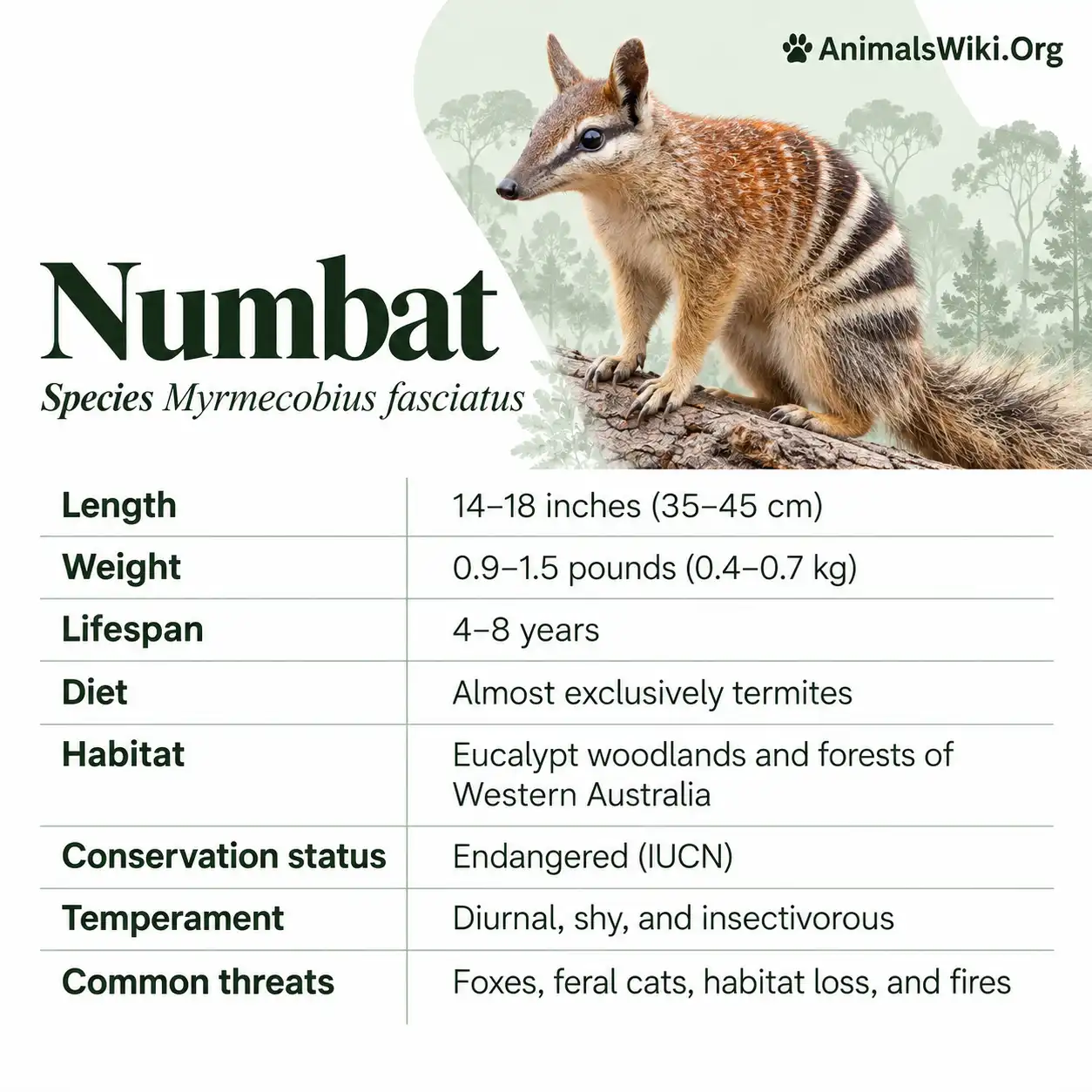
Numbat, The Striped Termite-Eating Marsupial of Australia
The Numbat is one of Australia’s most unusual marsupials.
Small.
Slender.
Rusty-red.
Covered with striking white stripes.
And equipped with a remarkably long, sticky tongue designed for eating one particular type of food:
termites.
Its scientific name is:
Myrmecobius fasciatus.
At first glance, a Numbat can look like a strange combination of:
- Squirrel
- Mongoose
- Small fox
- Anteater
But it is none of these.
The Numbat is a:
marsupial.
It belongs to an ancient Australian mammalian lineage and is the only living species in the family:
Myrmecobiidae.
Unlike Kangaroos, Koalas and many other famous marsupials, however, the female Numbat does not possess a conventional:
pouch.
Instead, her tiny newborn young attach directly to teats on the underside of her abdomen, where surrounding fur and skin folds provide some:
protection.
The Numbat is unusual in another important way.
Many Australian predatory and insect-eating marsupials are:
nocturnal.
The Numbat is primarily:
diurnal.
It searches for food during daylight.
There is a very good reason.
Its life is synchronized with:
termites.
Numbats do not normally smash open enormous termite mounds in the way a powerful anteater might.
Instead, they search for shallow underground termite galleries.
When termites move close enough to the surface, a Numbat uses its:
- Sensitive nose
- Strong forefeet
- Claws
- Narrow snout
- Long sticky tongue
to reach them.
A single adult can consume:
thousands of termites in one day.
Its narrow tongue may extend several centimeters beyond the mouth and is coated with sticky saliva that helps collect the tiny insects.
The animal’s teeth are also unusual.
Because termites require relatively little chewing, Numbats have numerous small, reduced teeth rather than the large cutting teeth expected in many carnivorous mammals.
Their appearance is equally distinctive.
Across the back and rump run a series of:
white transverse stripes.
The front of the body is usually reddish or rusty brown.
A dark stripe passes through the eye.
And behind the animal extends a long, bushy tail.
When alarmed, the Numbat can rush toward:
- A hollow log
- A burrow
- A tree cavity
- Dense shelter
where it may wedge itself securely away from danger.
That danger is substantial.
Numbats were once distributed across an enormous portion of:
southern Australia.
Today their natural distribution is dramatically smaller.
Major pressures have included:
- Introduced Red Foxes
- Feral Cats
- Habitat destruction
- Habitat fragmentation
- Changes to fire regimes
- Loss of hollow logs and shelter
Conservation programs now use:
- Predator control
- Captive breeding
- Reintroductions
- Fenced sanctuaries
- Habitat management
- Population monitoring
to restore this remarkable animal.
The Numbat has also become a symbol of wildlife conservation in:
Western Australia, where it is the state’s mammal emblem.
This comprehensive guide explores Numbat facts, scientific classification, appearance, stripes, size, weight, habitat, Australian distribution, termite diet, long tongue, teeth, daytime behavior, burrows, reproduction, lack of a true pouch, baby Numbats, lifespan, adaptations, predators, Numbat vs Anteater, Numbat vs Bilby, danger to humans, conservation, reintroduction and why the Numbat is one of Australia’s most unusual surviving marsupials.
Numbat Facts
| Feature | Information |
|---|---|
| Common Name | Numbat |
| Other Name | Banded Anteater |
| Scientific Name | Myrmecobius fasciatus |
| Animal Type | Mammal |
| Mammal Group | Marsupial |
| Order | Dasyuromorphia |
| Family | Myrmecobiidae |
| Genus | Myrmecobius |
| Living Species | 1 |
| Native Country | Australia |
| Major Wild Stronghold | Western Australia |
| Habitat | Woodland & forest |
| Diet | Primarily termites |
| Activity | Primarily diurnal |
| Body Length | Roughly 20–30 cm |
| Tail Length | Roughly 15–20+ cm |
| Weight | Roughly 300–700 g |
| Tongue | Long and sticky |
| Coat | Reddish-brown with white stripes |
| Lifestyle | Mostly solitary |
| Reproduction | Marsupial |
| True Pouch | Absent |
| Typical Maximum Litter | Up to 4 surviving attached young |
| Major Threats | Foxes, feral cats & habitat change |
| Special Distinction | Only living member of Myrmecobiidae |
What Is a Numbat?
A Numbat is a small termite-eating marsupial native to:
Australia.
Its scientific name is:
Myrmecobius fasciatus.
It is famous for its:
- White stripes
- Long tongue
- Termite diet
- Daytime activity
Is a Numbat a Marsupial?
Yes.
The Numbat is a:
marsupial mammal.
However, its reproductive anatomy differs from that of familiar pouched marsupials such as:
- Kangaroos
- Wallabies
- Koalas
Female Numbats do not have a fully developed permanent pouch.
Is a Numbat an Anteater?
No.
One alternative common name is:
banded anteater.
But the Numbat is not a true anteater.
True anteaters are placental mammals native to:
Central and South America.
The Numbat is an Australian:
marsupial.
Their similarities developed independently because both evolved to feed heavily on:
social insects.
Is a Numbat a Rodent?
No.
Despite its size and bushy tail, the Numbat is not:
- A rat
- A mouse
- A squirrel
It is a marsupial.
Is a Numbat Related to the Tasmanian Devil?
Yes, but distantly.
Both belong to the marsupial order:
Dasyuromorphia.
However, the Numbat belongs to its own living family:
Myrmecobiidae.
The Tasmanian Devil belongs to:
Dasyuridae.
Scientific Classification of the Numbat
| Classification | Name |
|---|---|
| Kingdom | Animalia |
| Phylum | Chordata |
| Class | Mammalia |
| Order | Dasyuromorphia |
| Family | Myrmecobiidae |
| Genus | Myrmecobius |
| Species | Myrmecobius fasciatus |
How Many Numbat Species Are There?
There is only one living species:
Myrmecobius fasciatus.
This makes the Numbat especially evolutionarily distinctive.
If the species disappeared, an entire surviving branch represented by the family Myrmecobiidae would disappear with it.
What Does a Numbat Look Like?
A Numbat has:
- Long pointed snout
- Small rounded ears
- Dark eye stripe
- Reddish-brown coat
- White bands across the back
- Slender body
- Short legs
- Strong claws
- Long bushy tail
It is one of Australia’s most visually distinctive small mammals.
Why Does a Numbat Have Stripes?
Numbats typically have several pale or white stripes across the:
rear half of the body.
These markings may help break up the animal’s outline against:
- Logs
- Leaf litter
- Woodland shadows
- Vegetation
However, it is safer to describe camouflage as a likely advantage rather than claim that the stripes evolved for one proven purpose.
How Many Stripes Does a Numbat Have?
The number and appearance vary between individuals.
Typically, several prominent white bands occur across the back and:
rump.
What Color Is a Numbat?
Numbats can display:
- Reddish-brown
- Rust
- Gray-brown
- Black
- White
The white bands contrast strongly with the darker body.
How Big Is a Numbat?
The head-and-body length is roughly:
20–30 cm.
The tail can add approximately:
15–20 cm or more.
How Much Does a Numbat Weigh?
Adults commonly weigh roughly:
300–700 grams, with variation among individuals and sexes.
Males are generally:
larger than females.
Is a Numbat Bigger Than a Squirrel?
Size depends on the squirrel species.
A Numbat is comparable in general scale to some:
medium-sized squirrels, although its anatomy is very different.
Where Do Numbats Live?
Numbats are native only to:
Australia.
Historically, they occupied a vast area across southern parts of the continent.
Their modern natural distribution became concentrated primarily in:
Western Australia.
Conservation programs have also established or re-established populations at selected sites elsewhere.
Did Numbats Once Live Across Australia?
Their historical distribution was much broader than it is today.
They once occurred across large portions of:
southern Australia.
The contraction of their range has been one of the most dramatic aspects of their conservation history.
Numbat Habitat
Numbats inhabit environments such as:
- Eucalypt woodland
- Dry forest
- Open woodland
- Areas with abundant fallen timber
Good habitat needs more than just:
termites.
Numbats also require places where they can hide from predators.
Why Are Hollow Logs Important to Numbats?
Logs provide:
- Shelter
- Escape sites
- Resting places
- Nesting locations
- Protection from predators
A Numbat pursued by a predator may rush into a hollow log and wedge itself:
inside.
Do Numbats Live Underground?
They use both:
burrows and hollow logs.
A Numbat may shelter in underground burrows, tree hollows or fallen timber.
Do Numbats Climb Trees?
They can climb to some extent, particularly when using:
hollow logs and trees.
However, they spend much of their feeding time:
on the ground.
Are Numbats Nocturnal?
No.
One of the Numbat’s most distinctive traits is that it is primarily:
diurnal.
It is active mainly during:
daylight.
Why Are Numbats Active During the Day?
Their activity closely follows the availability of:
termites near the soil surface.
Termite movements change with:
- Temperature
- Season
- Soil conditions
The Numbat adjusts its daily schedule accordingly.
Are Numbats Active All Day?
Not necessarily.
Activity patterns vary seasonally.
During cooler periods, Numbats may forage when temperatures rise enough for termites to become accessible.
During hot periods, activity may be divided between:
morning and later afternoon.
What Do Numbats Eat?
Numbats are highly specialized:
termite eaters.
Termites make up the overwhelming majority of their natural diet.
They may occasionally consume other small invertebrates, often incidentally.
Do Numbats Eat Ants?
They may consume some ants or other insects, but they are much more specialized toward:
termites.
Calling the Numbat primarily an ant-eater would therefore be misleading.
How Many Termites Does a Numbat Eat?
An adult Numbat is often estimated to consume around:
15,000–20,000 termites per day.
The actual number varies with:
- Body size
- Season
- Termite availability
- Energy requirements
The figure is best understood as an approximate daily estimate rather than an exact fixed number.
How Does a Numbat Find Termites?
The Numbat uses its:
excellent sense of smell
to locate shallow termite galleries beneath soil, bark and debris.
It then digs into the gallery with:
its claws.
Does a Numbat Break Open Termite Mounds?
Usually not in the dramatic way large anteaters or powerful digging mammals might.
Instead, Numbats often exploit termite:
foraging galleries close to the surface.
Their claws are useful, but they are not built to demolish extremely hard termite mounds.
How Does a Numbat Eat Termites?
Once a termite gallery is exposed, the Numbat inserts its:
long sticky tongue.
Termites adhere to saliva on the tongue and are pulled into:
the mouth.
How Long Is a Numbat’s Tongue?
The tongue can extend roughly:
10 cm
from the mouth, an extraordinary distance for such a small animal.
Why Is the Numbat Tongue Sticky?
Sticky saliva allows the tongue to collect:
many tiny termites quickly.
This is much more efficient than attempting to pick them up individually with:
teeth.
Does a Numbat Have Teeth?
Yes.
Numbats have numerous:
small teeth.
How Many Teeth Does a Numbat Have?
Numbats are unusual among terrestrial mammals because they can have approximately:
50 teeth, with some individual variation.
The teeth are relatively small and reduced.
Why Does a Numbat Have So Many Small Teeth?
Its food requires relatively little:
chewing.
Termites are small and soft compared with vertebrate prey.
As a result, the Numbat does not require massive carnassial teeth for slicing flesh or large molars for crushing hard plants.
Does a Numbat Chew Termites?
Termites require relatively little processing.
Many can be swallowed after being collected by the:
tongue.
Does a Numbat Drink Water?
Numbats obtain substantial moisture from their:
food.
They can survive without regularly drinking large amounts of free-standing water.
Numbat Behavior
Numbats are generally:
solitary.
Adults typically forage alone.
Do Numbats Live in Groups?
Not normally.
Adults generally maintain individual:
home ranges.
They come together primarily for:
breeding.
Are Numbats Territorial?
They use defined home ranges, and adults can show territorial behavior toward members of the same sex.
Scent and other signals help communicate:
occupancy.
How Do Numbats Communicate?
Communication can involve:
- Scent
- Body posture
- Vocalizations
Their social communication is less conspicuous than that of highly social mammals.
Do Numbats Make Sounds?
Yes.
They can produce various sounds, including soft:
- Clicks
- Growls
- Hisses
especially during social or defensive situations.
How Fast Can a Numbat Run?
Numbats can run quickly when escaping:
danger.
Reliable standardized maximum-speed measurements are limited, so precise internet speed rankings should be treated cautiously.
How Do Numbats Escape Predators?
A threatened Numbat may:
- Freeze
- Run rapidly
- Enter a hollow log
- Enter a burrow
- Hide among fallen timber
Its striped coat can also make it harder to detect against complex woodland backgrounds.
Can a Numbat Defend Itself?
Its main strategy is:
escape and concealment.
A Numbat is too small to fight effectively against major predators such as:
- Foxes
- Cats
- Large raptors
Why Does a Numbat Wedge Itself Into Logs?
When threatened inside a narrow hollow, a Numbat can press its body firmly against the:
walls.
This can make it difficult for a predator to pull the animal:
out.
Numbat Reproduction
Numbats usually breed during:
summer.
Mating generally occurs around the beginning of the year, although timing varies.
How Long Is a Numbat Pregnant?
Gestation is very short, as is typical for many marsupials.
Pregnancy lasts approximately:
two weeks.
How Many Babies Does a Numbat Have?
A female can give birth to several tiny newborns.
Usually no more than:
four
can remain successfully attached because she has four functional teats.
What Is a Baby Numbat Called?
Like many marsupial young, a baby Numbat can be called a:
joey.
Does a Numbat Have a Pouch?
This is one of the most fascinating Numbat facts.
Female Numbats do:
not have a conventional permanent pouch.
The teats are exposed on the underside of the abdomen.
Long hairs and folds of skin around the mammary area provide some protection for the attached young.
How Do Baby Numbats Survive Without a Pouch?
The tiny newborns attach firmly to:
the mother’s teats.
They remain attached as she moves around.
Protective abdominal fur helps shield them.
How Small Are Newborn Numbats?
Like other marsupials, newborn Numbats are:
extremely tiny and underdeveloped.
They must crawl to the mammary area and attach to a teat.
How Long Do Numbat Babies Stay Attached?
Young remain attached to the mother’s teats for approximately:
six to seven months.
As they grow larger, carrying them becomes increasingly difficult.
What Happens When Baby Numbats Become Too Large to Carry?
The mother leaves them in a:
nest or burrow
while she goes out to forage.
She returns to:
nurse them.
When Do Young Numbats Begin Eating Termites?
Young gradually begin learning to forage as they grow and accompany their mother.
By the time they approach independence, they increasingly depend on:
termites.
When Do Numbats Become Independent?
Young generally become independent by around:
late in their first year, often roughly nine to ten months after birth.
Do Male Numbats Raise the Babies?
Primary parental care is provided by:
the female.
Males do not normally participate extensively in raising the young.
Numbat Lifespan
Numbats can live for several years in the wild.
Under managed conditions, some individuals can survive:
longer.
Exact lifespan varies substantially because wild animals face heavy predation pressure.
Numbat Adaptations
Long Sticky Tongue
Extracts termites from narrow galleries.
Narrow Snout
Allows access to small openings.
Strong Claws
Expose shallow termite tunnels.
Excellent Sense of Smell
Locates termites beneath soil and debris.
Numerous Small Teeth
Suit a diet dominated by small soft-bodied insects.
Diurnal Activity
Synchronizes foraging with termite availability.
Striped Coat
May help break up the body’s outline in woodland habitat.
Bushy Tail
Can provide balance and visual concealment.
Hollow-Log Refuge
Provides protection from predators.
Low Dependence on Drinking Water
Moisture-rich prey helps satisfy water requirements.
What Animals Eat Numbats?
Natural and introduced predators can include:
- Birds of prey
- Large snakes
- Dingoes
- Red Foxes
- Feral Cats
Introduced predators have been particularly damaging.
Do Foxes Eat Numbats?
Yes.
Introduced:
Red Foxes
became one of the most serious historical threats to Numbats.
Do Cats Kill Numbats?
Yes.
Feral Cats are capable predators of:
Numbats.
Their impact remains an important conservation concern.
Do Eagles Eat Numbats?
Large birds of prey can kill:
Numbats.
Their daytime activity makes them potentially visible to aerial predators.
Do Snakes Eat Numbats?
Large snakes can potentially prey on:
Numbats, especially smaller individuals.
Why Are Numbats Vulnerable to Predators?
Several factors contribute:
- Small body size
- Ground foraging
- Daytime activity
- Open woodland habitat
- Limited ability to physically fight large predators
Introduced mammalian predators created pressures that the species did not historically experience at the same intensity.
Numbat vs. Anteater
| Feature | Numbat | True Anteater |
|---|---|---|
| Mammal Type | Marsupial | Placental |
| Native Region | Australia | Central & South America |
| Main Food | Termites | Ants & termites |
| Tongue | Long & sticky | Very long & sticky |
| Teeth | Many small teeth | Adults lack teeth |
| Size | Small | Varies; Giant Anteater much larger |
| Relationship | Not closely related | Xenarthran |
Their similarities are a classic example of:
convergent evolution.
Numbat vs. Bilby
| Feature | Numbat | Greater Bilby |
|---|---|---|
| Diet | Mostly termites | Omnivorous |
| Activity | Diurnal | Mostly nocturnal |
| Ears | Small/medium | Very large |
| Stripes | Prominent rear stripes | No comparable pattern |
| Pouch | No true pouch | Pouch present |
| Lifestyle | Surface forager | Strong burrower |
Numbat vs. Tasmanian Devil
Both belong to:
Dasyuromorphia.
But they have very different lifestyles.
The Tasmanian Devil is a powerful carnivore and scavenger.
The Numbat is a small specialist that feeds primarily on:
termites.
Numbat vs. Squirrel
The resemblance is superficial.
Squirrels are:
placental rodents.
Numbats are:
marsupials.
Their evolutionary histories are completely different.
Numbat vs. Mongoose
Both can have:
- Long bodies
- Pointed snouts
- Long tails
But mongooses are placental carnivores from completely different evolutionary lineages.
Are Numbats Dangerous to Humans?
No.
Numbats are:
small, shy animals.
They pose essentially no meaningful predatory danger to people.
Do Numbats Bite?
Like almost any wild mammal, a frightened or restrained Numbat could:
bite defensively.
But humans are not prey.
Can Numbats Be Pets?
No.
Numbats are protected native wildlife and require:
specialized conservation management.
Their highly specialized termite diet alone makes them unsuitable as ordinary pets.
Are Numbats Endangered?
Numbats are a major Australian:
conservation priority.
Their wild range has declined dramatically from its historical extent.
Formal conservation categories can change as populations and assessments are updated, so the latest authoritative status should be checked when publishing time-sensitive conservation information.
Why Did Numbats Become Rare?
Their decline resulted from several interacting pressures.
Important factors include:
- Red Fox predation
- Feral Cat predation
- Habitat loss
- Habitat fragmentation
- Altered fire regimes
- Loss of shelter
- Changes in woodland structure
How Much of Their Historical Range Was Lost?
The Numbat disappeared from the overwhelming majority of its former continental distribution.
Its remaining natural populations became concentrated in only a small part of:
southwestern Western Australia.
Are Numbats Extinct in Other Parts of Australia?
They disappeared from many parts of their historical range.
However, conservationists have subsequently:
reintroduced Numbats to selected areas.
Where Are Numbats Being Reintroduced?
Reintroduction programs have established populations at carefully managed sites in Australia, including:
- Predator-controlled reserves
- Fenced sanctuaries
- Restored historical habitat
Specific active populations should be checked against current conservation program data because reintroduction status changes over time.
How Are Numbats Protected?
Conservation strategies include:
- Fox control
- Feral Cat control
- Captive breeding
- Reintroduction
- Predator-proof fencing
- Habitat restoration
- Fire management
- Population monitoring
- Genetic management
- Public education
Does Captive Breeding Help Numbats?
Yes.
Captive breeding has produced animals for:
reintroduction programs.
This helps establish additional populations and reduces dependence on a small number of wild strongholds.
Why Is Predator Control Important?
A habitat can contain abundant termites and still fail to support Numbats if introduced predators kill animals faster than the population can:
replace them.
Controlling Foxes and Cats can therefore dramatically improve survival.
Why Is Fire Management Important?
Fire is a natural component of many Australian ecosystems.
But inappropriate fire frequency or intensity can remove:
- Hollow logs
- Ground cover
- Shelter
- Habitat complexity
Careful fire management can help maintain the structural features Numbats require.
Why Are Fallen Logs Important?
Dead timber provides:
- Nesting sites
- Escape refuges
- Cover
Removing too much fallen wood can reduce available:
shelter.
Why Are Numbats Important?
Numbats represent an evolutionarily distinctive branch of:
Australian marsupials.
They also participate in woodland food webs by consuming enormous numbers of:
termites.
Is the Numbat Western Australia’s Animal Emblem?
Yes.
The Numbat is the:
mammal emblem of Western Australia.
This gives it particular cultural and conservation importance within the state.
50 Interesting Numbat Facts
- The Numbat is a mammal.
- Its scientific name is Myrmecobius fasciatus.
- It is a marsupial.
- It belongs to the order Dasyuromorphia.
- The Numbat is the only living member of Myrmecobiidae.
- Numbats are native only to Australia.
- Their historical range was much larger than their modern range.
- Western Australia contains their most important natural strongholds.
- Numbats have reddish-brown fur.
- They have distinctive white stripes.
- A dark stripe passes through the eye.
- They have long bushy tails.
- Numbats are relatively small.
- Adults commonly weigh less than one kilogram.
- Males are generally larger than females.
- Numbats are primarily diurnal.
- This is unusual among many Australian small predatory marsupials.
- Their activity follows termite availability.
- Termites dominate the Numbat diet.
- An adult may consume thousands of termites every day.
- Estimates can reach roughly 15,000–20,000 termites daily.
- Numbats use smell to locate termites.
- Their claws expose shallow termite galleries.
- They have long sticky tongues.
- The tongue can extend several centimeters beyond the mouth.
- Numbats do not normally destroy massive termite mounds.
- They possess many small teeth.
- The number can approach about 50.
- Numbats are generally solitary.
- They forage mostly on the ground.
- Hollow logs provide important shelter.
- Numbats also use burrows.
- They can wedge themselves inside narrow refuges.
- Female Numbats do not have a conventional permanent pouch.
- Their young attach directly to exposed abdominal teats.
- Protective fur surrounds the nursing young.
- Females have four functional teats.
- Up to four young can normally remain attached successfully.
- Baby Numbats can be called joeys.
- Young eventually remain in a nest while their mother forages.
- Red Foxes have caused major Numbat losses.
- Feral Cats are also serious predators.
- Raptors can prey on Numbats.
- Habitat loss contributed to their decline.
- Altered fire regimes can affect shelter availability.
- Captive breeding supports conservation.
- Numbats have been reintroduced into parts of their historical range.
- Predator-proof sanctuaries provide important populations.
- The Numbat is Western Australia’s mammal emblem.
- Its combination of termite specialization, daytime activity, striped coat and pouchless marsupial reproduction makes the Numbat one of Australia’s most unusual mammals.
Did You Know?
The daily schedule of a Numbat is controlled partly by animals thousands of times smaller than itself.
The sun rises over an Australian:
woodland.
A Numbat emerges from a hollow log.
For many small mammals, daylight would be the time to:
hide.
Daylight exposes them to:
- Eagles
- Hawks
- Other predators
But the Numbat comes:
out.
Why?
Because its food is beginning to move.
Beneath the soil, thousands of:
termites
travel through narrow tunnels.
The Numbat cannot simply walk up to a giant termite mound and tear it apart.
Its body is too:
small.
Instead, it searches.
Its pointed nose moves close to:
the ground.
Its sense of smell detects activity below the surface.
It stops.
Then:
digs.
The claws break through the thin layer of soil covering a termite gallery.
But the opening is narrow.
Too narrow for the Numbat’s:
head.
That does not matter.
Out comes:
the tongue.
Long.
Thin.
Covered with:
sticky saliva.
It enters the tunnel.
Termites adhere to it.
The tongue disappears back into:
the mouth.
Then it happens again.
And again.
And again.
By the end of the day, the Numbat may have consumed:
thousands upon thousands of termites.
But tomorrow its schedule may:
change.
If the soil becomes colder, termites may remain deeper underground during the morning.
The Numbat waits.
When conditions warm, termites approach the surface.
The Numbat begins:
foraging.
During hotter seasons, midday temperatures may become excessive.
The termites alter their activity.
So does:
the Numbat.
Its daily routine follows the hidden movements of an insect colony beneath:
the soil.
This creates one of the most fascinating predator-prey relationships in Australian woodland.
The Numbat does not control when its food becomes:
available.
The termites do.
And the Numbat has evolved its entire daily rhythm around:
finding them.
That is why this little striped marsupial is so unusual.
Its:
- Tongue
- Snout
- Claws
- Teeth
- Activity pattern
all tell essentially the same evolutionary story.
A story built around one overwhelmingly important resource:
termites.
Frequently Asked Questions About Numbats
What is a Numbat?
A Numbat is a small termite-eating marsupial native to Australia.
What is the scientific name of the Numbat?
Myrmecobius fasciatus.
Is a Numbat a mammal?
Yes.
Is a Numbat a marsupial?
Yes.
Is a Numbat an anteater?
No. “Banded anteater” is an alternative common name, but true anteaters belong to a completely different mammalian lineage.
Is a Numbat a rodent?
No.
Is a Numbat a squirrel?
No.
Is a Numbat a mongoose?
No.
What family does the Numbat belong to?
Myrmecobiidae.
How many species of Numbat exist?
Only one living species is recognized, Myrmecobius fasciatus.
Is the Numbat related to the Tasmanian Devil?
Both belong to Dasyuromorphia, although they are placed in different families.
What does a Numbat look like?
It has reddish-brown fur, white stripes, a pointed snout, dark eye stripe and long bushy tail.
Why do Numbats have stripes?
The markings may help break up their outline in woodland habitat, although their precise evolutionary function is not completely established.
How many stripes does a Numbat have?
The number varies, but several white bands typically cross the rear of the body.
How big is a Numbat?
Its head and body are roughly 20–30 cm long.
How long is a Numbat’s tail?
Approximately 15–20 cm or more.
How much does a Numbat weigh?
Usually several hundred grams, commonly around 300–700 g.
Are male Numbats bigger than females?
Generally yes.
Where do Numbats live?
In Australia, particularly important surviving and restored populations in Western Australia and selected conservation sites elsewhere.
Are Numbats found anywhere outside Australia naturally?
No.
Did Numbats once live across Australia?
Their historical range extended across a much larger portion of southern Australia.
Why did the Numbat range shrink?
Introduced predators, habitat changes and other human-related pressures caused major declines.
What habitat do Numbats live in?
Woodland and forest habitats with termites and abundant shelter such as fallen logs.
Do Numbats live in trees?
They are primarily terrestrial but can use trees and hollow logs for shelter.
Do Numbats live in burrows?
Yes.
Do Numbats use hollow logs?
Yes. Hollow logs are extremely important refuges.
Are Numbats nocturnal?
No. They are primarily diurnal.
Are Numbats active during the day?
Yes.
Why are Numbats diurnal?
Their foraging activity is closely synchronized with when termites become accessible near the soil surface.
Are Numbats active all year?
Yes, although daily activity timing changes with temperature and season.
What do Numbats eat?
Primarily termites.
Do Numbats eat ants?
They may occasionally consume ants or other invertebrates, but termites dominate the diet.
How many termites does a Numbat eat per day?
Often estimated at around 15,000–20,000, although actual intake varies.
How does a Numbat find termites?
Mainly through its highly developed sense of smell.
Does a Numbat dig?
Yes. It uses its claws to expose shallow termite galleries.
Does a Numbat destroy termite mounds?
It generally feeds from accessible termite galleries rather than demolishing hard mounds.
Does a Numbat have a long tongue?
Yes.
How long is a Numbat’s tongue?
It can extend roughly 10 cm from the mouth.
Why is the Numbat tongue sticky?
Sticky saliva allows termites to adhere to it.
Does a Numbat have teeth?
Yes.
How many teeth does a Numbat have?
It can have around 50 small teeth, with some variation.
Why are Numbat teeth small?
Their termite diet requires relatively little heavy chewing.
Does a Numbat drink water?
It obtains much of its moisture from food and does not necessarily need frequent access to free water.
Do Numbats live in groups?
No. Adults are primarily solitary.
Are Numbats territorial?
They maintain individual home ranges and can show territorial behavior.
Do Numbats make sounds?
Yes. They can make quiet clicks, growls and other defensive or social sounds.
Can Numbats run fast?
They can run rapidly when escaping predators.
How do Numbats defend themselves?
Primarily by fleeing into hollow logs, burrows and other shelters.
Can a Numbat fight a Fox?
A Numbat is much smaller and generally relies on escape rather than fighting.
Why do Numbats hide in logs?
Logs provide protection from predators and weather.
Do Numbats have a pouch?
Females do not possess a conventional permanent pouch.
How do Numbats carry babies without a pouch?
Newborns attach to teats on the mother’s abdomen and are protected partly by surrounding fur and skin folds.
How many teats does a female Numbat have?
Four functional teats.
How many babies can a Numbat have?
Several may be born, but up to four can normally remain successfully attached.
What is a baby Numbat called?
A joey.
How long is a Numbat pregnant?
Approximately two weeks.
Are newborn Numbats tiny?
Yes. Like other marsupial newborns, they are extremely small and underdeveloped.
How long do young Numbats remain attached to their mother?
Approximately six to seven months.
What happens after they become too large to carry?
They remain in a nest or burrow while the mother forages.
Does the mother feed her babies milk?
Yes.
Does the male Numbat care for babies?
Parental care is primarily provided by the female.
When do Numbats become independent?
Generally toward the end of their first year.
How long do Numbats live?
They can live several years, with longer lifespans possible under managed conditions.
What predators eat Numbats?
Predators include Foxes, Feral Cats, raptors, snakes and other carnivores.
Do Foxes kill Numbats?
Yes. Introduced Red Foxes have been a major threat.
Do Feral Cats kill Numbats?
Yes.
Do Eagles eat Numbats?
Large birds of prey can prey on Numbats.
Do snakes eat Numbats?
Large snakes can potentially take them.
Are Numbats dangerous to humans?
No.
Do Numbats attack people?
No. They are small and generally shy.
Can a Numbat bite?
A frightened wild animal could bite defensively, but Numbats pose little danger to humans.
Can Numbats be pets?
No. They are protected wildlife with highly specialized ecological requirements.
What is the difference between a Numbat and an Anteater?
A Numbat is an Australian marsupial with teeth; true anteaters are American placental mammals and adult anteaters lack teeth.
What is the difference between a Numbat and a Bilby?
Numbats are daytime termite specialists, while Bilbies are mostly nocturnal omnivorous burrowers.
What is the difference between a Numbat and a Tasmanian Devil?
Both are Australian marsupials, but Devils are much larger carnivores and scavengers while Numbats specialize in termites.
What is the difference between a Numbat and a Squirrel?
Numbats are marsupials; squirrels are rodents.
Are Numbats rare?
Yes. Their present distribution is only a fraction of their historical range.
Are Numbats endangered?
They are a threatened species and major conservation priority. The latest formal conservation category should be checked against the current authoritative assessment when needed.
How many Numbats are left?
There is no perfectly precise real-time census of every wild Numbat. Population estimates change as breeding, surveys and reintroductions continue.
Why are Numbats threatened?
Predation by introduced Foxes and Cats, habitat loss, fragmentation and unsuitable fire regimes are major factors.
Why are Foxes so dangerous to Numbats?
Numbats are small ground-foraging mammals and can be readily killed by introduced Red Foxes.
Why are Feral Cats dangerous?
Cats are efficient predators of small and medium-sized Australian wildlife.
Does habitat loss threaten Numbats?
Yes.
Does fire threaten Numbats?
Poorly managed or extremely intense fire can remove shelter and alter habitat, although fire itself is a natural part of Australian ecosystems.
Why do Numbats need dead logs?
Logs provide shelter, nesting sites and escape refuges.
Are Numbats bred in captivity?
Yes. Conservation breeding supports reintroduction and population recovery.
Have Numbats been reintroduced?
Yes. They have been returned to selected protected areas within parts of their historical range.
Do predator-proof fences help Numbats?
Yes. Fenced sanctuaries can protect populations from introduced predators.
Can Numbats recover?
Recovery is possible where predator pressure is controlled and suitable habitat is protected.
Is the Numbat an emblem?
Yes. It is Western Australia’s mammal emblem.
Why is the Numbat important?
It is an evolutionarily distinctive marsupial, a specialized termite predator and an important symbol of Australian conservation.
What is the most interesting Numbat fact?
The Numbat is a daytime Australian marsupial that can eat thousands of termites using a tongue almost half the length of its body, yet unlike most familiar marsupials, the female has no conventional pouch for carrying her tiny young.
Conclusion
The Numbat does not survive through:
size.
It does not possess the jaws of a:
Tasmanian Devil.
It cannot leap like a:
Kangaroo.
It does not have the armor of an:
Echidna.
Instead, nearly every part of its body is centered around something much smaller:
termites.
Its snout searches the ground.
Its nose detects hidden colonies.
Its claws open:
shallow galleries.
Its extraordinary tongue reaches inside.
Thousands of termites disappear.
And the Numbat moves on.
This specialization shaped not only what the animal eats but also:
when it lives its daily life.
As termite activity changes with temperature, the Numbat changes its:
schedule.
When termites are accessible in the morning, it forages in:
the morning.
When seasonal conditions shift, its activity shifts with:
them.
This makes the Numbat an extraordinary example of an animal whose life is synchronized with:
its prey.
Its reproduction is equally unusual.
Although it is a marsupial, the female has no conventional:
pouch.
Tiny newborns attach directly to:
four teats.
For months, the mother carries them beneath:
her body.
Eventually they become too large.
She leaves them protected inside a:
nest.
Then she goes back outside.
Searching.
Digging.
Feeding.
But the greatest challenge facing the Numbat has not come from:
termites.
It came from changes to:
Australia.
Introduced Foxes spread across the continent.
Feral Cats became widespread.
Woodlands changed.
Habitat disappeared.
Shelter declined.
And an animal that once occupied an enormous area of southern Australia vanished from most of:
its range.
Yet the Numbat survived.
Conservationists protected remaining populations.
Foxes were controlled.
Cats were managed.
Numbats were bred.
Animals were released into:
restored habitats.
New populations were established behind:
predator-resistant fences.
And slowly, a species once pushed toward disappearance began returning to parts of:
its former world.
The Numbat’s story therefore represents two things.
Extreme:
specialization.
And remarkable:
survival.
A small striped marsupial.
A termite hunter.
A daytime specialist.
An animal without a conventional pouch.
And one of the most distinctive mammals found anywhere in:
Australia.



