
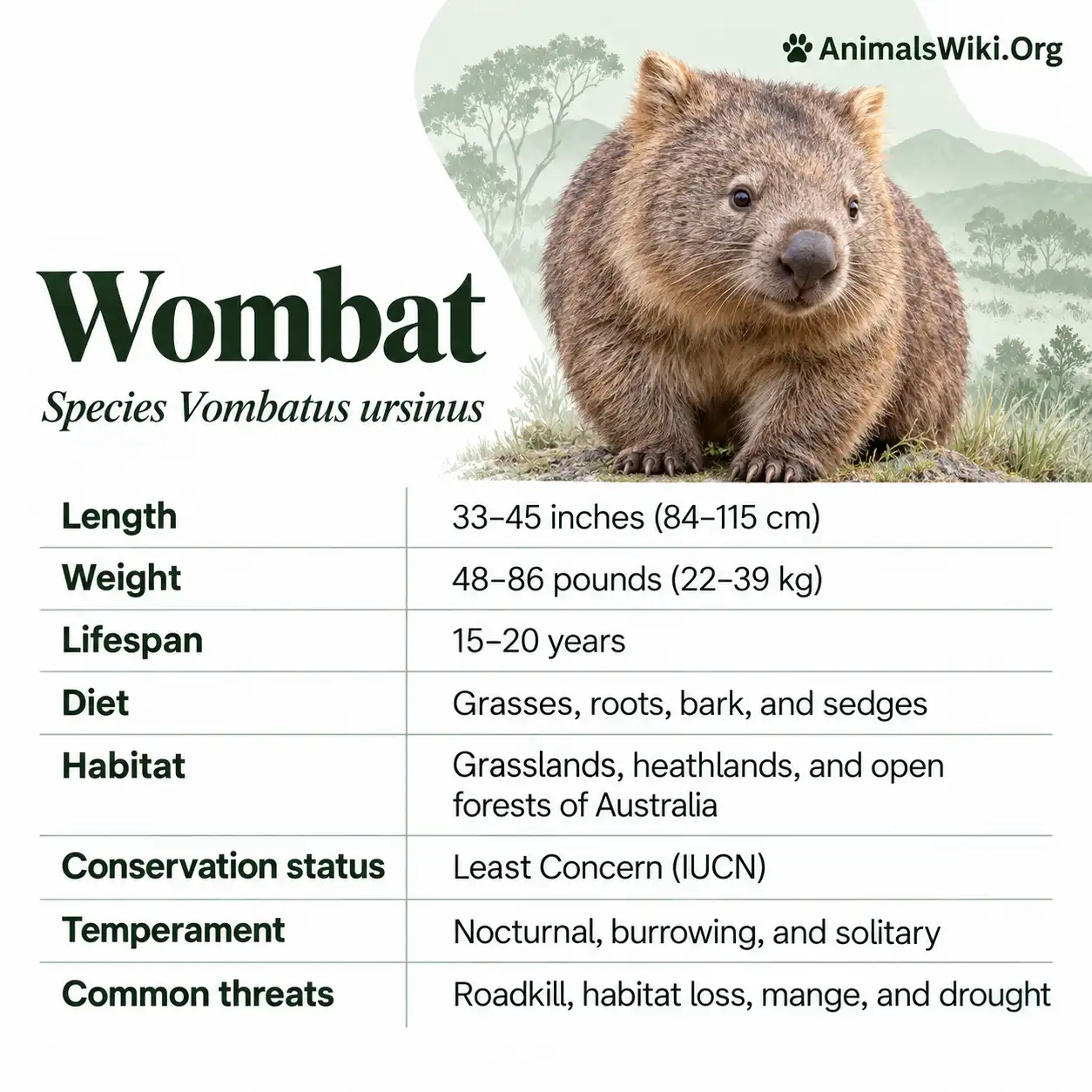
Wombat, The Powerful Burrowing Marsupials of Australia
The Wombat is one of Australia’s most recognizable marsupials.
Short-legged.
Heavy-bodied.
Powerfully built.
Expert at digging.
And famous for producing something almost no other animal on Earth is known to make:
cube-shaped poop.
Wombats are native to:
Australia.
There are three living species:
- Common Wombat — Vombatus ursinus
- Southern Hairy-nosed Wombat — Lasiorhinus latifrons
- Northern Hairy-nosed Wombat — Lasiorhinus krefftii
Together they belong to the family:
Vombatidae.
Wombats are:
marsupials.
Their closest living relatives are:
Koalas.
That relationship may seem surprising.
Koalas spend much of their lives:
in trees.
Wombats spend much of theirs:
underground.
Yet both belong to the marsupial suborder:
Vombatiformes.
Wombats are extraordinary excavators.
Their compact bodies contain:
- Powerful shoulders
- Muscular forelimbs
- Strong claws
- Sturdy legs
These adaptations allow them to construct extensive:
burrow systems.
A burrow protects a Wombat from:
- Heat
- Cold
- Weather
- Predators
This underground lifestyle is particularly valuable in Australia’s often:
harsh climate.
The Wombat possesses another unusual adaptation.
Its pouch opens toward the:
rear.
This prevents much of the soil thrown backward during digging from entering the pouch and covering:
the joey.
Wombats are mainly:
herbivores.
Their diet includes:
- Grasses
- Sedges
- Roots
- Bark
- Other vegetation
They possess continuously growing:
teeth.
This helps compensate for the wear caused by chewing tough, abrasive plant material.
Despite their chunky appearance, Wombats are not necessarily:
slow.
When threatened, a Wombat can run surprisingly quickly over short distances.
But running is usually not its best defense.
A frightened Wombat may rush toward:
its burrow.
The rear of its body is protected by:
- Thick skin
- Dense tissue
- Strong bone
- Powerful muscles
The Wombat can use this reinforced rump to block the tunnel behind it.
This has produced many dramatic stories about Wombats crushing predators against burrow roofs. The hardened rear is genuinely defensive, but sensational claims about routinely crushing predators’ skulls should be treated:
cautiously.
And then there is the poop.
Wombat feces can form distinct:
cubes.
This does not happen because the animal has a square anus.
Instead, the unusual shape develops inside the:
intestine.
Different regions of the intestinal wall stretch and contract differently as moisture is removed from digested material.
The result is one of the strangest digestive products in:
the mammal world.
This comprehensive guide explores Wombat facts, species, scientific classification, appearance, size, weight, Australian habitat, burrows, digging, diet, teeth, cube-shaped poop, backward pouch, behavior, speed, reproduction, joeys, lifespan, adaptations, predators, Wombat vs Koala, Wombat vs Capybara, Wombat vs Badger, danger to humans, conservation and the extraordinary biology of Australia’s powerful burrowing marsupials.
Wombat Facts
| Feature | Information |
|---|---|
| Common Name | Wombat |
| Animal Type | Mammal |
| Mammal Group | Marsupial |
| Family | Vombatidae |
| Living Species | 3 |
| Native Country | Australia |
| Diet | Herbivorous |
| Lifestyle | Primarily solitary |
| Activity | Mostly nocturnal/crepuscular |
| Habitat | Forest, woodland, heath & grassland |
| Body Length | Roughly 70–120 cm |
| Weight | Commonly about 20–35+ kg |
| Body Shape | Stocky & muscular |
| Main Shelter | Burrow |
| Teeth | Continuously growing |
| Pouch | Backward-opening |
| Young | Joey |
| Typical Litter | Usually 1 |
| Famous Feature | Cube-shaped feces |
| Closest Living Relatives | Koalas |
| Major Threats | Habitat loss, roads, disease & competition; varies by species |
How Many Species of Wombat Are There?
There are:
three living species.
Common Wombat
Scientific name:
Vombatus ursinus
Also called the:
Bare-nosed Wombat.
Southern Hairy-nosed Wombat
Scientific name:
Lasiorhinus latifrons
It inhabits drier regions of:
southern Australia.
Northern Hairy-nosed Wombat
Scientific name:
Lasiorhinus krefftii
It is the rarest of the three living Wombat species and has been the focus of intensive:
conservation.
Scientific Classification
| Classification | Name |
|---|---|
| Kingdom | Animalia |
| Phylum | Chordata |
| Class | Mammalia |
| Order | Diprotodontia |
| Suborder | Vombatiformes |
| Family | Vombatidae |
Is a Wombat a Marsupial?
Yes.
Wombats are:
marsupial mammals.
Females possess a pouch in which the young continue developing after:
birth.
Is a Wombat a Rodent?
No.
Wombats can look vaguely rodent-like because of their:
- Strong front teeth
- Stocky body
- Burrowing behavior
But they are not rodents.
They are:
marsupials.
Is a Wombat Related to a Koala?
Yes.
Wombats and Koalas are each other’s closest living relatives.
Both belong to:
Vombatiformes.
Their evolutionary relationship is much closer than their very different lifestyles might suggest.
What Does a Wombat Look Like?
Wombats have:
- Large heads
- Small eyes
- Short ears
- Thick necks
- Barrel-shaped bodies
- Short muscular legs
- Strong claws
- Very short tails
Their bodies are designed more for:
strength and digging
than speed or agility.
What Color Are Wombats?
Coat color varies by species and individual.
Possible colors include:
- Brown
- Gray
- Blackish brown
- Sandy brown
- Silver-gray
What Is a Hairy-nosed Wombat?
The two species in the genus Lasiorhinus possess:
- Hairy muzzles
- Longer ears
- Softer-looking fur
than the Common Wombat.
The Common Wombat has a comparatively:
bare nose.
How Big Is a Wombat?
Wombats are much larger than many people expect.
Depending on species, sex and individual, adults are generally around:
70–120 cm long.
Their low, broad bodies make them look extremely:
solid.
How Much Does a Wombat Weigh?
Many adult Wombats weigh approximately:
20–35 kg.
Large individuals can exceed this range.
That means a big Wombat may weigh roughly as much as a:
medium-sized dog.
Why Are Wombats So Heavy?
Wombats possess:
- Dense bones
- Strong muscles
- Powerful shoulders
- Thick bodies
Their build is adapted for:
excavation and underground living.
Do Wombats Have Tails?
Yes.
But their tails are:
extremely short.
They are barely noticeable compared with the long tails of Kangaroos and Wallabies.
Where Do Wombats Live?
Wild Wombats occur naturally only in:
Australia.
Different species occupy different parts of the continent.
Where Do Common Wombats Live?
Common Wombats occur primarily in southeastern Australia, including:
- New South Wales
- Victoria
- Tasmania
- Parts of Queensland
- South Australia
Their exact distribution varies regionally.
Where Do Southern Hairy-nosed Wombats Live?
They occur in dry and semi-arid areas of southern Australia.
Important populations occur in:
- South Australia
- Western Australia
- New South Wales
Where Do Northern Hairy-nosed Wombats Live?
The Northern Hairy-nosed Wombat has an extremely restricted distribution in:
Queensland.
Conservation programs have worked to establish additional populations so the species is not dependent on a single location.
Wombat Habitat
Depending on species, Wombats can occupy:
- Forest
- Woodland
- Heathland
- Grassland
- Shrubland
- Semi-arid environments
One important requirement is soil suitable for:
burrowing.
Why Do Wombats Dig Burrows?
Burrows provide:
- Shelter from heat
- Protection from cold
- Resting areas
- Refuge from predators
- Places for females and young
- Stable temperatures
For a Wombat, the burrow is central to:
survival.
How Big Is a Wombat Burrow?
Burrow dimensions vary enormously.
A burrow may extend for:
several meters
and can include:
- Entrances
- Tunnels
- Chambers
- Sleeping areas
Hairy-nosed Wombats may create particularly extensive interconnected burrow systems.
Can Wombats Dig Quickly?
Yes.
Their front legs and claws are powerful enough to move:
substantial quantities of soil.
Their compact body provides excellent leverage.
What Do Wombat Burrows Look Like?
The entrance is generally a broad opening leading into a tunnel.
Freshly excavated soil may accumulate near:
the entrance.
Inside, temperatures are much more stable than conditions:
above ground.
Do Wombats Share Burrows?
It depends on the species and circumstances.
Common Wombats are generally relatively solitary and may use separate burrows.
Southern Hairy-nosed Wombats can live in larger burrow complexes, sometimes called:
warrens.
Multiple animals may occupy different sections of the same system.
Do Other Animals Use Wombat Burrows?
Yes.
Wombat burrows can provide shelter to other wildlife.
This becomes particularly important during:
- Extreme heat
- Cold weather
- Fires
However, claims that Wombats deliberately invite or herd other animals into their burrows during bushfires are:
unsupported.
Other animals may independently use abandoned or accessible burrows.
How Deep Are Wombat Burrows?
Depth varies according to:
- Soil
- Terrain
- Species
- Burrow age
Some systems can extend several meters underground or horizontally into banks.
Are Wombats Nocturnal?
Wombats are primarily:
nocturnal and crepuscular.
They often emerge around:
dusk
and forage through the night.
Do Wombats Come Out During the Day?
Yes.
Daytime activity can occur, especially during:
- Cool weather
- Winter
- Overcast conditions
Activity patterns are influenced strongly by:
temperature.
Why Are Wombats Active at Night?
Night activity helps them avoid:
heat.
This is especially useful for a thick-bodied animal living in Australia.
What Do Wombats Do During the Day?
They often rest inside their:
burrows.
The underground environment helps maintain a more stable temperature.
What Do Wombats Eat?
Wombats are:
herbivores.
Their diet consists mainly of plant material.
Foods can include:
- Native grasses
- Sedges
- Roots
- Herbs
- Bark
- Shrubs
Diet differs according to species and habitat.
Do Wombats Eat Grass?
Yes.
Grass is an important food for:
many Wombats.
Do Wombats Eat Roots?
Yes.
They can consume roots and other underground plant material.
Do Wombats Eat Meat?
Wombats are overwhelmingly:
herbivorous.
Meat is not a normal part of their natural diet.
Do Wombats Eat Eucalyptus?
They may consume some plant material from various native species, but Wombats should not be described as specialized eucalyptus-leaf eaters like:
Koalas.
Their diet is much more focused on:
ground vegetation.
Do Wombats Drink Water?
Yes, when available.
However, Wombats can be extremely:
water-efficient.
They obtain moisture from vegetation and have adaptations that help conserve water.
How Long Does Wombat Digestion Take?
Wombats have a famously:
slow digestive process.
Food can take several days to move through the digestive system.
This prolonged digestion helps extract nutrients and moisture from:
tough vegetation.
Why Is Wombat Poop Cube-Shaped?
This is one of the most famous Wombat facts.
The cubes form inside the:
large intestine.
As digested material moves through the intestine, water is gradually removed.
Research indicates that different regions of the intestinal wall have different:
elastic properties.
These differences help mold the drying feces into:
flat-sided pieces.
The result is:
cube-shaped poop.
Does a Wombat Have a Square Anus?
No.
This is a common myth.
The cube shape develops before the feces leave:
the body.
Is the Wombat the Only Animal With Cube-Shaped Poop?
Wombats are famous for producing consistently:
cube-like feces.
This is exceptionally unusual among mammals and is one of their most distinctive biological traits.
Why Do Wombats Make Cubes?
The precise evolutionary reason is still discussed.
One likely advantage is that cubes are less likely to:
roll away.
This may be useful because Wombats deposit feces on prominent objects as part of:
scent communication.
Do Wombats Use Poop to Mark Territory?
Yes.
Wombats can deposit feces on:
- Rocks
- Logs
- Paths
- Elevated objects
This contributes to:
scent marking and communication.
Why Doesn’t Cube-Shaped Wombat Poop Roll Away?
Its flat surfaces make it more stable than round feces.
That can help keep scent markers positioned on:
raised surfaces.
How Many Cubes Can a Wombat Produce?
A Wombat can produce numerous fecal pieces in a:
single day.
Exact output varies with diet, hydration and individual physiology.
Popular claims of an identical daily number should not be treated as universal.
Do Wombats Have Strong Teeth?
Yes.
Wombats possess large:
incisors
and powerful chewing teeth.
Do Wombat Teeth Keep Growing?
Yes.
Their teeth are:
open-rooted and continuously growing.
This is an important adaptation for eating abrasive vegetation.
Why Do Wombats Need Continuously Growing Teeth?
Grass can contain abrasive material such as:
silica.
Soil may also enter the mouth while Wombats feed close to the ground.
Continuous growth compensates for:
tooth wear.
Are Wombat Teeth Like Rodent Teeth?
There is a superficial similarity because both can have continuously growing incisors.
But Wombats and rodents evolved these characteristics:
independently.
Wombat Behavior
Wombats are generally:
quiet, solitary animals.
Much of their life involves:
- Resting underground
- Foraging
- Maintaining burrows
- Scent marking
Are Wombats Solitary?
Common Wombats are particularly:
solitary.
Hairy-nosed species may show more tolerance of other individuals within large burrow systems.
Are Wombats Territorial?
They maintain home ranges and can defend important areas.
Communication through:
scent
is particularly important.
How Do Wombats Communicate?
They communicate through:
- Scent marking
- Feces
- Urine
- Vocalizations
- Body posture
What Sounds Do Wombats Make?
Wombats can produce:
- Growls
- Hisses
- Grunts
- Screeches
- Snorts
Young animals may also make calls to:
their mothers.
Are Wombats Friendly?
Wild Wombats should not automatically be considered:
friendly.
They may appear calm, but they are powerful wild animals.
Are Wombats Intelligent?
Wombats show learning, spatial memory and behavioral flexibility suited to navigating:
burrow systems and home ranges.
Comparing animal intelligence with a simple ranking is rarely scientifically useful.
Can Wombats Run Fast?
Yes.
Despite their heavy appearance, Wombats can run surprisingly fast over:
short distances.
Frequently cited estimates suggest speeds around:
40 km/h
for short bursts.
This should be understood as an approximate maximum rather than a precisely standardized speed for every species and individual.
Can a Wombat Outrun a Human?
Over a very short distance, a fast Wombat could potentially outrun many:
people.
It is not built for sustained high-speed pursuit.
Can Wombats Swim?
Yes.
Wombats are capable of:
swimming.
Can Wombats Climb Trees?
Adults are primarily terrestrial and are not specialized tree climbers.
Young Wombats can sometimes climb over:
obstacles.
How Strong Is a Wombat?
Extremely strong for its size.
Its strength is concentrated in:
- Shoulders
- Forelimbs
- Neck
- Back
- Hindquarters
These features support powerful:
digging.
How Strong Are Wombat Claws?
The claws are large and robust enough to excavate:
hard soil.
They are important both for digging and defense.
Does a Wombat Have a Hard Butt?
The rear of a Wombat is unusually:
tough and muscular.
It contains thick skin and strong underlying structures.
Why Does a Wombat Have a Tough Rump?
It can use the rear of its body as a:
defensive shield.
When threatened inside a burrow, the Wombat can position its rump toward the attacker.
Can a Wombat Block Its Burrow With Its Butt?
Yes.
This is a genuine defensive behavior.
The Wombat can wedge itself inside a tunnel with its reinforced rear facing:
the predator.
Can a Wombat Crush a Predator’s Skull With Its Butt?
This claim is frequently repeated online.
Wombats certainly possess:
powerful hindquarters
and may trap or injure an attacker in confined spaces.
However, dramatic claims that they routinely crush predator skulls against burrow ceilings are poorly documented and should not be presented as established biological fact.
What Predators Eat Wombats?
Potential predators include:
- Dingoes
- Large dogs
- Tasmanian Devils in Tasmania, particularly around carcasses or vulnerable animals
- Large raptors, mainly threatening small young
Historically, extinct large Australian predators would also have interacted with Wombats.
Do Dingoes Hunt Wombats?
Yes.
Dingoes can prey on:
Wombats.
Adults are difficult prey because of their strength and ability to retreat into burrows.
Do Tasmanian Devils Eat Wombats?
Tasmanian Devils can feed on:
Wombat carcasses
and may potentially attack vulnerable individuals.
Healthy adult Wombats are formidable animals.
How Do Wombats Defend Themselves?
Their main strategies include:
- Running to a burrow
- Powerful digging
- Blocking tunnels with the rump
- Kicking
- Biting
- Using their body strength
Wombat Reproduction
Like other marsupials, Wombats give birth to extremely:
underdeveloped young.
The newborn continues development inside:
the pouch.
Do Wombats Have a Pouch?
Yes.
Female Wombats possess a:
backward-opening pouch.
Why Does a Wombat Pouch Face Backward?
A backward-opening pouch helps prevent soil from filling it while the mother:
digs.
This protects the developing:
joey.
Is the Wombat the Only Marsupial With a Backward Pouch?
No.
Other digging marsupials, including some related species, also possess pouches oriented in ways that help protect young during:
excavation.
How Many Babies Do Wombats Have?
Usually:
one joey at a time.
Twins are uncommon.
What Is a Baby Wombat Called?
A baby Wombat is called a:
joey.
How Big Is a Newborn Wombat?
Like other marsupial newborns, it is:
extremely small and underdeveloped.
After birth, it crawls into the mother’s pouch and attaches to:
a teat.
How Long Is a Wombat Pregnant?
Gestation is short, generally around:
three to four weeks, depending on species.
Most development occurs after birth.
How Long Does a Wombat Joey Stay in the Pouch?
A joey generally remains in the pouch for approximately:
six to ten months, depending on species and individual development.
What Happens After a Joey Leaves the Pouch?
The young Wombat continues to:
- Nurse
- Follow its mother
- Learn feeding behavior
- Use the burrow
It remains dependent for some time after permanently leaving:
the pouch.
How Long Does a Baby Wombat Stay With Its Mother?
Young may remain associated with their mothers for around:
a year or longer, depending on species.
Do Male Wombats Raise Joeys?
Primary parental care is provided by:
the mother.
How Often Do Wombats Reproduce?
Reproductive timing varies by:
- Species
- Rainfall
- Food availability
- Environmental conditions
Because females invest heavily in each joey, Wombats reproduce much more slowly than many small mammals.
Wombat Lifespan
Wild Wombats can live:
well over a decade.
Some individuals may survive into their:
20s.
Under managed care, exceptional Wombats have lived:
more than 30 years.
Lifespan depends on species, habitat, disease and human-related threats.
Wombat Adaptations
Powerful Forelimbs
Allow rapid excavation.
Large Claws
Break and move soil.
Compact Body
Provides leverage underground.
Backward-Opening Pouch
Protects the joey from excavated soil.
Continuously Growing Teeth
Compensate for heavy wear.
Slow Digestion
Extracts nutrients and moisture efficiently.
Water Conservation
Helps survival in dry environments.
Burrowing
Protects against temperature extremes.
Tough Rump
Functions as a defensive barrier.
Nocturnal Activity
Reduces exposure to daytime heat.
Are Wombats Dangerous to Humans?
Wombats generally avoid:
conflict.
But they are extremely strong.
A frightened, cornered or habituated Wombat can:
- Bite
- Scratch
- Charge
- Knock a person down
They should be treated as:
wild animals.
Do Wombats Attack Humans?
Unprovoked serious attacks are:
uncommon.
Incidents are more likely when a Wombat feels:
- Cornered
- Threatened
- Handled
- Prevented from escaping
Can a Wombat Bite?
Yes.
Its powerful incisors can cause:
significant injury.
Can a Wombat Knock Down a Human?
Potentially.
A large Wombat is low, heavy and muscular.
A charging animal could knock a person:
off balance.
Are Wombats Aggressive?
They are not normally aggressive predators.
However, territorial or frightened individuals can defend themselves:
forcefully.
Can You Pet a Wild Wombat?
It is better not to approach or touch:
wild Wombats.
Give them space and avoid blocking access to:
their burrows.
Can Wombats Be Pets?
Wombats are wild native animals and are not suitable:
ordinary pets.
They:
- Dig extensively
- Grow large
- Possess powerful teeth
- Require specialized care
- Can become destructive
- May be legally protected
Wombat vs. Koala
| Feature | Wombat | Koala |
|---|---|---|
| Group | Marsupial | Marsupial |
| Relationship | Close relative | Close relative |
| Lifestyle | Terrestrial/burrowing | Arboreal |
| Diet | Grasses & other vegetation | Mainly eucalyptus leaves |
| Body | Heavy & compact | Tree-climbing |
| Pouch | Backward-opening | Pouch opening is oriented differently |
| Claws | Digging | Climbing |
| Famous Trait | Cube-shaped poop | Eucalyptus specialization |
Despite looking very different, they are:
close evolutionary relatives.
Wombat vs. Capybara
| Feature | Wombat | Capybara |
|---|---|---|
| Mammal Type | Marsupial | Placental |
| Group | Vombatidae | Rodent |
| Native Region | Australia | South America |
| Lifestyle | Burrowing | Semi-aquatic |
| Diet | Herbivore | Herbivore |
| Social Behavior | Mostly solitary | Highly social |
| Young | Tiny marsupial joey | Well-developed pups |
| Famous Trait | Cubic poop | World’s largest living rodent |
Their stocky herbivorous bodies are a superficial similarity.
Wombat vs. Badger
Both are:
powerful burrowers.
But a Badger is a placental carnivoran, while a Wombat is an Australian:
marsupial herbivore.
Their similarities are adaptations to:
digging.
Wombat vs. Groundhog
A Groundhog is a:
rodent.
A Wombat is a:
marsupial.
Both dig burrows, but they are only distantly related as mammals.
Wombat vs. Beaver
Beavers are:
semi-aquatic rodents.
Wombats are terrestrial:
marsupials.
Both possess strong continuously growing incisors, but this similarity evolved:
independently.
Wombat vs. Kangaroo
Both are Australian marsupials, but they have very different adaptations.
Kangaroos specialize in:
hopping.
Wombats specialize in:
digging.
Common Wombat vs. Hairy-nosed Wombat
Common Wombats have:
- Bare noses
- Smaller ears
- Coarser fur
Hairy-nosed Wombats generally have:
- Hairy muzzles
- Larger pointed ears
- Softer fur
- Adaptations to relatively dry environments
Northern vs. Southern Hairy-nosed Wombat
The two belong to the same genus:
Lasiorhinus.
But they are separate species.
The Northern Hairy-nosed Wombat is:
Lasiorhinus krefftii.
The Southern Hairy-nosed Wombat is:
Lasiorhinus latifrons.
The northern species is much:
rarer.
Are Wombats Endangered?
The answer depends on the:
species.
The three species do not have the same conservation situation.
The Northern Hairy-nosed Wombat is especially rare and has required intensive conservation management.
The latest formal status of each species should be checked against current authoritative assessments when publishing time-sensitive population information.
Why Are Northern Hairy-nosed Wombats So Rare?
Historical pressures included:
- Habitat loss
- Competition with livestock
- Drought
- Predation
- Small population size
- Restricted distribution
Once a species survives in only one or a few populations, threats such as:
- Fire
- Disease
- Drought
- Flood
- Genetic loss
become especially dangerous.
How Many Northern Hairy-nosed Wombats Are Left?
Their population has historically been extremely small.
Conservation programs have helped numbers increase, but precise counts change as animals are born, die and populations are established.
For a current article, use the latest official survey rather than a permanently fixed number.
What Threatens Common Wombats?
Threats can include:
- Road collisions
- Habitat fragmentation
- Mange
- Human conflict
- Drought
- Changing landscapes
Threat importance differs across regions.
What Is Mange in Wombats?
One major disease is:
sarcoptic mange.
It is caused by the parasitic mite:
Sarcoptes scabiei.
What Does Mange Do to Wombats?
Severe infection can cause:
- Thickened skin
- Hair loss
- Crusting
- Skin wounds
- Reduced vision
- Poor body condition
- Secondary infections
Advanced cases can become:
fatal.
How Do Wombats Get Mange?
The mites can spread through:
- Direct contact
- Contaminated burrows
- Shared environments
The ecology of transmission can vary.
Can Humans Get Sarcoptic Mange?
The same mite species can affect multiple mammals, including humans, although infections and transmission dynamics differ among hosts.
People should avoid handling infected wildlife without professional guidance.
Do Cars Kill Wombats?
Yes.
Road collisions are an important source of mortality in some areas.
Wombats may cross roads during:
nighttime foraging.
Their dark coloration and low body profile can make them difficult for drivers to see.
Why Are Road-Killed Female Wombats Important to Check?
A female killed on a road may still have a living:
joey inside her pouch.
Wildlife rescuers in Australia may check deceased female marsupials when it is safe and appropriate to do so.
Untrained people should prioritize road safety and contact local wildlife professionals.
Wombat Conservation
Conservation measures vary by species and location.
They can include:
- Habitat protection
- Predator control
- Disease management
- Roadkill reduction
- Population monitoring
- Captive management
- Establishing new populations
- Protecting burrow systems
- Genetic monitoring
- Community education
Why Are New Wombat Populations Important?
For extremely rare species, relying on a single population is:
dangerous.
One catastrophic event could affect nearly the entire species.
Creating additional populations spreads:
risk.
Why Are Wombat Burrows Important to Ecosystems?
Burrows physically modify:
soil and habitat.
Digging can influence:
- Soil turnover
- Water infiltration
- Nutrient movement
- Seedling establishment
- Shelter availability
For this reason, Wombats can function as:
ecosystem engineers.
Are Wombats Ecosystem Engineers?
Yes.
Their digging changes the physical environment in ways that can affect:
other organisms.
Do Wombat Burrows Help During Bushfires?
Burrows can remain cooler and more protected than the surface, and other animals may sometimes use them as:
refuges.
However, the viral claim that Wombats deliberately gather other animals and lead them into their burrows during fires is not supported by strong evidence.
Why Are Wombats Important?
They contribute to ecosystems through:
- Grazing
- Digging
- Soil disturbance
- Burrow creation
- Nutrient movement
They are also culturally important symbols of:
Australian wildlife.
50 Interesting Wombat Facts
- Wombats are mammals.
- They are marsupials.
- They belong to Vombatidae.
- There are three living Wombat species.
- All living Wombats are native to Australia.
- The Common Wombat is also called the Bare-nosed Wombat.
- Two species are hairy-nosed Wombats.
- The Northern Hairy-nosed Wombat is extremely rare.
- Wombats are close relatives of Koalas.
- They belong to the marsupial suborder Vombatiformes.
- Wombats are herbivores.
- Grasses are important foods.
- They also eat sedges, roots and other vegetation.
- Wombats are powerful diggers.
- Their forelimbs are heavily muscled.
- Their claws are adapted for excavation.
- Wombats build underground burrows.
- Some burrow systems extend for many meters.
- Burrows protect Wombats from temperature extremes.
- Other animals can sometimes use Wombat burrows.
- Wombats are primarily nocturnal or crepuscular.
- They may emerge during daylight in cool weather.
- Wombats can run surprisingly quickly.
- Short-burst speed estimates of around 40 km/h are frequently reported.
- Wombats can swim.
- They possess extremely short tails.
- Their bodies are compact and muscular.
- Adults commonly weigh tens of kilograms.
- Their teeth grow continuously.
- Continuously growing teeth compensate for abrasive plant foods.
- Wombat digestion is unusually slow.
- Their digestive system conserves water efficiently.
- Wombats are famous for cube-shaped feces.
- The cubes form inside the intestine.
- Wombats do not have square anuses.
- Differences in intestinal elasticity help create the cubic shape.
- Cubes are less likely to roll from raised scent-marking sites.
- Wombats use feces for communication.
- Female Wombats have backward-opening pouches.
- The pouch orientation helps keep excavated soil away from the joey.
- Wombats usually raise one joey at a time.
- Newborn Wombats are extremely tiny.
- Joeys spend months inside the pouch.
- Wombats possess tough, muscular hindquarters.
- They can use their rump to block a burrow.
- Dingoes can prey on Wombats.
- Sarcoptic mange can severely affect Wombats.
- Road collisions kill Wombats.
- Wombats modify soil and create habitat through digging.
- Their combination of cubic feces, continuously growing teeth, backward pouch and enormous digging strength makes Wombats some of Australia’s most unusual marsupials.
Did You Know?
A Wombat’s underground lifestyle has shaped almost every part of its body—from its claws to the direction its pouch opens.
Imagine a Wombat standing in an Australian woodland as the evening begins to:
cool.
For much of the day, it has been underground.
Outside, the air was:
hot.
Inside its burrow, conditions remained much more:
stable.
Now the Wombat emerges.
Its body looks almost comically:
round.
Short legs.
Tiny tail.
Large head.
But this shape has a purpose.
The Wombat approaches the soil.
Its front claws begin:
digging.
The shoulders drive forward.
The forelimbs loosen the earth.
Soil moves backward.
Again.
And again.
And again.
For many mammals, this would create a serious problem if a mother were carrying a baby in a pouch opening toward:
the front.
Dirt could be thrown directly toward the:
young.
But the Wombat’s pouch opens:
backward.
The joey remains protected while its mother excavates.
Her body is therefore not simply built to dig.
Even her reproductive anatomy reflects:
a life underground.
Then consider her:
teeth.
The Wombat spends hours feeding close to the ground.
Grass is abrasive.
Tiny particles of soil may enter the mouth.
Teeth wear down.
So evolution produced another solution.
The teeth keep:
growing.
Then there is the digestive system.
Plant food is difficult to process.
Water may be scarce.
So digestion becomes:
slow.
Moisture is removed efficiently.
By the time waste reaches the final part of the intestine, it is:
extremely dry.
But the intestine does not stretch uniformly.
Some sections are more elastic than:
others.
As contractions move the material forward, these differences gradually create:
corners.
The result falls onto the ground as something extraordinarily rare in nature:
a cube.
The Wombat may place these cubes on a rock or log.
Why there?
Because the feces carry:
scent information.
And cubes do something round pellets do poorly.
They stay:
where they are placed.
They do not easily roll away.
The Wombat has therefore turned digestion into:
communication.
But eventually danger approaches.
Perhaps a:
Dingo.
The Wombat runs.
Despite its heavy appearance, it accelerates surprisingly:
quickly.
It reaches its burrow.
Head first.
The predator follows.
But then the Wombat stops.
Its vulnerable head is deep inside.
Facing the predator is the hardest part of its body:
the rump.
The animal wedges itself into the tunnel.
The attacker now confronts a dense barrier of:
- Muscle
- Thick tissue
- Bone
The Wombat does not need to turn and fight like a carnivore.
Its body becomes:
the door.
Claws.
Teeth.
Pouch.
Digestion.
Rump.
Even its poop.
Almost every famous Wombat characteristic tells the same evolutionary story:
life close to the ground and beneath it.
Frequently Asked Questions About Wombats
What is a Wombat?
A Wombat is a stocky herbivorous marsupial native to Australia.
Is a Wombat a mammal?
Yes.
Is a Wombat a marsupial?
Yes.
Is a Wombat a rodent?
No.
Is a Wombat a bear?
No.
Is a Wombat related to a Koala?
Yes. Koalas are the closest living relatives of Wombats.
What family do Wombats belong to?
Vombatidae.
How many Wombat species are there?
Three living species.
What are the three species of Wombat?
The Common Wombat, Southern Hairy-nosed Wombat and Northern Hairy-nosed Wombat.
What is the scientific name of the Common Wombat?
Vombatus ursinus.
What is the scientific name of the Southern Hairy-nosed Wombat?
Lasiorhinus latifrons.
What is the scientific name of the Northern Hairy-nosed Wombat?
Lasiorhinus krefftii.
What is another name for the Common Wombat?
Bare-nosed Wombat.
Why are some Wombats called hairy-nosed?
They possess hair around the muzzle, unlike the comparatively bare nose of the Common Wombat.
Where do Wombats live?
Only naturally in Australia.
Do Wombats live in Tasmania?
Common Wombats do.
Do Wombats live underground?
They spend substantial periods inside underground burrows.
What habitat do Wombats live in?
Depending on species, forests, woodlands, heathlands, grasslands and semi-arid areas.
Why do Wombats dig?
Mainly to construct sheltering burrows.
How long are Wombat burrows?
Some extend for several meters, while large systems can be considerably more complex.
Do Wombats share burrows?
Some do, particularly hairy-nosed Wombats using larger warrens.
Do other animals use Wombat burrows?
Yes, other wildlife may sometimes shelter in them.
Do Wombats save animals from bushfires?
Their burrows may provide shelter, but claims that Wombats deliberately rescue or invite other animals into them are unsupported.
Are Wombats nocturnal?
Mostly.
Do Wombats come out during the day?
Yes, particularly in cool conditions.
What do Wombats eat?
Mostly grasses, sedges, roots and other vegetation.
Are Wombats herbivores?
Yes.
Do Wombats eat meat?
Not normally.
Do Wombats eat eucalyptus?
They can consume various native plants but are not specialized eucalyptus-leaf feeders like Koalas.
Do Wombats drink water?
Yes, but they are efficient at conserving water.
Why is Wombat digestion slow?
Slow digestion helps extract nutrients and conserve moisture from fibrous vegetation.
Why is Wombat poop square?
Different elastic properties of the intestinal wall help mold drying fecal material into cube-like shapes.
Does a Wombat have a square anus?
No.
Is Wombat poop really cube-shaped?
Yes.
Where does the cube shape form?
Inside the intestine.
Why do Wombats poop cubes?
The physical mechanism is understood reasonably well, while the exact evolutionary advantage remains less certain. Stability at scent-marking sites is a plausible benefit.
Does cube poop roll?
Its flat surfaces make it much less likely to roll than rounded feces.
Do Wombats mark territory with poop?
They use feces as part of scent communication.
Do Wombats poop on rocks?
They can deposit feces on prominent surfaces such as rocks and logs.
How big is a Wombat?
Many adults are approximately 70–120 cm long.
How much does a Wombat weigh?
Commonly around 20–35 kg, although size varies and some individuals are heavier.
Are Wombats heavy?
Yes. They are extremely solidly built for their length.
Why are Wombats so muscular?
Their muscles provide the strength needed for extensive digging.
Do Wombats have tails?
Yes, but their tails are extremely short.
How fast can a Wombat run?
Around 40 km/h is often cited as a short-burst estimate.
Are Wombats faster than humans?
A Wombat sprinting over a short distance can be faster than many people.
Can Wombats swim?
Yes.
Can Wombats climb?
They are not specialized climbers.
Do Wombats have strong claws?
Yes.
What are Wombat claws used for?
Primarily digging and defense.
Do Wombat teeth grow continuously?
Yes.
Why do Wombat teeth keep growing?
To compensate for wear caused by abrasive vegetation.
Are Wombat teeth like Beaver teeth?
Both are continuously growing, but the similarity evolved independently because Beavers are rodents and Wombats are marsupials.
Do Wombats have strong bites?
Yes. Their large incisors and strong jaws can cause serious injuries.
Do Wombats have hard backsides?
Their hindquarters are unusually tough, muscular and well protected.
Why is a Wombat’s butt hard?
It functions partly as protection when blocking a burrow entrance or tunnel.
Do Wombats use their butt as a shield?
Yes.
Can a Wombat crush a Dingo’s skull with its butt?
This popular claim is exaggerated and poorly documented. Their powerful rump can help block and potentially injure an attacker, but routine skull-crushing should not be stated as fact.
What predators eat Wombats?
Dingoes are important predators, while young or vulnerable animals may face additional predators.
Do Dingoes eat Wombats?
Yes.
Do Tasmanian Devils eat Wombats?
They can scavenge Wombat carcasses and may take vulnerable animals.
How do Wombats protect themselves?
They flee to burrows, use their powerful bodies to block tunnels, and can bite or kick if necessary.
Do Wombats have pouches?
Females do.
Which way does a Wombat pouch face?
Backward.
Why does a Wombat pouch face backward?
To help keep soil away from the developing joey while the mother digs.
What is a baby Wombat called?
A joey.
How many babies do Wombats have?
Usually one at a time.
Are Wombat babies born tiny?
Yes. Marsupial newborns are extremely small and underdeveloped.
How long is a Wombat pregnant?
Approximately three to four weeks, depending on species.
How long does a joey stay in the pouch?
Often roughly six to ten months.
Does a baby Wombat stay with its mother after leaving the pouch?
Yes.
Does a male Wombat raise the baby?
Parental care is primarily provided by the mother.
How long do Wombats live?
Many can live well over a decade, and some reach their 20s. Exceptional managed individuals have exceeded 30 years.
Are Wombats social?
Generally not highly social, although social structure varies among species.
Are Wombats territorial?
They maintain home ranges and can defend important areas.
How do Wombats communicate?
Through scent, feces, urine, sounds and body language.
What sounds do Wombats make?
Growls, hisses, grunts, screeches and other sounds.
Are Wombats friendly?
Wild Wombats should not be assumed to be friendly simply because they look calm.
Are Wombats dangerous?
Usually not if left alone, but they are powerful enough to cause injury.
Do Wombats attack humans?
Serious attacks are uncommon but can occur when animals feel threatened or cornered.
Can Wombats bite humans?
Yes.
Can a Wombat knock someone over?
A large charging Wombat potentially can.
Can you pet a wild Wombat?
It is best to keep a respectful distance.
Can Wombats be pets?
They are unsuitable as ordinary pets and are protected wildlife in Australia.
What is mange in Wombats?
Sarcoptic mange is a skin disease caused by the mite Sarcoptes scabiei.
Is mange dangerous to Wombats?
Yes. Severe untreated cases can be fatal.
What does mange look like?
It can cause crusting, hair loss, thickened skin and poor body condition.
Can Wombats recover from mange?
Treatment can be successful, particularly when cases are detected and managed appropriately by wildlife professionals.
Do cars kill Wombats?
Yes. Vehicle collisions are an important source of mortality.
Why are Wombats hit by cars?
They often forage at night and may cross roads in darkness.
Can a road-killed Wombat have a living joey?
Yes. A female may have a surviving joey in her pouch.
Are Wombats endangered?
Conservation status differs among the three species.
Which Wombat is the rarest?
The Northern Hairy-nosed Wombat.
Why is the Northern Hairy-nosed Wombat rare?
Historical habitat loss, competition, drought, restricted distribution and small population size contributed to its decline.
How many Northern Hairy-nosed Wombats are left?
Numbers have increased through conservation, but current totals should be taken from the latest official population survey rather than treated as a permanent figure.
Is the Common Wombat endangered?
Its conservation situation is much less severe overall than that of the Northern Hairy-nosed Wombat, although local populations face important threats.
Are Southern Hairy-nosed Wombats endangered?
Their conservation situation varies geographically, with threats including drought, habitat pressures and disease. Current formal status should be verified from the latest assessment.
How are Wombats protected?
Through habitat conservation, disease treatment, population monitoring, road safety measures and intensive recovery programs for threatened species.
Why are Wombat burrows ecologically important?
They modify soil and can provide shelter used by other animals.
Are Wombats ecosystem engineers?
Yes. Their extensive digging physically changes habitats.
What is the difference between a Wombat and a Koala?
Wombats are ground-dwelling burrowers, while Koalas are specialized tree-dwelling leaf eaters. They are nevertheless close relatives.
What is the difference between a Wombat and a Capybara?
Wombats are Australian marsupials; Capybaras are South American rodents.
What is the difference between a Wombat and a Badger?
Wombats are herbivorous marsupials; Badgers are placental carnivorans.
What is the difference between a Wombat and a Groundhog?
Groundhogs are rodents; Wombats are marsupials.
What is the difference between a Wombat and a Beaver?
Beavers are semi-aquatic rodents, while Wombats are terrestrial burrowing marsupials.
What is the most interesting Wombat fact?
Wombats combine several extraordinary adaptations: they produce cube-shaped feces, possess continuously growing teeth, dig enormous burrows with powerful claws, carry their joeys in backward-opening pouches and can use their heavily reinforced hindquarters as a defensive shield.
Conclusion
At first glance, the Wombat seems simple.
A short-legged Australian herbivore.
Round.
Heavy.
Slow-looking.
But almost everything about its biology tells a more remarkable story.
Start with:
the ground.
A Wombat is built to move it.
Its shoulders provide:
power.
Its claws break:
soil.
Its compact body pushes through narrow:
tunnels.
And those tunnels create an underground world protected from Australia’s changing temperatures.
Then consider:
the pouch.
Most people associate marsupials with a pouch opening toward the front.
But a digging Wombat throws soil:
backward.
So its pouch opens in the opposite:
direction.
Inside it, an extraordinarily tiny joey can continue developing while its mother excavates the earth around:
her.
Then there are the:
teeth.
Grass is abrasive.
Soil adds more wear.
The solution?
Teeth that continue:
growing.
Then there is the digestive system.
A Wombat does not simply move grass quickly through its body.
Digestion is:
slow.
Water is conserved.
Plant material is processed extensively.
And eventually the intestine creates something almost unbelievable:
cubes.
Not round pellets.
Not tubes.
Cubes.
These dry pieces can be placed on:
- Rocks
- Logs
- Other raised surfaces
where they help carry the animal’s:
scent.
Then danger appears.
The Wombat does not have:
- Horns
- Fangs of a carnivore
- Venom
- Great height
Instead, it runs for:
the burrow.
And if something follows, the Wombat can turn the strongest rear portion of its body into:
a shield.
This is what makes Wombats extraordinary.
Their famous features are not random curiosities.
They are interconnected adaptations to a life of:
digging, grazing and surviving close to the ground.
Even more importantly, there is no single Wombat story.
There are:
three living species.
The Common Wombat.
The Southern Hairy-nosed Wombat.
And the extraordinarily rare:
Northern Hairy-nosed Wombat.
Each represents a surviving branch of Australia’s unique marsupial heritage.
Protecting them means protecting more than:
an unusual animal.
It means protecting burrows that reshape ecosystems.
A lineage closely related to:
Koalas.
And one of the strangest combinations of adaptations found in any living mammal:
powerful claws, ever-growing teeth, a backward-facing pouch, a reinforced rump—and perfectly recognizable cube-shaped poop.



