
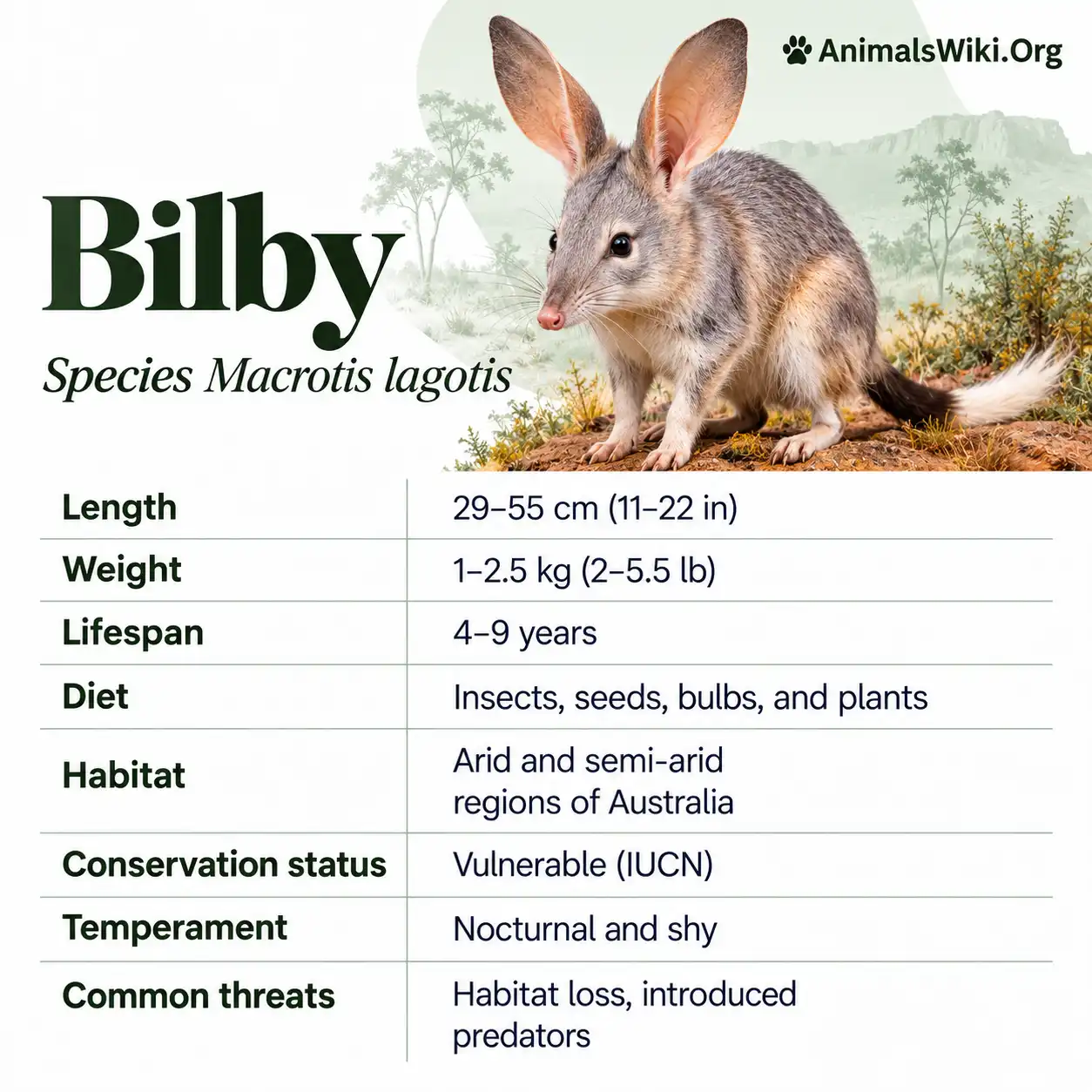
Bilby, The Long-Eared Burrowing Marsupial of Australia’s Deserts
The Bilby is one of Australia’s most distinctive desert marsupials.
Huge ears.
A pointed nose.
Soft blue-gray fur.
Powerful digging claws.
A black-and-white tail.
And a remarkable ability to survive in some of Australia’s hottest and driest environments.
Today, when people talk about the Bilby, they are usually referring to the:
Greater Bilby.
Its scientific name is:
Macrotis lagotis.
Historically, however, there were two modern bilby species.
The second was the:
Lesser Bilby (Macrotis leucura).
Unfortunately, the Lesser Bilby disappeared during the 20th century and is considered:
extinct.
That leaves the Greater Bilby as the only surviving representative of the genus:
Macrotis.
Bilbies are:
marsupials.
They belong to the family:
Thylacomyidae.
At first glance, a Bilby can resemble an unusual mixture of:
- Rabbit
- Bandicoot
- Mouse
- Small fox
But it is none of these.
The Bilby’s enormous rabbit-like ears are especially striking.
Those ears are useful for:
hearing.
A Bilby foraging at night can detect sounds produced by insects and other activity around it.
The ears may also assist with:
heat loss.
This is valuable for an animal living in hot, dry environments.
But perhaps the Bilby’s most important adaptation is underground.
Bilbies are exceptional:
diggers.
Using powerful forelimbs and long claws, they construct deep spiral-shaped burrows.
These burrows create a protected microclimate where the animal can escape:
- Extreme daytime heat
- Cold nights
- Predators
- Harsh weather
A Bilby may maintain numerous burrows within its home range rather than depending on only:
one shelter.
Like the Wombat, the female Bilby’s pouch opens:
backward.
This is particularly useful for a digging mammal.
As the mother throws soil behind her, the pouch orientation helps keep dirt away from her:
tiny developing joeys.
Bilbies are mostly:
nocturnal.
As darkness arrives, they emerge from their burrows and begin searching for food.
And they are not strict herbivores.
Bilbies are:
omnivores.
Their diet can include:
- Insects
- Termites
- Ants
- Beetles
- Larvae
- Seeds
- Bulbs
- Fungi
- Roots
- Other plant material
Their pointed snouts and strong sense of smell help locate food hidden beneath:
the soil.
Then the claws go to work.
Digging for food creates numerous small pits.
These disturbances turn over soil, trap organic matter and can influence:
- Seed germination
- Water infiltration
- Nutrient cycling
- Soil structure
For this reason, Bilbies are often described as:
ecosystem engineers.
Historically, Greater Bilbies occupied a vast area of:
Australia.
Their distribution once covered much of the arid and semi-arid interior.
Today, their range is dramatically:
smaller.
Their decline was driven by a combination of pressures, especially:
- Introduced Red Foxes
- Feral Cats
- Habitat change
- Altered fire regimes
- Competition with introduced herbivores
- Changes caused by livestock
Conservationists now protect Bilbies using:
- Predator control
- Predator-proof sanctuaries
- Captive breeding
- Reintroduction
- Indigenous ranger programs
- Habitat management
- Population monitoring
The Bilby has also become an Australian conservation symbol through the tradition of the:
Easter Bilby.
Instead of celebrating only the introduced European Rabbit, chocolate Bilbies are promoted to raise awareness and sometimes funding for native wildlife conservation.
This comprehensive guide explores Bilby facts, Greater Bilby scientific classification, appearance, giant ears, size, weight, Australian desert habitat, burrows, backward pouch, diet, digging, nocturnal behavior, reproduction, baby Bilbies, lifespan, adaptations, predators, Bilby vs Rabbit, Bilby vs Bandicoot, Bilby vs Wombat, Greater Bilby vs Lesser Bilby, Easter Bilby, conservation and why the Bilby is one of Australia’s most remarkable desert marsupials.
Bilby Facts
| Feature | Information |
|---|---|
| Common Name | Greater Bilby |
| Short Name | Bilby |
| Scientific Name | Macrotis lagotis |
| Animal Type | Mammal |
| Mammal Group | Marsupial |
| Order | Peramelemorphia |
| Family | Thylacomyidae |
| Genus | Macrotis |
| Living Bilby Species | 1 |
| Native Country | Australia |
| Habitat | Arid & semi-arid environments |
| Diet | Omnivorous |
| Activity | Primarily nocturnal |
| Lifestyle | Generally solitary |
| Body Length | Roughly 30–55 cm |
| Tail Length | Roughly 20–30 cm |
| Weight | Approximately 0.8–2.5 kg, males generally larger |
| Distinctive Feature | Very large ears |
| Main Shelter | Deep burrow |
| Pouch | Backward-opening |
| Young | Joey |
| Major Threats | Foxes, Feral Cats & habitat change |
| Ecological Role | Digging ecosystem engineer |
What Is a Bilby?
A Bilby is a long-eared, burrowing marsupial native to:
Australia.
The surviving species is the Greater Bilby:
Macrotis lagotis.
It is adapted to life in Australia’s:
arid and semi-arid landscapes.
Is a Bilby a Marsupial?
Yes.
Bilbies are:
marsupial mammals.
Females give birth to extremely underdeveloped young that complete much of their early development attached to teats inside:
the pouch.
Is a Bilby a Rabbit?
No.
Despite its enormous ears, a Bilby is not a:
rabbit.
Rabbits are placental mammals in the order:
Lagomorpha.
Bilbies are Australian:
marsupials.
Is a Bilby a Bandicoot?
Bilbies are closely related to:
bandicoots.
Both belong to the order:
Peramelemorphia.
However, Bilbies are placed in their own family:
Thylacomyidae.
Scientific Classification of the Greater Bilby
| Classification | Name |
|---|---|
| Kingdom | Animalia |
| Phylum | Chordata |
| Class | Mammalia |
| Order | Peramelemorphia |
| Family | Thylacomyidae |
| Genus | Macrotis |
| Species | Macrotis lagotis |
How Many Bilby Species Are There?
Historically, two bilby species survived into relatively recent times:
Greater Bilby
Macrotis lagotis
This is the surviving species.
Lesser Bilby
Macrotis leucura
The Lesser Bilby is:
extinct.
Therefore, only:
one living bilby species
remains today.
What Happened to the Lesser Bilby?
The Lesser Bilby once inhabited Australia’s:
arid interior.
Its decline was associated with major ecological changes following European settlement, including introduced predators and habitat disruption.
It disappeared during the:
20th century.
What Does a Bilby Look Like?
The Greater Bilby has:
- Extremely large ears
- Long pointed snout
- Soft gray or blue-gray fur
- Pale underside
- Long slender legs
- Strong front claws
- Long tail
- Black section on the tail
- White tail tip
Its appearance is unmistakable.
Why Does a Bilby Have Such Big Ears?
The ears serve several useful functions.
Hearing
Bilbies can detect subtle sounds while:
foraging at night.
Heat Regulation
Large ears contain blood vessels close to the skin.
Heat can be transferred from the blood to the surrounding air, potentially helping the animal:
cool itself.
The ears therefore contribute to both sensory ability and life in a:
hot environment.
How Big Are Bilby Ears?
The ears can be around:
10 cm or more in length.
They look enormous relative to the animal’s:
head.
How Big Is a Bilby?
Greater Bilbies are generally around:
30–55 cm in head-and-body length.
The tail adds another:
20–30 cm or so.
How Much Does a Bilby Weigh?
Weight varies substantially.
Adults may weigh approximately:
0.8–2.5 kg.
Large males can be considerably heavier than:
females.
Are Male Bilbies Bigger Than Females?
Yes.
Greater Bilbies show noticeable:
sexual size dimorphism.
Adult males can be substantially larger than adult females.
Why Does a Bilby Have a Long Nose?
The pointed snout contains a well-developed:
sense of smell.
This helps Bilbies locate food hidden beneath:
- Soil
- Leaf litter
- Sand
Where Do Bilbies Live?
Bilbies are native to:
Australia.
Historically, Greater Bilbies occurred across a huge portion of the continent.
Their present distribution is much more:
fragmented.
Remaining wild and managed populations occur in parts of Australia’s:
arid and semi-arid interior.
Did Bilbies Once Live Across Most of Australia?
Greater Bilbies once occupied a remarkably large range.
They were found across much of:
mainland Australia.
Their distribution contracted dramatically after European settlement.
Bilby Habitat
Bilbies can inhabit:
- Desert
- Semi-desert
- Spinifex grassland
- Shrubland
- Open woodland
- Sandy plains
- Desert dunes
- Arid grasslands
The soil must generally be suitable for:
digging burrows.
Do Bilbies Live in the Desert?
Yes.
They are superbly adapted to:
dry environments.
However, describing every Bilby habitat simply as “desert” would be too narrow.
They also occur in other arid and semi-arid:
landscapes.
Do Bilbies Live Underground?
They spend the daytime primarily inside:
burrows.
At night they emerge to:
forage.
Bilby Burrows
Bilbies are among Australia’s impressive mammalian:
excavators.
Their burrows can spiral downward through the soil.
A burrow provides:
- Shade
- Stable temperature
- Predator protection
- Resting space
- Shelter from weather
How Deep Is a Bilby Burrow?
Bilby burrows can descend roughly:
1–2 meters
and may extend several meters in total length.
Dimensions vary according to:
- Soil
- Location
- Individual
- Burrow age
Why Are Bilby Burrows Spiral-Shaped?
Many Bilby burrows descend in a:
spiral or winding pattern.
This creates a long protected tunnel leading to a deeper resting chamber.
The exact form varies with soil and terrain.
How Many Burrows Does a Bilby Have?
A single Bilby can maintain:
multiple burrows
within its home range.
Some individuals may use a large network of shelters rather than relying on one permanent burrow.
Why Does a Bilby Need Multiple Burrows?
Multiple shelters provide:
- Escape options
- Access to different feeding areas
- Protection across a large home range
- Flexibility when conditions change
Can Bilbies Dig Fast?
Yes.
Their forelimbs are equipped with:
powerful claws.
A Bilby can disappear into loose soil surprisingly quickly.
Why Are Bilbies Such Good Diggers?
Their anatomy includes:
- Strong shoulders
- Muscular forelimbs
- Large claws
- Compact front body
- Long snout for investigating soil
Together these adaptations make excavation:
highly efficient.
Are Bilbies Nocturnal?
Yes.
Greater Bilbies are primarily:
nocturnal.
They normally emerge after sunset and spend the night:
foraging.
Why Are Bilbies Active at Night?
Night activity helps reduce exposure to:
extreme daytime heat.
It also matches the activity patterns of some of the insects they:
eat.
What Do Bilbies Do During the Day?
They usually remain inside their:
burrows.
The underground environment is cooler and more stable than the surface.
What Do Bilbies Eat?
Bilbies are:
omnivores.
Their diet can include both animal and plant foods.
Common foods include:
- Termites
- Ants
- Beetles
- Insect larvae
- Spiders
- Seeds
- Bulbs
- Roots
- Fungi
- Fruit
- Other plant material
Diet varies by habitat and:
season.
Do Bilbies Eat Termites?
Yes.
Termites can be an important part of their:
diet.
Do Bilbies Eat Ants?
Yes.
Ants and other small invertebrates can be consumed.
Do Bilbies Eat Plants?
Yes.
Plant foods can include:
- Seeds
- Bulbs
- Roots
- Fruits
- Fungi
Do Bilbies Eat Meat?
They consume:
animal prey, especially invertebrates.
However, they are not large carnivorous hunters.
How Do Bilbies Find Food?
They rely heavily on:
smell and hearing.
Their long nose investigates the ground.
When food is detected below the surface, their claws excavate:
small feeding pits.
Do Bilbies Dig for Food?
Yes.
This behavior is ecologically extremely:
important.
A Bilby may dig numerous small pits while searching for food.
Do Bilbies Drink Water?
Bilbies are well adapted to:
dry environments.
They can obtain much of the water they need from:
food.
They may therefore survive without regularly drinking free-standing water.
How Do Bilbies Survive Without Much Water?
Water is obtained from foods such as:
- Insects
- Roots
- Bulbs
- Other plant material
Their physiology also helps conserve:
moisture.
Are Bilbies Solitary?
Greater Bilbies are generally:
solitary.
Individuals forage mostly alone.
Do Bilbies Live in Groups?
They do not normally form permanent social groups like:
Capybaras.
Their home ranges can overlap, but individuals generally maintain independent:
lifestyles.
Are Bilbies Territorial?
Bilby spatial behavior is complex.
Individuals maintain home ranges, and males may range over areas overlapping those of:
several females.
They use scent and other signals in communication.
How Do Bilbies Communicate?
Communication can involve:
- Scent
- Vocalizations
- Physical behavior
Their excellent sense of smell likely plays an important role.
Do Bilbies Make Sounds?
Yes.
Bilbies can make various:
- Squeaks
- Grunts
- Hisses
particularly when frightened, disturbed or interacting with one another.
Can Bilbies Run Fast?
Bilbies can move quickly when:
threatened.
Their movement may look unusual because of their relatively long hind legs and compact front limbs.
Precise standardized maximum-speed measurements are limited, so exaggerated online speed figures should be avoided.
Can Bilbies Jump?
They can make quick bounding movements but are not specialized hopping mammals like:
Kangaroos.
Can Bilbies Climb?
Bilbies are primarily:
ground-dwelling.
Their bodies are specialized for digging rather than tree climbing.
Bilby Reproduction
Greater Bilbies have one of the most remarkable reproductive systems among Australia’s desert mammals.
Females can reproduce relatively:
rapidly
when environmental conditions are favorable.
How Long Is a Bilby Pregnant?
The Greater Bilby has an exceptionally short gestation.
Pregnancy lasts roughly:
12–14 days.
This is among the shortest gestation periods found in:
mammals.
Why Is Bilby Pregnancy So Short?
Like other marsupials, Bilbies give birth at a very early stage of development.
Most early growth then continues while the joey is attached to a teat inside:
the pouch.
How Many Babies Does a Bilby Have?
A female commonly produces:
one to three young.
Litter size varies.
What Is a Baby Bilby Called?
A baby Bilby is called a:
joey.
How Small Is a Newborn Bilby?
Newborn Bilbies are:
tiny, hairless and extremely underdeveloped.
After birth they crawl into:
the pouch.
Do Bilbies Have Pouches?
Yes.
Female Bilbies possess a:
backward-opening pouch.
Why Does the Bilby Pouch Open Backward?
Bilbies dig constantly.
A rear-facing pouch helps prevent excavated soil from being thrown directly into:
the pouch.
This protects the developing:
joeys.
Is the Bilby Pouch Like a Kangaroo Pouch?
Both protect developing marsupial young.
However, their orientation differs because Bilbies are highly specialized:
diggers.
How Long Do Baby Bilbies Stay in the Pouch?
Young remain in the pouch for approximately:
two to three months.
After leaving, they continue developing and nursing.
Where Do Joeys Go After Leaving the Pouch?
They may remain in:
the burrow
while the mother forages.
The mother returns to nurse them.
How Quickly Can Bilbies Reproduce?
Under favorable conditions, females can reproduce relatively rapidly.
This ability can help populations recover when:
- Food is abundant
- Rainfall is favorable
- Predation is controlled
However, rapid reproduction alone cannot compensate for intense pressure from introduced:
predators.
Bilby Lifespan
Greater Bilbies can live for several years in:
the wild.
Under managed care, individuals may survive for approximately:
a decade or longer.
Actual lifespan varies with predation, environmental conditions and health.
Bilby Adaptations
Huge Ears
Improve hearing and may assist heat loss.
Long Snout
Helps detect food through smell.
Strong Claws
Allow rapid excavation.
Powerful Forelimbs
Construct burrows and feeding pits.
Backward-Opening Pouch
Protects joeys from excavated soil.
Nocturnal Lifestyle
Avoids extreme daytime heat.
Deep Burrows
Provide a stable underground microclimate.
Water-Efficient Physiology
Helps survival in dry landscapes.
Omnivorous Diet
Allows Bilbies to exploit many seasonal foods.
Multiple Burrows
Provide numerous shelters across the home range.
What Animals Eat Bilbies?
Potential predators include:
- Red Foxes
- Feral Cats
- Dingoes
- Large reptiles
- Birds of prey
Introduced Foxes and Cats are particularly serious conservation threats.
Do Foxes Eat Bilbies?
Yes.
Introduced:
Red Foxes
have played a major role in the decline of Bilbies and many other Australian mammals.
Do Feral Cats Kill Bilbies?
Yes.
Feral Cats are highly effective predators and remain a major threat to:
Bilby populations.
Do Dingoes Eat Bilbies?
Dingoes can potentially prey on:
Bilbies.
However, predator interactions in Australian ecosystems are complex, and the conservation effects of Dingoes should not simply be equated with those of introduced Foxes and Cats.
Do Eagles Eat Bilbies?
Large raptors may potentially prey on:
Bilbies, especially young or exposed individuals.
Their nocturnal lifestyle reduces some exposure to daytime raptors.
How Do Bilbies Escape Predators?
Their primary defense is:
escape.
A Bilby may run rapidly toward a burrow and disappear:
underground.
Are Bilbies Dangerous to Humans?
No.
Bilbies are small, shy animals.
They do not regard humans as:
prey.
Do Bilbies Bite?
A frightened or restrained Bilby could bite or scratch:
defensively.
However, they present little danger to people when left undisturbed.
Can Bilbies Be Pets?
Bilbies are protected Australian wildlife and are not suitable as:
ordinary pets.
They require specialized:
- Diet
- Habitat
- Burrowing opportunities
- Veterinary care
- Conservation management
Bilby vs. Rabbit
| Feature | Bilby | Rabbit |
|---|---|---|
| Mammal Type | Marsupial | Placental |
| Native to Australia | Yes | No |
| Ears | Very large | Large |
| Diet | Omnivorous | Primarily herbivorous |
| Pouch | Yes | No |
| Burrowing | Excellent | Excellent |
| Activity | Mostly nocturnal | Often crepuscular |
| Taxonomic Group | Peramelemorphia | Lagomorpha |
Their large ears and burrowing habits are examples of superficial ecological similarity rather than close:
relationship.
Bilby vs. Bandicoot
Bilbies and bandicoots are genuine:
relatives.
Both belong to:
Peramelemorphia.
Bilbies generally have:
- Much larger ears
- Longer tails
- Strong desert adaptations
- Particularly extensive burrowing behavior
Bilby vs. Wombat
| Feature | Bilby | Wombat |
|---|---|---|
| Body Size | Small-medium | Large & heavy |
| Diet | Omnivorous | Herbivorous |
| Ears | Very large | Small |
| Activity | Nocturnal | Mostly nocturnal |
| Burrowing | Excellent | Excellent |
| Pouch | Backward-opening | Backward-opening |
| Main Habitat | Arid/semi-arid | Varies by species |
| Taxonomic Relationship | Distant marsupial | Distant marsupial |
Both independently show powerful adaptations for:
digging.
Bilby vs. Numbat
| Feature | Bilby | Numbat |
|---|---|---|
| Main Diet | Omnivorous | Mostly termites |
| Activity | Nocturnal | Diurnal |
| Ears | Very large | Moderate |
| Pouch | Backward-opening | No conventional pouch |
| Burrowing | Extensive | Uses burrows/logs |
| Family | Thylacomyidae | Myrmecobiidae |
Greater Bilby vs. Lesser Bilby
| Feature | Greater Bilby | Lesser Bilby |
|---|---|---|
| Scientific Name | Macrotis lagotis | Macrotis leucura |
| Status | Surviving | Extinct |
| Genus | Macrotis | Macrotis |
| Native Region | Australia | Australia |
| Modern Population | Yes | None |
The extinction of the Lesser Bilby makes protecting the Greater Bilby even more:
important.
Why Did Bilbies Decline?
Their decline followed major changes to Australian ecosystems after European:
settlement.
Important pressures include:
- Red Fox predation
- Feral Cat predation
- Habitat degradation
- Changed fire patterns
- Livestock grazing
- Competition with Rabbits
- Competition with introduced herbivores
How Much of the Bilby’s Historical Range Has Been Lost?
The Greater Bilby has disappeared from a very large proportion of its former:
range.
Historically it occurred across much of mainland Australia.
Today its natural distribution is substantially more:
restricted and fragmented.
Are Bilbies Endangered?
The Greater Bilby is a:
threatened Australian mammal
and remains an important conservation priority.
Formal conservation categories can differ between national, state and international systems and can change after reassessment. Current status should therefore be verified against the latest authoritative listing when publishing time-sensitive information.
How Many Bilbies Are Left?
There is no perfectly precise real-time count of every Greater Bilby.
Wild populations occur across remote landscapes, while additional populations live in:
- Fenced sanctuaries
- Reintroduction sites
- Managed conservation areas
Population estimates therefore depend on survey date and methodology.
How Are Bilbies Protected?
Conservation measures include:
- Predator-proof fencing
- Fox control
- Feral Cat control
- Captive breeding
- Reintroductions
- Habitat protection
- Indigenous land management
- Fire management
- Population monitoring
- Genetic management
What Are Predator-Free Sanctuaries?
These are large conservation areas where introduced predators such as:
- Foxes
- Feral Cats
are excluded or intensively controlled.
Bilbies can then survive and reproduce with much lower:
predation pressure.
Have Bilbies Been Reintroduced?
Yes.
Greater Bilbies have been returned to selected parts of their historical range through:
reintroduction programs.
Some populations live within fenced conservation reserves.
Why Is Indigenous Land Management Important for Bilbies?
Aboriginal communities and Indigenous ranger programs play important roles in:
- Monitoring Bilbies
- Managing fire
- Controlling invasive species
- Protecting habitat
- Combining ecological research with traditional knowledge
Bilbies have also held cultural significance for Indigenous Australians for:
thousands of years.
Are Bilbies Ecosystem Engineers?
Yes.
This is one of the most important Bilby facts.
When Bilbies search for food, they dig numerous:
small pits.
These disturbances can change the soil environment.
How Does Bilby Digging Help the Ecosystem?
Digging can:
- Turn over soil
- Mix organic matter
- Trap seeds
- Trap leaf litter
- Improve water infiltration
- Create germination sites
- Influence nutrient cycling
This means one small Bilby can affect an area far larger than:
its own body.
How Much Soil Can Bilbies Move?
Bilbies can excavate substantial amounts of soil through:
daily foraging and burrow construction.
The exact quantity varies with habitat, population density and individual behavior, so universal annual tonnage claims should be treated cautiously.
What Is the Easter Bilby?
The:
Easter Bilby
is an Australian conservation tradition.
Chocolate Bilbies are sold as native alternatives to:
Easter Rabbits.
Why Is There an Easter Bilby?
Rabbits are an introduced species in Australia and have caused extensive:
environmental damage.
The Bilby is a native threatened mammal.
Using the Bilby as an Easter symbol helps draw attention to:
native wildlife conservation.
Are Chocolate Bilbies Real?
Chocolate Bilbies are Bilby-shaped:
confectionery.
They are modeled on the real Greater Bilby.
Some Easter Bilby campaigns have contributed money or public awareness to:
conservation.
Why Are Rabbits Bad for Bilbies?
Introduced Rabbits can contribute to environmental degradation by:
- Competing for vegetation
- Altering habitats
- Supporting high predator populations
Their effects combine with those of other invasive species.
Why Are Bilbies Important?
Bilbies are important because they are:
- Native Australian marsupials
- Ecosystem engineers
- Soil excavators
- Seed and nutrient movers
- Culturally significant animals
- Conservation symbols
Protecting Bilbies can therefore benefit:
entire ecosystems.
50 Interesting Bilby Facts
- The Bilby is an Australian mammal.
- It is a marsupial.
- The surviving species is the Greater Bilby.
- Its scientific name is Macrotis lagotis.
- Bilbies belong to Thylacomyidae.
- They are related to bandicoots.
- Only one living bilby species remains.
- The Lesser Bilby is extinct.
- Greater Bilbies have enormous ears.
- Their ears provide excellent hearing.
- Large ears may also help release heat.
- Bilbies have long pointed snouts.
- Their sense of smell helps locate food.
- Their fur is soft and grayish.
- Their tails have distinctive black and white coloration.
- Male Bilbies are generally larger than females.
- Bilbies are primarily nocturnal.
- They spend much of the day underground.
- Bilbies are powerful diggers.
- They construct deep burrows.
- Their burrows can descend in spiral patterns.
- Individual Bilbies may use multiple burrows.
- Burrows protect them from extreme temperatures.
- Bilbies are omnivores.
- They eat insects.
- They eat termites.
- They eat ants.
- They also eat seeds and plant material.
- They dig small pits while searching for food.
- Their digging turns over soil.
- Bilbies are ecosystem engineers.
- Their digging can trap seeds and organic matter.
- They can obtain much of their moisture from food.
- Females have backward-opening pouches.
- The pouch orientation helps keep soil away from joeys.
- Bilby gestation is extremely short.
- Pregnancy lasts only around two weeks.
- Baby Bilbies are called joeys.
- Females can produce more than one joey in a litter.
- Bilbies are generally solitary.
- Red Foxes are major predators.
- Feral Cats are also major threats.
- Bilbies once occupied much more of Australia.
- Their modern range is greatly reduced.
- Predator-proof sanctuaries help protect them.
- Bilbies have been reintroduced into parts of their former range.
- Indigenous ranger programs contribute to Bilby conservation.
- The Easter Bilby promotes native wildlife awareness.
- Bilbies are not rabbits despite their enormous ears.
- Their combination of giant ears, spiral burrows, backward pouch and ecosystem-engineering behavior makes Bilbies some of Australia’s most remarkable marsupials.
Did You Know?
A Bilby can change an entire desert landscape one small hole at a time.
Night falls across the Australian:
interior.
During the day, the ground may have been intensely:
hot.
But several feet beneath the surface, a Bilby has been sleeping inside:
its burrow.
The tunnel curves downward.
The temperature inside is more stable.
Then darkness arrives.
The Bilby wakes.
First appear:
two enormous ears.
They rotate.
Listen.
The animal emerges.
Its long nose moves close to:
the ground.
It catches a scent.
Something is hidden below:
the soil.
Perhaps:
- Beetle larvae
- Termites
- A bulb
- Seeds
The Bilby begins:
digging.
Its front claws break the surface.
Soil flies:
backward.
This is exactly why the female’s pouch faces toward:
the rear.
A forward-facing pouch would be directly exposed to much of the excavated:
dirt.
Instead, the young remain protected while their mother performs the behavior on which her life depends:
digging.
She reaches the food.
Eats.
Then moves:
on.
But the little hole remains.
Rain eventually arrives.
Water collects inside the depression.
Wind blows:
seeds into it.
Leaves and other organic material become trapped.
Nutrients accumulate.
A seed may:
germinate.
The Bilby did not intend to plant:
a garden.
It was simply searching for:
dinner.
But multiplied across hundreds or thousands of digging events, this behavior can alter:
the landscape.
Soil is mixed.
Water infiltration changes.
Organic material moves.
Seeds find new microsites.
This is why the Bilby is much more than a:
cute desert marsupial.
It is an:
ecosystem engineer.
For thousands of years, animals such as Bilbies and other digging mammals disturbed Australia’s soil on an enormous scale.
Then many of these mammals began to:
disappear.
Foxes arrived.
Cats spread.
Rabbits transformed vegetation.
Land use changed.
Bilbies vanished from vast areas where they had once:
dug every night.
And when the Bilby disappeared, the ecosystem did not lose only:
an animal.
It lost millions of tiny:
excavations.
Today, when conservationists return Bilbies to predator-protected landscapes, they are restoring more than:
a species.
They are returning an ancient ecological process.
One pair of ears.
One pointed nose.
Two powerful claws.
And thousands upon thousands of:
holes.
Frequently Asked Questions About Bilbies
What is a Bilby?
A Bilby is a long-eared, burrowing Australian marsupial.
What is the scientific name of the Bilby?
The surviving Greater Bilby is Macrotis lagotis.
Is a Bilby a mammal?
Yes.
Is a Bilby a marsupial?
Yes.
Is a Bilby a rabbit?
No.
Is a Bilby a rodent?
No.
Is a Bilby a bandicoot?
Bilbies are close relatives of bandicoots and belong to the same marsupial order, Peramelemorphia.
What family does the Bilby belong to?
Thylacomyidae.
How many Bilby species exist?
Only one living species remains.
What is the Greater Bilby?
The Greater Bilby, Macrotis lagotis, is the surviving bilby species.
What was the Lesser Bilby?
The Lesser Bilby, Macrotis leucura, was a smaller related species that is now extinct.
Is the Lesser Bilby extinct?
Yes.
Where do Bilbies live?
In arid and semi-arid regions of Australia.
Are Bilbies native to Australia?
Yes.
Do Bilbies live anywhere else naturally?
No.
Did Bilbies once live across Australia?
They once occupied a much larger portion of mainland Australia than they do today.
Why did their range shrink?
Introduced predators, habitat change, altered fire patterns and competition contributed to their decline.
What habitat do Bilbies prefer?
Deserts, grasslands, shrublands, spinifex country and other arid or semi-arid habitats with suitable soils.
Do Bilbies live underground?
They spend the day primarily inside burrows.
Do Bilbies dig burrows?
Yes.
How deep are Bilby burrows?
Some descend roughly one to two meters and can extend several meters in length.
Are Bilby burrows spiral-shaped?
They can have winding or spiral forms.
How many burrows does a Bilby use?
An individual can maintain multiple burrows within its home range.
Why do Bilbies have multiple burrows?
Multiple shelters provide protection and flexibility across their feeding range.
Are Bilbies nocturnal?
Yes.
Why do Bilbies come out at night?
Night activity helps them avoid extreme daytime heat.
What do Bilbies do during the day?
They generally rest inside burrows.
What do Bilbies eat?
Insects, termites, ants, larvae, seeds, bulbs, roots, fungi and other foods.
Are Bilbies herbivores?
No. They are omnivores.
Do Bilbies eat insects?
Yes.
Do Bilbies eat termites?
Yes.
Do Bilbies eat ants?
Yes.
Do Bilbies eat plants?
Yes.
Do Bilbies eat fungi?
They can.
Do Bilbies drink water?
They can obtain much of their required moisture from food.
How do Bilbies find food?
Primarily through smell and hearing, followed by digging.
Why is the Bilby’s nose long?
Its elongated snout helps investigate the ground and locate food.
Why do Bilbies have big ears?
Large ears provide excellent hearing and may also help dissipate heat.
How big are Bilby ears?
They can reach roughly 10 cm or more.
How big is a Bilby?
Approximately 30–55 cm in head-and-body length, with a long additional tail.
How much does a Bilby weigh?
Approximately 0.8–2.5 kg is a useful general range, with large males heavier than females.
Are male Bilbies bigger?
Yes.
What color are Bilbies?
They generally have soft gray to blue-gray fur with pale undersides and a distinctive black-and-white tail.
Do Bilbies have long tails?
Yes.
Can Bilbies run fast?
They can move quickly when threatened, although reliable standardized maximum-speed figures are limited.
Can Bilbies jump?
They can make bounding movements but are not specialized hoppers like Kangaroos.
Can Bilbies climb trees?
They are primarily terrestrial and adapted for digging.
Are Bilbies good diggers?
Extremely.
Why are Bilby claws so large?
They are used for excavating burrows and digging for food.
Are Bilbies solitary?
Generally yes.
Do Bilbies live in groups?
They do not normally form large permanent social groups.
How do Bilbies communicate?
Through scent, sounds and physical behavior.
Do Bilbies make sounds?
Yes, including squeaks, grunts and hisses.
Do Bilbies have pouches?
Females do.
Which way does a Bilby pouch open?
Backward.
Why does the Bilby pouch face backward?
It helps prevent soil from entering while the female digs.
What is a baby Bilby called?
A joey.
How long is a Bilby pregnant?
Roughly 12–14 days.
Is that one of the shortest mammal pregnancies?
Yes. Greater Bilbies have an exceptionally short gestation.
How many babies do Bilbies have?
Commonly one to three young.
Are Bilby babies born tiny?
Yes. Like other marsupial newborns, they are extremely underdeveloped.
How long do joeys stay in the pouch?
Approximately two to three months.
What happens after they leave the pouch?
They can remain in the burrow and continue nursing while developing greater independence.
Do male Bilbies care for joeys?
Maternal care is primarily provided by the female.
How long do Bilbies live?
Several years in the wild, with longer lifespans possible under managed care.
What predators eat Bilbies?
Foxes, Feral Cats and several native predators can prey on them.
Do Foxes kill Bilbies?
Yes. Red Foxes are a major introduced threat.
Do Feral Cats kill Bilbies?
Yes.
Do Dingoes eat Bilbies?
They can potentially prey on Bilbies, although their broader ecological role differs from that of introduced Cats and Foxes.
How do Bilbies escape predators?
Usually by rapidly retreating into burrows.
Are Bilbies dangerous?
No.
Do Bilbies attack humans?
They generally avoid people.
Can a Bilby bite?
A frightened or restrained animal could bite defensively.
Can Bilbies be pets?
They are protected wildlife and unsuitable as ordinary pets.
What is the difference between a Bilby and a Rabbit?
Bilbies are Australian marsupial omnivores; Rabbits are placental herbivores.
What is the difference between a Bilby and a Bandicoot?
They are relatives, but Bilbies have exceptionally large ears, long tails and strong adaptations for arid environments and burrowing.
What is the difference between a Bilby and a Wombat?
Bilbies are small omnivores with enormous ears; Wombats are much larger herbivorous marsupials.
What is the difference between a Bilby and a Numbat?
Bilbies are nocturnal omnivores with pouches, while Numbats are daytime termite specialists without conventional pouches.
Are Bilbies endangered?
The Greater Bilby is a threatened conservation priority. Formal status should be checked against the latest relevant authority for current publication.
Why are Bilbies threatened?
Introduced predators, habitat changes, altered fire regimes and competition with introduced animals are major factors.
How many Bilbies are left?
There is no exact real-time total for every wild and managed Bilby population.
Are Bilby populations recovering?
Some managed and reintroduced populations have benefited substantially from predator control and conservation programs.
Are Bilbies bred in captivity?
Yes.
Have Bilbies been reintroduced?
Yes. Reintroduction is an important conservation strategy.
Do Bilbies live in predator-proof sanctuaries?
Yes.
Why do predator-proof fences help Bilbies?
They can exclude Foxes and Feral Cats, greatly reducing predation.
Are Bilbies ecosystem engineers?
Yes.
Why are Bilbies called ecosystem engineers?
Their digging physically alters soil and creates microsites that influence water, seeds, nutrients and vegetation.
Does Bilby digging help plants?
It can. Feeding pits may trap seeds, water and organic material, potentially creating favorable germination sites.
Do Bilbies improve soil?
Their digging mixes and aerates soil and redistributes organic material.
What is the Easter Bilby?
An Australian Easter symbol that promotes awareness of native Bilbies instead of relying solely on the introduced Rabbit.
Why does Australia have chocolate Bilbies?
They help promote Bilby conservation and awareness of the environmental impacts of introduced Rabbits.
Is the Easter Bilby a real species?
No. It is a cultural and conservation tradition based on the real Greater Bilby.
Are Rabbits related to Bilbies?
No. Their large ears and burrowing lifestyles are superficial similarities.
Why are Rabbits a problem in Australia?
Introduced Rabbits damage vegetation, alter habitats and compete with native animals.
Are Bilbies important to Aboriginal Australians?
Yes. Bilbies have long-standing cultural significance for Indigenous Australian communities in parts of their range.
How can Bilbies be protected?
Through predator control, habitat protection, appropriate fire management, reintroductions, Indigenous land management and long-term monitoring.
Why should Bilbies be conserved?
Protecting Bilbies preserves an evolutionarily distinctive marsupial and restores an important soil-digging ecological process.
What is the most interesting Bilby fact?
A Bilby combines enormous heat-dissipating ears, a backward-facing pouch, a roughly two-week pregnancy and powerful digging behavior that can physically reshape desert soils—making it both an extraordinary marsupial and an important ecosystem engineer.
Conclusion
The Bilby may look delicate.
Its fur is:
soft.
Its ears are enormous.
Its nose is:
thin.
Its body weighs only a few kilograms.
But beneath that gentle appearance is an animal built to survive one of the most demanding environments on:
Earth.
When the Australian sun heats the surface, the Bilby disappears:
underground.
Its burrow becomes:
- Shelter
- Bedroom
- Refuge
- Climate-control system
Then night arrives.
Two giant ears rise from:
the entrance.
The Bilby listens.
Its nose searches the air.
Then it begins:
foraging.
A smell beneath the ground triggers:
digging.
Powerful claws move soil aside.
An insect is found.
A bulb is uncovered.
A seed is eaten.
Then the Bilby moves:
forward.
Behind it remains a small:
pit.
That hole seems insignificant.
But multiply it by:
thousands.
Soil is turned.
Seeds are trapped.
Leaves collect.
Rainwater enters.
Nutrients move.
The Bilby changes the environment simply by:
eating.
This is why it is an:
ecosystem engineer.
Its reproductive system is equally remarkable.
Pregnancy lasts only around:
two weeks.
The tiny newborn enters a pouch that opens:
backward.
Why backward?
Because its mother spends her life throwing soil behind:
her.
The pouch itself reflects the Bilby’s identity as:
a digger.
Yet even these remarkable adaptations could not completely protect it from rapid changes to:
Australia.
Foxes arrived.
Cats spread.
Rabbits transformed habitats.
Landscapes changed.
Bilbies disappeared from huge parts of their:
former range.
And one species—the Lesser Bilby—disappeared:
entirely.
The Greater Bilby survived.
Today, conservationists are giving it new opportunities.
Behind predator-resistant fences.
Inside restored habitats.
Across Indigenous-managed landscapes.
At carefully selected reintroduction sites.
Bilbies are digging:
again.
And every new burrow represents more than the survival of:
one animal.
It represents the return of an ecological process that shaped Australian landscapes for:
thousands of years.
The Bilby is therefore much more than Australia’s answer to the:
Easter Bunny.
It is a survivor.
A desert engineer.
A nocturnal hunter and forager.
A remarkable marsupial.
And one of the most distinctive animals of the Australian:
outback.



