Oarfish, The Giant Sea-Serpent Fish of the Deep Ocean
The Oarfish looks like an animal pulled directly from an ancient story about:
sea serpents.
Its body is extraordinarily:
long.
Its sides shimmer:
silver.
A brilliant red dorsal fin runs almost the entire length of its:
back.
Long rays rise above the head like a:
crown.
And when an enormous individual appears near shore, it can stretch for many:
meters.
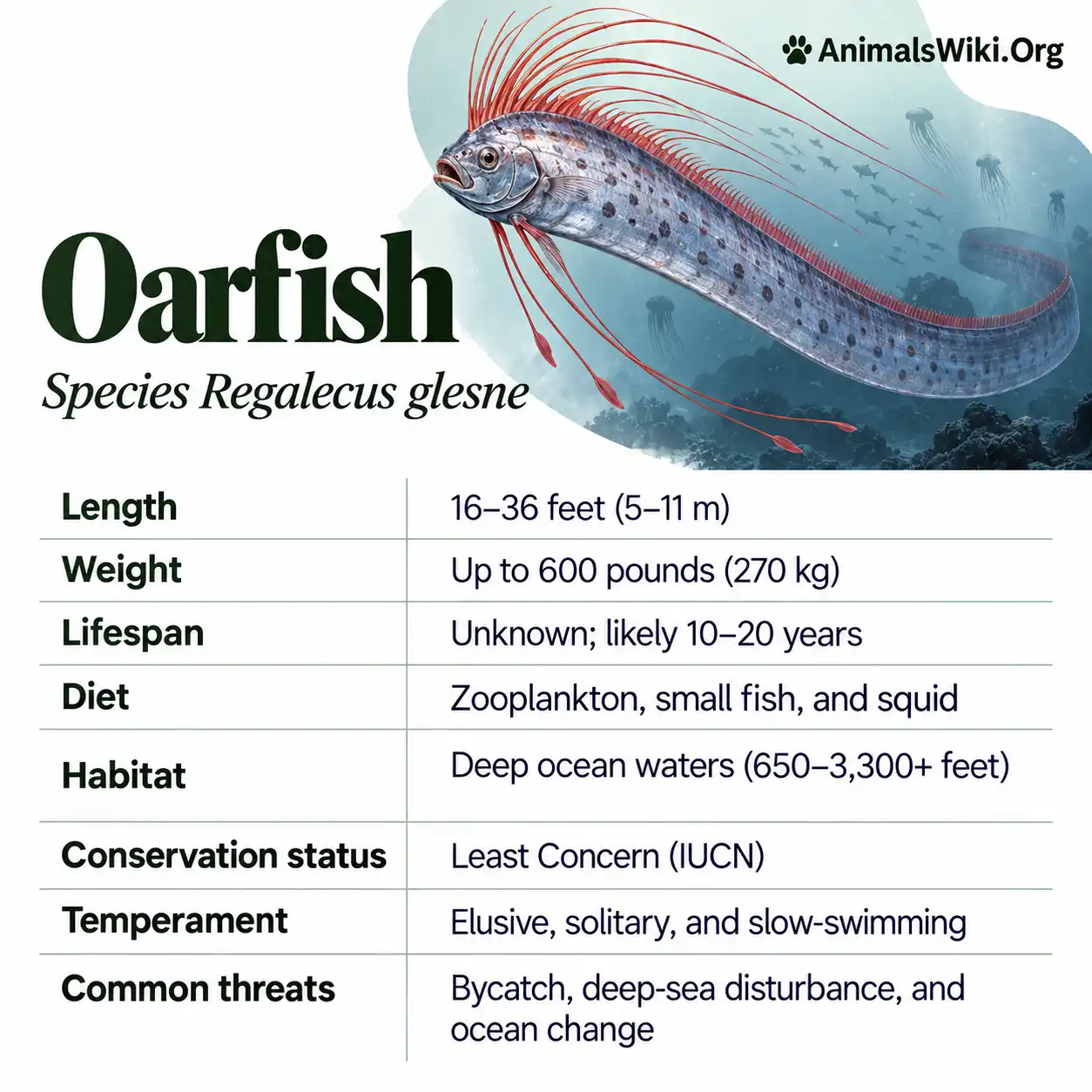
The best-known species is the:
Giant Oarfish.
Its scientific name is:
Regalecus glesne.
It is widely regarded as the:
longest living bony fish.
Exceptionally large individuals have been reported at lengths approaching:
8 meters or more, while historical reports sometimes claim even greater lengths.
Claims of extraordinarily huge individuals should be treated carefully because giant Oarfish are difficult to measure alive and old records are not always independently:
verified.
Even without exaggerated measurements, the reality is spectacular.
Imagine a silver ribbon several meters long moving vertically through dark:
ocean water.
The head points:
upward.
The body hangs almost:
straight down.
The long red dorsal fin undulates gently.
There is almost no movement from the rest of the:
body.
This strange posture has actually been observed in living:
Oarfish.
They can orient themselves vertically in the water column, apparently using their enormous dorsal fin for controlled:
movement.
Despite their terrifying sea-serpent appearance, Oarfish are not giant:
predators.
They do not hunt whales.
They do not attack:
ships.
And they do not normally threaten:
humans.
Instead, their diet consists largely of relatively small:
animals.
These can include:
- Krill
- Euphausiids
- Copepods
- Small crustaceans
- Squid
- Small fish
- Other planktonic organisms
Their mouth is relatively:
small.
They feed on organisms that seem almost absurdly tiny compared with their enormous:
length.
Oarfish generally inhabit deeper ocean waters.
This is one reason living individuals are rarely seen by:
people.
Most encounters occur when an animal:
- Washes ashore
- Becomes stranded
- Appears unusually close to the surface
- Is accidentally caught
- Is filmed by underwater equipment
When one appears on a beach, its extraordinary body can immediately attract:
attention.
A giant silver fish.
Bright red fins.
A head unlike most familiar:
fish.
And a body shaped almost exactly like the creatures sailors once described as:
sea serpents.
This resemblance has led scientists and historians to suggest that Oarfish sightings may have contributed to at least some traditional stories of gigantic:
sea monsters.
But another legend has become attached to the Oarfish in modern times.
The:
earthquake myth.
In Japan, Oarfish and similar deep-sea fishes have sometimes been associated in folklore with earthquakes and other natural:
disasters.
This has produced claims that Oarfish can:
predict earthquakes.
Scientific evidence does not support using Oarfish strandings as a reliable earthquake:
warning system.
The appearance of a deep-sea fish near shore may be influenced by many factors, including:
- Illness
- Injury
- Ocean currents
- Temperature changes
- Storms
- Disorientation
- Natural mortality
An Oarfish washing ashore is therefore fascinating—
but it should not automatically be interpreted as a prediction of an approaching:
earthquake.
The real biology of the Oarfish is far more interesting than the:
myth.
This comprehensive guide explores Oarfish facts, Giant Oarfish scientific name, classification, species, appearance, size, maximum length, weight, red fins, habitat, depth, distribution, diet, swimming, vertical posture, reproduction, eggs, larvae, lifespan, predators, adaptations, sea-serpent legends, earthquake myths, Oarfish vs Eel, Oarfish vs Mola mola, danger to humans, strandings and why the Giant Oarfish is one of the strangest fishes living in the deep ocean.
Oarfish Facts
| Feature | Information |
|---|---|
| Common Name | Oarfish |
| Best-Known Species | Giant Oarfish |
| Scientific Name | Regalecus glesne |
| Animal Type | Fish |
| Fish Type | Bony fish |
| Order | Lampriformes |
| Family | Regalecidae |
| Genus | Regalecus |
| Habitat | Open ocean, usually deeper waters |
| Distribution | Widespread in temperate & tropical oceans |
| Body Shape | Extremely long, ribbon-like & compressed |
| Color | Silvery with reddish fins |
| Maximum Length | Verified/credible reports around 8 m; larger historical claims exist |
| Diet | Zooplankton, crustaceans, squid & small fish |
| Famous Feature | Long red dorsal fin |
| Swimming | Dorsal-fin undulation |
| Human Danger | Very low |
| Famous Myth | Earthquake prediction |
| Record | Longest living bony fish |
What Is an Oarfish?
An Oarfish is a large, elongated marine fish belonging to the family:
Regalecidae.
The best-known species is:
Regalecus glesne,
the Giant Oarfish.
Is Oarfish One Species?
No.
“Oarfish” refers to members of the family:
Regalecidae.
Therefore, not every Oarfish is necessarily Regalecus glesne.
The family contains more than one recognized species.
What Is the Giant Oarfish?
The Giant Oarfish is:
Regalecus glesne.
It is famous for reaching extraordinary lengths and is generally considered the world’s longest living:
bony fish.
Scientific Classification of the Giant Oarfish
| Classification | Name |
|---|---|
| Kingdom | Animalia |
| Phylum | Chordata |
| Class | Actinopterygii |
| Order | Lampriformes |
| Family | Regalecidae |
| Genus | Regalecus |
| Species | Regalecus glesne |
What Does Regalecus Mean?
The name Regalecus relates to the idea of something:
royal.
This connects with another traditional name:
King of the Herrings.
Its spectacular red crest-like fin rays certainly give the fish a remarkably:
regal appearance.
Why Is It Called an Oarfish?
The origin of the common name has been associated with the fish’s long body and historically with the idea that its elongated pelvic fin rays might resemble:
oars.
However, Oarfish do not literally row themselves through the water using their fins like:
oars.
Why Is the Oarfish Called King of the Herrings?
This old name likely developed from its enormous size and historical associations with schools of:
herring.
However, the Oarfish is not simply a giant:
herring.
Is an Oarfish a Bony Fish?
Yes.
The Oarfish is a:
ray-finned bony fish.
Is an Oarfish an Eel?
No.
Its long body makes it look somewhat:
eel-like.
But Oarfish and true eels belong to completely different evolutionary:
groups.
Is an Oarfish a Sea Snake?
No.
Sea snakes are:
reptiles.
Oarfish are:
fish.
Is an Oarfish a Sea Serpent?
No mythical sea serpent has been scientifically identified as an:
Oarfish.
However, sightings of giant Oarfish may have helped inspire some historical:
sea-serpent stories.
What Does an Oarfish Look Like?
The Oarfish possesses one of the most distinctive bodies in the:
ocean.
Important features include:
- Extremely long ribbon-like body
- Silvery coloration
- Laterally compressed shape
- Bright red or orange dorsal fin
- Long crest-like fin rays above the head
- Small mouth
- Large eyes
- No ordinary-looking scales
- Tiny or reduced pelvic structures
- Tapering rear body
Why Is the Oarfish So Long?
Its elongated body represents an evolutionary specialization for life in the:
open ocean.
Unlike powerful pursuit predators, it can move efficiently using waves traveling along its enormous:
dorsal fin.
How Big Is an Oarfish?
Most Oarfish encountered are considerably smaller than the legendary giants.
However, Giant Oarfish can reach:
several meters in length.
Exceptionally large individuals can approach approximately:
8 meters or more.
What Is the Longest Oarfish Ever Found?
Credible records place Giant Oarfish at around:
8 meters
or somewhat beyond, depending on the record and measurement.
Historical reports sometimes claim individuals approximately:
10–11 meters long.
Those extreme figures are frequently repeated, but the quality of evidence varies.
For scientifically careful writing, it is better to say:
Giant Oarfish can reliably reach several meters and exceptional individuals around 8 meters, with larger historical reports requiring caution.
Is the Oarfish the Longest Fish in the World?
Not the longest fish of:
any kind.
The Whale Shark can reach greater overall lengths.
However, the Giant Oarfish is widely recognized as the:
longest living bony fish.
What Is the Longest Bony Fish?
The:
Giant Oarfish (Regalecus glesne).
How Much Does an Oarfish Weigh?
Large individuals can weigh:
hundreds of kilograms.
Weight varies enormously with length and body condition.
Because Oarfish are extremely long but relatively thin and compressed, they weigh much less than a similarly long:
shark or whale.
Why Is an Oarfish So Thin?
Its body is strongly:
laterally compressed.
Viewed from the side it appears broad and ribbon-like.
Viewed from another angle, it can appear surprisingly:
thin.
What Color Is an Oarfish?
The body is primarily:
silvery.
The fins can be:
- Red
- Orange-red
- Pinkish red
Dark spots or markings may also occur.
Why Does the Oarfish Have Red Fins?
The red coloration results from pigments in the fin:
tissue.
In the deep ocean, red wavelengths of sunlight disappear rapidly.
This means red coloration becomes much less conspicuous at:
depth.
Why Does the Oarfish Have a Red Crest?
The front rays of the dorsal fin are greatly elongated.
These create the dramatic crown-like:
crest.
The structure may play sensory, hydrodynamic or signaling roles, although not every aspect of its function is completely understood.
Does the Oarfish Have Scales?
Oarfish lack the typical overlapping scales seen on many:
fishes.
Their skin has a smooth, silvery appearance.
Does an Oarfish Have Teeth?
The mouth is relatively:
small.
Oarfish do not possess the huge predatory teeth that their sea-serpent appearance might suggest.
Their feeding anatomy is suited to capturing relatively small:
prey.
Where Do Oarfish Live?
Oarfish occur widely in:
the world’s oceans.
They are found in tropical, subtropical and temperate marine:
waters.
Do Oarfish Live in the Pacific Ocean?
Yes.
Do Oarfish Live in the Atlantic Ocean?
Yes.
Do Oarfish Live in the Indian Ocean?
Yes.
Do Oarfish Live in the Mediterranean?
Oarfish have been recorded in the:
Mediterranean region.
Are Oarfish Deep-Sea Fish?
They are commonly described as:
deep-water or mesopelagic fishes.
They usually live well below the ocean surface.
How Deep Do Oarfish Live?
Oarfish are associated largely with depths of roughly:
200–1,000 meters, although they can occur outside this range.
They may move vertically through the water column.
What Is the Mesopelagic Zone?
The mesopelagic zone is often called the:
twilight zone.
It generally extends from about:
200 to 1,000 meters deep.
Very little sunlight reaches this region.
Why Are Living Oarfish Rarely Seen?
Their normal habitat is far below the surface where humans rarely:
observe them directly.
Many known specimens have been:
- Stranded
- Washed ashore
- Accidentally caught
- Found dying near the surface
Modern underwater cameras have provided rare views of healthy animals in their natural:
environment.
Do Oarfish Live on the Ocean Floor?
They are primarily:
pelagic.
This means they live in the water column rather than spending their lives resting on the:
seafloor.
What Do Oarfish Eat?
Oarfish feed mainly on relatively small:
marine organisms.
Their diet can include:
- Krill
- Euphausiids
- Copepods
- Small crustaceans
- Small fish
- Squid
- Other planktonic animals
Do Oarfish Eat Humans?
No.
Do Oarfish Eat Sharks?
No.
There is no evidence that Oarfish are giant shark-hunting:
predators.
Do Oarfish Eat Whales?
No.
Do Oarfish Eat Jellyfish?
Various soft-bodied planktonic organisms may be consumed, but small crustaceans and similar prey are particularly:
important.
Do Oarfish Eat Krill?
Yes.
Krill and related crustaceans can form an important part of the:
diet.
Do Oarfish Eat Squid?
Small squid can be:
eaten.
Do Oarfish Eat Fish?
Yes.
Small fishes may form part of the diet.
How Does an Oarfish Eat?
The fish can use its mouth and specialized feeding mechanics to capture small organisms from the surrounding:
water.
Its feeding style is dramatically different from that of large predatory sharks.
How Does an Oarfish Swim?
This is one of the most fascinating aspects of its:
biology.
The dorsal fin extends along nearly the entire length of the:
body.
Waves travel along this fin.
These undulations propel the fish through:
water.
Does an Oarfish Move Its Whole Body Like an Eel?
Not usually in the same way.
Much of the propulsion can come from:
dorsal-fin undulation
while the long body remains relatively straight.
Can Oarfish Swim Vertically?
Yes.
Living Oarfish have been observed maintaining a:
head-up vertical posture.
The body hangs beneath the head while the dorsal fin gently:
undulates.
Why Do Oarfish Swim Vertically?
One likely advantage is improved feeding or detection of:
prey.
A vertical posture may allow the fish to scan or exploit organisms occurring above it.
However, Oarfish behavior remains incompletely understood because observations of healthy wild individuals are:
rare.
Can Oarfish Swim Horizontally?
Yes.
They are capable of both horizontal and vertical:
orientation.
Are Oarfish Fast?
They are not generally considered high-speed pursuit predators like:
tuna or billfish.
Their swimming style is adapted more toward controlled movement through the:
water column.
Do Oarfish Come to the Surface?
Occasionally.
But a healthy Oarfish’s normal habitat is generally much:
deeper.
Surface appearances can sometimes indicate:
- Stress
- Illness
- Injury
- Disorientation
- Changing environmental conditions
Why Do Oarfish Wash Ashore?
There is no single:
cause.
Possible explanations include:
- Strong currents
- Storms
- Injury
- Disease
- Temperature changes
- Natural death
- Disorientation
- Changes in oceanographic conditions
Does Finding an Oarfish Mean an Earthquake Is Coming?
No reliable scientific evidence supports this:
claim.
Oarfish strandings cannot currently be used as dependable earthquake:
predictions.
Why Are Oarfish Associated With Earthquakes?
Deep-sea fishes have long been associated with unusual natural events in:
folklore.
In Japan, Oarfish have sometimes been connected with legends about:
earthquakes.
Modern social media has amplified this association.
Can Oarfish Sense Earthquakes?
Fish may potentially detect:
- Vibrations
- Pressure changes
- Water movement
But this does not mean Oarfish can reliably predict earthquakes before:
humans can.
A biological ability to perceive environmental changes is very different from a scientifically useful earthquake-warning:
system.
Are Oarfish Earthquake Fish?
The phrase:
“earthquake fish”
is a cultural or popular label, not evidence that the animal reliably forecasts:
earthquakes.
Oarfish Behavior
Oarfish remain among the less-understood large:
fishes.
Much of what scientists historically knew came from dead or dying:
specimens.
Underwater observations are gradually revealing more about their normal:
behavior.
Are Oarfish Solitary?
They are generally thought to be largely:
solitary.
However, their social behavior is still poorly documented.
Do Oarfish Live in Groups?
They are not known for forming enormous schools like:
sardines.
Multiple individuals may occur in the same broader habitat.
Are Oarfish Nocturnal?
Their deep-water lifestyle makes a simple day-versus-night classification:
difficult.
Vertical movement may respond to prey and changing light conditions.
Do Oarfish Sleep?
Specific sleep behavior in wild Oarfish is poorly:
documented.
Like other fishes, they likely experience periods of reduced activity, but applying human-style sleep descriptions would be:
misleading.
How Do Oarfish Reproduce?
Oarfish reproduce by:
spawning.
Females release eggs into the:
water.
Males release sperm, and fertilization occurs:
externally.
Do Oarfish Lay Eggs?
Yes.
What Do Oarfish Eggs Look Like?
The eggs are:
pelagic.
That means they float or drift within the:
water column.
What Does a Baby Oarfish Look Like?
Oarfish larvae look dramatically different from enormous:
adults.
They possess elongated fin rays and distinctive features even at a very small:
size.
Are Baby Oarfish Tiny?
Yes.
Like many giant marine fishes, Oarfish begin life at a scale enormously smaller than their eventual adult:
size.
How Fast Do Oarfish Grow?
The growth rate of wild Giant Oarfish is not well:
established.
Because living individuals are difficult to monitor over long periods, many aspects of their growth remain:
unknown.
How Long Do Oarfish Live?
The precise lifespan of Giant Oarfish is:
not well established.
Claims giving a very specific lifespan should therefore be treated cautiously unless supported by direct scientific evidence.
Oarfish Adaptations
Extremely Long Body
Provides the species’ distinctive ribbon-like shape.
Long Dorsal Fin
Generates propulsion through wave-like movement.
Vertical Swimming
May assist with feeding and detecting prey.
Silvery Body
Reflects available light and may provide camouflage.
Red Fins
Become relatively inconspicuous in deep water where red light is absent.
Large Eyes
Help function in dimly illuminated environments.
Small Feeding Apparatus
Suitable for consuming relatively small prey.
Pelagic Lifestyle
Allows the animal to exploit deep open-ocean food resources.
Does the Oarfish Glow?
Oarfish are not generally known as strongly:
bioluminescent fishes.
Their silvery skin can reflect light dramatically, which may create an almost glowing appearance when illuminated underwater.
Can Oarfish Change Color?
Fresh Oarfish can display brilliant:
silver and red coloration.
Colors often fade after:
death.
This means stranded specimens may look different from living animals.
What Eats Oarfish?
The natural predators of adult Giant Oarfish are not well:
documented.
Large ocean predators such as:
sharks
may potentially prey upon them.
Smaller juveniles would be vulnerable to a much wider range of marine predators.
Do Sharks Eat Oarfish?
Large sharks are plausible predators and evidence of attacks has been noted on some specimens.
However, predator-prey interactions involving healthy adult Oarfish are rarely:
observed.
Do Orcas Eat Oarfish?
It is biologically possible for large marine predators to take Oarfish, but well-documented predation by Orcas is not a defining or frequently observed part of Oarfish:
ecology.
How Does an Oarfish Defend Itself?
Oarfish lack obvious major defensive weapons.
Possible defenses include:
- Deep-water habitat
- Large adult size
- Elongated body
- Swimming away from threats
Can an Oarfish Regrow Its Tail?
Oarfish are famous for sometimes being found with shortened posterior:
bodies.
Evidence suggests they can survive substantial loss of the rear portion.
This phenomenon is sometimes described as:
self-amputation or autotomy.
However, describing it as complete lizard-like tail regeneration would be misleading.
Why Do Oarfish Lose Their Tails?
The exact causes can vary.
Posterior loss may result from:
- Injury
- Predation
- Natural tissue loss
- Possible self-amputation
Because the rear body contributes relatively little to propulsion compared with the dorsal fin, an Oarfish can potentially survive significant posterior:
damage.
Oarfish vs. Eel
| Feature | Oarfish | Eel |
|---|---|---|
| Body | Extremely long & compressed | Long & cylindrical/compressed |
| Group | Lampriformes | Anguilliformes |
| Main Propulsion | Long dorsal-fin undulation | Body & fin undulation |
| Habitat | Primarily open deeper ocean | Highly variable |
| Maximum Length | Giant Oarfish can reach ~8 m or more | Most much smaller |
| Relationship | Not an eel | True eel |
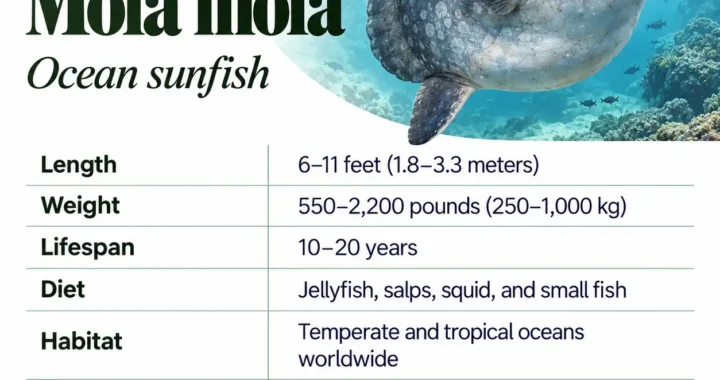
Oarfish vs. Mola Mola
| Feature | Oarfish | Mola Mola |
|---|---|---|
| Shape | Extremely long | Extremely deep & rounded |
| Famous Record | Longest bony fish | Among heaviest bony fishes |
| Body | Ribbon-like | Disc-like |
| Tail | Tapering rear | Clavus |
| Swimming | Dorsal-fin undulation | Dorsal + anal fins |
| Habitat | Deep/open ocean | Surface to deep open ocean |
| Diet | Small planktonic prey | Gelatinous prey + diverse animals |
Oarfish vs. Whale Shark
The Whale Shark is much heavier and can become:
longer.
However, it is a:
cartilaginous fish.
The Oarfish is a:
bony fish.
Therefore the Giant Oarfish retains its famous distinction as the longest known living:
bony fish.
Oarfish vs. Sea Snake
Sea snakes are:
reptiles.
They breathe:
air.
Oarfish are:
fish
and breathe using:
gills.
Oarfish vs. Sea Serpent
The legendary sea serpent is a creature of:
folklore.
The Oarfish is a real:
animal.
But an enormous Oarfish briefly appearing at the ocean surface could easily have contributed to historical reports of:
sea serpents.
Are Oarfish Dangerous to Humans?
Generally:
no.
Oarfish are not known as aggressive predators of humans.
Can an Oarfish Bite a Human?
Their mouths and feeding behavior are not adapted for attacking:
people.
A large stranded animal should still not be handled unnecessarily.
Do Oarfish Attack Divers?
There is no evidence that Oarfish routinely attack:
divers.
Can an Oarfish Kill a Human?
There is no evidence that Giant Oarfish normally hunt or kill:
humans.
Their enormous length makes them look frightening, but they feed mainly on comparatively tiny:
prey.
Can You Eat Oarfish?
Oarfish have occasionally been consumed, but their flesh is often described as:
soft or gelatinous
and is generally not considered an important commercial food fish.
Local regulations and food-safety guidance should always be followed.
Why Are Oarfish So Rare?
They may not necessarily be extraordinarily rare in suitable deep-water:
habitat.
Rather, they are rarely:
seen.
Humans spend little time hundreds of meters below the ocean:
surface.
Are Oarfish Endangered?
Their global conservation situation is difficult to evaluate because population data are:
limited.
For publication of a current formal conservation category, the latest authoritative assessment should be consulted.
What Threatens Oarfish?
Potential human-related pressures include:
- Accidental fishing capture
- Marine pollution
- Climate-driven ocean changes
- Habitat and food-web changes
However, their population ecology remains poorly understood compared with many commercially important:
fishes.
Why Are Oarfish Important?
Oarfish are part of deep pelagic:
food webs.
They consume smaller organisms and potentially provide prey for larger ocean:
predators.
They are also scientifically valuable because they offer insight into ecosystems humans still understand only:
poorly.
Oarfish and Sea-Serpent Legends
Imagine being a sailor hundreds of years:
ago.
There are no underwater:
cameras.
No marine biology textbooks.
No internet.
No deep-diving:
submersibles.
Then something rises beside your:
ship.
Silver.
Red-crested.
Snake-like.
Longer than several:
people.
It disappears almost immediately beneath the:
waves.
What would you call it?
Probably not:
Regalecus glesne.
You might call it a:
sea serpent.
This is why the Oarfish has become one of the strongest real-world candidates for explaining at least some historical sea-monster:
reports.
50 Interesting Oarfish Facts
- Oarfish are real deep-water fishes.
- They belong to the family Regalecidae.
- The best-known species is the Giant Oarfish.
- Its scientific name is Regalecus glesne.
- Giant Oarfish are the longest living bony fishes.
- Exceptional individuals can reach around 8 meters or more.
- Larger historical measurements have been reported but require caution.
- Oarfish are not eels.
- They are not sea snakes.
- They are not mythical sea serpents.
- Their bodies are extremely long and ribbon-like.
- Their bodies are laterally compressed.
- They have silvery skin.
- Their fins can be brilliant red.
- The dorsal fin extends along almost the entire body.
- The first dorsal rays form a dramatic crest.
- Oarfish primarily swim using their dorsal fins.
- Their bodies can remain relatively straight while swimming.
- Oarfish can orient vertically.
- They have been filmed swimming head-up.
- They usually inhabit deeper ocean water.
- They are associated especially with the mesopelagic zone.
- The mesopelagic zone begins around 200 meters deep.
- Oarfish may occur hundreds of meters below the surface.
- They are pelagic rather than bottom-dwelling.
- Oarfish eat krill.
- They eat copepods.
- They can eat small fish.
- They can eat squid.
- Their mouths are relatively small.
- They do not hunt humans.
- They do not hunt whales.
- They are generally harmless to divers.
- Living Oarfish are rarely encountered by people.
- Many famous specimens have washed ashore.
- Surface appearances may occur when an animal is sick or injured.
- Oarfish strandings do not reliably predict earthquakes.
- Their association with earthquakes is largely folklore.
- They reproduce by spawning.
- Their eggs are pelagic.
- Their larvae look very different from adults.
- Their precise lifespan is poorly known.
- Adult predator interactions are rarely observed.
- Large sharks may prey upon Oarfish.
- Oarfish can survive loss of portions of the rear body.
- They inspired the traditional name King of the Herrings.
- Their enormous bodies may have inspired sea-serpent legends.
- Red coloration becomes difficult to see in deep water.
- Modern underwater cameras have transformed our understanding of living Oarfish.
- Despite their enormous size, much of Oarfish biology remains mysterious.
Did You Know?
The longest living bony fish in the world may spend much of its life where humans almost never see it.
Several hundred meters beneath the:
surface,
sunlight begins to disappear.
Blue remains longer than:
red.
Eventually even the blue weakens.
The ocean becomes:
twilight.
Suspended in that dim water is something:
enormous.
At first, it resembles a:
silver ribbon.
Then the camera moves closer.
A head appears.
Above it rises a crown of brilliant:
red fin rays.
Behind the head stretches a body several meters:
long.
It is an:
Oarfish.
But the fish is not swimming like an:
eel.
Its body remains almost:
straight.
Instead, a wave travels through the enormous dorsal fin.
One section moves.
Then another.
Then another.
The wave passes backward along almost the entire:
body.
The fish moves:
forward.
Then something even stranger:
happens.
The head turns:
upward.
The body rotates.
Soon the enormous fish is hanging almost:
vertically.
Head above.
Tail:
below.
The dorsal fin continues gently:
undulating.
Around it drift tiny:
animals.
Krill.
Copepods.
Other organisms that seem ridiculously small beside such a gigantic:
fish.
But these are its:
prey.
The Oarfish does not need to chase:
whales.
It does not need enormous:
teeth.
Its frightening appearance is almost entirely:
deceptive.
Now imagine the same animal hundreds of years:
ago.
A storm pushes it toward:
surface water.
Sailors see a flash of:
silver.
Then a red:
crest.
Then meters and meters of serpent-like body moving beneath the:
waves.
They return home and describe what they:
saw.
A serpent.
A dragon.
A monster from beneath the:
sea.
Perhaps some stories were exaggerated.
Perhaps some were completely:
invented.
But some sailors may have been describing something very:
real.
Not a monster.
Not an omen.
Not an earthquake:
prophet.
Just one of the most extraordinary fishes evolution has ever produced—
the:
Oarfish.
Frequently Asked Questions About Oarfish
What is an Oarfish?
An Oarfish is an extremely elongated marine bony fish belonging to the family Regalecidae.
What is the scientific name of the Giant Oarfish?
Regalecus glesne.
Is Oarfish one species?
No. Oarfish refers to a family containing multiple species.
What is a Giant Oarfish?
The Giant Oarfish is Regalecus glesne, the best-known and largest Oarfish species.
Is the Oarfish a real animal?
Yes.
Is the Oarfish a bony fish?
Yes.
Is an Oarfish an eel?
No.
Is an Oarfish a snake?
No.
Is an Oarfish a sea snake?
No.
Is an Oarfish a sea serpent?
No, although sightings may have contributed to sea-serpent legends.
Why is it called an Oarfish?
The name has historically been associated with its unusual elongated fin structures and body shape.
Why is the Oarfish called King of the Herrings?
It is an old traditional name inspired by its extraordinary size and supposed association with herring.
How big is an Oarfish?
Giant Oarfish can reach several meters in length.
How long can an Oarfish get?
Exceptional credible specimens approach around eight meters, while larger historical claims exist.
Can Oarfish reach 10 meters?
Lengths around 10–11 meters have been historically reported, but these extreme records are less securely documented than smaller measured specimens.
Is the Oarfish the longest fish?
It is the longest living bony fish, but not necessarily the longest fish of any kind.
What is the longest bony fish?
The Giant Oarfish.
Is an Oarfish longer than a Whale Shark?
The largest Whale Sharks can exceed the lengths of securely measured Giant Oarfish.
How much does an Oarfish weigh?
Very large individuals can weigh hundreds of kilograms.
Why is the Oarfish so thin?
Its body is strongly compressed from side to side.
What color is an Oarfish?
Primarily silver with bright red or orange-red fins.
Why are Oarfish fins red?
Pigments create the coloration, which becomes difficult to see in deep water because red light is rapidly absorbed.
Does an Oarfish have a crest?
The elongated front rays of its dorsal fin create a crest-like appearance.
Does an Oarfish have scales?
It lacks the familiar overlapping scales of many common fishes.
Does an Oarfish have teeth?
Its feeding structures are not equipped with the huge predatory teeth suggested by its frightening appearance.
Where do Oarfish live?
In temperate, subtropical and tropical oceans around the world.
Do Oarfish live in the Pacific?
Yes.
Do Oarfish live in the Atlantic?
Yes.
Do Oarfish live in the Indian Ocean?
Yes.
Are Oarfish deep-sea fish?
They are deep-water pelagic fishes commonly associated with the mesopelagic zone.
How deep do Oarfish live?
They are often associated with approximately 200–1,000 meters of depth, although their range can extend beyond this.
What is the twilight zone?
The mesopelagic or twilight zone is roughly 200–1,000 meters beneath the ocean surface.
Do Oarfish live on the seafloor?
No. They are primarily pelagic fishes living within the water column.
Why are Oarfish rarely seen?
Their normal habitat lies far below the surface.
Why do Oarfish come to the surface?
Illness, injury, currents, temperature changes and other environmental factors may contribute.
Why do Oarfish wash ashore?
Strandings can result from several causes rather than one universal explanation.
Do Oarfish predict earthquakes?
No reliable scientific evidence demonstrates that they can.
Why are Oarfish called earthquake fish?
Folklore, particularly from Japan, has associated unusual deep-sea fish appearances with earthquakes.
Do Oarfish appear before tsunamis?
There is no reliable evidence that Oarfish strandings provide a dependable tsunami warning.
Can Oarfish sense earthquakes?
They may perceive environmental vibrations like many animals, but there is no evidence that this makes them reliable earthquake predictors.
What do Oarfish eat?
Krill, copepods, small crustaceans, small fish, squid and other planktonic organisms.
Do Oarfish eat krill?
Yes.
Do Oarfish eat squid?
Yes, particularly smaller squid.
Do Oarfish eat fish?
Small fishes can be consumed.
Do Oarfish eat humans?
No.
Do Oarfish eat sharks?
No evidence indicates that sharks are normal Oarfish prey.
Do Oarfish eat whales?
No.
How does an Oarfish swim?
Primarily by producing waves along its extremely long dorsal fin.
Does an Oarfish swim like an eel?
Not usually. Its dorsal fin provides much of its propulsion.
Can Oarfish swim vertically?
Yes.
Why do Oarfish swim vertically?
The posture may assist with feeding or prey detection, although its behavior remains incompletely understood.
Can Oarfish swim horizontally?
Yes.
Are Oarfish fast?
They are not considered extreme high-speed pursuit predators.
Are Oarfish solitary?
They are generally believed to be largely solitary.
Do Oarfish live in schools?
Large schooling behavior is not characteristic of the species.
How do Oarfish reproduce?
They spawn eggs and sperm into the water.
Do Oarfish lay eggs?
Yes.
Do Oarfish guard their eggs?
There is no evidence of elaborate parental guarding comparable with some nest-building fishes.
What does a baby Oarfish look like?
Larvae are tiny and possess distinctive elongated fin rays.
How long do Oarfish live?
Their exact lifespan remains poorly established.
What predators eat Oarfish?
Large sharks are among the likely predators, while juveniles probably face many additional predators.
Can an Oarfish regrow its tail?
They can survive posterior body loss, but claims of complete lizard-like tail regeneration are misleading.
Why do Oarfish lose part of their bodies?
Predation, injury and possible self-amputation may contribute.
Are Oarfish dangerous to humans?
No. They are generally considered harmless.
Do Oarfish attack humans?
No evidence suggests normal predatory attacks on humans.
Can an Oarfish bite you?
Its feeding anatomy is not designed for attacking large animals such as humans.
Can an Oarfish kill a human?
There is no evidence that Oarfish hunt or normally kill humans.
Can divers swim with Oarfish?
Rare encounters with living Oarfish have occurred. The fish should be observed without touching or harassing it.
Can people eat Oarfish?
They have occasionally been consumed, although they are not an important commercial food fish and their flesh is often considered poor quality.
Are Oarfish rare?
They are certainly rarely observed, although this does not necessarily mean they are equally rare throughout their deep-water habitat.
Are Oarfish endangered?
Population information is limited, so current formal conservation assessments should be checked before publishing a definitive status.
Why do Oarfish look like sea monsters?
Their extraordinary length, bright crest and serpentine body closely resemble traditional descriptions of sea serpents.
Did Oarfish inspire sea-serpent legends?
It is plausible that some historical sightings of Oarfish contributed to such legends.
Is the Oarfish related to Mola mola?
Both are bony fishes, but they belong to very different evolutionary groups.
What is the difference between Oarfish and Mola mola?
Oarfish are extremely long ribbon-shaped fishes, while Mola mola are enormous, deep-bodied and almost disc-shaped.
What is the difference between an Oarfish and an eel?
They belong to different orders and use different swimming mechanics despite both having elongated bodies.
What is the strangest Oarfish fact?
A fish capable of reaching around eight meters can hang vertically in deep water while feeding on animals tiny enough to seem insignificant beside its enormous body.
Conclusion
The Oarfish proves that the real ocean can produce animals every bit as strange as:
mythology.
Imagine descending hundreds of meters beneath the:
surface.
The sunlight fades.
Red disappears.
Then yellow.
Eventually only dim blue penetrates the:
water.
Ahead—
something:
moves.
At first it appears to be a:
ribbon.
Silver.
Thin.
Almost impossibly:
long.
Then you see the:
head.
Above it rises a brilliant red:
crest.
Behind it stretches meter after meter of:
body.
The fish turns.
Not sideways—
but:
vertical.
Its head points toward the distant:
surface.
The rest of the body hangs beneath it.
Then the dorsal fin begins:
moving.
A wave passes down the red edge of the:
body.
The giant fish glides forward.
No enormous jaws.
No giant:
teeth.
No attack.
Nearby drift tiny:
crustaceans.
Those are what interest the:
Oarfish.
For centuries, humans looked at animals like this and imagined:
monsters.
Sea serpents.
Dragons.
Warnings from the:
deep.
Today another myth follows it.
When an Oarfish washes ashore, people sometimes say an earthquake must be:
coming.
But the scientific evidence does not support that:
prediction.
The truth is less supernatural—
and far more:
interesting.
This is a real fish capable of reaching extraordinary:
length.
A fish that can swim vertically.
A fish propelled by a dorsal fin running nearly the length of its:
body.
A fish living in parts of the ocean humans still rarely:
see.
And that may be the greatest reason the Oarfish remains so:
fascinating.
It reminds us that beneath the familiar surface of the sea lies an enormous world where creatures that once sounded like legends are:
real.
Not a serpent.
Not an omen.
Not a monster.
But the longest living bony fish known to science:
the Giant Oarfish.