
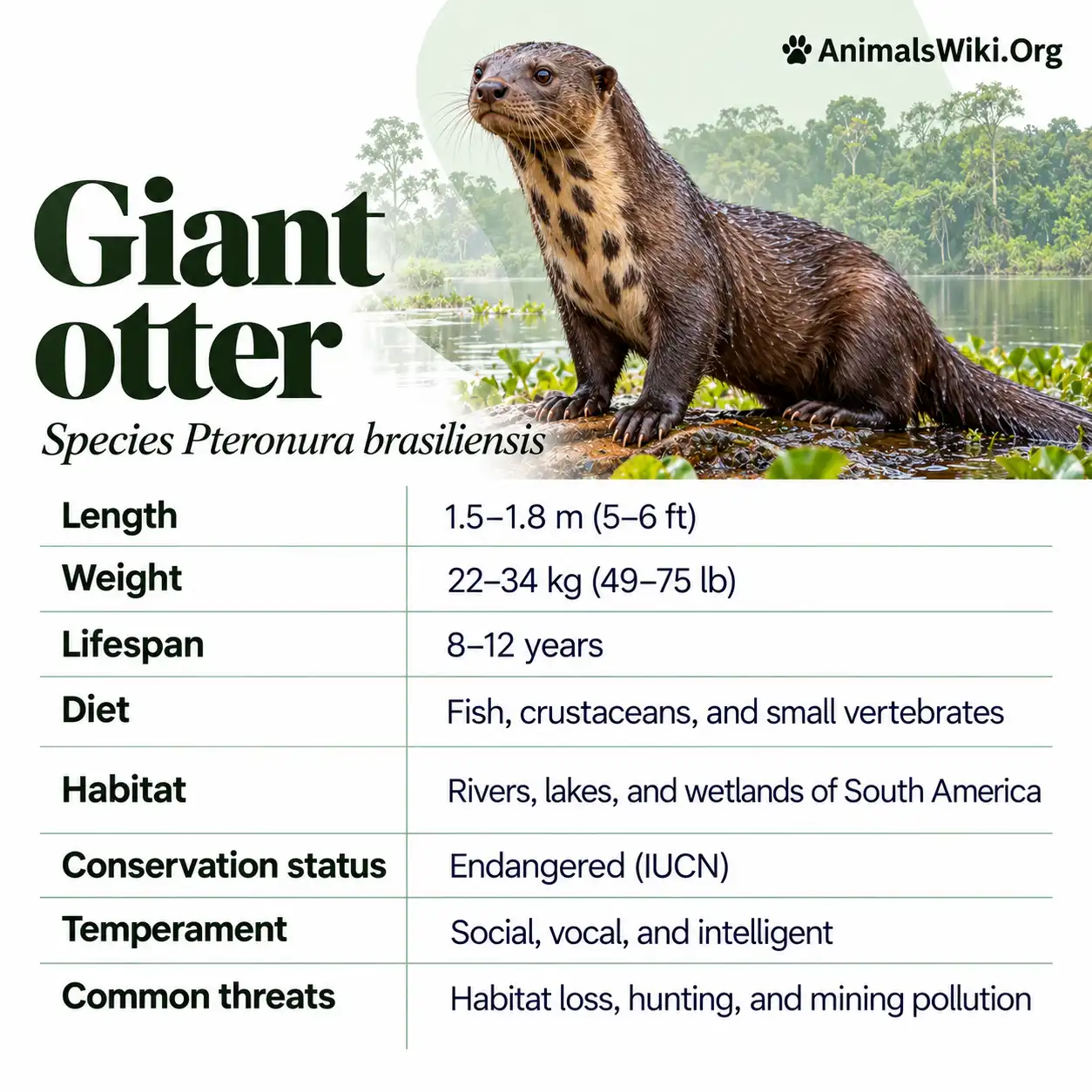
Giant Otter, The Remarkable River Wolf of South America
The giant otter is one of South America’s most distinctive freshwater mammals. Long-bodied, powerful and highly social, it moves through rivers and lakes with remarkable agility. Its brown coat, pale throat markings and flattened tail make it recognizable, while its calls announce the presence of a family group long before every member becomes visible.
Also known as the giant river otter or river wolf, this endangered animal depends on both water and land. It hunts mainly underwater but returns to riverbanks to rest, groom, mark its territory and raise young.
Family life is central to its biology. A group typically includes a breeding pair and offspring of different ages, with older members helping care for younger animals. Their relationships involve food sharing, vocal communication, group defense and repeated contact throughout the day.
However, giant otters face pressures that extend far beyond their immediate surroundings. Mining, habitat degradation, fishing conflicts, disturbance and changes to freshwater systems can affect their survival.
This guide explores giant otter identification, size, distribution, diet, reproduction, family behavior and conservation. It also separates documented abilities from exaggerated claims about an animal sometimes portrayed as an invincible Amazonian predator.
Information checked: October 19, 2026.
Giant Otter Facts
| Feature | Information |
|---|---|
| Common name | Giant otter |
| Other names | Giant river otter, river wolf, ariranha |
| Scientific name | Pteronura brasiliensis |
| Animal class | Mammalia |
| Family | Mustelidae |
| Subfamily | Lutrinae |
| Native continent | South America |
| Typical adult length | Approximately 1.5–1.8 meters, including the tail |
| Representative adult weight | Approximately 24–34 kilograms |
| Main food | Fish |
| Habitat | Rivers, lakes, creeks, wetlands and seasonally flooded environments |
| Activity pattern | Primarily active during daylight |
| Social structure | Family groups |
| Distinctive features | Pale throat markings and a broad, flattened tail |
| Young | Called pups or cubs |
| Global conservation category | Endangered |
1. What Is a Giant Otter?
A giant otter is a large, semiaquatic carnivorous mammal native to South America. It belongs to the weasel family, Mustelidae, and the otter subfamily, Lutrinae.
“Semiaquatic” means its life involves both water and land. It obtains most of its food in water but uses terrestrial shelter and riverbank spaces for essential activities.
The genus Pteronura contains this single living species. Its scientific classification distinguishes it from the North American river otter, Neotropical otter and sea otter.
The name “river wolf” reflects its predatory role and social nature. It does not indicate any close relationship with wolves.
Understanding the giant otter requires keeping both parts of its lifestyle in view. A healthy fish population cannot compensate for the complete loss of suitable banks, and a sheltered den cannot support a family without accessible food.
Its habitat is a connected system rather than simply the patch of water where it happens to be photographed.
2. How Big Is a Giant Otter?
Adult giant otters commonly measure approximately 1.5–1.8 meters from the nose to the end of the tail. Representative weights are around 24–34 kilograms, although measurements vary.
Males are generally larger than females. The Otter Specialist Group provides a total-length range of approximately 145–180 centimeters for the species.
The giant otter is generally recognized as the longest living otter. However, “largest” needs clarification because sea otters can be heavier.
This distinction prevents two different measurements from becoming confused:
- Length describes how far the body extends.
- Mass describes how much the animal weighs.
Historical claims based on stretched skins should also be treated separately from measurements of intact animals.
In the water, apparent size can be deceptive. A head above the surface reveals only a fraction of the animal. Its full length becomes clearer when it climbs onto a bank or stretches out while resting.
3. What Does a Giant Otter Look Like?
The giant otter has a long, muscular body, short legs, a broad head and a strong, flattened tail.
Its coat ranges through shades of brown, including reddish or chestnut tones. Pale cream or white patches occur on the throat and may extend toward the chin or chest.
A scientific species account describes this variation and identifies throat patterning as a useful feature for recognizing individuals.
The face is another important identification clue. Small ears, a broad muzzle and prominent whiskers contribute to its distinctive appearance.
Wet fur can make the animal look darker and narrower than it appears when dry. Light conditions also influence the apparent color of its coat.
For accurate identification, use several features together. A large otter with a broad tail and irregular pale throat patches is more informative than a photograph showing only a brown head.
Body proportions and markings are especially helpful where other otter species inhabit the same region.
4. Why Throat Markings Matter
A giant otter’s pale throat pattern acts as a natural identification feature.
Researchers can photograph the markings and compare them across encounters, helping establish which individuals remain in a group and which have disappeared or arrived.
Zoo Atlanta describes the patches as individual patterns that keepers use to distinguish animals.
This ability makes repeated observation particularly valuable. A sighting can reveal more than the presence of the species when the individual is recognizable.
Researchers may follow breeding animals, document the development of young and reconstruct group histories without needing to capture every otter repeatedly.
However, identification depends on image quality. Angle, water, shadow and the animal’s posture can conceal part of the pattern.
A clear throat photograph is therefore useful evidence, while an uncertain image should remain uncertain.
For wildlife photographers, recording markings from a respectful distance can contribute more information than obtaining a close portrait that shows only the face.
5. Giant Otter Swimming Adaptations
Giant otters are effective swimmers because several physical features work together.
Their long bodies bend through turns, their webbed feet push against water, and their broad tails help control movement. The tail is particularly useful during steering and rapid changes in direction.
Zoo Atlanta describes their maneuverability and the importance of the tail during swimming.
These abilities matter when prey changes direction or moves around roots, branches and submerged obstacles.
Swimming performance involves more than traveling quickly in a straight line. A hunting otter must accelerate, stop, turn, investigate confined spaces and return to the surface.
The animal’s flexible body supports this variety of movements.
A giant otter must still breathe air. It surfaces between dives rather than extracting oxygen from water.
Watching repeated hunting dives reveals a rhythm of searching, surfacing and repositioning. That rhythm is a more realistic picture of its aquatic life than a single maximum-speed claim.
6. Fur, Grooming and Sensory Whiskers
Like other otters, giant otters rely on specialized fur to help maintain suitable conditions next to the skin.
Otter coats contain dense underfur and protective outer hairs. Grooming helps keep this system functioning, which is why rolling, scratching and rubbing can have practical value.
San Diego Zoo explains the importance of coat maintenance and the insulating air retained by otter fur.
Their whiskers provide another important adaptation. Zoo Atlanta describes them as sensory structures that help detect prey and movement in water, particularly when visibility is limited.
These functions should not be exaggerated into perfect waterproofing or flawless underwater detection.
Instead, they provide advantages in a variable environment. Water may be shaded, muddy or obstructed, and the animal needs several sources of information.
The visible activities of grooming and close investigation therefore connect directly with the demands of hunting and remaining healthy in water.
7. Where Do Giant Otters Live?
Giant otters are native to South America, with important populations in the Amazon and Orinoco regions and the Pantanal.
Their distribution extends across several countries, but presence is uneven and some former populations have disappeared.
The Mammal Diversity Database lists countries including Brazil, Bolivia, Colombia, Ecuador, Guyana, Peru, Suriname and Venezuela within the species’ distribution.
A continental range map is an overview rather than a guarantee that every river inside the shaded area supports otters.
Local conditions determine whether a family can obtain enough food, find suitable shelter and avoid excessive disturbance.
Distribution also changes through time. A location described as unoccupied in an older account may later produce a confirmed sighting or become the focus of restoration.
For this reason, country lists and local population statements should be checked against their dates.
The most useful conservation information identifies the river system, the evidence of occupancy and whether breeding groups are known to persist there.
8. Giant Otter Habitat
Giant otters use rivers, creeks, lakes, wetlands and seasonally flooded environments.
Oxbow lakes are especially important in parts of the Amazon. These water bodies form when a river bend becomes separated from the main channel.
Research in Peru found that giant otters favored bank areas with dense forest canopy. Within the water, they selected features including open water and fallen logs while avoiding some heavily covered floating vegetation.
These findings show that habitat is not uniform even within one lake.
An area may provide good feeding conditions while another supplies safer cover or a suitable resting place.
The needs of a family group must also be considered across time. A useful bank during low water may become flooded later.
Protecting a mix of aquatic and terrestrial features gives otters more options than preserving an isolated pool alone.
Habitat quality depends on structure, resources and connections, as well as the simple presence of water.
9. How Seasonal Flooding Changes Their Lives
Seasonal flooding can transform giant otter habitat.
As water spreads across floodplains, fish gain access to areas that were previously dry or disconnected. Otters may adjust their movements to follow these changing opportunities.
Pantanal research documented seasonal changes in the territories used by family groups, including movements into flooded environments.
This creates a shifting landscape rather than a fixed map of feeding places.
During lower water, animals and fish may become concentrated in channels and remaining pools. During higher water, food can become more widely dispersed.
Neither condition is automatically better in every respect. Concentrated prey may be easier to locate, while expanding water can open new feeding areas.
Understanding these changes is essential when interpreting surveys. A group missing from a familiar dry-season stretch may have moved elsewhere.
Repeated seasonal observations provide a stronger picture than assuming that one visit represents year-round habitat use.
10. Dens and Resting Sites
Giant otters use riverbank shelters, including excavated dens and protected spaces among roots or branches.
A Pantanal study identified both dens and campsites, finding that most recorded shelters had partial or complete vegetation cover.
The study emphasized the importance of conserved banks and riparian vegetation for shelter protection.
Dens provide enclosed shelter, while campsites are more open areas used for activities such as resting and grooming.
These places are essential parts of the group’s habitat rather than incidental spaces beside it.
For breeding animals, a secure den is particularly important because newborn pups cannot accompany adults on routine foraging trips.
Disturbance near shelter can therefore affect more than a temporary resting period.
A boat repeatedly approaching a bank may seem harmless from the water, yet the bank may contain a nursery or an important route between shelter and feeding areas.
Recognizing that hidden use helps explain why den protection is central to responsible tourism.
11. Latrines and Scent Marking
Giant otters use communal marking sites, commonly called latrines.
These locations contain scent information deposited through droppings, urine and glandular secretions. They form part of the group’s communication and territorial behavior.
Research on territoriality recorded dens, latrines and other scent marks when mapping the areas used by different groups.
Scent marking allows information to remain after the animal has moved away.
This can be useful when neighboring groups do not meet directly. A recently visited site may advertise occupation without requiring a physical confrontation.
However, one latrine does not equal one animal or one family. Several individuals may use a site, and repeated deposits can come from the same group.
For observers, a latrine is evidence of habitat use rather than a straightforward population count.
It should also be left undisturbed. Walking over marking areas can interfere with a site that has continuing value to the animals.
12. What Do Giant Otters Eat?
Fish make up the great majority of the giant otter’s diet.
The species is strongly piscivorous, meaning fish-eating, although other prey can be consumed.
A Pantanal study comparing two floodplain systems found diets dominated by several fish families. The composition differed between the two habitats, reflecting differences in local fish communities.
| Food category | Importance |
|---|---|
| Fish | Main dietary component |
| Crustaceans | Occasional food in some settings |
| Other aquatic animals | Consumed less regularly |
| Small reptiles and other vertebrates | Documented but not representative of the usual diet |
A list of unusual prey should not overshadow the ordinary feeding pattern.
The presence of one dramatic hunting record does not mean that animal is a major food source.
Diet descriptions are most useful when they distinguish frequent foods from occasional records.
They should also identify the population and habitat studied, because a family living in a floodplain lake may encounter a different menu from one using a river channel.
13. How Giant Otters Hunt Fish
Giant otters search and pursue prey underwater, returning to the surface to breathe and often to handle food.
Groups may travel and forage together, but individual otters still make many of their own captures.
Their swimming abilities let them investigate banks, submerged structures and open areas while following available fish.
Chester Zoo describes fish such as catfish, piranhas and perch-like species among recorded foods.
Group foraging should not automatically be interpreted as a perfectly coordinated attack with fixed roles.
Several animals may benefit from moving through the same productive area without every capture involving deliberate teamwork.
Understanding cooperation requires observing what individuals do and whether their actions depend on one another.
Feeding success also depends on prey accessibility. A fish’s size, behavior and location influence whether it provides a worthwhile target.
The giant otter’s hunting lifestyle combines physical agility with repeated decisions about where to search and what to pursue.
14. Do Giant Otters Eat Caimans?
Yes, caiman predation has been documented, but it is not the foundation of the giant otter’s diet.
Researchers filmed giant otters taking subadult yacare caimans in shallow Pantanal pools late in the dry season.
They suggested that resource scarcity in these marginal environments could help explain the behavior.
The details matter. A record involving a smaller caiman in a restricted pool does not establish that giant otters routinely hunt large crocodilians in all habitats.
It also does not mean every confrontation ends in the otter’s favor.
Predator relationships change with the size, age and circumstances of the animals involved.
For readers, the most accurate answer is that giant otters can exploit some unusual vertebrate prey, including caimans, while remaining primarily fish-eaters.
Their capabilities are impressive without turning occasional events into universal rules or presenting them as animals immune to danger.
15. Daily Activity and Rest
Giant otters are primarily diurnal, carrying out much of their visible activity during daylight.
A day can include feeding trips, resting, grooming, communication, marking and social interaction.
Research comparing daytime activity along Amazonian rivers recorded giant otters across daytime hours and examined how disturbance affected their occurrence.
Their routine should not be imagined as continuous hunting from sunrise to sunset.
Food searching requires effort, and rest is a normal part of the activity budget.
Studies of zoo animals also demonstrate that feeding arrangements can change how time is distributed. Otters receiving supplied food do not face the same searching demands as wild animals.
This is why a resting group in managed care cannot directly reveal how wild otters spend a typical day.
Context matters when comparing behavior. Food availability, neighboring groups and environmental conditions all help shape the activities that an observer sees.
16. Giant Otter Family Groups
Family groups are central to giant otter life.
A typical group includes a breeding pair, young and older offspring that have not yet established independent breeding positions.
San Diego Zoo Wildlife Alliance describes groups ranging from two to fifteen individuals in its field research context.
Group size changes as pups are born, animals disperse or individuals die.
It should therefore be treated as a flexible characteristic rather than a fixed number that every family must contain.
The presence of multiple generations creates opportunities for repeated relationships. Animals recognize companions, remain in contact while moving and participate in care of younger group members.
Family life also has costs. More individuals require more food, and maintaining access to a suitable area can involve territorial pressure.
The group is both a social unit and a practical arrangement shaped by the resources and risks of its environment.
17. How Older Siblings Help Raise Young
Giant otter care can involve more than the two parents.
Research describes older family members participating in activities such as protection, grooming and prey sharing. Young animals obtain food from parents and siblings through persistent begging.
A detailed field account also documented family members assisting an aging breeding female, illustrating that help can sometimes flow toward an older animal.
These observations make giant otter society particularly interesting.
However, assistance does not mean every group member contributes equally or performs a permanent assigned role.
Age, opportunity and circumstances can affect participation.
A separate study in Brazil reported the importance of alloparental care—care by individuals other than the parents—during challenging situations, including den changes.
For conservation, this means social structure can matter alongside the number of animals present. A functioning family contains relationships and experience that are not captured by a simple head count.
18. Giant Otter Calls and Vocal Communication
Giant otters have a rich vocal repertoire.
One study identified 22 adult vocalization types and 11 types within the vocal bouts of newborns. Another investigation of Pantanal groups described 15 sound types using its own study framework.
These numbers should not be treated as a competition between contradictory answers.
Researchers may classify graded sounds differently, sample different situations or use different criteria for defining a call type.
The broader conclusion is that giant otter communication is diverse and closely connected with social activity.
Calls occur during contact, alarm, begging and other interactions.
A family moving through water and vegetation may temporarily lose visual contact, making sound especially useful.
For people observing them, a call is therefore part of a continuing exchange rather than simply background noise.
Recording the behavior around a sound is necessary to understand what it may be doing.
19. Can Giant Otters Recognize Individual Voices?
Research supports individual discrimination through certain giant otter calls.
A study of cohesion calls found evidence of individual signatures and used playback experiments to investigate whether otters could distinguish callers.
The animals responded in ways indicating discrimination between individuals in the tested calls.
This ability is useful in a group whose members repeatedly separate and reunite during movement and feeding.
Recognizing a caller can provide more information than merely detecting that another otter is nearby.
It may help an animal respond according to its relationship and previous experience with that individual.
However, recognition should not be translated automatically into a human-style system of names.
The research demonstrates differences in acoustic signals and responses to them.
That is already a substantial finding: a noisy group is exchanging information that can include who is calling, rather than producing an undifferentiated collection of sounds.
20. Territorial Behavior and Group Defense
Giant otter groups defend areas that provide feeding opportunities and shelter.
Defense can involve scent marking, loud calls and direct encounters.
Pantanal research found that territory extent and stability were influenced by group size, season and neighboring groups. Some boundaries overlapped rather than forming perfectly exclusive divisions.
Territoriality therefore does not mean an unchanging line that every animal recognizes in exactly the same way.
Water levels and social pressure can change the value or defensibility of particular places.
Defense also has costs. Time devoted to marking or confronting neighbors is time unavailable for other activities.
This helps explain why communication is useful. Advertising occupation can sometimes influence another group before a dangerous fight occurs.
For wildlife watching, a group’s loud reaction should not be interpreted as an invitation to approach.
It may indicate that the animals are alert to a perceived threat or disturbance near an important resource.
21. Giant Otter Reproduction
Giant otter reproduction usually centers on a breeding pair within the group.
A study of animals in managed care recorded pregnancies lasting 62–70 days, with an average of approximately 66.5 days.
The same research examined reproductive hormones, social behavior and environmental conditions associated with breeding success.
These observations should be distinguished from the delayed implantation commonly discussed for North American river otters. Reproductive details should not be copied from one species to another.
Small litters are typical, although litter size varies.
Zoo Atlanta describes a range of one to five pups, with an average around two in its species account.
Birth timing also needs regional context. Seasonal conditions differ across the species’ range.
A breeding calendar from the Pantanal should not automatically be applied to every Amazonian population.
Successful reproduction depends on more than pregnancy alone; pup survival and continued family care determine the longer-term outcome.
22. Baby Giant Otters
Baby giant otters are called pups or cubs.
They are born in sheltered dens and depend heavily on adults during early life. Their needs change gradually as they develop, begin exploring and gain experience in water.
Chester Zoo’s 2026 account of triplets described pups remaining inside the den during early growth and beginning to venture outside with their parents at around eight weeks.
That observation provides a useful example rather than a rigid timetable for every wild litter.
Development involves several separate milestones:
- Physical growth.
- Leaving the den.
- Entering the water.
- Handling solid food.
- Capturing prey.
- Reducing dependence on family members.
A pup capable of swimming may still rely on food sharing.
Similarly, a nearly adult-sized youngster may lack the experience needed to live independently.
Understanding these stages prevents the common mistake of equating visible activity with full independence.
23. Dispersal and Becoming Independent
Young giant otters do not necessarily leave their family as soon as they approach adult size.
Remaining with the group can provide continued feeding opportunities and experience while they participate in family life.
Eventually, dispersers must find suitable habitat and, if they are to reproduce, an opportunity to join or establish a breeding unit.
Long-term research in Manu National Park found substantial losses before and during dispersal, with particular challenges for dispersing males.
This stage is important for conservation because connectivity affects what opportunities exist beyond the natal territory.
A well-protected family lake may produce young, but those animals still need routes toward other suitable places.
Fragmentation can therefore affect the next generation even when the original group remains present.
Population recovery depends on successful transitions between life stages, including the difficult move from being a supported family member to an independent animal.
24. Giant Otter Lifespan
Giant otter lifespan varies with conditions and with how the number is measured.
Zoo species accounts commonly describe lives of roughly a decade or more, while some individuals in managed care survive longer.
Chester Zoo gives a general lifespan range of 10–13 years and reports the possibility of longer lives under human care.
These figures should not be confused with a precise average for every wild population.
A maximum age, average age at death and expected lifespan after surviving infancy are different measurements.
Long-term field studies are especially valuable because individual throat markings allow researchers to follow known animals.
Even then, disappearance does not always establish death. An animal may disperse beyond the monitored area.
A careful lifespan description therefore identifies whether it refers to wild animals, managed care, a general estimate or an exceptional individual.
25. What Animals Prey on Giant Otters?
Giant otters are powerful predators, but they can also become prey.
A published study documented a jaguar killing an adult female giant otter in the Brazilian Amazon. The animal was solitary and resting in a shelter when attacked.
This record illustrates why a species’ position near the top of a food web does not make it invulnerable.
Risk varies with age, group size, location and the circumstances of an encounter.
Young otters are more vulnerable than healthy adults, and an animal on land faces different escape options from one moving through water.
Dramatic footage of a family confronting a predator shows one event, not an inevitable outcome.
The relevant questions are which animals were involved, how large they were and what happened before the camera began recording.
Those details provide a more useful explanation than ranking species by supposed fearlessness.
26. The Giant Otter’s Ecological Role
Giant otters are important members of South American freshwater food webs.
Their fish-based diet links them closely with aquatic prey communities, while their use of banks connects feeding areas with terrestrial spaces.
Conservation researchers describe them as large aquatic carnivores whose survival and reproductive success can be studied alongside fish communities and habitat conditions.
Their ecological importance should be explained without assuming they produce an identical effect in every river.
Food webs differ among regions, and the influence of predators depends on their abundance, prey and interactions with other species.
Protecting giant otters can nevertheless help draw attention to broader freshwater needs.
A viable population requires more than one charismatic animal. It depends on functioning habitat, shelter, prey and the relationships among them.
That makes the species a useful focus for conservation efforts that benefit much more than otters alone.
27. Why Is the Giant Otter Endangered?
The giant otter is globally categorized as Endangered.
Historical exploitation severely reduced populations, and present threats include habitat loss, pollution, persecution and disturbance.
A major review of giant otter research describes recovery in some areas alongside intensifying pressures from land degradation, mining and poorly managed tourism.
Endangered does not mean the species is equally rare everywhere.
Some protected sites support regularly observed family groups, while other areas have lost the animal or retain fragmented populations.
Local abundance should therefore not be used to dismiss global risk.
Likewise, a sighting in a previously unrecorded place is encouraging but does not establish a secure population.
Conservation assessments consider wider patterns, including population changes, distribution and threats.
The practical goal is to maintain breeding groups across connected landscapes, rather than depend on a few highly visible tourist populations.
28. The Historical Fur Trade
Commercial hunting for pelts was a major cause of giant otter decline.
Their dense fur made them valuable to traders, and populations were heavily depleted across parts of their range.
Research on long-term demography in Peru emphasizes slow recovery following decades of hunting for the pelt trade.
Stopping exploitation does not automatically restore a species quickly.
A reduced population must still produce surviving young, maintain social groups and reconnect suitable areas.
Places emptied of otters may remain unoccupied if dispersers cannot reach them or if habitat has deteriorated.
The legacy of the fur trade is therefore more than a historical story. It influences the starting conditions from which present recovery occurs.
Conservation success requires understanding both past losses and current pressures.
An animal recovering from severe exploitation may face a landscape very different from the one it occupied before commercial hunting intensified.
29. Gold Mining and Mercury Pollution
Gold mining can affect giant otters through several pathways.
It can alter banks, remove vegetation, increase sediment and introduce contaminants associated with extraction activities.
San Diego Zoo Wildlife Alliance identifies mercury exposure and habitat degradation as important research concerns in the Peruvian Amazon.
A 2025 study also examined giant otters in mining-degraded freshwater systems. It found negative relationships involving mining and water conditions, while showing that otters could persist in some disturbed habitats.
Persistence is not proof that damage is harmless.
Animals may continue using a place because food remains available, alternative habitat is limited or conditions vary within the landscape.
Population health requires more information than presence alone.
This is why monitoring should consider reproduction, survival, water conditions and prey alongside sightings.
Restoration efforts can build on the species’ capacity to recolonize, while still addressing the causes of degradation.
30. Dams and Altered Waterways
Dams can transform flowing rivers into reservoirs and alter the timing or extent of water-level changes.
The consequences for giant otters depend on local conditions.
Research at Brazil’s Balbina reservoir documented resident groups, dens, latrines and year-round use. The authors identified circumstances that may have enabled continued occupation and called for comparisons with other reservoirs.
This finding should not be generalized into a claim that reservoirs automatically benefit giant otters.
One occupied reservoir does not represent every dam, shoreline or operating regime.
An adequate assessment asks whether suitable shelter remains, fish are accessible and water changes create problems for breeding.
It also considers the landscape before construction.
The important lesson is that conservation outcomes require evidence from the actual system. Broad labels such as “artificial lake” or “protected river” do not describe all the conditions affecting an otter family.
31. Giant Otters and Fishing Communities
Giant otters and people both use fish resources, which can create tension.
However, perceived competition should be distinguished from measured impacts.
A study from northeastern Peru examined concerns about otters and arowana fisheries. It reported that fishers viewed otters as competitors but found no evidence establishing that otters were driving the reported stock decline.
Diet research in the Pantanal also found that many fish eaten by otters were not targeted by commercial fisheries in the study region.
Neither finding means conflict is imaginary or that overlap never occurs.
It means effective management needs evidence about local fish populations, fishing methods, otter diets and actual losses.
Community knowledge is essential for identifying concerns and workable responses.
Long-term coexistence is more likely when conservation recognizes livelihoods while avoiding unsupported blame for changes caused by several interacting pressures.
32. Drought, Fire and Climate Pressures
Giant otters depend on freshwater systems that can be affected by drought and severe fire.
Although they spend much of their time in water, their dens, cover and resting sites occur on land.
A 2025 conservation report from the Pantanal described poor reproductive outcomes in monitored groups following major fires and drought-related pressures.
It also highlighted the interaction between environmental stress and intensive tourism.
These observations describe a particular monitored area, rather than a complete census of the species.
They nevertheless show why freshwater conservation must include surrounding vegetation.
A surviving pool cannot provide every resource if nearby shelter has been lost or repeated disturbance prevents its use.
Building resilience involves protecting refuge areas and maintaining connections among habitats.
It also requires repeated monitoring, because the effects of a severe event may continue through later breeding seasons rather than ending when the flames disappear.
33. Giant Otter Restoration in Argentina
Argentina provides an important example of active giant otter restoration.
Fundación Rewilding Argentina reports that a family group of four otters was released in Iberá Park in 2025.
The release followed earlier steps involving quarantine, pre-release enclosures and the formation of family groups.
This is a significant development, but a release is a stage in restoration rather than a complete guarantee of success.
Continued monitoring is needed to determine survival, movement, reproduction and long-term establishment.
Restoration also depends on suitable habitat and cooperation among the people responsible for managing it.
The value of the example lies in the preparation as well as the milestone itself.
Returning a social aquatic carnivore requires attention to family relationships, feeding ability, health and environmental conditions.
Successful recovery is measured through sustained life in the landscape after release, rather than the release event alone.
34. Responsible Giant Otter Tourism
Giant otters can be rewarding animals to observe, particularly where family groups are accustomed to distant boat traffic.
However, tourism must allow them to feed, travel and care for young without repeated interference.
The Giant Otter Project’s 2025 guidance emphasizes distance, quiet observation, slower boat speeds, avoiding feeding and leaving dens and latrines undisturbed.
It also advises against using recorded calls to attract animals.
Responsible viewing includes:
- Follow local guides and site-specific rules.
- Avoid blocking routes between water and banks.
- Keep boats away from nursery areas.
- Use binoculars or a longer lens.
- Allow the group to leave without pursuit.
An otter approaching or watching a boat is not automatically relaxed.
Its attention may reflect vigilance.
A successful encounter lets visitors observe normal behavior while leaving the animals free to continue their activities.
35. How Scientists Study Giant Otters
Scientists combine direct observation, individual identification, habitat surveys and other methods to study giant otters.
Throat markings allow known individuals to be followed across repeated visits.
Researchers can then examine group membership, breeding, survival and changes over time.
A range-wide priority-setting effort published through the Otter Specialist Group brought together information to guide conservation across the species’ distribution.
Different methods answer different questions.
A sighting confirms presence at a place and time. Repeated individual records can reveal whether the same breeding group persists.
Habitat mapping helps identify potentially suitable areas, while feeding studies reveal what animals are consuming.
No method provides every answer.
Combining them is particularly valuable when a species moves through seasonally changing environments.
Research also benefits from local observers whose experience can reveal where targeted surveys are most likely to produce useful information.
36. Giant Otter Intelligence and Cooperation
Giant otters show complex social behavior, but intelligence should be discussed through specific evidence.
An experimental study tested giant otters and Asian small-clawed otters using a cooperative rope-pulling task.
Both species could succeed when coordination demands were limited. Performance declined when the task required more precise timing between partners.
This is more informative than simply declaring the giant otter one of the world’s smartest mammals.
Different tasks measure different abilities, and experience influences performance.
Field observations of helping, recognition and food sharing provide other information about social life.
Together, these findings suggest useful questions about learning and cooperation without requiring a universal ranking.
The interesting issue is how an animal’s abilities meet the demands of its environment.
For giant otters, recognizing companions and maintaining contact can be particularly valuable in a family that repeatedly moves, separates and reunites.
37. Giant Otter vs Other Otters
Giant otters share an aquatic ancestry with other otters but have distinctive features.
| Feature | Giant otter | North American river otter | Sea otter |
|---|---|---|---|
| Scientific name | Pteronura brasiliensis | Lontra canadensis | Enhydra lutris |
| Main geographic association | South America | North America | North Pacific coast |
| General habitat | Tropical freshwater systems | Freshwater and some coastal habitats | Marine coastal waters |
| Tail | Broad and flattened | Long and tapered | Relatively short |
| Distinctive appearance | Pale throat patches | Brown coat with lighter throat | Dense coat and frequent back-floating |
| Size distinction | Longest living otter | Smaller than giant otter | Can be heavier than giant otter |
San Diego Zoo distinguishes giant otters as exceptionally long and sea otters as the heaviest otters.
These differences matter when discussing behavior or conservation. Information about one species should not automatically be applied to another merely because both are called otters.
38. Common Giant Otter Myths
Several popular claims simplify the species too much.
| Claim | More accurate explanation |
|---|---|
| Giant otters are the heaviest otters | They are the longest; sea otters can be heavier |
| They eat mainly caimans | Fish dominate their diet |
| Every group has the same size | Membership changes with births, deaths and dispersal |
| They are invulnerable predators | Predation has been documented |
| Any occupied river is healthy | Presence alone does not establish environmental quality |
| All adults in a group breed | Reproduction is often concentrated in a breeding pair |
| Seeing a family means the species is secure | Local sightings do not remove wider conservation risks |
| A restored population is established at release | Long-term outcomes require monitoring |
Correcting these ideas makes the animal’s biology clearer.
The real giant otter is remarkable because of its swimming, communication, family relationships and ability to exploit changing freshwater habitats.
Those documented traits provide a stronger story than exaggerated claims of size or fearlessness.
39. Frequently Asked Questions About Giant Otters
What is the scientific name of the giant otter?
The scientific name is Pteronura brasiliensis. It belongs to Mustelidae, the weasel family, and Lutrinae, the otter subfamily. “Giant otter” and “giant river otter” refer to the same species.
Why is it called the river wolf?
“River wolf” is a common nickname associated with its predatory role, vocal behavior and social life. It is not a wolf or a member of the dog family. Its evolutionary relationships are with other mustelids.
Is the giant otter the biggest otter?
It is generally recognized as the longest living otter. However, sea otters can be heavier. Descriptions should distinguish length from mass rather than use “biggest” without explaining the measurement.
How long is an adult giant otter?
Adults commonly measure about 1.5–1.8 meters in total length, including the tail. Individuals vary, and males are generally larger. Historical measurements from skins should be separated from measurements of intact animals.
How much does a giant otter weigh?
A representative adult range is approximately 24–34 kilograms. Sex, age and individual condition affect weight. A single large measurement should not be presented as the normal size of every adult.
Where do giant otters live?
They inhabit parts of South America, especially freshwater systems associated with the Amazon, Orinoco and Pantanal regions. Their distribution is uneven, and suitable habitat does not always contain an established breeding group.
Do giant otters live only in the Amazon?
No. The Amazon supports important populations, but the species also occurs in other South American freshwater systems. Describing it exclusively as an Amazonian animal leaves out significant parts of its distribution.
What do giant otters eat?
Fish provide most of their food. Other aquatic animals and occasional vertebrate prey are recorded, but unusual items should not overshadow the ordinary fish-based diet.
Do giant otters eat piranhas?
Yes, piranhas are among recorded prey. Their presence in the diet reflects local feeding opportunities. Giant otters consume a variety of fish rather than specializing exclusively in piranhas.
Can giant otters kill caimans?
Predation on smaller caimans has been documented. This does not mean giant otters routinely attack large crocodilians or always win encounters. The size of the animals and surrounding conditions matter.
Do giant otters hunt together?
They commonly forage as a group and may coordinate some activities. However, individual captures remain important. Several otters fishing nearby do not necessarily demonstrate a planned attack with fixed roles.
Are giant otters nocturnal?
They are primarily active during daylight. Their routine includes feeding, rest, grooming and social interaction. Activity should still be understood in local context rather than reduced to an identical daily schedule.
Why do giant otters have pale throat patches?
The patches are a distinctive part of their appearance and can help identify individuals. Researchers and keepers compare patterns across observations to recognize animals and follow group histories.
How many giant otters live in a group?
Group size varies. A family commonly includes a breeding pair and offspring of different ages. Births, deaths and dispersal change membership, so there is no single number that applies to every group.
Do giant otters mate for life?
They can form enduring breeding partnerships. However, deaths and changes in group membership can alter those relationships. “Mate for life” should not imply that every individual remains paired with one partner under all circumstances.
Do older siblings help raise pups?
Yes. Older offspring can participate in protection, grooming and food sharing. Their contributions vary. This assistance is an important part of the species’ family life and cooperative care.
What is a baby giant otter called?
A baby is called a pup or cub. Young are dependent during early development and remain sheltered before beginning to accompany their family outside the den.
How long is giant otter pregnancy?
Research in managed care recorded pregnancy lasting approximately 62–70 days. This should be distinguished from the prolonged mating-to-birth interval caused by delayed implantation in North American river otters.
Are newborn giant otters independent swimmers?
No. Newborns depend on shelter and adult care. Swimming, prey capture and independent living develop over time. A youngster entering the water may still rely heavily on its family.
Can giant otters recognize voices?
Experiments support the ability to distinguish individuals through tested cohesion calls. This helps explain how group members maintain contact. It should not be equated automatically with a human-style naming system.
Do giant otters have predators?
Yes. Jaguar predation has been documented. Risk varies with age, circumstances and whether an animal is alone or with its group. Being a powerful predator does not eliminate vulnerability.
Are giant otters dangerous to people?
They are large wild carnivores capable of forceful defense. Observe them from a distance, avoid dens and never attempt to touch or feed them. Their social behavior should not be interpreted as domestication.
Why are giant otters endangered?
Historical hunting severely depleted populations. Current pressures include habitat degradation, pollution, persecution and disturbance. Local recovery does not remove the need to protect populations across the wider range.
Have giant otters been reintroduced in Argentina?
Yes. Fundación Rewilding Argentina reports the release of a family group in Iberá Park in 2025. Continued monitoring is needed to assess survival, reproduction and long-term establishment.
How can people help protect giant otters?
Support freshwater habitat conservation, choose responsible wildlife tourism and avoid products or activities associated with illegal wildlife exploitation. Protecting riverbanks, water conditions and community coexistence supports the landscapes on which giant otters depend.



