
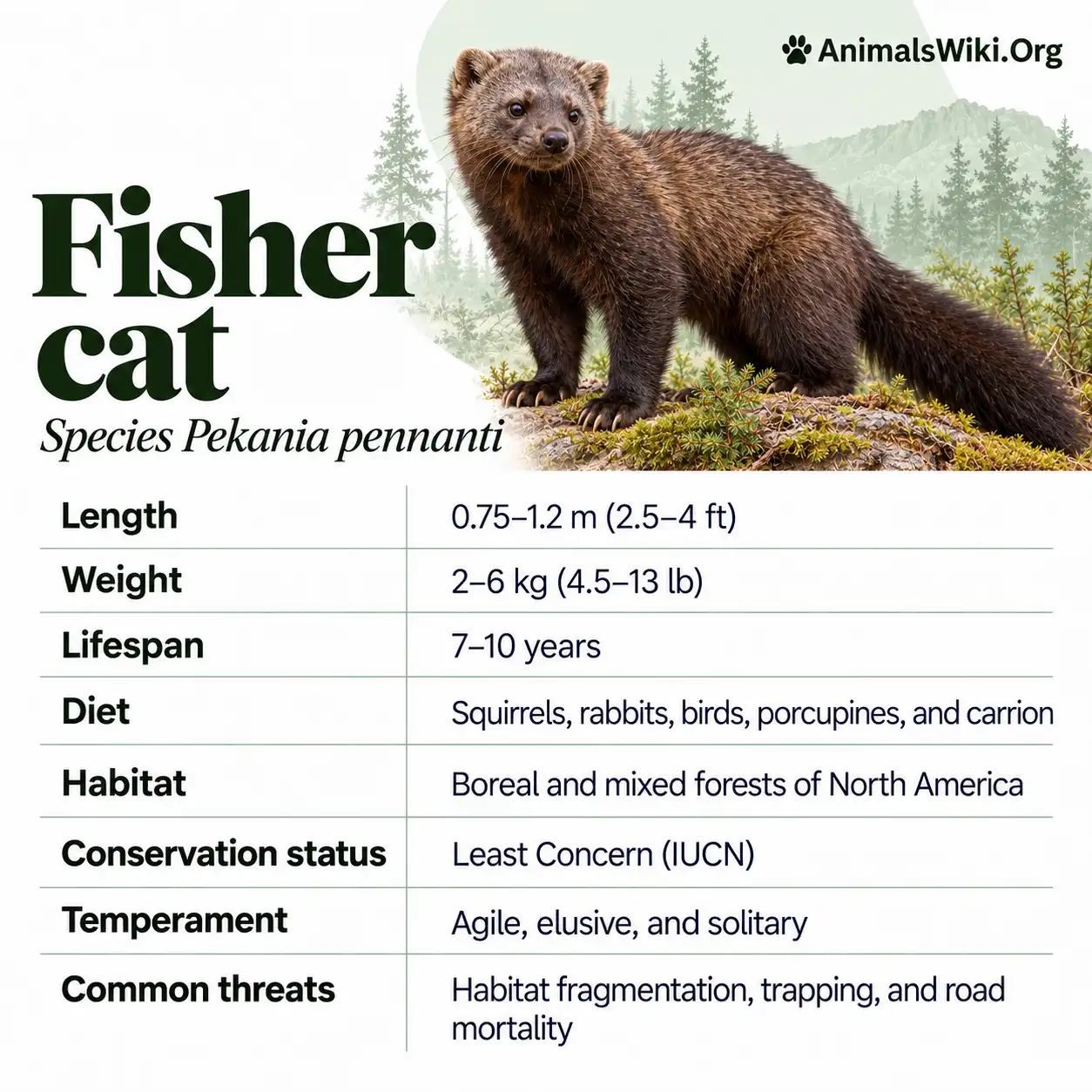
Fisher Cat, The Elusive Forest Hunter of North America
The fisher cat is one of North America’s most misunderstood mammals. Its name suggests a cat that catches fish, yet it belongs to the weasel family and does not depend on fishing. Its reputation includes terrifying nighttime screams, constant attacks on pets and an almost supernatural ability to move through forests unseen.
The real animal is more interesting than those stories.
Properly called the fisher, this forest carnivore has a long body, short legs, a bushy tail and impressive climbing abilities. It searches for small mammals, feeds on a varied seasonal diet and is particularly famous for hunting porcupines.
Fishers also have an unusual reproductive cycle. A long pause in embryo development separates mating from the later stages of pregnancy, allowing females to give birth the following spring.
Their conservation story varies across the continent. Some eastern populations have recovered substantially, while the southern Sierra Nevada population remains endangered and faces serious habitat pressures.
This guide explains fisher cat identification, size, habitat, food, behavior, reproduction and conservation. It also examines the evidence behind familiar claims about screams, porcupines and encounters with people.
Fisher Cat Facts
| Feature | Information |
|---|---|
| Preferred common name | Fisher |
| Popular alternative name | Fisher cat |
| Scientific name | Pekania pennanti |
| Older scientific name | Martes pennanti |
| Animal class | Mammalia |
| Family | Mustelidae |
| Native range | Parts of Canada and the United States |
| Appearance | Long body, short legs, rounded ears and a bushy tail |
| Male size | Generally larger and heavier than females |
| Diet | Small mammals, birds, carrion, fruit and other available foods |
| Hunting location | Primarily on the ground, despite strong climbing ability |
| Social behavior | Mostly solitary |
| Young | Called kits |
| Reproductive feature | Delayed implantation |
| Winter behavior | Active throughout winter |
| Global assessment | Least Concern under the older name Martes pennanti |
| Important regional distinction | Southern Sierra Nevada population federally listed as Endangered |
1. What Is a Fisher Cat?
A fisher cat is a medium-sized North American mammal whose preferred common name is simply fisher.
It belongs to Mustelidae, the family that includes weasels, martens, otters, badgers and wolverines. It is not a wild cat, despite the familiar nickname.
The current scientific name is Pekania pennanti. Older books and research papers often use Martes pennanti, reflecting its former placement with martens.
This classification helps explain its appearance. The elongated body and short legs resemble other members of the weasel family, while its thick coat and substantial tail give it a larger, heavier outline.
The fisher is also a forest predator rather than an aquatic specialist. Its ordinary feeding and movement take place in wooded landscapes, even though it may encounter streams, wetlands and ponds within its range.
Understanding those basic facts clears away much of the confusion created by its name.
2. Why Is It Called a Fisher?
The origin of the name is not completely certain.
A widely accepted explanation connects “fisher” with older European names such as “fitch” or “fiche,” used for the polecat. Early settlers may have applied a similar name to an animal they thought resembled that European mustelid.
Massachusetts wildlife officials describe this as the most likely explanation, while acknowledging uncertainty.
The name should therefore not be interpreted as a description of its main feeding method.
Fish are not a regular dietary foundation, and the fisher is not the forest equivalent of an otter.
The added word “cat” is similarly misleading. It may reflect superficial features such as whiskers, a short muzzle or climbing ability, but it does not identify the animal’s family.
For a wildlife article, using “fisher cat” in the title can help readers find the information they want. Explaining that “fisher” is the accurate common name then keeps the biology clear.
3. Fisher Classification and Relatives
The fisher belongs to the order Carnivora and the family Mustelidae.
Within that family, it is placed in the subfamily Guloninae and the genus Pekania. Its classification separates it from true cats in Felidae and from rodents such as squirrels or porcupines.
| Classification level | Fisher |
|---|---|
| Kingdom | Animalia |
| Phylum | Chordata |
| Class | Mammalia |
| Order | Carnivora |
| Family | Mustelidae |
| Subfamily | Guloninae |
| Genus | Pekania |
| Species | Pekania pennanti |
Scientific names are particularly useful when researching this animal because “fisher” also has an ordinary human meaning.
Searching by Pekania pennanti helps distinguish wildlife research from information about people who fish.
The older name remains useful for finding historical studies. A paper referring to Martes pennanti is generally discussing the same living species, rather than a separate animal.
4. What Does a Fisher Cat Look Like?
Fishers have long, well-furred bodies, short legs and a full tail. Their heads are relatively broad, with pointed muzzles and rounded ears.
The coat is usually dark brown to nearly black. The shoulders and back may look grizzled because individual guard hairs contain different colors.
Some animals have pale patches on the chest or other parts of the underside.
Pennsylvania’s wildlife agency also describes five toes on each foot and curved, semi-retractable claws.
The overall silhouette is often more useful than color alone.
A fisher moving across a trail appears low to the ground, with an extended body and a substantial tail behind it. It does not have the upright, long-legged outline associated with many cats.
Lighting can change its apparent color considerably. An animal that looks black beneath conifers may reveal brown or gray tones in open daylight.
Photographs showing the whole body are therefore especially useful for identification.
5. Fisher Cat Size and Weight
Male and female fishers differ noticeably in size.
New York wildlife information gives representative adult male weights of about 7–15 pounds and female weights of approximately 3–7 pounds. Total lengths are also greater in males.
| Measurement | General pattern |
|---|---|
| Adult male weight | Often about 7–15 pounds |
| Adult female weight | Often about 3–7 pounds |
| Male total length | Roughly 35–47 inches |
| Female total length | Roughly 30–37 inches |
| Tail | A substantial part of total length |
These are regional reference ranges, not limits that every animal must fit.
The thick coat and long tail can make a fisher appear much heavier than it is. A large-looking winter animal may contain considerably more fur than an observer realizes.
Measurements also need consistent definitions. Head-and-body length excludes the tail, while total length includes it.
Comparing one with the other can produce an exaggerated impression of disagreement between sources.
6. Fur and Seasonal Appearance
The fisher’s coat provides insulation and changes its visible outline.
A dense winter coat can make the animal look especially rounded through the body and neck, while the tail appears full and heavy.
Yosemite National Park describes fisher fur as thick, soft and shiny, with coloration ranging through different shades of brown.
Coat condition matters for more than appearance. Insulation helps an animal remain active while searching for food in cold weather.
Seasonal photographs can therefore make two fishers look surprisingly different even when their body sizes are similar.
Age, sex and lighting contribute further variation.
For identification, avoid relying on the assumption that every fisher must be uniformly black. Brown, grayish or grizzled areas are compatible with normal appearance.
It is more useful to combine coat features with body shape, ear size, tail proportions and the animal’s movements.
Those features remain informative even when color is difficult to judge.
7. Claws, Feet and Tree Climbing
Fishers are accomplished climbers.
Their feet and curved claws provide purchase on trunks, branches and rough surfaces. They can also rotate their hind feet, allowing a headfirst descent from trees.
Alaska’s wildlife agency identifies this ability in both fishers and martens.
Headfirst descent is useful because it lets an animal keep its eyes and muzzle directed toward the route below.
Climbing also gives access to resting structures and potential prey locations.
However, climbing ability does not mean a fisher spends its entire life in the canopy. Massachusetts wildlife information emphasizes that most hunting takes place on the ground.
The animal’s physical equipment supports movement through several forest layers.
A fisher may travel across the forest floor, investigate a fallen log and climb a tree within one active period.
That flexibility is more representative than imagining it as either exclusively terrestrial or permanently tree-dwelling.
8. Where Do Fishers Live?
Fishers are native to North America, occurring in parts of Canada and the United States.
Their distribution forms a broad but uneven pattern across forested regions. Some populations are widespread, while others are isolated or have been restored following earlier losses.
NatureServe describes a large northern North American range, with historical contractions partly offset by natural expansion and reintroduction in some areas.
A continental map should not be interpreted as continuous occupation.
Within the broader range, suitable habitat, past exploitation and connections between forests all influence local presence.
The species has also expanded into parts of Southeast Alaska in relatively recent decades, according to Alaska wildlife records.
This is a reminder that distribution is dynamic.
For local questions, recent wildlife-agency records are usually more useful than a simplified map reproduced without a date.
A verified photograph can establish presence, while repeated surveys are needed to describe a population.
9. What Habitat Do Fishers Prefer?
Fishers are associated with forested and partly forested landscapes.
Important features can include overhead cover, downed wood, large trees, sheltered resting places and accessible prey.
A regional analysis of resting-site selection in Pacific coastal forests found associations with dense overhead cover, cooler conditions, logs, large trees and standing dead trees.
These structural features matter because “forest” is a broad category.
Two stands containing the same tree species can differ greatly in the number of cavities, fallen logs or protected resting sites they provide.
Fishers also use different forest types across their range, so no single vegetation description applies everywhere.
Conservation should therefore consider what a forest contains, rather than relying only on whether a map labels it wooded.
A landscape can retain tree cover while losing the particular structures needed for resting or reproduction.
Those fine-scale features can influence whether an area supports more than occasional passage.
10. Do Fishers Need Old-Growth Forest?
The answer depends on the region and the habitat function being considered.
Fishers use forests of different ages in parts of their range. Eastern populations can occupy wooded landscapes that have experienced substantial human alteration.
In western forests, large trees and old structural features can be especially important for shelter and reproduction.
Research in the southern Sierra Nevada highlighted the value of large trees with decay, particularly those providing usable cavities.
The useful distinction is between forest age as a label and the actual features available to an animal.
A younger stand may retain valuable older trees. An older stand may still vary in cavity availability or understory conditions.
Likewise, habitat used while traveling may differ from habitat selected for a natal den.
Protecting fishers requires a combination of landscape access and suitable local structures, rather than one rule that treats every forest and every population identically.
11. Resting Sites and Dens
Fishers use a variety of sheltered places, including tree cavities, hollow logs, branch structures and other protected spaces.
Resting sites should be distinguished from reproductive dens.
A resting animal may use a location temporarily. A female raising young needs shelter suitable for vulnerable kits during repeated absences to obtain food.
A southern Sierra Nevada study documented differences between structures used for resting and those used for reproduction. Large hardwoods were particularly valuable sources of cavities.
This helps explain why the removal of one damaged tree can matter even when many healthy trees remain nearby.
Decay, broken sections and hollows can create features that a smooth, intact trunk lacks.
For wildlife management, the relevant question is not simply whether trees remain, but whether suitable shelter persists across the animal’s range.
For observers, suspected dens should be left undisturbed rather than investigated at close range.
12. Can Fishers Live Near Towns?
Yes. Some fishers use forest patches within suburban and other developed landscapes.
Research near Albany, New York, tracked individuals occupying a gradient of urbanization, including wooded patches surrounded by residential and commercial areas.
This does not mean all development is suitable habitat.
A fisher using a suburban forest still needs cover, food and resting places. It may also encounter roads, pollutants and human-associated food sources.
A sighting near a house can reflect ordinary movement through remaining habitat rather than an animal abandoning the forest.
The important distinction is between adaptation and absence of risk.
An animal may use a landscape successfully in some respects while facing hazards elsewhere within it.
Maintaining connected woodland patches and reducing unnecessary attractants can help separate routine wildlife presence from avoidable conflict.
Observing a fisher near town should prompt accurate identification and sensible precautions, rather than an assumption that the animal is unusually aggressive.
13. What Do Fisher Cats Eat?
Fishers have varied diets.
Recorded foods include small mammals, squirrels, hares, birds, carrion, fruit and fungi. The importance of particular foods changes among regions and seasons.
A U.S. Forest Service review summarizes this broad feeding pattern and the variation documented in diet studies.
| Food group | Examples |
|---|---|
| Small mammals | Mice, voles and shrews |
| Other mammals | Squirrels, rabbits and snowshoe hares |
| Defensive prey | Porcupines |
| Birds | Locally available species |
| Carrion | Remains of larger animals |
| Plant foods | Fruit and berries |
| Other foods | Fungi, insects and occasional additional items |
The fisher belongs to Carnivora, but that classification does not mean it eats meat exclusively.
Its feeding flexibility allows it to exploit different resources as opportunities change.
Nevertheless, a food list does not establish the importance of every item. An occasional record should be separated from foods that repeatedly support a population.
14. How Fishers Find and Capture Food
Fishers search through forest-floor cover, investigate likely prey locations and pursue animals they can catch.
Their movements can change with the distribution of food.
A detailed Forest Service account describes zigzag searching within productive prey patches and straighter travel between them. It also records food caching when an item cannot be eaten immediately.
This creates a practical distinction between searching and traveling.
An animal moving quickly along a trail may be heading toward another feeding area, while one repeatedly turning around logs may be investigating local opportunities.
Capture methods also vary with prey size.
The fisher’s agility and forefeet assist handling, while the jaws and teeth deliver the final capture or killing bite.
Its success comes from matching behavior to the target rather than applying one technique to every animal.
For observers, a brief camera-trap sequence reveals only part of that process. Passing through a camera’s view does not establish whether the animal was hunting at that exact moment.
15. How Fishers Hunt Porcupines
Fishers are among the predators best known for regularly attacking North American porcupines.
The porcupine’s defensive quills make this a difficult task. Successful hunting depends on avoiding the most heavily protected surfaces and repeatedly attacking vulnerable areas.
A Forest Service account describes repeated attacks directed at the face.
This is more accurate than the popular image of a fisher casually flipping every porcupine onto its back.
The encounter can involve movement, persistence and repeated opportunities rather than one effortless maneuver.
Fishers are also not immune to quills. Their ability reduces some risks through behavior, but it does not transform sharp defensive structures into harmless objects.
Porcupine hunting is an important part of the species’ reputation, yet its dietary importance varies.
A fisher living where small mammals or hares are abundant may obtain much of its food elsewhere.
Specialized capability and everyday dietary dependence are different questions.
16. Diet Changes Between Regions and Sexes
Fishers do not eat an identical menu throughout North America.
Research in southern Oregon found differences associated with sex and female reproductive condition. Females raising kits showed greater use of some relatively substantial prey compared with females without kits.
On Washington’s Olympic Peninsula, a study of reintroduced fishers found diets dominated by mammals, especially snowshoe hares, with other local prey also represented.
These findings illustrate why one regional diet chart should not become a universal description.
Prey availability, body size and reproductive demands can influence what is profitable to catch.
Methods also matter. The percentage of scats containing a food item is not automatically the percentage of dietary energy supplied by that food.
Reliable interpretation asks what was sampled, how remains were identified and whether the result describes frequency, biomass or another measure.
That context turns a food list into a more useful ecological explanation.
17. Do Fishers Catch Fish?
Fish are not a regular foundation of fisher diets.
The animal’s name is misleading, and its ordinary feeding ecology differs strongly from that of river otters.
Pennsylvania’s wildlife agency notes that fishers rarely consume fish or other aquatic prey.
“Rarely” is a more useful word than “never.”
An opportunistic mammal may encounter food outside its typical diet, including carrion or seasonally available resources.
The important point is that the species is adapted primarily to forest foraging rather than sustained underwater pursuit.
A fisher beside a stream has not necessarily been fishing. Waterways can occur along travel routes and within otherwise suitable woodland.
Similarly, a photograph of an animal carrying a fish should be carefully identified before using it as evidence of normal fisher behavior.
River otters, mink and fishers can be confused in incomplete images, especially when the tail and body proportions are hidden.
18. Are Fishers Nocturnal?
Fishers can be active during the day or night.
They are often observed around dawn and dusk, but a daytime appearance is not automatically unusual.
Studies of activity show that patterns can vary with weather, sex and the time scale being examined.
Winter research in Wisconsin found that temperature and wind affected activity differently across daily and shorter behavioral scales.
This is more informative than assigning one rigid schedule to every fisher.
An individual may alternate active and resting periods as it searches for food and moves through its range.
For wildlife watching, local evidence is useful. Repeated camera records can reveal when an animal tends to pass a particular route.
However, a camera records activity at one place, not every activity throughout the animal’s day.
A fisher absent from the frame may be resting, hunting elsewhere or moving along a different route.
19. What Do Fishers Do in Winter?
Fishers remain active through winter rather than hibernating.
Their coat provides insulation, but snow conditions can influence movement and access to food.
Research in Manitoba found that deep, soft snow restricted fisher movements during parts of winter.
Snow depth alone does not describe the entire problem. Firm crust, fresh powder and previously packed routes create different travel conditions.
A surface that supports an animal’s weight can be easier to cross than equally deep snow into which it sinks.
Winter also changes the availability of shelter and prey.
Fishers must continue balancing energy expenditure with food intake rather than simply waiting for spring.
Their tracks can become easier for people to detect during this season, even when direct sightings remain uncommon.
Those tracks show a route taken under particular conditions. They should not be assumed to represent the animal’s complete range or preferred route throughout the year.
20. Are Fishers Solitary or Territorial?
Fishers generally lead solitary lives outside breeding and maternal care.
A female with kits is an obvious exception, while adult encounters occur during the breeding period.
Solitary living does not mean individuals lack relationships with neighbors. Scent and repeated use of space can help structure their interactions.
New York wildlife information describes larger home ranges in males and limited overlap among some male ranges, consistent with territorial behavior.
However, “home range” and “territory” should not be treated as interchangeable.
A home range describes an area repeatedly used. A territory adds some degree of defense or exclusion.
The exact arrangement can depend on sex, habitat and available resources.
For an observer, seeing two animals together does not establish permanent pair living.
They could be interacting during breeding or represent a mother and young. Context is necessary before assigning a social relationship.
21. Fisher Sounds and the Screaming Myth
The claim that fishers routinely produce a human-like scream before killing prey is unsupported.
Wildlife agencies describe fishers as generally quiet, with low growls, grunts or chatter among their reported sounds.
There is some difference in agency wording about whether rare stressed animals can scream. Massachusetts allows for that possibility, while New York emphasizes the lack of a documented characteristic screaming call.
Both accounts reject the familiar story of a routine hunting scream.
A strange nighttime sound should therefore not be identified as a fisher solely because it is frightening.
Foxes, owls and other mammals can produce surprising calls.
Good identification requires a reliable recording, context and, ideally, a confirmed view of the caller.
This is an example of why “fisher cat sound” searches can spread confusion: an uncertain recording receives a confident label, and later listeners repeat the identification.
22. Scent Communication
Like other mustelids, fishers possess scent glands that contribute to communication.
Scent can carry information without requiring two animals to meet at the same time.
New York wildlife information identifies anal scent glands in both sexes and discusses their possible roles in territorial or reproductive communication.
A scent-marked object can remain informative after the animal has left, which is useful for a species that spends much of its time alone.
However, the message should not be oversimplified.
A deposit on a log is not necessarily a precise boundary marker, and every act of defecation need not have the same social function.
Interpreting communication requires observations of where marking occurs, which animals participate and how others respond.
For field observers, the presence of scent marks or droppings is evidence of use.
It does not reveal the number of fishers nearby or prove that the animal remains close at that moment.
23. Home Ranges and Forest Connections
Fishers need access to multiple resources distributed across a landscape.
Their home ranges include feeding locations, resting structures and, for breeding females, suitable dens.
Male ranges are generally larger, although size varies with habitat and study area.
Yosemite’s account describes this difference in the Sierra Nevada and links male movement with access to females during breeding.
The conservation significance is straightforward: one good den tree does not supply an entire living area.
An animal must also reach food and other shelter safely.
Connected woodland can help maintain those routes, while broad openings or heavily developed barriers may reduce movement options.
Researchers studying fishers near Albany also found substantial individual variation in movement and activity.
This cautions against assuming that every fisher uses the same route length or responds identically to development.
Conservation planning benefits from tracking actual movement rather than estimating needs from body size alone.
24. Fisher Reproduction and Delayed Implantation
Fishers have a reproductive strategy called delayed implantation.
After mating and fertilization, the early embryo pauses before implanting and entering the later period of active development.
As a result, mating and birth can be separated by nearly a year, even though active gestation is much shorter.
Alaska’s wildlife agency describes this process and notes that females commonly mate again shortly after giving birth.
This explains an apparent contradiction in wildlife accounts.
A description of an approximately year-long reproductive interval and another describing active development of roughly several weeks may be referring to different stages.
It is also important not to confuse reproductive capability with successful breeding.
A female may reach sexual maturity before producing her first surviving litter.
Pregnancy, birth and recruitment of independent young are separate outcomes, each of which matters when assessing population growth.
25. Baby Fishers and Maternal Care
Baby fishers are called kits.
Litters commonly contain a few young, although broader reported ranges extend from one to six.
The kits are born dependent, with closed eyes, and require protection and care in a den.
Yosemite’s account describes eyes opening at approximately six to eight weeks and weaning around eight to ten weeks in its regional summary.
These developmental ages are useful guides rather than an exact timetable for every individual.
Maternal care involves more than nursing. The female must obtain food while maintaining access to secure shelter.
Some females move kits between den sites as the season progresses.
The U.S. Fish and Wildlife Service describes the use of multiple structures during the rearing period in the southern Sierra Nevada.
This makes a network of suitable shelters valuable.
Protecting only the first known den may leave later needs unmet.
26. Independence and Dispersal
As kits grow, they become more mobile and increasingly capable of obtaining food.
Physical development and independence are not identical milestones.
A youngster may approach adult length before it has established its own living area.
Regional accounts describe young dispersing during later parts of their first year, with variation in timing and distance.
The U.S. Fish and Wildlife Service notes that male fishers generally disperse farther than females in its southern Sierra Nevada account.
Dispersal connects family success with landscape conditions.
Producing kits is only one stage. Those animals must survive movement, find suitable habitat and eventually obtain reproductive opportunities.
A protected breeding site can therefore contribute to recovery while still depending on conditions beyond its immediate boundaries.
This is why road risks, habitat connections and the availability of additional resting sites matter for the next generation as well as established adults.
27. Fisher Lifespan
Fishers can live for approximately a decade, although many wild individuals do not reach that age.
The U.S. Fish and Wildlife Service describes a lifespan of about ten years, while New York monitoring has documented an individual older than eleven years among sampled animals.
These figures should not be presented as a single universal average.
Maximum age, average age at death and survival after reaching adulthood answer different questions.
A young animal faces risks associated with development and dispersal, while an established adult may have different prospects.
Monitoring methods also influence what is known.
Some ages come from examined teeth, while other records follow marked animals.
A useful lifespan statement identifies the type of evidence rather than treating every number as interchangeable.
For readers, “can live around a decade or longer” is often more accurate than claiming that all fishers normally survive to one precise age.
28. What Animals Prey on Fishers?
Fishers can be killed by larger carnivores.
Research in California used carcass examinations and DNA evidence to identify bobcats, mountain lions and coyotes among the responsible predators.
The study also found differences associated with the fisher’s sex and the predator involved.
These results are more useful than a generic statement that fishers have no enemies because they are aggressive.
Their hunting ability does not eliminate vulnerability.
Smaller females and larger males may encounter different risks, and a fisher traveling on the ground faces different circumstances from one resting in a protected cavity.
The study’s mortality proportions also should not be read as the percentage of every fisher population killed each year.
They describe the examined carcasses and monitored circumstances.
That distinction matters whenever researchers investigate causes of death in a selected sample rather than counting all living animals.
29. Ecological Importance of Fishers
Fishers participate in forest food webs as predators, scavengers and consumers of plant foods.
Their diet connects them with rodents, hares, birds and other forest organisms.
Eating carrion also allows them to use energy remaining after the death of larger animals.
Pennsylvania’s wildlife agency notes that fruit consumption can contribute to seed dispersal.
The magnitude of these effects varies locally.
It is reasonable to describe fishers as ecologically important without assuming they control every prey population or automatically improve every forest.
Porcupine predation can matter in some systems, while other foods may dominate elsewhere.
Ecological relationships depend on predator density, prey abundance and interactions with other species.
A fuller picture recognizes the fisher as one participant in a changing community.
Its value does not depend on proving that every individual provides an immediate economic benefit to people.
30. Fisher Conservation Status
The fisher’s global and regional conservation statuses differ.
The IUCN assessment published under Martes pennanti lists the species as Least Concern and notes the importance of recovery through protection and reintroduction.
That assessment is older and flagged as needing an update.
In contrast, the southern Sierra Nevada Distinct Population Segment was federally listed as Endangered in 2020.
These statements are compatible because they apply at different scales.
A widespread species can include a small, isolated population facing substantial risk.
Likewise, recovery in parts of the Northeast does not establish that western populations are secure.
Accurate writing should identify the geographic population whenever discussing endangered status.
The practical goal is to maintain viable populations across their landscapes, while giving additional attention to places where isolation, habitat loss or mortality create particular problems.
31. Historical Decline and Eastern Recovery
Unregulated trapping and forest loss contributed to major historical fisher declines.
In several eastern regions, protection, forest recovery and management helped the animal return.
New Hampshire’s wildlife account explains that its population rebounded from remnant animals after protection, rather than through the often-repeated story of an introduction solely to control porcupines.
This illustrates why local conservation history matters.
A species may recover naturally in one state while requiring reintroduction elsewhere.
Historical recovery also does not mean the same management approach should remain unchanged indefinitely.
Populations and threats can shift, making continued monitoring necessary.
The broader lesson is that an elusive predator can return when conditions improve, even if people rarely observe the process directly.
Tracks, verified photographs and structured surveys often reveal recovery more clearly than casual sightings alone.
32. Fisher Reintroduction in Washington
Washington provides an important example of active fisher restoration.
After historical extirpation, agencies and partners moved fishers from Canadian populations into suitable parts of the state.
A National Park Service final report documents the translocation of 170 fishers into the North and South Cascades between 2015 and 2020, followed by monitoring.
Reproduction was recorded in both recovery areas within two years of release.
Those are encouraging results, but release numbers are not the same as a long-term population count.
Monitoring must examine survival, establishment of home ranges and continued reproduction.
The report also documented different survival outcomes between areas, emphasizing that restoration success is not uniform.
Such projects involve health assessment, transport, release planning and follow-up research.
Returning a species is a process whose value is measured through persistent wild populations, rather than the release event alone.
33. Rodenticide Exposure and Poisoning
Anticoagulant rodenticides are an important concern for fisher conservation.
Exposure can occur when predators or scavengers encounter contaminated food.
California research documented widespread exposure among examined fisher carcasses and confirmed deaths directly attributed to rodenticide poisoning.
The study also recorded transfer to a dependent kit.
This problem is not limited to one western population.
A northeastern research project tested hundreds of fisher liver samples and found exposure to one or more anticoagulant compounds in a large proportion of them.
Exposure and confirmed poisoning should still be distinguished.
Detecting a compound shows contact with the toxicant, while determining its contribution to death requires additional evidence.
For communities, the ecological implication is that rodent management can affect animals beyond the intended target.
Reducing rodent access to buildings and food sources can address the underlying problem while limiting unnecessary exposure pathways.
34. Wildfire, Drought and Habitat Change
Severe environmental change can affect fisher habitat, especially in vulnerable western populations.
A 2025 study estimated that suitable female fisher habitat in the southern Sierra Nevada declined by approximately 48% between 2012 and 2022, during widespread drought-related tree mortality and wildfire.
That is a habitat-model result for a defined population and period, not a direct count showing that exactly the same percentage of fishers died.
The distinction matters.
Habitat loss can influence future shelter, prey access and reproduction even where animals survive the immediate disturbance.
Other research found that survival responses to environmental conditions differed with age and sex.
Conservation therefore benefits from retaining refuges and habitat diversity while monitoring actual population outcomes.
A landscape containing a mixture of usable conditions may offer more options than one in which all suitable shelter is exposed to the same severe event.
35. Fishers, Pets and Backyard Poultry
Fishers are capable predators and can take domestic animals, including poultry and cats.
However, capability should not be confused with evidence that they routinely cause most local pet disappearances.
New Hampshire’s diet information reports cat hair in only one of more than a thousand examined fisher stomachs from a historical study. That result provides context rather than a guarantee of zero risk.
Practical precautions include:
- Keep cats indoors.
- Supervise small pets outside.
- Secure poultry and rabbits in sturdy enclosures.
- Remove outdoor pet food.
- Keep garbage inaccessible.
- Reduce spilled seed that attracts small mammals.
Massachusetts wildlife guidance recommends securing pets and poultry and managing food attractants.
A fisher passing through a yard is not necessarily targeting a pet.
Respond to actual conditions rather than frightening stories, while maintaining protections that also reduce risks from other predators.
36. Fisher Tracks and Wildlife Watching
Fishers can be difficult to see, but tracks and camera images provide evidence of their presence.
Tracks may show five toes, although the smallest toe does not always register clearly.
Snow quality and foot fur can blur details, so one print may be insufficient for identification.
Look at the sequence of tracks, the habitat and any nearby evidence rather than relying only on apparent footprint size.
New York wildlife information describes fisher tracks and common bounding patterns, while emphasizing that track appearance varies with conditions.
For direct observation, remain quiet and allow the animal to continue moving.
Do not approach a den, feed the animal or pursue it for a photograph.
A clear, distant image showing the whole body is usually more useful than a close, blurry frame obtained by rushing toward it.
The best encounter provides information while leaving the animal’s ordinary behavior undisturbed.
37. Fisher vs Marten, Mink and River Otter
Several mustelids can be confused in brief sightings.
| Animal | Helpful identification clues |
|---|---|
| Fisher | Substantial body, dark coat, bushy tail and rounded ears |
| Marten | Generally smaller, often with more conspicuous throat coloration |
| Mink | Usually smaller and frequently associated with water |
| River otter | Sleeker aquatic body and a muscular, tapered tail |
| Domestic cat | Different body proportions and a more distinctly feline outline |
The American Society of Mammalogists describes fishers as larger and less arboreal than martens.
No single feature is perfect.
A wet fisher can look sleeker, a large mink can appear substantial without a scale reference, and a partial photograph may conceal the tail.
Location also helps but should not decide the identification alone.
A forest animal can cross a stream, and an aquatic species can travel on land.
Use the combined evidence of proportions, coat, movement and setting.
38. Common Fisher Cat Myths
| Popular claim | More accurate explanation |
|---|---|
| A fisher cat is a wild cat | It belongs to the weasel family |
| Fish are its main food | Its diet is primarily associated with forest foods |
| It screams before every kill | The routine hunting-scream claim is unsupported |
| It cannot be harmed by porcupine quills | Successful hunting depends on behavior, not immunity |
| It lives only in trees | Much hunting occurs on the ground |
| It hibernates | It remains active in winter |
| Every fisher is endangered | Status differs between the species and particular populations |
| Every pet disappearance indicates a fisher | Identification and evidence are needed |
| Seeing a fisher in daylight is abnormal | Daytime activity occurs |
| Reintroduction success ends at release | Long-term survival and reproduction require monitoring |
The real fisher is a capable forest carnivore with flexible behavior and an unusual reproductive cycle.
Its biology provides a stronger explanation than stories that turn an elusive animal into a monster.
39. Frequently Asked Questions About Fisher Cats
Is a fisher cat actually a cat?
No. The fisher belongs to Mustelidae, the weasel family. Its feline nickname does not reflect its classification. Its long body, short legs and relationship to martens and other mustelids provide a more accurate picture.
What is the correct name for a fisher cat?
The preferred common name is fisher. “Fisher cat” remains widely used, particularly in online searches and informal conversation. Both names generally refer to Pekania pennanti, rather than two different animals.
What is the fisher’s scientific name?
The current scientific name is Pekania pennanti. Older sources often use Martes pennanti. That older name remains useful when searching historical research or the published IUCN assessment.
Why is it called a fisher if it does not fish?
The name is commonly linked to older European names for the polecat, which early settlers may have thought it resembled. The origin is not completely certain. It should not be interpreted as evidence of a fish-based diet.
How big is a fisher cat?
Adult males are generally larger than females. Regional reference ranges commonly place males around 7–15 pounds and females around 3–7 pounds. Their fur and long tails can make them appear substantially heavier.
What color are fishers?
They are generally dark brown to nearly black, sometimes with grizzled shoulders or pale underside patches. Light, age and coat condition change their appearance. A fisher does not need to look uniformly black to be correctly identified.
Where do fishers live?
They inhabit parts of Canada and the United States, mainly in forested or partly forested landscapes. Local distribution varies. Some populations persisted naturally, while others were restored after historical losses.
Do fishers live in cities?
Some use wooded patches within developed landscapes. This does not mean they can live without forest resources. Their presence near buildings may reflect movement through remaining cover or access to food nearby.
What do fisher cats eat?
Their diet includes small mammals, squirrels, hares, birds, carrion, fruit and other available foods. Porcupines are a famous prey item, but they do not dominate every population’s diet.
Do fishers eat fish?
Fish are not a regular dietary foundation. Occasional consumption should be distinguished from normal specialization. Fishers are primarily forest foragers, while otters are much more strongly adapted to aquatic hunting.
Can fishers kill porcupines?
Yes. Fishers are known for repeatedly attacking vulnerable areas, especially the face. This ability does not make them immune to quills, and porcupine encounters are not always effortless or risk-free.
Do fishers climb trees?
Yes. They have strong climbing abilities and can descend headfirst by rotating their hind feet. Nevertheless, much of their hunting occurs on the ground rather than in the canopy.
Do fisher cats scream?
They are generally quiet animals. Reports of routine, human-like hunting screams are unsupported. Agency accounts differ about rare stressed vocalizations, but they agree that frightening nighttime sounds are frequently misidentified.
What sounds do fishers make?
Reported sounds include low growls, grunts and chatter. Reliable identification requires a confirmed caller or good contextual evidence. An unsettling recording without a visible animal is not enough to establish a fisher.
Are fishers nocturnal?
They can be active during daylight or darkness, often with activity around dawn and dusk. Weather and local conditions influence their schedules. A daytime sighting is not automatically abnormal.
Do fishers hibernate?
No. They remain active through winter. Snow conditions can affect movement, but the animal continues searching for food rather than entering a seasonal hibernation.
Are fishers dangerous to people?
They are wild predators and should be given space. Human attacks are uncommon. Avoid approaching, feeding or cornering them, and leave an escape route rather than trying to force a close encounter.
Do fishers eat cats?
They are capable of doing so, but available diet evidence does not support every claim that they routinely cause pet disappearances. Keeping cats indoors protects them from multiple hazards, regardless of which predators occur nearby.
Will a fisher attack chickens?
Fishers can take poultry if they gain access. Secure buildings and well-maintained enclosures are important. Preventing entry is more dependable than assuming a predator will ignore accessible birds.
What are baby fishers called?
Baby fishers are called kits. They are born dependent and require maternal care. Leaving the den and becoming fully independent are separate stages of development.
How many kits does a fisher have?
Litters commonly contain two or three kits, although broader reported ranges extend from one to six. Litter size varies, and a maximum should not be presented as the normal number.
What is delayed implantation?
It is a pause in early embryo development before implantation. It separates mating from the later period of active pregnancy, producing a long mating-to-birth interval without continuous fetal growth throughout that time.
How long do fishers live?
They can live around a decade or longer, although many wild animals die younger. Average lifespan and maximum recorded age are different measurements and should not be combined into one supposedly universal number.
Are fishers endangered?
The global IUCN assessment lists the species as Least Concern under Martes pennanti. The southern Sierra Nevada population is federally listed as Endangered. Status statements need to specify the population and geographic scale.
What should I do if I see a fisher?
Observe quietly from a distance, keep pets under control and avoid feeding it. Photograph the whole animal if possible without approaching. Report sightings where local wildlife agencies request them, especially in restoration areas.



